Febrile neutropenia (FN) is among the most common complications of cancer therapy; it is a major driver of antibiotic exposure in individuals with cancer.Reference Caggiano, Weiss, Rickert and Linde-Zwirble 1 Guidelines support the reduction of avoidable antibiotic exposure in patients with FN.Reference Freifeld, Bow and Sepkowitz 2 – Reference Averbuch, Orasch and Cordonnier 4 Recognition of morbidity due to antibiotic-resistant infections and disturbance of gut flora has highlighted the need for antimicrobial stewardship (AS) in oncology and hematopoietic stem cell transplantation (HSCT) settings.Reference Averbuch, Orasch and Cordonnier 4 – Reference Taur, Jenq and Perales 6
There is interest among AS practitioners in optimizing antimicrobial use in oncology and HSCT settings, but several barriers have been identified.Reference Wolf, Sun and Tang 7 , Reference Seo, Lo and Abbo 8 Although facility-specific FN guidelines are recommended, few studies have evaluated outcomes of guideline implementation in oncology and/or HSCT settings.Reference Barlam, Cosgrove and Abbo 9 – Reference Vicente, Al Nahedh, Parsad, Knoebel, Pisano and Pettit 13
We report the outcomes of a multistep intervention to reduce routine use of antibiotics commonly used as second gram-negative agents for treating FN at our institution. Current FN guidelines recommend first-line monotherapy with an antipseudomonal β-lactam antibiotic, with addition of a second gram-negative agent only for clinically unstable patients.Reference Freifeld, Bow and Sepkowitz 2 , Reference Lehrnbecher, Phillips and Alexander 3 This recommendation is based on evidence showing equivalent efficacy, with greater toxicity associated with combination therapy.Reference Furno, Bucaneve and Del Favero 14 , Reference Paul, Soares-Weiser and Leibovici 15
METHODS
Design
Interrupted time series analysis was used to evaluate antibiotic use changes from the baseline phase (October 2011 to August 2013) through 2 intervention phases: phase 1, September 2013 to June 2015 and phase 2, July 2015 to June 2016.Reference Wagner, Soumerai, Zhang and Ross-Degnan 16 We hypothesized that use of the target antibiotics tobramycin and ciprofloxacin, which were primarily used as second gram-negative agents for FN, would decrease in association with one or both intervention phases. Although the goal of the interventions was to reduce combination therapy, during the baseline period there was no electronic medication administration record (MAR) at our institution from which to determine use of combination therapy. Thus, the use of the 2 drugs used most commonly as the second gram-negative agents for FN were treated as proxy measures for use of combination therapy. As an evaluation of a quality improvement program, the study was exempt from the approval of our institutional review board.
Setting
Benioff Children’s Hospital San Francisco is an academic referral hospital with separate oncology and HSCT services on the same hospital floor. Three oncology physicians also attend on the HSCT service. Oncology fellows and pediatric residents rotate on both services. The hospital initiated a pediatric antimicrobial stewardship program (ASP) in July 2015; previously, a systemwide ASP had focused on adult services.
Intervention Phase 1
At baseline, both services used combination therapy with an antipseudomonal β-lactam and a second gram-negative agent (usually tobramycin, with ciprofloxacin an alternative) for patients with high-risk FN, defined based on established criteria.Reference Alexander, Wade, Hibberd and Parsons 17 Separate guidelines were used by each service. Between November 2012 and August 2013, the oncology service guideline was changed according to published pediatric FN guidelines recommending the addition of tobramycin or ciprofloxacin only for clinically unstable patients.Reference Lehrnbecher, Phillips and Alexander 3 The collaborative update was led by a pediatric resident (E.R.L.), an infectious diseases fellow (R.L.W.), and oncology and infectious diseases faculty. Proposed changes were discussed in oncology service conferences. The updated guideline was distributed via the service handbook after approval in August 2013. Educational conferences about the guideline were provided to residents. Between September 2013 and April 2015, no other active intervention was undertaken.
Intervention Phase 2
The second intervention phase consisted of multiple components phased in over time, with the evaluation phase designated to start in July 2015 coinciding with the start of a pediatric ASP and allowing time for antibiotic use metrics on the HSCT service to reflect the adoption of new guideline changes. The HSCT service had deferred adoption of the change to routine monotherapy until April 2015, when a guideline update was initiated by an infectious diseases fellow (R.L.W.) and an HSCT faculty member (C.C.D.). Evidence was presented for monotherapy versus combination therapy, local epidemiology, and antibiotic susceptibility of bloodstream infections on the service. Preliminary data were provided following the oncology service guideline change. This guideline change also made ciprofloxacin the preferred second gram-negative agent when indicated. At this time, many providers had already shifted to preferential use of ciprofloxacin due to concerns about nephrotoxicity from tobramycin, though the change had not been formalized in the service guidelines.
In July 2015, a pediatric ASP was formed, led by an infectious diseases physician (R.L.W.), and subsequently an infectious diseases pharmacist. The physician focused on education, policy, and guideline development, and the pharmacist initiated a prospective audit and feedback system starting in October 2015. During ASP initiation in July 2015, changes in antibiotic use and clinical outcomes before and after the 2013 guideline change were reviewed with the oncology service. Barriers and facilitators to guideline adherence were discussed, and further guideline updates were proposed. An ASP teaching conference started for oncology fellows in August 2015 and continues to date. Prospective audit and feedback on inpatient antibiotics started in October 2015 and continues to date. Further guideline changes were reviewed in conferences with both services, with follow-up discussions with designated service champions (A.J.S. for oncology service and C.C.D. for HSCT service). These reviews ultimately led to a combined clinical pathway for both services in March 2016.
Data Sources
Antibiotic use was calculated by month from October 2011 (23 months before intervention phase 1) through June 2016 (12 months after the start of intervention phase 2) using data from the University HealthSystem Consortium Clinical Database-Resource Manager (CDB-RM). Reports were restricted to patients aged 0–17 years on the Medical Oncology and Bone Marrow Transplant service lines. Days of therapy (DOT) were determined for each target antibiotic using established methods, and these data were normalized to patient census in 1,000 patient days.Reference MacDougall and Polk 18 Our institution did not have an electronic MAR until the latter part of the baseline period; however, antimicrobial DOT calculated from the CDB-RM have previously been shown to correlate well with hospital MAR data from another institution.Reference Bartholomew, Aftandilian and Andrews 19 Data on clinical outcomes and tobramycin drug monitoring were obtained from the CDB-RM. Hospital-onset C. difficile infection rates were calculated using institutional infection surveillance data. Antibiotic susceptibility data were obtained from the institutional microbiology laboratory.
Statistical Analysis
Segmented regression of an interrupted time series evaluates whether changes in amount or rate of change of a parameter are associated with the timing of interventions. Initial models for each target antibiotic were fitted using segmented linear regression with variables to account for the baseline slope, and for each intervention phase, the level change (ie, the difference in amount of antibiotic use immediately following intervention, ie, at the beginning of the designated post-intervention segment) and slope change (ie the difference in rate of change in antibiotic use following intervention).Reference Wagner, Soumerai, Zhang and Ross-Degnan 16 Linear models were tested for violations of linearity, normality, and constant variance assumptions. Due to departures from these assumptions, Poisson and negative binomial models were evaluated treating tobramycin and ciprofloxacin use as count outcomes, using days of therapy (DOT) as the outcome and patient days as the exposure term. Negative binomial models were chosen over Poisson models due to the large variance in proportion to the mean. Robust standard error estimates were used. Differences between projected antibiotic use from baseline and modeled use following interventions were calculated via postestimation from the base models.Reference Wagner, Soumerai, Zhang and Ross-Degnan 16 Fisher’s exact test was used to compare frequency-based clinical outcomes across study phases.
RESULTS
Oncology Service: Tobramycin Use
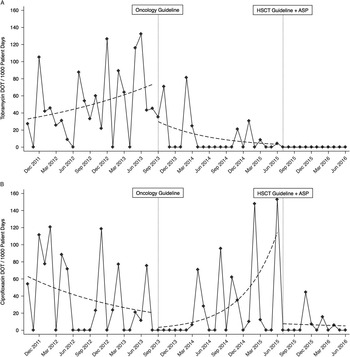
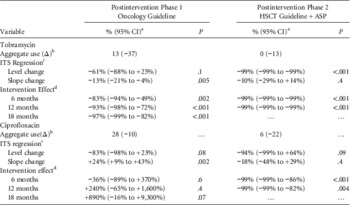
Figure 1 shows actual values of tobramycin use on the oncology service, plotted with fitted values based on the segmented regression model. The segmented regression model for tobramycin use (Table 1) showed that the oncology guideline (phase 1) was associated with a statistically significant change in slope, but not in level, resulting in a decreasing slope following guideline change (10% decrease in each subsequent month; 95% CI, −17% to −2%; P=.005). This corresponded to statistically significant reductions from projected tobramycin use, with differences sustained at 6, 12, and 18 months after intervention phase 1.
Target antibiotic use on the oncology service. (A) Tobramycin use, with actual values (connected diamonds) in days of therapy (DOT) per 1,000 patient days plotted over the baseline period (October 2011–August 2013), postintervention phase 1 (September 2013–June 2015, following the oncology guideline change), and postintervention phase 2 (July 2015–June 2016, following the hematopoietic stem cell transplant [HSCT] service guideline change and antimicrobial stewardship program [ASP] implementation). The dashed line shows fitted values from segmented negative binomial regression model. (B) Ciprofloxacin use over the same period, with actual values represented by connected diamonds and a dashed line showing fitted values from segmented negative binomial regression model. Note the lack of ciprofloxacin use during the initial 5 months postintervention phase 1, with subsequent increasing slope.

Oncology Service Postintervention Target Antibiotic Use

NOTE. HSCT, hematopoietic stem cell transplantation.
a Unless otherwise indicated.
b Aggregate use for time period in days of therapy (DOT) per 1,000 patient days, with Δ equal to absolute change from prior period.
c Derived from interrupted time series with segmented negative binomial regression models; percentage changes derived from incidence rate ratio, regression models also adjusted for baseline slope.
d Intervention effects calculated by postestimation from segmented regression models, figures represent difference between projected use in the absence of intervention vs modeled use postintervention.
The HSCT guideline change and ASP (phase 2) were associated with a statistically significant change in level, but not in slope of tobramycin use. Statistically significant differences between projected and modeled use (Table 1) were also seen following phase 2. Monitoring of tobramycin levels also decreased with 30 tests per 100 hospitalizations at baseline, 0.06 tests per 100 hospitalizations following phase 1, and no tests following phase 2.
Oncology Service: Ciprofloxacin Use
Figure 1 shows actual values of ciprofloxacin use, plotted with fitted values from the segmented regression model. According to the segmented regression model for ciprofloxacin use (Table 1) the oncology guideline (phase 1) was not associated with a statistically significant change in level of use. However, there was no ciprofloxacin use during the 5 months following the guideline change. There was a statistically significant change in slope, resulting in an increasing slope following phase 1, and there was a trend toward higher than projected use at 18 months postintervention.
The HSCT guideline and ASP (phase 2) were not associated with statistically significant changes in level or slope for ciprofloxacin use (Table 1). However, modeled ciprofloxacin use 6 months postintervention was 99% lower than projected (95% CI, −99% to −86%; P<.001); this difference was maintained at 12 months postintervention.
HSCT Service – Tobramycin Use
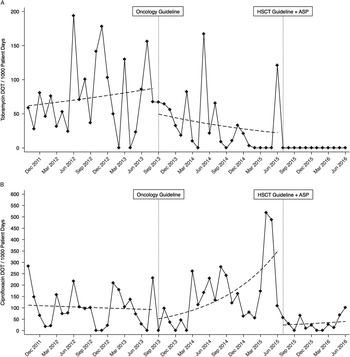
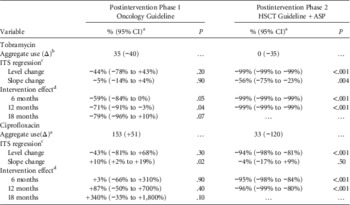
Figure 2 shows actual values of tobramycin use on the HSCT service, plotted with fitted values based on the segmented regression model. Modeling of tobramycin use on the HSCT service (Table 2) showed that the oncology guideline change (phase 1) was not associated with statistically significant changes in level or slope. However, tobramycin use at 12 months postintervention was 71% lower than projected (95% CI, −91% to −3%; P=.04) and there were trends toward lower use at 6 and 18 months postintervention, despite the absence of any active intervention on the HSCT service.
Target antibiotic use on the hematopoietic stem cell transplant (HSCT) service. (A) Tobramycin use, with actual values (connected diamonds) in days of therapy (DOT) per 1,000 patient days plotted over the baseline period (October 2011–August 2013), postintervention phase 1 (September 2013–June 2015, following the oncology guideline change), and postintervention phase 2 (July 2015–June 2016, following the hematopoietic stem cell transplant [HSCT] service guideline change and antimicrobial stewardship program [ASP] implementation). Dashed line shows fitted values from segmented negative binomial regression model. (B) Ciprofloxacin use over the same period, with actual values represented by connected diamonds, and dashed line showing fitted values from segmented negative binomial regression model.

HSCT Service Postintervention Target Antibiotic Use

NOTE. HCST, hematopoietic stem cell transplantation; ASP, antimicrobial stewardship program.
a Unless otherwise indicated.
b Aggregate use for period in days of therapy per 1,000 patient days; Δ represents the absolute change from prior period.
c Derived from interrupted time series with segmented negative binomial regression models; percentage changes derived from incidence rate ratio, regression models also adjusted for baseline slope.
d Intervention effects calculated by postestimation from segmented regression models, figures represent difference between projected use in the absence of intervention vs modeled use postintervention.
The HSCT guideline change and ASP (phase 2) were associated with statistically significant changes in both level (>99% decrease; 95% CI, −99% to −99%; P<.001) and slope (−56%; 95% CI, −75% to −23%; P=.004) of tobramycin use (Table 2). Modeled tobramycin use following phase 2 was significantly lower than projected use at both 6 and 12 months postintervention. Monitoring of tobramycin levels also decreased with 168 tests per 100 hospitalizations at baseline, 96 tests per 100 hospitalizations following phase 1, and no tests following phase 2.
HSCT Service – Ciprofloxacin Use
Figure 2 shows actual values of ciprofloxacin use on the HSCT service, plotted with fitted values based on the segmented regression model. The segmented regression model for ciprofloxacin use on the HSCT service (Table 2) showed that the oncology guideline (phase 1) was associated with a statistically significant change in slope but not a change in level; the post-phase 1 slope was an increase of 10% in each subsequent month (95% CI, +3% to +17%; P=.005). There was a trend toward higher than projected use at 18 months postintervention, but no statistically significant differences were detected.
The HSCT guideline change and ASP (phase 2) were associated with a statistically significant reduction in level of ciprofloxacin use, but not a change in slope. Modeled ciprofloxacin use 6 months postintervention was 95% lower than projected (95% CI, −98% to −84%; P<.001); this difference was maintained at 12 months postintervention.
Nontarget Antibiotic Use
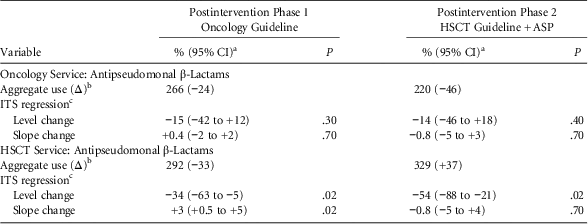
Segmented regression (Table 3) did not show changes in level or slope of antipseudomonal β-lactam use on the oncology service associated with either intervention. On the HSCT service, use of antipseudomonal β-lactams was similar between the baseline period and following phase 2, but lower following phase 1 (Table 3). There was a statistically significant change in level following phase 1, but also a change in slope resulting in an increasing postintervention slope. There was a statistically significant decrease in level following intervention phase 2 (Table 3). However, this did not correspond to an actual reduction in aggregate use between postintervention phase 1 and postintervention phase 2.
Postintervention Nontarget Antibiotic Use

NOTE. HSCT, hematopoietic stem cell transplantation; ASP, antimicrobial stewardship program.
a Unless otherwise indicated.
b Aggregate use for period in days of therapy per 1,000 patient days; Δ represents the absolute change from the prior period.
c Derived from interrupted time series with segmented linear regression models; percentage changes derived from coefficients normalized to baseline period use, regression models also adjusted for baseline slope.
Clinical Outcomes
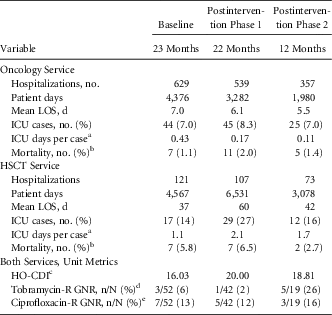
Table 4 shows clinical outcomes on both services during each of the 3 phases. Overall, mean length of stay and intensive care days per case decreased over each successive period on the oncology service, but did not show consistent trends on the HSCT service. Rates of intensive care unit admissions did not show statistically significant differences across time periods on the oncology service (P=.60), but rates were higher on the HSCT service following intervention phase 1 compared with the baseline and postintervention phase 2 periods (P=.04). In-hospital mortality remained low on both services and did not show statistically significant differences across time periods (P=.40 for oncology service; P=.60 for HSCT service). Incidence of hospital-onset Clostridium difficile infection for the entire shared unit was highest following intervention phase 1 and decreased slightly following intervention phase 2. Frequency of gram-negative isolates resistant to tobramycin (for the entire unit) was paradoxically highest during postintervention phase 2 (P=.01), likely unrelated to tobramycin use patterns at our institution. There were no statistically significant differences in frequency of gram-negative isolates resistant to ciprofloxacin across study phases (P=.90).
Patient Follow-up and Clinical Outcomes

NOTE. LOS; length of stay; HSCT, hematopoietic stem cell transplantation; GNR, gram-negative rods.
a Averaged over all cases including those not admitted to ICU.
b In-hospital mortality only.
c HO-CDI; hospital-onset Clostridium difficile infection, diagnosed >72 hours from admission, cases per 10,000 patient days; rate is for entire unit shared by both services.
d Unique gram-negative isolates with tobramycin resistance using susceptibility breakpoint=4 mg/L. Duplicate isolates were dropped if the same organism was isolated from same patient within the same study phase with an identical susceptibility profile.
e Unique gram-negative isolates with ciprofloxacin resistance using susceptibility breakpoint =1 mg/L. Duplicate isolates dropped if the same organism was isolated from same patient within the same study phase with an identical susceptibility profile.
DISCUSSION
In this analysis of interventions to reduce second gram-negative antibiotic use for pediatric FN, we found that a guideline change on an oncology service was associated with a long-term decrease in the use of tobramycin. The same intervention was associated with short-term limited use of ciprofloxacin that did not persist after 6 months. More robust and sustained improvements were observed after changing guidelines on the companion HSCT service and re-engaging both services with a pediatric ASP including audit and feedback. No apparent detrimental effects to patient outcomes were associated with the interventions.
Our findings highlight the benefits of active and ongoing intervention over single-phase passive intervention. Though locally adapted guidelines have demonstrated ability to improve clinical care, they also have inconsistent effects depending on the development, dissemination and implementation strategy. Furthermore, effects tend to diminish over time unless guidelines are reinforced by ongoing interventions such as education, feedback, and/or reminder systems.Reference Grimshaw and Russell 20 – Reference Storm-Versloot, Knops, Ubbink, Goossens, Legemate and Vermeulen 24 In our context, reduced use of tobramycin may have been more durable in the absence of an active intervention because of the greater intrinsic motivation to avoid its use, due to nephrotoxicity.
Reflecting on the intervention methods, and incorporating comments of providers, there were several factors that likely contributed to the observed effects. These included strong orientation of both services to consensus practice, collaboration between service champions and the ASP lead, availability of specialty-endorsed guidelines, and use of local data on antibiotic use and resistance to support changes in practice. Qualitative studies have shown that collegial relationships, stakeholder input and local data are facilitators of successful AS interventions.Reference Pakyz, Moczygemba, Vanderwielen, Edmond, Stevens and Kuzel 25 , Reference Jeffs, Thampi, Maione, Steinberg, Morris and Bell 26 Additionally, subspecialists tend to express more confidence in published guidelines generated by their own organizations.Reference Tunis, Hayward and Wilson 27 An additional important takeaway from our experience is the mutual influence of companion services that share providers, trainees, and patients. Although each service initially used separate FN guidelines, their antibiotic use trends mirrored one another throughout the study period, and larger reductions in target antibiotic use were seen on both services when practice guidelines were aligned.
A major strength of our analytic approach is the use of an interrupted time series, which strengthens causal inference between the intervention and observed outcomes by associating changes with the timing of interventions. Previously published studies of guideline-based interventions for FN have shown reductions in target antibiotic use, but were simple pre- and post analyses, which confer weaker causal inference.Reference Nucci, Landau, Silveira, Spector and Pulcheri 10 , Reference Vicente, Al Nahedh, Parsad, Knoebel, Pisano and Pettit 13 One study showed reduced use of multiple antibiotics via prospective audit with feedback in a cancer center using interrupted time series.Reference Yeo, Chan and Earnest 12 Our study supports the ability of guidelines to positively impact antibiotic use in oncology patients, but also shows the potential for lapses over time, and that additional impact can be achieved using other AS strategies.
Our approach has important limitations. Although changes in target drug use were associated with the timing of interventions, it is possible that the interventions were not causal. The changes could have been due to other concurrent factors, such as influence of published guidelines, or changes in patient case mix. It is unlikely that the changes were due solely to published guidelines; these were available online starting in September 2012, and graphs of target drug use (Figure 1 and Figure 2) do not show changes in use around that time. Although we do not have specific data on patient case mix during this time, the relatively stable use of antipseudomonal β-lactams suggests that the burden of FN did not change markedly during the study period.
The small number of individual data points and high monthly variability in antibiotic use somewhat limits the robustness of regression models for antibiotic use. The negative binomial model chosen for tobramycin and ciprofloxacin can exaggerate quantitative relationships between variables in a small sample. Because of these limitations, the fitted models should be primarily used to draw qualitative conclusions, with a more cautious interpretation of quantitative effects. In some cases, the models show a statistically significant slope change without a significant change in level. This could occur due to gradual phase-in of the intervention effect, or the model may not be adequately sensitive to capture an effect.
In our setting, it is difficult to draw strong conclusions about specific components of intervention phase 2, which consisted of multiple interventions phased in over time. We should also note that interventions that were effective in our setting may not be universally effective across all oncology and HSCT settings. However, our approach shares common elements with strategies that have been successfully implemented in other settings, and these results provide proof of concept that they can also be successful when applied to high-risk immunocompromised host services.
Our study shows that antimicrobial stewardship interventions can positively influence antibiotic use in oncology and HSCT settings. With a comprehensive implementation approach, those changes can be sustained over time. Patients undergoing cancer therapy and/or transplantation are at high risk for antibiotic-related complications including development of resistance. Further work is needed to identify opportunities to reduce antibiotic exposure and to understand best practices for stewardship in this population.
ACKNOWLEDGMENTS
Financial support: R.L.W. received support for this work from the Thrasher Research Foundation (Early Career Award, grant no. TRF11939). We thank the University of California at San Francisco Benioff Children’s Hospital Antimicrobial Stewardship team members (Jonathan Faldasz, PharmD, and J. Kim Stanley, MPH) for contributions to the Antimicrobial Stewardship Program, as well as the many Hematology/Oncology, Blood and Marrow Transplant Program and Infectious Diseases clinicians who reviewed and contributed to development and implementation of service guidelines.
Potential conflicts of interest: All authors report no conflict of interest relevant to this article.