Introduction
Patterns of use of psychotropic medication in nursing homes vary between countries and over time. Concerns about over-use have led to legislation being introduced in the USA (the Omnibus Budget Reconciliation Act). In addition, pharmacist reviews and education about how best to use medication, guidelines and the availability of new drugs have led to changes in prescription rates (Patterson et al., Reference Patterson, Hughes, Crealey, Cardwell and Lapane2010).
Surveys of medication use in nursing homes have allowed comparisons between countries, but unless they are conducted within similar time periods, there has to be a proviso that prescription rates may have changed between one survey and another.
The main aims of the present study were (1) to document psychotropic medication use in nursing homes in a defined area of Sydney, where three similar surveys had been conducted previously, at five-year intervals; (2) to review changes that have occurred in the pattern of psychoactive medication use over the three time intervals; and (3) to compare findings from the latest survey with data obtained from surveys during roughly the same time period in comparable facilities in other countries or jurisdictions. In addition, we aimed to prompt discussion of reasons for differences (between areas or over time), and whether increases or decreases in prescription rates of the different psychotropic drug groups might be considered beneficial.
Methods
Between January and December 2009, and also during 1993, 1998 and 2003, researchers noted details from medication cards in most nursing homes in the catchment area of a health service in Central Sydney (Snowdon et al., Reference Snowdon, Vaughan, Miller, Burgess and Tremlett1995; Reference Snowdon, Day and Baker2006; Snowdon, Reference Snowdon1999). The area expanded in size and population between 1998 and 2003. However, there was progressive closure (and some amalgamation) of nursing homes over the 16 years (1993–2009). Most nursing home managers in the area consented to involvement. The Health Service Ethics Committee gave approval for each of the surveys. During the last survey, data were collected by the three authors of this paper, with assistance from a second pharmacist.
The researchers recorded details regarding current prescription of drugs, noting whether, during the last 14 days or since initiation, they were administered regularly at the prescribed time(s) and/or p.r.n. (“pro re nata”, i.e. as required). If prescribed p.r.n. the frequency of use in the last 28 days was noted. If a p.r.n. drug was administered on at least 25 out of 28 days on a regular basis it was recorded as having been given regularly. Age and gender were noted. Information regarding diagnoses was not consistently available. All data were de-identified.
Results
The numbers of nursing homes included in the four surveys (and the percentages of area nursing homes providing details) were 46 (98%), 38 (97%), 51 (100%), and 44 (92%). The mean numbers of residents in these nursing homes were 52.5 (range 25–130) in 1993, 52.0 (19–152) in 1998, 60.6 (23–140) in 2003, and 56.0 (20–107) in 2009.
The mean age of residents rose over the years; in 2009, 36% (n = 895) of residents were male (mean 78.7 years, s.d. 12.1), and 64% (n = 1570) were female (84.2 years, s.d. 9.6). The mean number of medications prescribed per resident was 8.7, of which 7.4 were for a drug administered regularly (and sometimes p.r.n. as well) and 1.3 were prescribed only for p.r.n. use (a mean of 0.2 being actually administered once or more in the last four weeks). Regular prescribed nutritional supplements and cranberry juice were included on medication lists. If topical applications (ear, eye, nose, skin) were excluded, the mean number of prescriptions per resident was found to be 7.0 regular and 0.9 p.r.n.
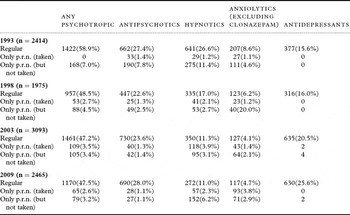
As shown in Table 1, the percentages of residents prescribed and taking different types of psychotropic medication regularly or p.r.n. have differed considerably between surveys. The size of the area remained the same in 1998 as in 1993, but the numbers of nursing homes and residents decreased over those five years. The same applied in 2003–2009, whereas increased area size had resulted in larger numbers in 2003 than in 1998.
Use of psychotropic medication in Sydney nursing homes in 1993, 1998, 2003 and 2009

As in comparable surveys, anticonvulsants other than diazepam (including carbamazepine, sodium valproate and clonazepam) were not labeled as “psychotropic”, nor included when calculating percentages of residents taking psychotropic medication (Table 1). Nor were antiparkinsonian medication, antihistamines, or analgesics. Although commonly included as psychotropic, cognition-enhancing medications have been omitted when calculating percentages of residents taking any psychotropic medication (see Table 1, which shows the four types of medication included as psychotropic) because such drugs had not been launched for use in nursing homes in the 1990s. Some anticonvulsants are used at times as mood stabilizers, but no attempt was made in these four surveys to estimate how often that was the reason for their prescription. Sodium valproate was prescribed for 7.5% of residents in 2009, and carbamazepine for 2%. Twenty-six (1.1%) residents took clonazepam regularly (none with other benzodiazepines) and two were prescribed it p.r.n. but did not take any. Whether its prescription was sometimes for its anxiolytic effect was not ascertained.
Midazolam, like clonazepam, was not included among anxiolytic agents when calculating the figures shown in Table 1; it was prescribed p.r.n. for six residents but none was administered.
The percentage of residents taking antipsychotic medication regularly in 2009 was a little higher than in 1993. All such drugs prescribed in 1993 were first generation (‘conventional’), whereas in 2009 most of the antipsychotics given regularly were second generation (‘atypical’): 21.8% of residents took atypical, 7.4% conventional, with 1.2% taking both types. Some residents were prescribed antipsychotic and/or anxiolytic medication regularly and also p.r.n. Haloperidol was prescribed to be taken regularly by 4.9%; for another 3.3% it was prescribed only for p.r.n. use – and actually administered to only 1%. Risperidone was taken regularly by 11.6%; 1% were prescribed it only p.r.n. – and rarely took any.
The mean daily dose of regularly given oral haloperidol was 1.3 mg. Only 11% were given more than 2 mg per day (contrasting with 54% in 1993, 30% in 1998, and 22% in 2003). Of those taking risperidone regularly, only 9% were given more than 2 mg daily, contrasting with 16% in 2003. However, 30% of those on olanzapine regularly were taking more than 7.5 mg daily (compared to 26.3% in 2003).
In 1993, nearly two-thirds of administered antidepressants were tricyclics. In 2009, 25.6% were taking antidepressants regularly, and over half (13.7%) were on selective serotonin reuptake inhibitors (SSRIs), while only 3.5% took tricyclics. Almost all residents on SSRIs took what is regarded as a therapeutic dose, but in 2009, of the 86 residents taking a tricyclic antidepressant (most administered in the evening), only 17 (20%) were given more than 25 mg daily, and only 7% took 75 mg or more.
Seventy-five residents (3.0%) were prescribed cognition-enhancing medication (48 donepezil, 15 galantamine, 7 rivastigmine and 9 memantine) in 2009. This represented a doubling of use of such drugs in nursing homes since 2003. Four of the nine on memantine took it with one of the cholinesterase inhibitors.
Discussion
The pattern of use of psychotropic medication in Sydney nursing homes changed considerably between 1993 and 2009. The percentage of residents taking hypnotics regularly or p.r.n. fell by more than half, and the percentage taking regular doses of anxiolytics fell considerably. Between 1993 and 1998 there was a modest fall in the use of antipsychotic agents, but this was followed by a 24% increase in regular use of antipsychotics over the next 11 years. In 2009, virtually the same percentage of residents as in 1993 were taking antipsychotics regularly or p.r.n., though over the 16 years the mean dose of prescribed antipsychotics had decreased and there had been a change from using conventional antipsychotics to a three-to-one preference for atypical antipsychotic medication. There was increased use of antidepressants.
Rates of psychoactive medication use in Sydney in 1993–1998 (Table 1) can be compared with those in six countries in the mid-1990s (Hughes et al., Reference Hughes2000). The percentage of residents taking at least one dose of a hypnotic and/or anxiolytic drug in the previous week was highest in Iceland (61.8%), but even in Sweden, Denmark and Italy the prevalence of use was 34% to 35.5% (i.e. higher than in Sydney in 1998), the adjusted odds ratios showing a 2.18 to 3.24 higher rate of use than in the USA, where 14.4% took these drugs. Antipsychotic use was lower in Japan (7.5%) than in the USA (14.4%) but markedly higher (22.1% to 26.5%) in Italy, Iceland, Sweden and Sydney at that time.
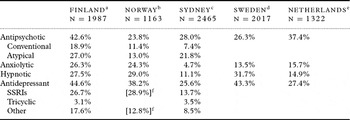
Surveys conducted in 2003–2009 showed that higher percentages of nursing home residents in Finland and Norway than in Sydney were being given anxiolytics, hypnotics and antidepressants regularly (Table 2). Regular antipsychotic use was higher in Finland (42.6%) than in Sydney (28%) and Norway (23.8%). The current Sydney report of a 24% increase in use of antipsychotics over recent years requires follow-up. Risperidone is the antipsychotic most frequently prescribed, and there is evidence of benefit, including among people with agitation associated with dementia (Brodaty et al., Reference Brodaty2003). Nevertheless, caution in its use is advised because of risks of cerebrovascular events and increased all-cause mortality.
Comparison of regular psychotropic medication use in nursing homes in five countries

aSurvey 2003 (Hosia-Randell and Pitkälä, Reference Hosia-Randell, Pitkälä and 2005)
bSurvey, 2004–2005 (Selbaek et al., Reference Selbaek, Kirkevold and Engedal2007)
cSurvey, 2009 (Snowdon et al. – current study reported here)
dSurvey of cognitively impaired persons in geriatric care units, 2000 (Lövheim et al., Reference Lövheim, Sandman, Kallin, Karlsson and Gustafson2006)
eSurvey of dementia units, 2003 (Nijk et al, Reference Nijk, Zuidema and Koopmans2009)
fIn the Norwegian study, the percentages referring to use of SSRIs and other antidepressants were extracted from the study by Barca et al. (Reference Barca, Selbaek, Laks and Engedal2009), relating to 902 of the 1163 subjects. The other 261 had data missing regarding dementia and depression assessments.
A US study reported that about half the participants in the National Nursing Home Survey (NNHS) had a chart diagnosis of dementia, and of these, 32.9% were receiving an antipsychotic and 46.8% an antidepressant (Seitz et al., Reference Seitz, Gruneir, Conn and Rochon2009). Stevenson et al. (Reference Stevenson2010) reported that 25.7% of all 12,090 NNHS participants aged >59 years took antipsychotics regularly, or p.r.n. on the day data were collected. A smaller US study of residents with dementia showed 34.5% were prescribed antipsychotics, 19% anxiolytics or sedatives, and 43.1% antidepressants (Kim and Whall, Reference Kim and Whall2006). Earlier findings (Snowdon et al., Reference Snowdon1996) showed that 80% of residents in the surveyed Sydney nursing homes were cognitively impaired. The ratio of residents with and without dementia is likely to affect frequency of use of the different types of psychotropic medication through associations with diagnostic, demographic and other factors. Differences between somatic and psychiatric nursing homes in the Netherlands might be expected to be associated with differences in pattern of psychotropic drug usage. A 2003 survey by Nijk et al. (Reference Nijk, Zuidema and Koopmans2009) showed that residents (n = 1322) in dementia special care units in the Netherlands were given antipsychotics (37.4%), anxiolytics (15.7%), sedatives (14.9%) and antidepressants (27.4%) regularly – and antipsychotics, anxiolytics and sedatives p.r.n. – at higher rates than were found in Sydney nursing homes (Table 2). Corresponding figures from an earlier Swedish survey (2000) of cognitively impaired residents in “geriatric care settings” were 26.3% (antipsychotics), 13.5% (anxiolytics), 31.7% (hypnotics and/or sedatives) and 43.3% (antidepressants) (Lövheim et al., Reference Lövheim, Sandman, Kallin, Karlsson and Gustafson2006).
The evidence points to lower use of psychotropic medication in the surveyed Sydney nursing homes than in other countries where comparable surveys have been conducted recently, but caveats are needed. Policies and funding differ between countries, so the diagnostic breakdown and factors affecting admission and treatment factors vary. Dementia was found in 81% of nursing home residents in the Norway study, and 72% had clinically significant psychiatric and behavioral symptoms (Selbaek et al., Reference Selbaek, Kirkevold and Engedal2007). These figures are not dissimilar to those reported from the 1993 Sydney survey, but differences in methodology and over time mean that a comparison of rates of dementia and mood disorders in the studied populations (Table 2) would be inappropriate. Data from the Sydney surveys do not reveal whether medication was prescribed appropriately or not. To give opinions on whether hypnotics/anxiolytics or antidepressants are being prescribed too much or too little would require assessment of individual cases and circumstances.
Nevertheless, it is of interest that rates of prescribing in individual countries have varied over time. In the USA it appeared that the fall in prescription of antipsychotic medication resulted from legislative and regulatory changes. In Sydney it appeared that publicity and education of health staff affected prescribing rates. In another Australian state (Tasmania), an intervention study that included staff education led to a significant fall in use of psychotropic medication: when surveyed in 2006, 42% of 2389 residents were prescribed regular dosage of benzodiazepines, but after the intervention only 26.9% were still taking benzodiazepines (Westbury et al., Reference Westbury, Jackson, Gee and Peterson2010). However, this remains a much higher rate than in Sydney in 2009 (Table 1).
Another Sydney study (Nishtala et al., 2009) reported 2008 data from aged care homes. Noting that a substantial minority of the residents were receiving low-dependence care, medication use figures were consistent with those obtained from nursing homes in the same city: 16% took hypnotics and/or sedatives, 33% antidepressants and 22.6% antipsychotic medication (4.8% conventional, 18.8% atypical). In their study of rest-homes, dementia care units and psychogeriatric hospitals in New Zealand (Hawke's Bay), Tucker and Hosford (Reference Tucker and Hosford2008) found that regular use of benzodiazepines was also reportedly low compared to most other countries, the rate having fallen to 12.4%, while antidepressant use had doubled to 30.6% since 1990.
The rate of antidepressant use in Sydney increased from 15.6% to 25.6% over the 16 years, but with a fall to 3.5% in the percentage of residents given a tricyclic regularly. When tricyclics are prescribed they are usually given in the evening and in doses unlikely to have an antidepressant effect. Discussions with local doctors suggest that commonly they prescribe them for their hypnotic effect or as an adjuvant in pain control. The fact that antidepressant use has not increased in Sydney as much as in Scandinavia and the USA is not necessarily evidence of neglect. Depression in nursing homes has not been shown to respond well to antidepressants (Bains et al., Reference Bains, Birks and Dening2002), though there is good reason to try using it in combination with psychotherapeutic approaches (see Bharucha et al., Reference Bharucha, Dew, Miller, Borson and Reynolds2006).
The recent survey showed relatively little prescription (3%) of cognition-enhancing medication in Sydney. Of US residents with a chart diagnosis of dementia, 28.9% were receiving a cholinesterase inhibitor (Seitz et al., Reference Seitz, Gruneir, Conn and Rochon2009). In Norway and Finland, about 11% and 7% of nursing home residents were taking cognitive enhancers (Hosia-Randell and Pitkälä, Reference Hosia-Randell, Pitkälä and 2005; Selbaek et al., Reference Selbaek, Kirkevold and Engedal2007). Anti-dementia drugs were administered to 15.2% of Hamburg residents living in specialized dementia facilities, while 13% of Mannheim traditional nursing home residents with at least moderate dementia were given such medication (Weyerer et al., Reference Weyerer, Schäufele and Hendlmeier2010). The rate of prescription for Dutch residents of special dementia care units was only 0.8% (Nijk et al., Reference Nijk, Zuidema and Koopmans2009). There is good reason to examine the potential benefits of such medication to residents in long-term care homes in relation to quality of life and costs.
The major limitation of this study is that it relates to only one part of one city in Australia. As evidenced by the Tasmanian report, findings from this study should not be generalized elsewhere.
A limitation in comparing rates of medication use is a lack of detail in most reports, including the later Sydney surveys, that would have allowed meaningful comparisons over time and between countries of residents’ clinical status, comorbid conditions and indication for administered psychotropic medication.
A major positive for the study is that changes in pattern of use have been observed over a 16-year period, albeit that doctors, residents, nursing homes, the size of the area and the system of care all changed too. Differences in patterns of psychotropic medication use across time and between administrative areas should provoke discussion regarding reasons to prescribe – or not.
Conflict of interest declaration
J. Snowdon was previously a member of the Janssen-Cilag Australia Dementia Drug Advisory Board, and this and two previous surveys were fully or partially funded by unrestricted grants from Janssen-Cilag. A previous survey was funded through an unrestricted grant from Astra-Zeneca. J. Snowdon has been a sponsored speaker and/or investigator for Organon, SmithKline Beecham, Pharmacia, Wyeth and Pfizer. He has received financial support to attend educational meetings from Novartis, Roche, Lundbeck and Janssen-Cilag.
Description of authors’ roles
John Snowdon developed the protocol for this study, supervised the collection of data, and took the main responsibility for writing this paper. Daniel Galanos arranged and was largely responsible for collection and analysis of the data. Divya Vaswani collected and entered much of the data. The three authors discussed the results and how they should be presented in the paper.
Acknowledgments
Ms Leanne Pratt assisted in collection of data in several of the nursing homes. We thank staff of the 44 nursing homes for their help in locating medication cards and their support for this study. Janssen-Cilag Australia provided unrestricted funds to enable us to conduct the present (2009) and previous surveys.