Introduction
Muscovy ducks are integral part of rural poultry production in Nigeria (Oguntunji and Ayorinde, Reference Oguntunji and Ayorinde2014). Preponderance of this waterfowl, popularly known as local ducks are concentrated in the northern part of the country while majority of the few reared in southern part have been ‘banished’ to rural communities. In the recent years, the population of this waterfowl has been observed dwindling (Ogah and Ari, Reference Ogah and Ari2012). Taboos, myths, social bias and prejudice are the principal factors contributing to the remarkable fall in their numbers coupled with the lack of interest in their domestication and low patronage of their products.
Furthermore, the discrimination suffered by this water bird in Nigeria is exemplified further in the absence of its commercial production and dearth of researches on its comprehensive characterization; encompassing phenotypic, genetic, morphological, biochemical, immunological, among others.
Efficient utilization of a species or breed is premised on accurate knowledge of its unique characteristics differentiating it from other breeds or species. Most of such unique characteristics in farm animals are recognized primarily based on physical (outward) attributes such as body size, colour and shape of the horns (Khan, Khan and Mahmood, Reference Khan, Khan and Mahmood2008). Phenotypic diversities observed in a population, breed or species are products of interaction of evolutionary forces such as selection, migration, mutation and various management and environmental challenges the animals have been exposed to over the years (Oguntunji, Reference Oguntunji2013). The observed phenotypic diversities in a population are pointers to the importance attached to certain phenotypic characteristics by the farmers and the end-users of animal and its products which could be of social, economic and religious relevance in a society (Oguntunji, Reference Oguntunji2013).
Documentation of the existing genetic resources, including the description of population phenotypic characteristics, cultural importance and genetic uniqueness is one of the main areas of the livestock conservation activities (Ruane, Reference Ruane1999; Duchev and Groeneveld, Reference Duchev and Groeneveld2006). To make the conservation of indigenous breeds a reality and ensure sustainable use of their genetic diversity, it is particularly desirable that their phenotypic characteristics and performance be evaluated in their home tracts and under traditional management conditions (Zarate, Reference Zarate1996).
In view of the foregoing, it is evident that characterization and conservation of diverse genetic attributes inherent in the indigenous livestock species are imperative and long overdue in order to take inventory and maintain their genetic biodiversity, enhance food security of the teeming population and boost economic activities in the developing countries (Oguntunji, Reference Oguntunji2013).
Comprehensive phenotypic characterization of Nigerian Muscovy ducks describing and comparing qualitative traits of ducks in different agro-ecological zones (AEZs) are lacking; while the few available ones are restricted to some localities (Hassan and Mohammed, Reference Hassan and Mohammed2003; Raji, Igwebuike and Usman, Reference Raji, Igwebuike and Usman2009; Chia and Momoh, Reference Chia and Momoh2012). Against this background, the present study was conducted to provide comprehensive report on the patterns and distributions of qualitative traits in Muscovy ducks drawn from three agro-ecological zones in Nigeria.
Materials and methods
Study areas
Adult Muscovy ducks were randomly drawn from three AEZs in Nigeria: Rain Forest, Derived Savanna and Guinea Savanna. The climatic conditions of the study areas have been described by Yakubu (Reference Yakubu2011), Ogah, Momoh and Dim (Reference Ogah, Momoh and Dim2011) and Oguntunji (Reference Oguntunji2013).
Experimental animals and sample sizes
For easy identification, Muscovy ducks sampled in Oyo and Osun States are herein after referred to as Derived Savanna ecotype, while those sampled in Lagos and Niger States are referred to as Rain Forest and Guinea Savanna ecotypes, respectively.
The 1020 Muscovy ducks (287 adult males and 733 adult females) used in this study were owned by small-scale farmers and were mostly traditionally managed with little or no supplementary feeding and medication. The ducks were provided with improvised housing made of low cost locally available materials such as bamboos, tree branches, mud, old iron sheets, palm fronds, dry grasses and leaves. Few duck farmers provided them with wooden cages. Only sexually matured birds were covered in this study. This is imperative because sexual maturation as influenced by sex hormones affects expression of the qualitative traits investigated. Besides, data were collected only on apparently healthy birds.
Data collection
Qualitative and quantitative data were taken on 203, 519 and 298 Muscovy ducks randomly sampled from the Rain Forest, Derived Savanna and Guinea Savanna AEZs, respectively.
Adult male and female Muscovy ducks sampled in each AEZ were individually assessed and scored for seven qualitative traits namely; plumage, skin, shank, feet/web, bill, bean and caruncle colours. All these were visually appraised and scored according to the sex and ecotype of the ducks as described by FAO guidelines on phenotypic characterization of chickens and ducks (Manuel, Reference Manuel2008).
Statistical analyses
Data on qualitative traits were analysed using descriptive statistics (percentages). Besides, fixed effect model was used to investigate association of plumage and skin colours with body weight of male and female ducks.
 $$Y_{\acute{\iota}jk} = \mu + P_{\acute{\iota}}+ S_j + e_{\acute{\iota}jk}$$
Y ίjk = individual body measurement; μ = overall mean; P ί = fixed effect of plumage colour (ί = white, black, mottled, ash, blue); S j = fixed effect of skin colour (j = white and yellow); e ίjk = experimental error, assumed to be independently, identically and normally distributed, with zero mean and constant variance, i.e. ί ίnd (0, r 2).
Significant differences in association between plumage colours and body weight were determined using Duncan's Multiple Range Test (DMRT) at 5 percent probability level.
All statistical analyses were performed using the SPSS (2001) version 16.
Results
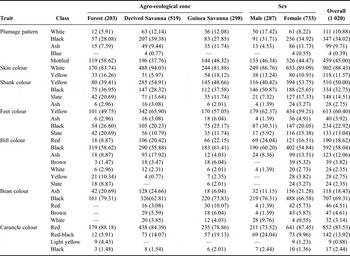
The frequency distribution of the qualitative traits is presented in Table 1.
Qualitative characteristics of adult Muscovy ducks in Nigeria – absolute numbers of ducks analyzed, relative numbers in parenthesis

Plumage colour
The frequency distribution of plumage patterns across the AEZs showed that the predominant (45 percent) plumage colour was mottled while blue (0.55 percent) had the lowest frequency. It is noteworthy that the only four blue-plumaged Muscovy ducks found in this study were in the Derived Savanna AEZ.
Sexual dimorphism in plumage colour
The predominant plumage types in the two sexes were mottled (Male 46.34 percent; Female 44.47 percent) and black (Male 31.71 percent; Female 34.92 percent).
Skin colour
White and yellow skin colours were observed in Muscovy ducks of the three AEZs. However, preponderance of ducks in each AEZ had white skin; 83.74, 94.03 and 81.88 percent, respectively, for RF, DS and GS.
Sexual dimorphism in skin colour
The relative distribution of skin colours in the two sexes was comparable; majority of male and female Muscovy ducks had white skin representing 86.76 and 89.09 percent, respectively.
Shank colour
Table 1 shows that half (50 percent) of the sampled Muscovy ducks had yellow shanks. Other variants were black (32.75 percent), slate (14.51 percent) and ash (2.75 percent). In tandem with general analysis, yellow shank had the highest frequency in all the AEZs.
Sexual dimorphism in shank colour
The relative distribution of shank colours in the two sexes showed that yellow and black shanks constituted the highest proportions in female (53.75 percent) and male (50.87 percent) Muscovy ducks, respectively. Furthermore, the distribution of shank colouration indicated that frequency of certain colours were exceptionally higher in one sex than the other. For instance, about half (50.87 percent) of all drakes sampled had black shank compared to about one-quarter (25.65 percent) of the females. In addition, incidence of slate shank in females was higher than twice that observed in males (17.33 vs 7.32 percent).
Feet/web colour
Yellow feet had the highest frequency (60.10 percent) followed by black (22.94 percent), slate (13.04 percent) and ash (3.92 percent). The distribution and frequency of feet colour in each zone followed the same trend as observed in the general analysis.
Sex differences in feet/web colour
Table 1 showed that the frequency of occurrence of yellow (62.37 vs 59.21 percent) and black (30.31 vs 20.05 percent) feet were higher in males compared with females. Conversely, frequencies of ash (4.91 vs 1.39) and slate (15.83 vs 5.92) feet colours were higher in females than males.
Bill colour
Across the ecotypes, the predominant bill colour was black (58.04 percent). Similarly, black was the predominant bill colour in all the AEZs.
Sex differences in bill colour
Majority of male and female Muscovy ducks had black bills; 66.20 and 54.84 percent, respectively. It is worthy of note that three bill colours (brown, slate and yellow) were not observed in males.
Bean colour
Highest proportion (69.31 percent) of Muscovy ducks had black bean. Others were ash (18.43 percent), brown (4.61 percent), red (4.51 percent) and white (3.14 percent). The relative distribution of bean colours in each AEZ indicates prevalence of black bean.
Sex differences in bean colour
Majority of male (76.31 percent) and female (66.58 percent) Muscovy ducks had black beans while the frequencies of occurrence of other bean colours were higher in females than in males except white.
Caruncle colour
The relative distribution of caruncle colours indicates that red caruncle was predominant (83.53 percent). Others were red-black (13.92 percent), black (1.66 percent) and pale/light yellow (0.88 percent). In agreement with the result of the general analysis, separate analysis of each AEZ indicated that majority of ducks had red caruncles. Pale/light yellow caruncle was found only in Rain-Forest ducks representing 4.43 percent of the sampled ducks in the zone.
Sexual dimorphism in caruncle colour
Prevalence of red caruncle was observed in the two sexes. Though, both male and female ducks had red-black caruncle, sex differences were observed in its distribution. About one-quarter (24.04 percent) of male ducks were red-black caruncled in contrast to 9.96 percent of the females. Besides, all the four caruncle variants were observed in female ducks but only three in males. No male duck had pale/light yellow caruncle.
Association of plumage patterns with body weight
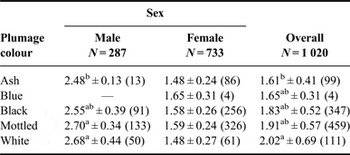
There was significant (P < 0.05) association between plumage colour and body weight: white-plumaged Muscovy ducks were heaviest (2.02 kg) and were significantly heavier than mottled (1.91 kg), black (1.83 kg), blue (1.65 kg) and Ash (1.61 kg) coloured counterparts (Table 2). Significant (P < 0.05) association of plumage colour with body weight was also observed on the body weight of adult male Nigerian Muscovy ducks but not (P > 0.05) in females.
Association of plumage colour with body weight of adult male and female Muscovy ducks

abMeans within column with different superscripts are significantly different (P < 0.05).
() Number of ducks analysed in parenthesis.
Skin colours and body weight
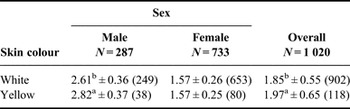
Table 3 shows that skin colour significantly (P < 0.05) differed with regard to body weight in male but not (P < 0.05) in female Muscovy ducks. The yellow-skinned male ducks were heavier (P < 0.05) than their white-skinned counterparts (2.82 vs 2.61 kg). Besides, analysis of pooled data indicated that yellow-skinned Muscovy ducks were significantly (P < 0.05) heavier than their white-skinned counterparts.
Association of skin colour with body weight of adult male and female Muscovy ducks

abMeans within column with different superscripts are significantly different (P < 0.05).
() Number of ducks analysed in parenthesis.
DISCUSSION
Plumage colour
The observed highest frequency of mottled plumage for Muscovy ducks in the present study agrees with the reports of Chia and Momoh (Reference Chia and Momoh2012) and Barnejee (Reference Barnejee2013) on Muscovy ducks of North-central Nigeria and West Bengal, India, respectively. Conversely, Black and multicoloured were the predominant plumage colours among North West (Hassan and Mohammed, Reference Hassan and Mohammed2003) and North Eastern (Raji, Igwebuike and Usman, Reference Raji, Igwebuike and Usman2009) Nigeria Muscovy ducks, respectively.
The relative distribution of the plumage patterns of Muscovy ducks across AEZs might be attributed to social preference. Solid black and white animals, most especially birds, are usually linked with gods/spirits and rituals in Nigeria; therefore, most duck farmers and consumers prefer mottled ducks because of their mixed plumage colour; hence, its highest proportion in the population understudy. Ikeobi et al. (Reference Ikeobi, Ozoje, Adebambo and Adenowo2001) corroborated this assertion that social preference in addition to natural selection and adaptation are the major causes of the variation in plumage colour.
The small proportion of white-plumaged Muscovy ducks in the present study agrees with the report of Hassan and Mohammed (Reference Hassan and Mohammed2003) on northwest Muscovy ducks but contradicts other previous studies on plumage colour of Muscovy duck in Nigeria (Raji, Igwebuike and Usman Reference Raji, Igwebuike and Usman2009; Chia and Momoh, Reference Chia and Momoh2012) whereby white Muscovy ducks were approximately one-third of the populations. The low frequency of white Muscovy ducks in all the AEZs understudy could be attributed to the religious roles ducks with such plumage are used for. Probing of household owners revealed that white Muscovy ducks command higher price than others and are in high demand for rituals and religious purposes. This submission was also further substantiated by duck sellers in the study area. This observation agrees with the reports of Leulseged (Reference Leulseged1998) and Gueye (Reference Gueye1998) that plumage and skin colours have cultural and religious functions. In addition, the postulated function of plumage colouration as mean of camouflage (Ayeni, Reference Ayeni1980) might be another factor responsible for low frequency of white-plumage Muscovy ducks in the studied population. The exceptionally-low frequency of occurrence of blue plumage in Nigerian Muscovy ducks might probably be attributed to social preference and or may be that the segregating allele(s) for it is/are recessive(s).
Plumage colour and sexual dimorphism
Of recent Barnejee (Reference Barnejee2013) reported higher frequency of black and white (mottled) compared to Sepia for the two sexes of Muscovy ducks in India. Social preference for a particular plumage colour in a gender of Muscvy ducks has neither been observed nor reported in the study area, therefore; the observed skewed distribution of white and ash plumage colours could probably be attributed to the influence of sex hormones or sex-linked genes or combination of some or all the postulated factors. Coyne, Kay and Pruett-Jones (Reference Coyne, Kay and Pruett-Jones2007) reported that in most groups of birds, plumage traits (e.g. feather colour or elongation, appearance of colour patches) appear to be oestrogen dependent, with male-specific traits expressed only in the absence of that hormone.
Skin colour
The prepoderance of white-skinned Muscovy ducks in this study corroborated results of FAO sponsored projects on ducks in Cambodia (FAO, Reference Dinesh, Geerlings, Sölkner, Thea, Thieme and Wurzinger2009a) and Egypt (FAO, Reference Yakout, Kosba and Thieme2009b). The low frequency of yellow skin (11.54 percent) in this study is in contrast to the expected 25 percent for an autosomal recessive gene in a random mating population where the studied population was drawn, thus, suggesting possible effect of salient genetic and non-genetic factors.
Skin colouration is determined by xanthophyll and melanin and the combined effects of the duo resulted in varying phenotypes (Mancha, Mbap and Abdul, Reference Mancha, Mbap and Abdul2006a). It has been established that yellow skin is influenced by the amount of carotenoids, primarily xanthophylls in the feed (Hutt, Reference Hutt1949). Smyth (Reference Smyth and Crawford1990) buttressed this further that yellow skin is the result of the expression of carotenoid pigments in the skin of the birds; and the more the carotenoids, the more intense the yellow colour. In view of this, the observed low frequency of yellow skin pigmentation of Nigeria Muscovy ducks in this study might probably be a reflection of the nutritional status of the sampled birds. Since the population understudy were mostly reared on the extensive system with little or no attention paid to the dietary needs of the birds or modification of their feed.
The report of Mancha, Mbap and Abdul (Reference Mancha, Mbap and Abdul2006a) lends credence to this assertion that relative abundance of white-skinned fowl could be higher even when genetically yellow-coloured skin was higher in a population due to nutrition. These researchers attributed such atypical observation to lack of special diets like yellow maize and alfalfa leaf meals. The lack of such ingredients results in pale colour in genetically yellow-skinned birds (Mwalusanya et al., Reference Mwalusanya, Katule, Mutayoba and Mtambo2002; Lesson and Walsh, Reference Lesson and Walsh2004). Against this background, it is highly probable that some genetically yellow-skinned ducks were inadvertently scored as white-skinned; hence, the low frequency of yellow-skinned Muscovy ducks in the population under study.
Furthermore, putting into consideration the relationship between plumage patterns and skin colour of Muscovy ducks in the present study, it is worth emphasizing that the reported skin colours were also possibly influenced by the pleiotropic actions of genes responsible for plumage colours. A general observation in this study was that all solid white and mottled Muscovy ducks (black and white ducks with more white plumage distribution) had yellow skin while all blacks and mottled ducks (with more of black plumage) had white skin. Besides, all deep ash-plumaged ducks had white skin except those with more of lighter pigmentation (ash-coloured with more of white distribution) had yellow skin.
Sexual dimorphism in skin colour
Reports of sexual dimorphism in skin colour of Muscovy duck are scarce to validate the result of the present study. The numerical higher frequency of yellow skin in males compared with females is consistent with previous studies on Nigerian (Mancha, Mbap and Abdul, Reference Mancha, Mbap and Abdul2006b) and Ethiopian (Dana et al., Reference Dana, Dessie, Liesbeth, Waaij and Van Arendonk2010) indigenous chickens. Smyth (Reference Smyth and Crawford1990) attributed higher percentage of yellow-skinned male possibly to diversion of the yellow pigment to egg yolk formation in females. Furthermore, superior foraging behaviour of cocks, guaranteeing access to better feed resource base was posited as a possible reason for higher yellow skin among Ethiopian cocks than females (Dana et al., Reference Dana, Dessie, Liesbeth, Waaij and Van Arendonk2010).
Shank colour
Comparison of shank pigmentation distribution in this study and other related studies in Nigeria revealed disparities. Contrary to the four shank colours reported in this study; Chia and Momoh (Reference Chia and Momoh2012) reported three major classes for Muscovy ducks sampled in North-Central Nigeria. They reported further that majority of ducks had black-yellow shank representing 53.5 percent followed by all-black (36.5 percent) and all-yellow (10.0 percent). Diversities observed in variants of shank colour in this study could be adduced to absence of selection coupled with indiscriminate mating among the local ducks. Contrary to the widely observed white shank colour in domestic chickens, no Muscovy duck was found having white shank in the present study. This might probably be attributed to genetic differences in the inheritance of shank colour in the two species.
Putting into consideration the trend of plumage patterns and shank pigmentation of Muscovy ducks in this study, it seems that expression of shank colour is not exclusively genetically controlled but probably influenced also by the plumage colour. A general observation in the sampled ducks across the ecotypes was that no white Muscovy duck had slate/grey, ash or black shank but yellow; likewise no black duck had yellow shank but black and slate/grey. Furthermore, among the mottled and ash-plumaged ducks, patches of yellow pigment distribution and intensity were in the same direction and depended on the relative distribution of white feather; the more the white plumage the more the yellow pigment distribution and intensity on the shank. It is therefore hypothesized that gene (s) responsible for light pigmentations (white and ash plumage patterns) influence(s) expression of yellow shank while the gene(s) responsible for black plumage pattern influence(s) expression of black and slate/grey shank colours.
A previous study by Nordskog (Reference Nordskog1970) on shank pigmentation of Fayoumi breed of chicken lends credence to the observation reported in this study. His report showed that not only shank colouration genes are responsible for shank colour but also the plumage genotype. He stated further that almost invariably, shank colour of birds with dark plumage is slate or green (melanin) and of birds with light plumage is yellow or white (non melanin).
Sexual dimorphism in shank colour
The observed trend of shank pigmentation in the two sexes suggests likelihood of certain modifying genes that are sex-linked/influenced which are influencing shank pigmentation of male and female Muscovy ducks in addition to the segregating alleles controlling the expression of shank colour. Alternatively, an underlying factor that may be due to the effect of sex hormones may also contribute to the observed disparities in both sexes. Previous studies by Owens and Short (Reference Owens and Short1995) and Kimball (Reference Kimball, Hill and McGraw2006) buttressed this assertion that in most avian species, testosterone is involved in inducing non-plumage traits such as bill and leg colour, presence of wattles, spurs and combs, as well as behavioural traits such as aggression and male-specific sex displays.
Feet/Web colour
It is noteworthy that distribution pattern of feet colour is similar to what was observed for shank colour; this is suggestive that possibly their inheritances are controlled by the same genes but different modifying genes and are also influenced by the same non-genetic factors.
Similarly to what was observed for shank and skin pigmentations, relationships were also observed between plumage patterns and feet/web colors. All solid white ducks had yellow feet while all blacks had black or slate/grey feet. Majority of mottled ducks had yellow feet or yellow-black. Among few with yellow-black feet, the more the white plumage distribution, the more intense the yellow colour of the feet and vice-versa. In addition, no ash-plumaged duck had black shank.
In general, it seems white and ash plumage genes are responsible for the expression of yellow feet/web while gene(s) coding for black plumage colour is/are connected with the expression of black and slate/grey feet colours.
Sex differences in feet/web Colour
The distribution pattern of web colours of the two sexes probably suggests sex influence. The frequency of occurrence of black web in males was about 50 percent higher than observed in females (30.31 vs 20.00 percent); thus corroborating higher frequency of black shank in males in this study. Conversely, though at low frequency, the frequency of slate (15.38 vs 5.92 percent) and ash feet/web (4.91 vs 1.39 percent) colours were higher in females compared with males.
Furthermore, on shank and feet colour frequency distribution, there is likelihood that their pigmentation is under the influence of the same genes; putting into consideration the same number of colour types and predominance of yellow and black colour in the two sexes and in the pooled data.
Bill colour
Comparison of the number of classes of bill and frequency of the bill colours in this study with the previous studies in Nigeria revealed disparities. In contrast to seven classes reported in this study, Chia and Momoh (Reference Chia and Momoh2012) classified North-central Nigeria Muscovy duck bills to three (all black, black-yellow and black pink) while Hassan and Mohammed (Reference Hassan and Mohammed2003) classified those of Northwest Nigeria to four (black, white, black-white and ash-white). Furthermore, discrepancies were observed in the proportion of bill colours. Black-yellow was the predominant bill colour among North-central Nigeria ducks (Chia and Momoh, Reference Chia and Momoh2012) while majority of ducks in North-west Nigeria had black-white bill (Hassan and Mohammed, Reference Hassan and Mohammed2003).
Sex differences in bill colour
Scarcity of related study on sex differences on bill colour of Muscovy ducks did not permit head-to-head comparison of the result of the present study. The absence of certain variants in males and skewed distribution of those expressed in the two sexes is a pointer to possible sex-influence on the diverse colours of the bill which might have been influenced through the action of sex-linked genes, sex-influenced genes, sex-limited genes or sex hormones.
Bean colour
Results on related studies on bean colours of Muscovy ducks are scare to compare the result of the present study. However, it should be noted that all the major classes of bill were represented in the Derived Savanna and Guinea Savanna while only two (ash and black) were found in Rain-Forest ducks. Since the population understudy has not undergone selection for any qualitative traits, the immediate and remote causes of absence of red, brown and white bean colours in Rain-Forest Muscovy ducks are not understood.
Sex differences in bean colour
Comparison of classes of colour scored for bill and bean in the two sexes indicate a common trend whereby black colour was higher in males whereas ash and brown were prevalent in females, thus suggesting possible sex-influence on the expression of bean colour in Muscovy ducks.
Caruncle colour
In tandem with the results of this study, red caruncle was reported for three-quarters of Cambodian Muscovy ducks (FAO, Reference Dinesh, Geerlings, Sölkner, Thea, Thieme and Wurzinger2009a). However, only two variants; red and red-black colours were reported for Cambodian Muscovy ducks (FAO, Reference Dinesh, Geerlings, Sölkner, Thea, Thieme and Wurzinger2009a) contrary to four in the present study.
Higher frequency of black caruncle corroborates observation of relationship between plumage and skin, shank, feet colours in this study. Irrespective of the sex, no white Muscovy duck had black or red-black caruncle but red.
Sex differences in caruncle colour
Though, both male and female ducks had red-black caruncles, sex differences were observed in its distribution. About one-quarter (24.04 percent) of male ducks were red-black caruncled in contrast to 9.96 percent of the females. Higher frequency of red-black caruncle in males than in females is consistent with earlier report in this study that frequency of black colour was higher in shank, feet, bill and bean of male compared with female Muscovy ducks. Besides, only females had pale yellow caruncles. Since preferential selection of caruncle colour has not been observed or reported in the studied population and the population from which the samples were drawn were random mating ones; therefore, the asymmetrical distribution of red-black and pale yellow caruncle colours in the two sexes may be ascribed to the effect of sex hormone.
A general observation on caruncles of the two sexes was that caruncle of males was more prominent and brighter (having shining appearance) compared with females that were smaller and dull. Dimorphism in caruncle size and appearance may be attributed to the fact that this secondary sexual characteristic is influenced by sex hormone.
Association of plumage colour with body weight
In agreement with the result of this study, Raji, Igwebuike and Usman (Reference Raji, Igwebuike and Usman2009) reported significant effect of plumage colour on live weight of adult Muscovy ducks studied in the North-east Nigeria where multicoloured Muscovy ducks were reported to have highest live weight. Similarly, mottled Muscovy ducks were significantly heavier than their sepia counterparts in West Bengal, India (Barnejee, Reference Barnejee2013). Conversely, no significant effect of plumage colour on body weight was reported on northwest Nigeria Muscovy ducks by Hassan and Mohammed (Reference Hassan and Mohammed2003).
The higher mean body weight of lighter pigmented-plumaged ducks (white and mottled) in this study may be related to their superior physiological adaptation to heat stress, associated with elevated ambient temperatures in tropical environments. It is well known that lighter surfaces reflect heat better than darker surfaces. Animals with lighter coats reflect more light (Silva, La Scala Junior and Tonhati, Reference Silva, La Scala Junior and Tonhati2003) and absorbs between 40 and 50 percent less radiation than those with dark coats (McManus et al., Reference McManus, Louvandini, Gugel, Sasaki, Bianchini, Bernal, Paiva and Paim2011); resulting in lower thermal absorption and lower body thermal load, thereby conferring physiological advantage on them compared to others with coloured/dark surfaces. Asserting on possible reasons for highest body weight of white West African Dwarf (WAD) sheep, Ozoje and Kadri (Reference Ozoje and Kadri2001) stated that the effect of white coat on body weight of extensively-reared WAD sheep may be influenced through its role in temperature-regulation and body metabolism under conditions of high ambient temperatures prevalent in the study area.
Besides, another possible underlying factor for the superior body weight of white and mottled Muscovy ducks may be the pleiotropic action of genes controlling inheritances of those plumage colours. It is also possible that the highest mean live weight of white Muscovy ducks may be another contributory factor responsible for its low frequency in this study. Their superior live weight probably makes them a prime target for sale in order to meet pressing financial needs, for the entertainment of august visitors, and as a source of meat for the family during festival periods, thus representing a form of negative selection against white ducks.
Association of skin colour with body weight
Literatures on relationship between skin colour and live weight of Muscovy ducks are lacking for comparison with the results of the present study. The observed superior mean body weight of yellow-skinned ducks may be attributed to pleiotropic effect of the gene(s) responsible for its expression. Alternatively, there is likelihood that superior live weight of yellow skinned ducks could be linked to pleiotropic action of plumage (white and mottled) colour genes. Preliminary investigation on relationship between plumage colour and skin colour of Muscovy duck in the present study revealed that majority of white and mottled ducks had yellow skin; and ducks with such plumage colours had higher mean live weight compared with black, ash and blue-plumaged counterparts.
Conclusion
Phenotypic diversities observed in the expression of the traits under study are indicative of absence of selection and abundant diversity in the gene pool of locally adapted Muscovy ducks in Nigeria awaiting selection and improvement for breed identification and classification. Higher frequencies of black shank, feet, bill, bean and caruncle colours in males are suggestive of likelihood of the influence of sex hormones in their expressions. The reported relationships between plumage colours and expression of skin, shank, feet and caruncle colours attests to the possible pleiotropic effect of plumage-coding genes. Further investigations under controlled experiments with large sample sizes are needed for validation of the reported association of plumage and skin colours with body weight.
Supplementary material
Supplementary materials of this paper is available at http://journals.cambridge.org/AGR