


In June 2015, the world watched in horror as news broke of a tragic mass shooting at Charleston’s Mother Emanuel African Methodist Episcopal Church. Black parishioners welcomed a white man into their Wednesday night prayer service before he began shooting, ultimately killing nine members of Mother Emanuel’s congregation. In response, party elites and social interest group leaders across the political spectrum condemned this as an act of terrorism against the Black community. Every major news network covered the event, sharing survivor accounts of the horrific attack and documenting the devastating loss of life as well as the reverberations of trauma the attack instilled in Black Americans across the country. But, would this mass tragedy intimidate the Black community from voting or would it mobilize them?
Mother Emanuel has, since its founding in 1817, been a symbol of Black hope and the struggle for Black equality for the Black community in and around Charleston. According to prior studies in psychology, it is likely that an attack on such a symbolic and meaningful institution would affect the psychological health and thus behavior of those with a geographical and/or social identity tie to the church (Benight and Harper Reference Benight and Harper2002; Dyb et al. Reference Dyb, Jensen, Nygaard, Ekeberg, Diseth, Wentzel-Larsen and Thoresen2014; Muldoon et al. Reference Muldoon, Acharya, Jay, Adhikari, Pettigrew and Lowe2017; Nader et al. Reference Nader, Pynoos, Fairbanks, Al-Ajeel and Al-Asfour1993; Pfefferbaum et al. Reference Pfefferbaum, Nixon, Tivis, Doughty, Pynoos, Gurwitch and Foy2001). This suggests that this event is likely to have traumatized many Black Charlestonians, perhaps affecting their political behavior. From 2012 to 2016, overall turnout in Charleston County increased about two percentage points from 45.4% to 47.1%, but is this change in turnout related to this traumatic event? Furthermore, would the effect be different for white and Black Charlestonians?
In recent years, a number of high profile tragedies, such as terrorist attacks, school shootings, and natural disasters have both traumatized Americans and had profound political effects. Yet, the politics of trauma remain undertheorized and underexamined by scholars. Due to the massive growth in access to the internet, the 24-hour news cycle, and the plethora of social media platforms, as well as climatic and cultural changes, mass exposure to news about traumatic events is becoming increasingly common. As a result, what was once considered “extraordinary politics” is becoming the new “ordinary politics” as the public thinks of traumatizing events in increasingly political terms (Atkeson and Maestas Reference Atkeson and Maestas2012).
While previous research examines the effects of major terrorist attacks (Davis and Silver Reference Davis and Silver2004; Huddy et al. Reference Huddy, Feldman, Taber and Lahav2005; Hersh Reference Hersh2013), mass shootings (Barnes et al. Reference Barnes, Hanson, Len, Meacham, McIntyre and Erickson2008; Hassell, Holbein, and Baldwin Reference Hassell, Holbein and Baldwin2020), and natural disasters (Atkeson and Maestas Reference Atkeson and Maestas2012; Fowler and Hall Reference Fowler and Hall2018; Gasper and Reeves Reference Gasper and Reeves2011; Healy and Malhotra Reference Healy and Malhotra2009), the plethora of psychological forces at play create a rich but confusingly complex tapestry of explanations. In all of this work, the role of trauma in explaining political behavior is often omitted or deemphasized. Largely, this is because it is difficult to isolate the causal effects of trauma, which one cannot ethically manipulate randomly. But, in leveraging the exogenous nature of certain types of mass tragedies, it may be possible to begin identifying the effect of trauma on political behavior.
As exposure to traumatic events increases with the nationalization of many traumatic events, posttraumatic psychological responses among the mass public likely play an increasingly important role in American politics. In particular, traumatic events may create a democratic problem. If traumatic events induce a mass stress response, individuals affected by the event may not participate in politics. Studies confirm that poor health decreases participation in politics and that healthier people are better represented in the United States. (Ojeda and Pacheco Reference Ojeda and Pacheco2019; Pacheco and Ojeda Reference Pacheco and Ojeda2020). This is, in and of itself, a major concern for American democracy. However, even more troubling is the fact that trauma is experienced more often by certain groups than by others. Black Americans, women, and individuals with lower socioeconomic status bear the greatest burden of trauma exposure and are more likely to develop more severe and long-lasting stress responses to this exposure (Cowden Hindash et al. Reference Hindash, Alexandra, Lujan, Howard and O’Donovan2019; de Jong et al. Reference de Jong, Komproe, Van Ommeren, el Masri, Arya, Khaled and van de Put2001; Dyb et al. Reference Dyb, Jensen, Nygaard, Ekeberg, Diseth, Wentzel-Larsen and Thoresen2014; Hatch and Dohrenwend Reference Hatch and Dohrenwend2007; Muldoon Reference Muldoon2013; Muldoon et al. Reference Muldoon, Acharya, Jay, Adhikari, Pettigrew and Lowe2017; Reference Muldoon, Lowe, Jetten, Cruwys and Haslam2020). Therefore, identifying the effect of traumatic events on voter turnout is crucial in measuring the health of American democracy—if traumatic events do decrease turnout, is this driven by those most likely experiencing stress reactions, who also already wield the least power in American politics?
In this article, I develop an individual-level theory of posttraumatic political response to mass tragedies. I then derive three empirical predictions from this theoretical framework about the effect of a traumatic event on voter turnout, conditioned by geographic proximity, temporal proximity, and shared salient social identity. Using county- and individual-level census and turnout data, along with records of Black church arson, mass shooting, and natural disaster occurrence, I test these predictions in US presidential elections from 1976 to 2016. These analyses support my theory of posttraumatic political response. I find that traumatic events decrease turnout in the next election by about 0.5 to 3.7 percentage points, a substantively significant effect. I also find that the closer a traumatic event occurs to an election, the more likely it is to increase turnout, but turnout reverts to the mean as events occur further in advance of an election. Finally, I find evidence that Black social identity increases the likelihood of turning out to vote in counties that have experienced a racialized traumatic event. I conclude that traumatic events have a demobilizing effect in American elections, through the mechanism of posttraumatic stress-demobilization responses, but that Black social identity provides important resiliency resources. This study combines a variety of data sources to investigate the effects of three mass tragedies on American political behavior, finding evidence that these traumatic events have important political consequences.
THE POLITICS OF TRAGEDY
Mass tragedies including devastating hurricanes, tornadoes, wildfires, and the subsequent environmental displacement; terrorist attacks; mass shootings; and sexual violence seem ever-present in contemporary American society. Such tragedies are not new challenges previously avoided by human society, though climate change, increasingly nonrestrictive gun laws, and the expansion of terrorist organizations and terrorism as a foreign policy tactic all may increase the occurrence of such politically relevant traumatic events. For example, according to the Federal Emergency Management Agency (FEMA), there were no more than 56 federally declared disasters in the United States in any given year from 1953 (when FEMA records begin) to 1995. Since 1995, however, that number has hovered around 100 disasters, with a high of 241 in 2011. Although part of this increase may be the effects of political considerations in the declaration of disasters, this seems to suggest an increase in the number of mass tragedies over time.
Regardless of any absolute increase in the occurrence of events, there is unquestionably an increase in the coverage of such events and, relatedly, an increase in the political attention paid to them. Accordingly, two conceptually distinct but related processes relevant to the politicization of traumatic events have occurred nearly simultaneously over the past several decades: (1) the nationalization of media that exposes a broader range of Americans to traumatic events more regularly and (2) changes in expectations of government responsibility.
The consistent shocks to the American political system from these occurrences are rooted in the contemporary American public’s increased and consistent exposure to them. The expansion of traditional media, the rapid growth in access to the internet and social media, the development of cable news networks, and the nationalization of politics have created a news environment in which Americans consistently face tragic news of traumatic events (Barnes et al. Reference Barnes, Hanson, Len, Meacham, McIntyre and Erickson2008; Metzl and MacLeish Reference Metzl and MacLeish2015). A prime example is hurricane season, which only affects one part of the country but is featured in prime-time programming on national news networks for several months. Even with this nationalization, however, those most closely tied to a region affected by such tragedies are most likely to develop strong psychological responses. So in the case of hurricanes, although national audiences witness the destruction, it is those on the East Coast of the United States who are most likely to develop strong posttraumatic stress responses by the increased exposure to such events, as they are most likely to be in danger themselves, be reminded of past experiences of hurricanes, and have stronger social identity ties to the places hit by hurricanes. Moreover, as I discuss below, the type of traumatic event matters for the trajectory of posttraumatic psychological responses.
Beyond this increase in news coverage and thus increased exposure, expectations of government to intervene in response to traumatic events have changed over time and continue to change for different types of traumatic events. The norm that political leaders respond to these events in order to build solidarity in the wake of tragedy has increased in recent decades and expanded to events beyond foreign wars (Campbell Reference Campbell and Chekki2000; Hawdon and Ryan Reference Hawdon and Ryan2011). In contemporary American politics, this norm expects political elites, especially presidents and governors, to respond to a wide variety of traumatic events. In past eras, however, this expectation centered largely around executives’ immediate response to national security threats (Azari Reference Azari, Azari, Brown and Nwokora2013; Mueller Reference Mueller1973; Norrander and Wilcox Reference Norrander and Wilcox1993; Sturm Reference Sturm1949), what Alexander Hamilton called “energy in the executive” in Federalist 70. With the Great Depression and Franklin D. Roosevelt’s New Deal, this expectation of government responsibility for threats to national security expanded to economic crises. As Roosevelt spurred the federal government to take greater responsibility for economic crises (Brownlow Reference Brownlow1949; Sturm Reference Sturm1949;), public expectations about government responsibility expanded to a growing collection of traumatic events. This broadening of government involvement has made traumatic events increasingly political and, perhaps, partisan. Mass tragedies increasingly command the attention of political elites and of the mass public. Intuitively, then, we may expect that these exogenous traumatic shocks to the American political system leave important changes in their wake. Political scientists have already begun identifying the negative and positive political outcomes of such events for the mass public. For example, previous research finds large increases in rates of posttraumatic stress responses in the wake of the September 11 terrorist attacks (Ford et al. Reference Ford, Udry, Gleiter and Chantala2003; Schuster et al. Reference Schuster, Stein, Jaycox, Collins, Marshall, Elliott and Zhou2001; Silver et al. Reference Silver, Holman, McIntosh, Poulin and Gil-Rivas2002). Another study finds that the events of September 11 caused greater political activism and advocacy among victims’ family members (Hersh Reference Hersh2013). But, this research concerns only one type of mass tragedy. Furthermore, what are the effects of traumatic events on a more consequential political outcome, voting?
Previous research investigates how some traumatic events affect vote choice, but the psychological processes of posttraumatic response point toward a more general question of how such events decrease voter turnout. Some scholars go so far as to identify a “myopic rationality,” which leads voters to blame and thus electorally punish incumbent elected officials for any such event that affects the voter regardless of incumbents’ ability to prevent or aid recovery from the event (Achen and Bartels Reference Achen and Bartels2016; Heersink, Peterson, and Jenkins Reference Heersink, Peterson and Jenkins2017)—though other work questions some of these findings (Fowler and Hall Reference Fowler and Hall2018; Healy and Malhotra Reference Healy and Malhotra2009). Other research contends, for example, that voters reward governors who seek federal assistance and punish presidents who reject these requests (Gasper and Reeves Reference Gasper and Reeves2011). In short, increased exposure to traumatic events along with changing expectations of government responsibility for responding to traumatic events may increase general exposure to trauma. But, these mechanisms of exposure also typically frame events so as to blame some group of elected officials for a failure to prevent or effectively respond to the event. Such blame processes can affect vote choice and attitudes, suggesting that it may also affect the decision to vote at all.
The present study asks a question about the most important political behavior, voting: do traumatic events cause a decrease in turnout? Although Hersh (Reference Hersh2013) identifies an increase in political participation among family members of September 11 victims, it is unclear whether this pattern applies to other traumatic events. Furthermore, studies of single types of traumatic events’ electoral effects may be susceptible to contamination from practical impediments. That is, after a natural disaster, for example, infrastructure challenges may make it physically difficult for voters to get to a polling place or they may be displaced and unable to vote absentee. Therefore, I develop a theory of posttraumatic political response that identifies the conditions in which traumatic experiences encourage or discourage participation in elections. In identifying the effect of Black church arson attacks, mass shootings, and natural disasters on voter turnout, as well as the conditioning roles of temporal proximity and social identity to an election, this study empirically measures the heretofore unidentified role of trauma in electoral behavior.
A THEORY OF POSTTRAUMATIC POLITICAL RESPONSE
Although previous work has identified some of the important political consequences of terrorist attacks, mass shootings, and natural disasters, this study brings all three together to identify the causal effect of traumatic events on American electoral behavior. Each of these events are major tragedies in American society, but it is trauma that links them all together as one type. To clarify this claim, I develop a theory of posttraumatic political response. To do so, I define trauma and traumatic events, examine posttraumatic psychological responses, and identify the specific posttraumatic political responses I expect for the types of events under investigation.
What Is Trauma?
Trauma is a contested and perhaps overly employed term in American news, scholarship, and ordinary language. The concept of psychological trauma was developed and is maintained by those treating survivors of trauma and represents a particular type of trauma. Even still, psychologists debate the definition of “trauma” and what its effects might be on human behavior (Wakefield Reference Wakefield2016; Weathers and Keane Reference Weathers and Keane2007). Despite these ongoing debates, working backward from the diagnostic criteria from clinical psychology provides a useful and workable definition for this study.
The entry for diagnosing posttraumatic stress disorderFootnote 1 from the Diagnostic and Statistical Manual of Mental Disorders, fifth edition requires “actual or threatened death, serious injury, or sexual violence,” thereby excluding stressful events that are typically not an immediate threat to life or physical safety such as divorce, job loss, or other psychosocial stressor events (APA 2013, 271). In this study, therefore, trauma is the experience of reasonably perceived threat of or actual death or serious violence. By extension, traumatic events are events in which there is a reasonably perceived threat of death or serious violence or actual experience of death or serious violence during the event or in its aftermath.
Posttraumatic Responses
When an individual experiences a traumatic event, the cognitive schemata that individual uses to understand how the world works and is structured are broken. In the wake of a traumatic event, survivors must reconstruct these schemata and two psychological responses, stress and growth/resilience, are the primary means to begin this process.
Posttraumatic stress is the most commonly discussed psychological response to traumatic stimuli, but it is a relatively rare reaction. Posttraumatic stress reactions include many negative psychological responses including distressing memories and nightmares of the event, dissociative reactions (flashbacks), distress upon seeing symbols of the event, avoidance behaviors, memory lapses, increased distrust of others, self-blame, negative emotions (fear, anger, guilt, or shame), decreased participation in social activities, and isolation and detachment (APA 2013). These are all indicators of poor health, and poor health can decrease the likelihood of turning out to vote (Lyon Reference Lyon2021). Such negative psychological and physical symptoms characteristic of posttraumatic stress should then manifest politically as decreased trust in government, estrangement from social and political networks and activities, and increased reliance upon negative emotions in political decision making. For the present study, the most important political consequence of posttraumatic stress political response is demobilization whereby through increased interpersonal and governmental distrust and estrangement from social and political networks, individuals who have experienced a traumatic event are less likely to participate in politics—namely, voting.
Posttraumatic growth/resilience is defined as “positive psychological changes experienced as a result of the struggle with traumatic or highly challenging life circumstances” (Tedeschi et al. Reference Tedeschi, Shakespeare-Finch, Taku and Calhoun2018). This is a process by which people create individualized versions of the basic cognitive categories that help them interpret experiences of trauma and to understand their self, future, and world in light of this experience (Janoff-Bulman Reference Janoff-Bulman1992; Tedeschi et al. Reference Tedeschi, Shakespeare-Finch, Taku and Calhoun2018). Surviving trauma can build resilience and motivate action through hope, an appreciation for life, and a stronger ability to relate to others (Tedeschi et al. Reference Tedeschi, Shakespeare-Finch, Taku and Calhoun2018), especially when a social identity is made salient through the traumatic experience (Muldoon et al. Reference Muldoon, Lowe, Jetten, Cruwys and Haslam2020). This response should manifest itself politically as an increased engagement in social and political activities, greater trust in others and in government, and reliance upon more positive emotions in political decision making. Most important for this study is that a posttraumatic-growth political response should mobilize voters, causing an increase in turnout. This should be especially likely when social identity is made salient so as to provide resources allowing relation to others.
Who Experiences Trauma?
When a traumatic event occurs, an individual experiencing the event may (or may not) experience trauma and respond with stress or growth/resiliency responses or some combination of both. The stress and growth/resilience responses to traumatic events affect not only the individual experiencing the event but also family and friends of survivors, those witnessing the event, and even individuals who have a social connection either to the primary victim(s) or to the geographical or cultural location of the event. Social psychological studies of posttraumatic stress responses in the wake of various terrorist and warfare events around the world find that individuals who had lived in the geographical area experiencing the event, had family in the area, or had some other close personal tie to the area displayed posttraumatic stress symptoms (Nader et al. Reference Nader, Pynoos, Fairbanks, Al-Ajeel and Al-Asfour1993; Pfefferbaum Reference Pfefferbaum2001; Pfefferbaum et al. Reference Pfefferbaum, Gurwitch, Mcdonald, Michael, Sconzo, Messenbaugh and Schultz2000). Further studies find that even exposure to such traumatic events on television can cause posttraumatic stress responses when viewers have a psychological attachment to the geographical area affected (Ahern et al. Reference Ahern, Galea, Resnick, Kilpatrick, Bucuvalas, Gold and Vlahov2002; Pfefferbaum et al. Reference Pfefferbaum, Nixon, Tivis, Doughty, Pynoos, Gurwitch and Foy2001; Schlenger et al. Reference Schlenger, Caddell, Lori Ebert, Rourke, Wilson and Thalji2002; Schuster et al. Reference Schuster, Stein, Jaycox, Collins, Marshall, Elliott and Zhou2001; Silver et al. Reference Silver, Holman, McIntosh, Poulin and Gil-Rivas2002).
Beyond the trauma to individuals who directly experience the traumatic event, their close friends and family members, witnesses, and those with close personal ties to the victim group or area, traumatic events often trigger those who have previously experienced trauma in one of the above listed ways. Studies of veterans, refugees, and immigrants confirm that traumatic events of similar type, in the locations where their trauma was first activated, or with other similarities reactivate or “trigger” those previous posttraumatic responses even if there was no adverse stress response to the initial traumatic exposure (Elliott Reference Elliott1997; Kinzie et al. Reference Kinzie, Boehnlein, Riley and Sparr2002; Long, Chamberlain, and Vincent Reference Long, Chamberlain and Vincent1994).
Furthermore, research shows that even if one is not present during the actual traumatic event, strong connections to the location experiencing the event can cause a posttraumatic stress response or, if one has previously experienced such trauma, trigger that traumatic stress (Pfefferbaum Reference Pfefferbaum2001; Pfefferbaum et al. Reference Pfefferbaum, Gurwitch, Mcdonald, Michael, Sconzo, Messenbaugh and Schultz2000) even if an individual witnesses the events or the aftermath on television (Pfefferbaum et al. Reference Pfefferbaum, Nixon, Tivis, Doughty, Pynoos, Gurwitch and Foy2001). Extensive social psychological research finds that trauma is not distributed equally across the population but instead is structured by social identity. Racial-ethnic minorities, women, and individuals with lower socioeconomic status are more likely to experience traumatic events and are more likely to develop stress responses to traumatic stimuli (Muldoon Reference Muldoon2013; World Health Organization 2011). But, it is also the case that social identity can increase the likelihood of growth/resiliency responses to trauma.
Traumatic events have long-term and wide-reaching effects on an exponentially increasing number of people, especially in an age of social media and 24-hour news cycles. Advances in social media translate to increased opportunities for exposure to videos, pictures, and stories of trauma, which may expand the scope of viewers who may be traumatized or, more likely, have their trauma reactivated. And so, there are both mobilizing and demobilizing forces pressing on this increasingly growing subset of the American population, but the type of event also structures which posttraumatic responses they will express.
Identifying Politically Relevant Traumatic Events
As stated above, a traumatic event is an event that causes a near-death experience, sexual violence, or serious harm and manifests as either posttraumatic stress or growth/resilience responses. Such a definition includes many different types of events, but not every type of traumatic event will be politically relevant. Therefore, I propose three criteria for a traumatic event to be politically relevant and thus follow the patterns of posttraumatic political response. The criteria ensure that the traumatic events included in this study involve government action, which makes them inherently political, but also that they all involve debate and contention about how the government should act (Birkland Reference Birkland1998; Gerber Reference Gerber2007). Meeting any one of these criteria make a traumatic event politically relevant, though some may meet more than one.
First, a traumatic event must be an event that by law or historical precedent demands a governmental response of some measurable quantity in an effort to minimize damage and rebuild resiliency in affected communities (Birkland Reference Birkland1997; Col Reference Col2007; Comfort et al. Reference Comfort, Birkland, Cigler and Nance2010). This criterion would make major natural disasters, which are threats to public safety and economic stability and have a precedent of major governmental response, politically relevant in that they involve government action.
Second, a traumatic event must be of a scale and severity so as to make a governmental response imperative (Gerber Reference Gerber2007). Major natural disasters fulfill this criterion because they inflict a massive toll both in the number of lives they claim and in the economic cost the communities hit by them incur in damages and in stalled economic activity. In this way, a traumatic event is politically relevant because the massive scale enjoins multiple levels of government to take action to mitigate the negative effects to citizens’ safety, well-being, and livelihoods.
These first two criteria provide the basis for identifying types of events that are politically relevant in a very surface-level way: they involve governmental action. But, the types of traumatic events most likely to produce the posttraumatic political responses I am interested in identifying involve a third criterion that moves beyond government action to debate and contention about that action. Efforts to help a community recover and rebuild from the events that by law or historical precedent (criterion one) and/or by scale and severity (criterion two) demand a governmental response are also opportunities for policy demanders to intervene in attempts to achieve particular policy goals (e.g., focusing events; see Birkland Reference Birkland1997; Birkland and Lawrence Reference Birkland and Lawrence2009; Hassell, Holbein, and Baldwin Reference Hassell, Holbein and Baldwin2020), leading to debate and contention about how and to what extent government is involved.
And so, a traumatic event may become politically relevant if it is made so by policy demanders. This final criterion makes events such as mass shootings politically relevant traumatic events. On their own, these events are tragic and traumatic but not necessarily politically relevant on face value, as they often do not inflict a death or economic toll as prolonged and great as that of large natural disasters such as to warrant an executive response, nor do they generally fall under the purview of the government, aside from being isolated criminal justice concerns. However, policy demanders reveal these events’ political relevance when they teach the mass public about the underlying, systemic patterns that characterize such events across time and space. That is, when policy demanders such as Black Lives Matter draw connections between racism and policing practices or when #MeToo draws connections between misogynistic and abusive work, domestic, and legal norms and the incredibly high rates of sexual violence against women, these traumatic events become politically relevant in that the events encourage debate over how the government should respond.
Cases
In this study, I restrict empirical analysis to three different types of persistent traumatic events in American society: Black church arson attacks, mass shootings, and natural disasters. In the case of each, large numbers of survivors perceive the threat of death or serious violence, the events are public, under the legal or publicly expected purview of government responsibility, or especially salient or widespread with policy demanders revealing political relevance. The population of traumatic events is much larger, but this initial study provides a foundation for empirical analysis of other types of events. I elaborate on these cases further in the Cases section of the SI.
Black church arson attacks are a particularly heinous event in American history and society. These attacks are politically relevant traumatic events because they are crimes (i.e., threats to public safety) and terrorist attacks, intended to traumatize Black Americans, and because policy demanders teach the American public of their political relevance. In this case, it is also important to note that these attacks are not simply done out of rage or hatred but are very clear in their target (Black Americans) and in their explicitly political message (stop demanding political, social, and economic equality that threatens white dominance).
Gun violence is a growing problem in the United States, a problem made especially evident in mass shootings. Mass shootings are less tied to a particular social identity than are Black church arson attacks but are likewise public and (relatively) rare. Although gun violence is a common and persistent problem in the United States, mass shootings, which cause at least three deaths and occur in public places, are few in number but large in traumatic reach. As with Black church arson attacks, mass shootings are politically relevant traumatic events because policy demanders have played a role in making these events politically relevant and they are crimes that represent public safety concerns.
Finally, natural disasters are a persistent and, due to climate change, increasingly serious concern in American life. Such events affect massive numbers of Americans and cause loss of life, physical harm, destruction of property and infrastructure, and displacement. Furthermore, such events cause millions and sometimes billions of dollars in economic damage and lost economic activity. Thus, these events are politically relevant traumatic events because of their clear trauma-inducing effects and their incredibly wide reach of lives threatened or lost.
Expectations
The type of traumatic event structures expectations about the posttraumatic psychological (and thus political) response. Posttraumatic stress (PTS) is most likely to occur and most likely to have more severe health and behavioral effects when a traumatic event is interpersonal and intentional, meaning that the event occurs between people (a car accident versus a tornado) and that the individual perpetrating the event is doing so on purpose (a mass shooting versus a car accident) (Matthieu and Ivanoff Reference Matthieu and Ivanoff2006; Van der Velden et al. Reference Van der Velden, Grievink, Kleber, Drogendijk, Roskam, Frans and Olff2006). Although natural disasters are least likely to cause severe and increasing posttraumatic stress-demobilizing responses because they are not defined by human violence, intention, or negligence, they are still tragic and uncontrollable events that increase uncertainty.
Social psychologists consistently find posttraumatic stress responses among those in close geographical proximity to the event (Nader et al. Reference Nader, Pynoos, Fairbanks, Al-Ajeel and Al-Asfour1993; Pfefferbaum Reference Pfefferbaum2001; Pfefferbaum et al. Reference Pfefferbaum, Gurwitch, Mcdonald, Michael, Sconzo, Messenbaugh and Schultz2000; Reference Pfefferbaum, Nixon, Tivis, Doughty, Pynoos, Gurwitch and Foy2001). Although I expect the effects to be particularly pronounced for Black church arson attacks and mass shootings, because of the above findings about interpersonal-intentional traumas, I expect to see similar (though dampened) effects after natural disasters as well. This is because in all three events, living in close geographical proximity to the site of the event increases threat and fear perceptions because it is more likely that an individual in that geographical area may live near the location, may be at or near that location regularly, could have reasonably been a victim of the event, or may personally know a victim. Therefore, my first hypothesis is about geographical proximity:
Traumatic events will decrease turnout in the next election among those within close geographical proximity to the event. (H1)
Temporal proximity is also an important component for understanding the effects of traumatic events on posttraumatic stress and growth/resiliency responses. Psychological and psychiatric studies find that there are multiple trajectories of posttraumatic stress symptoms such that over time after traumatic exposure, individuals may experience no change, an increase, or a decrease in both posttraumatic stress and posttraumatic growth/resiliency responses (Dickstein et al. Reference Dickstein, Suvak, Litz and Adler2010; Lowe et al. Reference Lowe, Galea, Uddin and Koenen2014; Osofsky et al. Reference Osofsky, Osofsky, Weems, King and Hansel2015; Self-Brown et al. Reference Self-Brown, Lai, Thompson, McGill and Kelley2013). These trajectories and rates vary in likelihood by the type of traumatic event and the social mediators at play (Bryant et al. Reference Bryant, Nickerson, Creamer, O’Donnell, Forbes, Galatzer-Levy and McFarlane2015; Dickstein et al. Reference Dickstein, Suvak, Litz and Adler2010; Lowe et al. Reference Lowe, Galea, Uddin and Koenen2014; Osofsky et al. Reference Osofsky, Osofsky, Weems, King and Hansel2015; Self-Brown et al. Reference Self-Brown, Lai, Thompson, McGill and Kelley2013). For example, natural disaster trauma survivors most often demonstrate a chronic but consistent PTS trajectory or a decreasing PTS trajectory (Osofsky et al. Reference Osofsky, Osofsky, Weems, King and Hansel2015). Other studies find that individuals who have suffered interpersonal-intentional traumatic events experience an increase in PTS symptoms over time after the event, whereas individuals who experience nonintentional traumatic events tend to experience a decrease in PTS symptoms over time after the event (Van der Velden et al. Reference Van der Velden, Grievink, Kleber, Drogendijk, Roskam, Frans and Olff2006).
In other words, when the event is intentional, as Black church arson attacks and mass shootings are, posttraumatic stress-demobilizing responses should not only persist as time goes on but also increase, whereas unintentional traumatic events (i.e., natural disasters) should engender a decrease in posttraumatic stress-demobilizing responses over time. Important in decreasing PTS responses and increasing PTG/resiliency responses is the availability of social resources (e.g., social support; Lowe et al. Reference Lowe, Galea, Uddin and Koenen2014). When an election is proximal to a traumatic event, it provides survivors with those social resources that may promote a PTG response and limit PTS responses. That is, when a traumatic event is shortly before an election, because of changing expectations of government, political elites are more likely to speak about the event and provide necessary social and economic resources to affected communities or at least promise to send resources. Thus, an event that is closer to an election should make available the social resources necessary to increase the likelihood of a posttraumatic growth-mobilization political response. On the other hand, when a traumatic event occurs further in advance before an election, there is less incentive for political elites to respond as robustly and, even if they do, there is time for the provision of social and economic resources to decline. This means that as the event is further in advance of an election, it is more likely that the declining access to social and economic resources drives posttraumatic stress demobilization.
Therefore, I have different expectations about the effects of temporal proximity based on the specific type of traumatic event. In the case of Black church arson attacks and mass shootings, the posttraumatic political response should be one of demobilization, and notably demobilization that increases over time as PTS reactions increase in the time after the event. However, natural disasters (because they are not interpersonal and intentional) should evidence a decrease in posttraumatic stress demobilization because PTS decreases over time, leading to the second hypothesis about temporal proximity, broken into three parts:
The closer a Black church arson attack or mass shooting event is to an election, the more likely it is to cause a mobilizing effect. (H2a)
The further a traumatic event is from an election, the more likely it is to cause a demobilizing effect. (H2b)
The demobilizing effects of natural disasters should decrease over time. (H2c)
However, posttraumatic growth-mobilization (PTG) responses are likely to form when there is a strong social identity attachment for survivors to form with one another. Traumatic events can consolidate community or social identities (Drury, Cocking, and Reicher Reference Drury, Cocking and Reicher2009; Hutchison Reference Hutchison2010; Muldoon and Lowe Reference Muldoon and Lowe2012), but the simple fact of having a strong identity can contribute to personal strength, empathy, and appreciation for life, among other posttraumatic growth/resilience outcomes in the wake of a traumatic event, especially when one’s group provides coping resources (Antonovsky Reference Antonovsky1979; Benight Reference Benight2004; Benight and Harper Reference Benight and Harper2002; Jetten, Haslam, and Haslam Reference Jetten, Haslam and Haslam2012; Muldoon et al. Reference Muldoon, Acharya, Jay, Adhikari, Pettigrew and Lowe2017). The resources for such connection that leads to posttraumatic growth mobilization should be most prevalent in the case of Black church arson attacks.
The Black church is a crucially important and unique social and religious institution that holds a particularly important place in understanding Black turnout, especially in the South (Gates Reference Gates2021; McClerking and McDaniel Reference McClerking and McDaniel2005; McDaniel Reference McDaniel2008; Reference McDaniel2013; Murphy Reference Murphy2000; Vedlitz, Alston, and Pinkele Reference Vedlitz, Alston and Pinkele1980). Because of this, the Black church is a main source of social support and of political mobilization for many Black communities. This support is important in the development of posttraumatic growth responses through resiliency (Brown Reference Brown2008).
Previous studies of Latinx political behavior find evidence of “threat mobilization” in which introduction of anti-immigrant policies are associated with increased turnout among Latinos (Ramírez Reference Ramírez2013; White Reference White2016). Studies of Black political behavior during the Civil Rights Era find that solidarity with the Black community and increased perceptions of repression against Black Americans encourage voting (Beyerlein and Andrews Reference Beyerlein and Andrews2008). More recently, studies find that exposure to officer-involved deaths of Black victims increases voter turnout among Black respondents (Burch Reference Burch2021).
Based on these findings, the unique history of oppression of Black individuals in the US and the explicitly racialized and political nature of Black church arson attacks, I expect that Black social identity should have a strong conditioning effect in the form of a “boomerang effect” (Lodge and Taber Reference Lodge and Taber2013). That is, Black church arson attacks are typically done to send a threatening message to Black Americans attempting to stop them from acquiring equal rights and yet the shared social identity and the social support it provides increase the likelihood of a posttraumatic growth/resiliency-mobilization political response. This leads to my third hypothesis about shared social identity:
Traumatic events will increase turnout in the next election among those with shared social identity of the primary survivors of the event. (H3)
EMPIRICAL DESIGN
Data
To identify the political consequences of traumatic events, I use time-series cross-sectional data at the county level from 1976 to 2016 and at the individual level from 1992 to 2016 (Marsh Reference Marsh2022). Previous social psychological work identifies a strong posttraumatic stress response among those in close geographic proximity to a traumatic event. The smallest geographical unit with consistently accurate turnout estimates is the county level. Therefore, I focus the analysis testing the first and third hypotheses on county-level data.
I also use the US Census Bureau’s Current Population Survey, Voter Supplement to identify individual-level trends to test my third hypothesis. Although the CPS data are not representative at the county level, they are representative at the state level and provide a very large sample of respondents. Due to this large sample, I am able to identify a large state-representative sample of respondents who are affected and not affected by traumatic events during each election year period.
To identify the occurrence of traumatic events (the treatment variable) and turnout at the aggregate-county and individual levels (the dependent variables of interest), I combine various county-level data sets. I acquire a database of county-level turnout from 1976 to 2016, by combining total vote data from David Leip’s Presidential Election Atlas, Congressional Quarterly, and the US Census Bureau with voting age population (VAP) from the US Census Bureau. To identify individual-level turnout, I use the aforementioned CPS. I identify the occurrence of traumatic events at the county level for both the county-level and individual-level analyses. That is, in the individual-level data, I consider an individual respondent treated if in that four-year election cycle, their county of residence experiences one of the three traumatic events.
To identify the occurrence of traumatic events, I use a variety of sources. First, my analysis of the effects of Black church arson attacks uses events listed in the National Church Arson Task Force’s final report in 2000, which identifies the location of all Black church arson attacks committed between 1995 and 2000. I limit the analysis to this period due to the highly politicized nature of the attacks as well as the disproportionate number of attacks on Black churches relative to other houses of worship. Although such events have occurred before and after, my analysis is limited to the 1995 to 2000 period, meaning I can identify the influence of these traumatic events on elections in 1996 and 2000. There are 268 Black church arson incidents in this time range.
Next, I use the Mother Jones US Mass Shootings database to identify mass shootings from 1982 to 2016. There are several mass shooting databases, and Mother Jones uses perhaps the most stringent criteria for identifying mass shootings. This database defines mass shootings as single incidents that occur in a public place and result in four or more victims killed by the attacker from 1982 to 2012 and three or more victims killed from 2013 onward (in keeping with a change in the federate mandate that changes the threshold for investigations into mass shooting events).Footnote 2
Finally, I use the Federal Emergency Management Agency’s (FEMA) disaster declarations database to identify natural disasters. The data span back to 1953 with FEMA’s first disaster declaration, but county-level data are not available before 1964. To parallel the other data in the analysis, the dataset includes all disaster declarations (major disaster declarations, fire management, and emergency declarations) from 1976 to 2016. Further, this represents a conservative test because some counties affected by natural disasters but who did not apply for and/or receive FEMA aid will not be included in these data. This is likely to be a small amount of cases because these data include both individual and region-wide disaster declarations and the scope of cases included is quite wide.
Methods
In this study, I employ multiple analyses to identify the effect of Black church arson attacks, mass shootings, and natural disasters on electoral outcomes at the county level. Due to the bracketing relationship between generalized two-way fixed effects (TWFE) and lagged dependent variable (LDV) models (Angrist and Pischke Reference Angrist and Pischke2009; Ding and Li Reference Ding and Li2019), I use both as upper and lower boundaries of the true expected effect of the treatment. The TWFE model estimates the effect of within-county changes in traumatic event exposure to isolate the independent influence of treatment on turnout. In so doing, this method removes time-invariant confounding characteristics of counties that are correlated with treatment status. Further, TWFE compares the change in a county experiencing a traumatic event (treated) with the same change in a county that did not experience a traumatic event (untreated), controlling for the possibility of secular temporal trends in the outcomes. Although panel analysis provides leverage to make causal inferences by tracing how a change in turnout between
 $ t $
and
 $ t+1 $
responds to treatment at
 $ t $
, such analyses do not provide a definitive basis for causal claims. Panel data do, however, yield suggestive evidence about causal direction, so I include three additional tests to model this relationship using different assumptions in the SI (see 10–21).Footnote
3
The generalized TWFE model takes the following form:
 $$ {V}_{ct}={\beta}_0+{\beta}_1{T}_{ct}+{\beta}_x Controls+{\theta}_c+{\lambda}_t+{\varepsilon}_{ct}. $$
In this formula,
 $ {T}_{ct}=1 $
when treatment (Black church arson attack, mass shooting, or natural disaster) occurs in county
 $ c $
in year
 $ t $
, and
 $ {T}_{ct}=0 $
otherwise, which allows for treatment to start in different counties at different points. The parameter
 $ {\theta}_c $
represents county fixed effects;
 $ {\lambda}_t $
represents the year fixed effects; and
 $ {\beta}_x Controls $
represents the the covariates included in the model as controls: percentage of the county population that is Black, the total population of the county, median household income of the county, and, in the mass shootings model, total fatalities and total individuals injured. The estimated effect of the treatment is
 $ {\beta}_1 $
(the coefficient estimate on the treatment variable), because this estimates the effect of treatment when indexing by county and year and controlling for various other relevant covariates. This approach allows me to account for unobserved or difficult-to-observe time-invariant confounders that are constant within a county within election cycles.
As I note above, I pair the TWFE model with the LDV model in order to leverage the bracketing relationship between the two modeling approaches. The TWFE models rely on the parallel trends assumption, but unobserved confounders sometimes have time-varying effects on outcomes, making such an assumption more tenuous. The LDV modeling solves this issue, presenting an alternative modeling approach, but involves an assumption of ignorability that is conditional on past outcomes as well as observed covariates. If one assumes parallel trends when the ignorability assumption is correct, the researcher will overestimate the effect for a true positive effect, but if the parallel trends assumption is correct, a mistaken ignorability assumption underestimates the effect (Angrist and Pischke Reference Angrist and Pischke2009; Ding and Li Reference Ding and Li2019). The opposite of this is true if there is a true negative effect. In practice, one rarely knows which of the two assumptions hold true, but analyzing the data using both modeling strategies allows me to treat the estimates from each as the upper and lower bounds of the true effect. The LDV model takes the following form:
 $$ {V}_t={\alpha}_1{V}_{t-1}+{\beta}_0{T}_t+{\beta}_1{T}_{cumulative}+{\beta}_x Controls+{\varepsilon}_t. $$
In this model, the estimated effect is
 $ {\beta}_0 $
, the coefficient on the treatment indicator variable while controlling for the lagged turnout (
 $ {V}_{t-1} $
) and controls (fatalities and injuries for the mass shooting model). I do not include other variables because the lagged turnout variable should capture and account for the effects of any confounders. I also include a cumulative treatment variable,
 $ {\beta}_1{T}_{cumulative} $
(Blackwell and Glynn Reference Blackwell and Glynn2018). This variable is a count of the number of each traumatic event type. The inclusion of the cumulative treatment variables controls for dosage (the number of traumatic events a county experiences within a four-year election cycle) in the LDV model, for additional robustness.
These TWFE and LDV models represent my main analysis of the effect of traumatic events on turnout (to test the geographical and temporal proximity hypotheses—H1 and H2a–H2c). County-level turnout is the dependent variable in these models and the treatment variable for H1, testing the effect of geographic proximity, is whether or not a traumatic event occurred in the county in the four-year presidential election cycle. For all three parts of H2, testing the effect of temporal proximity, I run the same models with the same dependent variable but with four different treatment indicators: when the traumatic event occurs within three months, within six months, within the election year, and within two years of the presidential election. To account for important within-state differences not captured by the fixed effects, I include the percentage of the county population that is Black, total population, and median household income. See the Explanation of the Data section in the SI for a more thorough discussion of these controls.
Finally, in order to test H3, regarding the effect of shared Black social identity, I use a TWFE model with an interaction between Black social identity and treatment exposure—this is the coefficient estimate of interest. The dependent variable is whether or not the respondent voted. I use linear regression because this does not drop groups where the dependent variable is all zeros or all ones and thus estimates the effect on the whole sample rather than the effect on a subset of the sample, avoiding unnecessary introduction of bias (Beck Reference Beck2020).Footnote 4 The model controls for variables known to influence turnout—gender, education, and income—and includes two-way county-year fixed effects.
RESULTS
Geographic Proximity
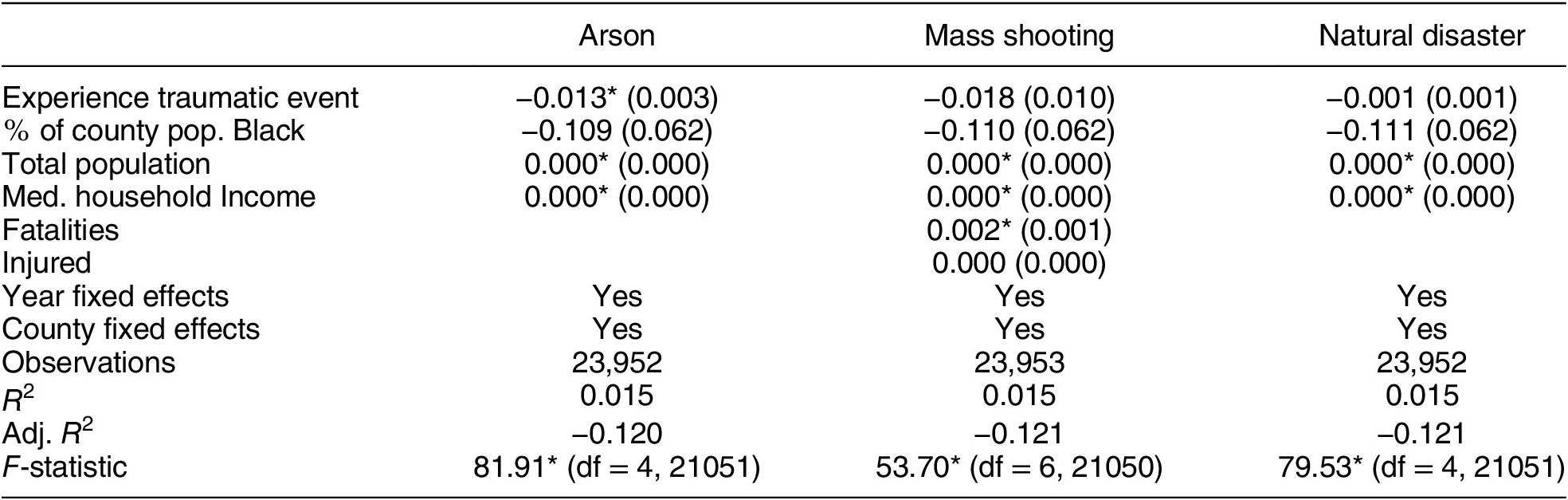
Table 1 provides the results of the TWFE models. I find that the estimated effect of experiencing an arson attack on turnout is statistically and substantively significant at -0.013. This estimate reflects a 1.3 percentage-point decrease in turnout for counties that experienced an arson attack on a Black church. This effect size is enough to potentially affect the results of an election, as previous research finds such a shift is important, especially in close elections (Hansford and Gomez Reference Hansford and Gomez2010). I also find a substantively significant demobilizing effect of mass shootings at -0.018, reflecting a 1.8 percentage point-decrease in turnout for counties that experienced a mass shooting. This estimate is not statistically significant at the p < 0.05 level but is at the p < 0.10 level.Footnote 5 Although the estimate for the effect of natural disasters on turnout is not statistically significant, it is in the right direction with a coefficient of -0.001. These results consistently demonstrate that traumatic events have a demobilizing effect in that turnout decreases in the next election for counties that experienced one of these traumatic events. Furthermore, I hypothesize that arson and mass shootings, which are interpersonal and intentional, will cause especially strong posttraumatic stress-demobilizing political responses compared with those from natural disasters, for which I find evidence in these results.Footnote 6
Effect of Traumatic Event on Turnout, Generalized Two-Way Fixed Effects (county-year) Estimator

Note: County-clustered standard errors in parentheses; *p < 0.05.
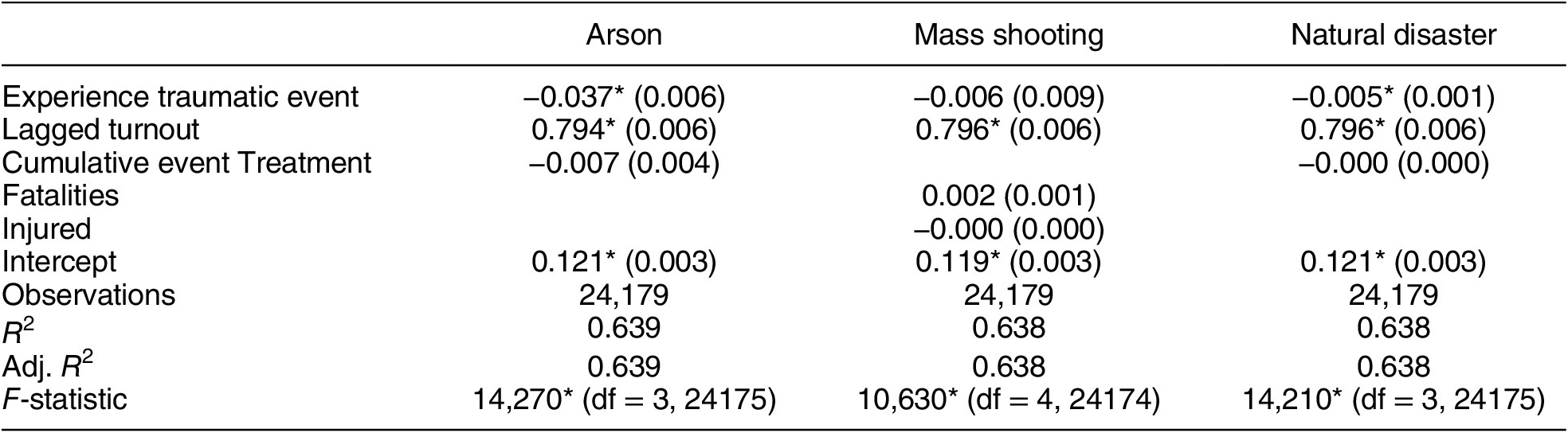
Table 2 provides the results from the LDV models for the effect of arson attacks, mass shootings, and natural disasters on presidential election turnout. In these models, I find a statistically and substantively significant estimate for the effect of arson attacks on turnout with a coefficient of -0.037, translating to a 3.7 percentage-point decrease in turnout for counties experiencing an arson attack. Counties experiencing a mass shooting experience a 0.6 percentage-point decrease in turnout, though the estimate is not statistically distinguishable from zero. Finally, the model estimates a statistically significant 0.5 percentage-point decrease in turnout for counties that experienced a natural disaster. Though, as indicated above, these are counties that experienced a natural disaster and received FEMA aid afterwards, which should have minimized posttraumatic stress reactions; thus, this is a conservative estimate of the effect of natural disasters on turnout.
Effect of Traumatic Event on Turnout, Lagged Dependent Variable Estimator

Note: There are no counties that experience more than one mass shooting, so there is no cumulative event treatment included for this model; *p < 0.05.
Altogether, these results provide consistent evidence that arson attacks cause a decrease in turnout of between 1.3 and 3.7 percentage points. I find less consistent, yet still convincing evidence that mass shootings and natural disasters decrease turnout by 0.6 to 1.8 percentage points and 0.1 to 0.5 percentage points, respectively, for counties experiencing such events. Notably, I never find a statistically significant posttraumatic growth-mobilization effect. Instead, I find consistent evidence confirming my hypothesis about the demobilizing effects of traumatic events and this mechanism’s potential for creating a serious democratic problem. In an era of close elections, any small decrease in turnout matters for the outcome of the election. Several notable cases in the last 20 years come to mind in which single-digit changes in turnout in some states or counties decided the winner of the electoral college. Furthermore, these changes in turnout are quite large when compared with other variables in the model that have an effect on turnout, such as the median household income of a county, which has a comparatively smaller effect on turnout than traumatic events in these models.
Temporal Proximity
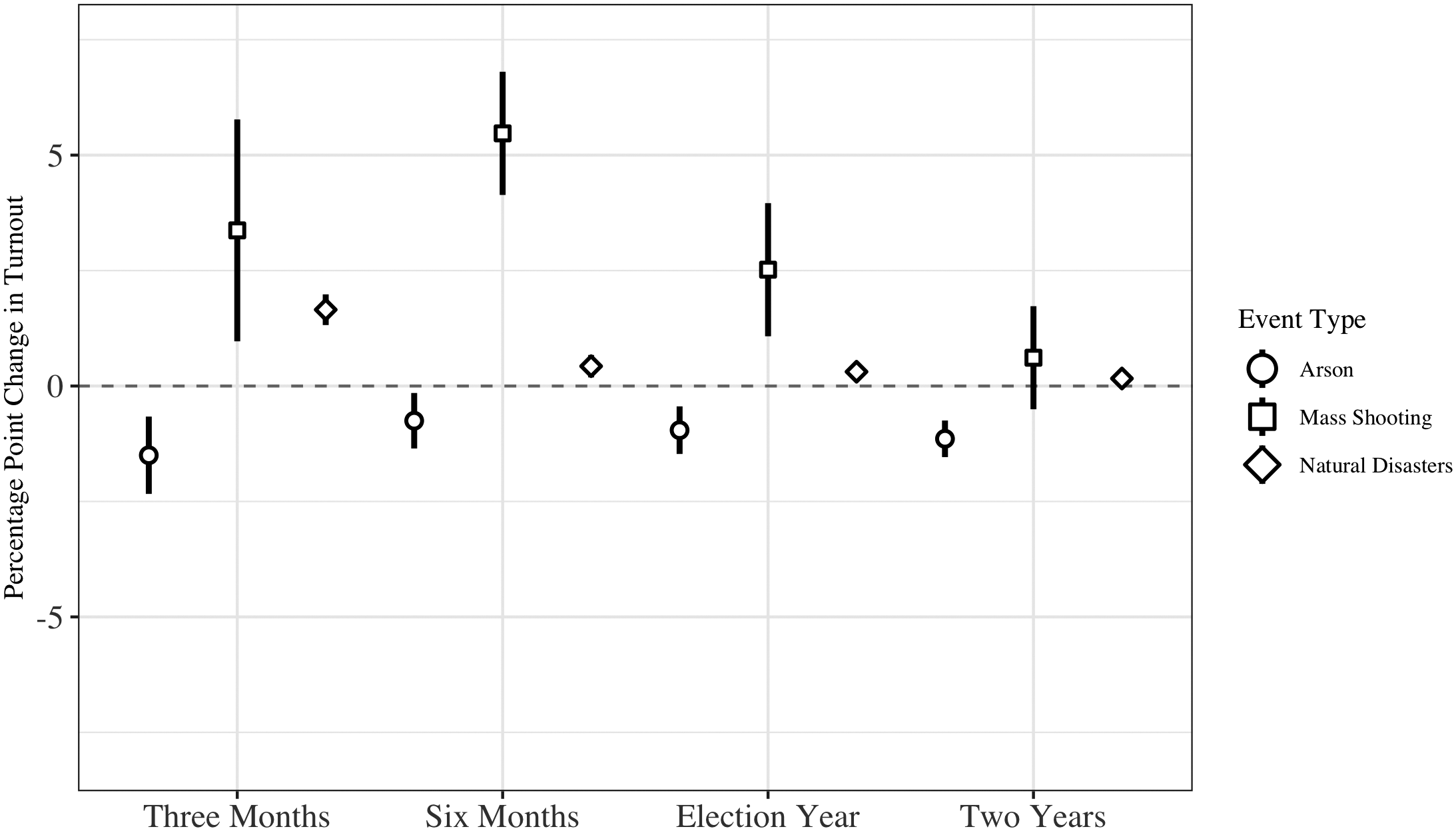
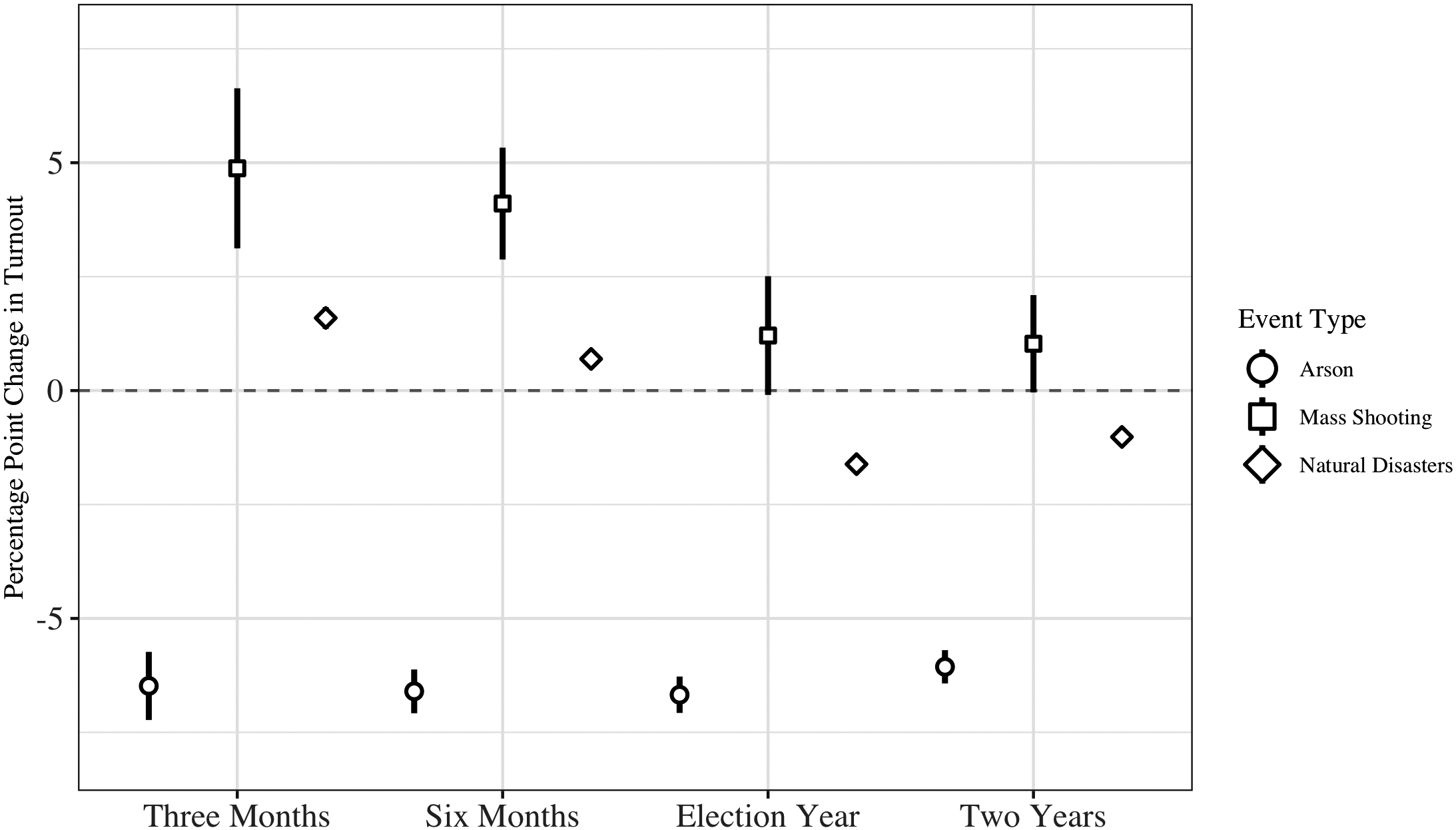
Figures 1 and 2 plot the coefficient estimates and 95% confidence intervals of the TWFE and LDV models testing the effect of temporal proximity of a traumatic event to a presidential election on turnout. To test the effects of temporal proximity, I run the same TWFE and LDV models where the treatment is whether the traumatic event occurs within three months, six months, within the election year, or within two years of an election.
Proximity of Traumatic Event Effect on Turnout, Two-Way FE Estimator
Note: The plot presents the percentage-point change in the estimated turnout for counties that experienced a Black chuch arson, mass shooting, or natural disaster by the temporal proximity of the event to the next presidential election, using the county-level data. The point estimates are the coefficient estimates from a two-way fixed effects model, and the error bars represent 95% confidence intervals. Full results are in Tables E.1, E.2, and E.3 in the SI.

Proximity of Traumatic Event Effect on Turnout, Lagged DV Estimator
Note: The plot presents the percentage-point change in the estimated turnout for counties that experienced a Black chuch arson, mass shooting, or natural disaster by the temporal proximity of the event to the next presidential election, using the county-level data. The point estimates are the coefficient estimates from a lagged dependent variable model, and the error bars represent 95% confidence intervals. Full results are in Tables E.4, E.5, and E.6 in the SI.

Social psychological research tells us that we should expect that posttraumatic stress reactions get worse over time, and these figures demonstrate just such a pattern, providing partial support for H2a, partial support for H2b, and unconvincing evidence for H2c. The results demonstrate a consistent demobilizing effect of Black church arson attacks regardless of the event’s proximity to a presidential election. But, a general pattern confirming H2a and H2b appears for both mass shootings and natural disasters: events that occur close to an election have a mobilizing effect, but this decreases over time, eventually reverting to the mean and, in the case of natural disasters, becoming demobilizing events. Although mass shootings follow this general trend, the small number of cases that fall in these time cuts warrant caution in deriving clear and decisive evidence of these patterns. Instead, I find that natural disasters fit this pattern, that Black church arson attacks exhibit consistent posttraumatic stress-demobilizing effects over time, and that more data are needed to confirm the findings for mass shootings, though these initial findings fit with prior social psychological work.
Shared Social Identity
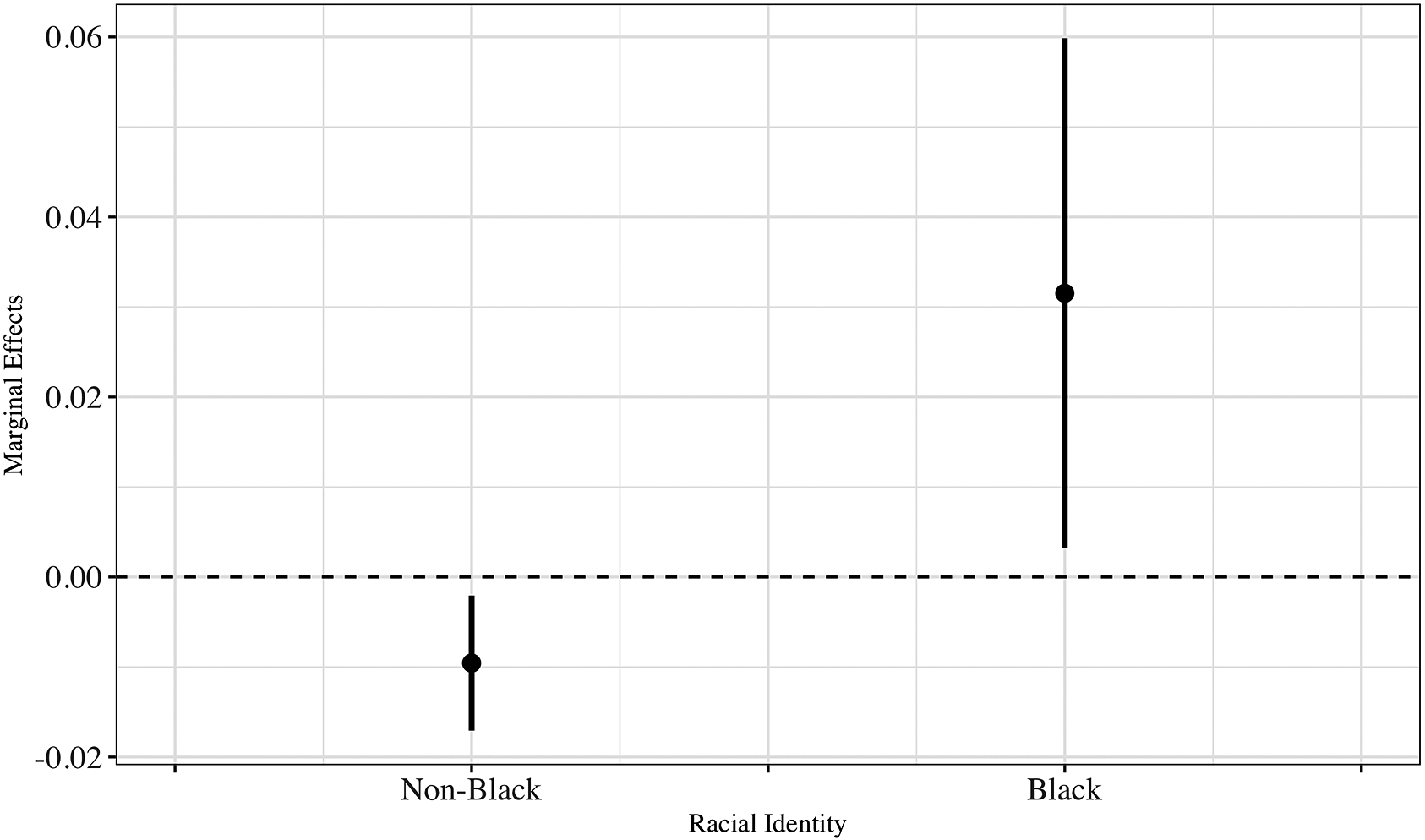
Although data limitations before 2008 restrict my ability to measure turnout for Black voters at the county level, an individual-level analysis allows me to identify the posttraumatic political response of Black Americans in the wake of Black church arson attacks. Black voters are more likely to be disproportionately affected by all traumatic events, but Black church arson attacks are a special case that allows me to identify how social identity conditions posttraumatic political response. Because Black Americans are the primary targets of this traumatic event and it is interpersonal and intentional, they could exhibit higher posttraumatic stress-demobilizing responses. But, because of the central role of Black social identity in these horrific events, the Black community within each county provides survivors with the resources to demonstrate posttraumatic growth/resilience political responses. I theorize that the social and political support provided by Black identity should cause a posttraumatic growth/resilience political response when the event makes Black identity salient. In short, I should find an increase in turnout among Black Americans living in counties that experienced a Black church arson attack.
I find support for H3 in Figure 3, which plots the marginal effects of a Black church arson attack on voting with 95% confidence intervals, varied by racial identity. The figure shows that whereas arson attacks demobilize non-Black voters, I find a posttraumatic growth/resiliency-mobilization political response among Black voters.
Black Social Identity Conditions the Effect of Black Church Arson Attacks on Voting
Note: The plot represents the marginal effect of Black racial identity on the effect of experiencing a Black church arson within the county of residence for respondents to the Current Population Survey. The point estimates are the coefficient estimates from a two-way fixed effects model, and the error bars represent 95% confidence intervals. Full results are in Table D.4 in the SI.

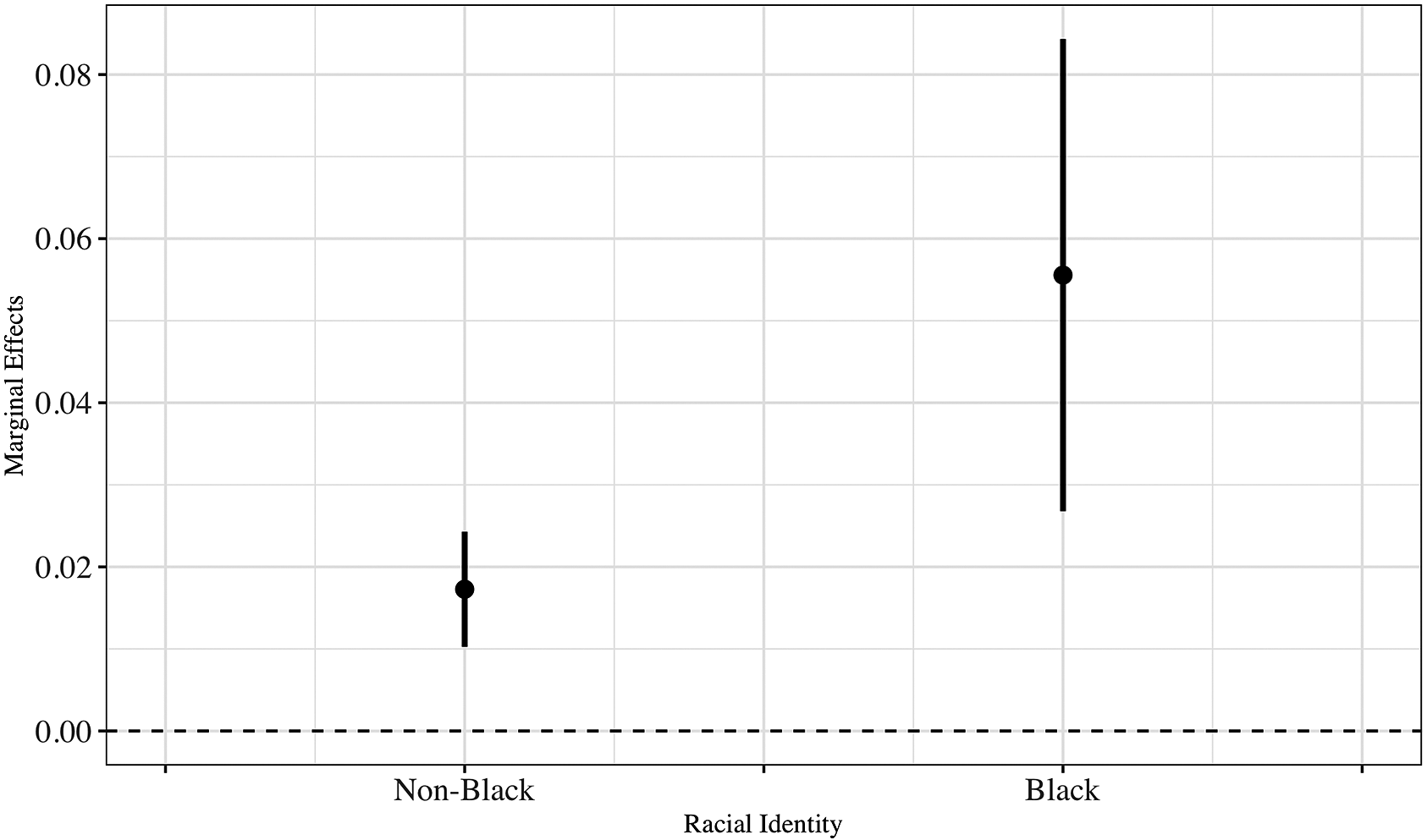
Survivors of traumatic events internalize trauma differently, especially when social identities are made salient. Hurricane Katrina is an example of such an event. Katrina brought racial inequality to the forefront of Americans’ attention (Sweeney Reference Sweeney2006). The trauma of Hurricane Katrina was deeply tied to the context of Black New Orleanians’ lives, which was characterized by unequal access to resources and economic and political opportunities. This made Black identity a key conditioning factor in how Americans sympathized with victims and blamed elected officials (Huddy and Feldman Reference Huddy and Feldman2006; Sweeney Reference Sweeney2006).
The dynamics of framing Katrina’s effects had important implications for how Black New Orleanians internalized trauma. With mainstream media referring to survivors as “refugees” instead of “evacuees,” Black New Orleanians were further alienated. Not only were Black New Orleanians not receiving adequate aid from FEMA quickly enough, but this framing insinuated Black Americans were un-American and unimportant (Cole Reference Cole2008). I therefore test Black identity’s conditioning effect on the effect of Hurricane Katrina (as a traumatic event that primed Black identity) on turnout.
I find further support for H3 in Figure 4, which plots the marginal effects of living in a county that was affected by Hurricane Katrina on voting, with 95% confidence intervals, varied by racial identity. The figure provides further evidence of a strong posttraumatic growth/resiliency-mobilization political response among Black voters in response to a traumatic event that is not inherently racial but was racialized in its effects and political coverage. Although there is a slight mobilizing effect among non-Black voters affected by Hurricane Katrina, the effect is substantively and statistically significantly larger among Black voters at almost the exact proportion for Black church arsons.Footnote 7
Black Social Identity Conditions the Effect of Hurricane Katrina on Voting
Note: The plot represents the marginal effect of Black racial identity on the effect of experiencing Hurricane Katrina within the county of residence for respondents to the Current Population Survey. The point estimates are the coefficient estimates from a two-way fixed effects model, and the error bars represent 95% confidence intervals. Full results are in Table D.8 in the SI.

These results provide support for H3 that when a traumatic event makes a social identity salient, posttraumatic growth/resiliency-mobilization responses are more likely among the group that shares this salient social identity with the primary targets/survivors. These results confirm the well-established resiliency of Black Americans (Brown Reference Brown2008), but they also identify the political consequence of Black resiliency in the face of direct threats to Black civil and religious rights and personal safety: when certain whites threaten the Black community with traumatic events, Black voters are mobilized to vote.
CONCLUSION
Traumatic events decrease voter turnout in American presidential elections. In particular, this study finds that geographic proximity, temporal proximity, and shared salient social identity condition aggregate and individual responses to traumatic events. In the wake of Black church arson attacks, mass shootings, and natural disasters, affected individuals’ voting behavior is characterized by posttraumatic stress-demobilization responses whereby voters in affected counties turnout to vote at significantly lower rates. Furthermore, the closer to an election a traumatic event occurs, the more likely it is to drive a mobilization response, whereas the further in advance of an election it is, the more likely it is to revert to the mean or drive a demobilization response. Finally, Black social identity provides important resources that encourage posttraumatic growth/resilience-mobilization responses among Black Americans when traumatic events make race salient.
My theory of posttraumatic political response helps to theoretically disentangle the effect of trauma on political behavior, and my empirical tests confirm a net negative effect, with exceptions for the conditioning effect of social identity and time. Importantly, the effects of traumatic events are enduring and substantial. Moreover, because of prior research on the unequal burden of trauma and posttraumatic stress responses, these findings also insinuate that the demobilizing force of trauma in American politics is likely to create further barriers to political equality for Black Americans, women, and individuals with lower socioeconomic status unless social resources are made salient or available. That is, in the wake of a traumatic event, policy demanders who make social identities salient provide resources that drive a posttraumatic growth/resilience response and may counteract a posttraumatic stress response that would depress and demobilize those most likely to be cut out of the democratic process. Likewise, government can increase aid to communities to help bolster social resources through social identity formation and solidification in the framing of events and through provision of physical and economic resources for recovery. As traumatic events have always been a feature of human life, it is unlikely that these demobilizing trends will resolve themselves. And so, it is incumbent upon social interest groups and political elites to provide more resources to increase posttraumatic growth-mobilizing responses and decrease posttraumatic stress-demobilizing responses.
Future research should identify the role that policy demanders and party elites play in promoting posttraumatic growth/resilience political responses in the wake of traumatic events that would otherwise demobilize voters. Police violence is one case beyond the scope of this study that would exemplify such dynamics. The police killings of Amadou Diallo, George Floyd, Breonna Taylor, and others led to increased political engagement (Williamson, Trump, and Einstein Reference Williamson, Trump and Einstein2018) and decreased contact with government (Cohen et al. Reference Cohen, Gunderson, Jackson, Zachary, Clark, Glynn and Owens2019). Because Black Americans experience a disproportionate share of interactions with the carceral state, this is an important type of traumatic experience in need of further examination. The present study has examined the general trends of how traumatic events influence voter turnout, especially when the event primes Black identity. The findings of this research help provide clues as to how future studies on other racialized traumatic events, such as police violence, should proceed. With data collection related to ongoing movements related to the repeated and internalized trauma of police violence, future work should build on this study to examine how trauma connects to participation beyond voting, such as protesting (Williamson, Trump, and Einstein Reference Williamson, Trump and Einstein2018).
Future research into police violence through the lens of trauma is a promising avenue for identifying the internal dynamics of mobilization and demobilization, as it may be the case that certain events drive a decrease in voting but an increase in other forms of social and political engagement. Finally, future research should investigate the role of trust and social group attachment in the wake of traumatic events and how these mediate posttraumatic political responses.
In 1996, then-Assistant Attorney General for Civil Rights Deval Patrick called the rising number of attacks on Black churches an “epidemic of terror.” At the time, it was unclear whether such attacks were a part of a larger white supremacist conspiracy or a disorganized, but no less concerning, racist copy-cat effect. At the heart of the subsequent Department of Justice investigations into the attacks was whether or not these attacks constituted a threat to not only religious liberty but also fundamental civil rights, a concern voiced by the NAACP (Fletcher Reference Fletcher1996). This study finds that not only are Black church arson attacks a civil rights violation and a threat to religious liberty; they are more fundamentally a threat to political rights and equality. Furthermore, the study finds that other traumatic events that make social identity salient, such as Hurricane Katrina, mobilize Black voters in the next election. Although shared social identity drives this posttraumatic growth/resiliency-mobilizing effect, the long-term implications of such repeated traumas is unclear. American democracy has relied for too long on the resiliency of Black Americans. If American democracy is to survive, therefore, party elites and policy demanders must use the mechanisms available to them to provide the necessary social, political, and economic resources for those who carry the heaviest burden of trauma to ensure that such events do not demobilize voters.
Supplementary Materials
To view supplementary material for this article, please visit http://doi.org/10.1017/S0003055422001010.
DATA AVAILABILITY STATEMENT
Research documentation and data that support the findings of this study are openly available at the American Political Science Review Dataverse: https://doi.org/10.7910/DVN/MXKMSE.
ACKNOWLEDGMENTS
The author is grateful to Geoffrey C. Layman, Jeffrey Harden, Christina Wolbrecht, David E. Campbell, and Dave Peterson for their very helpful comments on previous versions of this manuscript. I am especially thankful to Dave Campbell for sharing turnout data.
CONFLICT OF INTEREST
The author declares no ethical issues or conflicts of interest in this research.
ETHICAL STANDARDS
The author affirms this research did not involve human subjects.




Comments
No Comments have been published for this article.