



Introduction
The family Roccellaceae currently comprises 42 genera (Lücking et al. Reference Lücking, Hodkinson and Levitt2017; Wijayawardene et al. Reference Wijayawardene, Hyde, Dai, Sánchez-García, Goto, Saxena, Erdoğdu, Selçuk, Rajeshkumar and Aptroot2022) including both lichenized and non-lichenized species. Members of the family are mostly distributed in tropical to subtropical regions colonizing a wide range of substrata, including leaf, bark, rock, and other lichens (Aptroot et al. Reference Aptroot, Damien, de Jesus, Costa and Cáceres2013; Ertz et al. Reference Ertz, Tehler, Irestedt, Frisch, Thor and van den Boom2015; Cannon et al. Reference Cannon, Aptroot, Coppins, Ertz, Sanderson, Simkin and Wolseley2023). So far, 40 species of Roccellaceae in 15 different genera have been reported from India (Awasthi Reference Awasthi1991; Jagadeesh Ram et al. Reference Jagadeesh Ram, Aptroot, Sinha and Singh2007, Reference Jagadeesh Ram, Sinha and Singh2008; Singh & Sinha Reference Singh and Sinha2010; Joseph et al. Reference Joseph, Sinha and Ramachandran2013; Jagadeesh Ram Reference Jagadeesh Ram2016; Sinha et al. Reference Sinha, Nayaka and Joseph2018; Gupta et al. Reference Gupta, Joseph and Sinha2019; Joseph et al. Reference Joseph, Sinha and Nayaka2020).
Enterographa Fée, with 76 species globally, is the largest genus of Roccellaceae. The genus is characterized by having a crustose thallus; corticolous, foliicolous, saxicolous or lichenicolous habitat; Trentepohlia or Phycopeltis as photobionts; apothecioid, perithecioid or lirellate ascomata with a poorly developed excipulum; an absence of true paraphyses; branched and anastomosing paraphysoids; a hyaline to red-brown, non-carbonaceous hypothecium; cylindrical-clavate, usually 8-spored asci, often with a minute I+ blue apical ring; hyaline and transversely septate ascospores (Sparrius Reference Sparrius2004; Ertz Reference Ertz2009; Seavey & Seavey Reference Seavey and Seavey2014; Kantvilas Reference Kantvilas2021; Lebreton et al. Reference Lebreton, Carriconde, Brouste, Lespagnol, Stenger, Sérusiaux and Ertz2023). The genus Chiodecton Ach., with 29 species worldwide, differs from Enterographa in having mostly perithecioid ascomata, aggregated into slightly to distinctly elevated stroma-like structures and a carbonaceous hypothecium (Thor Reference Thor1990; Ertz et al. Reference Ertz, Tehler, Irestedt, Frisch, Thor and van den Boom2015).
The present work is part of an ongoing floristic study in the Western Himalayas. While identifying freshly collected Roccellaceae samples from the Champawat district in Uttarakhand, we came across similar specimens preserved in herbarium LWG. A detailed study of such specimens resulted in three species new to science, viz. Chiodecton submontaum, Enterographa sparrii and E. subcaudata.
Materials and Methods
The specimens examined in this study were recently collected by one of the authors (RSA) from the Champawat district, Uttarakhand, while some were previously deposited in the herbarium LWG. Morphological examination, photography and dissection were carried out using a Leica S9i stereo zoom microscope with an attached digital camera. Thin, hand-cut sections of ascomata were mounted in water, lactophenol cotton blue (LPCB) and Lugol’s iodine solution (I) and observed under an Optika B-510BF compound microscope. The following were used for spot tests: 10% aqueous KOH solution (K), aqueous solution of calcium hypochlorite (C) and 5% alcoholic p-phenylenediamine solution (P). Ascospore lengths were measured in water and lactophenol cotton blue (LCB) and given as (min)–x̄–(max), where ‘min’ and ‘max’ are the extreme values, and ‘x̄’ is the arithmetic mean. The presence of secondary metabolites was detected through thin-layer chromatography (TLC) in solvent systems ‘A’ and ‘B’ following Orange et al. (Reference Orange, James and White2001). Terminologies and keys provided by Thor (Reference Thor1990), Tehler (Reference Tehler1997), Grube (Reference Grube1998), Sparrius (Reference Sparrius2004), Aptroot & Sparrius (Reference Aptroot and Sparrius2008) and Seavey & Seavey (Reference Seavey and Seavey2014) were followed for identification.
Results and Discussion
Roccellaceae is a prominent family of lichens in India. Although several new species and new records of the family have been documented by various Indian lichenologists (Jagadeesh Ram et al. Reference Jagadeesh Ram, Aptroot, Sinha and Singh2007, Reference Jagadeesh Ram, Sinha and Singh2008; Joseph et al. Reference Joseph, Sinha and Ramachandran2013, Reference Joseph, Sinha and Nayaka2020; Jagadeesh Ram Reference Jagadeesh Ram2016; Gupta et al. Reference Gupta, Joseph and Sinha2019), the family remains poorly studied. Previously, most of the species of Roccellaceae in India have been reported from the Andaman and Nicobar Islands, the north-eastern regions and the Western Ghats, possibly due to the high humidity in these areas. The present study discovered three new species, viz. Chiodecton submontaum, Enterographa sparrii and E. subcaudata, which further expands the distribution of Roccellaceae in the Western Himalayas. Among the three new species, E. sparrii exhibits morphological similarities to the genus Chiodecton; however, it lacks a carbonized exciple and hypothecium, a characteristic feature present in all the known Chiodecton species. An identification key to Roccellaceae members in India is also provided.
The New Species
Chiodecton submontanum R. Adhikari, Nayaka & Upreti sp. nov
MycoBank No.: MB 859721
Similar to Chiodecton montanum Thor but lacks yellow pigment in the medulla and has more septa in the ascospores.
Type: India, Uttarakhand, Champawat district, Lohaghat, Abbott Mount, on rock, 1938 m, 29°28′43″N, 80°6′49″E, 13 March 2024, R. S. Adhikari 24-368683/C (LWG—holotype; LWG—isotype).
Chiodecton submontanum. A, habit. B, prothallus. C, ascomatal section. D, ascospores. E, hymenium with inspersion. Scales: A = 0.5 cm; B = 2 mm; C = 0.5 mm; D = 10 μm; E = 20 μm. In colour online.

Thallus saxicolous, crustose, greenish grey, tightly attached to the substratum, 2–5 cm diam. and 0.3–0.6 mm thick, ecorticate, continuous, verrucose, epruinose; medulla white, incrusted with numerous calcium oxalate crystals. Photobiont Trentepohlia, cells mostly round, 8–12 μm diam. Prothallus distinct, brown.
Ascomata perithecioid, 0.13–0.17 mm diam., solitary to united, immersed in verrucae, verrucae irregular, slightly to distinctly raised, without constriction at the base, epruinose, usually with > 10 ascomata per verrucae. Exciple 10–15 μm thick, carbonaceous. Hypothecium carbonaceous, extending down to the substratum. Hymenium hyaline, 80–120 μm high, I+ blue, IKI+ blue, inspersed, inspersion prominent or restricted towards the lower half of the hymenium only. Paraphysoids branched and anastomosing, 1–2.5 μm thick, apices not or slightly thickened. Asci cylindrical, 85–110 × 11–14 μm, 8-spored, tholus with IKI+ blue ring. Ascospores fusiform with one end pointed while the other blunt, (46.3)–54.6–(63.7) × (2.2)–2.6–(3.2) μm (n = 30), 6–8(–10)-septate; perispore absent.
Pycnidia not seen.
Chemistry
Thallus K−, P−, C−, UV−. TLC: roccellic acid.
Etymology
The species epithet ‘submontanum’ is based on its close resemblance to Chiodecton montanum.
Habitat and distribution
The new species was collected on exposed rocks in temperate forests of the Western Himalayas. Currently, this species is known only from its type locality.
Remarks
This species is characterized by a saxicolous habitat, verrucose thallus, inspersed hymenium with I+ persistently deep blue reaction, and ascospores exceeding 50 μm in length with 6–10 septa. It is similar to Chiodecton montanum, a saxicolous species which differs in having a yellow-pigmented medulla and 3-septate ascospores (Thor Reference Thor1990). Other species of the genus with an I+ persistently deep blue reaction of the hymenium and ascospores with ≥ 7 septa are C. lichexanthonicum M. Cáceres & Aptroot and C. mucorinum Zahlbr. Both these species differ in having a clear hymenium, a corticolous habitat, and smaller ascospores ≤ 50 μm in length with ≤ 8 septa (Thor Reference Thor1990; Cáceres & Aptroot Reference Cáceres and Aptroot2017). Furthermore, Chiodecton lichexanthonicum differs in the presence of lichexanthone (thallus UV+ yellow), and C. mucorinum has a white pruinose thallus and ascomata that are immersed in distinctly elevated pseudostromata (Thor Reference Thor1990; Cáceres & Aptroot Reference Cáceres and Aptroot2017).
Enterographa sparrii R. Adhikari, Nayaka & Upreti sp. nov.
MycoBank No.: MB 859723
Similar to Enterographa diederichiana Ertz but differs in having longer and narrower ascospores, (25–35 × 4–5 μm vs 40–60 × 1.5–3 μm).
Type: India, Kerala, Idukki district, Thenmallay, Tea Estate area, near Munnar, along roadside, on the bark of Quercus trees, c. 1800 m, 26 March 1985, D. D. Awasthi, R. Tewari & R. Mathur 85.340 (LWG—holotype; LWG—isotype).
A–E, Enterographa sparrii. A, habit. B, ascus (after treatment with IKI). C, prothallus. D, ascomatal section. E, ascospore. F–I, E. subcaudata. F, habit. G, ascomatal section. H, ascus with ascospores. I, ascospore. H & I, in lactophenol cotton blue. Scales: A & F = 2 mm; B, E, H & I = 10 μm; C = 0.5 cm; D & G = 100 μm. In colour online.
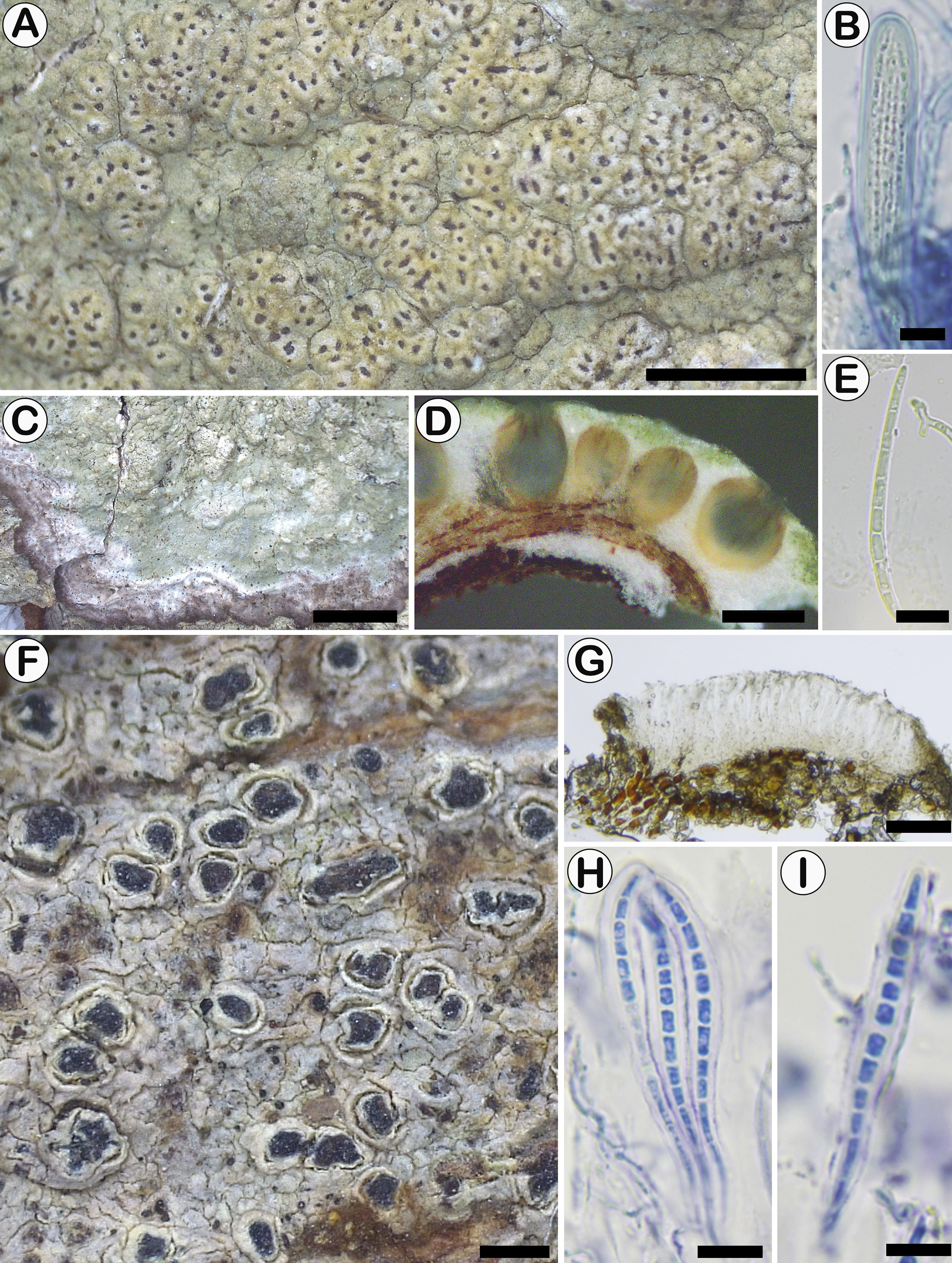
Thallus corticolous, crustose, pale grey to greenish grey, tightly attached to the substratum, up to 3 cm diam., 0.2–0.4 mm thick, ecorticate, continuous, verrucose, epruinose; medulla white, incrusted with numerous calcium oxalate crystals. Prothallus distinct, brown at the margin, whitish inside. Photobiont Trentepohlia, cells mostly round, 7–15 μm diam.
Ascomata perithecioid, 0.1–0.2 mm diam., usually solitary, sometimes united, immersed in slightly raised pseudostromata (usually with more than 10 ascomata). Exciple hyaline to pale, 10–12 μm thick. Hypothecium hyaline to pale, 30–50 μm high, not extending to the substratum. Hymenium hyaline, 100–150 μm high, I+ blue, KI+ blue, not inspersed. Paraphysoids simple to sparingly branched, 1–1.5 μm thick, apices not or slightly thickened. Epihymenium indistinct. Asci cylindrical, 80–100 × 12–15 μm, tholus with IKI+ blue apical ring. Ascospores fusiform with one end pointed while the other blunt, (40.0)–48.5–(59.5) × (1.5)–2.5–(3.3) μm (n = 30), 6–8(–9)-septate; perispore thin, < 0.5 μm.
Pycnidia not seen.
Chemistry
Thallus K−, P−, C−, UV−. TLC: roccellic acid.
Etymology
This species is dedicated to Laurens B. Sparrius, a Dutch lichenologist, for his contribution to the genus Enterographa.
Habitat and distribution
Enterographa sparrii was found growing on the bark of Quercus trees along roadsides. This species is currently known only from its type locality.
Remarks
This species is characterized by a greenish grey thallus with a distinct, brown prothallus, perithecioid ascomata, immersed in slightly raised pseudostromata and 6–9-septate ascospores. In the world key of Enterographa (Seavey & Seavey Reference Seavey and Seavey2014), this species would key out at couplet 42 with E. diederichiana, but ascomata of that species are immersed in a distinctly raised pseudostroma and it has smaller and broader ascospores, 25–35 × 4–5 μm, with less (4–7) septa (Ertz Reference Ertz2009).
Enterographa subcaudata R. Adhikari, Nayaka & Upreti sp. nov.
MycoBank No.: MB 859724
Similar to Enterographa caudata F. Seavey & J. Seavey but differs in lacking lichexanthone.
Type: India, West Bengal, Nadia district, Mohanpur, IISER-Kolkata campus, on bark, T. Hembram 14-024658 (LWG—holotype).
Thallus corticolous, crustose, greyish white, tightly attached to the substratum, 1.5–3.0 cm diam., 0.15–0.21 mm thick, ecorticate, continuous to cracked, smooth, epruinose; medulla white, incrusted with numerous calcium oxalate crystals. Prothallus absent. Photobiont Trentepohlia, cells mostly round, 9–15 μm diam.
Ascomata apothecioid, up to 0.6 mm diam. and 0.2 mm high, immersed, round to irregular; disc black, surrounded by a 30–60 μm thick, white to cream-coloured, ecorticated pseudothalline margin, separating from the thallus at maturity. Exciple hyaline to pale brown, 10–15 μm wide. Hypothecium hyaline to pale brown, 15–30 μm high. Hymenium hyaline, 65–90 μm high, I+ red, KI+ blue, not inspersed. Paraphysoids simple to sparingly branched, 1–2 μm thick, apices slightly thickened, 2–3 μm diam. Epihymenium indistinct. Asci clavate, 55–85 × 15–18 μm, 8-spored, tholus with IKI+ blue ring. Ascospores fusiform, (36.1)–45.8–(58.4) × (2.7)–3.4–(4.5) μm (n = 32), 6–12(–15)-septate, usually with a long acicular tail; perispore 1.5–2.5 μm thick.
Pycnidia not seen.
Chemistry
Thallus K−, P−, C−, UV−. TLC: schizopeltic acid.
Etymology
The species epithet ‘subcaudata’ refers to its closeness to Enterographa caudata.
Habitat and distribution
The new species was found growing on bark, collected from tropical regions of Assam and West Bengal.
Remarks
Enterographa subcaudata is characterized by having a greyish white thallus, immersed apothecioid ascomata, an I+ red hymenial reaction, 6–12(–15)-septate ascospores and by containing schizopeltic acid. Superficially this species is similar to Enterographa caudata and E. mesomela Sparrius et al. Enterographa caudata differs in containing lichexanthone (thallus UV+ yellow), while E. mesomela differs in containing confluentic acid in the thallus and norstictic acid in the hypothecium, lacking schizopeltic acid, having an I+ blue hymenial reaction and ascospores without an acicular tail (Sparrius et al. Reference Sparrius, Saipunkaew, Wolseley and Aptroot2006; Seavey & Seavey Reference Seavey and Seavey2014).
Additional specimens examined
India: Assam: Dhubri district, Panbari Tea Garden, on bark, 42 m, 26°9′12.8″N, 90°3′2.7″E, 9 ii 2020, S. Biswas s. n. (LWG); Sonitpur district, Arimora, on bark, 54 m, 2012, R. Daimari, K. D. Masahary & P. J. Borah 14-022403(LWG); Burahgaon, on bark, 66 m, 2012, R. Daimari, K. D. Masahary & P. J. Borah 14-020569 (LWG); Solagaon, on bark, 74 m, 2012, R. Daimari, K. D. Masahary & P. J. Borah 14-020548 (LWG).
A taxonomic key to the members of Roccellaceae in India

Acknowledgements
The authors are grateful to the Director, CSIR-National Botanical Research Institute, Lucknow, for providing laboratory facilities under in-house project OLP 0114; to the PCCF, Forest Department, Uttarakhand, for permitting the collection of lichen specimens; and to other lichen collectors who have deposited their specimens in herbarium LWG. RA also thanks the University Grants Commission, New Delhi, for providing financial assistance in the form of SRF (manuscript number CSIR-NBRI_MS/2025/01/17).
Author ORCIDs
Rakesh Adhikari, 0000-0003-0403-864X; Sanjeeva Nayaka, 0000-0001-6541-2362; Dalip K. Upreti, 0000-0002-5513-1759.
Competing Interests
The authors declare none.



