Implications
This study analyzes possible improvement of breeding management in the Italian Heavy Draught Horse (IHDH), a breed selected for heavy draught and meat production by a total merit index (TMI) accounting both attitudes. It highlights that maiden mares’ breeding can be improved by avoiding early first foaling at 3 years in feral or semi-feral conditions, because of the greater risk of conception failure in the subsequent season. Young 2-year-old stallions can be preferred for breeding to proven stallions and safely used for 3 to 4 subsequent years because of their mean genetic superiority in TMI over this time, also reducing cost of services.
Introduction
Breeding management in animal production systems largely depends on the biological aspects appropriate to each species, but it is also linked to the population structure and the productive aptitude of each breed (Koenen et al., Reference Koenen, Aldridge and Philipsson2004). With regard to horses, it is possible to recognize distinct breeding management in ‘light breeds’ and ‘heavy breeds’ (Hendricks, Reference Hendricks1995). The preference for young animals in athletic practices means that light breed horses are bred quite late in life. On the other hand, heavy draught breeds, ponies and saddle horses, used for leisure, are subjected to a breeding management similar to other farm species such as cattle, because of the absence of sport activity. Many aspects of reproduction management in horses (Gordon, Reference Gordon1997; Camillo et al., Reference Camillo, Galli and Palmer2006; Davies Morel, Reference Davies Morel2008), such as the correct nutrition of stallions and mares (Ellis et al., Reference Ellis, Boekhoff, Bailoni and Mantovani2006; Guillaume et al., Reference Guillaume, Salazar-Ortiz and Martin-Rosset2006a; Mantovani and Bailoni, Reference Mantovani and Bailoni2011), and the effect of nutrition on the occurrence of puberty (Camillo et al., Reference Camillo, Vannozzi, Rota, Panzani, Illuzy and Guillaume2002; Guillaume et al., Reference Guillaume, Salazar-Ortiz and Martin-Rosset2006a and Reference Guillaume, Schneider, Fleurance, Donabédian, Robert, Arnaud, Leveau, Chesneau and Martin-Rosset2006b), have nowadays been fully disclosed. Horses’ optimal reproductive management has also been considered (e.g., Dubois and Ricard, Reference Dubois and Ricard2007), but seldom in draught horses. From this point of view, Langlois and Blouin (Reference Langlois and Blouin2004) have investigated in an across-breed study, factors affecting mares’ numerical productivity (i.e., the number of foals declared per mated mare per year), using population data from different French light and heavy breeds. However, a number of aspects related to optimal breeding management have not yet been fully investigated in draught horses, such as the correct beginning of mares’ reproductive career (i.e., better age at first foaling (AFF)) or the possible advantages in selection because of the use of young stallions that have experienced just a performance test instead of stallions that have already experienced both performance and progeny test (i.e., ‘unproven’ or ‘proven’ stallions, respectively). Indeed, it is expected that young unproven stallions usually have a greater genetic merit than older proven stallions, despite a reduced accuracy in their estimated breeding values (EBVs), as well known for cattle (McDaniel and Bell, Reference McDaniel and Bell1992; Meinert et al., Reference Meinert, Pearson and Hoyt1992; Weigel et al., Reference Weigel, Cassell and Pearson1995). At present, only literature on saddle horses has found that greatest genetic response can be achieved by selecting after performance testing (Hugason et al., Reference Hugason, Arnason and Norell1987; Phillipsson et al, Reference Phillipsson, Arnason and Bergsten1990; Gerber Olsson et al., Reference Gerber Olsson, Árnason, Näsholm and Philipsson2000), and that decreasing age at selection can increase selection intensity (Dubois and Ricard, Reference Dubois and Ricard2007).
The IHDH is nowadays the only indigenous draught breed in Italy (Mantovani et al., Reference Mantovani, Pigozzi and Bittante2005). The breed accounts ∼6300 live registered animals, including nearly 3300 mares distributed in almost 1000 stud farms spread across the Italian territory. The variable size of studs and the different rearing systems could be typically identified in the North (average latitude: 45°; average altitude: 700 m; average temperature: 8°C to 15°C; cool temperate/sub-continental climate), Center (average latitude: 42°; average altitude: 500 m; average temperature: 10°C to 18°C; temperate/sub-coastal climate) or South (average latitude: 38°; average altitude: 200 m; average temperature: 15°C to 20°C; Mediterranean climate) of Italy. Indeed, animals in the North are mainly reared in small numbers in stables, whereas studs in the Center and South of Italy account for bigger groups of animals reared in semi-feral (i.e., individuals spend the winter in stables) or feral systems. This is because of the warmer winter in the Center and the South that enables animals to be kept outdoors for most of the year compared with the North of Italy. In the population, the mean productive life of mares is 5.8 years, with a mean production of 4.5 foals during the reproductive carrier, on average, ending at 9.3 years of age (Mantovani et al., 2005). As in the other heavy breeds, pregnancy is a little longer than in saddle horses (Ginther, Reference Ginther1992), although stud book data for IHDH indicate a mean pregnancy length of 12.2 ± 1.1 months. The IHDH was improved in the past with the use of French Postier Breton stallions since 1911. However, starting from 2004, Breton stallions are no more allowed in the IHDH stud book. The IHDH is nowadays selected for heavy draught works and meat production, and animal selection is based on breeding values (EBV) obtained from linear type traits scored on young foals (aged about 6 months), using a TMI combining the single EBVs of five traits: the head size expression (25% of incidence), the temperament (also called ‘blood’; 15% of incidence), the fleshiness (25% of incidence) and the fore (15%) and rear diameters (20% of incidence; Mantovani et al., 2005 and Reference Mantovani, Sartori and Pigozzi2010). The first trait is related to head size and head–neck conjunction, the second is the response to environmental stimuli, expressed by the reactivity and impulsion to the movement, the amplitude of steps and the regularity of pace, whereas the remaining three traits are basically morphometric measurements.
Moving from these points, this study focused on the optimal breeding management in the IHDH breed by a retrospective analysis of population data on mares and stallions after puberty. Particularly, the study has aimed at investigating (i) the effect of the interaction between an early or normal age AFF and different rearing conditions of maiden mares on the reproductive success of the subsequent year and (ii) the genetic lifespan of stallions or, in other words, the mean length of time in which the use of young 2-year-old stallions provide an economic advantage on older proven stallions.
Material and methods
Mares
Stud book data referred to the second reproductive event of 1862 maiden mares born between 1990 and 2001 that experienced a normal event of first foaling was initially considered. After editing, 1513 mares in single records per individual were retained for further analysis. All 1513 animals considered had, in the reproductive season subsequent to the first foaling, a known reproductive event registered as: foaling, abortion or involuntary absence of conception (i.e., open mares). The latter two options for the reproductive event (dependent variable) were both considered as an unsuccessful reproductive event and reported as 0, whereas the foaling (successful reproduction) was reported as 1. When foaling occurred in the subsequent season, animals were retained for analysis if the foaling interval was between 11 and 17 months (12.2 ± 1.0); otherwise, data were discarded from the data set. Lower (i.e., 11 months) and upper (i.e., 17 months) limits of the foaling interval were considered reasonable thresholds under or over which the differences between subsequent foaling dates could be considered wrongly reported. Maiden mares were then classified on the basis of the age AFF, considering 3 years AFF (3YR), the first foaling occurring between 33 and 42 months of age (n = 745), and 4 years AFF (4YR), the first foaling occurring between 45 and 54 months of age (n = 768). No animals were present in the classes of 43 and 44 months of age. Within AFF, maiden mares were also classified on the basis of the rearing system (RS) adopted in the stud farm: stable (S, n = 280 in 3YR and n = 208 in 4YR), semi-feral (SF, n = 334 in 3YR and n = 346 in 4YR) or feral for all the year (F, n = 131 in 3YR and n = 214 in 4YR). The analysis evaluated the probability to fail reproduction at second foaling (n = 1513), and the LOGISTIC procedure (SAS Institute, 2009) was used to model the logit of the probability of unsuccessful reproduction event on the combination of AFF–RS classes (six levels). The equation of logistic regression model was as follows:
 $$ y\, \sim \,{\rm{Bernoulli}}\,{\rm{(}}\pi {\rm{)}} $$
 $$ {\rm{Logit}}\,(\pi )\, = \,\alpha \, + \,\beta \,X $$
where π is the probability of unsuccessful reproduction, α is the intercept and β is the logistic regression coefficients (parameter estimates) for the explanatory effects (X) of different combinations AFF–RS, as described above. Other explanatory factors were not accounted for in the final model (e.g., birth year of mare) because of their nonsignificant effect on the probability of unsuccessful reproduction. A preliminary analysis with separate AFF and RS effects was also performed, but because of a worse fitting owing to a greater Akaike's Information Criterion (AIC; Akaike, Reference Akaike1974), this model was not considered, and the combination AFF–RS was preferred. The probability of unsuccessful reproduction in the final model was declared significant at P ⩽ 0.01 of Wald statistics. Finally, it has to be pointed out that because of the long time extent taken into account by this study, fillies of some previously bred mares were also analyzed (243 on 1513, i.e., 16% of cases). These fillies were bred by the same farmer in the same condition than their mother. Therefore, a partial confounding effect between genetic and rearing system in the group of mares analyzed could exist. This effect was not taken into account by the statistic analysis applied.
Stallions
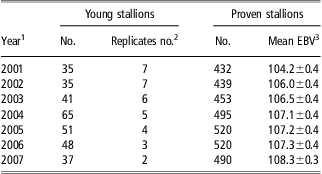
Data on a total of 312 young 2-year-old stallions of different birth years (from 1999 to 2005) were considered (mean n = 45/birth year; Table 1). Each young stallion was tracked for the TMI from the first evaluation at 2 years of age up to the seventh year of genetic evaluation. Because the data set was obtained considering the yearly genetic evaluations obtained from 2001 to 2008, stallions born in 1999 had seven evaluations, from 2001, at 2 years of age, to 2007, whereas stallions born in 2005 had only two evaluations (i.e., 2007 and 2008). According to that, individuals born between 2000 and 2004 had an intermediate number of evaluations. An EBV for the TMI was assessed yearly for each young stallion. Within each birth year class, an individual genetic differential for young stallions was computed as the difference between the breeding value (EBV) of each young stallion from the average EBV of proven stallions (mean n = 483/year; Table 1) obtained in the corresponding year of genetic evaluation. Within a given birth year, all animals aged 2 years were considered as young stallions, and the remaining animals as proven stallions. Each generation of young stallions was followed in the subsequent years of genetic evaluation, calculating again the individual selection differential of young stallions in a given birth year from mean EBV of the remaining proven stallions. Therefore, considering the genetic evaluations carried out from 2001 to 2008, a number between two (birth year 2005) and seven (birth years 1999 and 2000) individual yearly repeats of individual selection differentials were calculated using EBVs for the TMI. As reported by Mantovani et al. (2005), EBVs for the TMI were expressed on an average of 100 and a s.d. of 10. Because of the different timings involved for the genetic evaluation on young stallions and proven stallions, it has to be pointed out that the EBVs for TMI were obtained only from linear-type evaluation for young stallions (when aged 6 months), and from both individual and 6-month-old offspring-type evaluations for proven stallions. Therefore, EBVs used for obtaining individual annual selection differentials had different accuracies; these different accuracies were not taken into account for the aim of the study. Individual genetic differentials were analyzed using the MIXED procedure for repeated measurements (SAS Institute, 2009), with the following hierarchical linear model:
 $$ {{y}_{ijk}}\, = \,\mu \,{\rm{ + }}\,B{{Y}_i}\,{\rm{ + }}\,YS{{{\rm{(}}BY{\rm{)}}}_{k{\rm{:}}i}}\,{\rm{ + }}\,RE{{P}_j}\,{\rm{ + }}\,{{e}_{ijk}} $$
where yijk is the jth individual genetic differential of a k young stallion (YS) in birth year i; BYi is the fixed effect of birth year (i = 1999, …., 2005); YS(BY)k:i is the random effect of YS within BY (error term for the BYi effect); REPj is the progressive number of individual genetic differentials j registered over time in subsequent rounds of genetic evaluation (j = 2, …., 7, depending on the birth year of each YS); and eijk is the random error term ∼N(0, I σe2). Different covariance structures between repeated measures over years were preliminarily analyzed (Littell et al., Reference Littell, Henry and Ammerman1998), and the best fitting method was identified through the AIC parameter. The ante-dependence (co)variance structure, developed for repeated data over time (Gabriel, Reference Gabriel1962), was retained in the final model for the analyzed variable because of its lowest AIC value as compared with other (co)variance structure.
Young stallions retained in each year of comparison and data on reference population of proven stallions (number and mean EBV ± s.e.) for the same year
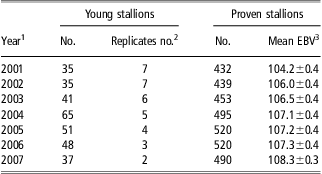
1Year of first genetic evaluation for each generation of young stallion (YS), born 2 years before.
2Replicates represent the number of yearly comparisons with proven stallions as individual total merit EVBs differences of each YS from the mean EBV of proven stallion in subsequent years after the first genetic evaluation.
3Mean estimated breeding value as total merit index for the group of proven stallions within the year of genetic evaluation.
Results
Mares
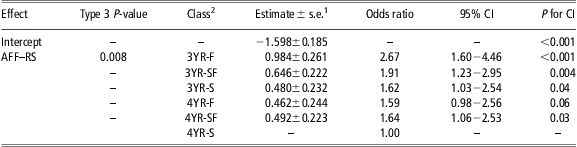
An overall unsuccessful reproduction in the long-day season subsequent to the first foaling because of abortion or unwanted absence of conception involved 25% of mares (i.e., 381 mares out of 1531). Results of the logistic regression analysis performed on the mares’ reproductive performances indicated that the model was significant (P = 0.008; Table 2). Moreover, a significant risk of unsuccessful reproduction in the subsequent season after first foaling was common for all maiden mares that had a first foaling at 3 years of age in feral (3YR-F; P < 0.001 for the confidence interval (CI) of the odd ratio; Table 2) or semi-feral (3YR-SF; P = 0.004 for CI; Table 2) rearing systems. This greater risk of unsuccessful reproduction resulted equal to 91% and 167% for 3YR-F and 3YR-SF, respectively. On the other hand, mares of the same age AFF but reared in stables showed a less certain result in terms of unsuccessful reproduction, because of a lower limit for the CI of the odd ratio, very close to unity (i.e., 1.03; Table 2), and a probability for CI = 0.04 (Table 2). Similarly, a border line situation was found for mares that had a first foaling at 4 years of age reared in feral (4YR-F; lower limit of CI = 0.98; P = 0.06) or semi-feral (4YR-SF; lower limit of CI = 1.06; P = 0.03) conditions (Table 2). The risk ratio for the mares reared in stables and first reproduced at 4 years (4YR-S) was assumed as the reference in the analysis.
Parameter estimates, estimated odds ratios, and their 95% CI from a logistic regression analysis
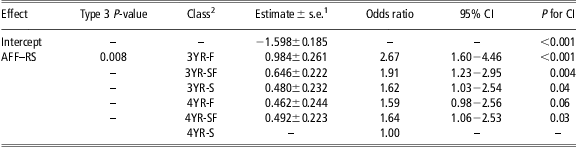
Logistic regression analysis modeled the risk of unsuccessful reproduction in a subsequent year after a normal first foaling combining the effects of age at first foaling (AFF) and rearing systems (RS) in Italian Heavy Draught Horse stud farms. Each level was considered significantly affecting the trait at P ⩽ 0.01
1s.e. = s.e. of estimate.
23YR = 3 years of age at first foaling; 4YR = 4 years of age at first foaling; F = rearing system on feral all year round; SF = semi feral rearing system, i.e., winter in stable; S = rearing system on stables for all the year.
Stallions
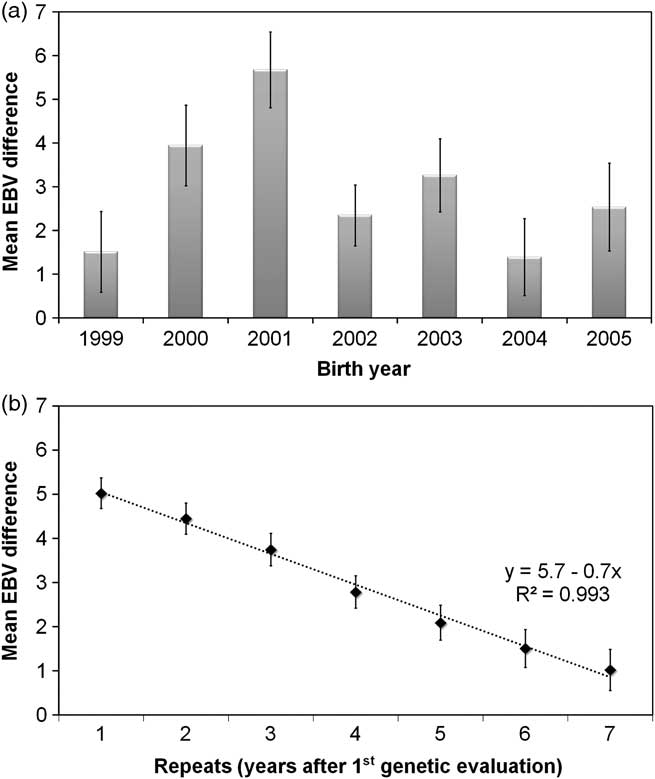
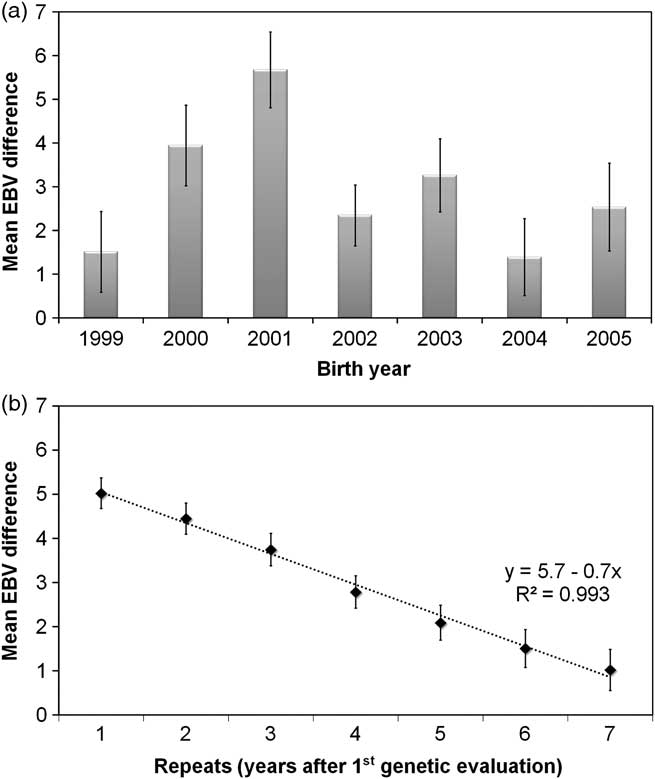
The mixed model analysis on EBV individual differences of young stallions from the mean of proven stallions (individual genetic differentials) indicated that both the birth year and repeat effects (i.e., number of rounds of genetic evaluations for each generation of young stallions) accounted for in the model absorbed a significant amount of variance (P = 0.008 and P < 0.001, respectively; data not shown). Considering the least square means of the individual genetic differentials by birth year of the young stallions (Figure 1a), the young stallions have shown on average 0.3 standard units greater EBVs than proven stallions (i.e., three points considering that EBV is expressed on a mean of 100 and s.d. of 10; Figure 1a). Figure 1b shows the variation of the genetic differential of young stallions in the course of the subsequent yearly measurements (i.e., repeats) considered after the first evaluation for each young stallion. The trend observed in Figure 1b represents the progressive decrease in genetic superiority of young 2-year-old stallions over proven stallions. The regression indicates a yearly decrease of 0.07 s.d. for TMI (i.e., 0.7 on the 10 s.d. scale; Figure 1b). The mean selection differential between young and proven stallions resulted of 0.5 s.d. units at first evaluation, but became halved after 3.6 years. On average, after 4 years from the first evaluation, young stallions lost almost 0.3 s.d. units (Figure 1b).
Least squares means (and SE) obtained from mixed model ANOVA on young stallions’ (YS) data for the effects of birth year (a) and for the number of repeats of individual genetic differentials for each YS (b). Each repeat was obtained as the difference between individual EBV and the mean EBV of proven stallion in subsequent years of genetic evaluations. EBV = estimated breeding value.
Discussion
Mares
In general, the estimated odd ratios obtained in this study indicated a very high risk of unsuccessful reproduction after first foaling for 3-year-old mares reared in feral or semi-feral conditions. On the other hand, in the remaining cases, the risk increases by about 60%, but the probability for the Wald χ 2-test was under the considered threshold for significance. Overall, the event of a first foaling at 3 years of age in maiden mares is a risky practice for the subsequent reproductive season, particularly for mares reared in feral and semi-feral conditions. A previous study in this breed has demonstrated that the first few years of reproductive activity can greatly influence the longevity of the IHDH mares (Mantovani et al., Reference Mantovani, Contiero, Sartori, Stoppa and Pigozzi2007). Therefore, it is important to note that the first foaling represents a critical moment in a mare's career, and the rearing in feral and semi-feral conditions could compromise not only the subsequent year of reproduction, but also the reproductive career of the mare. The high risk of failing conception or abortion in the subsequent year after the first foaling could be mainly a matter of the mares’ correct growth. Despite the fact that in this study it was not possible to take into account the body weight or the size of mares at the time of the first pregnancy, we could speculate that an unsuccessful reproduction following the first foaling at 3 years could be linked to the moment when the mares reach puberty. Young 2-year-old mares may experience a delay of the puberty to the subsequent summer because at their second year they have gone through less than four estrus cycles, mainly because of the winter ovarian inactivity. This can result in a possible lack in estrus behavior (Palmer and Driancourt, Reference Palmer and Driancourt1983; Salazar-Ortiz et al., Reference Salazar-Ortiz, Camous, Briant, Lardic, Chesneau and Guillaume2011). Ovarian inactivity is regulated by metabolic hormones and it is an important adaptation to the environment (Salazar-Ortiz et al., Reference Salazar-Ortiz, Camous, Briant, Lardic, Chesneau and Guillaume2011). The fact that both semi-feral and feral conditions, as compared with the stable system, resulted in a significant risk of unsuccessful reproduction when the first foaling occurred at 3 years could be an indirect confirmation of this hypothesis. Indeed, both feral and semi-feral conditions involve a longer time at pasture for animals. In this regard, it is well known that growth, production and maintenance of condition score are reduced when animals are reared on pasture rather than in confined conditions, as reported for cattle (Camfield et al., Reference Camfield, Brown, Johnson, Brown, Lewis and Rakes1999; Bargo et al., Reference Bargo, Muller, Delahoy and Cassidy2002). Moreover, Aiken et al. (Reference Aiken, Potter, Conrad and Evans1989) have reported lower growth rates also in yearlings and geldings fed at pasture without any supplementation. Nevertheless, it should be mentioned that possible complications in reproduction can occur if animals are bred too early and characterized by an insufficient body size at conception, as reported for cattle (Hoffman, Reference Hoffman1997). To achieve optimal productive performances, both quantitative (Heinrichs and Hargrove, Reference Heinrichs and Hargrove1987; Hoffman, Reference Hoffman1997; Davis Rincker et al., Reference Davis Rincker, Weber Nielsen, Chapin, Liesman, Daniels, Akers and VandeHaar2008) and qualitative (Waldo et al., Reference Waldo, Tyrrell, Capuco and Rexroad1997) correct growth standards have been widely investigated in cattle. Conversely, in horse breeding management, there is a lack of studies aimed at improving reproductive success through a proper growth for an adequate body weight and size at the first insemination of mares.
Stallions
As expected, results obtained for stallions indicated that the mean selection differential of young stallions from older proven stallions was always positive, although it did not increase consistently over time. This indicates that the selection of young stallions is not always focused on increasing the EBV for TMI, and some inefficiency in selection can occur. However, this is consistent with the fact that the TMI is not always the only criterion assumed for selecting the young stallions in the IHDH breed, as previously reported (Mantovani et al., 2005). Indeed, a minimum morphology score is required to allow young males to be registered as ‘stallions’, and this final morphological score does not always reflect the linear-type scores for the five traits considered in the TMI. Moreover, owing to the well-known high incidence of infertility in stallions (Gordon, Reference Gordon1997), another criterion for exclusion of young stallions from the stud book could be fertility, despite the good TMI and final morphological score. The time series analysis of the selection differential between young stallions and proven stallions indicates a progressive loss of genetic superiority of young stallions over time, despite an increase in EBV accuracy. These changes are because of the annual increase in the average breeding values of animals in the population (Mantovani et al., 2005). Indeed, younger animals such as young stallions always show a greater EBV at first evaluation owing to the selection process, but as time goes by the genetic advantage decreases. The study indicates that young 2-year-old stallions could be safely used instead of more expensive proven stallions for at least 3 to 4 years, when a good balance between genetic gain and accuracy is realized. Indeed, other than a genetic superiority, as in many other horse breeds, young stallions also have cheaper services. Conversely, because of their lower accuracy in EBVs, only a multiple use of different young stallions on all mares available at the stud farm can guarantee the success in speeding up the genetic progress at a minor cost compared with the use of older proven stallions.
This result confirms similar findings previously reported for young dairy sires used in the substitution of proven sires (McDaniel and Bell, Reference McDaniel and Bell1992; Weigel et al., Reference Weigel, Cassell and Pearson1995; Abdallah and McDaniel, Reference Abdallah and McDaniel2000). However, it has to be pointed out that the choice of a proper breeding strategy needs to consider the population structure and the average size of stud farms. Indeed, a reproductive management based on the use of many young stallions in a stud farm and on their rapid change, following a schedule similar to that adopted in many dairy herds (Abdallah and McDaniel, Reference Abdallah and McDaniel2002), could be effective only in a big stud farm (i.e., with a sufficient number of mares for breeding). Concerning the IHDH population, unfortunately this situation is not too common owing to the mean small size of many studs. However, an increase in the use of AI, a practice that is not yet common in IHDH, should provide additional help to such reproductive management, allowing a wider use of young stallions even in smaller studs.
Conclusion
This study has shown some concerns on the breeding management of one draught horse breed. Some practical implications for a correct reproductive management of both mares and stallions in the IHDH breed have been highlighted. Particularly, it has been demonstrated that optimal breeding management in IHDH stud farms should consider a correct growth of maiden mares to allow early foaling (i.e., at 3 years of age). These situations are not common in feral or semi-feral rearing conditions; consequently, in such rearing systems, it is important to avoid early reproduction. With regard to the males, the study has shown that the use of many young stallions in stud farms rather than proven stallions can significantly contribute to the increase of the mean genetic value of the studs. However, the selection process produces a mean reduction in the genetic differential for EBVs over 3 to 4 years, also suggesting a rapid change of the group of young stallions within studs. However, in small studs such as those of the IHDH population, only the artificial insemination can make it possible. Nevertheless, such a system could significantly reduce the breeding costs because of the lower price of services that characterizes young stallions compared with older proven stallions.