INTRODUCTION
Cross-linguistic research on language acquisition has shown that, up to the age of six, typically developing (henceforth, TD) children have selective difficulties interpreting structures that involve wh-movement, such as wh-questions and relative clauses. Typically, structures with canonical argument order (e.g. subject wh-questions (Who is pulling the athlete?), subject relative clauses (Show me the doctor that is pulling the athlete)) are better comprehended, compared to structures with non-canonical argument order (e.g. object wh-questions (Who is the athlete pulling?), object relative clauses (Show me the doctor that the athlete is pulling)) (for wh-questions: Avrutin, Reference Avrutin, Grodzinsky, Shapiro and Swinney2000; De Vincenzi, Arduino, Ciccarelli & Job, Reference De Vincenzi, Arduino, Ciccarelli, Job and Bagnara1999; Friedmann, Belletti & Rizzi, Reference Friedmann, Belletti and Rizzi2009; Tyack & Ingram, Reference Tyack and Ingram1977; among others; for relative clauses: Brown, Reference Brown1972; Friedmann et al. Reference Friedmann, Belletti and Rizzi2009; Guasti, Branchini, Arosio & Vernice, Reference Guasti, Branchini, Arosio and Vernice2012; among others). Subject/object asymmetries have also been observed in the production of wh-questions and relative clauses in child language (Contemory & Belletti, Reference Contemori and Belletti2013; Guasti, Branchini & Arosio, Reference Guasti, Branchini and Arosio2012; Wilhelm & Hanna, Reference Wilhelm and Hanna1992; among others). Moreover, several studies have revealed subject/object asymmetries in atypical language acquisition (Contemori & Garraffa, Reference Contemori and Garraffa2010; Deevy & Leonard, Reference Deevy and Leonard2004; Friedmann & Novogrodsky, Reference Friedmann and Novogrodsky2004, Reference Friedmann and Novogrodsky2011; Marinis & van der Lely, Reference Marinis and van der Lely2007; Stavrakaki, Reference Stavrakaki2001a, Reference Stavrakaki2001b; among others) and in agrammatic aphasia (Caramazza & Zurif, Reference Caramazza and Zurif1976; Grodzinsky, Reference Grodzinsky1989; Neuhaus & Penke, Reference Neuhaus and Penke2008; among others).
The comprehension difficulties with object-extracted constructions, which have been attested in adult sentence processing studies as well (De Vincenzi, Reference De Vincenzi1991; Frazier & Flores D'Arcais, Reference Frazier and Flores d'Arcais1989; among others), have been explained as an effect of the length between the wh-element and its trace/copy within the Minimal Chain Principle account (De Vincenzi, Reference De Vincenzi1991; De Vincenzi et al., Reference De Vincenzi, Arduino, Ciccarelli, Job and Bagnara1999); object-extracted structures require the formation of longer chains, compared to subject counterparts, thus inducing a more costly computation. Alternatively, within the Μemory-Ιnterference account, object-extracted structures are harder because in processing them, two Determiner Phrases (henceforth, DP) are held in memory and are subsequently retrieved, whereas this is not the case in the processing of subject-extracted structures (Gordon, Hendrick & Johnson, Reference Gordon, Hendrick and Johnson2001, Reference Gordon, Hendrick and Johnson2004). Recently, the difficulties with object dependencies have been interpreted by Grillo (Reference Grillo, Blaho, Schoorlemmer and Vicente2005, Reference Grillo2009) within the Relativized Minimality (henceforth, RM) approach to locality in syntax (Rizzi, Reference Rizzi1990, Reference Rizzi and Belletti2004; Starke, Reference Starke2001). According to the formal definition of RM in (1), syntactic relations in natural languages are satisfied in the smallest structural domain (i.e. minimal configuration) in which they can be satisfied. In other words, RM predicts that minimality effects between two terms of a dependency, X and Y, are caused by an intervening element Z whose set of features belong to the same class as X, because this element will be recognized as a possible candidate for the establishment of the chain relation between the two terms of the dependency, and, consequently, it will block it.
(1) Minimal Configuration: … X… Z… Y…
Y is in a minimal configuration (MC) with X iff there is no Z such that:
a. Z is of the same structural type as X, and
b. Z intervenes between X and Y (in terms of c-command)(Rizzi, Reference Rizzi and Belletti2004, p. 225)
To define similarity in structural type, Grillo (Reference Grillo, Blaho, Schoorlemmer and Vicente2005, Reference Grillo2009) adopts Rizzi's (Reference Rizzi and Belletti2004) Cartographic Approach, according to which each syntactic position in the syntactic tree can be defined by a particular set of morphosyntactic features “and such features can be cataloged in virtue of the ‘class’ they belong to: a. Argumental: person, gender, number, case; b. Quantificational: wh-, Neg, measure, focus …; c. Modifiers: evaluative, epistemic, Neg, frequentative, celerative, measure, manner …; d. Topic)” (Grillo, Reference Grillo2009, p. 1432).
This approach was used by Garraffa and Grillo (Reference Garraffa and Grillo2008) and Grillo (Reference Grillo, Blaho, Schoorlemmer and Vicente2005, Reference Grillo2009) to account for subject/object asymmetries observed in agrammatic aphasia. The authors suggest that because of processing limitations that agrammatic speakers have, they lack the ability to activate (or maintain) a full array of φ-features in their syntactic representations. As a consequence, they perform poorly in structures that involve movement of an element from its base generated position to another position, when movement crosses over an intervening element and the features of the intervening and of the moved element belong to the same class (Argumental, Quantificational, Modifier, Topic) (2) (Garraffa & Grillo, Reference Garraffa and Grillo2008, p. 181).
(2)
 (Grillo, Reference Grillo2009, p. 1433)
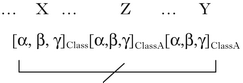 (Grillo,
Thus, according to RM, a decline in the performance of agrammatic speakers is predicted for sentences with non-canonical argument order, as a result of the presence of an intervening DP between the moved element, which is also a DP, and its trace/copy (Grillo, Reference Grillo, Blaho, Schoorlemmer and Vicente2005, Reference Grillo2009), as illustrated in (3). For instance, in object questions (4b and 4d), when the wh-object (which man, who) moves from its base generated position, it crosses over the subject (the woman); in contrast, in subject questions (4a and 4c), when the wh-subject (which man, who) moves from its base generated position, it does not cross over another argument. Nerantzini, Varlokosta, Papadopoulou, and Bastiaanse (Reference Nerantzini, Varlokosta, Papadopoulou and Bastiaanse2014) consider Grillo's (Reference Grillo, Blaho, Schoorlemmer and Vicente2005, Reference Grillo2009) RM approach in order to investigate the role of syntactic function (subject vs. object) and φ-features in the production and comprehension of wh-questions and relative clauses in a group of six Greek-speaking individuals with agrammatic aphasia. The authors argue that RM cannot explain the full range of subject/object asymmetries observed in the production and comprehension of wh-movement structures in Greek agrammatic aphasia, as some of the findings in their study are not compatible with the predictions that this account makes.
(3) DP-object……DP-subject……DP-/t-object
(4)
RM has been implemented to account for subject/object asymmetries observed in child language as well. In an extension of the RM approach, Friedmann et al. (Reference Friedmann, Belletti and Rizzi2009) claimed that not all object dependencies are equally hard, and thus not every moved or intervening element causes minimality effects in crossing dependencies. By presenting a series of experiments in 22 Hebrew-speaking children, aged from 3;7 to 5;0, Friedmann et al. (Reference Friedmann, Belletti and Rizzi2009) showed that structural similarity or dissimilarity between the moved element and the intervening subject results in selective difficulties in language acquisition. More specifically, structures in which both the moved and the intervening element are structurally similar in terms of lexical NP restriction (i.e. structures in which both DPs contain a lexical NP) cause severe difficulties in children. Within their account, referential object questions such as (4b), which contain a moved DP with a lexical NP specification, are predicted to be harder, compared to their non-referential counterparts (4d), because in the former question type, when the wh-object DP (which man) moves from its base generated position, it crosses over a similar element, namely a DP with an overt lexical NP (the woman). In this case both the moved element and the subject are lexically restricted, resulting in minimality/intervention effects. In contrast, non-referential object questions, such as (4d), are predicted to be easier in child language due to the absence of lexical NP restriction in the moved element. Friedmann et al.'s (Reference Friedmann, Belletti and Rizzi2009) results revealed selective difficulties in crossing dependencies. Children performed well in the comprehension (and production) of non-canonical constructions when the moved element was structurally dissimilar (in terms of lexical NP restriction) to the intervening DP subject (as in object who questions (4d) and in object free relatives), while they performed poorly in structures where a lexical NP was present in the wh-phrase (as in object which-NP questions (4b) and in object headed relative clauses). Thus, it was shown that the internal structure of the moved DP involved in crossing dependencies affects children's performance. Moreover, Friedmann et al. (Reference Friedmann, Belletti and Rizzi2009) showed that when a wh-element crosses a subject that has no lexical NP restriction, such as in the case of object headed relatives with an impersonal arbitrary pro subject (that has plural specifications, shown on the agreeing verb; Shlonsky, Reference Shlonsky1997), no minimality effects arise. Although the authors attribute this to the lack of lexical NP restriction in the intervening subject, they leave open the question whether the lack of minimality effects in these cases is due to the null nature of the subject (pro) or to the difference in the agreement features between the target and the null pronominal subject intervener.
Friedmann and Costa (Reference Friedmann and Costa2010) tested intervention effects in constructions that do not involve wh-movement but a crossing dependency, such as coordinated sentences (e.g. [The grandma idrew the girl] and [t ismiled]). Hebrew- and European Portuguese-speaking children, aged from 3;4 to 5;6, performed poorly in the comprehension of structures with a crossing dependency coordination in both languages, showing similar performance to that observed in wh-movement dependencies, such as object relatives. The authors proposed that crossing dependencies in which an argument crosses over another argument with which it shares lexical NP restriction, regardless of whether wh-movement is involved, affect children's performance in comprehension tasks.
Adani, van der Lely, Forgiarini, and Guasti (Reference Adani, van der Lely, Forgiarini and Guasti2010) argue that a more detailed definition of lexical restriction than the one proposed by Friedmann et al. (Reference Friedmann, Belletti and Rizzi2009) is necessary to explain the full array of comprehension data regarding object dependencies. The authors report evidence from 50 Italian-speaking TD children, aged from 5;0 to 9;0, that comprehension improves by manipulating the DP features involved in crossing dependencies. By assessing object center-embedded relative clauses, they observed that constructions involving an intervener with number features dissimilar to the moved element were more accurately interpreted by children compared to those involving an intervener which shares similar number features with the moved element. The same pattern was also observed in the gender conditions (i.e. better performance was attested in the conditions in which the intervener and the moved element shared dissimilar gender features compared to the condition in which they shared similar features), but with a milder effect. In other words, performance in the mismatch conditions was more accurate for the number feature compared to the gender feature. Thus, it was suggested that, although intervention effects are generated by the lexical NP within the DP, in line with Friedmann et al.'s (Reference Friedmann, Belletti and Rizzi2009) claims, the DP-internal structure seems to play a significant role in the creation of these effects. In Italian, “external and syntactically active features, such as Number, reduce intervention effects compared to internal and (possibly) lexicalized features, such as Gender” (Adani et al., Reference Adani, van der Lely, Forgiarini and Guasti2010, p. 2148).
Along similar lines, Belletti, Friedmann, Brunato, and Rizzi (Reference Belletti, Friedmann, Brunato and Rizzi2012) assessed headed relative clauses (RCs) in which the moved object and the intervening subject have the same or different gender values in 62 Hebrew- and Italian-speaking children, aged from 3;9 to 5;5. The authors observed that in Hebrew, headed relative clauses in which the moved element and the intervening subject shared similar gender features were harder for children to interpret compared to counterparts in which the moved element and the intervening subject had dissimilar gender features. However, gender mismatch did not significantly affect the comprehension of relative clauses in Italian. This difference was attributed to the differential status of the gender feature in each language, namely, to the fact that gender in Hebrew, but not in Italian, is part of the featural composition of the tensed verb, hence part of the feature set attracting the subject, and thus affects the computation of intervention. In other words, Belletti et al. (Reference Belletti, Friedmann, Brunato and Rizzi2012) argue that intervention effects are caused by the morphosyntactic status of a feature in a given language (in line with Adani et al., Reference Adani, van der Lely, Forgiarini and Guasti2010).
Therefore, it seems that factors such as the feature specification of the intervener or the moved element can modulate the intervention/minimality effects in A’-dependencies (see also Arosio, Guasti & Stucchi, Reference Arosio, Guasti and Stucchi2011; Garaffa & Grillo, Reference Garraffa and Grillo2008; for an elaborated analysis on how animacy affects TD children's and agrammatic speakers' performance, respectively). In an attempt to support the feature-based approach to intervention effects, Costa, Grillo, and Lobo (Reference Costa, Grillo and Lobo2012) assessed the comprehension of headed and free relative clauses in a group of 40 European Portuguese-speaking children, aged from 4;0 to 5;11. Their findings showed that although intervention effects appear in the presence of lexical NP restriction (e.g. in the case of headed relative clauses), they are prominent even in dependencies which involve relative pronouns that lack lexical NP restriction (e.g. object free relatives). Although wh-pronouns such as quem ‘who’ in European Portuguese lack lexical NP restriction, they have a rich internal structure that specifies features such as Noun, +animate, +human, wh, which might induce minimality effects in cases of non-local movement. Therefore, the authors conclude that intervention effects can emerge even in the absence of lexical NP restriction, though in a weaker form, and that the internal feature structure of the intervener is crucially modulating these effects.
To sum up, Friedmann et al.'s (Reference Friedmann, Belletti and Rizzi2009) account attempts to explain subject/object asymmetries observed in constructions that involve wh-movement, such as wh-questions and relative clauses, but at the same time captures comprehension difficulties observed in child language even in constructions that do not involve wh-movement but lead to crossing dependencies (see Friedmann & Costa, Reference Friedmann and Costa2010). Moreover, while lexical NP restriction seems to impinge on minimality effects, other features of the intervener or the moved element seem to also play a significant role in generating these effects (Adani et al., Reference Adani, van der Lely, Forgiarini and Guasti2010; Belletti et al., Reference Belletti, Friedmann, Brunato and Rizzi2012; Costa et al., Reference Costa, Grillo and Lobo2012).
In the context of these findings, the present study aims at investigating whether the predictions from Friedmann et al.'s (Reference Friedmann, Belletti and Rizzi2009) version of RM can account for the comprehension patterns observed in constructions that involve wh-movement in the acquisition of Greek, a language that displays overt case marking in its arguments and does not linearly show intervention in non-canonical sentences (see discussion in the next section). Limited research has been conducted until now on the comprehension of constructions that involve wh-movement in child Greek and the results are not fully conclusive, as they do not confirm subject/object asymmetries in the various wh-structures. Regarding wh-questions, Stavrakaki (Reference Stavrakaki2001a) reports significantly better performance on referential (which NP) and non-referential (who) subject questions compared to object counterparts, on the basis of a group of 16 TD children, aged from 3;4 to 5;2 (mean age: 4;1), which was used as a language-matched control group to compare the comprehension of wh-questions in typical and atypical development. On the basis of the same control group of TD children, Stavrakaki (Reference Stavrakaki2001b) does not report consistent subject/object asymmetries in relative clauses. Specifically, similar performance was observed in O-O relatives (i.e. relative clauses with an object head and an object gap – our object right-branching relative clauses; see next section) and in S-S relatives (i.e. relative clauses with a subject head and a subject gap – our subject center-embedded relative clauses). However, lower performance was detected in O-S relatives (i.e. relative clauses with an object head and a subject gap – our subject right-branching relative clauses) compared to O-O (object right-branching) and S-S (subject center-embedded) relatives, and even lower in S-O relatives (relative clauses with a subject head and an object gap – our object center-embedded relative clauses) compared to all relative types. Nevertheless, no statistical analysis was performed to compare the differences in performance across these four relative types, so no firm conclusions can be drawn regarding possible subject/object asymmetries in Greek relative clauses. Moreover, Stavrakaki (Reference Stavrakaki2001b) reports that the TD control group's performance was facilitated by the presence of case marking. Children performed significantly better in O-O relatives in which the object head and the subject of the relative clause were marked for accusative and nominative case, respectively, as opposed to O-O relatives in which the object head and the subject of the relative clause were not morphologically marked for case, as both were neuter DPs. Nonetheless, it is not obvious that it was case and not gender that facilitated performance in the O-O relatives with morphological case marking, because their heads and their subjects had different gender features (one was masculine and the other feminine), as opposed to the O-O relatives without morphological case marking, which involved heads and subjects with identical (namely, neuter) gender features.
To this end, we tested subject/object referential (which NP) and non-referential (who) questions and subject/object headed relative clauses, right-branching and center-embedded, to investigate whether there are indeed subject/object asymmetries in all these constructions and whether these potential asymmetries in Greek can be explained within Friedmann et al.'s (Reference Friedmann, Belletti and Rizzi2009) RM account. However, based on the predictions made by Friedmann et al. (Reference Friedmann, Belletti and Rizzi2009) regarding lexical NP restriction, and based on the predictions by Adani et al. (Reference Adani, van der Lely, Forgiarini and Guasti2010), Belletti et al. (Reference Belletti, Friedmann, Brunato and Rizzi2012), and Costa et al. (Reference Costa, Grillo and Lobo2012) regarding the effect of feature specification in causing intervention effects, we also included some structures in which the feature specification of the intervener and the moved element can be manipulated in Greek in terms of lexical NP restriction or φ-features. Particularly, we assessed: (a) non-referential wh-questions in which the wh-element does not inflect for gender, case, and number features (i.e. what questions) in order to examine the role of the φ-features of the moved element in intervention effects; (b) free relatives introduced by a bare wh-element (i.e. whoever) and free relatives introduced by a full DP that contained a wh-element and a lexical NP (i.e. whichever NP) in order to investigate the role of lexical NP restriction in a wh-structure that has not been investigated before within this context; and (c) relative clauses in which the intervening subject DP contained a quantifier (i.e. someone) as well as relative clauses in which the intervening subject was a DP that contained a quantifier and a lexical NP (e.g. some NP) in order to explore the role of feature specification and lexical NP restriction in the intervening subject.
THE PRESENT STUDY
The present study assesses the ability of Greek-speaking TD children to comprehend complex constructions that entail wh-movement, such as wh-questions, (restrictive) relative clauses (RC), and free relatives (FR), by means of three picture-pointing tasks, in order to examine (a) whether subject/object asymmetries are attested in these structures in a language like Greek, which marks DPs with overt/morphological case and involves verb–subject inversion in structures that are generated by wh-movement (see discussion below), and (b) whether intervention effects are present in the object dependencies in which the moved element and the intervener are structurally similar in terms of lexical NP restriction or in terms of other features.
Participants
Fifty-eight monolingual Greek-speaking TD children (26 boys and 32 girls), aged from 4;0 to 6;4 (mean age: 5;4, SD: 0·53), took part in the experiment. No history of speech and language difficulties or any psychological, social, or emotional disturbance was reported. None of the children received any kind of medications and they were all recruited from middle/high SES public kindergartens.
Materials–procedure
Three comprehension tasks were administered: (i) wh-questions, (ii) RCs, and (iii) FRs. The procedure and stimulus material (in an expanded version) for the wh-question task and for the RC task (specifically, for right-branching RCs) has been used in Nerantzini et al. (Reference Nerantzini, Varlokosta, Papadopoulou and Bastiaanse2014). All materials used are provided in the ‘Appendix’.
Regarding wh-questions, a total of 48 sentences in different question types were assessed: 16 non-referential pjos/pjon ‘who/whom’ and 16 non-referential ti ‘what’ questions (5), as well as 16 referential pjos zoγrafos/pjon zoγrafo ‘which painter’/‘which painter’ questions (6), half subject-extracted and half object-extracted in each question type. It should be pointed out that Greek presents a number of differences in its formation of wh-questions compared to other languages that have been previously studied. First, Greek does not distinguish lexically between who and which, unlike English (e.g. see Stromswold, Reference Stromswold1995) or Hebrew (e.g. see Friedmann et al. Reference Friedmann, Belletti and Rizzi2009); the interrogative pronoun pjos is used for both question types (pjos ‘who’; pjos zoγrafos ‘which painter’). Second, unlike in English or in Hebrew, where only in the object dependencies is the wh-pronoun marked with accusative, the interrogative pronoun in the subject and object position is overtly inflected for nominative and accusative case, respectively, (as well as for number and gender). Namely, both non-referential (pjos ‘who_NOM.MASC’/pjon ‘who_ACC.MASC’) and referential questions (pjos zoγrafos ‘which_NOM.MASC painter_NOM.MASC’/pjon zoγrafo ‘which_ACC.MASC painter_ACC.MASC’) have distinct morphological forms for nominative and accusative case, at least in the case of masculine wh-pronouns, as feminine and neuter wh-pronouns do not show a morphological distinction between nominative and accusative case. Third, non-referential pjos/pjon ‘who’ and ti ‘what’ questions differ with respect to their φ-feature properties; pjos/pjon is inflected for gender, case, and number features, whereas ti is not. Moreover, although the feature [+/–animate] distinguishes who and what questions in English (Alexopoulou & Keller, 2014), in Greek both wh-words can be used to refer to animate and inanimate entities, but the wh-word ti mainly refers to [–human] entities. Regarding our test sentences, in non-referential (who) questions, the wh-pronoun was always masculine and marked for nominative case in the subject questions and for accusative case in the object questions (5). In referential questions, the wh-pronoun was masculine in three subject and in three object sentences, and feminine in five subject and in five object sentences, and showed distinct morphological forms for nominative and accusative only in the case of masculine NPs (6) but not in the case of feminine NPs (see relevant test sentences in the ‘Appendix’). Moreover, both the subject and the object DPs in object and subject referential and non-referential questions, respectively, were marked for case (nominative for subject DPs and accusative for object DPs; see (5) and (6)).
(5) who subject: pjos kiniγa ton stratioti?
who_nom.masc chases the soldier_acc.masc
‘Who is chasing the soldier?’
who object: pjon kiniγa o stratiotis?
who_acc.masc chases the soldier_nom.masc
‘Who is the soldier chasing?’
what subject: ti kiniγa ton stratioti?
what chases the soldier_acc.masc
‘What is chasing the soldier?’
what object: ti kiniγa o stratiotis?
what chases the soldier_nom.masc
‘What is the soldier chasing?’
(6) which-NP subject: pjos zoγrafos kiniγa ton stratioti?
which_nom.masc painter_nom.masc chases the soldier_acc.masc
‘Which painter is chasing the soldier?’
which-NP object: pjon zoγrafo kiniγa o stratiotis?
which_acc.masc painter_acc.masc chases the soldier_nom.masc
‘Which painter is the soldier chasing?’
The RC task consisted of 32 relative clauses, 16 right-branching (RB) (7) and 16 center-embedded (CE) (8), half of which were subject-extracted and half object-extracted. In order to ensure that semantic cueing was eliminated, center-embedded clauses were depicted with all the agents having the same height. Again, note that in Greek the subject and the object DPs in both relative types (RB and CE) are overtly marked for case (nominative for subjects and accusative for objects; see (7) and (8)). Additionally, 8 object RCs were included in which the subject was a quantificational restrictor (kapjos ‘someome’) (objRC_Q) (9), and 8 object RCs in which the subject was a quantificational phrase that included a quantificational restrictor and an NP (kapjos stratiotis ‘some soldier’) (objRC_Q+NP) (10). These structures were included in our experiment because, if intervention effects are due to the presence of lexical NP restriction, in accordance with Friedmann et al.'s (Reference Friedmann, Belletti and Rizzi2009) account, an asymmetry is expected between structures in which the subject contains a quantificational restrictor and counterparts in which the subject contains a quantificational restrictor and an NP (see predictions in Table 1). The quantificational restrictor kapjos in Greek is inflected for case (as well as for gender and number). In our task, the objRC_Q condition always included sentences with quantificational restrictors in masculine gender, thus overtly inflected for nominative (ka pjos ‘someone_NOM.MASC’; see (9)). In contrast, the objRC_Q+NP condition included three sentences with quantificational restrictors in masculine gender, overtly inflected for nominative (kapjos stratiotis ‘whoever_NOM.MASC soldier_NOM.MASC’; see (10)) and five sentences with quantificational restrictors in feminine gender, where there was no morphological distinction between nominative and accusative (see relevant test sentences in the ‘Appendix’). Moreover, the two DPs in all of the test sentences in our RC task were matched for gender (they were either both masculine or both feminine), unlike the DPs in the test sentences in Stavrakaki's (Reference Stavrakaki2001b) study.
(7) subject RB: δikse mu ton zoγrafo pu kiniγa ton stratioti.
show me the painter_acc.masc that chases the soldier_acc.masc
‘Show me the painter that is chasing the soldier.’
object RB: δikse mu ton zoγrafo pu kiniγa o stratiotis.
show me the painter_acc.masc that chases the soldier_nom.masc
‘Show me the painter that the soldier is chasing.’
(8) subject CE: o zoγrafos pu kiniγa ton stratioti ine psilos. pjos ine?
the painter_nom.masc that chases the soldier_acc.masc is tall. who_nom.masc is
‘The painter that is chasing the soldier is tall. Who is he?’
object CE: o zoγrafos pu kiniγa o stratiotis ine psilos. pjos ine?
the painter_nom.masc that chases the soldier_nom.masc is tall. who_nom.masc is
‘The painter that the soldier is chasing is tall. Who is he?’
(9) objRC_Q: δikse mu ton zoγrafo pu kapjos kiniγa.
show me the painter_acc.masc that someone_nom.masc chases
‘Show me the painter that someone is chasing.’
(10) objRC_Q+NP: δikse mu ton zoγrafo pu kapjos stratiotis kiniγa.
show me the painter_acc.masc that some_nom.masc soldier_nom.masc chases
‘Show me the painter that some soldier is chasing.’
The FR task included 16 subject/object FRs with the free relative restrictor opjon ‘whoever’ (11), and 16 subject/object FRs with the free relative restrictor opjon and an NP (opjon zoγrafo ‘whichever painter’) (12). Notice that the free relative pronoun opjon ‘whoever’ is distinct from the interrogative pronoun pjon ‘who’ used to form wh-questions, and that, similarly to other pronouns in Greek, it is also inflected for case (as well as for gender and number) (o pjos ‘whoever_NOM.MASC’/opjon ‘whoever_ACC.MASC’). Since the FR clause was the object of the main clause in the test sentences, the free relative pronoun was always inflected for accusative in both subject and object FRs because of case matching (see Alexiadou & Varlokosta, Reference Alexiadou, Varlokosta and Alexiadou2007; Philippaki-Warburton & Stavrou, Reference Philippaki-Warburton and Stavrou1986; among others). Masculine free relative pronouns make an overt morphological distinction between nominative and accusative case, while feminine ones do not. Thus, the sentences in the condition with the free relative restrictor, which were always masculine, were overtly marked for accusative case (11), whereas the sentences including the free relative restrictor and an NP were overtly marked for accusative only in the case of the three masculine NPs (12), but not in the case of the five feminine NPs (see relevant test sentences in the ‘Appendix’).
(11) subject - FR_wh/whoever: δikse mu opjon kiniγa ton stratioti.
show me whoever_acc.masc chases the soldier_acc.masc
‘Show me whoever is chasing the soldier.’
object - FR_wh/whoever: δikse mu opjon kiniγa o stratiotis.
show me whoever_acc.masc chases the the soldier_nom.masc
‘Show me whoever the soldier is chasing.’
(12) subject - FR_wh/whoever+NP: δikse mu opjon zoγrafo kiniγa ton stratioti.
show me whoever_acc.masc painter_acc.masc chases the soldier_acc.masc
‘Show me whichever painter is chasing the soldier.’
object - FR_wh/whoever+NP: δikse mu opjon zoγrafo kiniγa o stratiotis.
show me whoever_acc.masc painter_acc.masc chases the soldier_nom.masc
‘Show me whichever painter the soldier is chasing.’
As is evident in the examples above, Greek involves verb–subject inversion in constructions that are generated by wh-movement (for discussion of the phenomenon, see Anagnostopoulou, Reference Anagnostopoulou1994; Kotzoglou, Reference Kotzoglou2006; among others). Thus, in all three tasks, the object dependencies involved the order VS. The order SV was implemented only in the RCs with a quantificational subject (obj RC_Q, obj RC_Q+NP) to avoid the ambiguity that can be caused in the obj RC_Q+NP cases with subject DPs in feminine gender; for example, δikse mu tin tigri pu trava kapja arkuda can mean ‘show me the tiger that some bear is pulling’ or ‘show me the tiger that is pulling some bear’. Given the VS order, linearly, the object dependencies appear not to induce intervention/minimality effects. However, given that, under standard assumptions, the wh-object moves from the postverbal DP position, there is intervention in all cases, as the subject appears postverbally because of the movement of the verb from the head of the verb Phrase (vP) to a higher position, namely the Tense Phrase (TP) (e.g. Anagnostopoulou, Reference Anagnostopoulou1994; Kotzoglou, Reference Kotzoglou2006) (or to the Complementizer Phrase (CP); Tsimpli, Reference Tsimpli and Kiss1995). Thus, assuming the analyses in which the verb moves to TP, the underlying structure of an object wh-question, such as (5), is as in (13), where the wh-object has moved from the postverbal position within the vP to the specifier position of CP, the verb has moved to TP, and the subject DP is in the specifier of vP. In any case, the moved wh-object crosses the intervening subject DP, thus, resulting in a structure that potentially could induce minimality effects.
(13) [ CPpjon [ TPkiniγa [ vP<o stratiotis> tv <pjon> ]]]?
who_acc.masc chases the soldier_nom.masc
‘Who is the soldier chasing?’
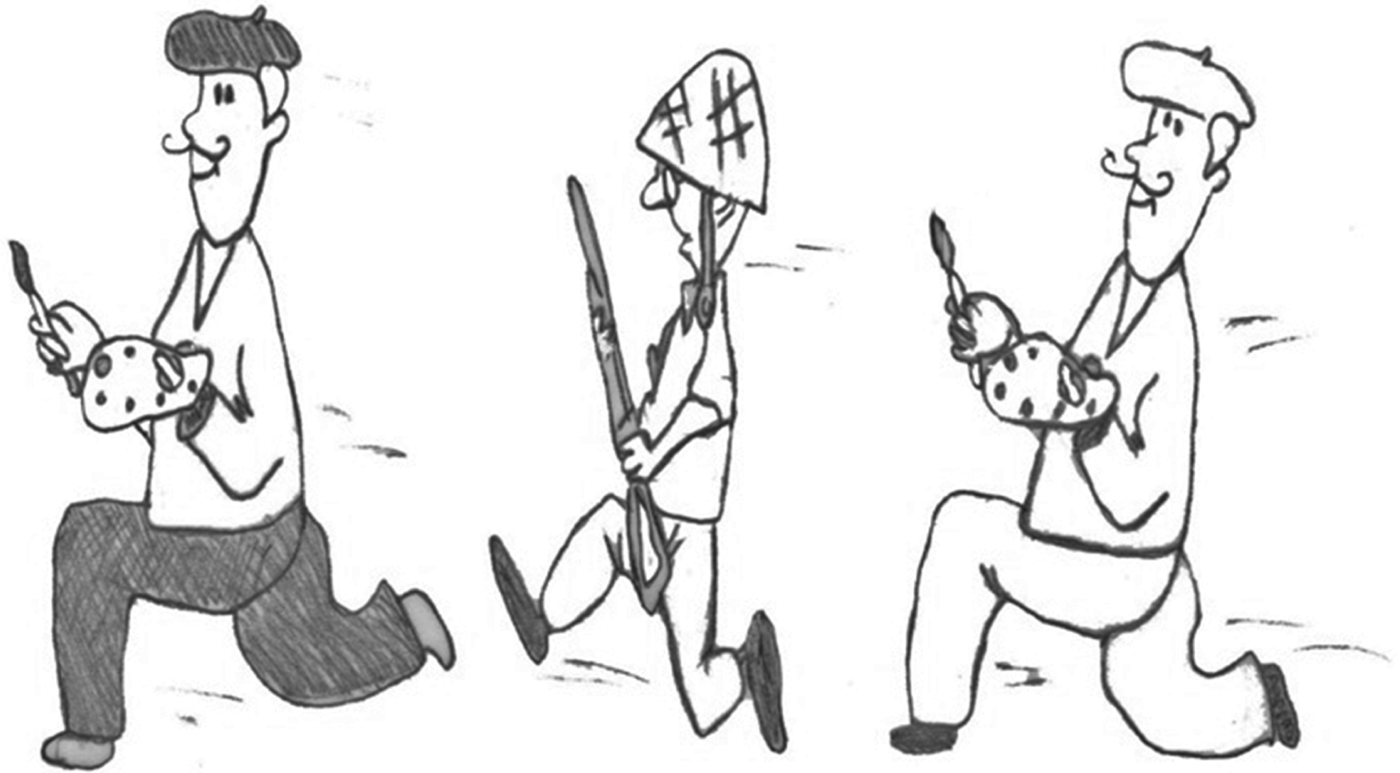
The same transitive action verbs and the same nouns were used across tasks in order to eliminate erroneous picture identification effects. The procedure used was also identical in all three tasks. A sentence–picture matching task was employed, in which black-and-white drawings were presented on a computer screen – one at a time – (see Figure 1), while children were orally presented with a sentence (wh-question/RC/FR) and were asked to point to the correct agent of the action. The drawings depicted semantically reversible actions performed by animate agents of the same gender (grammatical and semantic). The direction of the action was counterbalanced across conditions and all the experimental items were randomized across conditions in each task.
Experimental item.

All children were tested individually. Each task was administered in a separate session within a week. All three tasks were presented in a randomized order across participants. Four practice trials were included, as well, in each task. Repetition of the cueing sentence was accepted upon request, although feedback as to the accuracy was not given during the task administration.
Predictions
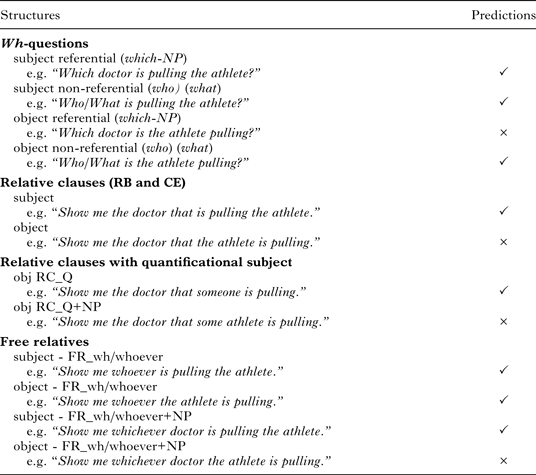
Table 1 summarizes the main predictions for the structures under investigation, based on Friedmann et al.'s (Reference Friedmann, Belletti and Rizzi2009) extension of the RM approach, according to which intervention/minimality effects are modulated by the similarity of the intervener and the moved element in terms of lexical NP restriction.
Predictions from Friedmann et al.'s (Reference Friedmann, Belletti and Rizzi2009) approach
notes: RB = right-branching; CE = center-embedded; FR_wh/whoever: sentence with a free relative restrictor; FR_wh/whoever+NP: sentence with a free relative restrictor and an NP; RC_Q: relative clause in which the subject is a quantificational restrictor; RC_Q+NP: relative clause in which the subject is a quantificational phrase.
Regarding wh-questions, referential which-NP questions involve a moved wh-phrase that contains a lexical NP. Thus, comprehension is expected to be weak in object referential questions, since both the moved object (wh-word+NP) and the intervening subject are lexically restricted, but not in subject referential questions, where there is no intervening subject DP. Non-referential who questions do not involve lexical NP restriction, and thus high performance is predicted for both subject and object conditions. Similarly, no subject/object asymmetry is expected in non-referential what questions, again due to the absence of lexical NP restriction in the moved element. In a similar vein, the comprehension of object RCs (right-branching or center-embedded) ought to be poor compared to the comprehension of subject ones, since in the former case both the moved element and the intervening subject involve lexical NPs. Moreover, in object RCs in which the subject is a quantificational phrase (objRC_Q+NP), both the moved and the intervening element involve lexical NPs, so comprehension ought to be adversely affected, while in the case of object RCs in which the subject is a quantificational restrictor (objRC_Q), performance is expected to be relatively high, due to the absence of a lexical NP. With respect to FRs, no intervention effects are predicted for sentences with a free relative restrictor (FR_wh/whoever), since the moved element in the object condition lacks lexical NP restriction. However, poor performance is expected in the object sentences with a free relative restrictor and an NP (FR_wh/whoever+NP), due to the presence of a lexical NP in both the moved element and the intervening subject. High performance is expected for subject-extracted sentences in both conditions (i.e. FR_wh/whoever, FR_wh/whoever+NP), as they do not involve an intervening DP.
RESULTS
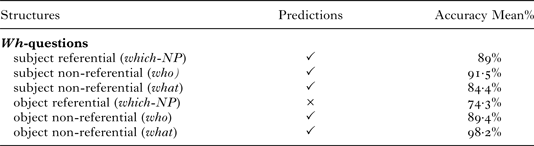
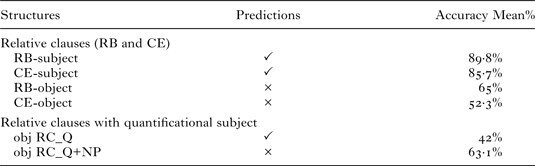
A number of asymmetries were observed in children's performance on the interpretation of the structures under investigation. With respect to wh-question comprehension, children, as a group, exhibited relatively high performance across conditions, except in referential which-NP object questions, where a lower score was attained (see Table 2).
Overall proportions correct on wh-question comprehension
No significant dissociation was observed between subject- and object-extracted who questions (χ 2(1, N = 928) = 1·255, p = ·263). However, object questions appeared to be significantly harder than subject ones in referential which-NP questions (χ 2(1, N = 928) = 33·300, p < ·001; Cramer's V = ·189), whereas subject questions appeared to be significantly more difficult than object ones in what questions (χ 2(1, N = 928) = 56·030, p < ·001; Cramer's V = ·246). (The Cramer's V coefficient ranges from 0 to 1; usually, a Cramer's V of ·10 suggests that there is a substantive relationship between the variables under investigation.) Additionally, in the subject questions, no significant difference was observed between referential which-NP and non-referential who questions (χ 2(1, N = 928) = 1·772, p = ·183), although an asymmetry was found between who and what questions (χ 2(1, N = 928) = 11·144, p < ·001; Cramer's V = ·110), in that what questions were less accurate than who questions. Importantly, in the object questions, referential which-NP questions were significantly harder than non-referential who counterparts (χ 2(1, N = 928) = 35·614, p < ·001; Cramer's V = ·196), while who questions were significantly more difficult than what questions (χ 2(1, N = 928) = 31·421, p < ·001; Cramer's V = ·338). We also investigated whether case had an impact on children's performance by analyzing separately the errors observed in referential which-NP questions in which the interrogative pronoun was morphologically (i.e. overtly) marked for nominative and accusative case (i.e. masculine wh-pronouns) and those in which it was not morphologically marked (i.e. feminine wh-pronouns). It turned out that case indeed affected children's performance, since more errors were obtained in referential questions that included feminine interrogative pronouns, compared to questions that included masculine ones in both subject (χ 2(1, N = 102) = 9·787, p < ·001; Cramer's V = ·310) and object dependencies (χ 2(1, N = 238) = 27·189, p < ·001; Cramer's V = ·246). Furthermore, we investigated whether the subject/object asymmetry generally observed in referential questions was also evident in the referential questions with masculine wh-pronouns (which are overtly marked with nominative and accusative), as well as in those with feminine wh-pronouns (which are not overtly marked with case). We found that in both cases there was a significant difference between subject and object dependencies (for referential questions with masculine wh-pronouns: χ 2(1, N = 348) = 4·285, p = ·038; Cramer's V = ·111; for referential questions with feminine wh-pronouns: χ 2(1, N = 580) = 30·741, p = ·000; Cramer's V = ·230).
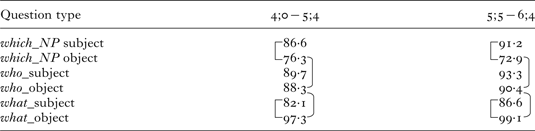
In a separate analysis, we divided our group into two age groups; group A consisted of 28 children, aged from 4;0 to 5;4 (mean age: 4;8, SD: 0·44), and group B consisted of 30 children, aged from 5;5 to 6;4 (mean age: 5;6, SD: 0·28). The same asymmetries were found within each age group (see Table 3; significant differences are indicated with brackets). Children's performance did not differ significantly across age groups in any condition.
Developmental data (age groups) for wh-questions (mean %)
In the RC comprehension task, children's performance, as a group, revealed dissociations between subject and object RCs across relative types (see Table 4).
Overall proportions correct on RC comprehension
Better performance was observed in subject compared to object dependencies in both RB (χ 2(1, N = 928) = 81·671, p < ·001; Cramer's V = ·297) and CE RCs (χ 2(1, N = 928) = 121·191, p < ·001; Cramer's V = ·361). Note that CE object relatives were significantly more difficult than RB object counterparts (χ 2(1, N = 928) = 15·476, p < ·001, Cramer's V = ·129). Additionally, the type of embedding/relative type affected children's performance; an overall difference was attested between the RB and the CE clauses, with better performance on the former relative type compared to the latter (χ 2(1, N = 1856) = 16·740, p < ·001; Cramer's V = ·095). Last, object RCs in which the subject included a quantificational restrictor (objRC_Q) were significantly harder compared to those in which the subject included a quantificational phrase (objRC_Q+NP) (χ 2(1, N = 928) = 41·508, p < ·001; Cramer's V = ·211). Again, to investigate the effect of case on children's performance, we analyzed the error patterns attested in the RCs in which the quantificational restrictor was overtly inflected for nominative case (i.e. masculine subjects in objRC_Q+NP sentences) and those in which it was not (i.e. feminine subjects in objRC_Q+NP sentences). Morphological marking affected children's performance, since more errors were obtained in cases where the quantificational restrictor was not overtly marked for nominative (i.e. feminine subjects) compared to cases in which it was overtly marked for case (i.e. masculine subjects) (χ 2(1, N = 342) = 8·614, p < ·001; Cramer's V = ·159).
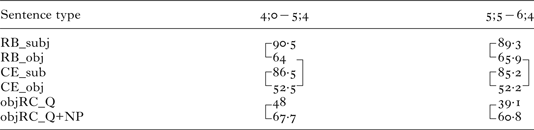
A separate analysis with the two age groups was also conducted. The same asymmetries were found within each age group (see Table 5; significant differences are indicated with brackets). Children's performance did not differ significantly across age groups in any condition.
Developmental data (age groups) for RCs (mean %)
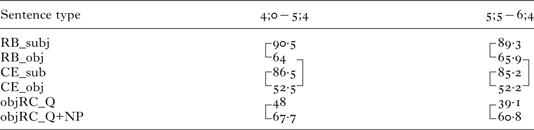
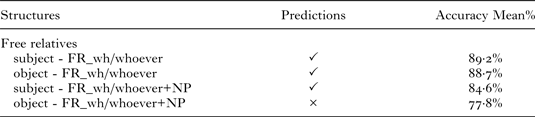
Turning to the FR comprehension task, overall, children again showed selective difficulties (see Table 6).
Overall proportions correct on FR comprehension
While no significant difference was attested between subject- and object-extracted clauses with a free relative restrictor (FR_wh/whoever) (χ 2(1, N = 928) = 0·044, p = ·834), a significant subject/object difference was observed in the condition where a free relative restrictor and an NP were included (FR_wh/whoever+NP) (χ 2(1, N = 928) = 7·243, p = ·007; Cramer's V = ·088). Moreover, better performance was observed in object FRs without an NP compared to those with an NP (χ 2(1, N = 928) = 20·145, p < ·001; Cramer's V = ·147). To investigate the effect of case on children's performance, we analyzed the error patterns attested in the sentences with the free relative restrictor and an NP, namely, those in which the free relative restrictor was overtly inflected for accusative case (i.e. masculine pronouns) and those in which it was not (i.e. feminine pronouns). In the case of object dependencies, more errors were obtained in the sentences in which the free relative pronoun was not overtly marked for accusative case (i.e. feminine pronouns) compared to those in which it was overtly marked for case (i.e. masculine pronouns) (χ 2(1, N = 206) = 10·334, p < ·001; Cramer's V = ·224). However, in the case of subject dependencies, more errors were attested in the sentences with masculine pronouns compared to those with feminine pronouns (χ 2(1, N = 142) = 9·443, p < ·001; Cramer's V = ·258). Additionally, we investigated whether the subject/object asymmetry generally observed in FRs with a free relative restrictor and an NP (FR_wh/whoever+NP) was also evident in the FR_wh/whoever+NP clauses with a masculine free relative pronoun (which is overtly marked with accusative – due to case matching), as well as in those with a feminine free relative pronoun (which are not overtly marked for case). The statistical analysis revealed that although the difference between subject and object dependencies in the FR clauses with masculine pronouns was not significant (χ 2(1, N = 348) = 3·276, p = ·070; Cramer's V = ·097), it turned out to be significant for the FR clauses with feminine pronouns (χ 2(1, N = 580) = 22·561, p = ·000; Cramer's V = ·197).
Subject/object asymmetries were also attested in a separate analysis within each age group (see Table 7; significant differences are indicated with brackets), although the subject/object asymmetry in the condition where a free relative restrictor and an NP were included (FR_wh/whoever+NP) did not reach significance in the second age group (χ 2(1, N = 624) = 3·167, p = ·075). Children's performance did not differ across age groups in any condition, except from the condition of object extracted clauses with a free relative restrictor (FR_wh/whoever), where a significantly better performance was attested in the older age group (χ 2(1, N = 464) = 7·903, p = ·005; Cramer's V = ·131).
Developmental data (age groups) for FRs (mean %)
DISCUSSION
The present study investigated the ability of Greek-speaking TD children to comprehend complex constructions that entail wh-movement, such as wh-questions, RCs, and FRs. Several asymmetries were revealed across conditions.
Regarding wh-questions, although children as a group performed relatively highly across conditions, they faced more difficulties interpreting referential which-NP object questions. A subject/object asymmetry was observed in referential which-NP questions and in non-referential what questions, but not in non-referential who questions. This is not in line with previous findings on Greek, which report subject/object asymmetries in both referential and non-referential who-questions (see Stavrakaki, Reference Stavrakaki2001a). One could argue that the discrepancy between the findings of the two studies is due to the age difference between the children in our study (their mean age was 5;4) and those in Stavrakaki (Reference Stavrakaki2001a) (their mean age was 4;1). However, the fact that the pattern of asymmetries is identical in the two age groups of our study (i.e. in the four-year-olds, which is the age group that has similar mean age as the TD group in the Stavrakaki, Reference Stavrakaki2001a, study, and in the five-year-olds) indicates that the asymmetry between referential vs. non-referential who questions in our study is a genuine asymmetry, which did not surface in Stavrakaki's (Reference Stavrakaki2001a) study, probably because of the small sample size. Moreover, the wh-comprehension data revealed two important findings: (a) the subject non-referential who questions were better interpreted compared to the subject non-referential what counterparts, and (b) besides the asymmetry between object referential which-NP questions and object non-referential who counterparts, an asymmetry was also found between object who and object what questions.
With respect to RC comprehension, children presented subject/object asymmetries across relative types. Specifically, better performance was observed in subject compared to object dependencies in both right-branching and center-embedded RCs. Note that the subject/object asymmetry attested in the right-branching RCs is in contrast to the patterns observed in Stavrakaki (Reference Stavrakaki2001b), where better performance was attested in O-O relatives (our object right-branching RCs) compared O-S relatives (our subject right-branching RCs). However, no statistical analysis was performed in Stavrakaki (Reference Stavrakaki2001a) to confirm the O-O vs. O-S asymmetry. Additionally, the type of embedding had an impact on children's overall interpretation of RCs; a difference in the interpretation of right-branching and center-embedded RCs was observed with the latter being harder, especially in the object condition. A similar effect was also attested in Stavrakaki's (Reference Stavrakaki2001b) data, namely, S-O relatives obtained low accuracy scores compared to all other relatives (although this asymmetry was also not confirmed by a statistical analysis). Regarding object RCs in which the features of the intervening subject were manipulated, an asymmetry was observed between those in which the subject included a quantificational restrictor (objRC_Q) and those in which the subject included a quantificational phrase (objRC_Q+NP), with the latter being better comprehended by children.
Last, our data from the FR comprehension task revealed a subject/object asymmetry in FRs where a free relative restrictor and an NP were included, while no such asymmetry was attested between subject- and object-extracted FRs with a free relative restrictor. Moreover, our data revealed a dissociation between object FRs with an NP and those without an NP (FR_wh/whoever+NP-object vs. FR_wh/whoever-object), with the latter being better preserved.
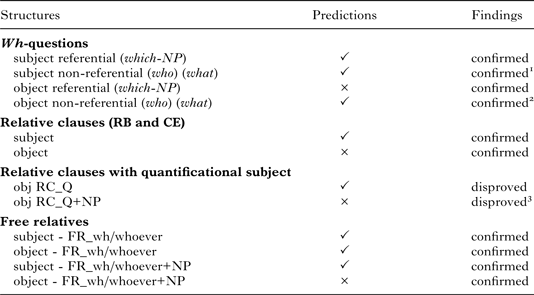
Let us now turn to the predictions of RM to see whether the patterns obtained in our data can be efficiently accommodated by this account. Table 8 summarizes our findings along with Friedmann et al.'s (Reference Friedmann, Belletti and Rizzi2009) predictions.
Predictions from Friedmann et al.'s (Reference Friedmann, Belletti and Rizzi2009) account and findings
notes: RB = right-branching; CE = center-embedded; FR_wh/whoever: sentence with a free relative restrictor; FR_wh/whoever+NP: sentence with a free relative restrictor and an NP; RC _Q: relative clause in which the subject is a quantificational restrictor; RC_Q+NP: relative clause in which the subject is a quantificational phrase.
1 However, although high accuracy scores were revealed in subject non-referential who and what questions, an asymmetry was found between them, in that performance on subject what questions was significantly lower than performance on subject who questions (see discussion in this section).
2 Likewise, despite the high accuracy scores attained in object non-referential who and what questions, object what questions received significantly higher scores than object who questions (see discussion in this section).
3 Although low performance was observed in the RC condition with a quantificational phrase (obj RC_Q+NP), Friedmann et al.'s account predicts worse performance in this condition compared to the RC condition with a quantificational restrictor (obj RC_Q) (see discussion in this section).
As shown in Table 8, the predictions within the extended version of the RM approach, proposed by Friedmann et al. (Reference Friedmann, Belletti and Rizzi2009), are confirmed by our data to a great extent. There are, however, some findings which cannot be straightforwardly accommodated within this account. More specifically, the main claim that comprehension will be compromised when both the intervening subject and the moved A’-element in object-extracted constructions like wh-questions, RCs, or FRs, contain a lexical NP, was supported by the child Greek data. Nevertheless, the asymmetry between object who and object what questions is not predicted by Friedmann et al.'s (Reference Friedmann, Belletti and Rizzi2009) RM approach. Moreover, lexical NP restriction does not explain the pattern observed in object RCs with a quantificational subject, since lack of lexical NP restriction in these structures caused more difficulties to children than its presence.
Consistent with Friedmann et al.'s (Reference Friedmann, Belletti and Rizzi2009) predictions, our data from wh-questions revealed comprehension difficulties in object referential which-NP questions compared to subject referential which-NP counterparts and object non-referential who questions. This finding corroborates the extended version of RM, since object referential questions involve movement from a postverbal position (see structure (13) in the previous section), and both the moved element and the intervening subject DP are lexically restricted, thus resulting in intervention/minimality effects. However, if the presence of lexical NP restriction in the moved wh-phrase was, in fact, the only source of the comprehension difficulties that children have, no difference would be predicted between object non-referential who and what questions, since both constructions lack lexical NP restriction. Nonetheless, an advantage of object what over object who questions was attested in the data. This asymmetry remains unaccounted for on Friedmann et al.'s (Reference Friedmann, Belletti and Rizzi2009) account, since both who and what object constructions involve wh-movement in which the intervening subject DP is lexically specified, while the moved wh-word is not. This asymmetry has also been observed in agrammatic aphasia, and has been attributed to the mismatch in the grammaticalized [±animate] feature in what questions (Garaffa & Grillo, Reference Garraffa and Grillo2008). According to Garaffa and Grillo (Reference Garraffa and Grillo2008), the moved [–animate] object differs in animacy from the intervening [+animate] subject DP in object what questions, helping speakers construct the correct syntactic representations. In contrast, in object who questions, the same [+animate] feature is involved in both the moved wh-word and the intervening subject DP, thus leading to a chain formation blockage. Note that it has also been shown that in typical language acquisition, animacy mismatch enhances comprehension in object-extracted conditions (Arosio et al., Reference Arosio, Guasti and Stucchi2011). In line with this reasoning, we suggest that the φ-features of the moved and of the intervening element also play a significant role in the comprehension of constructions involving wh-movement. In Greek, the wh-word what is not specified for gender, person, and number features, whereas the intervening subject is fully specified for these features. Thus, we argue that the lack of feature specification in the moved wh-word, as shown in (14), facilitates children's comprehension of object what questions.
(14)
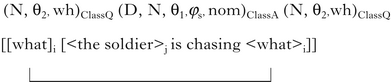
Note that an advantage of who over what questions was observed in the subject questions. This pattern is not related to minimality effects and might be due to the fact that, for some of the verbs, the use of the pronoun what was not preferred for animate agents in the subject questions; 64% of the errors in the subject what questions occurred with the verbs fotoγrafizο ‘photograph’, pleno ‘wash’, and kitao ‘look’ (see the ‘Appendix’ for the test sentences with these verbs), which may not be as tolerant of [–human] agents.
Turning to RCs, Friedmann et al. (Reference Friedmann, Belletti and Rizzi2009) would predict subject/object asymmetries across relative types, since in object-extracted RCs, the object has to move over an intervening subject, and both the moved element and the intervener share lexical NP restriction. This prediction was confirmed by our data, since subject/object dissociations were attested across relative types. Note, though, that center-embedded RCs were found to be harder to interpret compared to right-branching ones, especially in the object condition. Friedmann et al.'s (Reference Friedmann, Belletti and Rizzi2009) account does not make predictions for differences between different relative types, but this finding is in line with studies showing that center-embedded RCs are harder to parse compared to right-branching counterparts due to sentence complexity, memory limitations, or integration costs (Bates, Devescovi & D'Amico, Reference Bates, Devescovi and D'Amico1999; Corrêa, Reference Corrêa1995; Kidd & Bavin, Reference Kidd and Bavin2002).
With respect to FRs, our data are consistent with Friedmann et al.'s (Reference Friedmann, Belletti and Rizzi2009) account. A subject/object asymmetry was attested in FRs in which the moved DP included a free relative restrictor and a lexical NP (FR_wh/whoever+NP), suggesting that, in line with Friedmann et al.'s predictions, an intervener can block chain formation when it is similar in terms of lexical NP restriction to the moved element. In contrast, an intervening subject DP does not block chain formation in the case of FRs without a lexical NP (FR_wh/whoever); the dissimilarity in terms of lexical NP restriction between the moved element and the intervening subject DP leads to high performance in object-extracted sentences, further supporting Friedmann et al.'s account. The dissociation attested between object FRs with a lexical NP and object FRs without a lexical NP in the moved DP further supports the claim that the involvement of a lexically restricted intervener deteriorates children's performance.
Challenging the efficacy of that account, though, poor performance was attested in object RCs in which the intervening subject is a quantificational restrictor (objRC_Q), as well as those in which the intervening subject is a quantificational phrase (objRC_Q+NP). Note that Friedmann et al. (Reference Friedmann, Belletti and Rizzi2009) showed that in RC conditions where the intervening subject was an arbitrary pro, and thus had no lexical NP restriction, no minimality effects were obtained. However, they acknowledge the fact that the lack of intervention effects in this case may not be due to the absence of lexical NP restriction but to the null nature of the subject pro. In the light of this finding, we included in our study object RC conditions with a quantificational restrictor (objRC_Q) to assess whether there are minimality effects in the absence of lexical NP restriction in the intervening subject but in the presence of a quantificational operator, such as kapjos ‘some’. Moreover, we included object RC conditions with a quantificational phrase (objRC_Q+NP) to assess whether the presence of a lexical NP in the intervening quantificational subject creates additional comprehension difficulties for children. Contra Friedmann et al.'s (Reference Friedmann, Belletti and Rizzi2009) predictions, object RCs with a quantificational restrictor (objRC_Q), namely, structures that include subjects without lexical NP restriction, were found to be harder for children to interpret than those involving a quantificational phrase (objRC_Q+NP), namely, structures that include subjects with lexical NP restriction. The poor performance observed in our data in the condition of object RCs in which the subject was a quantificational restrictor (objRC_Q) suggests that the lexical restriction of the subject is not the critical factor for intervention effects. Instead, we argue that the feature specification of the intervening quantificational subject DP in both objRC_Q and objRC_Q+NP conditions, and the fact that both the moved and the intervening element in these conditions contain quantificational features, causes difficulties in children's comprehension. According to the RM approach to intervention effects developed in Grillo (Reference Grillo, Blaho, Schoorlemmer and Vicente2005, Reference Grillo2008, Reference Grillo2009), and subsequently advocated by Costa et al. (Reference Costa, Grillo and Lobo2012), in order for a speaker to distinguish between a moved and an intervening DP, s/he must activate, select, and maintain the activation of the feature structure of both DPs. This has a processing cost, which depends, among other things, on the complexity of the associated semantic representation and on the position of each feature in the hierarchy of morphosyntactic features. This entails that “the more features required to distinguish between the moved and the intervening DP, the higher the processing cost” (Costa et al., Reference Costa, Grillo and Lobo2012, p. 145). We conjecture that the poor performance observed in our RC conditions with an intervening quantificational subject was due to the features involved in the intervening quantificational subject DP, which induced in turn a structural (and possibly a semantic) complexity that increased processing load, because a quantificational element with a rich internal structure is intervening in the path of a quantificational movement (i.e. between a moved A’-element and its trace/copy). Specifically, the quantificational subjects kapjos ‘some’ and kapjos stratiotis ‘some soldier’ have a richer internal structure compared to the internal structure of subject DPs, such as o stratiotis ‘the soldier’, used in the non-quantificational RC conditions. Their internal structure includes argumental features such as case, number, and gender. Moreover, the element kapjos in Greek is an indefinite quantificational restrictor that has been argued to be ambiguous between a specific and a non-specific reading (Veloudis, Reference Veloudis1982). Thus, its internal structure specifies further features, such as indefinite specific or indefinite non-specific. If reduced processing resources, due to the additional features required to distinguish between the moved and the intervening quantificational DP in objRC_Q and objRC_Q+NP structures, make it impossible to activate (or maintain) the full array of features in these structures, their syntactic representation gets impoverished, resulting in an underspecified representation of the intervening DP, which generates a minimality effect, since it does not allow the construction of the relevant chain between the moved wh-element and its trace/copy. We assume, based on Grillo (Reference Grillo, Blaho, Schoorlemmer and Vicente2005, Reference Grillo2009), that the impoverished representation of an objRC_Q structure such as (15) looks like (16) (similar representations hold for objRC_Q+NP structures).
(15)

(16)

An anonymous reviewer raised the issue that since it is known that some quantificational structures may be difficult for children, one needs to know whether the difficulties observed in the sentences with quantificational subjects in the current study are due to the feature specification of these quantifiers or to a general delay in their comprehension. Although difficulties have been observed with the ‘inferred’ meaning of existential quantifiers (e.g. that ‘some’ implies ‘not all’; Noveck, Reference Noveck2001; Papafragou & Musolino, Reference Papafragou and Musolino2003, for the Greek quantifier meriki ‘some’), what is crucial for our purposes is that existential quantifiers are among the first ones to be acquired cross-linguistically (Hanlon, Reference Hanlon and Kessel1988) and that difficulties do not arise with their ‘semantic/logical’ meaning (i.e. with the meaning that some means ‘at least one’). Even though there are no studies on the acquisition of kapjos ‘some’ in Greek, Pouscoulous, Noveck, Politzer, and Bastide (Reference Pouscoulous, Noveck, Politzer and Bastide2007) show that four-year-old French-speaking children have perfect mastery of the ‘semantic/logical’ meaning of certains ‘some’ (i.e. they know that certains means ‘at least one’), even though they have not mastered the ‘inferred’ meaning at adult-like rates. Given that in our experiment only the ‘semantic/logical’ meaning of kapjos ‘some’ was available (e.g. for the sentences δikse mu ton zoγrafo pu kapjos kiniγa ‘show me the painter that someone is chasing’ and δikse mu ton zoγrafo pu kapjos stratiotis kiniγa ‘show me the painter that some soldier is chasing’, there was one soldier depicted in the figure), it is reasonable to conclude that the difficulties we observed in the RC conditions with quantificational subjects are due to their impoverished syntactic representation, because of the features involved in the intervening quantificational subject DP in these conditions.
If our explanation regarding the poor performance in object RCs with a quantificational intervening subject is on the right track, there is still an issue that needs further clarification, namely, why object RCs with a quantificational restrictor (objRC_Q) were harder to comprehend than object RCs with a quantificational phrase (objRC_Q+NP) or other object RCs examined in the study. Recall that the proportion of correct responses for objRC_Q was 42%, as opposed to 63·1% for objRC_Q+NP, 65% for object right-branching RCs, and 52·3% for object center-embedded RCs. It has been proposed that kapjos is considered to be an anti-specific indefinite which is referentially vague, i.e. it is used when the speaker does not have a fixed value in mind (Giannakidou & Quer, Reference Giannakidou and Quer2013). Experimental data confirm this claim, in that Greek native speakers do not prefer to use kapjos in specific contexts (Giannakidou, Papadopoulou & Stavrou, Reference Giannakidou, Papadopoulou and Stavrou2012). Hence, Greek children may have experienced difficulties with the interpretation of kapjos in our experimental sentences because a specific reading of the quantificational restrictor kapjos is required in them. In other words, the use of an anti-specific noun in specific positions, such as the preverbal subject position in our experimental conditions, creates a semantic/pragmatic conflict for children, possibly because of their reduced processing resources. As a result of this conflict, children performed very poorly in RCs with the indefinite quantificational restrictor kapjos in the preverbal subject position. This line of reasoning predicts that performance should improve in RC conditions in which the anti-specific indefinite kapjos appears in the postverbal subject position (e.g. δikse mu ton zoγrafo pu kiniγa kapjos instead of δikse mu ton zoγrafo pu kapjos kiniγa ‘show me the painter that someone is chasing’), which is a position more consistent with anti-specificity (Anastasia Giannakidou; personal communication). Moreover, if this line of reasoning is in the right direction, it raises the question why structures involving a quantificational restrictor and an NP (objRC_Q+NP) turned out to be easier for children compared to structures involving only a quantificational restrictor (objRC_Q). We conjecture that structures involving a quantificational phrase, although referentially vague, also generate a domain restriction, which creates more informative sentences (Anastasia Giannakidou; personal communication). Hence, these structures are easier to comprehend compared to objRC_Q structures because the NP aids children to attribute a specific reading to kapjos in a position that enforces a specific reading in any case, such as the preverbal subject position. To sum up, children's low performance on object RC conditions with a quantificational restrictor or a quantificational restrictor and an NP was attributed to the feature specification of the intervening quantificational subject DP, which triggers an impoverished/underspecified representation due to reduced processing resources that children have. Nonetheless, it was argued that the position of the intervening quantificational subject, namely, the preverbal subject position, also contributed to the very low performance observed in object RCs with a quantificational restrictor (which, in fact, was lower compared to the performance observed in the other object RC conditions), since it imposed a specific reading to a quantificational element that has an anti-specific meaning. We leave open for future research the question whether performance will improve in object RCs with the quantificational restrictor kapjos in postverbal subject positions.
The last issue we would like to address concerns the effect of case marking in facilitating children's comprehension of various structures involving wh-movement, such as wh-questions, RCs, and FRs. We found that case affected children's performance, since more errors were observed in the following instances: (a) in referential questions which included feminine interrogative pronouns (i.e. those without overt/morphological case marking), compared to referential questions which included masculine ones (i.e. those with overt case) in both subject and object dependencies; (b) in object RCs with a quantificational DP in which the quantificational subject restrictor was marked for feminine gender, and thus was not overtly marked for nominative, compared to object RCs in which the quantificational subject restrictor was marked for masculine gender, and thus was overtly marked for nominative case; and (c) in object FRs in which the free relative pronoun was marked for feminine gender, and thus was not overtly marked for accusative case, compared to object FRs in which the free relative pronoun was marked for masculine gender, and thus was overtly marked for case. These findings provide evidence for the claim that case facilitates children's comprehension of subject/object dependencies in languages, like Greek, that mark their arguments with morphological case. In fact, it was shown that case facilitates not only the comprehension of subject/object dependencies in RCs, as also shown in Stavrakaki (Reference Stavrakaki2001b), but also the comprehension of subject/object dependencies in other structures that involve wh-movement, such as wh-questions and FRs. Recall that Stavrakaki (Reference Stavrakaki2001a) argued that children's performance improved considerably in RCs in which the head and the subject of the RC were marked for case (accusative and nominative), as opposed to RCs in which the object head and the subject of the RC were not marked for case, since they were both neuter DPs. As noted before, though, it is not obvious that it was case and not gender that facilitated performance in the relatives with non-neuter nouns, because their heads and their subjects had different gender features (one was masculine and the other feminine). In our study, the head and the subject of object RCs were marked with identical gender values (i.e. either both masculine or both feminine). Similarly, the wh-pronoun in the referential wh-questions and the free relative pronoun in the FRs with a free relative pronoun and an NP were marked with identical gender values (i.e. both masculine or both feminine). Thus, our study provides new and more robust evidence compared to previous studies that case facilitates the interpretation of object dependencies, since higher accuracy was observed in the structures that involved arguments with masculine gender, where case is overtly marked.
An anonymous reviewer raised the question of in what way Case features are active by the time the sentences are processed, since Case features are supposed to be eliminated during the course of the derivation, as a result of checking. We follow the well-known distinction between abstract (syntactic) Case and morphological case (see Harley, Reference Harley1995; Marantz, Reference Marantz1991). In the present study we are concerned with morphological case, which is the realization of abstract Case at the level of Phonetic Form (PF), hence accessible to the speaker at the time the sentences are processed. Moreover, note that within current assumptions in the Minimalist Program, checking of uninterpretable Case (and φ-) features leads to their valuation at PF (see Chomsky, Reference Chomsky and Kenstowicz2001, and the literature building on the notion of valuation as a result of checking).
If the claim that morphological case facilitates children's comprehension is on the right track, there are two remaining issues that need further discussion. First, why were more errors attained in the sentences with overt case marking (i.e. those with masculine pronouns) compared to the sentences without overt case marking (i.e. those with feminine pronouns) in the case of FRs with a subject dependency? We conjecture that the pattern observed in FRs with subject dependencies was due to the case matching required in these structures (for discussion on case matching in Greek FRs, see Alexiadou & Varlokosta, Reference Alexiadou, Varlokosta and Alexiadou2007; Philippaki-Warburton & Stavrou, Reference Philippaki-Warburton and Stavrou1986; among others). In particular, the fact that the relative pronoun was marked with accusative, as the object argument of the main verb, although it was associated with the subject position of the FR, possibly created a conflict for the children, leading them to more errors in the FR clauses with DPs marked with masculine gender. In contrast, the unmarked for case relative pronoun in the FR clauses that contained DPs with feminine gender value facilitated children's association of the relative pronoun with the subject position of the FR clause. Case matching is also the reason why subject/object asymmetries were not attested in FR clauses that contained DPs with masculine gender value, as opposed to those that contained DPs with feminine gender value. Again, the fact that the relative pronoun was marked with accusative case in the FRs with masculine DPs, although it was associated with the subject position of the FR, possibly diminished children's performance in FRs with a subject dependency, thus minimizing the difference in performance between subject and object dependencies.
The second issue that calls for further discussion is whether there are indeed genuine minimality effects in non-canonical structures in a language that marks its arguments with case, given the evidence we found that case acts as a facilitator to reduce these effects. We argue that there are genuine minimality effects, despite the fact that case facilitates the comprehension of non-canonical structures. First, subject/object asymmetries arose in right-branching and center-embedded RCs, although both arguments in these structures were marked with overt case (nominative for subjects, accusative for objects). Second, even though one could argue that the lack of subject/object asymmetries in non-referential who questions was not due to the absence of lexical NP restriction, as we claimed within Friedmann et al.'s (Reference Friedmann, Belletti and Rizzi2009) RM approach, but was a result of the presence of case in the moved and in the intervening argument, the subject/object asymmetry observed in the referential questions with masculine wh-pronouns (i.e. pronouns marked with overt case) indicates that, despite the presence of case, minimality effects do arise in wh-questions.
To recapitulate, in the present study we assessed how children comprehend subject and object dependencies in structures that involve wh-movement (wh-questions, RCs, FRs), in order to investigate whether Friedmann et al.'s (Reference Friedmann, Belletti and Rizzi2009) predictions regarding minimality effects can be confirmed in Greek, a language that displays overt/morphological case marking in its arguments and does not linearly show intervention in non-canonical sentences. Driven by the aforementioned findings, we argued that Friedmann et al.'s (Reference Friedmann, Belletti and Rizzi2009) RM approach offers an adequate account for children's performance to a great extent. More specifically, lexical NP restriction seems to have an impact on the comprehension of object dependencies in structures that involve wh-movement. However, lexical NP restriction per se cannot provide an account for the entire dataset we presented here. In fact, we showed that the internal structure (i.e. the feature specification) of the moved element and the intervener affect children's comprehension, which is in line with recent findings by Adani et al. (2010), Costa et al. (Reference Costa, Grillo and Lobo2012), and with the version of the RM approach developed in Grillo (Reference Grillo, Blaho, Schoorlemmer and Vicente2005, Reference Grillo2008, Reference Grillo2009). Thus, we conclude that although intervention effects emerge in the presence of lexical restriction, they also depend on the feature specification of the moved or the intervening element, as shown in the case of what questions and in the case of object RCs with a quantificational subject. Last, we argued that although case facilitates children's comprehension in languages that mark their arguments with overt/morphological case, genuine minimality effects still arise in non-canonical structures.
APPENDIX: Test sentences
(Only distinct nominative and accusative case marking is indicated in the sentences.)
Which-N Subject Questions
Masculine which-NP phrase (wh-word and NP) & Masculine DP Object
1. Pjos jatros trava ton aθliti
Which-nom doctor-nom pulls the-acc athlete-acc
‘Which doctor is pulling the athlete?’
2. Pjos zoγrafos kiniγa ton stratioti
Which-nom painter-nom chases the-acc soldier-acc
‘Which painter is chasing the soldier?’
3. Pjos vasilias fotoγrafizi ton kloun
Which-nom king-nom photographs the-acc clown
‘Which king is photographing the clown?’
Feminine which-NP phrase (wh-word and NP) & Feminine DP Object
4. Pja γineka sproxni tin maγirisa
Which woman pushes the-acc cook
‘Which woman is pushing the cook?’
5. Pja γata kitai tin papja
Which cat looks at the-acc duck
‘Which cat is looking at the duck?’
6. Pja tiγris klotsai tin arkuδa
Which tiger kicks the-acc bear
‘Which tiger is kicking the bear?’
7. Pja γineka pleni tin maγirisa
Which woman washes the-acc cook
‘Which woman is washing the cook?’
8. Pja alepu δagoni tin papja
Which fox bites the-acc duck
‘Which fox is biting the duck?’
Which-N Object Questions
Masculine which-NP phrase (wh-word and NP) & Masculine DP Subject
1. Pjon jatro trava o aθlitis
Which-acc doctor-acc pulls the-nom athlete-nom
‘Which doctor is the athlete pulling?’
2. Pjon zoγrafo kiniγa o stratiotis
Which-acc painter-acc chases the-nom soldier-nom
‘Which painter is the soldier chasing?’
3. Pjon vasilia fotoγrafizi o kloun
Which-acc king-acc photographs the-nom clown
‘Which king is the clown photographing?’
Feminine which-NP phrase (wh-word and NP) & Feminine DP Object
4. Pja γineka sproxni i maγirisa
Which woman pushes the-nom cook
‘Which woman is the cook pushing?’
5. Pja γata kitai i papja
Which cat looks at the-nom duck
‘Which cat is the duck looking at?’
6. Pja tiγri klotsai i arkuδa
Which tiger kicks the-nom bear
‘Which tiger is the bear kicking?’
7. Pja γineka pleni i maγirisa
Which woman washes the-nom cook
‘Which woman is the cook washing?’
8. Pja alepu δagoni i papja
Which fox bites the-nom duck
‘Which fox is the duck biting?’
Who Subject Questions
Masculine wh-word & Μasculine DP Object
1. Pjos trava ton aθliti
Who-nom pulls the-acc athlete-acc
‘Who is pulling the athlete?’
2. Pjos kiniγa ton stratioti
Who-nom chases the-acc soldier-acc
‘Who is chasing the soldier?’
3. Pjos fotoγrafizi ton kloun
Who-nom photographs the-acc clown
‘Who is photographing the clown?’
Masculine wh-word & Feminine DP Object
4. Pjos sproxni tin maγirisa
Who-nom pushes the-acc cook
‘Who is pushing the cook?’
5. Pjos kitai tin papja
Who-nom looks at the-acc duck
‘Who is looking at the duck?’
6. Pjos klotsai tin arkuδa
Who-nom kicks the-acc bear
‘Who is kicking the bear?’
7. Pjos pleni tin maγirisa
Who-nom washes the-acc cook
‘Who is washing the cook?’
8. Pjos δagoni tin papja
Who-nom bites the-acc duck
‘Who is biting the duck?’
Who Object Questions
Masculine wh-word & Μasculine DP Subject
1. Pjon trava o aθlitis
Who-acc pulls the-nom athlete-nom
‘Who is the athlete pulling?’
2. Pjon kiniγa o stratiotis
Who-acc chases the-nom soldier-nom
‘Who is the soldier chasing?’
3. Pjon fotoγrafizi o kloun
Who-acc photographs the-nom clown
‘Who is the clown photographing?’
Masculine wh-word & Feminine DP Subject
4. Pjon sproxni i maγirisa
Who-acc pushes the-nom cook
‘Who is the cook pushing?’
5. Pjon kitai i papja
Who-acc looks at the-nom duck
‘Who is the duck looking at?’
6. Pjon klotsai i arkuδa
Who-acc kicks the-nom bear
‘Who is the bear kicking?’
7. Pjon pleni i maγirisa
Who-acc washes the-nom cook
‘Who is the cook washing?’
8. Pjon δagoni i papja
Who-acc bites the-nom duck
‘Who is the duck biting?’
What Subject Questions
1. Ti trava ton aθliti
What pulls the-acc athlete-acc
‘What is pulling the athlete?’
2. Ti kiniγa ton stratioti
What chases the-acc soldier-acc
‘What is chasing the soldier?’
3. Ti fotoγrafizi ton kloun
What photographs the-acc clown
‘What is photographing the clown?’
4. Ti sproxni tin maγirisa
What pushes the-acc cook
‘What is pushing the cook?’
5. Ti kitai tin papja
What looks at the-acc duck
‘What is looking at the duck?’
6. Ti klotsai ton astinomo
What kicks the-acc policeman-acc
‘What is kicking the policeman?’
7. Ti pleni tin maγirisa
What washes the-acc cook
‘What is washing the cook?’
8. Ti δagoni ton jatro
What bites the-acc doctor-acc
‘What is biting the doctor?’
What Object Questions
1. Ti trava o aθlitis
What pulls the-nom athlete-nom
‘What is the athlete pulling?’
2. Ti kiniγa o stratiotis
What chases the-nom soldier-nom
‘What is the soldier chasing?’
3. Ti fotoγrafizi o kloun
What photographs the-nom clown
‘What is the clown photographing?’
4. Ti sproxni i maγirisa
What pushes the-nom cook
‘What is the cook pushing?’
5. Ti kitai i papja
What looks at the-nom duck
‘What is the duck looking at?’
6. Ti klotsai o astinomos
What kicks the-nom policeman-nom
‘What is the policeman kicking?’
7. Ti pleni i maγirisa
What washes the-nom cook
‘What is the cook washing?’
8. Ti δagoni o jatros
What bites the-nom doctor-nom
‘What is the doctor biting?’
Right-Branching Subject Relative Clauses
Masculine DPs
1. δikse mu ton jatro pu trava ton aθliti
Show me the-acc doctor-acc that pulls the-acc athlete-acc
‘Show me the doctor that is pulling the athlete’
2. δikse mu ton zoγrafo pu kiniγa ton stratioti
Show me the-acc painter-acc that chases the-acc soldier-acc
‘Show me the painter that is chasing the soldier’
3. δikse mu ton vasilia pu fotoγrafizi ton kloun
Show me the-acc king-acc that photographs the-acc clown
‘Show me the king that is photographing the clown’
Feminine DPs
4. δikse mu tin γineka pu sproxni tin maγirisa
Show me the-acc woman that pushes the-acc cook
‘Show me the woman that is pushing the cook’
5. δikse mu tin γata pu kitai tin papja
Show me the-acc cat that looks at the-acc duck
‘Show me the cat that is looking at the duck’
6. δikse mu tin tiγri pu klotsai tin arkuδa
Show me the-acc tiger that kicks the-acc bear
‘Show me the tiger that is kicking the bear’
7. δikse mu tin γineka pu pleni tin maγirisa
Show me the-acc woman that washes the-acc cook
‘Show me the woman that is washing the cook’
8. δikse mu tin alepu pu δagoni tin papja
Show me the-acc fox that bites the-acc-acc duck
‘Show me the fox that is biting the duck’
Right-Branching Object Relative Clauses
Masculine DPs
1. δikse mu ton jatro pu trava o aθlitis
Show me the-acc doctor-acc that pulls the-nom athlete-nom
‘Show me the doctor that the athlete is pulling’
2. δikse mu ton zoγrafo pu kiniγa o stratiotis
Show me the-ACC painter-ACC that chases the-nom soldier-nom
‘Show me the painter that the soldier is chasing’
3. δikse mu ton vasilia pu fotoγrafizi o kloun
Show me the-ACC king-ACC that photographs the-nom clown
‘Show me the king that the clown is photographing’
Feminine DPs
4. δikse mu tin γineka pu sproxni i maγirisa
Show me the-ACC woman that pushes the-nom cook
‘Show me the woman that the cook is pushing’
5. δikse mu tin γata pu kitai i papja
Show me the-ACC cat that looks at the-nom duck
‘Show me the cat that the duck is looking at’
6. δikse mu tin tiγri pu klotsai i arkuδa
Show me the-ACC tiger that kicks the-nom bear
‘Show me the tiger that the bear is kicking’
7. δikse mu tin γineka pu pleni i maγirisa
Show me the-ACC woman that washes the-nom cook
‘Show me the woman that the cook is washing’
8. δikse mou tin alepu pu δagoni i papja
Show me the-acc fox that bites the-nom duck
‘Show me the fox that the duck is biting’
Center-Embedded Subject Relative Clauses
Masculine DPs
1. O jatros pu trava ton aθliti ine psilos
The-nom doctor-nom that pulls the-acc athlete-acc is tall
‘The doctor that is pulling the athlete is tall’
2. O zoγrafos pu kiniγa ton stratioti ine psilos
The-nom painter-nom that chases the-acc soldier-acc is tall
‘The painter that is chasing the soldier is tall’
3. O vasilias pu fotoγrafizi ton kloun ine psilos
The-nom king-nom that photographs the-acc clown is tall
‘The king that is photographing the clown is tall’
Feminine DPs
4. I γineka pu sproxni tin maγirisa ine psili
The-nom woman that pushes the-acc cook is tall
‘The woman that is pushing the cook is tall’
5. I γata pu kitai tin papja ine meγali
The-nom cat that looks at the-acc duck is big
‘The cat that is looking at the duck is big’
6. I tiγris pu klotsai tin arkuδa ine meγali
The-nom tiger that kicks the-acc bear is big
‘The tiger that is kicking the bear is big’
7. I γineka pu pleni tin maγirisa ine psili
The-nom woman that washes the-acc cook is tall
‘The woman that is washing the cook is tall’
8. I alepu pu δagoni tin papja ine meγali
The-nom fox that bites the-acc duck is big
‘The fox that is biting the duck is big’
Center-Embedded Object Relative Clauses
Masculine DPs
1. O jatros pu trava o aθlitis ine psilos
The-nom doctor-nom that pulls the-nom athlete-nom is tall
‘The doctor that the athlete is pulling is tall’
2. O zoγrafos pu kiniγa o stratiotis ine psilos
The-nom painter-nom that chases the-nom soldier-nom is tall
‘The painter that the soldier is chasing is tall’
3. O vasilias pu fotoγrafizi o kloun ine psilos
The-nom king-nom that photographs the-nom clown is tall
‘The king that the clown is photographing is tall’
Feminine DPs
4. I γineka pu sproxni i maγirisa ine psili
The-nom woman that pushes the-nom cook is tall
‘The woman that the cook is pushing is tall’
5. I γata pu kitai i papja ine meγali
The-nom cat that looks at the-nom duck is big
‘The cat that the duck is looking at is big’
6. I tiγris pu klotsai i arkuδa ine meγali
The-nom tiger that kicks the-nom bear is big
‘The tiger that the bear is kicking is big’
7. I γineka pu pleni i maγirisa ine psili
The-nom woman that washes the-nom cook is tall
‘The woman that the cook is washing is tall’
8. I alepu pu δagoni i papja ine meγali
The-nom fox that bites the-nom duck is big
‘The fox that the duck is biting is big’
Relative Clauses with Quantificational Subjectobj RC_Q
Masculine Head DP & Masculine Subject Quantifier
1. δikse mu ton jatro pu kapjos travai
Show me the-acc doctor-acc that someone-nom pulls
‘Show me the doctor that someone is pulling’
2. δikse mu ton zoγrafo pu kapjos kiniγa
Show me the-acc painter-acc that someone-nom chases
‘Show me the painter that someone is chasing’
3. δikse mu ton vasilia pu kapjos fotoγrafizi
Show me the-acc king-acc that someone-nom photographs
‘Show me the king that someone is photographing’
Feminine Head DP & Masculine Subject Quantifier
4. δikse mu tin γineka pu kapjos sproxni
Show me the-acc woman that someone-nom pushes
‘Show me the woman that someone is pushing’
5. δikse mu tin γata pu kapjos kitai
Show me the-acc cat that someone-nom looks at
‘Show me the cat that someone is looking at’
6. δikse mu tin tiγri pu kapjos klotsai
Show me the-acc tiger that someone-nom kicks
‘Show me the tiger that someone is kicking’
7. δikse mu tin γineka pu kapjos pleni
Show me the-acc woman that someone-nom washes
‘Show me the woman that someone is washing’
8. δikse mou tin alepu pu kapjos δagoni
Show me the-acc fox that someone-nom bites
‘Show me the fox that someone is biting’
obj RC_Q + NP
Masculine Head DP & Masculine Quantificational Subject DP (Restrictor and N)
1. δikse mu ton jatro pu kapjos aθlitis travai
Show me the-acc doctor-acc that some-nom athlete-nom pulls
‘Show me the doctor that some athlete is pulling’
2. δikse mu ton zoγrafo pu kapjos stratiotis kiniγa
Show me the-acc painter-acc that some-nom soldier-nom chases
‘Show me the painter that some soldier is chasing’
3. δikse mu ton vasilia pu kapjos kloun fotoγrafizi
Show me the-acc king-acc that some-nom clown photographs
‘Show me the king that some clown is photographing’
Feminine Head DP & Feminine Quantificational Subject DP (Restrictor and N)
4. δikse mu tin γineka pu kapja maγisa sproxni
Show me the-acc woman that some witch pushes
‘Show me the woman that some witch is pushing’
5. δikse mu tin γata pu kapja papja kitai
Show me the-acc cat that some duck looks at
‘Show me the cat that some duck is looking at’
6. δikse mu tin tiγri pu kapja arkuδa klotsai
Show me the-acc tiger that some bear kicks
‘Show me the tiger that some bear is kicking’
7. δikse mu tin γineka pu kapja maγirisa pleni
Show me the-acc woman that some cook washes
‘Show me the woman that some cook is washing’
8. δikse mou tin alepu pu kapja papja δagoni
Show me the-acc fox that some duck bites
‘Show me the fox that some duck is biting’
Free Relativessubject - FR_wh/whoever
Masculine wh-word & Masculine DP Object
1. δikse mu opjon trava ton aθliti
Show me whoever-acc pulls the-acc athlete-acc
‘Show me whoever is pulling the athlete’
2. δikse mu opjon kiniγa ton stratioti
Show me whoever-acc chases the-acc soldier-acc
‘Show me whoever is chasing the soldier’
3. δikse mu opjon fotoγrafizi ton kloun
Show me whoever-acc photographs the-acc clown
‘Show me whoever is photographing the clown’
Masculine wh-word & Feminine DP Object
4. δikse mu opjon sproxni tin maγirisa
Show me whoever-acc pushes the-acc cook
‘Show me whoever is pushing the cook’
5. δikse mu opjon kitai tin papja
Show me whoever-acc looks at the-acc duck
‘Show me whoever is looking at the duck’
6. δikse mu opjon klotsai tin arkuδa
Show me whoever-acc kicks the-acc bear
‘Show me whoever is kicking the bear’
7. δikse mu opjon pleni tin maγirisa
Show me whoever-acc washes the-acc cook
‘Show me whoever is washing the cook’
8. δikse mu opjon δagoni tin papja
Show me whoever-acc bites the-acc duck
‘Show me whoever is biting the duck’
object – FR_wh/whoever
Masculine wh-word & Masculine DP Subject
1. δikse mu opjon trava o aθlitis
Show me whoever-acc pulls the-nom athlete-nom
‘Show me whoever the athlete is pulling’
2. δikse mu opjon kiniγa o stratiotis
Show me whoever-acc chases the-nom soldier-nom
‘Show me whoever the soldier is chasing’
3. δikse mu opjon fotoγrafizi o kloun
Show me whoever-acc photographs the-nom clown
‘Show me whoever the clown is photographing’
Masculine wh-word & Feminine DP Subject
4. δikse mu opjon sproxni i maγirisa
Show me whoever-acc pushes the-nom cook
‘Show me whoever the cook is pushing’
5. δikse mu opjon kitai i papja
Show me whoever-acc looks at the-nom duck
‘Show me whoever the duck is looking at’
6. δikse mu opjon klotsai i arkuδa
Show me whoever-acc kicks the-nom bear
‘Show me whoever the bear is kicking’
7. δikse mu opjon pleni i maγirisa
Show me whoever-acc washes the-nom cook
‘Show me whoever the cook is washing’
8. δikse mou opjon δagoni i papja
Show me whoever-acc bites the-nom duck
‘Show me whoever the duck is biting’
subject – FR_wh/whoever + NP
Masculine wh-phrase (wh-word and N) & Masculine DP Object
1. δikse mu opjon jatro trava ton aθliti
Show me whoever-acc doctor-acc pulls the-acc athlete-acc
‘Show me whichever doctor is pulling the athlete’
2. δikse mu opjon zoγrafo kiniγa ton stratioti
Show me whoever-acc painter-acc chases the-acc soldier-acc
‘Show me whichever painter is chasing the soldier’
3. δikse mu opjon vasilia fotoγrafizi ton kloun
Show me whoever-acc king-acc photographs the-acc clown
‘Show me whichever king is photographing the clown’
Feminine wh-phrase (wh-word and N) & Feminine DP Object
4. δikse mu opja γineka sproxni tin maγirisa
Show me whoever woman pushes the-acc cook
‘Show me whichever woman is pushing the cook’
5. δikse mu opja alepu kitai tin papja
Show me whoever fox looks at the-acc duck
‘Show me whichever fox is looking at the duck’
6. δikse mu opja tiγri klotsai tin arkuδa
Show me whoever tiger kicks the-acc bear
‘Show me whichever tiger is kicking the bear’
7. δikse mu opja γineka pleni tin maγirisa
Show me whoever woman washes the-acc cook
‘Show me whichever woman is washing the cook’
8. δikse mu opja alepu δagoni tin papja
Show me whoever fox bites the-acc duck
‘Show me whichever fox is biting the duck’
object – FR_wh/whoever + NP
Masculine wh-phrase (wh-word and N) & Masculine DP Subject
1. δikse mu opjon jatro trava o aθlitis
Show me whoever-acc doctor-acc pulls the-nom athlete-nom
‘Show me whichever doctor the athlete is pulling’
2. δikse mu opjon zoγrafo kiniγa o stratiotis
Show me whoever-acc painter-acc chases the-nom soldier-nom
‘Show me whichever painter the soldier is chasing’
3. δikse mu opjon vasilia fotoγrafizi o kloun
Show me whoever-acc king-acc photographs the-nom clown
‘Show me whichever king the clown is photographing’
Feminine wh-phrase (wh-word and N) & Feminine DP Subject
4. δikse mu opja γineka sproxni i maγirisa
Show me whoever woman pushes the-nom cook
‘Show me whichever woman the cook is pushing’
5. δikse mu opja alepu kitai i papja
Show me whoever fox looks at the-nom duck
‘Show me whichever fox the duck is looking at’
6. δikse mu opja tiγri klotsai i arkuδa
Show me whoever tiger kicks the-nom bear
‘Show me whichever tiger the bear is kicking’
7. δikse mu opja γineka pleni i maγirisa
Show me whoever woman washes the-nom cook
‘Show me whichever woman the cook is washing’
8. δikse mu opja alepu δagoni i papja
Show me whoever fox bites the-nom duck
‘Show me whichever fox the duck is biting’