Introduction
Invertebrate traces are widely known from Antarctica from Paleozoic (e.g. Gevers et al. Reference Gevers, Lawrence, Lloyd and Marzolf1971), Mesozoic (e.g. Scasso et al. Reference Scasso, Olivero and Buatois1991, Miller et al. Reference Miller, Hasiotis, Babcock, Isbell and Collinson2001) and Cenozoic rocks (e.g. Covacevich & Lamperein Reference Covacevich and Lamperein1972, Yang & Shen Reference Yang and Shen1999, Fielding et al. Reference Fielding, Naish, Woolfe and Lavelle2000, Nelson et al. Reference Nelson, Smellie, Williams and Zalasiewicz2008, Miller et al. Reference Miller, Cowan and Nielsen2009). Vertebrate trace fossils, on the other hand, are extremely rare, and the record is presently restricted to dicynodont footprints described from the Early Triassic Fremouw Formation (MacDonald et al. Reference MacDonald, Isbell and Hammer1991), and avian tracks from the Eocene Fossil Hill Formation, at its type locality, Fossil Hill on King George Island (Covacevich & Lamperein Reference Covacevich and Lamperein1969, Reference Covacevich and Lamperein1970, Reference Covacevich and Lamperein1972, Covacevich & Rich Reference Covacevich and Rich1982, Li & Zhen Reference Li and Zhen1994). Here we present, describe, and analyse new avian tracks from the Fossil Hill locality, Antarctica, and integrate these data to the previous ichnological remains.
Location and geological setting
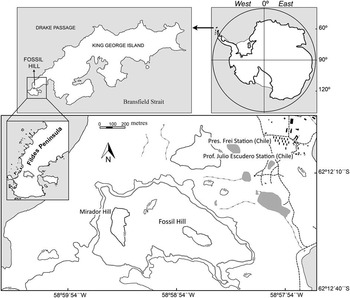
The Fossil Hill locality is at a small elevation above sea level, located on Fildes Peninsula of King George Island, South Shetland Islands, Antarctica (62°10′50′′S–62°11′28′′S, 58°55′27′′W–58°56′38′′W; Fig. 1). The ichnological site has been known since the end of the 1960s for its abundant and well preserved palaeobotanical and ichnofossil remains (e.g. Covacevich & Lamperein Reference Covacevich and Lamperein1969, Reference Covacevich and Lamperein1970, Reference Covacevich and Lamperein1972, Covacevich & Rich Reference Covacevich and Rich1982, Li & Zhen Reference Li and Zhen1994, Yang & Shen Reference Yang and Shen1999). As a result of the unusually rich fossil content, the area was declared an Antarctic Specially Protected Area (ASPA), No. 125 (ATCM 2009). All trace fossils reported to date were recovered from the Fossil Hill Formation (Smellie et al. Reference Smellie, Pankhurst, Thomson and Davies1984, Fontes & Dutra Reference Fontes and Dutra2010), a sedimentary unit which belongs to the Fildes Peninsula Group (Hawkes Reference Hawkes1961).
Map of the Fildes Peninsula, King George Island, Antarctica, showing the location of the Fossil Hill site. The location of detailed study area is modified from ATCM (2009).

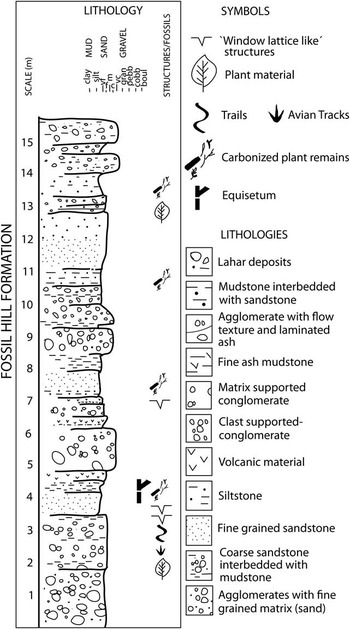
The trace fossil bearing section, located in the lower unit of the Fossil Hill Formation, was previously named Unit 1 by Covacevich & Lamperein (Reference Covacevich and Lamperein1972), and as Bed 2 by Xue et al. (Reference Xue, Shen and Zhuo1996). It consists of grey-yellow, coarse-grained tuffaceous sandstone interlayered with reddish brown mudstone forming units of up to 100 cm thickness (Fig. 2). The section is characterized by “window lattice-like” structures, which indicate tectonic stress after diagenesis (Xue et al. Reference Xue, Shen and Zhuo1996). Supported by the sedimentological evidence and petrological analysis such as a low content of boron, Xue et al. (Reference Xue, Shen and Zhuo1996) dismissed a marine interpretation for theses sediments, but proposed deposition in an intermontane lake with intermittent and rapid deposition by volcanic and seasonal floods.
Stratigraphic column of the Fossil Hill Formation, showing the avian footprints bearing section.

Palaeobotanical remains at Fossil Hill consist of abundant wood, leaf imprints and palynomorphs (e.g. Cao Reference Cao1992, Poole et al. Reference Poole, Hunt and Cantrill2001, Li & Zhou Reference Li and Zhou2007, Fontes & Dutra Reference Fontes and Dutra2010). The analyses suggest that the area was covered by forests dominated by gymnosperms, with shadow-tolerant angiosperms growing in the understory, in environments of low disturbance (Poole et al. Reference Poole, Hunt and Cantrill2001). The vegetation suggests that the climate was wet, and warm to cool, similar to other Eocene localities from Antarctica (Poole et al. Reference Poole, Hunt and Cantrill2001, and references cited therein).
Radiometric ages of the Fossil Hill Formation (e.g. Shen Reference Shen1994) together with the palynological and floral records of the locality (Cao Reference Cao1992, Li Reference Li1994), constrain the age of the unit to the lower to middle Eocene.
Material and methods
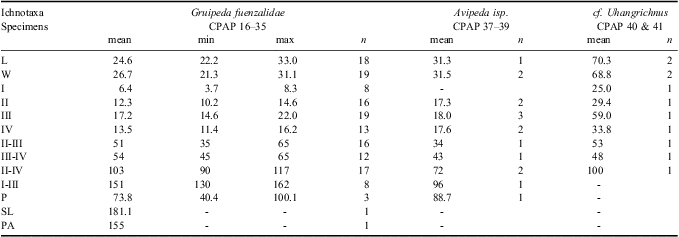
The material was discovered by two of the authors (HGM, MAL) during the 2009 Instituto Antártico Chileno (INACH) field campaign to King George Island. Vertebrate trace fossils described here are represented by moulds and casts. They are preserved in a reddish brown fine tuffaceous sandstone forming slabs of 10–20 cm thickness. They are housed in the Laboratorio de Palaeobiología of the INACH in Punta Arenas, as a part of the Colección Paleontológica de Cerro Fósil (CPCF). The data are summarized in Table I.
Summary of measurements on the preserved footprints. Linear measurements are expressed in millimetres and angles in degrees.
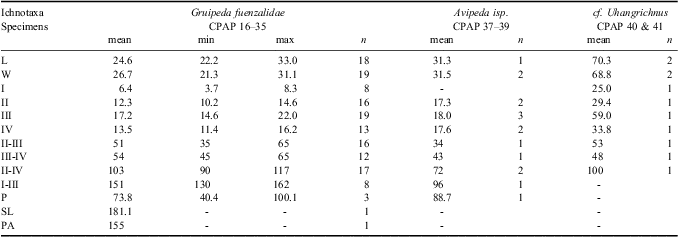
L = footprint length, distance between the distal tips of digit III and the proximal boundary of the sole; W = footprint width, distance between the distal tip of digits II and IV measured perpendicular to the footprint axis; I, II, III, and IV = length of digit imprints I, II, III, and IV; II-III = angle formed by the axis of digits II and III; III-IV = angle formed by the axis of digits III and IV; II-IV = angle formed by the axis of digits II and IV; I-III = angle formed by the axis of digits I and III; PA = pace angulation, angle formed by the segments joining corresponding points of three consecutive tracks; P = pace, distance between the same point of two consecutive tracks of opposite side of the trackway; SL = stride length, distance between the same point of two consecutive tracks on the same side of the trackway.
Ichnotaxonomic assignment of the material follows Bertling et al. (Reference Bertling, Braddy, Bromley, Demathieu, Genise, Mikuláš, Nielsen, Nielsen, Rindsberg, Schlirf and Uchman2006), de Valais & Melchor (Reference De Valais and Melchor2008), and Lockley & Harris (Reference Lockley and Harris2010), among other references. Some morphological types are left in open nomenclature, as a result of insufficient preservation or indistinctive morphological features.
Systematic ichnology
Avipeda Vialov, Reference Vialov1965
Type ichnospecies. Avipeda phoenix Vialov, Reference Vialov1965, p. 112, pls 13–14.
Diagnosis. Avian footprints of small to large size, showing three short, thick digits, with distinct claws. Length of central digit (III) < 25% greater than that of the lateral digits. Total interdigital span 95° or less. Digits closely convergent or united proximally; webbing lacking or limited to the most proximal part of the interdigital angles (Sarjeant & Langston Reference Sarjeant and Langston1994, p. 12).
Remarks. Vialov (Reference Vialov1965) named the ichnotaxon Avipeda as a term for all fossil bird tracks. Subsequently, however, Sarjeant & Langston (Reference Sarjeant and Langston1994) amended and redefined the ichnogenus to embrace tridactyl tracks with thick digit impressions and without webbing marks. Their suggestion is followed here.
Avipeda isp.
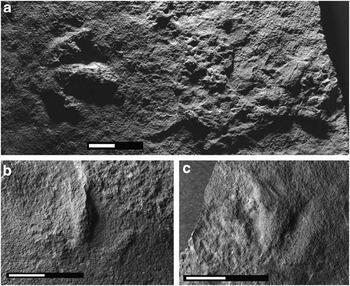
Photographs of specimens of Avipeda isp. a. CPAP 39, b. CPAP 37, and c. CPAP 38. Scale bar: 2 cm.

Material. CPAP 37, 38, and 39. The specimens are represented by two isolated tridactyl footprints (Fig. 3b & c) and two probably associated imprints, forming a partial trackway (Fig. 3a).
Description. The footprints are subequal in length and width (average length and width of 31.3 mm and 31.5 mm respectively). No sole mark is preserved and the proximal ends of the impression of the digits are not in contact. The impressions of the digits are thick, with a maximum width of 8 mm. They are straight and directed laterally. They lack distinguishable claw and digital pad marks. The imprints of the digits III, IV and II are subequal in length, in decreasing order, 18.0 mm, 17.6 mm, and 17.3 mm. The angles formed by the digit imprints are, on average, c. 34° between II and III, and 43° between III and IV. The average of the total divarication angle is 72°. The only measurable trackway parameter is the length of the pace of the partial trackway, which is c. 88.7 mm.
Remarks. The characteristics generally resemble the Avipeda ichnogenus, although the absence of certain specific features, such as the claw marks, is probably due to a preservational bias. Based on the general morphology, the Fossil Hill specimens resemble Avipeda adunca Sarjeant & Langston, Reference Sarjeant and Langston1994, but the scarce available material precludes an ichnospecific assignment.
Gruipeda Panin & Avram, Reference Panin and Avram1962
Type ichnospecies. Gruipeda maxima Panin & Avram, Reference Panin and Avram1962, p. 465, pl. 7, fig. 25.
Diagnosis. Footprints showing four digits, three of which (II–IV) are directed forward and one of which (the larger, fourth (I)), is directed backward, spur-like and short. The interdigital angles between digits II and III and between digits III and IV are commonly less than 70°. The axis of digit I does not correspond with that of digit III, the interdigital angle between digits I and II is smaller than that between digits I and IV. When present, phalangeal pad marks displaying the relation I: 2, II: 2, III: 3, IV: 4. Webbing absent (de Valais & Melchor Reference De Valais and Melchor2008, p. 152).
Remarks. The ichnogenus Gruipeda Panin & Avram, Reference Panin and Avram1962, was erected mainly on the basis of the purported trackmaker. Sarjeant & Langston (Reference Sarjeant and Langston1994) revised and emended the original diagnosis to embrace tridactyl or tetradactyl tracks, with slender and spread digit impressions and without webbing marks. This suggestion is followed here.
Gruipeda fuenzalidae (Covacevich & Lamperein, Reference Covacevich and Lamperein1970)
nov. comb.
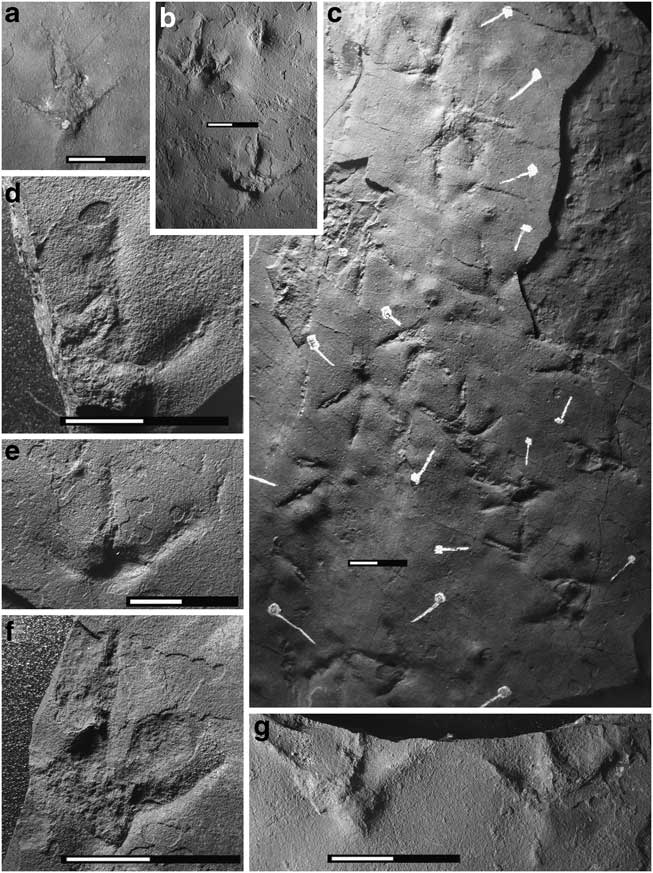
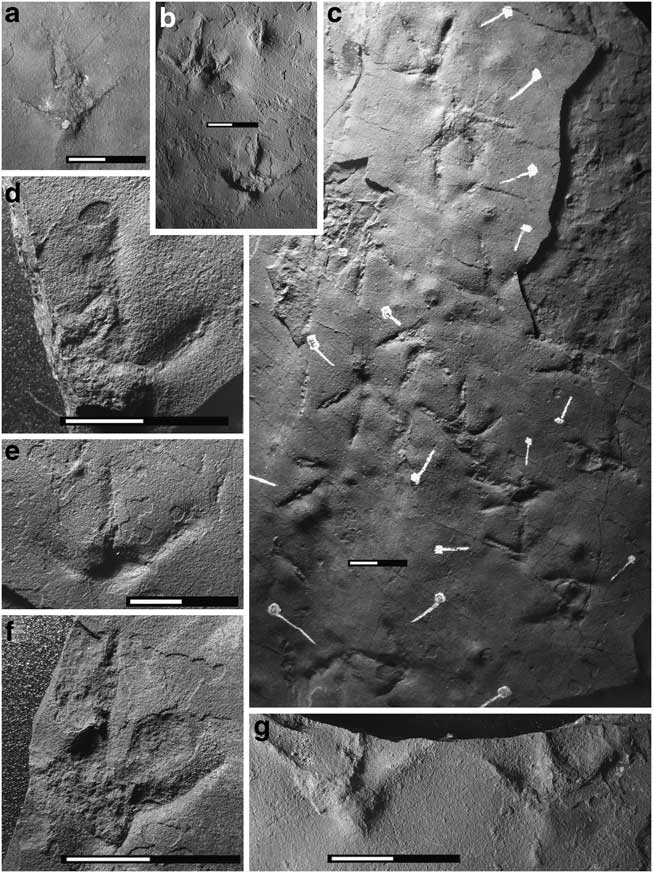
Photographs of specimens of Gruipeda fuenzalidae. a. CPAP 20, b. CPAP 25, c. CPAP 36, d. CPAP 22, e. CPAP 29, f. CPAP 17, and g. CPAP 21. Scale bar: 2 cm.
Material. CPAP 16, 17, 18, 19, 20, 21, 22, 23, 24, 25, 26, 27, 28, 29, 30, 31, 32, 33, 34, and 35. The specimens are represented by several isolated footprints, two probably associated imprints in a partial trackway, and a trackway accounting for three tracks.
Description. The footprints are tridactyl or tetradactyl when the hallux (digit I) imprint is present. In that case, the arrangement is anisodactyl, with the impression of the hallux directed posteriorly and not aligned with the impression of the digit III. The footprints are between 22.2 mm and 33.0 mm long, with an average length of 24.6 mm. Their width ranges between 21.3 mm and 31.1 mm, with an average width of 26.7 mm. The average length of the impression of the digits III, IV, II, and I are, in decreasing order, 17.2 mm, 13.5 mm, 12.3 mm, and 6.4 mm. All digit imprints are united proximally. The digit impressions display acuminate distal tips, although no clear claw marks are preserved. Digital pad impressions and webbing marks are absent.
The average angle of divarication between the impressions of the digits II and III and of the digits III and IV are 51° and 54°, respectively. The angle formed by the hallux and the digit III imprint is c. 151°.
Only one trackway with three tracks and a partial trackway are preserved. The pace angulations is 155°, the stride length is 181.1 mm, while the average pace length is 73.8.
Remarks. Antartichnus fuenzalidae was created by Covacevich & Lamperien (1970) to include tridactyl or tetradactyl avian footprints, with the impression of digits II, III and IV of subequal shape and size but with a short impression of digit I, and the axis of digit I directed posteriorly. Subsequent studies carried out by de Valais & Melchor (Reference De Valais and Melchor2008) caused them to consider the ichnogenus as a junior synonym of Gruipeda.
Fildesichnus sheni Li & Zhen, Reference Li and Zhen1994, from the Fossil Hill Formation, was named based on a single tridactyl slender-toed avian-like footprint. It is indistinguishable from the rest of the specimens and is here considered to be a junior synonym of Gruipeda fuenzalidae.
Uhangrichnus Yang et al., Reference Yang, Lockley, Greben, Erickson and Lim1995
emend. Mansilla et al., nov.
Type ichnospecies. Uhangrichnus chuni Yang et al., Reference Yang, Lockley, Greben, Erickson and Lim1995, p. 22, figs 3–5.
Emended diagnosis. Tridactyl tracks showing clear evidence of webbing between digits II–IV. Hallux impressions absent. The tracks are wider than long. The divarication angles between digits II–IV are commonly c. 100°. Digits II and IV are slightly curved inward rather than straight. The anterior margin of both web impressions between digits II and III, and III and IV is slightly concave anteriorly rather than straight or only slightly concave (modified from Yang et al. Reference Yang, Lockley, Greben, Erickson and Lim1995, p. 22).
cf. Uhangrichnus Yang et al., Reference Yang, Lockley, Greben, Erickson and Lim1995
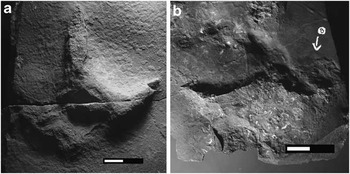
Photographs of specimens of cf. Uhangrichnus. a. CPAP 40, and b. CPAP 41. Scale bar: 2 cm.

Material. CPAP 40 and 41.
Description. CPAP 40 is a tetradactyl preserved as natural cast (Fig. 5a), while CPAP 41 is a poorly preserved tridactyl track preserved as a natural mould in negative epichnia (Fig. 5b), both with short and thick digit impressions.
CPAP 40 is a footprint of 7 mm depth; both surfaces of the slab display some parts of the track. On the upper surface of the slab, most of the distal section of the digit imprint I is preserved as negative epichnia, indicating that the producer digit I is located above of the rest of the digits. The lower surface (Fig. 5a) presents the rest of the track as positive hypichnia, i.e. the impressions of digits II, III, IV and the sole mark. The length of the impressions of digits III, IV and II are, in decreasing order, 59.0 mm, 33.8 mm (incompletely preserved), and 29.4 mm; the length of the digit impression I is estimated at 25.0 mm. The angle between the impressions of the digits II and III is 53°, and between digits III and IV 48°, while the total angle divarication is 100°. The hallux impression is posteromedially directed, even though the angle formed with the digit imprint III is not known with precision.
The footprints have an average length of 70.3 mm and width of 68.8 mm. The impressions of the digits II–IV are united proximally; most of the width corresponds to claw imprints. Digit imprints II and IV are slightly curved inward. The webbing impression is limited to the base of digits, and the sole mark displays a rhomboid outline.
Remarks. Covacevich & Rich (Reference Covacevich and Rich1982) reported two trackways accounting for eight footprints described as “Morphotype II”, with the same general morphological characteristics as those of our material. We suggest they belong to the same ichnotaxon. We provisionally refer all the specimens mentioned herein to Uhangrichnus Yang et al., Reference Yang, Lockley, Greben, Erickson and Lim1995. Specimens known to belong to Uhangrichnus do not display a hallux imprint. The hallux impression observed in the Fossil Hill material was detected in a sediment level slightly overlying the other digits, suggesting that hallux marks may not have been recognized previously due to preservational bias.
Discussions and conclusions
The ichnological assemblage discovered so far at Fossil Hill locality is composed of simple invertebrate traces (i.e. Skolithos, Helmintoidichnites, Gracilichnus; Yang & Shen Reference Yang and Shen1999), arthropod traces (Covacevich & Lamperein Reference Covacevich and Lamperein1972), and avian footprints assigned to three different ichnotaxa, Gruipeda fuenzalidae, Avipeda isp., and cf. Uhangrichnus, in addition to two groups of bird tracks described informally as “Morphotype I” and “Morphotype III” (Covacevich & Lamperein Reference Covacevich and Lamperein1969, Reference Covacevich and Lamperein1970,Reference Covacevich and Lamperein1972, Covacevich & Rich Reference Covacevich and Rich1982, Li & Zhen Reference Li and Zhen1994). Two badly preserved tracks referred to “Morphotype I” are large tridactyls, and have been assigned to ratites or phororhacoids (Covacevich & Rich Reference Covacevich and Rich1982). “Morphotype III” is more abundant (nine tracks) and resembles the ichnogenus Alaripeda Sarjeant & Reynolds, 2001, based on criteria established by de Valais & Melchor (Reference De Valais and Melchor2008). It is important to note that all avian tracks were discovered in a single layer of 150 cm thickness, which suggests that at least five different kinds of birds gathered in this place.
Antarctica has yielded abundant avian fossil bones, but these are restricted to James Ross Island (e.g. Chavez Reference Chavez2007, Tambussi & Acosta Hospitaleche Reference Tambussi and Acosta Hospitaleche2007, and references therein) and Isla Marambio (Seymour Island) (Acosta Hospitaleche & Di Carlo Reference Acosta Hospitaleche and Di Carlo2010, Hospitaleche & Reguero Reference Hospitaleche and Reguero2010). They were discovered in the Maastrichtian López de Bertodano Formation, the late Paleocene Cross Valley Formation, and in the late Eocene La Meseta Formation.
Avian tracks from the Fossil Hill Formation extend the avian record some 200 km to the north and fill the stratigraphical gap between lower to middle Eocene. In some cases, a relationship can be established between the record of fossil bones and tracks of Antarctic birds. For instance, “Morphotype I” tracks have been identified as Ratites or Phorusrhacidae indet. Bones of these group birds were discovered in the La Meseta Formation (late Eocene) of Isla Marambio (Van Tuinen et al. Reference Van Tuinen, Sibley and Hedges1998) and in the López de Bertodano Formation (Late Cretaceous) of Vega Island (Case et al. Reference Case, Reguero, Martin and Cordes-Person2006). Tracks described here as cf. Uhangrichnus (“Morphotype II”) appear to be related to Anseriformes. Fossil remains of these water birds are known from the Maastrichtian López de Bertodano Formation (Clarke et al. Reference Clarke, Tambussi, Noriega, Erickson and Ketcham2005). Producers of tracks assigned to Gruipeda, Avipeda and cf. Alaripeda (“Morphotype III”), on the other hand, have not been identified to date.
During the early Paleogene, Antarctica was still united with other Gondwana continental blocks. Ratite birds or Phorusrhacidae must have used Antarctica as routes of dispersion. The ichnological evidence of big cursorial birds in the Paleogene of Antarctica agrees with the fragmentary fossil records of Ralliformes and Ratites on that continent (Chavez Reference Chavez2007, Tambussi & Acosta Hospitaleche Reference Tambussi and Acosta Hospitaleche2007).
At Fossil Hill, the combination of invertebrate trace fossils, ripple marks, palaeobotanical remains, and avian footprints, indicates deposition on the banks of a shallow lake. This interpretation is not contradicted by the avian track record. An interpretation of the assemblage as shorebird ichnofacies (Lockley et al. Reference Lockley, Hunt and Meyer1994), on the other hand, is premature and only supported by the positive identification of Anseriformes.
Acknowledgements
We thank Prof Dr E. Frey and Dr D. Rubilar-Rogers for their valuable comments. We are also grateful to Dr A. Rubilar and G. Vilches, the curators of the Departamento de Geología, Universidad de Chile, for providing access to their palaeontological collections. Editor Alan Vaughan and reviewers George Mustoe and Carolina Acosta Hospitaleche made valuable comments that greatly improved the manuscript. Financial support for this work was obtained from FONDECYT Project 11080223, the Bundesministerium für Bildung und Forschung (BMBF CHL10/A09), to WS, ML and HM, and from the Universidad Nacional de Río Negro to SdV.