INTRODUCTION
Two decades have elapsed since I last reviewed the evidence for the peopling of the Americas for this journal (Fiedel Reference Fiedel2002). I concluded optimistically: “In the not so distant future, I am confident that we will know, perhaps with decadal precision, exactly when Paleoindians arrived in America, how long it took them to people the continent, and how they affected the native fauna. Establishment of a precise chronology is critical for modeling and understanding the colonization process. Once this has been achieved, there will be profound theoretical repercussions in ethnology, genetics, historical linguistics, demography, and ecology.” Where do we stand now, 20 years on?
The Revolutionary Impact of Paleogenomics
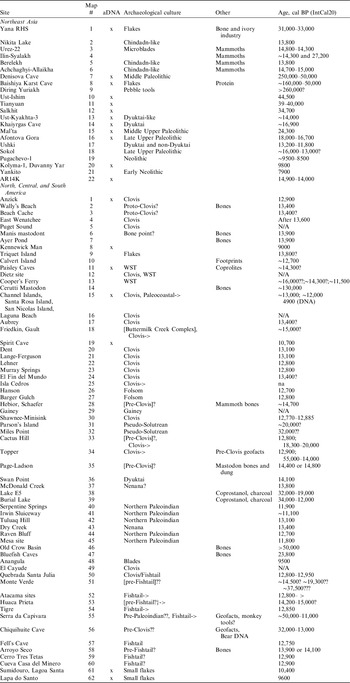
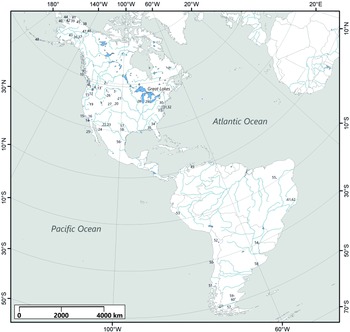
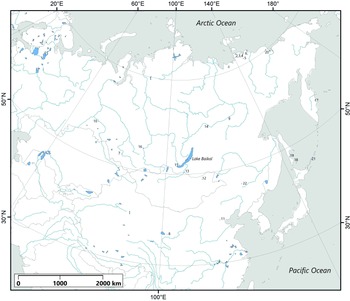
The most important development for this field since 2002 has been the astonishing progress of paleogenomic research. Some ancient mitochondrial DNA from American populations had already been available since the mid-1990s (e.g., Stone and Stoneking Reference Stone and Stoneking1993, Reference Stone and Stoneking1998; Lalueza Fox Reference Lalueza Fox1996; Shook and Smith Reference Shook and Smith2008). In 2010, the first ancient human autosomal genomes were reported, including the genome of a 4000-year-old Saqqaq Paleoeskimo man from Greenland (Rasmussen et al. Reference Rasmussen, Li, Lindgreen, Pedersen, Albrechtsen, Metspalu, Metspalu, Kivisild and Gupta2010). The genomes of the Mal’ta boy from Lake Baikal (Raghavan et al. Reference Raghavan, Degiorgio, Albrechtsen, Moltke, Skoglund, Korneliussen, Rønnow, Appelt, Gulløv and Friesen2014) and the Clovis-associated Anzick infant from Montana (Rasmussen et al. Reference Rasmussen, Anzick, Waters, Skoglund, DeGiorgio, Stafford, Rasmussen, Moltke, Albrechtsen and Doyle2014) were reported in 2014. Since 2015, the number of ancient autosomal genomes has been increasing exponentially, and nuclear genomes have largely replaced mtDNA as the “gold standard” in studies of ancient populations’ histories and affinities (Reich Reference Reich2018). Still, the growing datasets of uniparental samples (maternally transmitted mtDNA and paternally inherited Y chromosomes) continue to be informative (e.g., Llamas et al. Reference Llamas, Fehren-Schmitz, Valverde, Soubrier, Mallick, Rohland, Nordenfelt, Valdiosera, Richards and Rohrlach2016; Duggan et al. Reference Duggan, Harris, Marciniak, Marshall, Kuch, Kitchen, Renaud, Southon, Fuller and Young2017; Wei et al. Reference Wei, Wang, Wen, Yan, Canada, Gurianov, Huang, Mallick, Biondo, O’Leary, Wang, Lu, Zhang, Jin, Xu and Li2018; Pinotti et al. Reference Pinotti, Bergström, Geppert, Bawn, Ohasi, Shi, Lacerda, Solli, Norstedt and Reed2019; Grugni et al. Reference Grugni, Raveane, Ongaro, Battaglia, Trombetta, Colombo, Capodiferro, Olivieri, Achilli and Perego2019; Delgado et al. Reference Delgado, Rodríguez, Kassadjikova and Fehren-Schmitz2021). Unfortunately, the adamant resistance of many indigenous North Americans to genetic sampling of both living people and skeletal remains has hindered research in the United States and Canada. Nevertheless, ancient samples from Central and South America, the Caribbean, and northeastern Asia remain accessible and have formed the primary dataset for recent analyses (Moreno-Mayar et al. Reference Moreno-Mayar, Potter, Vinner, Steinrücken, Rasmussen, Terhorst, Kamm, Albrechtsen, Malaspinas, Sikora, Reuther, Irish, Malhi, Orlando, Song, Nielsen, Meltzer and Willerslev2018a, Reference Moreno-Mayar, Vinner, de Barros Damgaard, de la Fuente, Chan, Spence, Allentoft, Vimala, Racimo and Pinotti2018b; Posth et al. Reference Posth, Nakatsuka, Lazaridis, Skoglund, Mallick, Lamnidis, Rohland, Nagele, Adamski and Bertolini2018; Scheib et al. Reference Scheib, Li, Desai, Link, Kendall, Dewar, Griffith, Mörseburg, Johnson and Potter2018; Schroeder et al. Reference Schroeder, Sikora, Gopalakrishnan, Cassidy, Maisano Delser, Sandoval Velasco, Schraiber, Rasmussen, Homburger, Ávila-Arcos and Allentoft2018; Sikora et al. Reference Sikora, Pitulko, Sousa, Allentoft, Vinner, Rasmussen, Margaryan, de Barros Damgaard, de la Fuente and Renaud2019; Nagele et al. Reference Nägele, Posth, Orbegozo, Chinique de Armas, Hernández Godoy, González Herrera, Nieves-Colón, Sandoval-Velasco, Mylopotamitaki, Radzeviciute and Laffoon2020; Fernandes et al. Reference Fernandes, Sirak, Ringbauer, Sedig, Rohland, Cheronet, Mah, Mallick, Olalde and Culleton2021; Roca-Rada et al. Reference Roca-Rada, Politis, Messineo, Scheifler, Scabuzzo, Gonzalez, Harkins, Reich, Souilmi and Teixeira2021) (see Table 1 and Figures 1 and 2 for site locations and details).

Sites in the Americas

Sites in Northeast Asia

To some extent, these new data from ancient genomes merely add details to the broad picture that was already evident 20 years ago (e.g., Fiedel Reference Fiedel2004), based on human morphology and mtDNA. That is, Native American ancestry consists of two admixed strands: an ancient East Asian population, characterized by mtDNA haplogroups A2, B2, C1b, C1c, C1d, D1, D4h3a, and C4c, and Y-chromosome haplogroups C3-B473 and C3-MPB373, and an ancient North Eurasian (“ANE”) population characterized by two clades of the Y-chromosome Q haplogroup (Q-CTS2730/Q-CTS1780; Q-M930/Q-M3) and mtDNA haplogroups X2a and X2g. Three very widespread sub-clades of Q-M3-- Q-M848, Q-Y4308, and Q-Y4276— also may have been present already in the founding male population, or if not, they appeared very soon after arrival south of the ice sheets. mtDNA clades X2a and X2g, and Y-chromosome clade C3-B473 (or C-P39), all absent from Central and South America, probably arrived in a later northern migration wave. The D2 and D3 mtDNA haplogroups appear to be ancestral lineages only for later Arctic populations (Forster et al. Reference Forster, Harding, Torroni and Bandelt1996; Smith et al. Reference Smith, Malhi, Eshleman, Lorenz and Kaestle1999; Tamm et al. Reference Tamm, Kivisild, Reidla, Metspalu, Smith, Mulligan, Bravi, Rickards, Martinez-Labarga and Khusnutdinova2007; Fagundes et al. Reference Fagundes, Ricardo, Kanitz, Eckert, Valls, Bogo, Salzano, Smith, Silva and Zago2008; Perego et al. Reference Perego, Achilli, Angerhofer, Accetturo, Pala, Olivieri, Kashani, Ritchie, Scozzari, Kong, Myres, Salas, Semino, Bandelt, Woodward and Torroni2009; Kumar et al. Reference Kumar, Bellis, Zlojutro, Melton, Blangero and Curran2011; Raghavan et al. Reference Raghavan, Degiorgio, Albrechtsen, Moltke, Skoglund, Korneliussen, Rønnow, Appelt, Gulløv and Friesen2014).
If these multiple distinct founding uniparental lineages arrived in a single migration event (except the northern-only clades), the founding band must have included at least three, or perhaps six, distantly related or unrelated founding fathers, and eight unrelated founding mothers. Estimates of the “effective” size of the founding population, based on their descendants’ genetic diversity, have ranged from a low of about 43 (Ray et al. Reference Ray, Wegmann, Fagundes, Wang, Ruiz-Linares and Excoffier2010) to a high of about 5400 (Kitchen et al. Reference Kitchen, Miyamoto and Mulligan2008). Most recently, Fagundes et al. (Reference Fagundes, Tagliani-Ribeiro, Rubicz, Tarskaia, Crawford, Salzano and Bonatto2018) estimated the founding population as about 230–300, with a 95% credible interval between about 100 and 3700 individuals. Effective population sizes, by analogy with recent Polar Eskimo, are probably about 60% of the census population (Matsumura and Forster Reference Matsumura and Forster2008). A census population of about 450 is reminiscent of the critical number of ca. 500 often cited as necessary for a forager mating network to avoid extinction (Birdsell Reference Birdsell1953; Wobst Reference Wobst1974). We can only speculate about the sort of socio-political organization that would have been required to coordinate the long-distance migration of some 450 or more people.
In their report of the Anzick infant’s DNA, Rasmussen et al. (Reference Rasmussen, Anzick, Waters, Skoglund, DeGiorgio, Stafford, Rasmussen, Moltke, Albrechtsen and Doyle2014) stated unambiguously, “Contemporary Native Americans are effectively direct descendants of the people who made and used Clovis tools and buried this child.” However, the Anzick infant himself, dead before he had reached the age of 2 years, was the direct ancestor of no one. Rasmussen et al. assigned the little boy to Y-chromosome haplogroup QL54*(xM3) and mtDNA haplogroup D4h3a. Based on subsequent clarification of Q haplogroup phylogeny (e.g., Adamov et al. Reference Adamov, Guryanov, Karzhavin, Tagankin and Urasin2015; Kivisild Reference Kivisild2017), the infant is now assigned to Q-FGC47595 (YFull 2021), which is a descendant branch of the Q-M1107 clade. “Upstream” clades of the Q-M1107 haplogroup, the legacy of older branching events (mutations), are found in living men in Mexico and Peru. This distribution is consistent with the inference from autosomal DNA that the Anzick infant was closer to the ancestral line of living Central and South American peoples than to that of recent Athapaskan and Algonquian-speaking groups of northern North America (i.e., Scheib et al.’s ANC-B group). Recent re-dating (Becerra-Valdivia et al. Reference Becerra-Valdivia, Waters, Stafford, Anzick, Comeskey, Devièse and Higham2018) of the Anzick infant has confirmed his age as ca. 12,900 cal BP (not 12,600, contra Rasmussen et al. Reference Rasmussen, Anzick, Waters, Skoglund, DeGiorgio, Stafford, Rasmussen, Moltke, Albrechtsen and Doyle2014), as Morrow and Fiedel (Reference Morrow and Fiedel2006) previously estimated on the basis of 14C dates of ca. 11,040 rcbp for the elk-antler rods that were found with him (along with more than 100 Clovis-style chipped stone artifacts). The Anzick genome has provided the necessary ancient calibration point for calculation of the ages of the Q clades (Adamov et al. Reference Adamov, Guryanov, Karzhavin, Tagankin and Urasin2015).
The uniparental lineages manifest in the Anzick infant (Q-Z780 and D4h3a) were widespread in the Americas for several millennia after initial colonization, but ultimately became only minor components of recent native populations (e.g., Lindo et al. Reference Lindo, Achilli, Perego, Archer, Valdiosera, Petzelt, Mitchel, Worl, Dixon and Fifield2017). Some 80% of recent Native American males belong instead to another descendant branch of Q-M1107, Q-M3, or one of its several sub-clades. Q-M1107 and its “brother” clade Q-L330 (present today in some native Siberian and Altaian men [Battaglia et al. Reference Battaglia, Grugni, Perego, Angerhofer, Gomez-Palmieri, Woodward, Achilli, Myres, Torroni and Semino2013]) diverged from ancestral Q-L54 in Siberia about 15,500 years ago. Very soon afterward, the Q-M1107 lineage split into the Q-Z780 (or Q-CTS1780) and Q-M930 sub-clades. Soon after that split, a brother clade of Q-M3, called Q-1h or Q-L804, appeared. Thousands of years afterward, Q-L804 men ultimately ended up, via migration from Siberia, in northwestern Europe (Kivisild Reference Kivisild2017; Pinotti et al. Reference Pinotti, Bergström, Geppert, Bawn, Ohasi, Shi, Lacerda, Solli, Norstedt and Reed2019). Q-M3, represented today only by Native American men, appeared between 14,900 and 12,600 cal BP. Its ubiquitous American sub-clade, Q-M848, appeared and expanded ca. 12,600 cal BP (Grugni et al. Reference Grugni, Raveane, Ongaro, Battaglia, Trombetta, Colombo, Capodiferro, Olivieri, Achilli and Perego2019; YFull 2021). Three males in the Lagoa Santa (Sumidouro) population in Brazil, ca. 10,400 cal BP, belonged to this clade (Grugni et al. Reference Grugni, Raveane, Ongaro, Battaglia, Trombetta, Colombo, Capodiferro, Olivieri, Achilli and Perego2019), and Native men of this branch now live throughout Central and South America (including Patagonia). To the north, Kennewick Man (ca. 9000 cal BP), Spirit Cave Man (from Nevada, ca. 10,700 cal BP) and some ancient residents of the Channel Islands off Southern California also were members of Q-M848. Another minor clade of Q-M3, Q-Y4308, with representatives in northern Canada, Brazil, and the Channel Islands, has an estimated common ancestor at around 12,200 cal BP (13,800–10,800 cal BP) (Pinotti et al. Reference Pinotti, Bergström, Geppert, Bawn, Ohasi, Shi, Lacerda, Solli, Norstedt and Reed2019).
The Y chromosome chronology is consistent with that now inferred from mtDNA. Although initial estimates for the time of origin of the Native American mtDNA haplogroups were on the order of 30,000 years (e.g., Torroni et al. Reference Torroni, Neel, Barrantes, Schurr and Wallace1994), more recent analyses have yielded lower age estimates of about 15–18,000 years (e.g., Bodner et al. Reference Bodner, Perego, Huber, Fendt, Rock, Zimmermann, Olivieri, Gomez-Carballa, Lancioni, Angerhofer, Bobillo, Corach, Woodward, Salas, Achilli, Torroni, Bandelt and Parson2012; Llamas et al. Reference Llamas, Fehren-Schmitz, Valverde, Soubrier, Mallick, Rohland, Nordenfelt, Valdiosera, Richards and Rohrlach2016). The mtDNA lineages of the A, B, C, and D haplogroups underwent a rapid, 60-fold expansion in the Americas between ca. 16,000 and 13,000 cal BP (Llamas et al. Reference Llamas, Fehren-Schmitz, Valverde, Soubrier, Mallick, Rohland, Nordenfelt, Valdiosera, Richards and Rohrlach2016).
Ancient North Eurasians
Patterson et al. (Reference Patterson, Moorjani, Luo, Mallick, Rohland, Zhan, Genschoreck, Webster and Reich2012) hypothesized the former existence of an Ancient North Eurasian (ANE) population in order to account for an unexpected relationship between modern European and Native American genomes that emerged from statistical comparisons. An actual ancient representative of this population soon was identified when the genome of the Mal’ta boy was sequenced (Raghavan et al. Reference Raghavan, Degiorgio, Albrechtsen, Moltke, Skoglund, Korneliussen, Rønnow, Appelt, Gulløv and Friesen2014). This boy had been buried near Lake Baikal about 24,000 cal BP. His mtDNA and Y chromosome types—U and R, respectively—are not found in the Americas; however, his autosomal DNA was related to that of both the Anzick infant and all descendant Native Americans.
Native American ancestors were formed by an admixture of genes from this ANE population and an East Asian population. The percentage of ANE ancestry in the Native American genome is now estimated as about 15–30%. Genomic analyses suggest this admixture occurred about 23,000 cal BP—around the time of the Mal’ta boy. However, the genome of the Afontova Gora 3 girl, 14C-dated to ca. 18,000 cal BP (Fu et al. Reference Fu, Posth, Hajdinjak, Petr, Mallick, Fernandes, Furtwängler, Haak, Meyer and Mittnik2016), is more closely related than Mal’ta’s to later Native Americans. Flegontov et al. (Reference Flegontov, Altinisik, Changmai, Rohland, Mallick, Adamski, Bolnick, Broomandkhoshbacht, Candilio and Culleton2019) modeled two episodes of ANE admixture—the first ca. 23,000 cal BP, and the second, ca. 14,000–13,500 cal BP.
The new paleogenomic data and analyses appear to tightly constrain the chronology and geography of ancestral Paleoindian origins. Nevertheless, the precise location of the ancestral homeland remains as elusive as it was two decades ago (e.g., Haeussler Reference Haeussler2004). Paleoindian ancestors are among the many “ghost” populations that are now continually being conjured to fill in the gaps in paleogenomic phylogenies. They must have lived in Northeast Asia about 20–15,000 years ago, but they were replaced by subsequent immigration waves and so left no direct modern descendants in that region (Mooder et al. Reference Mooder, Schurr, Bamforth, Bazaliiski and Savel’ev2006; Zlojutro et al. Reference Zlojutro, Tarskaia, Sorensen, Snodgrass, Leonard and Crawford2008; Pugach et al. Reference Pugach, Matveev, Spitsyn, Makarov, Novgorodov, Osakovsky, Stoneking and Pakendorf2016; Moussa et al. Reference Moussa, Bazaliiskii, Goriunova, Bamforth and Weber2018; Sikora et al. Reference Sikora, Pitulko, Sousa, Allentoft, Vinner, Rasmussen, Margaryan, de Barros Damgaard, de la Fuente and Renaud2019; Mao et al. Reference Mao, Zhang, Qiao, Liu, Chang, Xie, Zhang, Wang, Li and Cao2021). The few Siberian individuals dated to the period before Paleoindians’ departure (e.g., Yana RHS, Mal’ta, Afontova Gora 2 and 3, Ust-Kyakhta-3, and Khaiyrgas-1) all seem to be ancient “cousins” rather than direct lineal ancestors of Native Americans (Yu et al. Reference Yu, Spyrou, Karapetian, Shnaider, Radzevičiūtė, Nägele, Neumann, Penske, Zech and Lucas2020; Kilinc et al. Reference Kılınç, Kashuba, Koptekin, Bergfeldt, Dönertaş, Rodríguez-Varela, Shergin, Ivanov, Kichigin, Pestereva and Volkov2021). A relatively close relationship to two recently analyzed 14,000-year-old individuals from the Amur region of Northeastern China suggests that the East Asian component of Paleoindian ancestry may have originated near this region (Mao et al. Reference Mao, Zhang, Qiao, Liu, Chang, Xie, Zhang, Wang, Li and Cao2021). Notably, they both belonged, like the Anzick infant, to mtDNA haplogroup D4h3, which is virtually non-existent among modern East Asians.
Population Y
Skoglund et al. (Reference Skoglund, Mallick, Bortolini, Chennagiri, Hünemeier, Petzl-Erler, Salzano, Patterson and Reich2015) reported their detection of a small fraction (1–2%) of “Australasian”-related alleles in the genomes of several living Amazonian native peoples (the Surui, Karitiana, Xavante, Piapoco, and Guarani). On that basis, they hypothesized a mysterious ancestral “Population Y,” distinct from other Native American ancestors. The report of a similar genetic component in Aleuts (Raghavan et al. Reference Raghavan, Steinrücken, Harris, Schiffels, Rasmussen, DeGiorgio, Albrechtsen, Valdiosera, Ávila-Arcos and Malaspinas2015) has not been replicated (Flegontov et al. Reference Flegontov, Altinisik, Changmai, Rohland, Mallick, Adamski, Bolnick, Broomandkhoshbacht, Candilio and Culleton2019). However, this component now has been reported in many more living Native groups in South America, including people along the Pacific coast (Araújo Castro e Silva et al. Reference Araújo, Ferraz, Bortolini, Comas and Hünemeier2021). Population Y seems to have been another “ghost”—a now-vanished East Asian population related to the Tianyuan Man, ca. 40,000 cal BP, from northern China, and to the remote Asian ancestors shared by modern Andaman Islanders (Onge), Papuans, and some Australian Aborigines (collectively, “Australasians”). Skoglund et al. speculated that this distinct Australasian genetic component might be related somehow to the early “Australo-Melanesian”-like skulls from Brazil, analyzed since the 1980s in numerous studies by Walter Neves and his colleagues (e.g., Neves and Hubbe Reference Neves and Hubbe2005). They also speculated that the inhabitants of pre-Clovis sites might have belonged to Population Y.
Population Y alleles were soon recognized in ancient DNA of a 10,400-year old skeleton from Lagoa Santa, Brazil (Moreno-Mayar et al. Reference Moreno-Mayar, Vinner, de Barros Damgaard, de la Fuente, Chan, Spence, Allentoft, Vimala, Racimo and Pinotti2018b), but, strangely, this component was absent from several 9600-year-old individuals from Lapa do Santo in the same region (Posth et al. Reference Posth, Nakatsuka, Lazaridis, Skoglund, Mallick, Lamnidis, Rohland, Nagele, Adamski and Bertolini2018). These alleles are also absent from the much later pre-Columbian Taino of the Caribbean, whose ancestors emigrated from the Orinoco basin (Schroeder et al. Reference Schroeder, Sikora, Gopalakrishnan, Cassidy, Maisano Delser, Sandoval Velasco, Schraiber, Rasmussen, Homburger, Ávila-Arcos and Allentoft2018). Posth et al. (Reference Posth, Nakatsuka, Lazaridis, Skoglund, Mallick, Lamnidis, Rohland, Nagele, Adamski and Bertolini2018) found no Population Y components in a sample of 49 ancient Central and South American genomes. However, a new re-analysis has detected a Tianyuan/Onge component (6%) in one of the Lapa do Santo individuals and in a Lagoa Santa skeleton (Sumidouro 5) (7–8% of the genome). This signal was also detected (only 2%) in an ancient individual, dated to 9300 cal BP, from Belize (Ning et al. Reference Ning, Fernandes, Changmai, Flegontova, Yüncü, Maier, Altınışık, Kassian, Krause, Lalueza-Fox, Manica and Potter2020).
As for the putative connection to the pseudo-Australo-Melanesian skulls from Brazil and elsewhere (e.g., Baja California, Yucatan, Tierra del Fuego), archaic-looking skulls have, in every case, yielded unexceptional Native American DNA, with no traces of Population Y. Skull shapes have turned out to be unreliable for determining ancestral relationships (Fiedel Reference Fiedel2004; Perez et al. Reference Perez, Bernal, Gonzalez, Sardi and Politis2009; Raghavan et al. Reference Raghavan, Steinrücken, Harris, Schiffels, Rasmussen, DeGiorgio, Albrechtsen, Valdiosera, Ávila-Arcos and Malaspinas2015: SI 53–57).
TWO SEPARATE RESEARCH QUESTIONS: EARLIEST HUMANS VS. EARLIEST NATIVE AMERICAN ANCESTORS
The new DNA data require that we now clearly distinguish two separate research questions: (1) When did the ancestors of the living indigenous peoples arrive? and (2) When was the earliest occupation of the Americas by Homo sapiens or pre-sapiens hominins? The answers may not be the same. In Europe, Asia, and Africa, recent archaeogenomic studies have revealed genetic discontinuities between the most ancient and recent human populations. Why should the Americas be unique? Many mammal species crossed Beringia in multiple immigration waves during cold periods of the Pleistocene (Salis et al. Reference Salis, Bray, Lee, Heiniger, Barnett, Burns, Doronichev, Fedje, Golovanova and Harington2020). Why not hominins, too?
The best candidate for a hypothetical pre-sapiens population in the Americas is the Denisovans. This sub-species (which diverged from Neanderthals about 400,000 years ago) was first recognized in the form of a distinctive mitochondrial genome extracted from a ca. 60,000-year-old “pinkie” finger bone from Denisova Cave in the Altai (Krause et al. Reference Krause, Fu, Good, Viola, Shunkov, Derevianko and Pääbo2010; Sawyer et al. Reference Sawyer, Renaud, Viola, Hublin, Gansauge, Shunkov, Derevianko, Prüfer, Kelso and Pääbo2015). Subsequent research has identified several more, older fragments of this sub-species from the same site, and a Denisovan mandible, more than 160,000 years old, has been found in Baishiya Karst Cave in Tibet (Chen et al. Reference Chen, Welker, Shen, Bailey, Bergmann, Davis, Xia, Wang, Fischer and Freidline2019). Modern Papuans and some aboriginal Philippine groups (Larena et al. Reference Larena, McKenna, Sanchez-Quinto, Bernhardsson, Ebeo, Reyes, Casel, Huang, Hagada and Guilay2021) have an extraordinarily high number of introgressed Denisovan alleles (about 3% and 5% of their genomes, respectively). It seems that this resulted from their ancestors’ interbreeding with a distinctive southern Denisovan population. Introgressed DNA of the more northern Denisovans has been recognized in the genomes of ancient Homo sapiens from northeast Mongolia (the Salkhit cranium, ca. 34,700 cal BP) and the 40,000 cal BP Tianyuan individual found near Beijing (Massilani et al. Reference Massilani, Skov, Hajdinjak, Gunchinsuren, Tseveendorj, Yi, Lee, Nagel, Nickel and Devièse2020). The time of this introgression event is estimated as ca. 50,000 years ago. This date roughly corresponds to the likely time of arrival of Homo sapiens in southern Siberia as marked by the appearance of Initial Upper Paleolithic blade industries in the Altai, northern Mongolia, Transbaikal, and north-central China at 50–47,000 cal BP (Slavinsky et al. Reference Slavinsky, Rybin, Khatsenovich and Belousova2019).
A Denisovan gene, EPAS1, introgressed into the ancestors of modern Tibetans about 43,000 years ago. Long after it had been acquired—only ca. 12,000 years ago—it was selected for and became fixed in Tibetans because it played a role in their adaptation to hypoxia at high altitude (Zhang et al. Reference Zhang, Xia, Chen, Li, Slon, Cheng, Yang, Jacobs, Dai and Massilani2020).
A very faint Denisovan genetic signal also has been detected in the DNA of living Native Americans (Qin and Stoneking Reference Qin and Stoneking2015). These Denisovan alleles seem to affect body fat distribution and lip thickness (Racimo et al. Reference Racimo, Gokhman, Fumagalli, Ko, Hansen, Moltke, Albrechtsen, Carmel, Huerta-Sanchez and Nielsen2017; Bonfante et al. Reference Bonfante, Faux, Navarro, Mendoza-Revilla, Dubied, Montillot, Wentworth, Poloni, Varón-González and Jones2021), traits that may have proven somehow adaptive to extreme cold in Beringia.
Apart from their very large teeth, the morphology of Denisovans remains almost completely unknown. As for their material culture, claims of their use of Upper Paleolithic stone and bone tools (Shunkov et al. Reference Shunkov, Fedorchenko, Kozlikin and Derevianko2020) remain questionable. The stone tools reported from Baishiya Karst Cave are a simple flake and pebble industry (Zhang et al. Reference Zhang, Xia, Chen, Li, Slon, Cheng, Yang, Jacobs, Dai and Massilani2020).
It seems most likely that humans would have required both controlled fire and tailored clothing to withstand the hyper-cold climate of Beringia (but see Bartsiokas and Arsuaga Reference Bartsiokas and Arsuaga2020). However, if Denisovans could survive in the mountains of Tibet, they might have had the necessary biological, if not cultural, adaptations for life in the Arctic. Scant attention has been paid in recent years to the pebble tools at Diring Yuriakh (dated by OSL to ca. >260,000 cal BP, Waters et al. Reference Waters, Forman and Pierson1997; Carlson Reference Carlson2001; but cf. Kuzmin and Krivonogov Reference Kuzmin and Krivonogov1999) and other putatively Lower to Middle Paleolithic sites in Siberia (Mochanov and Fedoseeva Reference Mochanov and Fedoseeva2017). Perhaps these sites should be reconsidered as a potential staging area for a hypothetical Denisovan migration into the Americas.
Hypotheticals aside, no pre-sapiens human fossils or ancient DNA have ever been discovered in the Americas. If any pre-sapiens hominins or early Homo sapiens arrived in the Americas 33,000 (Ardelean et al. Reference Ardelean, Becerra-Valdivia, Pedersen, Schwenninger, Oviatt, Macias-Quintero, Arroyo-Cabrales, Sikora, Ocampo-Diaz and Rubio-Cisneros2020), 50,000 (Santos et al. Reference Santos, Bird, Fifield, Parenti, Guidon and Hausladen2003; Goodyear Reference Goodyear2005; Goodyear and Sain Reference Goodyear and Sain2018), or 130,000 years ago (Holen et al. Reference Holen, Harington and Holen2017), or even earlier, they did not evolve locally into Native Americans. In fact, the chipped stone “artifacts” from Chiquihuite Cave in Mexico (Ardelean et al. Reference Ardelean, Becerra-Valdivia, Pedersen, Schwenninger, Oviatt, Macias-Quintero, Arroyo-Cabrales, Sikora, Ocampo-Diaz and Rubio-Cisneros2020), the Serra da Capivara rockshelter sites in northeastern Brazil (Guidon and Delibrias Reference Guidon and Delibrias1986; Guidon et al. 1996; Parenti Reference Parenti2001; Santos et al. Reference Santos, Bird, Fifield, Parenti, Guidon and Hausladen2003; Guidon et al. Reference Guidon, Pessis and Martin2009; Lahaye et al. Reference Lahaye, Hernandez, Boëda, Felice, Guidon, Hoeltz, Lourdeau, Pagli, Pessis, Rasse and Viana2013; Aimola et al. Reference Aimola, Andrade, Mota and Parenti2014; Boëda et al. Reference Boëda, Clemente-Conte, Fontugne, Lahay, Pino, Daltrini Felice, Guidon, Hoeltz, Lourdeau and Pagli2014, Reference Boëda, Ramos, Perez, Hatte, Lahaye, Pino, Herisson, Clemente-Conte, Fontugne and Guerin2021), and Topper, South Carolina (Goodyear and Sain Reference Goodyear and Sain2018) are so crude and unpatterned that their creation by any population of genus Homo is very improbable. In the Brazilian case, I have suggested (Fiedel Reference Fiedel2017a) that those multiply-flaked rocks not attributable to natural tumbling in waterfalls (Meltzer et al. Reference Meltzer, Adovasio and Dillehay1994) may have been created by the local tool-using capuchin monkeys (Proffitt et al. Reference Proffitt, Luncz, Falótico, Ottoni, de la Torre and Haslam2016; Haslam et al. Reference Haslam, Luncz, Staff, Bradshaw, Ottoni and Falotico2016). No chipped, shaped stone artifacts were associated with the 130,000-year-old Cerutti Mastodon in California, only several cobbles interpreted as bone-smashing tools (Holen et al. Reference Holen, Harington and Holen2017; Bordes et al. Reference Bordes, Hayes, Fullagar and Deméré2020). In this respect, the site resembles the much younger mammoth and mastodont sites that Holen and Holen (Reference Holen and Holen2014) interpret as evidence of human activity in North America between ca. 43,000 and 24,000 cal BP. Contrast these flake-less sites with, for example, the ca. 420,000-year old elephant excavated in Ebbsfleet, England, surrounded by 77 flint flakes (Wenban-Smith et al. Reference Wenban-Smith, Allen, Bates, Parfitt, Preece, Stewart, Turner and Whittaker2006). Clark and Haynes (1970) described many other examples of flake tools at Paleolithic elephant-butchering sites in Africa and Europe (see also McNabb Reference McNabb2019).
The past two decades have seen highly publicized claims for the pre-Clovis antiquity of several new sites, as well as publication of supportive evidence for the antiquity of some of the few remaining sites that have withstood scrutiny since they were first reported. For the sake of brevity, I cannot reiterate here in detail site-specific critiques of widely publicized putative pre-Clovis sites; the reader can find these reviews elsewhere (e.g., Morrow et al. Reference Morrow, Fiedel, Johnson, Kornfeld, Rutledge and Wood2012; Fiedel Reference Fiedel2013; Haynes 2015; Chatters et al. Reference Chatters, Potter, Prentiss, Fiedel, Haynes, Kelly, Kilby, Lanoë, Holland-Lulewicz and Miller2021; Fiedel et al. Reference Fiedel, Potter, Morrow, Faught, Haynes and Chatters2021). Given the new genomic data, for any further consideration of putative pre-Clovis sites, it is logical to divide them into two groups: sites dating between 13,500 and 16,000 years, which are plausibly ancestral culturally and biologically to Clovis Paleoindians and/or to recent Native Americans; and those older than ca. 16,000 years, which are very unlikely to represent ancestral Native Americans (Potter et al. Reference Potter, Chatters, Prentiss, Fiedel, Haynes, Kelly, Kilby, Lanoë, Holland-Lulewicz, Miller, Morrow, Perri, Rademaker, Reuther, Ritchison, Sanchez, Sánchez-Morales, Spivey-Faulkner, Tune and Haynes2021).
A Beringian Standstill?
Genetic anthropologists inferred from the mtDNA of living people that Native American ancestors must have been isolated from their closest East Asian relatives for about 8000 to 15,000 years (ca. 23–30,000 to 15,000 cal BP) before their migration into America south of the ice sheets (Tamm et al. Reference Tamm, Kivisild, Reidla, Metspalu, Smith, Mulligan, Bravi, Rickards, Martinez-Labarga and Khusnutdinova2007; Kitchen et al. Reference Kitchen, Miyamoto and Mulligan2008; Mulligan and Kitchen Reference Mulligan and Kitchen2014). The isolated population, numbering ca. 8000–10,000, was presumed to have remained in Beringia during the Last Glacial Maximum (LGM) (ca. 28–18,000 cal BP), while other people retreated to the south. Hoffecker et al. (Reference Hoffecker, Elias and O’Rourke2014, Reference Hoffecker, Elias, O’Rourke, Scott and Bigelow2016) proposed that those who stayed in the north adapted to the mesic shrub tundra in the center of LGM Beringia, where enough wood was available to kindle bone-fueled fires. Environmental reconstructions suggest that the southern, near-coastal portion of this central area would have had atypically abundant vegetation capable of supporting animals and humans. The absence of any archaeological traces of these people has been conveniently ascribed to the early Holocene submergence of this refugium. A multi-disciplinary team continues to search for confirmatory genetic and archaeological evidence of this hypothetical “Beringian Standstill” (e.g., Hoffecker et al. Reference Hoffecker, Elias, O’Rourke, Scott and Bigelow2016, Reference Hoffecker, Pitul’ko and Pavlova2019, Reference Hoffecker, Elias and Potapova2020; Hlusko et al. Reference Hlusko, Carlson, Chaplin, Elias, Hoffecker, Huffman, Jablonski, Monson, O’Rourke, Pilloud and Scott2018).
If the Standstill population was restricted to a ca. 125–250,000 km2 refugium in south-central Beringia, this could explain the absence of archaeological sites dated between 30,000 and 14,000 cal BP in the still-exposed portions of eastern (Alaska) and western (Chukotka) interior Beringia—an absence that has actually been observed, until recently. Bourgeon et al. (Reference Bourgeon, Burke and Higham2017) cited ostensible cutmarks on a horse mandible, along with a handful of other seemingly cut bones, as evidence of intermittent human occupation of Bluefish Caves in the Yukon for millennia, starting at 23,800 cal BP (see now Bourgeon and Burke Reference Bourgeon and Burke2021). Hoffecker et al. (Reference Hoffecker, Elias and Potapova2020), citing the Bluefish Caves evidence, now suggest that central Arctic Beringia may have been a more likely human refugium than the near-coastal zone. However, the few supposed cutmarks were recognized among thousands of unmodified bone fragments, and their anthropogenic origin is uncertain (Krasinski and Blong Reference Krasinski and Blong2020). In this context, we should also note the supposedly human-modified broken bones from the Old Crow Basin; those were once interpreted as traces of a ca. 40 to 20,000-year-old bone industry in the Yukon but are now infrequently discussed (Morlan and Cinq-Mars Reference Morlan and Cinq-Mars1982; Morlan Reference Morlan2003). The broken bones now appear to be older than 50,000 cal BP (Holen et al. Reference Holen, Harington and Holen2017). Another possible indicator of human activity, again without such unambiguous traces as hearths or stone tools, is the presence of distinctively human (or omnivore) fecal stanols, as well as charcoal particles, in sediments of Lake E5 and Burial Lake on the Alaskan North Slope. Vachula et al. (Reference Vachula, Huang, Longo, Dee, Daniels and Russell2019 and Reference Vachula, Huang, Russell, Abbott, Finkenbinder and O’Donnell2020) claim that these biomarkers indicate a continuous human presence in eastern Beringia since 31,000 cal BP. Curiously, the putative human tracers peter out ca. 15,000 cal BP, 1000 years before the oldest unambiguous human campsites in central Alaska.
The Standstill model was based mainly on mtDNA. More recent studies of Y-chromosome phylogeny cast doubt on this model; there may have been no Beringian standstill, or if it did occur, it might have lasted only about 2500 years (Wei et al. Reference Wei, Wang, Wen, Yan, Canada, Gurianov, Huang, Mallick, Biondo, O’Leary, Wang, Lu, Zhang, Jin, Xu and Li2018; Grugni et al. Reference Grugni, Raveane, Ongaro, Battaglia, Trombetta, Colombo, Capodiferro, Olivieri, Achilli and Perego2019; Pinotti et al. Reference Pinotti, Bergström, Geppert, Bawn, Ohasi, Shi, Lacerda, Solli, Norstedt and Reed2019).
Given the continuing absence of archaeological traces of a Standstill occupation of Beringia, Buvit and Terry (Reference Buvit and Terry2016) suggested that Siberians might have retreated to northern Japan as an alternative refugium during the LGM. Certainly, the Upper Paleolithic cultures of Hokkaido and Sakhalin contain bifaces and microblades that are plausible prototypes for Paleoindian tools. However, the genomes of ancient Jomon and their presumed descendants, the modern Ainu, are only very remotely related to those of Native Americans; their shared Asian ancestors diverged more than 26,000 years ago (Adachi et al. Reference Adachi, Shinoda, Umetsu, Kitano, Matsumura, Fujiyama, Sawada and Masashi2011; Gakuhari et al. Reference Gakuhari, Nakagome, Rasmussen, Allentoft, Sato, Korneliussen, Chuinneagáin, Matsumae, Koganebuchi and Schmidt2020; Cooke et al. Reference Cooke, Mattiangeli, Cassidy, Okazaki, Stokes, Onbe, Hatakeyama, Machida, Kasai and Tomioka2021). The admixed Mal’ta-like ANE component of Native American genomes is absent from the genomes of 8800 to 2500-year-old Jomon individuals (Gakuhari et al. Reference Gakuhari, Nakagome, Rasmussen, Allentoft, Sato, Korneliussen, Chuinneagáin, Matsumae, Koganebuchi and Schmidt2020). The most common mtDNA haplogroup in ancient Jomon samples, N9b (Adachi et al. Reference Adachi, Shinoda, Umetsu, Kitano, Matsumura, Fujiyama, Sawada and Masashi2011; Cooke et al. Reference Cooke, Mattiangeli, Cassidy, Okazaki, Stokes, Onbe, Hatakeyama, Machida, Kasai and Tomioka2021), is completely absent from both ancient and modern Native American populations (Llamas et al. Reference Llamas, Fehren-Schmitz, Valverde, Soubrier, Mallick, Rohland, Nordenfelt, Valdiosera, Richards and Rohrlach2016); conversely, the ubiquitous Native American clades of Y chromosome haplogroup Q are absent from Japan (Watanabe et al. Reference Watanabe, Naka, Khor, Sawai, Hitomi, Tokunaga and Ohashi2019). Still, it is not impossible that the Late Pleistocene inhabitants of Hokkaido were a vanished “ghost” population, related to the Paleolithic peoples of interior Siberia, who were completely replaced by intrusive Incipient Jomon. Unlikely as this scenario may be, only recovery of an ancient genome from a northern Japanese skeleton older than 13,000 cal BP could disprove it.
Early Siberian Populations
Recent archaeological research in Siberia and western Beringia suggests that successive migratory waves of Homo sapiens expanded and receded after ca. 50,000 cal BP. This evidence is congruent with recent paleogenomic analyses of some of the earliest Homo sapiens specimens from Europe (Hajdinjak et al. Reference Hajdinjak, Mafessoni, Skov, Vernot, Hübner, Fu, Essel, Nagel, Nickel and Richter2021; Prüfer et al. Reference Prüfer, Posth, Yu, Stoessel, Spyrou, Deviese, Mattonai, Ribechini, Higham, Velemínský, Brůžek and Krause2021; Vallini et al. Reference Vallini, Marciani, Aneli, Bortolini, Benazzi, Pievani and Pagani2021). The Ust-Ishim individual, represented by a femur dated to 41,400 rcbp (ca. 44,500 cal BP), was found above 50° N latitude in western Siberia. His DNA indicates he was not a direct ancestor of any extant population of eastern or western Eurasia (Fu et al. Reference Fu, Li, Moorjani, Jay, Slepchenko, Bondarev, Johnson, Aximu-Petri, Prüfer, de Filippo and Meyer2014). A few sites in northeastern Siberia appear to date to ca. 49,000–42,000 cal BP (Pavlova and Pitulko Reference Pavlova and Pitulko2020). Some of these earliest sites consist only of bones with suggestive cutmarks or breakage patterns; simple lithic flakes and well-made ivory tools and manufacturing debris are also reported, mostly from secondary contexts.
The next set of sites date from 41,500–30,000 cal BP; among these is the remarkable Yana RHS site, dated to 28,900–26,500 rcbp (33,500–31,000 cal BP) (Pitulko et al. Reference Pitulko, Nikolsky, Cirya, Basilyan, Tumskoy, Koulakov, Astakhov, Pavlova and Anisimov2004). Three aspects of the Yana RHS evidence should be emphasized. There are thousands of stone tools, mostly on flakes. The worked bone and ivory industry, including needles, points, bowls, and ornaments, is very sophisticated (Pitulko et al. Reference Pitulko, Pavlova, Nikolskiy and Ivanova2012). Recent genomic analysis of DNA extracted from two deciduous teeth shows that the inhabitants of Yana RHS were collateral but not direct lineal ancestors of Native Americans. They were closely related to the ANE population that later admixed with East Asian ancestors of Native Americans, but that ANE branch had diverged from the Yana branch long before the admixture occurred. The Yana population has no living descendants in Siberia; they were replaced around 20,000 cal BP (Sikora et al. Reference Sikora, Pitulko, Sousa, Allentoft, Vinner, Rasmussen, Margaryan, de Barros Damgaard, de la Fuente and Renaud2019).
If an eastern branch of this Yana population crossed Beringia and occupied, or even intermittently visited, Alaska or the Yukon, we would expect to find there some readily identifiable stone tools on flakes (but not microblades) and associated debitage, and finely made bone and ivory artifacts. In fact, no such unambiguous artifacts are known from eastern Beringia before 14,200 cal BP. In their absence, a few scratched bones and fecal stanols are insufficient proof of human occupation ca. 30,000–20,000 cal BP. In any case, even if Yana-derived people were living in Alaska at such an early date, they were not the direct biological ancestors of Native Americans, either in Alaska or south of the ice sheets.
The millennia after Yana RHS saw an apparent reduction of human activity in Arctic western Beringia, although a few LGM-age sites are known (e.g., the Yana-A locality, where a mammoth ivory artifact is dated to ca. 21,400 cal BP). The archaeological evidence increases at the onset of the Bølling-Allerød warming, with several sites, mainly in the northern Yana-Indighirka lowland, dated between ca. 12,600 and 11,800 rcbp (ca. 15,000–13,600 cal BP) (Berelekh, Achchaghyi-Allaikha, Ilin-Syalakh mammoth site, Nikita Lake site, and Urez-22 site) (Pitulko et al. Reference Pitulko, Pavlova and Basilyan2016a). This Bølling-Allerød re-settlement appears to have been spurred by rapid growth of the Siberian/Beringian mammoth population. All of these sites are associated with concentrations of mammoth remains, sometimes also accompanied by bones of woolly rhinoceros, reindeer, horse, bison, hare, and birds. These people made mammoth ivory rods that resemble, on the one hand, the much older artifacts from Yana RHS, but also the slightly younger rods from Clovis sites.
The Coastal Migration Theory and Monte Verde
The recent genetic and archaeological evidence summarized above still points, as the available data also did in 2002, to the interior of Siberia and western Beringia, and not the coast of Northeast Asia, as the ancestral homeland of Paleoindians and their Native American descendants. Why then, as Braje et al. (Reference Braje, Dillehay, Erlandson, Klein and Rick2017) asserted, do “most archaeologists and other scholars now believe that the earliest Americans followed Pacific Rim shorelines”? (e.g., Braje et al. Reference Braje, Erlandson, Rick, Davis, Dillehay, Fedje, Froese, Gusick, Mackie and McLaren2019; Waters Reference Waters2019; Davis and Madsen Reference Davis and Madsen2020).
The simple answer is, Monte Verde. Although a possible Pacific Coast migration route had been broached occasionally for decades (e.g., Dixon Reference Dixon1923; Hrdlicka Reference Hrdlicka1932; Fladmark Reference Fladmark1979), “the ‘coastal migration theory’ remained on the intellectual margins of Paleoindian archaeology until the late 1990s with the widespread acceptance of the ∼14,500 cal BP pre-Clovis occupation at the Monte Verde site in southern Chile, which demonstrated that humans were in South America more than 1,000 years before Clovis….” (Braje et al. Reference Braje, Erlandson, Rick, Davis, Dillehay, Fedje, Froese, Gusick, Mackie and McLaren2019:2). Since 1997, research into the peopling of the Americas has been distorted by archaeologists’ near-universal acceptance of the antiquity and anthropogenic origin of the Monte Verde II “site”—a unique, bizarre congeries of gravel, wood and peat, within which lay a few indubitable but poorly provenienced stone tools (Dillehay Reference Dillehay1997; Meltzer Reference Meltzer1997; cf. Fiedel Reference Fiedel1999a; Dickinson Reference Dickinson2011). Both genetic anthropologists and popular science writers incapable of assessing the published evidence on their own, simply rely on the archaeologists’ judgment. Thus, papers attempting to calibrate rates of genetic mutation or to model the migration process invariably start with the explicit assumption that people must have arrived in southern Chile by 14,500 cal BP. As I said in 2002, “Without a pressing need to account for the chronological and cultural anomaly of Monte Verde, the search for a coastal migration route loses its urgency” (Fiedel Reference Fiedel2002:421).
At ca. 14,500 cal BP (or even 14,000 cal BP [Erlandson et al. Reference Erlandson, Braje and Graham2008]), MV II is not only pre-Clovis, but also pre-dates emergence of a habitable ice-free corridor between the shrinking Laurentide and Cordilleran ice sheets. While Arnold (Reference Arnold2002) argued that the corridor only opened after ca. 13,000 cal BP, I suggested instead that the corridor was ice-free already at the onset of Bolling warming, ca. 14,700 cal BP (Fiedel Reference Fiedel2002). Dyke’s (Reference Dyke2004) ice margin reconstruction indicated that the sheets separated between 16,000 and 14,000 cal BP. Collapse of the connecting ice saddle at ca. 14,600 cal BP has been modeled as the source of meltwater causing the rapid global sea-level rise, Meltwater Pulse 1a (Gregoire et al. Reference Gregoire, Otto-Bliesner, Valdes and Ivanovic2016), as well as the Older Dryas stadial at 14,100 cal BP (Ivanovic et al. 2016). The coalesced ice sheets would have blocked any interior passage until about 15,000 cal BP (Munyikwa et al. Reference Munyikwa, Rittenour and Feathers2017). The central part of the corridor was open after that, but opinions differ on its biological viability before 12,600 cal BP (Pedersen et al. Reference Pedersen, Ruter, Schweger, Friebe, Staff, Kjeldsen, Mendoza, Beaudoin, Zutter and Larsen2016; Heintzman et al. Reference Heintzman, Froese, Ives, Soares, Zazula, Letts, Andrews, Driver, Hall and Hare2016; Dawe and Kornfeld Reference Dawe and Kornfeld2017; Potter et al. Reference Potter, Reuther, Holliday, Holmes, Miller and Schmuck2017, Reference Potter, Baichtal, Beaudoin, Fehren-Schmitz, Haynes, Holliday, Holmes, Ives, Kelly and Llamas2018; Froese et al. Reference Froese, Young, Norris and Margold2019). In any case, at ca. 14,500 cal BP, when Monte Verde was supposedly occupied, the ice-free corridor would have been very narrow and challenging (Froese et al. Reference Froese, Young, Norris and Margold2019).
In contrast, much of the Canadian Pacific coast was ice-free before 16,300 cal BP, when it hosted an arid tundra environment (Misarti et al. Reference Misarti, Finney, Jordan, Maschner, Addison, Shapley, Krumhardt and Beget2012; Lesnek et al. Reference Lesnek, Briner, Lindqvist, Baichtal and Heaton2018; Darvill et al. Reference Darvill, Menounos, Goehring, Lian and Caffee2018) and animals such as bears, fox, and caribou thrived in refugia. Humans might have hopped by short sea voyages between these habitable spots; but did they? The earliest human presence in the caves previously occupied by bears dates from about 12,700 cal BP (Fedje et al. Reference Fedje, Mackie, McLaren and Christensen2008)—1500 years later than Monte Verde, and also several hundred years after Clovis had spread throughout the North American interior.
A logical stepping-stone route for a Pacific Rim migration from Northeast Asia would run from Hokkaido via the Kuril Islands to Kamchatka, and from there to Alaska via the Aleutian Islands (Davis and Madsen Reference Davis and Madsen2020). The Aleutians were above water in the late Pleistocene and they still are, but the earliest site in this island chain is Anangula, and it is only 9500 years old, not 16,000 (Aigner Reference Aigner1970). There is no evidence of any early occupation of the Kuril Islands, either—the oldest known site there is Yankito, ca. 8000 cal BP (Yanshina and Kuzmin Reference Yanshina and Kuzmin2010). The oldest site in Kamchatka is Ushki, at 13,000 cal BP (Goebel et al. Reference Goebel, Slobodin and Waters2010).
For three decades (Fedje Reference Fedje1993), Canadian archaeologists have been searching intensively for early sites in areas along the coast of British Columbia that were above water in the late Pleistocene and afterward were uplifted high above the rising water. They have found faint traces of early human presence, but none date earlier than Monte Verde II. A cluster of quartz flakes was found at the bottom of a stratified sequence at a site on Triquet Island. One 14C date from the same zone is calibrated as ca. 14,000–13,600 cal BP. Just above it, another date of ca. 11,300 cal BP was obtained (Gauvreau and McLaren Reference Gauvreau and McLaren2017). On nearby Calvert Island, ostensible human footprints uncovered in 2015 appear to date to about 12,700 cal BP—the same age as the oldest artifacts found in the bear dens (McLaren et al. Reference McLaren, Fedje, Dyck, Mackie, Gauvreau and Cohen2018). The breakage patterns of bison bones found at Ayer Pond, near Victoria BC, have been attributed to human butchery (Kenady et al. Reference Kenady, Wilson, Schalk and Mierendorf2011). The bison dates to 11,990 rcbp (13,800–14,000 cal BP). To the south, the Manis mastodont in Washington, with a sliver of mastodont bone—perhaps a shattered dart tip—stuck in a rib, dates to 11,960 rcbp (ca. 13,800 cal BP) (Waters et al. Reference Waters, Forman, Jennings, Nordt, Driese, Feinberg, Keene, Halligan, Lindquist, Pierson, Hallmark, Collins and Wiederhold2011) No stone tools were associated with either animal. If these supposed kill sites represent an early coastal population, they either gave rise to, or else were soon surrounded by, people who made Clovis points. Eight fluted points have been found around Puget Sound (Croes et al. Reference Croes, Williams, Ross, Collard, Dennler and Vargo2008). The spectacular East Wenatchee Clovis cache, possibly as old as 13,500 cal BP, is located 190 km east of Puget Sound. This cache is about 250 km closer to the coast than the 14,000-yr-old putatively human feces from Paisley Caves, which somehow have become connected to the narrative of a pre-Clovis coastal migration. Paisley Caves, in turn, is about 75 km away from the Clovis assemblage at the Dietz site.
This pattern is replicated wherever there are claims of an early coastal presence: Clovis points or Clovis-derived Fishtail points have been found not far away. Shell fishhooks found on Isla Cedros off Baja California date to about 10,000 cal BP and marine food use there may date as early as 12,400 cal BP; but a fluted point was found on the island’s surface (Des Lauriers Reference Des Lauriers2008). To the east, 100 km from the Sea of Cortez, are the Clovis sites of Sonora, including the gomphothere butchery site at El Fin del Mundo, dated to ca. 13,400 cal BP (Sanchez et al. Reference Sanchez, Holliday, Gaines, Arroyo-Cabrales, Martínez-Tagüeña, Kowler, Lange, Hodgins, Mentzer and Sanchez-Morales2014). The 12,200-year-old stemmed points found on Santa Rosa Island off southern California are cited as an indicator of early coastal migration (Erlandson et al. Reference Erlandson, Rick, Braje, Casperson, Culleton, Fulfrost, Garcia, Guthrie, Jew, Kennett, Moss, Reeder, Skinner, Watts and Willis2011)—but a fluted point found on the mainland near Laguna Beach must be at least 600 years older (Fitzgerald and Rondeau Reference Fitzgerald and Rondeau2012). Clovis-like points have been found in southern Chile, 100 to 350 km north of Monte Verde (Jackson Reference Jackson2006). At Quebrada Santa Julia on the coast north of Santiago, a fluted preform was associated with a butchered horse and a hearth dated to 12,900 cal BP (Jackson et al. Reference Jackson, Mendez, Seguel, Maldonado and Vargas2007). Dillehay et al. (Reference Dillehay, Goodbred, Pino, Vásquez Sánchez, Rosales Tham, Adovasio, Collins, Netherly, Hastorf and Chiou2017) report several dates of about 14,500 cal BP in association with utilized stone spalls at the base of the Huaca Prieta mound in northern Peru. However, Fishtails and Paijan stemmed points have been found in nearby valleys (Maggard Reference Maggard2015). As for the Huaca Prieta radiocarbon dates, both old wood and marine upwelling effects are well-known problems in this region (e.g., Kennett et al. Reference Kennett, Ingram, Southon and Wise2002).
Erlandson et al. (Reference Erlandson, Graham, Bourque, Corbett, Estes and Steneck2007, Reference Erlandson, Braje, Gill and Graham2015) propose that maritime-adapted coastal migrants could have followed a resource-rich “kelp highway” southward from the coast of Beringia. However, these hypothetical mariners or strandloopers would have faced a daunting challenge when they set out southward from Baja California, because from there to northern Peru—a distance of some 5000 km—there are no kelp forests. On the other hand, if they somehow made it as far as northern Chile, they would have been fortunate, because they encountered a rare window of opportunity for settlement. This is now the driest desert on earth, but from 17,600 to 13,800 cal BP it was well-watered and habitable by plants, animals, and (potentially) people. However, there is no archaeological evidence of any human occupation of this near-coastal zone at 14,000 cal BP or earlier. For 1000 years after 13,800 cal BP the Atacama was arid, but it was wet again from 12,800 to 9800 cal BP—and the earliest sites in this region date from 12,800 cal BP (Latorre et al. Reference Latorre, Santoro, Ugalde, Gayó, Osorio, Salas-Egaña, De Pol-Holz, Joly and Rech2013; Santoro et al. Reference Santoro, Capriles, Gayo, de Porras, Maldonado, Standen, Latorre, Castro, Angelo and McRostie2017). Fishtail points have been found in those sites, as they have in most demonstrably early sites along the coast of South America (Grosjean et al. Reference Grosjean, Núñez and Cartajena2005). In the narrow littoral zone of northern Chile, the earliest occupations in rockshelters, and evidence of fishing, date no earlier than ca. 12,300 cal BP (Salazar et al. Reference Salazar, Arenas, Andrade, Olguín, Torres, Flores, Vargas, Rebolledo, Borie and Sandoval2018; Rebolledo et al. Reference Rebolledo, Béarez and Zurro2021).
Dillehay’s initial interpretation of MV II stressed the inhabitants’ use of many local terrestrial plants for food and medicine, and butchering of big game, as indicated by bones of gomphotheres and one paleolama bone (Dillehay Reference Dillehay1997). The diverse plant assemblage appeared to indicate centuries of local adaptation, preceded by millennia of slow overland migration from Beringia to Chile. In fact, Dillehay (Reference Dillehay1997) tentatively proposed that some pebbles, cracked rocks, burned patches, and a poorly provenienced handaxe-like tool at nearby MV I, across Chinchihuapi Creek from MV II, might represent human activity as early as 33,000 rcbp (ca. 37,500 cal BP according to IntCal20). Although the site is not very far from the Pacific coast, the supposed residents of MV II made little use of marine resources: no fish, no marine shellfish, and no sea mammal or sea bird bones were recovered. However, Dillehay et al. (Reference Dillehay, Ramirez, Pino, Collins, Rossen and Pino-Navarro2008) reported their recognition, in re-analyzed sediment samples, of nine species of seaweed, directly dated to ca. 12,300 rcbp (ca. 14,300 or possibly 14,800 cal BP). With this announcement of a link to the shore, Monte Verde became firmly tied to the rapid coastal migration/kelp highway hypothesis (Erlandson et al. Reference Erlandson, Braje and Graham2008).
After a long hiatus, Dillehay resumed test excavations along Chinchihuapi Creek, east of MV II, in 2013. In reports of this recent work (Dillehay et al. Reference Dillehay, Ocampo, Saavedra, Sawakuchi, Vega, Pino, Collins, Cummings, Arrequi and Villagran2015, Reference Dillehay, Ocampo, Saavedra, Pino, Scott-Cummings, Kovácik, Silva and Alvar2019, Reference Dillehay, Pino and Ocampo2021), he has claimed that the area was occupied intermittently perhaps before 20,000 cal BP, but definitely after 19,300 cal BP (or alternatively, just 17,500 cal BP [Dillehay et al. Reference Dillehay, Pino and Ocampo2021]). This claim relies upon dated plants and bone fragments associated with the same sort of crude stone “tools” that Dillehay previously reported from Monte Verde II. Yet this new claim has been greeted with polite silence (e.g., Braje et al. Reference Braje, Erlandson, Rick, Davis, Dillehay, Fedje, Froese, Gusick, Mackie and McLaren2019). Why? Because geologists, archaeologists, and geneticists already have tweaked their data (e.g., dates of Cordilleran ice sheet retreat [Darvill et al. Reference Darvill, Menounos, Goehring, Lian and Caffee2018] and mtDNA mutation rates [e.g., Kumar et al. Reference Kumar, Bellis, Zlojutro, Melton, Blangero and Curran2011]) to accommodate the date of ca. 14,500 cal BP for human occupation of southernmost South America; adding 3–5,000 years would have profound and unacceptable ramifications. Politis and Prates (Reference Politis and Prates2018, Reference Politis and Prates2021) have published skeptical appraisals of the older components, provoking a sharp, dismissive rebuke from Dillehay and his colleagues (Dillehay et al. Reference Dillehay, Pino and Ocampo2021).
South American Paleoindians
The hundreds of broken stream cobbles and three unprovenienced El Jobo-like bifaces that constitute the Monte Verde II lithic assemblage differ radically from Clovis tools and an ancestor-descendant cultural relationship between them is difficult to envision. In contrast, the amazingly uniform Fishtail (or Fell) points found from Mexico to Patagonia, including many finds along both the Pacific and Atlantic coasts (Grosjean et al. Reference Grosjean, Núñez and Cartajena2005), are unmistakably derived from Clovis (Morrow and Morrow Reference Morrow and Morrow1999; Pearson Reference Pearson2004, Reference Pearson2017; Nami Reference Nami2021). Fishtail points are often (but not always) fluted, like Clovis points; some Clovis points of the Southeast US closely resemble some Central American Fishtails. The Clovis-to-Fishtail transformation thus could have occurred in Central America, or perhaps, it happened farther south. At El Cayude on the coast of Venezuela there are surface-collected Clovis-like fluted preforms and blade cores (Pearson and Ream Reference Pearson and Ream2005). Several of the fluted points found in southern Chile, not far north of Monte Verde (Jackson Reference Jackson2006), are virtually indistinguishable from Arizona Clovis points.
There are notable concentrations of Fishtail sites in the Argentine Pampas (Flegenheimer et al. Reference Flegenheimer, Miotti and Mazzia2014) and Uruguay, where assemblages with points, fluted preforms, blades, and ovate biface preforms are precisely dated to 12,900–12,200 cal BP (Suarez et al. Reference Suarez, Pineiro and Barcelo2018; Suarez Reference Suarez2019). Although the literature on Brazil emphasizes putative pre-Clovis pebble tools, in fact, surface-found Fishtail points are widespread there (Loponte et al. Reference Loponte, Okumura and Carbonera2016). Indeed, a Fishtail point closely resembling those from Uruguay was recently found on the surface only 6 km away from the putatively pre-Clovis Pedra Furada rockshelter site in the Serra da Capivara (Boëda et al. Reference Boëda, Ramos, Perez, Hatte, Lahaye, Pino, Herisson, Clemente-Conte, Fontugne and Guerin2021).
However, the ostensible stylistic sequence leading from North American Clovis to Central and South American Fell I Fishtail points seems to have little or no temporal depth (Fiedel and Kuzmin Reference Fiedel and Kuzmin2010). Both Roosevelt et al. (Reference Roosevelt, Douglas and Brown2002) and Waters and Stafford (2007) correctly observed that the oldest 14C dates associated with Fishtails in southern South America overlapped with Clovis dates. Waters (Reference Waters2019) and Waters et al. (Reference Waters, Stafford and Carlson2020) still regard Clovis and Fishtail as coeval at ∼12,900 cal BP. Notably, the interhemispheric offset in the period from 13,000–12,700 cal BP, which fluctuated between ca. 0 and 50 years (Capano et al. Reference Capano, Miramont, Shindo, Guibal, Marschal, Kromer, Tuna and Bard2020; Hogg et al. Reference Hogg, Heaton, Hua, Palmer, Turney, Southon, Bayliss, Blackwell, Boswijk, Bronk Ramsey, Pearson, Petchey, Reimer, Reimer and Wacker2020), was never large enough to account for the very brief interval that separates the Clovis and Fishtail horizons. Re-dating by AMS of some of the ostensibly oldest Fishtail components has resulted, in most cases, in a slight reduction of their ages (Prates et al. 2013). Waters et al. (Reference Waters, Stafford, Kooyman and Hills2015) re-dated hearths at Fell’s Cave in Patagonia, where the Fishtail complex had first been recognized by Junius Bird in the 1930s. The deepest, oldest hearth now has a date of 10,835 ± 50 rcbp, or ca. 12,750 cal BP. Most Fishtail sites in the Southern Cone date within the span of ca. 10,800–10,200 rcbp, 12,750–11,800 cal BP (Flegenheimer and Zarate Reference Flegenheimer and Zarate1997; Faught Reference Faught2008; Steele and Politis Reference Steele and Politis2009; Prates et al. 2013; Suarez Reference Suarez2019).
However, there are still a few older outliers. Suarez (Reference Suarez2019) reports dates of 10,955 ± 50, 10,930 ± 20 and 10,905 ± 20 rcbp (ca. 12,850 cal BP) for a Fishtail component at the bottom of the Tigre site in Uruguay. Five additional dates from the same stratum range from ca. 10,600 to 10,400 rcbp. Suarez et al. (Reference Suarez, Pineiro and Barcelo2018) reported three dates for a single charcoal sample from the interface with the underlying stratum: 11,355 ± 30, 11,320 ± 30, and 11,315 ± 30 rcbp (ca. 13,200 cal BP). This sample was directly associated with 148 flakes and a biface fragment that is obviously a Fishtail preform, of the same shape and material as those found 3 cm above these artifacts. Old wood, spurious association, or artifact drift downward might account for the anomalous pre-11,000 rcbp date. At Quebrada Santa Julia in northern Chile, a basal fragment of a fluted bifacial preform is associated with a butchered horse and hearth charcoal dates of 11,090 ± 80 rcbp (Beta-215089), 11,060 ± 80 rcbp (Beta-215090), and 10,920 ± 80 rcbp (Beta-194725) (Jackson et al. Reference Jackson, Mendez, Seguel, Maldonado and Vargas2007). Although an old wood effect is possible, the hearth probably dates to ca. 11,000–11,050 rcbp, or ca. 12,950–12,800 cal BP (SHCal20). The fluted preform might have been intended for production of either a Fishtail or a Clovis-like point. At a few other sites with early dates, the affinities of the small lithic assemblages are indeterminate. Two 14C dates on hearth charcoal at Cueva Casa del Minero are 10,999 ± 55 (AA-37207) and 10,967 ± 55 (AA-37208) rcbp. Similar hearth-derived dates from Cerro Tres Tetas are 10,915 ± 65 and 10,853 ± 70 rcbp for one sample, and 11,145 ± 60 and 11,015 ± 66 rcbp for another (Steele and Politis Reference Steele and Politis2009). Again discounting any old wood effect, both of these sites could represent oldest Fishtail or transitional Clovis-Fishtail components.
Roosevelt et al. (Reference Roosevelt, Douglas and Brown2002) and Waters and Stafford (2007) inferred from the equivalent late Clovis/earliest Fishtail ages that the South American Paleoindians could not have been actual descendants of northern migrants; rather, some archaeologically invisible, previously dispersed earlier populations must have adopted the new lithic technology from the north. In that case, one would expect the various local imitations of Clovis to display some regionally specific stylistic distinctions and persistent traits of the precursor technologies (for which there is no archaeological evidence). Instead, what we actually see is the very rapid spread of a uniform point style and its associated tool types (such as sidescrapers and endscrapers) from Central America all the way to the southern tip of South America.
No ancient DNA has yet been sampled from any individual directly associated with a Fishtail assemblage. However, the most ancient genomes from South America, sampled from Brazilian skeletons dated to 10,400–9600 cal BP, shared ancestry with the Anzick Clovis infant (Posth et al. Reference Posth, Nakatsuka, Lazaridis, Skoglund, Mallick, Lamnidis, Rohland, Nagele, Adamski and Bertolini2018). These skeletons came from the Lagoa Santa region, where the Early Holocene crania have been interpreted as deriving from a pre-Clovis/Fishtail “Australo-Melanesian” ancestral population (e.g., Neves and Hubbe Reference Neves and Hubbe2005). The Fishtail complex is very weakly attested in this region; after 12,000 cal BP, the lithic industry here consists of simple quartz flake tools (Araujo et al. Reference Araujo, Neves and Kipnis2012). Araujo (Reference Araujo2015) infers from the divergent characters of this industry and two coeval Early Holocene Brazilian lithic traditions (Umbu, with bifaces, and Itaparica, with unifaces), that they must have originated before 13,000 cal BP and represent multiple slow migration waves beginning before the LGM. Both Neves’ and Araujo’s interpretations of the Brazilian data are now contradicted by the recovery of Clovis-affiliated genomes.
The star-like phylogeny of Native South American mtDNA haplotypes indicates that the founding Clovis/Fishtail population grew exponentially, very quickly (Llamas et al. Reference Llamas, Fehren-Schmitz, Valverde, Soubrier, Mallick, Rohland, Nordenfelt, Valdiosera, Richards and Rohrlach2016). This explosive growth, typical of an invasive species, is also evident in the continent-wide pattern of radiocarbon dates, which sharply increase everywhere at 13,000–12,500 cal BP (Bueno et al. Reference Bueno, Dias and Steele2013; Mendez Reference Méndez2013; Goldberg et al. Reference Goldberg, Mychajliw and Hadly2016; Prates et al. Reference Prates, Politis and Perez2020). Such exponential growth and rapid territorial expansion, from a founding population of ca. 500, doubling every generation (28–31 years) to ca. 50–100,000 in ca. 250 years, would appear effectively instantaneous, leaving no visible cline of 14C dates to track the wave from its presumed northwestern source (Hazelwood and Steele Reference Hazelwood and Steele2003).
Prates et al. (Reference Prates, Politis and Perez2020) recently compiled, critically assessed, and statistically analyzed the early radiocarbon dates from South America. They conclude that Paleoindians expanded in a “rapid radiation” after the LGM. However, they estimate that humans arrived ca. 15,500 cal BP—2500 years before the ubiquitous appearance of the Fishtail complex. Prates et al. (Reference Prates, Politis and Perez2020:6–7) observe that the summed probability distributions of 14C dates show that “during the first period with human evidence in South America (15,100–13,500 cal BP) the intensity of the archaeological signal is extremely low. Then, the signal increases slowly from ca. 13,400, and rapidly between 13,200 and 12,700 cal BP.” In fact, the only sites with pre-13,400 cal BP dates that they regard as acceptable are Monte Verde II, Huaca Prieta (with likely reservoir effects), and Arroyo Seco 2, where a horse (Equus neogeus) radius, possibly broken by a hammerstone, was dated to 12,170 ± 45 rcbp (UCIAMS-142842), ca. 13,900 or 14,100 cal BP. If these three isolated cases are relegated to unproven status, the puzzle of a dispersed, static, archaeologically invisible population, barely surviving for two millennia before suddenly exploding all over the continent—with a uniform Clovis-derived lithic industry—at 13,000 cal BP, disappears.
EXACTLY HOW OLD IS CLOVIS?
To support his inference that Clovis lithic technology spread via diffusion through a pre-Clovis population in North America, Waters has advocated a short Clovis chronology, with a temporal span from 13,050 to 12,800 or 12,750 cal BP (Waters and Stafford 2007; Waters et al. Reference Waters, Stafford and Carlson2020). Haynes et al. (Reference Haynes, Anderson, Ferring, Fiedel, Grayson, Haynes, Holliday, Huckell, Kornfeld and Meltzer2007) objected that a longer chronology, and thus expansion via migration, was just as possible. A simulation by Prasciunas and Surovell (Reference Prasciunas and Surovell2015) suggests that the post-13,100 dates may only be sampling the final years of a ca. 1,000-year-long colonization and demographic growth process. This model is congruent with archaeological evidence of the earliest humans in Alaska at 14,100 cal BP. Waters’ response has been to question all Clovis-associated ages older than 13,050 cal BP while touting several ostensible pre-Clovis sites (Waters Reference Waters2019; Waters et al. Reference Waters, Stafford and Carlson2020). In truth, the roster of pre-13,100 cal BP Clovis sites is small and dubious. Two Clovis-associated radiocarbon dates from the Aubrey site in Texas average 11,570 ± 70 rcbp or ca. 13,400 cal BP (Ferring Reference Ferring2001). Ferring (Reference Ferring2012) clarified that the dated charcoal samples came from hearths securely associated with the human occupation, but even so, they might be derived from long-dead wood that had inherent age at the time of burning, or might be contaminated by old carbon (Waters et al. Reference Waters, Stafford and Carlson2020). Charcoal-like organic matter found near the butchered gomphothere and associated Clovis points at the Fin del Mundo site in Sonora, Mexico, was dated to 11,550 ± 60 rcbp (ca. 13,400 cal BP) (Sanchez et al. Reference Sanchez, Holliday, Gaines, Arroyo-Cabrales, Martínez-Tagüeña, Kowler, Lange, Hodgins, Mentzer and Sanchez-Morales2014), but Waters et al. (Reference Waters, Stafford and Carlson2020) raise several valid concerns about the sample and the statistical manipulation that reduced the standard error. This leaves only the spectacular Clovis biface cache at East Wenatchee in Washington, which lay directly on a deposit of Glacier Peak tephra, so that particles of the tephra adhered to several bifaces (Mehringer and Foit Reference Mehringer and Foit1990; Gramly Reference Gramly1991). An attempt to date the bone rods found in the cache yielded obviously erratic young 14C ages, possibly due to contamination by agricultural pesticides (Gramly Reference Gramly1991). Glacier Peak tephra had long been assumed to date to about 11,200 rcbp (Foit et al. Reference Foit, Mehringer and Sheppard1993), but Kuehn et al. (Reference Kuehn, Froese, Carrara, Foit, Pearce and Rotheisler2009) revised its age to ca. 11,600 rcbp (13,500 cal BP). Minute particles of this tephra have now been detected in pond sediments in Maine and Nova Scotia (Pyne-O’Donnell et al. Reference Pyne-O’Donnell, Cwynar, Jensen, Vincent, Kuehn, Spear and Froese2016) and even in Scotland (Pyne-O’Donnell and Jensen Reference Pyne-O’Donnell and Jensen2019), so it has great potential for trans-continental tephrochronology. Unfortunately, the span of time that may have elapsed between the Glacier Peak eruption and the deposition of the East Wenatchee points cannot be determined, so 11,600 rcbp (ca. 13,500 cal BP) is only a terminus post quem for the Clovis cache.
There is no clear pattern of earlier western vs. late eastern dates for Clovis; classic sites such as Lehner and Murray Springs in Arizona date to ca. 10,850 rcbp, but Shawnee-Minisink in eastern Pennsylvania is just as old, maybe even earlier. Shawnee-Minisink is now the most precisely 14C-dated Clovis site (Waters and Stafford 2007; Gingerich Reference Gingerich and Gingerich2013; Waters et al. Reference Waters, Stafford and Carlson2020). The six AMS 14C dates were run on samples of burnt hawthorn plum seeds from two hearths. There are hundreds of these seeds, which must have been simultaneously deposited over a very brief period of days or weeks. The dates are 10,820 ± 50 (Beta-203865); 10,900 ± 40 (Beta-127162); 10,915 ± 25 (UCIAMS-24865); 10,940 ± 90 (Beta-101935); 10,970 ± 50 (OxA-1731); and 11,020 ± 30 rcbp (UCIAMS-24866). Their average is 10,940 ± 15 rcbp (12,770–12,885 cal BP). Note, however, that if the dates are taken individually, the calibrated ages for this single brief occupation range across the entire span of Clovis florescence as defined by Waters et al. (ca. 13,050 to 12,750 cal BP). Waters et al. (Reference Waters, Stafford and Carlson2020) accept as accurate, dates of 11,110 ± 40 rcbp (UCIAMS-11345) on mammoth bone from Lange-Ferguson, South Dakota, and 11,155 ± 50 rcbp (OxA-X-2736-12) for the Dent, Colorado mammoth. The same specimens also yielded slightly later ages, but the ca. 11,100–11,150 rcbp dates would indicate a starting date of 13,100 cal BP for Clovis florescence. Importantly, IntCal20 now shows a short radiocarbon cliff from about 11,250 to 11,050 14C years at 13,150–13,050 cal BP. If there was a dense, stable Clovis occupation of North America before 13,100 cal BP, there ought to be many dates of about 11,200 rcbp, but there are not. After the cliff, there is a short, slightly sloping plateau from 13,070 to 12,930 cal BP (Fiedel Reference Fiedel2015); occupations during that period should all yield dates of ca. 11,050 rcbp. There is a brief reversal at ca. 13,060 to 13,040 cal BP, such that a date of 11,000 is older than a date of 11,125 rcbp (Reinig et al. Reference Reinig, Wacker, Jöris, Oppenheimer, Guidobaldi, Nievergelt, Adolphi, Cherubini, Engels and Esper2021: their Figure 3). At ca. 12,870–12,850 there is another slight reversal, such that 10,950 is older than 11,010 rcbp. A steep cliff occurs between 12,770–12,670 cal BP, when 14C dates jump forward from ca. 10,920 to 10,580 rcbp.
The Wally’s Beach site in southern Alberta (near the southern outlet of the ice-free corridor) offers an interesting example of the application of Waters’ short Clovis chronology, as well as current approaches to radiocarbon dating of bone collagen samples. This site, exposed by draining of the St. Mary Reservoir, contains trackways of mammoths, camels, horses, bison, and caribou. Bones of horse (Equus conversidens), camel, muskox (Bootherium bombifrons), bison, caribou, scimitar cat (Homotherium), and smaller mammals have been found there, as well as eight Clovis-like points (Kooyman et al. Reference Kooyman, Newman, Cluney, Lobb, Tolman, McNeil and Hills2001, Reference Kooyman, Hills, McNeil and Tolman2006). Two of the points were reported to contain horse protein, and were, at first, assumed to be weapons made by the same people who butchered seven horses and a camel. However, these points were not actually in close association with any of the skeletons that showed butchery traces. The 29 stone artifacts found with those skeletons were all expedient choppers and flakes that could not be ascribed to any defined cultural types. The butchered camel yielded a date, on gelatin, of 11,070 ± 80 rcbp (TO-13513). Other bones of bison, horse, muskox, and caribou were dated between 10,980 (on the muskox) and 11,350 rcbp (none of these dates were on the butchered horse skeletons) (Kooyman et al. Reference Kooyman, Hills, McNeil and Tolman2006). Waters and Stafford (2015) reported 27 new dates on XAD-purified amino acids from bone collagen extracted from bones of all seven butchered horses, the butchered camel, and a nearby, un-butchered muskox. Eight dates for the horses ranged from 11,410 ± 30 (UCIAMS-127349) to 11,470 ± 35 rcbp (UCIAMS-127348). Two dates on the camel averaged 11,440 ± 25 rcbp. The muskox was re-dated to 11,320 ± 30 rcbp (UCIAMS-127373). These dates were 100 to 400 14C years older than those previously obtained from gelatin. Based on this shift, Waters has reinterpreted Wally’s Beach as a pre-Clovis kill site and dismissed the fluted points as unassociated (also questioning, and rightly so, the validity of the supposed horse protein residues that linked the points to the butchered horses) (Waters et al. Reference Waters, Stafford, Kooyman and Hills2015). Bones from Wally’s Beach were dated yet again in 2018, as part of the Oxford AMS laboratory’s (ORAU) project of revising Paleoindian chronology based on dating of hydroxyproline (HYP) (Deviese et al. Reference Deviese, Stafford, Waters, Wathen, Comeskey, Becerra-Valdivia and Higham2018). The muskox was dated to 11,255 ± 50 rcbp (OxA-X-2736-9), the camel to 11,530 ± 50 rcbp (OxA-X-2736-8), and one of the butchered horses, to 11,445 ± 55 rcbp (OxA-X-2736-10). These dates indicate an age of ca. 13,350 cal BP for the butchered animals.
These results show good agreement between the XAD-purification and HYP techniques, although the camel dates only overlap at 2 sigma. Both Stafford and Higham (at ORAU) have argued that these are the only techniques for collagen sample preparation that will reliably yield accurate, credible ages. Waters and Stafford (2015) go so far as to state that, “Ages on alkali-extracted collagen should be rejected entirely because this chemical fraction contains significant amounts of particulate carbon and humates. The occurrence of alkali-treated collagen and gelatin ages that are occasionally similar to XAD or SAA [single amino acid] ones should be considered fortuitous and not justification for using these fractions for final interpretations.”
HYP dating of European Upper Paleolithic human and animal bones almost always yields ages significantly older than bulk collagen processed by the standard Longin method (e.g., Marom et al. Reference Marom, McCullagh, Higham, Sinitsyn and Hedges2012; Nalawade-Chavan et al. Reference Nalawade-Chavan, McCullagh and Hedges2014; Reynolds et al. Reference Reynolds, Dinnis, Bessudnov, Devièse and Higham2017). Notably, Stafford’s date on hydroxyproline from the Anzick infant (A-2980) was 10,710 ± 100 (Stafford Reference Stafford, Hare, Currie, Jull and Donahue1991), and his XAD-gelatin date (reported in Rasmussen et al. Reference Rasmussen, Anzick, Waters, Skoglund, DeGiorgio, Stafford, Rasmussen, Moltke, Albrechtsen and Doyle2014 as the most accurate) was 10,705 ± 35 rcbp (CAMS-80538). ORAU reported a HYP date of 10,915 ± 50 rcbp (OxA-X-2739-54). In retrospect, Stafford’s date on glycine (AA-2981), 10,940 ± 90 rcbp, seems to have been more accurate than his hydroxyproline date.
Rejection of all gelatin dates may be unwarranted. Kuzmin (Reference Kuzmin2019) argues that the ORAU HYP ages for Upper Paleolithic burials are too old. An experiment in which five laboratories dated ribs of a moose that lay directly beneath Laacher See tephra (11,060 rcbp, 13,006 ± 9 cal BP [Reinig et al. Reference Reinig, Wacker, Jöris, Oppenheimer, Guidobaldi, Nievergelt, Adolphi, Cherubini, Engels and Esper2021]) showed that ultrafiltered bulk collagen yielded accurate ages (Kuzmin et al. Reference Kuzmin, Fiedel, Street, Reimer, Boudin, van der Plicht, Panov and Hodgins2018).
It is important to reach a broad consensus on bone dating methods (e.g., Herrando-Perez Reference Herrando-Pérez2021), because bone is rapidly becoming the material of choice for Paleoindian studies. Charcoal or other charred plant matter may not be directly associated with the human activities of interest, and wood charcoal may have inherent age (“old wood effect”). Burned seeds, such as those at Shawnee-Minisink, do not have that problem, but Paleoindians rarely consumed seeds and nuts. Surovell et al. (Reference Surovell, Boyd, Haynes and Hodgins2016) showed that calcined bone also yields good dates; specifically, they dated three samples from the Hanson Folsom site, producing ages of 10,626 ± 77, 10,600 ± 77, and 10,688 ± 77 rcbp. Credible calcined bone dates also have been reported for two Late Paleoindian (ca. 10,000 rcbp) sites in New Mexico (Blaine et al. Reference Blaine, Skinner and Hall2017; Holliday et al. Reference Holliday, Johnson, Warnica and Haynes2017). The Hanson site study is also a good example of the impact of the new IntCal20 calibration on Paleoindian chronology. Surovell et al. (Reference Surovell, Boyd, Haynes and Hodgins2016), using IntCal13, averaged the Hanson dates and calibrated them to obtain an age of 12,605 ± 45 cal BP. Based on the IntCal20 revision, the site now is about a century older, ca. 12,700–12,750 cal BP. Buchanan et al. (Reference Buchanan, Kilby, Hamilton, LaBelle, Meyer, Holland-Lulewicz, Andrews, Morgan, Asher and Holliday2021) report several new Folsom dates on calcined and unburnt bone, and apply a Bayesian program to the entire corpus of reliable dates (n = 37) to estimate the temporal span of the Folsom tradition. Calcined bones from the Barger Gulch site in Colorado were dated to 10,922 ± 61 (AA-109926), 10,874 ± 61 (AA-109925), and 10,718 ± 41 (AA-112887) rcbp. These are now the oldest apparently accurate ages for Folsom, putting its origin coeval with the Younger Dryas onset at ca. 12,800 cal BP. Notably, these new dates would be equally appropriate for a late Clovis context—the same overlap problem I observed and tried to explain in 1999 (Fiedel Reference Fiedel1999b; see also Haynes 1993, Taylor et al. Reference Taylor, Haynes and Stuiver1996).
What Caused the Extinction of American Megafauna?
As these new dates for Folsom imply, stylistic changes in the spearpoints of western North America coincide with the steep cliff in the calibration curve at 12,770–12,670 cal BP, when 14C dates jump forward from ca. 10,920 to 10,580 rcbp. This cliff also seems to demarcate the extinction date of most of the megafauna of North America. Most South American megafauna would become extinct by several hundred years later (Fiedel Reference Fiedel2009; Metcalf et al. Reference Metcalf, Turney, Barnett, Martin, Bray, Vilstrup, Orlando, Salas-Gismondi, Loponte and Medina2016; Villavicencio et al. Reference Villavicencio, Lindsey, Martin, Borrero, Moreno, Marshall and Barnosky2016; Prates and Perez Reference Prates and Perez2021). Megafaunal extinction was an abrupt, very rapid event encompassing at least 17 genera and probably all 35 in North America as well as at least 37 genera in South America (Faith and Surovell Reference Faith and Surovell2009; Cione et al. Reference Cione, Tonni and Soibelzon2009; contra Grayson Reference Grayson2007; Grayson and Meltzer Reference Grayson and Meltzer2002, Reference Grayson and Meltzer2003). Their extinction coincided with both the expansion of Paleoindians and the onset of the Younger Dryas cold period, which makes it difficult to disentangle the causal effects of human predation, climatic and environmental changes.
A potential approach to circumvent this problem is the analysis of stratified pond sediments where the stratigraphic relationships and frequencies of charcoal, pollen, and Sporormiella spores can be examined as proxies for, respectively, human arrival, vegetation change, and megafaunal population decline. Sporormiella is a fungus that grows on animal dung as part of its life cycle. Following work by Davis in western North America (Davis Reference Davis1987; Davis and Shafer Reference Davis and Shafer2006), Robinson et al. (Reference Robinson, Burney and Burney2005) and Gill et al. (Reference Gill, Williams, Jackson, Lininger and Robinson2009, Reference Gill, Williams, Jackson, Donnelly and Schellinger2012) interpreted a decline of Sporormiella reproductive spores in stratified Late Glacial pond sediments in Ohio, northern Indiana, and southeastern New York as a signal of the regional extinction of megafauna, probably due to human predation between 14,800 and 13,900 cal BP. It is tempting to see in this the “foreshock” impact of a first invasive wave of pre- or proto-Clovis hunters (Haynes 2013). However, this interpretation of the fungal spore decline is undermined by two salient evidential problems. First, numerous skeletons of mastodonts and mammoths in these areas date between 14,500 and 12,700 cal BP (Widga et al. Reference Widga, Lengyel, Saunders, Hodgins, Walker and Wanamaker2017). Megaherbivores were thriving and expanding their range into recently deglaciated areas when the fungal spore evidence implies that they were instead functionally extinct. Second, the archaeological record of human activity in these areas prior to 13,000 cal BP is sparse to nonexistent. The fungal spores have not been unambiguously attributed to megafauna (as opposed to small mammals or birds), and the subsequent changes in regional vegetation at 13,900 cal BP may have been caused by changes in precipitation and CO2 levels, rather than relaxed herbivory (Feranec et al. Reference Feranec, Miller, Lothrop and Graham2011; Fiedel Reference Fiedel2018). It is pertinent to observe that, at the Page-Ladson site, where a scattered handful of lithic artifacts embedded in a thick deposit of mastodont digesta is the basis for a claimed pre-Clovis occupation ca. 14,300–14,800 cal BP (Halligan et al. Reference Halligan, Waters, Perrotti, Owens, Feinberg, Bourne, Fenerty, Winsborough, Carlson, Fisher, Stafford and Dunbar2016), the Sporormiella decline occurs much later, at 12,700 cal BP (Perrotti Reference Perrotti2018). In the Peruvian Andes, Sporormiella declined ca. 16,800–15,800 cal BP, 3,000 years before humans arrived (Rozas-Davila et al. Reference Rozas-Davila, Valencia and Bush2016), but 14C dates indicate survival of horse (Hippidion) in the region to at least 12,800 cal BP (Villavicencio and Werdelin Reference Villavicencio and Werdelin2018). In highland Ecuador, the spore decline is dated to 12,800 cal BP, but initial occurrence of charcoal particles in lake sediment is interpreted as a possible signal of human arrival at 14,600 cal BP (Raczka et al. Reference Raczka, Mosblech, Giosan, Valencia, Folcik, Kingston, Baskin and Bush2019). In southeastern Brazil, the spores begin to decline ca. 18,000 cal BP, but fall to a percentage indicating megafaunal extinction only at 12,000–11,500 cal BP (Raczka et al. Reference Raczka, Bush and De Oliveira2018).
The calibration cliff at 12,770 cal BP denotes a sharp increase in atmospheric 14C by 25 per mil that is obviously linked in some way to the onset of the Younger Dryas (YD). This 14C pulse could have been caused by lower sea surface temperature and reduced ocean-air CO2 exchange owing to either shutdown of the AMOC (Atlantic meridional overturning circulation) (Broecker et al. Reference Broecker, Peteet and Rind1985, Reference Broecker, Kennett, Flower, Teller, Trumbore, Bonani and Wolfli1989) or reduced solar radiation (Renssen et al. Reference Renssen, van Geel, van der Plicht and Magny2000; Clement et al. Reference Clement, Cane and Seager2001).
In their original iteration of the bolide impact hypothesis for the YD onset, Firestone and Topping (Reference Firestone and Topping2001) proposed that a solar flare or supernova shockwave had somehow reset the radiocarbon clock, so that the Clovis culture was really 40,000—not 13,000—years old. This theory was based on Topping’s observation of tiny pits on the surface of fluted points from the Gainey site in Michigan, which he attributed to bombardment by micrometeorites produced during the cosmic event. The 14C reset idea was effectively refuted by Southon and Taylor (Reference Southon and Taylor2002). However, Firestone persisted and, at the American Geophysical Union meeting in May 2007, he and his new collaborators announced evidence of a bolide impact in North America at 12,900 cal BP. Their presentation was followed by a flurry of articles and papers (e.g., Firestone et al. Reference Firestone, West, Kennett, Becker, Bunch, Revay, Schultz, Belgya, Kennett and Erlandson2007a, Reference Firestone, West, Revay, Belgya and Smith2007b, Reference Firestone, West, Revay, Hagstrum, Smith and Que Hee2008; Kennett et al. Reference Kennett, Kennett, West, Erlandson, Johnson, Hendy, West, Culleton, Jones and Stafford2008a, Reference Kennett, Kennett, West, Erlandson, Johnson, Hendy, West, Culleton, Jones and Stafford2008b, 2009, Reference Kennett, Kennett, Culleton, Tortosa, Bischoff, Bunch, Daniel, Erlandson, Ferraro and Firestone2015; Kinzie et al. Reference Kinzie, Hee, Stich, Tague, Mercer, Razink, Kennett, DeCarli, Bunch and Wittke2014; Wittke et al. Reference Wittke, Weaver, Bunch, Kennett, Kennett, Moore, Hillman, Tankersley, Goodyear and Moore2013; Kletetschka et al. Reference Kletetschka, Vondrák, Hruba, Prochazka, Nabelek, Svitavská-Svobodová, Bobek, Horicka, Kadlec, Takac and Stuchlik2018; Moore et al. Reference Moore, West, LeCompte, Brooks, Daniel, Goodyear, Ferguson, Ivester, Feathers, Kennett, Tankersley, Adedeji and Bunch2017, Reference Moore, Brooks, Goodyear, Ferguson, Perrotti, Mitra, Listecki, King, Mallinson, Lane, Kapp, West, Carlson, Wolbach, Them, Harris and Pyne-O’Donnell2019). The putative impact evidence was disputed in a slew of anti-impact papers (Pinter and Ishman Reference Pinter and Ishman2008; Paquay et al. Reference Paquay, Goderis, Ravizza, Vanhaeck, Boyd, Surovell, Holliday, Haynes and Claeys2009; Surovell et al. Reference Surovell, Holliday, Gingerich, Ketron, Haynes, Hilman, Wagner, Johnson and Claeys2009; Fiedel Reference Fiedel2010; Holliday and Meltzer Reference Holliday and Meltzer2010; Pinter et al. Reference Pinter, Scott, Daulton, Podoll, Koeberl, Anderson and Ishman2011b; Boslough et al. 2012; Pigati et al. Reference Pigati, Latorre, Rech, Betancourt, Martinez and Budahn2012; van Hoesel et al. Reference van Hoesel, Hoek, Braadbaart, van der Plicht, Pennock and Drury2012, Reference van Hoesel, Hoek, Pennock and Drury2014; Holliday et al. Reference Holliday, Surovell, Meltzer, Grayson and Boslough2014; Scott et al. Reference Scott, Pinter, Collinson, Hardiman, Anderson, Brain, Smith, Marone and Stampanoni2016; Daulton et al. Reference Daulton, Amari, Scott, Hardiman, Pinter and Anderson2017; Roperch et al. Reference Roperch, Gattacceca, Valenzuela, Devouard, Lorand, Arriaga, Rochette, Latorre and Beck2017; Holliday et al. Reference Holliday, Bartlein, Scott and Marlon2020; Jorgeson et al. Reference Jorgeson, Breslawski and Fisher2020; Sun et al. Reference Sun, Brandon, Forman, Waters and Befus2020). The debate continues with no prospect of imminent resolution.
The bolide and its effects have been characterized inconsistently from one paper to the next, which makes this hypothesis difficult to refute. Impact advocates usually seem to envision the impactor as either a comet that broke into fragments before it hit the Earth’s atmosphere or a swarm of comets or carbonaceous chondrites. The fragments, or swarm, created a series of airbursts. The comet may have exploded above the Laurentide ice sheet in eastern Canada (Firestone et al. Reference Firestone, West, Kennett, Becker, Bunch, Revay, Schultz, Belgya, Kennett and Erlandson2007a), which would account for the absence of an impact crater. Intense heat from the blast would have melted much of the glacier. The meltwater poured into the North Atlantic, disrupting thermohaline circulation and triggering an abrupt drop in atmospheric temperature in Greenland, Europe, and eastern North America. An “intense radiation flux” (Kennett et al. Reference Kennett, Kennett, West, Erlandson, Johnson, Hendy, West, Culleton, Jones and Stafford2008a:2543) ignited continental-scale firestorms and sent high-temperature shock-waves across North America. The huge wildfires either immolated North American megafauna or carbonized the vegetation that they needed to subsist (Kennett et al. Reference Kennett, Kennett, West, Erlandson, Johnson, Hendy, West, Culleton, Jones and Stafford2008a), thereby causing their sudden extinction. The impact is also supposed to have caused the rapid demise of Clovis Paleoindians. In fact, this inference of a post-impact demographic catastrophe is contradicted by the numerous North American sites that demonstrate cultural and biological continuity from the pre-YD onset Clovis complex into descendant post-YD onset Paleoindian complexes, such as Folsom, Gainey, Barnes, etc.
Again, the key evidence for the impact papers since 2007 has come from Paleoindian sites, particularly Murray Springs, a Clovis kill and camp site in southern Arizona. The Clovis occupation there, and nearby mammoth footprints, are covered by a “black mat.” Previous analyses characterized this layer as the likely product of algal decomposition throughout the YD (Haynes Reference Haynes2007; but see Harris-Parks Reference Harris-Parks2016, who identifies it as mainly composed of herbaceous plant remains), but the impact advocates interpret it instead as a rapidly formed soot deposit containing nanodiamonds, melted iron spherules, carbon spherules, glassy charcoal, and iridium (Firestone et al. Reference Firestone, West and Bunch2010). Similar putative impact ejecta are also reported from several sites in western Europe (e.g., the charcoal-rich Usselo soils of the Netherlands) (Firestone et al. Reference Firestone, West, Kennett, Becker, Bunch, Revay, Schultz, Belgya, Kennett and Erlandson2007a), Syria (Moore et al. Reference Moore, Kennett, Napier, Bunch, Weaver, LeCompte, Adedeji, Hackley, Kletetschka, Hermes, Wittke, Razink, Gaultois and West2020), and South America (Mahaney et al. Reference Mahaney, Keiser, Krinsley, Kalm, Beukens and West2013). The supposed impact is now said to have caused damage even as far south as Chile (Pino et al. Reference Pino, Abarzúa, Astorga, Martel-Cea, Cossio-Montecinos, Navarro, Lira, Labarca, LeCompte, Adedeji and Moore2019). If that were so, one must ask why no clear climatic signal of the YD onset has been observed there, and why the Patagonian megafauna, instead of perishing instantly, persisted for five centuries after 12,800 cal BP (Metcalf et al. Reference Metcalf, Turney, Barnett, Martin, Bray, Vilstrup, Orlando, Salas-Gismondi, Loponte and Medina2016).
In the Greenland ice cores at ca. 12,800 cal BP, there are peaks in ammonium, nitrate, nitrite, formite, oxylate, and acetate, interpreted as indicators of the largest and most prolonged interval of biomass burning within the last 110,000 years (Mayewski et al. Reference Mayewski, Meeker, Whitlow, Twickler, Morrison, Alley, Bloomfield and Taylor1993). The impact advocates attribute this signal to the wildfires in North America ignited by the impact (Firestone et al. Reference Firestone, West, Kennett, Becker, Bunch, Revay, Schultz, Belgya, Kennett and Erlandson2007a). However, another possibility is that the signal results from fires started by Paleoindian colonizers, whether intentionally or accidentally. In other parts of the world, sudden increases in fire incidence, as marked by upticks in charcoal particles in lake sediments, have been interpreted as a sign of human arrival (e.g., Australia [Turney et al. Reference Turney, Kershaw, Moss, Bird, Fifield, Cresswell, Santos, Di Tada, Hausladen and Zhou2001, Miller et al. Reference Miller, Fogel, Magee, Gagan, Clarke and Johnson2005], New Zealand [McWethy et al. Reference McWethy, Whitlock, Wilmshurst, McGlone, Fromont, Li, Dieffenbacher-Krall, Hobbs, Fritz and Cook2010], and Madagascar [Burney et al. 2004; Burns et al. Reference Burns, Godfrey, Faina, McGee, Hardt, Ranivoharimanana and Randrianasy2016]). The American fire records are ambiguous, but there are hints of a pattern (Pinter et al. Reference Pinter, Fiedel and Keeley2011a). In northern Alaska, fires start to occur—with no evidence of aridity that might have encouraged natural burning—about 14,000 cal BP (Higuera et al. Reference Higuera, Brubaker, Anderson, Brown, Kennedy and Hu2008)—coeval with the earliest evidence of human settlement in central Alaska, at Swan Point. Marlon et al. (Reference Marlon, Bartlein, Walsh, Harrison, Brown, Edwards, Higuera, Power, Anderson and Briles2009) observed that there was no evidence of synchronous continent-wide wildfires across North America coincident with the supposed comet impact at 12,800 cal BP; instead, charcoal influx spiked at 13,200 cal BP. They suggested that fires at that time might have been caused by climate change (the Intra-Allerød Cold Period), but the timing is suspiciously coeval with Clovis expansion. Piperno et al. (Reference Piperno, Bush and Colinvaux1990) suggested that charcoal and weedy plants might signal human arrival in Central America ca. 13,000 cal BP. Moreno (Reference Moreno2000) reported evidence of stand-replacing fires from Lago Condorito, not far from Monte Verde, beginning ca. 13,100 cal BP (i.e., 1000 years after the supposed MV II human occupation, but roughly coeval with the oldest Fishtail sites).
Since the discovery of Folsom points amid skeletons of Bison antiquus in 1927, Paleoindian hunting of megafauna has been evident (Martin Reference Martin1967, Reference Martin1973, Reference Martin2005; Fiedel and Haynes 2004; Fiedel Reference Fiedel2009; Haynes Reference Haynes2007, 2013). Clovis hunting of mammoth was already known in 1932 at Blackwater Draw, and has since been demonstrated at 15 or more sites (Surovell and Waguespack Reference Surovell and Waguespack2008; Haynes 2013; Grayson and Meltzer Reference Grayson and Meltzer2015). In South America there is good evidence for hunting of horses, ground sloths, and other megafauna (e.g., Jackson et al. Reference Jackson, Mendez, Seguel, Maldonado and Vargas2007; Martinez Reference Martinez2001; Nami Reference Nami2019; Prates and Perez Reference Prates and Perez2021). Contrary to models of climatic or environmental causes, but concordant with the human overkill theory, the accumulating data show that megafaunal extinctions were abrupt in both North and South America, but not exactly synchronous. The big South American mammals survived longer (Metcalf et al. Reference Metcalf, Turney, Barnett, Martin, Bray, Vilstrup, Orlando, Salas-Gismondi, Loponte and Medina2016), but the radiocarbon dates suggesting their persistence for several millennia into the early Holocene are dubious. Again, accurate bone dates are critical (e.g., Messineo et al. Reference Messineo, Favier Dubois, Politis and Vitale2021).
The Wally’s Beach site, discussed above, sheds interesting light on the overkill model. The re-dating of the skeletons shows that muskox (of a species that would soon be extinct) were still alive in the area a few hundred years after humans had killed and butchered horses and camels there. A bulk collagen date (Beta-440230) for a skull of the scimitar cat, Homotherium serum, if accurate, indicates the even later survival of this apex predator to 10,740 ± 40 rcbp (ca. 12,750 cal BP) (Ewald et al. Reference Ewald, Hills, Tolman and Kooyman2018). Mammoth footprints preserved in the reservoir sediment are of the same age as the skeletal remains. The rarity of juvenile footprints has been interpreted as a signal of a stressed mammoth population, perhaps already affected by human predation (McNeil et al. Reference McNeil, Hills, Kooyman and Tolman2005). The butchered gomphothere associated with Clovis points at Fin del Mundo in northern Mexico may be of the same age (ca. 13,400 cal BP) as the Wally’s Beach kills. These data suggest that human hunters were not advancing southward as a brutally efficient killing wave, leaving extinct megafaunal populations in their wake, as in Martin’s “blitzkrieg” scenario. Instead, the pattern of coeval, widely dispersed kill sites seems more consistent with a “leapfrog” movement of Paleoindians, moving rapidly across long distances between concentrated oasis-like patches of megaherbivores (Anderson and Gillam Reference Anderson and Gillam2000; Haynes Reference Haynes2002a, Reference Haynes2002b). This mode of colonization might have been facilitated by certain forms of social organization, e.g., cross-cousin marriage and moieties (Ives Reference Ives2015).
Although simulations, beginning with Mosimann and Martin (Reference Mosimann and Martin1975), have shown that annihilation of prey species by an expanding population of human hunters is numerically feasible (Alroy Reference Alroy2001), many researchers have doubted whether such a rapid extinction by overhunting is realistic. A more palatable version of overkill would entail humans triggering a trophic cascade by predation on “keystone” species, or disrupting the previous balance between megaherbivores and the apex predators (Ripple and van Valkenburgh Reference Ripple and Van Valkenburgh2010). Apart from hunting and ecosystem disruption by fire, humans could have been responsible for introducing a novel, deadly hyperdisease (MacPhee and Marx Reference MacPhee and Marx1997). More likely, such a species-crossing pathogen might have been spread by their dogs. Based on the DNA then available (Leonard et al. Reference Leonard, Wayne, Wheeler, Valadez, Guillén and Vilà2002), in 2005 I suggested that Paleoindians must have arrived with dogs. Dogs could have facilitated the very rapid expansion of Paleoindians by providing hunting assistance and transport capability (pulling sleds or travois, or bearing packs), as well as an emergency food source (Fiedel Reference Fiedel2005). Although the oldest dog skeletons in North America, from Illinois, are only ca. 10,000 years old, recent studies of ancient genomes confirm the early arrival (∼14,600 cal BP) from Siberia of domesticated dogs as presumed companions of the Paleoindian colonizers (Leathlobhair et al. Reference Leathlobhair, Perri, Irving-Pease, Witt, Linderholm, Haile, Lebrasseur, Ameen, Blick and Boyko2018; Perri et al. Reference Perri, Feuerborn, Frantz, Larson, Malhi, Meltzer and Witt2021). In 2005, I suggested that the Paleoindians’ dogs might have carried the canine distemper virus, which could have infected native carnivores. Janssens et al. (Reference Janssens, Giemsch, Schmitz, Street, Van Dongen and Crombé2018) report that one of the oldest known dogs (ca. 14,200 cal BP), the puppy from Bonn-Oberkassel, Germany, probably suffered from a fatal case of canine distemper. This raises the real possibility that the ancient Siberian dogs of the same period might also have carried this disease, which is capable of jumping from dogs to other carnivores (e.g., Gilbert et al. Reference Gilbert, Sulikhand, Uphyrkina, Goncharuk, Kerley, Hernandez Castro, Reeve, Seimon, McAloose and Seryodkin2020). In contrast, Mitchell (2017), observing the absence of archaeological specimens of dog in South America before ca. 5000 cal BP, suggests that distemper or another disease already endemic in the native canids may have been responsible for this delayed dispersal.
If the first exposure of naïve American megafauna to human predators played a crucial role in their sudden extinction, then a much older pre-Clovis occupation would appear to pose a problem for the overkill theory. In that respect, it is pertinent to observe that the settlement of proficient human hunters at Yana RHS around 32,000 cal BP did not cause the immediate regional demise of mammoth, woolly rhinoceros, or other northern Siberian fauna.
Western Stemmed Tradition: Older than Clovis?
Over the past decade, many archaeologists have become convinced that the Western Stemmed Tradition (WST) of the Intermountain West was coeval with, and probably even older than, the Clovis complex (e.g., Beck and Jones Reference Beck and Jones2010; Davis et al. Reference Davis, Willis and Macfarlan2012; Brown et al. Reference Brown, Gilmour, Solimano and Ames2019; Rosencrance Reference Rosencrance2019; Smith et al. Reference Smith, Duke, Jenkins, Goebel, Davis, O’Grady, Stueber, Pratt and Smith2019; but see Fiedel and Morrow Reference Fiedel and Morrow2012; Goebel and Keene Reference Goebel and Keene2014; Fiedel Reference Fiedel2014; Fiedel et al. Reference Fiedel, Potter, Morrow, Faught, Haynes and Chatters2021). This conviction is based primarily on evidence reported from two well-excavated and intensively 14C-dated stratified sites: Paisley Caves in Oregon (Jenkins et al. Reference Jenkins, Davis, Stafford, Campos, Hockett, Jones, Cummings, Yost, Connolly and Yohe2012, Reference Jenkins, Davis, Stafford, Campos, Connolly, Cummings, Hofreiter, Hockett, McDonough, Luthe and O’Grady2014, Reference Jenkins, Davis, Stafford, Connolly, Jones, Rondeau, Cummings, Hockett, McDonough and O’Grady2016) and Cooper’s Ferry in Idaho (Davis and Schweger Reference Davis and Schweger2004; Davis et al. Reference Davis, Nyers and Willis2014, Reference Davis, Bean and Nyers2017, Reference Davis, Madsen, Becerra-Valdivia, Higham, Sisson, Skinner, Stueber, Nyers, Keen-Zebert and Neudorf2019). Both of these sites, and most of the numerous post-Clovis-age WST sites, are located deep within the interior of the western USA. Nevertheless, this evidence for an early WST has somehow become integral to the Pacific Rim migration theory (Beck and Jones Reference Beck and Jones2010; Braje et al. Reference Braje, Dillehay, Erlandson, Klein and Rick2017; Braje et al. Reference Braje, Erlandson, Rick, Davis, Dillehay, Fedje, Froese, Gusick, Mackie and McLaren2019; Davis and Madsen Reference Davis and Madsen2020).
Geneticists identified human (but also canid) mtDNA in coprolites from Paisley Caves dated to ca. 14,000–14,400 cal BP (Jenkins Reference Jenkins2007; Gilbert et al. Reference Gilbert, Jenkins, Götherstrom, Naveran, Sanchez, Hofreiter, Thomsen, Binladen, Higham and Yohe2008; Jenkins et al. Reference Jenkins, Davis, Stafford, Campos, Hockett, Jones, Cummings, Yost, Connolly and Yohe2012, Reference Jenkins, Davis, Stafford, Campos, Connolly, Cummings, Hofreiter, Hockett, McDonough, Luthe and O’Grady2014). These results were soon questioned (Poinar et al. Reference Poinar, Fiedel, King, Devault, Bos, Kuch and Debruyne2009; Goldberg et al. Reference Goldberg, Berna and Macphail2009; Fiedel Reference Fiedel2014; Sistiaga et al. Reference Sistiaga, Berna, Laursen and Goldberg2014). Recently, Shillito et al. (Reference Shillito, Whelton, Blong, Jenkins, Connolly and Bull2020) analyzed sterols and bile acids of 18 coprolites. The fecal biochemistry of only 3 of the 6 pre-Clovis-age samples is consistent with the previous human identification, based on mtDNA. Although Shillito et al. interpret this result as “supporting the pre-Clovis age of the earliest occupation at Paisley Caves,” it actually raises serious doubts about all of the previous mtDNA analyses.
Jenkins et al. (Reference Jenkins, Davis, Stafford, Campos, Hockett, Jones, Cummings, Yost, Connolly and Yohe2012) reasserted that the ca. 14,000-year-old coprolites were indeed human, accurately dated, and demonstrated pre-Clovis occupation of the caves. They also reported recovery of several diagnostic WST lithic artifacts and associated human coprolites dated to between 11,070 and 11,340 rcbp (ca. 13,000–13,300 cal BP)—contemporaneous with Clovis, but representing a different culture. This assemblage demonstrated that “the colonization of the Americas involved multiple technologically divergent, and possibly genetically divergent, founding groups” (Jenkins et al. Reference Jenkins, Davis, Stafford, Campos, Hockett, Jones, Cummings, Yost, Connolly and Yohe2012:223).
The same Danish laboratory that had identified the Native American mtDNA (of the A and B haplogroups) in the Paisley Caves coprolites later recovered autosomal DNA of two individuals, dated to ca. 10,700 cal BP, from Spirit Cave, Nevada. On this basis, they explicitly contradicted their previous speculation about a distinct WST population: “It was previously surmised that Clovis (Anzick1) and Western Stemmed (Spirit Cave) technologies… represented “genetically divergent, founding groups”…. It appears instead that the divergence is principally cultural, between genetically close populations living on opposite sides of the Rocky Mountains. This result affirms the point that archaeological, anatomical, and genetic records are not necessarily congruent” (Moreno-Mayar et al. Reference Moreno-Mayar, Vinner, de Barros Damgaard, de la Fuente, Chan, Spence, Allentoft, Vimala, Racimo and Pinotti2018b). They now attribute the differing lithic complexes to “The attenuating effects of distance, compounded (in places) by geographic barriers,” which “led to cultural drift and regional adaptations, even early in the peopling process.”
At Cooper’s Ferry, a few storage pits that penetrated into the deepest layer contained Lind Coulee-style stemmed points at the bottom. At other sites in the region, this type has been dated to ca. 11,500 cal BP. Several recently reported 14C dates of ca. 9600–10,000 rcbp from Cooper’s Ferry indicate that the points and pits there are also of that age. However, the first pit found at the site contained a charcoal piece dated to 11,370 ± 40 rcbp (∼13,250 cal BP). Discounting the discordant dates for other samples taken from this pit (8710 ± 120, 7300 ± 70, and 12,020 ± 170 rcbp), Davis and Schweger (Reference Davis and Schweger2004) regarded the 11,370 rcbp date as accurate. Davis et al. (Reference Davis, Madsen, Becerra-Valdivia, Higham, Sisson, Skinner, Stueber, Nyers, Keen-Zebert and Neudorf2019, 2021) now contend that the earliest occupation of Cooper’s Ferry occurred ca. 16,000 cal BP, mainly on the basis of three dated samples: 13,335 ± 75 and 13,165 ± 70 rcbp on bone fragments, and 13,070 ± 80 rcbp on charcoal. All of these samples appear to have been redeposited. An ovoid charcoal concentration, reasonably but not definitively interpreted as an anthropogenic hearth, dates to ca. 14,600–14,100 cal BP. Ignoring regional typology, Davis et al. (Reference Davis, Madsen, Becerra-Valdivia, Higham, Sisson, Skinner, Stueber, Nyers, Keen-Zebert and Neudorf2019) and Davis and Madsen (Reference Davis and Madsen2020) compare the Lind Coulee-like points to Tachikawa stemmed points from Hokkaido, which first appear there ca. 15,500 cal BP. This ostensible resemblance leads them to suggest that the first settlers of Cooper’s Ferry originated in northern Japan and followed a Pacific Rim migration route to end up in Idaho. Davis et al. have alternately disavowed (Davis et al. Reference Davis, Madsen, Sisson and Izuho2021) and reiterated (Davis and Madsen Reference Davis and Madsen2020) this idea. As discussed above, an origin of Native Americans during the LGM in a Hokkaido refugium is very improbable.
The oldest Western Stemmed point base from Paisley Caves arguably dates to ca. 13,000 cal BP, and at Cooper’s Ferry, the oldest WST point fragments are supposed to date to ca. 13,350 cal BP. Nevertheless, at each site, there is slight evidence for earlier production of bifacial tools: a drill fragment from deep within Paisley Cave 5 (with a very dubious obsidian hydration age of 16,910 cal BP), and an overshot flake at Cooper’s Ferry, estimated to date to ca. 15,200 cal BP (based on a Bayesian chronological model). The people who left these artifacts (and the putative human feces) could have been ancestors of the later WST inhabitants, or unrelated precursors, in view of the gaps in occupation at each site preceding the WST (13,400–12,700 cal BP at Paisley Caves, 13,200–11,500 cal BP at Cooper’s Ferry). Those gaps correspond to the period of Clovis florescence, raising the question, what were the proto-WST people doing while Clovis pioneers occupied the region (e.g., at the East Wenatchee and Dietz sites)?
The supposedly pre-Clovis (ca. 14,300 cal BP) deposits at Paisley Caves include bones of horse, camel, bison, mountain sheep, and bear. A cobble chopper and a utilized flake are reported to have tested positive for proboscidean protein. At Cooper’s Ferry, Davis et al. (Reference Davis, Madsen, Becerra-Valdivia, Higham, Sisson, Skinner, Stueber, Nyers, Keen-Zebert and Neudorf2019) argue that a piece of horse tooth and nearby horse-sized bone fragments indicate processing of megafauna ca. 14,600 cal BP. If, as the coastal migration model would imply, the first inhabitants of these sites were originally marine-adapted people who had made their way to the interior via rivers, it is odd that neither site offers any evidence of a gradual shift from marine to interior aquatic resources before the inhabitants became reliant on hunting of terrestrial mammals. Cooper’s Ferry is on the bank of the Salmon River, and Paisley Caves looked out on the nearby shoreline of pluvial Lake Chewaucan. One would expect early use of such marine-analogous local resources as fish, shellfish, and waterfowl. In fact, however, at Paisley Caves, even in the well-preserved ca. 12,500 cal BP WST occupation layer, only small numbers of waterfowl and fish were harvested; instead, the food remains are dominated by pronghorn and hare (Jenkins et al. Reference Jenkins, Davis, Stafford, Connolly, Jones, Rondeau, Cummings, Hockett, McDonough and O’Grady2016). At Cooper’s Ferry, intensive harvesting of river mussels began only ca. 9100 rcbp (10,200 cal BP), 6,000 years after the purported initial occupation of the site (Davis et al. Reference Davis, Nyers and Willis2014).
All of the ancient individuals or groups of western North America that might have been associated with the WST or some hypothetical ancestral or related “Paleocoastal” complex—Kennewick Man, the Spirit Cave people, the 4900 cal BP people of San Nicolas Island—are closely related genetically to the Anzick Clovis boy (Posth et al. Reference Posth, Nakatsuka, Lazaridis, Skoglund, Mallick, Lamnidis, Rohland, Nagele, Adamski and Bertolini2018; Moreno-Mayar et al. Reference Moreno-Mayar, Vinner, de Barros Damgaard, de la Fuente, Chan, Spence, Allentoft, Vimala, Racimo and Pinotti2018b). Paleogenomic data thus preclude any explanation of the Clovis-WST relationship premised on their separate ancestry and migrations. Either Clovis is a few hundred years older, and WST developed out of it (as Folsom also did) at the onset of the Younger Dryas (12,800 cal BP), or the earliest WST is coeval with Clovis, and both complexes arose from a common, older Proto-Clovis ancestral culture that did not yet have fluted points.
PRE-CLOVIS, NON-CLOVIS, PROTO-CLOVIS, EARLY CLOVIS?
The same logic must be applied to other putative pre-Clovis or non-Clovis sites in the range from ca. 13,500 to 16,000 cal BP. If accurately dated and truly anthropogenic, these sites must represent either early Clovis or Proto-Clovis ancestors lacking fluted points, or else, unsuccessful (pre-Clovis and/or non-Clovis) competitors who were completely replaced by Clovis (Haynes 2015; Fiedel Reference Fiedel2017b). Some of these sites may indicate hunting or butchery of megafauna, using only osseous and/or crude stone tools: e.g., the Manis mastodont, the Hebior and Schaefer mammoths in Wisconsin (Joyce Reference Joyce2006, Reference Joyce2014), the gomphotheres and paleolama at Monte Verde (or, in the case of the Ayer Pond bison, no tools at all). The horses and camel at Wally’s Beach were butchered with roughly flaked choppers. It is possible that the tool kits represented at these sites were task-specific and a more refined lithic industry might have existed at some as-yet undiscovered camp sites. However, for now, it is difficult to envision the Clovis toolkit, with its finely knapped fluted spearpoints and blade cores, emerging full-blown from such a Mode-1-like technological baseline. A more plausible ancestral lithic technology may be represented in the lowest levels of the multi-component Debra L. Friedkin and Gault sites, both located on Buttermilk Creek in central Texas. This “Buttermilk Creek Complex,” found below a thin Clovis-age horizon at the Friedkin site, is dated to ca. 15,000 cal BP on the basis of OSL dates for the surrounding matrix (Waters et al. Reference Waters, Forman, Jennings, Nordt, Driese, Feinberg, Keene, Halligan, Lindquist, Pierson, Hallmark, Collins and Wiederhold2011, Reference Waters, Keene, Forman, Prewitt, Carlson and Wiederhold2018). Similar artifacts at Gault are assigned an age of ca. 18–16,000 cal BP, also based on OSL dates (Williams et al. Reference Williams, Collins, Rodrigues, Rink, Velchoff, Keen-Zebert, Gilmer, Frederick, Ayala and Prewitt2018). At both sites, a few points and point fragments have been reported from the deepest zones. Although the excavators believe these are pre-Clovis artifacts, they appear instead to be Late Paleoindian or Archaic artifacts dislocated from the overlying deposits. Morrow et al. (Reference Morrow, Fiedel, Johnson, Kornfeld, Rutledge and Wood2012) observed that the artifacts at Friedkin—mainly tiny pieces of debitage—fall off steadily with depth below the Clovis zone. This distribution may be the result of continual downward drift over millennia via rodent burrows and cracks in the Vertisol matrix. This effect now seems to be demonstrated by the intrusive, temporally anomalous points. Waters et al. (Reference Waters, Forman, Jennings, Nordt, Driese, Feinberg, Keene, Halligan, Lindquist, Pierson, Hallmark, Collins and Wiederhold2011) stated that, “Overall, the Aubrey and Buttermilk Creek Complex debitage and tool assemblages are remarkably similar.” Aubrey is a Clovis site in northern Texas that might date from as early as 13,500 cal BP (Ferring Reference Ferring2001, Reference Ferring2012), although Waters et al. (Reference Waters, Stafford and Carlson2020) argue for an age no older than 13,100 cal BP. The only obvious difference between the Aubrey and Friedkin assemblages is that the distal half of one Clovis point was found at Aubrey, but no fluted points have (as yet) been found in the deepest levels of the Friedkin site. Given the acknowledged similarity of these assemblages, a hiatus of ∼2000 years separating them seems improbable.
Fluted points have been found in Alaska, but they appear to be late; the earliest date is ca. 10,700 rcbp (12,700 cal BP) from Raven Bluff (Buvit et al. Reference Buvit, Rasic, Kuehn and Hedman2019), and there are several dates of ca. 10,200 rcbp (11,800 cal BP) from Serpentine Springs on the Seward Peninsula (Smith and Goebel Reference Smith and Goebel2018). The earliest known site in Alaska is Swan Point, where Yubetsu cores and microblades date to ca. 14,100 cal BP (Hirasawa and Holmes Reference Hirasawa and Holmes2017). Yubetsu microblades were struck from bipointed ovoid biface cores, which were probably re-used knives (Doelman Reference Doelman2008; Gómez-Coutouly and Ponkratova Reference Gómez-Coutouly and Ponkratova2016). This technique spread throughout northeastern Asia after 19,000 cal BP (Gomez-Coutouly Reference Gomez-Coutouly2018; Guan et al. Reference Guan, Wang, Wang, Olsen, Pei, Zhenyu and Gao2020). In Siberia, the Yubetsu technique is characteristic of the Dyuktai complex; Swan Point appears to be an eastern extension of Dyuktai.
At first glance, the microblade industries of Northeast Asia and Beringia look very different from Clovis. This stark contrast led Stanford and Bradley (Reference Stanford and Bradley2002, Reference Stanford and Bradley2012) and Bradley and Stanford (Reference Bradley and Stanford2004) to propose an alternative origin of Clovis (and a hypothesized precursor culture in the Mid-Atlantic US) in Western Europe, where the Solutrean industry has fine bipointed bifaces and macroblades, made using specific knapping techniques (e.g., overshot flaking) shared with Clovis. However, recent AMS radiocarbon dates show that the Solutrean dates to ca. 26,000–22,000 cal BP, ending about 9000 years before Clovis begins (Zilhao Reference Zilhão2013; Cascalheira and Bicho Reference Cascalheira and Bicho2015; Ducasse et al. Reference Ducasse, Pétillon, Chauvière, Renard, Lacrampe-Cuyaubère and Muth2019, Reference Ducasse, Pétillon, Aubry, Chauvière, Castel, Detrain, Langlais, Morala, Banks and Lenoble2020; Verpoorte et al. Reference Verpoorte, Cosgrove, Wood, Petchey, Lenoble, Chadelle, Smith, Kamermans and Roebroeks2019). Furthermore, the genomes of ancient and recent Native Americans show no early input from Upper Paleolithic Western Europeans. The X2a clade of mitochondrial DNA, proffered as supposedly incontrovertible evidence of a European connection (Oppenheimer et al. Reference Oppenheimer, Bradley and Stanford2014), is only present in North America (mainly found today among Algonquian-speaking groups, particularly the Ojibwa/Chippewa). Even the other, remotely related, clades of Haplogroup X first appeared in western Europe only when Neolithic farmers who originated in Anatolia arrived there ca. 7500 cal BP (Hofmanova et al. Reference Hofmanová, Kreutzer, Hellenthal, Diekmann, Díez-del-Molino, van Dorp, López, Kousathanas, Link and Kirsanow2016). Long before then, the X2a lineage was already present in the people of the Northwest Coast (as evidenced by Kennewick Man, ca. 9000 cal BP [Rasmussen et al. Reference Rasmussen, Sikora, Albrechtsen, Korneliussen, Víctor Moreno-Mayar, Poznik, Zollikofer, Ponce de León, Allentoft, Moltke, Jónsson and Valdiosera2015]).
If Clovis progenitors were among the Dyuktai people who used microblade-inset bone points to kill mammoths in western Beringia 14,500 years ago, and then made the same kind of tools at Swan Point ca. 14,100 cal BP (Lanoe et al. Reference Lanoë, Reuther and Holmes2018; Gomez-Coutouly and Holmes Reference Gomez-Coutouly and Holmes2018), it would seem necessary to explain why their descendants south of the ice had abandoned the use of microblades for mammoth-hunting, or any other tasks, by 13,100 cal BP. However, analogous abrupt transitions between biface- and bladelet-dominated lithic industries are evident in other places and times, where they are not seen as a worrisome theoretical problem. For instance, the local ancestors of those biface-making Solutreans were Gravettians, who did not make bifaces. Instead, they inserted bladelets into bone hafts or foreshafts (Tomasso et al. Reference Tomasso, Rots, Purdue, Beyries, Buckley, Cheval, Cnuts, Coppe, Julien and Grenet2018). About 23–22,000 cal BP the Solutreans stopped making their beautiful, thin, leaf-shaped bifaces; their successors, the Badegoulians and later Magdalenians, reverted to using small blades. In the Middle Stone Age of southern Africa, biface and bladelet-dominated industries alternate over the course of many millennia (Will and Conard Reference Will and Conard2016). For example, the relatively short-lived Still Bay biface industry (ca. 77–72,000 cal BP) was abruptly replaced by the bladelets of the Howiesons Port industry (Soriano et al. Reference Soriano, Villa, Delagnes, Degano, Pollarolo, Lucejko, Henshilwood and Wadley2015). Yet another example of an unexplained, abrupt transition, in this case from microblades to macroblades, is the Irish Mesolithic, ca. 8800 cal BP (Woodman Reference Woodman2012).
More directly relevant to the issue of Clovis origins are the transitions from Yubetsu biface-derived microblades to industries with prismatic microblade cores, large bifaces and pottery, which occurred all over Northeast Asia during the Bølling-Allerød, Younger Dryas and early Holocene. The bifaces and unifaces made on Sakhalin during the Early Neolithic, between ca. 11,000 and 9000 cal BP (e.g., from Pugachevo-1 [Vasilevski and Grishchenko Reference Vasilevski and Grishchenko2014: their Figure 3]), are particularly similar to Clovis artifacts. These tools might have been made by distant relatives of the Paleoindians (“Ancient Palaeo-Siberians” like the ca. 9800 cal BP Kolyma-1 individual [Sikora et al. Reference Sikora, Pitulko, Sousa, Allentoft, Vinner, Rasmussen, Margaryan, de Barros Damgaard, de la Fuente and Renaud2019]), but given their age, they must represent a parallel cultural development, not a tradition ancestral to Clovis. They show how an assemblage of lanceolate points, end scrapers, and blades could develop logically out of an ancestral Dyuktai milieu (attested ca. 15,000 cal BP at Sokol on Sakhalin)—just as Clovis had emerged 2500 years earlier.
Within Beringia, there are Clovis-age, or slightly older, assemblages that do not include microblades (e.g., Powers and Hoffecker Reference Powers and Hoffecker1989; Goebel et al. Reference Goebel, Powers and Bigelow1991; Gore and Graf Reference Gore and Graf2018). Assemblages of the central Alaskan Nenana complex include blade- and flake-based tools, endscrapers and sidescrapers, and small teardrop-shaped (Chindadn) or triangular projectile points. Apart from the diminutive points, these tool types correspond to those found at Clovis sites. Most Nenana assemblages date from ca. 11,300 rcbp (13,200 cal BP) or later. However, Component I at Dry Creek was recently re-dated to 11,600 rcbp (ca. 13,400 cal BP) (Graf et al. Reference Graf, DiPietro, Krasinski, Gore, Smith, Culleton, Kennett and Rhode2015). The McDonald Creek site near the Tanana River may be slightly older still, with a living floor dated to ca. 13,800 cal BP (Goebel and Graf Reference Goebel and Graf2019)—about as old as the microblades at nearby Swan Point. Might Nenana represent a distinct cultural tradition—Clovis ancestors who had already given up microblades? Many Alaskan archaeologists now doubt this, regarding the presence/absence of microblades as a reflection of seasonal/functional differences within a single culture (Holmes Reference Holmes2011; Potter Reference Potter2011; Potter et al. Reference Potter, Holmes and Yesner2014).
The situation in eastern Beringia is echoed by recently reported sites in western Beringia (Pitulko et al. 2016, Reference Pitulko, Pavlova and Nikolskiy2017). The NKL (Nikita Lake) site and the Urez-22 (MKR/UR-22) sites are located only about 40 km apart. Mammoth bones were found at NKL along with bones of bison, horse, reindeer, wolf, wolverine, brown bear, and a bird. Several of the mammoth ribs bore butchering cutmarks and one had a lesion with embedded lithic fragments. The artifacts at NKL include tear-drop Chindadn-like points made on flakes. NKL dates to ca. 12,000–11,800 rcbp (ca. 13,800–13,600 cal BP); UR-22 may be slightly older, with a few dates from 12,400–11,700 rcbp (ca. 14,500–13,600 cal BP). Bones of at least 12 mammoths were found at UR-22. In contrast to NKL, the tools at Urez-22 are microblades (Pitulko et al. 2016). A Chindadn point, but also at least one true microblade, were found in the camp area (as opposed to the mammoth “graveyard”) at the Berelekh site, now dated to about 11,500 rcbp (13,400 cal BP). Pitulko et al. suggest that the NKL and Berelekh assemblages are closely related, and link both sites to the Nenana complex.
In addition to Dyuktai/Denali and Nenana, there appears to have been a third distinct culture in northern Alaska, dating from ca. 13,200–11,500 cal BP. This tradition is represented at the early end by bifaces from Tuluaq Hill (Rasic Reference Rasic2011) and at the later end by Irwin Sluiceway and the Mesa complex (Kunz and Reanier Reference Kunz and Reanier1994; Kunz et al. Reference Kunz, Bever and Adkins2003). The Mesa site contains points closely resembling and coeval with the Agate Basin type of the Plains, as well as various scrapers and gravers of typical Paleoindian forms. So close is this resemblance that the Alaskan material has been dubbed “Northern Paleoindian.” In about a third of the sites with Sluiceway points, microblades are also present, although the nature of the association is unclear (Rasic Reference Rasic2011).
There is a striking parallelism, if not yet a demonstrable congruence, in the differentiation of genetic lineages and lithic assemblages in Beringia and North America south of the ice sheets. The Ancient Beringians and the common ancestor of Southern and Northern Native Americans (SNA and NNA) began to diverge around 23–21,000 years ago. However, over the following millennia these populations must have remained in contact at least intermittently, because gene flow occurred between them. Perhaps, the final episode of admixture corresponds to the modeled second flow of ANE genes into Native American ancestors about 14,000–13,500 cal BP (Flegontov et al. Reference Flegontov, Altinisik, Changmai, Rohland, Mallick, Adamski, Bolnick, Broomandkhoshbacht, Candilio and Culleton2019). Moreno-Mayar et al. (Reference Moreno-Mayar, Vinner, de Barros Damgaard, de la Fuente, Chan, Spence, Allentoft, Vimala, Racimo and Pinotti2018b) hypothesize the existence of yet another genetically distinct population in Beringia; they call it “Un-sampled population A” and estimate that it diverged from other ancestral Native Americans around 30–22,000 cal BP. This age range overlaps with the inferred split of Native Americans from Siberians and East Asians, 26,100–23,900 cal BP, and the divergence of Ancient Beringians from other Native Americans (23,300–21,200 cal BP). Evidently, there were at least three genetically distinct populations in Beringia by 15,000 cal BP. It is unclear where their ancestral populations were located in Northeast Asia, and what impermeable geographic barriers might have caused their mutual isolation for millennia. If they were so effectively isolated—whether by topography and geographic distance, or by socio-cultural boundaries—how did Yubetsu microblade techniques diffuse across the entire region in the same period? In archaeology, there are recurrent instances around 14,000–12,500 cal BP of what appear to be coeval groups, occupying or periodically visiting the same area, but using strikingly different weapon systems: microblades vs. spearheads in Hokkaido, microblades at Urez-22 vs. Chindadn teardrop points at Nikita Lake and Berelekh, Yubetsu microblades at Swan Point vs. Nenana points at McDonald Creek, stemmed points in Ushki Layer VII vs. Yubetsu microblades in the overlying Layer VI, and finally, Clovis vs. Western Stemmed in the Great Basin. Is this variability a marker of the shifting alliances of the newly formed, alternately competing and cooperating male lineages, that emerged in Siberia when the Q-L54 clade exploded in a star-like radiation about 17–16,000 cal BP?
Perhaps, the intermediate form linking the Yubetsu bifacial core to the fluted Clovis point is the bipointed ovoid biface; examples of the latter have been found in the ice-free corridor in northwestern Alberta (Ives et al. Reference Ives, Froese, Supernant and Yanicki2014) and the Beach cache in North Dakota (Huckell Reference Huckell2014; Kilby and Huckell Reference Kilby and Huckell2014). The Solutrean-like bipointed bifaces of the Chesapeake region might be an eastern extension of this early proto-Clovis biface form.
The Enigma of Parson’s Island
The largest and best-dated collection of these Solutrean-like artifacts comes from Parson’s Island on Maryland’s Eastern Shore, where Darrin Lowery has found bipointed bifaces, small lanceolate points, blades (but no microblades), blade cores, and end scrapers eroding out of the collapsing bank into the Chesapeake Bay. Four of these bifaces were actually embedded in the bank, stratified far below a thick loess deposit attributed to the Younger Dryas. Small charcoal particles from the layer containing the artifacts yielded a date of 17,133 ± 88 rcbp (ca. 20,500 cal BP) (Lothrop et al. Reference Lothrop, Lowery, Spiess and Ellis2016). The exposed stratigraphic sequence also has been dated by OSL, with two dates of ca. 24,000 cal BP for the sediment overlying the artifact zone (Lowery, personal communication).
The superficial resemblance of these artifacts to those in Solutrean assemblages in France, Spain and Portugal is undeniable, but the absence of stemmed and winged points (common in the Upper (i.e., late) Solutrean) is particularly notable (the equally obvious absence of Solutrean artwork is also noteworthy, but is readily explicable given the inferred behavioral context). This site lay about 160 km inland from the Atlantic shoreline, 20,500 years ago—this was not a coastal encampment of hypothetical Solutrean maritime foragers. In any case, the Solutrean had disappeared from northern Spain long before 20,500 cal BP.
The Parson’s Island assemblage is what we might expect of a ca. 14,000-year-old proto-Clovis complex, perhaps related to the Beach cache bifaces. However, unless the stratigraphy of Parsons Island is somehow severely disturbed or inverted in some way that is not yet apparent, taken at face value, this is a much older assemblage. Given our current understanding of the genomic evidence, these artifacts, if they are really ca. 20,500 years old, are very unlikely to represent the material culture of Native American biological ancestors.
Nevertheless, we might entertain a speculative scenario that accommodates the genetic data. As the most severe LGM glacial conditions set in about 24,000 cal BP, the people who might have intermittently ventured into the Yukon (as attested, perhaps, by the cut bones at Bluefish Caves) somehow found their way south of the ice. This could account for both Parsons Island and the human footprints in southeastern New Mexico reported to date to ca. 23,000–21,000 cal BP (Bennett et al. Reference Bennett, Bustos, Pigati, Springer, Urban, Holliday, Reynolds, Budka, Honke, Hudson and Fenerty2021). A traversable corridor may have existed between the ice sheets even at the LGM; a now-extinct Beringian wolf clade apparently followed this route to arrive at Natural Trap Cave in Wyoming by ca. 26,000 cal BP (Meachen et al. Reference Meachen, Brannick and Fry2016). A southward migration of humans could have caused the initial genetic separation between Ancient Beringians and the common ancestor of Southern and Northern Native Americans at ca. 23,000 cal BP. A later Clovis migration north to eastern Beringia through the re-opening ice-free corridor (Smith and Goebel Reference Smith and Goebel2018) could then have been the context for the inferred second episode of flow of ANE genes into Native American ancestors about 14,000–13,500 cal BP (Flegontov et al. Reference Flegontov, Altinisik, Changmai, Rohland, Mallick, Adamski, Bolnick, Broomandkhoshbacht, Candilio and Culleton2019). This is mere speculation for now, not to be taken too seriously until the context of the Parsons Island artifacts is securely, unambiguously dated. This scenario would also become more credible if additional ca. 23,000–14,000 cal BP sites were discovered or their early dating confirmed (e.g., Miles Point, Cactus Hill). In any event, early people of the Chesapeake might have simply failed in the long run. We should consider Yana RHS as a possible analogy; highly proficient, well-adapted hunters could have established a community in North America for several centuries in the LGM, had no obvious impact on the regional fauna, and disappeared without leaving modern descendants.
CONCLUSIONS
The most important development since 2002 in the study of the peopling of the Americas has been the astonishing progress of paleogenomic research. The genomes of Ancient North Eurasians (ANE) (Mal’ta boy, Afontova Gora 3 girl), and the Anzick infant show that Native American ancestors were formed by admixture of ca. 15–30% ANE genes with those of an East Asian population. Paleoindian ancestors were a “ghost” population. They must have lived somewhere in Northeast Asia, perhaps between Lake Baikal and the Amur region, about 20–15,000 years ago, but they were replaced by subsequent immigration waves and so left no direct modern descendants in that region. However, the relationship of some northern Asian and Native American men can still be seen in extant clades of the Q and C Y-chromosome haplogroups. These indicate an Asian-American divergence ca. 15–14,000 cal BP and suggest that there was no lengthy Beringian standstill.
At the time the Paleoindian ancestors emigrated, Dyuktai lithic industries, with microblades struck off bifacial cores by the Yubetsu technique, were ubiquitous across Northeast Asia. The oldest known site (14,100 cal BP) in Alaska, Swan Point, is a Dyuktai site. We have not yet found any site that bridges the ca. 600–900-year hiatus between Swan Point and the oldest Clovis sites south of the ice sheets. Thus, the sudden abandonment of microblades—absent from Clovis assemblages—remains unexplained. Nevertheless, the Clovis toolkit of lanceolate points, end scrapers, and blades could have developed logically out of an ancestral Dyuktai tradition, as seen in analogous sequences in Northeast Asia.
The Anzick infant, buried with Clovis bifaces at 12,900 cal BP, belonged to a group that was biologically ancestral to later Native Central and South Americans. This genetic evidence is consonant with the archaeological inference that Fishtail points were derived from Clovis. These points, remarkably uniform across the whole of South America, mark the arrival of the colonizing Paleoindians. Their rapid expansion is also evident in the continent-wide pattern of radiocarbon dates, which sharply increase everywhere at 13,000–12,500 cal BP.
Both in North and South America, extinction of most genera of megafauna was virtually simultaneous with Paleoindian expansion. Human hunting must have been involved in some way, perhaps in concert with other indirect impacts, e.g., human-set fires, new zoonotic diseases spread by domestic dogs, and disruption of predator-prey balance. Contrary to the alternative bolide impact theory, there is no evidence that human populations declined dramatically, in concert with the big mammals, after 12,800 cal BP. Furthermore, the extinctions in South America appear to have occurred several hundred years later than in the North; however, this chronology should be re-examined as more refined collagen-derived 14C dates are obtained.
Paleogenomic data show that the people who made Western Stemmed points of the Great Basin, and also the post-Fishtail uniface assemblages of Brazil, belonged to the same population as the Anzick Clovis infant. Thus, there is no basis for attributing these divergent lithic traditions to a separate Pacific Rim migration stream.
Earlier waves of Homo sapiens migration across northern Eurasia after ca. 50,000 cal BP (Hajdinjak et al. Reference Hajdinjak, Mafessoni, Skov, Vernot, Hübner, Fu, Essel, Nagel, Nickel and Richter2021; Prüfer et al. Reference Prüfer, Posth, Yu, Stoessel, Spyrou, Deviese, Mattonai, Ribechini, Higham, Velemínský, Brůžek and Krause2021; Vallini et al. Reference Vallini, Marciani, Aneli, Bortolini, Benazzi, Pievani and Pagani2021), or even earlier expansions by pre-sapiens Denisovans, might conceivably have extended across Beringia into the Americas. We have no convincing archaeological or paleogenomic evidence for such ancient migrations, and if they did occur, these precursors must have either failed to thrive, or were ultimately replaced by proto-Clovis or Clovis people. As C. Ardelean readily admits, “there is a simple reason why genetic studies suggest that humans spread across the Americas only relatively recently: early groups such as the one he thinks was present at Chiquihuite Cave didn’t survive to contribute to modern gene pools…. ‘I definitely advocate for the idea of lost groups.’” (Barras Reference Barras2020:671).
The same logic must be applied to all putative pre-Clovis or non-Clovis sites in the range from ca. 25,000 to 13,500 cal BP If accurately dated and truly anthropogenic, those sites must represent either early Clovis or Proto-Clovis ancestors lacking fluted points, or else, unsuccessful (pre-Clovis and/or non-Clovis) precursors or competitors who were completely replaced by Clovis Parsons Island aside, for now, consilient paleogenomic and archaeological data indicate that initial colonization by Paleoindian ancestors of living Native Americans occurred after 14,500 cal BP.