Introduction
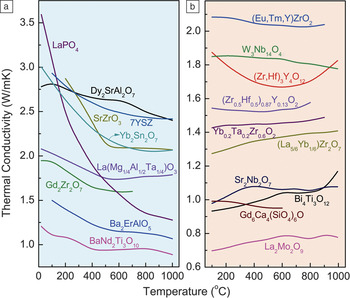
The need for thermal-barrier coating (TBC) materials with lower thermal conductivity than the currently used 7% yttria-stabilized zirconia (7YSZ) composition that can also operate in the strongly oxidative environment of combustion gases has stimulated a worldwide effort to identify new oxide compositions (see the introductory article in this issue). It has also stimulated a better understanding of the factors that determine low thermal conductivity in crystalline solids at high temperatures. Although TBC materials must satisfy a wide range of requirements, the primary performance metric is their thermal conductivity at operating temperatures of 1250°C and above. Depending on the processing technology and conditions, the thermal conductivity of 7YSZ lies in the range of 1.2–1.8 W m–1 K–1; we are therefore most interested in materials with thermal conductivities below ∼1 W m–1 K–1. For the foreseeable future, the operating temperatures are still not high enough for appreciable radiative heat transfer unless the coating material contains ions that absorb in the infrared.Reference Siegel and Spuckler1 As this article will describe, an impressive number of new oxide materials have been identified in the last decade that have conductivities lower than 7YSZ; the thermal conductivities of the emerging ceramics for TBC are summarized in Figure 1a–b. There are good reasons to believe that the continued search, combining crystal chemistry principles and simulation, will identify others. Unless otherwise noted, all the conductivity values presented are for fully dense materials without porosity, since porosity can significantly reduce the measured conductivity. Indeed, porosity is deliberately introduced into TBCs to decrease the thermal conductivity as well as increase strain compliance. We provide an overview of recently identified low thermal conductivity oxides and discuss the mechanisms involved in the minimization of the thermal conductivity.
(a) Thermal conductivity summary of the emerging ceramics for thermal-barrier coatings, whose conductivities vary with temperature, including 7YSZ,Reference Winter and Clarke23 Gd2Zr2O7,Reference Wu, Wei, Padture, Klemens, Gell, Garcia, Miranzo and Osendi22 Yb2Sn2O7,Reference Qu, Wan and Pan21 SrZrO3,Reference Ma, Mack, Vaβen and Stöver29 La(Mg1/4Al1/2Ta1/4)O3,Reference Jarligo, Mack, Vaβen and Stöver31 Ba2ErAlO5,Reference Wan, Qu, He, Luan and Pan32 Dy2SrAl2O7,Reference Wan, Sparks, Pan, Clarke and David33 BaNd2Ti3O10, and LaPO4;Reference Du, Wan, Qu and Pan38 (b) temperature-independent thermal conductivities of ceramics, including Yb0.2Ta0.2Zr0.6O2,Reference Shen, Leckie, Levi and Clarke13 (La5/6Yb1/6)Zr2O7,Reference Wan, Zhang, Wang, Qu, Du, Wu and Pan27 Gd6Ca4(SiO4)6O,Reference Qu, Sparks, Pan and Clarke40 La2Mo2O9,Reference Winter and Clarke23 Bi4Ti3O12,Reference Shen, Clarke and Fuierer35 (Zr,Hf)3Y4O12,Reference Winter and Clarke23 (Eu,Tm,Y)ZrO2, W3Nb14O4,Reference Winter and Clarke23 Sr2Nb2O7, and (Zr0.5Hf0.5)0.87Y0.13O2.

Yttria-stabilized zirconia
The most widely used TBC material is YSZ, zirconia containing 6–8 wt% Y2O3 (equivalent to about 3.4–4.5 mol%), which is produced in a metastable tetragonal phase (t’).Reference Stecura2 Alloying zirconia with yttria is necessary to avoid the disruptive monoclinic to tetragonal phase transformation that would otherwise cause mechanical breakdown of the zirconia; however, it also reduces the thermal conductivity by creating point defects that scatter phonons. The introduction of Y3+ as an aliovalent dopant on the Zr4+ site is compensated by vacant oxygen sites. Interestingly, because of the similarity in atomic mass between the Y3+ and Zr4+ ions, the oxygen vacancies are primarily responsible for reducing thermal conductivity.
A physical picture of thermal transport in solids is given by propagating lattice waves, known as phonons. Scattering of these waves off of each other, as well as off of the defects in the crystal lattice, impedes energy flow and pronounces itself as a thermal resistivity. Although models for the reduction in thermal conductivity from point defects based on this physical picture describe the basic mechanisms well,Reference Callaway and von Baeyer3 molecular dynamics simulations reveal a more complex situation in YSZ. Interestingly, the physics is very similar in off-stoichiometric fluorite-structured UO2, the dominant fuel system for nuclear fission reactors.Reference Schelling and Phillpot4, Reference Watanabe, Srivilliputhur, Schelling, Tulenko, Sinnott and Phillpot5 These studies show that with increasing defect concentration, the thermal conductivity transitions from that characteristic of a crystalline material to that characteristic of an amorphous solid.Reference Allen, Feldman and Bickham6 This transition can be described in terms of the structure of the vibrational modes of the system. These can be classified as propagons (normal phonon modes that are delocalized with well-defined momentum and polarization), diffusons (delocalized like phonons, but no longer possessing well-defined polarizations), and locons (strongly localized modes). While the vibrational modes in a crystalline solid are essentially all propagons, the vibrations in amorphous materials contain diffusons (∼93% of all modes in a-Si); these modes are far less efficient heat carriers. In both YSZ and UO2, propagon modes only appear at the low-frequency end of the spectrum (<2 THz), while locons are concentrated at the high end (>26 THz). In the case of YSZ, complete transition to amorphous-like heat transport dominated by the diffusons takes place at about 24 YSZ (24% yttria): further increase of the Y2O3content does not affect the structure of the vibrational spectrum. These molecular dynamics simulations indicate that more detailed exploration of the different forms of phonons in other complex oxides should be especially insightful.
The limitation in using YSZ at much higher temperatures than currently used is that the metastable tetragonal (t’) phase partitions by diffusion into the equilibrium tetragonal (t) and cubic phases (c) at high temperatures; the former of which will transform into a monoclinic phase (m) during cooling, resulting in disintegration of the coating. This is a slow process, taking more than 100 hr at temperatures in excess of 1350°C before monoclinic zirconia is detectable.Reference Lughi and Clarke7 To slow down this transformation and also lower the thermal conductivity, stabilizers other than yttria have been sought. Stabilization with rare-earth oxides, such as Gd2O3, Yb2O3, and Nd2O3, results in lower thermal conductivities than that of YSZReference Feng, Ren, Wang, Zhou and Pan8, Reference Rahaman, Gross, Dutton and Wang9 as a result of larger mass difference between the dopant and zirconia. However, with the exception of Yb2O3, these ions actually decrease the resistance to destabilization of the t’ phase.Reference Levi10
Co-doping zirconia with two or more oxides, one a trivalent oxide such as Y2O3 and the other a pentavalent oxide such as Nb2O5 or Ta2O5, has been shown to reduce the thermal conductivity.Reference Raghavan, Wang, Dinwiddie, Porter, Vaβen, Stöver and Mayo11, Reference Raghavan, Wang, Porter, Dinwiddie and Mayo12 Of particular interest is the compositional range over which the concentrations of trivalent and pentavalent ions are equal. In this range, a stable non-transformable tetragonal zirconia can form, with thermal conductivity almost half that of the conventional YSZ, despite the absence of oxygen vacancies.Reference Raghavan, Wang, Dinwiddie, Porter, Vaβen, Stöver and Mayo11–Reference Shen, Leckie, Levi and Clarke13 Moreover, yttria can be replaced by other heavier rare-earth oxides, which can further reduce the thermal conductivity to 1.4 W m–1 K–1 at 900°C for Yb-Ta co-doped zirconia.Reference Shen, Leckie, Levi and Clarke13, Reference Song, Xie, Mu, Zhou, Jia and An14
A further route to optimizing the performance involves the addition of paired dopants, such as Nd2O3 (or Gd2O3) and Yb2O3 (and/or Sc2O3), into the ZrO2-Y2O3 system, which segregate into 5–100 nm defect clusters and can reduce the thermal conductivity by about 20–40%, compared with the baseline ZrO2-Y2O3 ceramics.Reference Jarligo, Mack, Mauer, Vaβen and Stöver15–Reference Zhu and Miller17 Meanwhile, these thermodynamically immobile defect clusters can significantly enhance the sintering resistance of the coating at high temperatures.
Pyrochlore materials
Increasing the complexity of the crystal structure tends to reduce the thermal conductivity due to the increasing number of optical phonons that tend not to contribute substantially to the thermal conductivity. This is primarily due to typically small group velocities of the optical phonons as compared to acoustic phonons. Additionally, increasing the number of optical states also increases the number of available phonon-phonon interactions, further reducing thermal conductivity.
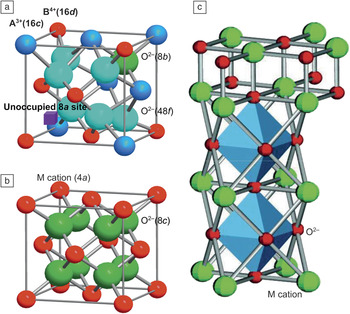
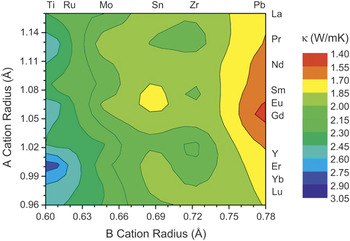
The A2B2O7-pyrochlore structure is one of a number of more complex crystal structures based on the fluorite structure of zirconia. It has a unit cell consisting of eight fluorite-like subcells, each of which contains one vacant oxygen site defect (the subcell of the pyrochlore structure is shown in Figure 2a). Both the presence of vacant sites and the larger unit cell should lower the thermal conductivity. Indeed, pyrochlore compounds of rare earth zirconates (where A= rare-earth element and B = Zr) exhibit extremely low thermal conductivity, ranging from ∼1.1–1.7 W m–1 K–1 at temperatures between 700°C and 1200°C for A = La, Eu, Sm, Nd, and Gd.Reference Vaβen, Cao, Tietz, Basu and Stöver18 The stability of the pyrochlore structure is sensitive to the ratio of the A and B cation radii.Reference Wuensch and Eberman19 Thermal conductivity simulations have been performed on the large family of pyrochlores with A = La, Pr, Nd, Sm, Eu, Gd, Y, Er, or Lu and B = Ti, Mo, Sn, Zr, or Pb.Reference Schelling, Phillpot and Grimes20Figure 3 presents the resultant map of the thermal conductivity as a function of the A and B ionic radii. Of particular note is that increasing the B-cation radii consistently reduces thermal conductivity, whereas the A cation size has less of an effect. As yet, there is insufficient experimental data to confirm the details of this property map.Reference Qu, Wan and Pan21 Large rare-earth ions in Ln2Zr2O7 (Ln = La, Nd, Sm, Gd) can lead to a stable pyrochlore structure up to at least 1500°C.Reference Wu, Wei, Padture, Klemens, Gell, Garcia, Miranzo and Osendi22 Gd2Zr2O7 can also take on a defected fluorite structure (Figure 2b) if suitably heat-treated, but the thermal conductivity was found to be the same as its pyrochlore counterpart.Reference Wu, Wei, Padture, Klemens, Gell, Garcia, Miranzo and Osendi22 It is interesting to note that a different defective fluorite structure, the delta-phase, is formed with smaller rare-earth ions, such as Dy, Er, Yb, and Y, and that these too have thermal conductivity similar to those of pyrochlores.Reference Winter and Clarke23, Reference Xu, Pan, Wang, Wan, Qi, Miao, Mori and Torigoe24
(a) A 1/8 unit cell of the A2B2O7-type pyrochlore structure that can be adopted by low thermal conductivity rare-earth zirconates (A = rare earth element, B = Zr), indicating lattice sites and the unoccupied oxygen position. (b) The defect fluorite structure that can be induced in heavier rare-earth zirconates or by heat treatment of pyrochlore-type Gd2Zr2O7 and shows similar thermal conductivities to the pyrochlores. In this structure, the cations are completely disordered, and the occupancy for each anion site is 0.875.Reference Wan, Sparks, Pan, Clarke and David33 (c) An example of a perovskite-structured oxide: The layered Ruddlesden–Popper phase of Sr-Ti-O.Reference Chernatynskiy, Grimes, Zurbuchen, Clarke and Phillpot34 The oxygen octahedra of the two perovskite unit cells are outlined in blue, and the single rock salt layer is shown at the top.

Contour map of thermal conductivity (κ) determined at T = 1473 K by simulation, as a function of ionic radii of the A and B ions for pyrochlore A2B2O7.Reference Schelling, Phillpot and Grimes20

The expectation that doping and alloying will reduce thermal conductivity is borne out experimentally. Some success has been achieved, at least up to ∼800°C, as exemplified by La2Zr2O7, which when doped with 30 at.% Gd displays a decrease in thermal conductivity from ∼1.55 W m–1 K–1 to ∼0.9 W m–1 K–1.Reference Lehmann, Pitzer, Pracht, Vaβen and Stöver25 In addition to lowering the thermal conductivity due to alloy scattering, doping can change the pyrochlore structure itself in ways that affect the thermal conductivity.Reference Wan, Qu, Du and Pan26 For example, in the (Sm1–xYbx)2Zr2O7 series, there is a transition from pyrochlore to a more disordered fluorite state when the x value lies between 1/6 and 1/3, at which there is also a dip in the thermal conductivity.Reference Wan, Qu, Du and Pan26 By contrast, in (La1–xYbx)2Zr2O7, the Yb3+ was found to “rattle” (undergo very large localized thermal vibration) at the 16 c-site, which could lead to a glass-like thermal conductivity.Reference Wan, Zhang, Wang, Qu, Du, Wu and Pan27 Among the mentioned pyrochlores, some oxides such as Sm2Zr2O7, Gd2Zr2O7, and their composites may become the potential materials for TBCs, owing to the better comprehensive mechanical and thermal performances.
Perovskite-structured oxides
The ABO3-type perovskites are another class of material that show both a large number of options for the A and B cations, and display a large number of structural variants.Reference Mitchell28 They therefore seem to be good candidates for engineering the thermal conductivity. Pure ABO3 perovskites containing high atomic mass ions exhibit low thermal conductivities, for example, 2.1 W m–1 K–1 for SrZrO3Reference Ma, Mack, Vaβen and Stöver29 and 3.4 W m–1 K–1 for BaZrO3Reference Vaβen, Cao, Tietz, Basu and Stöver18 at 1000°C on account of the structural rigidity of corner-shared octahedra.Reference Ma, Mack, Vaβen and Stöver29 However, following the strategy that was so successful for fluorite, Yb2O3 has been doped onto the B site of SrZrO3, leading to a 20% reduction in the thermal conductivity over the temperature range of 200–1200°C.Reference Ma, Jarligo, Pitzer, Malzbender, Vaβen and Stöver30 Moreover, increasing the doping level can lead to new complex perovskite structures. For example, Ba(Mg1/3Ta2/3)O3 has a melting temperature of ∼3000°C and is considered among the most refractory of all oxides;Reference Jarligo, Mack, Mauer, Vaβen and Stöver15 its thermal conductivity reaches 2.5 W m–1 K–1 at 1100°C. Likewise, the La(Al1/4Mg1/2Ta1/4)O3 complex perovskite system shows a low value of thermal conductivity (∼2 W m–1 K–1) and high coefficient of thermal expansion (∼11.9 × 10⁻⁶ K–1), which is a promising combination for TBC applications. However, TBCs made of these complex perovskites show short thermal cycling life, possibly due to their low toughness and consequent weak thermal shock resistance.Reference Jarligo, Mack, Vaβen and Stöver31
Bearing a similar relationship to the perovskite structure as the pyrochlore structure does to fluorite, Ba2LnAlO5 (Ln = lanthanide element), in which one-sixth of the oxygen sites in the perovskite structure are vacant, has a thermal conductivity of only 1.1 W m–1 K–1 at 1000°C.Reference Wan, Qu, He, Luan and Pan32 Again following the strategy of increasing the size of the unit cell and increasing the number of atoms per unit cell, thereby increasing the number of optical phonons and reducing the thermal conductivity, the perovskite structure can also be a building block for complex superlattice structures. The thermal conductivities of Ruddlesden–Popper (RP) structures of Ln2SrAl2O7Reference Wan, Sparks, Pan, Clarke and David33 and Srn+1TinO3n+1Reference Chernatynskiy, Grimes, Zurbuchen, Clarke and Phillpot34 (Figure 2c), the Aurivillius phasesReference Shen, Clarke and Fuierer35 of Bi4Ti3O12, and the Dion–Jacobson phases of BaLa2Ti3O10Reference Guo, Zhang, Ma and Gong36 have been studied, all producing thermal conductivities of 1–2 W m–1 K–1, which are substantially lower than the typical value of 2.5 W m–1 K–1 for 7YSZ. As shown in Figure 2c, the RP structure consists of n (n = 1, 2,...) layers of perovskite structured material separated by a rock salt structured layer; the Aurivillius and Dion–Jacobson phases show analogous layered perovskite structures.
Lanthanide orthophosphates and silicates
The lanthanide orthophosphates (LnPO4) are another set of compounds with low thermal conductivities.Reference Cao, Vaβen and Stöver37 The orthophosphates can take on either a monazite or xenotime crystal structure, depending on the ionic size of the lanthanide ions. Monazite LnPO4 (Ln = La-Gd) is expected to show a distinctly lower thermal conductivity than the xenotime structure compounds due to its lower crystal symmetry and weaker bonds.Reference Winter and Clarke23, Reference Du, Wan, Qu and Pan38 The anisotropy of thermal conductivity of the most studied monazite compound LaPO4 is also noticeable, due to the non-cubic crystal structure.Reference Du, Wan, Qu, Wu and Pan39 However, the characteristics of the line compound (small deviations from the stoichiometry can significantly change the solidus temperature, thereby making it hard to apply the plasma spraying process to make coatings) and poor adherence to the bond-coat layer (between the TBC and the superalloy) limits the applications of LaPO4 as a TBC.Reference Cao, Vaβen and Stöver37
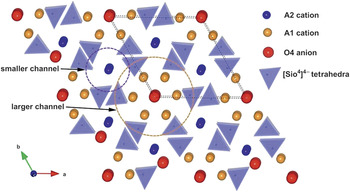
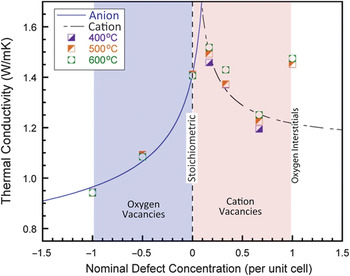
Based on their large unit cell and complex structures, the rare-earth silicates (Figure 4) can be expected to yield low thermal conductivity values. Among these, apatite structured Gd8Ca2(SiO4)6O2 has attracted particular attention;Reference Qu, Sparks, Pan and Clarke40 it exhibits an extremely low and temperature-independent thermal conductivity of about 1.4 W m–1 K–1 for almost fully dense samples. Another interesting feature of this compound is that the composition can be systematically altered by adjusting the relative proportions of alkaline earth cations and rare-earth ions to introduce different populations of oxygen vacancies, cation vacancies, and oxygen interstitials, resulting in even lower thermal conductivities for defect-containing compositions (Figure 5).Reference Qu, Sparks, Pan and Clarke40
View of the crystal structure of the stoichiometric rare-earth apatites A10(SiO4)6O2+δ, along the [001] axis, and the location of the two types of cation sites, A1 and A2, as well as the oxygen sites, O4.Reference Qu, Sparks, Pan and Clarke40 The complexity and large unit cell of this structure is believed to give rise to low thermal conductivity in materials such as Gd8Ca2(SiO4)6O2.

Thermal conductivity of rare-earth apatites in the range 400–600°C as a function of nominal defect concentration per unit cell. One defect per unit cell corresponds to a concentration of 2.5 at.%.Reference Qu, Sparks, Pan and Clarke40 The thermal conductivities agree well with the trend predicted by the simple defect scattering model, in which the thermal conductivities are proportional to the inverse square root of the anion and cation vacancy concentrations.

Thermal expansion coefficient
While thermal conductivity is the key performance metric for potential TBC materials, it is also essential that they be thermomechanically compatible with both the superalloy that they coat and the intermediate bonding layers (see the introductory article in this issue). The thermal expansion coefficient of YSZ is 10.7 × 10⁻⁶ K–1 from room temperature to 1273 K,Reference Vaβen, Kerkhof and Stöver41 while those of the typical superalloy substrate and bond coat (NiCrAlY) are 16 × 10–6 K–1 and 17.5 × 10⁻⁶ K–1, respectively, for the same temperature range.Reference Vaβen, Kerkhof and Stöver41 This mismatch can lead to high thermal stresses that have the potential to promote coating failure. Although YSZ coatings can last tens of thousands of hours and multiple cycling without failing, it is still believed that enhancement of the thermal expansion coefficients of TBCs could minimize this mismatch and thereby further improve the thermal cycling lifetime of TBCs. Ceria (CeO2), which has a high thermal expansion coefficient and relatively low thermal conductivity, has been found to improve the thermal expansion behavior of zirconia-based ceramics. For example, Sodeoka et al.Reference Sodeoka, Suzuki, Ueno, Sakuramoto, Shibata and Ando42 observed that the average thermal expansion coefficient of pure zirconia over the range of 25–800°C increases to 12.5 × 10⁻⁶ K–1 with the addition of CeO2. Moreover, Cao et al.Reference Cao, Vaβen, Fischer, Tietz, Jungen and Stöve43 proposed lanthanum-cerium oxide (La2Ce2O7) as a potential TBC material; it has a thermal expansion coefficient as high as about 13 × 10–6 K–1 at elevated temperature, though it displays a sharp decrease between 180°C and 300°C. The thermal expansion coefficient of pyrochlore-type Sm2Zr2O7 can be improved from 10.8 × 10⁻⁶ K–1Reference Wu, Wei, Padture, Klemens, Gell, Garcia, Miranzo and Osendi22 to 11.9 × 10⁻⁶ K–1Reference Qu, Wan and Pan44 with 7.5 mol% doping of MgO, as the relatively smaller Mg2+ can easily get into the interstitial site of the crystal, thereby weakening the bonds of ZrO6 octahedra. These successes notwithstanding, there remains a substantial gap between the thermal expansion coefficients of TBC materials and the bond coat and alloy.
Conclusions and outlook
The fluorite system provides a blueprint for a successful design strategy of starting with a crystal structure that can accommodate a large number of different chemical species and making it chemically and structurally more complex, has proven fruitful in developing low thermal conductivity materials for possible thermal-barrier coating (TBC) applications. This strategy is now being used in the context of perovskite materials, particularly through layering. The rich complexities of other oxide crystal systems remain largely unexplored for TBC applications. To move beyond an Edisonian approach to these materials, a more detailed fundamental understanding of thermal transport mechanisms is still required. Moreover, to truly accelerate the development of new TBCs, an integrated strategy of design for thermal management, thermomechanical, and chemical stability is required. This remains a challenge for the TBC community.
Acknowledgments
The work described has been supported, in part, by several agencies. The work of W.P., C.W., and Z.Q. was supported by the National Natural Science Foundation of China (Grant No. 51072088, 50990302) as well as through the US National Science Foundation through a World Materials Network grant. SRP and AC are subcontractors of the US Government under DOE Contract No. DE-AC07–05ID14517, under the Energy Frontier Research Center (Office of Science, Office of Basic Energy Science, FWP 1356). The US Government retains a worldwide license to publish or reproduce the published form of this manuscript, or allow others to do so, for US Government purposes.