Introduction
Autism spectrum disorders (ASDs), which correspond to the pervasive developmental disorders in DSM-IV (APA, 1994), include autstic disorder, Asperger's disorder and pervasive developmental disorder not otherwise specified (sometimes referred to as atypical autism). They affect about 1% of the population (as shown in several different European countries, e.g. Gillberg et al. Reference Gillberg, Cederlund, Lamberg and Zeijlon2006; Baird et al. Reference Baird, Simonoff, Pickles, Chandler, Loucas, Meldrum and Charman2006) and are characterized by deficits in social interaction, communication and behavioral flexibility. ‘Classic’ autism is defined as a severe neurodevelopmental disorder with pronounced socio-communicative deficits noted before 3 years of age, often accompanied by mental retardation, whereas Asperger's disorder is defined by an overall normal level of verbal functioning but significantly decreased intuitive social communication skills and ability to adapt behaviors and interests to contexts and circumstances (APA, 1994). It is not clear whether these diagnoses represent true categories among the ASDs or whether they are clinically defined types characterized by uneven intelligence profiles, cognitive dysfunctions, age at onset and gender-specific variation.
Other mental disorders, such as attention deficit hyperactivity disorder (ADHD), mood disorders, schizophrenia and personality disorders, seem to be present in one form or another in the majority of cases diagnosed with an ASD (e.g. in children: Simonoff et al. Reference Simonoff, Pickles, Charman, Chandler, Loucas and Baird2008; in adults: Hofvander et al. Reference Hofvander, Delorme, Chaste, Nyden, Wentz, Stahlberg, Herbrecht, Stopin, Anckarsäter, Gillberg, Råstam and Leboyer2009). Clinical (Lee & Ousley, Reference Lee and Ousley2006), epidemiological (Kadesjö et al. Reference Kadesjö, Gillberg and Hagberg1999), behavioral genetic (Lichtenstein et al. Reference Lichtenstein, Carlstrom, Rastam, Gillberg and Anckarsäter2010) and molecular genetic (Roohi et al. Reference Roohi, DeVincent, Hatchwell and Gadow2009) studies have reported commonalities in ASDs and ADHD, and clinical studies have shown overlaps between ASDs and anxiety (Pine et al. Reference Pine, Guyer, Goldwin, Towbin and Leibenluft2008), depression (Ghaziuddin & Greden, Reference Ghaziuddin and Greden1998) and conduct disorder (reviewed by Anckarsäter et al. Reference Anckarsäter, Nilsson, Saury, Rastam and Gillberg2008).
ASDs can be construed as the phenotypical expression of an extreme lowermost end of a continuum of socio-communicative abilities that are distributed dimensionally in the general population (Gillberg, Reference Gillberg1992). Autistic-like traits (ALTs), that is significant problems or peculiarities in social style, perception of self and others, pragmatic communication and adaptation to the environment, which do not meet formal criteria for a mental disorder, have also been found in the normal distribution of social responsiveness (Constantino & Todd, Reference Constantino and Todd2003). These traits are similar to the ‘broader autism phenotype’ described by Folstein & Rutter (Reference Folstein and Rutter1977) in unaffected siblings of children identified with autism, but the nosological link between the disorder, broader phenotype and ALTs has not yet been established. Neither have the three different symptom clusters described in ASDs been established for the ALTs, although two twin studies, one British and one Swedish, have recently demonstrated etiological heterogeneity within the autism-related symptomatology (Ronald et al. Reference Ronald, Happé, Bolton, Butcher, Price, Wheelwright, Baron-Cohen and Plomin2006, Reference Ronald, Edelson, Asherson and Saudino2010). The current state of knowledge on ASDs has not been paralleled by systematic research on ALTs, although such traits have been a noted feature in clinical studies of ADHD (Reiersen et al. Reference Reiersen, Constantino, Grimmer, Martin and Todd2008; Rommelse et al. Reference Rommelse, Altink, Fliers, Martin, Buschgens, Hartman, Buitelaar, Faraone, Sergeant and Oosterlaan2009), internalizing problems/depression (Kanne et al. Reference Kanne, Christ and Reiersen2009), conduct disorder (Gilmour et al. Reference Gilmour, Hill, Place and Skuse2004) and behavioral problems (Hoekstra et al. Reference Hoekstra, Bartels, Hudziak, Van Beijsterveldt and Boomsma2007). Recent twin studies have also documented substantial shared genetic influences operating over both ALTs and traits associated with ADHD and anxiety in children (Ronald et al. Reference Ronald, Simonoff, Kuntsi, Asherson and Plomin2008, Reference Ronald, Edelson, Asherson and Saudino2010; Hallett et al. Reference Hallett, Ronald and Happe2009). It has not yet been established, however, whether interindividual differences in subthreshold ALTs are associated with the risk for ADHD, anxiety, conduct problems, depression and substance abuse, nor whether there are similar associations between ALTs and other mental health problems both in children and in adults.
We have used data from two large-scale, population-based twin cohorts, one of children and one of adults, (1) to test whether varying degrees of ALTs are meaningful risk factors for concomitant ADHD, anxiety disorder, conduct problems, depression and substance abuse both in childhood and in adulthood, and (2) to assess whether there are common genetic and environmental susceptibilities explaining the coexistence of ALTs and traits associated with ADHD, anxiety, conduct problems, depression and substance abuse both in childhood and in adulthood.
Method
Sample
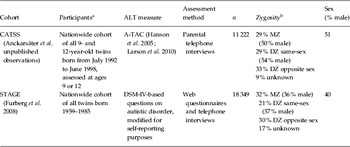
The present study is based on two prospective, nationally representative twin studies from Sweden: the Child and Adolescent Twin Study in Sweden (CATSS), previously used to investigate the etiology of ASDs and their triad structure (Lichtenstein et al. Reference Lichtenstein, Carlstrom, Rastam, Gillberg and Anckarsäter2010; Lundström et al. Reference Lundström, Haworth, Carlström, Gillberg, Mill, Råstam, Hultman, Ronald, Anckarsäter, Plomin, Lichtenstein and Reichenberg2010), and the Study of Twin Adults: Genes and Environment (STAGE), previously used to study addiction and psychiatric disorders (Furberg et al. Reference Furberg, Lichtenstein, Pedersen, Thornton, Bulik, Lerman and Sullivan2008; Frisell et al. Reference Frisell, Lichtenstein, Rahman and Langstrom2010). Both cohorts are described in Table 1.
Description of the two cohorts of twins: CATSS and STAGE

CATSS, Child and Adolescent Twin Study in Sweden; STAGE, Study of Twin Adults: Genes and Environment; A-TAC, Autism – Tics, ADHD, and other Co-morbidities inventory; ADHD, attention deficit hyperactivity disorder; MZ, monozygotic; DZ, dizygotic.
a The baseline data consisted of 11 122 individuals in CATSS and 18 349 individuals in STAGE. Only twin pairs with no more than one item missing on the autistic-like trait (ALT) variable were included, giving 10 773 individuals in CATSS and 16 695 in STAGE. Excluding individuals for whom data were missing on the response variables yielded seven final populations: in CATSS 10 760 individuals for ADHD, 10 770 for anxiety, and 10 768 for conduct disorder, and in STAGE of 16 647 individuals for ADHD, 14 438 for anxiety, 16 354 for depression, and 14 670 for substance abuse.
b In both cohorts, zygosity determination was based on a validated algorithm with >95% predictive value (Lichtenstein et al. Reference Lichtenstein, De Faire, Floderus, Svartengren, Svedberg and Pedersen2002).
Measures in CATSS
Parents of twins were interviewed with the Autism – Tics, ADHD, and other Co-morbidities inventory (A-TAC; Hansson et al. Reference Hansson, Svanstrom Rojvall, Rastam, Gillberg and Anckarsäter2005), a psychiatric telephone interview validated for administration by lay interviewers. The A-TAC has good test–retest and excellent inter-rater reliability and construct validity according to two validation studies (Hansson et al. Reference Hansson, Svanstrom Rojvall, Rastam, Gillberg and Anckarsäter2005; Larson et al. Reference Larson, Anckarsäter, Gillberg, Stahlberg, Carlstrom, Kadesjo, Råstam, Lichtenstein and Gillberg2010), and convergent validity with the Child Behavior Checklist (CBCL; Halleröd et al. Reference Halleröd, Larson, Ståhlberg, Carlström, Gillberg, Anckarsäter, Råstam, Lichtenstein and Gillberg2010). Items in the A-TAC are scored 1, 0.5 or 0 for ‘yes’, ‘yes, to some extent’ or ‘no’ respectively in a lifetime perspective and are organized in modules assessing different psychiatric diagnoses. Psychometric data for the dimensional and categorical assessments of the targeted conditions are based on the final validation study (Larson et al. Reference Larson, Anckarsäter, Gillberg, Stahlberg, Carlstrom, Kadesjo, Råstam, Lichtenstein and Gillberg2010) and detailed below.
ASDs
To correspond with the STAGE data in this paper, the DSM-IV score from the A-TAC was chosen (Larson et al. Reference Larson, Anckarsäter, Gillberg, Stahlberg, Carlstrom, Kadesjo, Råstam, Lichtenstein and Gillberg2010), containing 12 items assessing the DSM-IV algorithm for the identification of autism. This score has an excellent validity for identifying ASDs [area under a receiver operating characteristics (ROC) curve, AUC=0.96; Larson et al. Reference Larson, Anckarsäter, Gillberg, Stahlberg, Carlstrom, Kadesjo, Råstam, Lichtenstein and Gillberg2010] and a high internal consistency (Cronbach's α=0.86). A cut-off score of 4.5 yields a sensitivity of 0.86 and a specificity of 0.94 for the identification of ASDs (according to reanalyses of the data from the paper by Larson et al. Reference Larson, Anckarsäter, Gillberg, Stahlberg, Carlstrom, Kadesjo, Råstam, Lichtenstein and Gillberg2010), and a prevalence of 1.5% in the CATSS cohorts used here. A total of 10 773 subjects in the CATSS were classified into six groups according to their ASD DSM scores and arranged to be comparable with respect to percentage proportions across CATSS and STAGE: group 1 (0 points) n=7499 (69.6%); group 2 (0.5–1 point) n=2339 (21.7%); group 3 (1.5–2 points) n=497 (4.6%); group 4 (2.5–3 points) n=191 (1.7%); group 5 (3.5–4 points) n=88 (0.8%); and group 6 (⩾4.5 points) n=159 (1.5%), the latter thus corresponding to probable ASD cases according to the validation study (referred to as the ALT 1–5 and ASD groups). The same scale, ranging from 0 to 12, was used as a dimensional measure of ALTs. All three ASD subdomains in the A-TAC contribute to the ALTs with some overall differences in population frequency [social interaction problems (mean=0.09), communication problems (mean=0.14) and lack of flexibility (mean=0.17)].
ADHD
The A-TAC DSM-IV score for ADHD consists of 18 items and was used to assess ADHD. This scale has excellent validity for identifying ADHD (AUC=0.94; Larson et al. Reference Larson, Anckarsäter, Gillberg, Stahlberg, Carlstrom, Kadesjo, Råstam, Lichtenstein and Gillberg2010), with an optimal cut-off score at 8 yielding a sensitivity of 0.87 and a specificity of 0.88 (derived from the validation study as for the ASD score), with an excellent internal consistency (Cronbach's α=0.90) and a prevalence of 4.8% in the CATSS. The same scale, ranging from 0 to 18, was used as a dimensional measure of ADHD traits.
Anxiety
Six items in the A-TAC were used to assess anxiety. This scale had good validity for identifying anxiety disorders in the second validation study (AUC=0.78, unpublished data) and good internal consistency (Cronbach's α=0.65), yielding a prevalence of 6% in the present study. The same scale, ranging from 0 to 6, was used as a dimensional measure of anxiety traits.
Conduct problems
Five DSM-IV-based items in the A-TAC were used to assess and identify conduct problems. Using the second validation study enriched by A-TAC results from 66 institutionalized adolescents with a higher prevalence of conduct problems (from the study described by Ståhlberg et al. Reference Ståhlberg, Anckarsäter and Nilsson2010), the AUC for identifying conduct disorder was 0.95. Cronbach's α for the conduct scale was 0.65. As our subjects were only 9 or 12 years old, the prevalence of conduct disorder was low (n=48), and we chose to categorize subjects who scored ⩾1.5 as cases, yielding a prevalence of conduct problems at 1.7%. The same scale, ranging from 0 to 5, was used as a dimensional measure of conduct problems.
Measures in STAGE
Participants were interviewed with a web questionnaire including self-rated DSM-IV-based questions for ASDs and ADHD, scored as 1 for ‘yes’, 0.5 for ‘yes, to some extent’ and 0 for ‘no’. Depressive traits, anxiety traits and substance abuse were scored as 1 for ‘yes’ and 0 for ‘no’. All questions explicitly referred to a lifetime perspective.
ASDs
By analogy with the A-TAC algorithm, 12 DSM-IV-based items (Cronbach's α=0.63) were used to measure ALTs. The 16 695 subjects were divided into six groups based on their scoring on these items: group 1 (0–2 points) n=12 409 (74.3%); group 2 (2.5–3 points) n=2509 (15%); group 3 (3.5–4.5 points) n=1301 (7.8%); group 4 (5–5.5 points) n=265 (1.6%); group 5 (6–6.5 points) n=131 (0.8%); and group 6 (⩾7 points) n=80 (0.50%) (referred to as ALT groups 1–5 and ASD group).
ADHD
Eighteen items were used for the identification of ADHD (similar to the A-TAC algorithm and described previously by Frisell et al. Reference Frisell, Lichtenstein, Rahman and Langstrom2010). Cronbach's α for the whole scale was 0.84. ADHD was considered to be probable in those who responded ‘yes to some extent’ or ‘yes’ to six or more questions in the hyperactivity dimension or in the inattentive dimension according to the cut-off used in the DSM-IV, yielding a prevalence of 2.2%. The same scale, ranging from 0 to 18, was used as a dimensional measure of ADHD traits.
Anxiety
Six items corresponding to generalized anxiety disorder (GAD) in the DSM-IV, preceded by a question about whether the subject had ever experienced symptoms of anxiety and worrying lasting for one month or more, were used for the identification of anxiety disorder (Frisell et al. Reference Frisell, Lichtenstein, Rahman and Langstrom2010). The cut-off for a possible GAD was 3 plus an affirmative answer to the question of duration, yielding a prevalence of 4.5%. The same scale, ranging from 0 to 6, was used as a dimensional measure of anxiety traits.
Depression
Nine DSM-IV-based items were used to identify possible major depression. The cut-off for a possible lifetime major depression was 5 plus an affirmative answer to the C criterion (i.e. that the symptoms were causing clinically significant suffering) and the E criterion (i.e. that the symptoms were not better accounted for by bereavement) in DSM-IV (APA, 1994), yielding a prevalence of 13.4%. Depressive traits were measured by an 11-item version of the Iowa version of the Center for Epidemiologic Studies Depression Scale (CES-D; Carpenter et al. Reference Carpenter, Andrykowski, Wilson, Hall, Rayens, Sachs and Cunningham1998), a measure widely used in epidemiological settings to screen for depression.
Substance abuse
One item was used to capture substance and alcohol abuse: ‘Do you have or have you ever had problems with alcohol or drugs?’ The item is scored dichotomously, categorizing 2.5% of the sample as having experienced problems with alcohol or drugs at some time in life.
Covariates
Covariates included in all analyses were zygosity, sex and socio-economic status (SES) estimated by parental education (CATSS) or the education level of the respondent (STAGE). In STAGE, the age when the web questionnaire was answered was also used in the analyses. To control for the effects of low IQ, we also used the validated A-TAC algorithm for learning disorder (in the validation studies defined as mental retardation diagnosed clinically on the basis of neuropsychological testing, generally by the Wechsler scales; Hansson et al. Reference Hansson, Svanstrom Rojvall, Rastam, Gillberg and Anckarsäter2005; Larson et al. Reference Larson, Anckarsäter, Gillberg, Stahlberg, Carlstrom, Kadesjo, Råstam, Lichtenstein and Gillberg2010).
Statistical analyses
Association between ALTs and co-morbidity
The association between autistic traits and psychiatric co-morbidity was examined using generalized estimating equation (GEE) regression models with the proc genmod procedure in SAS 9.2 (SAS Institute Inc., USA). Odds ratios (ORs) with 95% confidence intervals (CIs) were first computed, and in a subsequent step adjusted for possible confounding by the covariates specified above. The GEE models account for correlations within twin pairs and are robust to deviations from a normal distribution. Cross-twin, cross-trait correlations were conducted with the proc corr procedure in SAS 9.2.
Genetic analyses
Twin modeling is based on the variance in traits and covariance between traits in monozygotic (MZ) and dizygotic (DZ) twins and is decomposed into genetic (A, the part of phenotypical variance that is attributable to genetic factors), shared environment (C, factors that make the twins similar) and unique environment/non-shared environment (E, factors that make the twins different) factors. As MZ twins share all their genes but DZ twins share only half of their segregating alleles, the factors attributable to A can be traced to the difference between MZ and DZ twins. For instance, if a phenotype is solely affected by genes, the twin-pair correlation for MZ twins would be 1.00 whereas the correlation for DZ twins would be 0.50. If, however, the phenotype is solely affected by C or E, a twin correlation of 1.00, or 0.00 for both MZ and DZ twins, would be expected. Most psychiatric disorders and traits are, however, affected by both genes and environment.
Intra-class correlations and standard continuous univariate analyses, with only same-sex MZ and DZ twins, were used to obtain heritability estimates. Cross-twin, cross-trait correlations were used to assess whether common genetic and environmental susceptibilities are important for the association between ALTs and ADHD or anxiety traits: the ALT score of twin 1 is correlated with the ADHD trait score in the co-twin. Higher correlations for MZ twins than for DZ twins indicate genetic covariation. We then used bivariate twin modeling, including only MZ twins and DZ same-sex twins. Eligible for the analyses were 6624 twins (3172 MZ and 3092 DZ) in CATSS and 8170 twins (4968 MZ and 3202 DZ same-sex) in STAGE. Because of power issues we used continuous measures in the bivariate models. We found mean differences between sexes for ALTs and ADHD traits (>0.001) in CATSS, and for ALTS, anxiety traits and depressive traits in STAGE (>0.001), when sex, SES and interview order were controlled for in a regression model. Thus, residual scores, controlling for sex, SES and interview order, were used in the twin analyses. We also found mean differences between zygosities for ALTs, ADHD traits, anxiety traits and conduct problems (>0.001) in CATSS. This was probably because of the sibling interaction effect (most probably due to parents unwittingly exaggerating the difference between DZ twins), as reported previously in another study using the CATSS sample (Ronald et al. Reference Ronald, Edelson, Asherson and Saudino2010). To resolve this, a contrast model considering the sibling interaction was used for the model-fitting analyses in CATSS. As the relationship between ALTs and ADHD traits, anxiety traits, conduct problems or depressive traits in the general population might be reciprocal, a correlated factors solution was chosen. As the substance abuse module was dichotomous, a liability threshold model using the same six categories as in the risk analyses was used. The twin analyses were performed in Mx (Neale et al. Reference Neale, Boker, Xie and Maes2003). To avoid oversimplification and thus bias of the estimates of A, C and E, we did not try to fit reduced models (Sullivan & Eaves, Reference Sullivan and Eaves2002).
Results
Association between ALT and mental health problems
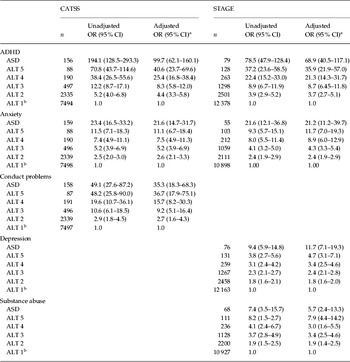
The ASD group showed a large increase in risk for ADHD (adjusted OR 100 in children, 69 among adults, Table 2). The risk for ADHD then decreased monotonically (a function that is consistently increasing and never decreasing or a function that is consistently decreasing and never increasing) by the ALT groups in both CATSS and STAGE. Furthermore, the risk of anxiety was 22 times greater in the ASD group in CATSS and 21 times greater in STAGE compared to subjects without ALTs. Again, the risk decreased monotonically with the number of ALTs. The risk for conduct problems in the ASD group was 35 times higher than in subjects without ALTs. The corresponding figures for depression and substance abuse were 12 and 6 respectively. Both adjusted and unadjusted ORs are given in Table 2. Adjusting the ORs left the magnitude of the associations almost unchanged, with the exception of the relationship between the two highest groups (ALT 5 and ASD) and ADHD, which was strongly confounded by the presence of learning disorder in both studies, as ORs adjusted only to zygosity, sex and SES remained similar to the unadjusted ORs; data not shown).
Associations between ALTs and risk of ADHD, anxiety, depression, substance abuse and conduct problems in CATSS and STAGE

CATSS, Child and Adolescent Twin Study in Sweden; STAGE, Study of Twin Adults: Genes and Environment; ALT, autistic-like trait; ADHD, attention deficit hyperactivity disorder; ASD, autism spectrum disorder; OR, odds ratio; CI, confidence interval.
In CATSS: ALT 1=0 points, ALT 2=0.5–1 point, ALT 3=1.5–2 points, ALT 4=2.5–3 points, ALT 5=3.5–4 points and ASD ⩾4.5 points.
In STAGE: ALT 1=0–2 points, ALT 2=2.5–3 points, ALT 3=3.5–4 .5 points, ALT 4=5–5 .5 points, ALT 5=6–6 .5 points and ASD ⩾7 points.
a Adjusted for interview order, zygosity, age, sex, socio-economic status (SES) and, in CATSS, learning disorder.
b Reference category.
Heritability and genetic correlation
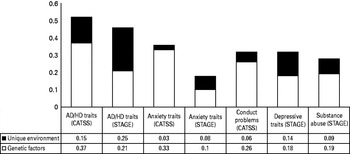
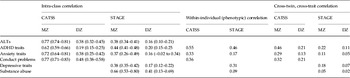
Table 3 presents the intra-class correlations for all mental health problems in CATSS and STAGE, all of which were higher for MZ than for DZ twins, indicating genetic influences. This was confirmed in the univariate analysis, where, for instance, ALTs in childhood showed a high heritability (h2=0.70). Similar effects were detected among adults but with more modest heritability estimates (h2=0.32). All cross-twin, cross-trait correlations were higher for MZ than for DZ twins, indicating genetic covariance (Table 3). The full statistics from the univariate and bivariate models between ALTs and the co-occurring conditions are given in the online Appendix (Supplementary Tables S1 and S2), and Fig. 1 provides an overview of the main results. The phenotypical correlation (i.e. the degree to which two traits covary in the population) between ALTs and ADHD traits was 0.55 in CATSS and 0.44 in STAGE. Of these correlations, 71% in CATSS and 54% in STAGE were accounted for by common genetic effects. The phenotypical correlations were more modest for ALTs and anxiety traits in both CATSS and STAGE whereas common genetic effects again accounted for 92% and 55%. For ALTs and depressive traits, roughly half of the correlation was accounted for by common non-shared environmental effects. Sixty-eight per cent of the correlation between ALTs and substance abuse was accounted for by common genetic effects, and 81% of the correlation between ALTs and conduct problems.
Phenotypical correlations with autistic-like traits (ALTs), and the portions of correlations accounted for by genetic and environmental effects. Unique environment means unique to each twin but common to ALTs and the other types of mental problems. CATSS, Child and Adolescent Twin Study in Sweden; STAGE, Study of Twin Adults: Genes and Environment; ADHD, attention deficit hyperactivity disorder.

Intra-class correlations, within-individual (phenotypic) correlations and cross-twin, cross-trait correlations

CATSS, Child and Adolescent Twin Study in Sweden; STAGE, Study of Twin Adults: Genes and Environment; ALT, autistic-like trait; ADHD, attention deficit hyperactivity disorder; MZ, monozygotic; DZ, dizygotic.
Discussion
The findings presented here add to what is known about ALTs in the general population in four respects. First, even if increasing symptoms of ALTs monotonically increase the risk for ADHD, anxiety, conduct problems, depression, and substance and alcohol abuse, the group with only one or two ALTs also had considerably increased risks for all other types of mental disorders compared to the majority of individuals who do not have such traits. Second, consistent with previous studies in children (Ronald et al. Reference Ronald, Simonoff, Kuntsi, Asherson and Plomin2008; Hallett et al. Reference Hallett, Ronald and Happe2009), we found evidence for substantial genetic influences on the correlations between ALTs and ADHD also in adulthood. Third, the phenotypic correlation between ALTs, depressive and anxiety traits in adults was almost as strongly affected by genetic as by non-shared environmental factors. Fourth, the largest part of the phenotypic correlation between ALTs and conduct problems and ALTs and substance abuse was affected by genes.
The study has several strengths. Both samples are nationwide birth cohorts, representative of children and adults. Although psychiatric symptoms were assessed by different informants, methods and instruments in the two samples (parental interviews versus self-report; telephone interviews and web questionnaires), overall the results were consistent.
The results also have to be interpreted in the light of important limitations. Asking adults direct questions based on DSM-IV criteria has not been formally validated as a measure of any of the targeted problem types, including ALTs, but has been used previously in epidemiological studies as a proxy for clinical instruments (Oliveira et al. Reference Oliveira, Ataide, Marques, Miguel, Coutinho, Mota-Vieira, Gonçalves, Lopes, Rodrigues, Carmona da Mota and Vicente2007; Frisell et al. Reference Frisell, Lichtenstein, Rahman and Langstrom2010). Until validated self-report measures for ALTs in adults are available for epidemiological studies, caution is warranted when interpreting the results. Socio-communicative restrictions may be less suited for self-rate assessment than other types of problems, and a core deficit in ASDs is the lack of understanding of emotions. For this reason, however, self-rate questionnaires for neuropsychiatric problems, just as for personality traits, are based on assessments of behavior patterns (such as avoiding to engage in small talk) rather than of emotional states (such as feeling left behind). Several studies have nevertheless shown valid results from self-rating instruments assessing ALTs among individuals with known ASDs (e.g. Baron-Cohen et al. Reference Baron-Cohen, Wheelwright, Skinner, Martin and Clubley2001). The cut-offs used for anxiety and depression have not been formally validated, but our prevalence estimates (4.5% for anxiety and 13.4% for depression) are compatible with previous estimates of the general population prevalence (Doris et al. Reference Doris, Ebmeier and Shajahan1999; Tyrer & Baldwin, Reference Tyrer and Baldwin2006). STAGE has a comparatively low response rate compared to CATSS, which may explain the lower ASD prevalence and the lower prevalence of males in STAGE than in CATSS. Thus, the adult results might not be generalizable to the most extreme cases because non-responders might be more likely to have some type of problem. As ASDs are defined as developmental disorders, epidemiological studies without access to developmental assessments are, by definition, suboptimal. At the same time it is probably not feasible to conduct developmental assessments of rare conditions in a population-based cohort. It should also be kept in mind that the number of possible confounding factors was uncontrolled for or included by crude measures; IQ, for instance, was reflected merely by the presence of learning disability, and systematic differences in measures and sources of information could give rise to some of the noted differences between children and adults. Finally, it was not possible to formally test whether the ALTs reported here are really ‘autistic’ or just similar phenotypic expressions with different etiology. In our opinion, however, there are more arguments for than against a continuity from ASDs to ALTs created by underlying dimensionally distributed traits or abilities. First, ALTs are assessed by the same DSM-IV symptom criteria used for autistic disorder, making it likely that at least the phenotypical expression corresponding to a specific item is similar. Second, pathogenetic processes that affect the risk for ASDs have also been shown to influence ALTs (e.g. increased paternal age, Lundström et al. Reference Lundström, Haworth, Carlström, Gillberg, Mill, Råstam, Hultman, Ronald, Anckarsäter, Plomin, Lichtenstein and Reichenberg2010; genetic aberrations on 16p11, St Pourcain et al. Reference St Pourcain, Wang, Glessner, Golding, Steer, Ring, Skuse, Grant, Hakonarson and Davey Smith2010). Third, studies of relatives of probands with ASDs consistently show marked elevation of ALTs regardless of whether they are conceptually defined as ‘broader phenotypes’ (Folstein & Rutter, Reference Folstein and Rutter1977) or traits (Szatmari et al. Reference Szatmari, MacLean, Jones, Bryson, Zwaigenbaum, Bartolucci, Mahoney and Tuff2000). These cautionary notes should be kept in mind in the following discussion on the implications of our findings.
It has been suggested that subthreshold ALTs might entail cognitive features useful for careers in, for instance, science or engineering (Baron-Cohen et al. Reference Baron-Cohen, Wheelwright, Skinner, Martin and Clubley2001; Focquaert et al. Reference Focquaert, Steven, Wolford, Colden and Gazzaniga2007). Our results do not contradict such possible advantages but demonstrate that, even if ‘systemizing’ abilities may be an asset in some respects, there is still an increased risk of mental health problems, such as ADHD, anxiety, and depression, substance abuse and conduct disorder. Furthermore, the presence of ALTs in subgroups of individuals with various forms of psychopathology may influence the response to pharmacological or psychotherapeutic interventions, as shown, for example, in anorexia nervosa, where the presence of ALTs was associated with a poorer psychosocial outcome (Wentz et al. Reference Wentz, Gillberg, Anckarsäter, Gillberg and Råstam2009).
Clinical descriptions of Asperger's syndrome and other types of autism-related personality profiles have long emphasized sensitivity to stress and social interaction as a basis for the development of concomitant anxiety and depression (Wing, Reference Wing1981). Our results indicate that, in addition to such reactions, there are common underlying genetic susceptibilities. The observed phenotypic correlation between ALTs and traits related to ADHD and anxiety in children is in line with previous findings (Ronald et al. Reference Ronald, Simonoff, Kuntsi, Asherson and Plomin2008; Hallett et al. Reference Hallett, Ronald and Happe2009), although our results indicate a stronger genetic component for the overlap with anxiety. This may be due to our larger sample size, but the findings are in need of corroboration. Moreover, our results suggest a modest genetic overlap between ALTs and ADHD traits among adults and between ALTs and anxiety and depressive traits, which might be expected, considering the well-known association between anxiety and depression (Kendler et al. Reference Kendler, Gardner, Gatz and Pedersen2007). The phenotypical correlation observed between ALTs and conduct problems is not surprising considering that social communication deficits are a common feature in children with conduct disorder (Gilmour et al. Reference Gilmour, Hill, Place and Skuse2004; Donno et al. Reference Donno, Parker, Gilmour and Skuse2010). The large CIs observed for the genetic and non-shared correlations between ALTs and substance abuse preclude firm conclusions on the etiology of this particular association. However, substance abuse has previously been reported in combination with ASDs (e.g. Sizoo et al. Reference Sizoo, van den Brink, Koeter, Gorissen van Eenige, van Wijngaarden-Cremers and van der Gaag2010; Ståhlberg et al. Reference Ståhlberg, Anckarsäter and Nilsson2010).
The differences between the heritability estimates and the phenotypical correlations in CATSS and in STAGE may reflect age-related effects. For instance, an increasing number of stressful life events increase the risk for anxiety disorders (Blazer et al. Reference Blazer, Hughes and George1987), which may deflate the phenotypical correlation and increase the non-shared environmental factors. The heritability of ADHD has indeed been found to be substantially lower in adulthood than in childhood in other studies (Boomsma et al. Reference Boomsma, Saviouk, Hottenga, Distel, de Moor, Vink, Geels, van Beek, Bartels, de Geus and Willemsen2010), indicating that unique environmental influences act in concert with the genotype. Of note, the proportion of unique environmental factors operating across ALTs and ADHD traits and across ALTs and anxiety traits was higher in adults than in children. On a speculative note, it may be argued that children experience a more homogeneous environment where genetics may play a greater role, whereas adults are exposed to a more versatile environment where environmental hazards that may affect both ALTs and ADHD traits and anxiety traits are more prevalent.
Recently, molecular genetic studies have suggested similarities in the etiologies of ASDs and ADHD. For example, a study of ADHD by Williams et al. (Reference Williams, Zaharieva, Martin, Langley, Mantripragada, Fossdal, Stefansson, Stefansson, Magnusson, Gudmundsson, Gustafsson, Holmans, Owen, O'Donovan and Thapar2010) detected increased rare copy number variants at locus 16p13.11, an area where microdeletions and microduplications have been reported in association with autism (Weiss et al. Reference Weiss, Shen, Korn, Arking, Miller, Fossdal, Saemundsen, Stefansson, Ferreira, Green, Platt, Ruderfer, Walsh, Altshuler, Chakravarti, Tanzi, Stefansson, Santangelo, Gusella, Sklar, Wu and Daly2008). Our results call for attention to a continuum of traits related to mental disorders that are less specific than previously thought in creating susceptibility for mental disorders. As suggested by Plomin et al. (Reference Plomin, Haworth and Davis2009), this will have implications on genome-wide association studies, where it may be more fruitful to use continuous measures to study the whole range of variation so as to explore genetic overlaps between quantitative traits and also polygenic factors behind these traits.
The accumulated evidence thus suggests a dimensional association between ALTs and ADHD, conduct problems, substance abuse, anxiety and depression. Such dimensional associations will challenge future versions of the DSM and ICD systems as it is clear that symptomatic and etiological commonalities exist behind disorders treated as distinct in diagnostics and that these etiological factors influence phenotypes both above and below diagnostic thresholds. In the future, clinicians need to be aware of the possibility of co-existing and complicating ALTs when assessing or treating patients with conduct problems, substance abuse, ADHD, anxiety and depression, and in clinical contacts with patients who are relatives of individuals with ASDs and thereby may be at an elevated risk for ALTs complicating other, more classic, mental disorders. New studies addressing whether the continuum of ALTs is etiologically similar or different from the ASDs are emerging (Ronald et al. Reference Ronald, Edelson, Asherson and Saudino2010) and will influence whether to clinically define caseness from the normal variation by symptoms or by other variables, such as global mental or specific cognitive functioning.
Note
Supplementary material accompanies this paper on the Journal's website (http://journals.cambridge.org/psm).
Acknowledgments
STAGE was supported by CA085739 from the U.S. National Cancer Institute of the National Institutes of Health, and by CA118412. CATSS was supported by the Swedish Council for Working Life, the Research Council of the Swedish National Alcohol Monopoly, funds under the ALF agreement, and the Swedish Research Council.
Declaration of Interest
None.