INTRODUCTION
Current models of public opinion suggest that citizens respond to changes in public policies and economic outcomes (Erikson, MacKuen, and Stimson Reference Erikson, MacKuen and Stimson2002; Durr Reference Durr1993). Recent research, however, finds that religiosity may also shape public opinion toward social welfare spending, and the size of government more generally. There is an appreciable body of literature that points to religion as a force that can drive down support for social welfare programs and other similar forms of government activity. This is reflected in the United States and Europe by the so-called “God Gap” between religious and secular citizens, with religious citizens favoring more conservative approaches to governance (Olson and Green Reference Olson and Green.2006; Stegmueller et al. Reference Stegmueller, Scheepers, Roteutscher and de Jong2012). From such findings comes the acceptance of a stylized fact: as religiosity increases, public support for a more active government declines.
We challenge this stylized fact. We begin by conceptualizing religiosity as the result of both short-term preferences for greater security and long-term preferences for religious goods. We argue that the failure to distinguish between these two aspects of religiosity could lead to false inferences about the relationship between religiosity and demand for government policy. A set of simulations helps illustrate this point. We next move to a longitudinal study of religiosity in the United States. Examining one country over time allows us to hold constant society's long-held preferences for religion (secularity) and thus analyze whether changes in security affect both religiosity and public opinion in similar ways. We find evidence that religiosity and public opinion move together over time. Further models show that religiosity and public opinion react to shifts in gross domestic product (GDP) per capita, an important measure of security. Together, the empirical evidence supports our theory that as insecurity increases, the public turns to both God and government for aid. Our findings run counter to conventional wisdom concerning religiosity and public opinion.
Rational Religiosity: Security and Secularity
Our theory is grounded in the assumption that religious decisions are rational and can be understood in like manner to secular choices (Iannaccone and Bainbridge Reference Iannaccone, Bainbridge and Hinnelss2010; Stark and Bainbridge Reference Stark and Bainbridge1985; Reference Stark and Bainbridge1987). That is, religion is similar to any other human activity in that people participate when there is a net gain in utility, when the benefits derived from religious activities outweigh the costs.Footnote 1
In this article, the concept of religiosity speaks to the consumption of goods as provided by religious firms (e.g., churches, synagogues, and other religious groups). Such goods include opportunities for worship, arguments and justifications for beliefs, coherent worldviews, access to God, forgiveness for sins, and life after death, to name a few. Religious institutions can combine these goods with secular ones such as marital counseling, moral education, recreation, entertainment, and material support. And religious firms can offer goods related to the Durkheimian concept of rituals that symbolize connections to a religious or ethnic group.Footnote 2 Religious consumers purchase such goods with time, money, and other resources (Iannaccone Reference Iannaccone1990). Religiosity, then, reflects the amount of religious goods purchased, such that those with higher religiosity are those who consume greater amounts of religious goods.
Following Scheve and Stasavage (Reference Scheve and Stasavage2006a; Reference Scheve and Stasavage2006b), we see religiosity as the function of two primary sets of preferences. First, religiosity is a function of long-term preferences for religious goods. Individuals have tastes for the type and quantity of religious goods that are developed during childhood and adolescence and are held into adulthood (Hoge et al. 1994; Kelley and De Graaf 1997; Myers 1996; Sandomirsky and Wilson 1990; Sherkat 1991; Sherkat Reference Sherkat1998).Footnote 3 Religiosity is also a function of short-term preferences for greater material or psychological security that people receive from religious goods. Religion provides a source of psychological support for individuals in the midst of adverse changes in life's circumstances (Gill and Lundsgaarde 2004; Glock 1964; Jacobson 1999; Land, Deane, and Blau 1991; Norris and Inglehart Reference Norris and Inglehart2004; Scheve and Stasavage Reference Scheve and Stasavage2006a; Reference Scheve and Stasavage2006b). Religion provides shelter from what Norris and Inglehart (Reference Norris and Inglehart2004) call “existential security.” When life is threatened, the demand for religious goods increases as people use religion to cope with adverse events (Pargament Reference Pargament1997; Smith, McCullough, and Poll Reference Smith, McCullough and Poll2003; Park, Cohen, and Herb Reference Park, Cohen and Herb1990; Clark and Lelkes Reference Clark and Lelkes2005). Accordingly, during periods when threats subside, religiosity decreases.
Scheve and Stasavage's (Reference Scheve and Stasavage2006b) offer a formal theory closely related to this theoretical perspective. Here they derive the equilibrium level of religiosity. This equilibrium is a function of three variables (each normalized to one):
α the exogenous preference for secular activities. This is defined as the weight given to secular leisure activities versus religious activities. [We can interpret this as secularity.]
λ the probability that a person will fall from a “good state” (employment) to a “bad state” (unemployment). [This can be considered the risk, the threat to security.]
θ the probability that a person in a “bad state” will remain in a “bad state.” [This is also a threat to security.]
The Scheve and Stasavage (Reference Scheve and Stasavage2006b) model (Eq. (8) p. 267) finds that equilibrium religiosity (r i) increases as people prefer less secular goods (or restated, have a lower preference for leisure)(α), and as people face greater risk (λ). This can be written as:
 $$r_i = {1 \over \alpha } + {2\lpar 1 - \theta \rpar \over \theta - \lambda - 1}.$$
We see from the above equation that religiosity (r i) is a function of both the long-held preferences for religious activities (secularity) and reactions to risk. But as we noted earlier, of these two factors, long-held preferences (α) is less likely to change than λ.
It is important to pause here to note that although Scheve and Stasavage (Reference Scheve and Stasavage2006b) capture threats to security in relation to the risk of unemployment and continued unemployment, we conceive of threats in a broader fashion. Threats can take a variety of forms, both real and perceived. Loss of employment, economic downturns, natural disasters, wars and rumors of war, terrorist attacks, public unrest, societal changes, immigration — each may be perceived as threatening. Increasing income inequality could pose a threat, and Solt, Habel, and Grant (Reference Solt, Habel and Grant2011) demonstrate that rising inequality fosters greater religiosity, both cross-nationally and within the United States over time. Conversely, peace agreements, stronger safety nets, a rise in wealth and prosperity, and protections of civil rights and liberties, to name a few, may assuage threats and drive down demand.
LINKING RELIGIOSITY AND PUBLIC OPINION: SECURITY AND SECULARITY
The public has recourse beyond religion when faced with insecurity. The aforementioned threats to life, liberty, and property should also lead to greater demand for public policy, the bundle of goods provided by the government. Previous research has focused attention on public responses to the economy and the state of public policy. In poor economic times, the public demands more government intervention in the economy. Erikson, MacKuen, and Stimson (Reference Erikson, MacKuen and Stimson2002) find that aggregate public opinion, public policy Mood, is driven by economic shifts and changes in public policy. In what the authors refer to as a “naive Keynesian view” (348), the public desires that government do more in times when unemployment increases, whereas higher levels of inflation trigger conservative responses as a result of government excesses. And, importantly, when policy provisions wane, society demands a more expansive government (Erikson, MacKuen, and Stimson Reference Erikson, MacKuen and Stimson2002). As policy provisions grow, the need for government lessens.
Returning to Scheve and Stasavage (Reference Scheve and Stasavage2006b), the authors consider the relationship among increased religiosity and support for social welfare programs. They formalize public support for taxation (τ) in the equation included below — where greater taxation implies increased support for social programs — as a function of religiosity (r i) and threats to security (λ; θ).Footnote 4 Scheve and Stasavage (Reference Scheve and Stasavage2006b) derive the following level of support for taxation, with greater taxation driving more government activity:
 $$\tau = \lambda \left(2 + {r_i \lpar \lambda - \theta \rpar \over 1 - \theta} \right).$$
Provided λ remains greater than θ, Eq. (2) suggests that the higher the level of religiosity (r i), the lower the support for taxes (τ). Scheve and Stasavage (Reference Scheve and Stasavage2006b) then find cross-country evidence in support of their theory: countries with higher levels of religiosity have lower levels of social spending. Such cross-national tests, however, are problematic.
We argue that cross-national tests of religiosity and public opinion are unable to differentiate the effects of secularity — the long-held preferences for religion — from insecurity. That is, the observed empirical pattern could be a reflection of one aspect of religiosity, secularity, more so than the responses of citizens in the face of threats to security. Comparative analysis may show that countries with higher levels of religiosity are less supportive of welfare states, but within a single country with relatively stable levels of secularity, the pattern could be quite different. Goertz (Reference Goertz2011) reminds us that causal inferences drawn from cross-sectional evidence may not corroborate with longitudinal approaches. Moreover, Goertz (Reference Goertz2011) notes that when examining dynamics over time, one should consider the effects of both slow-moving series (here, secularity) and fast-moving ones (here, response to risk).
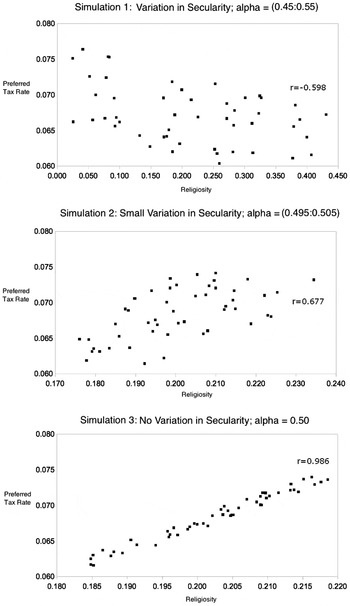
We estimate simulations based on the Scheve and Stasavage (Reference Scheve and Stasavage2006b) model to distinguish between the effects of secularity and security on public opinion. Through these simulations, we can begin to see whether demand for religion and government increase in response to security risk.Footnote 5 We offer three simulations where we alter only the long-held preferences for religious goods, the α term in Eq. (1), to trace the effect of religiosity (r i) on public opinion (τ) in Eq. (2). We assigned the exact same values for our measures of insecurity, λ and θ, for each of our 50 units (countries) across the three simulations.Footnote 6
In our first simulation, displayed in the first graph in Figure 1, we allow secularity (α) to vary considerably, taking on values between 0.45 and 0.55. Along with α, values of insecurity, λ, fluctuate between 0.045 and 0.055 across each of our 50 countries. The resulting estimates of the relationship between religiosity and public opinion corroborate with the the observed data from Scheve and Stasavage (Reference Scheve and Stasavage2006b). We can see that the relationship between religiosity and opinion is negative, with r equal to −0.598. Increased religiosity suppresses support for government activity.
Simulated patterns of religiosity and public opinion dependent on α. Note: Each of the three simulations uses the same values for λ and θ. N = 50. Values of θ are set at 0.55. λ was created from a distribution of values ranging from 0.045 to 0.055.

In Simulation 2, we restrict the variance of α to values between 0.495 and 0.555. As we noted, each of our countries has the same imputed value for risk across all three simulations, with individual countries ranging from 0.045 and 0.055. As we can see in Figure 1, with less variance in secularity, the relationship between religiosity and opinion is considerably more positive than in Simulation 1. Here, changes to religiosity result in public demands for increased government activity.
For our final simulation, designated Simulation 3 in Figure 1, we hold α at constant of 0.5 for each of our 50 countries. Thus, only the value of insecurity, λ, is fluctuating between 0.045 and 0.055 across our 50 units. As one can see in the bottom graph of Figure 1, when each country has the same level of secularity, the relationship between religiosity and public opinion is positively correlated, with a value of 0.986. Increased religiosity — as driven solely by responses to security — is accompanied by a preference for higher levels of taxation and greater policy output.
Although these simulations are not proofs, they illustrate the potential impact of religiosity when secularity varies greatly, somewhat, or when it is held constant. Simulations 2 and 3, respectively, show that when variation is small, or not at all, religiosity and public opinion move positively together. Alternatively, if there is considerable variation in secularity as in Simulation 1, then one may observe the reverse pattern, with greater religiosity suppressing support for government activity. Thus when Scheve and Stasavage (Reference Scheve and Stasavage2006b) make cross-country comparisons, more religious countries may be less supportive of social insurance due to their levels of secularity. However, if we could hold the effect of secularity relatively constant, then as Simulations 2 and 3 illustrate, we should see religiosity and public opinion moving together through time.
EMPIRICAL ANALYSIS
Our view of religiosity separates the two sets of preferences that result in the choice to purchase religious goods. While theoretically distinct, short-term preferences (security) and long-term preferences (secularity) are difficult to distinguish empirically. There exists two sets of preferences, but only one choice that reveals both sets of preferences. Some people will be religious regardless of how secure their lives are. Others will never participate in religion no matter their circumstances. Still, others will become more or less religious depending on the relative ease or dangers of life. Isolating the effects of insecurity on religiosity requires a research design that effectively holds secularity constant while allowing existential security to vary.
To test the effect of insecurity on religiosity, and the relationship among religiosity and public opinion, we offer a dynamic model for one society, the United States, over a 50 year period. The United States is a suitable laboratory for two reasons especially. One, unlike countries such as France or South Korea, long-held preferences for religion have not shifted dramatically. Forces affecting long-term preferences generally surround generational replacement and population change, which can be dealt with statistically by a control for a secular trend. Moreover, there will be less variation in long-held preferences in this one case over time than in a cross-sectional, comparative analysis. Two, unlike countries such as Spain or Russia, the United States has had a stable religious market. This environment is considered a “free market” for religion, with few restrictions on religious institutions or individual practices, and limited government financial support. The United States has never had a state church or a religious monopoly or oligopoly. And over the past six decades, the regulatory environment has changed relatively little, unlike that of other countries. Within a single society such as the United States, our theory leads us to expect that religiosity and demand for public policy will move in tandem, as both are principally led by changes in security.
We hypothesize that demand for policy goods and demand for religious goods are each driven by a similar set of factors that reflect threats to existential security. One way to address this argument is to trace both religiosity and public opinion over time to see if they react in similar ways to exogenous shocks, and thus determine to what extent they move together over time. To accomplish this, we need measures of both concepts over a significant period at the societal, or aggregate, level. In the past, such a study would have been hampered by data limitations. However, we take advantage of two available measures of these concepts, each of which considers information from thousands of survey indicators in order to estimate a single, macro-concept. For public opinion, we turn to Stimson's (1991; Reference Stimson1999) public policy Mood. For religiosity, we take advantage of Grant's (Reference Grant2008) Aggregate Religiosity Index.
Stimson's Mood is well known in the political behavior literature. Mood reflects a broad constellation of the public's attitude toward government, capturing the general liberal/conservativeness of the citizenry from the early 1950s to the present.Footnote 7 Mood captures much of the variance across support for many government policies, although social and morality issues such as abortion and crime do not track as well with general policy Mood.Footnote 8 The development and implementation of Mood, according to Philip Converse's (Reference Converse2006) review of the behavior literature, ranks among the most important contributions to the study of political behavior and representation. Mood has been shown to affect the decision-making of members of Congress (Fowler Reference Fowler2005; Jones, Baumgartner and True Reference Jones, Baumgartner and True1998; Wood and Andersson Reference Wood and Andersson1998), the president (Rottinghaus Reference Rottinghaus2006; Erikson, MacKuen and Stimson Reference Erikson, MacKuen and Stimson2002), and the Supreme Court (Flemming and Wood Reference Flemming and Wood1997; McGuire and Stimson Reference McGuire and Stimson2004). Mood also has consequences for electoral turnover and macropartisanship, with increases in Mood translating to greater support for the Democratic party among voters and partisan identifiers, respectively (Erikson, MacKuen and Stimson Reference Erikson, MacKuen and Stimson2002).
Religiosity, like Mood, is a concept that cannot be adequately captured by one, or even a few, survey questions. Religiosity is best understood as a latent concept measured by a multiplicity of indicators. Such indicators should cover dimensions of both belief (e.g., belief in God, belief in an afterlife) and practice of religion (e.g., attendance, prayer), as both speak to the consumption of religious goods. Unfortunately, substantial data limitations arise, as survey responses to such indicators are available only intermittently over the past 50 years. For these reasons, we take advantage of Grant's (Reference Grant2008) measure, the Aggregate Religiosity Index (ARI). ARI draws on a considerable number of survey questions tapping religious attitudes and behavior. The series is also available over the same time period as Mood, the early 1950s to the present. As demonstrated in Grant (Reference Grant2008), ARI offers greater validity and reliability than extant longitudinal measures of the concept. And prior work examining patterns of religiosity and inequality in the United States has used the ARI series (Solt and Grant 2011).
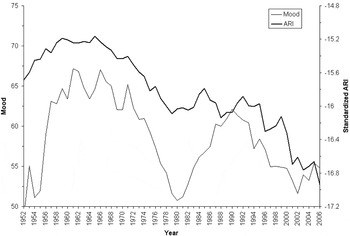
To assess the relationship between public opinion and religiosity, we first offer a visual presentation of the two series in Figure 2. Higher values for Mood indicate a public more demanding of government services, and higher values of ARI indicate a more religious public. To facilitate comparison across the two series in this figure, we standardized the ARI series using the mean and standard deviation of Mood.
Public policy mood and the aggregate religiosity index, 1952–2006.

Beginning with public opinion, the familiar Mood series charts a public that was conservative in the 1950s, followed by an increasingly liberal public in the 1960s and early 1970s. The mid-1970s to early 1980s brought about a turn toward conservatism, which was followed by a more liberal period in the early 1990s, followed again by a turn to conservatism in the the first part of the 2000s (Stimson Reference Stimson1999; Reference Stimson2004). Turning to ARI, we see that religiosity was at its highest level during the “revival” of the 1950s and early 1960s (Smith Reference Smith1960). From there, ARI declined until the late 1970s and reached a plateau in the 1980s and 1990s. The late 1990s to the present point to a decrease in religiosity. Looking at the series together, one cannot help but notice considerable collinearity. Both series move in tandem over time. Of course “eyeballing” two series without the benefit of statistical tests of the relationship can be misleading. To see the extent to which ARI and Mood move together over time, and to determine if they are driven by a common factor or set of factors, we test if the two series are cointegrated. This test, then, is the fundamental assessment of our theory that opinion and religiosity move together in response to changes in security.
Fractional Cointegration: Religiosity and Public Opinion Moving Together
Our theory predicts that when holding secularity steady, we should observe religiosity and public opinion moving together through time, reacting in similar ways to changes in security. Statistically, this would occur if there were a cointegrating relationship between religiosity and Mood. Cointegration exists when there is a dynamic equilibrium between two series, which is often the result of the series being driven by a common factor (Beck Reference Beck1992; Engle and Granger Reference Engle and Granger1987). Applying our theory, cointegration would indicate that both religiosity and public opinion are driven primarily by insecurity.
In many applications in political science, cointegration is identified when two series are integrated with an order of one, designated I(1), but the residuals of one series regressed on the other is I(0), that is stationary, or white noise. Although the conceptualization of cointegration as I(1) series is common, cointegration is a more general concept (Clarke and Lebo Reference Clarke and Lebo2003; Granger Reference Granger1980). It occurs when the deviations from equilibrium have an order of integration less than the parent series. If two parent series are I(d), where 0 < d < 1, and the residual series are less than I(d), we have what can be referred to as fractional cointegration. The two series are cointegrated, but the return to equilibrium is not immediate. When an exogenous shock disrupts the equilibrium, the two series will eventually (but not instantaneously) move back into equilibrium.
We follow Cheung and Lai (Reference Cheung and Lai1993) and Dueker and Startz (Reference Dueker and Startz1998) to test for fractional cointegration in this manner. We begin by estimating the order of integration of the parent series, Mood and ARI (Robinson Reference Robinson1995). Next, we estimate two models: Mood regressed on ARI; and ARI regressed on Mood. We then test if the residual series has a lower level of integration than the parent series.
We present the results of our estimated order of integration for the two parent series, Mood and ARI, and the two residual series in Table 1. We use Robinson's estimator to estimate the order of integration.Footnote 9 The order of integration of the two parent series are presented in the first two columns, followed by the residual series in the third and fourth columns. We see in Table 1 that the order of integration of the parent series is greater than that of the residual series, statistically significant at standard levels. The results of these tests indicate that public opinion and religiosity are fractionally cointegrated.
Diagnostic tests of the order of integration for mood and religiosity, 1952–2008

*p < 0.05.
Substantively, our findings confirm that Mood and ARI are in a dynamic equilibrium. The series move together through time, and they respond similarly to exogenous shocks. This finding is consistent with our theory that both demand for government and religion stem, at least in part, from reactions to insecurity.
Evidence of ARI and Mood being both positively correlated and fractionally cointegrated provides new insight into the relationship between religiosity and public opinion. Comparing across countries, there is evidence that religiosity and public support for more government intervention are negatively related. Our evidence suggests that the reason for this is due to differences in secularity across units. Countries with higher secularity — with greater long-term preferences for secular goods over religious ones — are more likely to seek governmental solutions for problems. Those living in religious countries are more likely to seek out comfort from religion, reducing the demand for government. However, within a single context, religiosity and public opinion move together because of changes to security. In the United States, ARI and Mood shift together in a manner consistent with our theoretical expectations.
Error Correction Models
The cointegration tests we presented provide the best assessment of our theory. Evidence of cointegration is consistent with our theory that both ARI and Mood are driven in similar ways by insecurity. We know of no other theory that would predict that religiosity and public opinion would move together in this way, but we cannot rule out that there could be some other explanation for this empirical relationship.
One way to further test if the relationship between ARI and Mood is based on reactions to security is to model each series as a function of security. We earlier conceptualized security as including economic conditions, natural disasters, disease, wars, and the many other threats to life and property. Measuring such a multifaceted concept (and over five decades) is beyond the scope of this article, but we can model both ARI and Mood as functions of one of the most important indicators of security: GDP. GDP per capita captures much of what we have conceived of as insecurity, not only in that economic down-turns are captured by changes in GDP, but also in that non-economic threats including natural disasters, social unrest, international catastrophes, others can affect the annual GDP.Footnote 10
An error correction framework (ECM) can be used to examine the dynamics of security (GDP), Mood, and religiosity. Our earlier diagnostic tests for the order of integration revealed that the Mood and ARI are non-stationary series and are fractionally cointegrated. Such results point to an ECM as the preferred time series model specification (Keele and DeBoef 2008). Estimating a model in levels in the presence of cointegration runs the risk of spurious regression. Alternatively, estimating a series in differences also suffers from misspecification. In the latter case, essentially one is discarding the information contained in the cointegrated relationship, and thus one runs the risk of the proverbial “throwing out the baby with the bathwater.”
We estimate two error correction models. The first, for ARI, can be written as follows:
 $$\Delta ARI_t = \alpha_0 + \alpha_1 ARI_{t - 1} + \beta_0 \Delta GDP_t + \beta_1 GDP_{t - 1} + \epsilon_t.$$
And the ECM for Mood is as follows:
 $$\eqalign{&\Delta Mood_t = \alpha_0 + \alpha_1 Mood_{t - 1} + \beta_0 \Delta GDP_t + \beta _1 GDP_{t - 1} + \cr &\quad \beta_2 \Delta PolicyLiberalism_t + \beta_3 PolicyLiberalism_{t - 1}+\epsilon_t.}$$
The β0 term speaks to the immediate impact of GDP on opinion or religiosity, whereas β1 represents the longer term effect of GDP on opinion or religiosity. For our model of Mood, we also include an additional explanatory measure that has been shown to be of consequence: the liberal-conservative direction of public policy. Erikson, MacKuen and Stimson (Reference Erikson, MacKuen and Stimson2002) find evidence for a thermostatic model of public opinion, where the public signals government should “cool down” in the face of excessive spending and policy liberalism, whereas the public demands more from government as policy provisions wane.Footnote 11
Our expectation is that as GDP decreases, both demand for God and for government will increase. This relationship should hold for the long-term effect of GDP on religiosity and opinion, the β1GDP t−1 term in both models. That is, we expect more liberal and more religious responses from citizens to the long-run level of economic output, rather than the difference between last year's value and this year's value, as captured by the β0Δ GDP t term. Thus, the sign on β1GDP t−1 in both models should be negative, and the variable should be statistically significant for both ARI and Mood.
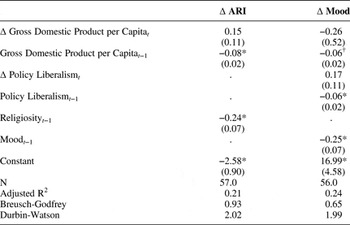
Table 2 presents the results of our two error correction estimations. The model for religiosity is presented in the first column, and the ECM for opinion, in the second. In both specifications, we see the coefficient for the long-run value of economic output is negatively signed, and that the variable is statistically significant (p < 0.05 for ARI and p < 0.06 for Mood). These ECM models and the earlier evidence of fractional cointegration suggest that ARI and Mood respond to changes in security.
Error correction models of religiosity and public policy mood, 1952–2008.

We report OLS regression coefficients with standard errors in parentheses.
The reported value for Breusch-Godfrey is the significance level of each test for residual autocorrelation.
One lag is included in each Lagrange Multiplier test. The null hypothesis is no autocorrelation.
GDP per capita is per 1,000 dollars, in 2005 dollar values.
*p < 0.05, two-tailed.
†p < 0.06, two-tailed.
DISCUSSION
Our findings support a theory of religion and public opinion that views demand for religious and governmental help as stemming from the many insecurities of life. Demand for more religion moves together through time with demand for more policy. Tests for fractional cointegration show that this relationship holds in the United States, and additional error correction models corroborate the role of insecurity in moving opinion and religiosity. When times get tough, the public calls out to government and God for help. During seasons of waning existential threat, the public prefers less government and less religion.
This article shows the value of having a well-defined, explicit theory of religion and politics. Building on previous work in sociology and political science, we are able to show that the relationship between religion and conservatism found in cross-sectional research may not hold when religion and public opinion are tracked through time within a single market — which holds the level of secularity relatively constant over time. By limiting our analysis to one case, we are able to limit variation in the regulation and supply of religious goods. As a result, fluctuations in religion over time are related to changes in demand, which we have argued reflect shifts in security. Economic output, wars, rumors of war, disasters, unrest, social upheaval, and the many other threats drive both religiosity and public opinion.
Our article also highlights the importance of using both comparative, cross-national research, and longitudinal analysis to address questions about religiosity and opinion. The stylized fact from comparative research is that more religious societies are less supportive of progressive policies. Our findings do not contradict this per se, but they clarify and test the theory linking religion and public opinion. Within a single country, religion, and progressive public opinion may move together, but comparatively — due to differing levels of secularity — religion may be a conservative force, driving down support for policies that would provide a greater social safety net. But when religiosity does change, it does so in tandem with public opinion. As we have argued, the reason is due to changes in existential security.
It is important to contextualize our findings. When examining the United States, where there is less variation in secularity, we are able to isolate the effect of insecurity on both religiosity and public opinion. As we noted above, in comparative tests such as those conducted by Scheve and Stasavage (Reference Scheve and Stasavage2006b), one could observe religiosity dampening support for government activity. But it also true that the United States polity is less likely to support redistributive policies or greater government intervention in the economy when compared with western European democracies, for example. Such comparative differences are likely due to different histories, cultures, and worldviews that have implications for a society's secularity. Even at its most liberal, public opinion in the United States does not approach the progressive policies found in Europe and other more secular societies. Long-held preferences for religion may very well suppress demand from government, but our dynamic models show that when security changes, religiosity, and public opinion shift in tandem.
It is also important to recognize that our tests for the relationship between religiosity and public opinion are at the aggregate level over time. More research is needed to untangle the relationship between religiosity and opinion at the individual level. Religion is, of course, only one way in which people deal with threats to security. Even in a more religious country such as the United States, there will be many citizens who would not become religious regardless of what threats they face. Such heterogeneity cannot be disentangled with our aggregate data. That said, studies using panel data at the individual level could be particularly informative. If individuals were tracked over time, our theory suggests that increased religiosity in response to risk would be related to more progressive attitudes. Unfortunately, most panel studies to date assume that religiosity is static and thus rarely measure religiosity more than once.
Finally, as this body of research progresses, it should continue to draw from theories of religion developed in sociology, particularly those in the paradigm of rational choice. Unlike in sociology, in political science, “religion” is an under-developed concept. There is no reason to reinvent the proverbial wheel. Because religion is a concept found throughout societies, sociologists from Durkheim and Weber to current thinkers have theorized about religion far more than other social scientists. We have drawn from theoretical work on religious markets to show how it aids in our understanding of the linkage between religiosity and public opinion. Undoubtedly, there are additional insights into the study of politics that could be garnered by building on the extensive sociological literature on religion.