Introduction
Every year, breast cancer is identified as a leading cause of death in women all over the world. On the other hand, early diagnosis increases the chances of good recovery and long-term survival. X-ray mammography, magnetic resonance imaging (MRI), and ultrasound imaging are frequently used for detecting diagnostic tools for breast tumor [Reference Karam, O'Loughlin, Oliveira, O'Halloran and Asl1]. Nevertheless, the percentage of false-negative diagnoses associated with X-ray mammography is between 10 and 30% and the false-positive diagnoses are more than 5% [Reference Mahmud, Islam, Misran, Kibria and Samsuzzaman2]. Even so, ultrasounds for young patients have only additional and poor detail [Reference Fallenberg, Dromain, Diekmann, Engelken, Krohn, Singh, Ingold-Heppner, Winzer, Bick and Renz3], although MRI is a costly method of screening. The procedure of detection for the actual systems is uncomfortable and painful for the patient and has the risk of false results.
MWI is a potential alternative imaging technique that would be comfortable for the patient, provide more sensitive and use non-ionizing waves [Reference Khalesi, Sohani, Ghavami, Ghavami, Dudley and Tiberi4]. Additionally, it is becoming a promising candidate to detect the malignant tissues of the human body [Reference Vispa, Sani, Paoli, Bigotti, Raspa, Ghavami, Ghavami and Tiberi5]. It has a high data rate, low cost, and low power spectral density. The antenna is used as a transceiver in an imaging system to affect microwave frequencies on human tissue.
The basic principle of MWI is related with the difference of electrical properties, which means the dielectric property of different human tissues. Malignant tissue has a higher dielectric constant than normal tissue, and the analysis of scattered antenna signals reflected by these tissues provides to identify unwanted cells [Reference Borja, Tirado and Jardón6].
Hence, the Federal Communication Commission (FCC) allowed its commercial UWB systems to work from 3.1 to 10.6 GHz in 2002 [7]. Enriched and potential MWI research activities were conducted in various communication applications and detection of the tumor. UWB antennas play an important role in efficient and effective imaging systems. The following specifications must be met for the use of UWB antennas in MWI applications [Reference Zerrad, Taouzari, Makroum, Aoufi, Islam, Özkaner, Abdulkarim and Karaaslan8]:
• High gain, small in size and relatively simple in model;
• Wide range of frequency with higher efficiency;
• Compatible penetration to human tissue;
• Ability to work both in low and high frequencies;
• The efficiency of directional power transmission into the target.
Although microstrip antenna is quite simple to design and cost-effective, it suffers from some limitations such as low gain (<5 dBi) and poor radiation performances.
A metamaterials sheet [Reference Pandey, Singh, Bharti and Meshram9], Vivaldi antenna [Reference Abbak, Akinci, Çayören and Akduman10], defected ground plane [Reference Perhirin and Auffret11], inserting an additional slot or super-state [Reference Islam, Samsuzzaman, Rahman and Islam12], and other strategies have been suggested by several researchers to improve the performance of UWB antennas. The metamaterial concept has been utilized in many applications such as sensors, antenna improvement and so on [Reference Abdulkarim, Dalgaç, Alkurt, Muhammadsharif, Awl, Saeed, Altıntaş, Li, Bakır, Karaaslan, Ameen, RK and Luo13–Reference Sağık, Altıntaş, Ünal, Özdemir, Demirci, Çolak and Karaaslan20].
This work presents a small microstrip patch antenna for UWB MWI applications. First, the proposed antenna is modified by cutting slits in both patch and ground plane to enhance the performance with the desired properties for UWB-based MWI applications. The suggested antenna is also used for a breast measurement system to analyze the variation of the backscattering signal and transmit-received pulses. The proposed antenna is designed with a step-shaped slot rectangular patch and T-shaped slot ground plane. Although the antenna demonstrates radiation characteristic as a monopole, since including step-shaped slot rectangular patch and T-shaped slot ground plane, the proposed antenna is referred to as patch antenna due to geometry.
The following is the structure of this work: The details of the antenna design are discussed in section “Antenna configuration”. Then, the effects of various geometrical parameters on the antenna performances are presented. In section “Results and discussion”, numerical and experimental results in frequency-domain performance, related with return loss and radiation pattern and time-domain performance, related with the group delay (τ) and the fidelity factor in both scenarios FtF and SbS, are presented and discussed. Section “Imaging performances” introduces the imaging performances and the system setup for breast phantom screening. While section “Conclusion” gives a final conclusion.
Antenna configuration
In this study, the key reasons for selecting planner patch antenna are stem from its simplicity, stable radiation diagram and compact low profile which may be utilized in a variety of UWB applications also as MWI [Reference Gibbins, Klemm, Craddock, Leendertz, Preece and Benjamin21]. The geometric layout of the suggested antenna is illustrated in Fig. 1. It is designed on an FR-4 substrate material with a relative dielectric constant of 4.4 and a loss tangent of 0.02. The antenna is designed with a step-shaped slot rectangular patch and T-shaped slot ground plane. The overall dimension of the antenna is 20 × 19 × 1.6 mm3. The height and width of the partial ground plane are 7 and 20 mm, respectively. The feedline is 2.98 mm in width and 6.25 mm in height. The feedline is directly connected to the patch by a 50 Ω microstrip line. All these dimensions have been determined by parametric sweep to provide the effectiveness of the antenna properties.
The realized antenna's geometric form: (a) front view, (b) back view.

A finite integration technique-based simulator was used to test the performance of the planned initial design. It can be shown that −10 dB return loss operational BW of the antenna varies greatly with adding slits on the patch and the ground. The influence of the step-shaped slot and the T-shaped slot is depicted in Fig. 2. It shows that the step-shaped slot with a partial ground plane has a major impact on the enhancement of the lower BW. The modified structure with step-shaped slot extended the lower frequency around 5.8 GHz (shifted from 3.9 to 9.7 GHz). In addition, by adding T-shaped slot on the partial ground plane, high performance of BW is achieved by enlarging the upper frequency around 1.7 GHz (shifted from 9.3 to 11 GHz).
Effects of the Slits on S11.

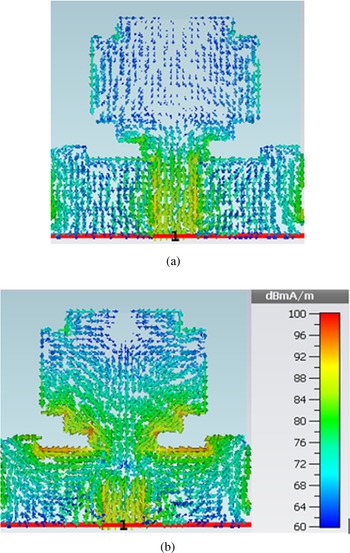
With a view to check the template dimension of the suggested antenna, the numerical surface current distribution for two frequencies of 5.3 and 9.8 GHz is presented in Fig. 3. The most dominant surface current-conducting area of the antenna distributed around the fed line, the lower part of the patch and around the slot edge of the ground. Most of the current distributed around the feed line and the slot edge of the ground plane is at a low frequency of 5.3 GHz. A large portion of current exists around the edge of cutting planes and the feed line radiates a few current, at a higher frequency of 9.8 GHz due to higher-order current mode. The excitation is sufficiently strong across the total portion of the antenna at the related frequency points. The existence of a slit in both the patch and the ground alters the current conducting direction and antenna characteristics specially allowing the working frequency band to be extended further.
The current distribution at: (a) 5.3 GHz, (b) 9.8 GHz.

Results and discussion
Frequency domain performance
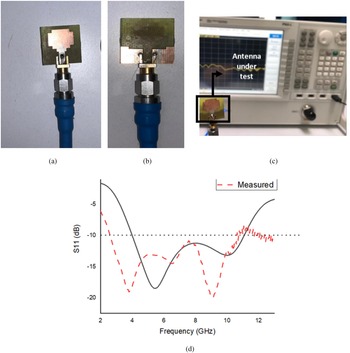
A sample of the designed antenna is constructed using the LPKF computer Proto Mat S103 to test the simulation performance. Then, PNA-L Network Analyzer N5234A is used to find out the S11. The fabricated prototype and measurement system are presented in Figs 4(a)–4(c). By cutting slits within the patch and ground, the frequency BW is significantly affected as depicted in the figure.
Antenna after fabrication (a) Upper view, (b) Bottom view, (c) measurement system, (d) Return loss (S11).

The simulated and measured S11 results versus frequency for the antenna are shown in Fig. 4(d). Depending on the production tolerances and faulty soldering of the SMA connector, a slight mismatch between the measured and simulated values is noticed. The simulated impedance BW for S11 below −10 dB is 7 GHz (shifted from 4 to 11 GHz). The measured and simulated values are in a good agreement throughout the entire BW.
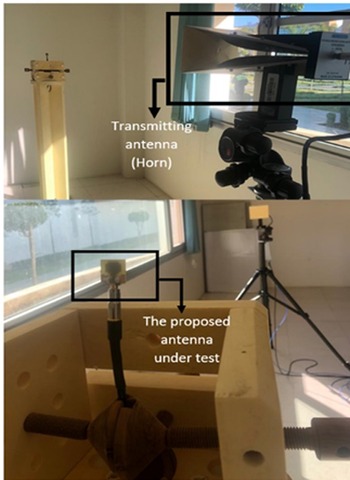
The utilized Geozondas antenna measurement system (GAMS) has been depicted in Fig. 5. The antenna radiation pattern has been measured by using a horn antenna, as a transmitter, while the proposed checked antenna is defined as a receiver.
Geozondas antenna measurement system.

Notice that co-polarization occurs where the transmitting antenna (Horn) and the receiving antenna under test (proposed antenna) have identical polarizations, while cross-polarization occurs when the Horn and the proposed antennas have perpendicular polarizations.
The simulated gain and efficiency variation versus the frequency is displayed in Fig. 6. The efficiency across the BW is calculated by using the following equation [Reference Khraisat, Hmood and Al-mofleh22]:

where: D (Directivity): the theoretical gain of the antenna; G (Power Gain): the measured gain of the antenna.
Simulated Gain and Efficiency.

In a high efficiency, the majority of the power at the antenna's input is efficiently radiated out. In a low-efficiency antenna, the majority of the power is absorbed as losses or reflected away due to impedance mismatch. The antenna is found to have a consistent and reasonable performance with a maximum value of 71% at 9.2 GHz. As compared to small dimensions, the antenna has a gain of 3 dBi at 5.3 GHz, and 3.08 dBi at 9.8 GHz.
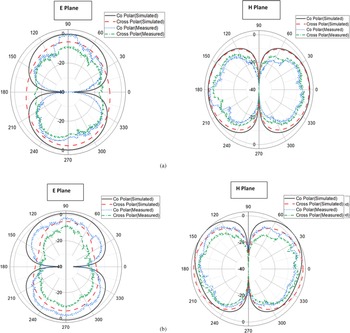
The radiation patterns of the suggested antenna at frequencies of 5.3 and 9.8 GHz are also elaborated. Figures 7(a) and 7(b) shows the measured and simulated 2D patterns at the elevation plane (xz plane, phi = 0) and azimuth plane (xy plane, theta = 0), co-polarization and cross-polarization for two frequencies of 5.3 GHz, 9.8 GHz. Since the radiation pattern experiments are not performed in an anechoic chamber, the recorded results vary significantly from the simulated results. Moreover, at a lower frequency of 5.3 GHz values, the antenna radiates omnidirectionally in E and H planes.
Measured and simulated radiation pattern at 5.3 GHz, (b) 9.8 GHz.

Time-domain performance
Two similar antennas are placed in two separate orientations, FtF and SbS, for the time domain study. In the far-field region, the first antenna serves as a transmitter, while the second serves as a receiver. One of the crucial parameters that defines the phase distortion of the transmitted (TX) signal over the transmission path is depicted as group delay.
The group delay τ indicates the time delay of signals during the propagation from transmitting to receiving end [Reference Tiwari, Singh and Kanaujia23]. The variation of τ against frequency for FtF and SbS at 246 mm is shown in Fig. 8.

where: θ (in radian): the signal phase; ω (in radian/ sec): the frequency.
The group delay variation for FtF and SbS.

From Fig. 8, the group delay fluctuation is between 0.96 and 1.3 ns over the whole operating BW which shows good phase linearity.
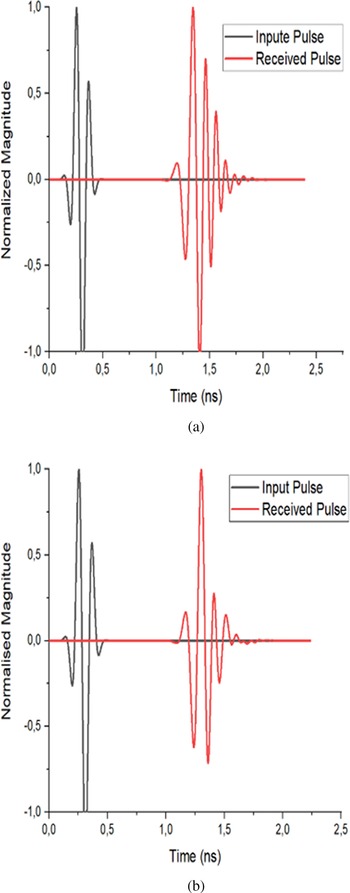
To ensure that the transmitted (TX) and received (RX) signals are almost identical, as well as to determine the utility of the UWB antenna [Reference Koohestani, Moreira and Skrivervik24], the fidelity factor (F) is also calculated. A high value of fidelity factor guarantees a low distortion of the TX signal. As a result, this property verifies that the antenna is ideal for MWI.

where: s(t): the TX signal; r(t): the RX signal.
The normalized TX and RX pulses in FtF and SbS at a distance of 246 mm is displayed in Fig. 9. TX and RX pulse graphs demonstrates that FtF and SbS orientations have little attenuation in receiving signals. According to the results of the data in this figure, fidelity factors of the antenna are calculated as 90.63% in FtF and 85.24% in SbS configuration, respectively, which expresses that the suggested antennas have the emitting and receiving capability.
Normalized TX and RX pulse in (a) FtF, and (b) SbS.

Imaging performances
As mentioned above, all papers should close with a conclusion section. The key aim of this study is to determine the difference in backscattering signal with and without tumor. Figure 10 presents a proposal system for breast tumor detection. This setup is composed of two antennas facing the breast, a breast model that contains two layers (breast tissue and skin) and a tumor located 6 mm inside from the skin layer. All the characteristics of the breast components at 3 GHz [Reference Tarikul Islam, Samsuzzaman, Faruque, Singh and Islam25] are presented in Table 1.
Simulation setup for MWI.

Properties of breast phantom

To evaluate the proposed system's performance, the correlation among S11, S21 for three different setups (free space, the breast model with and without tumor cell) is examined. The S-parameters are obtained by placing two antennas facing and on the surrounding of the breast model at 12 mm from the skin layer. The first one serves as a transmitter and the second one serves as a receiver. As a consequence of the dielectric properties of the breast and tumor tissue, the response of tumor can be observed in RX signals across the breast model. Therefore, S11 shows the reflected proportion of the wave when the wave penetrates through an environment aside from air. Additionally, the difference between the simulated S11 result in air and front of the breast model should present a comprehensible response and will not vary too much. The first plot in Fig. 11 presents the simulated S11 result. The antennas operate in the 4 to 11 GHz frequency band.
S parameters of the imaging setup.

Besides, to ensure that the signal emitted from the antenna to the sample has the least amount of distortion, the transmission response (S21) should be as flat as possible at the desired operating frequency BW [Reference Islam, Kibria and Islam26]. Figure 11 shows S parameters of the suggested antenna array system. There is a significant difference between the plot of the free space S21 and the breast phantom S21. Moreover, the free space transmission coefficient plot demonstrates the flattest amplitude at most of the operating band. In conjunction with, a significant change in RX signal is observed for the scenarios of with and without tumor cell inside the breast model between the transmitter and receiver antennas and it is a significant magnitude for breast without tumor at most of the BW as compared to the breast with the tumor.
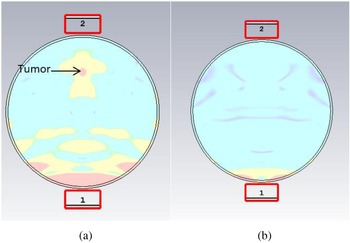
Figure 12 presents the simulated imaging results of the E-field distribution at 9.8 GHz of the breast tumor screening device that has been proposed. The imaging of the breast model with the presence of the tumor is presented in Fig. 12(a), and the result without tumor is shown in Fig. 12(b). It is seen that the location and presence of the tumor can be identified with a high-resolution image and the sensitivity of tumor is in Red and rest of the normal breast tissue is in Blue. On account of the different properties of the tumor cell and breast tissue dielectric, the scattering percentage of the signals inside normal tissue is greater than that of tumor, since, the tumor cell transmits a higher signal than normal breast tissue. Therefore, the imaging findings show a large contrast between tumor and normal breast tissue dispersed signals.
Imaging results for (a), unhealthy breast and (b), healthy breast.

In the final analysis, a comparative study between reported and designed results for similar applications in the literature antennas with proposed one is noted down. The considered parameters are BW, dimension of antenna, fidelity factor in both scenarios FtF and SbS, and application. Table 2 indicates that the proposed antenna outperforms previously observed antennas of smaller size in comparison to the operating frequency with a very high BW. The proposed antenna's high fidelity factor in both scenarios, and design simplicity are also highlighted.
Antenna comparisons with recent works.

All the imaging performance of the overall antenna system has been set on the reflection and transmission changes of the antennas for various cases of the breast such as free space, breast with and without tumor. The reflection and transmission changes for breast with and without tumor stem from the difference of dielectric constant of the sample under test at a fixed frequency of 3 GHz. According to the transmission results depicted in Fig. 11, the determination of the breast with and without tumor can be easily achieved at not only 3 GHz, but also various frequency points such as 5.1, 9.3 and 13 GHz. The possibility of tumor detection has been also demonstrated in a 2D analysis of the breast in comparison with the healthy breast at another frequency of 9.8 GHz as demonstrated in Fig. 12. In addition, the capability of a utilized antenna in the imaging process has been compared in Table 2. The proposed antenna bandwidth is around 7 GHz with the lowest dimensions. Hence, the detection method suggests a special antenna to determine the existence of the tumor.
Conclusion
To sum up everything that has been stated so far, imaging performance of the realized compact small UWB antenna for a breast tumor detection system is presented in this article. The UWB is accomplished by adding slits in both patch and ground. The proposed antenna was modeled using a finite integration technique based simulator, fabricated on FR4 substrate with a dielectric constant of 4.4 and thickness of 1.6 mm then tested.
According to the findings, the suggested antenna has a wider BW of 7 GHz (4–11 GHz). Additionally, the good radiation efficiency of more than 70% and gain of 3.05 dBi are obtained. Because of its basic construction, small size, and UWB capability, the antenna is a strong candidate for MWI applications. Moreover, the antenna performs admirably in both frequency and time domains with fidelity factors of 90.63% in FtF and 85.24% in SbS, which indicate an adequate coupling between transmitted and received signals. At the end of the article, a simulation configuration with a breast phantom is looked into and therefore the antenna accurately locates and detects the presence of the tumor within the breast phantom.
Conflict of interest
The author(s) declare none.
 Fatima-Ezzahra Zerrad was born in Morocco, in 1996. She received the engineer's degree in telecommunications and embedded systems from the Hassan First University of Settat (UH1), in 2019. She is currently pursuing the Ph.D. degree with the UH1. She is also a temporary professor with the Department of Electrical, Electronic and Embedded Systems Engineering, UH1. She is an associate researcher at the Aeronautical Telecommunications Laboratory, AIAC Casablanca, Morocco. Her main research interests include antenna design, wireless communication, RF engineering, and microwave imaging.
 Mohamed Taouzari is currently a professor with the National School of Applied Sciences; Laboratory LISA, Berrechid, Morocco and a visiting professor of the International Academy of Civil Aviation, Casablanca, Morocco. He has authored or co-authored a number of refereed journals, conference papers and a few book chapters on various topics with many inventory patents filed. His research interests include antenna design, RFID systems, metamaterial antennas and filters.
 El Mostafa Makroum is a professor in the faculty of the sciences and technology of Settat, Morocco. He received his M.S. degree in 2007 from the Mohammadia School of Engineering, University Mohammed V, Rabat, Morocco. He received his Ph.D. degree in computers and telecommunications from the Higher National School of Electricity and Mechanics, University Hassan II, Casablanca, Morocco. His current research concerns RFID antennas, propagation and EMC problems.
 Jamal Aoufi has obtained the Ph.D. in electronics and microwave circuits in 1998, and he recently obtained the university habilitation for scientific research at the Abdelmalek Essaadi University of Tetuan, in Morocco, his research is in the field of information technology, especially in transmission lines, antennas and modeling of electronic components used in microwave technologies. Currently, he is professor and Deputy Director of Research, Training and Cooperation at the Mohammed VI International Academy of Civil Aviation in Casablanca. He led several research projects in collaboration with other Universities and Research Laboratories.
 Hanane Nasraoui is an associate researcher in the Aeronautical Telecommunications Laboratory, AIAC Casablanca, Morocco. She obtained a Ph.D. in electronics and telecommunication at the faculty of science and technologies of Settat, in 2018. She is involved in the design of microwave circuits and metamaterials.
 Fadıma Gülsever Aksoy was born in Adana, in 1997. She received the B.Sc. degree in İstanbul Aydın University Faculty of Health Sciences, Department of Audiology, in 2019. She is a master's degree student of Cappadocia University School of Graduate Studies and Research, Department of Audiology, in Nevşehir. Her research interests are hearing and balance disorders, biomedical devices and artificial intelligence.
 Muharrem Karaaslan received a Ph.D. degree in the Physics Department from the University of Cukurova, Adana, Turkey, in 2009. He has authored more than 100 research articles and conference proceedings. His research interests are applications of metamaterials, analysis and synthesis of antennas, and waveguides.
 Md Tarikul Islam was born in Bangladesh, in 1994. He received the B.Sc. degree in computer science and engineering from Patuakhali Science and Technology University (PSTU), in 2016, and the master's degree from the Department of Electrical, Electronic and Systems Engineering, Universiti Kebangsaan Malaysia (UKM), Malaysia, in 2020. He is currently a Ph.D. student and working as a research assistant at the Department of Biomedical Engineering, the University of Illinois at Chicago -(UIC), USA. He has authored or co-authored a number refereed journals and conference papers. His research interests include the photoacoustic and thermoacoustic imaging, wireless communication, and microwave imaging for cancer detection.