1. TRADITIONAL NOTATION
Notation is undeniably important in music, defining the syntax with which musicians interpret formalised thoughts or, in other words, the composer’s ideas. Its advent was significant in broadening the scope of musical education and in the emergence of written legacies, but also in introducing constraints in music composition. Notation, to a certain extent, means rules and norms in written music that affect the composer’s concepts/creativity but also shape and bend those same ideas and processes. Roger Dannenberg (Dannenberg Reference Dannenberg1996: 63) summarises this, stating that ‘the language and notation we use exerts a large influence on what we think and create’, which Trevor Wishart reinforces by expressing that musical notation originated from a well-established musical practice but quickly grew to dominate it (Wishart Reference Wishart1996).
The first real indicator of proper notation can be found as early as the time of Ancient Greece (Read Reference Read1982). The Greeks used different letters, symbols and combinations of the two. It is worth mentioning that notation served as a mnemonic aid for accomplished musicians; thus, notation was not meant to be strict but rather to induce the recollection of memorised melodies. It is no wonder that the neumes, the most characteristic musical notation element of the Middle Ages, ‘did not attempt to mark out what we have now come to regard as individual pitches and units of rhythm but only shapes and contours of melodic line customary in current practice’ (Wishart Reference Wishart1996: 18).
Throughout most of its history since the Middle Ages, notation focused on defining pitch since it meant a sophisticated definition of melodies. This is not surprising, seeing that pitch was the most important compositional element at the time, as witnessed in written treatises and carefully considered in church music; progresses in notating rhythm came later and usually as a feature to clarify information about pitch and melody. The conventional notation we use nowadays describes pitch and quantised rhythm in detail but it is useless in describing other features used in contemporary composition, not to mention sounds in works that are not instrumental (e.g. soundscapes). It can actually be a daunting task to notate simple melodic movements that are easily described by drawing (e.g. periodic oscillations centred on a given pitch with a specific range), not to mention timbre effects or colours. Notation emerged to help visualise and describe music; however, musicians still interpret the same scores differently from each other. Even scores that are fully notated and detailed can be played differently.
While it is outside the scope of this article to go into detail on music notation history, it is important to remark that the system of notation we came to use contributed decisively to distance musicians from their aural interpretation and instincts, gearing them towards a dependency on written notation. Having said this, there is obviously a lot of music being performed without any scores (e.g. free jazz), besides various alternative formats where a score might be a moving person, a drawing, the movement of pedestrians and so on. Evidently, as well, there is immensely beautiful music made and performed with static conventional notation just like there are outstanding performances of completely improvised music (John Cage’s Theater Piece No. 1 and George Lewis’e Voyager, among others). In fact, as Dannenberg (Reference Dannenberg1996) states, there is nothing wrong with notation; the point is that there is a vast territory to explore, especially when one considers new technologies and computational power. I want to create musical interactive contexts with dynamic scores that lie between written music and free improvisation, aided by the powerful and accessible technologies of today.
Inherent issues regarding notation as such, visual music (Maura McDonnell’s work, as documented in her blog, http://visualmusic.blogspot.pt, is an extremely useful database for the topic) or graphic scores (the notations 21 project is a good resource about this subject: http://notations21.net) are also out of the scope of this article.
As a composer and active performer I am very conscious of the flaws in conventional notation. It constrains performers, restricting their involvement in music, thus making free-improvisation contexts unlikely. If one agrees that a score is not a definite truth, one can wonder about many possibilities of writing music and developing new systems of notation, emphasising separate aspects of musical performance and challenging musicians. In this article, I will discuss the process of creating interactive musical contexts in which scores mediate the performance of musical formalisations.
2. SCREEN SCORES
In this paper, I use the term ‘screen score’, as proposed by Hope and Vickery (Reference Hope and Vickery2011), when referring to scores being rendered and interpreted in real time on digital screens.
The access to computational power and high-level programming languages changed the way artists interact with the world and with their own practice. Never before has music been so democratised in both access and creative potential as it is nowadays, in spite of the fact that it entails dangers such as the illusion of ready-made music, pre-programmed loops, one click songs, 4/4 ‘tyranny’ and other matters that I will not be addressing in this article.
Particularly for those working in fields such as electroacoustic music, with access to interactive systems and multimedia installation, musicians are very often in contact with programming languages (MaxMSP, Supercollider, Pure Data, Processing, Open Frameworks, etc.), using computers as an aid to the creative process and performance. The ability to programme code coupled with the rise of graphical computing and efficient communication protocols, such as Open Sound Control (OSC) prompted some artists to devise systems to generate scores in real time. As Dannenberg (Reference Dannenberg1996: 64) states, ‘Modern computers and computer music systems have introduced a new possibility: that a score might be made to interact with decisions made during performance.’ Winkler (Reference Winkler2010: 89), describing why he got interested in this topic, remarks, ‘Why must musical scores be fixed on paper and defined for all ages to come?’
The use of real-time notation enhances a unique context combining composers, control and performers. It fosters a type of performance situation that is idiosyncratic of our time and current technology, making it attractive for composers who are willing to re-think the concept of score and notation. Due to it being a recent trend, the amount of works is still small and the experiences accomplished are unrelated.
To a certain extent, it is good that a score can be ambiguous. Otherwise, as with conventional notation, one would be trapped in the same constraints one is trying to avoid. However, the most exciting aspect of real-time notation does not lie in notation itself but in the ability to generate, change and shape musical notation in real time. The literature on this topic is relatively scarce, consisting mainly of reports and papers about developed software and its features, coupled with statements by its authors on their conclusions. The report given by Dr Cat Hope and Lindsay Vickery (Hope and Vickery Reference Hope and Vickery2011), however, is a good introduction on this subject, suggesting insightful taxonomies based on work completed so far. Further excellent resources of literature and practical work can be found in a website created and maintained by composer Ryan Ross Smith (http://animatednotation.com).
In this article, I wish to offer some insight about the process of creating/devising/composing music with the software, both in terms of compositional thinking and its graphical solutions, together with my considerations on what I believe to be the most challenging element: musical form.
According to the classification proposed by Hope and Vickery (Reference Hope and Vickery2011), this research positions itself in the area of generated compositions with screen scores. My interest in and approach to this matter originated while conceiving Õdaiko in 2009 (Lopes Reference Lopes2009). Õdaiko is a software application that generates scores in real time, based on rhythmic complexity using sieves (Ariza Reference Ariza2005). Elsewhere I have described the state of the art in selected projects that were relevant to my research at the time (Lopes Reference Lopes2010). Projects included eSCORE, Automatic Notation Generators, Flock, and work by David Kim-Boyle. Since then, other projects have arisen, illustrating the immense creative possibilities within this area. As the number of practical works has been exponentially increasing in the last few years, I have chosen to present two dissimilar recent approaches. Peripatoi and Study No. 8 illustrate the creative potential that real-time screen scores can lend to composers. These works were selected as examples because they demonstrate the variety of styles within this topic but also because I was present during the performances and thus able to experience the music.
2.1. Peripatoi
Peripatoi (2011), by Rui Penha, is conceived for bass clarinet, vibraphone, piano and double bass. Casa da Música, in Porto, Portugal, commissioned the work.
The movement of traffic, pedestrians, skaters and bikers that inhabit the surroundings of Casa da Música inspired Penha, He states: ‘I decided I should use the characteristics of these movements to generate a real-time score’ (Penha n.d.).
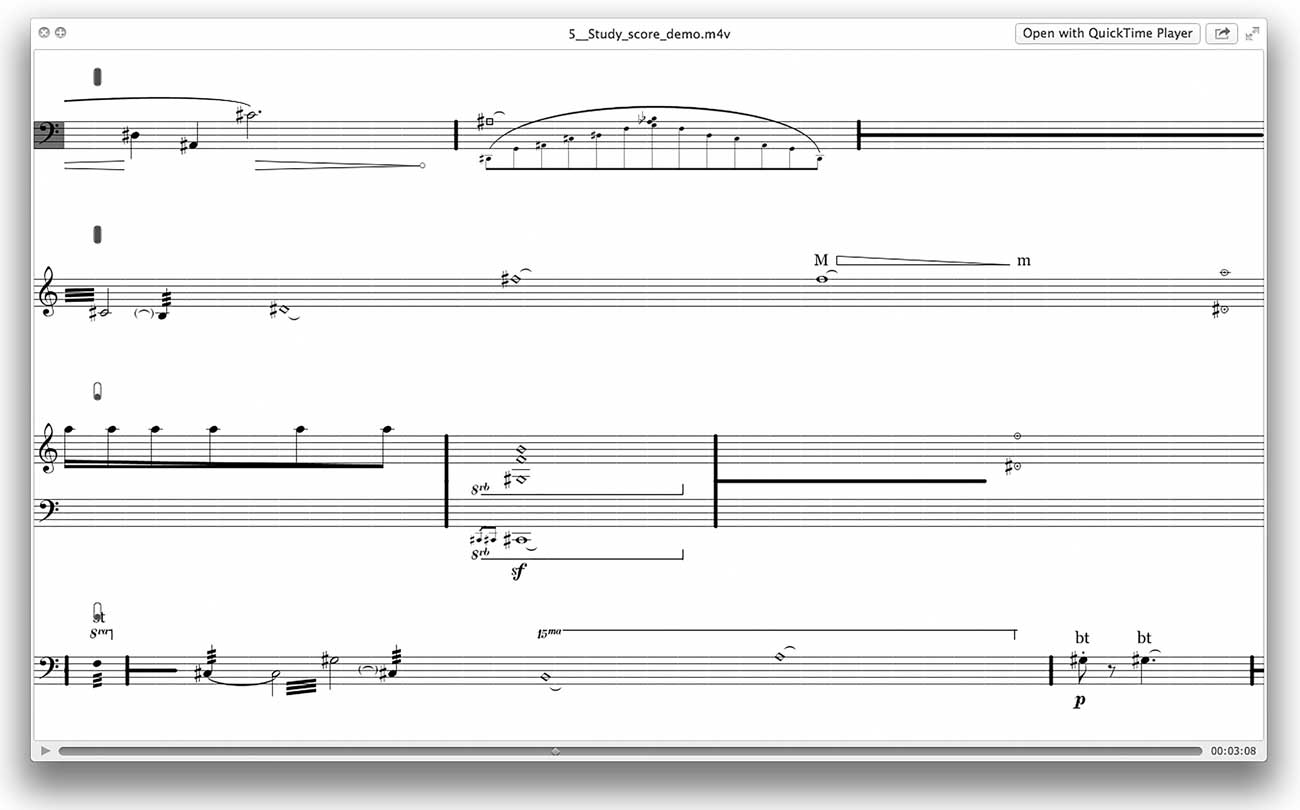
Each performer reads from an individual screen score; by analysing a live video feed, coupled with 256 pre-composed musical motives arranged in a 4D matrix, the algorithm will determine which motive to display in each screen. The motive appears in the screen floating from right to left until it stops, signalling the performer to play it. According to Penha, ‘Each instrument has its own independent algorithm that chooses each new gesture by weighting the last gesture played (i.e., the current position in the matrix), the current gestures being played by other instruments, the general harmonic and intensity realm and the kind of gesture the video analysis algorithm demands’ (Penha n.d.). Peripatoi holds an interesting feature, as it generates a real-time score determined by arbitrary events – the movements outside the hall. The triggering of the motives, which are notated in a traditional fashion (Figure 1), is thus a product of something that is out of the control of the composer, a very different approach from the ones on which the composer/manipulator decides, in real time, the flow of the piece. Finally, Penha states, ‘The generated score and the video projection are displayed with a 30 second delay in order to give the musicians some time to prepare and articulate the different gestures. The screen score contains the four instruments, giving the performers the opportunity to better articulate the gestures between themselves’ (Penha n.d.).
Screenshot of Peripatoi screen score.

Penha demonstrates an interesting decision regarding one of the most important features of music composition: time and development. Playing is determined by the arbitrary events coincident with the movements outside the hall, there is just an expectation of how much will be played. In addition, since the composition comprises motives, the music will basically be a continuous long flow. This was something I felt at the concert, music that was continuously being renewed even though still. The performers’ ability to see each other’s score enables them to interpret their motives freely, to interact and to be able to finalise their intervention accordingly. Although the graphical notation of the screen score is not the most important aspect in Peripatoi, the way it is used denotes a compositional thought aided by creative use of technology.
2.2. Study No. 8
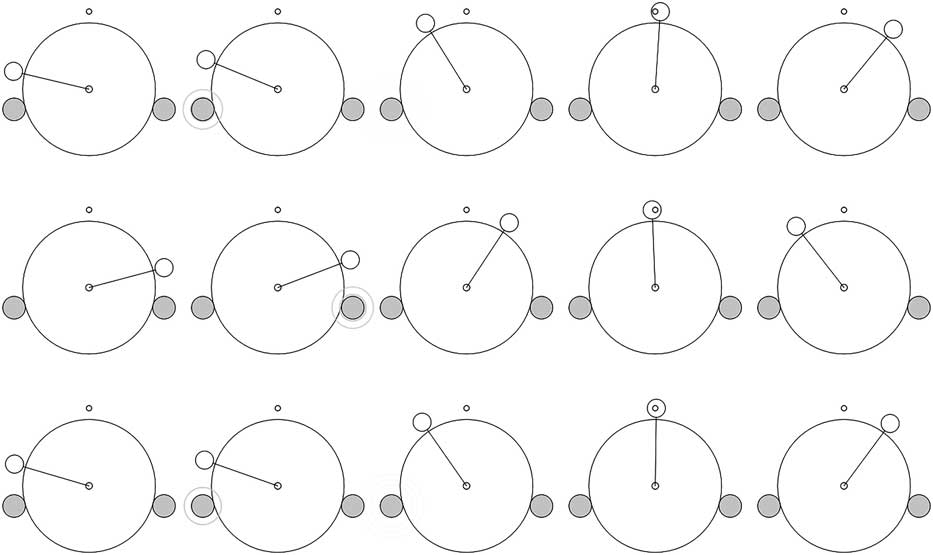
Study No. 8 (2012), composed by Ryan Ross Smith, is conceived for 15 performers. His interest in this field was spurred because Smith wanted to create complicated textures, without delving too much into conventional music notation. His aim was to design simple but effective animations that, when performed, would produce complex rhythms. Study No. 8 represents a phase of his research. In Smith’s own words: ‘each of the 15 performers has 6 sounds: 2 unpitched metals, 2 woods, and 2 pitched metals. Each performer watches one notational unit throughout. Each unit consists of 1 large circle flanked by 2 small circles, and the attack arm, which moves back and forth between the two small circles. Each time the attack arm hits one of the small circles, the performer is to strike a particular instrument based on the colour of the small circles: grey = unpitched metal, brown = wood, blue = pitched metals. Furthermore, the hand to be used is reflected in the score, i.e., when the attack arm is on the right, the player uses their right hand. When on the left, they use their left hand’ (personal e-mail communication).
The score (Figure 2) was projected on a wide screen and both the performers and audience could see it. Smith, unlike Penha, makes use of animated notation. Notice that the animated notation was clearly explained, beforehand, to the performers.
Screenshot of Study No. 8 screen score.

Smith does not make changes in real time, meaning that the score is autonomous. His compositional process is completed beforehand, embodied in the animation produced. It is interesting to observe that Smith devises the unfolding of music, thinking about conventional concept of rhythm, pitch and form, and creates the most appropriate graphics and animation towards that goal. This piece, contrasting with Peripatoi, has a clear, almost mechanical, musical form, which emerges from the complexity versus simplicity of interlocking rhythms that unfold in time. A sense of musical development is very much present in this work.
It seems unlikely that Smith is creating his own notational norm; instead he appears to aim at creating personalised solutions for given compositional ideas.
3. OVERVIEW: DO DESENHO E DO SOM
Do Desenho e do Som was written using Processing (www.processing.org). It is aimed at music performance situations where one can create and stochastically control musical form in real time. When considering musical form, I am also considering rhythm in its broadest sense, as opposed to rhythm being just pulses, metre or beats. Varèse (Reference Varèse1959: 202) describes this very clearly. Overall, and according to my goal, ‘Musical form, understood as the sectional proportions of a work, might conceivably be regarded as part of rhythm in music if one adopts a sufficiently inclusive definition of the term’ (Deutsch Reference Deutsch1999: 476).
The typical setup consists of one up to four computers, usually manipulated by one person (the assistant, whose role is explained in 3.1), displaying screen scores for musicians/performers and another person playing electroacoustic music. The addition of electroacoustic music is optional, however. All the machines are networked wirelessly and the communication between them is accomplished via Open Sound Control protocol, developed at the University of California at Berkeley.
Do Desenho e do Som produces animated graphical notation that can be controlled in real time. The most interesting but challenging aspect of playing and composing music with this software program is that none of the elements have a literal interpretation (i.e. graphical notation is essentially non-idiomatic). Everything is improvised or interpreted according to general suggestions given by the composer. The flow of communication is built out of musical hints (i.e. sounds produced) that are mediated by listening and acting. Although the software aims at being a compositional tool, it brings back the idea of neumes, a focus on listening and performing, coupled with current technological power.
The balance between humans and computer, and the interaction between them, has played an important role in the conception of this software. I aimed at keeping the human decision factor present and excluding computer analysis to generate scores, such as the one Gerhard Winkler uses in his piece KOMA (Winkler Reference Winkler2004). In order to keep humans in charge of the important compositional decisions, focusing especially on the act of listening, it was important that the scores should be evaluated, generated and controlled exclusively by humans.
Notice that the suggestions I will portray below might be challenged since they represent my compositional ideas and methods using Do Desenho e do Som. Ultimately, the aim of this software is to be a flexible environment, adaptable to suit each composer’s ideas, whether as the core of a performance, as something to be used in a section of a piece that has written and dynamic notation, or in any other performance that might benefit of such a setting.
3.1. Assistant
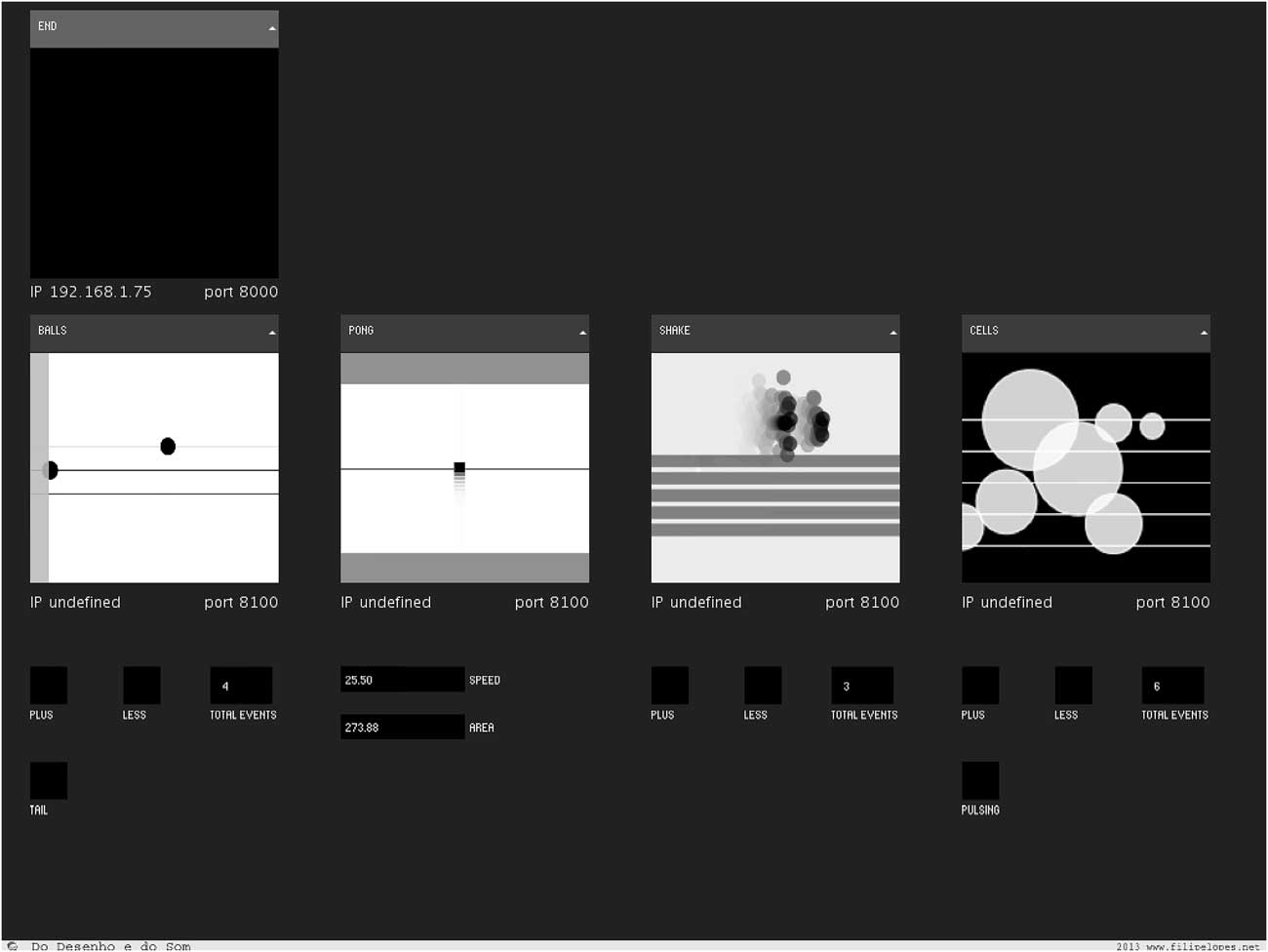
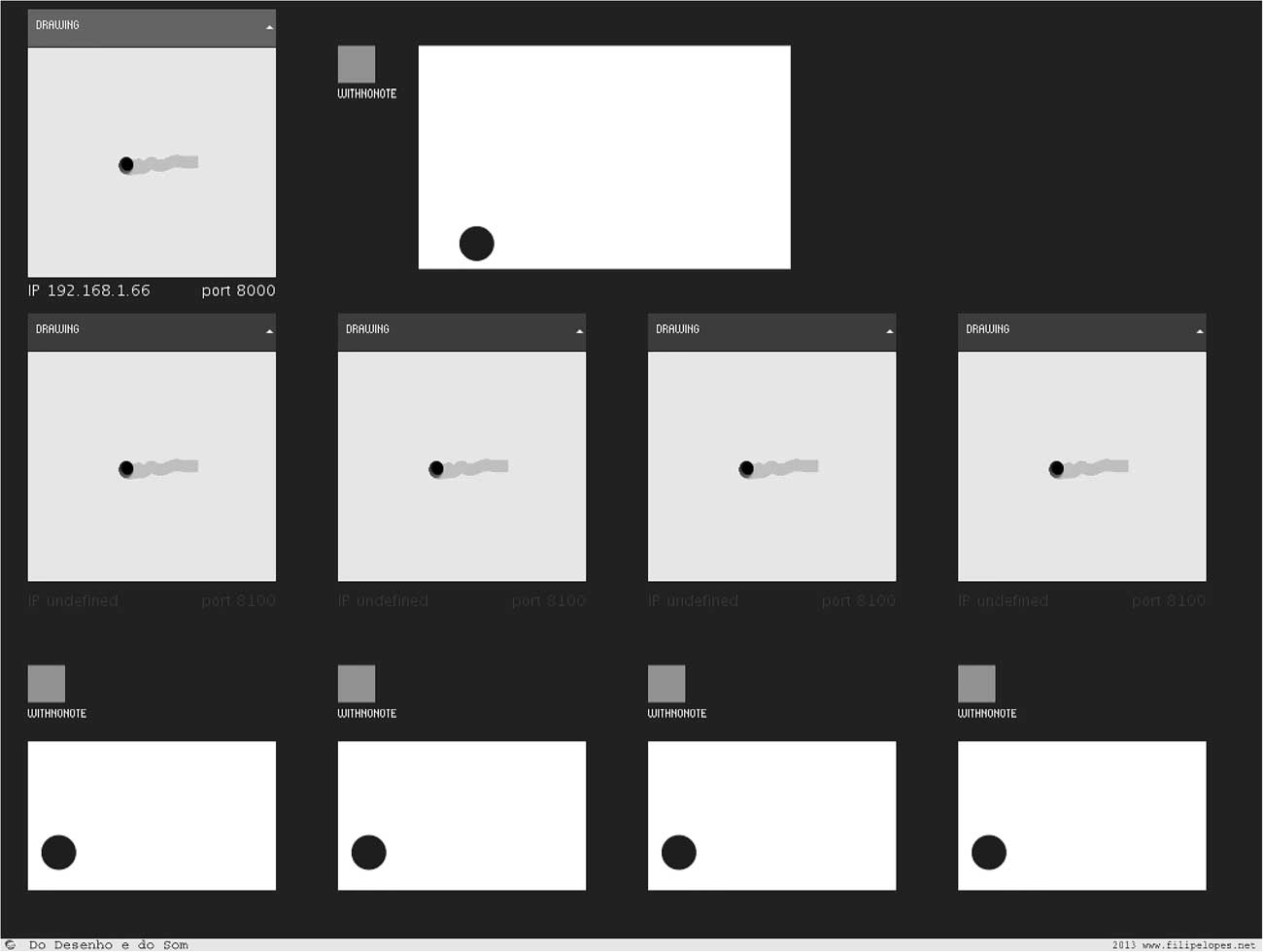
The assistant interface provides the ability to generate individual graphics for each screen score (Figure 3). The role of the assistant is essential because they lead the performance, controlling what is being displayed on the screen scores, and thus the unfolding of music in time. In a perfect situation, the assistant understands the sonic cues provided by the performers and adapts them to the meta-score (a guide to render the live scores, explained in 3.2).
Assistant interface.

3.1.1. Assistant interface
There is a wide range of approaches when it comes to design graphics for real-time screen scores. These include traditional notation, graphical notation or combinations of both. In Do Desenho e do Som, I use eight different animated graphical notations, each of them defined as a panel (explained in 3.3). The assistant can choose any one of the following panels: Pong, Balls, Cells, Shake, Drawing, Solo, Silence and End. They were conceived having in mind a design that would be quick to read and to provoke musical interpretations. I was inspired by musical expressions such as crescendo, accelerando, tremolo, low, high or other such musical expressions. Although these definitions do not appear in writing, nor are they supposed to be mandatorily played as such, they were starting points from which I designed the animations. Furthermore, each panel has attributes that can be changed in real time, allowing space for deviations and variations on the panel itself.
3.1.2. Assistant’s purpose
Composer, assistant and performers influence the real-time composition. Notice that the assistant, however, controls the score’s unfolding, and thus the music. They can choose whether or not to interact with the musical hints given by performers by changing the panels or the attributes of each panel. It puts them in a position of power although not of complete authority, since musicians are allowed freedom in their interpretation. While most of the animations portray simple animated graphics that might evoke a game, the goal of the performance is not something akin to Guitar Hero but a subtle interpretation of nuances (i.e. changing attributes of a panel) and drastic changes (i.e. changing panel).
Most of the music is made in real time, involving sound suggestions between everyone, unfolding in ways that are hard to predict but also according to the assistant’s actions. Based on my experience with Õdaiko (Lopes Reference Lopes2009), I supported the fact that ‘in order to understand and control the musical continuum, we will have to appeal to time-based notions like gestures and not only at the level of the individual musical event’ (Wishart Reference Wishart1996: 18). Of utmost importance is the fact the assistant does not see the real-time graphics that are being produced in any of the screen scores, but only a screenshot of the panel chosen is displayed (Figure 3). This is extremely significant because it puts an emphasis on listening rather than seeing when it comes to making decisions and changes. During a given performance, the assistant has only an expectation of both the animated panel and the corresponding sound interpretation. The music evolves in a process akin to a tendency mask on which the performance behaves stochastically. The ears then assess and it is through them that the interpretation is shaped.
The purpose of the assistant, from my point of view, is to choose and manipulate the panels and their attributes for each screen score, trailing a pre-determined order of panels per score.
3.2. Meta-score
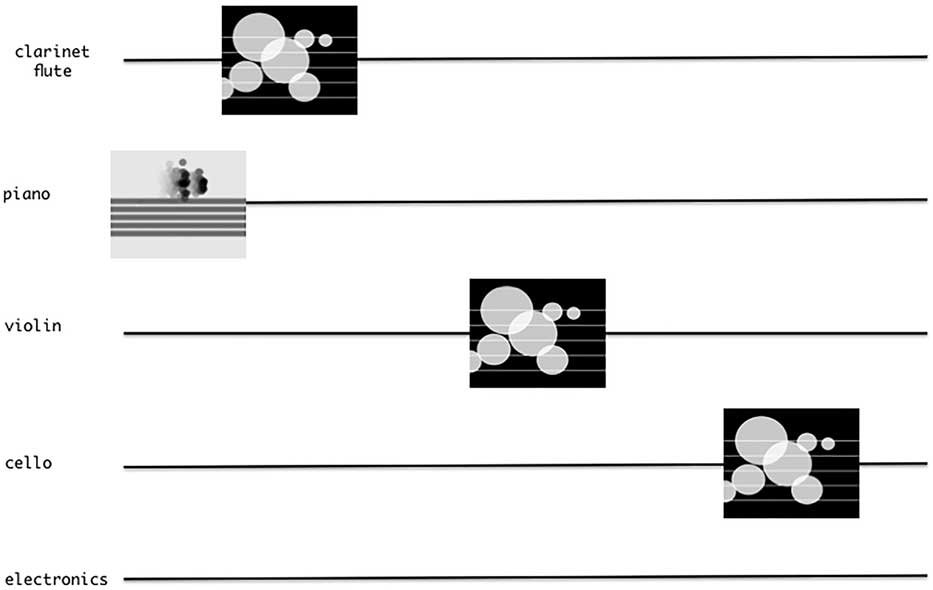
As I see it, musical form is the key aspect of composition and the one that justifies the need to create a meta-score. The meta-score (Figure 4) is a guide for the assistant to control the unfolding of music in time, comparable to a score of scores. Usually it is the materialisation of the impressions gathered by a composer, collected in rehearsals with musicians, which is then organised in time. It has clear delineations pertaining to music development and thus musical form. However, like most of the elements that characterise Do Desenho e do Som, the meta-score needs to be interpreted by listening (e.g. to silence all the performers at the same time in a proper way at a ‘right’ time).
Meta-score example.

In short, a meta-score is organised by sequenced events in time, guided stochastically by the assistant, defining the musical form and its unfolding. It is an important element in the environment as it is the element that holds the music together from beginning to end, defining anchor points and expectations.
3.3. Panels
I will now describe each of the eight panels there are to choose from. The Pong panel has a bouncing square that can be speeded up, slowed down or stopped. Balls displays three parallel horizontal lines and an adjustable number of circles that move along the horizontal lines; the circles accelerate from the moment they appear on the screen until they leave it, from right to left. In Cells, a minimum of one circle emerges and grows until it ‘explodes’ and starts growing again; the number of circles displayed can be increased or decreased and it also can be chosen if the circles are to ‘explode’ or if they increase and decrease their size, in loop. Shake (Figure 5) displays a vertically flickering ball that travels from left to right; the flickering is controlled by a noise function and the assistant is able to choose the number of circles on the screen. When the Drawing panel is chosen, the assistant can see a small white area displayed on his or her screen, mirroring the screen of the corresponding screen score. In that area, the assistant decides whether or not a ball appears. If there is a ball, and the mouse is clicked inside the white area, the ball will follow the mouse and imitate its movement. The ball can disappear if required but it always reappears in the middle of the screen. Solo panel is a simple animation intended to inform the performer to do a free improvisation, free from any indication whatsoever. Silence, as the name suggests, is a black screen intended to assign silence to the performer. End displays a fade to black of whatever is being displayed, intended to signify the end of the performance.
Shake panel.

Assistant interface.

Some of the graphics displayed have a gaming feeling to them. Performers, in their first contact with the software, usually compare it to Guitar Hero. Nevertheless, Do Desenho e do Som, as I see it, is at the opposite end of the spectrum. The scores are not to be interpreted literally but in relation to the present musical context. To understand what is happening musically, one needs to listen and to respond accordingly. Some examples include playing the note that someone else is playing, enhancing or complementing dynamic shifts, imitating rhythms, fading out when someone else is fading in or interacting with the electroacoustic music. The list of ideas is literally immeasurable, so I will not attempt to catalogue them. Enumerating examples as such will always be incipient, since the experience of music is multidimensional in its interpretation and existence. Instead, I am trying to convey a description of an act that is (or should be) natural to musicians and composers, especially those accustomed to improvisation: interaction in a musical context. To a certain extent, when I talk about interpreting a score according to the musical context, I am talking about something of a ‘mental’ tuning within the performers, which is hard to put into words. ‘In performance, musical decision-making is much more immediate than it is in traditional composing. Many snap judgments are made’ (Chadabe Reference Chadabe1997: 300).
3.4. Sync feature
The possibility of controlling all the screen scores at the same time is an important feature in Do Desenho e do Som. This is especially critical if more than one performer is playing since, at any given moment, the assistant is able to display the same panel with the same animation in all the scores (Figure 6).
In practical terms, this translates into a synchronisation of the performers, which compositionally is very important to create identical gestures and to imprint a sense of order into the performance. For instance, following a very busy section of the piece, if the assistant silences everybody at once, the effect is quite dramatic. The same can be said for the opposite action or for having an ensemble play the same rhythm. Musically, synchronisation is very important.
4. EMPHASISING LISTENING
My research about real-time screen-score generation focuses on developing an active notation to induce musical gestures judged aurally. As discussed above, this is not the case with conventional notation because it generally restricts musicians to a concrete set of rules. I am not stating that conventional notation implies that musicians do not have to listen to each other, but rather that the symbols have specific meanings (i.e., a B♭ is a B♭; it cannot be a C). After all, that was one of the goals behind the development of notation: to create a visual protocol to efficiently communicate music. To musicians and composers, notation caused a gradual ‘significance’ shift from the ears to the eyes. What was firstly a common practice, in which music was passed orally from generation to generation, transformed it to become something fixed on paper. The medium stopped being oral to become visual.
How can one create a notation that needs to be seen but advocates an aural understanding? I believe that graphical notation rendered in real time puts an emphasis on it. What interests me is the idea of exerting control, as a composer, but in such ways that musicians are compelled to interpret the visual notation with their ears. I want to urge musicians to interpret the score as an aid (or a means) rather than an end or an absolute truth.
As with any language, notation comprises codes that must be learned. In Do Desenho e do Som, the process of learning the notation is focused on knowing the animations and devising possible sound interpretations for them. The goal is to establish an agreement about what kind of gestures, sounds, pitch, noises and others might be appropriate for the instrumentalist, the instrument and the composition. In the following paragraphs, I will describe my own approach when presenting the software to musicians and the process of meta-composing.
4.1. A possible approach
If anyone wishes to use Do Desenho e do Som, the first task would be to define the amount of contact one allows performers to have with it. Although it seems to be quite an obvious action, the amount of contact with the software might be decisive in the musical outcome. This is because too much contact with the animations might induce musicians to ‘prepare’ interpretations, thus losing the natural improvisational flow they might have.
My own approach is based on three phases: 1) presenting the software to performers in order for them to get to know the panels and their animations; 2) auscultation of the kind of sound interpretation performers output; and 3) devising the flow of the piece. It is my interest to find the performer’s natural output to graphics because ‘Spontaneity is by no means something that “just happens”. It depends to a crucial extent on external and internal conditions, which of course can include a very specific musical framework as in jazz’ (Barret Reference Barret2002).
In my recent experiences, described below, I have exposed the software to musicians, four hours in average (two sessions of two hours). Usually, after the initial contact, I propose some general strategies to imprint a sense of order (e.g. gravitating around note C, starting piano and ending fortissimo, playing sections using clouds of small sounds as opposed to sections playing long notes), which I adapt to the instrument performers are using. It is important to remark that when playing with instruments capable of playing defined pitches, I usually propose some agreements. Similarly to Õdaiko, in which pitch is an element that is left to chance, when I developed the first draft of Do Desenho e do Som, I decided to maintain the indefiniteness about pitch while adding graphical animations suitable as pitch indicators. This is absolutely necessary if one wishes to have structures such as harmonic settings, melodies using groups of specific pitches, broad definitions such as high, medium and low pitches or any other strategy involving formalised pitch ideas. There is a need to clarify symbols to potentiate the performance to its maximum expressivity for the sake of coherence.
The last phase of my composition approach, when using Do Desenho e do Som, is composing the electroacoustic music. It is usually a patch comprising samples and synthesised sounds controlled by a typical interface such as a midi controller or the mouse. The main interest here is that I design them including possibilities to interact in real time with the ensemble (e.g. change frequency of oscillators, control speed of playback, trigger percussive sounds). Although I do not follow a screen score as the musicians do, I have a very clear idea of the meta-score and the type of sounds that the ensemble will produce, which enables me to compose the electroacoustic music settings better and play during the performance. Usually, I tend not to process any sound from the ensemble and instead approach the electroacoustic music as an instrument of its own.
My compositional approach is very much inspired by Varèse. In his words: ‘There is an idea, the basis of an internal structure, expanded and split into different shapes or groups of sound constantly changing in shape, direction, and speed, attracted and repulsed by various forces. The form of the work is the consequence of this interaction’ (1959: 203).
5. ELECTROACOUSTIC COMPOSITION
This software controls and renders graphics in real time. Although composing electroacoustic music is not the end goal, I believe that incorporating electroacoustic music intensifies the creative environment I aim to foster. Furthermore, it seems natural to include electroacoustic music as it envisages novel strategies to enhance interactivity.
Generally speaking, I believe systems using animated graphics might be helpful to generate scores for musicians playing electronic instruments since most of them, both digital and analogue, give access to several parameters besides pitch. Do Desenho e do Som might also be tested to generate electronic music in real time by mapping the score to sound generators in the tradition of early electronic music (e.g. UPIC software, devised by Xenakis). The main advantage here would be to change both the score and synthesis parameters in real time. Finally, the abstract nature of the generated graphical notation also serves the purpose of enabling an integration of instrumental and electroacoustic music by synchronising performers.
As an interactive notation system, Do Desenho e do Som might be used to trigger and explore several approaches to composition. In the following paragraphs I will highlight some key features I consider important when composing electroacoustic music using Do Desenho e do Som. There are three fundamental aspects to my approach: the first concerns performing electroacoustic music in real time, the second relates to the function of electroacoustic music and a third one is about character.
With regard to performing electroacoustic music in real time, I believe it is important to create software that allows the performer to ‘respond’ quickly, enabling him or her to react, interact with the other performers and interpret the meta-score in real time. Although most analogue synthesisers have interfaces that allow such reaction (i.e. keyboards), I would argue that it makes more sense to design and programme a digital instrument. There are several widely known solutions to creating these dedicated digital instruments, such as MaxMSP, Supercollider and Pure Data among others. These programming applications are incredibly flexible and therefore provide the user with endless creative possibilities, granting control over an unlimited number of constraints: most importantly, both the onset and the morphology of the sound. While a computer keyboard and mouse can be used to trigger events and perform alongside an ensemble, there is a variety of hardware that has been developed specifically to support controlling distinct sound parameters, including midi keyboards, pads and knobs. These tools are helpful in that they enhance the performative aspect of the digital electroacoustic instrument, while increasing its control.
Secondly, electroacoustic music can serve as a continuum sound backdrop, either by using drones or counterpoint attacks, against which instruments can interact. This sound backdrop can also help to enhance meta-compositional indications. If, for example, a duo is interpreting Do Desenho e do Som and there is an indication of a crescendo in the meta-score, electroacoustic music can dramatically enrich the desired effect for the listener while leveraging very simple techniques such as spatialisation and loudness.
Lastly, picture using Do Desenho e do Som with two different string quartets who are playing from the same meta-score. Whereas the interpretation of the screen scores would certainly be distinct, conceiving personalised electroacoustic music for each quartet would signify a piece with a stronger conceptual unity.
6. DO DESENHO E DO SOM #SERIES
I have composed three different works using Do Desenho e do Som, all of which were accompanied by live electroacoustic music: Do Desenho e do Som #1, for clarinet and live electronics; Do Desenho e do Som #3, for harp and live electronics; Do Desenho e do Som #4, for ensemble and live electronics (Sound example 1). With the exception of Do Desenho e do Som #3, in all of these performances I was assisted by someone who was generating the scores, as it is very cumbersome to play live electronics and generate scores at the same time. In all the performances, this assistant had a meta-score, which specified the way each screen score should unfold in time.
My aim was to fully explore the software’s potential and to investigate the possibilities of this system. I used a variety of techniques to enhance both the instrumentalists’ spontaneous interpretations of the graphical score, as well as my compositional ideas conveyed by the live electroacoustic music.
The inclusion of strategies to formalise pitch coupled with their corresponding graphical animation has been encouraging. In Do Desenho e do Som #4, I began by constructing harmonic fields that gravitated around the note A, and ended the piece by gravitating around the note D, imitating what could be a dominant–tonic progression. The succession from one harmonic field to the other was introduced after a long pause that appears towards the middle of the performance. As this was the only piece in which I used all four independent scores, I was curious to explore several textures and ways to combine all the players. Interestingly, during the process of rehearsing, composing and performing, there was a sense of gradual detachment from the screen scores. When performers acknowledged that nothing was exact and that the score was based on formalised compositional suggestions, they also become more expressive and creative.
Out of the three works, Do Desenho e do Som #1 has been performed the most. I have performed this piece but it has also been performed by an electroacoustic musician whose style is quite different from mine, yielding a variety of new sounds atypical from the ones I use. The clarinettist has also been experimenting with different clarinets and extended techniques. Each performance feels like a new experience where the performers, led by the composer, collaborate to reach an ‘agreement’ that can be changed completely in the next performance.
Finally, there is a sense of success regarding the balance achieved between random, expected and defined elements. Most importantly, the music that has been produced has quality and fluidity. The piece Do Desenho e do Som #3 was awarded by the European Conference of Promoters of New Music (www.ecpnm.com) at the competition for Live Electronic Music Projects, and the general feedback I have received from musicians and audiences is satisfactory.
7. CONCLUSIONS AND FUTURE WORK
With Do Desenho e do Som, one can perform real-time stochastic music, mediated by real-time screen scores, provoking creative contexts of shared formalised composition. I aimed at 1) bringing back relative notation reading (e.g. neumes), and 2) emphasising listening as a way of interpreting scores and interacting with the composition. The most interesting aspect of this system is that it allows one to have expectations about the music unfolding but not full control, as one would have with traditional paper notation. Furthermore, it is interesting to notice that simple animations interpreted by accomplished musicians can be very effective to create ‘controlled’ music.
The final goal is that, upon a given graphical impulse, the performer’s interpretation will be listened to by the assistant and the rest of the ensemble, but in such a way that it only makes sense in relation to both the electroacoustic music (if present) and what the others interpreters are doing (if there is more than one). If one addresses Do Desenho e do Som in this way, one concludes that the scores are, ultimately, the least important element and, instead, they become a medium to achieve stochastic musical textures driven by listening.
In the future I look forward to developing hardware that will improve the assistant’s performance by abandoning the mouse and developing dedicated hardware. I aim as well at developing simple procedures to add personalised panels to the existing ones, to better suit anyone’s ideas. Lastly, since the text presented here focuses on my personal practice, I am curious to see other composers working with Do Desenho e do Som to hear their compositions and opinions about it.
For updates and downloads, please go to www.filipelopes.net/Software/DesenhoSom.html.
Supplementary Material
To view supplementary material for this article, please visit http://dx.doi.org/10.1017/S1355771814000211