Introduction
Most vegetable and fruit consumers seek top quality products that support their health and well-being (Nuez et al., Reference Nuez, Prohens and Blanca2004). The relationship between biodiversity, dietary diversity and health has been empirically confirmed (Fanzo et al., Reference Fanzo, Holmes, Junega, Musinguzi, Smith, Ekesa and Bergamini2011). Historically, dietary interventions have focused primarily on protein and calories, later on minerals and vitamins, and most recently on functional and healthful properties of foods such as antioxidants. Therefore, the Food and Agriculture Organization of the United Nations (FAO) have promoted a broader assessment of the link between local food products, biodiversity and nutrition (Burlingame and Dernini, Reference Burlingame and Dernini2012). However, efforts to improve alimentary quality have not achieved great success until this last decade for three main reasons (Schuch et al., Reference Schuch, Kanczler, Robertson, Hobson, Tucker, Grierson, Bright and Bird1991; Harlander, Reference Harlander1993; Pitrat, Reference Pitrat2002): (1) breeding policies focused on growers' economic benefit; (2) controlling complex nutritional parameters require time that plant breeders were reluctant to spare; (3) lack of specific information regarding potentially useful quality attributes available in genetically diverse resources such as landraces. However, social values and breeding techniques are changing: consumers demand nutritional benefits in their diet, and researchers are able to add valuable physicochemical and nutritional parameters to fruit and vegetables in a competitive time frame. To achieve this goal, most of the scientific assessments initially focused on quality attributes after prolonged storage or different post-harvest treatments (Hoberg et al., Reference Hoberg, Ulrich, Schulz, Tuvia-Alkali and Fallik2003; Fallik et al., Reference Fallik, Shalom, Alkalai-Tuvia, Larkov, Brandeis and Ravid2005; Hodges and Lester, Reference Hodges and Lester2006; Saftner et al., Reference Saftner, Abbott, Lester and Vinyard2006a), or acted as a complement of a sensory analysis (Lester and Shellie, Reference Lester and Shellie1992; Pardo et al., Reference Pardo, Alvarruiz, Varon and Gomez2000; Lester, Reference Lester2006). To date, only a few studies have assessed diverse germplasm for one or two nutritional attributes (Lester and Eischen, Reference Lester and Eischen1996; Stepansky et al., Reference Stepansky, Kovalski, Schaffer and Perl-Treves1999; Burger et al., Reference Burger, Saar, Katzir, Paris, Yeselson, Levin and Schaffer2002; Burger et al., Reference Burger, Katzir, Tzuri, Portnoy, Saar, Shriber, Perl-Treves and Cohen2003a; Burger et al., Reference Burger, Yeselson, Sa'ar, Paris, Katzir, Tadmor, Schaffer, Lebeda and Paris2004; Burger and Schaffer, Reference Burger and Schaffer2007; Burger et al., Reference Burger, Tadmor, Lewinsohn, Meir, Sa'ar, Katzir, Paris, Schaffer and Pitrat2008; Obando-Ulloa et al., Reference Obando-Ulloa, Eduardo, Monforte and Fernandez-Trujillo2009). Still, direct comparisons of the physicochemical and/or nutritional attributes of traditional landraces and modern commercial hybrids are limited in most fruit and vegetables. These assessments could constitute an invaluable tool to help breeders and growers to locate unexploited germplasm with a high potential to become the source of beneficial compounds necessary to the human diet.
The objective of this study was to evaluate an array of Spanish Inodorus melon landraces that have been traditionally grown in small orchards in Madrid since the last century and have shown to be genetically and morphologically unique, with priceless sensory attributes that are highly appreciated by consumers (Escribano and Lázaro, Reference Escribano and Lázaro2009; Escribano et al., Reference Escribano, Lázaro, Cuevas, Lopez-Sese and Staub2012; Escribano and Lázaro, Reference Escribano and Lázaro2012). The assessment included an extensive panel of physicochemical and nutritional parameters: juiciness, soluble solids content (SSC or °Brix), pH, firmness, total sugars, carotenoids and ascorbic acid (AA) among seventeen landraces and ten commercial reference varieties of Spain. This study will reveal the potential usefulness of these traditional landraces as a valuable source of traits for improving the physicochemical and/or nutritional value of Inodorus melons worldwide.
Materials and methods
Plant material
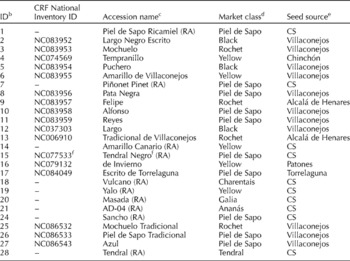
A total of twenty-seven melon accessions were evaluated including seventeen Inodorus landraces, from different locations of the Madrid region, and ten commercial reference varieties, mainly Inodorus and some Cantalupensis types, that have been widely cultivated in Spain, representing different fruit typologies and/or market classes (Table 1).
Description of Spanish melon (Cucumis melo L.) landraces and commercial varietiesa

RA, reference accession; CS, commercial seed.
a Seed collectors and other passport information are available in the Spanish National Inventory of Plant Genetic Resources at http://wwwx.inia.es/webcrf/CRFesp/Paginaprincipal.asp.
b Identification number used in the characterization.
c Local name given by the farmer or commercial name given by the company.
d All market classes studied in this study belong to the group Inodorus, except the Cantalupensis Charentais, Galia and Ananás.
e Villaconejos, Chinchón, Alcalá de Henares, Patones, Torrelaguna are the geographic locations of traditional seeds.
f Accession reclassified in Escribano and Lázaro (Reference Escribano and Lázaro2009).
Cultivation plots
A total of 20 plants per accession were cultivated during three summers at the agronomical station ‘El Encín’ (40°31′ N, 3°17′ W, 610 m above sea level), to study the intra- and inter-varietal differences and the environmental effect. Plant density was 0.5 plots/m2 (2.5 m between rows and 0.8 m between plants). Plastic mulch was used for reducing evaporation and controlling weed emergence. Moreover, plots were also weeded by hand to maintain optimal field conditions. Drip irrigation was applied throughout the plant growth phase. Twenty fruits per accession were harvested considering the specific signals of ripening within each of the melon groups. Following the Code of European Community Regulations (2001), all the harvested melons were adjusted to the quality standards for European grade no. 1 melons (mature, 10 °Brix for Charentais, 8 °Brix for the rest of the melons, firm, well formed and free from defects). Fruits were washed, brushed and stored at 10°C and 85–90% relative humidity from 1 to 5 d before evaluating the Cantalupensis accessions and from 1 to 15 d for the Inodorus ones.
Agroclimatic and soil characterization
According to the agroclimatic classification of Papadakis, the climate of the cultivation site was classified as temperate Mediterranean with winter type and summer type (INIA, 1977). Maximum temperatures varied from 33 to 40°C during the harvest period. Soils were classified as alluvial terrace type, order Alfisol, suborder Xeralf and group Haploxeralf (USDA classification).
Physicochemical and nutritional evaluation
All parameters on melon flesh were studied, always discarding the placental and rind areas. Measurements were conducted in five samples per fruit, twenty fruits per accession.
Firmness was measured in 2 × 2 × 2 cm samples. A compression analysis was performed using the Texture Analyzer TA-TX2, with a 50 mm-diameter cylindrical aluminium piston, and the program Texture Expert version 1.19 Windows (Stable Micro Systems, Surrey, UK). The cylinder speed in compression was 3 mm/s, with 50 g strength, and 30% of the sample was smashed for 2 s. Results are given in Newton (N).
Flesh juiciness (water content) and dry weight (DW) were determined as a percentage of fresh tissue after desiccation (Lester and Hodges, Reference Lester and Hodges2008) of 5 g samples, which was previously frozen ( − 80° C) for 24 h. Juiciness is expressed in g water per 100 g fresh weight (FW) (or g/100 g FW water.
For the following evaluations, each sample of 200 g fresh flesh was previously crushed for 10 min and centrifuged (10 min, 10,000 rpm). Subsequently, the supernatant was filtered (filter 25 mm Ø cellulose acetate). SSC was then measured with a refractometer (Atago, Japan), and pH was quantified with a Beckman-40 pH meter with temperature correction.
Total sugar content was measured by the anthrone-sulphuric acid colorimetric assay as described by Frechilla-Manso (Reference Frechilla-Manso1994), using glucose as the standard, and absorbance was measured at 620 nm with a spectrophotometer (Helios α; Thermo Electron Corporation, Madison, WI, USA). Results are expressed in mg/g DW. Carotenoid content was determined by the Lichtenthaler method (Lichtenthaler, Reference Lichtenthaler1987), by using 80% acetone and 20% distilled water (v/v), and absorbance was measured at 663, 646 and 470 nm. Results are expressed in μg/g FW. AA content was analysed by a second-derivative spectroscopy method (absorbance 267 nm) after mixing the melon juice with 1 M HCl, as detailed by Pfendt et al. (Reference Pfendt, Vukasinovic, Blagojevic and Radojevic2003). Values are reported in mg/100 g FW.
Data analysis
Descriptive statistical analyses were performed to produce an initial assessment of the varieties (mean and standard deviation per trait and variety; average of the 3-year study). The standardized data matrix was previously normalized to achieve analyses that require normal variables: a Box–Cox transformation was applied to juiciness, SSC, pH, carotenoids, AA content and firmness. The normalized data matrix was the input for further analyses using the software XLSTAT (version 2010.3.09, 15.0 Addinsoft©). Analysis of Variance (ANOVA) with a Duncan pos-hoc test was applied to evaluate variety, repetition, environmental effects, and nutritional and physicochemical differences between accessions and classes, as well as Kaiser–Meyer–Olkin (KMO) analysis, Pearson's correlations between nutritional and physicochemical values, and principal component analysis (PCA). In addition, Ward's cluster clustering (with Euclidean distance) was calculated to with Euclidean distance was used to determine homogeneous classes.
Results
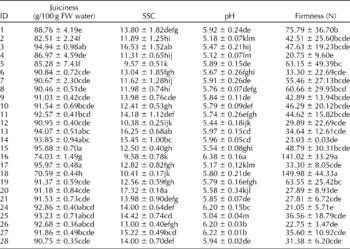
SSC, pH, carotenoid, AA and total sugar contents showed significant differences among the commercial varieties and landraces but not the textural parameters (Table 2). A significant environmental effect was found (P< 0.05) for SSC, pH and firmness. However, no significant variability was found within the accessions in the studied traits (Supplementary Table S1, available online). There was also no repetition effect observed in any of the traits.
Means and standard deviations of physicochemical attributes of melon

FW, fresh weight; SSC, soluble solids content.
Within each column, values with the same letter are not significantly different (ANOVA-Duncan; P= 0.05).
As shown in Table 2, firmness values spanned a range of 130 N between samples. Juiciness values ranged between 70.59 and 95.97 g/100 g FW water. The highest juiciness value was found in Piel de Sapo- and Rochet-type melons. Only one Amarillo-type melon, ‘Amarillo Canario’ ID 14, was included in the ranking of superior juiciness. The maximum SSC was 17.32 °Brix, which was exhibited by the commercial ‘Masada’ ID 20. Landraces ‘Mochuelo’ ID 3 (SSC = 16.53 °Brix) and ‘Melón de Villaconejos’ ID 13 (SSC = 16.25 °Brix) also ranked in the top group for the SSC rate. The maximum total sugar content was found in the landrace ‘Azul’ ID 27, but also high values (>800 mg/g DW) were found in other traditional accessions, ‘Mochuelo Tradicional’ ID 25 and a commercial variety ‘Masada’ ID 20. Minimum sugar levels were also found in some landraces (SSC < 10 °Brix in ID 5 and ID 16; < 300 mg/g DW in ID 16). In general, SSC was significantly greater in modern varieties (P< 0.05), while total sugar content was higher in traditional ones (data not shown).
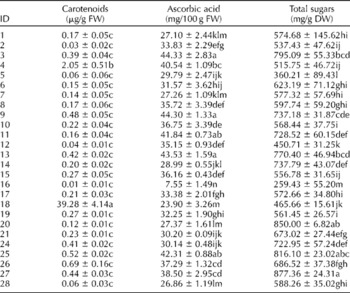
Significant differences among years for AA were found only in accessions ID 11 and ID 16 (data not shown). Likewise, only two accessions, ID 2 and ID 21, showed significant pH differences among years (data not shown). A high number of landraces (IDs 3, 9, 13 and 25) showed outstanding AA contents (Table 3), which were significantly different from the rest of the accessions, ranging from 44.33 to 42.31 mg/100 g FW. In fact, most of the traditional varieties showed remarkably high values of AA in comparison with the commercial reference accessions (IDs 1, 7, 14, 18, 19, 20, 21 24 and 28; ranging from 32.25 to 23.90 mg/100 g FW); in some cases, doubling AA values with respect to their same market class commercial variety were found.
Means and standard deviations of nutritive attributes of melon

FW, fresh weight; DW, dry weight.
Within each column, values with the same letter are not significantly different (ANOVA-Duncan; P= 0.05).
In this study, very low carotenoid content was found, and no significant differences were found among years for any accession. Only the landrace ‘Tempranillo’ ID 4, with orange flesh (Escribano and Lázaro, Reference Escribano and Lázaro2009), showed a significant amount of carotenoids on its flesh (2.05 μg/g FW). The ranking leader was the commercial variety ‘Vulcano’ (ID 18, Cantalupensis group), with a mean value of 39.28 μg/g FW. Although significant differences in carotenoid content were found between landraces and modern varieties, such differences were not significant within the Inodorus group.
Ward's cluster tree divided the landraces into four classes (Supplementary Tables S2 and S3, available online). Of these classes, two (class 3 and class 4) contained only one accession (‘Tempranillo’ and ‘Melón de Invierno’, respectively). Class 1 contained all the landraces from the black market class plus other four landraces with similar physicochemical traits. Class 2 components were strictly Piel de Sapo and Rochet melons. All physicochemical and nutritional parameters differed between the classes (P< 0.001). Juiciness, carotenoids and total sugars were not affected by year, nor were SSC, firmness and pH affected by the interaction class × year. Traits showed by melon class 2 were consistent among years for all parameters, except pH (P< 0.001), and was thus the most stable of all classes.
Nutrititonal traits such as AA and total sugars were highly correlated with physicochemical properties, such as juiciness, SSC, pH and firmness (Table 3).
KMO analysis (0.57) allowed to conduct a PCA. This analysis partitioned the physicochemical attributes and nutritional parameters along three main axes, which explained the 88.29% of the existing variability (Table 4).
Pearson's correlation coefficients and significance among the physicochemical and nutritional parameters evaluated in melon

SSC, soluble solids content.
*Statistically significant at P≤ 0.05.
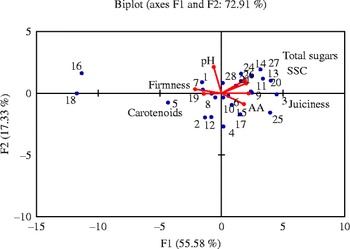
Figure 1 shows the relationships among the parameters studied in relation to the axes. Total sugars and SSC clustered together, being also close to juiciness and AA (Fig. 1). In clear opposition to all these attributes, firmness and carotenoids grouped together. The high importance of juiciness, total sugars, pH and firmness to the axes was remarkable.
Principal component plot of melon accessions, indicating correlations between the physicochemical and nutritional traits.

The PCA was also used to study the relationships among the varieties (Fig. 1; Supplementary Table S4, available online). The accessions ‘Vulcano’ ID 18 and ‘Melón de Invierno’ ID 16 were significantly separated from the others because of their carotenoids and/or firmness. The PCA quadrants represented by SSC, total sugars and juiciness contained the highest number of landraces. The second quadrant, defined by juiciness and AA, enclosed only the traditional accessions. The traditional variety ‘Pata Negra’ ID 8 was placed between the third and fourth quadrants, with the latter being distinct by carotenoids, firmness and pH, which contained the commercial accessions ‘Piel se Sapo Ricamiel’ ID 1, and ‘Piñonet Pinet’ ID 7.
Discussion
The Spanish melon landraces showed herein were located at the top and bottom for pH, AA and total sugar content rankings (Table 2), which demonstrated the enormous potential and extraordinary diversity inherent to this genetic pool, being genetically unique (Escribano and Lázaro, Reference Escribano and Lázaro2012; Escribano et al., Reference Escribano, Lázaro, Cuevas, Lopez-Sese and Staub2012).
Juiciness and firmness are essential attributes for the textural analysis of fruit and vegetables, directly linked to eating quality (Szczesniak and Ilker, Reference Szczesniak and Ilker1988; Lester and Shellie, Reference Lester and Shellie1992; Boulton et al., Reference Boulton, Corrigan and Lill1997; Fallik et al., Reference Fallik, Shalom, Alkalai-Tuvia, Larkov, Brandeis and Ravid2005). Local varieties showed a high diversity in firmness; however, in general, our measurements of firmness (Table 2) were higher than previously reported values for Inodorus commercial melons and Spanish cultivars (Lester and Shellie, Reference Lester and Shellie1992; Pardo et al., Reference Pardo, Alvarruiz, Varon and Gomez2000). The high values of juiciness exhibited by the landraces confirm the invaluable opportunity of eating quality improvement if Rochet melons were included in Spanish markets, as suggested before (Escribano and Lázaro, Reference Escribano and Lázaro2009; Escribano et al., Reference Escribano, Sanchez and Lázaro2010). Their outstanding juiciness, measured herein by objective methods, is exceptionally appreciated by consumers (Escribano and Lázaro, Reference Escribano and Lázaro2012). Moreover, this study has shown that the variability of this trait does not have significant environmental effects, assuring consistent stability, which would be an additional key to success when used in breeding projects. As genetic resources are immediately available to breeders and/or growers, Piel de Sapo and Rochet traditional accessions may increase juiciness in melon fruit, leading to a greater consumer acceptance and, hence, better diets to adults and children.
Researchers, breeders and producers have used SSC for decades to estimate eating quality because of its simplicity (Pardo et al., Reference Pardo, Alvarruiz, Varon and Gomez2000; Hoberg et al., Reference Hoberg, Ulrich, Schulz, Tuvia-Alkali and Fallik2003; Fallik et al., Reference Fallik, Shalom, Alkalai-Tuvia, Larkov, Brandeis and Ravid2005; Burger et al., Reference Burger, Sa'ar, Paris, Lewinsohn, Katzir, Tadmor and Schaffer2006; Lester et al., Reference Lester, Mon and Makus2006; Saftner et al., Reference Saftner, Lester and Abbott2006b). However, it is well known that it is not an accurate approach for measuring sugars: similar SSC values have been obtained for melon varieties with up to 50% difference in total sugar content (Stepansky et al., Reference Stepansky, Kovalski, Schaffer and Perl-Treves1999). The assessment of total sugars provides a more accurate measurement of the main fruit carbohydrates (fructose, glucose and sucrose), which are essential to the diet as a source of energy; 45–65% of the calories need to come from carbohydrates, according to the Dietary Guidelines for Americans (McGuire, Reference McGuire2011). Herein, both parameters were studied. Previous literature has shown that SSC has high environmental effects (Burger et al., Reference Burger, Sa'ar, Paris, Lewinsohn, Katzir, Tadmor and Schaffer2006); on the contrary, herein, significant differences among years for SSC values were found in only three accessions (IDs 13, 16 and 19; data not shown). The maximum SSC values in melon varieties reported to this date were 14.8 °Brix in a Reticulatus fruit selected from more than 400 accessions (Burger et al., Reference Burger, Sa'ar, Paris, Lewinsohn, Katzir, Tadmor and Schaffer2006) and 14.79 °Brix in a Spanish commercial yellow melon (Pardo et al., Reference Pardo, Alvarruiz, Varon and Gomez2000). However, two of the traditional accessions evaluated herein (IDs 3 and 13) scored over 16 °Brix (Table 2). The highest contents of total sugar were found in ‘Azul’ ID 27 (877.36 mg/g DW), ‘Masada’ ID 20 (850.00 mg/g DW) and ‘Mochuelo Tradicional’ ID 25 (816.10 mg/g DW). Reviewing previous studies with landraces, the highest values were found to be 783 mg/g sucrose (‘Arka Jeet’ Inodorus melon; Burger et al., Reference Burger, Sa'ar, Paris, Lewinsohn, Katzir, Tadmor and Schaffer2006) and 847 mg/g DW (Lester, Reference Lester2008) in a honeydew melon that was genetically improved for sugars. Herein, two traditional varieties ‘Mochuelo Tradicional’ and ‘Azul’ (IDs 25 and 27, respectively; Table 2) exceeded 800 mg/g DW, and the mean total sugars in ‘Azul’ surpassed the average sugars observed in the genetically enhanced commercial melon studied by Lester and Hodges (Reference Lester and Hodges2008). These outcomes highlighted the importance of this Spanish traditional array as genetic resources of total sugar content in any breeding programme, as average higher sugar levels have not been previously reported in any melon fruit. Besides, the present study shows that while SSC has a significant environmental effect, total sugar content has not; carbohydrate content is consistent across years. These results confirm that SSC could act a user-friendly fruit sugar indicator, but it cannot accurately reflect the nutritional content of the fruit.
The level of pH is widely used as an indicator of acidity (Kubicki, Reference Kubicki1962; Mallick and Masui, Reference Mallick and Masui1986; Pardo et al., Reference Pardo, Alvarruiz, Varon and Gomez2000; Pitrat et al., Reference Pitrat, Hanelt and Hammer2000; Gajk Wolska et al., Reference Gajc-Wolska, Szwacka and Malepszy2001; Burger et al., Reference Burger, Sa'ar, Paris, Lewinsohn, Katzir, Tadmor and Schaffer2006). Herein, this trait was studied together with AA, which is one of the most relevant and appreciated nutrients in melons (Hodges and Lester, Reference Hodges and Lester2006; Saftner et al., Reference Saftner, Abbott, Lester and Vinyard2006a; Lester and Hodges, Reference Lester and Hodges2008) and also shows a wide variation among varieties (Burger et al., Reference Burger, Sa'ar, Paris, Lewinsohn, Katzir, Tadmor and Schaffer2006).
Compared with previous studies, AA values (from 44.33 to 42.31 mg/100 g FW) of some landraces exceeded all those previously presented worldwide: 35.3 mg/100 g FW in a melon from a different subspecies, agrestis, which is known by its acid fruits (Katzir et al., Reference Katzir, Harel-Beja, Portnoy, Tzuri, Koren, Lev, Bar, Tadmor, Burger, Lewinsohn, Fei, Giovannoni, Schaffer and Pitrat2008); 34.2 mg/100 g FW in a Reticulatus melon (Burger et al., Reference Burger, Sa'ar, Paris, Lewinsohn, Katzir, Tadmor and Schaffer2006); 34.1 mg/100 g FW in a snapmelon (Dhillon et al., Reference Dhillon, Ranjana, Singh, Eduardo, Monforte, Pitrat, Dhillon and Singh2007). The level of pH ranged between 6.38 (‘Melón de Invierno’ ID 16) and 5.04 (‘Mochuelo Tradicional’ ID 25). The highest AA values were observed in the Rochet traditional type (‘Mochuelo’ ID 3 and ‘Felipe’ ID 9; Table 2), which reaffirms the attention that producers and breeders should give to this market class in the near future: their potential for increasing AA content in Inodorus melons is remarkable. Some accessions exhibited low levels of pH and high AA values. However, some other accessions, such as ‘Largo Negro Escrito’ ID 2 and ‘Tempranillo’ ID 4, showed low pH levels and medium AA values, which confirms the hypotheses declared by Burger et al. (Reference Burger, Sa'ar, Paris, Lewinsohn, Katzir, Tadmor and Schaffer2006): low pH does not assure a high AA content, even if it could define the positive or negative tendency with respect to this nutritional parameter. Those varieties studied herein as reference accessions (e.g. IDs 1, 24 and 28), as in previous studies (Pardo et al., Reference Pardo, Alvarruiz, Varon and Gomez2000), indicated similar pH levels, which verifies that the acidity showed by traditional varieties was due to genetic reasons, rather than management practice or environmental factors.
Carotenoids have lately received some interest, as a pivotal component to the human nutrition (Lester and Eischen, Reference Lester and Eischen1996), and its presence in the cantaloupe melon group has been demonstrated (Lester and Eischen, Reference Lester and Eischen1996; Burger et al., Reference Burger, Sa'ar, Paris, Lewinsohn, Katzir, Tadmor and Schaffer2006; Hodges and Lester, Reference Hodges and Lester2006; Saftner et al., Reference Saftner, Abbott, Lester and Vinyard2006a; Lester and Hodges, Reference Lester and Hodges2008). The relationship between carotenoids and the rose-red-orange melon pulp (Burger et al., Reference Burger, Sa'ar, Paris, Lewinsohn, Katzir, Tadmor and Schaffer2006; Burger et al., Reference Burger, Tadmor, Lewinsohn, Meir, Sa'ar, Katzir, Paris, Schaffer and Pitrat2008; Lester and Hodges, Reference Lester and Hodges2008) has avoided its characterization, until now, in Inodorus melons. However, it should be noted that ‘Tempranillo’ ID 4 is an Inodorus accession, with a more attractive morphology to the Spanish consumer in comparison with Cantalupensis melons (Escribano and Lázaro, Reference Escribano and Lázaro2009; Escribano et al., Reference Escribano, Sanchez and Lázaro2010), so its carotenoid content could be considered as an added value to the Inodorus genetic pool and Spanish consumer diet, if reintroduced in the melon market.
Finally, it should be considered that the combination of sugar and acid contents provides a unique and desirable taste for the consumer (Burger et al., Reference Burger, Sa'ar, Paris, Lewinsohn, Katzir, Tadmor and Schaffer2006). As shown herein, the landraces ‘Mochuelo’ ID 25, ‘Melón de Villaconejos’ ID 13 and ‘Mochuelo Tradicional’ ID 25 are high-acid melons, which accumulate high levels of sugars, fulfilling those sensory and physicochemical characteristics that researchers and breeders have spent many years seeking (Stepansky et al., Reference Stepansky, Kovalski, Schaffer and Perl-Treves1999; Burger et al., Reference Burger, Saar, Katzir, Paris, Yeselson, Levin and Schaffer2002; Burger et al., Reference Burger, Sa'ar, Distelfeld, Katzir, Yeselson, Shen and Schaffer2003b; Burger et al., Reference Burger, Sa'ar, Paris, Lewinsohn, Katzir, Tadmor and Schaffer2006), providing, moreover, exceptional levels of AA in melons, essential to the human health. The possibilities of these landraces to be used in improvement projects are innumerable; they should be surely taken into account in the immediate future.
Correlation outcomes could suggest the simultaneous increase in juiciness, total sugars and organic acids in the melon fruit growth, without severely affecting the pH values. As shown herein, it is possible to find melon fruits with differing textures and sweetness, but showing the same pH values. The association between pH and organic acids could be important to breeders who seek to develop fruits with high sugar and acid contents (Burger et al., Reference Burger, Sa'ar, Paris, Lewinsohn, Katzir, Tadmor and Schaffer2006), since, as suggested herein, pH measurement could only be a vague indicator of organic acids, but no other traits are linked to it. The strongest correlation (Table 3) was found between total sugars and SSC (0.915; P≤ 0.05). SSC was positively correlated with AA and negatively to firmness. This relation could confirm the parallel expression of sugars and organic acids, so the increase of one of them could mean the intensification of the other one (Tang et al., Reference Tang, Bie, Wu, Yi and Feng2010). Firmness was negatively associated with all the parameters studied, except pH and carotenoids, confirming the synchronization of melon pulp tenderization and sugar accumulation (Burger et al., Reference Burger, Saar, Katzir, Paris, Yeselson, Levin and Schaffer2002).
Ward's cluster tree divided the landraces into four classes; class 2 contained all Rochet and Piel de Sapo landraces with the highest values of total sugars, SSC, juiciness and AA. This class indicated consistency across three years for these traits, no significant environmental effect and no class × year interaction in most of the parameters. The high stability and heritability of the traits of interest within this sub-array of landraces suggests years of selection by traditional farmers with the objective of maximizing sweetness and juiciness in these accessions. The previous study of genetic diversity developed on this same array (Escribano et al., Reference Escribano, Lázaro, Cuevas, Lopez-Sese and Staub2012) grouped the landraces similarly as presented herein; both studies together could be an essential tool for future breeders interested in developing markers for nutritional improvement.
The PCA's first factorial axe (55.58% of the total variation) was mainly defined by juiciness, SSC, AA, total sugars and firmness. These parameters should be especially useful for future varietal distinction studies. Furthermore, two of these attributes represent nutritional values, which indicated the remarkable nutritive differences among varieties and the importance of selecting the proper material in a genetic improvement programme, which could provide high quality values to the consumer. Surprisingly, juiciness was the most discriminant character, even though this trait has not been previously used for varietal characterization. The second factorial axe (17.33% of the total variation) was mainly contributed by pH. This outcome suggests the importance of measuring pH for varietal identification. The third factorial axe (15.38%) was associated with carotenoids, which is the basis of previously published varietal distinction work (Burger et al., Reference Burger, Sa'ar, Paris, Lewinsohn, Katzir, Tadmor and Schaffer2006).
As shown herein, this PCA could be used by breeders to identify accessions that are defined by the same physicochemical and nutritional parameters. Furthermore, traditional accessions show intense expressions of almost all the main characters referring to quality standards. Thus, the potential of these landraces to be used by breeders and researchers is immeasurable. In this study, the richness of a traditional germplasm with respect to physicochemical and nutritional traits has been shown; more studies of similar traditional arrays are advised with a very high probability of success to provide breeders with the necessary sources to fulfil consumer requirements.
Supplementary material
To view supplementary material for this article, please visit http://dx.doi.org/10.1017/S1479262115000507
Acknowledgements
This study was financially supported by the ERDF (European Regional Development Fund) and INIA (Spanish Institute for Agro Food Research) project RTA2006-00083-00-00.