Advances in surgical techniques and post-operative intensive care have enabled patients with significant congenital heart disease (CHD) to survive into adulthood. Reference Marelli, Mackie, Ionescu-Ittu, Rahme and Pilote1 In particular, the success of the staged Fontan procedure contributed to enhance significantly the life expectancy of children with single-ventricle hearts. As a result, the cohort of adults living with a “Fontan-like” univentricular circulation is currently increasing. Reference Fontan and Baudet2,Reference Walker3 While the Fontan procedure contributes to prolong patient survival, Reference Julsrud, Weigel and Van Son4–Reference d’Udekem, Xu and Galati7 it does not guarantee a “normal” quality of life (QoL). Considering that heart disease has a significant impact on personal, social, family and professional life, Reference Kovacs, Sears and Saidi8 particular attention must be paid to the patient’s perception and satisfaction with his/her life. Reference Marino, Shera and Wernovsky9 Quality of life results from the difference between the expectations of the individual in his/her life and his/her present experience. Health-related QoL (HRQoL) is specifically influenced by factors linked to medical disease, healthcare providers and healthcare systems. Reference Marino, Shera and Wernovsky9 HRQoL can be measured using various instruments, including the SF-36 which is a widely used tool that consists of a 36-item questionnaire. It is available in several languages, adopted worldwide and currently accepted as a gold standard for measurement of the subjective health status (SHS), which is one way to evaluate HRQoL. Reference McHorney, Ware, Lu and Sherbourne10,Reference Leplege, Ecosse, Verdier and Perneger11 Although HRQoL of the overall adult CHD population is good, Reference Rassart, Apers and Kovacs12,Reference Bratt and Moons13 it seems to be lower in adults with operated complex CHD compared to their healthy counterparts. Reference Moons, Van Deyk and De Bleser14 The New York Heart Association (NYHA) classification, the social status, the psychological health or the SHS have been interchangeably used to evaluate HRQoL of patients with a previous Fontan surgery, Reference Moons, Van Deyk and De Bleser14–Reference Holbein, Fogleman and Hommel16 but these approaches may not provide a satisfactory assessment of HRQoL in this population. Reference Smith, Avis and Assmann17,Reference Moons and Luyckx18 An individual appraisal of perceived quality of life (PeQoL) by the patient may provide a more reliable and realistic evaluation of HRQoL than objective parameters. Reference Gill and Feinstein19,Reference Helm, Kempert, Körten, Lesch, Specht and Bauer20 In QoL research, the linear analog scale has robust psychometric properties and had been used in adult CHD surveys Reference Hickey, Barker, McGee and O’Boyle21 to assess PeQoL. The main objective of this study was to assess HRQoL in adults with Fontan circulation using both SF-36 SHS and linear analog scale PeQoL assessment, to compare the results to those of the general French population and to determine whether demographic or medical variables were related to SHS and PeQoL. Reference Holbein, Veldtman and Moons22,Reference Moons and Luyckx23
Material and methods
This was a two-centre study and was approved by each local Medical Ethical Committee. Criteria for inclusion in the study were: age at inclusion in the study ≥18 years; follow-up performed at the University Medical Center Jean Minjoz in Besançon or at the Cardiovascular Hospital Louis Pradel in Lyon (France); any type of Fontan procedure, i.e., total cardiopulmonary connection (TCPC) including any type of superior and inferior connection of the vena cava to the pulmonary arteries (Fontan or Kreuzer operation, or total cavopulmonary anastomosis with intracardiac or extracardiac tunnel), interval from Fontan surgery to study > 6 months and any type of underlying single-ventricle anatomy. Patients with a heart transplant, and/or with learning or language disabilities, which could be an obstacle for the questionnaire comprehension, were excluded.
Subjective health status (SHS) and perceived quality of life (PeQoL)
The SF-36 questionnaire was used to evaluate SHS, and a linear analog scale score for assessment of PeQoL, i.e., personal and individual patient perception of their own QoL. Reference Moons and Luyckx18,Reference Gill and Feinstein19 Patients were invited to participate via telephone or postal mail. The SF-36 was administered by telephone or included along with the invitation letter if sent by post. SF-36 questionnaire on SHS, PeQoL and socio-demographic data were completed after informed consent was obtained.
-
Subjective health status (SHS): the Short-Form 36 questionnaire (SF-36) was used to assess subjective health status because of its recognised psychometric properties Reference McHorney, Ware, Lu and Sherbourne10,Reference Leplege, Ecosse, Verdier and Perneger11 and because normative data of the French general population are available. Reference Leplege, Ecosse, Verdier and Perneger11 The SF-36 questionnaire items are classified into 4 physical (physical functioning, PF: 10 items; role limitations owing to physical functioning, RP: 4 items; bodily pain, BP: 2 items; general health, GH: 5 items) and 4 psychosocial dimensions (vitality, VT: 4 items; social functioning, SF: 2 items; role limitation because of emotional problems, RE: 3 items; mental health, MH: 5 items). Each category scores are coded, summed and transformed on to a scale from 0 to 100.
-
Perceived quality of life (PeQoL): the design of the study was based on Gill and Feinstein’s recommendations for QoL. Reference Gill and Feinstein19 PeQoL was measured using a linear analog scale, ranked from the worst (score 1) to the best imaginable QoL (score 10). In QoL research, the linear analog scale has robust psychometric properties and had been used in adult CHD surveys. Reference Moons, Van Deyk and De Bleser14 Patients were asked to score their PeQoL from 0 to 10, which resulted in an overall PeQoL score, scaled as excellent if scored ≥7.5, good if ≥5 to <7.5, poor if >3 to <5 and bad if ≤3. PeQoL was considered as satisfactory if excellent or good, and unsatisfactory if poor or bad.
PeQoL was also evaluated using the same linear analog scoring (from 0 to 10) applied to the 8 criteria used in the SF-36 questionnaire and 2 additional important criteria for life satisfaction, related to the family relationship, and sport or leisure. The composite PeQoL score (0–100) was then obtained by summing the scores of these 10 criteria.
The patients were asked to specify which criteria were important to them (one or more criteria), and they were allowed to add other domain(s) if they felt that criteria important for their life satisfaction were missing (free text).
Medical, social and demographic data
Data regarding medical follow-up were collected, i.e., underlying cardiac disease, type of ventricle, type and date of surgery, number of cardiac surgeries, non-cardiac medical history, history of arrhythmia or conduction disturbance, presence of cyanosis (defined as pulse oxygen saturation in room air <90%) and NYHA class.
Systemic ventricle systolic function was defined as normal if echocardiographic ejection fraction was >50%, and impaired if ≤50%.
Details about residence, marital and parental status, education level and occupation, as well as the number of medications, the discomfort of taking them, of having blood tests or scaring, were also collected.
Statistical analysis
Statistical analysis was performed using the SPSS-19 software. Data are presented as absolute value and frequency. Continuous variables are expressed as mean ± standard deviation (SD) or median. The SHS scores of the patients were compared to those of the general French and age-matched group population, Reference Fogleman, Apers and Moons24,Reference Eaton, Wang and Menahem25 using a bilateral t-test. Linear regression was used to analyse the correlation, between the overall PeQoL score and the composite PeQoL score as well as between the SF-36 and PeQoL scores for the eight equivalent domains. To determine which medical and socio-demographic variables impacted on subjective health status and quality of life, Kruskal–Wallis test and a trend test were performed as appropriate. A p-value ≤ 0.05 was considered as significant.
Results
Patients
Among the 89 eligible patients who underwent a Fontan-like procedure (33 were females: 37.1% and 56 males: 62.9%), 13 had died, 4 had been transplanted, 1 lived outside of France, 3 were lost to follow-up and 3 were unable to answer because of comprehension disabilities. Of the remaining 65 patients, 60 (92.3%) agreed to participate by answering the SF-36 questionnaire (37 males, 23 females), and 46 (70.8%) also answered the PeQoL questionnaire (25 males, 21 females). The mean ± SD age of this cohort was 26.7 ± 7.4 years, and that of the 19 patients (14 males, 5 females) who did not answer the PeQoL questionnaire was 23.7 ± 5.9 years.
Medical characteristics and demographics
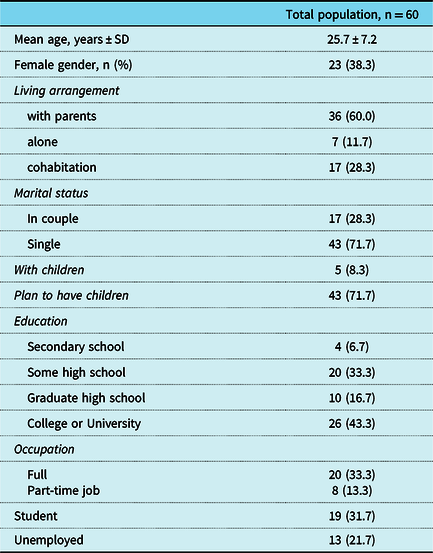
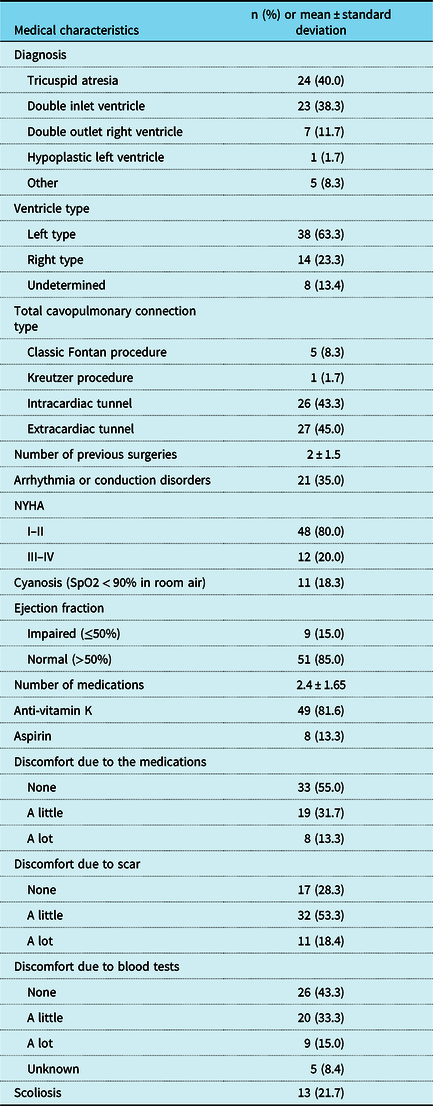
Medical, functional status (NYHA class), social and demographic data for the 60 patients who answered the SF-36 questionnaire are presented in Tables 1 and 2. Mean ± SD age was 25.7 ± 7.2 years at the time of the study (Table 1). Thirty-three patients were aged between 18 and 24, 18 were aged 25 and 34 and 9 were aged 35 and 45. The mean ± SD interval from the last surgery to study inclusion was 15.4 ± 8.5 years. Six patients (10%) underwent surgical revision, a mean ± SD 10.4 ± 5.9 years after the Fontan procedure. The majority of patients were men (61.7%), were single (71.7%), lived with their parents (60%), had a full-time occupation or were a student (65%) and planned to have children (71.7%; Table 1). Underlying cardiac disease was a tricuspid atresia in 24 cases (40%), a double inlet ventricle in 23 (38.3%), a double outlet right ventricle in 7 (11.7%). The systemic ventricle was a left type in 38 patients (63.3%), a right type in 14 (23.3%) and undetermined for the 8 remaining cases (13.4%). Twenty-one patients (35%) experienced arrhythmia or conduction. Twenty-two patients were class I (36.7%), 26 in class II (43.3%), 10 in class III (16.7%) and 2 in class IV (3.3%; Table 2). Echocardiographic systemic ventricle systolic function was normal in 51 patients (85%) and impaired in 9 (15%) (Table 2). Forty-nine patients were taking vitamin K antagonists (81.6%).
Social and demographic characteristics of adult TCPC survivors

SD=standard deviation.
Medical characteristics of adult TCPC survivors (n = 60)

Subjective health status (SHS)
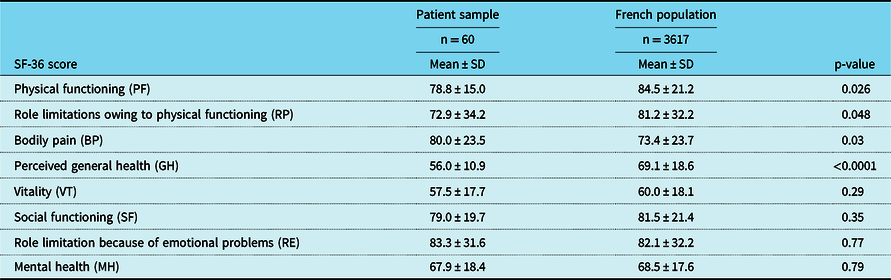
The following results are from the 60 patients who answered the SF-36 questionnaire and are reported in Table 3. The mean ± SD scores of the four physical dimensions were, physical functioning (PF): 78.8 ± 15; role limitations owing to physical functioning (RP): 72.9 ± 34.2; bodily pain (BP): 80 ± 23.5; general health (GH): 56 ± 10.9, and those with the 4 psychosocial dimensions were vitality (VT): 57.5 ± 17.7; social functioning (SF): 79 ± 19.7; role limitation because of emotional problems (RE): 83.3 ± 31.6; mental health (MH): 67.9 ± 18.4.
Subjective health status of adult TCPC survivors and the general French population Reference Eaton, Wang and Menahem25

SD=standard deviation; TCPC=total cavopulmonary connection.
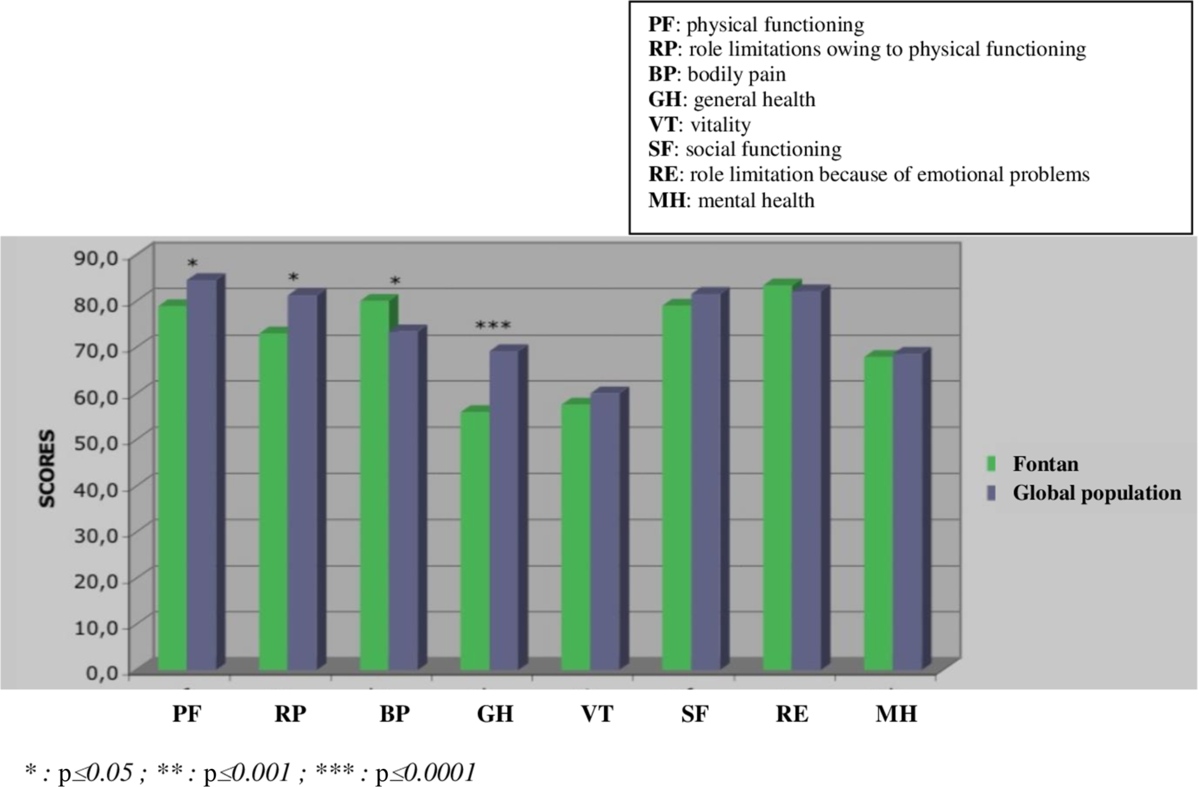
The SF-36 dimensions PF (p = 0.026), RP (p = 0.048) and GH (p < 0.0001) were significantly lower in the study patients than in the general French population, while BP was significantly higher in the study patients (p = 0.03), and the psychosocial scores were not significantly different between groups (Table 3, Fig 1).
Comparison of the study Fontan population and the French population for the eight scores of the SF-36 questionnaire.

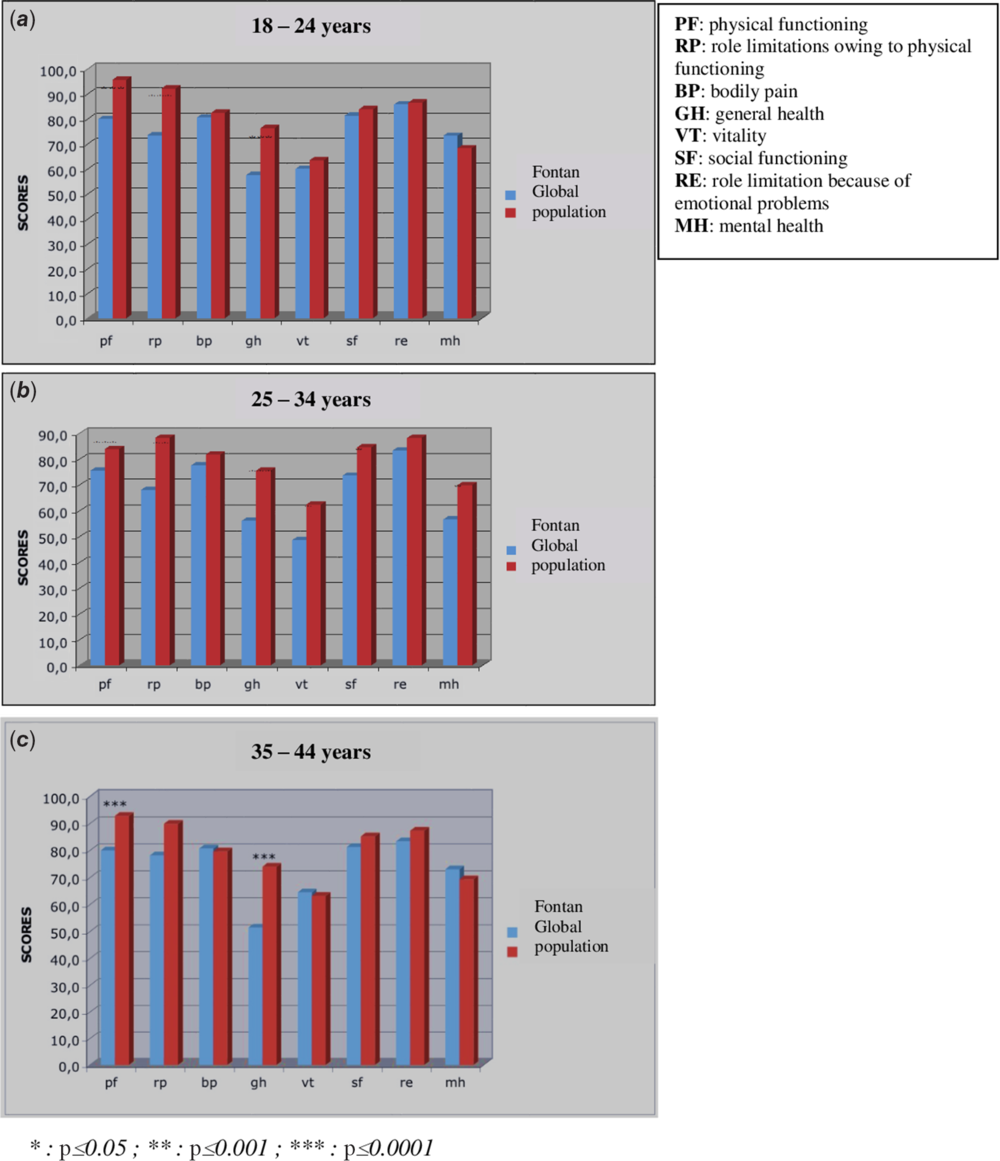
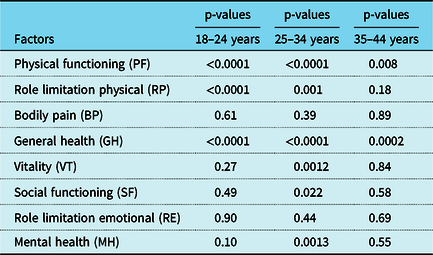
Age-matched comparison (18–24 years, 25–34 years, 35–44 years) found that the SF-36 dimensions PF and GH were lower in patients of all age groups than in the matched group of the general population (Fig 2). Three (VT, SF and MH) among the four psychosocial health status scores, were lower in patients aged 25–34, when compared to the same age group in the general French population (Table 4).
Comparison of the study Fontan population and the French population for the eight scores of the SF-36 questionnaire in the age groups 18–24 years ( a ), 25–34 years ( b ) and 35–44 years ( c ).

Comparison of SF-36 scores to the general French population by age group

The comparison of scores according to the patient medical characteristics found that the highest scores of PF and RP, and the lowest scores of BP were significantly related to the lowest NYHA class (respectively, p = 0.0001, p = 0.0001 and p = 0.03) and the highest level of occupation (respectively, p = 0.025, p = 0.006 and p = 0.04). The lowest MH score was related to the highest number of medications (p = 0.01) and discomfort of taking medications (p = 0.02). The highest vitality score correlated with the lowest NYHA class (p = 0.0001) and full-time occupation (p = 0.02). There was no significant relationship between SHS and the other patient’s variables.
Perceived quality of life (PeQoL)
The following results are from the 46 patients who answered the PeQoL questionnaire (linear analog scale).
A total of 36 patients (78.3%) reported a satisfactory overall PeQoL (excellent, n = 18, or good, n = 18) and 10 (21.7%) reported an unsatisfactory overall PeQoL (poor, n = 8, or bad, n = 2). The mean ± SD overall PeQoL score was 7.02 ± 1.6 and the composite PeQoL score was 65.2 ± 12.4; the overall PeQoL score correlated with the composite PeQoL score (r = 0.82; p ≤ 0.0001).
The mean ± SD score for family relationship was 8.18 ± 1.48, it was 7.58 ± 1.99 for social functioning and 6.62 ± 1.66 for general health; these were considered to be important in their life by, respectively, 63, 50 and 54% of the patients. The mean score for sports and leisure was 4.53 ± 2.13 and this was considered to be important by 20% of patients. The mean ± SD scores for physical functioning was 5.40 ± 1.32, of role limitations owing to physical functioning was 5.93 ± 2.39, of bodily pain was 6.33 ± 1.95, of vitality was 6.80 ± 1.99, of role limitation because of emotional problems was 6.24 ± 2.27 and of mental health was 7.58 ± 2.05, and considered to be important by, respectively, 24, 15, 17, 30, 24 and 24% of the patients. Among the additional aspects considered important, some patients reported social and professional difficulties related to their disability, whereas others pointed out the number of hospital stays as an important issue. One patient considered his cardiac disease to have enhanced his self-image.
The MH and GH scores of PeQoL mildly correlated with the SF-36 score of, respectively, MH and GH (r = 0.57; p ≤ 0.0001). No other significant correlation was found between SHS and linear scale PeQoL.
The score of overall PeQoL was associated with the NYHA classification (p = 0.01). Patients with the highest level of education and having at least achieved high school expressed a better PeQoL than non-graduated patients (p = 0.033). Patients with a full-time occupation reported a better PeQoL than patients unoccupied (p = 0.0018). Patients who suffered from scoliosis report a lower PeQoL than patients without scoliosis (p = 0.011). Other medical variables including the number of interventions, the type of Fontan procedure, time since last surgery or cyanosis, had no significant relationship with PeQoL.
Discussion
This study evaluated health-related quality of life (HRQoL) in adults living with a Fontan-like single-ventricle circulation. HRQoL is a personal perception of one’s own health status and/or of non-medical aspects of life. SHS, measured by instruments such as the SF-36 questionnaire, has commonly been used to evaluate it. Reference McHorney, Ware, Lu and Sherbourne10,Reference Leplege, Ecosse, Verdier and Perneger11 According to Gill et al, Reference Gill and Feinstein19 HRQoL can also be measured by direct linear scale assessment of the patients’ opinions about the different aspects of their life, i.e., perceived quality of life (PeQoL). The present study found only a mild correlation between SHS (SF-36 questionnaire) and PeQoL (evaluated by linear scale). Using the two methods, this study aimed to assess as much as possible the patients’ perception of their own life. A large-scale multicentric study (Approach) has also used perceived health status to assess the quality of life of young adults with CHD and after the Fontan procedure. Reference Rassart, Apers and Kovacs12,Reference Holbein, Fogleman and Hommel16,Reference Holbein, Veldtman and Moons22 Moons and al have highlighted major weaknesses in methodological rigor among QoL studies which might therefore be inconclusive. However, current literature about this topic is increasing. Reference Moons and Luyckx18,Reference Moons and Luyckx23
Our study focused on the Fontan population, i.e., patients with the most complex and severe cardiac anatomy. Moreover, the two-centres design of the study may have contributed to limit variations in QOL related to centre-specific characteristics. Reference Fogleman, Apers and Moons24–Reference Apers, Kovacs and Luyckx26 The population included herein did not differ from that of previous studies investigating adolescent or adult Fontan survivors, Reference Pike, Evangelista, Doering, Koniak-Griffin, Lewis and Child27–Reference Dulfer, Bossers and Utens29 as most of the patients had a left-type single-ventricle with normal systolic function and were in NYHA class I or II. However, the incidence of arrhythmias was lower than previously reported, Reference Pike, Evangelista, Doering, Koniak-Griffin, Lewis and Child27 which may have contributed to some differences as arrhythmias (cause of cardiac failure and/or hospitalisation) probably impact on patients’ perception of their overall QoL.
Patients reported limitations in the physical functioning and the general health dimensions of SHS, whereas the psychosocial aspects were congruent with the general population. These results might suggest that despite physical limitations, the psychological status of our patients was preserved. The findings of the present study differ from the report by Müller et al who showed a fairly good SHS assessed by SF-36 in both the physical and psychosocial dimensions in German patients aged 14 to 52 with total cavo-pulmonary connection intra or extracardiac tunnel. Reference Müller, Christov, Schreiber, Hess and Hager30 Studies have shown that these patients often overestimate their own physical capacity. Reference Lambert, Minich and Newburger31,Reference Gratz, Hess and Hager32 In the present study, physical functioning SHS score was significantly lower than among the general population; this result did not confirm previous report Reference Gratz, Hess and Hager32 and conversely highlighted patients’ awareness of their physical limitations. Exercise deconditioning and self-imposed exercise restrictions may (in part) explain the low physical performance of these patients. Reference Bordin, Padalino and Perentaler28,Reference Müller, Christov, Schreiber, Hess and Hager30,Reference Atz, Travison and McCrindle33 Several studies have shown that exercise might impact positively on perceived QoL. Reference Amedro, Gavotto and Legendre34,Reference Jacobsen, Ginde, Mussatto, Neubauer, Earing and Danduran35 However, one can also argue that patients able to exercise might represent an at-best prognosis sample of this population.
Published reports provide contradictory results regarding the psychological dimension of SF-36. Some highlighted the psychological disturbance among children with CHD, Reference McCrindle, Williams and Mitchell36,Reference Idorn, Jensen and Juul37 while others found no psychological issue. Reference Hickey, Barker, McGee and O’Boyle21,Reference Berghammer, Brink, Rydberg, Dellborg and Ekman38 Van den Bosch et al report a lower mental health in the Fontan population than in the general Dutch population, but only in the 25–34-year-old age group. Reference Gill and Feinstein19,Reference Van den Bosch, Roos-Hesselink, Van Domburg, Bogers, Simoons and Meijboom39,Reference Latal, Helfricht, Fischer, Bauersfeld and Landolt40 This is in accordance with that found herein and might result from several factors. For example, at the onset of adulthood, social and mental impairment may result from physical limitation, restricted leisure time activities and subsequent impaired peer relationships. In addition, the expectation of parenthood can expose patients to an unusual level of anxiety about their future. Reference Kovacs, Sears and Saidi8 Conversely, the improvements observed in the 35–44-year-old age group of the present study, may result from a psychosocial adaptation of way of life values as previously reported. Reference Berghammer, Brink, Rydberg, Dellborg and Ekman38,Reference Moons and Norekvål41 The results of the present study might suggest that the transition between childhood and adulthood probably need careful consideration in order to smoothly progress into full adulthood Reference Kovacs, Sears and Saidi8 and avoid or lessen disturbance in the 25–34 years age group of patients. Reference Kovacs, Sears and Saidi8,Reference Berghammer, Brink, Rydberg, Dellborg and Ekman38,Reference Rozenblum, Gianola and Ionescu-Ittu42
The overall PeQoL of the patients included herein might be considered as satisfying, since the majority of them scored a good or excellent quality of life, which is similar to that reported elsewhere. Reference Reiner, Oberhoffer, Ewert and Müller43 These results were unexpected, assuming that these patients are exposed to an unusual level of uncertainty about their future, their prognosis and the risk that their condition could get worse. This discrepancy might result from the following adaptive mechanisms. First is the disability paradox, in which patients with a serious disability can report a good or even excellent QoL even though external observers would have allocated them with very poor QoL, because some activities may provide self-satisfaction and confidence to the patient who feels grateful and lucky to be alive. Reference Moons and Norekvål41 Second is the sense of coherence, in which Fontan patients adapted positively their way of living to avoid certain types of activities that make them feel weaknesses. In the present study, family relationships, mental health and vitality carry on the highest scores of QoL, which might suggest that patients are able to get the satisfaction in their life despite their own physical limitations.
The NYHA class correlated significantly with the subjective physical health (SF-36) as previously reported. Reference Dulfer, Bossers and Utens29,Reference Rometsch, Greutmann and Latal44 NYHA has been controversially associated with the level of QoL. The lack of correlation between other medical variables such as cyanosis, age or number of the surgeries and SHS or PeQoL has also been reported elsewhere. Reference Rometsch, Greutmann and Latal44–Reference Jackson, Hassen, Gerardo, Vannatta and Daniels46 The present study, however, found scoliosis to be the only medical parameter associated with poor quality of life. This finding seems logical because a significant scoliosis can potentially alter the respiratory capacity and thus the physical performance of the patient, and also negatively influence the patient’s psychological approach to his (her) self-image. Reference Kukreja, Bryant, Cleveland, Dabal, Hingorani and Kirklin15
Lastly, the importance of socio-demographic variables was particularly highlighted in the present study, as patients with full-time occupations and a high level of education reported the best subjective physical health status and quality of life. In accordance with these results, others have observed a significant relationship between depression and unemployment in cyanotic adults with CHD. Reference Kamphuis, Vogels, Ottenkamp, Van Der Wall, Verloove-Vanhorick and Vliegen47,Reference Xiang, Su and Liu48 Kamphuis et al suggest that encouraging education may reduce issues related to unemployment, and an appropriate education and professional counseling are effective ways to adequately adapt employments to physical limitations. Reference Kamphuis, Vogels, Ottenkamp, Van Der Wall, Verloove-Vanhorick and Vliegen47
Of note, the age of the patients included in the study was relatively young. The results showed that the perceived quality of life of Fontan patients was generally good, except in the 25–34 age group. However, the oldest age group in our study was 35–44 years and included only nine patients. Therefore, the study cannot conclude on the quality of life of these patients later in life, as other medical complications can arise and have a negative impact on the patient’s life. In particular, the consequences of abdominal pressure overload and liver deterioration occur in Fontan patients beyond the fifth decade of life. Current literature has highlighted hepatic fibrosis and cirrhosis in Fontan patients and the potential need for liver transplantation. Reference Khairy, Fernandes and Mayer6,Reference Rassart, Apers and Kovacs12,Reference Holbein, Fogleman and Hommel16,Reference Eaton, Wang and Menahem25,Reference Jackson, Hassen, Gerardo, Vannatta and Daniels46 Further studies would be needed to address this issue, i.e., the quality of life of Fontan patients later in life.
Limitations of the study
Although the study represents a large QoL survey of Fontan adults, the number of patients was still limited, as commonly seen in CHD studies. The population was heterogeneous in terms of patient age at the time of surgery. Only survivors, without transplant or intellectual disability, were included. Furthermore, recruitment bias might have affected the results as patients with a single-ventricle heart who underwent a Fontan-like procedure probably represented an “optimistic” subgroup because they had no contraindication for this type of surgery. Therefore, the results cannot be applied to all patients with a single-ventricle heart.
Conclusion
The results of our study showed that most adults with a Fontan-like single-ventricle circulation present with an impaired physical health status, while social and psychological significant limitations exist mostly in the 25–34 years age group. The majority of patients reported a good or excellent perceived QoL, which may lead to conclude that a diminished physical capacity does not result necessarily in a bad QoL. Conversely, education and occupation are crucial issues in QoL. Focus on the transition period from childhood into adulthood should be emphasised in order to improve the psychological status of the 25–34 years age group. This study showed that assessment of QoL using a linear scale score may provide supplemental and relevant information about the patient’s self-perception of his/her own life in the specific population of adults living with a Fontan-like circulation.
Acknowledgements
None.
Financial support
This research received no specific grant from any funding agency, commercial or not-for-profit sectors.
Conflicts of interest
None.