INTRODUCTION
Marine interstitial environments are replete with microscopic detritus feeders, eukaryovores and bacterivores (i.e. meiofauna: eukaryotes between 60 and 2000 µm in length). Kalyptorhynch turbellarians are microscopic predators in this environment that are armed with an eversible, and sometimes bifurcated, proboscis. The proboscis can be equipped with hooks, toxins and mucus that aid in the entrapment of microscopic prey (e.g. harpacticoid copepods). Once prey has been captured from interstitial spaces, kalyptorhynchs convey the meal to the mid-ventral, muscular pharynx (Meixner, Reference Meixner1925; Karling, Reference Karling1961; Martens & Schockaert, Reference Martens and Schockaert1986; Brusca & Brusca, Reference Brusca and Brusca2003; Uyeno & Kier, Reference Uyeno and Kier2010). Kalyptorhynchs are simultaneous hermaphrodites, and the mutual exchange of gametes occurs through genital or through hypodermic impregnation using a stylet apparatus. There is considerable morphological variation in these often spear-like stylet apparatuses (Karling, Reference Karling1983a). Internal fertilization and the evolution of complex male and female structures have likely played a role in speciation in kalyptorhynchs, as they do in many animals (Mayr, Reference Mayr1963). Despite a few detailed studies of these organ systems in kalyptorhynchs (e.g. Schilke, Reference Schilke1970a; Rieger, Reference Rieger, Riser and Morse1974; Schockaert, Reference Schockaert, Riser and Morse1974; Artois & Schockaert, Reference Artois and Schockaert2003, Reference Artois and Schockaert2005a; see also Seth Tyler's literature database at turbellaria.umaine.edu), the diversity and evolutionary history of kalyptorhynchs remains poorly known (Karling, Reference Karling1983a; Rieger, Reference Rieger1998).
The kalyptorhynch proboscis
The anterior proboscis of kalyptorhynchs is a terminal invagination of the epidermis, basement membrane and subepidermal muscle sheath (Rieger, Reference Rieger, Riser and Morse1974). The kalyptorhynch proboscis can take on many different morphologies depending on the species; therefore, the most detailed information on these feeding structures is available in the widely scattered taxonomic literature (e.g. Noldt & Reise, Reference Noldt and Reise1987; Artois & Schockaert, Reference Artois and Schockaert2000; Artois & Schockaert, Reference Artois and Schockaert2003; Willems et al., Reference Willems, Sandberg and Jondelius2007 for eukalyptorhynch kalyptorhynchs; Karling, Reference Karling1961; Schilke, Reference Schilke1970a; Karling, Reference Karling1983a for schizorhynch kalyptorhynchs; see also turbellaria.umaine.edu). However, in general, the schizorhynch proboscis consists of two dorsoventrally opposed tongues, and the proboscis in eukalyptorhynchs is cone-shaped. One schizorhynch species, Typhlorhynchus nanus Karling Reference Karling1981, lacks a proboscis altogether, suggesting that losses of this trait occurred in some lineages of kalyptorhynchs.
The proboscis is everted forcefully from the anterior end of the animal to capture prey. In eukalyptorhynchs, the proboscis is everted using prominent musculature at the base of the proboscis sheath. In schizorhynchs, the proboscis is everted by retracting the rostral wall and generating pressure through the retraction of superficial circumferential body muscles; schizorhynchs lack protractor muscles (Karling, Reference Karling1961; Rieger et al., Reference Rieger, Tyler, Smith, Rieger, Harrison and Bogitsh1991; Uyeno & Kier, Reference Uyeno and Kier2010). Most kalyptorhynchs also have prominent glands at the base of the proboscis that secrete chemicals or mucus that aid in capturing and subduing prey. Other kalyptorhynchs, such as some schizorhynchs and Smithsoniarhynches, possess proboscis tip hooks capable of a range of motions for manipulating prey (Hochberg, Reference Hochberg2004; Uyeno & Kier, Reference Uyeno and Kier2010). Traits associated with the proboscis sometimes have been used to discriminate different species of kalyptorhynchs from one another.
The kalyptorhynch stylet apparatus
Differences between the male stylet apparatuses in kalyptorhynch species are scattered in the taxonomic literature (e.g. Schockaert & Karling, Reference Schockaert and Karling1975; Dean, Reference Dean1977; Karling & Schockaert, Reference Karling and Schockaert1977; Willems et al., Reference Willems, Schockaert and Artois2006b; Timoshkin et al., Reference Timoshkin, Zaytseva and Gutsol2009, for eukalyptorhynchs; Dean, Reference Dean1980; Doe, Reference Doe1974; Karling, Reference Karling1983a for schizorhynchs). There are at least four male stylet types, and in some species more than one type can occur within a single stylet atrium. For example, the polycystidid Triaustrorhynchus armatus Willems et al., Reference Willems, Schockaert and Artois2006b has three stylet types in its male atrium. Stylets may appear singly, or in a V-shape. The context of the stylet relative to the rest of the male copulatory apparatus is sometimes difficult to place in older reports because the stylet was separated from the body using chemicals and then photographed or drawn in isolation. Some species lack a distinct single or double stylet organ, and instead have a male copulatory organ with multiple visible points (Karling, Reference Karling1983a).
Kalyptorhynch systematics
The Kalyptorhynchia is one of two subclades within the Rhabdocoela, which is a diverse, monophyletic group of free-living flatworms whose sister group is uncertain (Cannon, Reference Cannon1986; Littlewood et al., Reference Littlewood, Rohde and Clough1999a, Reference Littlewood, Rohde, Bray and Hernioub; Joffe & Kornakova, Reference Joffe, Kornakova, Littlewood and Bray2001; Littlewood & Olson, Reference Littlewood, Olson, Littlewood and Bray2001; Willems et al., Reference Willems, Wallberg, Jondelius, Littlewood, Backeljau, Schockaert and Artois2006a). There are about 530 described kalyptorhynch species (Van Steenkiste et al., Reference Van Steenkiste, Tessens, Willems, Backeljau, Jondelius and Artois2013) but as is the case for other turbellarians (Artois & Schockaert, Reference Artois and Schockaert2005b), this is likely a vast underestimate of the true diversity of the group. The Kalyptorhynchia contain two subclades: the Schizorhynchia (bifurcated proboscis) and the Eukalyptorhychia (unbranched proboscis) (Cannon, Reference Cannon1986; Willems et al., Reference Willems, Wallberg, Jondelius, Littlewood, Backeljau, Schockaert and Artois2006a). The Schizorhynchia include at least 25 genera in the following four families: Diascorhynchidae Meixner, Reference Meixner1928, Karkinorhynchidae Meixner, Reference Meixner1928, Nematorhynchidae Schilke, Reference Schilke1969 and Schizorhynchidae Graff, Reference Graff1905; the Eukalyptorhynchia include at least 100 genera (47 of which are polycystidids) in twelve families. Molecular phylogenetic analyses of 18S rDNA sequences suggest that a clade comprising Dalytyphloplanida and Mariplanella frisia Ax & Heller, Reference Ax and Heller1970 forms the nearest sister group to the Kalyptorhynchia (Willems et al., Reference Willems, Wallberg, Jondelius, Littlewood, Backeljau, Schockaert and Artois2006a).
Evaluating the species diversity of kalyptorhynchs using DNA sequences is particularly useful because the availability of comparative morphological traits within the group is limited and some of the most conspicuous traits are likely subject to convergence (e.g. traits associated with the proboscis apparatus; Karling, Reference Karling1983a, Reference Karlingb). However, DNA barcoding efforts for understanding meiofaunal species diversity are limited by meagre sampling within kalyptorhynchs, and microturbellarians in general, despite the fact that turbellarians arguably rank third in abundance in meiofaunal samples, after nematodes and harpacticoid copepods (Giere, Reference Giere2009). The diversity of gene regions represented in past studies is also limited, which prevented us from using COI (the common barcoding gene) here. The main goal of this study was to use DNA sequence data to survey the diversity of kalyptorhynch species in marine sand from the eastern Pacific Ocean in order to increase our understanding of the interstitial biodiversity in this region and to help build a more comprehensive phylogenetic framework for the kalyptorhynch flatworms.
MATERIALS AND METHODS
Sampling and microscopy
Sand samples were collected from the western coast of Vancouver Island and the city of Vancouver (Canada) for DNA extraction and light microscopy (LM; Figures 1–6). Fine sand (2 l) was collected from Long Beach near Tofino on the western coast of Vancouver Island (49°03′20.42″N 125°43′40.16′′W) at low tide in a wave-exposed section of the beach in September 2009. Undicola tofinoensis gen. nov., sp. nov. and Rostracilla nuuchahnulthensis gen. nov., sp. nov. were isolated from this sample. Another fine sand sample (2 l) was collected near this site in a less wave-exposed pool in September 2009, and Linguabana tulai gen. nov., sp. nov. and Thinodactylaina tlaoquiahtensis gen. nov., sp. nov. were isolated from this sample. One specimen of T. tlaoquiahtensis sp. nov. was also isolated from a 2 l fine sand sample collected at low tide from Pachena Beach on the western coast of Vancouver Island (48°47.551′N 125°06.974′W) in June 2009. No other kalyptorhynchs were found in these samples.
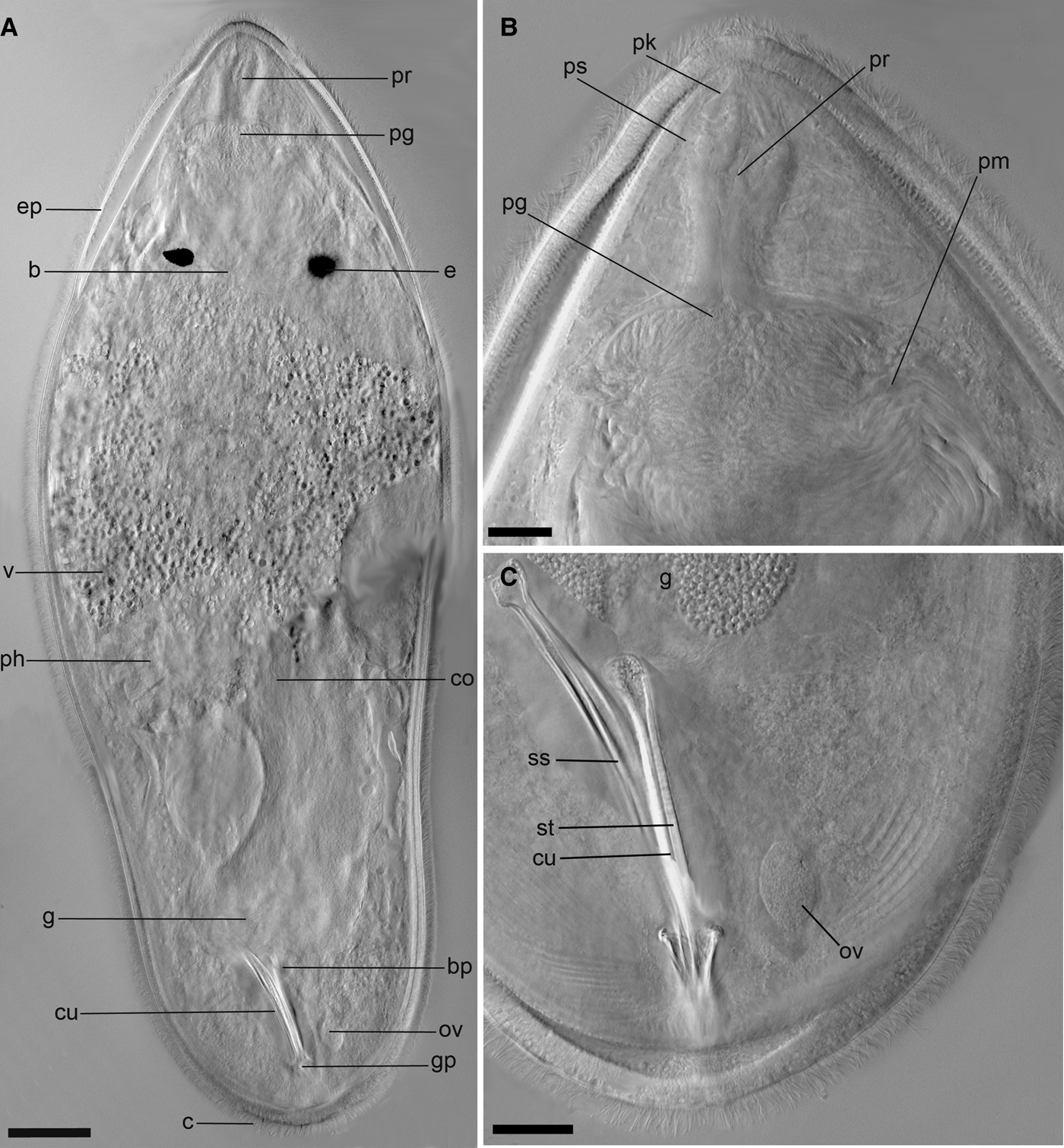
(A–C) Dorsal view of a gluteraldehyde-preserved Gyratrix hermaphroditus specimen (squeeze preparation); (A) full body; (B) head region showing details of proboscis and associated musculature; (C) posterior region showing details of the male and female genitalia, particularly the male cuticular apparatus. Abbreviations: b, brain; bp, bursal pore; c, cilia; co, copulatory organ; cu, male cuticular apparatus; e, eye; ep, epidermis; g, germarium; gp, common gonopore; ov, ovary; pg, proboscis glands; ph, pharynx; pk, proboscis hooks; pm, proboscis muscles; pr, proboscis; ps, proboscis sheath; ss, stylet sheath; st, stylet; v, vitellaria. Scale bars: A, 50 μm; B,C, 20 μm.

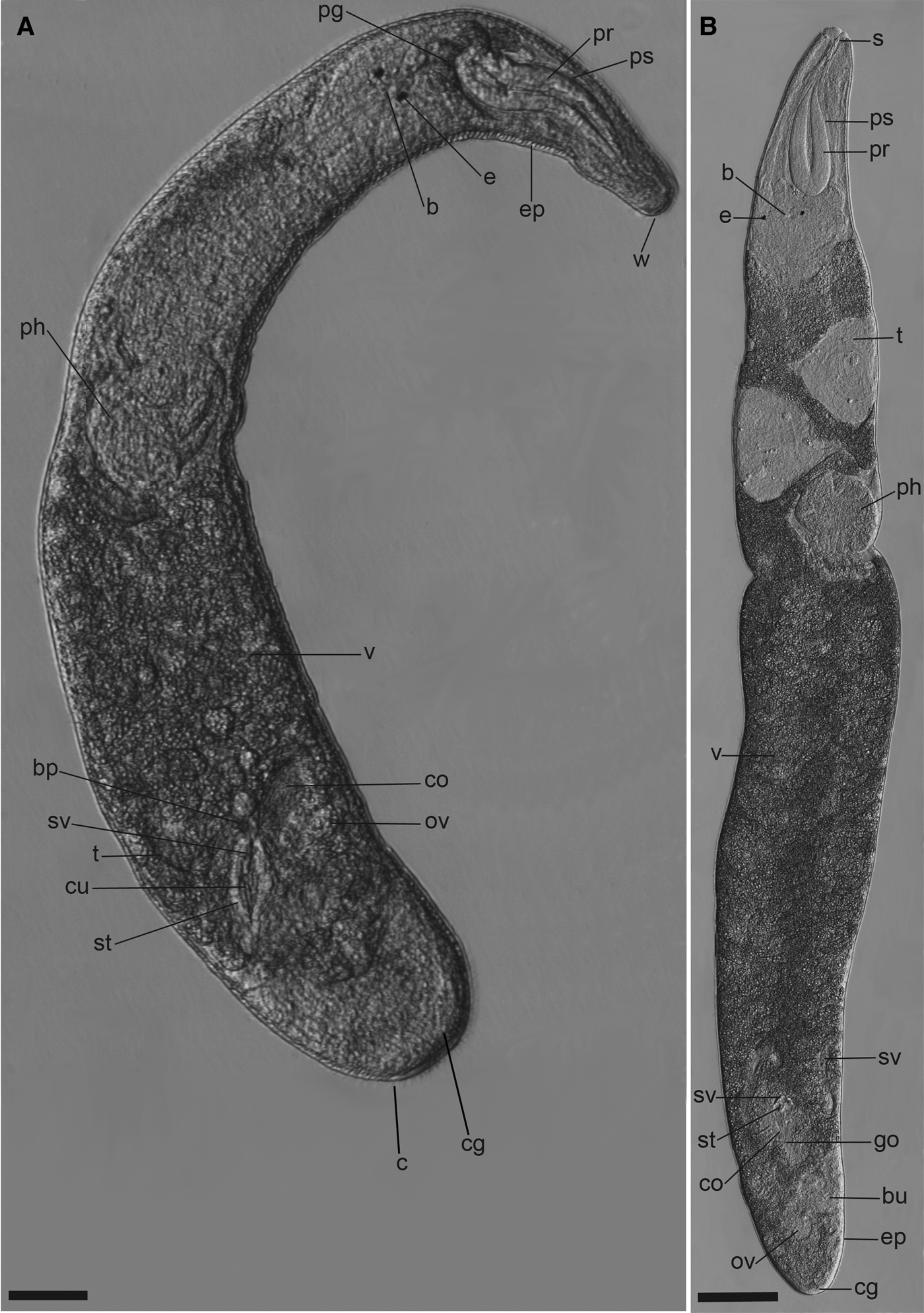
(A) Dorsal view of live anaesthetized Undicola tofinoensis gen. nov., sp. nov. specimen (squeeze preparation); (B) dorsal view of live anaesthetized Linguabana tulai gen. nov., sp. nov. specimen (squeeze preparation). Abbreviations: b, brain; bp, bursal pore; bu, bursa; c, cilia; cg, caudal glands; co, copulatory organ; cu, male cuticular apparatus; e, eye; ep, epidermis; go, genital opening; ov, ovary; pg, proboscis glands; ph, pharynx; pr, proboscis; ps, proboscis sheath; s, sphincter; st, stylet; sv, seminal vesicle; t, testis; v, vitellaria; w, whiskers. Scale bars: A, B, 50 μm.
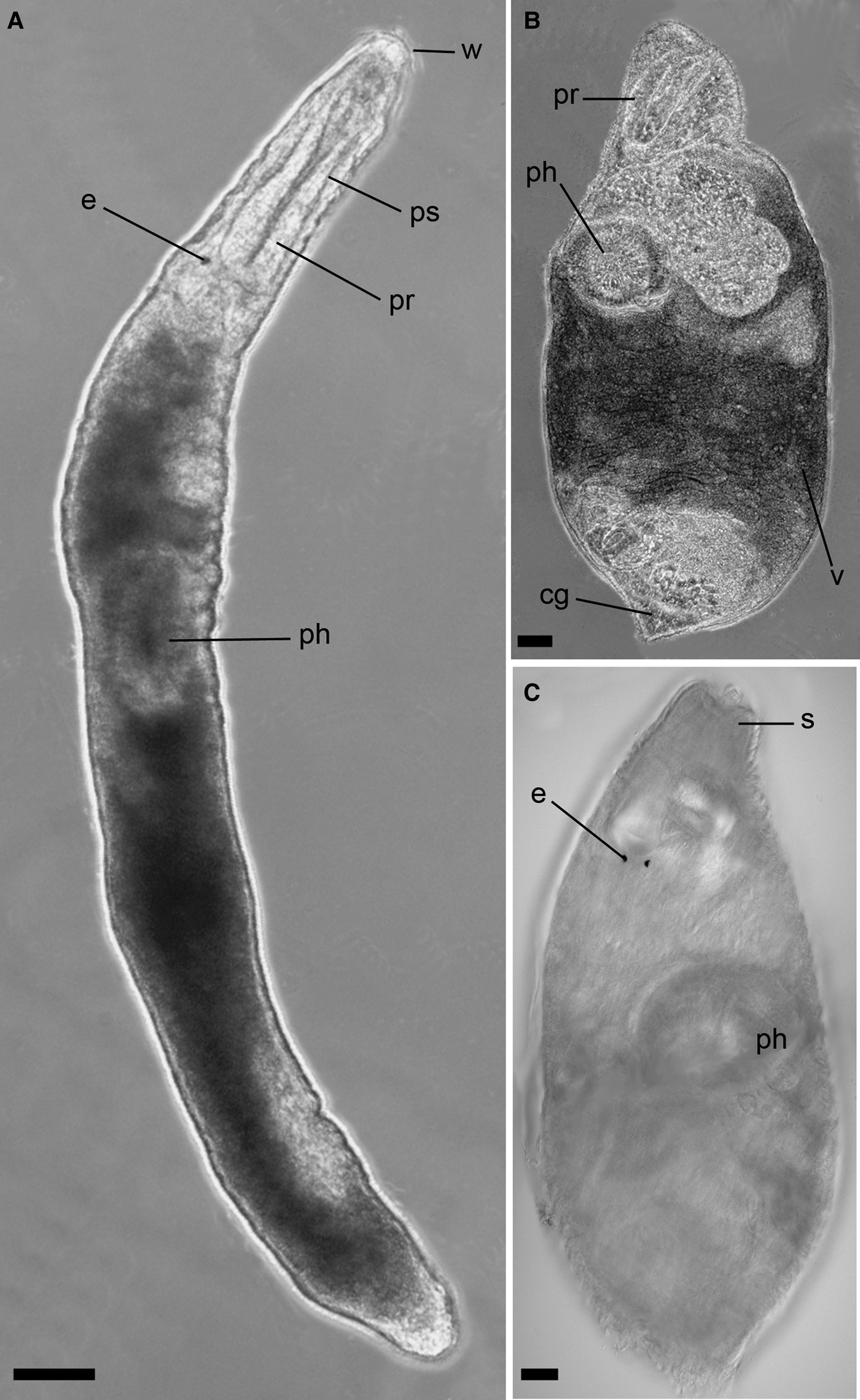
Schizorhinos vancouverensis gen. nov., sp. nov.: (A) dorsal view of fully extended live anaesthetized specimen; (B, C) dorsal views of retracted live anaesthetized specimens. Abbreviations: cg, caudal glands; e, eye; ph, pharynx; pr, proboscis; ps, proboscis sheath; s, sphincter; v, vitellaria; w, whiskers. scale bars: A, 20 µm; B, C, 100 µm;
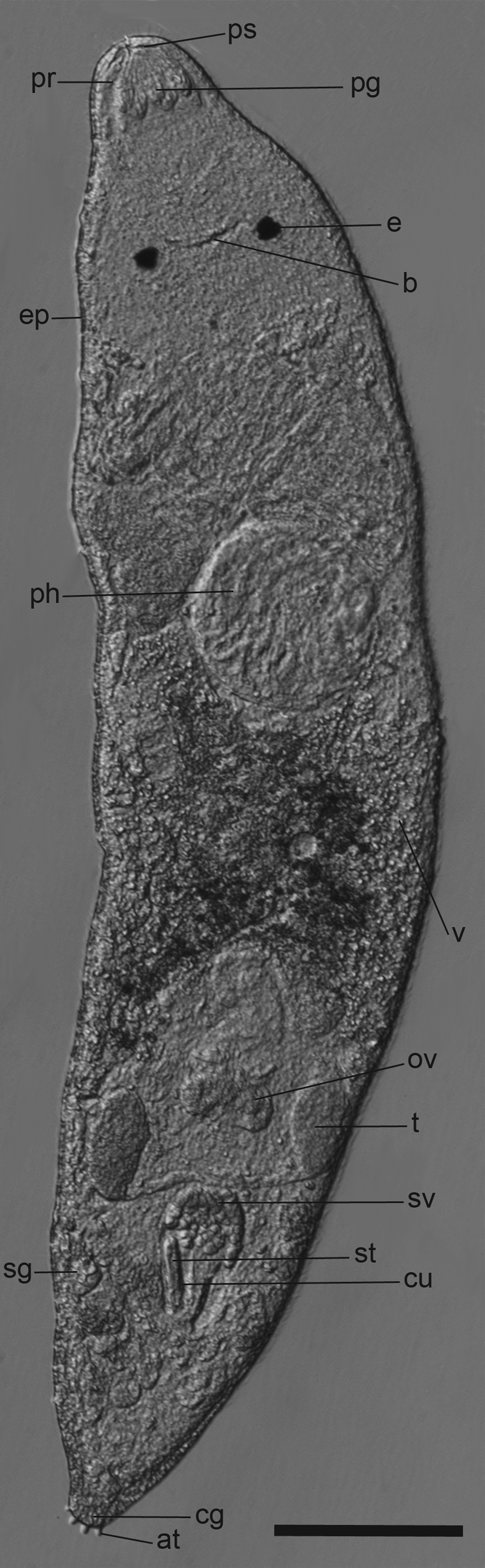
Dorsal view of extended live anaesthetized Thinodactylaina tlaoquiahtensis gen. nov., sp. nov. specimen (squeeze preparation). Abbreviations: at, adhesive toes; b, brain; cg, caudal glands; cu, male cuticular apparatus; e, eye; ep, epidermis; ov, ovary; pg, proboscis glands; ph, pharynx; pr, proboscis; ps, proboscis sheath; sg, shell gland; st, stylet; sv, seminal vesicle; t, testis; v, vitellaria. Scale bar: 50 µm.
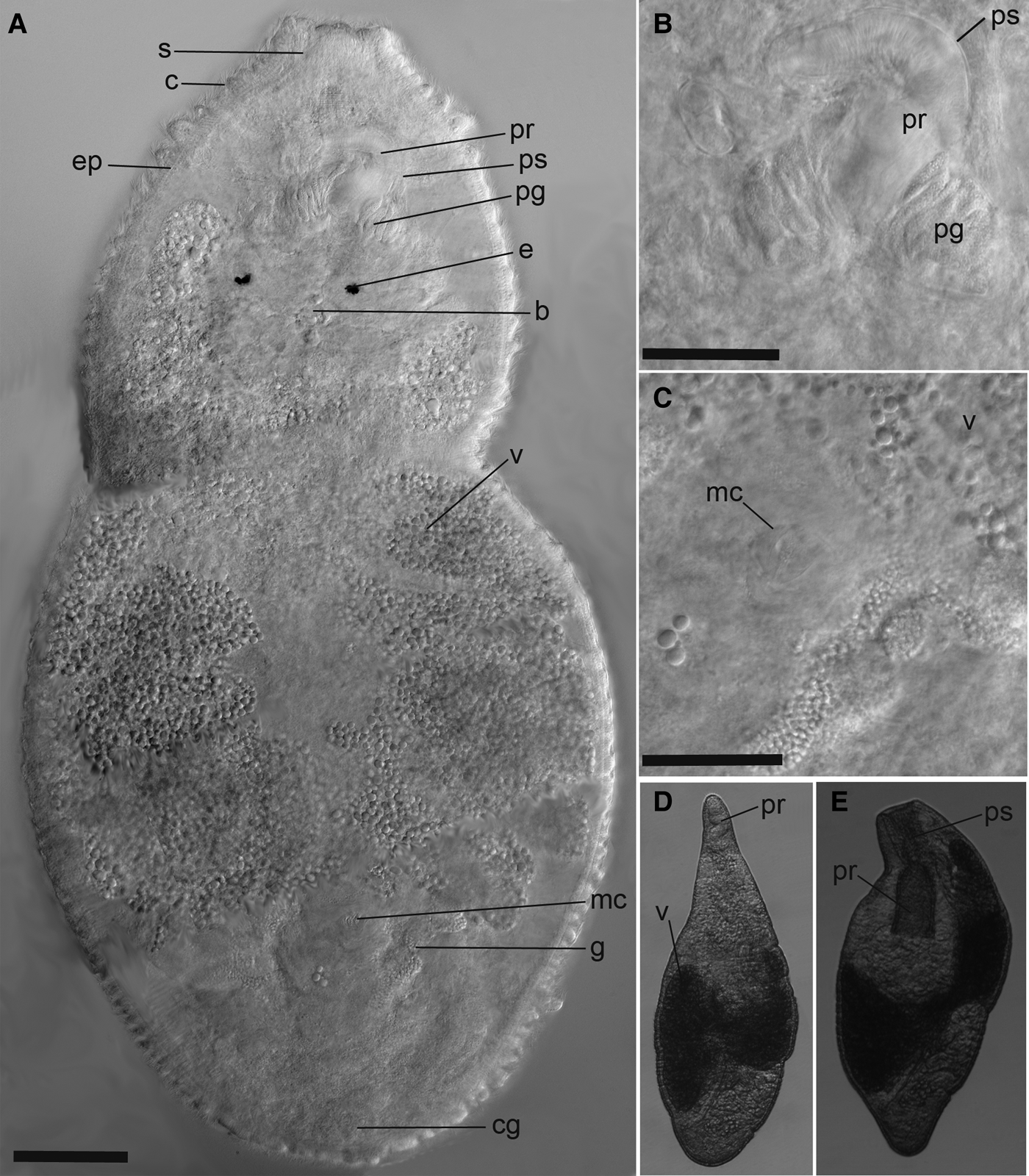
(A–C) Dorsal view of a gluteraldehyde-preserved Rostracilla nuuchahnulthensis gen. nov., sp. nov. specimen (squeeze preparation); (D, E) dorsal view of a live anaesthetized specimen (squeeze preparation); (A) full body; (B) head region, showing details of the proboscis and proboscis glands; (C) posterior region showing the male copulatory organ from (A); (D) proboscis extended in live specimen; (E) proboscis of live specimen retracted into the proboscis sheath. Abbreviations: b, brain; c, cilia; cg, caudal glands; e, eye; ep, epidermis; g, germarium; mc, male copulatory organ; pg, proboscis glands; pr, proboscis; ps, proboscis sheath; s, sphincter; v, vitellaria. Scale bars: A, 50 µm; B, C, 50 µm).
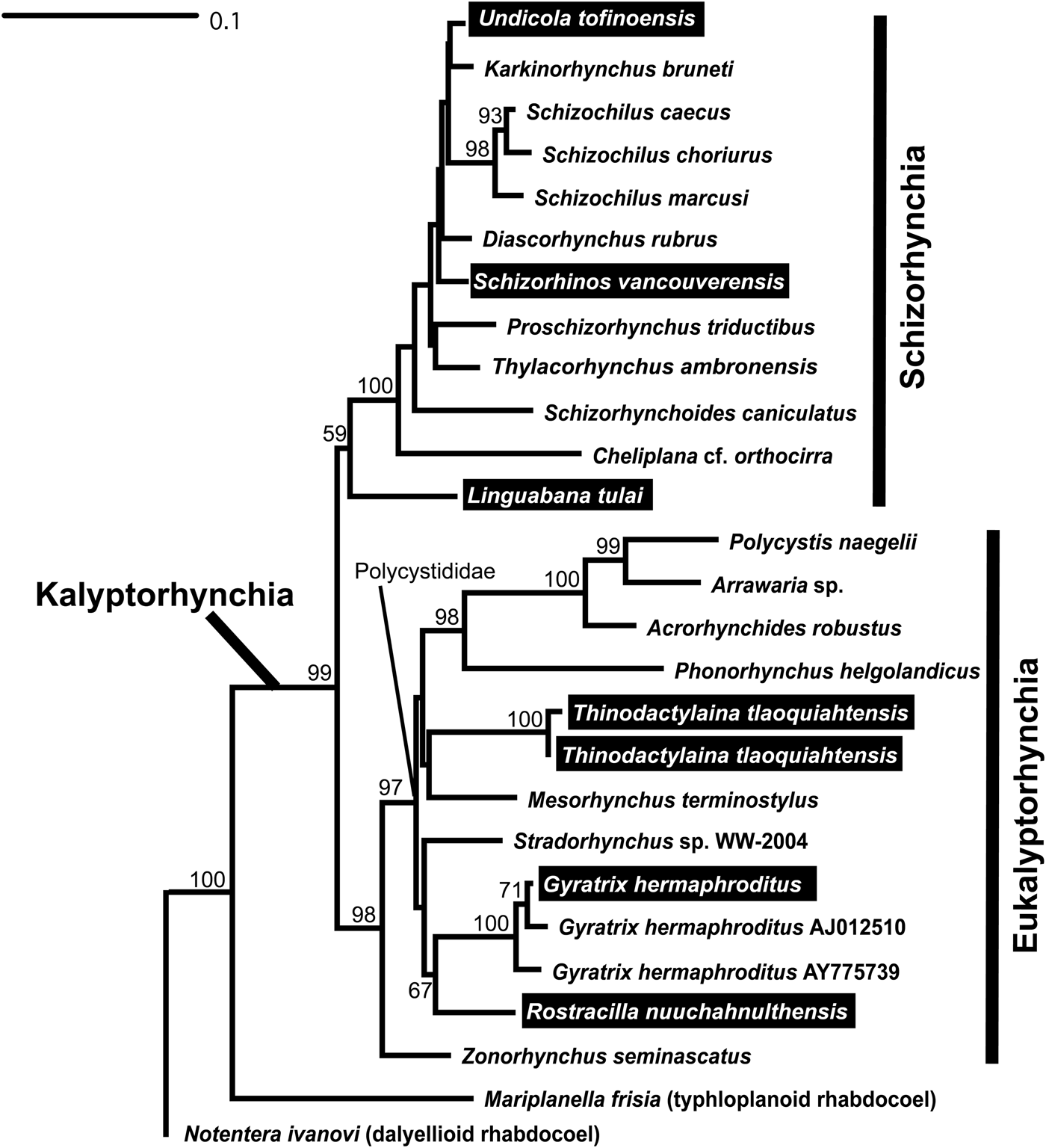
Maximum likelihood tree (GARLI; Zwickl, Reference Zwickl2006, ln L = −10003.42044) inferred from 18S rDNA sequences from 27 species of kalyptorhynchs (1653 sites); the positions of a new isolate of Gyratrix hermaphroditus and five new kalyptorhynch species are outlined in black. Numbers represent bootstrap values greater than 50.
Course sand (6 l) was collected by snorkelling at high tide 3 m from the shore of Stanley Park (Vancouver, 48°17′18.48′′N 123°08′37.78′′W) in August 2009. Schizorhinos vancouverensis gen. nov., sp. nov. was isolated from this sample. Shell hash, mixed with marl and silt (50 l), was collected by dredge at 15–20 m depth near Wizard Islet (48°51.580′N 125°09.659′W), Trevor Channel, Barkley Sound, on the western coast of Vancouver Island in September 2009. Gyratrix hermaphroditus Ehrenberg, Reference Ehrenberg, Hemprich and Ehrenberg1831 isolates (e.g. Figure 1) were collected from these samples.
In all cases, marine sediment was kept in clean plastic containers on ice in a cooler and immediately transported to the laboratory at Bamfield Marine Sciences Centre or the University of British Columbia for sieving on the same day, or one day later. Organisms were sieved through large PVC tubes into a large plastic Petri dish using the Uhlig sea water ice method (Uhlig, Reference Uhlig1964) and 230 µm Nitex plankton mesh.
Individual kalyptorhynchs were captured by a glass pipette under a dissecting microscope and transferred to smaller Petri dishes containing filtered autoclaved seawater. Behaviour was observed under a Leica MZ6 stereomicroscope or a Zeiss stereomicroscope using DIC settings. Live kalyptorhynchs were anaesthetized in isotonic MgCl2 solution and photographed using a squeeze preparation technique to enable observation of internal morphology. It was necessary to photograph kalyptorhynchs through several planes of focus, because their bodies were rounded even under squeeze preparations. According to Cannon (Reference Cannon1986) fixed whole mounts for microturbellaria (in contrast to some macroscopic forms) are not useful, except for visualizing cuticular structures, because fixation can render most morphological features unobservable. Thus, we aimed to photograph live specimens. When necessary, we used fixed specimens preserved at 4°C in a dilute gluteraldehyde and autoclaved filtered seawater solution. Vouchers were deposited in the Beaty Biodiversity Museum Marine Invertebrates Collection (BBMMI).
DNA extraction, PCR and sequencing
Kalyptorhynchs were dissolved in MasterPure kit buffer plus proteinase K solution at 55°C for >24 h and DNA was subsequently extracted according to the kit protocol (MasterPure Complete DNA and RNA Purification Kit, Epicentre Biotechnologies). One individual was used in each extraction. 18S rDNA sequences were amplified using illustra PuReTaq Ready-to-Go PCR beads (GE Healthcare), 22 µl dH20, 1 µl genomic DNA and the primer pairs (1 µl each of 1F-5R; 3F-9R) and PCR protocol described by Giribet et al. (Reference Giribet, Carranza, Baguna, Riutort and Ribera1996). The PCR products were purified with ExoSAP-IT enzyme (USB, Affymetrix, Inc.) and sequenced using Big Dye chemistry (Applied Biosystems) and an ABI 3730 DNA Analyzer. The new 18S rDNA sequences generated here were edited in Sequencher (Gene Codes).
Multiple sequence alignment and molecular phylogenetic analyses
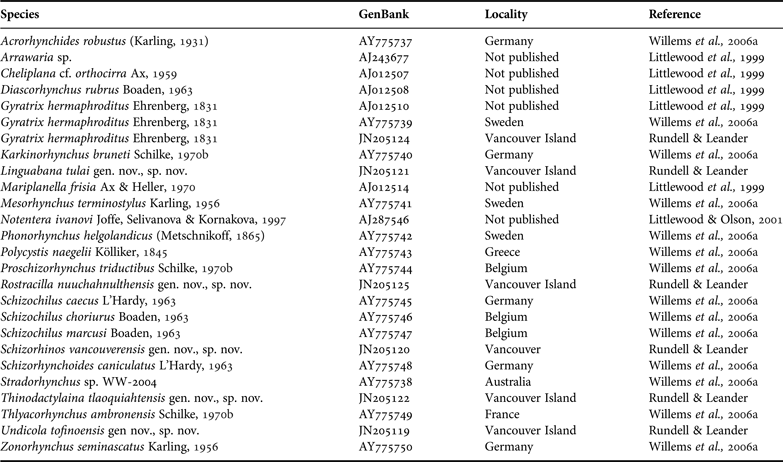
GenBank was used to obtain additional kalyptorhynch samples and non-kalyptorhynch rhabdocoels for molecular phylogenetic analysis. All species included in the analyses and their GenBank Accession numbers are listed in Table 1. Novel sequences were aligned with the GenBank sequences using ClustalX and by eye using MacClade 4 (Maddison & Maddison, Reference Maddison and Maddison2001) (Thompson et al., Reference Thompson, Gibson, Plewniak, Jeanmougin and Higgins1997), resulting in a 27-taxon alignment.
Species included in the analyses and their GenBank Accession numbers.
Maximum likelihood (ML) analyses were conducted using two non-kalyptorhynch rhabdocoels as outgroups (JN205119-JN205122, JN205125), based on previous molecular work demonstrating the monophyly of Kalyptorhynchia (Willems et al., Reference Willems, Wallberg, Jondelius, Littlewood, Backeljau, Schockaert and Artois2006a). jModelTest v.01.1 (Guindon & Gascuel, Reference Guindon and Gascuel2003; Posada, Reference Posada2008) was run using the Akaike information criterion model evaluation approach. The general time-reversible model with gamma distribution and number of invariant sites (GTR + G + I) was the best fit for the data. Ten likelihood replicates and non-parametric bootstrap analyses (100 pseudoreplicates) were performed in GARLI v.0.95 (Zwickl, Reference Zwickl2006) under the GTR (6-rate) model (accepted using this version of GARLI) and using default settings and rate matrix specified by jModelTest output.
RESULTS
Isolation of a previously described species
Five individuals with morphological traits that corresponded with previous descriptions of Gyratrix hermaphoditus were discovered and examined, one of which is shown in Figure 1A–C (BBMMI6491-6495). The stylet of our isolate was 70 µm. The total body length was 680 µm; proboscis length was 50 µm (Table 2). Other available material from these isolates includes four separate genomic DNA samples from each of four individuals (BBMMI6496-6499), one of which is represented in the present study, and an 18S rDNA sequence deposited in GenBank under Accession number JN205124.
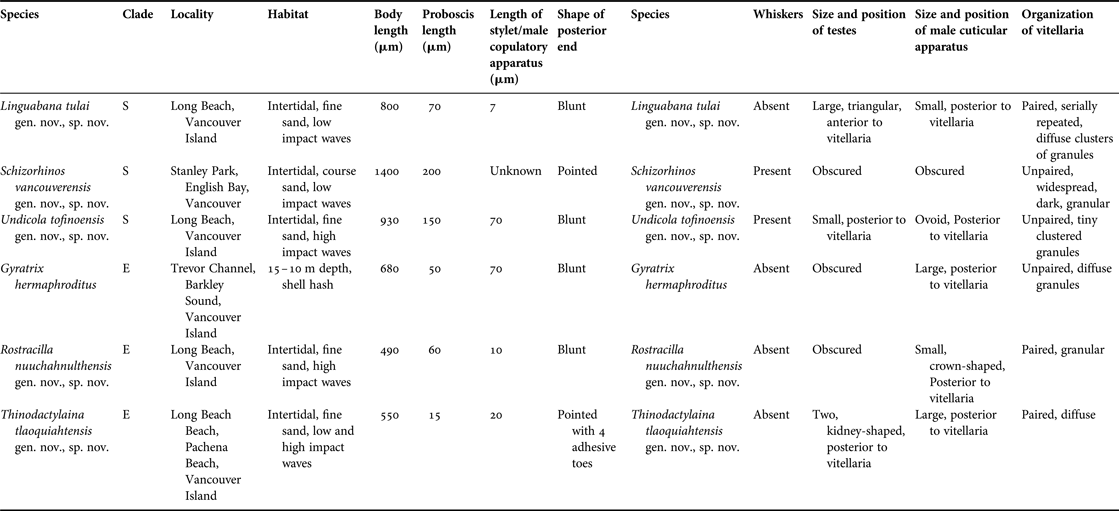
Key features of kalyptorhynch flatworms from the Pacific North-west. Clade E = the Eukalyptorhynchia; Clade S = the Schizorhynchia. All localities are in British Columbia, Canada.
Molecular phylogenetic analyses
Phylogenetic analyses of the 27-taxon alignment resulted in two main clades (Figure 6): the Schizorhynchia and the Eukalyptorhynchia. The 18S rDNA sequences of Undicola tofinoensis sp. nov., Schizorhinos vancouverensis sp. nov. and Linguabana tulai sp. nov. clustered within the Schizorhynchia; this result was congruent with the fact that all three species possessed the unifying feature of the clade, namely a bifurcated proboscis. Linguabana tulai sp. nov. formed the nearest sister lineage to all other members of the Schizorhynchia included in the analysis, albeit with modest statistical support. The Eukalyptorhynchia received robust statistical support (98% bootstrap value) and contained Thinodactylaina tlaoquiahtensis sp. nov. and Rostracilla nuuchahnulthensis sp. nov. along with the Vancouver Island isolate of Gyratrix hermaphroditus.
The relationships within each of the two major clades were poorly resolved. Within the Schizorhynchia, the two karkinorhynchid species Karkinorhynchus bruneti and Cheliplana cf. orthocirra are not monophyletic, nor are the described schizorhynchids Proschizorhynchus triductibus, Thlyacorhynchus ambronensis and Schizorhynchoides caniculatus. The only exception was the clade of Schizochilus species (98% bootstrap value). Within the Eukalyptorhynchia, all of the putative polycystidids formed a well-supported clade that was the nearest sister group to the cicerinid Zonorhynchus seminascatus (97% bootstrap value). The 18S rDNA sequence from the Vancouver Island isolate of G. hermaphroditus clustered strongly with the other two G. hermaphroditus sequences available in GenBank (100% bootstrap value). The G. hermaphroditus clade was most closely related to Rostracilla nuuchahnulthensis sp. nov., albeit with modest statistical support (67% bootstrap value). The two new sequences from Thinodactylaina tlaoquiahtensis sp. nov. formed a distinct clade that branched from the unresolved polycystidid backbone. With the exception of R. nuuchahnulthensis, which is potentially related to G. hermaphroditus, phylogenetic pattern was uninformative for informing generic comparisons or assignments.
SYSTEMATICS
RHABDOCOELA Meixner, Reference Meixner1925
KALYPTORHYNCHIA Graff, Reference Graff1905
EUKALYPTORHYNCHIA Meixner, Reference Meixner1928
Thinodactylaina tlaoquiahtensis gen. nov., sp. nov.
TYPE MATERIAL
A gluteraldehyde-fixed and preserved specimen (holotype, BBMMI6504); specimen in Figure 4A (iconotype); genomic DNA from one individual (BBMMI6505).
TYPE LOCALITY
Long Beach near Tofino on the western coast of Vancouver Island (49°03′20.42′′N 125°43′40.16′′W) at low tide in a small sand pool in a section of beach somewhat less wave-exposed than for that of Schizorhynchus tofinoensis sp. nov. Coll. R.J.R. on 10 September 2009.
OTHER LOCALITY
Specimen from GenBank Accession number JN205123: low tide fine sand sample taken from Pachena Beach on the western coast of Vancouver Island (48°47.551′N 125°06.974′W; near Bamfield, BC). Coll. R.J.R. on 26 June 2009.
ETYMOLOGY
Genus name is from the Greek word thinos (beach, shore) and the feminized version of the Greek daktylos (toe) in reference to the adhesive toes of the type species, which allow the animal to stick to sand grains. This species is named in honour of the First Nations of Tla-o-qui-aht, whose traditional lands extend to the Long Beach area where Thinodactylaina tlaoquiahtensis sp. nov. was found, and who are part of the Nuu-chah-nulth First Nations of the western coast of Vancouver Island. This species helps educate the public in this region about a particular place, its culture, and the unseen biodiversity adapted to living there.
DESCRIPTION
Head is blunt with an indistinct, sheathed, unbranched proboscis without hooks (Figure 4). There are no whiskers. Prominent proboscis glands are clustered into an anterior snout-like region of the head. A curved brain region is clearly visible between two large eyespots. A large round muscular pharynx is present midway down the body. Diffuse paired vitellaria are present on either side of the body below the pharynx. There are two distinct and kidney-shaped testes below the vitellaria, that each have a duct that meets in the male stylet region. The tail is pointed and bears four adhesive toes. Body is mostly brownish in colour. Extended body length is 550 µm and retracted body length is 340 µm. Proboscis length is 15 µm and stylet length is 20 µm.
COMPARISONS WITH OTHER SPECIES
Body length is less than 1/3 of the body length of Polycystis naegelii Kölliker, Reference Kölliker1845. Thinodactylaina sp. nov. can be differentiated from other polycystidids on the basis of its distinctive 18S rDNA sequence. Thinodactylaina tlaoquiahtensis sp. nov. is also distinct from Gyratrix hermaphroditus in that it has a smaller, unarmed proboscis, different stylet morphology, and adhesive toes. Thinodactylaina tlaoquiahtensis sp. nov. is distinct from R. nuuchahnulthensis sp. nov. on the basis of its much smaller proboscis, more anterior position of its proboscis glands, and larger stylet.
DISTRIBUTION AND ECOLOGY
Fine sand, exposed but low-impact sand pools (i.e. deeper pockets of water subjected to irregular influx of new water, but not quite a tide pool) and/or fine sand exposed to waves.
DNA SEQUENCE
An 18S rDNA sequence was deposited in GenBank (JN205122).
Rostracilla nuuchahnulthensis gen. nov., sp. nov.
TYPE MATERIAL
A gluteraldehyde-fixed and preserved specimen (holotype, BBMMI6506; Figure 5A–C); specimen pictured in Figure 5D, E (iconotype); genomic DNA from one individual (BBMMI6507).
TYPE LOCALITY
Long Beach near Tofino on the western coast of Vancouver Island (49°03′20.42′′N 125°43′40.16′′W) at low tide in wave-exposed section of beach. Coll. R.J.R. on 10 September 2009.
ETYMOLOGY
Genus name is from the Latin word rostrum (snout) and the feminized version of the Latin cillo (put in motion) in reference to the prominent and expressive proboscis of the type species. The species is named in honour of the lands of the Nuu-chah-nulth people, a group of fifteen related First Nations of the western coast of Vancouver Island. The Nuu-chah-nulth people were traditionally known for their sophisticated hunting techniques (exemplified by the eversible proboscis of Rostracilla nuuchahnulthensis sp. nov.), which involved the capture of animals such as salmon, halibut, seals and sometimes whales. This species helps educate the public in this region about a particular place, its culture, and the unseen biodiversity adapted to living there.
DESCRIPTION
Head region is distinct and bears a heavily ciliated proboscis sheath opening, posterior to which the proboscis can be curved and substantially retracted (Figure 5A, B, D, E). Large proboscis glands are present at the base of the proboscis, posterior to which are the eyespots. The pharynx is obscured by the paired vitellaria, which appear as a vest of brown granules on either side of the body. The male cuticular region is minute and crown-shaped (Figure 5A, C). The tail region is blunt. Body is mostly brownish in colour. Total body length is 490 µm, proboscis length is 60 µm, and male copulatory organ length is 10 µm.
COMPARISONS WITH OTHER SPECIES
The most distinctive features of R. nuuchahnulthensis sp. nov. are its highly retractable proboscis and its tiny crown-shaped male cuticular region, which was unique among the specimens examined in this study. It can be differentiated from other polycystidids on the basis of its distinctive 18S rDNA sequence. In our phylogenetic analysis (Figure 6), R. nuuchahnulthensis is most closely related to Gyratrix hermaphroditus, the type species for Gyratrix Ehrenberg Reference Ehrenberg, Hemprich and Ehrenberg1831. However, the genital anatomy of R. nuuchahnulthensis differs from this species in clearly lacking a long and prominent stylet.
DISTRIBUTION AND ECOLOGY
Fine sand at wave-exposed site. Only known from type locality.
DNA SEQUENCE
An 18S rDNA sequence was deposited in GenBank (JN205125).
SCHIZORHYNCHIA Meixner, Reference Meixner1928
Family SCHIZORHYNCHIDAE Graff, Reference Graff1905
Undicola tofinoensis gen. nov., sp. nov.
TYPE MATERIAL
Specimen pictured in Figure 2A fixed and preserved in gluteraldehyde (BBMMI6508); genomic DNA from one individual (BBMMI6500).
TYPE LOCALITY
Long Beach near Tofino on the western coast of Vancouver Island (49°03′20.42′′N 125°43′40.16′′W) at low tide in wave-exposed section of beach. Coll. R.J.R. on 10 September 2009.
ETYMOLOGY
Genus name is from the Latin word undicola (one that lives in waves), in reference to the type species' habitat in a wave-swept section of beach. The species name comes from the town nearest the species' locality, an exposed wave and wind-swept spot on the western coast of Vancouver Island, a region popular with surfers. Tofino was named in honour of cartographer Admiral Vicente Tofiño.
DESCRIPTION
Head region is elongate with a sheathed bifurcated proboscis without hooks (Figure 2A). Whiskers (elongate cilia) are present at the anterior tip of the head. Posterior to the proboscis there are two prominent eye spots. There is a prominent muscular pharynx approximately halfway down the body. Posterior to the pharynx is the vitellarium, which appears as hundreds of tiny, sometimes clustered, granules. The ovoid region of the stylet apparatus is the most prominent feature of the tail region. There is a single ovary. The body terminates in a blunt, heavily ciliated tail. Body is mostly brownish in colour. Total body length is 930 µm, proboscis length is 150 µm, and stylet length is 70 µm.
COMPARISONS WITH OTHER SPECIES
This species is distinguished from the other Long Beach, Vancouver Island schizorhynch described here (Linguabana tulai sp. nov.) based on its longer body, its longer proboscis (which is twice as long as that of L. tulai sp. nov.) and its enormous stylet, which is ten times longer than the stylet of L. tulai sp. nov. Undicola tofinoensis sp. nov. has much smaller and less distinct testes than L. tulai sp. nov. Undicola tofinoensis sp. nov. has a shorter body length and proboscis length than Schizorhinos vancouverensis sp. nov., the species from English Bay (Vancouver), and has a 18S DNA sequence distinct from both of the schizorhynch species described here. Undicola tofinoensis sp. nov. has a shorter body length than most of the other schizorhynch species in Figure 6, and also lacks proboscis hooks, unlike Karkinorhynchus bruneti Schilke, Reference Schilke1970b. The placement of the testes in Schizorhynchus tofinoensis sp. nov. is also different from that of K. bruneti, whose testes are near the mid-body pharynx (Schilke, Reference Schilke1970b).
DISTRIBUTION AND ECOLOGY
Fine sand at wave-exposed site. Species is only known from type locality.
DNA SEQUENCE
An 18S rDNA sequence was deposited in GenBank (JN205119).
Linguabana tulai gen. nov., sp. nov.
TYPE MATERIAL
Specimen pictured in Figure 2B. Genomic DNA from two specimens (i.e. two separate extractions (BBMMI6509–6510), one of which we used here).
TYPE LOCALITY
Long Beach near Tofino on the western coast of Vancouver Island (49°03′20.42′′N. 125°43′40.16′′W) at low tide in a small sand pool in a section of beach somewhat less wave-exposed than for that of Undicola tofinoensis sp. nov. Coll. by R.J.R. on 10 September 2009.
ETYMOLOGY
Genus name is from the Latin word lingua (tongue) and the Anglo-Saxon bana (slayer, that which hurts or destroys) in reference to the type species' two-tongued proboscis that is used to capture microscopic prey. The new species is dedicated to the Tula Foundation, which generously funded the work herein and has championed the basic discovery and exploration pursuits of the Centre for Microbial Diversity and Evolution at the University of British Columbia.
DESCRIPTION
Head region is elongate with a sheathed bifurcated proboscis without hooks (Figure 2B). There are no whiskers. Posterior to the proboscis there are two prominent eye spots. Posterior to the head region are two large, light-coloured, triangular-shaped testes, which are slightly larger than the round muscular pharynx, which is just posterior to the second testis. Posterior to the pharynx is an elongate region of vitellaria, which appear as serially-repeated diffuse clusters of granules on either side of the body. The small stylet region is posterior to the vitellaria. The single ovary is close to the end of the tail. The tail is slightly rounded. Body is mostly brownish in colour. Total body length is 800 µm, proboscis length is 70 µm, and stylet length is 7 µm.
COMPARISONS WITH OTHER SPECIES
Differences between this species and U. tofinoensis sp. nov. are described above. The most remarkable features of this species are its anteriorly positioned large triangular testes. The position of the testes is similar to that of Karkinorhynchus bruneti, however the shape and size are different. The long, pronounced serial repetition of granular vitellaria was also unique among Vancouver Island kalyptorhynchs, which made this species a striking schizorhynch. Its 18S rDNA sequences also distinguishes it from all other kalyptorhynchs discussed here (Figure 6)
DISTRIBUTION AND ECOLOGY
Fine sand, exposed but low-impact sand pools (deeper pockets of water subjected to irregular influx of new water, but not quite a tide pool). Only known from type locality.
DNA SEQUENCE
An 18S rDNA sequence was deposited in GenBank (JN205121).
Schizorhinos vancouverensis gen. nov., sp. nov.
TYPE MATERIAL
A gluteraldehyde and osmium tetroxide-fixed specimen preserved in 70% ethanol, catalogue number BBMMI6501 (holotype); three specimens pictured in Figure 3A–C (iconotypes); genomic DNA from two specimens (i.e. two separate extractions (BBMMI6502–6503), one of which we used here).
TYPE LOCALITY
High tide 3 m from shore at the beach near Stanley Park on English Bay (Vancouver; 48°17′18.48′′N 123°08′37.78′′W). Coll. by R.J.R. on 19 August 2009.
ETYMOLOGY
Genus name is from the Greek word schizo (cleave, split) and the feminine Greek rhinos (snout) in reference to the split proboscis characteristic of the Schizorhynchia. The species is named for the type locality, which is in the city of Vancouver (named for Captain George Vancouver, who explored the city's Burrard inlet in 1792).
DESCRIPTION
Head region is elongate with a very long sheathed bifurcated proboscis without hooks (Figure 3A, B). Whiskers (elongate cilia) are present at the anterior tip of the head. Posterior to the proboscis there are two prominent eyespots. There is a prominent muscular pharynx approximately halfway down the body. Posterior to the pharynx is the vitellarium, which is a dark, granular area that obscures most of the other reproductive organs. The body terminates in a slightly pointed tail that includes prominent caudal glands. Body is mostly brownish in colour. Extended body length is 1400 µm and retracted body length is 1200 µm. Proboscis length is 200 µm.
COMPARISONS WITH OTHER SPECIES
This species' locality is distinct from the other kalyptorhynchs described here; this species was never found on Long Beach (Vancouver Island). Perhaps this species prefers the slightly lower salinities present in English Bay. Schizorhinos vancouverensis sp. nov. has the longest proboscis of any kalyptorhynch currently known from the Vancouver or Vancouver Island area (this study). It is also clearly distinct from other kalyptorhynchs based on its 18S rDNA sequence.
DISTRIBUTION AND ECOLOGY
Course sand, exposed to waves but low wave activity. Only known from type locality.
DNA SEQUENCE
An 18S rDNA sequence was deposited in GenBank (JN205120).
DISCUSSION
Comparative morphology of the new isolates and other North American species
We erected new binomials for the five new species described here because they do not conform to existing genera in the literature (starting with Seth Tyler's database: turbellaria.umaine.edu) and do not cluster closely with existing 18S rDNA sequences. All five of the new kalyptorhynch isolates had an eversible proboscis, which was either prominent and bifurcated (Schizorhynchia: Undicola tofinoensis sp. nov., Linguabana tulai sp. nov., Schizorhinos vancouverensis sp. nov.; Figures 2A, B & 3), diminutive and unbranched (Eukalyptorhynchia: Thinodactylaina tlaoquiahtensis sp. nov.; Figure 4) or prominent and unbranched (Eukalyptorhynchia: Rostracilla nuuchahnulthensis sp. nov.; Figure 5). The new isolates also differed in their body length, proboscis length and appearance, presence of ‘whiskers’ (e.g. elongated cilia), shape of the posterior end and reproductive morphology (e.g. stylet length, appearance of the vitellarium, and relative positions of the testes and male cuticular apparatus) (Table 2). All of the isolates were capable of attachment and rapid release to and from sand grains using their posterior body region and associated caudal glands.
The three new schizorhynch isolates (Undicola tofinoensis sp. nov., Linguabana tulai sp. nov., Schizorhinos vancouverensis sp. nov.) did not possess cirri, which distinguished them from the described North American Pacific coast species Cheliplana californica Karling, Reference Karling1989 and C. elkhornica Karling, Reference Karling1989, Schizochilus hoxholdi Karling, Reference Karling1989 and Proschizorhynchella inflata Karling, Reference Karling1989. The three new isolates did possess eyes, which distinguished them from the eyeless Proschizorhynchella schilkei Karling, Reference Karling1989 and Paraschizorhynchoides glandulis Karling, Reference Karling1989. The relatively large size (2500 µm) and the presence of a tongue-like process on the stylet distinguished Proschizorhynchella linguata Karling, Reference Karling1989 from these three new isolates.
The three new schizorhynch species also differ from three western Atlantic species, Parathylacorhynchus reidi Dean, Reference Dean1980, Proschizorhynchus nahantensis Doe, Reference Doe1974 and Proschizorhynchus papillatus Doe, Reference Doe1974. Parathylacorhyuchus reidi, Proschizorhynchus nahantensis and P. papillatus are opaque and over 2100 µm in body length; P. reidi also has three distinctive bands of holdfasts (Dean Reference Dean1980). The three new schizorhynch isolates lacked these traits, were brownish in colour, and were much smaller (≤1400 µm). Undicola tofinoensis sp. nov. differed from Proschizorhynchus nahantensis and P. papillatus by possessing testes that were posterior to the pharynx. Linguabana tulai sp. nov. had testes positioned anterior to the pharynx and has a much smaller copulatory organ than previously described species of schizorhynchs. The proboscis length of all three new species is shorter (≤200 µm) than in P. nahantensis and P. papillatus.
The two new eukalyptorhynch isolates (Thinodactylaina tlaoquiahtensis sp. nov. and Rostracilla nuuchahnulthensis sp. nov.) lacked cirri, which distinguished them from the North American Pacific coast species Cicerina bicirrata Karling, Reference Karling1989, C. triangularis Karling Reference Karling1989, Duplacrorhynchus minor Schockaert & Karling, Reference Schockaert and Karling1970, D. major Schockaert & Karling, Reference Schockaert and Karling1970 and Yaquinaia microrhynchus Schockaert & Karling, Reference Schockaert and Karling1970. The two new eukalyptorhynch isolates also possessed eyes, which distinguishes them from the eyeless North American Pacific coast species Placorhynchus pacificus Karling, Reference Karling1989 and Uncinorhynchus pacificus Karling, Reference Karling1989. Gyratrix proaviformis Karling & Schockaert, Reference Karling and Schockaert1977 is yellowish in colour and twice the size of the two eukalyptorhynch isolates we describe here. Paraustrorhynchus pacificus Karling & Schockaert, Reference Karling and Schockaert1977 has a much larger (140 µm) cuticular organ than the two eukalyptorhynch isolates we describe here. Neither of the two new eukalyptorhynch isolates had a dark blue mantle that is distinctive of Alcha evelinae Marcus, Reference Marcus1949.
The two new eukalyptorhynch isolates also differ from the North Atlantic species Cystiplana rubra Dean, Reference Dean1977 and the very large (4000 µm) Crassicollum musculare Dean, Reference Dean1977 by lacking longitudinal red stripes and by being much smaller (≤550 µm) than these North Atlantic species. The North Atlantic species Gnathorhynchus riseri Karling, Reference Karling1995 possesses proboscis hooks that are absent in the isolates we describe here; Placorhynchus doei Karling, Reference Karling1995 has testes anterior to the pharynx with a different stylet structure than in the isolates we describe here.
Kalyptorhynch evolution
The molecular phylogenetic analyses suggest that the Schizorhynchia and Eukalyptorhynchia are monophyletic groups within the Kalyptorhynchia (Figure 6). Thus the distinction between an unbranched proboscis and a bifurcated proboscis may be phylogenetically informative and, if so, this distinction occurred relatively early in the evolution of kalyptorhynch rhabdocoels. Presumably, the difference between unbranched and bifurcated proboscises reflects different feeding strategies for different prey items. Research on the functional morphology of schizorhynchoid vs eukalyptorhynchoid proboscises in relation to the food preferences within each kalyptorhynch clade will be necessary to better understand the biological significance of these proboscis types. More extensive sampling within Kalyptorhynchia is needed to better resolve basal relationships. And as with other rhabdocoel lineages, the relationships within the Schizorhynchia and the Eukalyptorhynchia are still unclear, likely because of poor taxon sampling (Willems et al., Reference Willems, Wallberg, Jondelius, Littlewood, Backeljau, Schockaert and Artois2006a). This poor resolution limits our ability to draw compelling inferences about the evolution of morphological features within the subclades.
However, the meiofaunal species described here are clearly new, based not only on molecular phylogenetic evidence, but also on morphological features, such as presence or absence of adhesive toes, proboscis length, male cuticular apparatus differences, stylet length and position of the testes (Table 2). Many putatively closely related schizorhynch species also possess differences in major organ systems. For example, Schizochilus marcusi adults have 18–24 testes, whereas many other schizorhynchids have only two or four testes. Although some have reported that testes number can be variable in filiform meiofaunal taxa, or fluctuate with age (Karling, Reference Karling1989). Schizochilus choriurus caecus Boaden, Reference Boaden1963 (presumably referable to the species recorded in GenBank as Schizochilus caecus) has eyes, but Schizochilus choriurus Boaden, Reference Boaden1963 reportedly does not. Schizochilus marcusi also lacks eyes, and possesses a sheathed cirrus (a male reproductive structure) that other Schizochilus species lack. These distinctions among species have probably led to the proliferation of genera.
Systematic confusion persists within the kalyptorhynchs. It is unclear which morphological features beyond general proboscis structure (i.e. bifurcated or not) are phylogenetically informative, and therefore systematics of the group may be more pragmatically resolved with molecular phylogenetic data. Within the eukalyptorhynch family Polycystididae in particular, species often possess significant morphological differences from the type genus Polycystis (Schockaert & Karling, Reference Schockaert and Karling1970), leading to the proliferation of genera (i.e. 47 polycystidid genera, according to Cannon, Reference Cannon1986). For example, Mesorhynchus terminostylus was originally placed within Polycystididae, but differences in the proboscis ultrastructure of this species compared with other polycystidids led some authors to doubt this placement (DeVocht, Reference DeVocht1991). However, the phylogenetic tree inferred from our data does place M. terminostylus within the Polycystididae.
The best-known polycystidid, Gyratrix hermaphroditus, is considered either a variable cosmopolitan species or a complex of cryptic species (Heitkamp, Reference Heitkamp1978; Puccinelli & Curini-Galletti, Reference Puccinelli and Curini-Galletti1987; Curini-Galletti & Puccinelli, Reference Curini-Galletti and Puccinelli1990, Reference Curini-Galletti and Puccinelli1994, Reference Curini-Galletti and Puccinelli1998; Therriault & Kolasa, Reference Therriault and Kolasa1999; Artois & Tessens, Reference Artois and Tessens2008). Morphological data are important for helping to resolve this question. The stylet length of our isolate from Vancouver Island (70 µm) is much shorter than the stylet lengths for G. hermaphroditus reported from Zanzibar, Seychelles, Kenya, Indonesia and Réunion (Artois & Tessens, Reference Artois and Tessens2008). For example, our isolate's stylet is half the length of the longest stylet observed on individuals from Réunion. However, the stylet length of our G. hermaphroditus is very close in size to individuals from the Hawaiian Islands and coastal California, which were noted to have the smallest stylet sizes ever recorded for G. hermaphroditus (Karling & Schockaert, Reference Karling and Schockaert1977). No DNA sequence data are available for these individuals, so molecular phylogenetic comparisons cannot be made. Such comparisons are important for determining whether G. hermaphroditus is truly cosmopolitan, or a complex of cryptic species (e.g. the latter of which was the case with a meiofaunal sea slug; Jörger et al., Reference Jörger, Norenburg, Wilson and Schrodl2012).
Each of the new isolates had an unarmed proboscis (lacking hooks, spines or ridges), which is characteristic of the Schizorhynchidae. But because no morphological features justified alliance with a particular schizorhynchid genus, and molecular systematics was equivocal (i.e. our isolates did not cluster with any of the putative schizorhynchid species Schizochilus spp., Proschizorhynchus triductibus, Thylacorhynchus ambronensis or Schizorhynchoides caniculatus), we have established unique binomials for the new isolates. The same was the case for our new eukalyptorhynch isolates. Although both new eukalyptorhynch species fall within the Polycystididae in the molecular phylogenetic tree, neither phylogenetic nor morphological data brings them within existing genera; thus, new binomials were established. Taxonomy within the Polycystididae is rather outdated (Willems et al., Reference Willems, Schockaert and Artois2006b), but may eventually be improved upon using molecular approaches to understand phylogenetic relationships within this large family.
Rostracilla nuuchahnulthensis sp. nov. is the nearest sister lineage to the G. hermaphroditus clade (67% bootstrap), yet there are major differences in the male copulatory apparatus between R. nuuchahnulthensis sp. nov. and G. hermaphroditus. Rostracilla nuuchahnulthensis sp. nov. has a very small (10 µm) male copulatory organ that is superficially similar in appearance to the schizorhynch Cheliplana setosa (Karling, Reference Karling1983a). In contrast, the stylet of our G. hermaphroditus specimen is larger and spear-like.
Differences in prey capture mode might also be important in the evolution of kalyptorhynch species. Undicola tofinoensis sp. nov., Linguabana tulai sp. nov., Thinodactylaina tlaoquiahtensis sp. nov. and Rostracilla nuuchahnulthensis sp. nov. were all collected at low tide from relatively exposed fine sand at Long Beach near Tofino on the western coast of Vancouver Island. The proboscis length of schizorhynch species L. tulai sp. nov. is half that of U. tofinoensis sp. nov.; moreover, eukalyptorhynch species T. tlaoquiahtensis sp. nov. and R. nuuchahnulthensis sp. nov. both have shorter proboscises than the schizorhynch species, and the proboscis of T. tlaoquiahtensis sp. nov. is much shorter than species R. nuuchahnulthensis sp. nov. These differences in proboscis length suggest differences in prey preference that would allow all of these predators to co-occur in the same environment. Differences in body size among all of the Tofino kalyptorhynch species, also suggest consumption of different-sized prey (MacArthur, Reference MacArthur1972). All of these species also differ in the length of their stylets and in the arrangement of the associated copulatory apparatus; these differences likely reflect reproductive isolation in the same habitat and ensure successful copulation between conspecifics.
In conclusion, kalyptorhynchs are important components of meiofaunal ecosystems that offer opportunities for addressing questions relating to the evolution of novel reproductive and feeding structures. DNA sequences used in combination with improved sampling are essential for estimating the overall biodiversity of kalyptorhynchs and for delimiting the boundaries between different species within the group and other microscopic animals that co-occur in the same habitat.
ACKNOWLEDGEMENTS
We thank the staff of the Bamfield Marine Sciences Centre (Bamfield, BC, Canada) for hosting our field research, and S. Sparmann and K. Wakeman for laboratory and translation assistance. We also thank the anonymous referees for their thoughtful comments.
FINANCIAL SUPPORT
This work was supported by the Tula Foundation (Centre for Microbial Diversity and Evolution) and the Canadian Institute for Advanced Research, Programme in Integrated Microbial Diversity.