Introduction
In Brazil, the fall armyworm (FAW), Spodoptera frugiperda (J. E Smith, 1797) (Lepidoptera: Noctuidae) is the most important insect pest of corn (Zea mays L.) (Cruz, Reference Cruz1995). The considerable economic losses caused by the consumption of corn plants by the FAW have led growers to seek to control them using chemical insecticides. As a result, this pest has developed resistance to many classes of insecticide, making their control difficult (Carvalho et al., Reference Carvalho, Omoto, Field, Williamson and Bass2013).
An alternative strategy for the control of insect pests is the development of constitutive resistance in plants, through conventional breeding or genetic engineering (Dowd & Johnson, Reference Dowd and Johnson2009). Plant resistance to insect pests can also be obtained by induction, which is a temporary manifestation of resistance, where a plant becomes less suitable for the insect due to a particular condition that affects its physiology (Lara, Reference Lara1991). Among other means, such induction can be initiated by administration of partially soluble sources of silicon (Vilela et al., Reference Vilela, Moraes, Alves, Santos-Cividanes and Santos2014; Assis et al., Reference Assis, Moraes, Assis and Parolin2015; Han et al., Reference Han, Lei, Wen and Hou2015).
When silicon is absorbed by plants, it accumulates and polymerises in leaf cell walls, forming a mechanical barrier (Yoshida, Reference Yoshida1981). This silicon deposition is considered to represent a major mechanism underlying Si-mediated plant resistance to insect pests (Reynolds et al., Reference Reynolds, Gurr, Padula and Zeng2016), as it contributes to increased rigidity and abrasiveness of plant tissues, reducing their palatability and digestibility to insects (Goussain et al., Reference Goussain, Moraes, Carvalho, Nogueira and Rossi2002, Reference Goussain, Prado and Moraes2005; Vilela et al., Reference Vilela, Moraes, Alves, Santos-Cividanes and Santos2014).
Silicon also acts as an elicitor of plant chemical defences, increasing enzymatic activity and producing an overall effect on the production of plant defence compounds against phytophagous agents (Gomes et al., Reference Gomes, Moraes, Santos and Antunes2008; Ranger et al., Reference Ranger, Singh, Frantz, Cañas, Locke, Reding and Vorsa2009). Furthermore, recent studies have demonstrated a strong interaction between silicon and jasmonate (JA) in defences against insect herbivores (Ye et al., Reference Ye, Song, Long, Wang, Baerson, Pan, Zhu-Salzman, Xie, Cai, Luo and Zeng2013) and attractiveness to their natural enemies (Kvedaras et al., Reference Kvedaras, An, Choi and Gurr2010). Silicon is translocated within plants in the form of monosilicic acid, which is an elicitor of systemic stress signals, including JA (Fauteux et al., Reference Fauteux, Rémus-Borel, Menzies and Bélanger2005), the primary signal activated in response to herbivore chewing, which facilitates production of herbivore-induced plant volatiles (HIPV). The first published study to demonstrate the effects of silicon on plant defence-mediated HIPV was conducted by Kvedaras et al. (Reference Kvedaras, An, Choi and Gurr2010) and highlighted that silicon can act at different trophic levels.
Gibberellins are phytohormones (Taiz & Zeigler, Reference Taiz and Zeigler2004) and are used to promote salinity neutralisation, improvement of membrane permeability and nutrient absorption (Tuna et al., Reference Tuna, Kaya, Dikilitas and Higgs2008), stem growth (Taiz & Zeigler, Reference Taiz and Zeigler2004), and increases in lateral root growth (Zimmermann et al., Reference Zimmermann, Sakai and Hochholdinger2010). In some Poaceae, increases in specific types and overall amounts of roots can increase silicon absorption (Ma et al., Reference Ma, Goto, Tamai and Ichii2001, Reference Ma, Yamaji, Tamai and Mitani2007). The development of corn lateral roots is primarily controlled by a group of genes, collectively known as Z. mays gibberellic acid stimulated-like genes, which are regulated by gibberellin (Zimmermann et al., Reference Zimmermann, Sakai and Hochholdinger2010). Lateral roots are primarily responsible for the absorption of water and nutrients and may also be linked to improved silicon absorption. In addition to its role as a phytohormone, gibberellic acid can also reduce damage to plants resulting from insect feeding (Cottrell et al., Reference Cottrell, Wood and Ni2010; Gordy et al., Reference Gordy, Leonard, Blouin, Davis and Stout2015).
The aims of this research were to evaluate the effects of silicon and gibberellic acid on the vegetative characteristics and resistance to S. frugiperda of corn plants by measuring changes in biological parameters of immature and adult stage insects and their food preferences.
Materials and methods
The bioassay was conducted in Plant Insect Resistance Laboratory at 25 ± 1°C, RH 70 ± 10% and photoperiod of 12 h, and in a greenhouse of the Entomology Department of the Federal University of Lavras (UFLA).
The insects were obtained from laboratory rearing in which the larvae fed on an artificial diet (Greene et al., Reference Greene, Leppla and Dickerson1976) and adults were fed with an aqueous honey solution [10% (w:v)]. The laboratory rearing was initiated using larvae collected from field corn at the Federal University of Lavras, Minas Gerais State, Brazil, in 2010, and annually the colony was supplemented with larvae collected from the same area. The GNZ 2004 hybrid corn seeds were sown in 3-litre pots containing C horizon soil (Dark Red Latosol – Lve) as the substrate, fertilized with the equivalent of 250 kg ha−1 of NPK fertilizer (4–14–8). Plants were kept in a greenhouse until the V10 vegetative growth stage (tenth leaf) (Magalhães & Durães, Reference Magalhães and Durães2006). The plants were watered daily to obtain the plant water requirements.
In all the bioassays the following inducers were utilized: (1) Silicic acid (zero dose and 1.0% silicic acid solution) and (2) gibberellic acid (zero dose and 0.3 mg). Silicon was provided in the form of silicic acid solution (1% SiO2·XH2O) at a dosage equivalent to 2 t SiO2 ha−1. This amount was applied as a drench in each pot around the stem of newly emerged seedlings. Hormonal treatment was performed 7 days after emergence, by applying 100 µl gibberellic acid [90% gibberellin A3 basis (HPCL)] (total dose, 0.3 mg plant−1) (Rood et al., Reference Rood, Witbeck, Major and Miller1992) onto the leaves, using a pipette.
Biological aspects of S. frugiperda
The bioassay was conducted in the laboratory, adopting a completely randomized experimental design.
Newly hatched FAW larvae, reared in the laboratory, were maintained on an artificial diet for two days (Greene et al., Reference Greene, Leppla and Dickerson1976), in order to prevent deaths caused by handling of the caterpillars, which are fragile at this stage. They were then individually placed in Petri dishes (5 cm diameter) and fed with discs of leaves from plants emerged 40 days previously, as plants at this stage are more susceptible to attack by the FAW (Cruz & Turpin, Reference Cruz and Turpin1982). Leaves from the middle third of plants in each treatment group were removed using scissors. In the laboratory, leaves were washed in water and then immersed in 1% hypochlorite solution for 5 min to eliminate potential pathogens. Initially larvae were fed with leaf discs of approximately 10 cm2; once they reached the third-instar stage, they were provided with leaf discs of approximately 20 cm2 (Grützmacher, Reference Grützmacher1999). Leaf discs were replaced daily during the larval period. To determine daily consumption, leaf discs were measured every day before supply and after consumption using a portable AM300 leaf area meter. Total leaf area consumed was also determined.
The S. frugiperda biological parameters evaluated were duration, survival and biomass of larvae; duration, biomass up to 24 h after formation, and survival of pupae; and longevity, percentage of malformation (twisted or non-expanded wings) and total fecundity of adults.
Larval biomass was measured on a precision scale (0.1 mg) and only values for those caterpillars that reached the pupal stage were considered in the calculation of larval duration and biomass. The duration of the pupal stage was determined only for those pupae from which adults emerged.
For the analyses of larval and pupal biological parameters we performed ten replications. Each replication consisted of average values from five insects; hence, biological data were collected from 50 specimens per treatment.
When adults emerged, single males and females from each treatment group were paired. Each pair were isolated in polyvinyl chloride (PVC) tube cages (10 cm height × 10 cm diameter), according to the emergence date, with a total of ten pairs/treatment. Cages were lined with filter paper as an oviposition substrate, and covered with organza-type cloth. Pairs were fed with an aqueous honey solution [10% (w:v)]. Freshly laid eggs were collected from the cage and incubated at 25 ± 1°C in clean Petri dishes (diameter, 5 cm). The number of eggs laid overnight was counted with the aid of a stereomicroscope. This was repeated daily until females died.
S. frugiperda non-preference
The bioassay was conducted in the laboratory, adopting a randomized complete block design involving silicon and gibberellic acid.
The effects of silicon and gibberellic acid on the preference of first instar larvae of S. frugiperda were evaluated using the free choice feeding test. Leaves from corn plants subjected to gibberellic acid and/or silicon treatment 40 days after emergence were excised from plants using scissors, washed and immersed in 1% hypochlorite solution for 5 min. The leaves were cut into sections (5 cm × 2 cm) and arranged equidistantly in Petri dishes (diameter, 20 cm) in an arena system on a 1% agar–water layer.
To assess first instar caterpillar feeding preference, Petri dishes containing corn leaf sections were infested with 20 larvae in the centre of the dish, which was then sealed with PVC film. Dishes were darkened with newspaper to avoid the effect phototropism, and maintained in a climate controlled room at temperature, 25 ± 2°C and relative humidity, 70 ± 10%. The number of caterpillars on leaves from each treatment group was recorded 24 and 48 h post-release. Caterpillars which were not on leaves were not counted, according to the modified method of Mendes et al. (Reference Mendes, Boregas, Lopes, Waquil and Waquil2011).
Before leaf supply and after 48 h, the leaf areas consumed by caterpillars were evaluated using the AM300 leaf area meter. Experiments were performed ten times; hence, feed preference was monitored in a total of 200 first instar caterpillars.
Vegetative characteristics of the plants
The following vegetative characteristics were analysed in corn plants 40 days after emergence (at vegetative stage, V10): height, stem diameter, chlorophyll content (using a portable SPAD-502 chlorophyll meter), fresh and dry weight of plant shoot and root matter, and Si content in the entire shoot. Plants were cut close to the soil and the roots washed, the material was then separated into individual paper bags, labelled and placed to dry in an oven at 60°C until it reached a constant weight. Subsequently, dried leaves were milled into a fine powder and sent for silicon content determination at the Fullin Laboratory, Agricultural, Environmental and Chemical Solution Preparation Analysis Laboratory, in the city of Linhares, Espírito Santo.
Statistical analyses
To determine the effect of treatments on the biology of S. frugiperda and the vegetative characteristics of corn plants, silicon administration (control and 1.0% silicic acid solution) and the application of gibberellic acid (control and 0.3 mg) and their interaction were included as independent variables and analysed by two-way analysis of variance (ANOVA), with means compared using a Tukey test (P ≤ 0.05 was considered significant). Quantitative biological parameter data (larval and pupal stage duration, adult longevity) and percentages (larval and pupal survival, malformation adults) were transformed, by calculating
 $\sqrt {X + 0.5} $
and arcsine
 $\sqrt {X/100} $
before analysis. Analyses were performed using the SAEG 9.0 system (Ribeiro Reference Ribeiro2001). Results of non-preference response experiments were analysed using a Chi-square (χ2) test in BioEstat 3.0 (Ayres et al. Reference Ayres, Ayres Junior, Ayres and Santos2003). Analyses of leaf areas consumed were performed by two-way ANOVA and means compared using the Tukey test (P ≤ 0.05 was considered significant).
Results
Biological aspects of S. frugiperda
Neither of the two inducers (silicon and gibberellic acid), nor their interactions induced significant variation in overall biological parameters of S. frugiperda at the larval stage. The duration (Mean (x̅) = 18.675 ± 0.33 days; F 1,36 = 1.176, P = 0.2854 for silicon; F 1,36 = 0.821; P = 0.371 for gibberellic acid), biomass (x̅ = 0.206 ± 0.01 g; F 1,36 = 0.286, P = 0.5958 for silicon; F 1,36 = 0.358, P = 0.553 for gibberellic acid), survival (x̅ = 72.5 ± 2.84%; F 1,36 = 0.273, P = 0.605 for silicon; F 1,36 = 1.485, P = 0.231 for gibberellic acid) and consumed leaf area (x̅ = 176.31 ± 5.82 cm2; F 1,36 = 2.063, P = 0.1596 for silicon; F 1,36 = 1.628, P = 0.210 for gibberellic acid) of FAW larvae did not differ significantly between controls and larvae fed on plants treated with silicon and gibberellic acid. Moreover, we did not observe any influence of treatments on insects at the pupal stage, in terms of duration (x̅ = 10.41 ± 0.10 days, F 1,36 = 2.306, P = 0.1375 for silicon; F 1,36 = 2.184, P = 0.1485 for gibberellic acid), biomass (x̅ = 0.196 ± 0.01 g; F 1,36 = 0.010, P = 0.9211 for silicon; F 1,36 =3.590, P = 0.066 for gibberellic acid) and survival (x̅ = 82.67 ± 3.11%; F 1,36 = 0.098, P = 0.7560 for silicon; F 1,36 = 0.496, P = 0.4858 for gibberellic acid), or on adult insect longevity (x̅ = 9.25 ± 0.41 days; F 1,36 = 0.172, P = 0.680 for silicon; F 1,36 =0.013, P = 0.908 for gibberellic acid) or malformation (x̅ = 28.54 ± 4.43%; F 1,36 = 0.619, P = 0.436 for silicon; F 1,36 = 1.113, P = 0.2942 for gibberellic acid).
In contrast, lower fecundity was observed among adult females derived from caterpillars fed on plants treated with silicon (F 1,36 = 6.164, P = 0.017) and gibberellic acid (F 1,36 = 15.112, P = 0.0004) (fig. 1), although there was no evidence of interaction between the two treatments (F 1,36 = 1.509, P = 0.227).
Mean (±SE) fecundity (eggs/female) of S. frugiperda fed material from plants treated with silicon (Si+; Si−) and/or gibberellic acid (GA+; GA−). Bars with the same lowercase and uppercase letters did not differ significantly within silicon and gibberellic acid-treated groups, respectively, as determined by Tukey test (P > 0.05).

S. frugiperda non-preference
Assessment of first instar larvae feeding preference revealed no significant differences between treatment groups 24 h after the release of the caterpillars (x̅ = 4.125 ± 0.64; χ2 = 3.329, df = 3, P = 0.3436); however, after 48 h, caterpillars preferred material from plants, which had not been treated with silicon and/or gibberellic acid (x̅ = 0.875 ± 0.32; χ2 = 23.962, df = 3, P < 0.0001).
In addition, no significant difference in leaf area consumed was identified as a result of treating plants with silicon (F 1,27 = 0.636, P = 0.4321); however, there was a significant reduction in the consumed area of samples from plants receiving hormonal treatment (gibberellic acid) (F 1,27 = 14.971, P = 0.0006) (fig. 2).
Mean (±SE) of the leaf area consumed by the first instar S. frugiperda (assessed at 48 h) in corn leaf sections (Z. mays) from plants treated with the silicon (Si+; Si−) and gibberellic acid (GA+; GA−). Bars with the same lowercase and uppercase letters did not differ significantly within silicon and gibberellic acid-treated groups, respectively, as determined by Tukey test (P > 0.05).

Vegetative characteristics of the plants
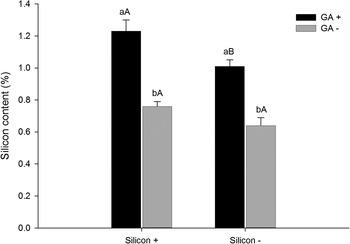
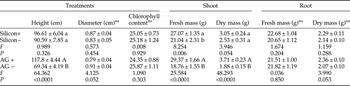
No significant interactions were observed between the effects of gibberellic acid and silicon on the overall vegetative characteristics of plants. Plants that received gibberellic acid were taller compared with controls not treated with this phytohormone. Moreover, shoot fresh weight was higher in plants receiving silicon and gibberellic acid; however, shoot dry mass was only elevated in plants treated with phytohormone (table 1). Root fresh and dry mass weight, stem diameter, and chlorophyll content did not differ significantly as a result of the application of silicon or gibberellic acid (table 1). Plants treated with silicon were found to contain significantly more silicon (F 1,36 = 10.717, P = 0.0023). In addition, plants treated with gibberellic acid also exhibited higher silicon content (F 1,36 = 65.104, P < 0.0001). The highest silicon content was observed in plants treated with both gibberellic acid and silicon (fig. 3).
Mean (±SE) of the leaf silicon content (%) of corn plants Zea mays treated with silicon (Si+; Si−) and gibberellic acid (GA+; GA−). Bars with the same lowercase and uppercase letters did not differ significantly within silicon and gibberellic acid-treated groups, respectively, as determined by Tukey test (P > 0.05).

Mean (±SE) of the vegetative characteristics of corn plants (Zea mays) treated with the inductors silicon (Si+; Si−) and gibberellic acid (GA+; GA−).

Means followed by the same lowercase letters within silicon inductor and the same uppercase letters within the gibberellic acid inductor did not differ by Tukey test (P > 0.05). ns, no significant difference.
Discussion
Previous studies have shown that silicon plays a significant role in plant resistance to insects through its effects on the biological characteristics of insect pests (Hou & Han, Reference Hou and Han2010; Assis et al., Reference Assis, Moraes, Auad and Coelho2013). In the present study, we did not observe any effects of silicon on larval or pupal development of S. frugiperda; however, our results indicated that treatment with silicon and gibberellic acid affected adult phase parameters. When S. frugiperda females were derived from larvae fed with plants treated with these substances, their fecundity was adversely affected. Insect fecundity is one of the biological parameters most affected by silicon. Silva et al. (Reference Silva, Alvarenga, Moraes and Alcantra2014) reported that male–female pairs of S. frugiperda derived from larvae fed on cotton leaves treated with silicon produced fewer eggs per female, while He et al. (Reference He, Yang, Li, Qiu, Qu, Qiu and Li2015) demonstrated that feeding with rice plants treated with silicon solution significantly reduced the fecundity of Nilaparvata lugens (Stål). This deleterious effect on oviposition may be due to the accumulation of silicon in plants, which can activate and increase the production of defence metabolites (Tatagiba et al., Reference Tatagiba, Rodrigues, Filippi, Silva and Silva2014). The quality of host plants is crucial to insect fecundity, and components such as carbon, nitrogen, and defence metabolites, directly affect the fecundity of herbivores on both individual and populational scales (Awmack & Leather, Reference Awmack and Leather2002). Additional studies (mainly of aphids) have also suggested that silicon reduces insect fecundity (Carvalho et al., Reference Carvalho, Moraes and Carvalho1999; Basagli et al., Reference Basagli, Moraes, Carvalho, Ecole and Gonçalvs-Gervásio2003; Gomes et al., Reference Gomes, Moraes, Santos and Antunes2008; Dias et al., Reference Dias, Sampaio, Rodrigues, Korndörfer, Oliveira, Ferreira and Korndörfer2014).
The phytohormones most commonly associated with induced resistance to pests are jasmonic and salicylic acids (Bruce et al., Reference Bruce, Martin, Pickett, Pye, Smart and Wadhams2003; Boughton et al., Reference Boughton, Hoover and Felton2006; Ulland et al., Reference Ulland, Ian, Mozuraitis, Borg-Karlson, Meadow and Mustaparta2008). In addition, some studies have demonstrated effects of gibberellic acid in insects (Altuntaş et al., Reference Altuntaş, Kılıç, Uçkan and Ergin2012; Abdellaoui et al., Reference Abdellaoui, Halima-Kamel, Acheuk, Soltani, Aribi and Hamouda2013) and our results indicate that females derived from larvae fed on plants treated with gibberellic acid exhibit a decrease in fecundity. These results corroborate those reported by Kaur & Rup (Reference Kaur and Rup2002) and Parolin (Reference Parolin2012) demonstrating reduced fecundity in Bactrocera cucurbitae (Coquillett) and S. frugiperda, respectively, fed on plants treated with gibberellic acid. The observed decreased fecundity associated with gibberellic acid is likely because it has antifeedant properties, acts on insect metabolism, induces changes in the haemolymph metabolites of insects (Visscher, Reference Visscher1980; Abdellaoui et al., Reference Abdellaoui, Halima-Kamel, Acheuk, Soltani, Aribi and Hamouda2013), and increases peroxidase activity in plants (McCune & Galston, Reference McCune and Galston1959; De Souza & MacAdam, Reference De Souza and MacAdam2001). Increases in peroxidase activity are associated with the synthesis of lignin and suberin, which increase tissue hardness, and with the production of active oxygen and quinones, which have antibiotic properties (Stout et al., Reference Stout, Workman and Duffey1996).
In the non-preference bioassay, no significant differences were observed between treatment groups after 24 h; however, after 48 h, untreated control plants were preferred to those treated with gibberellic acid, since less treated plants were consumed by first instar caterpillars. A preference of S. frugiperda for plants not treated with silicon was also reported by Nascimento et al. (Reference Nascimento, Assis, Moraes and Sakomura2014); hence, the application of silicon and gibberellic acid may have inhibited larval feeding and caused them to seek untreated leaf sections.
The application of gibberellic acid and silicon not only affected the fecundity and feeding preference of insects, but also interfered with the vegetative characteristics of plants. The changes in plant vegetative characteristics observed in our study could be explained by an increased elongation of internodes, resulting from an increased cell division rate stimulated by gibberellic acid (Greulach & Haesloop, Reference Greulach and Haesloop1958; Bostrack & Struckmeyer, Reference Bostrack and Struckmeyer1967; Francis & Sorrell, Reference Francis and Sorrell2001). The results of the present study in relation to gibberellic acid application are similar to those reported by Parolin (Reference Parolin2012) in corn, Bostrack & Struckmeyer (Reference Bostrack and Struckmeyer1967) in ornamental plants, Ghorbanli et al. (Reference Ghorbanli, Kaveh and Sepehr1999) in soybean and Martins et al. (Reference Martins, de Camargo, Martins, Silva and Araujo2012) in rice.
Furthermore, we observed that the highest silicon content was found in plants treated with both gibberellic acid and silicon. This demonstrates that silicon absorption is more effective when gibberellic acid is applied, suggesting that the increased absorption many be due to an rise in the production of lateral roots, which are responsible for silicon absorption (Ma et al., Reference Ma, Goto, Tamai and Ichii2001, Reference Ma, Yamaji, Tamai and Mitani2007); however, the results of this study did not indicate an increase in lateral roots. This may be because the method used to quantify lateral roots was not suitable, since only total root mass was determined. Gibberellins stimulate the growth of very small lateral roots of minimal weight, which originate from the main root (Zimmermann et al., Reference Zimmermann, Sakai and Hochholdinger2010). An effect of gibberellic acid on root growth has been observed in corn (Whaley & Kephart, Reference Whaley and Kephart1956) and other crops (Tanimoto, Reference Tanimoto1987, Reference Tanimoto2012), supporting our hypothesis. Hence, the findings presented here, in conjunction with prior literature, support a role for gibberellic acid in improving absorption of silicon.
Although no differences were observed in the various biological parameters of S. frugiperda investigated as a result of exposure to silicon or gibberellic acid, the observed decrease in fecundity points to a negative influence of silicon and gibberellic acid on S. frugiperda, which may result in a lower insect population density and, consequently, less potential for plant damage. Furthermore, gibberellic acid can increase the vegetative characteristics and silicon uptake of plants, which has a negative effect on the preference of S. frugiperda larvae for corn plants.
Acknowledgement
We thank the Conselho Nacional de Desenvolvimento Científico e Tecnológico (CNPq, Brazil) and Fundação de Amparo à Pesquisa do Estado de Minas Gerais (FAPEMIG, Brazil) for supporting our research.