Introduction
Patients with chronic illnesses, including coronary heart disease (CHD) and diabetes, have an increased prevalence of depression, with rates estimated to be 15–20% (Ali et al. Reference Ali, Stone, Peters, Davies and Khunti2006; Whooley et al. Reference Whooley, de Jonge, Vittinghoff, Otte, Moos, Carney, Ali, Dowray, Na, Feldman, Schiller and Browner2008), and this is associated with impaired quality of life (Moussavi et al. Reference Moussavi, Chatterji, Verdes, Tandon, Patel and Ustun2007). Much of this depression seems to be unrecognized or untreated (Pouwer et al. Reference Pouwer, Beekman, Lubach and Snoek2006). The finding that structured depression treatment in patients with chronic illness leads to benefit in terms of mood and well-being (Katon et al. Reference Katon, Von Korff, Lin, Simon, Ludman, Russo, Ciechanowski, Walker and Bush2004; Davidson et al. Reference Davidson, Rieckmann, Clemow, Schwartz, Shimbo, Medina, Albanese, Kronish, Hegel and Burg2010) has led to recommendations to screen for depression (Lichtman et al. Reference Lichtman, Bigger, Blumenthal, Frasure-Smith, Kaufmann, Lesperance, Mark, Sheps, Taylor and Froelicher2008; NICE, 2009b; IDF, 2011).
Within the UK, the Quality and Outcomes Framework (QOF), a nationally implemented pay-for-performance scheme (Doran et al. Reference Doran, Fullwood, Gravelle, Reeves, Kontopantelis, Hiroeh and Roland2006), introduced routine annual screening for depression for all patients with CHD or diabetes in primary care in April 2006. This has been widely adopted by primary care practices, with 90% of eligible patients with CHD or diabetes in Scotland screened during the 2007–2008 contract year (ISD Scotland, 2011). This screening comprises a clinician [most commonly a practice nurse but sometimes the general practitioner (GP)] asking the patient two validated questions (Whooley et al. Reference Whooley, Avins, Miranda and Browner1997), with additional questions or follow-up if either of the answers is positive. The two questions used are: ‘During the last month, have you often been bothered by feeling down, depressed or hopeless?’ and ‘During the last month, have you often been bothered by having little interest or pleasure in doing things?’ Screening is typically carried out as part of a chronic illness review consultation but may occur opportunistically at other times, including if a patient with CHD or diabetes presents with depression. Estimates of the diagnostic accuracy of two-item depression screeners suggest a sensitivity of 80–90% and a specificity of 60–80% (Whooley et al. Reference Whooley, Avins, Miranda and Browner1997; Thombs et al. Reference Thombs, Ziegelstein and Whooley2008b; Arroll et al. Reference Arroll, Goodyear-Smith, Crengle, Gunn, Kerse, Fishman, Falloon and Hatcher2010).
Despite this enthusiasm for screening patients with chronic illnesses for depression, there are questions about its usefulness (Thombs et al. Reference Thombs, de Jonge, Coyne, Whooley, Frasure-Smith, Mitchell, Zuidersma, Eze-Nliam, Lima, Smith, Soderlund and Ziegelstein2008a; Ziegelstein et al. Reference Ziegelstein, Thombs, Coyne and de Jonge2009; Pouwer, Reference Pouwer2009). There have been no studies in which screening for depression in patients with CHD or diabetes by their usual professional (as opposed to by researchers) has been linked to depression outcomes. Qualitative studies have identified practical difficulties in detecting and dealing with depression in consultations for physical health problems (Coventry et al. Reference Coventry, Hays, Dickens, Bundy, Garrett, Cherrington and Chew-Graham2011) and evidence from more general primary care studies suggests that screening for depression does not improve outcomes (Gilbody et al. Reference Gilbody, House and Sheldon2005) and is unlikely to be effective without additional interventions (Thombs et al. Reference Thombs, de Jonge, Coyne, Whooley, Frasure-Smith, Mitchell, Zuidersma, Eze-Nliam, Lima, Smith, Soderlund and Ziegelstein2008a; O'Connor et al. Reference O'Connor, Whitlock, Beil and Gaynes2009; Pouwer, Reference Pouwer2009; Ziegelstein et al. Reference Ziegelstein, Thombs, Coyne and de Jonge2009).
We hypothesized that if screening for depression in patients with diabetes and CHD in routine primary care is effective, it should lead to more new cases being diagnosed and treated in the weeks following screening compared to other time periods. As screening, diagnosis and treatment of depression are routinely recorded in primary care, we sought to measure the impact of screening on the diagnosis and treatment of depression within a large primary care database using the self-controlled case-series method. Specifically, we aimed to test the impact of screening by comparing the incidence of new depression diagnosis and antidepressant treatment between the time period following screening and other times.
Method
Data sources
We examined data from the Primary Care Clinical Informatics Unit Research (PCCIUR) database held by the University of Aberdeen. The PCCIUR database comprises anonymized extracts from the General Practice Administration System for Scotland (GPASS) clinical information system. This was the most widely used general practice clinical database in Scotland at the time of the study and was used for issuing almost all prescriptions and recording clinical codes and demographic data. For the observation period of 12 months commencing 1 April 2007, it contained data from 1280840 patients registered with 237 general practices containing 1245 GPs. The patients registered with these practices have been found to be representative of the Scottish population (5.1 million) (Elder et al. Reference Elder, Kirkpatrick, Ramsay, MacLeod, Guthrie and Sutton2007). The study was approved by the PCCIUR steering committee. As an anonymized database was used for this research, ethical committee approval was not required.
Subjects and exposures
The sample in our study comprised all patients in the PCCIUR database during the observation period who met three criteria: (1) a recorded diagnosis of CHD and/or diabetes (Read codes in the online Appendix) before the study start date; (2) a record of screening for depression either once or twice during the study period; (3) either a new diagnosis of depression or initiation of an eligible antidepressant during the observation period. We deemed screening to have occurred if the records included the relevant Read code. As this code was used to measure QOF performance and hence influenced practice remuneration, practice staff were encouraged to record it whenever screening was carried out. Practices were not contractually required to code all new diagnoses of depression; if the diagnosis was entered in the text of the clinical record but not explicitly coded, we could not identify it. When GPs did code a new diagnosis of depression, they were contractually required to carry out, and record, a formal assessment of severity (Moore et al. Reference Moore, Yuen, Dunn, Mullee, Maskell and Kendrick2009; Burton et al. Reference Burton, Anderson, Wilde and Simpson2012). For this reason we used either a coded diagnosis of a depressive disorder or initiation of antidepressant treatment. Eligible diagnostic codes included pure depression and mixed anxiety and depression and are listed in the online Appendix. Both were deemed to be new if they were recorded during the observation period but not in the 12 months preceding this. As GPs sometimes recorded codes for depressive symptoms (such as ‘low mood’), we carried out a sensitivity analysis that included these. Eligible antidepressant drugs included those commonly used for depression, including selective serotonin reuptake inhibitors (SSRIs) and most serotonin–norepinephrine reuptake inhibitors (SNRIs), but excluded antidepressant drugs that are commonly prescribed for diabetic neuropathy and other painful conditions (amitriptyline and other tricyclic antidepressants and duloxetine) as these are no longer recommended for initial treatment of new depression (NICE, 2009a).
Exclusion criteria
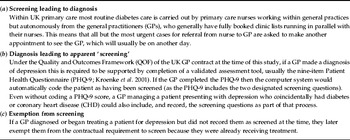
For the primary analysis, we excluded patients who were diagnosed or began treatment on the same day as screening because we recognized that when a GP diagnosed or initiated treatment for a patient presenting with depression, they might record the patient as having been screened. We took this decision based on contextual knowledge of UK primary care: most depression screening for patients with CHD and diabetes is carried out by nurses working semi-autonomously, whereas diagnosis and treatment (whether following screening or of patients presenting with symptoms of depression) is carried out separately by GPs. This contextual detail is expanded in Table 1. To test the effect of this assumption on our results, we conducted a sensitivity analysis that included patients who were screened and diagnosed on the same day.
Contextual information used in interpreting diagnosis or treatment on the same day as screening

Statistical methods
We measured the relationship between screening and either a new depression diagnosis or antidepressant prescribing using the self-controlled case-series method. This method, which has been described extensively (Whitaker et al. Reference Whitaker, Farrington, Spiessens and Musonda2006), investigates the association between a time-varying exposure (i.e. screening) and an event (i.e. depression diagnosis or treatment). By including only cases with both an exposure and an event, the temporal relationship between exposure and events can be examined for each individual, thereby controlling for inter-individual differences.
We reasoned that a new diagnosis or treatment following screening should occur within the exposure period defined as 1–28 days after the screening day. Therefore, we allocated all events (depression diagnosis or prescribing) occurring during the observation period to one of three categories: occurring before, during or after the exposure period following depression screening. We then determined the relative incidence (RI) of being diagnosed or treated for depression in this period compared to at other times. To illustrate the relative impact of screening, we also plotted bar charts in which each bar represented a 28-day block, with the central bar representing the exposure period of 28 days after screening and the remainder extending up to 20 weeks before and after this (data from the screening day were omitted). We checked the validity of using 28-day exposure period and blocks by examining weekly trends to ensure we did not lose data with this approach. For each patient we allocated their event (diagnosis or new treatment) to one 4-week block and calculated the event rate for each block as the number of events divided by the number of patients in the block.
We estimated the absolute impact of screening by determining the increased number of patients diagnosed or treated for depression in the 28 days after screening. This was calculated by dividing the observed number of diagnoses and treatments during the 4 weeks after screening by the RI and then subtracting this from the observed number of diagnoses to give the additional number of patients diagnosed or treated [with 95% confidence intervals (CIs)]. From this, we were able to calculate the number needed to screen to obtain one new diagnosis or treatment by dividing the total screened population by the additional number of patients diagnosed or treated.
We addressed the problem of patients with multiple screening events during the study period but only one new diagnosis or treatment in several ways. Where patients were screened twice in the year, we calculated the relative incidence based on the first recorded episode of screening. Patients who were screened three or more times were excluded because of the difficulty of choosing between screenings. In addition, we carried out two sensitivity analyses: first, we analysed only those patients with a single screening event and, second, we analysed the data using the screening event closest in time to the diagnosis of depression or antidepressant treatment. For the secondary analysis including patients with diagnosis or treatment on the same day as screening, we used this date. All analyses were conducted in R 2.14 (R Development Core Team, 2011); the self-controlled case-series analysis used the script published by the originators of the method (Whitaker et al. Reference Whitaker, Farrington, Spiessens and Musonda2006).
Results
Patients and screening
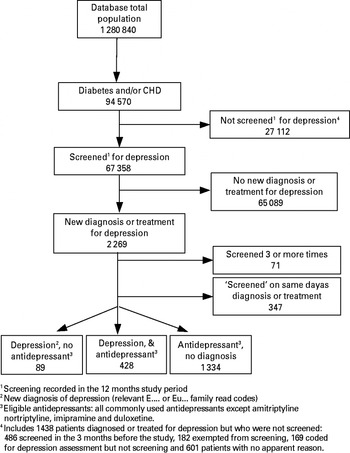
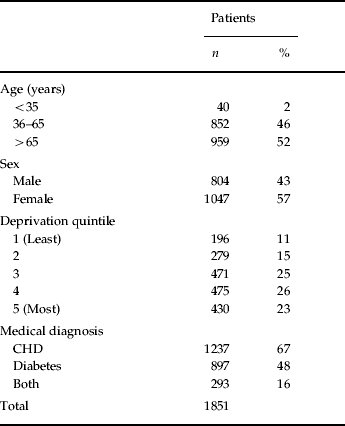
At the start of the study period, 94 570 (7.4%) patients had a diagnosis of CHD or diabetes and, of these, 67 358 (71.2%) were screened at least once for depression during the study year. A total of 3707 (3.9%) patients with diabetes or CHD were either diagnosed with depression or began eligible antidepressant treatment during the year, of whom 2269 (61.2%) were screened for depression during the year. These patients were screened on a total of 2838 occasions; 1792 patients were screened once, 406 twice and 71 three times or more. Of those screened once or twice, 347 patients were recorded as screened on the same day they received a diagnosis of depression (233 patients) or began treatment (221 patients). These were excluded from the primary analysis. This left 1851 patients eligible for analysis, of whom 517 (27.9%) patients received a diagnosis of depression. Of these, 428 also received new antidepressant treatment and 89 did not. There were 1334 (72.1%) patients who started antidepressant treatment with no diagnostic code for depression. These data are summarized in Fig. 1. The demographic characteristics of included patients are listed in Table 2.
Flow chart of entry into the study from the database.

Characteristics of patients screened and either diagnosed with depression or starting antidepressant
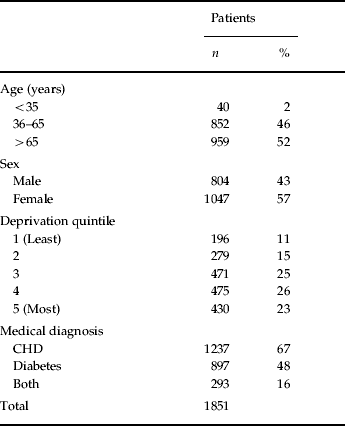
CHD, Coronary heart disease.
Impact of screening
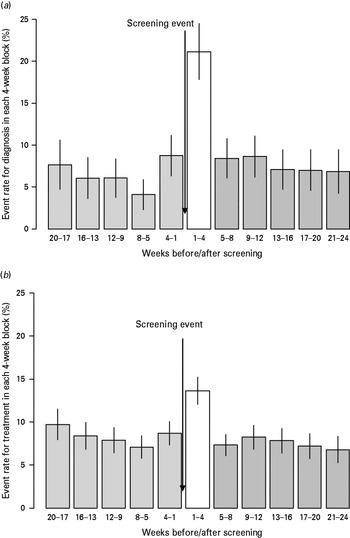
A new diagnosis of depression was recorded between 1 and 28 days after the first screening during the study period in 103 (13.7%) patients who received a diagnosis within the study period (including on the same day as screening). Diagnosis was recorded before screening in 182 (24.3%) and more than 28 days after screening in 232 (30.9%). Antidepressant treatment was started between 1 and 28 days after the first screening in 225 (11.3%) patients receiving an antidepressant, before screening in 848 (42.8%) and more than 28 days after in 689 (34.7%). Figure 2 shows the relationship between first screening and diagnosis or starting treatment, excluding those patients recorded as screened and diagnosed or treated on the same day.
The influence of screening on (a) diagnosis and (b) treatment. The event rate indicates the proportion of patients in each time period who were diagnosed or started treatment. The time periods more than 20 weeks before and 24 weeks after screening included smaller numbers of patients and have been omitted for clarity. Error bars indicate 95% confidence intervals (CIs). Patients diagnosed or starting treatment on the same day as screening were excluded. Data relate to the first screening episode in the study period.

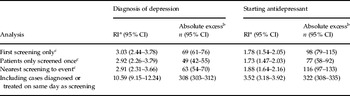
The RI for diagnosis in the 4 weeks after the first screening was 3.03 (95% CI 2.44–3.78) and for treatment the RI was 1.78 (95% CI 1.54–2.05). The absolute impact of screening and the corresponding results from the sensitivity analysis and the secondary analysis including patients with treatment or diagnosis on the same day as screening are shown in Table 3. The estimated figure of 69 (95% CI 61–76) additional diagnoses following screening accounted for 8.2% of all new diagnoses of depression in patients with CHD or diabetes in the year (including patients who were not screened). The comparable value for additional new treatment of 98 (95% CI 79–115) patients accounted for 2.8% of all newly initiated antidepressant treatments. Given the total population of patients screened in the study period of 67358, these figures equate to a number needed to screen for one new depression diagnosis of 976 (95% CI 886–1104) and for one new antidepressant treatment of 687 (95% CI 586–853) based on the first screening and excluding patients diagnosed or treated on the same day as screening.
Results of the sensitivity analysis using the self-controlled case-series method

RI, Relative incidence; CI, confidence interval.
a RI from self-controlled case-series analysis during the 4 weeks after screening of the specified event compared to other times.
b Absolute excess in cases in the 4 weeks after screening relative to the 4-week blocks either side of this.
c Excludes patients diagnosed or commencing treatment on the same day as screening.
The sensitivity analyses that included symptom codes in addition to depression diagnoses added 79 patients but made no difference to the results. The results of the analysis including patients diagnosed or treated on the same day as screening are shown in Table 3. When these patients were included in the analysis, the number needed to screen reduced to 232 for diagnosis and 203 for treatment.
Discussion
Summary of main findings
This is the first database study to examine the impact of systematic screening for depression in patients with chronic illness in a community setting. Although a new diagnosis of depression and initiation of antidepressant treatment were significantly more common in the 28 days after screening for depression, the absolute number of patients diagnosed with depression or beginning treatment after screening was small.
Strengths and weaknesses of this study
The large database used for this study is representative of the socio-economically diverse Scottish population (Elder et al. Reference Elder, Kirkpatrick, Ramsay, MacLeod, Guthrie and Sutton2007). Records of CHD and diabetes diagnoses and screening are likely to be accurate because they are recorded as part of the QOF payment for performance scheme and subject to audit. The recording of a diagnosis of depression is subject to bias, such as different coding behaviours between practices: publicly available data show wide variation in coding rates between geographically similar practices within Scotland (ISD Scotland, 2011). Records of antidepressant treatment are likely to be complete because practices contributing to the database use computerized prescribing and the vast majority of antidepressant prescriptions in Scotland are issued in primary care, even when patients receive out-patient specialist care. Although some of the antidepressant prescribing may have been for indications other than depression, we excluded those antidepressants commonly prescribed for diabetic neuropathy and have no reason to suspect that screening for depression should affect any other indication for antidepressant treatment. Conversely, we may have missed some patients who were prescribed ineligible antidepressants for depression; however, given that these agents are not recommended as first-line drugs (NICE, 2009a), this is unlikely to be important. We may also have missed patients who were diagnosed (but not coded) and referred for psychological treatment; however, drug treatment is prescribed for approximately 90% of patients managed with depression in UK primary care and a similar proportion (83%) was seen in our coded patients so it is unlikely that missing patients would substantially alter our findings. Our decision to use either antidepressant prescribing or a diagnosis of depression rather than diagnosis alone has been used previously (Burton et al. Reference Burton, Anderson, Wilde and Simpson2012), and although it differs from an English study using a different database (Moore et al. Reference Moore, Yuen, Dunn, Mullee, Maskell and Kendrick2009), it reflects the fact that the PCCIUR database does not require participating practices to ensure all diagnoses are coded and is thus more representative of routine general practice.
We excluded patients from the primary analysis who were recorded as screened on the same day that they were diagnosed with depression or began antidepressant treatment because contextual evidence suggested that, in many cases, screening would be recorded after a diagnosis or treatment in patients presenting with depression, either by the GP or in some cases by the GPASS computer system itself. In other cases it was not recorded, possibly because treatment was not for depression, possibly because treatment was for another condition such as an anxiety disorder, or simply because the practitioner did not think to do it. This influenced our findings, and the secondary analysis including these patients showed a greater impact from screening. To examine the assumption that it was more appropriate to exclude patients diagnosed or treated on the same day as screening, we reviewed all instances of screening and diagnosis on the same day. One hundred and seven patients were recorded as having screening, diagnosis and commencement of treatment all on the same day, which we regarded as more in keeping with the primary reason for consultation being depression. A further 126 patients only had screening and diagnosis entered on the same date; 80 of them had neither antidepressant treatment nor codes that would indicate assessment of a new episode of depression as stipulated in the QOF. This pattern was more suggestive of the GP entering a past diagnosis at the time of current screening. Of the remaining 46 treated patients with a new depression diagnosis on the same day as ‘screening’, 22 had already received their new antidepressant prescription before their ‘screening’ date, suggesting that some assessment of depression had already been made before the screening was coded. Although we show only a small direct effect of screening, we cannot exclude indirect effects of screening, such as raising awareness among patients, nurses and GPs.
Generalizability of findings
The UK QOF is one of the first provider schemes to include systemic screening for depression in a community population with chronic disease. Compared to the results of trials of screening plus coordinated care (Katon et al. Reference Katon, Von Korff, Lin, Simon, Ludman, Russo, Ciechanowski, Walker and Bush2004; Davidson et al. Reference Davidson, Rieckmann, Clemow, Schwartz, Shimbo, Medina, Albanese, Kronish, Hegel and Burg2010), the number of new depression diagnoses and courses of treatment in our study are disappointing. However, a recent trial from tertiary diabetes centres in The Netherlands (Pouwer et al. Reference Pouwer, Tack, Geelhoed-Duijvestijn, Bazelmans, Beekman, Heine and Snoek2011) showed only a non-significant increase in use of mental health care among patients after additional depression detection and no measurable effect on clinical outcomes. There are substantial barriers to the recognition of depression in the context of management of chronic illness (Coventry et al. Reference Coventry, Hays, Dickens, Bundy, Garrett, Cherrington and Chew-Graham2011) and to the initiation of treatment when depression is not the patient's presenting complaint (Karasz et al. Reference Karasz, Dowrick, Byng, Buszewicz, Ferri, Hartman, van Dulmen, Weel-Baumgarten and Reeve2012). Previous systematic reviews have reported that screening for depression without additional care does not translate into improved outcomes (Gilbody et al. Reference Gilbody, House and Sheldon2005; O'Connor et al. Reference O'Connor, Whitlock, Beil and Gaynes2009); although we could not examine outcomes of treatment, the very small increase in patients commencing treatment after recognition suggests that any difference in outcomes would have been small.
Implications for policy, practice and research
Our findings suggest that screening for depression leads to a statistically significant but small number of patients being diagnosed or receiving treatment in the period following screening. By contrast, GP practices diagnosed new depression and commenced treatment independently of screening for almost 4% of patients with CHD and depression during the year; this figure compares favourably with the 2.2% of the overall population who began antidepressant treatment during the same year (Burton et al. Reference Burton, Anderson, Wilde and Simpson2012). Together these results suggest, at least in health-care systems in which primary care practitioners deal with both physical and mental health problems, that screening for depression leads to little additional recognition or treatment of depression in chronic illness over standard care.
Given these findings we recommend careful consideration before further extension of screening for depression in patients with chronic illness. The screening instruments themselves are commendably brief and have reasonable predictive values, so it may be that the way in which they are used could be more effective. Raising the issue of depression in the context of a complex disease-monitoring consultation may mitigate against its usefulness (Coventry et al. Reference Coventry, Hays, Dickens, Bundy, Garrett, Cherrington and Chew-Graham2011; Karasz et al. Reference Karasz, Dowrick, Byng, Buszewicz, Ferri, Hartman, van Dulmen, Weel-Baumgarten and Reeve2012), and it is possible that administering the screening questions separately from the consultation may lead to more cases being detected. As current methods of brief screening in routine consultations lead to few new cases being treated, financial incentives to promote screening may be better used elsewhere, for instance in promoting structured management for patients who are recognized (Katon et al. Reference Katon, Von Korff, Lin, Simon, Ludman, Russo, Ciechanowski, Walker and Bush2004).
Conclusions
Routinely implemented screening for depression in patients with CHD or diabetes leads to more cases being diagnosed and treated in the 4 weeks after screening than at other times. However, its absolute impact is small and health-care systems should consider the resource implications of current or additional screening for depression in patients with chronic disease.
Supplementary material
For supplementary material accompanying this paper visit http://dx.doi.org/10.1017/S0033291712001481.
Acknowledgements
Data extraction for this study was funded by the Mental Health Collaborative of National Health Service (NHS) Scotland. C.B. and C.S. are supported by the Chief Scientist Office of the Scottish Government. The researchers conducted the study independently of the funders who had no involvement in the study design, collection, analysis, and interpretation of data; in the writing of the report; and in the decision to submit the article for publication.
Declaration of Interest
All authors have completed the Unified Competing Interest form at www.icmje.org/coi_disclosure.pdf (available on request from C.B.) and declare that they have no relationships with any companies that might have an interest in the submitted work in the previous 3 years, except that C.B. is a GP working under the General Medical Services (GMS) contract, which remunerates screening for depression.