Orphanage care often represents a severe form of early neglect or deprivation that places children at increased risk for deficits in many domains including difficulties in regulatory abilities such as inhibitory control, attention, and emotion regulation even after removal from institutional settings (Audet & Le Mare, Reference Audet and Le Mare2010; Batki, Reference Batki2018; Bos, Fox, Zeanah, & Nelson, Reference Bos, Fox, Zeanah and Nelson2009; Burkholder, Koss, Hostinar, Johnson, & Gunnar, Reference Burkholder, Koss, Hostinar, Johnson and Gunnar2016; Colvert, Rutter, Beckett, et al., Reference Colvert, Rutter, Beckett, Castle, Groothues, Hawkins and Sonuga-Barke2008; Colvert, Rutter, Kreppner, et al., Reference Colvert, Rutter, Kreppner, Beckett, Castle, Groothues and Sonuga-Barke2008; Frenkel et al., Reference Frenkel, Koss, Donzella, Frenn, Lamm, Fox and Gunnar2017; Gunnar, Van Dulman, & International Adoption Project Team, Reference Gunnar and Van Dulmen2007; Hostinar, Stellern, Schaefer, Carlson, & Gunnar, Reference Hostinar, Stellern, Schaefer, Carlson and Gunnar2012; Loman et al., Reference Loman, Johnson, Westerlund, Pollak, Nelson and Gunnar2013; McDermott et al., Reference McDermott, Troller-Renfree, Vanderwert, Nelson, Zeanah and Fox2013; Merz, McCall, & Groza, Reference Merz, McCall and Groza2013; Tottenham et al., Reference Tottenham, Hare, Quinn, McCarry, Nurse, Gilhooly and Casey2010; Wiik et al., Reference Wiik, Loman, Van Ryzin, Armstrong, Essex, Pollak and Gunnar2011). Deprivation associated with institutional care is multifaceted and can include lack of cognitive stimulation, adequate nutrition, and basic healthcare (Gunnar, Reference Gunnar, Nelson and Luciana2001). Even when nutrition and healthcare are adequate, notably, children lack a dedicated, stable caregiver (van IJzendoorn et al., Reference van IJzendoorn, Palacois, Sonuga-Barke, Gunnar, Vorria, McCall and Juffer2011). In institutional care, children often experience changing caregivers and high caregiver-to-child ratios (McCall et al., Reference McCall, Groark, Hawk, Julian, Merz, Rosas and Nikiforova2019). Moreover, the quality of care in institutional settings is lower than in home care including less availability and time spent with caregivers (Smyke et al., Reference Smyke, Koga, Johnson, Fox, Marshall and Nelson2007). Adoption from institutional settings results in a radical shift in caregiving experiences for youth as they are often adopted by families with a high motivation to parent and the economic means to do so. Removal from institutions and placement into families is associated with improved child outcomes. For example, rapid catchup growth is demonstrated in many outcomes including improvements in physical growth, attachment, and cognitive development (van IJzendoorn & Juffer, Reference van IJzendoorn and Juffer2006). Results from a randomized trial show that children placed into high-quality foster families, relative to children who remain in institutional settings, display more positive outcomes across a broad set of domains including cognitive, brain, and socioemotional development (Nelson, Fox, & Zeanah, Reference Nelson, Fox and Zeanah2014). Despite noted improvements in some domains, there is substantial variability in children's development following adoption. While adoption represents vast improvements in care, research also shows that variation in adoptive parents’ caregiving abilities after entry into the family can influence subsequent child development (DePasquale, Raby, Hoye, & Dozier, Reference DePasquale, Raby, Hoye and Dozier2018; Lawler, Koss, & Gunnar, Reference Lawler, Koss and Gunnar2017; van den Dries et al., Reference van den Dries, Juffer, van IJzendoorn, Bakermans-Kranenburg and Alink2012). However, less research has examined the role of specific forms of postadoption parenting that may promote recovery and lessen the impact of preadoption adversity on children's later regulation abilities.
Early Life Adversity and Children's Regulatory Abilities
Children do not experience recovery in all domains, with marked deficits observed long after adoption for some outcomes. For postinstitutionalized (PI) children, these difficulties include persistent difficulties in regulation. Broadly, we refer to regulatory abilities as the developing capacity for self-control of thoughts, behaviors, and emotions manifested across multiple systems including biological, behavioral, and cognitive strategies. Research on PI youth demonstrate difficulties that span multiple regulation abilities. For example, poorer executive function skills, including inhibitory control, cognitive flexibility, and working memory, are found among PI youth (Bos et al., Reference Bos, Fox, Zeanah and Nelson2009; Colvert, Rutter, Kreppner, et al., Reference Colvert, Rutter, Kreppner, Beckett, Castle, Groothues and Sonuga-Barke2008; Hostinar et al., Reference Hostinar, Stellern, Schaefer, Carlson and Gunnar2012; McDermott et al., Reference McDermott, Troller-Renfree, Vanderwert, Nelson, Zeanah and Fox2013; Merz et al., Reference Merz, McCall and Groza2013). Research with PI youth does demonstrate some discrepancies dependent on the method of data collection. For example, inhibitory control measured by behavioral responses to a go/no-go task does not evidence differences by early care experiences, but early care effects are evident in brain activity to the same task (Loman et al., Reference Loman, Johnson, Westerlund, Pollak, Nelson and Gunnar2013; McDermott, Westerlund, Zeanah, Nelson, & Fox, Reference McDermott, Westerlund, Zeanah, Nelson and Fox2012). Difficulties with sustained attention and symptoms of attention-deficit/hyperactivity disorder (ADHD) are frequently documented among PI youth (Frenkel et al., Reference Frenkel, Koss, Donzella, Frenn, Lamm, Fox and Gunnar2017; Gunnar et al., Reference Gunnar and Van Dulmen2007; Loman et al., Reference Loman, Johnson, Westerlund, Pollak, Nelson and Gunnar2013; Wiik et al., Reference Wiik, Loman, Van Ryzin, Armstrong, Essex, Pollak and Gunnar2011) and are proposed as a deprivation-specific syndrome (Kreppner, O'Connor, Rutter, & English and Romanian Adoptees Study Team, Reference Kreppner, O'Connor and Rutter2001). These difficulties can continue to persist throughout childhood (Wiik et al., Reference Wiik, Loman, Van Ryzin, Armstrong, Essex, Pollak and Gunnar2011). PI youth also demonstrate difficulties with emotion regulation and increased emotional problems (Batki, Reference Batki2018; Burkholder et al., Reference Burkholder, Koss, Hostinar, Johnson and Gunnar2016; Colvert, Rutter, Beckett, et al., Reference Colvert, Rutter, Beckett, Castle, Groothues, Hawkins and Sonuga-Barke2008; Tottenham et al., Reference Tottenham, Hare, Quinn, McCarry, Nurse, Gilhooly and Casey2010). Research on PI children finds that children who are adopted later, spend more time in institutional care, and receive poorer care while in the institution demonstrate greater deficits in a broad range of outcomes including regulatory abilities (Merz & McCall, Reference Merz and McCall2011; Merz et al., Reference Merz, McCall and Groza2013). Not all children adopted from institutional care demonstrate these difficulties. Some studies find a threshold effect of age at adoption or duration such that children adopted from institutional care prior to a specific age evidence similar behavioral outcomes when compared to typically developing children, while institutionalization represents a barrier to healthy development for children adopted after these ages (Julian, Reference Julian2013). These threshold effects vary by country of origin, such that the enduring effects of institutionalization on children's outcomes are found at earlier ages when the severity of deprivation increases (Julian, Reference Julian2013). For example, children adopted after 6 months of age from Romanian orphanages demonstrated increased attention problems (Audet & Le Mare, Reference Audet and Le Mare2010; Colvert, Rutter, Kreppner, et al., Reference Colvert, Rutter, Kreppner, Beckett, Castle, Groothues and Sonuga-Barke2008) while similar effects were seen for children adopted after 18 months of age from Russian orphanages (Merz & McCall, Reference Merz and McCall2010). Country as well as historical time may also influence these timing effects. For example, orphanages in Eastern Europe and Russia improved in the quality of care they provided after the fall of communism with the influx of funds from nongovernmental organizations. Collectively, this research suggests that both duration of institutionalization and the quality of care in the institution are important for forecasting children's later developmental outcomes. The ability to effectively regulate emotion and behavior is a hallmark of development and an important mechanism for understanding individual differences in the development of psychopathology. Thus, difficulties in these regulation domains may cascade into broader difficulties later in development for PI children.
Caregiving and self-regulation
The caregiver–child relationship lays the groundwork for children's developing regulation skills during early life (Schore, Reference Schore2000; Sroufe, Reference Sroufe2000); thus, the disruptions in caregiving that often accompany institutional care may undermine children's emerging regulatory abilities. Children's regulation skills emerge in the first few years of life and evidence rapid growth across early childhood (Montroy, Bowles, Skibbe, McClelland, & Morrison, Reference Montroy, Bowles, Skibbe, McClelland and Morrison2016). In infancy, caregivers serve as external regulators of children's arousal and emotion (Kopp, Reference Kopp1982). As children age, internal regulation abilities (e.g., self-regulation) develop throughout the toddler and preschool years (Kopp, Reference Kopp1982). Caregiving early in life has been posited to shape later emotion regulation skills through programming of the brain during infancy and early childhood (Perry, Blair, & Sullivan, Reference Perry, Blair and Sullivan2017), and individual differences in parenting contribute to variation in children's regulation abilities (Bernier, Carlson, & Whipple, Reference Bernier, Carlson and Whipple2010; Sroufe, Reference Sroufe2000). Among typically developing children, a substantial literature demonstrates that parenting quality promotes better self- and emotion-regulation skills in children (for reviews, see Grolnick & Farkas, Reference Grolnick, Farkas and Bornstein2002; Morris, Criss, Silk, & Houltberg, Reference Morris, Criss, Silk and Houltberg2017). Meta-analyses demonstrate parental behaviors are associated with children's executive function (Valcan, Davis, & Pino-Pasternak, Reference Valcan, Davis and Pino-Pasternak2018) and self-regulation skills (Karrenman, van Tuijl, van Aken, & Dekovic, Reference Karreman, van Tuijl, van Aken and Dekovic2006). Research also demonstrates two main dimensions of parenting influence children's development including both sensitivity and responsiveness and structure and limit setting (Locke & Prinz, Reference Locke and Prinz2002).
Sensitivity and responsiveness
Parents high in sensitivity and responsiveness are characterized as attentive, involved, warm, and nurturing. The role of parental sensitivity and responsiveness in shaping children's regulation has its roots in attachment theory (Bowlby, Reference Bowlby1982/1969). Sensitive and responsive caregivers are able to read children's cues including the ability to anticipate and respond effectively to calm children during times of distress and validate children's emotional experiences. Contingent, responsive caregiving that serves to calm a distressed infant allows the child to develop expectations that his or her caregiver will be available and responsive to meet his or her needs during times of distress; these repeated experiences with caregivers help to build the skills and confidence needed for internalized self-regulation (Calkins, Reference Calkins1994; Cassidy, Reference Cassidy1994; Cicchetti, Ganiban, & Barnett, Reference Cicchetti, Ganiban, Barnett, Garber and Dodge1991). Sensitive and responsive caregiving is associated with better executive function and emotional and behavioral regulation skills (Bernier, Carlson, & Whipple, Reference Bernier, Carlson and Whipple2010; Sroufe, Reference Sroufe and Perlmutter1983). A recent meta-analysis demonstrates that positive parenting, inclusive of parental support, involvement, warmth, responsiveness, and sensitivity, is associated with better executive function skills during early childhood (Valcan et al., Reference Valcan, Davis and Pino-Pasternak2018). Secure attachment, often associated with sensitive and responsive caregiving, is also related to better emotion regulation in a recent meta-analysis (Cooke, Kochendorfer, Stuart-Parigon, Koehn, & Kerns, Reference Cooke, Kochendorfer, Stuart-Parrigon, Koehn and Kerns2019). Lower levels of parental sensitivity and responsiveness may lead to increased stress for young children (including changes in the hypothalamic–pituitary–adrenal axis; e.g., Gunnar & Quevedo, Reference Gunnar and Quevedo2007) interfering with effective regulation (Blair et al., Reference Blair, Granger, Willoughby, Mills-Koonce, Cox and Greenberg2011).
Structure and limit setting
Parental structure and limit setting reflects a parent's ability to structure the environment in ways that provide predictable experiences for children. Effective caregivers provide boundaries on children's behavior that are appropriate and manageable for their current capabilities (Kopp, Reference Kopp1982). Parental structure and limit setting also reflects the parent's ability to effectively communicate expectations to the child and consistently respond to noncompliance of these expectations. Parental structure and limit setting provides children with external supports that help to build and scaffold children's self-regulation abilities. For example, greater maternal autonomy support, reflecting a mother's ability to provide scaffolding matched to the child's needs and flexibility in her strategies to keep the child on task, is associated with better executive function in children (Bernier, Carlson, & Whipple, Reference Bernier, Carlson and Whipple2010). Maternal use of gentle verbal limit setting and fewer physical strategies are associated with children's self-regulation (LeCuyer, Swanson, Cole, & Kitzman, Reference LeCuyer, Swanson, Cole and Kitzman2011). Maternal limit setting strategies that assert power and control without the use of support and reasoning have been related to worse performance on a delay of gratification task (Houck & LeCuyer-Maus, Reference Houck and LeCuyer-Maus2004). Moreover, a meta-analysis of parenting and children's self-regulation found that positive parental control was associated with better self-regulation while negative parental control was associated with worse self-regulation in preschool-aged children (Karreman et al., Reference Karreman, van Tuijl, van Aken and Dekovic2006). An additional meta-analysis demonstrated that cognitive parental behaviors, reflecting parents’ use of scaffolding, autonomy support, and strategies to maintain or redirect children's attention, are associated with better executive function skills during early childhood (Valcan et al., Reference Valcan, Davis and Pino-Pasternak2018).
Consistency in family routines
In addition to parents providing structure to their children through their interactions, consistency in family routines provides children with a sense of predictability and order to daily life. Family routines have also been posited to provide stability to family life during times of change (Boyce, Jensen, James, & Peacock, Reference Boyce, Jensen, James and Peacock1983). Consistency in both meal times and sleep schedules for children are important aspects of family routines (Jenson, James, Boyce, & Hartnett, Reference Jensen, James, Boyce and Hartnett1983). Predictability is critical to biobehavioral regulation (Miller, Reference Miller1981) including biological processes that underlie children's behavioral regulation skills. Routines provide external supports to help build self-regulation (Kopp, Reference Kopp1982). Consistent family routines are associated with children's self-regulation during middle childhood (Brody & Flor, Reference Brody and Flor1997). Among preschoolers from low-income homes, consistent family routines were predictive of better emotion regulation among children with low cortisol levels, a potential marker of particularly vulnerable youth (Miller et al., Reference Miller, Song, Sturza, Lumeng, Rosenblum, Kaciroti and Vazquez2017).
Caregiving following early adversity
The research in typically developing children demonstrates that high-quality parenting serves as a promotive factor (Sameroff, Reference Sameroff, Osofsky and Fitzgerald2000) in supporting the emergence of better self-regulation and executive function skills in young children regardless of the level of risk. It is less clear the role that each of these forms of parenting (e.g., parental sensitivity and responsiveness, parental structure and limit setting, consistency in family routines) play as protective factors that serve to foster resilience and recovery following early institutional care. Research on other forms of early life adversity, such as maltreatment, exposure to violence, and homelessness, demonstrate that parenting quality may serve as a protective factor for fewer behavioral problems in children (Alink, Cicchetti, Kim, & Rogosch, Reference Alink, Cicchetti, Kim and Rogosch2009; Labella, Narayan, McCormick, Desjardins, & Masten, Reference Labella, Narayan, McCormick, Desjardins and Masten2019; Manning, Davies, & Cicchetti, Reference Manning, Davies and Cicchetti2014). Early adversity that is characterized by the separation from or the loss or absence of a primary caregiver results in the loss or lack of children's external regulators that serve as precursors to internalized self-regulation. For children adopted from institutions during the toddler years, the presence of high-quality caregiving after adoption may serve as a protective factor to repair children's emerging self-regulatory systems. Newly formed attachment relationships after loss or separation have been posited to serve as external regulatory processes in the caregiver–child dyad that support internalized self-regulation (Hofer, Reference Hofer1994). While the transformation from primarily external regulation to primarily internal regulation begins in infancy, development of internalized regulation occurs throughout the first few years of life and remains a stage-salient task during the toddler and preschool years (Calkins, Reference Calkins1994; Cicchetti et al., Reference Cicchetti, Ganiban, Barnett, Garber and Dodge1991; Sroufe, Reference Sroufe2000). Despite this shift, caregivers continue to facilitate children's regulation beyond infancy, and in instances of atypical development caregivers may need to take a more active role as an external regulator for longer periods of time relative to typically developing toddlers (Cicchetti et al., Reference Cicchetti, Ganiban, Barnett, Garber and Dodge1991). Thus, the establishment of an attachment relationship with a new caregiver during the toddler years following early adversity may constitute a developmental period in which new caregivers may serve as new external regulators to facilitate the internalization of better self-regulation for children who did not experience this care during infancy. It is noteworthy that in the present sample, PI children were found to have formed a discriminating attachment within the first 9 months in the family, and in most instances this relationship was classified as secure (Carlson, Hostinar, Mliner, & Gunnar, Reference Carlson, Hostinar, Mliner and Gunnar2014).
Caregiving in PI families following adoption
Echoing the literature on typically developing children, caregiver sensitivity, structure and limit setting, and consistency have each been associated with better outcomes among institutionalized and postinstitutionalized youth. For example, interventions targeting caregiving by staff in institutional settings are associated with improved developmental outcomes for still institutionalized youth (McCall et al., Reference McCall, Groark, Hawk, Julian, Merz, Rosas and Nikiforova2019) underscoring the notion that caregiving deficits underlie many of the effects of deprivation observed in institutionalized children. In particular, caregiver sensitivity improved children's cognitive outcomes while the combination of caregiver sensitivity and consistency improved children's socioemotional outcomes (Hawk et al., Reference Hawk, McCall, Groark, Muhamedrahimov, Palmov and Nikiforova2018). Institutionalized children randomized to foster care, thus receiving higher quality of care, had better selective attention, as measured by performance on the go portion of a go/no-go task, than children who remained in institutionalized care (McDermott et al., Reference McDermott, Westerlund, Zeanah, Nelson and Fox2012). There were no differences in children's inhibitory control as measured by performance on the no-go portion. Furthermore, on a flanker task, these same children randomized to foster care performed as well as the never institutionalized comparison group (McDermott et al., Reference McDermott, Troller-Renfree, Vanderwert, Nelson, Zeanah and Fox2013).
There is some research to support the notion that improvements in caregiving may translate into better outcomes for PI children after adoption. More structure and limit setting shortly after adoption is associated better behavioral regulation 8 months later (Lawler et al., Reference Lawler, Koss and Gunnar2017). Parental sensitivity is related to normalization of cortisol reactivity for families participating in a parenting intervention (DePasquale et al., Reference DePasquale, Raby, Hoye and Dozier2018). Maternal sensitivity is associated with fewer disinhibited social engagement behaviors (van den Dries et al., Reference van den Dries, Juffer, van IJzendoorn, Bakermans-Kranenburg and Alink2012). Even though there is a vast literature supporting the notion that individual differences in parenting influences children's development, few studies have examined postadoption parenting as a moderator of associations between preadoption adversity and children's subsequent development. As such, it is unclear the extent to which postadoption parenting during toddlerhood and the preschool years may overcome the lack of high-quality caregiving PI children experienced during infancy. In one of the few studies to do so, Garvin, Tarullo, Van Ryzin, & Gunnar (Reference Garvin, Tarullo, Van Ryzin and Gunnar2012) found support for parental emotional availability as a moderator of early life adversity on children's disinhibited social engagement behaviors. In a sample of Romanian adoptees, Audet and Le Mare (Reference Audet and Le Mare2010) found that the effect of positive attachments with adoptive parents during middle childhood on attention problems was moderated by duration of institutional care such that more positive attachments were associated with fewer attention problems but only for children adopted prior to 19 months of age. To date, questions remain regarding which specific aspects of parenting may improve children's regulatory abilities (Audet & Le Mare, Reference Audet and Le Mare2010).
Transition to family care
Removal from institutional settings and placement in family care represents an ecological transition for children (Seidman & French, Reference Seidman and French2004) that results in improvements in care. However, a child's entry into the family also results in the reorganization of the family system and new roles for both first-time parents and at the entrance of additional children (Lewis, Owen, & Cox, Reference Lewis, Owen and Cox1988; Volling, Reference Volling2012). While adoptive parents do not on average experience greater parenting stress than biological parents, there are individual differences in parenting stress such that greater perceived child behavioral difficulties and longer durations of institutionalization are predictive of increased parenting stress during the initial transition for internationally adopting parents (Canzi, Ranieri, Barni, & Rosnati, Reference Canzi, Ranieri, Barni and Rosnati2019). Parenting stress can impede parents' abilities to be effective caregivers to children that in turn contribute to poorer child outcomes (Deater-Deckard, Reference Deater-Deckard1998). As such, the quality of parenting a child receives postadoption may vary among internationally adopting families, and this variation in caregiving may influence the degree of recovery subsequently observed in children's regulation abilities. This transitional period may also be an especially salient time period for caregiving due to the formation of discriminate attachments with adoptive parents that occurs during this transition period (Carlson et al., Reference Carlson, Hostinar, Mliner and Gunnar2014).
Present Study
The transition to family care following adoption may represent a particularly important time for the influence of postadoption parenting in toddlers as regulation skills become internalized. Thus, we sought to examine the role of parenting during the first 2 years after children entered family care among a group of children adopted between the ages of 15 and 36 months from institutional settings. The aims of the present study were threefold. First, we examined the impact of parenting on children's regulatory abilities among a group of families who adopted children internationally and a group of families with same-aged nonadoptive children. We examined three dimensions of parenting proposed to foster better regulation abilities in young children including (a) sensitivity and responsiveness, (b) structure and limit setting, and (c) consistency in routines. Second, we sought to test group differences between PI and nonadoptive children (i.e., adoption status as marker of early adversity) in children's regulation skills several years after adoption. We examined broad dimensions of children's regulatory capabilities, including children's executive function skills, attention abilities, and emotion and behavioral regulation. Finally, as the severity and duration of early adversity contributes to individual differences within PI children's outcomes, we examine postadoption parenting as a moderator of the impact of preadoption adversity (i.e., variation in duration of institutionalization and quality of care in the institution) within the group of PI children. We hypothesized that adoption status would be associated with children's regulation difficulties and that higher quality parenting would offset or lessen the effect of preadoption adversity to promote better regulation skills several years after adoption. The present study extends our previous report of parenting and children's behavioral regulation difficulties during the transition to family care (Lawler et al., Reference Lawler, Koss and Gunnar2017) in several important ways, including extending our investigation beyond the first few months postadoption, inclusion of additional dimensions of parenting, inclusion of a broader array of regulatory abilities, and tests of parenting as a moderator of preadoption adversity.
Method
Participants
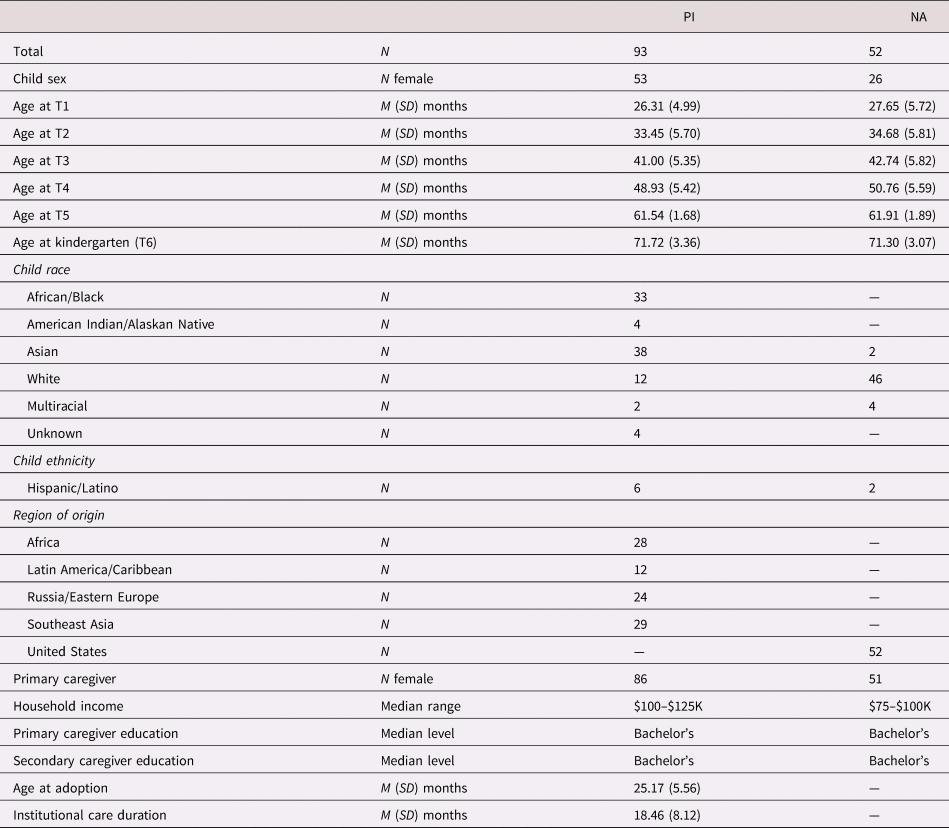
Participants included 145 families taking part in a larger longitudinal study following the transition to family care after international adoption. The present investigation included two groups: 93 postinstitutionalized children (PI; 57% female) adopted internationally from orphanage care and 52 nonadopted (NA) same-aged children (50% female). PI children were recruited through an international adoption clinic and local adoption agencies within the first months following adoption. PI children were adopted from various regions of the world (see Table 1). PI children were included if they were adopted out of an institutional setting, entered into adoptive parents’ full-time care between the ages of 15 and 36 months (M age at adoption = 25.17 months, SD = 5.56; children were 18–36 months at Time 1 [T1] recruitment, M age at T1 = 26.31 months, SD = 4.99), and the ability to participate in the first laboratory session within the first 3 months after arrival into the United States (M time since arrival at T1 = 1.70 months, SD = 0.77). However, some PI families were not able to start that soon or were identified after 3 months postadoption; these families were recruited into the study and began participation at Time 2 (T2) consistent with the timing of sessions relative to arrival (n = 25, T2 time since adoption M = 8.37 months, SD = 0.68). PI children entering the study at T2 did not differ from PI children recruited at T1 on preadoption care measures, composite scores of parenting, or any of the behavioral outcomes. PI children were excluded from analyses for fetal alcohol exposure (using the FAS Facial Photographic Analysis Software; Astley & Clarren, Reference Astley and Clarren2000; 8 PI children) or congenital and endocrine disorders (2 PI children). NA children were recruited through a department-maintained registry of families interested in research. Inclusion criteria for the NA children were being between 18 and 36 months at T1 (M age at T1 = 27.65 months, SD = 5.72) and reared in their family of origin. NA children were a typically developing sample recruited to be similar to the family demographics of the adoptive families (3 NA children excluded for atypical development: 1 autism, 1 maltreatment, and 1 childhood cancer). All NA families and adoptive families of PI children were located in the greater Twin Cities, Minnesota, area. See Table 1 for complete demographic information for each group.
Participant demographics

Procedure
Data for the present analysis were collected during five in-person laboratory sessions, one in-school kindergarten assessment, and one telephone interview. Parenting was assessed at the first four laboratory assessments as well as through in-home diaries following each of these sessions that occurred at approximately 2 (T1), 8 (T2), 16 (Time 3 [T3]), and 24 (Time 4 [T4]) months postadoption. Children's outcomes were assessed at a laboratory session at 5.0–5.5 years of age (Time 5 [T5]) and a kindergarten classroom visit (Time 6 [T6]; M age = 5.96 years, SD = 0.27). Kindergarten assessments were a minimum of 3 months after the T5 assessment (M = 9.85 months, SD = 3.17). In the PI group, preadoption care was assessed through a telephone interview conducted by a trained adoption social worker following the initial laboratory interview. Parents provided informed consent, and all study procedures were approved by the university's institutional review board.
Measures
Parental sensitivity/responsiveness and structure/limit setting
Parent–child interactions were videotaped and later coded for two dimensions of parenting during a 25-min segment of the laboratory session with the child's primary caregiver at T1–T4. Parent–child interactions were observed during a series of tasks including a free play and clean-up task, a saliva collection, and a structured play and clean-up task. During the free play segment, caregivers and children were asked to play as they normally would at home and were provided a bin of toys. During the structured play task, caregivers and children were asked to construct a scene (e.g., make a face on an outline of a head) with Play-Doh®. At the end of each 8-min play task, a knock signaled to the caregiver to initiate clean up (2 min). Finally, saliva was collected from the child with the assistance of both the experimenter and the caregiver (5 min). Trained coders rated parental sensitivity/responsiveness and structure/limit setting using an established coding scheme (Erickson, Sroufe, & Egeland, Reference Erickson, Sroufe and Egeland1985; Matas, Arend, & Sroufe, Reference Matas, Arend and Sroufe1978). The sensitivity/responsiveness scale reflected caregivers’ contingent responsiveness, attentiveness, involvement, and the ability to serve as a secure base and provide emotional support. High scores on the sensitivity/responsiveness scale reflect a caregiver who encourages and provides verbal or physical support throughout the series of tasks, demonstrates a calm, warm, and confident tone, reads the child's signals, anticipates mounting frustration, and responds contingently. The structure/limit setting scale assessed caregivers’ ability to structure the environment, respond consistently and authoritatively to noncompliance, communicate expectations to the child, and provide effective leadership to accomplish goals. While caregivers’ responses to noncompliance are considered when they occur, the scale provided ratings of parenting behavior that were independent of children's compliance. High scores in the context of compliance reflect a caregiver who establishes and maintains structure throughout the tasks and sets an agenda for the child's behavior. High scores in the context of noncompliance reflect a caregiver who increases efforts to set limits prior to an escalation of the child's unacceptable behavior and does not retreat from difficult behavior. Each dimension of parenting was scored on a 7-point scale with higher scores indicating higher quality parenting. A global code for the full 25-min segment was scored for each parenting dimension. Global codes for the full sequence were used to be inclusive of transitions between tasks, which may prompt greater need for supportive presence and limit setting as well as account for variation between dyads of when during the interaction parenting may be most evident. In the larger longitudinal sample, approximately 20% of tapes were coded by two raters; in the present subsample, intraclass correlations (ICCs) ranged from .72 to .87 for sensitivity/responsiveness and .71 to .88 for structure/limit setting across the four time points. Previous research has demonstrated predictive and discriminate validity of the parenting scales (Quint & Egeland, Reference Quint, Egeland and Smith1995).
Consistency in routines
Caregivers completed three daily diaries in conjunction with the collection of saliva in the home following the laboratory sessions (T1–T4). Caregivers were instructed to do so on days the child spent with the caregiver. Timing of meals (breakfast, lunch, and dinner) and wake and bedtimes were extracted from the diaries. As a measure of consistency or predictability in family routines, deviation scores were created for each of the five events (three meal times, wake time, and bedtime) for each of the 3 days from the individual's own mean timing. The mean of the deviation scores across days and events was calculated with lower scores reflecting smaller deviations in the timing of family events as an objective measure of consistency in family routines.
The consistency of routines scores were created for this study. As a measure of validity, deviation scores were examined in relation to parent report of consistency in the frequency the child goes to bed at the same time each night and the frequency the family eats dinner at the same time each night from the Family Routines Inventory (Jensen et al., Reference Jensen, James, Boyce and Hartnett1983). Parents reported on a 4-point Likert scale (1 = almost never, 4 = everyday), and the two items were averaged. Higher deviation scores from the diaries were significantly associated with less consistency in parent report of bedtime and family dinner at all four sessions (T1: r = –.44, p < .001; T2: r = –.22, p = .02; T3: r = –.32, p < .001; T4: r = –.24, p = .02).
Gift delay
Children's inhibitory control was assessed using a delay of gratification task (Kochanska, Murray, Jacques, Koenig, & Vandegeest, Reference Kochanska, Murray, Jacques, Koenig and Vandegeest1996) at T5. The child was told he/she would receive a gift after the experimenter wrapped the gift. The child sat with his/her back to the experimenter and was asked not to peek during which the experimenter noisily wrapped the gift for 1 min. After the gift was wrapped, the experimenter excused herself from the room to get the bow she forgot for the top of the gift. The child was instructed not to peek in her absence; the child was in the room alone for 3 min. Children's behavior during both the wrap and the wait phases were each rated on a 6-point scale (0 = no peeking, 5 = touched or grabbed gift). Scores during the wrap and wait phases were significantly correlated (r = .48, p < .001); in analyses, the mean of these scores was used (α = .65) with higher scores reflecting greater deficits in inhibitory control (interrater reliability κ = .97 for each phase). Previous research demonstrates validity and developmental stability in children's inhibitory control including on the gift delay task as a reflection of children's delaying abilities (Kochanska, Murray, & Harlan, Reference Kochanska, Murray and Harlan2000; Kochanska et al., Reference Kochanska, Murray, Jacques, Koenig and Vandegeest1996).
Dinky toys
Children's inhibitory control was also assessed using the dinky toys task (Kochanska et al., Reference Kochanska, Murray, Jacques, Koenig and Vandegeest1996). On five separate occasions during the T5 laboratory session, children were asked to choose one small toy (e.g., bouncy ball) from a bin full of toys presented to the child by the experimenter. With hands on the lap, the child was asked to use his/her words to describe the toy he/she would like without using his/her hands. Each trial used a different bin of toys. Children's behavior during each trial was individually rated on a 6-point scale (0 = used words, hands never left lap, 5 = impulsively grabbed toy). Children's scores on the five trials were significantly correlated (rs .52–.76, ps < .001). The mean of the trials (α = .89) was computed and used in analyses, with higher scores reflecting greater deficits in inhibitory control (interrater reliability κs range .96–.99 across five trials). Previous research demonstrates validity and developmental stability in children's inhibitory control including on the dinky toys task as a measure of children's delaying abilities (Kochanska et al., Reference Kochanska, Murray, Jacques, Koenig and Vandegeest1996, Reference Kochanska, Murray and Harlan2000).
Spin the pots
As a measure of working memory, children completed the multilocation search task spin the pots (Hughes & Ensor, Reference Hughes and Ensor2005) at T5. Visually distinct boxes were displayed on a Lazy Susan. While the child watched, experimenters placed stickers in the boxes and the child was told he/she would get to keep any stickers he/she found. The difficulty of the task (e.g., number of boxes and numbers of stickers) was scaled to children's chronological age (4.5-year-olds: 12 boxes and 10 stickers; 5-year-olds: 13 boxes and 11 stickers; 5.5-year-olds: 14 boxes and 12 stickers). The experimenter covered the tray with a scarf and rotated the Lazy Susan 180 degrees. The child was asked to choose a box to open to try to find a sticker. If the chosen box contained a sticker, the experimenter gave the sticker to the child. If the box did not contain a sticker, the experimenter encouraged the child to try again next time. Regardless of the outcome of the trial, the experimenter then covered and rotated the Lazy Susan and repeated the task. This continued until all stickers were located or the maximum number of trials was reached (4.5-year-olds: 20 trials; 5-year-olds: 22 trials; 5.5-year-olds: 24 trials). Scores were calculated as the proportion of stickers located relative to the number of trials it took to locate all stickers (or the maximum number of trials) and was used in analyses as a measure of working memory. The spin the pots task shows moderate correlations from ages 3 to 4 years old (Hughes & Ensor, Reference Hughes and Ensor2007).
Go/no go
A computerized continuous performance task designed to be appropriate for preschool to school-aged children (Lamm et al., Reference Lamm, Walker, Degnan, Henderson, Pine, McDermott and Fox2014; Lamm, White, McDermott, & Fox, Reference Lamm, White, McDermott and Fox2012) was used as a measure of attention and inhibitory control. The current task consisted of 75% go trials and 25% no-go trials to ensure a prepotent desire to respond, thus requiring inhibition during the no-go trials. The task was presented in two blocks of 140 trials each following 12 practice trials to ensure proficiency. Children were asked to help a zoo keeper recapture escaped animals with the help of a chimpanzee referred to as “Joey the monkey.” To recapture the animals, children were told to press a button as quickly as possible when they saw an animal on the screen unless it was “Joey the monkey.” Animal stimuli were presented on the screen for 500 ms, followed by a black screen for 900 ms or until the child responded. Higher scores reflect greater accuracy. In analyses, accuracy during the go trials was used as a measure of attention and accuracy during the no-go trials was used as a measure of inhibitory control.
ADHD symptoms
Kindergarten teachers completed the 15-item ADHD symptoms subscale of the MacArthur Health and Behavior Questionnaire (Essex et al., Reference Essex, Boyce, Goldstein, Armstrong, Kraemer and Kupfer2002). Teachers rated each item on a 3-point Likert scale. The mean of all items was computed and used in analyses with higher scores reflecting higher levels of inattention and impulsivity. Sample items include “distractible, has trouble sticking to any activity,” “interrupts or butts in on others,” and “fidgets.” All kindergarten assessments occurred a minimum of 2 months after the start of the school year (M = 5.14 months, SD = 1.67 in the longitudinal study). Previous research demonstrates that the MacArthur Health and Behavior Questionnaire is a reliable and valid measure of children's psychopathology (Essex et al., Reference Essex, Boyce, Goldstein, Armstrong, Kraemer and Kupfer2002; Lemery-Chalfant et al., Reference Lemery-Chalfant, Schreiber, Schmidt, Van Hulle, Essex and Goldsmith2007). The ADHD scale had good internal consistency in the present sample (α = .93).
Emotion regulation
Primary caregivers and children's kindergarten teachers completed the 15-item lability/negativity subscale of the Emotion Regulation Checklist (ERC; Shields & Cicchetti, Reference Shields and Cicchetti1997). Items were rated a 4-point scale reflecting children's dysregulated negative affect, mood lability, and lack of flexibility. Sample items include “exhibits wide mood swings,” “easily frustrated,” and “prone to angry outbursts.” Scores were summed and higher scores reflect greater deficits in emotion regulation skills. In addition, trained research assistants observed children during a typical school day in their kindergarten classroom and rated children on each item of the ERC following the classroom visit. There was good internal consistency for all three reporters in the present sample (observer α = .96, teacher α = .90, parent α = .86). Interrater reliability among observers was established on an independent sample of children at the university laboratory preschool (n = 44). ICCs averaged .61 across ERC ratings and observers. A latent variable across the three reporters was constructed and used in analyses. Previous research demonstrates the ERC is a reliable and valid measure of children's regulation (Shields & Cicchetti, Reference Shields and Cicchetti1997).
Preadoption care
Information about PI children's preadoption care was assessed through a semistructured telephone interview with adoptive caregivers (n = 2 parent refusals). Interviews were conducted by a trained retired adoption social worker. Three indicators of preadoption care were utilized from the interviews: duration of institutionalization and the quality of social and physical care children received in the institution. A timeline of early care experiences was established through which duration of time spent in an institution (in months) was determined. Duration of institutionalization was significantly correlated with age at adoption (r = .42, p < .001). As there is variation in the age children entered the institution (Median = 3.16 months, M = 6.54 months, SD = 7.66 months, Range 0–30 months), duration, rather than age at adoption, was used to capture exposure to preadoption adversity.
After the timeline of care was established, the caregiver was probed to describe the quality of the institutional setting. The quality of children's physical and social care were rated on a 5-point scale (1 = very poor, 5 = very high) reflecting the degree to which children's needs were met. The physical care quality reflected the physical environment, including the availability of toys and adequate clothing and the cleanliness of the institution and children. For example, ratings of “very poor” physical care reflected parent reports of unclean rooms (e.g., peeling paint or dirty floors) and children (e.g., laying in soiled or wet diapers). Ratings of “adequate” physical care reflected parent reports of a clean physical environment and children but lack of cognitive stimulation (e.g., few toys or children unable to play with available toys). Ratings of “very high” physical care reflected parent reports of clean children and rooms along with observations of children playing with toys. The social care quality reflected caregiver-to-child ratios, observances of caregiver affection toward children, and the degree of individualized care children received. For example, ratings of “very poor” social care reflected parent reports of few caregiver–child interactions, high caregiver-to-child ratios, and observations of “assembly line” type care. Ratings of “adequate” social care reflected parent reports of larger group sizes (10+ children) coupled with observations of some caregivers providing more than basic care such as talking or playing with children. Ratings of “very high” social care reflected parent reports of smaller caregiver-to-child ratios (e.g., 1:4, 1:5), observations of children receiving individualized care, and caregivers playing or cuddling with children.
Based on the descriptions of their experiences at the institution and the level of detail provided in response to the interviewer's probes, the interviewer determined whether there was sufficient information to rate the quality of care. The majority of parents provided sufficient information of the institution's physical (73/91) and social (71/91) care quality. Those with institutional care ratings were more likely to report seeing the institution directly (physical ratings: 71/73; social ratings: 70/71) compared to those without care ratings: physical ratings: 2/18, χ2 (1) = 61.74, p < .001; social ratings: 4/20, χ2 (1) = 63.45, p < .001. The majority of parents who provided sufficient information for institutional care ratings reported received a thorough viewing of the institution and its practices (thorough viewing n = 55 and n = 54; brief tour of institution n = 15 and n = 15; viewing the waiting room only n = 2 and n = 2; ns reflect participants with scored physical and social care ratings, respectively). Reliability was established through independent ratings on 10 interview scenarios by a separate trained social worker (κs > .80). The social and physical care ratings were reversed scored so that all three indicators reflected more adverse early care.
Data analytic plan
Analyses were conducted in four parts. First, descriptive statistics and bivariate correlations for each group are reported. We also report variations in preadoption adversity, postadoption parenting, and child outcomes by region of origin within the PI sample. Second, group differences and longitudinal change (or stability) in the three parenting constructs were examined across T1–T4. Latent growth curves were fit to examine longitudinal trajectories in parental sensitivity/responsiveness, parental structure/limit setting, and consistency in family routines. A chi-square difference test was used to compare a no growth/intercept only model to a linear growth model. Third, main effects of the three parenting dimensions and adoption status were examined as predictors of children's T5 and kindergarten outcomes in the full sample. Multiple regression analysis was conducted to examine whether adoption status (e.g., group differences, NA = 0, PI = 1) and the three parenting dimensions (e.g., sensitivity/responsiveness, structure/limit setting, consistency in routines) were predictors of child outcomes. Child age at the outcome measurement and child sex were included as covariates. Fourth, postadoption parenting was examined as a moderator of the impact of preadoption adversity on children's outcomes within the PI group only. A latent variable of preadoption care was constructed using duration of time spent in an institution and the social and physical preadoption care quality ratings (reversed-scored). The measurement model for the latent variable of preadoption adversity was examined. To test moderation, latent interactions between preadoption adversity and postadoption parenting (composite of four assessments) were fit using the XWITH command in MPLUS (Muthen & Muthen, Reference Muthén and Muthén1998–Reference Muthén and Muthén2012). Child sex and age at the outcome assessments were included as covariates. Separate models were fit for each parenting parameter and outcome. Predictors were standardized prior to the creation of the latent interaction variables. All analyses were conducted in the structural equation modeling framework using MPLUS. Missing data were estimated using full information maximum likelihood estimation. With the exception of the planned missingness in T1 parenting data for the late enrolled PI families (n = 25), Little's missing completely at random tests indicated that data were missing at random. First, we examined all study demographic data, T2–T4 parenting variables, and behavioral outcomes at T5 and kindergarten for the full sample, χ2 (661) = 652.47, p = .58 (31 missing patterns). Second, we examined the preadoption variables separately within the PI sample as these variables were not applicable for NA children, χ2 (13) = 13.39, p = .42 (5 missing patterns).
Results
Descriptive statistics
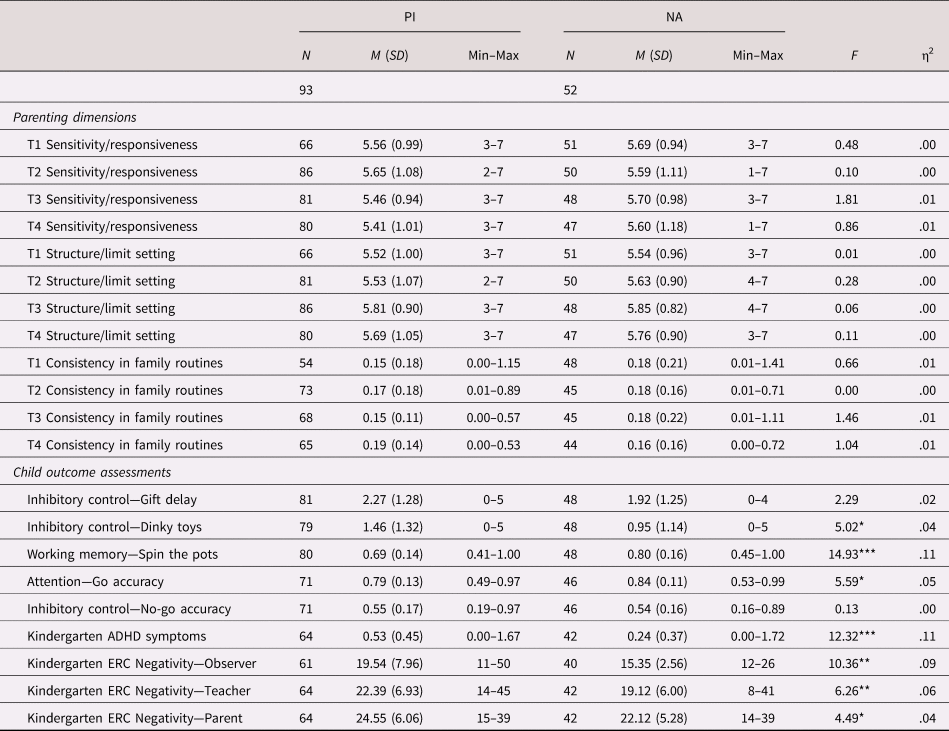
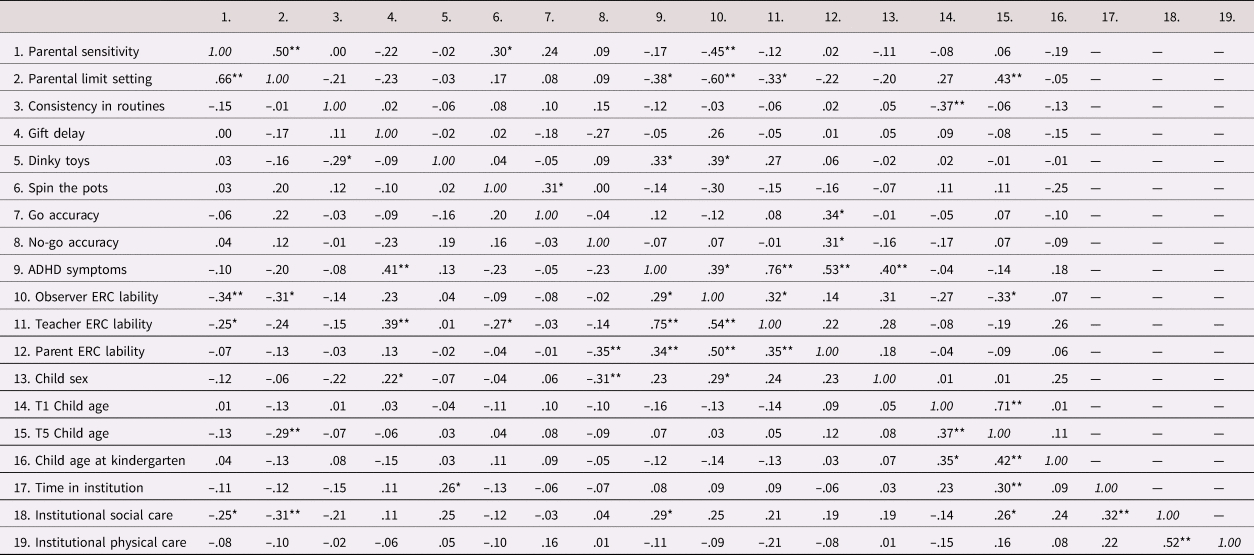
Group-specific means, standard deviations, and ranges for all study variables are displayed in Table 2 (group differences tested in subsequent regression analyses). Group-specific correlations are displayed in Table 3. Among parenting dimensions, parental structure/limit setting and sensitivity/responsiveness, which were assessed during the same series of tasks, were highly correlated in both groups. Consistency in routines was not associated with the two observational parenting measures in either group. Within the PI group, ratings of better social care in the institution were positively correlated with more postadoption parental sensitivity and limit setting. The multiple reporter ratings (e.g., observer, teacher, and parent) of children's lability/negativity, a measure of deficits in emotion regulation, were correlated with one another. Correlations in both groups were relatively low in magnitude among child outcomes, including multiple tasks that tap into the same skills (e.g., inhibitory control). The pattern of correlations were largely similar across the two groups with a few group-specific associations noted. For example, ADHD symptoms were positively associated with deficits in inhibitory control in both groups; however, the specific task capturing this association differed (as measured by the gift delay task in PI children and the dinky toys task in NA children).
Descriptive statistics by adoption status

Note: ERC, Emotion Regulation Checklist. *p < .05. **p < .01. ***p < .001.
Group-specific correlations among study variables

Note: Postinstitutionalized group below the diagonal and nonadopted group above the diagonal. Parenting dimensions reflect composites across all assessments. Child sex: 0 = female, 1 = male. ERC, Emotion Regulation Checklist. *p < .05. **p < .01.
Among PI youth, there were no differences in postadoption parenting or child outcomes by region of origin. As care for orphaned and abandoned children varies around the globe, preadoption adversity differed by region of origin: duration, F (3, 87) = 36.41, p < .001, η2 = .56; social care, F (3, 67) = 2.53, p = .07, η2 = .10; and physical care, F (3, 69) = 0.83, p = .48, η2 = .03. PI youth adopted from Africa (M = 9.61, SD = 5.33) spent significantly less time in an institution relative to all other regions (Eastern Europe: M = 24.19, SD = 5.69; Southeast Asia: M = 21.05, SD = 4.77; Latin America: M = 21.97, SD = 7.36; p < .001 for all three pairwise comparison). This likely reflects the fact that many institutionalized children from the African continent arrived in care after the illness and death of a parent. Children adopted from Eastern Europe also spent more time in an institution relative to youth from Southeast Asia (p = .04). Finally, while the omnibus test did not reach statistical significance, significant pairwise comparisons indicated that children from Eastern Europe received worse social care (M = 2.52, SD = 1.27) than those from both Africa (M = 1.54, SD = 1.32, p = .02) and Latin America (M = 1.33, SD = 1.41, p = .04) but not Southeast Asia (M = 2.00, SD = 1.69, p = .27).
Parenting
Prior to testing the impact of postadoption parenting on child outcomes, longitudinal change in parenting was examined. Table 2 contains the group-specific means for each of the parenting dimensions at each of the four assessments. There were no significant group differences in parenting at any individual time point. Parenting assessments, within a given dimension, were correlated across time (sensitivity: rs .32–.56; structure/limit setting, rs .25–.37, consistency in family routines rs .16–.50). Latent growth curves were fit to examine longitudinal trajectories in parental sensitivity/responsiveness, parental structure/limit setting, and consistency in family routines. For parental sensitivity, the linear growth model did not fit significantly better than a no growth model (χ2diff = 3.07, Δdf = 3, χ2crit = 7.82), suggesting no change in parental sensitivity. The no-growth model provided adequate fit to the data, χ2 (11) = 16.08, p = .14, root mean square error of approximation (RMSEA) = .06, comparative fit index (CFI) = .96. For parental structure/limit setting, the linear growth model did fit the data significant better than a no growth model (χ2diff = 9.28, Δdf = 3, χ2crit = 7.82) and provided adequate fit to the data, χ2 (8) = 9.42, p = .04, RMSEA = .04, CFI = .97. In the model, the slope mean (M = 0.09, p = .01) was significant. Total change in structure/limit setting across the four assessments spanning the 2-year period was approximately 0.25 on a 7-point scale. For consistency in routines, while the linear growth model fit the data significant better than the no-growth model (χ2diff = 7.90, Δdf = 3, χ2crit = 7.82), the slope mean parameter was not significant (M = 0.004, p = .54), suggesting no linear change in consistency in routines: model fit for the linear growth model, χ2 (8) = 12.94, p = .11, RMSEA = .07, CFI = .89. Given parenting was primarily stable (or evidenced little meaningful change), composite summary scores were created by averaging all available assessments within an individual for the remainder of the analyses. There were also no group differences in the summary scores: sensitivity, F (1, 142) = 0.77, p = .38, η2 = .01; structure/limit setting, F (1, 142) = 0.45, p = .50, η2 < .01; consistency in routines, F (1, 129) = 0.05, p = .82, η2 < .01.
Adoption status and parenting as predictors of child outcomes among all children
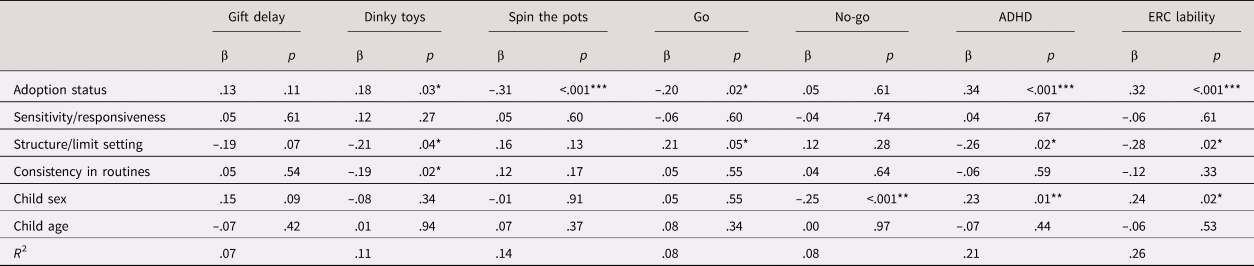
A multiple regression analysis was conducted to examine whether adoption status and the three parenting dimensions were predictors of child outcomes. A latent variable of children's lability/negativity was constructed using the three reporters. A multigroup analysis comparing a constrained versus an unconstrained/group-specific measurement model indicated that the factor loadings were invariant across groups (χ2diff = 0.60, Δdf = 2, χ2crit = 5.99). Thus, factor loadings were constrained across groups in all analyses (standardized factor loadings: observer report λ = .81, p < .001, teacher report λ = .63, p < .001; parent report λ = .54, p < .001). The regression model for adoption status and parenting as predictors of children's outcomes provided adequate fit to the data, χ2 (43) = 66.59, p = .01; RMSEA = .06, CFI = .90. See Table 4 for complete model results. Child age at the outcome measurement and child sex were included as covariates. Boys had lower accuracy on the no-go trials of the zoo game (β = –.24, p < .01), higher ADHD symptoms (β = .23, p = .01), and greater deficits in emotion regulation (i.e., lability/negativity; β = .24, p = .02).
Regression analyses examining main effects of adoption status and parenting

Note: Adoption status: 0 = NA, 1 = PI. Child sex: 0 = female, 1 = male. *p < .05. **p < .01. ***p < .001.
Adoption status effects
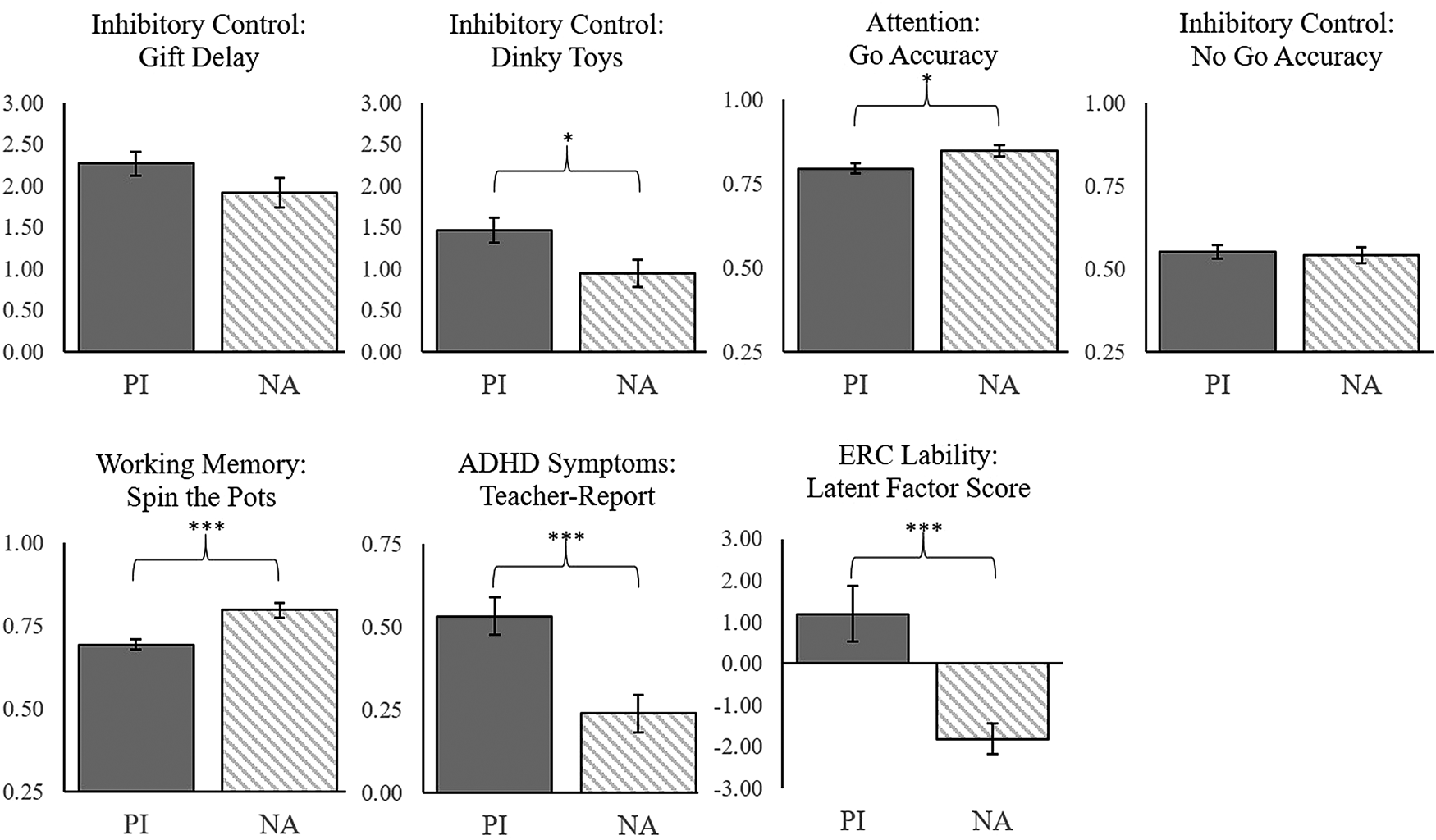
Adoption status, as an indicator of early life adversity, was significantly associated children's inhibitory control measured by the dinky toys task (β = .18, p = .03), working memory (β = –.31, p < .001), attention measured by go accuracy (β = –.20, p = .02), ADHD symptoms (β = .34, p < .001), and emotion regulation difficulties (i.e., negativity/lability; β = .32, p < .001) with PI youth demonstrating greater deficits in each of these domains. Adoption status was not a predictor of children's inhibitory control assessed by the gift delay task (β = .13, p = .11) and no-go accuracy (β = .05, p = .61). Figure 1 depicts group-specific means in outcomes.
Group-specific means (raw data) in regulatory outcomes for postinstitutionalized (PI) and nonadopted (NA) children at age 5 and kindergarten assessments.

Parenting main effects
Higher levels of structure/limit setting were associated with better inhibitory control on the dinky toys task (β = –.21, p = .04), fewer ADHD symptoms (β = –.26, p = .02), better attention on go accuracy of the zoo game (β = .21, p =.05), and better emotion regulation (i.e., lower lability/negativity; β = –.28, p = .02). Unexpectedly less consistency in routines was associated with better inhibitory control on the dinky toys task (β = –.19, p = .02). Parental sensitivity was not associated with any child outcomes.
Postadoption parenting as a moderator of the relation between preadoption adversity and later outcomes in PI children
As a measure of early adversity within the PI group, a latent variable of preadoption care was constructed using duration of time spent in an institution and the social and physical preadoption care quality ratings (reversed-scored). The measurement model for the latent variable of early adversity was examined: χ2 (1) = 0.42, p = .52; CFI = 1.00; RMSEA = .00; standardized factor loadings, social care λ = 1.00, p < .001, physical care λ = .53, p < .001; duration of institutionalization, λ = .30, p = .01). We first report any significant main effects of the preadoption adversity latent variable and parenting variables within the PI group. Next, latent interactions between preadoption adversity and postadoption parenting (composite of four assessments) are reported with child sex and age at the outcome assessments included as covariates.
Preadoption adversity and parenting main effects within PI children
Higher levels of preadoption adversity were associated with more problems in inhibitory control as measured by the dinky toys task (B = 0.35, SE = 0.18, p = .05). Higher levels of parental sensitivity were associated with better emotion regulation (i.e., lower lability/negativity; B = –2.81, SE = 1.20, p = .02) among PI children. Higher levels of structure and limit setting were associated with better emotion regulation (i.e., lower lability/negativity; B = –3.22, SE = 1.26, p = .01), attention measured by go accuracy (B = 0.28, SE = 0.12, p = .02), and working memory (B = 0.04, SE = 0.02, p = .05) among PI children. Finally, similar to the full sample findings, less consistency in family routines was unexpectedly associated with fewer inhibitory control problems measured by the dinky toys task (B = –3.74, SE = 1.40, p = .01).
Parental sensitivity/responsiveness as a moderator
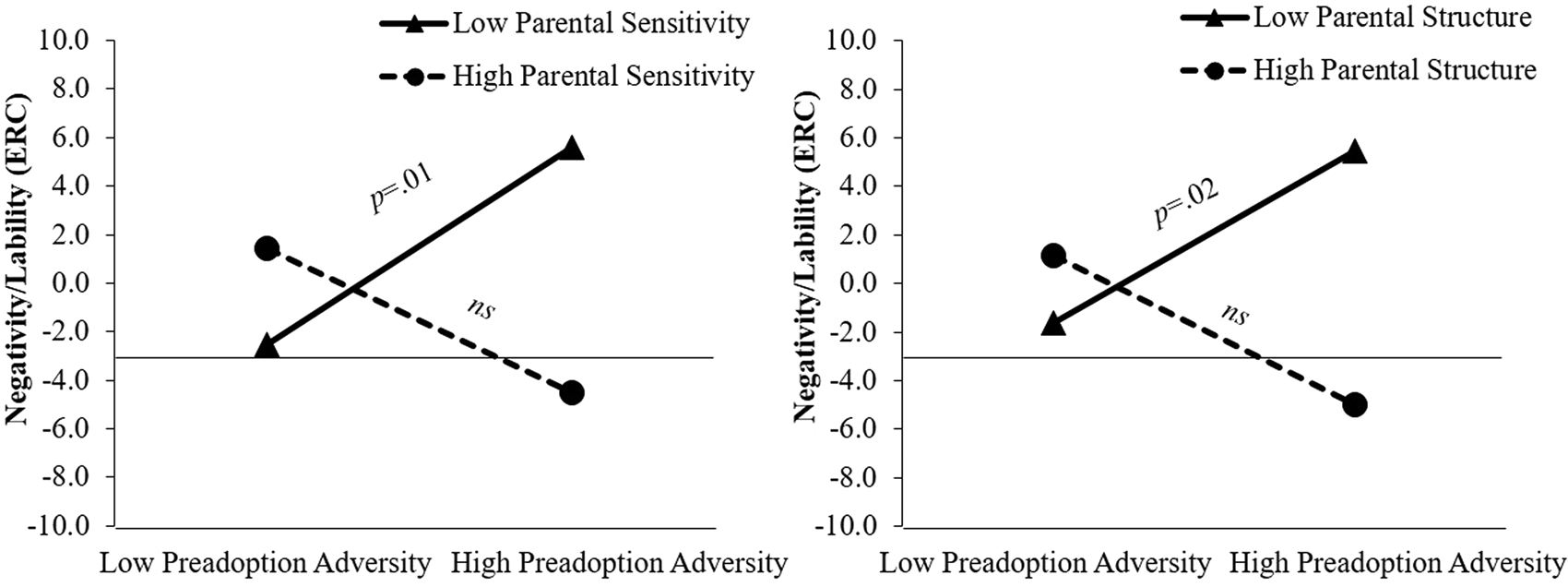
There was a significant interaction detected predicting the lability/negativity emotion regulation scale (Β = –3.93, SE = 1.35, p < .001; see Figure 2). A simple slope test was conducted. At lower levels of parental sensitivity, there was a significant effect of preadoption adversity on children's emotion regulation such that higher levels of preadoption adversity were associated with higher levels of lability/negativity (i.e., worse emotion regulation; slope gradient = 4.55, t = 2.60, p = .01). However, at higher levels of parental sensitivity, this effect was not significant (slope gradient = –3.31, t = –1.67, p = .10), supporting the notion that higher postadoption parental sensitivity buffered against deficits in emotion regulation and trended toward promoting better emotion regulation skills among those who experienced the highest levels of preadoption adversity. Postadoption sensitivity did not moderate the association between preadoption adversity and the remainder of children's outcomes.
Postadoption parental sensitivity/responsiveness and parental structure/limit-setting as a moderator of preadoption adversity and children's emotion regulation (negativity/lability) in postinstitutionalized children. The mean of the latent variable of negativity equals zero. One SD above and below the mean plotted for preadoption adversity and parenting. As a reference, the horizontal line indicates the mean in the outcome for the nonadopted group.

Parental structure/limit setting as a moderator
There was one significant interaction detected between preadoption adversity and parental structure/limit setting predicting the lability/negativity emotion regulation scale (Β = 0.37, SE = 1.27, p < .001; see Figure 2). Similar to the parental sensitivity findings, simple slope analyses indicated that at lower levels of parental structure/limit setting, higher levels of preadoption adversity were associated with poorer emotional regulation skills (i.e., greater lability/negativity; slope gradient = 3.91, t = 2.41, p = .02). This was not the case at higher levels of parental structure/limit setting (slope gradient = –3.34, t = –1.66, p = .10), supporting the notion that parental structure may offset the impact of preadoption adversity on deficits in emotion regulation and trended toward promoting better emotion regulation skills among those who experienced the highest levels of preadoption adversity. Postadoption structure/limit setting did not moderate the association between preadoption adversity and the remainder of the PI children's outcomes.
Consistency in family routines as a moderator
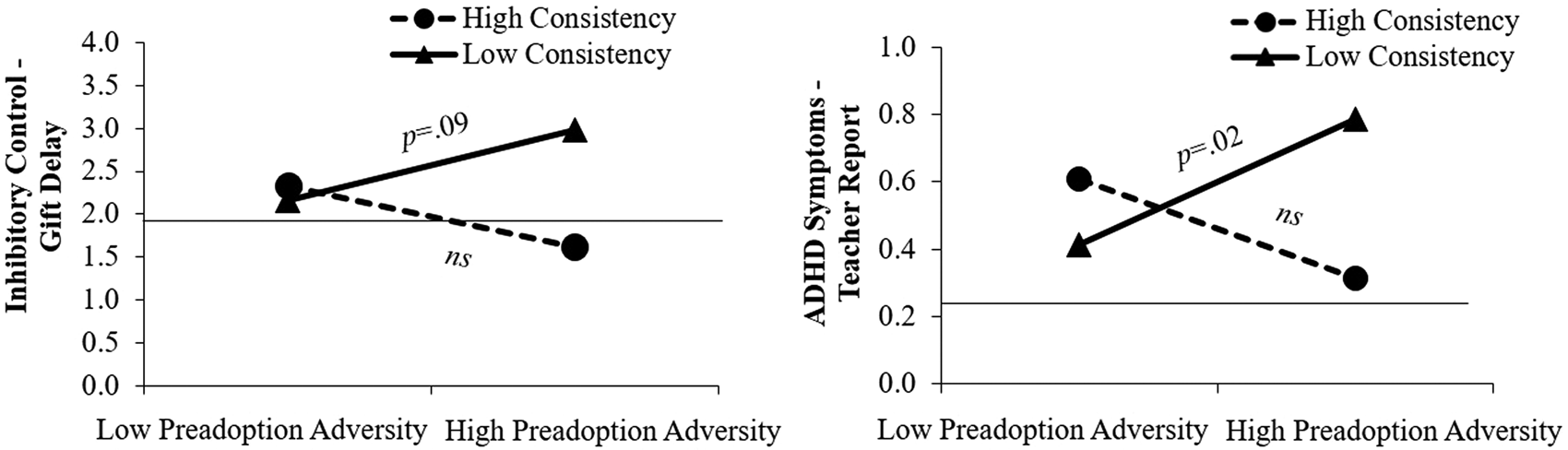
There was a significant interaction between preadoption adversity and consistency in routines predicting inhibitory control in the gift task (Β = 0.42, SE = 0.20, p = .04; see Figure 3). The simple slope analysis for the gift delay task was not significant at 1 SD above or below the mean (slope gradient = –0.39, t = 1.70, p = .09; slope gradient = 0.45, t = –1.38, p = .09, respectively); however, the simple slope analysis was significant at 2 SD, such that higher levels of preadoption adversity were associated with more inhibitory control deficits for children who experienced less consistency in family routines following adoption (slope gradient = 0.86, t = 1.99, p = .05) and a trend for greater consistency (i.e., more predictable routines) offsetting the impact of preadoption adversity (slope gradient = –0.80, t = –1.77, p = .08). In addition, there was a trend for the interaction term predicting ADHD symptoms in kindergarten (Β = 0.17, SE = 0.09, p = .055; see Figure 3). The simple slope analysis for ADHD symptoms indicated that for children who experience less consistency in family routines, higher levels of preadoption adversity were associated with heightened ADHD symptoms (slope gradient = 0.19, t = 2.40, p = .02). In contrast, greater consistency (e.g., more predictable routines) buffered this relation (slope gradient = –0.15, t = –0.98, p = .33).
Postadoption consistency in family routines as a moderator of preadoption adversity and postinstitutionalized children's inhibitory control and ADHD symptoms. One SD above and below the mean plotted for preadoption adversity and consistency in routines. As a reference, the horizontal line indicates the mean in the outcome for the nonadopted group. Gift delay simple slope is significant (p = .05) at 2 SD.

Discussion
The current study sought to examine the extent to which postadoption parenting contributes to individual differences in PI children's regulatory abilities. Parenting was measured objectively over the first 2 years postadoption in children adopted between the ages of 15 and 36 months with self-regulatory abilities measured later in development when children were approximately 5 to 6 years of age. Consistent with past research, we found evidence for group differences (i.e., adoption status) in the majority of the regulatory abilities assessed, including inhibitory control measured by the dinky toys task, working memory, attention measured by go accuracy on the zoo task, teacher-reported ADHD symptoms, and lability/negativity as a measure of emotion regulation difficulties. Paralleling the group differences in regulatory skills, there was also a main effect of the severity of preadoption adversity in the PI group predicting greater inhibitory control deficits, evidenced by performance on the dinky toys task. These regulatory difficulties were evident several years after adoption, suggesting continued problems in the regulatory and executive function domain following early life adversity despite the removal from institutional care. One caveat to this general finding is that these group differences were not evident across all outcomes, including those that tap into the same domain. For example, correlations were low among tasks designed to assess the same broad construct, such as inhibitory control, across both the NA and PI children. McDermott et al. (Reference McDermott, Troller-Renfree, Vanderwert, Nelson, Zeanah and Fox2013) note that different components of inhibitory control may recruit different regions of the brain. As such, it may be that early experiences differentially affect these developing skills. The lack of a group difference on no-go accuracy in this study is consistent with past research demonstrating difficulties among institutionalized children with sustained attention to the task (e.g., go accuracy) but not inhibitory control during the same zoo game for behavioral performance (while PI children do demonstrate inhibitory control difficulties when measured by brain activity; Loman et al., Reference Loman, Johnson, Westerlund, Pollak, Nelson and Gunnar2013; McDermott et al., Reference McDermott, Westerlund, Zeanah, Nelson and Fox2012).
Given the possibility of child effects in eliciting parenting, we also wanted to test whether there was evidence for changes in parenting over the course of the study. Despite the disruptions in bringing a new child into the family, parents demonstrated on average consistent and high-quality caregiving across the study. Parenting was largely stable across this 2-year period in early childhood for most measures of parenting. This is consistent with and extends previous research demonstrating stability in maternal sensitivity during the first 6 months postadoption (van den Dries et al., Reference van den Dries, Juffer, van IJzendoorn, Bakermans-Kranenburg and Alink2012). While parenting was largely stable across the study, there was evidence for slight increases in structure/limit setting; however, these changes did not amount to meaningful increases in terms of qualitatively different parenting on the observational scale. Moreover, parents of PI children did not differ in their parenting quality from parents of NA children across all three dimensions of parenting, including sensitivity/responsiveness, structure/limit setting, and consistency in routines. This finding is in contrast to previous research on differences among of parents of PI and NA children (Garvin et al., Reference Garvin, Tarullo, Van Ryzin and Gunnar2012; Stams, Juffer, Rispens, & Hoksbergen, Reference Stams, Juffer, Rispens and Hoksbergen2000), which demonstrated lower quality parenting in internationally adopting families. One factor that might explain this discrepancy is differences in the internationally adopted populations studied. The population studied by Garvin et al. (Reference Garvin, Tarullo, Van Ryzin and Gunnar2012) was primarily adopted from severely deprived institutions, possibly leading to children with more difficulties and higher demands. It is possible that this led to evocative effects of challenging children evoking harsher or less effective parenting. While our sample of PI children were adopted from institutions, there was wide variety in the length of institutionalization and conditions experienced prior to adoption such as longer periods of parental care prior to institutionalization. This may have resulted in children who were more responsive to parental overtures, leading to increased dyadic mutuality and higher quality parenting. However, timing of assessment may also play a role. The sample examined in Stams et al. (Reference Stams, Juffer, Rispens and Hoksbergen2000) was evaluated at 7 years of age, and they noted that differences in parenting were not evident at earlier time points. It may be that over time, differences in parenting quality emerge. There were also important differences between studies with regard to children's early care. The majority of children in the Stams et al. (Reference Stams, Juffer, Rispens and Hoksbergen2000) study were in the care of a biological parent prior to adoption or spent little time in institutions, marking a notable difference in the quality of early care received that limits direct comparisons. In our sample, the adoptive parents were well educated and highly motivated to parent, which may account for the better than average parenting observed in this study.
Postadoption parenting also moderated the effect of more severe preadoption adversity on children's emotion regulation skills. Both parental sensitivity/responsiveness and structure/limit setting were associated with better emotion regulation skills in PI children. Parental sensitivity/responsiveness and structure/limit setting not only offset the impact of heightened preadoption adversity on emotion regulation difficulties but also trended toward promoting better emotion regulation skills at the highest levels of preadoption adversity, a reversal of the effect at lower levels of postadoption parenting quality. Emotion regulation, in particular, develops in the caregiver–child relationship, and thus sensitive caregiving following early life adversity may be key in contributing to better emotion regulation skills following the lack of sensitive care during infancy. While the observed structure/limit setting variable reflects parents’ ability to provide predictable responses, it also incorporates an affective component, which may account for its relation to children's emotion regulation skills and the high correlation with the sensitivity/responsiveness rating in this study. The parent's ability to remain calm and confident in his/her expectations during noncompliance is reflected in this observational code, which may also reflect the caregiver's own emotion regulation abilities in times of stress such as child noncompliance.
We found evidence for the role of parents’ ability to provide structure and consistency to children's daily lives as an important contributor to children's regulatory abilities. This was evidenced by the main effects of our observational measures of parental structure/limit setting across the sample as a whole as well as by consistency in routines as a moderator of preadoption adversity in the PI children. Although assessed through different measurements and in different settings (e.g., home vs. laboratory tasks), both of these parenting dimensions tap into parents’ ability to structure activities for children that provide consistency and predictability. Several main effects of our observational assessment of parental structure/limit setting were evident across both PI and NA children. This was not the case for the other parenting dimensions. Parents’ ability to structure children's environment for success, set expectations for children's behavior, and respond to noncompliance in a predictable and nonthreatening manner may provide a foundation for children's emerging regulatory abilities. As these main effects were observed for the sample as a whole and the PI group, this type of parenting may contribute to children's regulation both normatively and following adversity in higher risk populations.
Postadoption parenting may also serve to promote recovery in underlying regulatory systems and abilities. Among the PI group, parents’ consistency in routines moderated the effect of more severe institutional adversity on later regulation. For some PI youth, this consistency following early adversity offset the negative effects of adversity and resulted in regulation abilities that reflected more typical development by the time children reached the early school age years. Greater consistency or predictability was associated with better inhibitory control, evidenced by performance on the gift delay task, and lower ADHD symptoms during kindergarten in children who experienced the highest levels of adversity. One potential mechanism for the effect of consistency in routines may in part be the result of changes in children's sleep and bedtime routines. Consistency in routines has been associated with improved toddler sleep (Staples, Bates, & Petersen, Reference Staples, Bates and Petersen2015), and toddler sleep is related to children's self-regulation abilities (Bernier, Carlson, Bordeleau, & Carrier, Reference Bernier, Carlson, Bordeleau and Carrier2010).
While the general trend across the evidence in the present study supports the notion that greater consistency in family routines confers positive influences on children's regulation skills, there was an unexpected finding for this measure of parenting. There was a main effect of greater consistency associated with lower performance on the dinky toys task. While structure and predictable routines appear to be important across several findings in the present investigation, on the flip side, consistency may also reach a point where parenting becomes too rigid. A degree of flexibility may be beneficial for children. Previous research finds evidence for curvilinear relations among postadoption parenting and children's attention problems. Audet and Le Mare (Reference Audet and Le Mare2010) found that higher levels of authoritarian parenting were associated with more attention problems for children adopted prior to the age of 5 months but associated with fewer attention problems for children adopted after the age of 48 months. This finding suggests that the type of parenting needed to support the best outcomes for children following early adversity may vary based on children's prior experiences. Additional research is needed to examine whether the extremes of both ends of the continuum of consistency in routines, lack of established routines and rigidity in sticking to routines, both contribute to poorer regulation skills.
It may also be that greater consistency in routines is a parent's response to a child with poorer inhibitory control as evocative effects of child behavior have been found to influence parenting. The possibility of children's influence on parenting has long been considered (Bell, Reference Bell1968). Less research has examined these effects within internationally adopting families. Two studies that tested the directionality between observed parenting and child behavior (e.g., behavioral regulation and attention skills) longitudinally did not find support for the influence of child behavior after adoption on parenting (Audet & Le Mare, Reference Audet and Le Mare2010; Lawler et al., Reference Lawler, Koss and Gunnar2017). However, the possibility for child evocative effects may encompass child behavior not measured directly in this previous research. For example, as in our previous work (Lawler et al., Reference Lawler, Koss and Gunnar2017), we find that children's preadoption experiences were associated with initial parenting. Higher quality care in the institution was associated with higher levels of sensitive parenting and more structure and limit setting after adoption. Children adopted out of institutions that provide higher quality of care may have fewer problems and be easier to parent. Due to their previous individualized interactions with caregivers, children who received higher quality social care in particular may be more adept at evoking more sensitive and effective caregiving during this transition to parenting. What signals or behaviors may elicit this parenting is unknown; however, our previous research suggests it is not through children's behavioral regulation captured in a laboratory setting (Lawler et al., Reference Lawler, Koss and Gunnar2017). Further research is needed to ascertain the direction of effects among parenting and these child behaviors and the specific child signals that elicit parenting.
These results have implications for interventions designed to improve outcomes for children still in institutions as well as those fostered or adopted out of institutions. First and foremost, the group differences (i.e., adoption status) and preadoption adversity findings further support calls to reduce the use of institutional care for children (Dozier, Zeanah, Wallin, & Shauffer, Reference Dozier, Zeanah, Wallin and Shauffer2012; McCall, Reference McCall2011). Along with other research, these findings also support the need to increase the quality of care children receive in institutional settings. The caregiving relationship early in life lays the groundwork for emerging regulation skills. Previous research to increase the quality of caregiving in institutions by making them more family-like has been found to improve outcomes for still-institutionalized youth and has allowed those who are later adopted to function better in their new families (Hawk et al., Reference Hawk, McCall, Groark, Muhamedrahimov, Palmov and Nikiforova2018; McCall et al., Reference McCall, Groark, Hawk, Julian, Merz, Rosas and Nikiforova2019).
Second, main effects of postadoption parenting within the PI group suggest that all parents adopting a child internationally should be given guidance in appropriate limit setting and how to properly structure the environment for their child. These skills appear to improve several domains of self-regulation regardless of the level of preadoption adversity. The majority of existing preadoption preparatory programs are run by adoption agencies, and the content, format and effectiveness of such programs are unknown (Welsh, Viana, Petrill, & Mathias, Reference Welsh, Viana, Petrill and Mathias2007). Existing evidenced-based interventions such as the Incredible Years (Webster-Stratton & Reid, Reference Webster-Stratton, Reid, Weisz and Kazdin2017) teaches parents how to set limits and establish clear household rules and routines. Previous research demonstrates its effectiveness in reducing rates of attention problems (Jones, Daley, Hutchings, Bywater, & Eames, Reference Jones, Daley, Hutchings, Bywater and Eames2007). The Incredible Years has been adapted for other high-risk populations such as for families involved in the child welfare system and foster parents (Webster-Stratton & Reid, Reference Webster-Stratton and Reid2010). Programs like the Incredible Years could potentially be adapted to be a good fit for this population, but future research is necessary to test this hypothesis.
Third, targeted intervention should be provided for parents of children exposed to the highest levels of preadoption adversity, including children who experience long durations of institutionalization and poorer preadoption care. This indicated intervention should focus on both structure/limit setting/consistency and sensitivity as each domain appears to moderate different regulation-related outcomes. No parenting intervention that we are aware of directly targets all of these areas in tandem. Dozier and colleagues’ Attachment and Biobehavioral catch-up (ABC) intervention is designed to improve children's self-regulation and focuses primarily on sensitivity and contingent responsiveness (Dozier, Bernard, & Roben, Reference Dozier, Bernard, Roben, Steele and Steele2017). This intervention has been found to improve emotion regulation (Lind, Bernard, Ross, & Dozier, Reference Lind, Bernard, Ross and Dozier2014) and executive function (Lind, Raby, Caron, Roben, & Dozier, Reference Lind, Raby, Caron, Roben and Dozier2017) in child-welfare involved families, and has also been used successfully in internationally adopting families (Caron, Weston-Lee, Haggerty, & Dozier, Reference Caron, Weston-Lee, Haggerty and Dozier2016). Specifically, the ABC intervention has been shown to improve parental sensitivity and positive regard and reduce intrusiveness in internationally adopting parents (Yarger, Bernard, Caron, Wallin, & Dozier, Reference Yarger, Bernard, Caron, Wallin and Dozier2019). Our results indicate that effects of the ABC intervention could potentially be bolstered by additional guidance surrounding structure and consistency.
Fourth, in addition to providing adoptive parents with skills to better their parenting abilities directly, caregivers may benefit from supports to reduce the stress they experience during the transition. Previous research demonstrates that some adoptive parents may experience increased parenting stress (Canzi et al., Reference Canzi, Ranieri, Barni and Rosnati2019). Moreover, increased parenting stress in internationally adopting parents is associated with their own rates of depressive symptoms and perceptions of children's behavioral difficulties (Judge, Reference Judge2004; Viana & Welsh, Reference Viana and Welsh2010). As parenting stress can inhibit parents’ ability to be an effective caregiver, adoptive parents may benefit from additional support programs to manage their own stress and reduce depressive symptoms as well as manage their child's behavioral difficulties both prior to and following adoption to reduce the stress they experience during this transition.
There are several limitations that warrant consideration. We do not have objective ratings of children's preadoption experiences. Duration of institutionalization may reflect approximations of children's time in an institution dependent on the accuracy of information provided to parents from children's records. As such, there inherently is a degree of measurement error in all of our preadoption measures. Our latent measure of preadoption adversity also included ratings of the quality of the institutional settings that were based on parents’ answers to questions about what they observed when they adopted their child from the institution. Thus, they may reflect limited knowledge of these settings, and further, generally reflect children's last care setting and not the totality of early care environments the child may have experienced prior to arrival at the institution from which they were adopted. Nevertheless, these institutional care ratings may provide additional information about children's preadoption experiences beyond length of institutionalization alone. Results from our larger longitudinal study are consistent with the findings here that demonstrate that the quality of institutional care explains additional variance in PI children's behavioral and biological outcomes (Koss, Hostinar, Donzella, & Gunnar, Reference Koss, Hostinar, Donzella and Gunnar2014; Lawler, Koss, Doyle, & Gunnar, Reference Lawler, Koss, Doyle and Gunnar2016; Lawler et al., Reference Lawler, Koss and Gunnar2017). In addition, our measure of consistency of family routines was derived from 3 days of diary reports that may not capture family routines more generally. Although our measures of parenting were drawn from observations of parent–child interactions, these only provide a small window into their parenting abilities demonstrated in the laboratory setting. While the structure and limit setting rating was designed to be independent of children's compliance, it may be that aspects of children's behavior elicit less optimal structure and limit setting during the interaction. The majority of primary caregivers in this study were female, which limits the generalizability of findings to fathers’ and non-primary caregivers’ parenting during the transition to family care. Despite these limitations, the present investigation is strengthened by the use of multiple measures and multiple reporters across this prospective longitudinal study.
These findings have important implications for offsetting the effect of adversity on psychopathology. Children's regulation abilities have been implicated as a mechanism for a broad range of problem behaviors and psychopathology across development (Vohs & Baumeister, Reference Vohs, Baumeister, Baumeister and Vohs2004). The ability to improve children's regulation skills early in life even after the experience of substantial adversity has the potential to disrupt developmental cascades that place children on pathways toward psychopathology. Even after the lack of high-quality care during infancy, parenting during toddlerhood may promote positive influences in shaping children's regulation abilities. These findings have the potential to inform research and practice for parenting children who experience adversity early in life, including foster families and domestically adopting families with children who experience early adversity prior to entering their care. The evidence in this study suggests that interventions targeting both parental sensitivity/responsiveness and parental consistency and structure may improve outcomes in regulation abilities following early life adversity.
Acknowledgments
We would like to express our gratitude to the families and teachers for their participation in this research, the International Adoption Project staff at the University of Minnesota, and the parenting coders and child observers for their contribution to the data presented.
Financial Support
Grant support was provided by R01 MH080905 and P50 MH078105 (to M.R.G.) and by NIMH training grants T32 MH018921 and T32 MH15755 (to K.J.K.).