





Introduction
The radiotherapy workforce represents a highly specialised and skilled group of professionals, central to the treatment of more than 50% of cancers in the UK. 1,Reference Aggarwal, Choudhury and Fearnhead2 Rising cancer prevalence and advancements in treatment have heightened the demand for radiotherapy services, placing sustained pressure on the existing workforce Reference Nightingale, Sevens and Appleyard3 and contributing to challenges of retention and staff burnout. 1,4,5 Ensuring the sustainability and resilience of this workforce requires a deeper understanding of professional experiences, alongside strategies that support retention, development and job satisfaction.
In 2023, a shortfall of 582 (∼9%) whole-time equivalent (WTE) staff was reported across the radiotherapy profession. 1,4–6 This contributes to 92% of cancer centres experiencing delays in treatment, and 85% of Heads of Service are concerned about the impact on patient safety. 4 While professional bodies’ censuses suggest that vacancy rates across radiotherapy professions are lower in the North West than nationally, 4–6 regional services continue to experience challenges in recruitment, retention and vacancies.
The impact of these challenges on the radiotherapy workforce has been reported previously, Reference Nightingale, Sevens and Appleyard3,4,7 and 100% of radiotherapy service leaders report concerns of low staff morale and burnout due to workforce shortages. 4 Studies have found a high incidence of burnout among oncologists, Reference Joaquim, Custódio and Savva-Bordalo8 and earlier studies found a prevalence of >35% among therapeutic radiographers (TR) Reference Probst, Griffiths and Adams9,Reference Hutton, Beardmore and Patel10 which can have a negative impact on patient care. Evidence also highlights the association between burnout and compassion fatigue with patient care and demonstrates that both are harmful to care quality. Reference Joaquim, Custódio and Savva-Bordalo8,Reference Hutton, Booker and Shuttleworth11
A third of TR self-reported being stressed, Reference Arnold, Loan-Clarke and Coombs12 with feelings of ‘disillusionment’ and ‘boredom’ attributed to limited progression opportunities. Reference Nightingale, Sevens and Appleyard3 Among physicists, higher levels of job satisfaction have been recorded relative to other professional groups, but workplace stress related to ‘time pressures’, ‘poorly defined responsibilities’ and a ‘reduction of private life due to high workload’ remain evident. Reference Sehlen, Vordermark and Schäfer13 Professional bodies have also found that staff are leaving the workforce earlier, with over a third of consultants exiting in 2023 under 45 years old. 4 For those later in their career, both workplace stress and insufficient support can exacerbate burnout and contribute to premature retirement. Reference Nightingale, Sevens and Appleyard3
This article reports on research undertaken to gain new insight into the experiences of professionals working in radiotherapy across North West (NW) England, focusing on job satisfaction, burnout and related factors. Staff from Lancashire Teaching Hospital NHS Foundation Trust, The Christie NHS Foundation Trust and The Clatterbridge Cancer Centre NHS Foundation Trust were invited to share their experiences, with all trusts anonymised from this point forward.
Methods
Study design
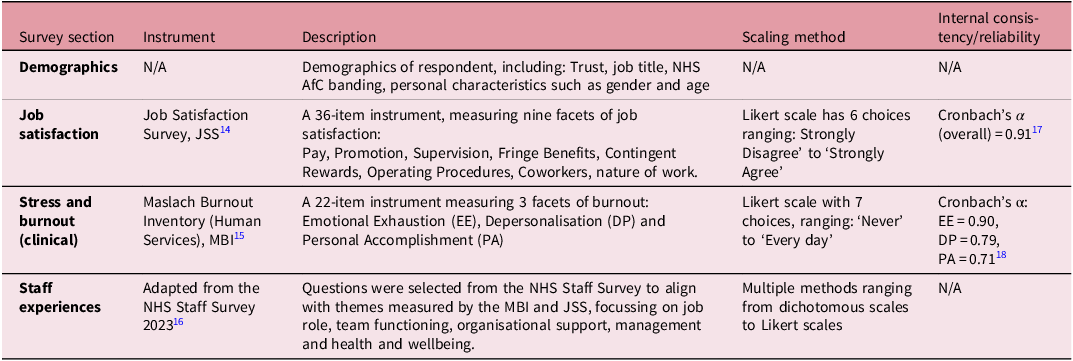
This study employed a quantitative survey design, structured into four sections (Table 1): (1) Personal Information, (2) the Job Satisfaction Survey (JSS), 14 (3) the Maslach Burnout Inventory Human Services (MBI) Reference Maslach, Jackson and Leiter15 and (4) selected items from the 2023 NHS Staff Survey (Supplementary Materials 1), 16 produced using Microsoft Forms. A free-text response option was included in each section to allow participants to elaborate on their experiences and provide additional qualitative insights.
Survey construction, including description of instruments used in each section, with scale used and internal consistency and reliability details

The survey tools are established, psychometrically validated instruments with strong internal consistency across diverse populations (Table 1). Validated instruments are particularly valuable when investigating abstract or hypothetical constructs and facilitate meaningful comparisons with previously studied cohorts. The instruments chosen were consistent with the 2012 national radiotherapy workforce survey by Hutton et al., where the rationale of choosing these instruments is discussed. Reference Hutton, Beardmore and Patel10 Questions from the NHS staff survey were selected to match the facets of the JSS and MBI.
The survey was piloted with eight staff members representing multiple professional groups across the three NW radiotherapy centres, allowing for assessment of survey accessibility and estimation of completion time (approximately 15 minutes—comparable to similar national staff surveys). The final survey was distributed over a four-week period (2nd–29th September 2024), timed to avoid overlap with other surveys in circulation, reducing the risk of confusion and survey fatigue.
Participants
The study targeted all qualified professionals within the Radiotherapy Workforce in NW England, spanning three radiotherapy providers across 8 sites. Participation was voluntary, and responses were anonymous. Participants were asked to indicate the centre where they worked to enable comparative analysis, with a ‘prefer not to say’ option available for any personal information questions to protect participant confidentiality.
Data collection
Survey distribution was facilitated via email invitations to Radiotherapy Service Managers, Heads of Physics and lead Clinical Oncologists, as well as departmental ‘Champions’ within each centre. These Champions were responsible for cascading the survey to colleagues and encouraging participation. Posters featuring QR codes were also displayed in communal areas to increase accessibility. Participant information and debriefing sheets accompanied each survey invitation, outlining the study purpose and guidance on where to seek support, particularly given the sensitive nature of some questions.
The survey received ethical approval from the University of Liverpool ethics committee. NHS ethics approval was not required. All data were managed by a core research team in accordance with high ethical standards, ensuring confidentiality and data integrity.
Data analysis
Survey responses were anonymised at the point of submission. Quantitative data from the JSS, MBI and NHS Staff Survey were analysed to identify trends and patterns across the workforce and between the three providers. The inclusion of free-text responses enabled conventional content analysis to enhance interpretation of the quantitative findings. Comparative analyses were conducted to examine alignment with national benchmarks, comparative norms and previous survey results. Reference Hutton, Beardmore and Patel10
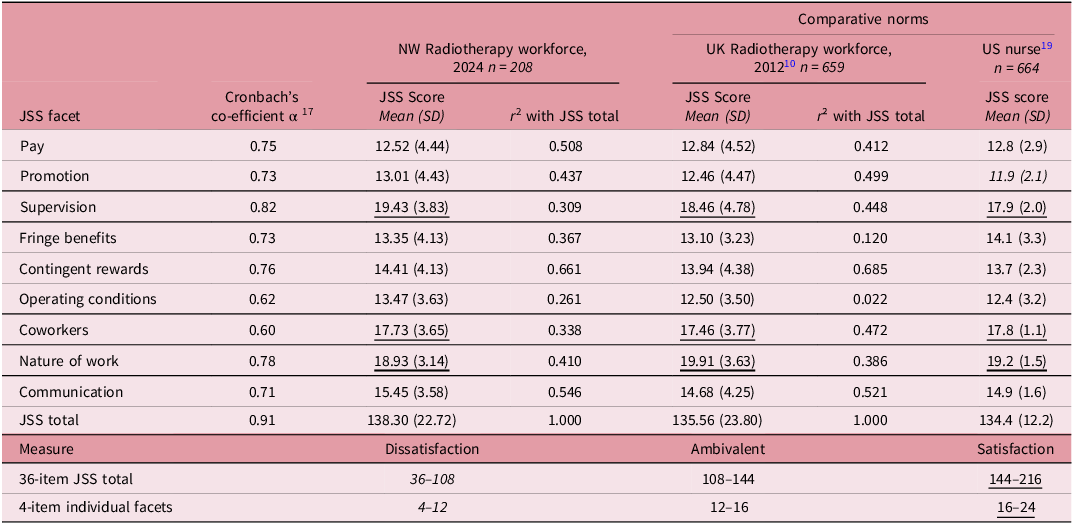
The JSS measures job satisfaction along a continuum from dissatisfied to satisfied. Likert scale scores were employed (with 1 indicating strong disagreement and 6 strong agreements). Values were summed to produce overall scale totals, acknowledging that the ordinal data serve to rank responses rather than convey precise quantitative differences. This applied an absolute approach to classify participants as satisfied, ambivalent or dissatisfied and complemented this with a normative comparison against available reference population data. This is outlined in Table 3.
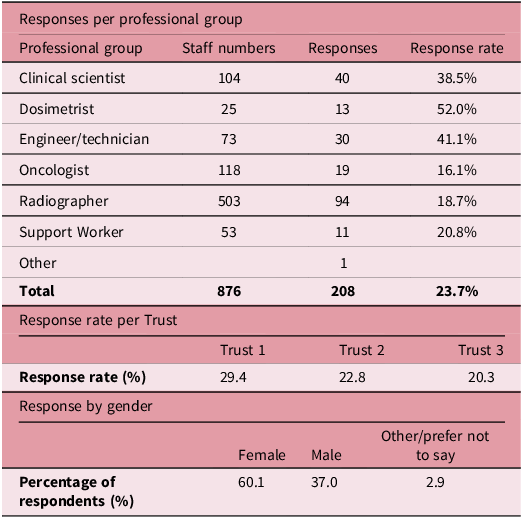
Numbers of responses and response rates by professional group and Trust

JSS data, with key to dissatisfaction/ambivalence/satisfaction

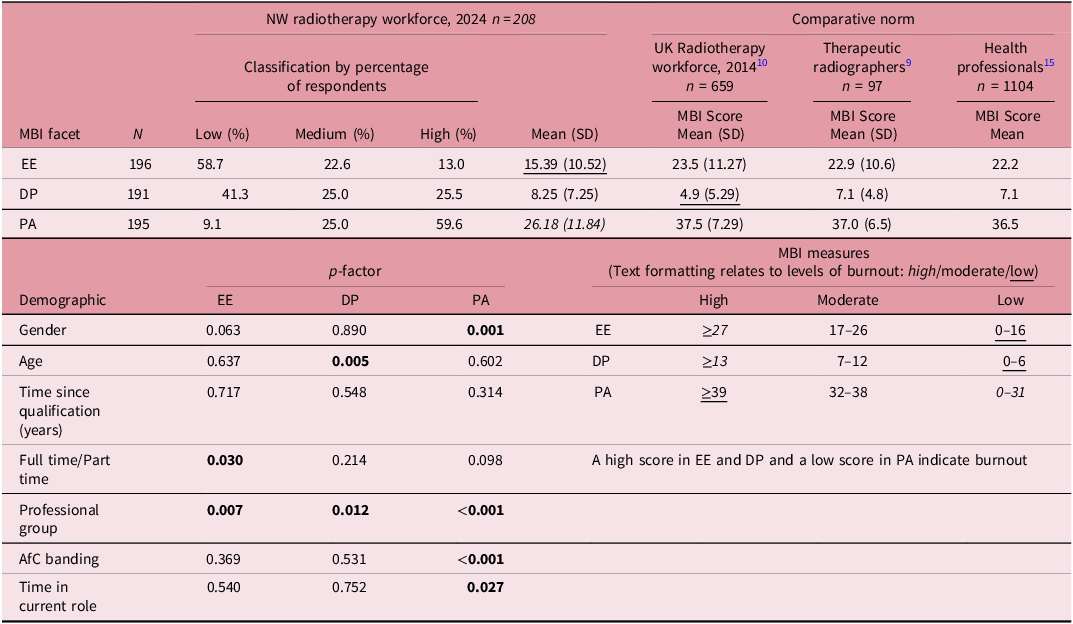
For MBI data, an absolute approach coupled with normative comparison data was adopted, as seen in Table 4.
MBI results. Including: overall results compared to norm data, significance of MBI facets on demographic data (p-factor from independent-samples Kruskal–Wallis test, significant results in bold) and key to MBI measures

Table 4. Long description
The table compares the NW radiotherapy workforce in 2024 with various comparative norms using MBI facets and demographic data. It includes classification by percentage of respondents, mean scores, and p-factor significance. The table is divided into sections for MBI facets and demographic data. Row 1: EE, 196, 58.7, 22.6, 13.0, 15.39 (10.52), 23.5 (11.27), 22.9 (10.6), 22.2. Row 2: DP, 191, 41.3, 25.0, 25.5, 8.25 (7.25), 4.9 (5.29), 7.1 (4.8), 7.1. Row 3: PA, 195, 9.1, 25.0, 59.6, 26.18 (11.84), 37.5 (7.29), 37.0 (6.5), 36.5. Demographic data includes gender, age, time since qualification, full time/part time, professional group, AfC banding, and time in current role. Significant p-factor values are bolded.
Statistical methodology
Statistical analysis was performed using SPSS version 29, IBM Corp. Released 2023. IBM SPSS Statistics for Windows, Version 29.0.2.0 Armonk, NY: IBM Corp.
The Mann–Whitney test and Kruskal–Wallis test were applied to assess Statistical significance for continuous nonparametric data when comparing two groups and more than two groups, respectively. For categorical variables, the Chi-square (χ2) test was used. R 2 statistics were employed to describe the strength of association between individual JSS facets and the overall total score.
Results
Participant demographics
Response numbers and rates for professional group and Trust are shown in Table 2. There was an overall response rate across the population of 23.7%, with representation from colleagues at all career stages, across all staff groups.
All respondents indicated their staff group and 4 declined to provide information about their employer (2x engineers, 1x support worker, 1x oncologist)
JSS findings
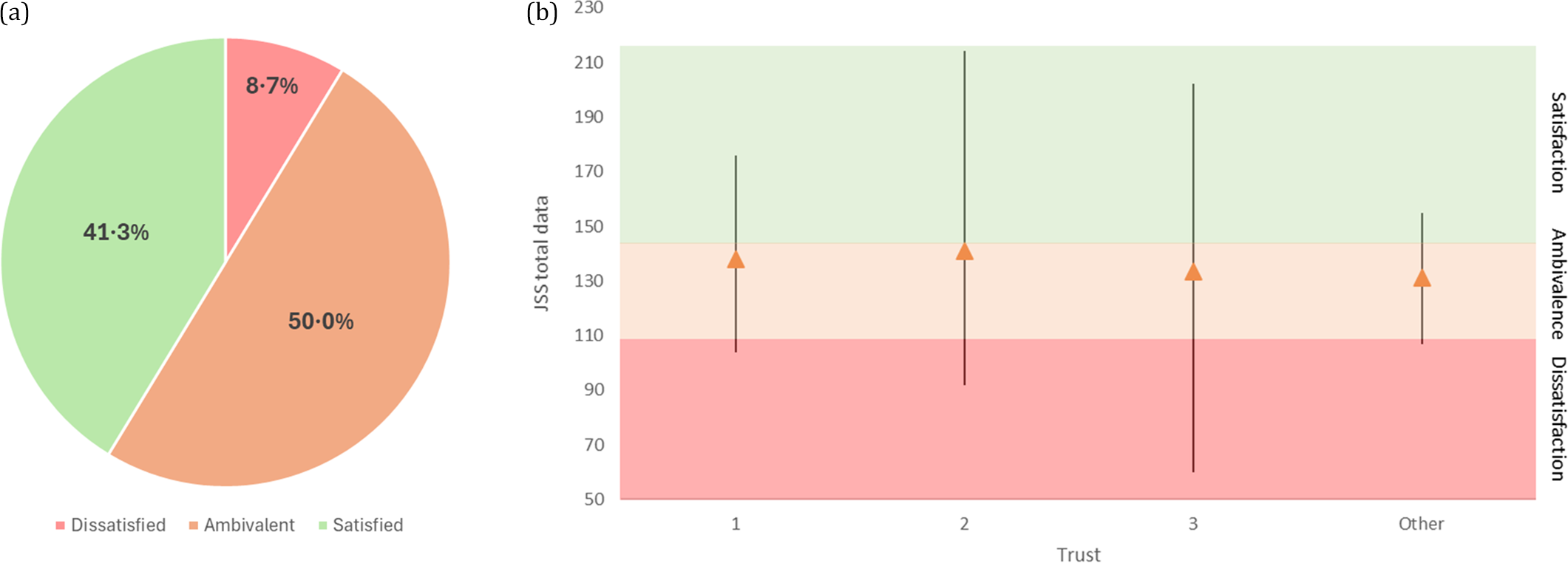
As shown in Figure 1a, only 41.3% of respondents reported being satisfied with their job. When comparing mean JSS scores between Trusts (Figure 1b), no significant difference was found (p = 0.410), with all Trust mean values indicating staff ambivalence. The range of JSS scores for each Trust must be noted, with scores for Trusts 1 and 2 predominantly in ambivalence/satisfaction, and only reaching a short distance into dissatisfaction. However, Trust 3 JSS scores reach high into satisfaction, and low into dissatisfaction.
(a) Levels of job satisfaction in the NW radiotherapy workforce; (b) mean JSS score by Trust. ‘Other’ represents staff who chose not to disclose information about their employer.

Considering professional groups (Figure 2), there was a significant difference in job satisfaction (p = 0.026), with dosimetrists and oncologists reporting higher levels of job satisfaction than other groups.
Total JSS score for professional groups. A higher score suggests higher levels of job satisfaction.

Overall scores for the individual facets of the JSS are shown in Table 3, with comparison to two comparative norms. Reference Hutton, Beardmore and Patel10,14 JSS scores for each facet are comparable to those in a previous national Radiotherapy workforce survey. Reference Hutton, Beardmore and Patel10
A statistically significant difference in satisfaction with promotion opportunities between Trusts (p = 0.002) was observed. Trusts 1 and 2 were ambivalent and Trust 3 dissatisfied (mean 12.94, 13.96 and 10.98, respectively). A highly statistically significant difference (p < 0.001) was found when comparing only Trusts 2 and 3.
R2 statistics were employed to assess the strength of association between individual facets of the JSS and overall score (Table 3). Areas which contribute most to the overall score are pay, contingent rewards and communication. Operating conditions have the lowest r 2 value of 0.261 in the current survey; however, this has increased from 0.022 in 2014 suggesting that operating conditions are becoming more of a factor on job satisfaction.
Free-text responses relevant to the individual facets of the JSS are included in Supplementary Materials 2.
MBI findings
The mean MBI scores for respondents show low emotional exhaustion (EE), moderate depersonalisation (DP) and low personal accomplishment (PA) (Table 4). There is no statistically significant difference in MBI score between Trusts.
EE levels reported in the current survey are lower than all comparative norms (Table 4). Of particular interest is the decrease in EE when compared to the national 2012 survey. Reference Hutton, Beardmore and Patel10 Although the mean MBI score has decreased, it is important to note the range of scores for this facet: 0–42, indicating that levels of EE range from very low to very high.
Working hours have a significant impact on EE, with staff working less than full-time reporting lower levels of EE (mean MBI score 12.60) than full-time colleagues (16.14), although both groups report low EE on average.
MBI scores per professional group are shown in Figure 3a. With the exception of TR, who experience moderate EE, all staff groups report low EE. A significant difference between levels of EE was identified between TR and dosimetrists, who reported the highest and lowest levels of EE of all staff groups, respectively. No significant differences were observed between other groups.
Box plots for MBI scores which showed significant variation when analysed using the independent-samples Kruskal–Wallis test. (a) EE by professional group, (b) DP by age group, (c) DP by professional group and (d) PA by professional group. The coloured regions indicate high/medium/low levels of burnout for red/orange/green, respectively.

Levels of DP have increased when compared to the 2012 survey Reference Hutton, Beardmore and Patel10 but are comparable to other comparative norms Reference Probst, Griffiths and Adams9,Reference Maslach, Jackson and Leiter15 (Table 4). Respondents in the age group 26–30 displayed a significantly higher level of moderate DP (mean MBI score 11.60) than other age groups (7.57), Figure 3.
All staff groups report low or moderate levels of DP (Figure 3c). A significant difference in DP was identified between TR and Engineer/Technicians, who reported the highest and lowest levels of DP, respectively. No significant differences were observed between other groups.
The mean MBI scores for the PA facet are lower than all comparative norms (Table 4), indicating a decrease in PA since the 2012 survey. Reference Hutton, Beardmore and Patel10
Male respondents reported significantly lower PA than females (mean MBI scores 22.40 and 28.68, respectively). Significant variation in PA was reported with respect to Agenda for Change (AfC) banding (lower PA experienced by Bands <5 and >8D) and time in current role (lower PA experienced by <6 and >10 years).
A variation in PA is observed between professional groups, with oncologists, support workers and TR displaying a significantly higher level of PA than clinical scientists, dosimetrists and engineers (mean MBI scores of the two groups: 33.70 and 16.59), as shown in Figure 3d.
Free-text responses relevant to the individual facets of the MBI are included in Supplementary Materials 2.
NHS staff survey findings
Table 5 presents key findings from the NHS staff survey. Marked variation was observed between Trusts in perceptions of flexible working, safety to raise concerns and intention to leave (Trust 1 most positive, Trust 3 most negative), as well as willingness to recommend their organisation for care (Trust 3 most positive, Trust 1 most negative).
A representative sample of NHS Staff Survey results. Percentage of respondents who gave a positive response (‘Strongly agree’ or ‘agree’) to the statements. Statements with significant variation (identified with a χ2 test) between results from different Trusts are shown in bold. Quotes taken from the free-text response questions in the survey are also included for each statement where possible

Table 5. Long description
The table presents key findings from the NHS staff survey, comparing perceptions across three trusts. It includes statements about job enthusiasm, initiative opportunities, ability to make suggestions, improvements, staffing levels, meeting demands, adequate materials, pay satisfaction, knowledge development, learning access, potential support, flexible working satisfaction, manager approachability, safety to raise concerns, thoughts of leaving, and recommendation of the organization. The table has 20 rows and 6 columns, with column headers Overall, Trust 1, Trust 2, Trust 3, and Chi-Square Test. Each row corresponds to a statement, with percentages indicating positive responses. Notable trends include significant variations in perceptions of flexible working, safety to raise concerns, and intention to leave, with Trust 1 being the most positive and Trust 3 the most negative. Additionally, Trust 3 is the most positive about recommending the organization for care, while Trust 1 is the most negative. Quotes from free-text responses are included for each statement where possible.
Only 37.1% of respondents felt able to meet all work demands, and 30.4% believed staffing levels were adequate (Trust 1 only 12.8%). Consequently, 75.5% reported weekly overtime, contributing to 41.4% feeling worn out after shifts, 31.7% lacking energy for family or friends, and 22.1% feeling exhausted before another shift. These pressures may explain the 33.2% satisfied with pay, 29.4% considering leaving, and 58.2% who would recommend their organisation as a workplace. Additionally, 42% reported work-related stress in the past year and 47% worked while unwell.
Figure 4 shows proportions of respondents experiencing unwanted behaviour within the last 12 months. All reports of unwanted sexual behaviour from colleagues came from Trust 2, while incidents from patients were evenly distributed and generally infrequent. 27% of affected staff reported six or more occurrences. Rates were comparable to the 2023 national survey. 20
Unwanted behaviour experienced by respondents from colleagues and patients/service users in the last 12 months. (a) Behaviour of a sexual nature, (b) abuse (including physical violence, harassment and bullying), (c) discrimination across a range of grounds.

Among those experiencing abuse, most frequently affecting staff aged 20–30, 45.8% did not report or were unsure if it had been reported. Discrimination was reported mainly by women (68%) and was lower than national levels. 20
Despite these challenges, 78.3% described their team as kind, 80.7% as respectful and 74% as appreciative, with over half looking forward to work and more than 70% reporting opportunities for initiative and skill development.
Discussion
The study yielded a RR of 23.7% of the population, from all sites in the NW and all professional groups and AfC bandings, with lower response rates seen in TR (18%) and CO (16%). This is an improvement on a previous national study (16%), following a similar methodology. Reference Hutton, Beardmore and Patel10 While no consensus exists quantifying an adequate RR, Kiess and Bloomquist state that an RR of 60% (of the sample) is required to account for the bias of voluntary sampling. Reference Kiess and Bloomquist21 However, this is countered by others, Reference Curtin, Presser and Singer22–Reference Peytchev26 with Pernerger et al, stating that greater survey participation has minimal influence on conclusions. Reference Perneger, Chamot and Bovier27
A risk exists that voluntary response sampling may over sample people who have more extreme opinions and consequently under sample those with milder attitudes. Reassuringly, the results, for both validated surveys, report the full spread of data suggesting a range of views were represented. This study provides new insights into the experiences and perceptions of the NW radiotherapy workforce. The findings echo earlier national survey data, suggesting that levels of job satisfaction have remained largely static over the last decade. While staff continue to derive meaning and fulfilment from direct patient care, particularly through supportive colleagues and the intrinsic value of their work, this satisfaction is offset by high levels of emotional strain, limited opportunities for career progression, and concerns about workforce sustainability.
The coexistence of pride in the quality of care delivered with ambivalence about the profession as a long-term career is an urgent and concerning finding. Compared with the 2023 NHS Staff Survey, NW colleagues were more likely to express confidence in the standard of care patients receive. Yet paradoxically, they were less likely to recommend their trust as a place to work. This divergence suggests that the workforce is making significant personal sacrifices to maintain standards of care, with possible repercussions for staff wellbeing and long-term retention. In line with MBI findings, although EE has decreased since 2012, DP has risen and perceived PA has declined. These results highlight the duality of radiotherapy work, which is deeply rewarding in patient-facing interactions, but emotionally depleting over time.
Younger colleagues, aged 26–30, reported higher levels of depersonalisation than other age groups. Prolonged clinical facing roles with accompanying workforce and pay pressures and the prevalence of abuse in this age group may explain the erosion of compassion and increased cynicism reported in free-text comments. These findings reinforce the need for targeted early-career support to protect against compassion fatigue and sustain motivation.
Overtime emerged as a factor in shaping job satisfaction and contributing to burnout, reflecting chronic understaffing and service demands, with one in four staff reporting avoiding additional hours. Paid overtime highlights the routine reliance on staff beyond contracted hours, while unpaid overtime reflects an ingrained culture of goodwill that masks chronic understaffing.
Workforce shortages pose a challenge for staff wellbeing. Although vacancy rates in the North West are lower than national averages, 30.4% of colleagues still feel there are not enough staff to do their jobs properly, highlighting that workforce capacity cannot be measured by vacancy data alone. The finding that 29.4% of staff are considering leaving their role, with 45.8% of these (over 13% of the workforce) leaving the NHS or healthcare altogether, underscores the urgency of robust workforce modelling that reflects both the complexity of contemporary radiotherapy practice and the demands of emerging technologies. Capacity planning should extend beyond headline staff numbers to account for skill mix, evolving roles and the time required for increasingly complex treatment protocols. Workforce models must also incorporate the growing emphasis on personalised care including provision for late effects services.
Career progression also surfaced as a source of dissatisfaction. More than half of respondents felt they lacked professional development opportunities, contributing to frustration, disengagement and in some cases the intention to leave the profession. These findings align with earlier research, Reference Hutton, Beardmore and Patel10 which demonstrates the centrality of professional development as a retention strategy. Encouragingly, new initiatives such as the Aspirant Cancer Career and Education Development (ACCEND) programme may help mitigate these effects. Radiotherapy networks are well-positioned to review existing development pathways, ensuring equitable access to training and progression opportunities across the workforce.
The survey identified cultural challenges. Despite the presence of ‘speak up’ frameworks, staff expressed scepticism about the impact and consequences of raising concerns, fearing damage to workplace relationships or experiencing indifference from senior management. Such perceptions may challenge psychological safety and contribute to disengagement. Ensuring that existing policies on bullying, discrimination and harassment are consistently enacted, alongside proactive efforts to foster a supportive culture, will be essential to enhancing trust. Use of validated measures such as the Culture of Care Barometer (CoCB) could provide organisations with a more nuanced understanding of workplace culture, complementing existing NHS staff survey data. Reference Coughlin, Hutton, Hancock and Hutton28
Despite these challenges, the free-text responses provide an important counterbalance, highlighting the deep sense of privilege and meaning derived from supporting patients through radiotherapy treatment. This sense of vocation remains a powerful motivator and may act as a protective mitigation against burnout. However, it should not be relied upon as a substitute for addressing systemic challenges. Resilience-building initiatives can play a role, but should be coupled with organisational reform. For example, realistic workload allocation, improved career structures and cultural change. There is a risk that resilience becomes another expectation placed on already overstretched individuals.
These findings point to a couple of priorities. First, radiotherapy service providers and radiotherapy networks must collaborate on comprehensive workforce planning, aligning capacity with demand and ensuring equitable access to development opportunities. Secondly, attention must be paid to sustaining the intrinsic motivators that keep staff engaged such as patient care, teamwork and professional pride, while removing the systemic barriers that undermine long-term retention.
Recommendations
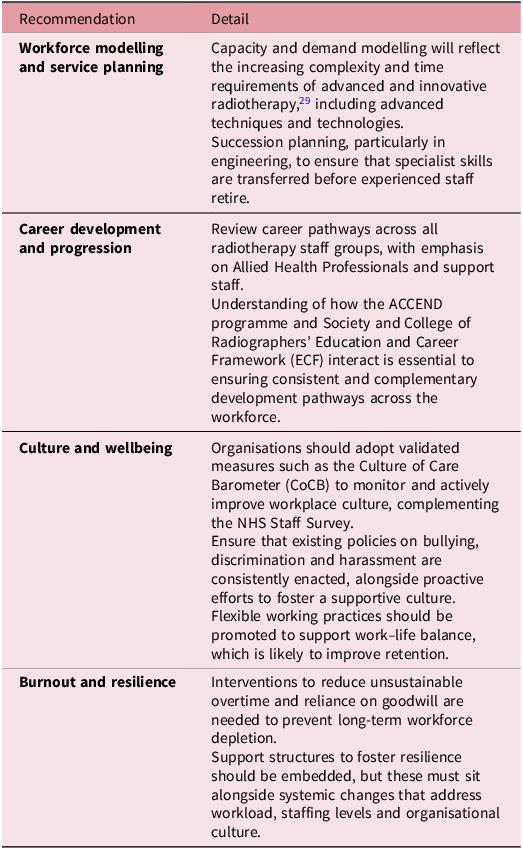
Addressing the workforce challenges highlighted in this study requires coordinated action across trusts, radiotherapy networks, and national workforce planners. A holistic approach to workforce planning is essential, moving beyond headcounts to consider the evolving complexity of radiotherapy practice, the increasing demands placed on staff and the need to safeguard both professional development and service sustainability. Specific recommendations are discussed in Table 6.
Recommendations to address the workforce challenges highlighted in this work

Conclusion
While this study provides insight into experience within the radiotherapy workforce, it is acknowledged that the sample is drawn from a single region of the UK. As such, the findings may not be representative outside of the North West. Recognising this contextual limitation is important when interpreting the conclusions and recommendations. Reassuringly, the findings are comparable to the national 2012 study. Reference Hutton, Beardmore and Patel10 Future research incorporating a broader, multi-regional or national sample would help validate and extend these insights.
This survey highlights the tensions inherent in the radiotherapy workforce. A deep sense of pride and fulfilment in delivering high-quality patient care is counterbalanced by chronic pressures that threaten satisfaction and retention. While staff remain committed to their patients, the emotional demands of the role, coupled with limited opportunities for development and unsustainable workloads, are eroding morale and contributing to burnout.
The findings underline that sustaining a person-centred radiotherapy service is only possible if equal care is extended to the workforce delivering it. Strategic workforce modelling, investment in career progression and a genuine commitment to cultural change are urgently required. By valuing and supporting radiotherapy professionals, services can strengthen resilience, improve retention and ultimately ensure that patients continue to receive the timely, high-quality treatment and care.
Supplementary material
The supplementary material for this article can be found at https://doi.org/10.1017/S1460396926100442
Acknowledgements
The authors would like to thank the 208 colleagues who completed the survey, the champions and the North West SSCN Network Oversight Group.
Financial support
This work was supported by the North West Radiotherapy Specialised Services Clinical Network.
Competing interests
The authors declare no conflicts of interest.




 Open access

