1 Introduction
This study explores the expression of the present perfect, a meaning canonically expressed by the have + past participle periphrastic construction, in ten regional varieties of English. Although there is a large body of research on the present perfect in English, most studies are concerned with the distribution of the present perfect and the simple past (see section 2). This article intends to complement such analyses by providing a more holistic picture of the expression of perfect meaning in World Englishes, considering the distribution of all forms used to express this meaning in these varieties, not just the present perfect and the preterite.
The specific focus will be on the different varieties of English currently available in the International Corpus of English project, used either as first languages, such as British English (BrE) and American English (AmE), second-language varieties (such as East African English (EAfE) and Hong Kong English (HKE)), and ESD (English as a second dialect) varieties, such as Jamaican English (JamE). The motivations for using the ICE corpora are discussed in section 3.
In the analysis I make a selection of ten high-frequency verbs by searching all the contexts of perfect meaning in a wide sense, that is, resultative contexts (as in She hasn't arrived yet), experiential contexts (e.g. Have you ever been to Paris?), persistent situation contexts (e.g. He has always been very persistent) and recent-past contexts (e.g. They've just announced it) (Comrie Reference Comrie1976; Winford Reference Winford1993; Klein Reference Klein1994; Tagliamonte Reference Tagliamonte, Fischer, Rosenbach and Stein2000; Huddleston & Pullum Reference Huddleston and Pullum2002: 143) (see section 4.2 for further details on different categories of perfect meaning). The verbs examined are come, finish, get, give, go, hear, see, say, tell and think, verbs that, in a previous study on the co-occurrence of verbs with the perfect-marking adverbials just, (n)ever and yet, were found to be the most frequent (Suárez-Gómez & Seoane Reference Suárez-Gómez, Seoane, Bech and Andersen2013). All the occurrences of these verbs were individually analysed in order (i) to remove from the database those instances that did not express perfect meaning, and (ii) to select the examples of verb phrases expressing present perfect meaning (see section 3 on methodology for further details).
In order to arrive at a more nuanced picture of the expression of present perfect, a host of linguistic factors known to influence the forms in question are analysed, including both intralinguistic and extralinguistic factors. Within the former, the meaning of the perfect (resultative, experiential, recent past and persistent situation) turns out to be a strong predictor of forms for the expression of temporal meaning, with some forms showing an increasing specialization in the expression of particular perfect meanings, but not others. The presence of adverbials also plays a role in the semantic distribution of forms, which seems to support Miller's claim that the meaning of the perfect construction by itself is rather vague, but is made clear by the co-occurrence with adverbs (Miller Reference Miller2000: 335). The presence of adverbials will be discussed in relation to the kind of perfect meaning expressed. Another notable variable is the lexical verb used for the perfect. This allows us to identify potential distributional preferences between specific lexical verbs and the different surface variants used to express perfect meaning with such verbs.
Regarding language-external variables, the impact of mode will be examined, in order to identify differences between written and spoken language and to see whether the non-canonical forms reported for spoken language have spread to the written mode. Since spoken and written forms of language are heterogeneous as regards register, I also decided to look at register. Following Biber & Conrad (Reference Biber and Conrad2009: 6), I define register as ‘a variety associated with a particular situation of use (including particular communicative purposes)’ and thus I selected homogeneous text types in terms of register representing the formal and informal poles in order to provide an accurate description.
The article is structured as follows: section 2 provides a brief review of current research on the expression of perfect meaning. Section 3 describes the corpus used and the selection of relevant examples. Section 4 presents the analysis of the corpus data according to different factors that are usually considered relevant in the expression of perfect meaning. Finally, section 5 offers a summary and conclusions.
2 Background
The present perfect (PP) has generated significant research interest in English linguistics, from both theoretical and corpus-based approaches. Indeed, it has been of concern to theoretical linguists since at least Reichenbach (Reference Reichenbach1947), and important work on the basis of his time-relational approach has continued thereafter (Klein Reference Klein1994; Rothstein Reference Rothstein2008 among others).Footnote 2 According to this semantic approach, it is generally agreed that the present perfect conveys an event time which occurs before both speech and reference times;Footnote 3 it is thus a tense that serves to connect a past situation with the present time. From the 1990s onwards, the scope of research on the present perfect was expanded by sociolinguistic analyses using corpus data (e.g. Werner, Seoane & Suárez-Gómez Reference Werner, Seoane and Suárez-Gómez2016). While the former approach is time-relational and focuses on the notion of time, research within the corpus-linguistics tradition is concerned with variation and frequencies of use of different forms. Although function-to-form studies on the perfect in individual varieties exist (Winford Reference Winford1993; Tagliamonte Reference Tagliamonte1996, Reference Tagliamonte, Fischer, Rosenbach and Stein2000; Van Herk Reference Van Herk2008; Davydova Reference Davydova2011), to date most research on the perfect in different varieties has been semasiological (form-to-function) and has been concerned with the alternation between the have + past participle periphrasis and the simple past in English (Yao & Collins Reference Yao and Collins2012; Werner Reference Werner2014; Werner, Seoane & Suárez-Gómez Reference Werner, Seoane and Suárez-Gómez2016, etc.).
Early corpus-based studies on the perfect typically analysed and compared the two major L1 varieties, BrE and AmE (Elsness Reference Elsness1997; Hundt & Smith Reference Hundt and Smith2009, among others), taking data from the Brown family corpora. In both cases, the most notable finding is that variation in the use of the present perfect is stable between the 1960s and the 1990s, and that the present perfect is less frequently used than the preterite in AmE than in BrE. More recently, corpus analyses have gone beyond these L1 varieties, extending to World Englishes, partly thanks to the release of several components of the International Corpus of English (ICE), with studies usually taking BrE as the benchmark of comparison. Some work has focused on individual varieties (Davydova Reference Davydova, Duarte and Gogolin2013 on Singapore English; Seoane Reference Seoane2016a on JamE; Van Rooy Reference Van Rooy2016 on Black South African English; Werner & Fuchs Reference Werner and Fuchs2017 on Nigerian English) or on geographically related varieties (Seoane & Suárez-Gómez Reference Seoane and Suárez-Gómez2013; Suárez-Gómez & Seoane Reference Suárez-Gómez, Seoane, Bech and Andersen2013 for Asian Englishes); alternatively they select multiple varieties and provide a comparison among these (e.g. Davydova Reference Davydova2011; Werner Reference Werner2013, Reference Werner2014; Yao & Collins Reference Yao and Collins2012). Although the research questions in these studies vary, as do the methodologies adopted and the type of texts analysed, their common aim is to assess the distribution of the present perfect and the simple past and to classify varieties as more ‘perfect-friendly’ or more ‘preterite-friendly’. Much of this research has approached the study of the perfect from a semasiological perspective, in which the periphrastic construction have + past participle (e.g. have gone) is analysed in comparison with the synthetic preterite form (went).
Variation in the distribution of the present perfect and preterite depends on a number of factors. One of these is the type of perfect meaning involved, that is, which central meanings of the perfect (resultative and experiential) favour the canonical present perfect, as opposed to meanings such as the recent past, which shows a higher use of alternative grammatical competitors, like the preterite (Yao & Collins Reference Yao and Collins2012: 394; Seoane & Suárez-Gómez Reference Seoane and Suárez-Gómez2013). Another relevant factor affects the type of adverbial in adverbially specified contexts, which shows specific co-occurrences between certain adverbs and grammatical forms (Werner Reference Werner2013), mode (spoken or written), and also register, which points to the use of a wider range of variants in more conversational styles, which are also more informal, than in formal and more monitored text types, which rely more heavily on the canonical have perfect (Suárez-Gómez & Seoane Reference Suárez-Gómez, Seoane, Bech and Andersen2013; see also Yao & Collins Reference Yao and Collins2012: 396). Typological similarity (Kortmann & Wolk Reference Kortmann, Wolk, Kortmann and Lunkenheimer2012) and geographic proximity (Fuchs Reference Fuchs2016) have also been suggested as additional factors to account for morphosyntactic variation in varieties of English.
Significantly, corpus-based work on the perfect has largely ignored other surface variants of the present perfect and the simple past for the expression of perfect meaning. Only sporadically has the complete picture of variation in the perfect variant been addressed (function-to-form analysis), and this has led to the identification of new forms which have made their way into the English language and whose use is associated with specific contexts and meanings. Among these new forms we find the be perfect, as in example (1), which it is suggested might have been retained from the earlier superstrate (Seoane & Suárez-Gómez Reference Seoane and Suárez-Gómez2013; Seoane Reference Seoane2016a; Werner Reference Werner2016), or the use of uninflected forms, as in (2), found recurrently in Asian varieties and very likely a consequence of language contact with isolating substrates (Seoane & Suárez-Gómez Reference Seoane and Suárez-Gómez2013) (examples from Seoane & Suárez-Gómez Reference Seoane and Suárez-Gómez2013).
(1) Look I'm I’m almost finished Sacred Hunger (ICE-HK:S1A-047#34:1:A)Footnote 4
(2) She has give four exams (ICE-IND:S1A-070#111:1:A)
3 Methodology
As noted in section 2, the present perfect in World Englishes has recently attracted much attention, including studies comparing and contrasting indigenized varieties. Many of these studies have taken a semasiological perspective, in which the distribution of the analytic periphrastic construction have + past participle is compared with the synthetic preterite form in contexts of alternation. The current article will aim to present a more holistic picture of the expression of perfect meaning in World Englishes. To this end, I believe it is necessary to adopt an approach which will allow us to identify how speakers choose to express perfect meaning in a wide range of pragmatic contexts. For this purpose, I examine all the occurrences of ten high-frequency verbs in a present perfect context as a means of identifying all those variants in which perfect meaning is expressed. Despite their high frequency, I have excluded be, do and have, given their use as both auxiliaries and lexical verbs in English. This decision was also informed by practical reasons. The verbs examined are come, finish, get, give, go, hear, see, say, tell and think, verbs that, in a previous study on the co-occurrence of verbs with the perfect-marking adverbials just, (n)ever and yet, were found to be the most frequent (Suárez-Gómez & Seoane Reference Suárez-Gómez, Seoane, Bech and Andersen2013).
As mentioned above, the data used here are drawn from components of the International Corpus of English (ICE). They were chosen due to the homogeneous compilation of data, whose parallel design facilitates direct comparisons of the varieties represented. The data include the speech of ‘adults (18 or over) who have received formal education through the medium of English to the completion of secondary school’ (Greenbaum Reference Greenbaum and Greenbaum1996: 6). Speakers, then, are multilingual and we can assume that they speak English fluently, that is, they are considered speakers of the corresponding upper-mesolect or acrolect.
All the Outer Circle ICE varieties available have been analysed, including varieties from Africa (East African English, ICE-EA, and Nigerian English, ICE-NIG), from Asia (Philippines English, ICE-PHI, Indian English, ICE-IND, Sri Lankan English, ICE-SL, Hong Kong English, ICE-HK, and Singapore English, ICE-SIN) and from the Caribbean (Jamaican English, ICE-JAM), and the two major Inner Circle varieties (British English, ICE-GB, and American English, ICE-USA).Footnote 5 In order to carry out a comprehensive study, all the texts available in the corpora were included in the analysis. Therefore, both the spoken (600,000 words) and the written (400,000 words) components of each corpus were analysed, with the exception of ICE-USA and ICE-SL, of which only written texts are available.
Although the ICE corpora facilitate the direct comparison of varieties because they have been compiled following the same guidelines, it is important to bear in mind that the local realities of the territories concerned may differ. For instance, text types are not always comparable due to cultural differences, and are thus sometimes heterogeneous, as Hundt (Reference Hundt, Biber and Reppen2015: 383–4) and Schaub (Reference Schaub, Schubert and Sanchez-Stockhammer2016) have pointed out. Additionally, there are differences in the sampling dates of some of the corpora. Hudson-Ettle & Schmied (Reference Hudson-Ettle and Schmied1999: 5), compilers of the East Africa corpus, acknowledge that the texts ‘originate from the period between 1990 and 1996’, as opposed to those included in the Sri Lanka corpus, which are more recent and ‘date from 2003 to 2009’ (Körtvelyessy et al. Reference Körtvelyessy, Bernaisch, Mukherjee and Mendis2012: 5). Despite these caveats, the ICE corpora are still a valuable tool for the analysis of World Englishes.
The total size of the corpus used was 8.8 million words, and the retrieval of examples followed two steps. In order to ensure a maximally exhaustive search, examples were first retrieved automatically using AntConc 3.2.4, a concordance program which rendered just over 153,000 instances of the different relevant verbs (come, finish, get, give, go, hear, see, say, tell and think). These c.153,000 examples were analysed manually in order (i) to remove from the database those instances that did not express perfect meaning, such as (3) below, in which the periphrastic construction have seen combines with yesterday to indicate that an action is already finished and has taken place in a period of time that belongs to the past, and (ii) to select the examples of verbs expressing present perfect meaning, as shown in examples (4)–(6) below, where the perfect meaning is expressed by forms other than have + past participle.
(3) You know yesterday I have seen some two guys speaking with you (ICE-IND:S1A-049)
(4) And I think Michael (Poco) Morgan told me that there was this young history teacher who just come from Africa and who was very interested in the liberation struggles. (ICE-JAM:W2A-019#68:1)
(5) Two events gone and already four medals for Indonesia two golds one silver and a bronze. (ICE-SIN:S2A-011#22:1:A)
(6) She come she come all the way from Hanover to here//She here for three years’ learning, poor thing (ICE-JAM:S1A-026#205-206:1:A)
The manual analysis helped us to find those examples which showed ambiguity between different readings, such as (4), which can be interpreted as ambiguous in terms of two forms, either the participle of the verb come with an elided auxiliary or an uninflected form (irrespective of tense), but functionally representing a perfect action of the recent past indicated by the adverb just; it also helped us identify forms such as participles, for instance gone in (5), and where the present tense was used with perfect meaning (6), with third-person -s deletion, also ambiguous with base (or invariable) forms and participles. This entailed the careful reading of broad contexts so as to clarify the time frame in which the action is set, which is especially laborious in those examples where no adverbial marker is present, as in (6), in which come, as already noted, expresses perfect meaning.Footnote 6
Following the analysis, a total of 8,765 relevant examples were found, and these were stored in an SPSS database.
4 Analysis and results
4.1 Overall distribution
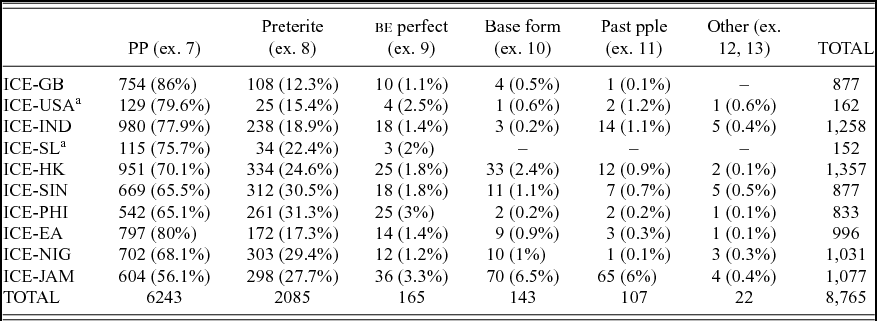
Table 1 sets out the variants found in the different geographical varieties. The forms are illustrated in examples (7)–(13).
Overall distribution of forms expressing perfect meaning in ICE

a Only written material available
(7) The main impetus for economic growth has come from expansion in the tourism industry, rehabilitation of export in agriculture, recovery in the bauxite/alumina industry. . . (ICE-JAM:W2B-018#98:2)
(8) The versatile star of Sophie's Choice and Out of Africa reportedly beat out fellow Oscar winner Geena Davis for the role <O> music </O> // You just heard the one o'clock news (ICE-PHI:S2B-016#84-85:6:A)
(9) Give it a rest, Benjamin. They’re gone and the game's up. (ICE-GB:W2F-012#103-104:1)
(10) They just finish national population and housing census in Nigeria. (ICE-NIG:EX_25)
(11) You seen enough to make you concerned that you know that this is a real challenge for the company people. (ICE-JA:S1B-045#125:1:A)
(12) She don't come yet? (ICE-JA:W2F-015#11:1)
(13) I have saw Andy Lau concert organised by Chase Credit card (ICE-HK:W1B-005#143:12)
The grouping of the variants in table 1 is such that some of the labels include potentially ambiguous forms, as follows:
– ‘PP’ includes forms such as There's a piece of plaster ’s come off the ceiling so they'll replaster the ceiling as well (ICE-GB:S1B-071 #262-263:1:C) where the highlighted ’s (in the zero relative clause) can be understood as the abbreviated form of is or has;
– ‘preterite’ includes the forms finished, got, heard, said, thought and told (8), which can also be past participles;
– ‘base form’ includes forms like come, as in example (4) above (this young history teacher who just come from Africa (ICE-JAM:W2A-019#68:1)), in which verbs or past participles can also be present (see section 3 on methodology);
– ‘other’ includes examples of present tense used with perfect meaning (10) and combinations like have saw, which can also be interpreted as performance errors (for a discussion of the difference between errors and incipient changes, see Hundt Reference Hundt, Seoane and Suárez-Gómez2016).
The overall distribution of forms expressing perfect meaning set out in table 1 shows that the most common form in all varieties is the canonical present perfect construction. However, this form is more frequent in ICE-GB, with 86 per cent of cases, than in any other variety, where it ranges from only 56.1 per cent in ICE-JAM to 80 per cent in ICE-EA, a percentage slightly higher than that found for ICE-USA (79.6 per cent). One obvious reason for the high proportion of PP in ICE-EA is the diachronic gap between the corpus representing this L2 variety and the other L2s, as pointed out in section 3. Another potential reason for the frequent use of PP forms in ICE-EA is that African varieties are said to show a convergence with L1 varieties and ‘are still relatively closely oriented towards (written) standard BrE’ (Brato & Huber Reference Brato, Huber and Hickey2012: 181). ICE-IND and ICE-SL, which come fourth and fifth in the use of the PP, contain texts from the 1990s and texts written between 2003 and 2009, respectively. In the case of IndE there is agreement that it is more elaborate (Xiao Reference Xiao2009) and traditional than other varieties, because English here has been learnt through school, relying on an exonormative British model. Likewise, Sri Lankan English tends to pattern very much like Indian English, as if this has become a new epicentre or a source of influence for South-Asian varieties, Sri Lanka included (Hundt Reference Hundt, Schreier and Hundt2013: 191). Additionally, it must be borne in mind that the results from ICE-SL contain only written English, usually more conservative than spoken language (see section 4.3 on mode).
The second most frequent form is the preterite, especially frequent in ICE-SIN, ICE-PHI and ICE-NIG, where it scores around 30 per cent of uses (I will return to preterite use in table 3). In fact, ICE-HK, ICE-NIG, ICE-SIN, ICE-PHI and ICE-JAM stand out as the varieties which show the highest rate of alternative forms to the PP. Within these, JamE deserves special attention, not only because it shows the highest frequency of non-PP forms (nearly 60 per cent), but also because it has the highest frequency of be periphrases, base forms and past participles (see table 1). According to Seoane (Reference Seoane2016a: 217) the use of be periphrases in JamE takes place predominantly with go, an intransitive verb of motion. In her opinion, this periphrastic structure is the result of diffusion from the input language, that is, an earlier variety of English in which the grammaticalization of have + past participle for the expression of perfect meaning had not yet taken place. The use of be with intransitive verbs of motion occurred more often in the period of colonization in the seventeenth century. In JamE, be also combines relatively frequently with the verb finish. The ambiguous status of the construction be finished is acknowledged in the literature: it is considered a ‘pseudo-passive’ construction with perfect meaning in the literature (see Quirk et al. Reference Quirk, Greenbaum, Leech and Svartvik1985 and also section 4.5 below) and also a ‘prefab’ (see footnote 4; Yerastov Reference Yerastov2015: 176). As for the use of base forms and past participles in JamE, they can be attributed to the influence of Jamaican Creole (JamC) (see, e.g., Christie Reference Christie2003; Deuber Reference Deuber2014; Seoane Reference Seoane2016a).
4.2 Type of perfect meaning
Classic accounts of the present perfect distinguish the following four semantic subtypes: resultative, experiential, recent past and persistent situation (Comrie Reference Comrie1976; see also Dahl Reference Dahl1985: ch. 5, Reference Dahl, Brown and Miller1999: 290–1; Dahl & Hedin Reference Dahl, Hedin and Dahl2000: 385–8; Miller Reference Miller2000: 327–31, Reference Miller, Fischer, Norde and Perridon2004: 230; Huddleston & Pullum Reference Huddleston and Pullum2002: 143–5). Following Miller (Reference Miller, Fischer, Norde and Perridon2004), I classified as resultative those examples which express an action having current relevance, such as (14), where the action of ‘giving advice to schools’ has current relevance for the topic. Examples like (15) were classified as experiential perfect, since they express an indefinite event (in (15) the speaker's experience at SRC) whose temporal frame leads to the present (the speaker's life). Regarding the expression of recent past, examples usually contain explicit temporal markers that express recency, such as the adverb recently in (16). Finally, examples containing persistent-situation typically describe recurrent events occurring in a period that leads up to the present. This is the case with (17), the recurrence emphasized by always.
(14) The Education Department is absolved since it has already given advice to schools to emphasise reading, listening and speaking in lower primary school (ICE-HK:W2B-006 #39:1)
(15) The only the only I have ever seen regularly at uh S R C is Max le Blond (ICE-SIN:S1A-082#197:1:A)
(16) Have you heard anything from Pam recently? (ICE-USA:W1B-004#56:1)
(17) Dominguez has corroborated what this newspaper has always said, and which the bankers and the government have been so hard put to cover up. (ICE-PHI:W2E-010#50:2)
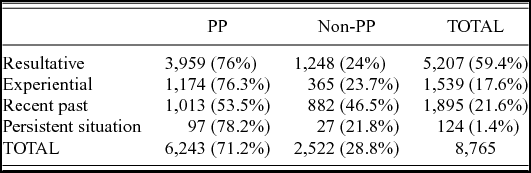
In table 2 we can see that the canonical present perfect is favoured irrespective of the type of meaning expressed, but this formal variant is especially frequent in the expression of resultative meaning, which is the most common one and hence can be considered the perfect meaning par excellence in the corpus, and also in the expression of experiential meaning.Footnote 7 The same is the case with the expression of persistent situation perfect meaning, although the figures here are rather low. For the expression of recent past, however, the PP is in strong competition with alternative forms, especially the preterite, as clarified in table 3.
Distribution of present perfect vs non-present perfect forms according to type of perfect meaning

Distribution of preterite forms expressing ‘recent past’ per variety

a Only written material available
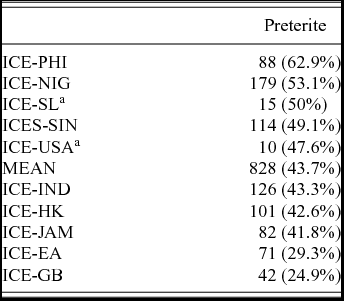
Turning to table 3, then, frequencies of the preterite for the expression of recent past are set out: the use of the preterite is higher than the global mean (43.7 per cent) in ICE-USA, an L1 variety, and in most L2s, especially in ICE-PHI, which shows the highest score of the preterite with this meaning (and in general, as shown in table 1). It is tempting to attribute the high incidence of the preterite in Philippines English (PhilE) to the fact that AmE was the colonizer variety and in AmE the preterite with perfect meaning is more frequent than in BrE, as can be seen both in the corpus itself and in previous studies (Hundt & Smith Reference Hundt and Smith2009); however, as we know, the cultural and linguistic influence of the US today is not restricted to the Philippines but extends to a wide range of territories around the world, triggering other types of language change in many other varieties (Leech et al. Reference Leech, Hundt, Mair and Smith2009: 258).
Falling well below the mean (43.7 per cent) we find ICE-GB and ICE-EA, the only variety which patterns closely to ICE-GB, at some considerable distance from the rest. We might recall that this was also the case when we examined the extent of PP use (see section 4.1), in which ICE-EA reflects ICE-GB closely; we also noted in this context the time gap between different ICE components.
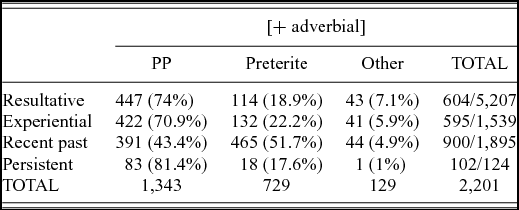
From these results we can confirm eWAVE feature number 99 (Kortmann & Lunkenheimer Reference Kortmann and Lunkenheimer2013), which specifies ‘levelling of the difference between present perfect and simple past, with the simple past or preterite used for StE present perfect’.Footnote 8 This is what we observe in ICE, but only for the expression of recent past. Furthermore, the results from table 4 show that, when the selected form is different from have + past participle, the recent past is the meaning that relies most strongly (51.7 per cent) on the presence of explicit adverbial markers of time (mainly just, today and now) and that in most cases this alternative form is a preterite.
Presence of adverbial markers according to meaning

4.3 Mode: spoken vs written
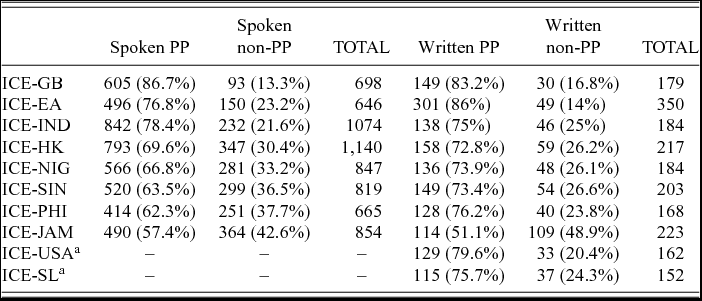
The distribution of PP vs non-PP per variety according to mode (spoken vs written language) is given in table 5. Footnote 9
Distribution of PP and non-PP forms according to variety and mode

a Only written material available
The findings in table 5 show that, in five out of the eight varieties where both spoken and written language are available, the present perfect is more frequently attested in the written than in the spoken mode. In these five varieties, therefore, non-PP forms tend to occur in the spoken mode, which might perhaps be expected, given that innovative alternatives of expression often appear in spontaneous spoken interactions but are filtered out in written discourse.
The strongest contrast between spoken and written modes is observed most notably in ICE-PHI, but also in the two African varieties and in ICE-SIN. In fact, of all those varieties in which the PP is more frequent in the written mode, it is PhilE where the contrast is most pronounced, with 62.3 per cent of PP forms in spoken English, compared to 76.2 per cent in written English.Footnote 10 An explanation for this might be found in table 3, where we can see that PhilE is the variety with the highest proportion of preterite (thus non-PP) forms. As for the African varieties, there is again a fairly pronounced gap between written English and spoken English in ICE-EA (86.0 as against 76.8 per cent), which could be interpreted as a reflection of the early stage of development of the varieties it comprises, from Kenya, at stage 3 Schneider's (Reference Schneider2007) Dynamic Model, and from Tanzania, very early at stage 3. We might see in this evidence for the fact that adherence to the kind of linguistic norms taught in schools is reflected primarily in written English, and less so in the spoken mode. However, ICE-SIN is one of the most advanced varieties (stage 5 in Schneider's model) yet it also shows a similar gap between use of the PP in spoken versus written English (73.4 vs 63.5 per cent).
The three exceptions to the high frequency of non-PP forms in spoken material are ICE-GB, an L1 variety where non-PP forms are scarce in general, and ICE-IND, a very elaborate variety which shows a high incidence of present perfect forms irrespective of mode. Once more, the fact that English in India is learnt at school, with British English as the exonormative model, explains the homogeneity of the variety, where no clear differences between spoken and written texts can be observed in the expression of perfect meaning. In ICE-JAM, the pervasiveness of non-PP forms is not exclusive of spoken texts but is generalized to written text types too, which testifies to the fact that the influence of JamC is strong and predominant in a wide range of text types across both modes.
Thus, whereas at first glance the general picture seems coherent, with a tendency for the PP to predominate in the written mode, other factors must be at play to account for differences between varieties. These differences are likely to be related to the composition of the written and spoken components of the corpus, that is, the different text types and their linguistic conventions. Such differences in the composition of the corpora can at times distort the comparison of the spoken versus written modes (Mair Reference Mair and Collins2015: 141; Seoane Reference Seoane2016b).
4.4 Register: formal vs informal
Another variable relevant to us here is register (formal vs informal), determined by the different text types available. In spite of the caveats described in section 3 (methodology) regarding the ICE data, this section provides an attempt at comparing registers. In order to determine registers (as defined by Biber & Conrad Reference Biber and Conrad2009; see section 1), I selected specific text types of the spoken and written modes and classified them as formal and informal according to the following parameters: type of audience, communicative purposes and production circumstances.
Two balanced subgroups of 260,000 words each were created. Subgroup A represents informal register and includes the text types private conversation (spoken mode) and personal letters (written mode). Broadly speaking, the audiences in both text types are similar in that they are close to the speaker/writer and there is shared knowledge between them. These text types also share communicative purposes, because there are non-official, informative and conversational-like texts. Finally, they are produced under similar conditions: with relative spontaneity and a low degree of sophistication, little planning or editing, and unlikely to involve revision. Regarding subgroup B, which represents a more formal register, this contains the ICE categories scripted monologue (spoken mode) and academic writing, instructional writing and reportage (written mode). These share the following characteristics: (i) the type of audience is similar;Footnote 11 (ii) they are informational; (iii) they are carefully planned; and (iii) they are edited, revised and produced under similar circumstances.
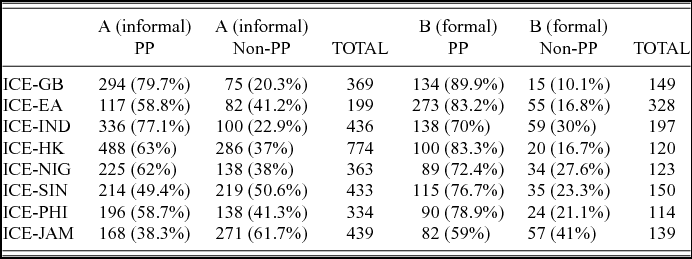
One unexpected finding from the comparison set out in table 6 concerns the raw numbers, which show that the distribution of perfect meaning (independently of the form it takes) varies widely across varieties: if we take ICE-HK, for example, we see that it expresses perfect meaning 774 times in the selected informal registers, whereas in ICE-GB only 369 examples in the same registers are recorded. The contrast in formal registers is not so pronounced; nevertheless, 328 such examples from ICE-EA contrast with 149 in ICE-GB. There is clearly room here for a more fine-grained, qualitative study in order to reveal why these differences are observed in these text types across varieties. Since we are comparing exactly the same text types in all varieties, such differences between varieties are unexpected and may have to do with the fact that the selection and interpretation of text types is culturally dependent. As Hundt (Reference Hundt, Biber and Reppen2015) shows, a student essay in ICE-PHI, for example, is not linguistically similar to a student essay in ICE-GB. So comparing text types with the same label (e.g. ‘social letters’) does not necessarily entail comparing similar text types, after all.
Distribution of PP vs non-PP forms across a selection of formal and informal registers

Regarding the results of register, table 6 shows that subgroup A, representing informal registers, tends to exhibit a higher proportion of non-PPs than subgroup B, which contains formal registers. The only exception is ICE-IND, which shows a more balanced distribution of PP forms across registers, as it also did across modes (see section 4.3). As argued above, the homogeneity exhibited by ICE IND might be a reflection of the status of English in India, a co-official language learnt at school with prescriptive exonormative rules which speakers might be expected to apply in a broad range of contexts, which may turn Indian English into a monostylistic variety.Footnote 12 The frequent use of a periphrastic structure might also be fostered by the existence of a periphrastic structure to express perfect in Hindi.Footnote 13 The remaining varieties have more than 30 per cent of non-PPs. As to the distribution of subgroup B, representing formal register, there is a much higher incidence of PP forms.
These results must be interpreted with caution, since registers are heterogenous due to cultural differences and different principles adhered to in the compilation of corpora (e.g. Hundt Reference Hundt, Biber and Reppen2015: 384). However, the findings here do show that register seems to be a strong predictor for variation in the realm of perfect meaning, and appears to override mode (see Seoane Reference Seoane2016b).
4.5 Lexical verbs
The last variable analysed in detail is that of the forms used by the different lexical verbs. The analysis here sought to identify any distributional preferences.
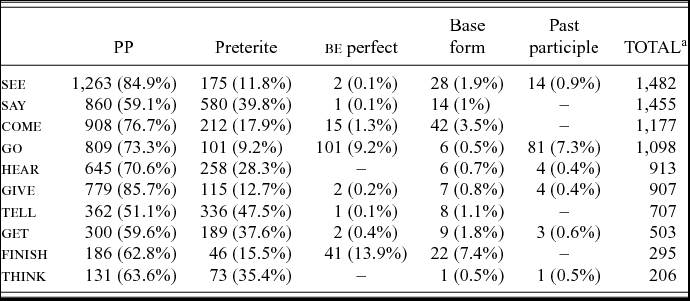
Table 7 shows that the verbs finish, get, say, tell and think express perfect meaning in more than 35 per cent of cases by means of a non-PP form. Following a more detailed examination of the preferences of these lexical verbs and specific non-PP forms, table 7 shows that get, say, tell and think (i.e. all but finish) select the preterite as the most frequent non-PP form, the four verbs together representing 56.5 per cent of all occurrences of the preterite in the corpus (1,178/2,085). say is found very frequently in broadcast news and press news reports (of the ten verbs, say is in fact the most frequent verb in such texts, with 33.5 and 25.1 per cent respectively). Both of these text types encompass a style known as journalese, characteristic of the popular media, and often feature the structure X said today, as in (18):
(18) Hindi to give the latest tally and important results, official sources said here today. (ICE-IND:W2C-005#60:5)
Distribution of forms by lexical verb

a Category ‘other’ excluded
The same applies to tell, frequently used in the same text types. Both verbs are also recurrent in the construction As I told/said + before/earlier, as in (19).
(19) Now as I told you before Daswani would not accept Indian English as a variety of British <,> British English (ICE-IND:S2A-047#93:1:A)
finish, on the other hand, the only regular verb in the sample, is the most frequent example of a verb used in the base form (see example (10), repeated here for convenience as (20)) and also occurs frequently in the be periphrastic construction to express perfect meaning (21).
(20) They just finish national population and housing census in Nigeria. (ICE-NIG:EX_25)
(21) Results of another 7,000 applications will be ready in the first week of next month and those of the remaining applications will be announced as soon as the processing is finished. (ICE-HK:W2C-007#83:6)
The case of the base form might be the result of simplification of final consonant clusters. In fact, 82 per cent of the occurrences of finish in the base form are found in ICE-HK, ICE-SIN and ICE-JAM. This phenomenon has already been reported for Asian varieties with a Chinese substrate (Gut Reference Gut2009; Suárez-Gómez & Seoane Reference Suárez-Gómez, Seoane, Bech and Andersen2013) and for ICE-JAM, under the influence of Jamaican Creole (Sand Reference Sand1999: 120; Seoane Reference Seoane2016a: 205). As already mentioned, the use of finish in the be periphrasis (21) to express perfect meaning is also documented in the literature, and is referred to by Quirk et al. (Reference Quirk, Greenbaum, Leech and Svartvik1985) as a ‘pseudo-passive’ construction, or considered a ‘prefab’ by Yerastov (Reference Yerastov2015: 176; see also footnote 4). It is also important to bear in mind that verbs meaning ‘finish’ are a frequent source of grammaticalized perfect markers across the world's languages (Kortmann & Schneider Reference Kortmann, Schneider, Heine and Narrog2011: 270, 273).
(22) Give it a rest, Benjamin. They’re gone and the game's up. (ICE-GB:W2F-012#103-104:1)
(23) I'm kind of pressured now because my boss gone for like three days and the other <indig> bredrin</indig> that work with me him gone out too for (ICE-JAM:S1A-037#18:1:A)
Another very frequent verb choosing the be periphrasis is go (finish and go represent 86 per cent, 146/165 examples of be perfect) (see (9), repeated here as (22)). This combination (be gone) is reminiscent of the use of be + past participle of mutative intransitive verbs for the expression of perfect meaning in the history of English before the grammaticalization of the have perfect from the end of Early Modern English onwards (Rissanen 1999: 215). Connected to this construction is the use of go in the past participle (23) (81/107, 75.7 per cent) as a consequence of copula deletion, 61 per cent of them in ICE-JAM, reflecting the influence of Jamaican Creole (see table 1, and Christie Reference Christie2003; Deuber Reference Deuber2014; Seoane Reference Seoane2016a, among others).
5 Conclusions
This study has provided an onomasiological analysis of the expression of perfect meaning in ten varieties of English. It includes the analysis of a number of variables which have offered an insight into the determinants of such variation. This holistic methodology has shown that the envelope of variation is much wider than that typically recognized in current research, which tends to focus exclusively on the variation between PP and preterite, whereas in fact the range of variation includes productive forms such as the preterite, the be periphrasis, the base form, and the past participle.
As for the factors that determine the use of the different variants, one important finding is that the PP form seems to be specialized in the expression of the resultative as most frequent meaning of the perfect, and also in the experiential meaning. The frequency of the have perfect is considerably lower for the expression of recent past meaning at the expense of the preterite, since it is selected in more than 40 per cent of cases in Outer Circle varieties (except ICE-EA). This finding confirms eWAVE feature 99 on the levelling between the present perfect and the simple past to refer to perfect meaning, but only for the expression of this very type of perfect meaning, namely the recent past.
Also relevant for the use of the different variants is the specific lexical verb concerned. The analysis has shown that the PP forms clearly dominate in most verbs, with the exception of tell and say, which often select the preterite in phraseological combinations such as As I told you before, as I said earlier or the Prime Minister said today. Regarding other non-PP forms, go and finish are frequently found with be, the former reminiscent of the historical be perfect, and the latter illustrating a ‘prefab’ or a so-called ‘pseudo-passive’ structure with perfect meaning. In addition, finish, the only regular verb analysed, also expresses perfect meaning through an invariable form, which can be associated with the trend in languages to grammaticalize verbs meaning ‘finish’ as perfect makers.
The analysis of mode revealed an apparent correlation between present perfect and written language and between non-PP and spoken language, although this correlation is less clear in ICE-GB, ICE-IND (where the PP is pervasive in both modes) and ICE-JAM (where the PP shows low frequencies in both modes). By contrast, the analysis of register, based on a selection of homogeneous text types, turned out to be an important variable of variation in this area: while formal types show a higher frequency of have perfects, informal types offer wider variation and the more frequent use of alternative forms in all varieties.
Another factor noted in this article, although not systematically analysed, was the influence of local languages. This was notable in the case with ICE-JAM, where the high proportion of non-canonical forms, particularly the use of the participle (especially gone) as a marker of the perfect, was ascribed to the influence of Jamaican Creole. In the case of ICE-IND, the high incidence of PP can also be attributed to an acknowledged traditional and highly wrought style, as well as being fostered by the existence of a periphrastic construction in Hindi to express perfect.
Whenever different World Englishes are compared, a recurrent factor is the evolutionary stage of the variety (following Schneider's Dynamic Model). Although my analysis has revealed no clear correlation between stage of development and the way of expressing perfect meaning, the early stage of development of both Kenyan English and Tanzanian English was mentioned as a potential factor in their levels of distribution, which in both cases is very similar to that of ICE-GB.
Finally, neither typological similarity (Kortmann & Wolk Reference Kortmann, Wolk, Kortmann and Lunkenheimer2012) nor geographic proximity (Fuchs Reference Fuchs2016) – claimed to be important factors accounting for morphosyntactic variation in the anglophone world – showed itself to be conclusive here. Although typological similarity and geographic proximity can be used to justify similarities in ICE-IND and ICE-SL, the potential effects of this variable cannot be seen in African varieties, which show important differences: ICE-NIG shows convergence with the other L2s, whereas ICE-EA exhibits different scores in the global distribution of forms, especially grounded in the expression of ‘recent past’; for this meaning ICE-EA presents the lowest score of preterite use of all L2s. Typology and geography cannot be fully discarded, however, since in these varieties the time gap between the texts in ICE-EA (1990s) and those in ICE-NIG (2000s) might also have affected the results.
The general picture that emerges from this study is that the perfect is not confined to the use of have + participle periphrasis, and that forms associated with other tenses (e.g. preterite) and vernacular forms (e.g. base form, participle or be periphrasis) are used in World Englishes too, in expressing the perfect meaning in contexts which are favourable to this, notably in informal registers, in the expression of recent past, or when associated with certain lexical verbs.
What does this study tell us about processes of language variation and ultimately change? The periphrastic perfect construction have + past participle is the most common variant in non-native varieties of English. However, it comes to alternate with other forms, such as the be + past participle (with intransitive verbs), a form which persists from earlier stages of the English language, in which be combined with the past participle of mutative intransitive verbs for the expression of the perfect (as it still does in German and in fixed phrases in present-day varieties of English, such as Canadian English). Persistence can also be observed in the use of the preterite with perfect meaning, since the preterite was an extended variant while English was still mainly a synthetic language, although this form has specialized now in the expression of ‘recent past meaning’, especially in American English. Finally, principles of language contact seem to be responsible for the use of particular variants confined to individual varieties: thus, the use of gone as a marker of the perfect can be interpreted as a consequence of a process of copula deletion, a direct influence of Jamaican Creole.