This essay explores Aquinas’s thinking on necessity in the created material world. Throughout his works, he defines the necessary as that which is ‘not able to not be’ or that which is ‘impossible not to be’.Footnote 1 Aquinas thought that everything that exists is freely created by God and, thus, had God chosen otherwise, nothing created would exist. Yet, Aquinas nevertheless claims that there are some aspects of the created world that cannot be otherwise.Footnote 2 This raises the question of how such necessities arise in the contingently created world and how does necessity in the created world relate to the power of an omnipotent God. Is even God not able to make created necessities otherwise? Aquinas’s thought on necessity in the created world is especially complicated since he claims that the term ‘necessity’ is ‘said in many ways’.Footnote 3 Not all things in the created world that are unable not to be otherwise are unable not to be so in the same way. For example, the manner in which a human is unable not to be an animal is a different manner in which an action that is coerced by a more powerful cause is unable not to be. Among the types of created necessities that Aquinas mentions in his works are absolute necessity, natural necessity, material necessity, conditional necessity, necessity from supposition of an end, intrinsic necessity, and extrinsic necessity. To further complicate matters, he uses the term ‘absolute necessity’ in different ways in different contexts. The goal of this essay is to provide a roadmap to Aquinas’s various distinctions between types of necessities in the created world. The essay will examine how each type of necessity arises in the created world and how absolute necessities in the created world relate to the power of God.Footnote 4
The paper begins in Section 1 by introducing Aquinas’s overarching rationale for the distinctions he draws between types of necessities in the created world. Section 1 also discusses the difference between the ontological necessity that Aquinas thinks obtains in the created material world and logical necessity. Section 2 discusses the details of Aquinas’s thinking on the various types of created necessities, and Section 3 considers the relationship between created necessities and God’s power.
1. Aquinas’s rationale for the division between types of created necessities and their distinction from logical necessity
Aquinas believes that everything in the created world is contingent upon God’s free creation. So, nothing in the created world is such that its necessary existence follows from God’s necessary creation of it. Rather, in Aquinas’s view, necessity in the created world arises in virtue of the order that created realities have to their contingently existing created causes.Footnote 5 Aquinas thinks that some created things ‘[i]f compared to their proximate principles are found to have absolute necessity’.Footnote 6 This is to say that although created substances are contingently willed to exist by God, given that these substances exist, certain effects that follow from them are unable not to be.Footnote 7 Thus, on Aquinas’s view, ontological necessity in the created world is a relationship that obtains between a created effect and its proximate or created cause(s). For created realities, some reality x is necessary if given the existence of its created cause y, x is unable not to be. However, it is important to recognize that Aquinas understands causation in a much broader way than we do today. We tend to think of causes as those things that cause changes. For Aquinas, however, causes are anything upon which something depends for its being. He writes regarding causes in general: ‘[T]he name cause implies a certain influence on the being of the thing caused.’Footnote 8 Elsewhere he writes: ‘It is necessary for an effect to depend on its cause. This is part of the notion of effect and cause.’Footnote 9 Because Aquinas views the relationship between cause and effect as ontological dependence, he acknowledges any instance in which one thing ontologically depends on another as a type of causation. Moreover, he recognizes that there are very different types of things upon which a thing can depend for its being. For example, a baby depends on its parents’ generation of it in a very different way than it depends on its human nature for its existence as human. Following Aristotle, Aquinas adopts the four-cause schema (i.e., form, matter, efficient, and final) to categorize different types of causes. The reason why Aquinas denies that necessity is a univocal term, even when it is restricted to the necessities that obtain in the created world, is because each of the four different types of Aristotelian causes gives rise to necessities and different types of causes give rise to different types of necessity. He writes: ‘Necessity in created things is understood in diverse ways based on diverse causes’.Footnote 10 As we will see in what follows, Aquinas’s main divisions between types of necessities in the created world are based on differences in how the four causes relate to the effect which they cause.
Before moving on, it is worth noting that in addition to his notion of a created ontological necessity, Aquinas has a distinct notion of conceptual or logical necessity. A created ontological necessity is an instance in which some created reality x is unable not to be given the existence of its created cause y. By contrast, Aquinas understands logical or conceptual necessities as propositions that are true on the basis of their terms. In simple propositions, the predicate is part of the subject (e.g., Human beings are rational) or the subject is included in the notion of the predicate (e.g., Every number is even or odd).Footnote 11 Aquinas also thinks that there are complex propositions, i.e., conditionals and disjunctives, that are logically necessary based on the principle of non-contradiction. In commenting on Aristotle’s Peri Hermenias, he explains that something that is not absolutely necessary (i.e., necessary considered in itself) becomes necessary on the supposition that it presently exists.Footnote 12 For example, though it is not considered in itself necessary that Socrates sit (i.e., in virtue of a necessary connection between these terms), on the supposition that he is sitting, it follows with necessity that he is sitting.Footnote 13 Aquinas explains that the basis for this necessity is the principle of non-contradiction. Since contradictories (e.g., p and ~p) cannot exist simultaneously, on the supposition that one member of a pair of contradictories exists at a time, the existence of the opposite is impossible at that time.Footnote 14 Aquinas also explains that logically necessary propositions can be formulated by adding the disjunction of the opposite to that which is not itself necessary. For example, though it is not in itself necessary for Socrates to sit, this proposition is logically necessary: ‘Socrates is sitting or Socrates is not sitting.’ Aquinas believes that this necessity is also based on the principle of non-contradiction since it follows from the fact that contradictories cannot both be true that a thing either is or is not.Footnote 15
In some texts, Aquinas describes propositions in which there is a necessary connection between the subject and predicate terms in the proposition as ‘absolutely necessary’.Footnote 16 He contrasts these with propositions that are necessarily true supposing some condition.Footnote 17 However, we will see in what follows, especially in Section 3, that many of the ontological absolute necessities that Aquinas identifies in the created world are not absolute logical necessities. Furthermore, some of the created necessities that Aquinas contrasts with absolute created necessities are in fact absolute necessities in the logical sense.
2. Types of ontological necessities in the created world
Aquinas discusses various types of necessity in many texts throughout his corpus. Often these discussions occur in the context of discussing whether some particular thing is necessary. For example, he asks whether it is necessary for fallen human nature to be restored (In III Sent. 20.1.1.3 co.), whether the body assumed in the Incarnation was of necessity subject to defects (ST IIIa.14.2 co.), and whether grace and the sacraments are necessary for the beatific vision (In II Sent. 29.1.1 co. and In IV Sent. 7.1.1.2 co.). Typically, when addressing a specific question about whether a given thing is necessary, he focuses only on the senses of necessity relevant to the question at hand. There are, however, some especially systematic discussions of types of necessities in the created world throughout his corpus. These occur in his commentaries on Aristotle’s writings on necessities in his Metaphysics and Physics and in his major theological works Summa Theologiae and Summa contra Gentiles. In these texts, Aquinas advances two different basic schema for classifying created necessities based on the type of cause from which they follow.
2.1. Intrinsic (absolute) necessity vs. extrinsic (relative) necessities
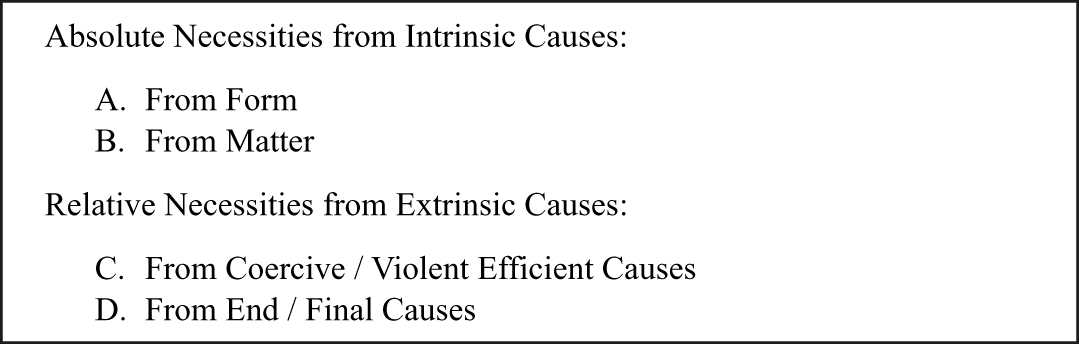
In Summa theologiae I 82.1 and In V Meta. lec. 6, Aquinas introduces a classification of necessities in the created world that divides them into intrinsic vs. extrinsic necessities. He classifies the necessities that arise from each of the four causes into this division.Footnote 18 Intrinsic necessities are those that arise through the intrinsic constituents of a substance, namely its matter, form, or essence, while extrinsic necessities apply to a substance in virtue of its relation to something external to it. Aquinas identifies efficient and final causes as sources of extrinsic necessities.Footnote 19 See Figure 1 below for an illustration of this division.
Extrinsic vs. intrinsic division of necessities.

In both texts, Aquinas claims that necessities that arise from intrinsic causes are ‘absolute necessities’. He explains that what has absolute necessity cannot exist differently from how it does.Footnote 20 Absolute necessities differ from other necessities in so far they arise in a subject from causes that are ‘proximate and intimate’ including form, matter, and essence.Footnote 21 Since absolute necessities arise from the intrinsic of principles of a substance, the substance cannot exist without being subject to these necessities. The necessity attaches to the subject based on what it is in itself, rather than in virtue of some reality outside of it. In the Metaphysics text, he gives examples of absolute necessities that apply to animals in virtue of the three different types of intrinsic cause: on account of its matter, an animal is necessarily corruptible due to being composed of contraries, based on its form an animal is necessarily capable of sensation and based on its essence an animal is necessarily a living, sensible substance.Footnote 22
In the Summa theologiae text, Aquinas also refers to the absolute necessities that follow from matter and form as ‘natural’ necessities. He writes:
In one way there is the [necessity] which belongs to a thing from an intrinsic principle, either from matter, just when we say that it is necessary for everything composed from contraries to corrupt; or from form, just as we say that it is necessary for a triangle to have three angles equal to two right angles. This is natural and absolute necessity.Footnote 23
Aquinas conceives of the absolute necessities that follow from matter and form as natural necessities because they follow from the principles of nature.Footnote 24 In contemporary philosophy, natural necessities are often conceived as necessities that are relative to natural laws that could have been otherwise.Footnote 25 For Aquinas, however, natural necessities are based on the invariable natures of things, and thus, Aquinas equates such necessities with absolute necessities.Footnote 26
In the division presented in ST I 82.1 co. and In V Meta. lec. 6, absolute necessities are contrasted with extrinsic necessities. He also calls the latter necessities ‘relative (secundum quid) necessities’ because they only obtain relative to other things, rather than following from the very being of the subject of the necessity.Footnote 27 Aquinas claims that there are two different causes from which extrinsic necessities arise, namely, efficient and final causes.
Aquinas identifies necessity of coercion as an extrinsic necessity that arises from an efficient cause. Necessity of coercion obtains when one efficient cause’s action makes it such that another efficient cause cannot fail to act.Footnote 28 This form of necessity applies both to voluntary causes, as when an agent is forced do something against its will, and natural causes as when one body forces another body to move against its natural inclination, such as stone being forced upward against its natural inclination to move downward.Footnote 29 The cause that is forced or coerced cannot do otherwise and in this respect, it has necessity. Clearly, the necessity it has is not due to its own intrinsic principles, but rather on account of the coercing cause’s action.
Aquinas distinguishes two forms of necessity of coercion.Footnote 30 The first type of coercion, which he calls absolute coercion, is when one efficient cause moves another body to act. The moved body cannot fail to move given the action of the coercing cause upon it. This type of coercion is usually called necessity of violence when it applies to natural causes, such as when a stone is forced to move upward against its natural inclination to move downward.Footnote 31 The second type of coercion, which Aquinas calls ‘mixed’ violence or coercion, applies to cases in which the coerced cause has within its power not to do the coerced action but dire consequences will follow from not doing the action. This type of coercion applies only to free causes. The point of distinguishing it is to note that freedom is compromised on account of the consequences that follow from not doing the action. Aquinas gives the example of a person throwing valuables overboard on a boat to avoid sinking. Though the person has the power not to do this action, the fact that not doing so will lead to death diminishes the voluntariness of the act. Aquinas does say that in so far as there remains some voluntariness in ‘mixed’ actions they are subject to praise and blame.Footnote 32
Extrinsic necessity arises from final causes in so far as the means required to achieve an end are necessary for that end.Footnote 33 Aquinas states that necessity from an end is twofold.Footnote 34 First, there are things that are necessary for the existence of something else; and second, there are things that are necessary to achieve certain goods or to reach an end easily or well. Aquinas gives the example of breathing’s necessity for an animal’s life as a necessity that is required for something else’s existence.Footnote 35 An animal that breathes cannot live without breathing. Examples of the second type of necessity from an end are medicine’s necessity for health and a horse’s necessity for a long journey. Health can exist without medicine and a journey can be made without a horse, but these things are needed to achieve these ends more efficiently. Necessities that arise from final causes are considered extrinsic necessities because the thing that bears the necessity can in itself be otherwise. The inability to be otherwise arises solely from its relationship to the end. Breathing, for example, in itself can be or not be. But when considered in relation to the life of a breathing animal, it becomes unable not to be.
Aquinas thinks that absolute necessity has priority over other senses of necessity.Footnote 36 On Aquinas’s understanding of analogy, whenever a term is used with many related meanings, every meaning makes reference to one primary sense of the term. Aquinas thinks that absolute necessity is the primary sense of necessity to which all other senses of the term make reference. That which is absolutely necessary is ‘impossible to have itself otherwise’.Footnote 37 All other senses of the necessary include the notion of a thing’s inability to be otherwise, while also adding on to this notion some extrinsic qualifying condition under which something cannot be otherwise.
2.2. Necessity from prior causes (absolute) vs. necessity from posterior causes (conditional)
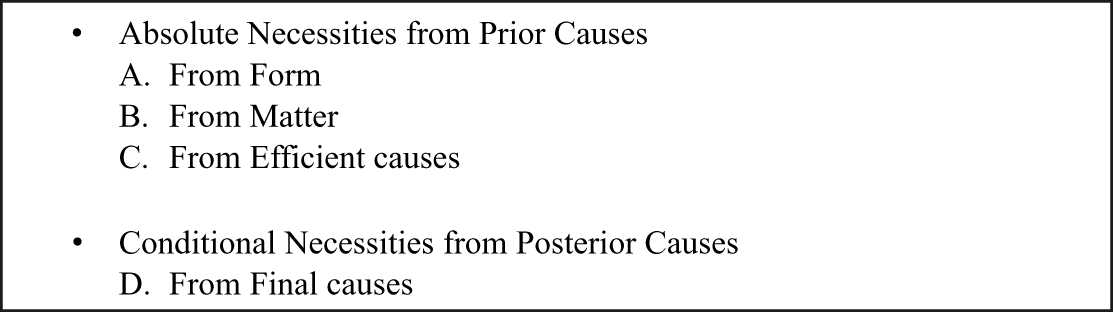
In his early De ente et essentia and in his later commentary on Aristotle’s Physics and Summa contra Gentiles, Aquinas discusses another way of dividing and classifying created necessities.Footnote 38 Like the division between intrinsic and extrinsic necessities, this division also has Aristotle as its source.Footnote 39 According to this division, necessities that follow from each of the four causes are divided into absolute and conditional necessities. However, the term ‘absolute’ is used in a different way in this division from how we have seen it used above. We saw above that Aquinas uses the term ‘absolute necessity’ to signify (1) conceptually necessary propositions that are true in virtue of the relationship between their terms and in another way, to signify (2) necessities in creation that arise from the intrinsic principles of creatures, i.e., their matter, form, and essence. When he divides absolute necessities from conditional necessities, Aquinas uses the term ‘absolute necessity’ in a third way to signify necessity that arises from a cause that is prior in being to its effect. By contrast, a conditional necessity is a necessity that arises from a cause that is posterior in being to their effects.Footnote 40 See Figure 2 below for an illustration of this division.
Prior vs. posterior division of necessities.

To understand this distinction, we must review a few details from Aquinas’s Aristotelian natural philosophy. Aquinas thinks that material substances come into existence through the union of form with matter. Forms are induced in matter through the action of an efficient cause. These three causes are considered prior in being to the effects which they bring about since their effect exists through them. Final causes, however, are not prior in being to their effects. Final causes come into being through the effects that they cause. For example, when a person takes a walk in order to be healthy, the state of being healthy exists through the walking and thus, it is posterior in being to it. Similarly, the oak tree which is the final goal of the acorn’s development exists after and because of the developmental stages that are ordered to that goal. The walking would not have occurred if it were not for the goal of being healthy, the walking is what produces health into being. This naturally leads to the question of how an end or goal can influence an action or process if the end does not exist until after the action or process occurs. To address this issue, Aquinas distinguishes between the final cause or end as it exists in real being and as it exists in the intention of the agent or efficient cause. He thinks that the final cause influences the actions and processes that bring that final cause into real being in virtue of first existing in the intention of the agent.Footnote 41 For example, health causes walking not in so far as it exists in the person’s body after the walk, but rather as it exists in the person’s intention prior to the walking. Aquinas believes that even non-intellectual natural causes have intentions toward goals. He writes: ‘to intend is nothing other than to have a natural inclination toward something.’Footnote 42 An acorn, for example, has a natural inclination toward becoming an oak tree and it is through this inclination that the end influences the process of the acorn’s development.
Since final causes are brought about through the actions and processes that they cause, Aquinas states that final causes have a priority of nature, but not a priority of being to the actions and processes of which they are the goal. Accordingly, Aquinas thinks that final causes give rise to a different type of necessity from other causes. He writes: ‘The necessity that is from that which is posterior in being although it is prior in nature, is not absolute necessity, but conditional: such as, “if this ought to become, it is necessary that this happen first”’.Footnote 43 Aquinas thinks that conditional necessity characterizes the relationship that stages in natural processes have with respect to the ends of those processes. For example, he claims that conception is necessary according to conditional necessity for the generation of a son.Footnote 44
What is most significant about Aquinas’s two different ways of diving and classifying necessities is the diverging ways in which absolute necessity is defined and its implications for efficient causation. As we have seen, in the first division, absolute necessities are defined as those that follow from intrinsic principles, while in the second division they are defined as those that follow from prior causes. This raises a complication for thinking about necessities that follow from efficient causes because efficient causes are both extrinsic causes and prior causes. Thus, in the first classification, necessities from efficient causes are not absolute necessities, yet on the second classification they are. It will be helpful to see in more detail what Aquinas says about absolute necessities that follow from efficient causes, and then we can see whether these two different classifications of created necessities can somehow be reconciled.
2.3. Absolute necessity: efficient causes
Aquinas’s lengthiest discussion of absolute necessities that follow from efficient causes, in so far as they are prior causes, occurs in Summa contra Gentiles Bk. II, c. 30.Footnote 45 To understand his views in this text, it is helpful to review some of his general views on efficient causation. Aquinas thinks that efficient causes cause their effects by acting through an active causal power. Aquinas distinguishes between efficient causes that have an action outside of themselves (transeunt causes) and efficient causes whose act remains in the cause itself (immanent causes). Fire’s burning wood is an example of transeunt action, while a human being’s seeing an apple is an example of immanent action.Footnote 46 For transeunt causes, Aquinas identifies the active power to cause an effect x with the same form by which the agent is itself x. Fire’s active power to heat other things, for example, just is the accidental form of heat by which fire is itself hot.Footnote 47 When considering necessity in efficient causation, Aquinas thinks that it is important to distinguish between the necessity of the cause’s action and the necessity of its effect. Aquinas states that immanent causes perform their actions by absolute necessity. For example, sense powers necessarily have an act of sensation when actualized by a sensible object.Footnote 48 Aquinas explains that a substance’s immanent actions follow from its form just as other necessary accidents of it do. He writes: ‘Just as some accidents follow from the necessity of essential principles, so too does action follow from the necessity of the form by which the agent is in act, for an agent acts in so far as it is actual’.Footnote 49 The actions of transeunt causes do not arise from their forms by absolute necessity since the action of a transeunt cause depends on an additional factor beyond possession of the form.
Transeunt causes require a patient to act upon, and that substance must be suitably disposed to receive the agent’s action. For example, in order to have the action of heating, fire requires the presence of something else which is able to be heated. Furthermore, even in the presence of a suitable patient, the transeunt cause can only act on the condition that is not impeded by external agents or internal dispositions that weaken its power.Footnote 50 Because the actions of transeunt causes require both the agent and patient to be properly disposed for the action to occur and in most cases either substance can lose the necessary disposition, Aquinas claims that there is no absolute necessity in most cases of transeunt action between material creatures.Footnote 51 For terrestrial material efficient causes, there is only necessity in efficient causation on the supposition that the agent and patient are not impeded.Footnote 52 He does note, however, that the powers of such transeunt causes arise from their forms with absolute necessity. For example, fire, through its form, has the power to heat by absolute necessity.Footnote 53 In some texts, Aquinas even gives the example of active causal powers, such as fire’s power to heat, as an example of a necessity that arises from a substance’s intrinsic formal principle.Footnote 54
Aquinas states that there are certain transeunt efficient causes in the material world with effects that follow by absolute necessity, namely, the heavenly bodies. An example of such an effect is the alternation of day and night, which according to Aquinas’s medieval cosmology happens on account of the motion of the sun and its light being received in air.Footnote 55 Aquinas conceives of the effects that the heavenly bodies cause in terrestrial substances as natural motions, rather than instances of violence or coercion, since he thinks that terrestrial substances have a natural disposition to receive the effects of the heavenly bodies.Footnote 56 In fact, Aquinas holds that without the effects of the heavenly bodies, earthly material substances would not be able to engage in their own proper operations, e.g., fire would not be able to heat.Footnote 57 Aquinas thinks that the heavenly bodies are inalterable and thus, they could not lose the disposition to act. Though terrestrial material substances can change in many ways, they cannot lose the disposition required to be acted upon by the heavenly bodies. No change of quality, quantity, or location could make a material substance such that it could not be impacted by the action of the heavenly bodies. Since both the agent and the patient have the dispositions needed for the agent to act by absolute necessity, Aquinas concludes that the effect of the heavenly bodies happens with absolute necessity.Footnote 58
It is important to note that the respect in which an effect of an efficient cause is absolutely necessary in this second division differs from necessity of coercion in the first division. Actions that are necessary by coercion are such that with the coercing agent’s action posited, the coerced action cannot not be. However, this does not equate to the absolute necessity of efficient causation under discussion in this section since the coerced cause’s action might possibly be prevented due to it or its patient losing the disposition needed for the action to occur. Absolutely necessary effects are those that follow from agents that have the disposition to act by absolute necessity and occur in patients that have the disposition to undergo action by absolute necessity.
2.4. Reconciling the two divisions
As we saw above, Aquinas divides necessities both according to whether they are from an intrinsic or an extrinsic cause and according to whether they are from a cause that is prior or posterior in being. In the first division, he identifies necessities from intrinsic causes as absolute necessities, and in the second division, he associates necessities that arise from causes that are prior in being with absolute necessities. This raises a difficulty because efficient causes are both extrinsic causes and prior causes. So, in one division, they are sources of absolute necessities and on the other division, they are not. This poses a difficulty for understanding the nature of necessity involved in efficient causation and for understanding how Aquinas conceives of absolute necessity in the created world. However, the difficulty is not intractable if careful attention is given to what Aquinas takes to be the underlying source of the absolute necessities that arise from efficient causes. Absolute necessities in efficient causation are ultimately due to absolute necessities that arise from the intrinsic principles through which substances cause and undergo actions.
Above, we saw that Aquinas regards immanent actions and the powers of transeunt efficient causes as similar to the necessary accidents that follow with absolute necessity from a substance’s form. In his view, agents are able to cause absolutely necessary effects because they have an absolutely necessary disposition. The agent has such a disposition through an intrinsic cause, namely its form. The patient in which an absolutely necessary effect occurs is able to be the subject of an effect with absolute necessity because it likewise has an absolutely necessary disposition to undergo action. This disposition is similarly possessed through an intrinsic principle, namely, matter.Footnote 59 The ultimate explanation for why there are absolute necessities in transeunt efficient causation is the complementarity between the agent’s absolutely necessary disposition for acting and the patient’s absolutely necessary disposition for being acted upon. These complementary absolutely necessary dispositions arise from the agent’s formal principles and the patient’s material principles. Therefore, although an absolutely necessary effect in a patient is efficiently caused by an extrinsic agent, the absolute necessity of such an effect is ultimately traced to the intrinsic principles of both the agent and the patient. So, like other absolute necessities, absolutely necessary effects of transeunt efficient causes also arise due to intrinsic causes. Yet, unlike the absolute necessities that follow only from form or only from matter, absolutely necessary effects of transeunt causes do not follow from just one of these principles. Rather, they follow from the complementary formal and material principles of two distinct substances that engage in causal interaction. Accordingly, although Aquinas does not mention the effects of heavenly bodies on terrestrial substances when dividing necessities into intrinsic and extrinsic necessities, these cases seem like they can be subsumed under the absolute necessities that arise from intrinsic principles since such necessities arise in efficient causation through intrinsic formal and material necessities in the agent and patient.Footnote 60
3. God and absolute necessities in the created world
When discussing God and necessity, it seems that Aquinas’s main concerns are, first, to establish that God does not create out of necessity or obligation and, then, to establish that the fact that creatures could have not been does not undercut the absolute necessity of some aspects of the created world.Footnote 61 As we have seen, Aquinas thinks that created principles that are contingently produced by God are able to give rise to absolute necessities once posited in being. He gives the example of an animal composed of contraries. Though an animal is contingently caused by God, it nevertheless follows with absolute necessity from its being composed of contraries that it will corrupt.Footnote 62 Aquinas does not explicitly address the question of how absolute necessities in creation relate to God’s power. This latter question is important, however, for understanding the nature of absolute necessities in the created world. Are they unable to be otherwise in such a way that even God cannot make them otherwise? Aquinas claims that the correct way to understand the scope of divine omnipotence is as extending to all things that are absolutely possible.Footnote 63 He defines absolute possibility as follows:‘Something is said “to be possible or impossible absolutely” from the relationship of terms. A certain thing is possible because the predicate is not repugnant to the subject, as “Socrates sits”, or impossible absolutely because the predicate is repugnant to the subject, as “A man is an ass”’.Footnote 64 As we saw in Section 1, in some contexts, Aquinas also defines the absolutely necessary according to the necessary relation between subject and predicate terms. Accordingly, if God is able to make the opposite of absolute created necessities this implies that such necessities are a type of necessity distinct from absolute logical or conceptual necessities.
Aquinas does not explicitly address the question itself of whether God can make absolute created necessities otherwise. However, sometimes when addressing other questions, he reveals that he does think that God can make the opposite of some of his key examples of absolute necessities in creation. In fact, he claims that God can cause a material creature that is composed of contraries not to corrupt. He claims that before original sin, God gave human beings a supernatural power in their soul to prevent their bodies from dissolving. The soul must, however, remain subjected to God to retain the power, and this is why the power was lost through original sin.Footnote 65 This example shows that although Aquinas conceives of the corruption of a material substance composed of contraries as an absolute necessity that follows from one of its intrinsic principles, he does not see any repugnance between the terms ‘material body’ and ‘incorruptibility’. If there were such a repugnance, God would not be able to save a material body from corruption since such a state would be absolutely impossible.
Another example we saw from Aquinas of an absolute necessity is the absolutely necessary effects of the heavenly bodies in the terrestrial material substances. However, Aquinas thinks that this, too, is a necessity that God is able to suspend through his divine omnipotence. He claims that at some point in the future God will stop the movements of the heavenly bodies by an act of the divine will.Footnote 66 Thus, there cannot be any repugnance between the existence of the heavenly bodies (and the terrestrial substances that are their patients) and a lack of the motions caused by the heavenly bodies in terrestrial substances. This shows that the absolute necessities that Aquinas accepts in efficient causation are not such that their opposites involve a repugnance in terms. God through his power is able to suspend absolutely necessary effects of creatures.
It is clear that Aquinas thinks that God is not able to suspend all absolute necessities that arise from created principles. Some of the absolute necessities that follow from creatures’ intrinsic principles belong to their essences, and Aquinas thinks that the denial of any essential attribute of a thing implies repugnance between subject and predicate. Thus, even God cannot make it the case that a subject lacks anything that belongs to it essentially. In discussing the limits of omnipotence, Aquinas writes:
From the removal of the essential principles of a thing follows the removal of the thing itself. If then God is not able to make a thing at once be and not be, then neither is he able to make a thing lack something belonging to its essential principles while the thing itself remains, such as a man that does not have a soul.Footnote 67
For a similar reason, Aquinas thinks that God is unable to falsify the principles of certain sciences, such as logic, geometry, and arithmetic. The principles of these sciences are based solely on formal principles from which the essences of things also arise. Thus, the negation of these principles would also imply the negation of essential features of things.Footnote 68
It may seem that Aquinas regards only the absolute necessities based on creatures’ forms as belonging to the essences of creatures and, therefore, such that their denial involves contradiction. However, Aquinas is clear that material creatures’ essences contain both formal and material attributes.Footnote 69 He writes: ‘[I]t belongs to man through himself that he has a rational soul and a body composed from the four elements. Accordingly, without these parts man is unable to be understood, and it is necessary to posit these in the definition of man …’.Footnote 70 On Aquinas’s view, it would involve a denial of an essential attribute of human beings to posit that a human being is made out of something other than flesh and bones composed from the four elements. Thus, even God cannot make a living human out of some other matter (e.g., clay or slime). As we have seen, however, not all absolute necessities arising from material principles are such that their denial involves contradiction. While God cannot make a living human that is not made out of flesh and bone, he can nevertheless make it the case by a supernatural power that such flesh and bone does not corrupt.
Though Aquinas contrasts necessities that arise from an end with absolute necessity in the ontological sense, we must nevertheless consider how necessities from an end relate to absolute logical necessity and God’s power. Since absolute ontological and absolute logical necessities are distinct types of necessity, it may be the case that necessities from an end are logically necessary. In his Summa contra Gentiles discussion of necessity in creation, Aquinas addresses the issue of how conditional necessities (i.e., necessity from an end) apply to God’s action of creating. Aquinas thinks that God wills no ends regarding creatures with absolute or natural necessity, e.g., as a human necessarily wills his happiness.Footnote 71 However, he states that some things in creation become conditionally necessary from the plan for creation that God freely chooses. This is to say that if God wills to create certain realities, then it is conditionally necessary for him make what is needed for those things to exist.Footnote 72 Aquinas writes: ‘it is not able to be that God plans to make something which afterward he does not make, otherwise his plan would be mutable or weak’.Footnote 73 He emphasizes that it is God’s own plan and not creatures that conditionally necessitate him to create certain realities. He writes: ‘God is not said to be a debtor to the creature, but to the fulfillment of his own plan’.Footnote 74 Aquinas identifies three ways in which conditional necessities arise from God’s plan. First, if God wills to make a certain type of universe, he must make the parts that are needed for the perfection of such a universe, such as the sun and moon. Next, if God wills to make certain types of creatures, he must make the other creatures needed for their existence. For example, if he wills to make humans, Aquinas states that God must make plants and animals since humans make use of them in order to exist. Presumably what he is mind is a human being’s use of plants and animals for food, clothing, and shelter. Lastly, if God wills to make an individual creature, he must make the parts, properties, and accidents that are necessary for its existence. For instance, if God wills to make a human, he must make a body and soul to compose it.Footnote 75
It may seem that if the fulfillment of God’s plan conditionally necessitates certain things it is because there are certain necessary relationships between created realities that even God cannot alter. However, Aquinas states that God can produce the effects of secondary causes without them.Footnote 76 As examples, he says that God can cure a fever or make rain without the operations of natural principles.Footnote 77 Accordingly, conditionals such as this one ‘If there is to be rain, liquid water must evaporate’ are not logically necessary, since God can make rain without the natural principles and processes that ordinarily produce rain.Footnote 78 However, conditional necessities that are based on what is essential to creatures are unable to be otherwise. For instance, this conditional necessity ‘If there is to be a man, then he must have a soul and body’ cannot be otherwise.
It would seem that if God can produce the effect of any secondary cause without that cause, he would be able to directly produce light and heat without the sun and that he would be able to meet human beings’ physical needs without plants and animals, e.g., by creating manna for them to eat. It most certainly is Aquinas’s views that God could do these things. Perhaps when Aquinas claims that certain things become conditionally necessity on God’s plan, he is assuming that part of that plan includes that the world operate for the most part in accord with natural principles, i.e., without routine supernatural interventions. One way to think about the absolute necessities that arise from efficient causation and the absolute necessities that arise from matter that are not part of the essences of material beings is that they are absolutely necessary on the supposition of no supernatural intervention. If God does not intervene in created natural processes, then such absolute necessities will result from created efficient and material principles. The absolute necessities that follow from these principles are necessary in the sense that they cannot be otherwise through the operations of created powers, though they could be otherwise through God’s power.
4. Conclusion
Aquinas claims that necessity is said in different ways. This study provided an overview of the different ways that necessity is said of realities in the created world and Aquinas’s rationale for his divisions between types of necessities. One important conclusion from the study is that not only is necessity in general said in many ways, but the more specific term ‘absolute necessity’ also has different meanings in different contexts. As we saw above, there are at least three different meanings that Aquinas attaches to ‘absolute necessity’ and recognizing these different meanings is quite important for accurately interpreting Aquinas’s views on questions about necessity. First, he uses the term ‘absolute necessity’ to refer to propositions that are necessary based on the necessary connection of the subject and predicate. Second, he uses ‘absolute necessity’ to refer to necessities that follow from intrinsic, rather than extrinsic, principles of creatures, namely, form, matter, and essence. Lastly, he uses ‘absolute necessity’ to refer to necessities that follow from prior, rather than posterior, causes, namely, form, matter, and efficient causes. In Aquinas’s thinking, there are many realities that are absolutely necessary according to the second and third ways of understanding the term that are nevertheless not absolutely necessary according to the first usage of the term. The absolute necessities that follow from efficient causes, such as the alteration of night and day, and many of the absolute necessities that follow from material causes, such as the corruption of material substances composed from the elements, are absolutely necessary in so far as the follow from prior or intrinsic causes. Yet, they are not absolutely necessary in the logical sense, since there is no necessary connection between subjects and predicates expressing these absolute necessities. In Aquinas’s view, God is able to make them otherwise through his supernatural power.
By recognizing other types of absolute necessity besides logical necessity, Aquinas is able to hold onto the Aristotelian necessities that unfailingly follow from created causes while also holding that God through his supernatural intervention is able to both directly cause or prevent the ordinary effects of material and efficient causes. Since logical necessity is not the only type of absolute necessity, Aquinas is able to uphold a form of absolute necessity that applies to those necessities that follow from creatures that is God is able to suspend. Absolute necessities in efficient causation and material processes are the natural result of unfailing natural causes and cannot be otherwise through any created natural power. Thus, they do have a grade of necessity. Yet, they do not have the logical necessity of those necessities that follow from the essences of creatures and they can be otherwise through God’s power.