Introduction
Establishing the validity of the acanthocephalan genus Pseudoacanthocephalus Petrochenko, 1956 (Echinorhynchidae), parasitic in amphibians and reptiles, has been problematic. The importance of the characters Petrochenko (Reference Petrochenko1956, Reference Petrochenko1958) used to separate species of the genus Acanthocephalus from those of Pseudoacanthocephalus have been a matter for debate (see, for example, Kennedy, Reference Kennedy1982). Nevertheless, species from terrestrial hosts have continued to be assigned to the genus Pseudoacanthocephalus and species from aquatic hosts assigned to the sister genus Acanthocephalus Koelreuther, 1771. Recently, Amin et al. (Reference Amin, Van Ha and Heckmann2008, Reference Amin, Heckmann and Van Ha2014) and Tkach et al. (Reference Tkach, Lisitsyna, Crossley, Binh and Bush2013) reviewed the genus Pseudoacanthocephalus, discussed its validity and presented keys to its species. Tkach et al. (Reference Tkach, Lisitsyna, Crossley, Binh and Bush2013) also provided some preliminary molecular sequence data and analyses.
The guttural toad, Sclerophrys gutturalis (Power, 1927) is widespread throughout much of sub-Saharan Africa (Channing, Reference Channing2001) and is quite distinctive due to its loud calls. Individuals can attain a comparatively large size, with a snout-to-vent length of up to 120 mm (Spawls et al., Reference Spawls, Howell and Drewes2006). Sclerophrys gutturalis is common due to its adaptability to a range of habitats including savannah, agricultural land and even garden ponds (Channing, Reference Channing2001) and is listed by the International Union for the Conservation of Nature (IUCN) as of Least Concern (IUCN SSC Amphibian Specialist Group, 2016). The introduction of guttural toads to Mauritius occurred in 1922 as a method of biocontrol for the cane beetle Phyllophaga smithi (Arrow, 1912) (see Cheke & Hume, Reference Cheke and Hume2008). Toads were then collected from Mauritius in 1927 to act as a form of biocontrol against mosquito larvae in Réunion, in an attempt to control malaria (Cheke & Hume, Reference Cheke and Hume2008). Recent research has identified that the toads originally introduced to these two islands came from source populations in South Africa (Telford et al., Reference Telford, Channing and Measey2019).
Following a series of remarkable events, specimens of an acanthocephalan emerged alive from a female guttural toad that had arrived in the UK as a stowaway from Mauritius and subsequently entered the care of the Cambridge and Peterborough Amphibian and Reptile Group (CPARG). The acanthocephalans were found to be a new species of Pseudoacanthocephalus, which is described in the results section. The implications of the introduction of the guttural toad into the UK, with its parasites, are considered.
Materials and methods
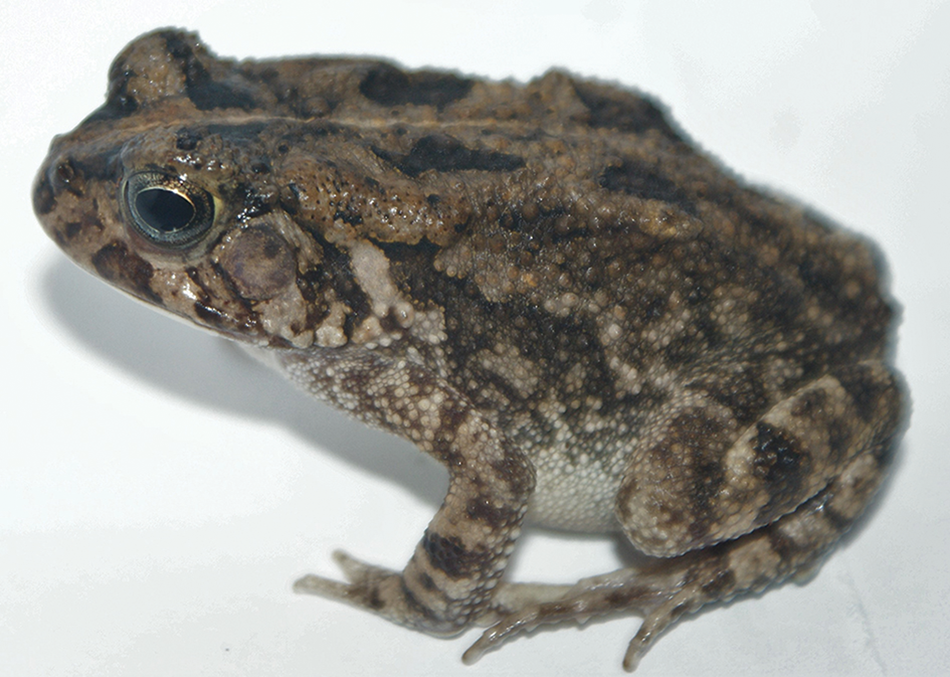
A female guttural toad, S. gutturalis (fig. 1), found its way into Cambridgeshire, UK, in October 2015, within the luggage of tourists who had been visiting Mauritius. The toad quickly found a temporary home with one of the authors (S.J.R.A. of CPARG). It was during this time that the acanthocephalans were collected and submitted for further analysis.
The guttural toad (Sclerophrys gutturalis) that made its way to Cambridge.

A total of 11 male and 16 female worms were collected on three or four occasions, from faecal pellets left by the guttural toad, fixed in formalin and stored in 70% ethanol. The acanthocephalans were cleared in lactophenol prior to examination as temporary wet mounts using an Olympus BH-2 compound microscope (Olympus, Japan). Measurements in micrometres, unless otherwise stated, were made using an ocular micrometre and are presented as the range, followed by the mean in parentheses, where three or more measurements were taken. Drawings were made with the aid of a drawing tube. Type specimens were deposited in the Natural History Museum, London (NHMUK) and voucher specimens in the South Australian Museum, Adelaide (SAMA).
Results
Pseudoacanthocephalus goodmani n. sp. (figs 2 and 3)
Description
General. Echinorhynchidae. Trunk medium-sized, smooth, more or less cylindrical, widest anteriorly. Females larger than males. Lacunar system comprising two longitudinal lateral canals with numerous small reticulate canals forming a network. Proboscis cylindrical, armed with 14–18, usually 14, longitudinal alternating rows of 4–6 hooks each, usually five, with simple roots. Hooks 1 and 5 usually smaller than hooks 2–4. Neck short, broader at base. Proboscis receptacle double-walled, attached to the base of proboscis. Cerebral ganglion at base of proboscis receptacle. Lemnisci digitiform, longer than proboscis receptacle. Genital pore subterminal in males and females.
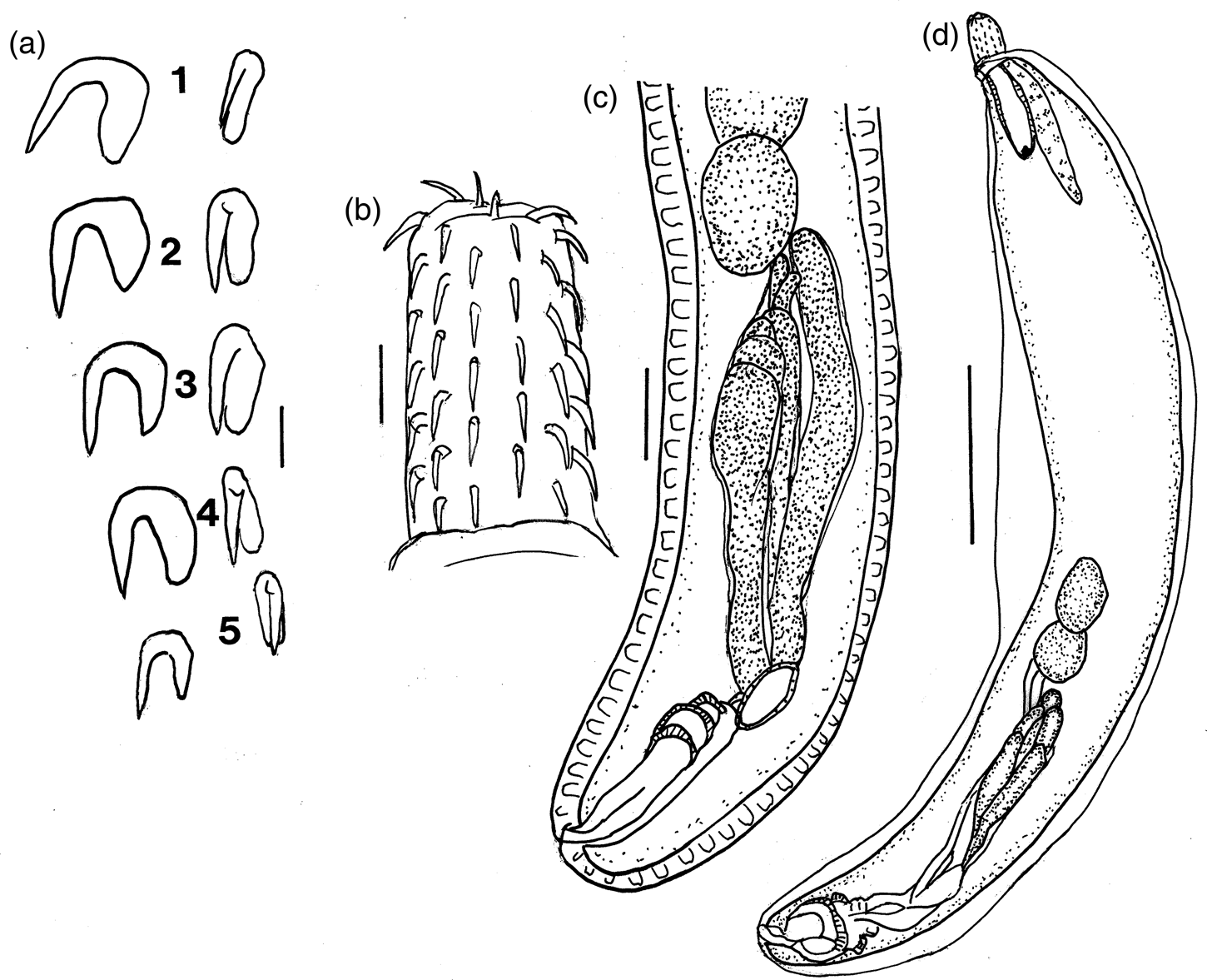
Pseudoacanthocephalus goodmani n. sp. male from Sclerophrys gutturalis in Mauritius. (a) Proboscis hooks, two longitudinal rows; (b) proboscis; (c) posterior end, lateral view; (d) entire specimen, lateral view. Scale bars: (a) 25 µm; (b) 100 µm; (c) 400 µm; (d) 750 µm.

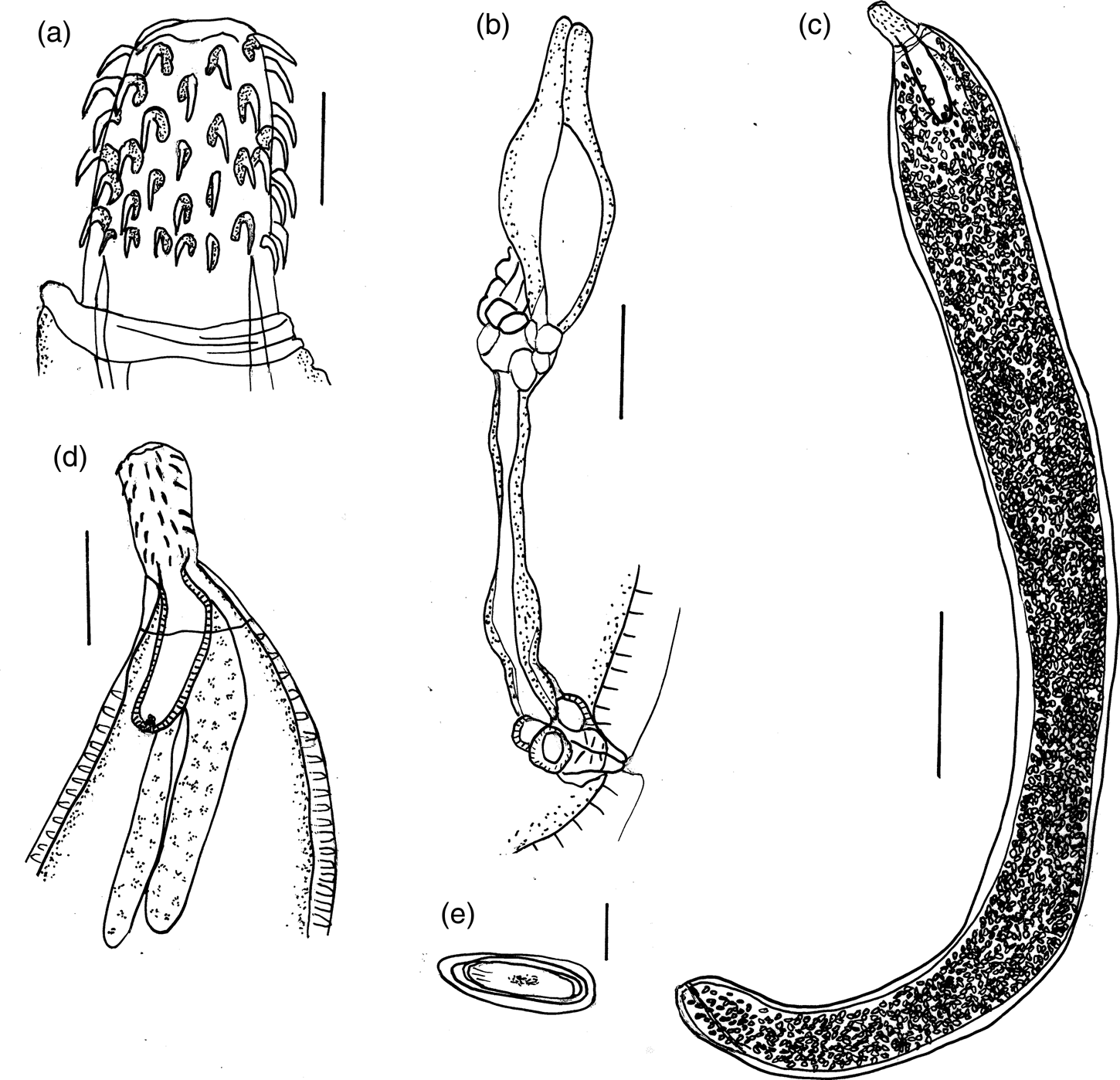
Pseudoacanthocephalus goodmani n. sp. female from Sclerophrys gutturalis in Mauritius. (a) Proboscis; (b) reproductive apparatus with uterine bell, uterus and vagina; (c) entire specimen, lateral view; (d) anterior end, lateral view; (e) egg. Scale bars: (a, b) 200 µm; (c) 2 mm; (d) 500 µm; (e) 25 µm.

Male (based on five specimens) (fig. 2a–d). Trunk 6–11 (8.4) mm long, 1020–1632 (1254) at widest part. Proboscis 302–629 (473) long, 221–268 (256) wide. Hook blades, measurements of two rows, from three proboscides. Blades proboscis 1 (1) 86, 93; (2) 93, 96; (3) 73, 83; (4) 73, 69. Proboscis 2 (1) 46, 66; (2) 53, 72; (3) 66, 69; (4) 66, 66; (5) 66, 63. Proboscis 3 (1) 83, —; (2) 93, 58; (3) 99, 60; (4) 102, 66; (5) 96, 63; (6) 83, 60. Roots proboscis 1 (1) 43, 36; (2) 50,53; (3) 53, 63; (4) 56, 50. Proboscis 2 (1) 36, 36; (2) 53, 43; (3) 53, 50; (4) 50, 43; (5) 50; 63. Neck 147–235 (206) long, 389–489 (438) wide. Proboscis receptacle 737–850 (798) long, 255–402 (306) wide. Lemnisci 703–1445 (1166) long, 200 wide. Testes equatorial, ovoid, tandem, contiguous; anterior testis 503–603 (576) long, 355–408 (391) wide; posterior testis 516–629 (580) long, 295–482 (389) wide. Cement glands six in compact cluster of two tiers, elongate, 900–1750 (1360) long, 60–300 (144) wide; two cement ducts overlapping Saefftigen's pouch, Saefftigen's pouch 637, 740 long (two measurements). Bursa not extended.
Female (based on ten specimens) (fig. 3a–e). Trunk 14–19 (16.5) mm long, 1292–1870 (1579) wide. Proboscis 502–605 (556) long, 235–402 (290) wide. Hook measurements from three rows, two proboscides. Blades proboscis 1 (1) 53, 99, —; (2) 79, 99, 102; (3) 86, 106, 106; (4) 83, 99, 93; (5) 56, —, 73. Proboscis 2 (1) 86, 99, 93; (2) 109, 99, 93; (3) 103, 99, 92; (4) 93, 96, 73; (5) —, 93. Roots proboscis 1 (1) 50, 51; (2) 45, 45; (3) 50, 45; (4) 40, 50; (5) 38, 35. Proboscis 2 (1) 45, 45; (2) 50, 40; (3) 45, 45; (4) 45, 40; (5) 35, 30. Neck 170–368 (243) long, 442–603 (529) wide. Proboscis receptacle 782–1122 (989) long, 153–680 (343) wide. Lemnisci 1105–1608 (1472) long, 250, 290 wide (two measurements). Reproductive system from anterior edge of uterine bell to genital pore 935–1870 (1325) long. Vagina with two sphincters, the internal sphincter well developed. Uterine wall thick and uterine bell glands many. Eggs ovoid, without polar prolongation of fertilization membrane, 72.6–85.8 (76.3) long, 23.1–26.4 (26.0).
Taxonomic summary
Type host. Guttural toad S. gutturalis (Power, 1927) (Bufonidae).
Site of infection. Digestive system.
Type locality. Mauritius.
Prevalence and intensity. One animal examined with 27 worms.
Specimens deposited. Holotype male NHMUK 2019.11.12.1, allotype female NHMUK 2019.11.12.2, paratypes NHMUK 2019.11.12.3–20 in NHMUK; vouchers one male, one female, two anterior ends female, SAMA AHC48865 in SAMA.
Etymology. The species name is given in recognition of the enthusiasm and commitment of Mark Goodman (CPARG) to the conservation of British herpetofauna.
Remarks
The new species is accommodated within the genus Pseudoacanthocephalus because specimens have the generic characters of an aspinose cylindrical trunk, a cylindrical proboscis with hooks arranged quincuncially, a short neck, a cluster of cement glands, eggs without polar prolongation of the fertilization membrane and are parasitic in a toad (Petrochenko, Reference Petrochenko1958; Golvan, Reference Golvan1969). Pseudoacanthocephalus goodmani n. sp. does not, however, correspond to any species listed in the most recent key to the species (Tkach et al., Reference Tkach, Lisitsyna, Crossley, Binh and Bush2013). In having a proboscis hook formula of 14–18, usually 14 longitudinal rows of 4–6, usually five hooks and six cement glands. Pseudoacanthocephalus goodmani can be placed between P. perthensis (Edmonds, Reference Edmonds1971) and P. reesei (Bush et al., Reference Bush, Duszynski and Nickol2009), species that have 12–15 longitudinal rows of 4–5 hooks, and P. lutzi (Hamman, 1891), P. bufonis (Shipley, 1903) and P. bufonicola (Kostylew, 1941), species with 16–19 longitudinal rows of 5–8 hooks (Tkach et al., Reference Tkach, Lisitsyna, Crossley, Binh and Bush2013).
Pseudoacanthocephalus goodmani can be further distinguished from P. perthensis in being a larger worm (males 4–11 mm compared with 2.6–3.2 mm long) with a cylindrical, not subcylindrical to ovoid proboscis, having the lemnisci longer than the proboscis receptacle, not about the same length and larger eggs (72.6–85.8 long compared with 45–55) (Edmonds, Reference Edmonds1971). Pseudoacanthocephalus reesei in amphibians from China and usually with rows of four hooks can be further distinguished from P. goodmani in having the proboscis hooks increase progressively in length from anterior to posterior, the posteriormost hook being considerably larger compared with hooks 1 and 5 being smaller than hooks 2–4, the largest hooks being up to 131 in length compared with 109, and having larger eggs, 84–96 long compared with 73–86 for P. goodmani (see Bush et al., Reference Bush, Duszynski and Nickol2009).
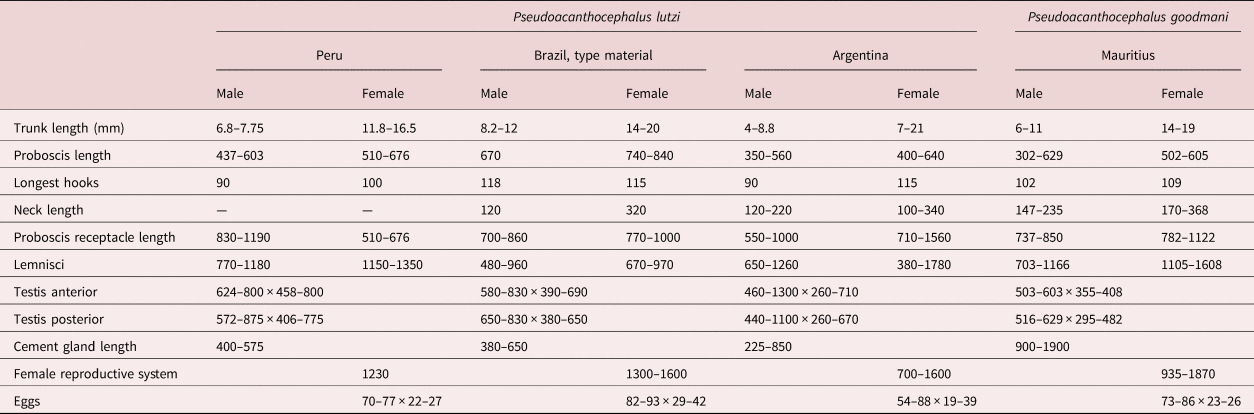
As redescribed by Arredondo & Gil de Pertierra (Reference Arredondo and Gil de Pertierra2009) and Amin & Heckmann (2014), P. lutzi, a South American species, has a proboscis hook formula of 14–18, usually 15–16, longitudinal rows of 5–8 proboscis hooks, which is similar to that of P. goodmani with 14–18, but usually 14, longitudinal rows of no more than 4–6 hooks. The hooks of P. lutzi are longer, up to 115 in males, 118 in females, progressively increasing in length posteriorly and with spatulate roots, compared with hook lengths of up to 99 in males and 106 in females, hooks 1 and 5/6 usually smaller and with simple roots for P. goodmani. Males of P. lutzi have testes in the posterior third of the trunk, pyriform cement glands, a sigmoid-shaped posterior end compared with those of P. goodmani, which have equatorial testes, elongated cement glands and the posterior end of the male not sigmoid in shape (comparative measurements are given in table 1).
Comparative measurements of Pseudoacanthocephalus goodmani and P. lutzi. Data from Arredondo & Gil de Pertierra (Reference Arredondo and Gil de Pertierra2009) and Amin & Heckmann (Reference Amin and Heckmann2014).

Pseudoacanthocephalus bufonis from South-East Asia and Southern China as per Bush et al. (Reference Bush, Duszynski and Nickol2009) has a shorter proboscis (408–542) of usually 16 alternating rows of 5–6 hooks each, the hooks measuring up to 104 long and about the same length from anterior to posterior along the proboscis. The proboscis of P. goodmani is longer (302–629) and the hooks, up to 109 long, vary in length from anterior to posterior, with hooks 2–4 longer than hooks 1 and 5/6 (Bush et al., Reference Bush, Duszynski and Nickol2009). Trunk length of P. bufonicola, from Central Asia and Eastern Europe, does not exceed 10 mm and the proboscis armature, with the posterior two hooks in each row rootless and hooks 4, 5 longest, distinguishes the species from P. goodmani, which is up to 19 mm long and has a proboscis armature with all hooks having roots and hooks 2–4 longest (Petrochenko, Reference Petrochenko1958; Golvan, Reference Golvan1969).
Although having a similar proboscis hook formula to Pseudoacanthocephalus nguyenthileae (Amin et al., Reference Amin, Van Ha and Heckmann2008), P. goodmani differs in having 14–18 longitudinal rows of 4–6 hooks, usually 14 rows of five hooks, hooks 1 and 5/6 usually smallest, and six cement glands compared with 16–18 (rarely 15 or 19) rows of 5–6 hooks, hooks longest posteriorly and eight cement glands (Amin et al., Reference Amin, Van Ha and Heckmann2008).
Pseudoacanthocephalus coniformis (Amin et al., Reference Amin, Heckmann and Van Ha2014), described more recently than could be included in the key of Tkach et al. (Reference Tkach, Lisitsyna, Crossley, Binh and Bush2013), differs from P. goodmani in having a cone-shaped anterior trunk, a proboscis hook formula of 13 rows of seven hooks, up to 75 long, sub-equal lemnisci and eight cement glands (Amin et al., Reference Amin, Heckmann and Van Ha2014).
Most of the species of the genus Pseudoacanthocephalus are from Asian or associated regions (Amin et al., Reference Amin, Heckmann and Van Ha2014). Two species are known from Madagascar, one from Tanzania and P. goodmani from Mauritius, with a probable origin in South Africa (see the following section), which is the fourth of the 19 accepted species to be found in the African region.
Discussion
Adult acanthocephalans being expelled in host faeces appears to be an unusual event. It is not referred to by Kennedy (Reference Kennedy2006) in his discussion of acanthocephalan life cycles and their transmission. The only record we could find of such an event happening was from Kidov et al. (Reference Kidov, Kondakova, Matushinka and Afrin2018), who reported finding adults of Acanthocephalus falcatus (Froelich, 1789), A. ranae (Shrank, 1788), P. bufonis and Pseudoacanthocephalus caucasicus (Petrochenko, 1953) in the Caucasian toad Bufo verucossismus (Pallas, 1814). Perhaps the phenomenon is more common in toads than the literature would suggest but has previously gone unnoticed.
As indicated above, P. lutzi and P. goodmani are morphologically similar and the cane toad, Rhinella marina (Linnaeus, 1758), the type host of P. lutzi (see Arredondo & Gil de Pertierra, Reference Arredondo and Gil de Pertierra2009), was introduced into Mauritius between 1936 and 1938 (Cheke & Hume, Reference Cheke and Hume2008). Pseudoacanthocephalus lutzi has been reported from a range of amphibian hosts across South America and the West Indies (Arredondo & Gil de Pertierra, Reference Arredondo and Gil de Pertierra2009; Amin & Heckmann, 2014, Drake et al., Reference Drake, Zeiger and Growskowski2014; Toledo et al., Reference Toledo, de Fonesca, Iannacone, Cardenas Callirgos, Pineda Castilla and da Silva2017) but not from any of the other countries where R. marina has been introduced. Barton (Reference Barton1997) reported that only local parasites had been recorded from Australian cane toads and Barton & Pichelin (Reference Barton and Pichelin1999) recorded only P. bufonis from cane toads in Hawaii, thereby supporting the finding that the species P. goodmani is distinct from P. lutzi.
As Mauritius possesses no native species of amphibians, either P. goodmani was introduced from South Africa with its host S. gutturalis or P. goodmani arrived in Mauritius with the introduction of the cane toad, R. marina, and subsequently infected S. gutturalis. Given that P. lutzi has been reported only from American hosts, this latter scenario seems most unlikely.
The problem of the effects of non-native, sometimes invasive species in contributing to the current global biodiversity crisis is increasingly recognized (e.g. Jardine & Sanchirico, Reference Jardine and Sanchirico2018; Bélouard et al., Reference Bélouard, Petit and Paillisson2019). For example, the American bullfrog, Lithobates catesbianus Shaw 1802, has been deliberately or inadvertently released on several continents and in many countries (including the UK) and frequently persists extremely well, acting as an invasive predator, competitor and vector of diseases (Cunningham, Reference Cunningham2018; Urbina et al., Reference Urbina, Bredeweg, Garcia and Blaustein2018). Introduced species of current concern in the UK include the marsh frog, Pelophylax ridibundus (Pallas, 1771), and its congeners, and the alpine newt, Ichthyosaura alpestris (Laurenti, 1768), both of which are associated with the detection of the fungal pathogen, Batrachochytrium dendrobatidis (Bd), in the wild (Smith, Reference Smith2013).
While it is unlikely that S. gutturalis could easily become established in the wild in northern Europe, the species’ adaptability and latitudinal and altitudinal range make this impossible to rule out. Further, accidental stowaways of the species to the UK are likely to be very infrequent. More pertinent is perhaps the concern that stowaway non-native amphibians could introduce novel pathogens and, particularly, novel parasites with unknown environmental tolerances such as P. goodmani, if or when released into the wild. Despite having an indirect life cycle, acanthocephalans have been known to invade and extend their range by travelling with introduced or invading hosts. For example, Plagiorhynchus cylindraceus, a common parasite of passerine birds as definitive hosts and mammals as paratenic hosts, originating in Europe, is known to have invaded Australia and North America using introduced and then indigenous birds as hosts (Moore, Reference Moore1983; Smales, Reference Smales2002). Similarly, P. cylindraceus has invaded New Zealand, probably with isopod intermediate hosts, and has been detected in hedgehogs, alien pests in this context, as paratenic hosts (Skuballa et al., Reference Skuballa, Taraschewski, Petney, Pfaffle and Smales2010). The introduction of Acanthogyrus (Acanthosentis) alternatespinus Amin, Reference Amin2005 in Lake Biwa, Japan, has been similarly attributed to the introduction of its host Rhodeus ocellatus ocellatus (Kner, 1866) from eastern China and the Korean Peninsula (Amin, Reference Amin2005). Fortunately, in the present situation, the unwitting couriers of the toad in question were responsible enough not to release it into the surrounding countryside. This example of the unplanned arrival of toad plus acanthocephalan parasite into the UK, however, illustrates the need for vigilance in controlling the entry of potentially invasive species.
The toad has been maintained in isolation in captivity by J.W.W. since early 2016 and remains apparently healthy, although it has not been tested for Bd or other pathogens. The husbandry routine is such that other captive specimens are not brought into contact with any of the terrarium contents. The appetite and activity patterns of the toad appear to be normal, and no more parasitic worms have been recovered, despite regular checking.
Acknowledgements
Thanks are due to Mark Goodman who collected the toad before it entered the care of S.J.R.A., after which the parasites were first discovered, and for his efforts to engage younger generations with the natural world.
Financial support
This research received no specific grant from any funding agency, commercial or not-for-profit sectors.
Conflicts of interest
None.
Ethical standards
The authors assert that all procedures contributing to this work comply with the ethical standards of the relevant national and institutional guides on the care and use of laboratory animals.