Introduction
Iran had been identified as a country with successful family planning programmes during the 25 years from 1989 to 2014 (Aghajanian, Reference Aghajanian1994; Karamouzian et al., Reference Karamouzian, Sharifi and Haghdoost2014). This success was affected by several factors, such as the support of religious leaders and the integration of family planning programmes in the primary health care system. An active family planning programme was introduced in 1989 by the Ministry of Health & Medical Education (MOHME), resulting in high contraceptive prevalence rates in the year 2000 of 77.4% and 67.2% in urban and rural areas, respectively (Simbar, Reference Simbar2012). Due to the proactive family planning programme over these years, and many other socioeconomic changes in the country, a strong tendency emerged among families to regulate their fertility by using contraceptive methods (Karamouzian et al., Reference Karamouzian, Sharifi and Haghdoost2014).
Many other social, demographic and economic changes over the last three decades have contributed to the fertility rate reduction in Iran to a low of 1.6 births per woman in 2011 (Abbasi Shavazi & Hosseini-Chavoshi, Reference Abbasi Shavazi and Hosseini-Chavoshi2014). In Tehran, the fertility rate in 2011 was estimated to be 1.5 births per woman – lower than the national rate (Erfani, Reference Erfani2013a). In 2012, these fertility trends became a serious concern for the Iranian Government, leading to a shift towards a pronatalist population policy (Erfani, Reference Erfani2017) aimed at raising the birth rate (Hosseini-Chavoshi et al., Reference Hosseini-Chavoshi, Abbasi-Shavazi and McDonald2016). One strategy adopted was to decrease publicly funded family planning services (Erfani, Reference Erfani2017). For instance, surgical sterilization was banned for men and women using it merely to regulate conception (Erfani, Reference Erfani2015), and financial resources allocated to family planning were cut substantially (Behboudi-Gandevani et al., Reference Behboudi-Gandevani, Tehrani, Cheraghi, Noroozzadeh, Farahmand and Azizi2017). While the components of the policy are still under discussion (Hosseini-Chavoshi et al., Reference Hosseini-Chavoshi, Abbasi-Shavazi and McDonald2016), an analysis of the situation suggests that banning sterilization is unlikely to result in an increase in the fertility rate. It might, however, lead to unintended pregnancies, induced abortions and maternal mortality (Erfani, Reference Erfani2015), particularly among those who cannot afford contraceptives from private providers.
Recent research in Iran indicates that about a third of pregnancies are unintended (Moosazadeh et al., Reference Moosazadeh, Nekoei-Moghadam, Emrani and Amiresmaili2014) and a considerable number of these occur among couples who used the withdrawal method (always freely available), the contraceptive pill and condoms (accessible in drugstores at minimal cost) (Erfani, Reference Erfani2011, Reference Erfani2013b, Reference Erfani2015). So, banning surgical sterilization will not lead to a rise in birth rates across Iran, because ‘only 7% of the reduction in fertility can be attributed to the effective use of medical sterilization and the intrauterine device, which are the two major contraceptive methods funded by the government’ (Erfani, Reference Erfani2015, p. 318).
A longitudinal study conducted in Iran between 2002 and 2011, before the introduction of the pronatalist population policies, showed that use of traditional methods such as withdrawal increased significantly, while modern methods experienced a reverse trend. Tubal ligation and IUD use dropped significantly, while condom use significantly increased over the decade. Hence, a rise in male method use, including condoms and withdrawal, had begun before the advent of the pronatalist policies (Behboudi-Gandevani et al., Reference Behboudi-Gandevani, Tehrani, Cheraghi, Noroozzadeh, Farahmand and Azizi2017). It is also worth noting that in Iran, male contraceptives were introduced long before the Islamic period. Withdrawal, known as azl (an Arabic word literally meaning ‘climbing down’ or withdrawal, coitus interruptus), dates back to the slave era when men used it during sex with slave women. Condoms have, more or less, a similar story in terms of their historical association with extramarital sex. They were introduced in Iran during the First World War (1914–1918) and have been used particularly by urban men during sex with sex workers (Mehryar et al., Reference Mehryar, Mostafavi and Agha2001).
After the introduction of pronatalist policies important changes have been seen in the pattern of contraceptive use, with an increase in use of temporary and unreliable contraceptive methods (Khalajabadi Farahani & Khazani, Reference Khalajabadi Farahani and Khazani2019). This comparative study examined changes in contraceptive use among women aged 15–29 years before (in 2010) and after (in 2016) the introduction of the policies in Sanandaj City. It revealed a significant reduction in the prevalence of modern method use compared with traditional methods (from 81.2% to 64.7%), while withdrawal increased from 19% to 36% (a considerable increase). Moreover, in 2016 women reported a decrease in access, quality, advocacy and counselling compared with 2 years earlier.
Fertility intentions and ideals have also changed among both men and women due to modernization, higher education and individualism over the recent decades. Recent studies have shown below-replacement ideal fertility and intended fertility for new marriage cohorts in Tehran (Erfani, Reference Erfani2013a; Khalajabadi Farahani & Saraie, Reference Khalajabadi Farahani and Saraie2013; Khalajabadi Farahani & Erfani, Reference Khalajabadi Farahani and Erfani2014). Hence, families are tending to control their fertility using modern and traditional contraceptive methods, and male-oriented methods in particular seem to be rising among couples.
In 1959, the first educational family planning programmes were established in Iran in welfare centres, and social workers provided face-to-face education on family planning and reproductive issues. In fact, this was the first time much attention was given to them, with men (especially fathers and young men) having access to lectures, films and free discussions. These were available not only during standard working hours but also in the evenings, making them accessible to those who were working. The purpose was to highlight family planning as an integral part of social welfare with an emphasis on its economic and social consequences, and the importance of the role of fathers. In addition, social workers went to ‘male’ public places such as tea houses and cafeterias, to make men aware of the services provided in the welfare centres, as well as to encourage them to attend family planning and reproductive health educational classes (Saleh, Reference Saleh2008). However, after the Islamic Revolution in Iran, the main target group of the National Family Planning Programme was women, and few men were targeted. From then onwards, due to sensitivity around sexual issues, and particularly sexual relations, there was limited education on condom use and withdrawal for men and women, and family planning services were mainly provided by female health care workers to women attending the clinics to receive contraceptive methods (Hoodfar & Assadpour, Reference Hoodfar and Assadpour2000).
Given these recent changes, men seem to be increasingly responsible for fertility control in Iran, with a trend towards greater use of male-oriented methods such as condoms and withdrawal (Khalajabadi Farahani & Khazani, Reference Khalajabadi Farahani and Khazani2019). These methods need men’s motivation and active involvement in fertility decision-making. This study aimed to explore Iranian men’s perspectives and interpretations on access to contraceptive information and services and their participation in contraceptive use, and to explore their views on the cultural and gender barriers to accessing these.
Theoretical considerations and conceptual framework
The Theory of Gender and Power (Connell, Reference Connell1987) provided the general theoretical framework for this research. This examines the role of gender relations and decision-making and behaviour issues in contraceptive method use and fertility control. It identifies ‘…three main structures that characterize the gendered relationships between men and women: (1) the sexual division of labour, which examines economic inequities favouring males; (2) the sexual division of power, which examines inequities and abuses of authority and control in relationships and institutions favouring males; and (3) cathexis, which assesses social norms and affective attachments’ (Wingood & DiClemente, Reference Wingood, DiClemente, DiClemente, Crosby and Kegler2002, p. 313). This approach considers not just the need to transform individuals at a personal level, but recognizes that gender relations are contextualized in a particular socioeconomic and cultural setting. In this study the theory was adapted to analyse the individual, institutional and social gender factors that influence men’s participation in contraceptive use and fertility control. This gender perspective will help better understand men’s participation in contraceptive use, as advocated by the International Conference on Population and Development (ICPD) in Cairo 1994, which called for men to share the responsibilities of family planning (Croce-Galis et al., Reference Croce-Galis, Salazar and Lundgren2013).
Previous research has indicated that men’s participation in contraceptive use is influenced by many factors operating at the individual, family and socio-cultural levels. However, the levels are not exclusive, and do not have a linear progression, but rather interact in complicated ways through linking concepts. Thus, the conceptual framework has many components including socio-cultural norms (Mullany, Reference Mullany2006; Fallahi et al., Reference Fallahi, Tavafian, Yaghmaiee and Hajizadeh2012), education systems (Ali et al., Reference Ali, Rizwan and Ushijima2004), gender roles (Lindberg et al., Reference Lindberg, Lewis-Spruill and Crownover2006), media (Gupta et al., Reference Gupta, Katende and Bessinger2003; Mistik et al., Reference Mistik, Nacar, Mazicioğlu and Cetinkaya2003; Yazdi et al., Reference Yazdi, Aschbacher, Arvantaj, Naser, Abdollahi and Asadi2006) and health systems and its indicators such as service availability and accessibility, gender balance in health centres, provider bias, cost and finally, time (Rakhshani et al., Reference Rakhshani, Niknami and Ansari Moghaddam2005).
The conceptual framework was used to write a set of appropriate questions for interviews, addressing various themes within the framework and allowing an exploration of how these can interact at different levels.
Methods
Study sample and context
Data came from a larger qualitative project examining men’s involvement in family planning and reproductive health matters in Tehran from a gender perspective (Bagheri, Reference Bagheri2017). This interviewed 60 married men selected purposively from the city of Tehran who were mostly working in the public sector. Data collection was conducted from January 2014 to April 2014. Interviewees were recruited based on their demographic variation to achieve maximum variation (heterogeneity) sampling (Sandelowski & Leeman, Reference Sandelowski and Leeman2012). The sampling method sought to include men of varying ages and education levels and from different regions in Tehran. Interviewees who met the selection criteria (see below) were found using the snowball technique, where a few interviewees provide recommendations for other possible participants and volunteers (Petersen & Valdez, Reference Petersen and Valdez2005). This technique is specifically used when respondents are sought who are not easily accessible or who have specific or exclusive experiences that are of interest. The men interviewed were asked to recommend other men who fitted the selection criteria, and many recommended their colleagues, friends and relatives.
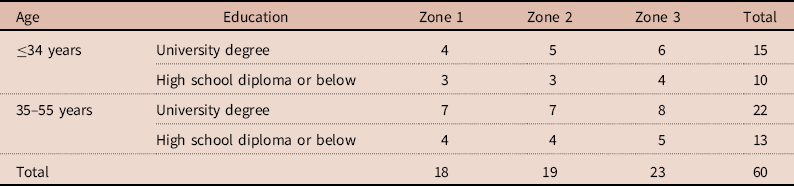
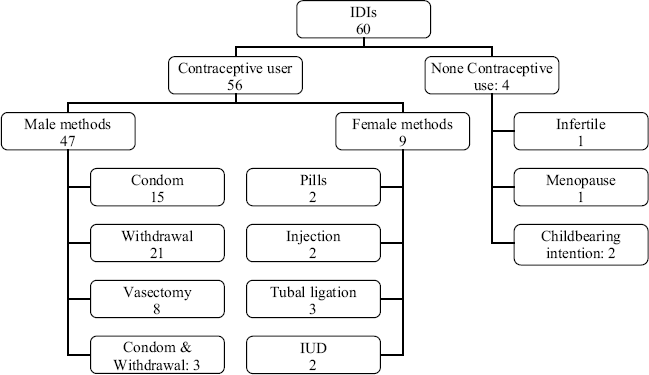
The inclusion criteria were: living in Tehran, being male, being 55 years of age or younger, being married for at least a year and living with their spouse. Men were sought from different socioeconomic backgrounds within the city. Tehran’s 22 municipal districts were divided into three zones based on the social class or socioeconomic situation of residents. Zone 1 (upper-middle class) included districts 1–3, and 5; Zone 2 (middle class) included districts 4 and 6–12; and Zone 3 (lower-middle class) included districts 13–22. It was assumed that people living in the same zone had fairly similar socioeconomic status (Gheissari, Reference Gheissari2009; Fereshtehnejad et al., Reference Fereshtehnejad, Asadi-Lari, Moradi Lakeh, Vaez-Mahdavi, Motevalian and Afkari2010; Mokhayeri et al., Reference Mokhayeri, Mahmoudi, Haghdoost, Amini, Asadi-Lari and Naieni2014). To ensure a range of interviewees with varying ages and socioeconomic statuses, maximum variation sampling was employed (see Table 1). The 60 interviewees were aged 25–55 years (mean 38.4 years). Thirty-seven had a university degree, and the remaining 23 had a high school diploma or below. Most were government employees (n=48) and the rest worked in the private sector. The average length of marriage was 12.6 years. Eleven had no children, 19 had one child and 25 had two children. Seventeen reported using contraceptive methods that had failed leading to an unplanned pregnancy. Thirty-four were using modern contraceptive methods at the time of the survey, while 21 were using traditional methods (withdrawal). Only four were not using any contraceptive method, one of which reported that his wife was infertile, another reporting that she was going through the menopause and the remaining two reporting that they were trying to conceive (see Figure 1). Twenty-eight had only ever used male contraceptive methods and their wives had never used female methods. Only two interviewees reported that their wives took sole responsibility for contraceptive use (by using female contraceptive methods).
Sampling matrix for study participants

Zone 1 (upper-middle class) included districts 1, 2, 3 and 5; Zone 2 (middle class) included districts 4, 6, 7, 8, 9, 10, 11, and 2; and Zone 3 (lower-middle class) included districts 13 to 22.
Current contraceptive method use and reasons for non-use of interviewees.

Data collection
Qualitative data were collected using in-depth interviews. All but two interviews were conducted in a private space at the interviewee’s work place (conference room, dining room or waiting room). One took place in the interviewer’s car, and one in a park. Men were interviewed by a trained, married male interviewer who was very familiar with conducting in-depth interviews on sensitive topics such as family planning, contraceptives and sexual issues. During interviews, no one else was present except the interviewer and the interviewee.
An interview topic guide was created, based on the conceptual framework, with a series of core topics and probes to expand and deepen responses. Questions covered the socio-demographic characteristics of men, and their interpretations/views on their participation in contraceptive use, rationales, barriers and facilitators at individual and social and structural levels. All interviewees, regardless of their current contraceptive method use, were asked about their knowledge of contraceptive methods, availability of, and access to, contraceptive information and services, experiences with health care services providers and their perceived socio-cultural barriers to contraceptive use. In this study, family planning was defined as the purposeful decision-making by couples on the numbers, timing and spacing of children through the use of contraceptive methods (Tran et al., Reference Tran, Dawson, Meyers, Krause and Hickling2015). Contraception methods comprised hormonal contraceptive pills, the intrauterine device (IUD), hormonal implants or injections, condoms, male sterilization (vasectomy), female sterilization (tubal ligation), withdrawal and abstinence in this study. Interviews were conducted in Farsi and lasted between 45 and 110 minutes (average 75 minutes). They were recorded and transcribed verbatim. The analysis was initially conducted in Farsi and then the identified codes, categories and quotes were translated into English using the forward–backward translation procedure.
Data collection was ethically grounded in cultural and religious awareness and respect for the rights of the interviewees. Verbal consent was audio-recorded at the beginning of the interview. Interviewees were assured that their identity would be kept confidential and all identifiable information removed or altered before reporting the findings. The participation of all men was voluntary and all interviewees were informed about the purpose of the study. They were told that they could stop the interview at any point without having to provide any reason.
Analysis
A basic interpretive approach and qualitative inductive strategy was adopted for the qualitative data analysis. The interpretive approach assesses how people make sense of, and interpret, their experiences (Merriam, Reference Merriam2002). The aim was to identify and examine overall themes related to family planning knowledge, sources of family planning and contraceptive information and experiences when accessing family planning information and services.
The software MAXQDA10 (which supports Farsi) was used for the analysis and to identify initial open codes. The analysis had three stages, as recommended by Elo and Kyngäs (Reference Elo and Kyngus2008): preparation, organization and reporting. Preparation involved familiarization with the data – repeatedly listening to the interview recordings and reading the transcripts multiple times to get a feel for the data and the main themes evident within the talk, as well as determining reporting units. The organizing stage allowed open coding by labelling the text, sentence by sentence, providing the basis for analysis. The open codes were compared to identify similarities and then clustered into different categories at a higher abstract level guided by the conceptual framework.
Results
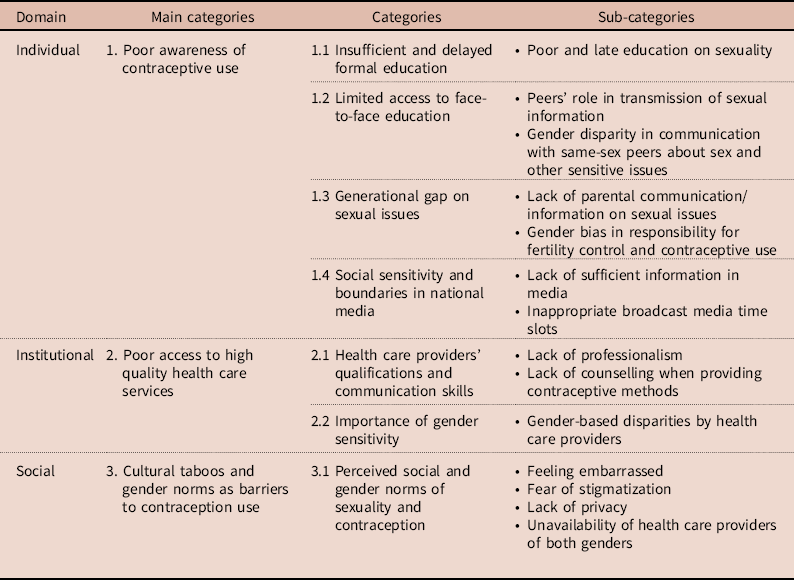
Three main inter-related, and partly overlapping, categories of men’s views on access to, and experiences of, contraceptives were identified: (1) poor awareness of contraceptive use; (2) poor access to high-quality health care services; and (3) cultural taboos and gender norms as barriers to contraception use by men. Socio-cultural and gender norms were found to significantly affect the men’s contraceptive use (Table 2).
Main categories and sub-categories of barriers to men’s participation in contraceptive use in Tehran

Poor awareness of contraceptive use
Men’s education and sources of information about sexual issues and contraceptive use were viewed as being generally poor. The interviewees highlighted the poor availability and quality of education programmes, which did not address the real issues about contraceptive use. This category was broken down into four sub-categories.
Insufficient and delayed formal education
Most interviewees believed that the existing educational programmes provided by the military, universities and compulsory premarital consultation courses came too late, as teenage boys often had sexual experiences before they joined the military, going to university or getting married. Furthermore, not all young men enter the military service or go to university and experience the obligatory family planning and contraception (‘family ethic’) courses:
When they taught us these matters in university, it was about 15 years after the first time I had sex. Teaching regarding this matter was very weak. (32 years, Associate degree, 3 children)
The type and time of teaching is important. They should have been taught at high school in order to get better results. They will get familiar by attending family planning course in the university. They get mature when they study at high school and might get married after high school. (37 years, Master’s degree, one child)
Interviewees reported that the quality of the compulsory courses for young couples who are getting married in health centres was poor, although they acknowledged that they did improve awareness and use of contraceptives. One reason given was the huge number of people to each instructor:
Educational course before marriage is of very low quality, 50 to 60 people in one class with one speaker. That’s all. (28 years, Bachelor’s degree, no child)
Another weakness given was the lack of comprehensiveness of the education and that it did not meet the needs of couples. Interviewees seemed to prefer an interactive teaching approach with questions and answers, rather than a deductive learning approach of watching an educational video with no discussion and interaction with the educator:
Unfortunately, we went for educational course but there was nothing special to learn. Only 15 minutes of general matters and playing a CD, nothing about family planning, when to take the pills, no details. (31 years, Diploma, no child)
Limited access to face-to-face education
Most interviewees cited electronic sources (the internet) and other texts (books, articles and leaflets) as their first sources of information about sex and contraception. However, there was a preference for information delivered through active face-to-face discussion with counsellors and health care providers. A number of interviewees also noted the important role of peers in the transmission of sexual information:
I read a small part from a book, and read the rest last year, followed by my communication with my friends. I had a friend who had sexual problems. He explained so many things to me. (45 years, Secondary education, 2 children)
Yes [I discuss these issues with my friends], about what information I have, or what I have found on the internet or if something bad happened, try not to experience that. This is good to exchange the information. (43 years, Secondary education, 2 children)
Some interviewees noted that talking with peers and exchanging information with them helped to raise their awareness about male contraceptive methods:
For example, they talk about condoms, or those vasectomized talk about problems they faced. Consultation and communication definitely has a good result. The result is practical. (46 years, Diploma, 2 children)
We talked about condoms and vasectomy a lot. Well, men think if they are vasectomized and later want to have children, it is impossible, but lately I heard, it is possible. (54 years, Diploma, 2 children)
Conversely, some men did not consider peers to be an important main source of information on contraception, and considered sexual matters to be private and were not willing, or able, to talk with their colleagues or friends about them. They believed that men’s modesty, embarrassment and prejudice about sexual topics were barriers to communication with other men:
Men do not talk about these matters because of their prejudice…They are not open about everything. (31 years, Diploma, no child).
These men said that it is more common in women as they talk about sexual issues with their peers:
Women talk a lot about sexual topics, but men do not talk about them, because they feel shy. (47 years, Bachelor’s degree, one child)
This quote reflects a gender disparity between men and women’s communication with same-sex peers about sexual and sensitive issues. Along with men’s sense of embarrassment and prejudice about sexual topics, this might be justified with the notion that family planning is perceived not to be relevant to men. From this traditional perspective, men are not responsible for contraceptive use, and are therefore embarrassed to talk about such matters with their male peers. In addition, a paradox and contradiction was observed in the peers’ roles in transmission of sexual information. On the one hand, peer interactions, for men who were willing to open up, was reported to be a good source of information that helped them clarify sexual issues or made information more accessible. On the other hand, if peers become the only source of sexual information, the information could be incorrect or unreliable. For example, one interviewee described personal misconceptions and others misperception about the side-effects of vasectomy:
I heard that someone had a vasectomy, but cannot do heavy activity, since hearing that, I didn’t go for it. (34 years, Elementary education, two children)
Another interviewee explained that many myths and misperceptions might be imparted from peers:
There are so many [men] who don’t like vasectomy. They think it doesn’t work and some think it causes infertility or affects sexual relationships. For example, they say they cannot have good sex, but it is not like that. (46 years, Diploma, 2 children)
Vasectomy, it is not a popular prevention method for many people. They assume it’s a method to permanently infertile a person for ever or make them less able to perform sexual activities. It’s commonly believed by people. They think they are less able when it comes to sexual activities but they are wrong. (34 years old, Elementary education, 2 children)
These quotes also reflect men’s preference for using contraceptive methods that do not interfere with their sexual activity or potential. In fact, fear of losing masculinity, their pride in their sense of manhood, the social stigma attached to vasectomy made men fear it. A lack of trust about vasectomy and its effect on sexuality negatively affected men’s perception on this male method.
Generational gap on sexual issues
Despite many claims that parents can a good source of sexual education, the majority of interviewees said that their parents did not give them with any information about sexual matters. They considered parents to be ill-prepared, lacking in knowledge and communication skills, as well as being uncomfortable talking about such issues:
Some parents say, it is not the time for young people to know about such a thing, let them learn it when they get married. For example, I never heard about it from my family, even when I was about to get married. Parent never clear it up, so young people make mistake and get things wrong. (28 years old, Diploma, one child)
There were parents who even punished their children if they were seen to engage with materials on sexual issues:
I remember, in my teenage years when I read a book related to marital relationships, my parents punished me and asked me why I was reading such book? (30 years, Bachelor’s degree, no child)
Thus parents are not a reliable source of contraceptive information, and appear to be opposed their children being curious about and accessing such information. Some interviewees even stated that their fathers reinforced gender stereotypes on women being responsible for fertility control rather than men, and had negative views on men’s participation in family planning (particularly using male methods such as vasectomy). One of the interviewees shared how upset his father was when he found out that he had undergone a vasectomy:
Once I was talking with my dad and told him that I had a vasectomy. He got so upset and asked me ‘why?’ The old generation point of view is totally different from now. (40 years, Master’s degree, 2 children)
Social sensitivity and boundaries in national media
Despite evidence that various forms of media are effective in attracting men’s attention and imparting health messages, the interviewees thought that advertising related to men’s access to contraception information was minimal. Furthermore, they considered that TV and radio programmes, press, posters and billboard messages on fertility and reproductive health only gave very general messages, and not the specific and more detailed information they required. Some media messages were thought to be too complex and difficult to comprehend, were not explicit enough in their messaging and not prepared for the general population and were in easy language:
There were some CDs in pharmacies. I can’t remember their names. They were about these matters but they do not explain them clearly. (28 years, Diploma, one child)
I saw a TV programme on family planning many years ago. I saw it once or twice. The explanation was not clear. (33 years, Associate degree, one child)
It should be mentioned that the subject matter is sensitive, and national media has some restrictions on addressing sensitive issues and so cannot provide comprehensive information on contraceptive methods. Thus national media and TV are not suitable sources of information:
I saw some brief content in the media. In our country they cannot explain some matters [openly] in the media. If they show Hello Doctor every week, most people will get accustomed to these matters. (33 years, Elementary education, no child)
However, the lack of transparency and forthrightness in explaining these issues in the Iranian national media has led many people to turn to satellite programmes (foreign TV networks). Hello Doctor is a programme on national TV in which doctors address health and well-being issues and answer people’s questions. Unlike local Iranian media, the foreign media are quite clear and straightforward when talking about such subjects. For example, one interviewee pointed out the positive impact of foreign network programmes in terms of increasing their knowledge:
Satellite television documentaries are very useful. Like the X network which was for pregnant women. My wife was pregnant. It was very useful and we obtained a lot of information. Then I realized that we did not know many things. Iran TV does not show these things. Our first fetus had problems when he died at 6 months old. We did not know and did a series of laboratory test. Doctors said, it was because of measles during pregnancy. If we had the information in the beginning, earlier, this would not happen. (43 years old, Diploma, one child)
Many interviewees also pointed out that the broadcasting times of TV and radio programmes covering contraception and sexual issues did not suit working men, being generally during the day:
Once I said ‘I won’t go to work’. Until then I had never been at home on Mondays. I turned on the TV at 10 am and saw a doctor was giving his talk [on family planning matters], but what working man can see this programme on Monday morning?’ (30 years, Master’s degree, no child)
Poor access to high-quality health care services
Men’s participation in contraceptive use was affected by the quality of health care services and providers. Men were of the belief that the public clinics providing contraception and counselling did not recruit qualified, professional staff able to deliver accurate and comprehensive information on sensitive topics. They talked about their personal experiences of dealing with unprofessional staff with inadequate training in clinics:
They should be more serious and should receive strong administrative support and be trained by experts and not the employees in the health centres who only train to get more salary; need to get academics, purposely trained staff. (40 years, Bachelor’s degree, 2 children)
Men did not think this was acceptable or appropriate, and this improper behaviour made many men hesitate attending clinics. One interviewee said:
Lately I didn’t go, but they [the staff] don’t work well. You need contraceptive device, but they won’t serve you well. (41 years old, Bachelor degree, 3 children)
The majority of men thought that giving a contraceptive without discussing choices and possible side-effects, or answering questions and spending time on counselling, was not appropriate:
They cannot just deliver the contraceptives [condoms and pills] and leave; no explanation, no suggestions given; those centres are [only] good if they work well. (32 years, Bachelor’s degree, one child)
Interviewees commented that clinic staff did not create a warm, safe or friendly environment. They were unwelcoming and did not explain things well. This discouraged people, especially men, asking questions. Thus, men had negative attitudes towards public clinics and preferred to purchase contraceptives from pharmacies. One interviewee suggested that the poor service provided by public clinic staff was because they were not paid very well:
I don’t like the environment [of the clinic] in my neighbourhood, it is not that professional, and the staff are unprofessional. I prefer to get contraceptive from a pharmacy. But those who cannot afford that, will have to go to those centres. Their staff are not well behaved. I know they get a very low salary and with that low salary we can’t expect them to behave better. (34 years, Bachelor’s degree, no child)
The majority of men claimed that health care providers in health centres were mainly female, and that this discouraged them from using services:
Usually women distribute the contraceptives, rarely will you see men. That’s why I never went there and won’t go. (39 years, Diploma, 3 children)
I never went there myself, but my wife went. Men don’t go since their staff are women. It is difficult for the men who end up preferring to use the pharmacy [to access contraceptives]. (38 years, Diploma, 2 children)
The men expressed a strong need and desire for male health care workers to whom they could talk about sexual and contraceptive methods issues and obtain contraceptives. Ideally this should be available at a convenient time, perhaps after work.
Cultural taboos and gender norms as barriers to contraception use
According to the interviewees, cultural factors impeded their use of family planning and contraceptives. Many reported being in a state of continuous struggle between public discourses on contraceptive use and socio-cultural norms:
In our culture, because we consider sex-related issues taboo and keep them hidden, there is no conversation about it. (42 years, Associate degree, 2 children)
Likewise, the purchasing of contraceptive methods (condoms and sometimes the contraceptive pill) at a pharmacy was identified as tricky and somewhat embarrassing for both men and women. When interviewees were asked ‘who takes care of procuring contraceptives in their relationships?’, gender norms were revealed. Interviewees explained that when a woman is shy about buying contraceptives, her husband should do so:
When a woman wants to prevent against pregnancy her husband should buy the contraceptives. A woman can buy them herself, however since they feel embarrassed, men usually buy these contraceptives. (32 years old, Diploma, one child)
In my opinion, both should be able to buy it. But, since women often feel ashamed, men usually buy it. I have never seen a woman buying contraceptives. (28 years old, Bachelor degree, no child)
According to the interviewees, women could feel embarrassed when buying contraceptives, and this could be heightened by society’s perception that such women are of questionable character and possibly sex workers, or at least promiscuous. For this reason men prefer to purchase contraceptives, particularly condoms:
Because of our [social] prejudice, and negative views about women buying contraceptives, we do not let our spouses to buy condoms. (32 years, Associate degree, one child)
Women shouldn’t go to the pharmacy to buy condoms. Nothing ever happens to men, there won’t be any gossips about them, but if women were to be involved in such a thing, it would be a big issue. (37 years, Diploma, no child)
In fact, fear of stigmatization within society was perceived to be an important factor – and it was also a question of honour:
It depends on a man’s honour. Some men are very open-minded and let their wives buy contraceptives. For others, buying condoms and emergency pills by women is not acceptable. It depends on the men’s attitude. (31 years, Diploma, no child)
Honourable men are expected to protect the honour of their wives, and letting them buy the contraceptives would mean losing that honour. In contrast, some of the interviewed males believed that men and women should have equal rights in decision-making about contraceptive use, and the same rights should apply when it came to buying contraceptives. They said men should buy their own gender-related contraceptive methods and women buy theirs:
It depends on who wants to use it, man or woman. It is logical that man buys his contraceptive and woman buys hers. (40 years old, Bachelor degree, 2 children)
Another interviewee said:
It depends. If a woman wants to use IUD or injections, or take pills, they should go to the clinic or pharmacy and get it. But, condoms should be bought by men. (40 years, PhD student, 2 children)
In spite of this, some interviewee statements reinforced the idea that wives’ buying their own contraceptive methods might not reflect men’s adherence to gender equality, but that it is a strategy to deal with social stigma. As one interviewee said:
If a woman goes to buy condoms, people will make fun of her, so she will not go for a second time. It might happen vice versa as well in the case of man going to buy pills for his wife. (44 years, PhD student, 2 children)
Men’s embarrassment is an important issue and can sometimes discourage them from buying or using condoms:
Many years ago, when I wanted to buy condoms at the pharmacy, I felt shy. I got shocked when a saleswoman asked me about the type of condoms. I said I would be back and buy it later. (33 years, Secondary education, one child)
Honestly, I feel too shy to buy contraceptives. This is the reason why I never use them. My wife has asked me to use condoms. I felt ashamed when I wanted to buy them from a pharmacy. We used them once or twice, however I did not continue it. (36 years, Diploma, 2 children)
Embarrassment, and lack of privacy, were important obstacles to obtaining contraceptives. The interviewed men shared how, in some cases, they felt too shy when the pharmacy was crowded. Some men pointed out that, in crowded pharmacies, people’s reactions could affect them purchasing contraceptives:
A couple of days ago, a man in a pharmacy said ‘I want condoms’; everybody looked at him. (33 years, Diploma, no child).
Another interviewee said:
I saw one of the staff in the pharmacy explaining to a customer about contraceptives and how to boost your sex drive, but when the customer asked for one of the products, others started laughing at him, so he cancelled his purchase. (44 years, PhD student, 2 children)
One strategy used to avoid embarrassment and feeling shy was to wait for the pharmacies to be less crowded, to choose a pharmacy where they could be anonymous:
If I want to buy condoms, I would wait till the pharmacy gets less crowded or buy from a pharmacy where I am anonymous. I would feel shy, if I wanted to buy condoms from a pharmacy where the staff and clients know me. (48 years, Diploma, one child)
The gender of the salesperson also seemed to reinforce the feelings of embarrassment, with men reporting this to be particularly difficult when the salesperson is women. Men considered the best approach was to buy gender-appropriate contraceptives from gender-matched salespeople:
If the salesperson is male, I will buy the condoms and if the salesperson is a female, my wife will buy them. (31 years, Diploma, no child)
There was general argument that if contraceptives were put on the counter with price labels so that customers did not need to talk about price with salespeople, then they could buy them more easily without feeling shy:
Usually we go shopping at malls, and buy it. (37 years old, Master degree, one child)
The majority of interviewees preferred buying contraceptives in shopping malls where they are easily accessible on shelves:
Some men feel embarrassed when want to ask for condom [at a pharmacy]. But, if it is in the shopping mall, they can buy it without asking a salesperson. (48 years, Master’s degree, 2 children)
Overall, the described level of discomfort and unease in purchasing contraceptives was surprising, considering that the interviewees were all adult men who were married, indicating that there is underlying taboo and stigma attached to contraceptives in Iran.
Discussion
This study shows that men in Iran take into consideration a range of issues when deciding on contraceptive use, and highlights some gender issues around men’s access to contraceptive information and services. The gender perspective on men’s participation in contractive use and family planning is a construct of power and gender-relations dynamic that change with context and over time. Thus, socio-cultural norms and gender relations, as well as the educational system, affect Iranian men’s access to contraceptive information and services.
Overall, the study interviewees were aware of the importance of family planning and the need to use contraceptives, by both themselves and their spouses. However, they felt that their access to contraceptive information and services was poor.
The study identified several important issues that should be considered in future interventions. One key finding was the embarrassing nature of discussing sexual matters openly within Iran, particularly among men. Men reported limited frank, open and detailed discussion of sexuality and contraceptive use, in general and on national TV and other formal media. Other studies have indicated that the media has a significant influence in increasing men’s involvement in family planning and contraceptive use (Rabbani et al., Reference Rabbani, Afshani and Fazel Najaf Abadi2008), but the majority of interviewees criticized local media for the lack of clarity of its educational programmes, and also criticized the scheduling. In addition, existing formal education on contraceptive use at university, in the military service and in premarital courses was considered to be too late, and provided well after men starting sexual activity. The findings are consistent with those of other studies, which showed that unmarried adolescents and young people are excluded from education on contraceptive methods and condom use (Khalajabadi-Farahani, Reference Khalajabadi-Farahani2015). According to the interviewees, better and formalized educational programmes about contraceptive methods are needed, particularly before marriage and before young people start being sexually active.
Although family members and parents are the most significant sources of information on sexual topics in Iran (Shokoohi et al., Reference Shokoohi, Karamouzian, Mirzazadeh, Haghdoost, Rafierad, Sedaghat and Sharifi2016), the men in this, and some other studies, thought that parents in Iran rarely talked to their children about sexual matters or contraceptives (Wood & Aggleton, Reference Wood and Aggleton2002; O’Byrne & Watts, Reference O’Byrne and Watts2014). Their parents are from a generation that has traditional socio-cultural views on sexuality, and will often have had limited exposure to discussions on these topics. This lack of parental communication can be attributed to the conservative culture in Iran, as well parents not having sufficient knowledge about contraception and sexual health (Karamouzian & Shokoohi, Reference Karamouzian and Shokoohi2014). As a result, the study men tended to learn about contraceptive methods (especially male methods) and other sexual issues through discussion with their peers. Although peer education has been demonstrated to be an effective approach to promoting healthy behaviours and improving sexual reproductive health knowledge (Cupples et al., Reference Cupples, Zukoski and Dierwechter2010), it is not always a reliable source of information. Information shared among peers is not always accurate, and interaction might take place between uninformed persons, which could result in sharing inaccurate information or reinforcing misconceptions (Gueye et al., Reference Gueye, Speizer, Corroon and Okigbo2015; Ochako et al., Reference Ochako, Mbondo, Aloo, Kaimenyi, Thompson, Temmerman and Kays2015).
Men contribute to family planning and contraception in various ways. Greene et al. (Reference Greene, Mehta, Pulerwitz, Deirdre, Bankole and Singh2006) saw ‘men as clients’, with them being encouraged to seek out services as a means of sharing responsibility with their partners, and so participate in contraceptive use (WHO, 2012). For this it is critical that services are welcoming to male clients, and that staff are skilled and proficient, and most of all sensitive to male clients’ needs. Thus treating ‘men as clients’ or ‘men as contraceptive users’ is key to increasing their involvement in family planning.
Service ‘access’ is affected by a range of factors, including availability, affordability, acceptability, convenience and knowledge, while service ‘quality’ is a social experience (Bertrand et al., Reference Bertrand, Hardee, Magnani and Angle1995). Simmons et al. (Reference Simmons, Brown and Díaz2002, p. 64) called these the ‘software’ dimensions of quality of care, which are ‘less visible or demonstrable’, unlike technological solutions. Here, quality is correlated to the extent to which a programme is responding to the client’s needs. This relates very much to client–provider interaction: ‘this critical but often neglected aspect of quality in client–provider interactions is essential for improving the quality of care’ (Price & Hawkins, Reference Price and Hawkins2007, p. 31). Although health centres in Iran serve people and educate couples in family planning and contraception (Pournia et al., Reference Pournia, Binabaj and Salarvand2012), the men in this study perceived these services to be very poor: they thought they were not male-friendly and did not make them feel welcome, perceiving a gender bias in services (Mortazavi & Mirzaii, Reference Mortazavi and Mirzaii2012; Kohan et al., Reference Kohan, Mohammadi, Mostafavi and Gholami2016).
One reason given by interviewees for men’s poor awareness of contraceptive methods was men’s lack of access to professional health care providers and counselling at health centres. Even a single, brief counselling session has been shown to lead men to talk about their needs and doubts about contraceptive methods and how to prevent method failure (WHO, 2012). Other studies have shown that couple counselling sessions encourage couples to seek services together (Sternberg & Hubley, Reference Sternberg and Hubley2004; Barker et al., Reference Barker, Ricardo and Nascimento2007). These need trained and competent staff, and male-friendly services. Similarly, studies have shown that men suggest that teaching staff helps them to better meet men’s needs, and make services more male-friendly (Larsson et al., Reference Larsson, Thorson, Nsabagasani, Namusoko, Popenoe and Ekström2010; Kululanga et al., Reference Kululanga, Sundby, Malata and Chirwa2011), ensuring men are treated with dignity and respect. Health care providers and staff who are not supportive act as barriers to men’s participation in contraceptive use (Simmons et al., Reference Simmons, Brown and Díaz2002; Shaikh & Hatcher, Reference Shaikh and Hatcher2005). From the present study interviewees’ perspective, a lack of gender-sensitivity training for health care providers significantly affects the quality of services and discourages men from accessing these services.
Gender sensitivity is also an issue for men when purchasing contraceptives. The interviewees said that contraceptives were an embarrassing and stigmatizing subject, leading to shyness when accessing or purchasing them. This was confirmed by Akbari et al. (Reference Akbari, Ramezankhani and Pazargadi2013), who found cultural conservativism had a significant impact on men’s fear of stigmatization. Such negative feelings were felt by men particularly when the salesperson was a woman, or when the pharmacy was crowded (Fallahi et al., Reference Fallahi, Tavafian, Yaghmaiee and Hajizadeh2012). Khalajabadi Farahani and Heidari (Reference Khalajabadi Farahani and Heidari2013) also found that the gender of health care providers at family planning clinics was an important obstacle to attending family planning services or pharmacies. Interviewees had different approaches to avoiding these negative feelings and stigma. The first was to follow a ‘labour division’ in contraceptives provision, where men and women only buy gender-appropriate contraceptive methods – condoms by men, and contraceptive pills the IUD by women. The second was to match the gender of the buyer with the gender of the salesperson (i.e. men to salesmen and women to saleswomen). Such gender division in contraceptive purchasing is very prescribed, and would be a complex system requiring careful navigation. Interestingly, the findings on embarrassment and stigma demonstrate the complexity of gender dynamics in the contraceptive purchasing process. Men did not feel comfortable asking their wives to buy contraceptives in a context where their spouse could be stigmatized or scrutinized by people around at the pharmacies. Hence, men’s honour and prejudice tend to prohibit women from buying contraceptives. This is closely associated with gender and power relations and gender norms ascribed to women in a patriarchal society where women should remain virtuous and kept away from societal stigma. This indicates the extent to which a patriarchal culture can expose women to the adverse consequences of not using contraceptives such as unwanted pregnancy and STIs. Even though men’s participation in contraceptive use is critical for women’s health, the greater social power that men have not only limits women’s equal participation in contraceptive purchasing, but also places them at risk. Men’s power over women is also evident when men’s feelings of embarrassment dissuade them from buying condoms, even though this would reduce women’s vulnerability to unwanted pregnancy and sexually transmitted infections. Therefore, traditional patriarchal culture is a barrier to behaviour change. Gendered barriers to men’s participation in condom buying and use needs more research.
The majority of the men in this study used some form of contraceptive method, and the most common method was withdrawal (n=21). It is critical that men acquire correct information when choosing contractive methods so they can weigh up the benefits and possible side-effects of different contraceptive methods. Appropriate intervention to educate men about contraceptives is necessary. These interventions could target men at different stages in life, both in society, such as at university or in school, and also in the health system by health care providers. Health care services need to have a gender-sensitive approach; both male and female clients should be treated by health services, in a way that encourages them to seek care and continue to use services with no shame and stigma.
The study had its limitations. The main limitation was that the sample was not representative of the Iranian male population, and was simply based on interviews with 60 married men selected purposively in the city of Tehran – largely employed men working in the public sector. The results may therefore not be representative of the existent population of Tehran. Future research could examine similar issues in different provinces in Iran with different demographic make-ups in terms of socioeconomic status or cultural affiliation and local customs. The study only focused on married men in their reproductive years. Future research could examine the sexual and reproductive health knowledge, and access to contraceptives services, of men who are not married but are sexually active.
Overall, this study contributes to the growing body of work on the need for gender-transformative approaches in contraception educational programmes and services to minimize gender-related barriers in accessing contraceptive information and services (Barker et al., Reference Barker, Ricardo and Nascimento2007; Shahjahan et al., Reference Shahjahan, Mumu, Afroz, Chowdhury, Kabir and Ahmed2013). Although Iran is one of the most progressive countries in the Middle East when it comes to family planning and contraceptive prevalence, sexual issues remain a somewhat embarrassing subject. This study demonstrated that, in the context of Tehran, Iran, adult men who are married can still feel embarrassed and experience stigma when accessing contraceptive methods, information and services. Family planning services need to pay close attention to social and cultural context to encourage better contraception practices by men. This study highlighted the link between men’s contraceptive use and the quality of health services – both in terms of the ‘hardware’ (infrastructure; range of contraceptives available; staff who are well trained, knowledgeable and skilled) and ‘software’ (professionalism, gender and culturally sensitive health professionals). The latter is often neglected but must be given more importance in health programmes and services because it is integral to the concept of quality of care. Men feeling welcome must be integral to the environment of services. Simply recruiting male health workers to cater to men’s needs is an example of an intervention that can easily be made. Assuring privacy, confidentiality and gender sensitivity would also increase the accessibility of family planning services.
Funding
This research is a part of first author’s doctoral programme supported by the Graduate Assistant Programme (2012–2015) at Universiti Sains Malaysia.
Conflicts of Interest
The authors have no conflicts of interest to declare.
Ethical Approval
Ethical clearance was granted by the Committee of the Centre for Research on Women and Gender (KANITA) of Universiti Sains Malaysia.