In the early twentieth century, amid heightening industrial tensions, many large corporations introduced welfare work to co-opt their employees' loyalties and pacify public anger. Many of the techniques and ideas of what became known as “welfare capitalism” were adapted from charity aid and settlement work. Over time, however, labor relations moved from being identified as a social reform issue—bound up with other issues on which the new profession of social work concentrated—to a business management prerogative. This article argues that professionalization played a significant role in these developments. Philanthropic reformers initially claimed welfare work as part of their professional agenda. However, in the second decade of the century, the social work profession began to narrow its field of operations. As social work's ambivalent claims on the factory and shop floor atrophied, business schools were introducing elements of industrial social work into their new management curriculums. The burgeoning field of professional labor management incorporated welfare work as one of its essential tools.
In July 1913, in the midst of the New York Factory Investigating Commission's work, the National Civic Federation (NCF) issued a report on working conditions in New York City department stores.Footnote 2 The NCF investigation focused on four topics: company-provided “welfare activities,” the length of the workday, women's wages, and the connection between wage rates and the “social evil” (prostitution). Although the NCF investigation identified a number of problems, its overall assessment of working conditions was significantly more favorable than the picture emerging from the Factory Investigating Commission hearings. For example, the NCF study reported that saleswomen earned, on average, $9.31 per week, somewhat higher than the “lowest reasonable wage” that social workers had deemed necessary for self-supporting women. Although many women earned less than this, the NCF found no evidence that department store owners paid low wages with the expectation that their female employees would turn to the streets to make up the difference.Footnote 3
The NCF report, financed by the New York Retail Dry Goods Association, drew immediate ire from reformers representing the National Consumers' League and the Russell Sage Foundation. A war of words ensued, fought publicly in the pages of the National Civic Federation Review, The Survey magazine and the New York Evening Post and privately in an exchange of letters sent to parties directly involved and to opinion makers each side hoped to influence. Mary Van Kleeck of the Russell Sage Foundation, Maud Nathan, president of the New York branch of the National Consumers' League, the editors of The Survey, and other critics charged that the NCF report was a whitewash built on errors of omission and emphasis and on the misleading manipulation of wage data.Footnote 4 In its formal letter of protest, the Consumers' League objected, among other things, to the “use of sensational headlines in what purports to be an unbiased report of a scientific investigation, as for example: ‘Department Stores Not the Recruiting Ground for White Slavery—Business Greatly Maligned.’”Footnote 5 Mary Van Kleeck saw this as part and parcel of the NCF's whitewash job and further criticized the NCF for devoting seventeen of the thirty-two pages to welfare work, giving, she argued, a false impression of the real working conditions in New York department stores. A former sales clerk went further, telling a Consumers' League audience that “such welfare features as are described with much gusto in the Federation's report do not exist at all” and calling the NCF report “a brazen deception perpetrated by the employers.”Footnote 6
Welfare or Hellfare?: Reconsidering the Statist-Voluntarist Divide
In many respects this incident is another chapter in a familiar story. As the American economy modernized at the turn of the last century, battles raged not only between workers and their employers, but also more broadly over the legitimacy of the new business regime.Footnote 7 Muckraking journalists, and reformer- and government-sponsored investigations (such as the New York Factory Investigating Commission), exposed a pandemic of unethical, dangerous, and exploitative business practices. The NCF report is an example of business fighting back. The report's sponsor, the New York Retail Dry Goods Association, should have been happy to foot the bill. The NCF investigators had taken the bull by the horns and purposefully targeted the most controversial aspects of department store labor practices: unhealthy work conditions and prostitution by underpaid salesgirls. The NCF's carefully crafted reputation as a nonpartisan advocate of economic harmony brought much-needed legitimacy to the report's conclusions. It absolved the department stores of responsibility for prostitution among low-paid salesgirls, and it positively praised them for what was known as welfare work, practices ranging from good ventilation and sanitation to employee recreation programs, drama clubs, and lunchrooms.
Disagreement over welfare work was, in many ways, at the heart of the six-month-long confrontation over the NCF department store report. As noted, Mary Van Kleeck challenged the report as a whitewash primarily on the grounds that it gave so much positive attention to welfare work. The Consumers' League chastised the NCF for including ventilation and sanitation in the report's litany of welfare work, asserting that these were basic responsibilities and not welfare work. Gertrude Beeks, secretary of the NCF Welfare (Work) Department, retorted that the “term ‘welfare work’ was coined by The National Civic Federation ten years ago . . . and it claims the right to judge what its scope should be.”Footnote 8 So, what was welfare work and why did it raise such ire?
Corporate welfare work, sometimes called “welfare capitalism,” was a set of labor practices adopted by thousands of employers in the hopes of solving their labor problems. Beginning on a tiny scale in the 1890s, the welfare work system grew to encompass four broad areas by the 1910s: safe and healthy workplaces (good lighting and ventilation, lunchrooms, washrooms, drinking fountains); educational, recreational, and social activities (travel lectures, workplace gymnasiums, company bands, sewing clubs, company picnics); financial benefit programs (on-site banking, savings plans, profit-sharing, bonus plans); and moral guidance through the challenges of modern life (home visits, supervision of mixed dances, advice for the lovelorn). Welfare work advocates argued that the right mix of welfare practices would infuse employees with the values and habits of the Victorian middle class, transforming them into loyal, industrious workers. Turnover, soldiering, unionism, and socialism would, it was hoped, disappear. Firms selected from the range of possible welfare work features based on the nature of their workforce. For example, dining rooms appointed with linen tablecloths and fine china might train native-born white women in home decorating, and immigrant men's loyalty might be garnered by monetary prizes for home gardens. They also took into account the firm's location within an urban area; free meals in a company cafeteria could challenge workmen's interest in long dinnertime commutes or the salty food of nearby saloons. An employer's dedication to this new labor relations system also affected the particular mix of a firm's welfare features. Well-developed programs added, on average, 2 percent to payroll costs. Costs associated with welfare work ranged from profit sharing and bonus monies to constructing restrooms, baseball team uniforms, company picnics, and the salaries of welfare managers and their office staffs.Footnote 9
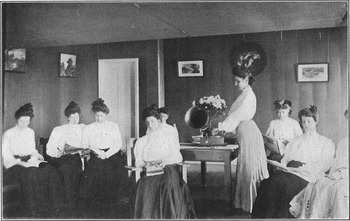
“With the Social Secretary at the Pilgrim Steam Laundry.” Resting rooms such as this were precursors of later employee lounges. In the early twentieth century they were designed to promote more than employee rest. The décor, Victrola, and supervising welfare manager (social secretary) conjured the atmosphere of a sedate Victorian drawing room. The image of well-attired laundry workers, quietly reading books and magazines, projects a learned Victorian femininity habituated to familial harmony rather than class conflict. Source: Social Service, Oct. 1905, 119.

These employers and their salaried welfare managers, whom I will call business reformers for the purposes of this article, embraced significant elements of the era's progressive frame of mind. They were true believers in system and efficiency.Footnote 10 Many pioneered or were early adopters of production and distribution methods that became synonymous with the modern industrial economy: John Patterson, president of the National Cash Register Company, would have been the first to agree with historians who credit him with systematizing salesmanship; Edward Filene of department store fame invented a “model stock plan” that is the foundation of modern merchandise control; owners and executives at International Harvester, DuPont Corporation, and National Biscuit Company among others, redefined big business as they consolidated market control during the first great merger movement at the turn of the century.Footnote 11
Businessmen's progressivism, however, was not limited to rationalizing the form and function of their firms. They responded to the myriad social problems that attended their industrial revolution by promoting ideals of social harmony and class cooperation. Jeffrey Haydu's study of business communities in Cincinnati and San Francisco finds that employers shared this rhetoric with progressives of all persuasions; “businessmen citizens” spoke a language of class harmony and asserted that they acted on behalf of the public good.Footnote 12 Mansel Blackford and Austin Kerr find similar paeans to class harmony among a broad coalition of corporatist-minded “business people, government officials, scholars, scientists, and reformers” who “looked for a new kind of partnership between government and business and, in some cases, between business and labor, one that emphasized reason and cooperation, not confrontation, to solve practical problems of business strategy.”Footnote 13 Welfare work was one of those business strategies designed to solve practical problems of labor-management conflict. The business reformers who adopted welfare work shared the broader progressive belief that social environment mattered and that they could systematically build spaces and relations that would transform working people into cooperative business partners.Footnote 14 They parted ways, however, from those who called for state intervention to make this happen; business reformers pointed to welfare work as proof that regulatory compulsion was unnecessary.
Although welfare work brought measurable improvements to the workplace, labor unions and probably a majority of workers strongly opposed it. They understood, correctly, that it was an employer strategy to preclude unionism. Many Progressive Era reformers shared this opposition to welfare work but for a different reason. They placed more faith in legislated, regulatory controls than in either employer voluntarism (as supported by the NCF report) or collective bargaining (as supported by the unions). Andrea Tone, who studied the politics as well as practices of welfare work, notes that “proponents of legislated social welfare came to view welfare capitalists as political foes.”Footnote 15 It was this group, proponents of a statist solution, who launched the attack on the NCF department store report. They projected the viewpoints of a powerful network of progressives connected through settlement houses, charity aid societies, and public-interest groups such as the National Consumers' League and Russell Sage Foundation. Although often at odds with one another, this constellation of what I will call philanthropic reformers did agree that modern business, left to its own devices, would not solve the labor or social problems of the day.Footnote 16
Still, both the fireworks over the 1913 department store report and current scholarship paint too neat a picture of a statist-voluntarist divide. As I will argue, the behind-the-scenes story leading up to and onward from this 1913 argument about welfare work reveals an era of possibilities before these partisan battle lines became as fixed and as clear as they appear in hindsight. The key to this story lies in the overlapping process of professionalization taking place amongst both philanthropic and business reformers. By the early twentieth century, progressive reformers of all persuasions were turning toward professionalization as a way to legitimize and develop their expertise. As they did so, they had to make choices that distinguished what they did and what they knew from what other experts did and knew. The intersection of corporate welfare work and professionalization reveals much about how Progressive Era reformers divided up one of the greatest problems of the era: the labor problem.
A few snapshots behind the scenes suggest the initially uncertain boundaries between philanthropic and business reformers. I will begin with the department store story and then widen the lens. Mary Van Kleeck of the Russell Sage Foundation and Gertrude Beeks of the NCF, who found themselves on opposite sides of the controversy, had each devoted their careers to improving the lives of American workers. Although Van Kleeck and other critics charged that the NCF report was a whitewash, Beeks reminded them of the reports' many criticisms, including a call to abolish overtime and night work (and if overtime became necessary, that it be paid at one and one-half to double time). In testimony before the congressional Commission on Industrial Relations the following year, Beeks detailed a number of bad labor practices in need of correction.Footnote 17 Van Kleeck had spent the three years prior to the department store controversy investigating night work in the millinery, bookbinding, and flower-making industries. Her research contributed to the successful passage of legislation in 1914 that outlawed night work for women in New York. Despite her stinging attack on the NCF's methods and motives, Mary Van Kleeck nevertheless noted that some benefits might flow from the report. The department store study, she wrote, “may have valuable results in a practical way because attention has been called in so detailed a manner to welfare plans in operation in stores.”Footnote 18 What welfare plans would Van Kleeck have approved?
Virtually all. The welfare work praised by the NCF resembled the programs of their philanthropic reform antagonists. Girls and boys clubs, drama clubs, kindergartens, recreation programs, housing improvement, home visits, and workers' lunchrooms had been pioneered by settlement houses, charity aid societies, and home missionaries. It was not a coincidence that business reformers incorporated these as essential elements of welfare work—the first systemic attempt to manage labor relations.
More than common practice united these groups. They also shared elements of a reformist ideology. For example, despite their occupational positions within business, welfare work managers agreed with philanthropic reformers that employers' exploitation of cheap labor was counterproductive. Gaylord White, president of the New York Association of Settlement Workers, wrote, “Nothing could be more exasperating to the workingman than to assume that he desires to persuade his employer ‘to deal generously and magnanimously’ with him. What he desires and demands is not generosity and magnanimity at the hands of his employer, but simple justice.” Beeks, former welfare manager for the McCormick Company and secretary of the NCF Welfare Department, expressed a similar sentiment to Stanley McCormick at International Harvester when she wrote, “I cannot say enough to emphasize the necessity of a fair wage scale.” “Welfare work will not succeed,” she told an audience of welfare workers, “unless all the underlying principles of fair dealing are observed.”Footnote 19 Records also reveal similar critiques of labor mismanagement expressed by Jane Robbins of the Jacob Riis settlement in New York and Elizabeth Briscoe, welfare manager at a Delaware textile mill. In 1913, business reformer Briscoe explained that “one of the things I am trying to do in my position is to bring employers to realize the poor grade of future work they are storing up for themselves” by demanding long workdays, particularly of children who “will become uneducated adult employees.” Two years later, Robbins told a National Federation of Settlements audience that “settlement workers . . . have an important responsibility in making the employing class aware of the human cost of unemployment. . . . Employers as a class should be made ashamed of being responsible for such atrociously bad business management.”Footnote 20
Welfare advocates would also have agreed with the charity aid worker who wrote in the pages of Charities magazine that despite the many practical problems plaguing the poor, “strength of character is the only basis for social reform.”Footnote 21 Historian Mina Carson, who parses the subtle as well as not-so-subtle differences between charity aid and settlement reformers, confirms this fundamental similarity among philanthropic reformers who, as she states, “believed that cultivating character was critical to improving the condition of the poor.”Footnote 22 Carson could have added welfare work advocates to her list of Progressive Era reformers motivated by this basic assumption. Maud Nathan of the Consumers' League did this when she praised those who went into welfare work a decade earlier. “The position of the Social Secretary,” she wrote, “is a responsible one and is an agreeable one for women of broad sympathies who desire to uplift their fellow men.”Footnote 23
These similarities between philanthropic reformers and business-based welfare reformers probably seem more surprising in retrospect than they did at the time. After all, many welfare managers came from the ranks of philanthropic reform organizations, particularly from settlement houses, charity aid societies, and home missions. Gertrude Beeks, the behind-the-scenes player for the NCF in the department store debate, had roots in the extensive Chicago reform community. Her movement into welfare work seems to have been made with the blessing of Jane Addams as was that of International Harvester's long-serving employee relations supervisor, Sara Southall. Writing about her career, Southall recalled that as a “young woman living at Hull House, I asked Jane Addams whether I should work in a large corporation. She answered: ‘I would, if I were you . . . I think the strongest forces of the future will be labor and management.”Footnote 24 Other examples are readily available. Winifred Collins, spent a dozen years at Chicago Commons before taking a position as welfare manager at the Rockefellers’ Tennessee Coal and Iron Company.Footnote 25 Isabelle Nye, hired to create the welfare program at Greenhut-Siegel-Cooper Department Store in New York, came directly from charity aid work. Lena Harvey was working as a home missionary when John Patterson invited her to establish the welfare program at National Cash Register.Footnote 26
As these stories suggest, some employers purposefully embraced at least some aspects of philanthropic reform. Owners of big businesses, in particular, found reformers' efforts to cultivate character attractive. The notion that they could build a harmonious, classless society by spreading their own Victorian ethic resonated with businessmen, as well as with middle-class reformers.Footnote 27 Many attributed their own success to the quality of their character. After studying the Chicago reform community, which included some of the city's leading businessmen, historian Steven Diner concluded, “If interlocking directorates, shared experiences, and personal interrelationships united the personnel of the reform community, a common ideology and reform agenda defined its purposes.”Footnote 28 Individual employers used their contacts in the reform community to find women and men who could bring this transformative agenda to their employees on the shop or factory floor.
Were business reformers and philanthropic reformers, then, allies or antagonists? Even if one rejected labor's assessment that welfare work was “hellfare,” could one move seamlessly from visiting injured neighbors around the settlement house to nursing injured workers in a company emergency room? Even if the content of the work was similar, was the meaning the same? What difference did it make that the basic practices of philanthropic reformers found their way into corporate labor practices—and at the very time that American firms were inventing systematic labor policies?
Historians have given only cursory attention to this issue. Most typically, scholars study business reform or philanthropic reform apart from and not in relation to one another. There are a few exceptions. In Working With Class, Daniel Walkowitz argues that welfare work, what he calls “industrial social work,” constituted one of three social reform movements competing to shape the new profession of social work in the early twentieth century. (The other two were the settlement houses and medical social work.) Although he makes a case for the “conflicting loyalties and multiple, often overlapping social identities” that characterized these contenders for a new middle-class professional identity, Walkowitz does not explain how welfare workers participated in the contest to define social work or how, if at all, they influenced the professionalization of social work in the 1920s.Footnote 29
Michael McGerr, in A Fierce Discontent, similarly recognizes a close connection between philanthropic reform and welfare work. McGerr's progressives were those white middle-class Victorians who adopted ideas of mutualism in place of individualism and were intent on converting their fellow Americans, especially working-class Americans, to their Victorian lifestyle and ethic. “Welfare Capitalism,” he asserts, was “the deepest penetration of progressives and progressive ideas into business.” It was, he notes, “a satisfying development that engaged a good deal of reformers' energy.” However, the two paragraphs devoted to welfare work are insufficient to demonstrate these assertions.Footnote 30
There may be good reason for these underdeveloped conclusions. To explore the relationship between philanthropic reformers and business reformers engaged in welfare work, I attempted to locate points of contact between reformers at the grassroots level—not a straightforward task. I also looked for contacts between the formal organizations and leaders of each movement. I was particularly interested in the ways in which reformers in each group were involved in or influenced the work of the other group.
What I discovered was that philanthropic reformers initially presumed that welfare work was an inherent part of their new profession. During the first decade of the twentieth century they supported welfare work as one of a myriad of reforms, alongside anti-child labor, consumer protection, industrial hygiene, and worker's compensation, intended to improve working conditions. Nevertheless, philanthropic reformers were unwilling fully to embrace the factory or shop floor as a site for their activities. Although thousands moved into settlement houses in American slums to live side-by-side with working-class neighbors, there was no comparable effort to enter factories and shops to work side-by-side with them.Footnote 31 As philanthropic reformers sought to establish their own expertise and professional credentials, they treated corporate welfare work as a poor second cousin. Ironically, the one area in which big business embraced the workplace agenda of philanthropic reformers, welfare work, was the one area about which philanthropic reformers evinced the greatest ambivalence. By the second decade of the century, philanthropic reformers were abandoning welfare work. Philanthropic reformers' ambivalence contributed, in part, to businessmen's success at absorbing welfare work into their anti-statist arsenal. Progressive businessmen adopted welfare work into their labor practices and redefined these activities as key elements of the emerging field of labor management.
Philanthropic Reformers and the Origins of Corporate Welfare Work
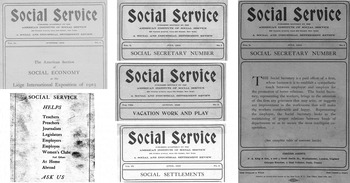
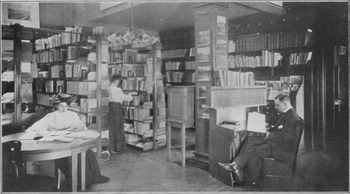
Corporate welfare work did not begin separate from philanthropic reform. The American Institute of Social Service (AISS), a leader in the social gospel movement, incorporated what it named “industrial betterment” as one of two great divisions of social reform.Footnote 32 The masthead of its monthly magazine, Social Service, advertised its core mission as “Social and Industrial Betterment.” Offering the AISS as an inspirational and informational clearinghouse, social gospel leaders Josiah Strong and William Tolman embraced reform by philanthropic, government, and business institutions as part of a single grand social mission. Tolman's “Illustrated Lectures on Present Day Problems,” advertised in Social Service in 1904, reflected the AISS's inclusive definition of reform. The lecture on “The Higher Industrial Life, or the Golden Rule in Business,” shared equal billing with “Problems of the City Child” and “Evils of the Tenement and Improved Housing.” Social Service magazine informed its readers on subjects as diverse as village improvement, crime and criminology, social settlements, and social secretaries (later known as welfare managers).Footnote 33 When AISS moved to the top floors of the United Charities Building in New York City in 1903, it welcomed all reform-minded people to visit its new library. According to the AISS announcement, the library's 8,000 pamphlets, 17,000 books, 2,000 special volumes, and over 3,000 lantern slides comprised “an apprentice school where anyone who wishes to take a new step can be taught how to do it.” The library was a “social laboratory . . . illustrating social work of every kind.”Footnote 34
Mastheads from Social Service, published by the American Institute for Social Service (AISS), with the full cover of the July 1904 issue devoted to social secretaries. Whereas historians have emphasized philosophical and strategic differences between social-welfare and industrial-welfare reformers, the AISS's notion of social and industrial betterment presumed a commonality of purpose. The cover of Social Service carried the Allied Printers Trades Council union label, a reminder of workers' engagement in this project of social and industrial betterment.

“The American Institute of Social Service—One Corner of the Library or Social Laboratory,” United Charities Building. A second photograph captured researchers studying materials in the French section. Large posters brought back from the French exhibit at the Liege International Exposition in 1905 hang over the French section, visible reminders that an international movement shared the AISS conception of social welfare. Source: Social Service, Oct. 1905, 107.

The AISS proudly advertised that it was the first to promote welfare work in the United States, the “industrial betterment” half of its social reform mission. An early issue of Social Service noted that William Tolman had initially coined the term “social secretary” in an 1899 newspaper article.Footnote 35 Still, even as it asserted leadership of this new field of industrial betterment and solicited institute memberships from businessmen, AISS never defined its purpose as business reform. It assumed that welfare work was an integral part of a broad social welfare agenda. This is most evident from AISS-sponsored Social Economy exhibits at early twentieth-century world's fairs. Based on its own accounts, the AISS was the sole organizer of U.S. entries in the Social Economy pavilions at the 1900 Exposition Universelle in Paris, the 1904 St. Louis World's Fair, the 1905 Leige International Exposition, and the 1906 Milan International Exposition. Proud to participate in the European arena in 1900, Tolman expressed dismay that the Social Economy pavilion at the 1904 St. Louis fair “did not even hold its own” with the earlier Paris fair.Footnote 36 He waxed eloquent, however, over the quality of the Liege exposition the following year. In fact, Social Service devoted an issue to the 1905 fair, declaring that the exposition set the “highest standard yet attained for Social Economy.”
What was that standard, and where did welfare work fall within the realm of social economy? As defined at Leige, social economy encompassed a dozen formal classifications, including apprenticeship, protection of child labor, profit sharing, regulation and remuneration of labor, security of factories and workshops, public and private movements for the welfare of citizens, institutions for thrift, and hygiene. Based on the classification and exhibit descriptions, it seems that the object of the activity mattered more than who sponsored the activity. Notably, corporate welfare work appeared side-by-side with government regulation and philanthropic reform initiatives in a number of judging categories. A list of New Jersey labor laws and a state-sponsored study of labor conditions shared classification with examples of factory-sponsored betterment activities. The Garden City Association of London and the National Cash Register Company both won gold medals for exhibits on workmen's dwellings. Exhibits on “institutions for the intellectual and moral development of the workmen” and “public and private movements and institutions for social betterment” were seen as so “closely akin” that they were judged together.Footnote 37
AISS leaders worked to spread this inclusive vision of social reform to Americans at home. In May 1901 they announced plans to open an “Exposition of Industrial Betterment” in New York. The following year, AISS was still looking for a “public-spirited and generous man or woman of wealth” to finance what it was calling a “Social Museum for New York.” Its purpose would be to “correlate, systematize and make accessible the various activities in the field of practical effort.” American civic leaders did not jump at this opportunity. A decade later Josiah Strong was still trying to bring the European model of the social museum to the United States.Footnote 38
Although the hoped-for social museum never came to pass, AISS was not alone in presuming that welfare work was part and parcel of philanthropic reform. In 1910, The Survey magazine, which represented the ideas and activities of the most influential philanthropic reformers in the country, noted with pride that “it marks the spirit of the age” that private business was coming to social work for ideas.Footnote 39 What kinds of ideas did private business seek in social work, and what did The Survey and its predecessors, Charities and Charities and the Commons, offer to business?
The New York Charity Organization Society (COS) began publishing Charities as an organizational newsletter in 1898. In 1905, Charities (by then Charities Review) merged with the newsletter of the Chicago Commons settlement and two other newsletters to become The Charities and the Commons. The 1905 merger enlarged both its audience and the scope of its coverage. The most significant difference, for our purposes here, was an added interest in industrial conditions. This reflected the addition of Graham Taylor, warden at the Chicago Commons, who began a monthly column titled, “The Industrial Viewpoint.” The magazine underwent another transformation in 1910, changing its name to The Survey in recognition of its newfound prominence as sponsor of the Pittsburgh Survey. It also featured expanded coverage of industrial and labor issues. Reflecting on this change, the magazine offered a formal statement of its purposes, which included the goals of serving “as interpreter of social invention in industry” and “as interpreter of movements for the betterment of industrial relations and conditions.”Footnote 40
During its first few years, Charities printed detailed information on charity issues ranging from almshouses and public baths to tenement house reform and charity scams. Almost from the beginning these were interspersed with articles on progressive developments in labor practices. Thus, in 1899 readers of Charities could learn that despite generally abysmal conditions in garment factories and department stores, a noteworthy few had instituted humane conditions that earned the Consumers' League seal of approval. This was not simply philanthropy, the investigator noted, but part of a labor management policy. Managers had discovered that “humane treatment pays . . . that [the girls] worked better, were better tempered, and sold better.”Footnote 41 In 1904 Charities reported that the National Cash Register Company was closing its factory for two weeks, with no loss of pay, so that its thousands of employees could attend the St. Louis Exposition. Such articles highlighted innovative employment practices associated with the new corporate welfare system, including ventilation systems, employee baths, resting rooms, lunch rooms, clubs and classes, company hospitals, safety programs, and pension and savings plans.Footnote 42
In addition to news about individual companies, the magazine carried a few articles on broader developments in the field of welfare work. These included a notice of the creation of the National Civic Federation's Welfare Department, as well as a handful of articles on trade associations promoting welfare work among employers.Footnote 43 In 1906 Charities and the Commons reported the formation of a NCF-sponsored Committee on Welfare Work, whose purpose was to develop a plan for improving working conditions in public and private employment throughout New York City. The committee boasted prominent philanthropic reformers including Homer Folks of the National Child Labor Committee; Gaylord White, president of the Association of Neighborhood Workers; and David Blaustein, head of the Jewish Educational Alliance.Footnote 44
Although these stories offered few value judgments in the early years, by the second decade of the century The Survey was more likely to evaluate such welfare practices, suggesting an interest in their quality and effectiveness related to the magazine's assumed role as interpreter of industrial relations. Thus, a 1910 article on a plan by Chicago businesses to pool resources to build a tuberculosis sanatorium for employees drew not only praise for the employers' interests in employee welfare, but also criticism for being so far away (in New Mexico) that family visits would be prohibitively expensive. Similarly, a 1913 article on plans by a Rochester, New York button manufacturer to offer vacation time for perfect attendance drew criticism for not recognizing legitimate reasons for missed workdays, including illness.Footnote 45
Overall, Charities-Survey coverage of welfare work was not likely to motivate many employers to adopt welfare work. In contrast to Social Service, Charities and Survey articles were sporadic, incomplete, and increasingly critical. In fact, one employer angrily canceled his subscription, writing that Charities is not “edited in a spirit to which I wish to contribute my mite of support.” This comes as no surprise because the magazine was written by and for philanthropic reformers, not businessmen.Footnote 46 Nor did stories on welfare work appear within the magazine's “industrial conditions” reports. If coverage of welfare work was not intended to inform or encourage employers to institute this work, then who among the magazine's audience was interested and why?
Even in the absence of subscription lists, there are some clues. Charities-Survey carried a regular “Employment Exchange” section that accepted ads from both prospective employers and prospective employees. Three to six such notices appeared in each weekly issue. Throughout the pre-war years, not a single employer advertised for a welfare worker in this section. However, some employers must have subscribed. In 1907 the editor, who did know his subscriber base, inserted a preface to the Employment Exchange informing readers that he “would be glad to hear from Employers who would like to know more of the workers mentioned below.”Footnote 47 Who sought jobs through the magazine? An examination of the employment ads reveals that a small number of job seekers specifically identified welfare work as their occupational goal (a total of 12 ads over the course of almost a decade, 1905–1913). More typically, job seekers seem to have assumed that welfare work was part of social work and thus one of a variety of venues in which they could practice their craft. Thus, some ads specified a range of work settings, such as one from a woman who claimed ten years of experience in “every phase of social work” and sought a position as a “head resident of settlement, organized charity or welfare work in factory or department store.” Most ads were less specific, leaving the choice of prospective employer purposely vague. A typical example was the man with charity experience who sought an “opportunity to continue this work or to take charge of other social work where [his] experience and previous business training will be of use.”Footnote 48 Although employers may not have looked toward Charities-Survey as a place to share initiatives in welfare work, these ads suggest that philanthropic reformers did consider welfare work to be part of their field of interest and expertise. This would have been reinforced by the periodic articles that highlighted the instances in which business sought the resources and expertise of local philanthropic reformers.
Elizabeth Wheeler, one of the nation's first welfare workers, suggested a pattern that others could follow. Recognizing that employees needed much more than their employers could or were willing to provide, Wheeler advised that welfare workers must find “mighty resources in the various charitable institutions with . . . which [they] must keep on good terms.”Footnote 49 Thus, when operators at the Chicago Telephone Company showed an interest in domestic science or other classes, the welfare manager sent them to social settlements in their neighborhoods. This practice could also be used to deflect workers' suspicions of their employers' motives. In another case, the American Tobacco Factory asked a local Women's League in New Orleans to develop a program to improve conditions for its 1,500 female employees; the company was particularly interested in girls' club work. In doing this, the company was recognizing the failure of its own labor policy. It hoped that the league's methods would produce the desired “cooperative spirit” between employer and employees.Footnote 50 Similarly, when Gertrude Beeks first introduced welfare work at the McCormick Company in 1901, she tried to persuade the Chicago Commons settlement to front for the firm. Beeks's goal was to send employees to summer camp where they could be guided toward moral uplift through constructive recreation. Sensing that workers would turn a cold shoulder to this kind of employer control, Beeks wanted the settlement to run the program as if it were its own and keep the McCormick Company's sponsorship a secret. The Commons grudgingly cooperated but demanded that the experiment be conducted largely on its terms. Thus, instead of keeping the company's involvement a secret, the Commons publicized the McCormick connection. Rather than the eighty-nine people who initially showed an interest in the summer camp, only fifteen McCormick workers took the trip.Footnote 51
Stories such as these demonstrate the flexible skills of philanthropic reformers. They also suggest the ways in which philanthropic reform was compatible with the emerging business culture. As Daniel Walkowitz explains, by the turn of the twentieth century philanthropic reformers were elaborating a business model in which moral imperatives “took a backseat to ‘efficiency’ and ‘professionalism’” as an explanatory motive. This “commitment to scientific method and efficiency” paralleled developments in business circles.Footnote 52 In this respect, philanthropic reformers did not have to “go to the other side” in order to take up labor-relations work within private industry. Elizabeth Wheeler, welfare manager at a Rhode Island department store, was among the first to make this connection explicit. Wheeler called on philanthropic reformers to look beyond the social settlements as the best place to engage in meaningful social reform. “May we not go one step further [than the social settlements]?” she asked. “Will not our college-trained men and women of generous hearts and broad sympathies not only go and live side by side with those whose advantages have been limited, but work side by side with them as well? Let them go into the shops and factories and, while earning bread in the sweat of the brow, let them share the culture which has been their opportunity with their co-laborers.” Wheeler left little doubt that such reformers could use their social-work skills to transform the labor-management relationship. “When we have even a few trained social workers in any industrial establishment,” she went on, “the tyranny of the ignorant foreman will cease—he will be rooted out as weeds from a garden.”Footnote 53
Professionalization and the Scope of Social Work
When Wheeler penned this challenge to readers of Charities in 1903, philanthropic reform leaders were in the process of creating the first formal training schools for social work. The impetus for these schools grew out of the 1897 meeting of the National Conference of Charities and Correction. Mary Richmond, general secretary of the Baltimore COS, used this conference to issue a call for professional training schools. Richmond spoke to the confusion reigning in charity work as it tried to adapt to the needs of industrial society. William Tolman's almost simultaneous invention of the title “social secretary” for those undertaking industrial betterment activities was part of that confusion. Richmond's call for training schools was a conscientious step toward clarifying and legitimizing a widening range of social service work, a step toward professionalization. Over the next few years, as this type of work became more systematized, the term philanthropy, meaning the “science of giving,” increasingly replaced the term charity, which carried a connotation of moralizing friendly visitors. In recognition of developments among both business and philanthropic reformers, the 1910 census included charity aid, settlement workers, and welfare workers in a new classification of semiprofessionals (which also included, among others, hospital workers, probations officers, fortune tellers, theater owners, and race track owners).Footnote 54 In 1917, after two decades of dramatic change, Mary Richmond published the first social work textbook, Social Diagnosis, and the National Conference of Charities and Correction changed its name to the American Association of Social Work. By the 1920s social workers were redefining themselves as caseworkers, an occupation distinct from other kinds of social service occupations, including business welfare work.Footnote 55
The development of social work in the first decade of the twentieth century and its narrowing to casework by the 1920s was part of a process of professionalization that occurred in many fields of endeavor. Professionalization entailed development of a discrete body of knowledge, ideology, and skills; organizational and educational institutions claiming exclusive authority to certify its practitioners; and claims to both monetary and status rewards based on that professional imprimatur. Women's and men's professions varied in significant ways. Women's professions, social work among them, were less likely than men's professions (that is, law and medicine) to entail a highly exclusive body of knowledge and skills; to enjoy an unmediated relationship between the professional and the client seeking his expertise; or to acquire high status and commensurately high incomes. Although certain characteristics of professionalization may be identifiable, the process of professionalizing was often messy. Internecine struggles frequently erupted over the guiding ideology of a new profession, over the set of knowledge and skills that qualified practitioners, over access to training and certification, and over specializations within the field.Footnote 56
The professionalization of social work followed these patterns. The widely accepted history of social work pinpoints a speech by Abraham Flexner as a turning point in the process of professionalization. Flexner charged that social work could never be a true profession.Footnote 57 By 1915, when Flexner laid down this gauntlet, social workers had spent more than a decade developing the professional identity that he dismissed. However, the process of professionalization was messy, with welfare work one of the principle sources of contention.
That process began in earnest following Mary Richmond's 1897 call for training schools for social work. The New York COS initiated a summer course in applied philanthropy the following year. The COS course proved popular, leading to the formal incorporation of the New York School of Philanthropy in 1904. The Chicago Commons settlement initiated a second training program in 1903. This began as a lecture-study course under the auspices of the University of Chicago, but by its second year it grew into a recognized training program within the university's College of Commerce and Administration. In 1906 the school, now called the Institute of Social Science, became independent under the aegis of Chicago Commons. Another reorganization in 1908 included a name change to the Chicago School of Civics and Philanthropy. In Boston, Simmons College hired the director of the Baltimore Department of Charities and Correction who created a School of Social Work “almost identical” to the New York School.Footnote 58 In developing training programs for this new profession, these schools defined not only how social work should be conducted, but where it should be conducted. Was welfare work a part of social work? Was the shop floor an appropriate place for the practice of social work? Would a professionally trained social worker be a qualified welfare worker?
One indication of the indeterminate nature of this profession-in-the-making was the variety of names by which it was identified. According to Walkowitz, “Even after ‘social work’ began to insinuate itself into discussions of the field . . . it had to compete with ‘social service’ and ‘welfare work.’” This overlapped with a cluster of names for company-based labor practices that included both the terms “social service” and “welfare work,” as well as “betterment work,” “industrial service,” and “human engineering.”Footnote 59
How did the new social work training schools deal with welfare work, which at this point still hovered under the philanthropic reform umbrella? The New York School of Philanthropy and the Chicago School of Civics and Philanthropy were established by different wings of philanthropic reform. The New York School was established by the New York COS; the Chicago school was established by Chicago Commons, with significant representation on the part of the local settlement network. Still, both grappled with the inclusion of welfare work in the new profession of social work. The direction followed by these two schools exerted considerable influence. Their work did much to define the new profession of social work, and between them they encompassed much of the nationwide network of philanthropic reformers. The Russell Sage Foundation, which supported both schools financially, sought to infuse a shared set of standards to these founding endeavors. According to the director of the Russell Sage Foundation, the most important objective of the funding support was to produce “good social workers and investigators.”Footnote 60 Finally, both schools passed into the hands of major universities, which added legitimacy to their construction of professional social work. The New York school became part of Columbia University in 1908, and the Chicago school was definitively absorbed by the University of Chicago in 1920.
In 1898, when the New York school began offering classes, it intended to introduce participants to the broad array of practical philanthropic work taking place in New York. The initial course in “applied philanthropy” was meant to broaden the knowledge and perspective of experienced social workers, rather than provide technical training for the inexperienced. However, by the second year the school's directors moved toward technical training. Areas of regular study came to include “private charitable agencies, administration of public charities, child saving, medical charities, public activities affecting the poor, prisons, and prisoners.” By the third year, the field of social work, as defined by the staff of the New York School of Philanthropy, also included “neighborhood improvement,” and the school's directors were discussing plans for a regular winter session and an expanded one-or two-year program of study.
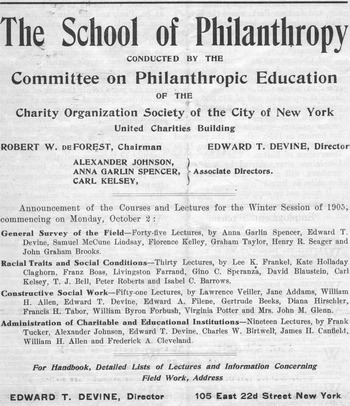
New York School of Philanthropy, announcement of courses and lectures, winter 1905. The list of speakers in the third course of lectures, titled Constructive Social Work, suggests the school's construction of this emerging profession: housing (Veiller), social settlements (Addams, Glenn), municipal government (Allen), charity aid (Devine), corporate welfare work (Filene, Beeks, Hirschler), play and sport (Tabor), boy's and girl's clubs (Forbush, Potter). Source: Charities, Sept. 23, 1905, 1106.

Continual attention to the growing field of reform brought new innovations in welfare work to the attention of the New York school. This became easier when, in 1903, the American Institute of Social Service moved its headquarters (and extensive library) into the United Charities Building on Twenty-Second Street, home of the School of Philanthropy. The following year, in 1904, the NCF's newly established Welfare Department garnered notice in the pages of Charities magazine, still affiliated with the New York COS. Later that year AISS's Social Service magazine devoted an entire issue to welfare work.Footnote 61 The COS's New York School of Philanthropy recognized this new employer initiative and assumed its inclusion in social work. When the school announced its mission in 1904, it stated that its “aim [is] . . . to place emphasis on practical training, under experts for any branch of social work. This is broadly conceived, and is understood to include institutional church work, such positions as that of ‘welfare secretary,’ private almoner, tenement-house inspector, as well as positions connected with philanthropic societies and institutions.”Footnote 62
Founded around the same time, the Chicago school similarly incorporated welfare work within its definition of social work. Graham Taylor of Chicago Commons recalled that in 1902 he had become “impressed with the public need of some agency to furnish training for philanthropic, social, civic and industrial welfare work.”Footnote 63 When the school incorporated as the Chicago Institute of Social Science in 1906, Taylor explained that its purpose was to prepare students for “paid positions and voluntary co-operation” in “charity, reformatory, child-helping, settlement and civic work; playgrounds, recreation, public school and neighborhood centers; educational and welfare agencies in factories and stores; Juvenile Court probation work; in public and private institutions, and in the social effort of the churches.”Footnote 64
Given this background, it makes sense that both schools incorporated training in welfare work within their curriculum. In 1904–05 the New York School of Philanthropy's course of study included five general areas. Directors added welfare work at two points in the curriculum—in Group A's “General Survey” of the field and in Group D's “Constructive Social Work.” Anna Garlin Spencer, who taught the General Survey of the Field series, incorporated welfare management in her general lecture on administration and management of various philanthropic organizations. Spencer described her lecture topic as: “Welfare Secretaries in manufactories and shops, executive secretaries of consumer leagues and kindred societies for bettering conditions of wage-earners and preventing child labor; qualifications needed, and relation to economic condition.” True to their promise to offer instruction by trained experts, the New York school invited Gertrude Beeks, former welfare manager and new secretary of the NCF Welfare Department, to deliver the main lecture on welfare work. The following school year Beeks offered two lectures. These were accompanied by two further lectures on welfare work, one by Edward Filene, owner of Filene's Department Store in Boston, and the other by Filene's welfare manager, Diana Hirschler. Combined, these four lectures comprised 10 percent of the coursework in the area of “Constructive Social Work.”Footnote 65
Welfare work assumed an even more prominent place in the social work curriculum of the Chicago school. In the spring of 1906, the Chicago Institute of Social Science delineated three general areas of instruction: Institutional Work and Administration, Children's Club and Outing Work, and Welfare Work. To initiate instruction in this third area, Graham Taylor organized a course of twelve evening classes under the title Welfare Work in Mercantile and Manufacturing Plants. He designed the course “for those who are interested in, or who wish to train for Welfare Work” and advertised that participants would learn by “the informal interchange of experiences and views, and by visits to mercantile and industrial establishments.” Taylor invited seventeen people to participate, at least eleven of whom were directly engaged in welfare work in Chicago firms. He began the first conference with a wide-ranging lecture on the “History of Industrial Welfare.” Other conference topics included “Initiating Welfare Work—what to do first, and how to develop it,” “Opportunities and Facilities for Recreation,” and “Improvement of Neighborhood and Civic Conditions.” The last two topics suggest a permeable border between business-based and neighborhood-based social work.Footnote 66 At the conclusion of this course, International Harvester's Charles W. Price noted that the “lectures have established the fact that Welfare Work is practically under the present industrial conditions, a matter of good business organization.”Footnote 67 Taylor agreed but acted on the assumption that the practical implementation of such welfare work was a matter for trained social workers, not business managers.
The Changing Sites of Social Work
Within a few years of their founding and a few years of the introduction of corporate welfare practices, these new schools were including welfare work within the scope of social work. This line of development, however, was neither smooth nor permanent. In 1906, in the midst of her second set of lectures at the New York School of Philanthropy, Gertrude Beeks became embroiled in an argument over child labor with many of the people who were her fellow lecturers and their reform allies. The incident was, in many respects, a precursor to the 1913 controversy over the department store report. In 1906, the National Child Labor Committee published a report on the dire conditions of child laborers in northern glass works plants and southern cotton mills. The NCF responded with its own investigation of child labor in southern cotton mills, conducted by Beeks. As with the later department store report, critics accused Beeks of a biased investigation. Beeks had defined her purpose, they noted, as an effort to “learn what manufacturers have done to ameliorate the conditions under which their employees live.” Further, they attacked what one critic referred to as Beeks's “threadbare plea” that working in the mills was better than the alternative (which Beeks defined as juvenile delinquency) and provided valuable training in “self-reliance” and industrial work skills.Footnote 68
Beeks and the NCF acted as if this challenge to the National Child Labor Committee report was a minor disagreement among reform allies. A few months after issuing Beeks's southern cotton mill report, Ralph Easley, general secretary of the NCF, sent the welfare manager of Rockefeller's Colorado Fuel and Iron Company seven blocks uptown to the New York COS with a letter of introduction. He assumed that this would open the doors to a friendly sharing of information. Instead, the COS turned Rockefeller's man away. Easley took this as a personal affront, indicating that he expected that his good standing with the COS should have opened doors even if the Rockefeller name was suspect. This was not all. Beeks was not invited back to lecture at the School of Philanthropy. Prior to this conflict she had been invited to give a stereopticon lecture for the Chicago school's second course on welfare work. Her last-minute replacement on the spring 1907 course announcement might have been related to this issue, as well. Commenting on this and other incidents, Beeks wrote to Easley that “there is evidently a feeling of great resentment against us . . . permeating the charity field, which is probably due to Mrs. Sinchovitch [sic] and the National Child Labor Committee.”Footnote 69
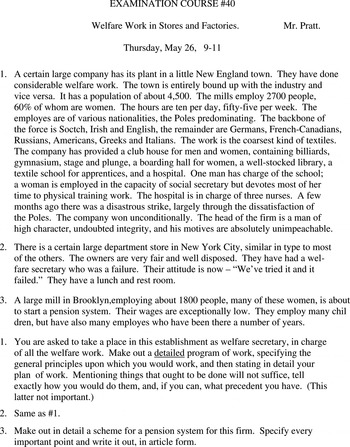
Welfare work disappeared from the New York School of Philanthropy's curriculum for two years. It experienced a short revival from 1908–12, when the school grappled with its promise to provide instruction by qualified experts and with the place of welfare work in the broader social work curriculum. In 1908 Diana Hirschler returned to give a series of lectures on “relations of employers and employees in stores and factories.” Hirschler was an experienced welfare worker. By this time, however, she had left her position at Filene's and was teaching salesmanship in a business school for girls. Hirschler did not return the following year. Jane Seymour Klink, a University of Chicago graduate and welfare manager at the Pilgrim Steam Laundry, also began a short run as a guest lecturer on welfare work. When Klink left in 1911, the school engaged Columbia graduate student Edwin Pratt to lecture on welfare work. As he moved from student to lecturer, Pratt co-authored a “Preliminary Directory of Firms Who Have Established Methods of Industrial Betterment.” Pratt, who brought an outside investigator's knowledge of welfare work to his course, nonetheless thought it appropriate to train social work students for positions within businesses. A surviving exam asks students to draw up a detailed welfare plan for each of three workplace scenarios; the exam instructions even warn students, “Mentioning things that ought to be done will not suffice, tell exactly how you would do them, and, if you can, what precedent you have.” Pratt remained with the school for only one year, leaving to take up work with the New York Factory Investigating Commission.Footnote 70 Aside from Beeks, Hirschler, and Klink, there is no evidence that the school engaged any other experts with experience in the field.
Suggesting a narrower definition of social work, Columbia professor Henry Seager's lectures on profit sharing and old-age pensions placed these labor practices in the context of unions and legislation, not corporate welfare work. Florence Kelley also began to lecture at the school, offering a course on industrial causes of destitution that would not have encouraged budding social workers to consider industry a friendly arena for their work. At the same time, Anna Garlin Spencer's introduction to “The Field in Which the Social Worker Labors” now differed considerably from earlier versions. She explicitly divided social work into three arenas, none of which could be construed to cover the workplace: the Family, The Church, and The State.Footnote 71 A student might still acquire training in welfare work under the school's provision for special courses. Special courses were taught when requested by five or more students. Welfare Work in Stores and Factories was listed as a special course option for a number of years. However, with the exception of 1910, there is no evidence that it was taught. Nor was it included within the general two-year curriculum after this point.
Final Exam, Welfare Work course at the New York School of Philanthropy, 1911. Instructor: Edwin Pratt. The workplace-specific information provided in each company scenario, combined with the requirement that students assume the role of welfare worker, indicate that Pratt's goal was to prepare students to engage in this type of work. Welfare work was neither an idea to be examined at a distance nor a distasteful labor practice. Source: Historical File, 1899–1936, box 2, Columbia University School of Social Work, 1898–1999, RG4, Acc.00-009, Columbia University Archives.

The fate of welfare work at the Chicago School of Civics and Philanthropy was similarly bumpy. After the 1906 course proved successful, the school expanded the place of welfare work within its social work curriculum. Although Beeks was dropped from the spring 1907 line-up, the course itself took on a more substantive form in its second year. Diana Hirschler, an experienced welfare manager who had taught at the New York program as well, was brought in and billed as a co-instructor with Graham Taylor. In addition, Charles Price of International Harvester and Mary Dewhurst of the Chicago Telephone Company returned from the first course to give guest lectures on the practical development of welfare work. In contrast to the informal first year, the second permutation of this course was organized to provide technical training. Students attended lectures on specific features of welfare work, on concrete examples of welfare work, on welfare work among women, and on the qualifications and responsibilities of the welfare manager.Footnote 72 Students apparently welcomed this practical approach; the welfare course was the second most popular in the fall of 1906.Footnote 73 When the school announced its program the following year, it promised “expert training for social work” in four areas: relief, settlements and institutions, play, and welfare (work).Footnote 74
However, for reasons not explicit in the records, these welfare lectures seem to have ended at the close of this promising year. This did not reflect any neglect of labor conditions. The “Industrial Field” remained one of the school's three primary curricular areas. Rather, it seems that the industrial field was increasingly defined as an arena in which social work took place outside the shop floor. Course offerings in the industrial field addressed the labor problem through other venues, focusing on solutions through regulatory oversight and union activism.Footnote 75
This curricular movement away from workplace-based welfare work is striking given Taylor's personal connections with welfare work practitioners in the Chicago area. In addition to those he invited to lecture, the Chicago School of Civics and Philanthropy was financially dependent on the largesse of two of Chicago's leading welfare employers, Julius Rosenwald of Sears & Roebuck and Charles Crane of the Crane Company.Footnote 76 Nevertheless, the Chicago school seems to have taken only limited advantage of these business connections. Some students did visit local factories and stores. However, these tours appear to have been of the show-and-tell variety; students in Dr. Alice Hamilton's Industrial Hygiene course visited “factories in which such protective measures are in use,” and those in Sophinisba Breckenridge's Labor Problems course visited industrial plants to enhance their critical examination of “remedial programs now under discussion.”Footnote 77 There is no evidence that students were being groomed to conduct social work at factory or store sites.
In fact, when the school placed one of its students in a private corporation for a welfare work field experience in 1913, it reported this as an unusual development. That year the school faced a demand for sixty-five field work slots, twenty-two more than its primary venue, United Charities, could provide. In desperation it solicited placements elsewhere. The number and locations of these overload placements suggests how unlikely it was that students were gaining welfare work experience at the Chicago school; three went to the Legal Aid Society, two to the Illinois Children's Home, five to the Juvenile Protective Association, and one to welfare work in an unnamed private corporation.Footnote 78 The directors of the Chicago School of Civics and Philanthropy seem to have shared the growing ambivalence toward welfare work that was evident in the program changes at the New York school.
Still, even as attention to the factory and shop floor waned, welfare work continued to hover within the constellation of professional social work. When newly elected President Woodrow Wilson met with the social workers who “[wrote] the social welfare plank of the Bull Moose platform,” the list of invitees included not only well-known philanthropic reformers such as Lillian Wald, Homer Folks, and Paul Kellogg, but also Winthrop Talbot, publisher of Human Engineering, a short-lived journal dedicated to welfare work, as well as a bibliography on the subject.Footnote 79 Two years later the city of Chicago's Social Service Directory similarly assumed that welfare work was part of the broad arena of social work. The directory listed hundreds of philanthropic and government agencies engaged in child welfare, civic betterment, employment, medical aid, and moral reform, among other endeavors. It included listings for the welfare departments at the Chicago Telephone Company, Commonwealth Edison, and Illinois Steel Company in the same Industrial Welfare classification as the Illinois Department of Factory Inspection and the City of Chicago Department of Public Welfare.Footnote 80
More evidence of social work's increasingly ambivalent claim on welfare work arose with the government's wartime mandate that war contractors must employ personnel managers. By this point the schools of social work had largely abandoned practical training in welfare work. The director of the government program to train personnel managers, Boyd Fisher, purposefully used the program to build a new masculine profession of employment management. Beginning with an employment management course at the University of Rochester, Fisher presided over the creation of eight new schools. These programs presented welfare work as one of the central responsibilities of the new profession.Footnote 81 Although Fisher was largely successful in excluding women from these training programs, he apparently contacted both the New York and Chicago schools of philanthropy. This was undoubtedly due to intense lobbying by his co-director, well-known welfare manager Mary Barnett Gilson and her friend Mary Van Kleeck of the Russell Sage Foundation. In response, the Chicago School of Civics and Philanthropy added Industrial Service to its program of emergency war courses in 1918. The course was intended to “prepare qualified persons for positions in Industrial Service.” A partial list of course topics included labor problems, industrial hygiene and safety, factory organization, worker housing, management of a state employment service, the labor movement, and social case work. The school hired “special lecturers . . . with direct experience in these areas.” It was a popular course from the standpoint of both students and employers. All fourteen students in the first class found quick employment, five with industrial firms and nine with government and philanthropic organizations. At the end of the course the school reported that “requests for trained industrial workers have come to us, and the opportunities along these lines seem to be increasing.”Footnote 82
Although the wartime mandate ended, the Chicago School of Civics and Philanthropy decided to continue the Industrial Service course for a second term. Another twenty-six students quickly enrolled. Fisher, who was promoting employment management through the new Federal Board of Vocational Guidance, wrote to the Chicago school that “the letters that we have received from the students are most enthusiastic about the benefits they have got out of the course, and I believe that you will have reason to be proud of your contact with them after they have got to work.” The following year a school bulletin provided an employment report on twenty-eight students who had completed the Industrial Service course. The largest cohort, almost 40 percent, were working as employment managers in industrial plants; the remainder were working for philanthropic and government agencies.Footnote 83 Although the courses had been prompted by wartime exigencies, the Chicago School of Civics and Philanthropy, its students, and a range of public and private employers had embraced industrial service as one field within professional social work.
The New York School of Philanthropy, which did not offer a wartime course in industrial service, jumped on the bandwagon. It initiated a new curriculum in 1919, based on an assessment that the nearly 100 different occupations that called for professional social workers shared some “fundamental unity,” which could be captured in seven diploma categories. These seven “divisions of social work” were: community work, criminology, family and child welfare, industry, medical social service, psychiatric social work, and social research.Footnote 84 In 1919, the largest number of special diplomas, seven of eighteen, were awarded in “industry.”Footnote 85 In a 1922 article titled “The Professional Organization of Social Work,” Van Kleeck and Taylor wrote, “Industry is being invaded by social workers, who are bringing their experience to bear upon problems of personnel and research as they affect human relations.” They noted that the Taylor Society (named for Frederick Winslow Taylor, not Graham Taylor) had recently recognized “in the experience of social workers in industry the necessary qualification for admission to a professional group concerned with problems of management.”Footnote 86
Van Kleeck and Taylor seem to have read too much into the revived interest in industrial social work. The popularity of the industrial specialization soon faded. At the New York School of Philanthropy, the industrial specialization accounted for only 10 percent of diplomas awarded in 1926. By this time the emerging focus on family case work was evident; the largest number of diplomas, eight of thirty-one, were awarded for family welfare. The next year only one student out of twenty-five received a diploma in industry.Footnote 87
Business Schools and the Professionalization of Labor Management
Corporate welfare work did not disappear, of course; it was incorporated into the emerging field of personnel management. Nor did business suffer from a shortage of college-educated professionals. During the same years that social workers established training schools and struggled to define their profession, a growing number of universities revised their classical curriculums to offer practical training in business management. The University of Chicago and the University of California opened the country's second and third business schools in 1898, the same year that the COS established the New York School of Applied Philanthropy. By 1910, five schools of social work and eight schools of business were in operation. Business schools grew more rapidly after this; a contemporary counted twenty-two in 1921.Footnote 88
These early business schools, like their social work counterparts, assumed that the labor problem must be addressed in their curriculum. However, it took some time before they fully incorporated labor management into that curriculum. Significantly, at the very time that social work schools were showing less interest in training their students to work in industry, business schools were introducing elements of industrial social work into management training.
A brief examination of the program at the University of Chicago evokes an image of two boats passing in the night. Similar to the schools of social work, Chicago's College of Commerce and Administration, where the program came to be housed in 1904, had a vocational mission: “This College was organized in response to the growing demand for courses . . . which should fit men in the practical professions of Banking, Transportation, Trade and Industry, and Journalism.”Footnote 89 From the beginning, the college offered a pair of courses, Labor and Capital and the Economics of Workingmen. Students studied “various schemes proposed to improve the material condition of the working classes and to [increase] the productivity of labor,” including “trades unions, laborer's insurance, co-operation, profit-sharing, and the like, socialistic and educational schemes . . . social settlements, etc.” As the program developed, the study of labor became one of the core subfields. Beginning in 1909 course descriptions included “corporation welfare plans.” The records suggest that the study of welfare work, like that of trade unions and social settlements, was initially intended to provide students with a broad understanding of labor issues, rather than train them to work in any particular institutional setting. Between 1913 and 1917 the college undertook a series of reorganizations that transformed and expanded these undergraduate surveys into graduate training in labor management. In 1917 the graduate program formalized a course of study in business management and labor that was distinct from other aspects of business management taught in the Industrial Administration group.
The College of Commerce and Administration's definition of the professional manager encompassed both business manager and philanthropic reformer. In 1913 the college offered graduate-level professional training in three areas: public service; business service, trade and industrial service; and charitable and philanthropic service. The 1917 reorganization folded all labor-related management, whether based in businesses or philanthropies, into the Business Management and Labor division.Footnote 90 Similar to the early professionalization of social work, it appears that training students for certain kinds of activities (administration and management in this case) took precedence over the place where those activities might occur (shop floor or settlement house). In fact, the undergraduate course of study comingled aspiring business managers and social work executives for three of their four years of study. “It is significant,” the college announced proudly, that “the future social worker sits side by side with the future business man.”Footnote 91
These curricular decisions were more than bureaucratic shuffling. As higher education shifted from an esoteric training ground for gentlemen to a pragmatic training ground for the professions, it was incumbent on the professoriat itself to professionalize. In his study of this process at the University of Chicago, Steven Diner concluded that during these years, “the American university provided the new academic professionals with an extraordinary opportunity to advocate and work for the kind of social change that would enhance their own status and rewards . . . This was accomplished in part by forging an alliance with those social groups whose support the university needed.” Among the things that the universities needed was generous funding from donors.Footnote 92
Professors, as Diner explains, might attract favorable attention for themselves and their institutions by becoming experts in areas close to the hearts of wealthy donors (“scientific charity, kindergartens . . . even social survey research”), while avoiding those that encroached too closely on donors' business interests (“wages or working conditions”).Footnote 93 Thus, Charles Henderson, a central figure in the Chicago reform community, chair of the University of Chicago's Department of Sociology, and author of an early study of corporate welfare programs, never presumed to teach a course on labor management.Footnote 94 Instead, he encouraged sociology students to enroll in courses on labor offered by the School of Commerce and Administration. On the other hand, the 1917 reorganization of the School of Commerce and Administration program was undoubtedly shaped by a generous gift made the year before by philanthropist Hobart Williams. Williams's gift required that the school undertake “training for the task of the business manager” that would include the manager's relation to labor. Part of the 1917 reorganization included a new course titled The Business Manager's Administration of Labor.Footnote 95
The study of labor management, as distinct from labor conditions, made its debut first in schools of social work and then in schools of engineering. In 1910 Yale's engineering school introduced a course on industrial service work. By 1916, according to Sanford Jacoby, “over 150 engineering colleges sponsored industrial service programs intended to bring out ‘the human side of engineering.’”Footnote 96 The assertion by schools of business of their own professional expertise as trainers of labor managers soon overshadowed this trend among engineers. A 1921 Bureau of Labor Statistics study on personnel research found over fifty colleges and universities engaged in some form of industrial relations research and training. Twenty-three of these institutions offered courses in labor management (the other twenty-seven reported research only). Fourteen of these were housed in schools of business; two were located in schools of social work; none were reported within schools of engineering.Footnote 97 By laying claim to labor relations as a part of professional management, business schools also ensured that it would become a male profession. Although higher education was becoming increasingly coeducational, business schools (like schools of law and medicine) were male preserves. Profits, efficiency, and system were highly valued; raising workers to be hard-working Victorians and creating meaningful careers for women were not.
The Philanthropic-Business Exchange
Social work and labor management changed significantly in the decade following World War I. Although it is beyond the scope of this article, a “psychiatric turn” in the 1920s drew social work away from neighborhood and workplace concerns with the poor to focus on medical case work.Footnote 98 In the process, social work's already ambivalent claims on the factory and shop floor atrophied. At the same time, a confluence of the psychiatric turn and vocational education directed notions of labor management away from humanizing the shop floor to finding the right worker for the right job. Significantly, the burgeoning field of labor management incorporated welfare work as one of its essential tools. Beginning first in the exclusively male wartime industrial service courses and carried forward in early labor management textbooks, labor managers were taught that they needed welfare work to “keep the employees sold.”Footnote 99 They maintained philanthropically inspired welfare programs in order to attract and keep the right workers for the job. Although they did not acknowledge it, this founding generation of personnel managers depended on industrial social work to achieve their ends.
As I evaluate this ongoing dialogue, at times friendly, at times indifferent, and at times hostile, I find that a kind of exchange took place. Philanthropic reform and business reform shared more than personnel and beliefs. They engaged in an extended and unequal exchange, an exchange in which business reformers repeatedly sought the expertise of philanthropic reformers. Still, philanthropic reformers were less consistent, at times embracing business reform as an extension of their own professional agenda and at times treating it as a noteworthy anomaly among otherwise dismal business practices. These dedicated reformers, committed to improving the lives of poor workers, paid surprisingly little attention to intervening in daily life on the shop floor. Professional social work ultimately rejected the political arena as well as the shop floor as sites of social amelioration, favoring instead family and individual case work. Before this occurred, however, philanthropic reformers' professionalizing project had introduced the idea that labor relations could be systematically studied. They had helped establish welfare work as a program for managing labor, and they had defined labor relations as an activity necessitating trained professional management. Business reformers enthusiastically took over the workplace-based initiatives that the philanthropic reformers had set in motion and then abandoned. Business reformers would not push labor reform so hard or in the same direction. In this respect, the fight over the 1913 department store report was more than a simple expression of a statist-voluntarist divide; it was a struggle among progressives of various persuasions as they divided up and claimed expertise over an increasingly complex world.
Despite the demise of welfare work as a system for managing labor relations after WWI, major elements of welfare work became standard labor policy through the twentieth century.Footnote 100 These elements had their foundations not simply in a labor policy introduced by progressive businessmen, but in the philanthropic reform movements that impressed their beliefs and practices into business practice. By WWI, this acceptance had become so complete that even when welfare work as a system for managing labor relations was shunted aside, welfare work practices continued. This is a legacy of the reach of those social justice reformers whose impact on labor policy was felt from within the realm of business as well as imposed from without through state power and trade unions.