1. Introduction
The contrast between conservative and progressive ideologies has been an important element of postwar Japanese politics. The two camps have clashed over whether Japan's traditional prewar political systems should be preserved, whether defensive power should be increased, and whether Japan should form a defensive alliance with the United States. Furthermore, these confrontations have also demanded that a choice be made between capitalism and socialism (Kabashima and Takenaka, Reference Kabashima and Takenaka1996; Otake, Reference Otake1999). These ideologies have been diffused among voters and have influenced their opinions and voting behavior (Kabashima and Takenaka, Reference Kabashima and Takenaka1996; Miyake, Reference Miyake1985). Since the end of the Cold War and the establishment of the coalition government of the Liberal Democratic Party (LDP) and the Japan Socialist Party, representing conservative and progressive camps, respectively, some pundits contend that the importance of ideology in Japanese politics has declined. Even if this is true, studying Japanese ideology remains important: the decay of ideology itself is an interesting phenomenon from the perspective of comparative politics.
Studies of ideology mostly focus on how voters perceive parties or political actors, because this ability to determine differences is considered evidence of voters being able to form opinions and vote accordingly. Prevailing theory states that although Japanese voters were able to locate parties on a conservative–progressive scale in a common-sense way from the 1960s to the 2000s, there is a downward trend in the degree of ideological distinction of parties, and that voters can scarcely distinguish parties based on their ideology (Endo and Jou, Reference Endo and Jou2014b; Kabashima, Reference Kabashima1998; Kabashima and Takenaka, Reference Kabashima and Takenaka1996, Reference Kabashima and Takenaka2012). This has also been interpreted as evidence that parties have become more centrist in recent years (Kabashima and Takenaka, Reference Kabashima and Takenaka2012).
These arguments are based on survey questions asking voters to locate parties on an ideological scale. In prior studies, researchers simply calculated the mean of all answered values for every party and compared the ‘average’ perception of each party's position. It is questionable, however, whether the responses to such questions truly reflect respondents’ ideological perceptions. Because ideology is a difficult concept for ordinary citizens to grasp (e.g., Converse, Reference Converse and Apter1964), it is likely that many respondents are unable to properly understand such questions.
In this article, I investigate the following research questions by analyzing data from an opinion poll carried out after the 2012 Japanese general election.
RQ1 How do members of the Japanese electorate perceive parties’ ideological locations today?
RQ2 Do questions of ideological perception appropriately measure what they should measure? If not, how can researchers improve such measurements?
My answer to the first half of the second question is ‘no’. I argue that questions of ideological perception currently suffer from two kinds of measurement errors caused by incomprehension and misunderstanding. One is middle-category inflation (Bagozzi and Mukherjee, Reference Bagozzi and Mukherjee2012), which is caused by respondents who, not understanding the meaning of ideological terms used in question phrasings, choose the middle category instead of saying ‘I don't know’. The other source of error is respondents’ misunderstanding of what numbered items mean. I suggest that many respondents who are unfamiliar with ideological terms form the wrong assumption that the numbers on the ideological scale denote an evaluation of the given party. Thus, these respondents answer questions according to their likes and dislikes of particular parties, an interpretation unanticipated by previous researchers.
If these errors are real phenomena, what should researchers do to improve measurement? My suggestion is to use a mixture model, such as that developed in this article, to remove these errors. Mixture models assume that the population consists of several subpopulations and each subpopulation comes from different data-generating processes. The model in this article assumes that survey respondents fall into one of three groups: one of these answers the question appropriately, and the other two each cause one of the aforementioned errors.
I apply this model to data from an opinion poll conducted after the 2012 Japanese general election, and estimate parameters using a Markov chain Monte Carlo simulation. The results answer the first research question, showing that those who understand left–right terminology account for a little over half of all Japanese voters and that they perceive party ideologies in a common-sense way. Additionally, I find that it is difficult even for them to ideologically locate parties that have ambiguous positions or short histories.
The basic outline of this article is as follows. In the next section, I explain the necessity of correcting measurement error in survey data arising from incomprehension and misunderstanding. The third section presents a mixture model, tailored to questions about respondents’ ideological perceptions of parties. I then apply this model to Japanese opinion poll data to reveal the current ideological thinking of the Japanese electorate. Finally, I conclude the article by considering the results’ implications for Japanese politics, survey methodology, and analysis of heterogeneous survey responses.
2. Measurement error in survey data resulting from incomprehension and misunderstanding
Most previous work analyzing survey data has considered a given response to be a random variable and modeled it assuming that it followed a homogeneous distribution. Namely, this approach assumes that all respondents understand the questions in the same way and answer them according to the same criteria. Prior studies of Japanese political ideology have also adopted the methodology based on this type of assumption, such as by calculating the means of reported answers for each party (e.g., Kabashima, Reference Kabashima1998; Kabashima and Takenaka, Reference Kabashima and Takenaka1996, Reference Kabashima and Takenaka2012).
However, there may be heterogeneity in respondents’ question interpretations and evaluation standards due to variations in their degrees of political sophistication. One of the results of such heterogeneity is what Bagozzi and Mukherjee (Reference Bagozzi and Mukherjee2012) call ‘middle-category inflation’. When respondents are uninformed or uncertain, they tend to choose the middle response category instead of answering ‘I don't know’ (Alvarez and Franklin, Reference Alvarez and Franklin1994; Ferber, Reference Ferber1956). This tendency seems to be caused by respondents’ desire to ‘save face’ and hide their lack of knowledge. That is, it is a type of social desirability bias (Bagozzi and Mukherjee, Reference Bagozzi and Mukherjee2012). When a variable suffering from middle-category inflation is treated as an ordered dependent variable, it introduces measurement error. Bagozzi and Mukherjee's (Reference Bagozzi and Mukherjee2012) Monte Carlo experiments show that if there are covariates that affect both the inflation process and the dependent variable, ordinal models produce biased estimates.
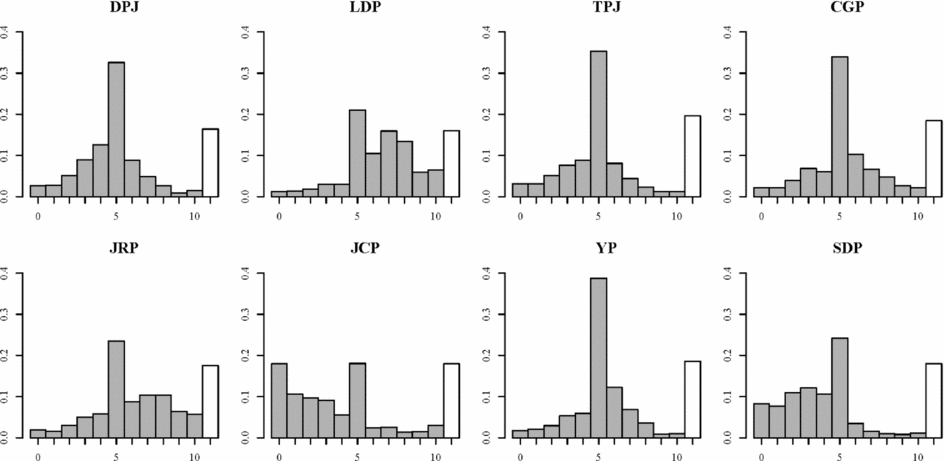
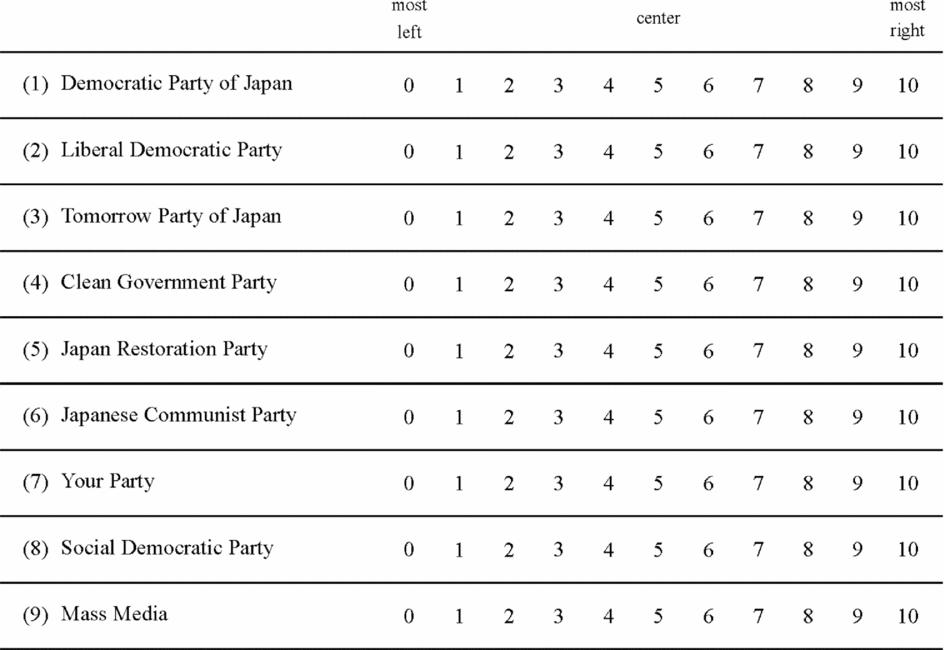
An understanding of the gravity of middle-category inflation is best gained by examining real data. Figure 1 shows the response distributions for a series of questions about various Japanese parties’ locations on a left–right ideological scale at the time of the 2012 general election. The non-response rate is depicted by the white bar at the far right of each histogram. The data come from the UTokyo-Asahi Survey (UTAS) conducted by Masaki Taniguchi of the Graduate Schools for Law and Politics at the University of Tokyo and the Asahi Shimbun.Footnote 1 The question asks respondents ‘Where do you think the (average) positions of the following people or groups lie? Mark the number corresponding to your feeling with a circle around each item from (1) to (9).’ Because the UTAS is a mail-in survey, respondents mark circles on the answer sheet independently. As shown in Figure 2, numbers from 0 to 10 are placed in order on the answer sheet, and the meanings of the numbers 0, 5, and 10 are specified as ‘most left’, ‘center’, and ‘most right’, respectively. The question refers to each of the eight main parties in the 2012 Japanese general election.Footnote 2
Histograms of responses to the question on ideological perception in UTAS 2012 Notes: White bars on the far right show the non-response rate. Abbreviations of parties are as follows: DPJ, Democratic Party of Japan; LDP, Liberal Democratic Party; TPJ, Tomorrow Party of Japan; CGP, Clean Government Party (Komeito); JRP, Japan Restoration Party; JCP, Japanese Communist Party; YP, Your Party; and SDP, Social Democratic Party.

Answer sheet for UTAS 2012 question on ideological perception Note: This figure was created by the author based on the UTAS 2012 survey questionnaire. The original version was written in Japanese.
When one examines Figure 1, the most remarkable pattern is that the frequency of the middle category, ‘5’, is very high. Even in the case of the LDP and the Japanese Communist Party (JCP), which have relatively familiar ideological locations, the middle category is the most popular choice. For parties that have short histories and ambiguous positions, like the Tomorrow Party of Japan (TPJ) or the Your Party (YP), the frequency of a response of ‘5’ is about twice as common as a non-response. It is possible, of course, that many members of the Japanese electorate actually see these parties as centrist. When one considers that non-response rates are almost equal across parties, it seems more likely that the middle category is used in place of non-response.
Therefore, the convergence towards ‘average’ responses for each party does not necessarily indicate that Japanese voters have stopped ideologically distinguishing parties or that parties have moved to the political center. Even if a portion of Japanese voters cannot read ideological cues, the remainder may still recognize ideological differences among parties.
Furthermore, there may be a second type of error. As shown in Figure 2, questions about ideological location place numbers on a straight line. This is a common format used not only in UTAS. For respondents who are unfamiliar with the ideological jargon used in the questions, numbers on an answer sheet may seem to indicate a grade for each party. Respondents with this misunderstanding would select large numbers for their favorite parties and low numbers for the parties they dislike. If there are a considerable number of such respondents, the noise caused by their responses is not negligible.
Although previous studies have not clearly demonstrated that this type of error exists, the possibility that numbers in ideological scales provide implicit cues has been considered. For example, Klingemann (Reference Klingemann1972) used a left–right scale without numerical cues and said, ‘This should have avoided any possible connotations with respect to “hot–cold”, “up–down”, or “plus–minus”.’ Research in survey methodology has shown that numerical values accompanied with rating scales affect respondents’ interpretation of scale labels (e.g., Schwarz et al., Reference Schwarz, Knäuper, Hippler, Noelle-Neumann and Clark1991). Rammstedt and Krebs (Reference Rammstedt and Krebs2007) compared formats of a questionnaire on personality and found that scales assigning a low number to the positive pole (strongly agree) and a high number to the negative pole (strongly disagree) produced diversified answers. They inferred that ‘subjects were confused by the discrepancy between the numerical labels and the verbal ones’. This tells us that large numbers in response scales can remind respondents of positive meanings and low numbers can remind them of negative meanings.Footnote 3 Therefore, it is not surprising that some respondents misinterpret numbers in ideological scales as a grade for each party.
Some prior studies have tried to correct measurement error in survey data resulting from misreporting. In political science, for example, Katz and Katz (Reference Katz and Katz2010) corrected the over-reporting of voter turnout in post-election surveys using a Bayesian analysis with auxiliary information. In addition, Imai and Yamamoto (Reference Imai and Yamamoto2010) coped with a differential measurement error, which is not conditionally independent of outcome, using a non-parametric identification analysis. An approach using mixture models is another promising avenue for research. Mixture models assume that there are heterogeneous data-generating processes – exactly the situation that this article seeks to resolve.Footnote 4 Mixture models have been widely used to correct measurement errors in survey research in other social science fields (Leite and Cooper, Reference Leite and Cooper2010; Li et al., Reference Li, Trivedi and Guo2003; Strazzera et al., Reference Strazzera, Scarpa, Calia, Garrod and Willis2003).
Bagozzi and Mukherjee (Reference Bagozzi and Mukherjee2012) and Jackson (Reference Jackson1993) tackled the problem of middle-category inflation. Bagozzi and Mukherjee (Reference Bagozzi and Mukherjee2012) developed a middle-inflated ordered probit (MiOP) model, which handles ordered survey responses with middle-category inflation by assuming that they are generated via a two-step latent process.Footnote 5 In the first stage, inflation is caused by uninformed respondents; this is modeled by a binary probit model. In the second stage, which is conditioned on the first-stage model, informed respondents answer the given question in a normal fashion; this is modeled by an ordered probit model. Bagozzi and Mukherjee (Reference Bagozzi and Mukherjee2012) applied the MiOP model to data on attitudes regarding EU membership in Central and Eastern Europe to show that correcting middle-category inflation can lead to substantial differences in estimation results and the insights subsequently drawn from them.
3. Methodology
To remove the noise resulting from those who inappropriately answer questions about ideological perceptions, I develop a mixture model by extending Bagozzi and Mukherjee's (Reference Bagozzi and Mukherjee2012) MiOP model. The model assumes that survey respondents (those who respond ‘I don't know’ or do not answer are excluded) are classified into three groups: informed respondents, middle-category inflators, and grade evaluators. This classification is implemented in two stages. First, based on their personal characteristics, respondents are divided according to whether or not they understand left–right terms. I refer to those who know the meaning of left–right terms as informed respondents and those who do not as uninformed respondents. Second, the model splits uninformed respondents into two groups based on their response modes. In one group, the middle-category inflator group, respondents opt for the middle-category response even though they do not understand the left–right terms. The other group is grade evaluators. This contains people who misinterpret the left–right scale as indicating a ‘good–bad’ scale or other means of evaluation. Hence, grade evaluators select large numbers for the parties they like and small numbers for those they dislike. These classifications are treated as latent traits in the model.Footnote 6
Like Bagozzi and Mukherjee's (Reference Bagozzi and Mukherjee2012) MiOP model, the model I propose is comprised of two stages. In the first stage, respondents are classified into the three groups based on variables related to respondents’ political knowledge and response tendencies; thus, the unit of observation in this stage is individual respondents. First, respondents are sorted into informed respondents and uninformed respondents via a logit model. I introduce κi as a latent dummy variable that denotes whether a given respondent does not understand left–right terms. That is, κi = 1 if respondent i is an uninformed respondent and κi = 0 if respondent i is an informed respondent. I model κi as follows:
 \begin{equation*}
\kappa _i \sim {\rm Bin}\left( {1,q_{1i} } \right),\end{equation*}
where  $q_{1i} = {\rm \Lambda }\left( {{\bf s}_i {\rm \prime }{\bf \zeta} } \right)$. Here, si is a vector of variables related to the respondent's political knowledge,
 ${\bf \zeta} $ is a vector of coefficients, and Λ( · ) is the cumulative distribution function of the standard logistic distribution; that is, Λ(a) = 1/(1 + e −a).
Uninformed respondents are then classified as either middle-category inflators or grade evaluators via another logit model. Again, λi is a dummy variable that refers to the two types of uninformed respondents’ responses, where λi = 1 if respondent i is a middle-category inflator and λi = 0 if respondent i is a grade evaluator. The model is as follows:
 \begin{equation*}
\lambda _i \sim {\rm Bin}\left( {1,q_{2i} } \right),\end{equation*}
where  $q_{2i} = {\rm \Lambda }\left( {{\bf t}_i {\rm \prime }{\bf \eta} } \right)$, in which ti is a vector of variables signifying the traits of these groups, and
 ${\bf \eta} $ is a vector of coefficients.
In the second stage, the model describes the survey responses of each group, conditioned on the first-stage classification. The observation unit in this stage is specific to a respondent and to a party. The dependent variable yij ∈ {1, …, m, …, K} denotes a response from respondent i about party j, where m is the middle category and K is the final category.
First, middle-category inflators invariably check the middle category; that is,  $\Pr \left( {y_{ij} = m{\rm |}\kappa _i = 1,\lambda _i = 1} \right) = 1$.
Second, the choices of grade evaluators are modeled by an ordered logit model with variables xij that indicate respondent i's evaluation of party j and its coefficient α. Therefore,
 \begin{eqnarray*}
&&\Pr \left( {y_{ij} = 1{\rm |}\kappa _i = 1,\lambda _i = 0} \right) = {\rm \Lambda }\left( {\tau _1 - g_{ij} } \right),\\
&&\Pr \left( {y_{ij} = k{\rm |}\kappa _i = 1,\lambda _i = 0} \right) = {\rm \Lambda }\left( {\tau _k - g_{ij} } \right) - {\rm \Lambda }\left( {\tau _{k - 1} - g_{ij} } \right), \\
&&\Pr \left( {y_{ij} = K{\rm |}\kappa _i = 1,\lambda _i = 0} \right) = 1 - {\rm \Lambda }\left( {\tau _{K - 1} - g_{ij} } \right),
\end{eqnarray*}
where gij = xijα,  ${\bf \tau} = \left( {\tau _1 , \ldots ,\tau _{K - 1} } \right)\prime $ is a vector of threshold parameters, k = 2, …, K − 1. Note, xij does not contain a constant term for identification.
Third, I explain informed respondents’ choices with two factors. One is the parties’ ideological platforms, which is the very element that this study seeks to determine. These are expressed via party-specific constants, which vary according to average ideological locations perceived by informed respondents. The other factor is proximity. I assume that as long as respondent i understands the question on ideological perception, a better evaluation of party j implies that respondent i is ideologically closer to party j. Some readers may feel that there is no need to include the proximity factor in the model because this is not a primary concern of this article. However, the models for grade evaluators and informed respondents become very similar and the likelihood of each unit in both models becomes very close if I do not include this factor. Because the estimation is done iteratively and the estimated results of the second stage affect the first, the power of the first-stage classification may deteriorate. Proximity is useful for the classification because this feature is only observed for informed respondents’ responses.
To model informed respondents’ choices, I use a multinomial logit model because alternatives are not ordered when proximity is considered.Footnote 7 Proximity is implemented via an observation-specific variable vij that corresponds to respondent i's evaluation of party j and an alternative-specific variable wik that indicates the distance between alternative k and respondent i's own ideological location. Then, the probability of respondent i's choice is as follows:
 \begin{eqnarray*}
&&\Pr \left( {y_{ij} = k{\rm |}\kappa _i = 0} \right) = \frac{{e^{h_{ijk} } }}
{{\mathop \sum \nolimits_k e^{h_{ijk} } }}\\
&&h_{ijk} = \beta _{jk} + v_{ij} \gamma _k + {\bf z}_{ijk} {\rm '}{\bf \delta} ,\end{eqnarray*}
where k = 1, …, K, βjk is party j's constant for alternative k, and γk is the coefficient on the observation-specific variable. Furthermore,  ${\bf z}_{ijk} = \left( {w_{ik} ,w_{ik} v_{ij} } \right){\rm \prime }$ is a vector of alternative-specific variables,
 ${\bf \delta} $ is a vector of its coefficients constant across alternatives,Footnote 8 and β·1 and γ1 are restricted to zero for identification.Footnote 9
4. Analysis
In this section, I use this model to investigate ideological knowledge and perceptions of members of the current Japanese electorate.
4.1 Data and variables
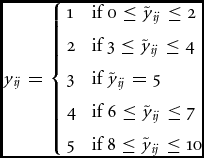
The data are obtained from the UTAS carried out after the 2012 general election.Footnote 10 As shown in Figures 1 and 2, respondents answered questions regarding their ideological perceptions of the eight major parties at that time. I convert the UTAS 11-point scale into five categories to facilitate the analysis. Note that  $\tilde y_{ij} $ denotes raw data
 \begin{equation*}
y_{ij} = \left\{
\begin{array}{l@{\hspace*{8pt}}l}
1 & {\rm if}\, 0 \le \tilde y_{ij} \le 2 \\[4pt]
2 & {\rm if}\, 3 \le \tilde y_{ij} \le 4 \\[4pt]
3 & {\rm if}\, \tilde y_{ij} = 5 \\[4pt]
4 & {\rm if}\, 6 \le \tilde y_{ij} \le 7 \\[4pt]
5 & {\rm if}\, 8 \le \tilde y_{ij} \le 10
\end{array} \right.\end{equation*}
The middle category is y = 3.
In the first stage, I introduce a number of explanatory variables to enable an accurate classification. Thus,  ${\bf s}_i $, which distinguishes informed respondents from uninformed respondents, contains voters’ demographic characteristics that may be related to political knowledge, including gender and education (e.g., Delli Carpini and Keeter, Reference Delli Carpini and Keeter1996). Education is treated as a categorical variable to allow a non-linear relationship. I expect that both female and lower educated respondents are more likely to be uninformed. Age is also included because in Japan ideological terms are less familiar to younger voters (Endo and Jou, Reference Endo and Jou2014c; Kabashima and Takenaka, Reference Kabashima and Takenaka1996, Reference Kabashima and Takenaka2012). The UTAS measured respondents’ self-evaluation of political knowledge; thus, I also use this variable. In addition, I create two variables based on responses to other questions that show evidence of incomprehension. One is a dummy variable indicating whether ideological self-identification is classified as middle or ‘I don't know’ (DK). The other is a dummy variable indicating whether ideological self-identification and attitudes for ideology-related issues in Japan, that is security and defense issues, contradict one another.
Furthermore,  ${\bf t}_i $, which distinguishes middle-category inflators from grade evaluators, consists of four variables. The first two relate to the characteristics of middle-category inflators. One is a dummy variable indicating whether ideological self-identification is classified as middle. The other is the number of middle responses to questions on 35 issue attitudes, which are asked using a five-point scale. The other two variables are related to the tendency to evaluate political actors, as the desire to evaluate political actors is necessary to become a grade evaluator. One is a dummy for those who have partisanship, which prompts one to assess parties. The other is the respondent's degree of ‘intensity of feeling’, which is operationalized by the sum of absolute values for feeling thermometer measures toward 16 political actors minus 50.
In the ordered logit model of the second stage, respondent i's evaluation of party j, which is a part of  ${\bf x}_{ij} $, is operationalized via the feeling thermometer. Because a high feeling thermometer indicates that a respondent likes the given party, the coefficient on the feeling thermometer variable should be positive if there are grade evaluators. Additionally, I include party-specific constants in the model. Because right-wing parties like the LDP and Japan Restoration Party (JRP) were popular in the 2012 general election, many respondents have positive feelings (i.e., high feeling thermometer measures) toward them. Moreover, it is natural for them to have higher yij values because they are right-wing parties. When a respondent who had positive feelings toward the LDP provided a high value for the left–right question regarding the LDP, it is not possible to identify whether they did so because they gave a high grade to the LDP or because they perceived the LDP as a right-wing party. Therefore, it is necessary to include party-specific constants as control variables to show that grade evaluators really exist. Once party-specific constants are included, observations within parties can be compared.
In the multinomial logit model, I also include the feeling thermometer as vij. Lastly, I calculate the distance between each alternative and ideological self-identification as wik. When respondent i locates him/herself at 4, for example, (w i1, w i2, w i3, w i4, w i5) = (3, 2, 1, 0, 1). I replace DK in the ideological self-identification with 3. When a respondent likes the given party and the feeling thermometer is high, the party is likely to be located close to him/her, and the marginal effect of the distance should be negative. In contrast, when a respondent dislikes a party and the feeling thermometer is low, the party is likely to be located far from him/her, and the marginal effect of the distance should be positive. Therefore, I expect that the coefficient on the interaction term wikvij will be negative. For details of all variables, see the Appendix.
I exclude respondents who do not answer questions for all parties or who have missing data for the explanatory variables. The final number of observations is 12,209, and the number of respondents is 1,583. Approximately 15% of all respondents did not answer at all, that is, they did not comprehend left–right terms and report this fact sincerely.Footnote 11
4.2 Results
I estimate the model parameters  ${\bf \zeta} $,
 ${\bf \eta} $,
 ${\bf \alpha} $,
 ${\bf \tau} $,
 ${\bf \beta} $,
 ${\bf \gamma} $, and
 ${\bf \delta} $ via the Markov chain Monte Carlo (MCMC) method using JAGS 3.4.0 (Plummer, Reference Plummer2003).Footnote 12,Footnote 13 MCMC is a technique involving sampling from posterior distributions, which is the central focus of the Bayesian framework. Estimation results are reported in the form of summary statistics for the posterior distribution based on the MCMC samples, such as the mean and highest density interval. MCMC has several advantages over other estimation methods. For example, researchers can use MCMC to estimate complex models that are difficult to estimate by other methods such as maximum likelihood estimation. Furthermore, researchers can sample latent variables, like κi and λi in this article, and can make inferences about these variables.Footnote 14
The priors of all parameters are N(0, 100), while order constraint is imposed on  ${\bf \tau} $. I sample κi and λi as well, from which I am able to estimate the posteriors of respondent i's type in the first stage. I set three MCMC chains. In each chain, I obtain 1,000 approximately independent samples at every 10th interval after 2,000 iterations as burn-in. The chains are judged to converge because the
 $\hat R$s of all the main parameters are below 1.05.
Before investigating informed respondents’ ideological perceptions of parties by considering the estimate of  ${\bf \beta} $, which is the main goal of this article, I check whether the mixture model performed well. The parameters in the first stage, the coefficient on the feeling thermometer in the ordered logit model, and the coefficient on the interaction term in the multinomial logit model should all have the expected signs if the mixture model successfully classified respondents into the three groups.
The signs of all parameters in the first stage, that is,  ${\bf \zeta} $ and
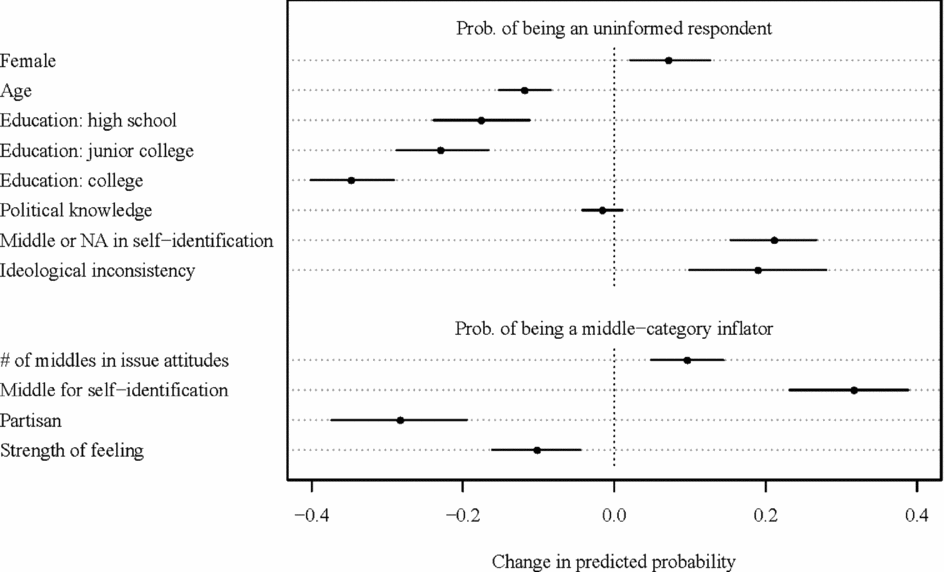
 ${\bf \eta} $, are consistent with predictions, and most of the 95% highest posterior density (HPD) intervals do not include zero. I compute substantive quantities of interest because the coefficients of non-linear models are difficult to interpret within themselves.Footnote 15Figure 3 shows the effects of the explanatory variables. I calculate the difference in predicted probability as a result of changing each explanatory variable from some value to another using an observed-value approach with a 95% HPD interval.Footnote 16 All variables have effects in the predicted directions.
Predicted effects of changing explanatory variables in the first stage Notes: In each simulation, only one explanatory variable is varied, while fixing the other variables at their observed values. The predicted change in probability is calculated based on the logit model in the first stage, and the predicted change across all respondents is averaged. While all samples are used for simulations of  ${\bf \zeta} $, only samples classified as uninformed respondents are used for simulations of
 ${\bf \eta}$ in each MCMC iteration. Selected values are 0 and 1 for dummy variables and the first- and third-quartile values for continuous variables. Dots denote posterior means, and horizontal lines are 95% HPD intervals.
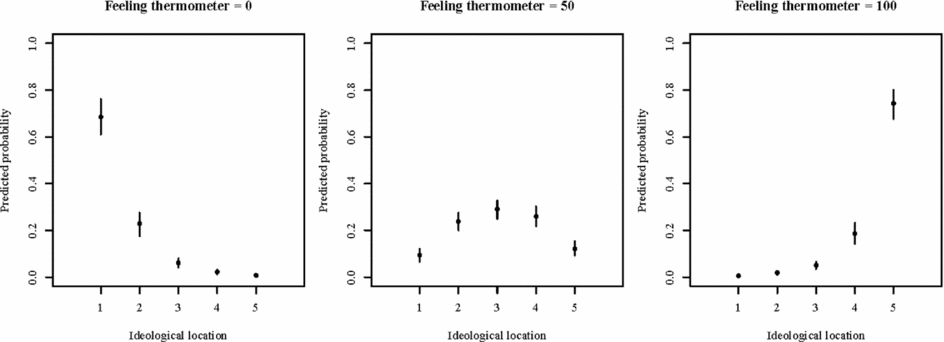
The estimated coefficient on the feeling thermometer in the ordered logit model is positive, consistent with the prediction. Figure 4 shows predicted perceptions of LDP by grade evaluators. Thus, the grade evaluators choose a small number when they dislike the LDP and a large number when they like the LDP. This supports the hypothesis that grade evaluators do exist.
Predicted ideological perception of the Liberal Democratic Party by grade evaluators Notes: The feeling thermometer for LDP was set at 0 (left panel), 50 (center panel), or 100 (right panel), the predicted probability of selecting each category was calculated based on the ordered logit model in the second stage, and the predicted change was average across all respondents. Dots denote posterior means and vertical lines are 95% HPD intervals.
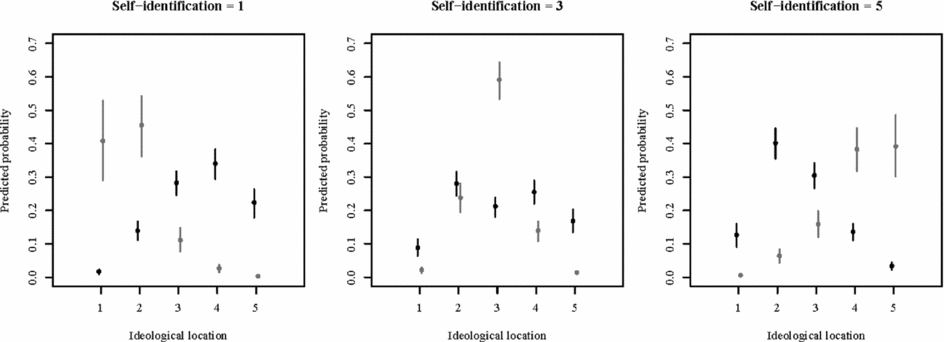
Finally, the posterior mean of the coefficient on the interaction term between proximity and the evaluation of a given party in the multinomial logit model is −0.40, and its 95% HPD interval is [−0.44, −0.37], being negative as expected. Figure 5 shows the predicted perceptions of informed respondents (via self-identification) regarding the Democratic Party of Japan (DPJ); its three panels correspond to left-identifiers, centrists, and right-identifiers. When informed respondents’ feelings for the DPJ are very low (black dots and lines), they tend to locate the DPJ at some distance from themselves, and when they are very high (gray dots and lines), they tend to locate the party closer to themselves. These results indicate that informed respondents can connect party evaluation with left–right ideology.
Effect of proximity on the perceptions of informed respondents on the Democratic Party of Japan Notes: Respondents’ ideological self-identification were set at 1 (left panel), 3 (center panel), or 5 (right panel), and the feeling thermometer for the DPJ was set at 0 (black dots and lines) or 100 (gray dots and lines). The predicted probability of selecting each category was calculated based on the multinomial logit model in the second stage. Dots denote posterior means and vertical lines are 95% HPD intervals.
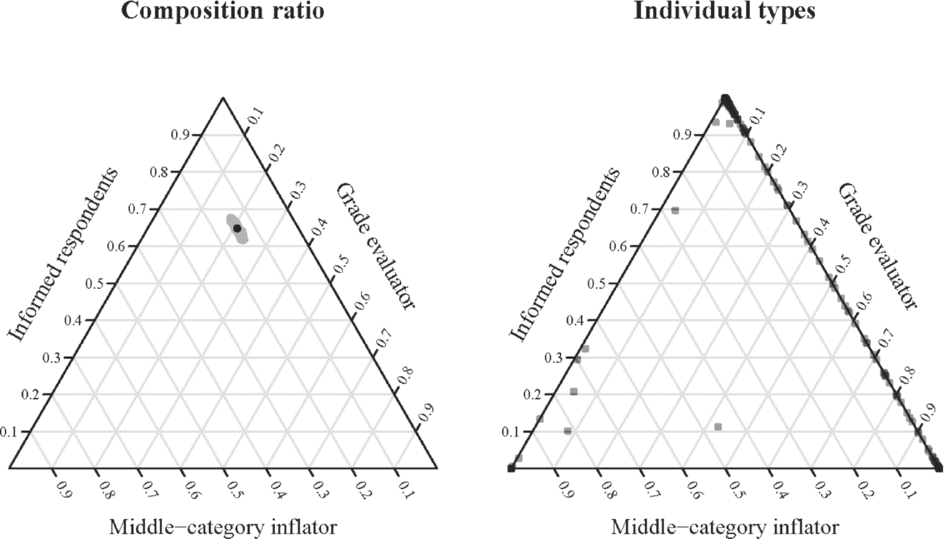
The model tells us how many Japanese voters understand left–right terms. Figure 6 shows the estimated composition ratios of the three groups (left panel) and the distribution of posterior probabilities of respondents’ types (right panel) based on the sampled κi and λi.Footnote 17 Approximately 65% of respondents are informed respondents, 20% are grade evaluators, and 15% are middle-category inflators. Considering that about 15% of survey respondents did not answer the ideology question for any of the eight parties, it becomes apparent that a little over half of the Japanese electorate understands the meaning of the ‘left–right’ spectrum. From the right panel, there is substantial heterogeneity in posterior probabilities for comprehension of the question on ideological perception. This result indicates that it is inappropriate to analyze such data (e.g., calculation of simple averages) based on the assumption that all data are generated from an identical process.Footnote 18
Results of classification Notes: The left panel shows the estimate of the composition ratio of the three groups. The black dot shows the posterior mean and the gray dots are composition ratios in each MCMC sample. The right panel shows the distribution of posterior probabilities of respondents’ types based on sampled  ${\bf \kappa} _i$ and
 ${\bf \lambda} _i$ by semitransparent dots. Estimates from only 300 random samples are shown to improve figure clarity.
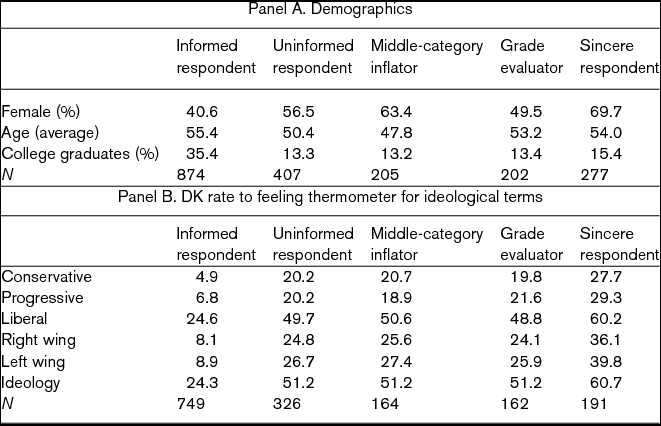
Who comprises each group? Panel A of Table 1 provides the average make up of the groups; that of respondents who genuinely confess their ignorance by non-response for all eight parties (hereinafter referred to as sincere respondents) is also shown for comparison. To specify the constituents of each group, I extract respondents whose posterior of belonging to the given group is 90% or higher. As classified in the first stage, the proportions of male and college graduates are higher in informed respondents than in uninformed, and informed respondents are older on average than uninformed. However, in examining differences within uninformed respondents and comparing them with sincere respondents, matters are more complex. The proportion of female middle-category inflators, which is close to that of sincere respondents, is higher than that of female grade evaluators. The average age of middle-category inflators is lower than that of grade evaluators, and interestingly, sincere respondents are older on average than middle-category inflators. In contrast, the percentage of college graduates is equal in the three groups.
Characteristics of the constituents of the classified groups
Notes: The constituents of informed respondents, middle-category inflators, grade evaluators are specified by the criterion that the posterior of belonging to the given group is 90% or higher. Uninformed respondents are the sum of middle-category inflators and grade evaluators. Sincere respondents are those who provide no answers for all of the eight parties. Because Age is originally an ordered categorical variable from a six-point scale (the coding is in the Appendix), average Age is calculated as  $14.5 + 10{\rm } \times \overline {{\rm Age}^{\rm *} } $, where
 $\overline {{\rm Age}^{\rm *} } $ is the average of the original variable. The second wave survey carried out after the 2013 House of Councillors election asks a question about ideological terms using a feeling thermometer. The question has an instruction requesting respondents to draw x-marks if they do not know the meaning of the terms. Cells entries in Panel B are the percentage of DK (the sum of x-marks and blank answers).
Panel B of Table 1 provides further evidence that the classification is working. The 2012 UTAS respondents were mailed another survey after the 2013 House of Councillors election, which was held seven months after the 2012 election. This second-wave survey uses feeling thermometers for several ideological terms, with an instruction encouraging sincere responses. The instruction requests respondents to draw x-marks if they do not know the meaning of any terms (the question wording is shown in the Appendix). I examine the percentage of DK (the sum of x-marks and blank answers) by the constituents of the classified groups. As seen in Panel B of Table 1, the DK rate of uninformed respondents is prominently higher than that of informed respondents. The DK rate of middle-category inflators and grade evaluators are nearly equal, and they are close to that of sincere respondents. These results show that the classification of the mixture model can predict responses about ideological terms after approximately six months.
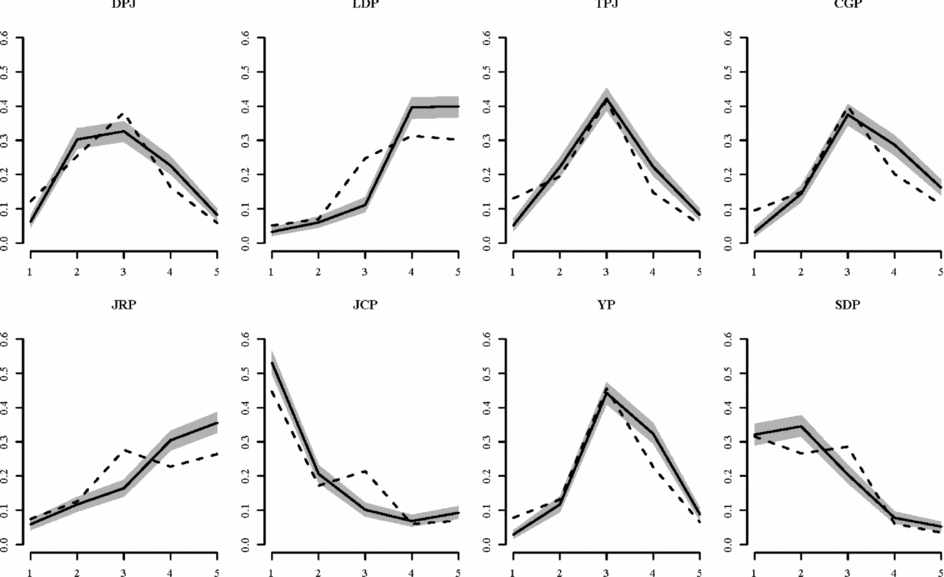
Next, I examine how informed respondents perceive parties’ ideological positions. Figure 7 displays the predicted distributions of informed respondents’ perceptions based on party-specific constants  ${\bf \beta} $ in the second-stage multinomial logit model as solid lines. It also shows raw data distributions, which contain uninformed respondents’ perceptions as well as those of informed respondents, with dashed lines. For comparison, Figure 8 shows the results of an expert survey asking parties’ left–right positions conducted by Junko Kato after the 2012 election (Kato, Reference Kato2014).Footnote 19
Predicted distributions of ideological perception for informed respondents Notes: The feeling thermometer and proximity were fixed at their observed values, the predicted probability was calculated based on the multinomial logit model in the second stage, and the predicted change was averaged across all respondents. Samples classified as informed respondents were used in each MCMC iteration. Differences between parties were derived from party-specific constants β. Solid lines denote posterior means of predicted probability and dashed lines denote distributions of the raw data for comparison. Shaded areas denote 95% HPD intervals. Abbreviations of parties are as follows: DPJ, Democratic Party of Japan; LDP, Liberal Democratic Party; TPJ, Tomorrow Party of Japan; CGP, Clean Government Party (Komeito); JRP, Japan Restoration Party; JCP, Japanese Communist Party; YP, Your Party; and SDP, Social Democratic Party. ‘1’ refers to the very left, and ‘5’ refers to the very right.
Parties’ left–right ideological location perceived by experts Notes: This figure shows the average left–right perception of parties by experts based on the expert survey conducted by Junko Kato after the 2012 election (Kato, Reference Kato2014). Horizontal lines are 95% confidence intervals. Abbreviations of parties are as follows: JCP, Japanese Communist Party; SDP, Social Democratic Party; DPJ, Democratic Party of Japan; PLP, People's Life Party (the successor of TPJ); CGP, Clean Government Party (Komeito); YP, Your Party; LDP, Liberal Democratic Party; and JRP, Japan Restoration Party. ‘1’ refers to the very left, and ‘20’ refers to the very right.

At a glance, the middle-category inflation is dramatically reduced via the prediction. In addition, distortion caused by grade evaluators is also corrected. The predicted probabilities of category ‘1’ for the TPJ and the Clean Government Party (CGP), for example, decrease compared with the raw distribution.Footnote 20 This is reasonable because there are some voters who strongly dislike the TPJ and CGP.Footnote 21
One remarkable result demonstrated by this analysis is that the ideological perceptions of informed respondents generally align with the common wisdom of experts. Most informed respondents locate the LDP and JRP on the right and the JCP and Social Democratic Party (SDP) on the left as experts do. Your Party (YP), a party promoting neoliberalism and administrative reform, is seen as center-right, which is also in line with experts’ views. However, informed respondents’ perceptions of the CGP differ from those of experts. Political researchers in Japan think that the CGP is a centrist party, whereas informed respondents consider it to be rather right. This is perhaps because the CGP formed a coalition with the LDP, which is seen as the most right-wing party in Japan, and voters use this as a cue to infer its position (Fortunato and Stevenson, Reference Fortunato and Stevenson2013).
It is worth noting that even informed respondents have difficulty evaluating the ideologies of some parties. Specifically, the prediction for the TPJ is not very different from the raw distribution. The TPJ was formed no more than three weeks before the 2012 general election, and its predecessor, the People's Life First, was a splinter group from the DPJ, forming only five months before the election. Furthermore, it is composed of actors from various camps, including an anti-nuclear group, a tax-cut group, and an anti-Trans-Pacific-Partnership group. Thus, their policy positions would be fairly unfamiliar to the electorate.Footnote 22 In addition, the prediction for the DPJ is relatively flat, which means that there is no common view of the party among informed respondents. The DPJ has been said to lack intra-party unity since its foundation in 1998 and its platform was not stable during the 2000s (Kabashima and Steel, Reference Kabashima and Steel2010: Chap. 8). These results indicate that even informed respondents have trouble judging ideological positions of ambiguous or new parties.
5. Conclusion
Previous studies of ideology in Japan have claimed that the Japanese electorate no longer distinguishes parties in an ideological fashion; these results were based on conventional survey questions that asked respondents to locate parties on an ideological scale. However, researchers did not pay attention to heterogeneity in respondents’ understanding of ideological terms and thus did not examine whether their data genuinely measured what they wanted to measure. In this article, I have investigated two research questions related to respondents’ perceptions of parties’ ideological positions. Considering the possibility of heterogeneity in the data-generating process, I developed a mixture model to analyze survey questions about ideological perception. I then applied this model to data from an opinion poll carried out after the 2012 Japanese general election.
The first research question asked how the Japanese electorate currently perceives parties’ ideological locations. I found that respondents who understand left–right terminology perceive parties’ ideologies in a common-sense way, similar to that of experts. However, it is also difficult for such respondents to locate ambiguous or new parties on the left–right scale. The second research question asked whether questions of ideological perception appropriately measure what they should. The results revealed that these questions suffer from noise arising from the responses of those who pretend to be informed and those who misunderstand the questions’ intent. I argue that researchers should be aware of this heterogeneity among respondents and remove such noise by using a mixture model.
My findings suggest that the prevailing theory of ideology in contemporary Japanese politics needs to be reconsidered. First, ideological understanding has not declined uniformly among all Japanese voters. It is true that there are many voters who do not understand ideological concepts, but my estimations reveal that a little over a half of all Japanese voters are familiar with ideological terms and that their understanding is generally appropriate. It is important to note, however, that this article does not reveal whether voters in contemporary Japan use ideology as a cue to make their opinions or vote. This is a question to be considered in future research.
A second notable finding is that many Japanese voters understand left–right, not conservative–progressive, terminology; this is in contrast to arguments that the left–right scale is unfamiliar to Japanese voters (e.g., Miyake, Reference Miyake1985: 211; but see also Kabashima and Takenaka, Reference Kabashima and Takenaka1996: 199). Endo and Jou (Reference Endo and Jou2014a) recently argue that not all generations understand the conservative–progressive scale (this scale is more commonly used in Japan than the left–right scale). In particular, they find that younger citizens interpret the word ‘progressive’ (kakushin) strikingly differently from the conventional view (see also Endo and Jou, Reference Endo and Jou2014b, Reference Endo and Jou2014c). In contrast, Endo and Jou (Reference Endo and Jou2014c) report that there is no generation gap in the voters’ perception of parties on the left–right scale. Taking these findings into consideration, left–right may be a more suitable terminology than conservative–progressive for opinion polls today. However, there is one caveat: a little under half of all voters do not understand left–right terms.Footnote 23 Survey researchers should properly use each scale in accordance for the purpose.
Third, it is not appropriate to see parties as converging to the median based on voters’ naïve perceptions of party ideologies. This article implies that the average voter's perception is a dubious gauge for measuring parties’ policy positions because it is distorted by a large amount of noise. If it is assumed that ideological perceptions of parties among those who appropriately understand ideological terms reflects the true ideological positions of parties, then it can be concluded that some parties still lie in extreme positions today: the LDP and JRP are considerably right, and the JCP and SDP are considerably left.
In addition, this article has implications for survey methodology. The ideological scales used in designing surveys require improvement. First, numbers on a scale may cause misunderstanding because numbers remind respondents of evaluation scores. Where respondents have previously answered questions using a feeling thermometer, this misunderstanding may be heightened. One solution is to use blank boxes or to draw a simple segment without number cues.Footnote 24 The second point is that survey planners should include an option for ‘I don't know’. This will have an effect on respondents by enabling them to confess their ignorance and will prevent uninformed respondents from answering inappropriately.
Many opinion polls in other countries, including the American National Election Studies and Comparative Studies of Electoral Systems, have used a numbering scale without a DK option to measure ideological perceptions of political actors and ideological self-placement.Footnote 25 Future research should investigate under what conditions over-reporting and misunderstanding are most common by analyzing various opinion polls’ data using mixture models.
Another methodological implication of this study is that it demonstrates the usefulness of mixture models for investigating heterogeneity in public opinion. For example, in the case of studying Japanese ideology, Endo and Jou (Reference Endo and Jou2014a, Reference Endo and Jou2014b) found a generation gap in the interpretation of conservative–progressive terms. Young citizens see the JRP as a progressive party, while it is conventionally thought to be conservative and was found in this article to be seen lying to the right when measured on a left–right scale. Endo and Jou (Reference Endo and Jou2014a) hypothesized that young people associate ‘progressive’ (kakushin) with reform, as the original meaning of ‘kakushin’ is ‘innovation’. This intergenerational heterogeneity is an obstacle to investigating conservative–progressive ideology in contemporary Japan. Mixture models may be able to adequately deal with this heterogeneity. Speaking more generally, examining voters’ views of political axes or ideological conflicts is important for understanding interactions between the elites and general public in democratic countries. Mixture models will be of some help to carefully identify the various views found within the electorate.
About the author
Hirofumi Miwa is a graduate student in the Graduate School for Law and Politics, The University of Tokyo and a research fellow of the Japan Society for the Promotion of Science. He is a member of the research team of the UTokyo-Asahi Survey. His research interests lie in the areas of public opinion and voting behavior. He is currently researching the formation of voters’ political ideology and its heuristic role, mainly in Japanese politics.
Appendix
This appendix explains the variables used in the analysis. The variable names within the UTAS dataset are given in parentheses.
y : Dependent variables
Left–right perception of parties Coded as the response provided to the question: ‘Where do you think the (average) positions of the following people or groups lie on the same scale?’ The same scale means the left–right scale, as this question appears just after the question about self-identification (mentioned below). Options range from ‘most left’ ( = 0) to ‘most right’ ( = 10) (Q013400). The recoding method is explained in the main article.
s : Variables for classification between informed respondents and uninformed respondents
Female Coded 1 if a respondent is ‘female’ and 0 if a respondent is ‘male’ (Q014100).
Age Coded 1 if a respondent is in their ‘20s’, 2 if in their ‘30s’, 3 if in their ‘40s’, 4 if in their ‘50s’, 5 if in their ‘60s’, and 6 if ‘over 70’ (Q014200; this is originally a categorical variable).
Education: high school Coded 1 if a respondent reports that he/she has completed ‘high school’, NA if ‘other’, and 0 otherwise (Q014300).
Education: junior college Coded 1 if a respondent reports that he/she has completed ‘vocational college’ or ‘junior college’, NA if ‘other’, and 0 otherwise (Q014300).
Education: college Coded 1 if a respondent reports that he/she has completed ‘college’ or ‘graduate school’, NA if ‘other’, and 0 otherwise (Q014300).
Political knowledge Coded based on the response to the question: ‘It is taken for granted that some are very informed about politics and some are otherwise unless they are a politician or a commentator. How do you consider yourself?’ Recoded from ‘I think that I am very informed’ ( = 1) to ‘I think that I am very uninformed’ ( = 5) (Q012100).
Middle or NA in self-identification Coded 1 if a respondent answered the middle category (5) or did not respond to the question: ‘It is common to express political position using “left–right” terms. Where do you state your position on this scale?’ Options range from ‘most left’ ( = 0) to ‘most right’ ( = 10) (Q013300).
Ideological inconsistency Coded 1 if (a) self-identification (Q013300) is left (< 5) and the score for issue attitudes is right (< 3) or (b) self-identification (Q013300) is right (> 5) and the score for issue attitudes is left (> 3). The score for issue attitudes is the average of the following issue-attitude items: constitutional revision (Q013001), increasing defensive power (Q013002), preemptive defense (Q013003), pressure on North Korea (Q013005), right to collective defense (Q013006), and US prior to Asia (Q013101).
t : Variables for classification between middle-category inflators and grade evaluators
Number of middles in issue attitudes Coded as the number of middle-category responses to 35 issue-attitude questions (Q013001–Q013026 and Q013101–Q013109).
Middle for self-identification Coded 1 if a respondent answers the middle category (5) to the question of ideological self-identification (Q013300, see above).
Partisan Coded 1 if a respondent expresses long-term partisanship for any party and 0 otherwise, based on the response to the question: ‘Many people seem to think that “I’m close to *** party”. Even if, of course, you may vote for other parties in the short term, what party you are close to in the long run?’ (Q013700). For information about the concept of long-term partisanship, see Taniguchi (Reference Taniguchi2012).
Strength of feeling The sum of absolute values for feeling thermometer measures toward 8 parties and 8 politicians (NA is replaced with 50) minus 50 (Q012201–Q012216).
x : Variables in the ordered logit model for grade evaluators
Feeling thermometer measure towards party Feeling thermometer measure for the given party. NA is replaced by 50 (Q012201–Q012208).
v : An observation-specific variable in the multinomial logit model for informed respondents
Feeling thermometer measure towards party See x.
w : An alternative-specific variable in the multinomial logit model for informed respondents
Proximity Explained in the main article.
Variables appeared in Panel B ofTable 1
Feeling thermometer measure toward ideological terms Feeling thermometer measure for the following ideological terms: conservative (hoshu, Q021101), progressive (kakushin, Q021102), liberal (riberaru, Q021103), right wing (uyoku, Q021104), left wing (sayoku, Q021105), and ideology (ideorogi, Q021114). The following instruction is attached: ‘If you do not understand the meaning of the terms, please draw “X” in parentheses.’