I. INTRODUCTION
A. The role of computational thermodynamics for solid oxide fuel cells research
In a recent review, symmetric solid oxide fuel cells (SOFC), where the same electrode material is used as anode and cathode, have been a promising conceptReference Ruiz-Morales, Marrero-Lόpez, Canales-Vázquez and Irvine1: while being as efficient as conventional SOFC, symmetric SOFC have advantages regarding both fabrication and operation. A working model system for this configuration with redox-stable electrodes made of La–Sr–Mn–Chromite (LSCM) with the perovskite structure ABO3−δ was presented by Refs. Reference Bastidas, Tao and Irvine2 and Reference Ruiz-Morales, Canales-Vázquez, Peña-Martínez, Marrero-López and Núñez3.
In traditional SOFC, Sr-doped lanthanum manganite (LSM) with the perovskite structure is used as cathode materials in SOFC. However, uncontrolled diffusion of chromium from the metallic interconnects into the cathode leads to a severe cell voltage decrease that was linked to the formation of Cr-containing phases.Reference Badwal, Deller, Foger, Ramprakash and Zhang4, Reference Jiang, Zhang and Foger5 Thermodynamic calculations are feasible for a deeper understanding of the mechanisms of chromium “poisoning” since the effects of increasing chromium content inside the cathode on the formation of phases such as Cr–Mn spinel, being harmful for the cell performance, can be calculated. Also, conclusions on the evolution of the phase chemistry of degraded LSM cathodes can be drawn. One can calculate the expected equilibrium state under reducing oxygen partial pressures, the latter reflecting the situation at the cathode–electrolyte interface in SOFC under current load. By modeling oxygen nonstoichiometry of LSCM, trends of the ionic conductivity of the cathode can be evaluated. The evolution of phase relations in SOFC at varying oxygen partial pressures represents a multicomponent problem. Computational thermodynamics in SOFC research utilizing oxide database assists understanding of phase relations at different positions inside SOFC at long-term operation, i.e. the closer the material approaches thermodynamic equilibrium. Of particular interest is a deeper knowledge of the thermodynamics at the complex interfaces inside SOFC, the interconnect/electrode, as well as electrochemically active electrode/electrolyte interfaces. A thermodynamic La–Sr–Mn–Cr–O oxide database is highly desirable, to understand phase formations due to solid–gas and solid–solid reaction, affecting cell performance. A thermodynamic database contains the optimized Gibbs energy functions of solid oxide phases, for stoichiometric phases (line compounds) as a function of temperature and for solid solution phases as a function of temperature and composition. From the above example of thermodynamic computations of Cr-contaminated LSM, it is obvious that the database should meet the demand to calculate stable and metastable phase equilibria, thermodynamic driving forces and activities, as well as defect concentrations of LSCM at different temperatures and oxygen partial pressures. These requirements are conformed by using the calculation of phase diagrams (CALPHAD) approachReference Saunders and Miodownik6–Reference Liu8: model parameters for the molar Gibbs energies of the phases of a system are evaluated from experimental thermochemical and equilibrium phase diagram data, the latter representing areas of minimal Gibbs energy in function of temperature, pressure (in this study, constant atmospheric pressure), and composition. Experimental thermochemical data include for instance calorimetric results (enthalpies of formation, heat capacities). With gas phase equilibria techniques such as Knudsen mass spectrometry, the vapor pressure of component of interest is measured to derive its activity. Electromotive force (emf) generated by electrochemical cells is used to derive the standard Gibbs energy of formation of a phase. More details of these and less common techniques can be found in Ref. Reference Saunders and Miodownik6. The power of the CALPHAD approach is that the thermodynamic properties of a multicomponent phase, such as LSCM, i.e., its molar enthalpy, entropy, heat capacity, and Gibbs energy, are founded on the thermodynamics of its forming simple oxides, and only the excess contribution to its molar Gibbs energy, in essence the nonideal Gibbs energy of mixing, is optimized with experimental thermodynamic and phase diagram data. In principle, optimizations are made in low-order binary and pseudobinary systems, where experimental information is available (in the following, a three-component oxide system with binary oxide end-members is named pseudobinary, a four-component oxide system with three binary end-members is named pseudoternary, and so forth). On this fundament, reasonable assumptions can be made about the thermodynamics of high-order systems, where experimental data are scarce or missing. To allow extension from low-order systems to multicomponent databases, a common reference for the molar enthalpy is defined, which for an element is the standard molar enthalpy of its stable modification at 298.15 K (SER = Stable Element Reference). Also, it is required that the same Gibbs energy functions of pure elements, compiled by Dinsdale,Reference Dinsdale9 are used in all thermodynamic assessments. The molar entropy of a phase is zero at 0 K and must of course obtain positive values at finite temperatures.
B. CALPHAD modeling of solid oxides
1. Stoichiometric solid oxides
A ternary line compound α, containing m and n moles of two different sorts of cations, a with the positive electrical charge r and b with the positive electrical charge q, respectively, and p moles of one sort of anions, c with the negative electrical charge s, the three types of ions sitting in three distinctive crystallographic sublattices (i.e., nonequivalent Wyckoff sitesReference Liu8), can be described by the sublattice formula 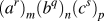 . For oxides, c = O and charge s = −2. To account for the charge neutrality criterion, Eq. (1) is true.

The molar Gibbs energy of α,  at constant pressure is given by

where A, B, C, D, E, and F are model parameters to be optimized by thermodynamic and phase diagram data. Since the heat capacity at constant pressure, Cp(α) is defined by:

C, D, E, and F are optimized to heat capacity data only.  can be based on the molar Gibbs energies of α-forming oxides
 and
 (
 ), if it is assumed that the heat capacity of the ternary oxide composed by the two binary oxides is simply the sum of the heat capacities of the composing oxides [based on Neumann (1831) and Kopp’s (1964) rule that the molar heat capacity of a solid compound is the sum of the heat capacities of the elements in it] as shown in Eq. (4):
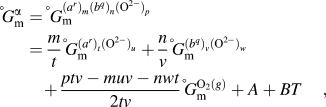
where  is the Gibbs energy of formation of the phase α relative to the oxide components. A and B are optimized by thermodynamic and phase diagram data.
2. Solid solution phases—the Compound Energy Formalism
LSCM perovskite is the important solid solution phase for SOFC to be modeled in the multicomponent database presented. To understand its thermodynamic modeling, let us consider the simple case of an oxide phase β with sublattices  containing cation a with the positive charge r. When another sort of cation with the positive charge q,
 sits in the same sublattice as a; the sublattice formula of the resulting solid solution phase β(ss) reads
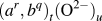 . Equation (5) is the criterion for charge neutrality:

Using the Compound Energy Formalism (CEF),Reference Andersson, Guillermet, Hillert, Jansson and Sundman10–Reference Hillert12 the molar Gibbs energy of the solid solution (ss) phase comprises the Gibbs energies of the compounds. For β(ss), the two compounds read  and
 . The Gibbs energy of β(ss) at constant pressure reads

where  is the fraction of cation a on the cation sublattice (site fraction), and
 is the site fraction of cation b on the cation sublattice. R = 8.31451 J/(mol K). The second last term accounts for the configurational entropy of mixing, related to the number of possible configurations of a and b. The last term describes the excess Gibbs energy of mixing due to interactions of ions in the mixture that can be accounted for by introducing interaction parameters, in the following denoted with 0L to nL, where only the 0th interaction parameter denotes composition-independent interaction energies. The form of interaction energies as Redlich–KisterReference Redlich and Kister13 polynomials has been described in detail elsewhere, e.g., Liu.Reference Liu8
3. Vacancies and the concept of reciprocal reactions
Let an oxide phase (A)2(B)3, where A stands for the cation sublattice and B denotes the anion sublattice, contain one cation a accepting the charge 3+ or 2+ in the cation sublattice. When the cation is reduced, the charge neutrality criterion is no longer obeyed by an anionic sublattice that is completely filled with oxygen. Charge neutrality under such reducing conditions can be conserved by the formation of zero-charged vacancies (Va) in the anionic sublattice resulting in the phase becoming oxygen-nonstoichiometric. In the sublattice form, the phase can be written as  . The oxygen nonstoichiometry is denoted “O3−δ.” The molar Gibbs energy of the phase at constant pressure reads

Four end-member compounds of the phase are obtained by simple recombinations of 2+ or 3+ cations with oxygen anions or vacancies. The molar Gibbs energies of all the four end-member compounds  ,
 ,
 , and
 are required for the molar Gibbs energy of the phase. However, the only neutral end-member is
 . It thus can exist, and its molar Gibbs energy can be defined by optimization of model parameters by experiments. The three other end-members are charged and cannot exist, but a line of neutral compositions connects
 with the reduced compound
 , and its Gibbs energy can be optimized with experiments that are related to the reduction of the phase, for instance oxygen nonstoichiometry data.
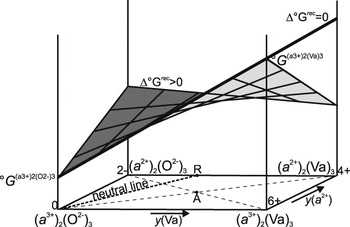
The composition square of the phase can be seen in Fig. 1 that is redrawn from Hillert,Reference Hillert12 with the neutral line and the reduced compound, denoted with R, included. The 2+ charged center composition of the square,  , denoted with A in Fig. 1, is theoretically obtained by mixing equal amounts of either
 and
 or
 and
 .
The surface of reference for the Gibbs energy of the reciprocal phase  approximating its whole Gibbs energy for Δ°G rec > 0 and Δ°G rec = 0, plotted above the composition square.

A system that obeys this relation is called a reciprocal system, and  is a reciprocal phase.Reference Hillert12 For an unambiguous definition of the molar Gibbs energy of the reciprocal phase, it is necessary to give an arbitrary molar Gibbs energy to a reference. As the chosen molar Gibbs energy of the reference is unlikely the true value, the reference should favorably be a highly charged compound, thus far off neutral compositions that can really exist. For the example of the reciprocal solid solution phase
 , the 6+ charged compound
 is chosen as reference. The morphology of the Gibbs energy surface of the reciprocal phase depends on
 of the reciprocal reaction
 :

The Gibbs energy surface of the reciprocal phase  resulting from
 = 0, by neglecting the configurational entropy contribution, and without excess terms for the Gibbs energy is flat. The edge of this plane appears as bold line in Fig. 1. When on the other hand positive
 is resulting from the modeling, the Gibbs energy surface is curved. The theoretic compound A will tend to demix to
 and
 by only slightly oxidizing or reducing it. As no tendency of demixing was reported for the nonstoichiometric oxide solid solutions that are treated in this study, and no experiments define a proper value of the reciprocal reaction parameter, it is legitimate to define
 = 0.
4. Calculation of defect chemistry using the CALPHAD approach
The CALPHAD method is powerful for the calculation of the defect chemistry of high-order nonstoichiometric reciprocal solid solution oxide phasesReference Grundy, Povoden, Ivas and Gauckler14 such as (A)(B)O3−δ perovskite with a complex sublattice formula, for instance  for Cr-doped LSM perovskite as a function of composition, temperature, and oxygen partial pressure, once model parameters of the reduced and oxidized compounds are optimized with experimental information on charge carriers, site fractions, and oxygen content.
II. ASSESSMENT OF OXIDE SUBSYSTEMS
Establishing of correct Gibbs energies polynomials of the oxide phases of the pseudoquaternary La–Sr–Mn–Cr–O oxide system requires thermodynamic assessments of experimental thermodynamic and phase diagram data of all oxide subsystems. Based on this assessment procedure, thermodynamic parameters were optimized using the PARROT data evaluation module of the ThermoCalcReference Grundy, Povoden, Ivas and Gauckler15 software (version S). PARROT can take into account all sorts of thermodynamic and phase diagram data simultaneously. The program minimizes the sum of squared errors between the experimentally determined phase diagram and thermodynamic data. As the use of all the experimental data in a simultaneous least square calculation often leads to divergence, the authors selectively adjusted the relative weight of each experimental data point and excluded data that were inconsistent with the majority of the data points during the optimization procedure. This weighting process is based on the accurate assessment of experimental thermodynamic and phase diagram data.
For the construction of the La–Sr–Mn–Cr–O oxide database, the Sr–Cr oxide, La–Mn–Cr–O oxide, and La–Sr–Cr–O oxide systems are assessed. Sr–Mn–Cr–O oxide is treated as ideal extension from the subsystems. No quaternary phases or solid solutions were found in the Sr–Mn–Cr–O oxide system.Reference Filonova, Demina and Petrov16 Previous assessments of the La–O, Cr–O, La–Cr–O, and Cr–Mn–O oxide databases are adopted from Povoden et al.,Reference Grundy, Hallstedt and Gauckler17–Reference Povoden, Grundy and Gauckler21 with some modifications denoted in the supplement file to this paper, LSCM_v1.0.tcm (ThermoCalc macrofile), and the La–Sr–Mn–O oxide database is taken from Grundy et al.,Reference Grundy, Hallstedt and Gauckler22–Reference Grundy, Hallstedt and Gauckler27 also with the following slight modification: Grundy et al.Reference Grundy, Chen, Hallstedt and Gauckler23, Reference Grundy, Hallstedt and Gauckler24 allowed Mn3+ on the A-site of LSM to reproduce experimental oxygen nonstoichiometries under low oxygen partial pressures. Due to large differences between the ionic radii of La3+ and Mn3+ and possible coordination numbers (1.5 Å for 12-fold coordinated La3+, 0.785 Å for at maximum 6-fold coordinated Mn3+),Reference Shannon and Prewitt28 we omit Mn3+ on the A-site. With this manipulation of the original model, still the results of calculated oxygen nonstoichiometry of LSM perovskite in equilibrium with MnO compare well with experimental data.Reference Grundy, Hallstedt and Gauckler27
A. Sr–Cr–oxide
Thermodynamic functions for Sr–Cr–oxides in the Scientific Group Thermodata Europe Substances Database (SSUB)Reference Hack29 are based on estimates.Reference Yokokawa, Sakai, Kawada and Dokiya30 We propose optimized thermodynamic functions for oxide phases of the Sr–Cr–O oxide system resulting from the assessment of all available experimental data: agreement exists between Gibbs energies of formation of SrCrO4 determined by emf technique using a Y2O3-stabilized ZrO2 electrolyte,Reference Jacob and Abraham31, Reference Maruyama, Inoue and Akashi32 whereas emf measurements using CaF2-based emf techniqueReference Azad, Sudha and Sreedharan33 led to conflicting results likely caused by competing reactions.Reference Akila and Jacob34 Differences concern the reported stabilities of further compoundsReference Jacob and Abraham31, Reference Maruyama, Inoue and Akashi32, Reference Kisil, Sharova and Slobodin35–Reference Hartl and Braungart39: for the stabilities of SrCr2O4 and Sr2CrO4, we trust the accurate study of Jacob and Abraham.Reference Jacob and Abraham31 On the other hand, the conflicting phase equilibria presented by Kisil et al.Reference Kisil, Sharova and Slobodin35 lack experimental details. Sr3Cr2O7Reference Maruyama, Inoue and Akashi32 was approved as high-pressure phase only.Reference Castillo-Martínez and Alario-Franco36 The stoichiometry of a phase defined as Sr3Cr2O8Reference Negas and Roth37 was later corrected to be essentially Sr2.67Cr2O8 by using microprobe analysis,Reference Peck, Miller and Hilpert38 in agreement with Hartl and Braungart.Reference Hartl and Braungart39
B. La–Sr–Cr–oxide
In the La–Sr–Cr–O oxide systems, no quaternary stoichiometric compounds were reported. Phase equilibria in the La–Sr–Cr–O oxide system in air at 1223 K and under vacuum at 1873 K were determined by using solid-state technique.Reference Jiang, Zhang and Foger5 Limited solution of Sr in La1−xSrxCrO3−δ perovskite was confirmed by a later investigation.Reference Miyoshi, Onuma, Kaimai, Matsumoto, Yashiro, Kawada, Mizusaki and Yokokawa40
The existence of several layered phases of the Ruddlesden–Popper series with alternating perovskite and rocksalt structure unitsReference Ruddlesden and Popper41 is restricted to reducing conditions; solely, Sr(La, Sr)CrO4 showed reproducible stoichiometry.Reference Peck, Miller and Hilpert38 In contrast to Peck et al.,Reference Peck, Miller and Hilpert38 it was proposed earlier that Sr(La, Sr)CrO4 were stable in air.Reference Yokokawa, Sakai, Kawada and Dokiya30 The exact temperature and oxygen partial pressure range of Sr(La, Sr)CrO4 is ambiguous, thermodynamic data are missing, and the solubility of Cr is unknown. Thus, and since Ruddlesden–Popper phases have not been reported to form during SOFC operation with LSM cathodes, Sr(La, Sr)CrO4 is omitted in the modeling at present.
Myoshi et al.Reference Miyoshi, Onuma, Kaimai, Matsumoto, Yashiro, Kawada, Mizusaki and Yokokawa40 investigated the single-phase region of La1−xSrxCrO3 with x = 0.1, 0.2, and 0.3 as a function of temperature and oxygen partial pressure using x-ray diffraction analysis. PeckReference Peck, Miller and Hilpert42 determined the Gibbs energy of formation of La1−xSrxCrO3 with x = 0.1, 0.2, and 0.3 using Knudsen mass spectrometry. Cheng and NavrotskyReference Cheng and Navrotsky43 measured enthalpies of formation of La1−xSrxCrO3−δ with x = 0.1, 0.2, and 0.3, and δ = 0, −0.04, −0.09, and −0.11 using drop calorimetry at 1080 K. Positive δ in the perovskite formula reflects oxygen deficiency, whereas negative δ essentially stands for cation nonstoichiometriy. Nonstoichiometry data for La1−xSrxCrO3−δ with x = 0.1, 0.2, and 0.3 at 1273, 1373, 1473, and 1573 K,Reference Mizusaki, Yamauchi, Fueki and Ishikawa44 and La0.8Sr0.2CrO3−δ at 1273 KReference Hilpert, Steinbrech, Boroomand, Wessel, Meschke, Zuev, Teller, Nickel and Singheiser45 were measured as a function of oxygen partial pressure using thermogravimetry. Cr4+ and oxygen vacancies are regarded as the major defects.Reference Mizusaki, Yamauchi, Fueki and Ishikawa44, Reference Hilpert, Steinbrech, Boroomand, Wessel, Meschke, Zuev, Teller, Nickel and Singheiser45
C. La–Mn–Cr–oxide system
As in the La–Sr–Cr–O oxide system, quaternary stoichiometric compounds are missing. An isothermal section of the La–Mn–Cr–O oxide system at 1073 K in air and pure oxygen has been published without further commenting of experimental evidences.Reference Yokokawa, Horita, Sakai, Yamaji, Brito, Xiong and Kishimoto46 Complete solid solution between the LaMnO3 and the LaCrO3 perovskites was affirmed.Reference Grundy, Hallstedt and Gauckler17 δ of LaMn0.9Cr0.1O3−δ was measured using thermogravimetry.Reference Morales and Caneiro47
D. La–Sr–Mn–Cr–oxide system
In the La–Sr–Mn–Cr–O oxide system, complete solid solubility of Mn and Cr is reported for La1−xSrxMn1−yCryO3−δ perovskite.Reference Grundy, Hallstedt and Gauckler17 Plint et al.Reference Plint, Connor, Tao and Irvine48 concluded from the similarity between x-ray absorbtion spectra of Cr K of LaCrO3 and La1−xSrxMn0.5Cr0.5O3−δ with x = 0.2, 0.25, and 0.3 at 1173 K-edges that Cr4+ were absent in the latter. Perovskite + MnCr2O4 spinel equilibrium of a powdered mixture of La0.8Sr0.2MnO3 and Cr2O3 at 1073 K was reported after 1000 h of heat treatment in airReference Komatsu, Chiba, Arai and Sato49.
III. THERMODYNAMIC DESCRIPTIONS OF OXIDE PHASES
A. Sr–Cr–oxide
The sublattice models (Sr2+)(Cr6+)(O2−)4 and (Sr2+)(Cr3+)2(O2−)4 are used for the descriptions of SrCrO4 and SrCr2O4. (Sr2+)8/3(Va)1/3(Cr6+)2/3(O2−)8/3(Cr5+)4/3(O2−)16/3 and (Sr2+)(O2−)1(Sr2+)(Cr4+)(O2−)3 were chosen for Sr2.67Cr2O8 following the proposed formulaReference Hartl and Braungart39 and for the Ruddlesden–Popper phase Sr2CrO4, accounting for the structural feature of alternating rocksalt and perovskite layers of the latter. Gibbs energy functions of Sr–Cr–oxides were formulated as
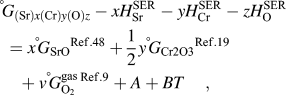
where v = 0.75, 0, 7/6, and 0.25 for SrCrO4, SrCr2O4, Sr2.67Cr2O8, and Sr2CrO4, respectively.  is the standard enthalpy of the stable state of element a at 298.15 K and 105 Pa.Reference Risold, Hallstedt and Gauckler50
B. Modeling of the perovskite phase
It is essential for a consistent description of the perovskite phase that defects that occur in the structure in low-order systems remain on the same sites at the extension to higher order; this is achieved by using the same model. We adopt the description (A, Va)(B, Va)(O−2, Va)3 with A, B = cations, and Va = vacanciesReference Grundy, Chen, Hallstedt and Gauckler23, Reference Grundy, Hallstedt and Gauckler24 using the CEFReference Hillert12 and the concept of reciprocal reactions described in Sec. I. B. 3. The molar Gibbs energy of the perovskite phase then reads
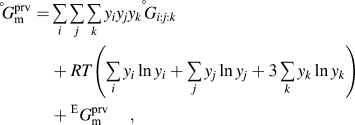
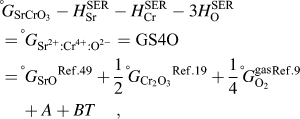
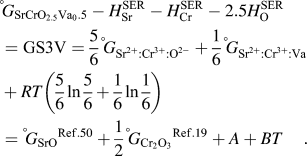
where yi is the site fraction of each cation and Va on the A-sublattice, yj is the site fraction of each cation and Va on the B-sublattice, and yk is the site fraction of O2− and Va on the anion sublattice. R = 8.31451 J/(mol K). The second last term accounts for the configurational entropy of mixing. The last term describes the excess Gibbs energy of mixing. It can be accounted for by introducing interaction parameters. The parameters of the CEF are the Gibbs energies of the end-member compounds  . Typical compositions of LSMs used for SOFC cathodes, e.g., La0.8Sr0.2MnO3−δ are rhombohedral at SOFC operating temperatures (1073–1273 K), and small amounts of Cr brought into the cathode unlikely lead to a change of the structure. Thus, to meet applicability of the database, it is reliable to take the Gibbs energies of the compounds of rhombohedral perovskite from Ref. Reference Povoden, Chen, Grundy, Ivas and Gauckler20 for the model. By doing so, we realized that the original temperature-dependent terms of GS4O and GS3V stabilize SrCrO3 perovskite at high temperatures. This problem is solved with modified parameters listed in the supplement LSCM_v1.0.tcm.
1. La1−xSrxCrO3−δ perovskite
Using the above model and the proposed defect chemistry,Reference Cheng and Navrotsky43–Reference Hilpert, Steinbrech, Boroomand, Wessel, Meschke, Zuev, Teller, Nickel and Singheiser45 the sublattice formula for La1−xSrxCrO3−δ reads (La3+, Sr2+, Va)(Cr3+, Cr4+, Va)(O2−, Va)3. The molar Gibbs energy  of La1−xSrxCrO3−δ is uniquely defined as follows: °Gs of the end-members (La3+)(Cr3+)(O2−)3, (La3+)(Cr3+)(Va)3, (La3+)(Va)(O2−)3, (La3+)(Va)(Va)3, (Sr2+)(Va)(O2−)3, (Sr2+)(Va)(Va)3, (Va)(Va)(O2−)3, and (Va)(Va)(Va)3 and ternary interaction parameters are adopted,Reference Povoden, Chen, Grundy, Ivas and Gauckler20, Reference Grundy, Hallstedt and Gauckler24, Reference Sundman52 °G(Sr2+)(Cr4+)(Va)3
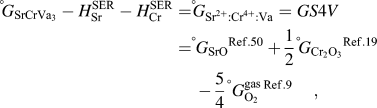
is chosen as reference, and °G of two neutral compounds read
2. LaMn1−xCrxO3−δ perovskite
Though structure–chemical information of site occupancies in LaMn1−xCrxO3−δ perovskite is missing, it is reliable to allow Cr4+ on the B-site: since Cr4+ exists in nonstoichiometric lanthanum chromite perovskite,Reference Povoden, Chen, Grundy, Ivas and Gauckler20 it is expected that it is not removed from the structure if the phase is doped. Thus, for LaMn1−xCrxO3−δ, we propose the sublattice formula (La3+, Va)(Mn2+, Mn3+, Mn4+, Cr3+, Cr4+, Va)(O2−, Va)3.
3. Modeling of Cr4+ in LSCM perovskite
The sublattice formula of the quinary perovskite reads (La3+, Sr2+, Va)(Mn2+, Mn3+, Mn4+, Cr3+, Cr4+, Va)(O2−, Va)3. All end-members have been defined in the assessed subsystems.
To approximate the absence of Cr4+,Reference Plint, Connor, Tao and Irvine48 it would be necessary to give large positive values to the regular [i.e., independent of x(Cr) and x(Mn) in LSCM] interaction parameters 0L(Sr2+:Cr3+, Mn3+:O2−) and 0L(Sr2+:Cr4+, Mn3+:O2−). Experimentally determined nonstoichiometry of LaCrO3 indicates the existence of some Cr4+, and the conclusion of missing Cr4+ (Ref. Reference Komatsu, Chiba, Arai and Sato49) is not based on a direct chemical analysis of Cr valencies. We believe that complete removal of Cr4+ from the perovskite structure is unlikely. Thus, we stick to a model without interaction parameters. Experimental findingsReference Filonova, Demina and Petrov16, Reference Plint, Connor, Tao and Irvine48 are in line with our calculations.
IV. OPTIMIZATION RESULTS AND DISCUSSION
The assessed Gibbs energies of the La–Sr–Cr–Mn–O oxide database, LSCM_v1.0, are laid open in the supplement to this paper.
A. Parameterization of thermodynamic parameters of the Sr–Cr–O oxide system
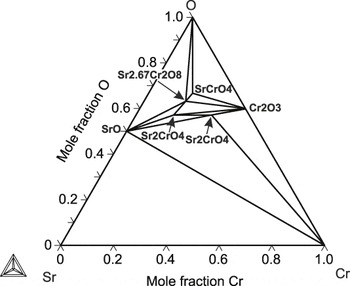
A and B of Eq. (9) are adjustable parameters; their optimization with the following experimental phase diagram and thermodynamic data using the PARROT module of the ThermoCalc softwareReference Filonova, Demina and Petrov16 resulted in the lowest error between model and experiments: Gibbs energies of formation of SrCrO4Reference Jacob and Abraham31, Reference Maruyama, Inoue and Akashi32 and phase stabilities of SrCr2O4 and Sr2CrO4 investigated by equilibration experiments of different mixed oxide compositions under controlled atmospheresReference Jacob and Abraham31 and the equilibrium Sr2.67Cr2O8 + SrCrO4 + Cr2O3 as a function of temperature and oxygen partial pressure.Reference Jacob and Abraham31, Reference Maruyama, Inoue and Akashi32 The reported subsolidus phase equilibriaReference Jacob and Abraham31 are correctly reproduced by the model, as shown in Fig. 2.
Calculated isothermal Sr–Cr–O section at 1250 K. The same three-phase equilibria are predicted as experimentally observed.Reference Jacob and Abraham31

Since both experimental thermodynamic and phase diagram data are available for the optimization of Sr–Cr–O oxide SrCrO4 and Sr2.67Cr2O8 descriptions, we believe that the predicted thermodynamics is close to the real situation. However, to confirm the quality of the modeling, further experimental work, in particular calorimetry, would be beneficial to directly obtain enthalpy data of Sr–Cr–O oxide phases. Also, differential scanning calorimetry is suggested to testify their thermal stabilities. SrCr2O4 and Sr2CrO4, which are stable under reducing conditions, are solely optimized by experimental phase diagram data. Thus, their descriptions are considered tentative, as long as no experimental thermodynamic data are available.
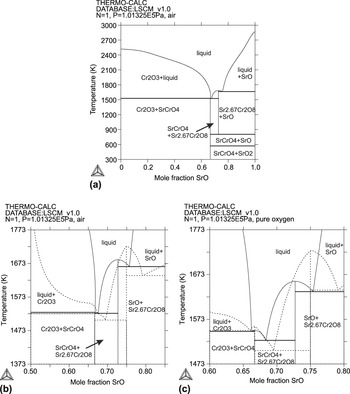
Our modeling predicts the high temperature phase equilibria that include the liquid phase, proposed by Negas and Roth,Reference Negas and Roth37 not exactly. This becomes evident in Fig. 3, showing the calculated SrO–Cr2O3 in air atmosphere (a), in comparison with experiments (b), and in oxygen (c) with experimental data included. Since Negas and RothReference Negas and Roth37 report hydroxide formation in the humid air atmosphere during their experiments, it is rather sensible not to overvalue their results for the parameter optimization of water-free SrO–Cr2O3. A better reproduction of the experimental phase equilibria proposed by Negas and Roth,Reference Negas and Roth37 by manipulating the model parameters of solid oxides, will lead to a worse reproduction of both the newer thermodynamic and phase diagram data.Reference Jacob and Abraham31, Reference Maruyama, Inoue and Akashi32 On the other hand, the chosen liquid description allows at least for qualitative reproduction of experimental phase equilibria.
SrO–Cr2O3 system calculated (solid lines) in air atmosphere (a), and region of intermetallic phases in air (b) and oxygen (c) with experimental data (dashed lines)Reference Negas and Roth37 included.

A specific feature of this system is the deep eutectic at 70 mol% SrO and the rather flat liquidus curves toward high Cr2O3 and SrO values, respectively. The ionic liquid modelReference Hillert, Jansson, Sundman and Ågren51, Reference Sundman52 has been used for the liquid description. Strategies of liquid modeling are discussed in detail in the assessments of binary subsystems.Reference Grundy, Hallstedt and Gauckler17, Reference Povoden, Grundy and Gauckler19, Reference Risold, Hallstedt and Gauckler50 The experimental liquidus course indicates strong deviation from ideal mixing, which requires a complex model description. In addition to end-member ionic species, in the current liquid description of SrO–Cr2O3, intermediate liquid associatesReference Hastie and Bonnell53, Reference Bonnell and Hastie54 are necessary. The neutral associate SrCrO4 is chosen to simulate Cr6+ in the liquid, and SrCrO3 reflects the existence of Cr4+. Temperature dependence of interaction parameters is neglected since this makes them less controllable in terms of their extensions to high orders. For instance, the liquid phase might appear at low temperatures, or artificial miscibility gaps may occur. For the time being, we make do with a qualitative liquidus reproduction, as the liquid phase, being not essential for production and working temperatures of SOFC, is not a focus of this study. The modified quasichemical model,Reference Pelton and Chartrand55 allowing for short-range order in the liquid description, will potentially improve the reproduction of the experimental liquidus.
B. Perovskite—parameterization of thermodynamic model parameters
1. La1−xSrxCrO3−δ
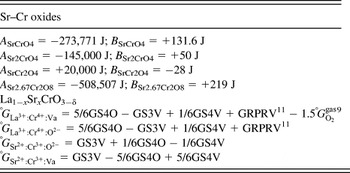
A and B parameters of the neutral perovskite compounds GS4O and GS3V from Eqs. (12) and (13), respectively, are optimized with all available experimental data of the perovskite phase. Eq. (12) denotes °G (Sr2+)(Cr4+)(O2−)3, with A = +30,800 and B = −40. A = +140, 300 and B = −67 for  in Eq. (13). °Gs of the remaining end-members (La3+)(Cr4+)(Va)3, (La3+)(Cr4+)(O2−)3, (Sr2+)(Cr3+)(O2−)3, and (Sr2+)(Cr3+)(Va)3 are obtained by conversions of reciprocal equations that are set zeroReference Grundy, Chen, Hallstedt and Gauckler23 and are listed in Table I. The solution of Sr in La1−xSrxCrO3−δ is adjusted by negative interaction energies of Sr2+ and La3+ in the first sublattice.
Optimized model parameters.

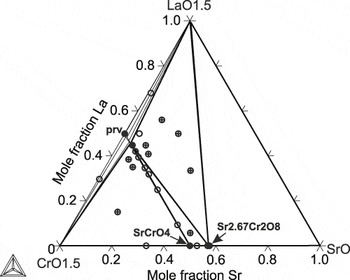
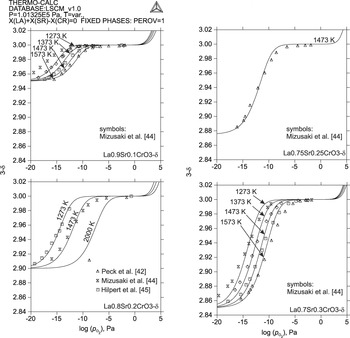
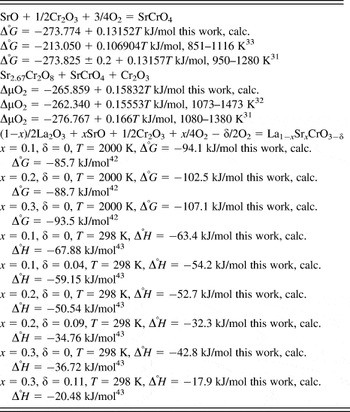
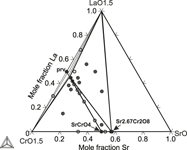
The reproduction of experimentally determined Gibbs energiesReference Peck, Miller and Hilpert42 and enthalpies of formation,Reference Cheng and Navrotsky43 solid solubilities,Reference Peck, Miller and Hilpert38, Reference Miyoshi, Onuma, Kaimai, Matsumoto, Yashiro, Kawada, Mizusaki and Yokokawa40 and nonstoichiometriesReference Mizusaki, Yamauchi, Fueki and Ishikawa44, Reference Hilpert, Steinbrech, Boroomand, Wessel, Meschke, Zuev, Teller, Nickel and Singheiser45 of La1−xSrxCrO3−δ as well as phase equilibria in the La–Sr–Cr–O oxide system by the modeling is satisfying as shown in Table II and in Figs. 4 and 5. Due to the availability of various types of experimental data, which can be used for the parameter optimization, the model description in principle appears reliable. Experimental phase equilibria of the experimental isothermal section at 1223 K are reproduced by the model. Potential improvement of the modeling will become accessible, when also the extension of calculated phase equilibria toward higher temperatures can be based on experimental phase equilibria.
LaO1.5–SrO–CrO1.5 system calculated at 1223 K in air atmosphere (solid lines) with experimental dataReference Peck, Miller and Hilpert38 included (symbols). prv = La1−xSrxCrO3−δ. Calculated phase equilibria are the same as in Ref. Reference Peck, Miller and Hilpert38. Filled circles, blank circles, and circles with crosses denote single-phase, two-phase, and three-phase equilibria. Thin lines (conodes) connect phase compositions of two coexisting equilibrium phases.

Calculated (lines) and experimental (symbols)Reference Mizusaki, Yamauchi, Fueki and Ishikawa44, Reference Hilpert, Steinbrech, Boroomand, Wessel, Meschke, Zuev, Teller, Nickel and Singheiser45 nonstoichiometries of La1−xSrxCrO3−δ at different temperatures for x = 0.1, 0.2, 0.25, and 0.3 as a function of oxygen partial pressure.

Calculated and experimental thermodynamic data.

The error between calculated and experimental molar enthalpies of the perovskite phase is in general less than 10%. The higher difference of approximately 20% between calculated and experimental Gibbs energies is likely due to more error sources of the experimental gas phase equilibria method used. Calculated oxygen nonstoichiomteries at different Sr contents in perovskite are in principle closest to the experiments at higher temperatures from 1473 to 1573 K and oxygen partial pressures below 10−5 Pa. The best agreement is obtained with the newer experimental data from Hilpert et al.Reference Hilpert, Steinbrech, Boroomand, Wessel, Meschke, Zuev, Teller, Nickel and Singheiser45
2. LaMn1−xCrxO3−δ
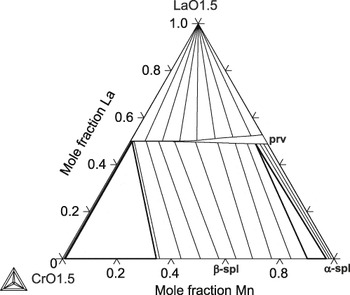
All end-member compounds of LaMn1−xCrxO3−δ have been defined in the assessed subsystems. The interaction parameter 0L(La3+:Cr3+, Mn3+:O2−) accounting for interaction energies between Cr and Mn cations is fitted to experimental nonstoichiometriesReference Morales and Caneiro47; 0L(La3+:Cr3+, Mn3+:O2−) = +8500 J. The calculated isothermal section of the La–Mn–Cr–O oxide system at 1273 K in air is presented in Fig. 6.
LaO1.5–MnOx–CrO1.5 system calculated at 1273 K in air atmosphere. α-spl = tetragonally distorted Cr–Mn–spinel, β-spl = cubic Cr–Mn–spinel, prv = LaMn1−xCrxO3−δ. Thin lines (conodes) connect phase compositions of two coexisting equilibrium phases.

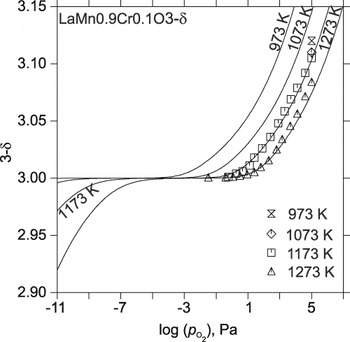
Currently, the calculated La–Cr–Mn–O oxide phase diagram is supported only by a single experimental information on complete solid solution of the perovskite phase from LaCrO3 to LaMnO3. Thus, there will be considerable potential of evaluation and refinement of model parameters, when further experimental work on phase equilibria at different temperatures is performed. In the context of SOFC research, a detailed investigation of the stability limits of the perovskite stability will be beneficial. As shown in Fig. 7, the calculated nonstoichiometries of La1−xSrxCrO3−δ are in good agreement with the experimental values at higher temperatures, the difference being smaller at lower oxygen partial pressures.
Calculated (lines) and experimental (symbols)Reference Morales and Caneiro47 nonstoichiometries of LaMn0.9Cr0.1O3−δ at different temperatures as a function of oxygen partial pressure.

However, it was not possible to better reproduce the nonstoichiometries at 1073 and 973 K by any combinations of interaction parameters that can influence the oxygen nonstoichiometry. The gross difference between the measured thermal evolution of oxygen nonstoichiometry from 1173 to 1073 K in comparison to the change of δ from 1273 to 1173 K is not intuitive. Thus, we believe that the experimental increase of δ from 1173 to 1073 K might be too small, possibly caused by equilibration difficulties due to slow diffusion at these lower temperatures.
C. Structural and magnetic transitions of perovskite
Magnetic and structural transitions of La1−xSrxCrO3−δ,Reference Khattak and Cox56–Reference Matsunaga, Kawaji, Atake, Takahashi and Hashimoto62 LaMn1−xCrxO3−δ,Reference Cabeza, Long, Bari, Muirhead, Francesconi and Greaves63–Reference Hrovat, Bernik, Holc, Kuscer and Kolar67 and La1−xSrxMn1−yCryO3−δReference Filonova, Demina and Petrov16, Reference Kallel, Dhahri, Zemni, Dhahri, Oumezzine, Ghedira and Vincent68 were reported. Transitions of LaMn1−xCrxO3−δ are complex as they depend on temperature, composition, and oxygen partial pressure. Consistency among transition data for La1−xSrxCrO3−δ and LaMn1−xCrxO3−δ prevails, whereas diversities exist regarding the transitions in La1−xSrxMn1−yCryO3−δ. Thus, in terms of the applicability of the new database for SOFC, the authors omit structural transitions in the modeling. Even though magnetic transitions have been reproduced by an ordering modelReference Inden69, Reference Hillert and Jarl70 in the case of LaCrO3,Reference Povoden, Chen, Grundy, Ivas and Gauckler20 we did not obtain satisfying results in higher-order perovskites, most likely due to more complex interactions that cannot be sufficiently described by the model. Since the magnetic transitions are low temperature features, their modeling was omitted without consequences for the applicability of the database for SOFC.
V. SUMMARY
The thermodynamic La–Sr–Mn–Cr–O oxide database has been obtained by combining thermodynamic assessments of oxide subsystems. We propose the model (La3+, Sr2+, Va)(Mn2+, Mn3+, Mn4+, Cr3+, Cr4+, Va)(O2−, Va)3 for the complex perovskite phase. Optimized by experiments in pseudoternary and pseudoquaternary oxide subsystems, this model allows the quantitative calculation of defects as a function of composition, temperature, and oxygen partial pressure. Refinement of the presented Gibbs energy functions can be obtained when further experimental data are provided, in particular, the experimental validation of the stability limits of single-phase La–Cr–Mn perovskite. Since the modeling is sufficiently supported by thermodynamic and qualitative phase diagram data at working temperatures of conventional SOFC, the new database is considered to be of practical value for computations of phase equilibria and defect chemistry in traditional LSM SOFC cathode poisoned by chromium. Thus, in terms of the endurability of traditional SOFC, one can learn about the evolution of phases in Cr-contaminated LSM in an oxygen partial pressure gradient at SOFC working temperatures. Care was taken that the modeling of the perovskite phase is consistent with other assessments of perovskite-containing systems with relevance for SOFC, and the database can thus, to better understand the thermodynamics of noble symmetric SOFC configurations, be further extended without restatement of model descriptions.