Introduction
Two simultaneous trends in European agriculture currently affect the development of farms: intensification into larger farms in plain areas and small farms in marginal areas going out of production. Intensification has been achieved through increased specialization, mechanization and industrialization of production. To support this transformation, the use of external inputs such as synthetic fertilizers and pesticides has increased. Intensification has increased yields substantially since the 1950s, but industrial farming has also had negative impacts on landscape heterogeneity, wild and on-farm biodiversity and local communities (e.g.Reference Björklund, Limburg and Rydberg1–Reference Lobao and Stofferahn4). In other areas, concurrently, ecosystems and communities are negatively affected by the loss of farm production, i.e., increased number of farms that reduce their level of activity to the degree that fields are left unmanaged, animals disappear from the landscape and ultimately farms are closed down as production unitsReference Kumm5. In Sweden, areas of farm loss can be found in all areas dominated by forests. These regions used to be characterized by dairy production. However, since the 1980s the number of dairy farms in Sweden has decreased by 80%, the number of dairy cows has decreased by 44%, but the production of milk has only seen a 10% reduction6, 7. Due to changes in technology and animal material, each cow now produces 40% more milk. During the same time period, the average herd size increased from 15 to 52 cows. This trend can be found in all types of agricultural production in Sweden. While small to middle-sized farms in forest-dominated areas either reduce farming activities or close down, farms in lowland areas suitable for arable farming become fewer and larger6. Both these processes influence wild biodiversity in mainly negative ways. Since semi-natural grasslands are one of the most biodiversity rich habitats, forestation of these areas decreases biodiversityReference Benton, Vickery and Wilson8. Similarly, farms with large herds of dairy cows are not able to use semi-natural grasslands properly since some of them will be situated too far away from the farm center. Instead, cows are fed with imported feed, needed to keep up the high production of milk.
In Sweden, as in other countries in the European Union (EU), agriculture is supported by different subsidies, including direct payments, agri-environmental schemes and other payments in the rural development program. Despite this support that Swedish farmers have been eligible to receive since accession into the EU in 1995, farms continue to close down due to low economic viability in areas dominated by forests.
It is widely accepted that agricultural production activities in crops and livestock bring with them a number of functions that are beneficial for rural communities and society at large9. For example, agriculture plays an important role for rural tourism because the diversity of natural habitats and the scenic beauty of rural landscapes are closely related to the type and intensity of land useReference van der Ploeg, Renting, Brunori, Knickel, Mannion, Marsden, de Roest, Sevilla-Guzmán and Ventura10. Large-scale cereal farming is less suited for the management of a mosaic landscape, where fields are small and scattered, or where large forests separate the open areas of agricultural landReference Stenseke11. It is in these mosaic landscapes with multiple ecotones that most biodiversity can be foundReference Benton, Vickery and Wilson8, Reference Rundlöf, Nilsson and Smith12. In addition, environmental sustainability also benefits rural communitiesReference Flora2, Reference Brodt, Feenstra, Kozloff, Klonsky and Tourte13. For example, sustainable farming methods tend to require more locally produced inputs and services, which increases local trade and support businesses within communitiesReference Brodt, Feenstra, Kozloff, Klonsky and Tourte13. Thus, as farms become more extensive or close down, a number of functions other than food production are also lost.
These several trends, together with the depopulation of rural areas, loss of human services and infrastructure, such as schools, shops, medical facilities and post offices, have given many people in rural areas a general feeling of being left out in the development of mainstream society. A combination of factors has induced groups of rural residents to take action and form village action groups in Sweden and other countriesReference Halhead14. These groups consist of people who want to develop their local communities with projects that range from saving the local school to inspiring farmers to produce and sell products locally. Many of these groups in Sweden are concerned about the loss of farms, because they see a direct link between the development of agriculture and their local communities.
The objectives of the research presented in this paper were to explore what functions farms have for the villages they are situated in, as well as how village action groups can support farms in sustaining these functions. Using cases from four rural areas in Sweden, we explore the research questions of how the loss of active farm production affects the rural communities in which the farms are located and what rural inhabitants do to counter this trend. We do this by taking a closer look at the functions farms and farmers provide to rural communities and landscapes in areas where farms and farmers are decreasing in numbers. Better understanding of rural change can contribute to improved design of education and other intervention programs that will lead to improved quality of rural life.
Multiple Functions of Agriculture and Rural Development
Agricultural systems are situated within social, economic and political environments that influence how they operate; globalization and low margins in conventional agriculture are among the most important factors that appear to require increased scale and efficiencyReference Archer, Dawson, Kreuter, Hendrickson and Halloran15. As a result, the relative economic importance of agriculture in many countries is on the decline and the rural sector is no longer the monopoly of farmersReference van der Ploeg, Renting, Brunori, Knickel, Mannion, Marsden, de Roest, Sevilla-Guzmán and Ventura10. Indeed, in many rural regions, agriculture is no longer neither the main user of labor nor the main source of regional incomeReference Vos and Meekes16. Intensification in plain areas and loss of small farm agriculture in forest-dominated areas both result in transformed landscapesReference Vos and Meekes16. The countryside is also economically and socially transformed by resource flows arising from amenity-based consumptionReference Slee17.
However, it is widely recognized that European agriculture has the capacity to produce a broad range of so-called public goodsReference van der Ploeg, Renting, Brunori, Knickel, Mannion, Marsden, de Roest, Sevilla-Guzmán and Ventura10. Much of the beauty and biodiversity of landscapes in Europe depend on the continuation of active farmingReference Dobbs and Pretty18 where human interaction is indispensableReference Stenseke11. For example, acceptable economic returns from agriculture with animal husbandry are vital for the continuing management of the biodiversity-rich, semi-natural grasslandsReference Stenseke11.
More than any other rural activity, farming has the capacity to play a vital role in rural developmentReference Knickel and Renting19. The current neo-conventional agro-industrial logic, which defines rural areas as intensive production space, has driven many farmers into a dead end in terms of economic return and social life, as well as caused environmental loadingReference Marsden and Sonnino20. Yet there are other models of rural development where farming can have a central role in achieving rural sustainability goals (cf.Reference Marsden and Sonnino20). This central role for enhancing sustainable rural development can be realized if farms are defined as potential multifunctional rural enterprises serving a variety of marketsReference Marsden, Banks and Bristow21. From a contemporary perspective, all farms were multifunctional in their organization a century ago, because they were designed to serve a multitude of purposes for the farm family and the rural communityReference Noe, Fjelsted Alroe and Langvad22.
Multifunctionality describes farming systems that meet multiple needs of the family as well as providing ecosystem servicesReference Noe, Fjelsted Alroe and Langvad22. The concept provides perspective as a tool for focusing not only on the negative side effects of farming, which are often emphasized in the sustainability debate, but also on the positive effects that we want farming to have for rural areas and society at large9, Reference Noe, Fjelsted Alroe and Langvad22. Multifunctionality suggests that agriculture can deliver valued functions that cannot be produced by other economic sectorsReference Dobbs and Pretty18. Among the positive side effects of farming are aesthetic values, recreation, water accumulation and storage, nutrient cycling and fixation, wildlife habitat, storm protection and flood control. In other words, agriculture produces and supports a number of vital ecosystem services on which humanity depends (cf.Reference Daily23–Reference Raudsepp-Hearne, Peterson and Bennett26). Ecosystem services are the benefits people obtain from ecosystems25. There are research initiatives to recognize the value of such ecosystem services, which are not normally rewarded by the current economic systemReference Brown27.
WilsonReference Wilson28 argues that expressions of multifunctionality are most important at the farm level because they lead to tangible effects in the farmed landscape, catalyze crucial farm–community interactions and improve the quality of local production. According to WilsonReference Wilson28, strong and viable multifunctional farms are both embedded in, and also shape, the local and regional landscapes and contribute to environmental sustainability. In addition, multifunctional farms display low production intensity and put less pressure on scarce natural resourcesReference Raudsepp-Hearne, Peterson and Bennett26. However, farms do not necessarily stay at the same level of multifunctionality. When changes take place such as fewer or more employees, changes at the field and farm levels, or intensifying pressures due to external circumstances, farmers need to adapt; this may influence the multifunctionality of the farmReference Brown27. Thus, the complexity of multiple functions is dynamic and not all farms have or maintain the same level of diversity of structure and function over time.
Multifunctionality also implies legitimizing non-market goods and services in planning and policyReference Wolf29, and designing strategies that will lead to greater economic recognition of the importance of multiple services. The concept of multifunctionality has thus been used in various international negotiations to legitimize public support to agricultureReference Dufour, Mauz, Rémy, Bernard, Dobremez, Havet, Pauthenet, Pluvinage and Tchakérian30. Since the European Commission committed to multifunctionality in 1996Reference Gorman, Mannion, Kinsella and Bogue31, multifunctional agriculture has been part of the European model of agricultureReference Potter and Burney32. As a result, some actors in the US agricultural industry have viewed multifunctionality as a protectionist measure to continue EU subsidies under the guise of environmental protectionReference Dobbs and Pretty18. However, the normative view of multifunctionality, which is assumed in this paper, suggests that the concept should not be seen as a term appropriated by European policy-makers to defend farm subsidies, but as a process for explaining what is happening at the farm levelReference Holmes33.
Swedish Context
The rural development dynamic has its roots among the bottom-up initiatives associated with the empowerment of ‘peripheral’ rural communitiesReference Marsden, Banks and Bristow21. The village action movement in Sweden arose, as in some other Scandinavian and European countries, as a response to the rapidly changing economic and social circumstances in rural areasReference Halhead14. The main effects of change include: increasing urbanization and centralization, decline of agriculture, decline of rural services, depopulation of rural areas, regional inequalities, isolation of rural communities and the need for a stronger political voice in non-urban communitiesReference Halhead34. Successful rural development often relies on the positive interactions among and sustained commitment of small groups of individualsReference McAreavey35. The first village action groups were formed in Sweden in the 1970s. In 1989, the existing village action groups joined together under the umbrella of the Swedish Popular Movements Council for Rural Development. There are currently some 4700 village action groups in Sweden36. There is no clear definition of village action groups, more than that these groups work to promote local development. They should be open to all and work publicly; they are appointed locally and arrive at decisions in a democratic way. Groups can look very differently. For example, while some focus on developing local tourist attractions, others may find sustaining cultural heritage or a specific landscape type more important. Some groups manage to attract funding for their activities while other groups do not. In short, groups are formed by committed individuals and focus on the activities found important by those active in the group. Thus, in some groups, local farmers are members, while in other contexts farmers find it more useful to take part in local farmer association groups. However, all inhabitants in a village are considered members of the local village action group. Groups operate in a district—the village or the parish—as defined by the inhabitants themselves36. In the village action groups referred to in this paper, some of the interviewed farmers were active members of the groups. In most cases, however, farmers knew about the village action group but did not actively participate.
Farmers and village action groups are entitled to apply for subsidies from the EU. Individual farmers can apply for direct payments, such as payment per hectare of arable land or pastures, and for environmental supports, such as payments for delivering services or functions that are wanted from society. Furthermore, new farmers can apply for start-up grants and all farmers can apply for investment grants. Farmers and local people can together apply for project support, for example, projects that support several stakeholders such as a community kitchen for processing of local products into locally branded products or a cooperative sales outlet. However, the largest part of the EU subsidy budget is allocated first to direct payments and second to agri-environmental schemes. These support programs enhance the economic viability and encourage multifunctional activities in communities that are embedded in rural landscapes.
Methods
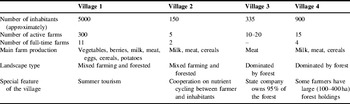
Four rural areas in Sweden (Table 1) were selected from a larger rural ‘Sustainable Villages’ development project that included 14 pilot areas. The project ‘Sustainable Villages’ was carried out by the Village Action Movement in Sweden 2003–2006 and was funded by the Swedish Rural Development Program. Each participating village action group obtained funds for a project leader. The aim was to show a diversity of sustainable rural development in less-favored areas in relation to natural resource management. The study areas were chosen in places where a village action group was working actively with issues of farming. A geographic spread was also a goal. The villages are spread out in the middle and south of Sweden. The aim was not to represent all of Sweden, but rather to illustrate the potential emergence of a rich picture of multifunctionality in rural Sweden. In each area, the active members of the village action groups consisted of 5–10 people. In most cases, these were middle-aged or retired people. There was a mix of people who had lived in the villages all their lives and people who had settled there. In all groups, at least one farmer was active. In addition, local shop owners, retired extension agents, foresters and people with a special interest in, e.g., cultural heritage, tourism or just a commitment for the village were represented. Despite the limited number of active members, a broad range of competencies was represented as well as a historical depth concerning the village. However, the young generation was missing, which the groups were aware of.
Description of the villages in the study.

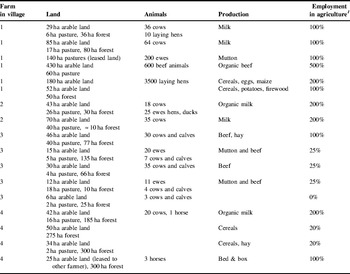
In all study areas most people commuted to nearby towns to work. In addition, the economic viability of agriculture was low in most cases. Many of the farmers running small and medium-sized units did not particularly aim at maximizing yields, but were more interested in finding time- and cost-saving solutions for the farming system which would make it possible for them to continue farming (cf.Reference Stenseke11). The farms in the four areas were diverse, both in their production and size. The typical farm had between 10 and 30 ha arable land. Vegetable and cereal production, as well as egg, meat and milk production, could be found (Table 1). However, the main trend was that farms in the areas had gone from dairy farming to suckler cow rearing and from full-time farming to part-time farming. The farmers who were interviewed in this study were also diverse (Table 2). In addition to differences in size, production and how many people the farm could support financially, both female and male farmers were represented, as well as farmers in their early 20s up to late 60s. The majority of the farmers were born on the farm or in the same area. Only two had settled in the area as grown-ups.
Description of the farms in the study.

1 One full-time employed person=100%.
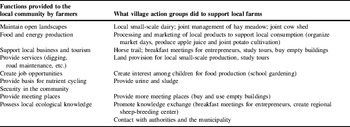
This was an explorative study. The aim was to better understand what functions local agriculture had for the villages, and how village action groups supported the viability of agriculture. These issues were explored through workshops with village action groups and interviews with farmers. A one-day workshop with active members of the local village action group was carried out using participatory toolsReference Pretty, Guijt, Thompson and Scoones37 where we focused on the economic, social and ecological links between local farms and the rural community. The purpose was for the researchers to get to know the village, start discussing the functions of agriculture for the village, as well as the activities of the village action group. Participants were asked to draw a map of their village. In doing this, we discussed the borders of the village, and what important features the village had, as well as the activities of the village action group. Further, workshop participants were asked to discuss influences on the village from the outside world. Another exercise was to brainstorm all functions agriculture had in the village. Finally, the village action group members were asked to draw up a joint vision for the village 20 years from now. In total, 26 members of village action groups participated in the four workshops. The sample of interviewed farmers was purposiveReference Kvale38. In order to find farmers to interview, village action groups were asked to recommend farmers. In village 1, with a large number of active farms, we got a list of full-time and ‘almost full-time’ farmers from one knowledgeable person in the village action group. From this list, we then selected as diverse farms as possible concerning age, gender, production, size and location. In the other villages we got comprehensive lists from the village action groups of active farms in the area and selected farmers to approach. Four to seven farmers were interviewed in each community, using semi-structured interviewsReference Kvale38. In total, 17 farms were visited (Table 2). The farmers were asked about their role in their rural area, how this role had changed over the years and what they anticipated their role would be in the future. They were also asked about the possibilities for further developing their farms and the obstacles they saw for this development. The aim of interviews and workshops was thus to create a rich picture of current and possible future functions farms could have for the benefit of the rural community. All interviews were taped and transcribed. The narrative data collected were thematically analyzed on their content, focusing on the functions of the farm, the contribution of the farm to rural development and how the village action group could support the farmersReference Miles and Huberman39. Data on the economic situation of the farm were collected as well as data on production and material flows. All areas were visited twice. The second time, the researchers presented preliminary results from the workshop and interviews and invited farmers, village action groups and other interested local citizens to comment and help adjust the findings. In total, these seminars attracted 47 participants. The process was designed to assess the current and potential future multifunctionality of each area. The themes that emerged in the workshops and interviews are summarized in Table 3.
Functions provided to the local community by farmers according to farmers and village action groups, and actions taken by village action groups to support local farms.

Results
The farmers and the participants in the village action groups mentioned similar services and functions that the farms and agriculture delivered to the local community, even if they were partly described in different terms by farmers and village action groups (Table 3). Since the village action groups considered the sustaining of farming in the villages to be important, they organized activities in order to support local farms in different ways (Table 3). The services that were brought up were ecological, economic and social; some are paid and some are not paid.
Maintain open landscapes
Both farmers and village action groups considered maintaining an open agricultural landscape as the most important function of local farms. All four villages were situated in forested areas where the agricultural fields were scarce and the forest dominated. Forests were important for income and livelihoods but there was also a threat from the forest ‘taking over’ the landscape as farms were closed down or used less actively. A farmer who managed several farms in one of the villages expressed:
Much of the land I manage would be forested. Four of the farms I use would be forest unless I managed them. All places would be planted [with trees], that's for sure. So in that way … in order for the landscape to be open, maybe I'm needed.
Farmers mentioned the maintenance of an open landscape as important for two reasons. First, they acknowledged that other rural residents enjoyed living in an open landscape. Second, they themselves appreciated an open mosaic landscape. The open landscape represented a managed landscape conveying the works of many generations of farmers, i.e., the open landscape was open in both a spatial and a temporal sense. Farmers performed traditional agricultural work and a farm may have been active for generations. In this sense, farms represented and maintained cultural heritage. Further, some farmers had historically valuable remnants in fields and forests, such as stonewalls, old buildings, ruins or graves from earlier centuries or millennia. This cultural heritage was visible due to the management system of farmers. For example:
…and there's a stonewall … and these old house ruins and all and barns out in the forest, where the fields used to be. And you can see them because I use the forest for grazing.
The open landscape was also seen as a prerequisite for other activities in the area, such as tourism and recreation. The open agricultural landscape was suitable for walks, bicycle trips and bird watching. The managed forest was ideal for berry and mushroom picking, hunting and also for bird watching. A quality in the open landscape that was mentioned in the villages was the prevalence of grazing animals. Both farmers and village action group members reasoned that people feel better when they see grazing animals and that these were a natural part of the agricultural landscape. Grazing was both a social and an ecological service to the villages. Two farmers explained:
And then my cows graze the neighbor village, and so on. And at some more neighbors around here. … There aren't many who have animals around here, they pull at you in spring. They all want animals.
Well, I think it would be boring if the animals disappeared, because animals belong in the country side, I think … it is fun to see, especially during summers. When they graze outdoors, it's sort of, it belongs here.
The open landscape, or rather the threat of losing the open landscape, was a major driver for the work in the village action groups in all villages. An important aim of the groups was to make sure that the remaining farms in the area were viable farm operations that managed and developed the open landscape. In one of the villages (4) where cattle and dairy cows were quickly disappearing from the landscape and many people were interested in local food products, the village action group bought a small mobile milk processing facility and put it in the village center. In this way, small-scale milk producers could rent the facility and process their milk into cheese, which they sold locally. In this village action group, a part-time farmer was a leading actor, and so many activities of the group concerned farming activities. A discussion in this village considered whether the village action group should support the building of a cooperatively owned suckler cow shed. While buildings for grazing cows for meat production were expensive for each individual farmer, a common cowshed could decrease costs, increase efficiency and reclaim some of the previously grazed land in the village. Another village action group (2) managed a hay meadow together with a farmer. This helped the maintenance of a species-rich meadow, but was also a social occasion and an opportunity to revitalize and maintain knowledge on farming for the rural residents. This village action group was highly influenced by one of the participating farming families, which offered their land and knowledge to a number of activities for the benefit of the village.
Food and energy production
The production of food created the open landscapes. Production of food and fibers provided an income, albeit small in many cases, for all farms in the study. However, the production and processing of food on the one hand, and the consumption of food on the other, were mainly occurring at different scales. For example, animals were transported and slaughtered far away from the farm and later sold in stores as anonymous meat cuts. The majority of the farms with animals sold their products to large-scale processors, and in these cases farm products were not a direct contribution to the food consumption in the village but to the Swedish food system overall. This may be the reason why only one farmer mentioned food production as a service to the village. This farmer sold products directly to consumers in the village. However, six out of 17 interviewed farmers, and in all four villages, sold products directly to consumers at their farm or through deliveries. These products included eggs, meat, milk and vegetables. In most cases, these sales provided an important income source for the farmers. We can only speculate on why these farmers did not mention food production as a service to their communities. One reason may be that food production is so self-evident for farmers that they ‘forget’ about it. Another reason may be the way the interviews were laid out to focus on additional services and functions to the local community.
Three of the farms were certified organic. Two sold milk and milk products (such as cheese and cheese cake) and one farm produced beef (Table 2). In the case of village 1, the farms that sold directly to local consumers did not experience that consumers demanded organic quality. These consumers were happy to pay for the added value of local production. For the farms in village 3, organic certification was not an option since they were economically weak and produced beef (mainly) to sustain landscape values. For an organic certification to pay, production and farms would have had to be larger. In village 4, farmers with cereal production lived from the forest and farmed arable land in order to maintain the open landscape. Thus, their production was too limited to pay for organic certification. Only in the case of village 2, where one of the farmer couples was the hub of all activities, organic certification was an issue. In this village, nutrient cycling, organic production and low-energy food production were hot issues, supported by committed villagers.
People in the village action groups seemed keen on developing projects that allowed them to ‘taste’ or ‘use’ the landscape, e.g., local dairy products, meat and vegetables. Local products that were unique were also considered important to attract tourists. One village action group (4) collected leftover apples each autumn and made local apple juice that was sold in the village supermarket. Another group (3) organized market days to attract people to the village and to provide local farmers with an opportunity to show off their products. This group was a mix of people who were interested in cultural heritage of the area and people who were working for re-population of the area. Markets days with an old-fashioned touch satisfied both groups. A third group (2) organized joint potato cultivation on the land of the farming family that was the hub for all activities of this group. All village action groups discussed the possibilities to decrease the use of fossil fuels in the local community by converting agricultural products to renewable energy. Another reason village action groups focused on local food production was the awareness that fossil fuels will become more expensive in the future, making long-distance transport of food impossible. For the village action groups, local food production and processing was a way to increase robustness of their communities.
Businesses, services and jobs
An open and living landscape attracted both local dwellers and tourists. The farms and farming activities were perceived to bring life to the landscape. The farmed, mosaic landscape attracted tourists, but the villages needed additional activities and facilities to deepen this attraction. The activities they mentioned were horse or walking trails, bed and breakfast, fishing and selling of local foods with added value. Farmers and the village actions groups discussed the possibilities of processing farm products and selling locally branded items that showed the added value of that specific product, e.g., the production of local cheese (4). In that case local milk was needed, and thus grasslands in the community were grazed and biodiversity enhanced. In addition, local resources such as labor and know-how were also required to run the local dairy.
Farmers also mentioned services they provided, such as pulling cars out of ditches, lending machines to other residents or repairing machines of others, as contributions they made to their villages. Other related activities were rental of summerhouses, digging works or rental of storage buildings. Since farmers normally had a number of machines few other rural residents had, this equipment could also be used for purposes other than farm work, which had both economic and social value for the area and the farmers themselves. One farmer expressed it in this way:
And different kinds of machines that I have; tractors, diggers and all, and there could be someone driving into the ditch and needs a favor, it is there.
Most farms within the villages were small and were thus family farms without employees outside the family. However, indirectly their production created jobs, e.g., in food processing and tourism, and one larger farm with grazing animals employed a handful of people (Table 2). In addition, farmers mentioned the effect their needs for repair and purchases had for local businesses.
All village action groups saw the need to strengthen farming as an entrepreneurial activity. One group (1) organized breakfast meetings for all local entrepreneurs to provide knowledge exchange and networking. The same group organized study tours for local farmers to businesses and farms with innovations such as renewable energy production or on-farm food processing. This village action group consisted of active farmers and retired rural residents with an interest of local development. Thus, many of the activities this group developed were firmly grounded in the farming community. Another group (4) tried to increase interest among schoolchildren for agriculture through a school vegetable garden.
Provide basis for nutrient cycling
One farmer pointed out that her farm was a base for local nutrient cycling. This farm and the village action group (2) had an explicit aim of recycling. The farming family collected human urine and sludge from neighboring residents. The farmer stated:
For the recycling to function you need a farm, and we provided that. Our role is to provide that space.
In all villages the local nutrient cycle was mentioned as an important issue. This included local production, local consumption and local return of compost and sludge. The last part was the hardest to realize and it was found only on the above-mentioned farm in one of the villages.
Security in the community
A farm couple argued that the fact that they were at home during daytime was a service they provided for the village. Since most other residents were in town working or in school, only farmers were in the village to provide help if something happened. In their words:
That there is someone here in the middle of the day. So, I mean, otherwise people go to town to work. It is totally deserted and then the old people, if they fall down and can't get up, we have to go and get them up. Yes, it is a security, that there are people around.
These farmers also mentioned the fact that they were the only ones that had an electricity generator, which was important for security when there was a power failure. All village action groups also mentioned the farms as a stable and secure backbone in the community. The fact that someone was at home during the day but also because of the know-how farmers had. Their ability to perform as a ‘jack-of-all-trades’ and the machinery they possessed created this local security.
Provide meeting places
In two of the interviews farmers said that their farms were meeting places. They mentioned different reasons for this claim. One was that there was a farm shop and rural residents came by to buy food, or a machinery repair service that attracted customers. Examples from the farms in the study included farm gate selling of eggs, milk, handicrafts, firewood, potatoes, hay, manure and meat, as well as rental of machines, child care and study visits. If the farmer was a sociable person, the farm became a meeting place for that reason. Farm buildings, machines and fields were used for social purposes, e.g., sports activities were undertaken in newly mowed fields. One farmer offered land for members of the village action group to grow potatoes, which increased the possibilities for people to come together, meet the farmer and share each other's concerns.
The village action groups mentioned the lack of meeting places as a constraint for community development. Therefore, they had created different kinds of meeting places or incentives to meet. As mentioned before, one village action group (1) organized breakfast meetings with farmers and other entrepreneurs in order to create regular opportunities for exchange of experiences and information. Two of the village action groups (3 and 4) had purchased empty buildings from the municipality and now used them for meetings and social events. This also benefited the farmers, since they could take part in the social life of the village.
Possess local ecological knowledge
The village action groups valued the local and ecological knowledge that farmers held. Farmers were knowledgeable about the area and its history. This gave people a context, which in turn created feelings of community and a sense of placeReference Jackson40. Farming includes work in and with nature and thus farmers had an awareness and knowledge of local agro-ecosystems. This knowledge was often focused on larger landscape and ecosystem scales and less on species knowledge.
One village action group (3) planned to open a regional sheep-breeding center, inviting farmers to share and exchange their knowledge for the benefit of sheep farming in the area. A major concern for this group was to keep viability of farming in the area and to attract new entrepreneurs to the area. Another group (1) made sure farmers’ knowledge was spread during the program of their breakfast meetings mentioned earlier. Some farmers received study visits from schools or other interested groups. This provided income as well as knowledge exchange.
Contact with authorities and the municipality
Farmers and village action groups mentioned the administrative workload as a problem for the development of local products and the establishment of new farms or production units. Some of the farmers felt that the contact with authorities was an obstacle for development, and they did not consider public services or extension agents to be of any significant help. According to some of the farmers, conventional extension agencies emphasized increase of scale as the sole alternative for development. For farmers who wanted to develop in other ways, e.g., diversify or stay small, this was not a viable option. One way village action groups (1, 3 and 4) wanted to support farmers was to be a link to authorities. In the villages there were people working with administration, with authorities or at the municipality level, and thus it was possible to use their knowledge to help farmers or local companies. For example, in order to provide the mobile dairy in one of the villages, more than a year of applications, controls and adjustments were needed before the county administrative board approved it. The village action group (4) did most of this work.
Important reasons village action groups were formed were because the villagers had to fight to save the local school, the fire station or local grocery store. In all cases, the village action groups had managed to become a voice the municipality listened to. The village action groups did not win all their fights, but often they created something else instead. In one case the village action group (3) took over the management of the old school building after the municipality had closed it. The building was used as a community center, offering a kindergarten, meeting place and seminar rooms. In another case the village action group (4) took over the fire station the municipality closed and now managed it with volunteers. Thus, village action groups created conditions for communities to function, benefiting farmers as well as all other rural residents.
Discussion
The focus in this study was on functions from agriculture and what farmers and their managed landscapes provided that were relevant for the local community. These include functions in the social, economic and ecological realms. Social functions are directly beneficial for the local community (meeting places, scenic landscapes and security) and can also enhance the well-being of the farmer. Economic functions are characterized by the fact that the farmer can gain an income from them and that they are beneficial for the rural community as job opportunities or the availability of local foods with identity and added value. Ecological functions are important for the sustainability of agro-ecosystems, and can be important preconditions for recreation, tourism or health.
Functions from agriculture can emerge in three different ways. First, the farmer and farming family produce goods or services depending on their interests, commitments and personalities. For example, a farmer can be more or less inclined to cooperate with others or take more or less interest in natural values and cultural heritage. Second, the farm and farmer give services to the rural community because of farming as an activity and how it maintains the rural character. This includes the production of a certain landscape that would not be there otherwise. Another service is that a person is at home most times of the day and can help if something happens or if there is an emergency. And third, the farm as a place also gives services to the local community, such as being a meeting place or offering the possibility to play softball on a farm field.
Of all functions farming has for the villages, only some of them are remunerated. Many citizens do things for free, and so do farmers; however, the relation between paid and unpaid activities has to be proportionate. Thus, if farmers experience too low an income from farming activities, there is a risk that they will decide to discontinue farming, and thus villages lose all functions associated with these farms. Farmers can only be paid for services for which there is a market, such as agricultural products, machinery services, tourism and ecological functions that are paid through agri-environmental schemes. Most functions that are unpaid are related to social or ecological services (see Table 3). Only if the farmer is involved in tourism, he/she can be paid for the landscape and recreation values that are created through farming.
However, unpaid functions of farms do not have to be paid in order for them to benefit farmers directly. For example, civic participation can benefit farmers by helping them to build social capital, which enhances farmers’ integration in the community, increasing well-being and economic opportunities (cf.Reference Brodt, Feenstra, Kozloff, Klonsky and Tourte13). Nurturing social functions such as meeting places, education and security is a satisfaction and can increase quality in life (cf.Reference Nordström Källström and Ljung41). In addition, even if the farmer is not directly paid for all services to the village, these services can be compensated in other ways. For instance, managing biodiversity and soils can bring higher yields and fewer pestsReference Altieri42. Thus, unpaid functions can be created if they are needed from the farmers’ point of view, that is, if there are positive feedbacks such as work satisfaction, increased soil fertility or beautiful surroundings. At the same time, a farmer does not have the capacity to only create unpaid functions, despite that they may be important for family well-being, farm production and the welfare of the community. As with all rural residents, farmers need an income. In summary, unpaid functions need to be created and sustained via paid functions whenever possible. If there is an incentive for the farmer, there is a potential for the function to be created in the future as well. For example, agri-environmental schemes pay farmers for services and functions wanted by society, e.g., management of semi-natural grasslands. By generating an income from using semi-natural grasslands, farmers also create ecological and social functions for the village such as biodiversity and a beautiful landscape (cf.Reference Stenseke11). However, the agri-environmental schemes have been criticized because they do not change farmers’ attitudes. Thus, when the action is no longer economically rewarded it is no longer performedReference Altieri42. In contrast, many of the actions and the motivation created in the studied villages are longer lasting because they are embedded in the local community.
Village action groups contribute to the sustenance of local farms. Without the village action groups in our study areas there is an obvious risk that these communities would be less thriving. The village action groups seemed to resist the old truth that attitudes/ideas and actions are separatedReference Wicker43. In our cases, these groups discussed an idea, e.g., that locally produced is good or that they wanted to maintain the open landscape, and then performed actions to make their wish come true.
The multiple functions of farms are closely related to each other. Brodt et al.Reference Brodt, Feenstra, Kozloff, Klonsky and Tourte13 suggest that a shift to more sustainable farming practices—which rely more on natural ecological processes than on synthetic chemical inputs—will not only produce ecosystem services, but will also inherently benefit rural communities in other ways. This is partly because sustainable agriculture tends to require more locally produced inputs to replace agro-chemicals, and so they will increase local trade and support businesses within communitiesReference Brodt, Feenstra, Kozloff, Klonsky and Tourte13. Also, there is a trade-off between input intensive production of food and fiber and the provision of ecosystem servicesReference Raudsepp-Hearne, Peterson and Bennett26. In addition, more industrially organized farms tend to have negative socioeconomic consequences for local communities (see Lobao and StofferahnReference Lobao and Stofferahn4 for an elaboration). This is partly because small and middle-sized farms and other firms tend to be more embedded in the local community by social and economic relationshipsReference Tolbert, Lyson and Irwin44. This was the case in our study, where many of the social and economic functions of farms emerged as farmers interacted with the local community.
The quality and quantity of functions coming out from a farm also depends on the scale of the enterprise. Both the overall size of the farm and the size of the farm fields, which tend to be larger on large-sized farms, influence a farm's contribution to wild biodiversity negativelyReference Östman, Ekbom and Weibull45, Reference Belfrage, Björklund and Salomonsson46. For example, large fields have relatively shorter edge zones where wild species can thrive, and consequently decrease availability of these speciesReference Östman, Ekbom and Weibull45. Another reason why large farms may produce fewer functions for the local community is that large farms normally produce large quantities of produce, which in turn need to find processors and markets beyond the local area. For farmers on such farms it is not economically rational to sell locally (cf.Reference Björklund, Westberg, Geber, Milestad and Ahnström47). In this case, functions that can emerge out of local food selling such as providing meeting places and value added foods are not provided. Another issue connected to scale is nutrient cycling. A farm with 1000 dairy cows is not likely to spread manure evenly on all fields, but probably only on fields closest to the farm center. Thus, too much nutrients may concentrate in some fields, with leakages and eutrophication as a possible result. In addition, it is seldom practically possible to let so many cows graze all available grasslands. Instead, the animals are restricted to areas close to the farm center, being fed concentrates and hay. In this case, semi-natural grasslands further away from the farm center are not maintained, with reduced wild biodiversity as a result. However, large farms may generate functions small farms do not, such as providing job opportunities on the farm. This was the case in the study cited in this paper, where the largest farm was the only one able to provide jobs to people outside the farm family. It is also important to note that even if small farms seem to have more functions in the local community as the situation looks today, it does not necessarily have to stay this way in the future when many circumstances will change.
In order to refine research to better capture what multifunctionality means from a measurement perspective, it is useful to look at research concerning ecosystem services and ecosystem bundlesReference Raudsepp-Hearne, Peterson and Bennett26, Reference Foley, DeFries, Asner, Barford, Bonan, Carpenter, Chapin, Coe, Daily, Gibbs, Helkowski, Holloway, Howard, Kucharik, Monfreda, Patz, Prentice, Ramankutty and Snyder48. Many of the functions farms have can also be described as ecosystem services. Foley et al.Reference Foley, DeFries, Asner, Barford, Bonan, Carpenter, Chapin, Coe, Daily, Gibbs, Helkowski, Holloway, Howard, Kucharik, Monfreda, Patz, Prentice, Ramankutty and Snyder48 bundled ecosystem services emerging from different land uses, and found that croplands with restored ecosystem services such as water flow regulation and carbon sequestration produce more ecosystem services than intensive croplands. This can be seen as a parallel to ecological functions of farms. However, more research is needed to look into how the bodies of knowledge on ecosystem services and multifunctional agriculture may be linked.
Conclusion
This was an explorative, qualitative study of four villages and 17 farms in these villages. The villages and the preferences of the members of the four village action groups were different. A larger study, including more villages and farms could have given more robust answers to the questions asked in this paper. Despite the limitations of this study, some commonalities between the four villages were found, and thus some results may be relevant for other contexts as well. First, farmers and village action groups were well aware of the multifunctionality of farming and farms for the rural community. In the four villages, the landscape was not appropriate for industrial farming, and thus the farms in these areas could not deliver as much bulk food as those with the potential of large-scale farms. However, they contributed substantially to the local community with other products and functions. For example, farms offered meeting places in rural areas where few meeting places existed. Farms selling produce locally attracted other rural residents. Local selling of farm products also reinforced local nutrient cycles, and gave farms that could not, or did not, want to develop according to the conventional agro-industrial logic a means to stay in business. Second, the relation between paid and unpaid functions of farms was an issue in all four villages. Farmers were willing to perform unpaid functions generated from the activity of farming as long as they had an income from farming. For example, farmers did not own tractors in order to pull neighbors out of ditches, but since they had tractors for agricultural purposes, they could easily use them for non-agricultural purposes as well.
Finally, the village action movement is an important bottom-up movement that seems to positively stimulate rural communities to support farmers to stay in business, create a local context and a local identity that leads to local production and consumption and local nutrient cycling. When work in the local context is successful, it has a good potential to support the development of sustainable communities and sustainable agricultural production. These also contribute to improved quality of life for farm families and for residents of rural communities. If more functions created by farms and farmers were remunerated and had a market, it is likely that fewer farms would close or decrease their activity. In order for this to happen, village action groups and farmers need a framework of supportive policies and guidelines on how to work together to achieve shared goals in each community.
In times when cheap oil may become history and the need for climate change mitigation questions Western life-styles, agriculture and land use will become increasingly contested issues. The same piece of land may be needed as a carbon sink, as a source of biodiversity and for food and fuel production. We need to find ways to evaluate the possible multiple functions of agriculture in order to understand what land use gives the most possible outputs from a systemic perspective. There will be trade-offs and difficult questions to bring up for discussion in society. Should agriculture serve local communities or the global food production? Should agriculture focus on one function, e.g., food production, or on many simultaneous functions, i.e., multifunctionality? What actors have the power to decide on these issues, and who benefits from different outcomes? To answer these questions, it is important to be aware of the functions from agriculture that are lost if one or the other alternative is chosen. Thus, research is needed to describe functions from agriculture in more detail, and in differing contexts. It will also be vital to look closer at the functions agriculture needs to provide in a world of climate change and how we should measure these functions.
Acknowledgements
This research was funded by the Swedish Farmers’ Foundation for Agricultural Research, the Swedish Board of Agriculture, the Swedish Environmental Protection Agency, and the Centre for Sustainable Agriculture at the Swedish University of Agricultural Sciences. The Swedish Research Council Formas funded J.A. We are deeply indebted to C.A. Francis for comments on earlier versions of the paper.