Introduction
This study focuses on the contribution of independent expert witnesses, child protection agencies and police in assessing cases of allegations of sexual abuse of a child in the context of custody claims between separated parents. An examination has been made of Family Court of Australia (FCA) trial transcripts for cases (n = 62) involving allegations of sexual abuse of a child made by a former partner over the period 2012–2016. The aim of this analysis is to draw out issues identified in such contributions. Findings reveal that those responsible for assessing risk consistently identified systems abuse in conjunction with emotional abuse by the applicant as a challenge to child protection. Furthermore, it highlights issues arising from multiple risk assessments by experts with different disciplinary backgrounds and subject to different operational objectives. As an exploratory study, the implications of these findings need to be viewed through the lens of protecting the best interests of the child.
Part 1, titled The legal framework, outlines the legal and procedural framework shaping the work of the FCA in adjudicating such cases. It provides a profile of participants responsible for gathering and assessing evidence as to the potential risk of past and future abuse. Part 2, titled Allegations of child sex abuse in custody disputes and a question of risk: FCA 2012–2016, documents the systemic themes emerging from the analysis of the case studies with specific documents the systemic themes emerging from the analysis of the case studies with a specific focus on the recurring behaviours creating harm to children, including the problematic aspects of risk assessment, systems abuse and failure to provide timely intervention in cases of emotional abuse. The risks to children’s well-being found in these cases highlight the need to redress the limitations of current standards and processes.
Part 1: The legal framework
The Family Law Act 1975 (comlaw.gov.au, 2018) sets out the law applied in the FCA. Central to the FCA, as specified under the Act, is the principle of the best interests of the child. Section 60CC stipulates that determining the best interests of the child requires two considerations – enabling a meaningful relationship with both parents and protection from physical or psychological harm, abuse, neglect or violence. Safe guarding requirements supersede other considerations as set out in Section 60CC Part 2A. Section 69ZT of the Act allows the court to dispense with aspects of the Evidence Act 1995 when considering child related matters including rules about the admission of hearsay and opinion evidence. The judge of FCA has a responsibility for determining the best interests of the child, taking into account on the balance of probabilities that the abuse may or may not have occurred and the level of risk thought to be presented by the accused. When making a determination, the FCA must judge the reliability of the reporting of others. As a consequence, the means for gathering and weighing evidence used to adjudicate risk are a relevant subject of enquiry.
The High Court of Australia in determining the case known as M v M (1988) has been influential in shaping how the matter of risk is considered in the context of determining custody or access arrangements. The High Court cautioned that the FCA does not have to make a positive finding that abuse had occurred and indeed does not have a duty to resolve whether or not it has. Furthermore, the Court observed (pp. 76–77):
In considering an allegation of sexual abuse, the Court should not make a positive finding that the allegation is true unless the Court is so satisfied according to the civil standard of proof, with due regard to the factors mentioned in Briginshaw v Briginshaw (1938) 60 CLR 336 at p. 362. There Dixon J said:
The seriousness of an allegation made, the inherent unlikelihood of an occurrence of a given description, or the gravity of the consequences flowing from a particular finding are considerations which must affect the answer to the question whether the issue has been proved to the reasonable satisfaction of the tribunal. In such matters ‘reasonable satisfaction’ should not be produced by inexact proofs, indefinite testimony, or indirect inferences.
As stated by Fogarty, J, in the Full Court decision in N and S and the Separate Representative (1996) FCA 92-655:
Thus, the essential importance of the unacceptable risk question as I see it is in its direction to Judges to give real and substantial consideration to the facts of the case, and to decide whether or not, and why or why not, those facts could be said to raise an unacceptable risk of harm to the child. Thus, the value of the expression is not in a magical provision of an appropriate standard, but in its direction to Judges to consider deeply where the facts of a particular case fall, and explain adequately their findings in this regard.
Furthermore, Fogarty J remarked at 82,714:
In asking whether the facts of the case do establish an unacceptable risk the Court will often be required to ask such questions as: What is the nature of the events alleged to have taken place? Who has made the allegations? To whom have the allegations been made? What level of detail do they involve? Over what period of time have the allegations been made? Over what period of time are the events alleged to have occurred? What are the effects exhibited by the child? What is the basis of the allegations? Are the allegations reasonably based? Are the allegations genuinely believed by the person making them? What expert evidence has been provided? Are there satisfactory explanations of the allegations apart from sexual abuse? What are the likely future effects on the child?
Given the significant consequences of any parental custody and access order made by the FCA, Section 69ZT of the Act in conjunction with the Section 15.5 of the Family Law Rules 2004 empowers the Court to appoint an independent expert witness and to stipulate the matters upon which the witness should report. Key features of this appointment are professional independence (as compared to other professional witnesses who may be asked by litigants to testify on their behalf) and avoidance of the problematic nature of duelling experts. Because considerable weight may be given to the testimony of the appointed expert witness, the qualifications and professional credibility of the individual as well as the methods employed to assess risk are critical for gauging the reliability of such evidence. The 2015 Australian Standards of Practice for Family Assessments and Reporting sets out basic standards for those presenting opinion or interpretative-based testimony. These standards are advisory, refer to generic practice principles and do not provide guidance with respect to the tools or methods that may be used.
Family Report Writers, Family Consultants and other independent specialist witnesses called upon to assess risk come from a diverse range of disciplinary backgrounds including psychology, social work, counselling and psychiatry. Family consultants and Family Report Writers, who are employed by the Court and are responsible for completing a Family Report, are social workers or psychologists deemed to have experience working with separating and divorced families (Fact Sheet, Australian Family Law Court). Family reports are neither clinical nor forensic assessments. This is critical where the expert witness relies upon abstracting from observational data to draw conclusions (Gould & Martindale, Reference Gould and Martindale2005). The Court may request additional expertise, for example, a psychiatric or psychological assessment of one or both parents. Expert witnesses appointed by the Court are expected to have the qualifications to undertake a risk assessment, diagnosis, contribute evidence or information which the Family Report Writer is not able to provide.
In addition to the independent expert witness, s68L of the Act enables the Court to appoint an Independent Children’s Lawyer (ICL). The primary responsibility of the ICL is to represent, give voice to and promote the best interests of a child in a family law proceeding. The FCA Guidelines (2013) for the ICL emphasise the independence of the role. This includes permitting exchanges with the Court appointed expert witness as well as accessing information from external sources such as schools, documents from police, child protection agencies and health records. The ICL may interview the child, though this is dependent on the age of the child. They are able to recommend to the Court the appointment of an independent person to carry out a specialist or specific form of risk assessment. The ICL participates in the trial process by asking questions of witnesses and offers recommendations based on information provided by others.
The Magellan system in the FCA establishes a process for bringing together and managing complex cases involving relevant information or evidence from state/territory child protection agencies, police, the Court appointed expert witness and the ICL. This is intended to assist in meeting the demand of Section 67ZBB of the Act that requires the Court to take prompt action in cases where a person applies for parenting orders and files a Notice of Child Abuse, Family Violence or Risk of Family Violence. While the process brings together these different reporting streams, such reports do not always reach similar conclusions because the aim and methods employed by different agencies is influenced by the specific roles and primary responsibilities of each agency as reflected in the approaches and criteria they employ: police will focus on the extent to which evidence would support a criminal prosecution, child protection services may be focused on the need for agency intervention and the independent expert witness is focused on the terms of reference set by the Court. This may lead to differing perceptions of what constitutes robust evidence and risk.
Constructing and assessing risk
Society is increasingly defined in terms of heightened risks. While institutions (government, academic and non-government) shape the construction and representation of risk, the nature and the extent of risk can be a matter of debate. A key principle associated with a risk perspective is that the threat of harm is assumed and safety must be proven. As argued by Bergkamp (Reference Bergkamp2017, p. 1285), ‘while in the past, risk had to be proven, and safety was assumed by default, this changes in the risk society. The precautionary principle requires that safety be proven beforehand. Risk society’s precautionary approach rejects the rational approach of requiring proof of harm before taking action, and requires proof of safety before permitting a proposed activity’. In this environment, those claiming specialist knowledge play an important role defining the nature of risks, demonstrating knowledge of risks and the surveillance of risk. There is considerable variability in the acceptance and weight given to particular theories and methods promoted across and within disciplines asserting such specialist knowledge. This has consequences for those presenting as expert witnesses, the basis upon which claims are made and the reliability when viewed through the perspective of legal processes. For example, Rathus (Reference Parkinson2012) highlighted the problematic nature of both the expert and the Court selecting from social science literature when it is contested within the disciplinary field. A similar view was expressed by Black, Schweitzer, and Varghese (Reference Black, Schweitzer and Varghese2012, p. 484) who said, ‘In a contentious and complicated subject area such as allegations of sexual abuse in custody battles in Australia, perhaps it is understandable that even empirical research itself is inconsistent and disputed.’ Murphy, in the case of Carpenter and Carpenter No 2 (2012), warned that ‘Caution is needed on the part of the Court when reference is made to a particular study or studies – even by a properly qualified expert. Such a reference can be of little assistance unless it is known where the study or studies sit within the accepted body of knowledge. As the Honourable John Fogarty AM said above “You could fill a library with articles on this topic arriving at differing conclusions”’ (2012, p. 57).
The number of individuals and agencies that may be, and often are, involved in assessing risk adds to the complexity with regard to how risk is determined on the balance of probabilities. This examination of trial records provided a limited description of the assessment processes that were undertaken and the quality of evidence that they relied upon to advise Court determinations. Despite these limitations, the analysis revealed unexpected serious consequences in terms of child protection as set out in Part 2 below.
Options available to the court and final orders
In making a determination, the FCA is informed by the Independent Child Lawyer, the Court appointed Expert Witness and the findings of investigations by police and relevant child protection agencies if they have been involved. While other witnesses may provide testimony to the Court, this may be given less weight in decision making due to specific alignment with one or other of the parents and/or confirmation bias. Reference may be made to observations reported by those responsible for formal supervision of contact visits when such arrangements have been in place prior to the proceedings.
In making orders, the Court will consider the level of assessed risk of future abuse, linked to whether the allegations are described broadly as substantiated or unsubstantiated. When considering the best interests of the child, the Court must consider any relevant issues identified in the case and may make orders restricting one or more of the parents’ access to the child on the basis of reasons not related to the initial allegations themselves. This may include, for example, risk of family violence, of alienation, emotional harm, capacity to co-parent or other forms of abuse (e.g. Carpenter & Carpenter No 2, 2012; Smoothe & Enmore, 2016).
The Court orders allocate responsibility for the day-to-day care of the child, responsibility for major decisions including those of health and education, time spent residing with each parent and any restrictions on access. The Court may limit access by a parent to their child without making a finding that abuse has occurred if the Court believes it is in the best interests of the child (as in the case of De Silva & Rogers, 2015; Hollister & Gosselin, 2016). The Court may also allocate responsibility for major decisions to one parent but still provide for substantial shared residential time for both parents. The Court can deny face-to-face contact or require supervised access with a child where other risks are present such as emotional harm or the impacts of parental alienation rather than the allegations of risk lodged by an applicant (e.g. Earles & Highsmith, 2016; Helbig & Row, 2015).
Part 2: Allegations of child sex abuse in custody disputes and a question of risk: FCA 2012–2016
Methodology
Using the legal database AusLII, a search was made of cases subject to trial in the FCA involving allegations of child sex abuse in contested custody disputes in the period 2012–2016. This period was selected to ensure that the cases were determined following the 2012 amendments to the Act which were specifically focused on prioritising child safety and widened the definition of family violence to include emotional harm and serious psychological injury. There were 62 cases that met the criteria, including 3 of 4 appeals heard by the Full Court. The transcript of each case was uploaded using NviVO software and coded for key descriptors. The age of parents and children, location, judicial officer, date and outcomes were recorded. Coded case related features include nature of allegations, by whom, historic context, presence of other justice or protection actors (e.g. presence of protection orders, risk assessments or prosecutions), case duration, access to children and final orders. Coding also recorded a description of the evidence presented, disciplinary background, methods and opinions of appointed witnesses, police and child protection agency assessments as well as any issues identified in judicial reasons underpinning final orders.
Limitations
A significant limitation has been the reliance on the transcript of cases heard by the Court. Given privacy protections, actual reports written by the contracted expert witness, child protection or police interviews were not accessible. As a consequence, critical information may be missing if not mentioned in the testimony or by judicial reference in the trial. For example, there was limited detail regarding the methods employed to assess the risk of past or future sex abuse. Additionally, the cases able to be reviewed are limited to those in which orders are determined by a Court judgement. Cases resolved by consent prior to the trial completion are not recorded in any public record. It is also not possible to identify cases that do not proceed for whatever reason (e.g. cases are withdrawn) but may involve such allegations. This means that the cases reviewed represent an unidentified proportion of cases involving such allegations. Finally, any investigations or findings by other agencies such as Child Protection agencies or police are unknown unless mentioned in the transcript. The extent to which investigations by these authorities influence the expert witness is difficult to assess directly, with the only indication being any reference to the methodology set out in the transcript. Given the lack of any physical evidence of sexual abuse in the cases reviewed, the methods for assessing risk employed by witnesses were consistently interpretative in nature.
The cases
The cases meeting the criteria for this review involved 93 children ranging in age from 2 years to 14 years. Between 11 and 14 cases were heard in each year of this study. Each case had been subject to previous interim orders from the FCA as a consequence of marital breakup and prior child custody disputes. The time taken from initial claims, counter claims, interim orders, trial and final orders from the FCA took no less than a year and up to 10 years.
Trial outcomes
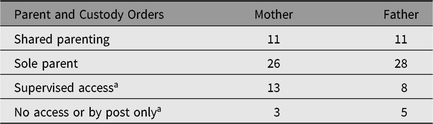
Drawing on the advice of the independent experts, the ICL, police and child protection agency evidence and the testimony of parents and their witnesses, the Court made the orders shown in Table 1 above.
To appreciate how the Court came to make the final orders, this review examined the nature of evidence provided by those presenting as having appropriate qualifications for advising the Court. The Independent Child Lawyer and the Court appointed expert witnesses (who bring different disciplinary perspectives) are able to access any investigations or determinations made by child protection agencies or police when relevant.
FCA final orders for custody and parental access in sample cases

a Of the mothers for whom supervised access or no face to face access was ordered, emotional abuse and psychological harm to the child was the basis for such orders. Of those fathers having supervised access or no face to face access, three involved acceptance of abuse allegations and two involved a risk not associated with sexual abuse. The remaining three were a consequence of significant child alienation by the other parent and family which had created a breakdown in relationship despite no evidence that abuse had occurred. It is noteworthy that of the 27 cases in which a jurisdictionally relevant ‘no contact protection order’ had been granted to the applicant mothers by the police, nine or one-third of such cases culminated in the father (against whom the orders had been taken out) being given sole parental responsibility by the FCA. In addition, 10 of the fathers who had been subjected to police protection orders were granted shared care by the FCA.
Independent child lawyer
The ICLs most often proposed orders similar to those requested by one of the parents and consistent with that of the expert witnesses. Final orders generally reflected such recommendations with some refinement by the Court. For example, in the case of Hemmingway and Holmes (2012) the ICL stated the view that alternative weekend access was sufficient to meet the standard of ‘substantial and significant time’. Both the Court and the mother disagreed with this interpretation. The inability of the parents to cooperate, rather than risk, was the matter of issue in this case. In this same case, the ICL recommended that the father be prohibited from lodging a report with child protection or police without the mother’s consent. Again the Court rejected this on the basis that FCA orders should not be a barrier to legitimate complaints.
Court appointed expert witnesses
Based on the transcript records, it is not possible to identify the specific background of 31 (43%) of the Family Report Writers or Family Consultants. Of those Court employed Family Report Writers, Family Consultants and other Court appointed expert witnesses whose disciplinary training is noted in the trial transcripts, 21 (29%) were psychologists (of which five were identified as forensic psychologists), 13 (18%) psychiatrists and 7 (10%) social workers. Additional psychologists, social workers, and counsellors testified or were cited in Court. However, when they were aligned with one or more of the parents their testimony was not accorded the weight of the Court appointed witnesses, as noted in the transcript in the context of reasons for the final orders (e.g. Cocknye & Cocknye, 2012; Lavery & Lavery, 2012; Sealy & Sealy, 2016; Tamarovic & Gillard, 2014).
The disciplinary background, and ability to claim specialist knowledge by the expert witnesses, was challenged by applicants in five cases. In these cases, the applicants alleged that the expert was not specifically qualified in the matter of child sexual abuse (Hammond & Hammond, 2014; Helbig & Rowe & ORS, 2016; Smoothe & Enmore, 2016; Tyler & Sullivan, 2014; Webber & Hatton, 2013). As there is no specific nationally or internationally recognised standard or basis upon which witnesses presenting themselves as experts in child sex abuse risk assessment can refer, the Court relies upon individual academic qualifications and experience. This makes the methods for assessing risk used by expert witnesses appropriately subject to scrutiny.
The case of Prentice and Wilfred (2017) provides a useful illustration of the importance of the appointment of the independent witnesses and the problematic of duelling experts, particularly with different disciplinary perspectives. In this case, two psychiatrists, two therapists and a social worker were all involved at one stage or another. The two Court appointed forensic psychiatrists assessing the risk of the father and the mother found common ground that it was unlikely the child had been subject to abuse. In contrast, the therapists and counsellors retained by the mother were consistent in portraying the father as a significant risk. In both cases, the psychologists’ providing therapy to the child for assumed sexual abuse (based on the mother’s reporting) recorded wide ranging criticism of the father, yet had never met or spoken with him. This was viewed by the Court as an example of the risks aligned with confirmation bias.
Similarly, in the case of Sealy and Sealy (2016), the therapist asked to prepare a report for the Court by the mother’s solicitor acknowledged that she had not spoken with nor witnessed any interaction between the father and the child. She also did not directly claim that the child had been a victim of sexual abuse. Despite this, she was prepared to recommend that all contact between the father and child be permanently curtailed. In contrast, neither of the Court appointed witnesses were able to find any indication that the allegations were likely to be true or that the relationship between the father and child should be curtailed. FCA Judge Hogan, in giving his reasons, highlighted this case as a valuable illustration of the ‘difference between a forensic psychologist and a treating psychologist’ (2016, p. 256).
A third explicit example lies in the case of Cocknye and Cocknye (2012) in which the therapist interpreted a drawing by the child, without actually discussing it with the child, as an indicator of abuse. While admitting on examination that she did not know what the drawing depicted, she had suggested implicitly it was an indicator of abuse. However as FCA Judge Austin remarked, ‘On any objective appraisal the drawing is not necessarily sexualised at all. The Family Consultant certainly did not interpret the drawing in any sinister way’ (p. 13).
Multiple independent experts from quite different disciplinary backgrounds can also be problematic for the Court. In the case of Lavery and Lavery (2012), two independent witnesses provided reports to the Court with quite different outcomes. Dr S, identified as a forensic psychologist, prepared a report without any interview or observation involving the father. In contrast, the Court appointed employed Family Report Writer, who interviewed and observed the parents and siblings, was denied access by the mother to the school-aged child alleged to have been abused. As a result, neither of those advising the Court had access to all those relevant to making a risk assessment. In laying out decisions for the orders, FCA Judge MacMillan highlighted the numerous weaknesses in the various reports given to the Court and, in particular, a lack of consideration of a range of disruptive factors that may have influenced the child’s behaviour.
The challenge arising from the receipt of multiple assessments by expert witnesses with different disciplinary backgrounds was also remarked upon in the judgement of the Bramford and Ainslee (2016) case. In giving his opinion, FCA Judge Forrest observed that
These apparent somewhat divergent opinions of Dr J, the treating psychologist, and Dr E, the independent psychiatrist, and Ms B the family report writer (an experienced social worker and psychologist) demonstrate the difficulties faced in the determination of cases such as this. Frankly, and with respect to all three experts, I have to say that there was little that I could rely upon to determine that I prefer or accept the opinions of one of these expert witnesses over the other or the others. Each of them is highly qualified and experienced in their field and each of them confidently expressed their opinions on these matters. (p. 34)
Challenges to the expert witnesses were also made by the Court where questions arose with respect to interpretations ascribed to particular behaviours. For example, in the case of Sealy and Sealy (2016), FCA Judge Hogan challenged the Family Report Writer’s reliance on the accused’s emotional response to the allegations as a basis for asserting risk.
I am not remotely persuaded that it would be safe to conclude from the father’s presentation to Ms J that he is more likely than not to have sexually abused his children: the asserted ‘failure’ of a person facing such accusations to demonstrate the anger, upset and/or refutation expected by another person as being the ‘appropriate’ or ‘usual’ manner of response cannot possibly be thought to be something upon which reliance can safely be placed in the assessment of whether the first-mentioned person presents an unacceptable risk of harm to their children. (157, p. 27)
The importance of the independent assessment process is not only couched in legislation, but also validated in the issues documented in court transcripts. However, the potential for contentious differences in assessment and interpretation is also evident in the contribution of the police and child protection agencies in the assessment of risk and who advised the Court.
State/territory police and child protection agencies
The court transcripts document that agencies external to the FCA, and who operate under different legislation, were frequently involved prior to the cases coming to trial. This includes relevant state police and child protection agencies. State police (at times in specialist teams) were involved in 52 of the cases. Typically, documented involvement included interviewing of the applicant and the children who are alleged to be victims of sexual abuse. The involvement of child protection agencies is reported in transcripts for 47 of the cases; however, an assessment of risk is reported in only 32 of the cases. Engagement of child protection services was initiated by contact from the applicant or referral by other professionals. There is limited record of referrals between police and child protection agencies.
Reporting of the risk assessments, as documented in the trial transcripts, reveals that in many cases different conclusions were reached by police and child protection agencies as to the likelihood of past abuse and future risks on the balance of probabilities. There were three cases in which both the police and child protection agencies concluded that there was a risk of sexual abuse (e.g. Brennan & Emery, 2014; Lett & Lett, 2014; Zawadzki & Zawadzki, 2014). The independent expert witness reached the same conclusion. In these cases, the FCA allocated sole parental responsibility to the maternal parent with the paternal parent having supervised access only. In another case, the police assessment expressed a concern for risk of physical violence (Baur & Furhman, 2013), and in a second case, a risk of maternal alienation of children from the father was identified (De Silva & Rogers, 2015). Reported assessments by child protection agencies indicated four cases in which a risk of abuse was suggested in addition to the three in which there was a similar police finding. However, these assessments were supported in only one case by the Court appointed expert witness.
Collectively, there were 19 cases or almost one-third of all cases (31.78%) in which police and/or child protection agencies suggested that the applicant making the allegations were responsible for ongoing emotional abuse of children and coaching children to make allegations, often in conjunction with systems abuse and deliberate alienation of the other parent’s relationship with the child (e.g. Blake, Torino, & OR, 2015; Dylan, Bilsen, & Anor, 2015; Melton & Hurley, 2017; Rilak & Tsocas, 2015).
The case identified as Dylan, Bilsen, and Anor (2015) is illustrative of the complexity which can occur when multiple agencies and assessments occur. In this case, which was in and out of court for over 10 years, there were multiple interviews by child protection, police, psychologists and 2 psychiatrists. The final determination made by the FCA was consistent with the views of the police and independent expert witnesses; the father was not a risk and was appointed as a sole parent. This over-rode the child protection agency assessment.
Significant influences impacting on assessment
It is important to avoid ‘cherry picking’ from court records to demonstrate what can go wrong, but instead to look for sustained or systemic themes. The transcript analysis revealed recurring factors that influenced the assessment of allegations and the nature of risk. Despite different methodologies for assessing risk, police, child protection agencies, expert witness testimony and Court deliberations shared a concern about the harm done to children as a consequence of repetitive and leading questioning by the applicant family, the priming or coaching of young children as to what to report to interviewers and the impact of systems abuse (e.g. Hemmingway & Holmes, 2012; Howard & Lipschitz, 2014; Walker & Baldwin, 2015).
Being subjected to multiple and ongoing interviews not only by police and child protection agencies but also by various doctors, psychologists, therapists and counsellors was found to be harmful to children (e.g. Carpenter & Carpenter No 2, 2012; Howard & Lipschitz, 2014; Walker & Baldwin, 2016;). Such systems abuse was found to foster false memories, to create a false belief in children that they had been abused when they had not and led to alienating a child from a non-abusive parent in which future reconciliation was judged virtually impossible (Helbig et al., 2016; Hemmingway & Holmes, 2012; Lett & Lett, 2014; Melton & Hurley, 2017; Pollock & Breen No. 3, 2014; Vezzoni & Maxwell, 2013). As noted in the case of Lett and Lett (2014), the consequence of systems abuse ‘de-sensitises the children to the process and they become schooled about what to expect, thus weakening the validity of their response’. Similarly, as observed by the Court appointed expert witness in the case of Gahen and Gahen (2013, p. 17), young children have ‘malleable minds and are liable to have false memories created by persistent discussion of a topic with them’. As an example, in the case of Carpenter and Carpenter No 2 (2012), the children were not only ‘interviewed’ (the applicant’s description) and video-taped by the applicant and family multiple times but also interviewed three times, by the police, twice by child protection, once by a psychologist and three times by the Family Report Writer. In fact, as noted by the police, the child’s reporting became more and more unbelievable across each of the interviews.
A corollary to the problem of systems abuse identified by expert witnesses, police, child protection agencies and the Court is the attempt to influence child reporting through coaching, through ongoing and repetitious discussion of the alleged abuse with the child, and through deliberate employment of leading questions intended to encourage false reporting (Enmore & Smoothe, 2016; Howard & Lipschitz, 2013; Prentice & Wilfred, 2017; Rilak & Tsocas, 2015 are relevant exemplars). As noted by the Family Report Writer in the case of Dover and Rogers (2016, p. 36), ‘A false belief that sexual abuse has occurred can have a similar detrimental impact to a child’s emotional wellbeing compared to if abuse occurred.’ Similarly, FCA Judge Forrest observed in the case of Smoothe and Enmore (2016, 324, 63), ‘To make such allegations falsely, or, at least, without any rational substance, to serve the desired end of permanently restricting your child’s relationship with her father is reprehensible and demonstrative of your own attitude and capacity as a parent in respect to the critical responsibilities of parenthood – the physical and emotional nurturing of your child until they reach their own independence.’
In 40% of all cases reviewed, evidence was found of parental coaching of children to report abuse. As noted in Helbig and Rowe (2015), there is no probative value to any disclosures made as a consequence of leading questions and repetitive interviewing (whether by state police or child protection workers or by the parent making allegations). Priming and coaching children as to what to report to police, child protection and family report writers was identified as a matter of concern in transcripts from some 27 cases including, but not limited to, Hammond and Hammond, Blake and Torino (2015), Dixon, Barnes, & Ors (2013) Meinhardt & Santos (2012) and Burridge & Yeats (2016). In 10 cases, it was concluded that such actions were consistent with a deliberate attempt to support a false allegation and to deny access by the other parent to the child (e.g. De Silva & Rogers, 2015; Grainger & Grainger, 2015; Heriot & Maverick No 2, 2012; Pollock & Breen No 3, 2014). The Court also identified risks to children as a consequence of the therapists and counsellors who may be aligned with the applicant and not challenge the truth of the allegations, but rather to be shaped by confirmation bias. The cases of Banks and Banks (2012), Smoothe and Enmore (2016) and Lavery and Lavery (2012) exemplify such risks where the therapeutic process itself becomes harmful by promoting fear or false beliefs.
This exploratory study identified a recurrent concern with the harm done by emotional abuse, systems abuse and the manipulation of those systems intended for protection. This refers not only to the denial of access, to coaching and to systems abuse but also equally to the impact of an unstable environment and to stress and confusion experienced by the child caught in the middle of such conflicts.
A third recurring factor identified by the Court and those reporting to it is nature and reliability of the diversity of methods employed for assessing risk and determining what constitutes the best interests for the child.
Methods for assessing risk
Prediction of future risk relies substantially on past events, which in turn requires good evidence with respect to the past. Therefore, any risk assessment is accountable to the quality and reliability of facts upon which it is based (Sarkar, Reference Rathus2011). The nature and reliability of facts upon which the expert’s opinion is based is influenced by the methods employed to gather evidence and the weight given to observations elected for inclusion or exclusion. Furthermore, as noted previously, different agencies (such as child protection agencies and police) are governed by different priorities, which may influence the risk assessment process. This raises the relevance of such factors for the reliability of an assessment of probability and future risk.
The methods employed (and the evidence supporting them) by the Court appointed independent expert witnesses, state police and child protection agencies in these cases were not well documented. There was a paucity of explanation as to the basis for employing particular methods, the processes involved or the basis of any consequential interpretations. This is relevant when acknowledging how such priorities may influence the approach that may be taken in assessing risk. Concern for evidence for future criminal prosecution, child welfare intervention or meeting the Court directed questions will be influenced by the discipline approaches and personal perspectives of the individual.
Court transcripts provide a general description of the police assessment processes (including when part of a broader team with child protection). In these cases, interviews reported in the transcripts were most commonly with the child and parent presenting with the allegations. This often involved multiple interviews where the child was presented multiple times, instigated by further allegations. Interviews that are videoed and recorded are able to be viewed by the Court. There is little record in the transcripts of interviews with the accused. Drawing from the transcript, indicators which police mention in interviewing children include the appropriateness of language, ability to provide detail and evidence of coaching, taking into account the child’s age (e.g. Dover & Rogers, 2016).
The processes adopted by child protection interviewers were not detailed, but appeared to rely principally on the interviewing of the child and, in some cases, referring to others who have reported based on a statutory obligation such as teachers or medical doctors. The content of such interviews was not described in the trial transcripts. It is not possible to determine the extent to which any specific facts or evidence was excluded or included in reaching a decision about the nature or level of risk.
In the absence of physical evidence, the material upon which the Family Report Writers and Family Consultants relied was primarily garnered through observation and interviews. Court appointed independent witnesses were advised by the documentation provided by other agencies or prior Family Reporters assessments. In most cases, transcripts do not detail the extent of observations (how long, how often, with whom), the conditions under which observations were undertaken, the nature of questions that were asked in interviews (whether there is evidence of a potential for confirmatory bias or leading questions that may reduce reliability) or the theory and supporting evidence underpinning the approach adopted by the person doing the assessment. The Australian Standards of Practice for Family Assessment and Reporting (2015, p. 14) requires that family assessors must be able to explain decisions concerning their methodology. While such explanation may be in the reports to Court, it is not detailed or described in transcript documentation.
There were three cases in which two psychiatrists and one psychologist reported employing specific risk assessment tools, although these were not without some controversy, and were not accorded significant weight in the Court decision. For example, in the case of Hammond and Hammond (2014, 168, p. 31), the independent expert, a forensic psychologist, conceded that in citing the test that had been used, ‘you would not find a consensus for any test, and the SVR-20 is only one aspect in the risk assessment’. This is consistent with reservations that have been expressed about the reliability of one off clinical assessments (Parkinson, Reference O’Neill, Bussey, Lennings and Seidler2015; Sarkar, Reference Rathus2011). ‘What kind of clinical picture emerges from the expert’s interviews reflects their own approach, and in this sense, is a subjective process however much the expert sticks to accepted guidelines’ (Kennedy, Reference Kennedy2005, pp. 21–22). A complementary latent risk identified by Family Court Judge Bryant (Judicial Conference of Australia Colloquium, 2012) arises from the potential for a judge to acquire particular understandings as a consequence of the same expert(s) appearing in the Court. Family Court Judge Bryant raised the concern that this has the potential to influence the considerations of judges in subsequent cases. It is noted that it is not possible to discern whether expert witnesses appointed by the court have been involved in multiple cases heard by the presiding judge in these cases.
One factor to be considered by those undertaking assessments is the impact of conditions that may explain a child’s behaviours other than sexual abuse. For example, the stress of long-term parental conflict, emotional and systems abuse or as being inculcated with a false belief of victimisation may be significant influences on a child’s behaviour. To illustrate, in the case of Gahen and Gahen (2013, p. 32), the Family Consultant observed that the anxiety of the parent with whom the child lived, a substantial number of changes in recent months as well as adjusting to a new family unit was as likely a contributor to the child’s anxiety as the risk of past or future sexual abuse. Similarly, attention has been given to the potentially harmful influence of therapeutic counselling that focuses on alleged abuse which had not occurred and did not take into account the influence of parental coaching of children to make such allegations (Banks & Banks, 2012; Blake, Torino, & OR, 2015; Howard & Lipschitz, 2013; Smythe & Leopold No 2, 2012).
Children may also display interest in their own bodies in different ways at different ages and may not be a reflection of abuse. As noted by Parkinson (Reference O’Neill, Bussey, Lennings and Seidler2015, pp. 2–3), ‘There is also no behavioural sign that is clearly symptomatic of child sexual abuse. Some texts, seeking to raise professional awareness of child sexual abuse, refer to “signs” of sexual abuse in children. Whatever merit such lists may (or may not) have in alerting those involved with children to the possibility of child sex abuse, they are in no way diagnostic’. Remaining focused on the reliability of both assessment tools and interview processes, there is little consensus. In the absence of any factual evidence there is no empirical proof of the efficacy or reliability of assessments intended to determine risk in terms of the best interests of the child nor the long-term outcomes for the wellness of the child when such assessments underpin custody decisions (Parkinson, Reference O’Neill, Bussey, Lennings and Seidler2015; Zumbach & Koglin, Reference Zumbach and Koglin2015).
Most recently, a study by O’Neill, Bussey, Lennings, and Seidler (Reference Kennedy2018) collected the views of psychologists, lawyers and judges with respect to single expert reports prepared for the FCA. This study found a disconnect between ‘what legal professionals consider important and what expert reports deliver. The key components with the greatest discrepancy were the experts’ provision of a risk assessment (in matters involving allegations of sexual abuse), the recommendations made flowing from the report, being specific and appropriate, opinions being based in fact, and experts’ providing a balanced discussion of the parties and testing inconsistencies’ (p. 75). Given the consequences of a false positive or false negative assessment, the Court and those impacted by the implications of such reports should require the expert to be explicit about how the expert knows what they claim to know (Schuman & Berk, Reference Sarkar2012).
Conclusions: Study Implications for FCA, justice system, and priority concerns
No one will deny that the law should in some way effectively use expert knowledge wherever it will aid in settling disputes. The only question is as to how it can do so best (Hand, Reference Hand1901)
A critical factor in achieving protection is the ability to identify and respond effectively to past abuse and act to reduce the likelihood of future risk. The systems in place to operationalise the assessment and prevention process need to be not only effective, but not contribute to vulnerability itself. The aim of this analysis of trial records involving allegations of child sex abuse in the context of custody disputes between separated parents has been to consider how well these objectives are being met. It has been possible to draw out issues identified in the trial transcripts as they advise priorities for research and continuing improvement in policy and practice.
Broadly, the transcripts provide insufficient detail to identify the fundamental assumptions or analytical processes which underpin the conclusions and recommendations of those advising the Court as expert witnesses. Nonetheless, the methods are described as broadly subjective in nature, reliant upon analysis of interviews and observations. This is consistent with the Australian Standards of Practice for Family Assessments (2015). However, while these Standards refer to a family assessment as a ‘forensic assessment’, this has not been the approach employed by independent experts in many of the cases reviewed. Irrespective of the cases in which some criticism can be made of methodology (for example, the sole reliance on the materials of others in assessing risk or flawed interviewing processes), the tripartite involvement of police, child protection agencies and Court appointed experts provide some potential for cross-checking. However, the lack of consensus across these different assessment processes can equally be viewed as problematic for the Court.
Despite the limitations of this small study, the FCA and those who advise its deliberations have identified system abuse as a significant source of potential emotional abuse and psychological harm to children. The process of repetitive interviewing, observation, testing and medical check-ups has an inherent capacity to foster false memories of sexual abuse, have ramifications for the child’s social and emotional development and contribute to alienating a child from a nonabusive parent compromising any reconciliation. This problem and the associated risks are recognised and documented in the FCA transcript evidence. There is a need for more attention to be given to the way in which repetitive presentations to police, child protection, counsellors and therapists can ultimately be abusive to those who the system is intended to protect and to develop strategies that can prevent such abusive behaviours.
A second finding from the review has been the extent to which the Court has found emotional abuse and psychological harm is a documented risk to children where the applicant engages in behaviours that can lead to a child developing false memories of abuse, and/or foster or seek to prevent a relationship with the targeted parent. Whether such behaviours are undertaken maliciously or with a genuine belief, the harmful outcome is consistently identified as a real risk. Given that such emotional and psychological abuse was substantiated more frequently than that of accused sexual abuse in this sample of cases, it should serve as a red flag to researchers, justice processes and those in relevant professional practice.
The challenge arising from the receipt of multiple assessments by expert witnesses with different disciplinary backgrounds is not well examined in the Australian Standards of Practice. While such Standards highlight the importance of family assessors being advised by the reporting of others, there is no specific consideration of how different institutional roles operating under different statutory provisions may impact on the nature of any risk assessment. A corollary to this is the lack of acknowledgement in such Standards of the challenge to the Court as a consequence of risk assessments being undertaken by those with diverse disciplinary frameworks seeking to present as experts in the field. As was found in this review, there can be significant consequences for parenting orders when those advising the court based on their own assessments reach incompatible conclusions.
As a small study, there is a need to extend its parameters to examine the extent to which similar patterns are found in cases in which other forms of abuse are alleged. Referring back to the core objective of the best interests of the child, the balance of probabilities and level of risk, the FCA has had to consider complex cases in which the evidence upon which decisions are made is to no small extent reliant on the advice of others presenting themselves as experts. A significant outcome of this small scale study has been the identification of procedural risks to the best interests of children that warrant greater consideration. This will need to include a strategic approach resolving risks of systems abuse as well as individual and professional practices involving researchers, practitioners, the justice system and those who advise it.