INTRODUCTION
More than 6000 species of sea slugs are known for their beautiful coloration and evolutionary traits, which are mostly related to feeding and defence (Wägele et al., Reference Wägele, Klussmann-Kolb, Vonnemann, Medina, Ponder and Lindberg2008). They were classically grouped within ‘Opisthobranchia’, which has been considered paraphyletic since Haszprunar (Reference Haszprunar1985) by morphological (Ponder & Lindberg, Reference Ponder and Lindberg1997; Dayrat & Tillier, Reference Dayrat and Tillier2002) and molecular studies (Grande et al., Reference Grande, Templado, Cervera and Zardoya2004; Dinapoli & Klussmann-Kolb, Reference Dinapoli and Klussmann-Kolb2010; Jörger et al., Reference Jörger, Stöger, Kano, Fukuda, Knebelsberger and Schrödl2010). Still, the name ‘opisthobranch’ holds a historical value and is used to refer to some euthyneuran heterobranch clades with similar traits. They generally have an externally bilateral body and distinct detorsion and shell reduction degrees, as well as similar biological features and strategies (Schrödl et al., Reference Schrödl, Jörger, Klussmann-Kolb and Wilson2011). Most have a worldwide distribution and, with a few limnic and amphibian exceptions (Schrödl & Neusser, Reference Schrödl and Neusser2010; Neusser et al., Reference Neusser, Fukuda, Jörger, Kano and Schrödl2011), occupy exclusively in marine and estuarine habitats. They reach their highest richness in the tropical Indo-Pacific, as is the case with most invertebrate groups (Gosliner, Reference Gosliner2002).
‘Opisthobranchs’ only had their distribution patterns and faunal affinities extensively analysed in the Atlantic, for the first time, just recently (García & Bertsch, Reference García and Bertsch2009), despite the scarce level of knowledge in some areas. Notwithstanding the recent ecoregionalization of marine areas proposed by Spalding et al. (Reference Spalding, Fox, Allen, Davidson, Ferdaña, Finlayson, Halpern, Martin, Mcmanus, Molnar, Recchia and Robertson2007), García & Bertsch (Reference García and Bertsch2009) adopted the traditional division in marine provinces proposed by Briggs (Reference Briggs1974).
From a biogeographical perspective, the Brazilian Province shows the lowest number of species compared to its neighbouring provinces (Caribbean and Argentinean). It also holds the lowest endemism rate in the Atlantic (García & Bertsch, Reference García and Bertsch2009). The detailed study of distribution patterns in Brazilian biogeographic zones and nearby areas shows large faunal richness contrasts along the country's coast (García et al., Reference García, Domínguez and Troncoso2007). The highest number of species occurs in the South-east region, studied since the 1950s by Ernest and Eveline Marcus. In other Brazilian regions, this number rarely exceeds half as many (García et al., Reference García, Domínguez and Troncoso2007).
Due to the low number of studies, ‘opisthobranchs’ represent a gap in the knowledge of the malacofauna in the remaining Brazilian regions. After the Marcuses, studies on ‘opisthobranchs’ have only been revived in the last decade. Most include new records (Padula & Santos, Reference Padula and Santos2006; Lima & Delgado, Reference Lima and Delgado2011; Sales et al., Reference Sales, Delgado, Queiroz, Padula, Sampaio and Johnsson2011), new species descriptions (García et al., Reference García, Troncoso and Domínguez2002; García & Troncoso, Reference García and Troncoso2003; Pola et al., Reference Pola, Cervera and Gosliner2005, Reference Pola, Padula, Gosliner and Cervera2014; Domínguez et al., Reference Domínguez, García and Troncoso2006a; DaCosta et al., Reference DaCosta, Padula and Schrödl2010; Padula & Delgado, Reference Padula and Delgado2010; Alvim et al., Reference Alvim, Padula and Pimenta2011, Reference Alvim, Simone and Pimenta2014; Cunha, Reference Cunha2011; Silva et al., Reference Silva, Meirelles and Matthews-Cascon2013, Reference Silva, Azevedo and Matthews-Cascon2014; Padula et al., Reference Padula, Araújo, Matthews-Cascon and Schrödl2014) and reviews (Domínguez et al., Reference Domínguez, García and Troncoso2006b, Reference Domínguez, Troncoso and García2008; Alvim & Pimenta, Reference Alvim and Pimenta2013; Cunha et al., Reference Cunha, Saad and Lima2014; Saad et al., Reference Saad, Cunha, Colpo and Valdés2014). Recent checklists have also been published, on local (García et al., Reference García, Troncoso and Domínguez2002; García & Troncoso, Reference García and Troncoso2003), state (Padula et al., Reference Padula, Bahia, Vargas and Lindner2011, Reference Padula, Bahia, Correia and Sovierzoski2012; Sales et al., Reference Sales, Queiroz, Padula, Neves and Johnsson2013) and national scales (García et al., Reference García, Domínguez and Troncoso2008). Moreover, there are recent contributions that provide relevant information on and support the validity of some Brazilian species (Carmona et al., Reference Carmona, Bhave, Salunkhe, Pola, Gosliner and Cervera2014a, Reference Carmona, Lei, Pola, Gosliner, Valdés and Cerverab, Reference Carmona, Pola, Gosliner and Cerverac).
The Ceará State is an important target for faunistic studies. Though it is located within the second most well-represented Brazilian biogeographical zone (García et al., Reference García, Domínguez and Troncoso2007), it is still underrated. It has over 600 km of shoreline bathed by the oligotrophic Equatorial current. Its coastal territory is characterized by large sandy beaches, interrupted by rocky formations and estuaries (Smith & Morais, Reference Smith and Morais1984). These geographical features have led to a wide range of habitats, which allows for the establishment of a rich invertebrate fauna.
Ceará belongs to the Brazilian biogeographic province described by Briggs (Reference Briggs1974), modified by Floeter et al. (Reference Floeter, Rocha, Robertson, Joyeux, Smith-Vaniz, Wirtz, Edwards, Barreiros, Ferreira, Gasparini, Brito, Falcón, Bowen and Bernardi2008) and adopted by Briggs & Bowen (Reference Briggs and Bowen2012). This province has the Orinoco–Amazon barrier as its northern boundary with the Caribbean, and the Cabo Frio resurgence as the southern limit with the Argentinean province. Several rivers, including the Amazon and Orinoco, discharge their waters along this province. They promote low salinity and high turbidity levels that serve as a barrier for boundary species (Briggs, Reference Briggs1974). In the physical division made by Castro & Miranda (Reference Castro and Miranda1998) and adopted by García et al. (Reference García, Domínguez and Troncoso2007) to analyse the Brazilian ‘opisthobranch’ fauna, the Ceará State belongs to the North-east Brazilian Shelf (NBS). This zone has low variations in temperature and salinity as its main characteristics (Castro & Miranda, Reference Castro and Miranda1998).
Currently, there are 22 ‘opisthobranch’ species reported from Ceará, including three recently described taxa, namely Marionia limceana Silva et al., Reference Silva, Meirelles and Matthews-Cascon2013, Tritonia khaleesi Silva et al., Reference Silva, Azevedo and Matthews-Cascon2013 and Cratena minor Padula et al., Reference Padula, Araújo, Matthews-Cascon and Schrödl2014 (Kempf & Matthews, Reference Kempf and Matthews1968; Marcus, Reference Marcus1970, Reference Marcus1977; García et al., Reference García, Domínguez and Troncoso2008; Barroso & Matthews-Cascon, Reference Barroso and Matthews-Cascon2009; Rios, Reference Rios2009; Meirelles et al., Reference Meirelles, Galvão Filho, Scramosin and Matthews-Cascon2010; Cunha, Reference Cunha2011; Silva et al., Reference Silva, Meirelles and Matthews-Cascon2013, Reference Silva, Azevedo and Matthews-Cascon2014; Padula et al., Reference Padula, Araújo, Matthews-Cascon and Schrödl2014). As stated in previous studies, sampling of further data from distinct Brazilian areas improves faunistic knowledge and helps to overcome biogeographic problems in the Atlantic. The present study adds to previous contributions, providing information for future distribution models and biogeographic studies on ‘opisthobranchs’.
MATERIALS AND METHODS
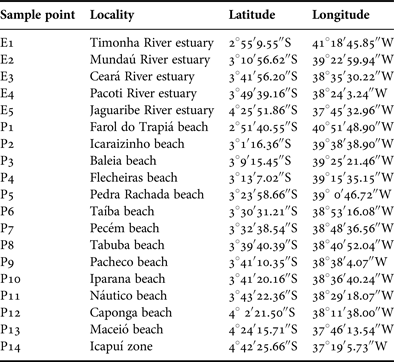
The study sites were located in 14 different beaches and five estuaries along the coast of Ceará, North-east Brazil (Figure 1, Table 1). Sampling was carried out in different periods from November 2006 to March 2014. The explored sites included intertidal zones at low tide during syzygy, when ‘opisthobranchs’ could be collected directly or indirectly. The former consisted of looking for sea slugs under rocks, among algae, living in tide pools or crawling on the sand. The latter consisted of collecting potential food sources, such as algae, sponges, cnidarian and others, for subsequent sorting in the laboratory.
Localities sampled along the coast of the Ceará State and named as in Table 1 (red dots: beaches; blue dots: estuaries).

Georeferences of the sampling localities illustrated in Figure 1.
E, estuary area; P, beach area.
Samples were transported to the laboratory and placed in recipients with seawater from a few minutes to a few hours, until some sea slugs could be seen moving on the recipient walls. After sorting, samples were photographed and examined under a stereomicroscope for measuring. Afterwards, they were submitted to cold anaesthesia and preserved in 70% ethanol. Specimens were dissected and hard buccal structures such as radula, jaws and gizzard plates (when present) were extracted and analysed under optical microscopy for identification. Additional material previously deposited in the Malacological Collection Professor Henry Ramos Matthews (CMPHRM) – Series A and B (CMPHRM-A/CMPHRM-B), belonging to the Universidade Federal do Ceará (UFC), was analysed.
The contributions of García & Bertsch (Reference García and Bertsch2009) to the Atlantic Ocean and García et al. (Reference García, Domínguez and Troncoso2007) to the Brazilian zones were considered to compare faunal affinities. Subsequently published records were also taken into account (Table 2).
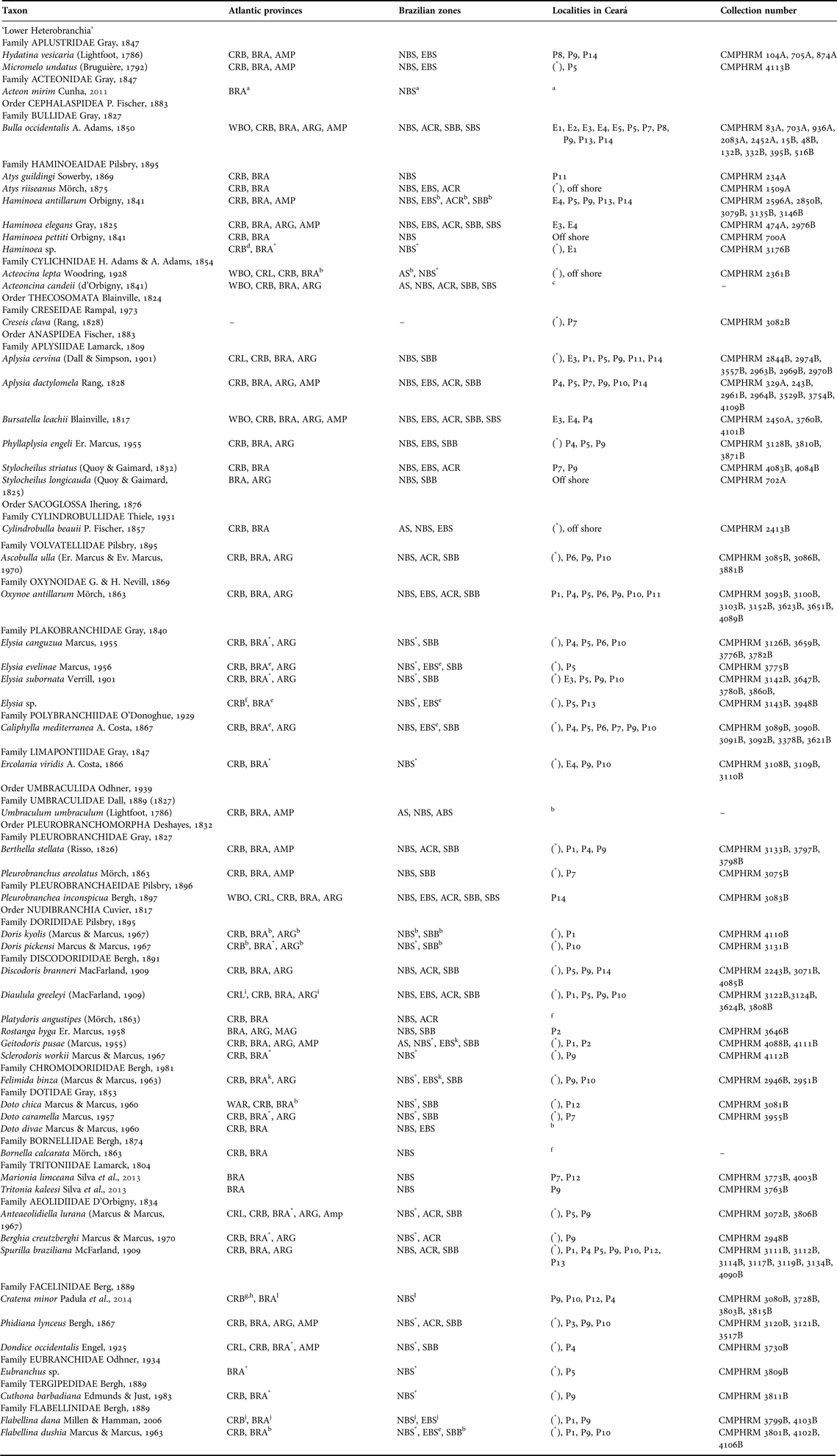
List of ‘opisthobranchs’ from state of Ceará collected in this survey including the previously records and the samples deposited in the Malacological Collection Professor Henry Ramos Matthews (CMPHRM). Localities according to Table 1.
* New record from Ceará, Brazilian zones or Atlantic provinces.
Atlantic provinces (as in García & Bertsch, Reference García and Bertsch2009): WAR, Western Arctic Province; WBO, Western Boreal Province; CRL, Carolinian Province; CRB, Caribbean Province; BRA, Brazilian Province; ARG, Argentinean Province; MAG, Magellanic Province; AMP, Amphiatlantic status (occur in Eastern Atlantic provinces). Brazilian zones (as in García et al., Reference García, Domínguez and Troncoso2007): AS, Amazon Shelf; NBS, North-east Brazilian Shelf; EBS, East Brazilian Shelf; ACR, Abrolhos-Campos Region; SBB, South Brazilian Bight; SBS, Southern Brazilian Shelf.
References: aCunha (Reference Cunha2011); bGarcía et al. (Reference García, Domínguez and Troncoso2008); cMatthews & Rios (Reference Matthews and Rios1969); dMalaquias (Reference Malaquias2014); ePadula et al. (Reference Padula, Bahia, Correia and Sovierzoski2012); fRedfern (Reference Redfern2013); gKempf & Matthews (Reference Kempf and Matthews1968); hValdés et al., (Reference Valdés, Hamann, Behrens and Dupont2006); iAlvim & Pimenta (Reference Alvim and Pimenta2013); jSales et al. (Reference Sales, Delgado, Queiroz, Padula, Sampaio and Johnsson2011); kSales et al. (Reference Sales, Queiroz, Padula, Neves and Johnsson2013); lPadula et al. (Reference Padula, Araújo, Matthews-Cascon and Schrödl2014).
RESULTS
A total of 35 new records from Ceará State are reported herein. Three of these were found in the UFC collection: Atys riiseanus Mörch, 1875 (Figure 2B), Acteocina lepta Woodring, 1928 (Figure 2D) and Cylindrobulla beauii P. Fischer, 1857 (Figure 2H). Added to the 22 already published records, the Ceará State has a total of 57 species, 27 families and seven ‘opisthobranch’ orders (Table 2). The most diverse group sampled was the order Nudibranchia, which corresponds to 45.6% (25 species) of the total number of species. On the other hand, the orders Umbraculida and Thecosomata were the less diverse, each with a single species.
New records from Ceará state. (A) Micromelo undatus (20 mm) (photo: F.A.C. Monteiro) (CMPHRM 4113B); (B) Atys riiseanus (6 mm) (CMPHRM 1509A); (C) Haminoea sp. (30 mm) (CMPHRM 3176B); (D) Acteocina lepta (2.3 mm) (CMPHRM 2361B); (E) Creseis clava (8 mm) (CMPHRM 3082B); (F) Aplysia cervina (110 mm) (CMPHRM 2963B); (G) Phyllaplysia engeli (6 mm) (CMPHRM 3128B); (H) Cylindrobulla beauii (5 mm) (CMPHRM 2413B); (I) Ascobulla ulla (5 mm) (CMPHRM 3086B); (J) Elysia canguzua (14 mm) (CMPHRM 3776B); (K) Elysia evelinae (5 mm) (CMPHRM 3775B).
Twelve species are reported for the first time for the Brazilian province (Table 2): Haminoea sp. (Figure 2C), Elysia canguzua Marcus, 1955 (Figure 2J), Elysia subornata Verrill, 1901 (Figure 3A), Ercolania viridis A. Costa, 1866 (Figure 3D), Doris pickensi Marcus & Marcus, 1967 (Figure 3H), Sclerodoris workii Marcus & Marcus, 1967 (Figure 3L), Doto caramella Marcus, 1957 (Figure 4C), Anteaeolidiella lurana (Marcus & Marcus, 1967) (Figure 4D), Berghia creutzberghi Marcus & Marcus, 1970 (Figure 4E), Dondice occidentalis Engel, 1925 (Figure 4H), Eubranchus sp. (Figure 4I) and Cuthona barbadiana Edmunds & Just, 1983 (Figure 4J). We also report herein Sclerodoris workii and Cuthona barbadiana for the first time from Brazil.
New records from Ceará state (continued). (A) Elysia subornata (20 mm) (CMPHRM 3964B); (B) Elysia sp. (24 mm) (CMPHRM 3963B); (C) Caliphylla mediterranea (12 mm) (CMPHRM 3090B); (D) Ercolania viridis (3 mm) (CMPHRM 3109B); (E) Berthella stellata (7 mm) (photo: A. Anker) (CMPHRM 3133B); (F) Pleurobranchus areolatus (25 mm) (CMPHRM 3075B); (G) Doris kyolis (6 mm) (CMPHRM 4110B); (H) Doris pickensi (5 mm) (CMPHRM 3131B); (I) Discodoris branneri (32 mm) (CMPHRM 2243B); (J) Diaulula greeleyi (13 mm) (CMPHRM 3124B); (K) Geitodoris pusae (18 mm) (CMPHRM 4088B); (L) Sclerodoris workii (15 mm) (CMPHRM 4112B).
New records from Ceará (continued). (A) Felimida binza (7 mm) (CMPHRM 3131B); (B) Doto chica (5 mm) (CMPHRM 3081B); (C) Doto caramella (5 mm) (CMPHRM 3955B); (D) Anteaeolidiella lurana (8 mm) (CMPHRM 3075B); (E) Berghia creutzberghi (10 mm) (CMPHRM 2948B); (F) Spurilla braziliana (15 mm) (CMPHRM 4090B); (G) Phidiana lynceus (11 mm) (CMPHRM 3120B); (H) Dondice occidentalis (11 mm) (CMPHRM 3730B); (I) Eubranchus sp. (2 mm) (CMPHRM 3809B); (J) Cuthona barbadiana (3 mm) (CMPHRM 3811B); (K) Flabellina dana (5 mm) (CMPHRM 3730B); (L) Flabellina dushia (5 mm) (CMPHRM 3801B).
Additionally, we report 19 new records for the NBS. Besides the above-mentioned records from the Brazilian province, Acteocina lepta, Elysia evelinae Marcus, 1956 (Figure 2K), Geitodoris pusae (Marcus, 1955) (Figure 3K), Felimida binza (Marcus & Marcus, 1963) (Figure 4A), Doto chica Marcus & Marcus, 1960 (Figure 4B), Phidiana lynceus Bergh, 1867 (Figure 4G) and Flabellina dushia Marcus & Marcus, 1963 (Figure 4L) are new to the NBS region.
The new records for the Brazilian province reported herein show an expected connection between its two neighbours, the Caribbean and Argentinean provinces, which already have a high faunal affinity (García & Bertsch, Reference García and Bertsch2009). Moreover, 51 species (89.47%) from Ceará are shared between the Brazilian and Caribbean provinces, whereas only 25 species (43.86%) are shared with the Argentinean province (Table 3). From all of them, 24 have an amphiatlantic distribution (24.56%) and only four are endemic (7.02%) to the Brazilian province (Table 3). The fauna from Ceará proved to be more similar to the South Brazilian Bight (SBB) (56.14%) than the neighbouring East Brazilian Shelf (EBS) (36.84%) and the Amazon Shelf (8.77%) (Table 3).
Number and percentage of common species between biogeographic areas and the Ceará State. Atlantic Provinces defined in Table 2.
DISCUSSION
The two-fold increase in the prior number of species reported from Ceará is evidence of the poor knowledge on Brazilian ‘opisthobranch’ fauna, mainly regarding the Brazilian Province. The history of studies on this group is brief, but is still in development, as detailed above. The present paper, added to recent species descriptions (Padula & Delgado, Reference Padula and Delgado2010; Cunha, Reference Cunha2011; Silva et al., Reference Silva, Meirelles and Matthews-Cascon2013, Reference Silva, Azevedo and Matthews-Cascon2014; Alvim et al., Reference Alvim, Simone and Pimenta2014; Padula et al., Reference Padula, Araújo, Matthews-Cascon and Schrödl2014; Pola et al., Reference Pola, Padula, Gosliner and Cervera2014) and records (Lima & Delgado, Reference Lima and Delgado2011; Sales et al., Reference Sales, Delgado, Queiroz, Padula, Sampaio and Johnsson2011; Padula et al., Reference Padula, Bahia, Correia and Sovierzoski2012; Sales et al., Reference Sales, Queiroz, Padula, Neves and Johnsson2013; Carmona et al., Reference Carmona, Bhave, Salunkhe, Pola, Gosliner and Cervera2014a, Reference Carmona, Lei, Pola, Gosliner, Valdés and Cerverab, Reference Carmona, Pola, Gosliner and Cerverac; Pola et al., Reference Pola, Padula, Gosliner and Cervera2014) reinforce the delimitation of provinces and zones used in previous works.
The large number of nudibranchs reported herein clearly reflects the high diversity of this order within ‘Opisthobranchia’, encompassing half the total number of species (Wägele & Willan, Reference Wägele and Willan2000; Wägele, Reference Wägele2004). The only Umbraculida member found was Umbraculum umbraculum (Lightfoot, 1786), which was previously reported in the literature (Rios, Reference Rios2009), but not sampled in field or collection surveys. In fact, this order is the least diverse within the ‘opisthobranchs’, with only 11 species (Gofas, Reference Gofas2014). The limited number of species is, therefore, not unexpected. On the other hand, Creseis clava (Rang, 1828) (Figure 4E) was the only species of Thecosomata recovered in this study. This is easily explained by fieldwork methodology, since it did not included plankton samplings.
Together with the Sacoglossa, nudibranchs represent the main findings that connect areas of occurrence between the Caribbean and Brazilian provinces. Our results clearly reinforce the strong similarity between these two provinces, and also show a low resemblance with the Argentinean province. This relatively high similarity, as well as the lower endemism of the Brazilian Province compared to the remaining Atlantic provinces, is discussed by García & Bertsch (Reference García and Bertsch2009). A worldwide review of the biogeography of Sacoglossa also verified the low endemism rate of the Brazilian Province, as more than 90% of its fauna is shared with the Caribbean (Jensen, Reference Jensen2007).
The two new records from Brazil (Cuthona barbadiana and Sclerodoris workii) are also new to the South Atlantic. Both species demonstrate a clear capacity to cross the Amazon–Orinoco barrier, as well as all the other species that are shared with the Caribbean Province. This has been observed in other marine invertebrates (Medel & López-González, Reference Medel and López-González1998; Simões et al., Reference Simões, Kowalewski, Mello, Rodland and Carroll2004) and reef fish (Rocha, Reference Rocha2003). Collete & Rützler (Reference Collete and Rützler1977) documented a long bank of sponges in shallower depths. Salinity levels at these depths allow for the occurrence of many invertebrates and reef fishes, possibly promoting the connection between the North and South Atlantic fauna. This may be the cause for the high similarity between the Caribbean and Brazilian provinces, but further sampling is still necessary.
It is important to highlight that during this project, four new species were described from Ceará (Cunha, Reference Cunha2011; Silva et al., Reference Silva, Meirelles and Matthews-Cascon2013, Reference Silva, Azevedo and Matthews-Cascon2014; Padula et al., Reference Padula, Araújo, Matthews-Cascon and Schrödl2014), three of which are endemic to the Brazilian Province. Together with four other recently described species (Padula & Delgado, Reference Padula and Delgado2010; Alvim et al., Reference Alvim, Simone and Pimenta2014; Pola et al., Reference Pola, Padula, Gosliner and Cervera2014), they increase the rate of endemic species documented by García & Bertsch (Reference García and Bertsch2009), who reported only six endemic species in the province. This endemicity might be artificial since the distributions of the new species are scarcely known. Considering the small number of studies conducted in this area compared to the Caribbean, this province may have an underestimated diversity, and endemism rates may change to reflect future results.
Some specimens reported here are not identified to the species level, but have been reported in previous works. Elysia sp. (Figure 3B), for example, was recently recorded by Redfern (Reference Redfern2013) in the Bahamas and by Camacho-García et al. (Reference Camacho-García, Pola, Carmona, Padula, Villani and Cervera2014) in Costa Rica. It was also recorded in different places by many authors under valid names (e.g. Valdés et al., Reference Valdés, Hamann, Behrens and Dupont2006 as Elysia papillosa Verrill, 1901, from the Caribbean Sea; Padula et al., Reference Padula, Bahia, Correia and Sovierzoski2012 as Elysia subornata, from Brazil). On the other hand, the Haminoea sp. has not been identified in previous studies, and was considered unnamed instead (Malaquias, Reference Malaquias2014). Nevertheless, the Eubranchus sp. seems to have never been previously reported.
Considering the total of 74 species previously reported by García et al. (Reference García, Domínguez and Troncoso2007) from the NBS, the 24% increase in this number presented here is especially relevant. All of the more recently described species from the Brazilian Province belong to this zone. The greater similarity between this zone and the SBB, instead of the neighbouring EBS, is due to the discontinuous knowledge of the fauna along the Brazilian coast. Any broad addition to this census can mean a future change in the relationships among all zones, as proposed by García et al. (Reference García, Domínguez and Troncoso2007).
Several coastal areas from Brazil are poorly sampled. Biogeographic zones applied to ‘opisthobranchs’ must be treated very carefully and should have only temporary value (García et al., Reference García, Domínguez and Troncoso2007). Biogeographical studies on the ‘opisthobranch’ fauna are outdated and do not discuss the recent concepts and advances in marine biogeography. García & Bertsch (Reference García and Bertsch2009), for example, had no opportunity to discuss the ecoregions proposed by Spalding et al. (Reference Spalding, Fox, Allen, Davidson, Ferdaña, Finlayson, Halpern, Martin, Mcmanus, Molnar, Recchia and Robertson2007). Nevertheless, a more precise knowledge of local fauna is mandatory to test whether the relationships between pre-established zones or provinces for other animal groups can be applied to ‘opisthobranchs’.
ACKNOWLEDGEMENTS
We are grateful to Patricia O. Lima from the University of São Paulo for helping with the identification of dorids. We are deeply grateful to Carlo M. Cunha and Vinicius Padula for their general help, and to Cristiane X. Barroso for biogeographic considerations. This work was partially supported by the following research grants: Fundação Cearense de Apoio ao Desenvolvimento Científico e Tecnológico – FUNCAP, Edital FUNCAP, no. 05/2009 (Pesquisa e Infraestrutura Laboratorial); and Coordenação de Aperfeiçoamento de Pessoal de Nível Superior – CAPES, Edital Ciências do Mar, no. 09/2009.