Introduction
Continuing to drive is reported by older adults as important for maintaining independence and quality of life (Adler and Rottunda Reference Adler and Rottunda2006). However, there are a variety of circumstances that may conspire to force older adults to cease driving, including declines in health and cognition (Edwards et al. Reference Edwards, Ross, Ackerman, Small, Ball, Bradley and Dodson2008). In turn, a number of negative outcomes have been linked to driving cessation, including increased social isolation and depression (Fonda, Wallace and Herzog Reference Fonda, Wallace and Herzog2001; Mezuk and Rebok Reference Mezuk and Rebok2008), as well as reduced life satisfaction (Liddle et al. Reference Liddle, Gustafsson, Bartlett and McKenna2012). Yet our understanding of what the prospect of losing the ability to drive means to older adults themselves warrants further exploration, and may be better understood in light of social identity change and loss.
Social identity theory describes a person's sense of who they are based on their group membership(s) (Tajfel and Turner Reference Tajfel, Turner, Austin and Worchel1979). Some group membership may be chosen (e.g. being a member of an environmental group, bicycle club) but other memberships may not be under an individual's control (e.g. gender, race or age). Regardless of this, what most group memberships have in common is that they give us a sense of belonging in the social world and help us to define who we are. Importantly too, social identity theory posits that we prefer to belong to groups that are valued in society. In this respect, age is an unusual group; old age is typically seen as undesirable but it is also clear that it is a group to which one can (and possibly hope) to eventually belong to, with the passage of time. We argue that driving cessation may be an important marker of transitioning from the ‘young group’ to an ‘older group’. Indeed, driving cessation is a significant event in later life, which may not only move the individual into the ‘non-driver group’ but may also serve to make salient or even precipitate thinking of oneself as now ‘old’.
In a recent qualitative study of driving cessation in persons with dementia, the difficulty of bringing up the topic of stopping driving, due to its high emotional impact, was mentioned frequently by care-givers: ‘It meant transport, it meant independence, but it was also something about the activity itself that was so important to him … It was his manly activity’ (Liddle et al. Reference Liddle, Bennett, Allen, Lie, Standen and Pachana2013: 2038). This finding can be well understood when considering driving cessation as social identity change: we argue that one reason that driving cessation is resisted and stressful is because it also implies a change in social identity in terms of ‘young’ to membership in the less desirable ‘old’ group (Jetten and Pachana Reference Jetten, Pachana, Jetten, Haslam and Haslam2012). Consistent with this, the importance of driving to sense of self and identity has been mooted by several other authors. For example, driving and one's valid driver's licence have been seen as explicitly linked to a positive sense of identity, while loss of one's driver's licence is linked with taking on an ‘older’ identity (Eisenhandler Reference Eisenhandler1990).
Several recent studies examining what older adults think about regulating or ceasing their driving behaviours also broadly point to the notion that driving cessation, because it involves loss of independence, implies loss of identity. Rudman et al. (Reference Rudman, Friedland, Chipman and Sciortino2006) used focus groups of older adults who were either still driving (aged 55+) or had stopped driving (aged 65+) to explore their perspectives on self-regulating their driving behaviours. One important theme that emerged from this qualitative research is that driving was described as having functional advantages, but there was also an indication that stopping driving would affect drivers' sense of themselves: ‘[Y]ou've lost part of yourself when you don't have the mobility when you're used to it.’ While those who had not yet ceased to drive in this study almost could not envision themselves in the position of no longer driving: ‘I can't imagine not driving’ (Rudman et al. Reference Rudman, Friedland, Chipman and Sciortino2006: 70), drivers who had already given up driving stated that they had felt losses of independence and self-determination keenly but also many stated they had adapted and could also see benefits after stopping driving.
Further evidence that driving cessation also involves social identity change is evident from the fact that changes associated with driving (such as increased depression as cited above; Fonda, Wallace and Herzog Reference Fonda, Wallace and Herzog2001) could persist even if the affected person still has access to means to remain mobile (i.e. a spouse who can drive them places). So although the functional aspects of driving may be quite important to the individual (loss of independence, decreased personal control and reduced participation in important life roles; see Liddle et al. Reference Liddle, Gustafsson, Bartlett and McKenna2012; Ragland, Satariano and MacLeod Reference Ragland, Satariano and MacLeod2005; Windsor et al. Reference Windsor, Anstey, Butterworth, Luszcz and Andrews2007), other changes within the person, how they are defining themselves, changes to their social identity and their relationship with others, may also be relevant.
Consistent with this, several qualitative studies have suggested that continuing to drive may be an effective way of holding off the individual's perception of growing older (Gardezi et al. Reference Gardezi, Wilson, Man-Son-Hing, Marshall, Molnur, Dobbs and Tuokko2006; Rudman et al. Reference Rudman, Friedland, Chipman and Sciortino2006; Siren and Hakamies-Blomqvist Reference Siren and Hakamies-Blomqvist2005). Rudman et al., for example, reported that stopping driving was equated in their sample with ageing and becoming old – ‘one more thing about old age’ (former driver 65+) and ‘a sign that you're growing old’ (driver age <65) (2006: 68). However, we note that to date we are unaware of quantitative studies specifically undertaken to explore how driving cessation impacts one's thoughts about one's own ageing.
Our exploratory study aimed to examine how actual or imagined driving cessation might be seen as a potentially stressful life event, one that was hypothesised to be related to feeling older, in a sample of older persons who had either ceased driving or who were planning to stop driving in the near future. We wished to assess the extent to which respondents would see driving cessation as involving practical hassles, life changes (i.e. social identity change) and changed relationships with others, and to examine the potential impact of such changes on how stressful driving cessation was viewed in our sample.
Method
Participants
Participants were recruited from the community in Southeast Queensland, Australia, using convenience and snowball sampling, via a number of sources, including media releases, pamphlets, community groups (e.g. seniors group, churches, community support groups), and referrals from family, friends or health professionals, from both rural and more urban areas, as part of a larger driving cessation study (for full details of this larger study, see Gustafsson et al. Reference Gustafsson, Liddle, Liang, Pachana, Hoyle, Mitchell and McKenna2012). Our sample consisted of 208 older adults who attended the UQDRIVE driver retirement classes (Gustafsson et al. Reference Gustafsson, Liddle, Liang, Pachana, Hoyle, Mitchell and McKenna2012) preparing them for driving cessation in terms of both practical skills (e.g. how to negotiate public transportation options such as buses and ferries) as well as providing an opportunity to discuss a sense of personal loss regarding driving cessation. Individuals were included in the study if they were aged 60 years and over, had stopped driving or intended to stop driving, and had a Mental Status Questionnaire score of greater than 7, indicating no cognitive impairment (Chodosh et al. Reference Chodosh, Reuben, Albert and Seeman2002).
Measures
Respondents completed the Driver Identity Survey along with other questionnaires at the same point during the larger UQDRIVE intervention programme when other data were collected. Questionnaires including the Driver Identity Survey were completed by participants where the driving groups were run, at a number of local libraries and community halls in the Brisbane area. The Driver Identity Survey took approximately ten minutes to complete. After completing a brief demographics section, they were asked to indicate how they thought they would feel before they stopped driving and how they thought they would feel after they stopped driving. Response categories were: (0) ‘much younger than I really am’, (1) ‘a bit younger than I really am’, (2) ‘my real age’, (3) ‘a bit older than I really am’ and (4) ‘much older than I really am’.
Respondents were then asked to imagine/think about giving up driving and they were asked to indicate to what extent they agreed with statements that they would worry about practical hassles associated with driving cessation (three items: ‘I would worry about how to get to places’, ‘I would worry about relying on others to get around’ and ‘I would worry about knowing how to use public transport’; α = 0.70), to what extent driving cessation was associated with life change (three items: ‘It would mean entering a new phase in my life’, ‘It would mean closing a chapter in my life’ and ‘my life would change quite a bit’; α = 0.84), and to what extent driving cessation would change relationships with others (two items: ‘my relationship with others would change’ and ‘It would change how others see me’; r = 0.70, p < 0.001). All responses were recorded on a scale ranging from 0 = ‘definitely disagree’ to 4 = ‘definitely agree’.
Finally, we presented respondents with a list of important life stressors, such as bereavement events, having poor health and having dementia; driving cessation was among the events listed. Participants were asked to rate how stressful they felt these events would be (scale from 0 = ‘not at all stressful’ to 100 = as stressful as it can be’).
Results
Respondents were uniformly of Caucasian descent. A minority of respondents had already stopped driving (N = 47) and the majority planned to stop driving within 12 months (N = 161). Participants who had stopped driving consisted of 13 males (27.7%) and 33 females (70.2%, with one missing value) whose average age was 78 years. The sample of older adults who were still driving consisted of 44 males (27.3%) and 115 females (71.4%, with two missing values), whose average age was 72 years.
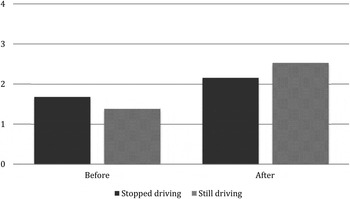
We first assessed the extent to which driving cessation was seen as ageing by examining responses to questions about how respondents would feel before and after stopping driving (within-participants factor labelled before–after) for both drivers and ex-drivers (between-participants factor labelled group). The repeated measures analysis of variance showed no main effect for group, F(1, 187) = 0.08, p = 0.777, a main effect for the before–after factor, F(1, 187) = 59.48, p < 0.001, which was qualified by a significant interaction between group and the before–after factor, F(1, 187) = 10.12, p = 0.002. As can be seen in Figure 1, while respondents indicated that, on average, they would feel slightly younger than their real age when considering how they would feel before stopping driving, they indicated feeling a bit older than their real age when considering how they would feel after stopping driving. Interestingly too, these ageing effects were more pronounced for those who were still driving (meanbefore = 1.1.38, standard deviation (SD) = 0.94; meanafter = 2.53, SD = 0.99; t(144) = 11.47, p < 0.001) than for those who had already given up driving (meanbefore = 1.68, SD = 0.80; meanafter = 2.16, SD = 0.86; t(43) = 2.46, p = 0.018).
Feelings before and after stopping driving.

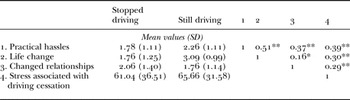
We then examined the extent to which respondents agreed that driving cessation would involve practical hassles, life change and changed relationships with others. Inspection of the means showed that respondents were equally concerned about the extent to which driving cessation would involve practical hassles (mean = 2.27, SD = 1.13), life change (mean = 2.80, SD = 1.18) and changed relationships with others (mean = 1.83, SD = 1.20). However, those who had stopped driving differed from those who were still driving. Those who were still driving were more concerned about the extent to which driving cessation would cause practical hassles (mean = 2.26, SD = 1.11) and life change (mean = 3.09, SD = 0.99) compared to those who had stopped driving, mean = 1.78, SD = 1.11, t(206) = 2.64, p = 0.009 and mean = 1.76, SD = 1.25, t(207) = 7.65, p < 0.001, respectively. Those who were still driving did not differ from those who had stopped driving in the extent to which they were concerned about changing relationships with others, mean = 1.76, SD = 1.14 and mean = 2.06, SD = 1.40, respectively, t(206) = 1.52, p = 0.130 (see Table 1).
Descriptive statistics and bivariate correlations

Notes: Bivariate correlations are based on the full sample. Practical hassles, life change and changed relationships were recorded on a scale ranging from 0 = ‘definitely disagree’ to 4 = ‘definitely agree’ whereas stress associated with driving cessation was measured on a 100-point scale from 0 = ‘not at all stressful’ to 100 = ‘as stressful as it can be’. SD: standard deviation.
Significance levels: * p < 0.05, ** p < 0.01.
A regression analysis was conducted to examine among the larger sub-sample of those who were still driving whether the two identity change measures (i.e. life change and changing relationships with others) predicted stress associated with driving cessation over and above concerns about practical hassles. We found that the correlations between these three types of concerns and how stressful they expected driving cessation to be were highly correlated among those who were still driving (practical hassles, r = 0.50, p < 0.001; life change, r = 0.49, p < 0.001; changed relationships with others, r = 0.39, p < 0.001) and not significantly correlated among those who had already stopped driving (practical hassles, r = 0.03, p = 0.821; life change, r = −0.11, p = 0.471; changed relationships with others, r = 0.08, p = 0.597). It thus appears that many of these concerns only underlie stress appraisals in the anticipation of driving cessation. The practical hassles measure was entered at step 1 while life change and changing relationships with others were entered at step 2. We found that, at step 1, practical hassles predicted stress associated with driving cessation, β = 0.50, t(158) = 7.20, p < 0.001, explaining a significant amount of variance, F(1, 158) = 51.80, p < 0.001. At step 2, life change and changing relationships with others predicted a significant amount of additional variance, F change(1, 156) = 7.98, p = 0.001, and both predictors significantly predicted stress associated with driving cessation, β = 0.24, t(156) = 2.94, p = 0.004 and β = 0.17, t(156) = 2.20, p = 0.029, respectively.
Finally, we examined respondents' rating of how stressful they felt certain events would be, including stopping driving. Severely disabling conditions such as ‘having loss of eyesight’, ‘having loss of hearing’, ‘having dementia’, ‘having poor health’ and ‘having loss of memory’ were rated as highly stressful, with average responses between 73 (in the case of hearing loss) and 94 (in the case of eyesight loss). Among these older adults who still lived independently, moving into a nursing home was also rated as highly stressful (mean = 78). In this sample, ‘stopping driving’ was rated as equally stressful as ‘death of a close friend’ (mean = 65 and 67, respectively) and examination of responses by ex-drivers and drivers did not reveal any differences, t(206) = 0.85, p = 0.395. Note too that ratings were much higher than those for other important life transitions such as ‘retiring from paid work’ (mean = 28).
Discussion
Our survey of what older adults think about their age when thinking about driving cessation revealed a tendency among participants to think of themselves as older following driving cessation. In that sense, driving cessation is an important social identity change marker: as evidence that the person has moved from the category of ‘young’ older adults to ‘old’ older adults (see Jetten and Pachana Reference Jetten, Pachana, Jetten, Haslam and Haslam2012). Moreover, such identity change perceptions were more pronounced for those who were still contemplating stopping driving than for those who had actually ceased driving. These results suggest that particularly in anticipation of stopping driving, the state of having stopped driving is more equated with increased age.
When considered as a group, our sample of older adults who had and had not ceased driving were equally concerned about the extent to which driving cessation would involve practical hassles, life change and changed relationships with others. However, those still driving were more concerned about the extent to which driving cessation would cause practical hassles and the extent to which driving cessation would be associated with life change, suggesting that this group's fears about how much their lives would be changed on these two parameters was perhaps in excess of what might actually transpire (suggested by lower levels of concern on these two parameters as expressed by the group who had ceased driving).
The fact that both older adults who had and had not stopped driving viewed ceasing driving as having an impact on relationships with others is notable. Previous identity change research has suggested that regardless of whether change is positive or negative, change may, at least temporarily, affect wellbeing negatively. This is because any type of change is unsettling – it requires re-orientation and adjustment (Ethier and Deaux Reference Ethier and Deaux1994) and is associated with uncertainty, anxiety and the feeling of ‘losing ground’ (Jetten, O'Brien and Trindall Reference Jetten, O'Brien and Trindall2002). This is the main reason why our questionnaire only asked about change, but not the positive or negative direction of this change. However, it may be important to ask participants explicitly whether they perceive driving cessation as positive or negative change and this represents an area for future research to explore.
What older adults think about stopping driving may influence their choices about whether and when to stop driving, as well as behaviours leading up to driving cessation. This is underscored by the level of stressfulness that ceasing driving was rated as by our participants, in a majority on a par with ‘death of a close friend’. A variety of methods of easing the transition to driving cessation status are being developed, with the majority focusing on maintaining safe driving, deciding to stop at appropriate times and addressing practical concerns about transportation after driving cessation (Meuser et al. Reference Meuser, Berg-Weger, Chiball, Harmon and Stowe2013; Molnar et al. Reference Molnar, Eby, St Louis and Neumeyer2008; Windsor and Anstey Reference Windsor and Anstey2006). One approach, which expressly takes a broader approach to driving cessation in the sense of dealing explicitly with both the loss and stress of driving cessation as well as practical concerns (UQDRIVE; Gustafsson et al. Reference Gustafsson, Liddle, Liang, Pachana, Hoyle, Mitchell and McKenna2012), notes that older people indicated they were more comfortable seeking practical support as opposed to social support for driving cessation (Liddle, McKenna and Bartlett Reference Liddle, McKenna and Bartlett2007). It was observed, however, that in setting individualised goals (Gustafsson et al. Reference Gustafsson, Liddle, Liang, Pachana, Hoyle, Mitchell and McKenna2012) and in reflecting on the usefulness of the programme (Gustafsson et al. Reference Gustafsson, Liddle, Lua, Hoyle, Pachana, Mitchell and McKenna2011), older people participating in UQDRIVE strongly expressed the value of social support and recognition in coming to terms with life without driving. In addition, the inclusion of peer leaders who have successfully stopped driving (Liddle et al. Reference Liddle, Liu, Aplin and Gustafsson2015), and the provision of groups that have both retiring and retired drivers, as in the UQDRIVE programme, may assist with the anticipated concerns and fears about driving cessation which are often of significantly greater concern to those who have not yet stopped driving. The inclusion of information about the impact of driving cessation on social identity may enhance the value of a driving cessation programme and help health professionals better meet the needs of this group.
So much of the research on ageing suggests that being mindful of, and working towards, good health and deliberate steps to maximise healthy ageing is an excellent strategy to pursue in mid-life. For example, exercise, healthy eating and robust cognitive and social engagement are all beneficial at any age, but larger benefits may accrue if these measures are started in mid-life (McLaughlin et al. Reference McLaughlin, Leung, Pachana, Flicker, Hankey and Dobson2012; Sabia et al. Reference Sabia, Singh-Manoux, Hagger-Johnson, Cambois, Brunner and Kivimaki2012; Sun et al. Reference Sun, Townsend, Okereke, Franco, Hu and Grodstein2010). However, if driving cessation is viewed so negatively, both in terms of functionality as well as in the potential threats to one's social identity, then the potential need to cease driving may be ignored, with potential significant personal, familial and societal consequences. Both policy makers and practitioners need to be aware of the potential concerns of older persons contemplating driving cessation, and that strategies to encourage positive pro-active consideration of driving cessation need to take both functional and social identity issues into account.
Limitations
This study represents an exploratory survey of the views of older adults considering stopping driving about their perceived age and driving cessation. As participants in this pilot study were in a larger trial of a driving cessation intervention, doubtless this was a group that had considered giving up driving, and could have been much more concerned about the impact of driving cessation than the broader population of similar-aged persons not attending such a class. The results obtained in the current pilot point to potentially fruitful avenues of inquiry to pursue in a larger, more representative sample, particularly in terms of social identity. Including older non-drivers might also afford useful comparisons.
In the current study, the finding that older adults perceive their relationships will change was purposefully not explored as to directionality; thus, this remains an area to be explored further with older adults contemplating ceasing to drive. In future research, assessing whether driving cessation involves ageing in a more unobtrusive way, to obviate this issue of potential demands placed on participants in how to respond to the question of age and driving, would be useful.
Conclusions
Social identity and driving cessation remain relatively unexplored topics in the literature on later life. Anticipated driving cessation often evokes concerns about practical issues of mobility and quality of life, for older adults themselves as well as their families. However, at least equally important is the finding that changes to driving status involve social identity change, potentially leading to consideration of oneself as chronologically older compared to those still actively driving. In this study, participants' expectations about practicalities as well as social identity changes were predictors of the stress associated with driving cessation.
Acknowledgements
We gratefully acknowledge the assistance of the participants of this study, and our support staff and research assistants on the project. The study reported here was funded by an Australian National Health & Medical Research Council Project Grant (Project 455876). The study was conducted in compliance with, and with the approval of, the Behavioural and Social Sciences Ethical Review Committee of The University of Queensland. Pachana and Jetten co-designed the pilot questionnaires within the larger study. Jetten analysed the data. Jetten and Pachana initially drafted the manuscript, at which point all authors contributed to refinements in the original submitted manuscript as well as constructed and reviewed responses to reviewers. There are no known conflicts of interest for any authors of this paper.