Introduction
Obsessive–compulsive disorder (OCD) was traditionally thought to be a rare disorder with a prevalence of 0.03% (Rasmussen & Eisen, Reference Rasmussen, Eisen, Jenike, Baer and Minichiello1998). However, in the Epidemiological Catchment Area (ECA) programme, OCD was found to be the fourth most prevalent psychiatric disorder, with a lifetime prevalence of 1.9–3.3% using DSM-III criteria (Karno et al. Reference Karno, Golding, Sorenson and Burnam1998). Other studies at that time showed similar prevalence rates (Rasmussen & Eisen, Reference Rasmussen, Eisen, Jenike, Baer and Minichiello1998). However, studies using DSM-III-R and DSM-IV criteria generally show lower lifetime prevalence rates: 0.5–2.3% (Stein et al. Reference Stein, Forde, Anderson and Walker1997; Bijl et al. Reference Bijl, Ravelli and van Zessen1998a; Grabe et al. Reference Grabe, Meyer, Hapke, Rumpf, Freyberger, Dilling and John2000; Jacobi et al. Reference Jacobi, Wittchen, Holting, Höfler, Pfister, Müller and Lieb2004; Mohammadi et al. Reference Mohammadi, Ghanizadeh, Rahgozar, Noorbala, Davidian, Afzali, Naghavi, Yazdi, Saberi, Mesgarpour, Akhondzadeh, Alaghebanrad and Tehranidoost2004; Kessler et al. Reference Kessler, Chiu, Demler, Merikangas and Walters2005; Ruscio et al. Reference Ruscio, Stein, Chiu and Kesslerin press). This might be because of the definition of the disorder in DSM-III-R and DSM-IV (Crino et al. Reference Crino, Slade and Andrews2005), the population studied, the instrument used, the interviewer (lay or clinician) and the use of collateral information (family members) (Fontenelle et al. Reference Fontenelle, Mendlowicz and Versiani2006).
For most psychiatric disorders, DSM-III-R and DSM-IV include a criterion that states that the disorder should cause suffering or disturb the social or occupational functioning. However, for OCD this criterion is more strict than for other psychiatric disorders. According to DSM-III-R and DSM-IV (in contrast to DSM-III), the obsessions and/or compulsions should cause severe suffering and they should either exist for ‘at least one hour per day’ or ‘markedly disturb the normal routine, the social or occupational functioning’ (APA, 1994). One reason for introducing this stringent OCD definition has been the unexpectedly high prevalence found for OCD in the general population, which was even labelled as the ‘hidden epidemic’ (Hollander, Reference Hollander1997). The reliability and the validity of these findings from epidemiological studies were called into question because of the use of lay-administered interviews (such as the DIS and the SCID). The more strict DSM-IV definition has serious consequences for the prevalence of this disorder. Crino et al. (Reference Crino, Slade and Andrews2005) found that the 12-month prevalence according to the former DSM-III criteria and the more stringent DSM-IV criteria differed more than threefold (2.1% v. 0.6%). In a recent study on obsessions and compulsions, only 45% of subjects with obsessions and 20% of subjects with compulsions reported being emotionally upset by them whereas the number of subjects reporting that the symptoms existed for more than one hour per day was even lower (Fullana et al. Reference Fullana, Mataix-Cols, Caspi, Harrington, Grisham, Moffitt and Poulton2009). Meanwhile, it is questionable whether the decision to emphasize the severity of the consequences of the disorder in the DSM-IV criteria is valid. We suggest that diagnostic criteria should focus on the pathological symptoms rather than on the consequences.
This stringent ‘severity’ criterion carries the risk of underdiagnosing OCD if the suffering and disability associated with the obsessions and/or compulsions are not acknowledged, either by the patient or by the examiner. OCD patients can present themselves in a relatively healthy way compared to other psychiatric disorders. Chronic patients often have adjusted their lives to their rituals in such a way that it is difficult to clearly point out their suffering and disability. When both the patient and the examiner underestimate the severity and the impact of the symptoms, patients might suffer from OCD but not get a diagnosis. In large, general population studies, where most diagnostic instruments are administered by lay interviewers and no collateral information is gathered, this risk could be substantial.
Subjects who suffer from obsessions and/or compulsions but do not meet all DSM-IV criteria are called subthreshold cases. Two studies have examined the prevalence and characteristics of subthreshold cases and found that the 12-month prevalence of the subthreshold cases varied from 1.6% to 6.4% and that these subjects displayed significant levels of distress and impairment (Grabe et al. Reference Grabe, Meyer, Hapke, Rumpf, Freyberger, Dilling and John2000; Angst et al. Reference Angst, Gamma, Endrass, Goodwin, Ajdacic, Eich and Rössler2004). However, the study by Angst et al. (Reference Angst, Gamma, Endrass, Goodwin, Ajdacic, Eich and Rössler2004) only included adolescents and their diagnostic categories were based on criteria other than just DSM-IV. The Grabe et al. study (Reference Grabe, Meyer, Hapke, Rumpf, Freyberger, Dilling and John2000) did not focus on the severity criterion and used another definition for subclinical OCD. Kim et al. (Reference Kim, Jang and Kim2009) studied a subclinical OCD sample and found deficits in executive functioning; however, these findings showed no longer statistical significance after controlling for the influence of depression and anxiety. Finally, Fullana et al. (Reference Fullana, Mataix-Cols, Caspi, Harrington, Grisham, Moffitt and Poulton2009) studied the prevalence of obsessions and compulsions in subjects with OCD or other mental disorders and found that obsessions and compulsions occur frequently in the absence of OCD and cause significant interference even in the absence of mental disorders according to DSM-IV.
The aim of the present study was to study whether subjects with subthreshold obsessions and/or compulsions suffer less than patients with full-blown OCD according to DSM-III-R. Our main question was whether subthreshold subjects could be discriminated from subjects without obsessions or compulsions on the one hand and from subjects who meet all DSM-III-R OCD criteria on the other, in terms of psychological vulnerability (neuroticism, mastery, coping strategies and self-esteem) and consequences (health and social functioning, psychiatric co-morbidity, seeking treatment).
Method
Subjects
The data were derived from the Netherlands Mental Health Survey and Incidence Study (NEMESIS). The NEMESIS is a prospective study collecting data in three waves (1996, 1997 and 1999) from a national, multi-stage random sample (age 18–64 years) in The Netherlands. The analyses presented here are based on data from the first wave. A total of 7076 people were interviewed and the response rate was 69.7%. The respondents adequately reflect the Dutch population. For more detailed information on the NEMESIS, see the report by Bijl et al. (Reference Bijl, van Zessen, Ravelli, de Rijk and Langendoen1998b).
Instruments
Diagnostic criteria
The Composite International Diagnostic Interview, Version 1.1 (CIDI 1.1) was used to assess DSM-III-R criteria for OCD and also other psychiatric disorders. The CIDI 1.1 is a reliable and validated, fully structured diagnostic interview, enabling us to make diagnoses according to ICD-10 and DSM-III-R criteria (Cottler et al. Reference Cottler, Robins, Grant, Blaine, Towle, Wittchen and Satorius1991). In the CIDI, the DSM-III-R criteria are assessed in a structured way. No additional information (such as the type of obsession and/or compulsion) is gathered in the CIDI. DSM-III-R and DSM-IV criteria for OCD are generally similar (APA, 1987, 1994). The lay interviewers had been given a 4-day training course at the World Health Organization (WHO) CIDI training centre of the Academic Medical Centre in Amsterdam.
Dependent variables
The respondents were divided into three groups: (1) no OCD: subjects without either obsessions or compulsions; (2) subthreshold cases: subjects with obsessions and/or compulsions (the DSM-III-R A criterion) who did not meet the full criteria for OCD; and (3) OCD: subjects who met full DSM-III-R criteria for OCD. OCD diagnoses were made based on the CIDI. Subthreshold cases were all cases that reported having either obsessions or compulsions according to the CIDI, who did not meet full OCD criteria. As recency data were only available for full-blown OCD, and not for subthreshold cases, lifetime diagnoses were used.
Discriminant variables
The following variables were selected to test the discriminant validity of the DSM-III-R criteria for OCD:
(1) Demographic variables. These included sex, educational level, employment rate and living situation (with partner, urban area).
(2) Psychiatric co-morbidity. The lifetime presence of mood disorders, eating disorders, substance-related disorders, schizophrenia and other anxiety disorders according to DSM-III-R was based on the CIDI. To account for the influence of these disorders, an item for ‘other psychopathology’ was created that included mood disorders, eating disorders, substance-related disorders, schizophrenia and other anxiety disorders (except OCD).
(3) Personality and vulnerability traits such as neuroticism, mastery, coping strategies and self-esteem were assessed using the following instruments:
The Groningen Neuroticism Questionnaire is a scale for assessing neuroticism, asking questions on symptoms such as feeling lonely, feeling dizzy, trembling, or having nightmares. A low score indicates a high degree of neuroticism.
Mastery was assessed with the five-item Mastery Scale, in which a high score indicates an internal locus of control, and a low score indicates an external locus of control with feelings of helplessness.
The Rosenberg Self-Esteem Scale attempts to assess a unidimensional measure of global self-esteem. Scores range from 10 to 40, with higher scores indicating higher self-esteem.
The Utrecht Coping List (UCL) evaluates trait-like aspects of coping, and consists of the scales Active Approach, Palliative Reaction, Avoidance, Seeking Social Support, Depressive Reaction, Expression of Emotions and Comforting Cognitions. The UCL has been validated in the Dutch population (Evers et al. Reference Evers, van Vliet-Mulder and Groot2000).
(4) Health and functional status were assessed using the 36-item Short-Form Health Survey (SF-36), the General Health Questionnaire (GHQ) and the Groningen Questionnaire on Social Behaviour (Groningse Vragenlijst over Sociaal Gedrag, GVSG). The SF-36 is a well-validated self-report survey of functional health-related quality of life over the past 4 weeks (Chern et al. Reference Chern, Wan and Pyles2000). It has been translated and validated for Dutch-speaking residents of The Netherlands (Aaronson et al. Reference Aaronson, Muller, Cohen, Essink-Bot, Fekkes, Sanderman, Sprangers, te Velde and Verrips1998). The GHQ is a self-report survey measuring the perceived severity of mental problems. It includes items on being able to sleep and to concentrate, feeling happy, feeling able to cope with difficulties and to make decisions, being able to enjoy things and items on self-image. It has been translated and validated for the Dutch general population (Evers et al. Reference Evers, van Vliet-Mulder and Groot2000). The GVSG is a self-report survey on social functioning and competence during the past 4 weeks. The test has been developed and validated in Dutch-speaking citizens (Evers et al. Reference Evers, van Vliet-Mulder and Groot2000). For the present analyses, the scales Social Role (the extent of daily contact with others) and (the extent of) Leisure Activities were considered most relevant. Furthermore, the number of days spent in bed and the number of days absent from work due to psychological problems in the past 12 months were assessed, and also seeking psychological or psychiatric treatment in the past 12 months.
Data analyses
The discriminant validity was established by comparing the mean scores of the discriminant validators of the groups: no OCD, subthreshold cases and OCD. Means and 95% confidence intervals (CIs) were calculated using weighted data in Stata Statistical Software, release 9 (Stata Corporation, USA), taking into account the study design. Because of the small sample size for the OCD group, we decided not to apply Bonferroni's adjustment. Because of the high rates of co-morbidity, we decided to account for the presence of the psychiatric disorders mentioned above (discriminant variables item 2). We accounted for the influence of other psychopathology on the personality and vulnerability traits and the health and functional status items using SPSS generalized linear models (PASW statistics 17; SPSS Inc., USA).
Results
Of 7076 subjects, 5.8% (n=409) reported having experienced lifetime obsessions or compulsions. The majority of them, 348 subjects (4.9% of the sample), did not meet OCD criteria according to DSM-III-R (subthreshold cases). Sixty-one subjects (0.9% of the sample) met criteria for OCD, 94.2% (n=6667) had neither obsessions nor compulsions (no OCD). The three groups did not show any differences in demographic variables, such as sex, educational level, employment rate or living situation (with partner, urban area).
Psychiatric co-morbidity
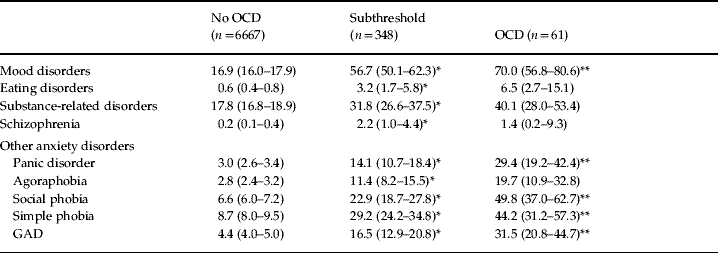
Co-morbidity rates were high for both the OCD group and the subthreshold group, and subthreshold cases had significantly higher co-morbidity rates than subjects without OCD. The subthreshold group differed significantly from the OCD group in mood disorders and in most of the co-morbid anxiety disorders although 95% CIs overlapped in most cases (see Table 1).
Psychiatric co-morbidity for subjects with no OCD diagnosis, subthreshold cases and subjects with OCD according to DSM-III-R

OCD, Obsessive–compulsive disorder; GAD, generalized anxiety disorder.
Values given as percentage (95% confidence interval).
* Significant difference at p<0.05 between no OCD and subthreshold cases.
** Significant difference at p<0.05 between subthreshold cases and OCD.
Personality and vulnerability traits
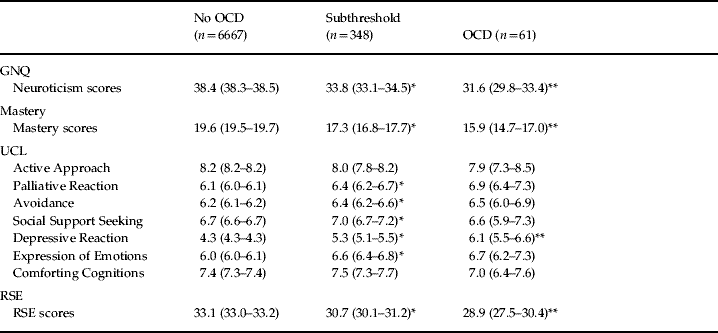
Although the subthreshold group differed significantly from the subjects without OCD on the majority of items, the difference with the OCD group was significant on four items only: the neuroticism item, the mastery score, the depressive reaction and the self-esteem item. In these items, 95% CIs overlapped between the OCD group and the subthreshold group. On the other items, there was no significant difference between the subthreshold group and the OCD group (see Table 2). Other psychopathology had a significant influence on all variables. After accounting for overall psychopathology, the significant differences between the subjects without OCD and the subthreshold group remained intact with one exception: the difference for social support seeking was no longer significant. After accounting for overall psychopathology, the significant differences between the subthreshold group and the OCD group mostly disappeared, with only the depressive reaction item remaining significantly different.
Personality and vulnerability traits for subjects with no OCD diagnosis, subthreshold cases and subjects with OCD according to DSM-III-R
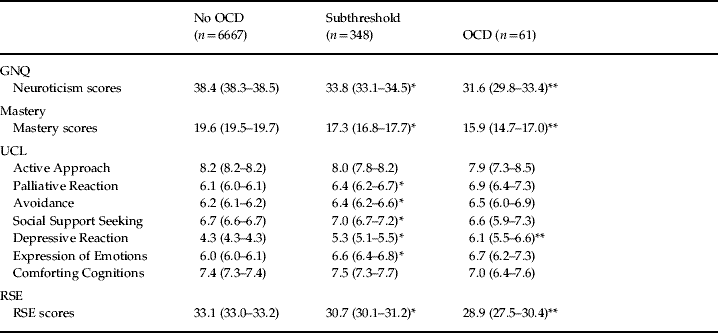
OCD, Obsessive–compulsive disorder; GNQ, Groningse Neuroticism Questionnaire (higher scores indicate less neuroticism); Mastery, five-item Mastery Scale (higher scores indicate more internal locus of control); UCL, Utrecht Coping List; RSE, Rosenberg Self-Esteem (higher scores indicate higher self-esteem).
Values given as mean (95% confidence interval).
* Significant difference at p<0.05 between no OCD and subthreshold cases.
** Significant difference at p<0.05 between subthreshold cases and OCD.
Health and functional status
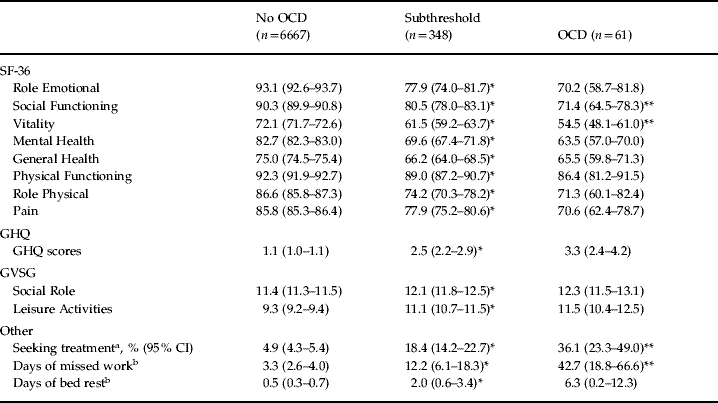
The subthreshold cases differed significantly from the subjects without OCD on all items of the instruments for measuring health and functional status: the SF-36, the GHQ and the GSVG. The subthreshold cases differed from the OCD group on two SF-36 items (social functioning and vitality, 95% CIs overlapped) and did not differ from the OCD group on the GHQ and GSVG items (see Table 2). The subthreshold cases sought treatment less frequently and missed work less frequently than subjects with OCD, but they did not differ on the bed rest item. The subthreshold cases sought help more frequently, missed more days at work and had more bed rest due to psychological problems than subjects without OCD (see Table 3). Other psychopathology had a significant influence on all these items as well. However, after accounting for other psychopathology, all differences between the subjects without OCD and the subthreshold cases remained significant. The significant differences between the subthreshold group and the OCD group also remained intact, with the exception of the vitality item: this difference was no longer significant.
Health and functional status for subjects with no OCD diagnosis, subthreshold cases and subjects with OCD according to DSM-III-R

SF-36, 36-item Short Form health survey (higher scores indicate better conditions); GHQ, General Health Questionnaire (higher scores indicate worse conditions); GSVG, Groningen Questionnaire on Social Behaviour (higher scores indicate worse conditions); CI, confidence interval.
Values given as mean (95% confidence interval) unless stated otherwise.
a Seeking psychological or psychiatric treatment during the past 12 months.
b Days of missed work/bed rest due to psychological problems during the past 12 months.
* Significant difference at p<0.05 between no OCD and subthreshold cases.
** Significant difference at p<0.05 between subthreshold cases and OCD.
Discussion
In this large, general population study we found a high lifetime prevalence of obsessions and compulsions. We found that the presence of obsessions and compulsions was associated with high co-morbidity rates. Furthermore, obsessions and compulsions had a great impact on health and functional status and several aspects of psychological vulnerability, even after accounting for the influence of other psychopathology.
Additionally, our results question the validity of the stringent DSM III-R/DSM-IV criteria for OCD. On the majority of the items measured, there was no difference between the group with full-blown OCD and the subthreshold group, who did report obsessions and/or compulsions but did not meet the full DSM-III-R criteria. In cases where there was a difference, most of the time the 95% CIs overlapped, indicating that the difference was not very robust. Half of these differences no longer remained significant after controlling for the influence of other psychopathology. Furthermore, there was a significant difference between the subthreshold group and the subjects without OCD on nearly all items, even after controlling for the influence of other psychopathology, indicating that the presence of obsessions and compulsions per se is associated with psychological vulnerability and also with negative consequences on health and functioning.
Although the criterion differentiating between subthreshold cases and OCD concerns the severity of suffering and the impact of the consequences, subjects scoring negatively on this item (the subthreshold cases) did not perform much better on items concerning health, psychological and functional status than the ‘true’ OCD cases.
Some earlier studies have examined subthreshold OCD subjects. In the general population study of Grabe et al. (Reference Grabe, Meyer, Hapke, Rumpf, Freyberger, Dilling and John2000), a comparison was made between OCD (12-month prevalence 0.4%) and ‘subclinical OCD’ (1.6%). Diagnoses were made using the CIDI. In their study, subclinical OCD was defined as having obsessions or compulsions plus at least one additional formal criterion, including the time and distress criteria according to DSM-IV. This definition is more stringent than ours (having obsessions or compulsions without further restrictions). In general, our results match theirs. However, although they used a more stringent definition of subclinical OCD than ours, they did find some differences between OCD and subclinical OCD: their subjects with OCD were less frequently employed and married than subclinical subjects and, like our subjects, sought more help. For quality of life and missing days at work, their results equal ours: OCD and subclinical OCD do not differ, both groups perform worse than controls. In our study, a much broader variety of outcome variables was studied.
The study by Angst et al. (Reference Angst, Gamma, Endrass, Goodwin, Ajdacic, Eich and Rössler2004) examined the prognosis of OCD and subthreshold cases among adolescents in the community, starting in 1979 with a 20-year follow-up. In their study, the Structured Psychopathological Interview and Rating of the Social Consequences for Epidemiology (SPIKE) was used to assess psychopathology, in which an item for distress is incorporated. In their diagnoses, the level of distress was used to determine a difference between obsessive–compulsive disorder (significant distress, 12-month prevalence 0.7%), obsessive–compulsive syndrome (moderate distress, 2.5%) and obsessive–compulsive symptoms (just symptoms, 3.9%). The three categories did not differ in their ability to predict having OCD at follow-up.
Ruscio et al. (Reference Ruscio, Stein, Chiu and Kesslerin press) studied the prevalence of obsessions, compulsions and OCD in a nationally representative survey and found a lifetime prevalence of 2.3% for OCD and 28.2% for obsessions or compulsions.
Fullana et al. (Reference Fullana, Mataix-Cols, Caspi, Harrington, Grisham, Moffitt and Poulton2009) studied the prevalence of obsessions and compulsions in a young community sample at ages 26 and 32 using DIS-IV, administered by health-care professionals. They also found much higher prevalence rates: the year prevalence of OCD was 1.8–2.3% and the year prevalence of obsessions and compulsions was as high as 21–25% (at ages 26 and 32 respectively). Their analyses were the other way around than ours: they studied the prevalence of obsessions and compulsions in several psychiatric disorders. They found a significant association between obsessions and compulsions and the presence of other Axis I disorders and they also found that, even in the absence of other mental disorders, obsessions and compulsions still caused significant interference.
Our results and the results of some of the studies mentioned above show a similarity between subjects meeting all DSM-III-R/DSM-IV criteria for OCD and the subthreshold subjects. Although the main difference between these two groups concerns an item regarding the severity of the suffering and disability caused by the obsessions and compulsions, we did not find many differences regarding suffering and disability (in terms of health and functional status) between OCD subjects and subthreshold subjects. We did find differences on missing work, seeking treatment and on several items regarding the psychological vulnerability; the latter differences were small in absolute numbers and the CIs overlapped, so from both a clinical and a statistical point of view these differences were not very relevant. Apparently, both groups experience a generally comparable amount of suffering and disability, but the subthreshold subjects do not attribute this to their obsessions and compulsions (thus scoring negatively on the item whether the obsessions and compulsions cause severe suffering and disability). Following this thought it could be suggested that the severity criterion is a measure for awareness of illness (do subjects attribute the suffering and disability they experience to their obsessions and compulsions?) rather than a measure for the impact of the disease. The fact that subjects with OCD display more ‘patient behaviour’ (missing work, seeking treatment) than subthreshold subjects corresponds with this ‘awareness of illness hypothesis’. Nevertheless, the proportion of subthreshold subjects that seek help is still considerable in absolute numbers. Following DSM-III-R/DSM-IV rules strictly might result in withholding reimbursement of treatment-related expenses. However, on the basis of our findings we do not state that all subthreshold cases should be regarded as having OCD. This view would carry the risk of overdiagnosing, with the disadvantage of pathologizing normal subjects, increasing health costs and impeding the identification of adequate patients for research proposals. Perhaps a dimensional view of obsessive–compulsive symptoms would do more justice to reality.
The strengths and limitations of the current study deserve further comment. This study is a large, representative general population study, in which diagnostic criteria are made using a validated instrument. Of course, it is necessary to be cautious about interpreting CIDI items as DSM criteria. Other interviews might yield different results. However, the CIDI has been well validated against other structured interviews (Peters & Andrews, Reference Peters and Andrews1995; Komiti et al. Reference Komiti, Jackson, Judd, Cockram, Kyrios, Yeatman, Murray, Hordern, Wainwright, Allen and Singh2001). It has been suggested that CIDI administered by lay interviewers tends to overdiagnose OCD. However, when compared to prevalence rates found by skilled mental health professionals, NEMESIS rates for OCD are fairly low (Bijl et al. Reference Bijl, Ravelli and van Zessen1998a; Fontenelle et al. Reference Fontenelle, Mendlowicz and Versiani2006; Fullana et al. Reference Fullana, Mataix-Cols, Caspi, Harrington, Grisham, Moffitt and Poulton2009).
In the present study all subjects experiencing either obsessions or compulsions were examined. However, a limitation to our study is that we had to use lifetime diagnoses, which carries the risk of including subjects who once had (subthreshold) OCD and are currently in remission. However, because OCD is a chronic disorder with low rates for full remission (Eisen et al. Reference Eisen, Goodman, Keller, Warshaw, DeMarco, Luce and Rasmussen1999; Skoog & Skoog, Reference Skoog and Skoog1999; Steketee et al. Reference Steketee, Eisen, Dyck, Warshaw and Rasmussen1999; Reddy et al. Reference Reddy, D'Souza, Shetti, Kandavel, Deshpande, Badamath and Singisetti2005), the subjects currently in remission probably represent a minority. For comparison, in the Grabe et al. (Reference Grabe, Meyer, Hapke, Rumpf, Freyberger, Dilling and John2000) study, the lifetime prevalence of OCD was 0.5%, the 12-month prevalence was 0.4%, and for subclinical OCD these prevalence rates were 2.0% and 1.6% respectively. In the recent National Comorbidity Study Replication, the difference was somewhat larger: the lifetime prevalence for OCD was 2.3% and the year prevalence was 1.2% (Ruscio et al. Reference Ruscio, Stein, Chiu and Kesslerin press). The findings of Angst et al. (Reference Angst, Gamma, Endrass, Goodwin, Ajdacic, Eich and Rössler2004) indicate that OCD and subthreshold obsessions and compulsions do not differ significantly in course. Using 12-month diagnostic data instead of lifetime data would probably have resulted in slightly greater differences between the subthreshold group and the subjects without OCD, but there is no reason to assume that there would be more differences between the subthreshold group and the OCD group, as both contain a (probably similar) proportion of subjects currently in remission.
Finally, because we used a general population sample, the OCD group in addition to the subthreshold group might include a relatively large proportion of mild cases. More research is needed in clinical settings.
To summarize, the prevalence of experiencing obsessions and compulsions in this general population study was 5.8% whereas the prevalence of OCD was only 0.9%. The strict criteria for OCD in DSM-III-R and DSM-IV have had enormous consequences for the prevalence of this disorder. The majority of the subjects with obsessions and compulsions do not meet the current criteria for OCD. More research is needed on the subthreshold cases and the optimal criteria for setting the threshold. Other possible diagnostic criteria might be compared to the present criteria. As in other psychiatric disorders, also in OCD a dimensional view of diagnoses might be more appropriate. Furthermore, the subthreshold subjects could be studied in other settings (clinical settings, general practitioners) and other measures of disability might be investigated. Finally it would be interesting to examine the follow-up of the subthreshold cases: should they be viewed as a pre-stage of OCD, do they stay ‘subthreshold’ or do the subthreshold symptoms go in remission? Nevertheless, our data show that these subthreshold subjects display generally comparable health and functional status, co-morbidity rates and psychological vulnerability as subjects with OCD. The current diagnostic criteria do not diagnose these subthreshold subjects, which carries the risk of withholding adequate treatment or reimbursement of treatment-related expenses. These findings are in accordance with other findings evaluating the relevance of other subthreshold disorders in psychiatry (Cuijpers et al. Reference Cuijpers, de Graaf and van Dorsselaer2004; Batelaan et al. Reference Batelaan, De Graaf, Van Balkom, Vollebergh and Beekman2007). We recommend that these subthreshold cases and the diagnostic threshold receive special attention in the development of DSM-V.
Declaration of Interest
None.