Introduction
Adolescence is a period of neural and physical development augmented by increased environmental demands. Behavioural changes characteristic of this period such as risk taking are linked to neural immaturity (Ernst et al. Reference Ernst, Pine and Hardin2006), particularly in the prefrontal cortex, one of the last brain regions to mature (Casey et al. Reference Casey, Giedd and Thomas2000). The triadic model of motivated behaviour seeks to explain the processes underlying risk taking and its emergence during adolescence (Ernst et al. Reference Ernst, Pine and Hardin2006). The model proposes that decision-making behaviour is coordinated by the medial and ventral prefrontal cortices, which balances input from reward-seeking (ventral striatum) and harm-avoidant regions (amygdala circuits). During adolescence, prefrontal regulation is biased towards reward-seeking inputs, thus tipped towards choosing rewarding yet risky behaviours. In healthy adults, prefrontal regulation has developed such that reward-seeking and harm-avoidant ‘behavioural brakes’ are in balance. Thus, the triadic model suggests that a lack of prefrontal cortex maturity influences behaviour during adolescence, in particular risky, reward-driven decision making.
The reward-driven behaviour exhibited by adolescents takes many different forms and its nature and degree will be subject to individual differences. Because of its characteristics as a risky, reward-driven behaviour, heedless of long-term consequences, we conceptualize self-harm (SH) as occurring at the extreme end of this spectrum. Its specific link to adolescence, namely an increased prevalence and comparative low levels in adulthood (Hjelmeland & Groholt, Reference Hjelmeland and Groholt2005), further suggests that it could be linked to prefrontal cortex function and immaturity. A comparison of prefrontal cortex functioning in healthy and self-harming adolescents may therefore be important in understanding more about SH.
In the present study we used two measures to compare self-harming adolescents with healthy and depressed groups to test the hypothesis that SH behaviour may be associated with frontal lobe function. First, we used the Iowa Gambling Task (IGT), a decision-making test considered to be a measure of orbitofrontal cortex function, in particular the ventromedial prefrontal cortex (VMPFC). Lesion studies show that impaired performance on the IGT, characterized by persistent high-risk choices, is associated with damage to the VMPFC (Bechara et al. Reference Bechara, Damasio, Damasio and Anderson1994, Reference Bechara, Damasio, Tranel and Damasio1997, Reference Bechara, Damasio, Damasio and Lee1999). IGT results indicate that adolescents have poorer decision-making skills than adults (Overman et al. Reference Overman, Frassrand, Ansel, Trawalter, Bies and Redmond2004) and performance steadily improves with development throughout teenage years, into adulthood (Crone & van der Molen, Reference Crone and van der Molen2004; Hooper et al. Reference Hooper, Luciana, Conklin and Yarger2004; Overman et al. Reference Overman, Frassrand, Ansel, Trawalter, Bies and Redmond2004), thus the task appears to be sensitive to prefrontal cortex development. Decision-making deficits measured using the IGT have also been observed in adults who engage in reward-driven behaviours such as substance misuse (Grant et al. Reference Grant, Contoreggi and London2000), pathological gambling (Cavedini et al. Reference Cavedini, Riboldi, D'Annucci, Belotti, Cisima and Bellodi2002a), obsessive–compulsive disorder (Cavedini et al. Reference Cavedini, Riboldi, D'Annucci, Belotti, Cisima and Bellodi2002b), borderline personality disorders (Haaland & Landro, Reference Haaland and Landro2007) and eating disorders (Cavedini et al. Reference Cavedini, Bassi, Ubbiali, Casolari, Giordani, Zorzi and Bellodi2004; Boeka & Lokken, Reference Boeka and Lokken2006; Tchanturia et al. Reference Tchanturia, Liao, Uher, Lawrence, Treasure and Campbell2007). Poor decision making on the IGT has also been observed in adult suicide attempters, where it appears to be trait-like and stable even after recovery from depression (Jollant et al. Reference Jollant, Bellivier, Leboyer, Astruc, Torres, Verdier, Castlenau, Malafosse and Courtet2005). We predicted that deficits on the IGT would also be observed in young people who have self-harmed.
Second, we assessed problem-solving skills using the Means–Ends Problem-Solving Procedure (MEPS). Decision making is a component of global problem-solving skills, defined by D'Zurilla & Goldfried (Reference D'Zurilla and Goldfried1971) in five stages: problem orientation, definition, generation of solutions, decision making, and solution implementation. The MEPS focuses on the initial steps of the problem-solving process (problem orientation/definition, solution generation) and includes no solution implementation. It assesses social problem solving, which is pertinent because people who SH indicate that interpersonal problems act as triggers (McLaughlin et al. Reference McLaughlin, Miller and Warwick1996) and that they engage in SH ‘to obtain relief’ or ‘to escape’ (Boergers et al. Reference Boergers, Spirito and Donaldson1998). Lesion studies suggest that performance on this type of problem-solving task is impaired following non-specific lesions to the frontal lobes, not necessarily including the orbital frontal cortex (Channon & Crawford, Reference Channon and Crawford1999). It has been demonstrated in one particular case study, with specific damage to the VMPFC, that MEPS ability is preserved, despite impaired performance on the IGT (Saver & Damasio, Reference Saver and Damasio1991). Previous studies using the MEPS with adults who have attempted suicide found impaired problem solving, and, as with the IGT, the deficit has been noted to persist even after an improvement in mood (Pollock & Williams, Reference Pollock and Williams2004). Only a few studies have used the MEPS in adolescent SH samples and the results are inconclusive: some report no differences from matched controls and those finding deficits tend to suggest that they are mediated by co-morbid depression or have not controlled for this (see Speckens & Hawton, Reference Speckens and Hawton2005 for review). Thus, the existence of problem-solving deficits underpinning SH in adolescents remains somewhat uncertain and requires further investigation.
Both IGT and MEPS measures are objective and provide an indication of real-life behaviour rather than self-reported problem-solving ability, yet the MEPS taps into rather different aspects of problem solving to the IGT; it is not a measure of risky or reward-driven behaviour and may reflect performance of different brain regions. In light of previous research using the MEPS in SH populations, we predicted that performance on this task would be a function of depression rather than SH per se. Furthermore, if SH is uniquely linked to VMPFC-mediated decision making, this implies that depressed adolescents who self-harm will not be more impaired on the MEPS task than depressed adolescents with no SH history.
The present study investigated decision making and problem solving in adolescents who self-harm compared with a non-clinical healthy control group and a non-self-harming depressed control group. To assess whether performance on the tasks is consistent and trait-like, regardless of recovery from SH, secondary analyses compared the performance of adolescents currently self-harming to that of those who no longer self-harmed.
Method
Participants
One hundred and thirty-three participants aged between 12 and 18 years were recruited from a Community Child and Adolescent Mental Health Service (CAMHS) in London or through schools and contacts to form three groups: the SH group (n=54), a depressed group (n=22), and a healthy control group (n=57). Written informed consent was obtained prior to the study from all adolescents, and from parents of those aged under 16 years. The study was approved by the Joint South London and Maudsley NHS Trust Research Ethics Committee.
Inclusion in the SH group required a history of SH and for CAMHS patients this had to be their presenting problem. Self-harm was defined as any self-injurious act purposefully carried out, regardless of underlying intent. Thus, suicidal and non-suicidal acts were included (Fortune & Hawton, Reference Fortune and Hawton2005). Inclusion in the depressed control group required no history of SH, plus a primary clinical diagnosis of depression (if treated in the CAHMS) or a score above the clinical cut-off of 27 points recommended by the National Institute for Health and Clinical Excellence guidelines (NICE, 2005) on the Mood and Feelings Questionnaire (MFQ). Two participants included in the depressed group had diagnoses of depression from a CAMHS clinician but did not score in the clinical range on pure self-report. Exclusion criteria were IQ below 70, history of serious head injury, current use of medication affecting attention or primary psychiatric diagnosis other than depression or SH.
CAMHS participants were referred by clinicians and included in SH or depressed groups as appropriate. Participants recruited from schools/contacts local to the CAMHS team were screened using the MFQ and a Clinical and Demographic Questionnaire and subsequently assigned to the relevant group depending on disclosure of SH and MFQ score. All measures and tasks were completed in a random order in one 45-minute sitting, or screening was completed in one session and outstanding measures completed within 2 days. In case of distress resulting from disclosure, all participants were advised of a named counsellor and of contact details for a children's telephone counselling service.
A total of 224 participants were screened for participation. Of these, 15 were excluded for failure to complete assessments (due to school-imposed time restraints), IQ <70 or age >18 years. Seventy-five healthy participants were excluded after screening/assessment to match this sample closely to the SH group on gender and age.
Some adolescents had self-harmed in the past but reported that they no longer engaged in this behaviour. The distribution of SH behaviour indicated that 55% (n=30) of participants had experienced an SH episode within the previous 30 days and another 30% (n=16) had not self-harmed for 6 months or more, with the remainder falling in between. On the basis of this spread, it was decided to use a median split and take 30 days as a cut-off, creating two groups: Current Self-Harm (last SH episode ⩽1 month ago; n=30) and Past Self-Harm (last SH episode occurred >1 month ago; n=24). Four participants (all in the SH group: three current, one past) were taking antidepressants.
Measures
Background information and symptom assessment
Clinical and Demographic Questionnaire
This self-report questionnaire obtained basic background information and history of SH behaviours, such as frequency, duration and type of act(s).
Mood and Feelings Questionnaire, Child Report Version (MFQ-C; Costello & Angold, Reference Costello and Angold1988)
The MFQ-C (long version) is a self-report measure of depression designed for children and adolescents consisting of 33 items covering depressive symptoms and behaviour in the 2 weeks preceding assessment. The maximum score is 66. The accuracy of the MFQ in detecting cases meeting DSM-IV criteria for major depressive disorder in adolescents (Kent et al. Reference Kent, Vostanis and Feehan1997), high internal consistency (Cronbach's α=0.94) and stable scores at retest (Wood et al. Reference Wood, Kroll, Moore and Harrington1995) have been demonstrated. Guidelines from NICE (2005) conclude that the MFQ has good diagnostic validity with acceptable case detection of depression using a cut-off of 27 points or more.
Wechsler Abbreviated Scale of Intelligence (WASI; Psychological Corporation, 1999)
This short measure of intelligence can be completed using four or two subtests to gain an estimate of Full-Scale IQ. The two-subtest version comprises vocabulary and matrix reasoning assessments and was considered appropriate for the current study, which needed a brief and efficient estimate of intelligence.
Problem-solving measures
Iowa Gambling Task (IGT; Bechara et al. Reference Bechara, Damasio, Tranel and Damasio1997)
The IGT is a computerized task played by selecting one card at a time from a choice of four decks displayed on the screen. With each selection, the participant wins some money, or wins then immediately loses. Participants are instructed to win as much money as possible and are told it is impossible to predict when a loss will occur. They do not know that two decks are disadvantageous because they are high-risk and result in overall net loss (big wins, but even more money lost; decks A and B), and two are advantageous low-risk decks leading to an overall net win (lower wins offset by even smaller losses; decks C and D).
Participants' progress is displayed during the task by a horizontal bar that changes length relative to the amount of money won or lost. Instructions in this study followed the format given by Bechara et al. (Reference Bechara, Damasio, Damasio and Lee1999) ; participants were not told that the task would last 100 selections, but did know that it was not random and they would lose more on some decks than on others. Participants worked for points, not actual performance-dependent financial reward.
Participants' performance was measured using High-Risk Choices [mean number of ‘high-risk’ cards (decks A+B) chosen during the task] and Net Score {calculated by subtracting total number of high-risk cards chosen from the sum of low-risk card choices [decks (C+D)−(A+B)]}. Previous research in a similar population of adults with a history of suicide attempts (Jollant et al. Reference Jollant, Bellivier, Leboyer, Astruc, Torres, Verdier, Castlenau, Malafosse and Courtet2005, Reference Jollant, Buresi, Guillaume, Jaussent, Bellivier, Leboyer, Castelnau, Malafosse and Courtet2007) and observations made by the task's developers (Bechara et al. Reference Bechara, Damasio, Tranel and Damasio1997, Reference Bechara, Damasio, Tranel and Damasio2005) suggest that choice 50 is the threshold between two different phases of the task: the average point where healthy controls switch from choosing equal numbers of high- and low-risk cards, to making more low-risk choices. Therefore, two Intermediate Net Scores (net scores for choices 1–50 and 51–100) were also calculated to investigate whether a change in strategy occurred.
The task is considered to be a good model of real life because it requires participants to apply decision making in the context of uncertainty; participants cannot predict degree or timing of punishment. This ‘ecological validity’ of the IGT has been demonstrated in a comparison of scores with real-life behaviour (Verdejo-Garcia et al. Reference Verdejo-Garcia, Bechara, Recknor and Perez-Garcia2006).
Means–Ends Problem-Solving Procedure (MEPS; Platt & Spivack, Reference Platt and Spivack1975)
This study used a modified version of the MEPS consisting of four stories told in the first person, each focusing on a different type of social relationship: current and prospective peer friendships, adult and partner. The original MEPS has been shortened in this way by several previous studies (e.g. Marx et al. Reference Marx, Williams and Claridge1992; Goddard et al. Reference Goddard, Dritschel and Burton1996; Sutherland & Bryant, Reference Sutherland and Bryant2008), including two that specifically adapted the task to include the same scenarios pertinent to SH used in the present study (Linehan et al. Reference Linehan, Camper, Chiles, Strosahl and Shearin1987; Hawton et al. Reference Hawton, Kingsbury, Steinhardt, James and Fagg1999).
For each scenario, the participant was given the beginning and end of the story and told to fill out the middle part by giving the ideal solution that would connect them. For example, ‘You love your boyfriend/girlfriend very much, but you have many arguments and one day (s)he leaves you. The story ends with everything being fine between you and your boyfriend/girlfriend. You begin where your boyfriend/girlfriend has just left you.’
Participants had a paper copy of the stories presented randomly. Each one was read aloud by the researcher immediately prior to the answer being given. Answers were given verbally, audiotaped and later transcribed to eliminate effects of problems such as dyslexia.
MEPS stories were scored according to the number of Relevant Means (RM) provided, defined as discrete steps taken from the beginning of the story that each bring the participant closer to the described end. Steps lacking detail, for example ‘we sort things out’ with no explanation of how things were resolved, were not considered to be RM. RM were broken down into those that were ‘Active’ (relied solely on actions of the participant) and those that were ‘Passive’ (someone else in the story completed a step or acted on the participant's behalf). An additional score of Effectiveness was rated on a five-point scale devised by the investigators based on the D'Zurilla & Goldfried (Reference D'Zurilla and Goldfried1971) definition of effective problem solving. A sum of scores across all stories for variables RM, means lacking detail, active means, passive means and effectiveness rating were calculated.
The MEPS was scored by two independent raters and inter-rater reliability was mostly excellent, with κ values ranging from 0.91 to 0.99. One MEPS variable (passivity) had a satisfactory reliability of 0.78.
Statistical analysis
Demographic variables were not normally distributed, thus Kruskal–Wallis tests were followed with Mann–Whitney U tests.
To assess the effect of age, level of depression and IQ on task performance, regression analyses were completed for IGT net score and intermediate net scores and for all MEPS variables. IQ was the only variable to significantly predict IGT scores (accounting for 4–4.5% of variance). MEPS performance on variables relevant means and effectiveness of solution were predicted by age (accounting for 3.8–4.3% of variance) and depression score predicted the passivity of answers (accounting for 3.4% of variance). Although all relationships were weak, we aimed to eliminate these potential confounds by including appropriate variables as covariates in subsequent analyses.
One-way analyses of covariance (ANCOVAs) were completed for IGT Net Scores and all MEPS variables, using relevant covariates, for two separate group comparisons: (1) main group comparison (SH, depressed controls, healthy controls) and (2) SH group comparison (current SH, past SH). Because of multiple MEPS variable comparisons, Bonferroni corrections were applied and significance was set at p<0.01 (p<0.05/five variables).
As intermediate net scores and high-risk choices did not meet assumptions for parametric analysis, non-parametric within-group (Wilcoxon signed ranks test) and between-group analyses (Kruskal–Wallis tests/Mann–Whitney U tests) were used respectively. Bonferroni corrections for multiple within-group comparisons set significance for these analyses at p<0.01 (p<0.05/five analyses).
Correlation analyses used Pearson's correlation coefficient for normally distributed data and Spearman's correlation coefficient for non-normally distributed scores.
Results
Demographic and SH variables
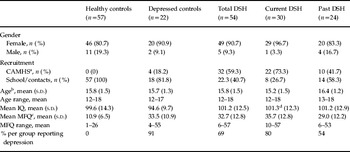
Table 1 summarizes group demographic features. Groups had similar ages, gender ratios and IQs. There was a significant group difference on MFQ score (χ2=72.8, p<0.001); SH and depressed groups reported significantly higher levels of depression than healthy controls (p's <0.000). Significantly more SH participants than depressed participants were recruited from a CAMHS (U=350.0, p<0.01).
Demographic characteristics of all participants

DSH, Deliberate self-harm; CAMHS, Community Child and Adolescent Mental Health Service; MFQ, Mood and Feelings Questionnaire; s.d., standard deviation.
a Significantly more SH participants than depressed participants were recruited from a CAMHS (U=350.0, p<0.01).
b Past SH group significantly older than current SH group (U=246.0, p<0.01).
c Significant group difference on MFQ score (χ2=72.8, p<0.001): healthy controls less depressed than SH or depressed groups (p<0.000).
d Four scores missing.
Direct comparison of current and past SH groups indicated statistically similar gender ratios, IQs and MFQ scores. However, participants who no longer self-harmed were significantly older than those currently self-harming (U=246.0, p<0.01).
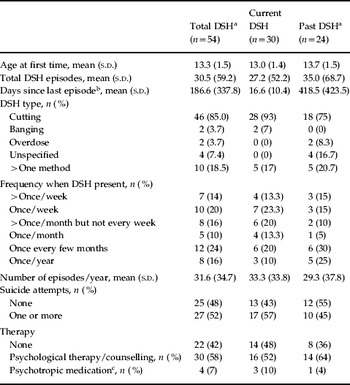
Table 2 gives details of SH history. The current and past SH groups only differed in the recency of their SH episodes (U=0.00, p<0.000, r=−0.8).
Self-harm history and characteristics

DSH, Deliberate self-harm; s.d., standard deviation.
a Data for two participants missing on all variables; data for four participants missing on ‘Frequency when DSH present’ variables.
b Current and past SH groups only differed on duration since last SH episode (U=0.00, p<0.000, r=−0.8).
c Participants receiving psychotropic medication also had psychological treatment.
Task performance
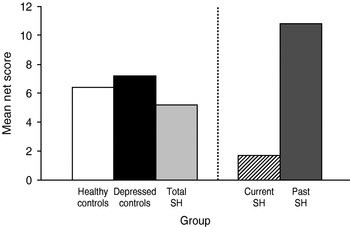
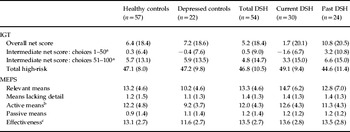
Table 3 summarizes performance on all tasks, adjusted to correct for confounding variables identified using regression. Figures 1 and 2 depict group performances on IGT and MEPS tasks.
Mean net scores on the gambling task for all five groups, after adjustment for IQ. SH, Self-harm.

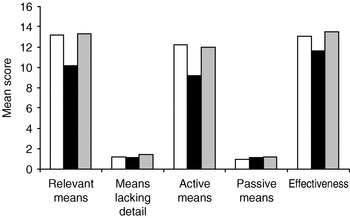
Mean scores on Means–Ends Problem-Solving Procedure (MEPS) variables for three main comparison groups: Healthy Controls (□), Depressed Controls (■) and Self-Harm (SH;  ) participants. MEPS variables were adjusted for age or Mood and Feelings Questionnaire (MFQ) score as appropriate following regression analyses. * Depressed participants produced significantly fewer active means than other groups [F(2, 130)=4.2, p=0.01, r=0.25)]. ** Depressed participants produced significantly less effective means than SH participants [F(2, 129)=4.3, p=0.01].

Summary of result on all problems-solving tasks

DSH, Deliberate self-harm; IGT, Iowa Gambling Task; MEPS, Means–Ends Problem-Solving Procedure.
Values are given as mean (standard deviation).
a All groups significantly improved their score during the task (p's <0.01), except for the current SH group (z=−1.9, p<0.01).
b Significant group differences (on three-group comparison) [F(2, 130)=4.2, p=0.01]; depressed group significantly fewer active means than other groups (p's <0.05).
c Significant group differences (on three-group comparison) [F(2, 129)=4.3, p=0.01]; depressed group significantly fewer active means than SH group (p<0.01).
SH participants versus depressed participants versus healthy controls
Net score
No group differences on overall net score were observed.
Change in card choices during the task
All groups significantly improved their scores over the course of the task (SH: z=−2.6, p<0.01, r=−0.4; depressed: z=−2.9, p<0.01, r=−0.6; healthy controls: z=−3.1, p<0.01, r=−0.4).
High-risk choices
No significant between group differences in the number of high-risk cards chosen were observed.
MEPS variables
The number of active means provided by participants showed significant group differences [F(2, 130)=4.2, p=0.01, r=0.25)], the depressed group generated significantly fewer active means than other groups (p's<0.05). The overall effectiveness of solutions also differed between groups [F(2, 129)=4.3, p=0.01], with the depressed group suggesting solutions that were significantly less effective than those of SH participants (p<0.01).
Current SH participants versus past SH participants
Net score
No significant group differences on overall net score were observed.
Change in card choices during the task
The performance of the past SH group significantly improved during the course of the task (z=2.1, p<0.01, r=0.4) but that of the current SH group did not.
High-risk choices
The current SH group showed a trend towards choosing more high-risk cards than the past group (U=271.5, p=0.06, r=−0.2).
MEPS variables
No significant differences on MEPS variables were found between SH groups.
Correlations and comparisons
IGT variables did not correlate with frequency of SH, total number of episodes or age at first episode. However, relationships with recency of SH were observed (net IGT score: r s=0.3, p<0.05; high-risk choices: r s=−0.3, p<0.05), therefore scores improved as duration since last SH episode increased. MEPS variables did not correlate with any SH variable. MEPS and IGT variables did not correlate with one another.
Recruitment strategy, SH history or change in behaviour due to psychological intervention may have affected performance. However, no significant differences on either task were found when comparing clinical participants recruited from CAMHS versus those recruited from school (n=36 and n=40 respectively). Equally, SH participants who reported a history of suicidal act(s) were no different to those who did not (n=28 and n=26 respectively) and SH participants who had previously received psychological therapy (n=30) were similar to those who had not (n=24).
Discussion
This study examined decision-making and problem-solving skills in adolescents who self-harm as compared with depressed and healthy adolescent controls. It also directly compared those with current and past SH behaviour.
Key findings are that adolescents who have self-harmed, including current and past self-harming young people as a collective group, do not differ significantly from healthy controls or depressed controls in decision making on the IGT. However, when divided out, those who currently self-harm demonstrate poor decision-making skills, indicated by a greater attraction to short-term, high-reward solutions, and poorer adaptation of strategy to avoid long-term punishment, than individuals with a past history of SH. Those with a past history have decision-making skills comparable to those of healthy controls. Decision-making abilities appear to have a direct relationship with recency of SH episodes. By contrast, on the MEPS task, depressed adolescents who have a history of SH, whether current or past, are not impaired, whereas depressed adolescents with no SH history generate fewer and less effective solutions to problems.
Our findings support previous work indicating that the IGT can be used to detect poor decision making associated with risky behaviour in adolescents (Ernst et al. Reference Ernst, Grant, London, Contoreggi, Kimes and Spurgeon2003). The majority of the SH participants in our community sample were self-cutters and female, which reflects previous demographic observations of this group (Hawton et al. Reference Hawton, Rodham, Evans and Weatherall2002) and supports the notion that these findings may be generalized. Our study in part both supports and contrasts with that of Jollant et al. (Reference Jollant, Bellivier, Leboyer, Astruc, Torres, Verdier, Castlenau, Malafosse and Courtet2005), who found that adults who have attempted suicide are significantly poorer than healthy controls on IGT decision making even after recovery from suicidal ideation and axis I disorder. Although our results indicate that some deficits in decision making may exist in adolescents who SH, they appear to be state-like.
Prefrontal cortex development continues throughout adolescence (Casey et al. Reference Casey, Giedd and Thomas2000) and poor, high-risk performance on the IGT is associated with prefrontal cortex deficits (Bechara et al. Reference Bechara, Damasio, Damasio and Anderson1994). We may speculate that our findings suggest that decision making in the VMPFC of adolescents who self-harm is perhaps slightly less developed or deficient as compared with that of adolescents who have ceased SH behaviour. The performance of past SH participants might imply that ‘recovery’ from poor decision making is possible during this developmental stage. Indeed, this period of adolescence may be crucial for working to improve deficient decision making, as Jollant et al. (Reference Jollant, Bellivier, Leboyer, Astruc, Torres, Verdier, Castlenau, Malafosse and Courtet2005) suggest that once poor decision making continues into adulthood, this skills deficit becomes ‘fixed’ and trait-like, associated with vulnerability to adult suicide attempts.
Given the significant age difference between the current and past SH groups, it could be argued that results reflect developmental changes. Although a difference in maturity may well be a factor, both in these findings and in cessation of SH itself, there are several reasons to believe that age at least does not solely underlie these decision-making differences. First, age in the current SH group was not different to age of healthy controls and yet their decision-making scores were lower. Second, age did not correlate with or predict scores on the IGT, and third, current SH performance was similar across ages.
Decision-making deficits are not reflective of overall problem-solving capability. The present study supports the evidence that MEPS deficits may be mediated by underlying depression (Speckens & Hawton, Reference Speckens and Hawton2005), and adds to it by demonstrating that, even after controlling for depression, adolescents with current and previous SH histories are significantly better than depressed adolescents at generating effective and active solutions to problems. It is possible that adolescents who self-harm and are depressed have different characteristics to depressed adolescents who do not self-harm; they are able to generate more solutions but are poorer at choosing or applying appropriate solutions in practice, opting for high-risk, ‘quick-fix’ answers.
Limitations
Improved understanding of the differences between the groups, by including wider assessment of prefrontal function, psychological or behavioural factors could have provided a clearer picture, indicating whether differential prefrontal cortex deficits were factors in the performance of these groups. Addition of skin conductance measures during the IGT could clarify emotional responses to reward and loss. Measures of impulsivity, novelty seeking, reward dependence and emotional tolerance could give insight into differing psychological factors. It has been proposed that decision making on the IGT is guided by emotional feedback (Dunn et al. Reference Dunn, Dalgleish and Lawrence2006, for review) and the VMPFC is implicated in the regulation of emotion (Quirk & Beer, Reference Quirk and Beer2006). Therefore, it is uncertain whether some form of emotional dysfunction in adolescents who self-harm, such as intolerance of uncertainty, poor regulation or high emotional reward response, could have affected their ability to complete the IGT. By contrast, the MEPS relies on hypothetical situations that are not emotionally charged; this could explain the comparably good performance of current SH participants during this task.
Although the comparison of current and past SH participants is robust, we cannot be certain of the decision-making abilities of the past SH group when their SH behaviour was present or whether the current SH group consists of subtly different or more severe cases. A clearer way of demonstrating that cessation of SH and improved decision making are linked would be with a longitudinal study, following the same participants through from current self-harm to cessation, and measuring within-group score changes.
Full diagnostic interviews were not completed with all participants. Therefore, the extent of co-morbidity including inattention due to attention deficit hyperactivity disorder (ADHD) or anxiety disorders cannot be confirmed. However, a recent IGT study on major depressive disorder found that anxiety scores did not correlate with or predict IGT performance (Must et al. Reference Must, Szabo, Bodi, Szasz, Janka and Keri2006).
Furthermore, non-normal distribution of some scores indicates that the study would have benefited from greater participant numbers. Replication with larger numbers, particularly in the depressed group, and more closely age-matched participants is required.
Clinical implications
These findings have implications for the treatment of self-harm and suggest that work to improve decision-making skills in a clinical setting could help young people to move away from self-harm behaviour. Interventions focusing on decision-making development and learning the benefits of low-risk over high-risk solutions are indicated.
In conclusion, poor decision making is poorer in young people who currently self-harm than those with just past history. Deficits are unique to decision making and not reflective of overall problem-solving ability. Improvement of decision-making skills may be linked to recovery from self-harm and both may be mediated, in part, by prefrontal cortex development. The difficulties of adolescents who are depressed and self-harm appear to be distinct from those of depressed young people who do not self-harm.
Acknowledgements
We thank Professor Iain Campbell and Drs Kate Tchanturia, Helen Startup and Frederique Van den Eynde for their thoughtful reviews of early drafts. This study was funded by an Institute of Psychiatry Research and Development Grant.
Declaration of Interest
None.