Introduction
Chickpea (Cicer arietinum L.), also known as Bengal gram or Garbanzo, is one of the earliest food legumes cultivated by man and plays an important role in the human diet and agricultural systems. Currently, chickpea is grown in over 50 countries across all continents with about 89% of area in Asia. During 2010, the global chickpea area was about 12.0 million ha, with a production of 10.9 million metric tons and an average yield of 911 kg/ha (FAOSTAT, 2009). India is the largest chickpea-producing country with a share of about 68% in the global chickpea production (FAOSTAT, 2009). The other major chickpea-producing countries include Australia, Pakistan, Turkey, Myanmar, Ethiopia, Iran, Mexico, Canada and the USA. Chickpea is an important constituent of the diet for people in developing countries who either cannot afford animal proteins or are vegetarian by choice. Chickpeas are rich in protein (20–22%), carbohydrate, fibre, minerals (Ca, Mg, Zn, K, Fe and P) and vitamins (thiamine and niacin) (Williams and Singh, Reference Williams and Singh1987; Zia-Ul-Haq et al., Reference Zia-Ul-Haq, Ahmad, Iqbal, Ahmad and Hakoomat2007; Jukanti et al., Reference Jukanti, Gaur, Gowda and Chibbar2012). Chickpea is a good protein supplement for people with a cereal-based diet and can complement the diet with several essential amino acids.
Two distinct types are recognized in chickpea: ‘Desi’ (microsperma) with pink flowers, anthocyanin pigmentation on stems, small and coloured seed and thick seed-coat; ‘Kabuli’ (macrosperma) with white flowers, lack of anthocyanin pigmentation on stems, white or beige-coloured large seed with ram's head shape, thin seed-coat and smooth seed surface. The Desi types account for about 80% of the total chickpea area. Chickpea ranks second, next to dry beans (Phaseolus vulgaris), in terms of area under cultivation and production (FAOSTAT, 2009). Chickpea is an important legume crop that helps in maintaining/improving soil health through nitrogen fixation (Krouma, Reference Krouma2009).
Chickpea seeds are consumed in a variety of ways with or without decortication (removal of seed-coat). Some of the common ways of using seeds without decortication include boiled or roasted seeds, in preparation of curries, and soaked/boiled and ground to make paste (e.g. hummus). Chickpea seeds, particularly Desi type, are decorticated for making splits (dal) and flour (besan). Chickpea flour, in combination with other flours (such as wheat/rice), is used in making flatbread (chapati) and different snacks and sweets. Volume expansion (after soaking in water) and cooking time are important cooking quality traits in chickpea, particularly in Kabuli type which are mostly cooked as ‘whole grain’ without decortication. Cooking time is generally assessed by the softness of the cooked seeds by applying pressure with the fingers (Singh et al., Reference Singh, Subrahmanyam and Kumar1991).
Though several reports are available on physical and chemical characteristics of chickpea, limited information is available on the differences between Desi and Kabuli types for different cooking quality traits. The information available on the role/influence of phenological, physicochemical properties and seed traits on cooking time is also sparse. Therefore, the present investigation was undertaken to assess the genetic variability in Desi and Kabuli chickpea genotypes for different phenological, physicochemical and cooking quality traits. Further, the interrelationships between these traits were also examined.
Materials and methods
Experimental design, materials and growing conditions
Eighty-six chickpea genotypes (44 Kabuli and 42 Desi), which included cultivars released from ICRISAT-bred materials in nine countries (Australia, Bangladesh, Ethiopia, India, Kenya, Myanmar, Nepal, Sudan and the USA), advanced breeding lines developed at ICRISAT and cultivars/breeding lines developed by the Indian National Agricultural Research System, were studied. The material was grown in vertisols under rainfed condition at ICRISAT, Patancheru, India (17°30′N; 78°16′E; altitude 549 m) during the crop season 2008/2009. The experimental design used was a completely randomized block design with two replications. Each entry was planted in a 4 m row with a row-to-row spacing of 60 cm and a plant-to-plant spacing of 10 cm. All the recommended package of practices was followed to ensure good crop growth. Observations were recorded on days to 50% flowering, days to maturity, number of pods per plant, number of seeds per plant and grain yield per plot (g). The physicochemical parameters and cooking time were assessed at ICRISAT's chickpea breeding laboratory and Quality Control laboratory at Acharya NG Ranga Agricultural University, Hyderabad, respectively. All the laboratory tests were carried out in duplicate.
Physicochemical and cooking characteristics
Hydration capacity, hydration index, swelling capacity, swelling index, cooking time (min) and 100-seed weight were evaluated as described below:
(1) 100-seed weight (g): average weight of two random samples of 100 seeds from each plot.
(2) Hydration capacity (HC, g water/seed): 50 seeds were transferred to a 200 ml Erlenmeyer flask and 100 ml demineralized water was added. The flask was tightly stoppered and left overnight (16 h) at room temperature. The following day, the seeds were drained, superfluous water was removed with help of a paper towel and seeds were reweighed.
 $$\begin{eqnarray} HC = (weight\,after\,soaking - weight\,before\,soaking)/50. \end{eqnarray}$$
(3) Hydration index (HI): the ratio between HC and original weight (HC per seed/original weight per seed [g]).
(4) Swelling capacity (SC, ml/seed): after reweighing, the soaked seeds were transferred to a 200 ml measuring cylinder and 100 ml water was added.
$$\begin{eqnarray} SC = (volume\,after\,soaking - volume\,before\,soaking)/50. \end{eqnarray}$$
(5) Swelling index (SI): the ratio between SC and volume (SC per seed/volume per seed [ml]).
(6) Cooking time (min): 25 seeds of each sample were soaked in 100 ml demineralized water for 12 h. After 12 h, the samples were cooked in 100 ml water at 100°C. The temperature was maintained constant throughout, until the samples were cooked. Seeds were cooked until soft when pressed between the fingers to check for softness.


Statistical analysis
Data were subjected to one-way analysis of variance (ANOVA) using GENSTAT version 8.1. The data were statistically analysed according to Cochran and Cox (Reference Cochran and Cox1992). The significance of difference of treatment means was tested by the ‘F-test’. To see the variation among the traits, phenotypic coefficients of variation (PCV) and genotypic coefficients of variation (GCV) were computed as follows:
 $$\begin{eqnarray} PCV = \left (\sqrt { V _{p}}/\bar {> X }\right )\times 100;\quad GCV = \left (\sqrt { V _{g}}/\bar {> X }\right )\times 100, \end{eqnarray}$$
where V p, V g and X are phenotypic variance, genotypic variance and grand mean of each trait, respectively. Broad-sense heritability (h 2BS) was calculated according to Allard (Reference Allard1999) as the ratio of genotypic variance (V g) to phenotypic variance (V p). Genetic advance (as percentage of mean) assuming selection of the superior 5% of the genotypes was estimated in accordance with Johanson et al. (Reference Johanson, Robinson and Comstock1955) as:
 $$\begin{eqnarray} GA = Kh ^{2}_{BS}\sqrt { V _{p}};\quad GA\,(as\,percentage\,of\,mean) = (GA/\bar {> X })\times 100, \end{eqnarray}$$
where K is the selection differential (2.06 for selecting 5% of the genotypes). Correlation coefficients (r) were computed to examine the interrelationships between all traits studied.
Results
Genotypic differences for phenological, physicochemical and cooking quality traits
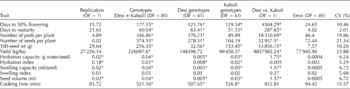
There were significant differences among the genotypes within each type (Desi and Kabuli) of chickpea and between the two types for phenology (days to 50% flowering and days to maturity), seed size (100-seed weight and seed volume), hydration capacity and swelling capacity (Table 1). The two types of chickpea also differed significantly from each other for number of pods per plant, number of seeds per plant and grain yield per plot, although Kabuli genotypes did not show significant differences for any of these traits and Desi genotypes differed significantly only for the first two traits. There was no significant difference between the two types for hydration index and cooking time, while these traits showed significant genotypic variations within each type. Swelling index was the only trait that did not show significant genotypic variations within each type and also between the two types.
Analysis of variance for different phenological, physiochemical and cooking quality traits in 86 chickpea genotypes

*Significant at P = 0.01.
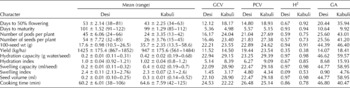
Days to 50% flowering ranged from 34 (ICCV 2, 06301, 07304 and 07308) to 81 (Himchana 1), and days to maturity from 85 (ICCV 2) to 122 (Himchana 1) (Table 2). Seed size (100-seed weight and seed volume) varied significantly more so in Kabuli types (13.5–58.6 g/100 seed; 0.14–0.52 ml/seed) than in Desi types (10.5–26.5 g/100 seed; 0.1–0.25 ml/seed). The Kabuli accession ICC 17 109, which has been reported to be highly resistant to Fusarium wilt (Gaur et al., Reference Gaur, Pande, Upadhyaya and Rao2006), had the largest seed size (seed weight 58.6 g/100 seed; seed volume 0.52 ml/seed), while the green-seeded Desi accession Himchana 1 had the smallest seed size (seed weight 10.6 g/100 seed; seed volume 0.1 ml/seed).
Mean values, ranges and estimates of different genetic parameters for phenological, physiochemical and cooking quality traits in Desi and Kabuli chickpea genotypes

GCV, genotypic coefficient of variation; PCV, phenotypic coefficient of variation; H2, broad-sense heritability; GA, genetic advance (as percentage of mean).
Hydration capacity was higher in Kabuli types (0.19–0.68 g water/seed) compared with Desi types (0.11–0.31 g water/seed), while the hydration index was almost similar in both Desi and Kabuli types (Table 2). Swelling capacity and the swelling index of the different genotypes ranged from 0.11 to 0.70 ml/seed and 2.1 to 2.76, respectively. Similar to 100-seed weight and seed volume, hydration capacity and swelling capacity were highest in ICC 17 109 (0.68 g water/seed; 0.70 ml/seed) and lowest in Himchana 1 (0.11 g water/seed; 0.11 ml/seed). Cooking time showed a large variation in both Desi and Kabuli types (Table 2). A maximum cooking time (125 min) was observed in the case of Kabuli genotype ICCV 92337 (JGK 1), while Desi genotype ICCL 83110 took a minimum time to cook (38 min).
Genetic parameters of different characters
In the case of Kabuli genotypes, the GCV was moderate (18.2–28.9%) for most of the traits studied except for days to maturity, swelling index, hydration index and yield for which it was low (>15%) (Table 2). In Desi genotypes, a moderate value of GCV (22.1–24.53%) was obtained for 100-seed weight, hydration capacity, swelling capacity, seed volume and cooking time while a low GCV was recorded for the remaining traits (Table 2). In general, the magnitude of PCV was moderately higher than the corresponding GCV for most of the traits, indicating a moderate influence of the environment on the expression of these traits.
In both Kabuli and Desi types, high estimates of h 2BS were recorded (0.78–0.98) for days to maturity, 100-seed weight, seed volume, hydration capacity, swelling capacity and cooking time (Table 2). High heritability coupled with high genetic advance was recorded for 100-seed weight, seed volume, hydration capacity, swelling capacity and cooking time in both Desi and Kabuli chickpea genotypes (Table 2). In Kabuli genotypes, high heritability coupled with high genetic advance was also obtained for days to 50% flowering, number of pods per plant and number of seeds per plant (Table 2).
Correlation analysis of different traits
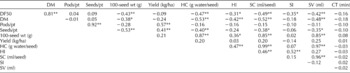
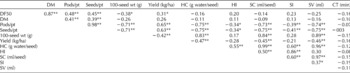
The correlation coefficients between the phenological, physicochemical and seed traits were calculated for Desi and Kabuli types separately (Tables 3 and 4, respectively). Days to 50% flowering was positively correlated with days to maturity and negatively correlated with 100-seed weight in both the types. A significant difference between the Desi and Kabuli types was that both the phenological traits (days to 50% flowering and days to maturity) showed a significant negative correlation with hydration capacity, hydration index, swelling capacity and seed volume only in the Desi type. The number of pods per plant showed a high positive correlation (>0.9) with the number of seeds per plant, and both of these traits were positively correlated with yield in both the types. The number of pods per plant showed a significant negative correlation with 100-seed weight, hydration capacity, hydration index, swelling capacity, swelling index and seed volume only in the Kabuli type, whereas the number of seeds per plant was negatively correlated with 100-seed weight, hydration capacity, swelling capacity and seed volume in both the types and with hydration index and swelling index only in the Kabuli type. In both the types, 100-seed weight showed a significant positive correlation with hydration capacity, swelling capacity and seed volume. Hydration capacity was positively correlated with hydration index, swelling capacity and seed volume in both the types and with swelling index only in the Kabuli type. The hydration index was positively correlated with swelling capacity and swelling index in both the types. Similarly, swelling capacity was positively correlated with seed volume in both the types. The swelling index was positively correlated with hydration capacity, hydration index, swelling capacity and seed volume only in the Kabuli type. It was interesting to note that cooking time did not show a significant correlation with any of the traits in both the types.
Correlation coefficients of different phenological, physicochemical and cooking quality traits in Desi-type chickpea

DM, days to maturity; Pods/pt, pods per plant; Seeds/pt, seeds per plant; HC, hydration capacity; HI, hydration index; SC, swelling capacity; SI, swelling index; SV, seed volume; CT, cooking time; DF50, days to 50% flowering.
*, **Significant at the 5 and 1% level of significance, respectively.
Correlation coefficients among different phenological, physicochemical and cooking quality traits in Kabuli-type chickpea

DM, days to maturity; Pods/pt, pods per plant; Seeds/pt, seeds per plant; 100-seed wt, 100-seed weight; HC, hydration capacity; HI, hydration index; SC, swelling capacity, SI, swelling index, SV, seed volume, CT, cooking time; DF50, days to 50% flowering.
*, **Significant at the 5% and 1% level of significance, respectively.
Discussion
Genotypic variations within each type (Desi and Kabuli) of chickpea were significant for most of the traits studied, indicating that the genotypes included in this study represented considerable variability for these traits. The Desi and Kabuli types differed significantly from each other for all the traits studied, except hydration index, swelling index and cooking time. On average, the Kabuli genotypes were early in phenology (days to 50% flowering and days to maturity) and had lower number of pods per plant, lower number of seeds per plant, larger seed, lower grain yield, and higher hydration and swelling capacity than the Desi genotypes. It is well known that Kabuli types, in general, have larger seeds and lower grain yields than Desi types, which is further supported by the results of this study. Malik et al. (Reference Malik, Maher, Asif, Iqbal and Iqbal2010) also observed that Kabuli genotypes, in general, had high values of seed weight, hydration and swelling capacity than Desi types.
Though there are large genotypic variations for seed size within each type in the germplasm and available cultivars, the consumers' preference for seed size is different for these two types due to the variation in their uses. Globally, the Desi and Kabuli types account for about 80 and 20% of chickpea production, respectively. The bulk of chickpea consumption is in the form of splits (dal) and flour (besan), and these are primarily made from the Desi type. For this reason, small to medium seed size (16–24 g/100 seed) is preferred in the Desi type. There is very little demand for large-seeded Desi chickpea. On the other hand, large seed size (30–60 g/100 seed) is preferred in Kabuli types, which are largely used as whole grains in salads, vegetable curries and other preparations. In general, large-seeded Kabuli chickpeas fetch a higher price than small- and medium-seeded Kabuli chickpeas, and the price premium increases as the seed size increases (Gaur et al., Reference Gaur, Gowda, Knights, Warkentin, Acikgoz, Yadav and Kumar2007).
The magnitude of PCV was moderately high than the corresponding GCV values for most of the traits, indicating that the influence of the environment on the expression of these traits was not high. Several earlier studies have also observed little influence of the environment on the expression of seed physiochemical traits in chickpea (Ali et al., Reference Ali, Maher, Anwar and Haqquani2002; Singh et al., Reference Singh, Yadava and Agarwal2003; Patanè et al., Reference Patanè, Iacoponi and Raccuia2004; Lokare et al., Reference Lokare, Patil and Chavan2007; Malik et al., Reference Malik, Saleem, Iqbal, Zahid, Bakhsh and Iqbal2011).
As estimates of GCV and PCV are not sufficient to understand the expected gains through selection, heritable variation was determined through the estimates of h 2BS. High heritability coupled with high genetic advance was recorded for 100-seed weight, seed volume, hydration capacity, swelling capacity and cooking time in both Desi and Kabuli chickpea genotypes. These results indicate that high heritability of these traits is predominantly due to additive gene action and hence direct selection for these traits is expected to be effective. Genetic advance is expected to be low when heritability is due to a non-additive gene effect (Rajput et al., Reference Rajput, Sarwar and Tahir1987; Sadiq et al., Reference Sadiq, Sarwar and Abbas2000). High heritability coupled with high genetic advance has been reported in chickpea for 100-seed weight, seed volume and swelling index (Pandey et al., Reference Pandey, Rastogi and Geda2007; Malik et al., Reference Malik, Maher, Asif, Iqbal and Iqbal2010).
A significant negative correlation between 100-seed weight and number of seeds per plant indicates strong compensation of the traits where an increase in seed size leads to a reduction in the number of seeds per plant. In Kabuli types, where most genotypes had large seed, seed size was negatively correlated with grain yield. This poses a major challenge in developing large-seeded Kabuli varieties without compromising on grain yield. Increasing seed size over a threshold level (about 35 g/100 seed) in chickpea generally leads to the corresponding decrease in the number of seeds per plant and grain yield. The preference of farmers in growing large-seeded Kabuli chickpea largely depends on the price premium they receive because of large seed size.
Seed volume, swelling capacity and cooking time are important traits for consumers, particularly when whole grains are consumed after soaking and cooking. Physicochemical characteristics such as water-absorbing capacity of the seed have been reported to be determined by cell wall structure, composition and compactness of the cells (Muller, Reference Muller1967). It may also be related to increased permeability and softer seed-coat.
Seed size (100-seed weight) showed a significant positive correlation with hydration capacity, hydration index, swelling capacity and seed volume in both the types of chickpea. Most of the earlier studies have reported a positive relationship between seed weight and hydration capacity (Williams et al., Reference Williams, Nakoul and Singh1983; Singh et al., Reference Singh, Sekhon, Bajwa and Goyal1992; Gil et al., Reference Gil, Nadal, Luna, Moreno and De Haro1996; Kaur et al., Reference Kaur, Singh and Sodhi2005; Iqbal et al., Reference Iqbal, Khalil, Ateeq and Khan2006; Khattak et al., Reference Khattak, Khattak, Mahmood, Bibi and Ihsanullah2006; Nizakat et al., Reference Nizakat, Khattak, Khattak, Mehmood and Ihsanullah2006; Özer et al., Reference Özer, Karaköy, Toklu, Baloch, Kilian and Özkan2010et al., 2010; Malik et al., Reference Malik, Maher, Asif, Iqbal and Iqbal2010). There are also reports on the positive correlation of seed weight with seed volume (Malik et al., Reference Malik, Maher, Asif, Iqbal and Iqbal2010) and swelling capacity (Gil et al., Reference Gil, Nadal, Luna, Moreno and De Haro1996; Kaur et al., Reference Kaur, Singh and Sodhi2005; Malik et al., Reference Malik, Maher, Asif, Iqbal and Iqbal2010). Williams et al. (Reference Williams, Nakoul and Singh1983) suggested that the mechanism of water absorption was only slightly related to seed size, and more closely associated with permeability and water absorption by starch and seed-coat components. Özer et al. (Reference Özer, Karaköy, Toklu, Baloch, Kilian and Özkan2010) et al. (2010) found that fibre content was negatively correlated with hydration capacity and swelling capacity. In chickpea, fibre is located in the seed-coat, and the Desi type has more fibre than the Kabuli type. Gil et al. (Reference Gil, Nadal, Luna, Moreno and De Haro1996) reported that the significant negative correlation between the fibre content and hydration capacity might be attributable to a seed-coat barrier effect, as a thicker seed-coat is correlated with higher fibre content, and also lower hydration capacity.
We found that in both Desi and Kabuli types, hydration capacity was positively correlated with hydration index, swelling capacity and seed volume; the hydration index was positively correlated with swelling capacity and swelling index; and swelling capacity was positively correlated with seed volume. Hydration capacity was positively correlated with the swelling index, and the swelling index was positively correlated with swelling capacity and seed volume only in the Kabuli type. There are earlier reports on the positive associations between seed volume and swelling capacity (Khattak et al., Reference Khattak, Khattak, Mahmood, Bibi and Ihsanullah2006; Nizakat et al., Reference Nizakat, Khattak, Khattak, Mehmood and Ihsanullah2006; Malik et al., Reference Malik, Saleem, Iqbal, Zahid, Bakhsh and Iqbal2011), swelling capacity and hydration capacity (Kaur et al., Reference Kaur, Singh and Sodhi2005; Özer et al., Reference Özer, Karaköy, Toklu, Baloch, Kilian and Özkan2010), and between the swelling index and hydration capacity (Özer et al., Reference Özer, Karaköy, Toklu, Baloch, Kilian and Özkan2010).
Cooking time is one of the most important traits for every household as fast cooking varieties can significantly lead to saving of time and energy. Genotypic variability for cooking time was very high in the Desi type (38–106 min) as well as Kabuli type (42–125 min). Cooking time did not show a significant correlation with seed size and any of the other traits studied in both types of chickpea. In contrast to the present study, a significant positive correlation of cooking time with seed weight, seed volume, swelling capacity and a negative correlation with the hydration index was observed by Kaur et al. (Reference Kaur, Singh and Sodhi2005). The longer cooking time can be attributed to the hardness of the seed, the chemical composition of the cell wall and the time taken for starch gelatinization (Jood et al., Reference Jood, Bishnoi and Sharma1998). The results of this study suggest that it is possible to develop fast cooking varieties in both the types of chickpea and in all size categories. Chickpea with large seed and faster cooking time would be very well appreciated by women (both urban/working and rural) and can be marketed as a ready-to-eat food. This would increase the demand and act as an incentive to the farmer to grow chickpea.
Acknowledgements
Financial support from the Department of Agriculture and Cooperation, Ministry of Agriculture, Government of India is gratefully acknowledged.