Change is endemic to the world of digital startups. When I first wrote this piece in February 2019, the website for a company called Jukedeck was still fully operational, allowing anyone to make a custom artificial intelligence (AI) track for free. Now, a year on, the site has disappeared, leaving a trail of ghostly afterimages to drift around the web. According to various news outlets the company was acquired by the social media platform TikTok (a subsidiary of the Chinese company ByteDance) in summer 2019 for an undisclosed amount. Prior to this, Jukedeck had already raised funds of around £2.5 million.Footnote 1 Jukedeck.com simply tells us that something is ‘coming soon’.
Rewind to the late 2010s. In roughly the same time as it once took for a dialup modem to access the Internet, Jukedeck's AI produces an original piece of music for me. The interface is simple: I select ‘folk’ as a genre, opt for a slow tempo, and agree to a ‘climax’ at the suggested 45 seconds. Unseen synapses ignite and my 1’30” track emerges. With little apparent irony, it is called ‘Epic Story’ and tagged as ‘uplifting’. I'm inclined to disagree. ‘Uplifting’ is one of 10 possible moods you're offered in conjunction with particular genre categories: piano, electro folk, downtempo, J-pop and folk can all be ‘uplifting’; piano and trip hop can be ‘melancholic’; future bass and synth pop can be ‘aggressive’. Only pop dance, alas, has the potential to be ‘tropical’. Given the ability to control duration, tempo, climax, and (to some extent) instrumentation, myriad possibilities are opened up within these constraints. I try once again, just for fun. This time I choose moody synth pop and the result is more impressive. There's a heavy dose of 1980s nostalgia owing to gated reverb and classic keyboard synths. It resembles aspects of the Internet microgenre outrun and I can't help but think of Kavinsky and the soundtrack to Nicolas Winding Refn's film Drive.
Jukedeck's aim is to train ‘deep neural networks to understand music composition at a granular level’ in order to ‘build tools to aid creativity’ and, ultimately, to manufacture customisable royalty-free music.Footnote 2 It's the brainchild of two former choristers whom The Guardian has described as the ‘next generation of music makers’, Ed Newton-Rex and Patrick Stobbs (Featherstone Reference Featherstone2017). Production of a track involves two stages. First, their AI composes a ‘symbolic score’ similar to conventional notation by employing neural networks to select particular notes and chords. Second, this score is synthesised, i.e. turned from written notation into audio through the mediation of virtual instruments. One of Jukedeck's innovations is to use AI to carry out this second stage as well. What's striking is that a computer can therefore realise the entire activity on its own, writing and producing complete pieces ‘from start to finish, using purely machine learning-driven techniques’.Footnote 3 No one had ever heard my two tracks before: I was listening to the pure noise of algorithms.
As Jean-François Lyotard foresaw during the 1970s, our culture has been and continues to be irrevocably altered by the rationale of a post-industrial economy. Driven by what he describes as the increasing ‘hegemony of computers’, Lyotard believed that a new kind of production would eventually gain ascendency:
[Knowledge] can fit into the new channels, and become operational, only if learning is translated into quantities of information. We can predict that anything in the constituted body of knowledge that is not translatable in this way will be abandoned and that the direction of new research will be dictated by the possibility of its eventual results being translatable into computer language. The ‘producers’ and users of knowledge must now, and will have to, possess the means of translating into these languages whatever they want to invent or learn. (Lyotard Reference Lyotard, Bennington and Massumi1984, p. 4)
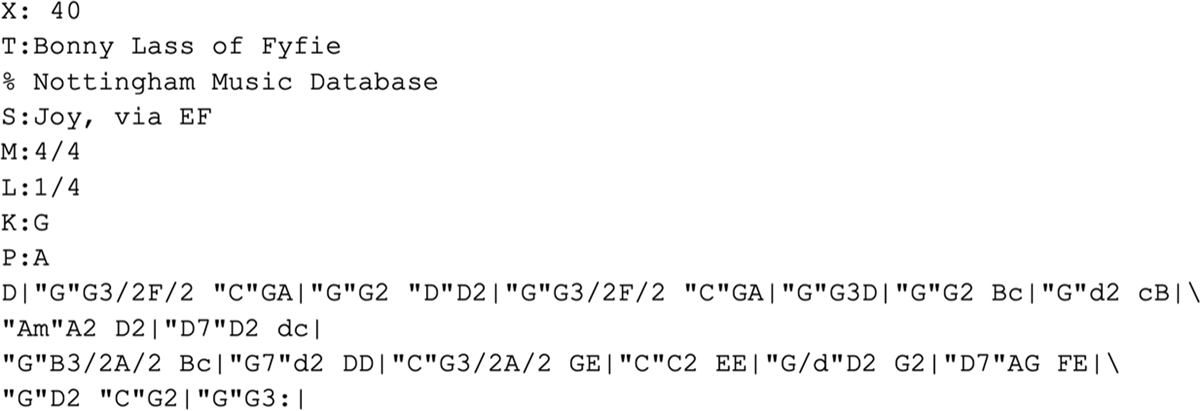
AI composition is the perfect illustration of this process in which the tendrils of technocracy extend into domains once prized for their relative autonomy from the marketplace and their resilience against instrumentalising logic. AI is deeply reliant on such logic, turning vast data sets into resources for machine learning. Jukedeck, for instance, draws on archives such as the Nottingham Music Database – a collection of 1,000 ‘folk’ tunes translated into ABC format, a text-based notation system designed to be readable by computers (Figure 1).Footnote 4 These melodies become mere chunks of information to be processed; as Jukedeck announces, they are ‘constantly on the quest for data-driven solutions to various compositional problems’ such as structure and coherence.Footnote 5
An example of ABC notation from the Nottingham Music Database, http://abc.sourceforge.net/NMD (accessed 5 February 2019).

However, things aren't quite as bad as Lyotard supposes. AI in its early stages (as we're experiencing it now) often appears more humourous and bathetic than dystopian. Let's consider an example. I'm at my brother's flat in the gentrifying Old Market area of Bristol, home to dubious massage parlours and boutiques selling artisan sourdough. Our conversation ranges from narrativity to the precarity of the academic job market, and we share stories of things that have made us laugh over the past few months. One of these is an ironically existentialist AI called InspiroBot.Footnote 6 The website is a green and slightly more welcoming replica of HAL 9000's interface from Stanley Kubrick's 2001: A Space Odyssey. You click ‘Generate’ and it produces inspirational memes from remixed phrases overlaid on stock imagery. ‘Without barbarism there can be no privacy’ juxtaposed with an urban fast food stand. A lightning storm with the phrase ‘First we give away our capability to inspect history, then we give away our capability to plan for the dead’. A woman staring out into a pine forest: ‘With inexplicable self-awareness comes inexplicable melody’. What InspiroBot draws its humour from is not only the absurdity of these collages and their playful parody of inspirational memes, but also the fact that it reveals the insincerity of AI itself: when we click ‘Generate’ we're presented with an outcome that looks more artificial than intelligent (more on this later). Self-aware diversions such as InspiroBot lay bare the device of AI, allowing us to see that what is going on is less like machine creativity than a highly rationalised algorithmic process. Although InspiroBot toys with the notion that it has consciousness (‘you're my favourite user’ it tells me), in so doing it exposes a fundamental lack.
This lack, and the absurdities arising from it, is nowhere more apparent than in words and semantics – in the case of pop music, lyrics. The Botnik community of developers and writers has, among other things, fashioned an online predictive writing AI trained on a range of artists from Belle & Sebastian to Beyoncé. Using this site, here's my attempt at some AI-aided lyrics in the style of The National:
I'm walking out among the missing sons
And your ghost gone through the glass
Don't explain everything to me now
The river where they wander can see
The technology works like a series of pathways: every word choice you make opens up a new but finite variety of 18 possible words to choose from, and so on.Footnote 7 It's collaborative and works more like a tool to aid inspiration than a closed system. I had to rewrite these lines several times to cultivate a theme and find some way to close the stanza (at best, a simple rhyme between ‘me’ and ‘see’ echoing an earlier sibilance). Rather than the AI – which provided random options without regard for aesthetics – my own creative agency and thought were foregrounded. But what if AI was let loose to do the whole thing on its own?
This was the aim of a Silicon Valley startup called WaveAI, which released an app called ALYSIA in 2019 – the acronym for ‘automated lyrical song-writing application’.Footnote 8 Inspired by the fact that their CEO Maya Ackerman longed to write her own songs but found this to be more challenging than she'd expected, the programme allows users to produce unique lyrics and melodies with minimal input, creating ‘original songs in minutes’ and thereby ‘democratizing songwriting through AI’. The ALYSIA Music Company had released two promotional EPs using this technology the year before: Invisible Tides and Miss Blue Christmas, both available on Spotify. Invisible Tides, they claim, is ‘the first ever album where both lyrics and vocal melodies were created with an AI-based system’.Footnote 9 The title track is a disorienting take on gothic metal in the vein of Nightwish – quivering vocals over piano and industrial percussion with occasional interjections of spoken drivel such as ‘bleeding tears will never die’. The second track, ‘Believe in Us’, is not much better, but could perhaps pass for something inane on the radio, with its tinny pseudo-trap rhythm track and anthemic chorus. Finally, there's ‘Beautiful Memory’, which gets stuck in your head, its softly sung indie-pop melody pulling against the beat. These songs exemplify what the Japanese roboticist Masahiro Mori called the ‘uncanny valley’ (Reference Mori2012) – that feeling of aversion we tend to share when confronted with something not quite human enough. Whereas InspiroBot and the Botnik lyric tool force us to confront the limitations of such technology and the distinction between human and machine agency, ALYSIA seeks to erase such distinctions and embrace AI as the solution to human limitation.
Amidst all the clamour and excitement surrounding this material fabricated entirely via machine learning, we often neglect to question the very notion of AI: what exactly do we mean when we use the term ‘artificial intelligence’? The definition of intelligence in this conjunction is evident, if rarely made explicit: the ability to master StarCraft II, solve Rubik's Cubes, overcome obstacles, outsmart Go players, analyse vast data sets, run the stock market, and shame chess grandmasters into submission. While this definition revolves around something undoubtedly mesmerising – the recognition of patterns and the cracking of complex puzzles – it adopts a fairly blinkered and ideological view of intelligence, much like an IQ test. Those who arrive at this assumption, it's tempting to point out, define the concept as a reflection of their own ability to navigate the runes of empirical data and rejoice in an algorithmic sublime. Predicated on calculation, in other words, the I of AI is a form of scientistic narcissism. Songs, however, are not strategy games. As John Lanchester reminds us, a generation of ‘digital “disruptors”’ made in the image of Mark Zuckerberg ‘have a shared tendency to imagine that they have important insights into worlds they don't in fact understand’ (Lanchester Reference Lanchester2016).
And artifice? No doubt Jukedeck and ALYSIA demonstrate impressive levels of high-tech intelligence, but their tracks are irrefutably artificial – hollow, near-human things drifting towards us on a sea of digital possibility. I can't seem to detect anything behind them except the noiseless workings of a machine carrying out an assignment, a machine thus lacking the impetus of creativity itself. The word artificial has multiple origins (the French artificial and the Latin artificiālis) and brings with it a wide range of meanings, from something skilfully made or contrived by art to something cunning, affected, unspontaneous or seeking to deceive. The A of AI does indicate a Promethean undercurrent: the creation through human skill, artistry and ingenuity of a thing altogether new and unforeseen. Yet it also carries the latter connotation of something guileful, unnatural, fake and deceptive. AI music is artificial in precisely this way, as are the neural networks from which it springs: both are proxies and simulacra, things feigned and mimetic. Their deception is twofold, involving not only the simulation of human creative endeavour, but also a need to lure our attention towards novelty and innovation away from what we cannot help but hear if we were to listen more carefully: the competitive frenzy of what Shoshana Zuboff has called ‘surveillance capitalism’ (Reference Zuboff2019), a corporate hijacking of personal experience for the sake of ever-more-powerful behaviorial prediction products. Anticipated profit is the primary motivation behind these AI startups.
For Alan Turing, of course, artificial intelligence was to be measured by his now eponymous test – an ‘imitation game’ in which a computer, suitably concealed, mimics human responses to a series of written questions. Such ‘thinking machines’, he envisioned, would soon be able to fool an interrogator into believing they were interacting with another human being rather than a programmed electronic device. Objecting to arguments against the idea that machines think, Turing (Reference Turing1950, pp. 444, 460) proposes that ‘consolation’ would be more appropriate than refutation: these devices ‘will eventually compete with men in all purely intellectual fields’. But it is the word ‘purely’ that stands out here. Indeed, Turing's definition draws a deliberately ‘sharp line between the physical and the intellectual capacities of a man’ (p. 434). The body and the senses are curiously absent in his seminal paper and Turing admits that he is concerned above all with ‘“unemotional” channels of communication’ that ‘do not presuppose any feelings on the part of the machine’ (p. 457). Turing's digital mimic, in short, is a sociopathic ideal, a forgery – a bot.
What Turing sought to overturn in this paper was the putative notion that human consciousness is unique, a divine singularity. Tellingly, for our present purposes, he cites a paragraph by the neurosurgeon Geoffrey Jefferson:
[the difference] lies above all in the machines’ lack of opinions, of creative thinking in verbal concepts … Not until a machine can write a sonnet or compose a concerto because of thoughts and emotions felt, and not by the chance fall of symbols, could we agree that machine equals brain – that is, not only write it but know that it had written it. No mechanism could feel (and not merely artificially signal, an easy contrivance) pleasure at its successes, grief when its valves fuse, be warmed by flattery, be made miserable by its mistakes, be charmed by sex, be angry or depressed when it cannot get what it wants. (Jefferson Reference Jefferson1949, p. 1110)
Aligning himself ‘with the humanist Shakespeare rather than the mechanists’, Jefferson warns against the great danger ‘of anthropomorphizing the machine’. Although Turing sees this argument as a descent into solipsism (only I can know if I think and therefore have consciousness), I find it harder to dismiss. Siri tells me that it's my opinion of Picasso that counts because at present, and perhaps necessarily, computers are unable to offer their own opinions on aesthetics: they simply replicate and rehash whatever trends appear in the available data. Shakespearean sonnet bots now exist – but they can never work from private experience or introspection. Recall, moreover, Microsoft's virulently misogynistic and ultimately neo-fascist Twitter chatbot Tay. An AI such as Tay can be inventive, but can it think ‘in verbal concepts’, as Jefferson puts it, i.e. can it reason? Can it act ethically, or will its ends always justify the means? These are difficult questions. More and more we're seeing that allegedly objective AIs are in fact shot through with familiar socio-political biases, the very biases found within the data upon which they're fed.
Prompted by a question from a fan, Nick Cave recently decided to weigh in on this issue. Responding to the prospect that companies such as Jukedeck or WaveAI will soon be able to manufacture bespoke AI songs to correlate with our fluctuating moods, Cave turns the ambitions of such technology into its Achilles heel:
It is perfectly conceivable that AI could produce a song as good as Nirvana's ‘Smells Like Teen Spirit’, for example, and that it ticked all the boxes required to make us feel what a song like that should make us feel – in this case, excited and rebellious, let's say … But, I don't feel that when we listen to ‘Smells Like Teen Spirit’ it is only the song that we are listening to. It feels to me, that what we are actually listening to is a withdrawn and alienated young man's journey out of the small American town of Aberdeen … What we are actually listening to is human limitation and the audacity to transcend it. Artificial Intelligence, for all its unlimited potential, simply doesn't have this capacity. How could it? And this is the essence of transcendence. If we have limitless potential then what is there to transcend? And therefore what is the purpose of the imagination at all. (Cave Reference Cave2019)
As Gaston Bachelard (Reference Bachelard and Jolas2014, p. 6) writes, there are forces in creative practice ‘that do not pass through the circuits of knowledge’. Some things are simply not measurable, or to measure them would be to miss the mark: they elude translation into the narrow and impassive language of mathematics. We would do well to heed Lyotard's warning that such things risk being abandoned as a consequence, discarded by the onward march of information. What we need as a counterbalance to the indifferent scientism of AI is something like Bachelard's ‘phenomenology of the soul’ (Bachelard Reference Bachelard and Jolas2014, p. 6). Cave is saying that a song is precious to the extent that it calls on human imagination in production and reception – the visionary, Icarus-like audacity of the artist and the listener's desire to be entranced.
Alongside Kurt Cobain, Cave gives the example of Nina Simone stuffing ‘all her rage and disappointment into the most tender of love songs’ (Cave Reference Cave2019). What would a love song be without a lover, a body, loss, memory and an awareness of finitude? When we listen to Cave's 1990 recording of ‘The Ship Song’ we catch a glimpse of the man behind a performative mask, a vocal presence and a poetic agency that's human through and through, mirroring our own experience as subjects. With an instantly generated track or an algorithmic output this vision is shattered and we hear nothing but a void, a vacancy. A singer-songwriter AI will never pass Turing's test because we'll never want it to; it would be a meaningless triumph. As Cave attests, when we listen to popular music we hear far more than a set of harmonic, rhythmic and timbral relationships – we hear presence and craft, narrative and biography, aspiration and limitation. What matters, in short, are the age-old associations we inevitably sketch between lyrical writing and subjectivity. AI tracks, by way of contrast, are little more than shrewdly lucrative muzak – the eminently forgettable kind that tends to accompany corporate PR videos.
And so, for what it's worth, my claim is this: AI music will, by definition, never be able to satisfy our hunger for imagination and embodiment. AI might be able to make passable synthwave, but it will always stumble on song because we prize song as a form – perhaps the form – of subjective expression. But there's a deeper problem with AI music: the discourse has been lying to us all along. Never a pure outpouring of algorithms, such music is in fact a species of hybrid creativity predicated on the enmeshing of people and computers – a cyborg inventiveness uniting human agency with the power of machine learning that renders unsustainable the dualisms we draw between nature and technology. We might, then, begin to see AI not as a threat to subjective expression, but as one more tool with its own peculiar affordances – another facet of music's inherent sociality. Now more than ever, as Donna Haraway (Reference Haraway2016, p. 7) writes, we are fusions of organism and machine: ‘the cyborg is our ontology’. It is for the future to decide whether AI will lead to a true democratisation of culture or whether it will fall within Haraway's disquieting vision of an ‘Informatics of Domination’ (p. 28).