



Non-technical Summary
Melanerpeton kuselense is a new, tiny, newt-like species that was unearthed at the rich Remigiusberg quarry in southwestern Germany. We show that it belongs to the family Branchiosauridae, a group of aquatic, gill-bearing forms that are believed to be closely related to modern amphibians. The rocks date around the Carboniferous-Permian boundary and formed in a lake-delta environment. The deposit yielded a vertebrate fauna that is unusual for other localities of similarly aged rocks in Germany and more consistent with North American faunas.
Introduction
The Branchiosauridae forms a speciose clade of 10–15 cm long, newt-like temnospondyls that dwelled a wide range of environments in the late Paleozoic. Thanks to their presence in great quantities and sometimes exquisite preservation, numerous studies of ontogeny, paleoecology and evolution have been carried out (Boy, Reference Boy1972, Reference Boy1974; Werneburg, Reference Werneburg1991, Reference Werneburg2002, Reference Werneburg2012; Schoch, Reference Schoch1992, Reference Schoch2006, Reference Schoch2009, Reference Schoch2022; Boy and Sues, Reference Boy, Sues, Heatwole and Carroll2000; Fröbisch et al., Reference Fröbisch, Olori, Schoch and Witzmann2010). First described from lower Permian deposits of the Palatinate region in southwestern Germany (Meyer, Reference Meyer1844a), large samples were later discovered in rocks of similar age near Autun in northeastern France (Gaudry, Reference Gaudry1875), the Pennsylvanian coal deposits of Nýřany in the Czech Republic (Fritsch, Reference Fritsch1876), and lower Permian rocks of Saxony in eastern Germany (Credner, Reference Credner1881). In addition, Milner (Reference Milner1982) and Werneburg (Reference Werneburg2009) reported evidence of branchiosaurids in the Pennsylvanian of Mazon Creek (Illinois, USA) and the Permo-Triassic of the Tunguska River (Oblast Krasnojarsk, Russia). In the last decade, the morphology of Pennsylvanian branchiosaurids has become much better understood (Werneburg, Reference Werneburg2012, Reference Werneburg2019). This permitted a more inclusive phylogenetic analysis of the group, which confirmed that all branchiosaurids form a well-supported clade of dissorophoids and fall into a series of subclades, with the Pennsylvanian taxa differing in a several features from the monophyletic Permian taxa (Schoch, Reference Schoch2022).
Here, we report a new specimen from the Remigiusberg quarry near Kusel in the Palatinate region, southwestern Germany (Fig. 1). Thanks to extensive excavations, this site has produced a wealth of new fossils over the last decade, encompassing both lake- and stream-dwelling fishes and temnospondyls as well as terrestrial reptiliomorphs and amniotes (Boy and Schindler, Reference Boy and Schindler2000; Fröbisch et al., Reference Fröbisch, Schoch, Müller, Schindler and Schweiss2011; Witzmann, Reference Witzmann2013; Voigt et al., Reference Voigt, Fischer, Schindler, Wuttke, Spindler and Rinehart2014; Schoch and Voigt, Reference Schoch and Voigt2019; Spindler et al., Reference Spindler, Voigt and Fischer2020; Werneburg et al., Reference Werneburg, Witzmann, Rinehart, Fischer and Voigt2023b). The new specimen ranks among the smallest tetrapod finds at this locality so far and comprises a 10.3 mm long skull and partial forelimb of a tiny dissorophoid temnospondyl. A unique combination of cranial features suggests that this find constitutes a new taxon that is quite distinct from the branchiosaurids hitherto known from the Saar-Nahe Basin.
Simplified geological map of the Saar-Nahe Basin, lithostratigraphic subdivision of the post-Moscovian basin fill, and general section of Remigiusberg Formation at the Remigiusberg Formation near Kusel in the basin’s central part. The branchiosaurid of this work comes from the upper part of the Theisbergstegen lake level (star), middle part of the Remigiusberg Formation at the Remigiusberg quarry (UGKU locality 211). Artin. = Artinskian.
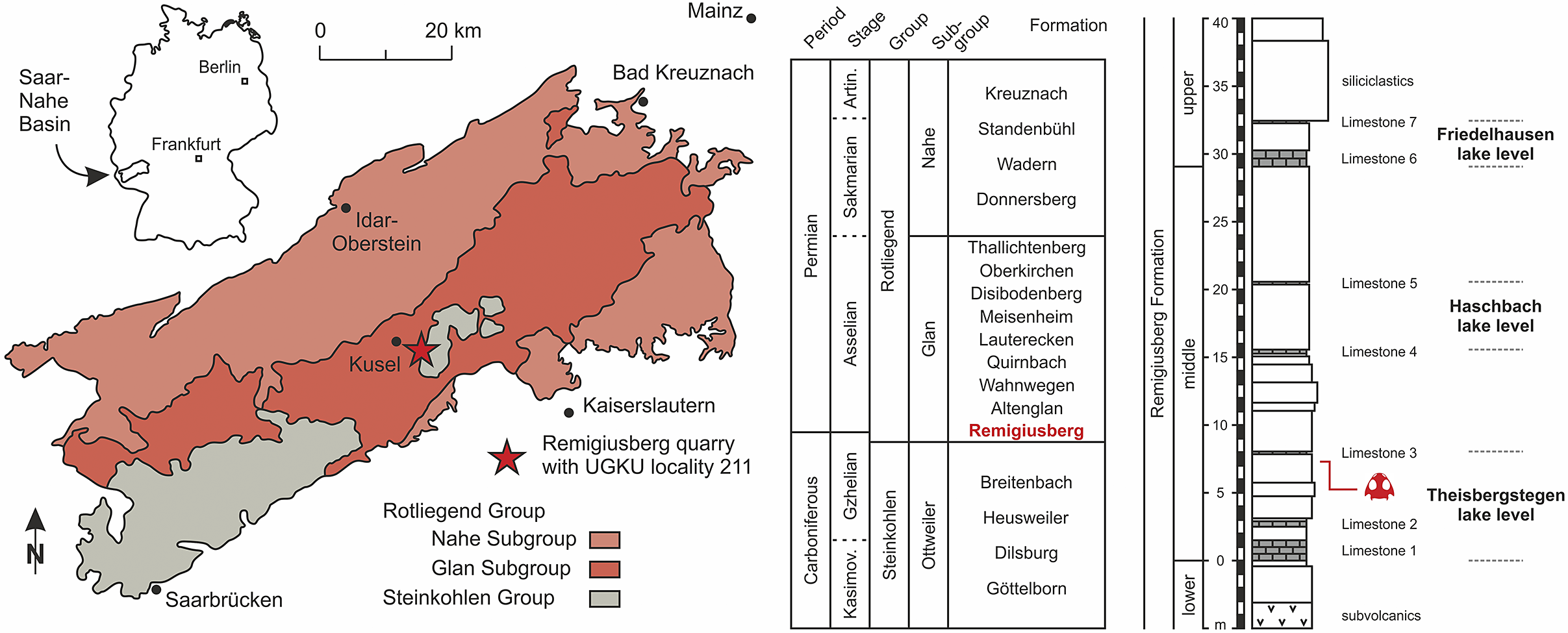
Figure 1. Long description
The figure is divided into three panels.
Panel 1: A geographical map of the Saar-Nahe Basin in Germany. An inset map shows the basin's location in southwest Germany relative to Frankfurt, Berlin, and Mainz. The main map shows the basin extending from Saarbrücken in the Southwest to Bad Kreuznach in the Northeast. The basin is color-coded into three geological units: the Steinkohlen Group in light gray at the southern edge; the Glan Subgroup of the Rotliegend Group in medium red covering the central and northern areas; and the Nahe Subgroup in light red at the western edge. A red star near Kusel marks the Remigiusberg quarry with U G K U locality 211. A scale bar indicates 20 kilometers.
Panel 2: A lithostratigraphic table organized by Period, Stage, Group, Sub-group, and Formation.
- Permian Period: Includes the Artinskian, Sakmarian, and Asselian stages. These correspond to the Rotliegend Group, which is divided into the Nahe Subgroup (Formations: Kreuznach, Standenbühl, Wadern, Donnersberg) and the Glan Subgroup (Formations: Thallichtenberg, Oberkirchen, Disibodenberg, Meisenheim, Lauterecken, Quirnbach, Wahnwegen, Altenglan, and Remigiusberg highlighted in red).
- Carboniferous Period: Includes the Gzhelian and Kasimovian stages, corresponding to the Steinkohlen Group and Ottweiler Subgroup (Formations: Breitenbach, Heusweiler, Dilsburg, Göttelborn).
Panel 3: A vertical stratigraphic section of the Remigiusberg Formation measured in meters from 0 to 40.
- 0 to 5 meters: Lower part, containing subvolcanics at the base and Limestones 1 and 2.
- 5 to 30 meters: Middle part, containing the Theisbergstegen lake level (Limestone 3), the Haschbach lake level (Limestones 4 and 5), and a red skull icon indicating the fossil find location just above Limestone 3.
- 30 to 40 meters: Upper part, containing the Friedelhausen lake level (Limestones 6 and 7) and topped by siliciclastics.
The objective of the present study is to describe the new taxon based on the type specimen and to elucidate its phylogenetic position.
Material and methods
Material examined
The new taxon is represented by a single specimen (NHMMZ/LS PW 2023/5265; Fig. 2) discovered in greenish-gray siltstone from the base of a lacustrine deltaic distributary channel of the middle Remigiusberg Formation of the Remigiusberg quarry near Kusel, Rhineland-Palatinate, southwestern Germany in July 2023 (Fig. 1). It consists of a skull preserved from the inner (ventral) side and appears not to include palatal elements other than the dislocated right pterygoid. Bone preservation is generally good with coloration ranging from white to gray, in places with a bluish stain. The elements are partially translucent. However, the bones are broken off in many places due to uneven splitting (the counterpart is missing), and therefore a computed tomography (CT) scan did not reveal any further features. The newly erected species was compared with Melanerpeton pusillum Fritsch, Reference Fritsch1878, the type species of the genus, which was reexamined by one of us (RW).
Melanerpeton kuselense n. sp.: (1) interpretative drawing and (2) photo of holotype (NHMMZ PW 2023/5265LS). (3) Drawing of the holotype skull region in ventral view with some surface details of the dorsal side. (4) Reconstruction of the skull in dorsal view. f = frontal; ju = jugal; la = lacrimal; m = maxilla; n = nasal; p = parietal; pf = postfrontal; pi = pineal foramen; pm = premaxilla; po = postorbital; pp = postparietal; prf = prefrontal; ps = parasphenoid; pt = pterygoid; qj = quadratojugal; ra = radius; sc = scleral plates; sq = squamosal; st = supratemporal; sta = stapes; t = tabular; ul = ulna; x = supernumerary element.
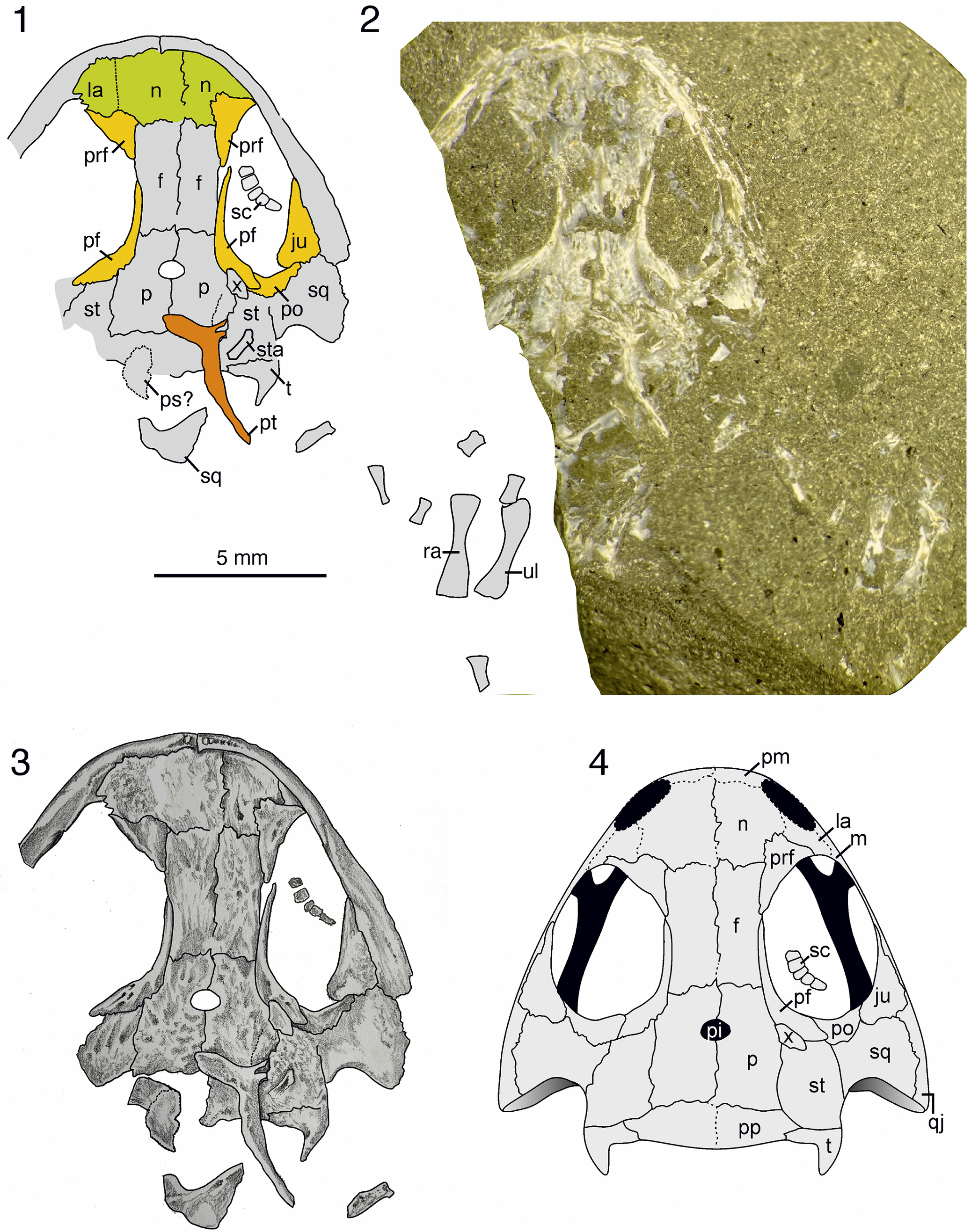
Figure 2. Long description
The figure consists of four panels labeled 1 through 4.
Panel 1 is an interpretative line drawing of the holotype fossil. The snout region is colored green, containing the nasal (n) and lacrimal (la) bones. The orbital margins are colored yellow, including the prefrontal (prf), postfrontal (pf), and jugal (ju). A long, orange element represents the pterygoid (pt). Other labeled bones include the frontal (f), parietal (p), supratemporal (st), squamosal (sq), and tabular (t). Below the skull, the radius (ra) and ulna (ul) are shown. A 5 millimeter scale bar is provided.
Panel 2 is a high-resolution photo of the actual holotype fossil (N H M M Z P W 2023 forward slash 5265 L S) embedded in a dark, textured rock matrix, showing the flattened white bone fragments.
Panel 3 is a detailed grayscale drawing of the skull region in ventral view, showing the underside of the fossil with surface textures and the circular pineal foramen.
Panel 4 is a symmetrical reconstruction of the skull in dorsal view. From the anterior tip moving backward along the midline are the premaxilla (pm), nasal (n), frontal (f), and parietal (p) which contains the black circular pineal foramen (pi). At the very back are the postparietal (pp) and tabular (t). Moving laterally from the midline, the skull includes the lacrimal (la), maxilla (m), prefrontal (prf), postfrontal (pf), postorbital (po), jugal (ju), squamosal (sq), supratemporal (st), and quadratojugal (qj). The large eye orbits contain small scleral plates (sc). A small supernumerary element (x) is located near the postfrontal.
Phylogenetic analysis
The cladistic analysis was performed employing TNT v.1.5 (http://www.cladistics.org/tnt.html), using equally weighted ‘New Technology Search’ algorithms to explore the tree space and find a global optimum. All characters were left unordered because sequences of evolutionary character transformations are especially difficult to assess in branchiosaurids because of widespread neoteny. Although the new taxon under study here has enough adult traits to permit coding, other taxa from which only larval samples are known (e.g., Tungussogyrinus Efremov, Reference Efremov1939; some Apateon spp.) have been omitted. Implied weighting has not been attempted, because homoplasy levels are high in temnospondyls (and still higher in branchiosaurids due to neoteny) so that identifying plausible homoplasies remains very difficult. Trees were calculated with ‘Sectorial Search,’ ‘Ratchet,’ and ‘Tree Fusing’ algorithms using 100 iterations each and 1,000 random addition sequences (RAS). Analysis of the complete dataset (48 taxa, 115 characters) found three equally most parsimonious trees (TL = 332; CI = 0.401; RI = 0.728; Fig. 3).
Phylogeny of branchiosaurid temnospondyls with position of Melanerpeton kuselense n. sp. highlighted. Based on the TNT analysis of 48 taxa and 114 characters described in the text and Supplemental material. Taxa not otherwise mentioned in the text are: Acanthostomatops Kuhn, Reference Kuhn1961; Acheloma Cope, Reference Cope1882; Anconastes Berman, Reisz, and Eberth, Reference Berman, Reisz and Eberth1987; Branchierpeton Boy, Reference Boy1972; Broiliellus Williston, Reference Williston1914; Cacops Williston, Reference Williston1910; Conjunctio Carroll, Reference Carroll1964; Dendrerpeton Owen, Reference Owen1853; Dissorophus Cope, Reference Cope1895; Ecolsonia Berman, Reisz, and Eberth, Reference Berman, Reisz and Eberth1985; Eimerisaurus Boy, Reference Boy1980; Eocaecilia Jenkins and Walsh, Reference Jenkins and Walsh1993; Fedexia Berman et al., Reference Berman, Henrici, Brezinski and Kollar2010; Georgenthalia Anderson et al., Reference Anderson, Henrici, Sumida, Martens and Berman2008a; Gerobatrachus Anderson et al., 208b; Karaurus Ivaknenko, 1978; Leptorophus Bulman and Whittard, Reference Bulman and Whittard1926; Limnogyrinus Milner, Reference Milner and Rocek1986; Mattauschia Milner, Reference Milner2019; Micromelerpeton Bulman and Whittard, Reference Bulman and Whittard1926; Milnererpeton Hunt, Lucas, and Berman, Reference Hunt, Lucas and Berman2002; Mordex Steen, Reference Steen1938; Palodromeus Schoch, Henrici, and Hook, Reference Schoch, Henrici and Hook2020; Perryella Carlson, Reference Carlson1987; Phonerpeton Dilkes, Reference Dilkes1990; Schoenfelderpeton Boy, Reference Boy1986; Sclerocephalus Goldfuss, Reference Goldfuss1847; Tambachia Sumida, Berman, and Martens, Reference Sumida, Berman and Martens1998; Triadobatrachus Kuhn, Reference Kuhn1962; Trimerorhachis Cope, Reference Cope1878.
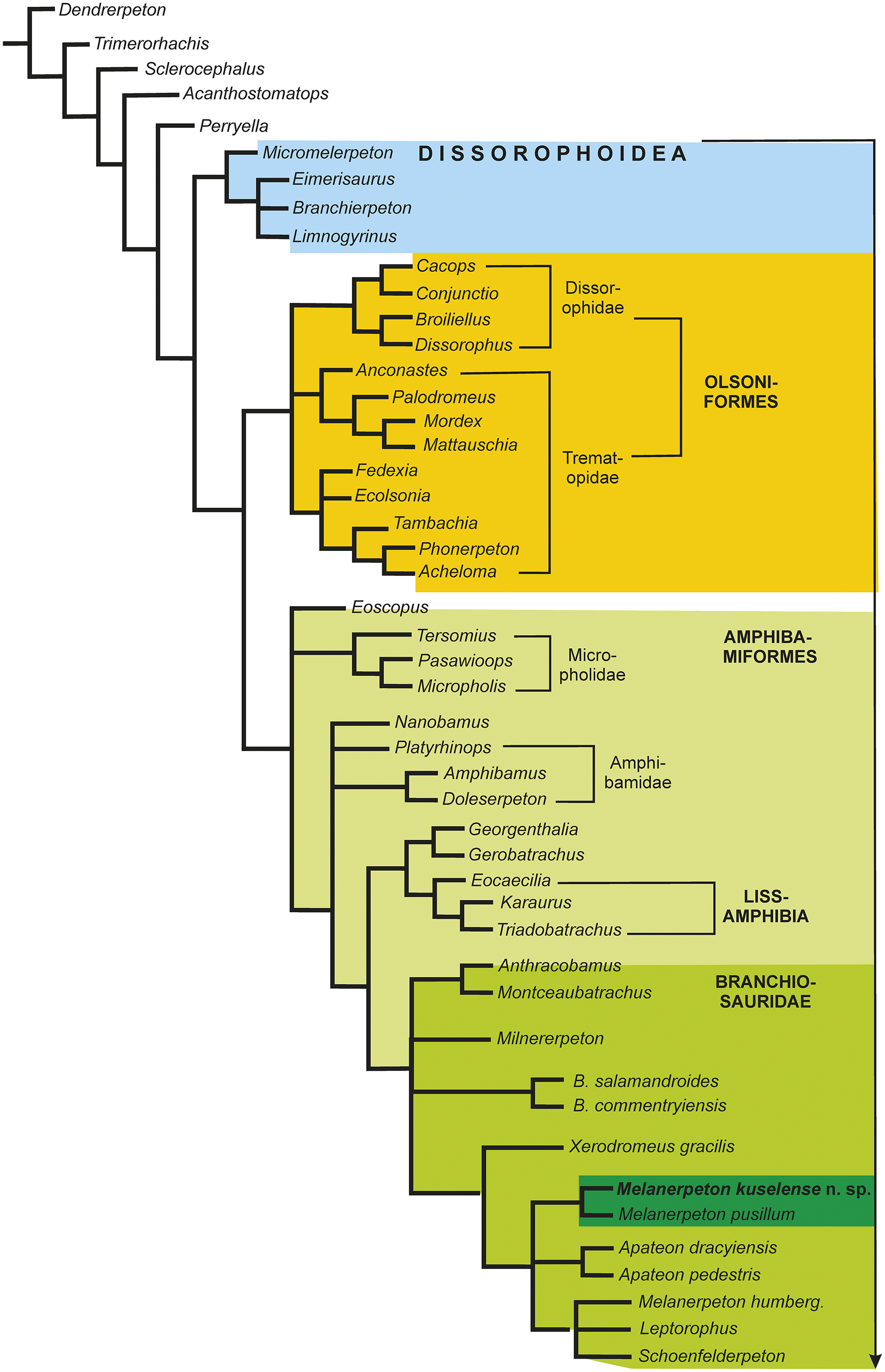
Figure 3. Long description
The cladogram begins at the top-left with outgroups Dendrerpeton, Trimerorhachis, Sclerocephalus, Acanthostomatops, and Perryella. The main lineage branches into a large clade labeled D I S S O R O P H O I D E A, which is further divided into four color-coded horizontal blocks.
* The top blue block contains Micromelerpeton, Eimerisaurus, Branchierpeton, and Limnogyrinus.
* The second yellow block, labeled O L S O N I F O R M E S, contains two sub-groups: Dissorophidae (including Cacops, Conjunctio, Broiliellus, and Dissorophus) and Trematopidae (including Anconastes, Palodromeus, Mordex, Mattauschia, Fedexia, Ecolsonia, Tambachia, Phonerpeton, and Acheloma).
* The third light green block, labeled A M P H I B A M I F O R M E S, includes Eoscopus, Micropholidae (Tersomius, Pasawioops, Micropholis), and Amphibamidae (Nanobamus, Platyrhinops, Amphibamus, Doleserpeton). Below these is the L I S S A M P H I B I A group containing Georgenthalia, Gerobatrachus, Eocaecilia, Karaurus, and Triadobatrachus.
* The bottom dark green block, labeled B R A N C H I O S A U R I D A E, contains Anthracobamus, Montceaubatrachus, Milnererpeton, B. salamandroides, B. commentryiensis, and Xerodromeus gracilis.
At the bottom of this final clade, a dark green highlighted box contains Melanerpeton kuselense n. sp. and Melanerpeton pusillum. Below this highlighted section are Apateon dracyiensis, Apateon pedestris, Melanerpeton humberg., Leptorophus, and Schoenfelderpeton.
Repositories and institutional abbreviations
NHMMZ/LS, Naturhistorisches Museum Mainz/State Collection of Natural History of Rhineland-Palatinate, Germany; UGKU, Urweltmuseum GEOSKOP, POLLICHIA geoscience collections, Thallichtenberg, Germany.
Systematic paleontology
Temnospondyli Zittel, Reference Zittel1888
Rhachitomi Watson, Reference Watson1919 sensu Schoch, Reference Schoch2013
Dissorophoidea Bolt, Reference Bolt1969
Amphibamiformes Schoch, Reference Schoch2019
Branchiosauridae Fritsch, Reference Fritsch1879
Melanerpeton Fritsch, Reference Fritsch1878
Type species
Melanerpeton pusillum Fritsch, Reference Fritsch1878.
Diagnosis
(1) Postorbital skull table very narrow (width between lateral supratemporal margins/skull length = 0.6–0.7); (2) squamosal small with abbreviated lateral wing (shorter than combined width of anterior parietal and squamosal), giving a well-anteriorly placed jaw articulation; (3) orbit elongate-oval with main axis aligned sagittally; (4) narrow and anteriorly concave, V-shaped postorbital; (5) pterygoid with gracile palatine ramus and extremely short quadrate ramus (shorter than width of squamosal); and (6) ilium short with broad dorsal end.
Remarks
Traditionally, four additional species have been referred to Melanerpeton: Melanerpeton arnhardti Werneburg, Reference Werneburg1988a; Melanerpeton eisfeldi Werneburg, Reference Werneburg1988b; Melanerpeton humbergense Boy, Reference Boy1978; and Melanerpeton sembachense Werneburg, Reference Werneburg1989 (Werneburg, Reference Werneburg1988a, Reference Werneburgb, Reference Werneburg1989, Reference Werneburg2024; Schoch and Milner, Reference Schoch and Milner2008). In noticing many divergent features between these and the type species, we take a cautious approach here in defining the genus based exclusively on apomorphic characters (1–5 as listed above) shared by the type species and Melanerpeton kuselense new species (below). Other species referred to Melanerpeton require reexamination, as indicated by their equivocal position of their most completely known representative, Melanerpeton humbergense, in the phylogenetic analysis.
Melanerpeton kuselense new species
Holotype
NHMMZ/LS PW 2023/5265, encompassing a large part of the skull roof in ventral view and a few fragmentary postcranial elements. Skull length (premaxilla-postparietal) as preserved is 10.3 mm.
Diagnosis
Autapomorphies: (1) nasal elongate (nasal length/skull length = 0.25), (2) pterygoid extremely short and gracile (pterygoid length/skull length = 0.5), (3) jugal long, integrating cheek with maxilla. Plesiomorphies (contrasting the condition in most Permian branchiosaurids): (4) prefrontal and postfrontal long and almost in contact, and (5) interorbital distance of adults moderately narrow (interorbital distance/skull length = 0.25). All of these characters indicate that, despite its small size, the specimen was fairly mature and therefore can be readily diagnosed.
Occurrence
Remigiusberg quarry at the northeastern rim of the Remigiusberg (387615 E, 5487510 N, UTM 32U, WGS 84; UGKU locality 211), ~1 km northeast of Haschbach, Kusel County, western Rhineland-Palatinate, Germany (Voigt et al., Reference Voigt, Fischer, Schindler, Wuttke, Spindler and Rinehart2014). The type horizon is a greenish-gray massive siltstone with small mudstone and coal intraclasts as well as lots of disarticulated vertebrate remains, just below limestone no. 3 of the Theisbergstegen lake level, middle part of the Remigiusberg Formation, base of Rotliegend, Gzhelian/Asselian boundary, latest Carboniferous or earliest Permian (Menning et al., Reference Menning, Glodny, Boy, Gast and Kowalczyk2022). NHMMZ/LS PW 2023/5265 was part of a bonebed-like deposit at the base of a distributary channel of the Remigiusberg lacustrine deltaic complex (litho-unit 17; Poschmann et al., Reference Poschmann, Hegna, Emrich, Fischer, Hoffmann, Schindler and Voigt2025, fig. 2).
Comparative description and remarks
The material comprises one larger block (6.5 x 6.5 cm) and two small pieces, preserving most of the skull roof, the pterygoid, four neural arches, parts of the pectoral girdle, and right forelimb with a partial humerus and complete forearm but without the carpus and manus.
The skull roof is distinctive by the combination of a very slender postorbital skull table, a relatively long preorbital region and an unusually short gape. In these features, it falls on the extreme end of variation among the known taxa of branchiosaurids, but remains well outside the proportions of amphibamids and micropholids (Schoch, Reference Schoch2022). The narrow postorbital skull and short gape are shared with the early Permian Melanerpeton pusillum from Olivětín in the Intrasudetic Basin (Czech Republic). The most distinctive, autapomorphic character-states of Melanerpeton kuselense n. sp. are the elongated nasal and the extremely small and gracile pterygoid.
The general outline of the skull and size of the orbits is consistent with that of an equal-sized Apateon pedestris Meyer, Reference Meyer1844b from M8 (Odernheim Black Shale; Boy, Reference Boy1972), whereas the position of the orbits differs in their more posterior placement in Melanerpeton kuselense n. sp.
All exposed dermal skull bones are preserved in ventral view. They are faintly ornamented with radially arranged pits that cover most of the surface area. Despite this mode of preservation, the ornament is visible in places where the bones are translucent. The most clearly established pits are found on the parietal, but they appear to be even present on the nasal and prefrontal.
The preorbital region is longer than in most branchiosaurids of this size class and even in adult ‘Melanerpeton’ humbergense and Schoenfelderpeton prescheri Boy, Reference Boy1986, but smaller than in adults of Leptorophus tener (Schönfeld, Reference Schönfeld1911) and Xerodromeus gracilis Credner, Reference Credner1881. The snout of Melanerpeton kuselense n. sp. is dominated by the elongated nasal, which measures 70% of the length of the frontal (Apateon pedestris: 30–40%). The outline of the naris remains unknown, as does the presence of a medial premaxilla fenestra.
Consistent with many branchiosaurids, the parietal and frontal are of equal length, but in contrast to most other taxa the parietal is only gently wider than the frontal.
The relative size of the orbits is consistent with that of Apateon pedestris of similar size and smaller than in ‘Melanerpeton’ humbergense (see Boy, Reference Boy1972, fig. 24), but the shape differs in that the posterior margin is more strongly concave and the anteromedial margin is oblique due to the large prefrontal. On the right side, five or six small plates of the sclerotic ring are preserved, relatively far anterior within the orbit.
The prefrontal is substantially larger than in other branchiosaurids of equal size, and its shape is more differentiated with a thin posteromedial process and a longer anterior portion. Due to the large size of the prefrontal, the orbit margin is clearly angled rather than rounded as in other taxa. In contrast, the postfrontal is very gracile with a narrow posterior region but an extended spike-like anterior portion. The outline of the postfrontal is most similar to that of Branchiosaurus salamandroides Fritsch, Reference Fritsch1876 (see Werneburg, Reference Werneburg2012) and Montceaubatrachus platyrhynchus Werneburg, Reference Werneburg2019 (see Werneburg, Reference Werneburg2019). The prefrontal and postfrontal were apparently separated by a very short portion of the frontal contributing to the orbit margin, but they approach one another more closely than in most Permian branchiosaurids.
The pineal foramen is relatively large and broadly ovate to elliptical, consistent in size with Apateon spp. and ‘Melanerpeton’ humbergense and different from the sagittally oval foramen in Melanerpeton pusillum.
In Melanerpeton kuselense n. sp., the narrow postorbital skull table is only 2.2 times wider than long, which plots at the extreme lower end of the branchiosaurid range and outside amphibamids (Schoch, Reference Schoch2022).
The supratemporal is slender with a tapering anteromedial end. Contrasting the wide rectangular element in Apateon spp., it is more similar to that of ‘Melanerpeton’ humbergense and Leptorophus spp. It is overplated by the gracile posterior portion of the postfrontal, and unlike in Apateon spp., the postfrontal has a long contact with the supratemporal. This pattern forms part of the apomorphic configuration in Melanerpeton kuselense n. sp., which combines a slender postorbital skull table with a relatively large orbit.
There is a small, oval supernumerary element wedged between the postfrontal and supratemporal on the right side (Fig. 2, labelled as ‘x’). Such extra bonelets were reported by Boy (Reference Boy1972) as individual variants in Apateon pedestris in which they occupy similar regions.
The postparietals are only incompletely preserved, and the presence of posterior occipital shelves remains unclear. Large pieces of bone resembling the unpaired occipital flange of Milnererpeton huberi Hunt, Lucas, and Berman, Reference Hunt, Lucas and Berman1996, Apateon caducus (Ammon, Reference Ammon1889), or Leptorophus tener are located posterior to the postparietal level (Schoch, Reference Schoch1992, Reference Schoch2022; Werneburg et al., Reference Werneburg, Schneider and Lucas2013).
Most distinctive feature is the tabular with its prominent horn, which distinguishes branchiosaurids from other amphibamiforms, and especially amphibamids in which this bone is extremely reduced both in larvae and adults (Schoch, Reference Schoch2022). The large horn of Melanerpeton kuselense n. sp. is most similar to that of Xerodromeus gracilis and Apateon spp. (Schoch, Reference Schoch1992; Schoch and Werneburg, Reference Schoch and Werneburg2023).
The abbreviated squamosal and quadratojugal are poorly preserved on the right side, whereas the left squamosal is rotated and dislocated well posterior to the skull (Fig. 2).
In the palate, only the right pterygoid is preserved. It is a slender and remarkably small element. This forms the most puzzling feature of the taxon, because the pterygoid measures only 45% of the length of the skull in its longest expansion. In Apateon pedestris, the pteryoid is at least 60% of the skull length, a trait that remains similar throughout ontogeny (Schoch, Reference Schoch1992), and in Xerodromeus gracilis, the pterygoid is even longer by proportion (Boy, Reference Boy1978; Schoch and Werneburg, Reference Schoch and Werneburg2023). In Melanerpeton kuselense n. sp., only the quadrate ramus of the pterygoid is abbreviated whereas the palatine ramus is consistent in length with that of other branchiosaurids. The short straight shaft of the right stapes is preserved on the tabular, consistent with that of Apateon pedestris (see Boy, Reference Boy1972, fig. 38) in its preserved part. No other visceral elements are preserved, and branchial denticles are not identified, although much fragmentary bone material is present along the posterior rim of the skull.
The few postcranial remains are not well preserved and include mostly undiagnostic, damaged elements. The clavicles and interclavicle are probably present but their outline and proportions are difficult to trace. The slender humerus is present with its distal part, whereas the equally long and gracile radius and ulna are fully preserved. They are unusually large with respect to the skull. The manus is dislocated and several phalanges are present posterolateral to the tabular (Fig. 2).
Etymology
Referring to Kusel, the nearby town and municipality in which the Remigiusberg locality falls.
Phylogenetic relationships
Objective
To assess the phylogenetic position of Melanerpeton kuselense n. sp., we conducted a phylogenetic analysis using the amphibamiform character-taxon matrix recently published by Schoch (Reference Schoch2022). For details of the analysis, see Materials and methods and Supplemental material. Dendrerpeton acadianum Owen, Reference Owen1853 was used as the outgroup. Scores for Melanerpeton kuselense n. sp. were added, and the operational taxonomic units ‘Amphibamus larvae’ and ‘Olsoniform larvae’ were omitted, because they do not fit the scope of the present study.
Results
The topology of the trees is essentially similar to that found by Schoch (Reference Schoch2022). Here, Amphibamiformes comprises an early-branching Micropholidae (Eoscopus Daly, Reference Daly1994; Tersomius Case, Reference Case1910; Pasawioops Fröbisch and Reisz, Reference Fröbisch and Reisz2008; and Micropholis Huxley, Reference Huxley1859), followed by the Amphibamidae sensu stricto (Platyrhinops Steen, Reference Steen1931; Nanobamus Schoch and Milner, Reference Schoch, Milner and Sues2014; Doleserpeton Bot, 1969; and Amphibamus Cope, Reference Cope1865), the Lissamphibia including two putative stem-taxa Georgenthalia clavinasica Anderson et al., Reference Anderson, Henrici, Sumida, Martens and Berman2008a and Gerobatrachus hottoni Anderson et al., Reference Anderson, Reisz, Scott, Fröbisch and Sumida2008b, and finally the Branchiosauridae. The last falls into four clades and three additional taxa, with the following topology of branching: (1) Anthracobamus-clade (Anthracobamus fayoli Werneburg, Reference Werneburg2019; Montceaubatrachus platyrhynchus); (2) Milnererpeton huberi; (3) Branchiosaurinae (Branchiosaurus commentryensis Werneburg, Reference Werneburg2019; Branchiosaurus salamandroides); (4) Melanerpeton kuselense n. sp.; (5) Xerodromeus gracilis; (6) Apateoninae (Apateon pedestris; Apateon dracyiensis Werneburg, Reference Werneburg2001); and (7) Leptorophinae (‘Melanerpeton’ humbergense, Leptorophus tener, Schoenfelderpeton prescheri). Because Melanerpeton kuselense n. sp. unequivocally nests well within branchiosaurids, it can be safely ranked as a member of Branchiosauridae. What is more, its intermediate position between the Branchiosaurinae and the more apically branching Permian taxa is not only consistent with the overall morphology, but also with its stratigraphic position at the Gzhelian-Asselian boundary.
Character evolution
Melanerpeton kuselense n. sp. shares plesiomorphic traits with Pennsylvanian branchiosaurids, among which the elongate anterior process of the postfrontal is the most obvious. The postfrontal is especially similar to that of Monteceaubatrachus platyrhynchus and Branchiosaurus spp.
In turn, Melanerpeton kuselense n. sp. lacks the definitive synapomophies of either Apateoninae and Leptorophinae but shares with Xerodromeus gracilis the longer nasal and preorbital region, a feature also found in large Branchiosaurus salamandroides.
Arguably, the slender palatine ramus of the pterygoid is a shared feature with Leptorophinae, even though it is still more pronounced in the latter. Two autapomorphies, the short squamosal and tiny pterygoid, constitute extreme traits not found in other branchiosaurids.
The narrow posterior skull table is the most compelling trait, because it is not found in other branchiosaurids (Fig. 4). The only exception appears to be adult ‘Melanerpeton’ arnhardti, in which the ratio postorbital skull table/skull length reaches a value of 0.7, contrasting with much higher values (1.0) in smaller specimens (Werneburg, Reference Werneburg1988a). Otherwise, the skull table was already as wide in Anthracobamus Weinburg, 2019 and Montceaubatrachus Werneburg, Reference Werneburg2019 as in the Permian taxa and apparently did not undergo a consistent evolutionary change.
Restoration of selected branchiosaurid skulls in dorsal view (not to scale): (1) Melanerpeton kuselense n. sp.; (2) Melanerpeton pusillum Fritsch, Reference Fritsch1878 (redrawn from Werneburg, Reference Werneburg1986); (3) Apateon pedestris Meyer, Reference Meyer1844b (redrawn from Schoch, Reference Schoch1992). (4) Xerodromeus gracilis Credner, Reference Credner1881 (redrawn from Schoch and Werneburg, Reference Schoch and Werneburg2023); (5) ‘Melanerpeton’ humbergense Boy, Reference Boy1978 (redrawn from Boy, Reference Boy1987); (6) Leptorophus tener (Schönfeld, Reference Schönfeld1911) (redrawn from Boy, Reference Boy1986). f = frontal; ju = jugal; la = lacrimal; m = maxilla; n = nasal; p = parietal; pf = postfrontal; pi = pineal foramen; pm = premaxilla; po = postorbital; pp = postparietal; prf = prefrontal; qj = quadratojugal; sc = scleral plates; sq = squamosal; st = supratemporal; t = tabular; x = supernumerary element.
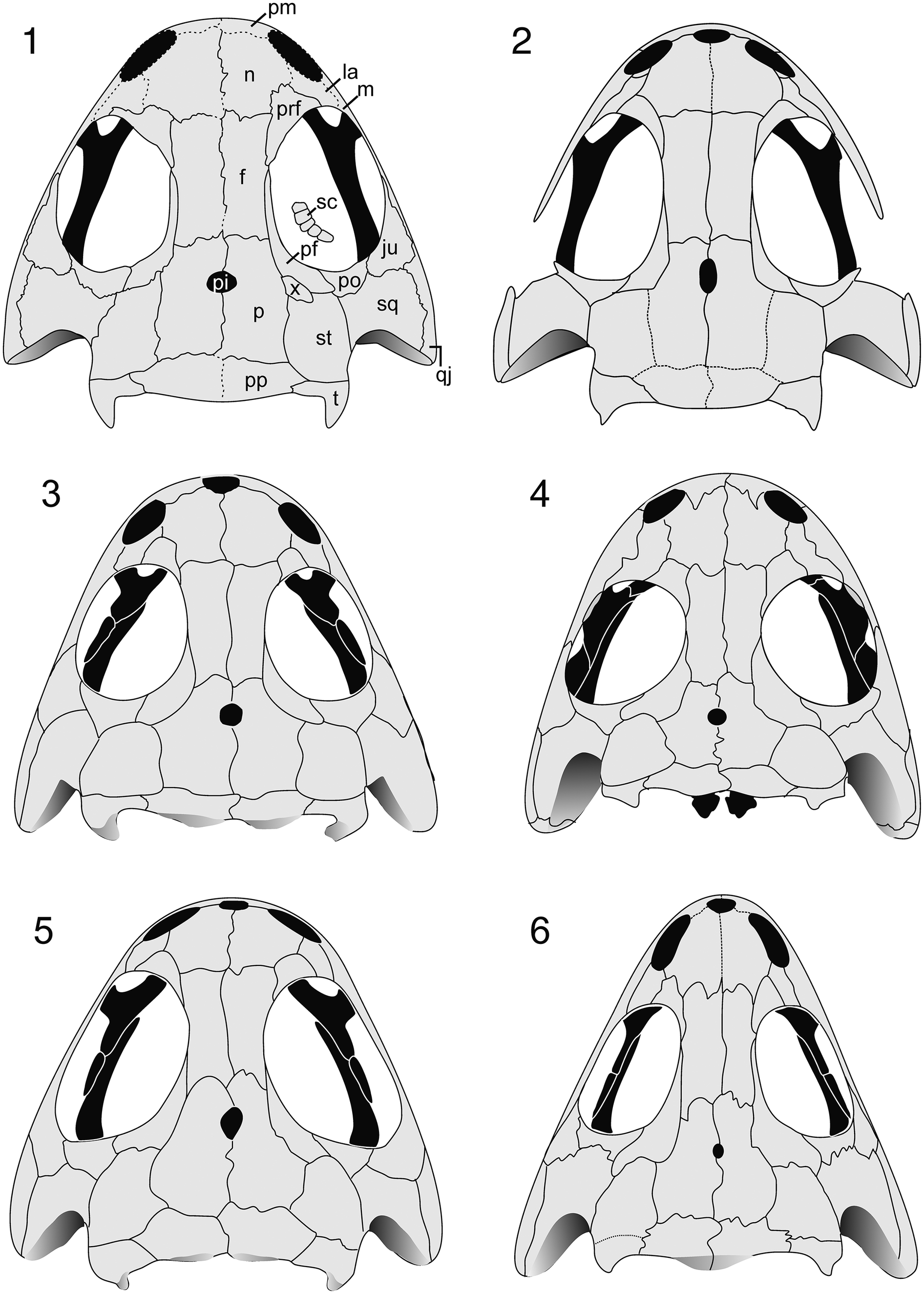
Figure 4. Long description
A six-panel set of anatomical line drawings illustrating the dorsal cranial morphology of branchiosaurids.
Panel 1, Melanerpeton kuselense, contains detailed labels. Along the midline from front to back are the p m (premaxilla), n (nasal), f (frontal), p (parietal) containing the black oval p i (pineal foramen), and p p (postparietal). Moving laterally from the snout are the l a (lacrimal), p r f (prefrontal), m (maxilla), and j u (jugal). The large orbital openings contain s c (scleral plates). Posterior to the orbits are the p f (postfrontal), p o (postorbital), x (supernumerary element), s t (supratemporal), s q (squamosal), t (tabular), and q j (quadratojugal).
Panel 2, Melanerpeton pusillum, shows a wider, more robust posterior skull table compared to panel 1.
Panel 3, Apateon pedestris, features a more rounded snout and larger, more circular orbital openings.
Panel 4, Xerodromeus gracilis, displays a narrower snout and elongated posterior elements.
Panel 5, ‘Melanerpeton’ humbergense, shows a triangular skull shape with a prominent pineal foramen.
Panel 6, Leptorophus tener, exhibits the most elongated, slender snout of the group with a highly tapered anterior profile.
All skulls are rendered in light gray with black fills for the naris, pineal foramen, and orbital shadows.
It should be stressed that the unambiguous placement of Melanerpeton kuselense n. sp. within the Branchiosauridae is possible without the two most distinctive characters, the Y-shaped palatine and isolated finger-like branchial denticles, which are both not preserved in the holotype.
Discussion
Ontogeny and evolution
The studied specimen has a skull of moderate size (10.3 mm), which exceeds the maximum length of branchiosaurids in some localities of the Saar Nahe and Thuringian Forest Basins, and which falls within the common adult size of Apateon pedestris as found in the Odernheim Black Shale (Odernheimer Kalkbank, M8; Boy, Reference Boy1972, Reference Boy1986). Compared with Apateon pedestris of equal size, the holotype of Melanerpeton kuselense n. sp. is remarkably advanced in development in some features. At the same time, a few other traits appear exceptionally immature in comparison to nearly all branchiosaurids.
Mature features are the length of the nasal and the prominence of the tabular horn. These features were established during the latest phase of larval development (Boy, Reference Boy1974; Werneburg, Reference Werneburg1991; Schoch, Reference Schoch1992). The ornament also indicates that the specimen was in an ontogenetically advanced larval phase (first maturity stage of Boy, Reference Boy1987). These features suggest that Melanerpeton kuselense n. sp. was a small-growing taxon, substantially smaller than most Apateon spp. and more similar to Xerodromeus gracilis.
Immature features of Melanerpeton kuselense n. sp. are located in the cheek and marginal palate, with the short squamosal and extremely gracile pterygoid being the most perplexing. Whereas the short squamosal is consistent with early larval stages of branchiosaurids and other temnospondyls (Schoch, Reference Schoch1992; Werneburg et al., Reference Werneburg, Stapf, Stapf, Will, Götz and Raisch2023a), the pterygoid usually exceeds half of the skull length at any growth stage. Among other branchiosaurids, larval ‘Melanerpeton’ humbergense has the smallest pterygoid measuring only 60% of the skull length (Boy, Reference Boy1978, fig. 20b). Hence, the morphological gap between Melanerpeton kuselense n. sp. and other branchiosaurids is considerable. The short gape, which results from the peculiar proportions of squamosal and pterygoid, indicates that Melanerpeton kuselense n. sp. focused on even smaller prey than other branchiosaurids. It might have been a plankton feeder, as was suggested by Boy (Reference Boy1987) for the small larval stages of Apateon spp., based on the brush-like structure of the branchial denticles. Unfortunately, neither the marginal teeth nor the branchial denticles are preserved in Melanerpeton kuselense n. sp. The only preserved teeth are in the symphysis, which are indeed very small and numerous, and an isolated larger single tooth below the pineal foramen.
Faunal assemblage and paleoecology
The occurrence of a branchiosaurid in the Theisbergstegen lake level of the Remigiusberg Formation does not come unexpected. Branchiosaurids are extremely common in some Moscovian and many Asselian lake deposits of the central European Variscan mountain range, especially in water bodies in which actinopterygian fishes were less successful (Boy and Sues, Reference Boy, Sues, Heatwole and Carroll2000; Werneburg, Reference Werneburg2002). Their larvae formed plankton feeders with a branchial sieving apparatus distinct in size from that of acanthodians and therefore can also co-occur with these (Boy, Reference Boy2003). However, the aquatic Remigiusberg assemblage differs from all later Rotliegend deposits in the Saar-Nahe Basin, with the medium-sized dvinosaur Trypanognathus remigiusbergensis Schoch and Voigt, Reference Schoch and Voigt2019 and the large eryopid Stenokranio boldi Werneburg et al., Reference Werneburg, Witzmann, Rinehart, Fischer and Voigt2023b (Schoch and Voigt, Reference Schoch and Voigt2019; Werneburg et al., Reference Werneburg, Witzmann, Rinehart, Fischer and Voigt2023b). In later deposits of the Saar-Nahe Basin, these ecomorphotypes were represented by Micromelerpeton spp. and Sclerocephalus spp., eventually joined or replaced by Discosauriscus pulcherrimus Fritsch, Reference Fritsch1879 and Glanochthon spp. (Boy et al., Reference Boy, Haneke, Kowalczyk, Lorenz, Schindler, Stollhofen and Thum2012). The Remigiusberg lagerstätte is further peculiar in that it formed in a large delta environment and can thus preserve a different and more diverse littoral fauna compared with the classical Asselian deposits that formed under profundal lake conditions at some distance from the shoreline and below the wave base (Boy, Reference Boy2003).
The occurrence of a new branchiosaurid that differs from younger lake deposits therefore adds to the unique faunal composition of the Remigiusberg aquatic tetrapod assemblage. The Theisbergstegen lake level (or its larger drainage system) thus harbored at least three aquatic tetrapods occupying different trophic levels: (1) the plankton feeding (third-level consumer) Melanerpeton kuselense n. sp.; (2) Trypanognathus remigiusbergensis that probably fed on small fishes and tetrapod larvae, e.g., Melanerpeton kuselense n. sp.; and (3) Stenokranio boldi, the apex predator in the trophic system. The much heavier skeleton of eryopids like Stenokranio boldi and Onchiodon spp. differs conspicuously from those of Sclerocephalus spp. that dominate all post-Remigiusberg assemblages of the Saar-Nahe Basin. This probably indicates a different mode of life, e.g., the preference of structured, densely vegetated lake floors and river channels, or more frequent land excursions to migrate between water bodies (Fig. 5). Furthermore, the ability to feed both in the water and outside might have been advantageous, as was the capacity to migrate further and cover a wider range of habitats (Werneburg et al., Reference Werneburg, Witzmann, Rinehart, Fischer and Voigt2023b). The co-occurrence of large chondrichthyan fishes (Orthacanthus spp.) might also have furthered the more flexible Stenokranio boldi to settle rather than the aquatic Sclerocephalus spp.
Life reconstruction of Melanerpeton kuselense n. sp. in a distributary channel of the Remigiusberg lacustrine delta facing a coelacanth, hydromedusae, cordaitalean leaves with settled microconchids, and remains of a decaying archipolypod millipede (artwork by Frederik Spindler, PALAEONAVIX).
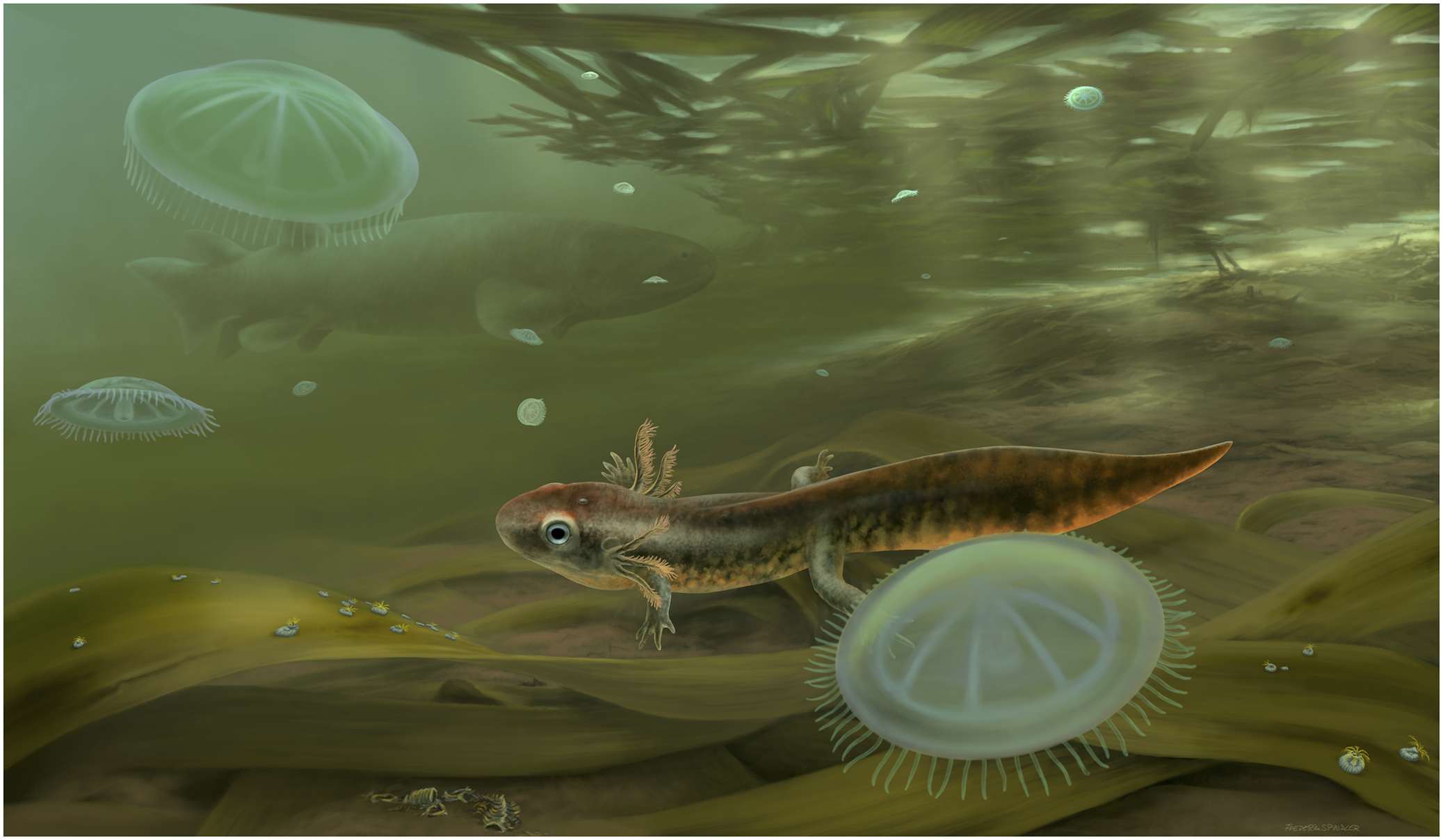
Figure 5. Long description
The scene is set in a murky, green-tinted underwater environment.
* In the lower center foreground, a Melanerpeton kuselense n. sp. is depicted as a small, salamander-like creature with external feathery gills, a long tail, and a mottled brown body.
* To its right and slightly below is a large, translucent, bell-shaped hydromedusa with fine radial lines and a fringed edge.
* The substrate consists of broad, ribbon-like cordaitalean leaves scattered across the bottom. Small, white, coiled microconchids are settled on the surface of these leaves.
* In the bottom left corner, the segmented remains of a decaying archipolypod millipede lie on the sediment.
* In the mid-ground to the left, a large, dark coelacanth fish swims horizontally, partially obscured by the turbidity.
* Several smaller hydromedusae of varying sizes float throughout the water column.
* The upper portion of the scene is filled with dense, overlapping aquatic vegetation and filtered sunlight rays penetrating from the surface, creating a sense of depth in the distributary channel.
Acknowledgments
We thank all participants of the Remigiusberg citizen science project of 2023, especially K. Harnisch, Dannstadt-Schauernheim, who called attention to the type specimen of Melanerpeton kuselense n. sp. The excavation was supported by the Basalt-Actien Gesellschaft, Linz am Rhein, with special thanks to BAG authorities K. Schön, D. Rübel, C. Gall, J. Kalmes, and C. Geissler. Research into the Remigiusberg paleoecosystem is a joint project of the General Directorate for Cultural Heritage Rhineland-Palatinate and the Urweltmuseum GEOSKOP. The software TNT was made freely available by the Willi Hennig Society. We are grateful to E. Amson and S. Spiekman for advice on methods. F. Witzmann and M. Ruta are thanked for their thoughtful and constructive reviews.
Competing interests
The authors declare none.
Data availability statement
Data available from the Dryad Digital Repository: https://doi.org/10.5061/dryad.rfj6q57r2



