INTRODUCTION
In experimental psycholinguistic research with adults, priming experiments have proven to be an advantageous technique for studying the online processing of morphologically complex words; see, for example, Marslen-Wilson (Reference Marslen-Wilson and Gaskel2007) for a review. In priming tasks, participants are presented with a prime word before a target word or picture, and the researcher manipulates the semantic, phonological, orthographic, or morphological relation between prime and target to examine the potential influence of these variables on participants' responses. A robust finding from priming experiments with adults is that response times to targets are shorter for morphologically related than for unrelated prime–target pairs. Consider, for example, results from a priming experiment with derived word forms (Silva & Clahsen, Reference Silva and Clahsen2008). Critical prime–target pairs such as bitterness/bitter were compared to two control conditions which are thought to reflect the minimum and maximum amount of facilitation or priming for a given lexical item, an unrelated condition in which the target word (e.g. bitter) is preceded by a semantically and formally unrelated word, and an identity condition in which it is preceded by the same word. The results revealed a significant reduction of the target words' response times for morphologically related prime–target pairs (relative to the unrelated condition), with the same amount of facilitation as in the identity condition. Stem-repetition priming effects of this kind have been interpreted to reflect the presence of shared morphological constituents in the prime and in the target; see Pinker (Reference Pinker1999, Chapter 5) for a review. In the present case, derived words are thought to be decomposed into their morphological constituents (e.g. bitter+-ness) by which the base stem is isolated and directly primes the target stem. According to this view, the mental representations of derived and inflected words encode morphological structure, and priming effects provide a window into how these representations are used during processing (e.g. Clahsen, Eisenbeiss, Hadler & Sonnenstuhl, Reference Clahsen, Eisenbeiss, Hadler and Sonnenstuhl2001). There is, however, an alternative interpretation according to which what looks like a morphological priming effect is in fact the result of the surface form overlap and semantic relatedness between the critical prime–target pairs, e.g. between bitterness and bitter. This interpretation is consistent with the view that all words, including morphologically complex ones, are represented and processed in terms of their surface forms and their semantic properties without any representation of their morphological structure (e.g. Gonnerman, Seidenberg & Andersen, Reference Gonnerman, Seidenberg and Andersen2007; Seidenberg & Gonnerman, Reference Seidenberg and Gonnerman2000). To properly assess results from priming experiments it is therefore important to determine whether priming effects between morphologically related prime–target pairs can indeed be explained in terms of their surface form and/or semantic overlap.
The current study investigates an inflectional system, past participle formation in German, in which the source of any priming effect for morphologically related items can be more straightforwardly assessed than for derived words. While the prime words we tested were morphologically different (e.g. regular -t vs. irregular -n participles), they were exactly parallel in terms of their semantic overlap with the target words. In addition, priming effects for -n participles with and without stem changes were compared, to assess the role of formal (orthographic/phonological) prime–target overlap; see ‘Materials’ section below. With these comparisons, it should be possible to decide whether any priming effects for -t and/or -n forms are indeed morphological in nature.
Morphological priming has also been examined in a number of studies with primary-school children in English, French, and Hebrew (Casalis, Dusautoir, Colé & Ducrot, Reference Casalis, Dusautoir, Colé and Ducrot2009; Deacon, Campbell, Tamminga & Kirby, Reference Deacon, Campbell, Tamminga and Kirby2010; Feldman, Rueckl, DiLiberto, Pastizzo & Vellutino, Reference Feldman, Rueckl, DiLiberto, Pastizzo and Vellutino2002; Quémart, Casalis & Colé, Reference Quémart, Casalis and Colé2011; Rabin & Deacon, Reference Rabin and Deacon2008; Ravid Reference Ravid2011; Schiff, Raveh & Kahta, Reference Schiff, Raveh and Kahta2008). These studies used visual priming paradigms with written stimuli focusing on the role of children's sensitivity to morphological structure for the development of reading. In addition, one study (Rosa & Nunes, Reference Rosa and Nunes2008) examined how prior presentation of a morphologically related prime facilitated children's spelling performance on existing derived and pseudo-derived target words in Portuguese. A common finding from these studies is that morphologically related words produced priming effects suggesting that primary-school children are sensitive to morphological structure. Three studies (Deacon et al., Reference Deacon, Campbell, Tamminga and Kirby2010; Feldman et al., Reference Feldman, Rueckl, DiLiberto, Pastizzo and Vellutino2002; Rabin & Deacon, Reference Rabin and Deacon2008) employed the fragment-completion task with English-speaking primary-school children in which participants complete a letter fragment of the target word after reading a morphologically or orthographically related prime word. These studies reported better performance on the target fragments in the morphological (e.g. filmed – film) than the orthographic priming condition (e.g. filled – film; Feldman et al. Reference Feldman, Rueckl, DiLiberto, Pastizzo and Vellutino2002, p. 535), indicating children's sensitivity to morphological relatedness beyond surface form overlap. Other studies asked participants to name or to perform lexical (word/nonword) decisions on visually presented target words preceded by morphologically or orthographically related prime words. Casalis et al. (Reference Casalis, Dusautoir, Colé and Ducrot2009), investigating French-speaking nine-year-old children, found significantly more facilitation for derived prime words than for orthographic controls, except for the shortest prime duration ( = 75 ms) when both prime types produced similar effects. Schiff et al. (Reference Schiff, Raveh and Kahta2008) tested third- and seventh-grade children on irregular root forms in Hebrew. They found that morphologically related forms (e.g.  , NGS–haGaSa ‘handing over’) produced stronger priming effects than orthographic baseline forms, but that, unlike adults, children did not show any priming for morphologically related forms that did not have overlapping surface forms. Schiff et al. (2008, p. 739) attribute this difference to children's incomplete lexical representations at ‘a level that abstracts away from differences in surface form’.
One problem with these studies is that although pure orthographic overlap could be ruled out as the source of priming in the morphological conditions, it is not clear to what extent the larger priming effect for morphologically related word pairs such as ducks/duck (relative to decks/duck) is indeed morphological in nature and/or due to the fact that the former but not the latter are also semantically related. Quémart et al. (Reference Quémart, Casalis and Colé2011) addressed this concern by including prime–target pairs such as baguette/bague ‘French bread/ring’ which are semantically unrelated but in which the prime word contains a pseudo-affix. In addition, Quémart et al. (Reference Quémart, Casalis and Colé2011) also included a semantic overlap condition to control for potential semantic priming effects. Testing three age groups of French-speaking children (between the ages of 8;0 and 14;3) and three prime durations (60 ms, 250 ms, 800 ms), they reported the same significant facilitation for pseudo-derived prime–target pairs (e.g. baguette/bague) as for morphologically related prime–target pairs (e.g. armure/arme ‘armor/weapon’) relative to orthographic and semantic control conditions. Similar results have been reported for French verb inflection in adult priming experiments (Meunier & Marslen-Wilson, Reference Meunier and Marslen-Wilson2004). Quémart et al. (Reference Quémart, Casalis and Colé2011) conclude from their findings that children make use of morphemic decomposition during reading. Note, however, that strictly speaking this claim can only be made for derivational morphology, as Quémart et al. (Reference Quémart, Casalis and Colé2011) did not test priming from inflected words.
Although results from a number of previous studies have shown that primary-school children demonstrate adult-like priming effects for morphologically related words, questions remain as to what these results might mean for morphological representation and processing. One concern is that because previous studies with children used largely unimodal designs with visual stimuli, the reported priming effects might be specific to the written modality and may not extend to a more abstract level of lexical representation. Another concern is that the reported priming effects may not (only) be morphological in nature but could (also) be due to the semantic relatedness between primes and targets. Finally, little is known from previous studies about developmental changes in children's morphological processing.
The current study addresses these concerns. The technique we used for the present study is cross-modal immediate repetition priming in which participants listen to a spoken prime word immediately followed by a visually presented target word which they read out aloud. One advantage of cross-modal priming is that it taps more directly into abstract lexical representations than purely visual or auditory priming experiments. This is because participants receive auditory primes and visual targets in different modalities. Hence, any priming effect is thought to take place at a modality-independent level of lexical representation that is relatively independent of low-level form properties of the prime and target words (Marslen-Wilson, Tyler, Waksler & Older, Reference Marslen-Wilson, Tyler, Waksler and Older1994; but see Allen & Badecker, Reference Allen and Badecker2002). Furthermore, materials were constructed (using -t and -n participle forms of German) that allowed us to tease apart morphological priming effects for inflected word forms from non-morphological factors, viz. the formal (orthographic/phonological) and semantic overlap between prime and target words. Finally, we examined a large sample of children (n = 108), comprising two age groups (group I, mean age: 8;4, group II: mean age: 9;9), to determine potential changes of children's morphological processing with age.
Linguistic background: participle formation in German
The linguistic phenomenon under study is past participle formation in German. Three morphological processes are involved in participle formation, prefixation, suffixation, and stem allomorphy; see (1) for illustration.
(1) Infinitive Past participle
a. kaufen gekauft
‘to buy’ ‘bought’
b. gehen gegangen
‘to go’ ‘gone’
c. laufen gelaufen
‘to run’ ‘run’
d. verlaufen verlaufen
‘go astray’ ‘gone astray’
Participles carry the prefix ge-, which is prosodically rather than morphologically determined. When the stem is stressed on the first syllable, ge- is inserted, as indicated in (1c). The prefix is not inserted when stress occurs on another syllable, as indicated in (1d). Participles always carry one of two segmentable endings, -t and -n. The -t participle suffix readily applies to novel verbs (Clahsen, Reference Clahsen1997), irrespective of whether they are similar to existing verbs. By contrast, verbs that take -n participles represent a lexically restricted closed class of items, and -n participle formation only generalizes to novel words that are similar to existing verbs that take -n participles (Weyerts & Clahsen, Reference Weyerts and Clahsen1994). To capture this difference, Wunderlich and Fabri (Reference Wunderlich and Fabri1995) proposed a linguistic analysis of German in which -t participles are formed by the affixation rule in (2a), and -n participles such as (1d) constitute subentries of a restricted set of lexical templates as illustrated in (2b).
- (2)
a. /-t/; [+Verb] → [ ]+part
b. [verlaufen]+part ‘gone astray’
The rule in (2a) applies to any element of the syntactic category [+Verb], irrespective of its phonological or semantic properties, and computes a corresponding participle form as its output. Furthermore, Marcus, Brinkmann, Clahsen, Wiese, and Pinker (Reference Marcus, Brinkmann, Clahsen, Wiese and Pinker1995, p. 219) argued that ‘by the same tests that establish that -ed is the default past tense suffix in English, -t is the default in German’. The diagnostics for defaults included preferences for non-rhyming novel words, low-frequency and unusual words, non-canonical roots, and derived words (p. 197). The rule is blocked by -n participle forms, which have internally structured lexical entries such as the one in (2b); see Clahsen (Reference Clahsen1999) for a more detailed description.
Some researchers have claimed that -t participles are more frequent in German than those with -n, e.g. Bybee (Reference Bybee1995). There are, however, several problems with frequency counts that put -t participles in the majority. First, they require collapsing linguistically distinct types of words into one category. Bybee (Reference Bybee1995), for example, calculated type frequencies for all so-called ‘Grundverben’ (‘base verbs’) that share a root. This might be appropriate for English, but German has many families of particle and prefix verbs, such as ankommen ‘arrive’, bekommen ‘receive’, aufkommen ‘support, pay’, which have non-compositional meanings, which orthographically and phonologically behave like single verbs, and which in their participle form always appear as a single verb. Consequently, Clahsen and Rothweiler (Reference Clahsen and Rothweiler1993) counted verbs such as those mentioned above separately, and this yielded similar (type and token) frequencies for -t and -n participles. Second, in both Bybee's (Reference Bybee1995) and Clahsen and Rothweiler's (Reference Clahsen and Rothweiler1993) count, -t participles are only more common than -n participles in terms of pure type frequencies, but not when token frequencies are also included. Consider, for illustration, the frequency distribution of -t and -n participles in CELEX. There are 14,163 participles in CELEX, 48% ( = 6,808 instances) of which are -n participles (mean token frequency: 4·5 per million), and 52% ( = 7,355 instances) are -t forms (mean token frequency: 1·76 per million). Third, with respect to estimating participle frequencies relevant for child language and for children's input, type frequency counts that yield -t participles as more frequent are based on the entire adult German verb lexicon, which contains many low-frequency words unfamiliar to children. Weyerts and Clahsen (Reference Weyerts and Clahsen1994) therefore determined type (and token) frequencies in child-directed speech on the basis of spontaneous speech corpora covering the age range of 1;5 to 8;7. Similar type (and token) frequencies were found for -t and -n participle forms, 46·6% for the former and 53·4% for the latter. We conclude that frequencies can be determined in a number of ways and that not all frequency counts put -t participles in the majority.
Stem changes in participles such as those illustrated in (1b) above are found for 138 simplex verbs in German. Of these, 125 form their participles with -n, and only 13 with -t (e.g. bringen/gebracht ‘to bring’, denken/gedacht ‘to think’, nennen/genannt ‘to name’, brennen/gebrannt ‘to burn’). Some linguists have tried to describe stem allomorphy in German verb inflection through (morphologically conditioned) phonological rules (e.g. Barbour, Reference Barbour1982; Beedham, Reference Beedham1994, 1995/Reference Beedham1996; Bittner, Reference Bittner1996). This, however, is far from straightforward. Beedham (Reference Beedham1995/1996), for example, posits phonological rules that specify fifty different patterns to distinguish between unmarked and marked stem forms. One problem with any account that attempts to handle stem alternations by phonological rules is the large number of exceptions and counter-examples (e.g. Durrell, Reference Durrell1980, Reference Durrell, Watts, West and Solms2001; Wiese, Reference Wiese1996). Given that stem allomorphy in German verb inflection is largely unpredictable, an alternative proposal suggests that stem alternants might be directly represented in the lexicon, either through associative pattern networks or schemas (e.g. Köpcke, Reference Köpcke1998) or as subnodes of structured lexical entries (Wunderlich, Reference Wunderlich1996); see Clahsen, Prüfert, Eisenbeiss, and Cholin (Reference Clahsen, Prüfert, Eisenbeiss, Cholin, Kaufmann and Stiebels2002) for discussion.
Previous studies of participle formation in German
Two of the most consistent findings from a considerable number of studies on German child language are that (i) children sometimes overapply the participle -t in cases in which -n forms are required in the adult language, whereas overapplications of the participle -n to verbs that require -t forms are much less common, and that (ii) children sometimes use the unmarked (infinitival) stem of a verb in cases in which marked stems are required, but not vice versa (e.g. Clahsen & Rothweiler, Reference Clahsen and Rothweiler1993; Clahsen et al., Reference Clahsen, Prüfert, Eisenbeiss, Cholin, Kaufmann and Stiebels2002; Elsen, Reference Elsen, Fabri, Ortmann and Parodi1998; Lindner, Reference Lindner, Fabri, Ortmann and Parodi1998; Szagun, Reference Szagun2011; Weyerts & Clahsen, Reference Weyerts and Clahsen1994).
While most previous studies have examined German children's participle forms in spontaneous speech or elicited production data, the current study examines representations and processes involved in children's recognition of participle forms, using the cross-modal priming technique. Previous priming studies on German participle formation have tested adult participants, both native speakers and non-native second language (L2) learners of German. Sonnenstuhl, Eisenbeiss, and Clahsen (Reference Sonnenstuhl, Eisenbeiss and Clahsen1999) examined participles without stem changes suffixed with either -t or -n in a cross-modal priming experiment with adult native speakers. Priming effects from the morphological conditions (e.g. gekauft – kaufe ‘bought – buy[1ps]’, geschlafen – schlafe ‘slept – sleep[1ps]’) were compared to two control conditions, an identity condition, with the same (1st person singular) form being presented as both prime and target (kaufe – kaufe ‘buy[1ps] – buy[1ps]’) and an unrelated condition in which the target word was preceded by an unrelated prime (lobe – kaufe ‘praise[1ps] – buy[1ps]’). The results revealed priming differences between -t and -n participles. While -t participle primes yielded a full stem-priming effect, i.e., the same amount of facilitation on the recognition of the target as in the identity condition, -n participle primes produced a partial or reduced effect, with significantly less priming than in the identity condition. These results were replicated by Neubauer and Clahsen (Reference Neubauer and Clahsen2009) in a masked visual priming experiment with a new group of adult native speakers.
In contrast to the results from these two studies, both of which demonstrated priming differences between -t and -n participles for adult native speakers of German, Smolka, Zwitserlood, and Rösler (Reference Smolka, Zwitserlood and Rösler2007) did not obtain any priming differences between -t and -n participles in an unmasked priming experiment in which both primes and targets were visually presented. Instead, the same amount of facilitation was found relative to an unrelated control condition. There are, however, a number of problems in the design of their study. First, unlike the two other priming studies, Smolka et al. (Reference Smolka, Zwitserlood and Rösler2007) compared -t forms without stem changes to -n participles with stem changes, which makes it hard to properly assess the contribution of the different types of exponent (affix type, stem type) to the observed priming effects. Second, Smolka et al. (Reference Smolka, Zwitserlood and Rösler2007) used -n forms (infinitives) as target words. Consequently, -n but not -t participle primes had the same ending as the corresponding target words, which may have artificially enhanced priming effects for -n forms. Third, both primes and targets were presented overtly and in the visual modality only, a design that is known to yield postlexical strategic effects (e.g. Forster, Reference Forster1998) and to be more directly affected by semantic and orthographic overlap between primes and targets than cross-modal or masked priming experiments (Marslen-Wilson, Reference Marslen-Wilson and Gaskel2007). Smolka et al. did not, however, include any orthographic or semantic control condition, which makes it difficult to decide whether the reported priming effects were indeed morphological in nature. Finally, their experiment did not include an identity condition. Hence it is not possible to identify the contrast between full priming (for -t) and partial priming (for -n participles) that was found in both the cross-modal and the masked priming experiments. For these reasons, we remain unconvinced by Smolka et al.'s (Reference Smolka, Zwitserlood and Rösler2007) findings.
The present study
The main aim of the current study is to gain insight into how children process inflected words, specifically German past participles, during online language comprehension. To this end, we employed the cross-modal priming technique testing seven- to ten-year-old children as well as a control group of adults, who were native speakers of German. In our experiment, participants listened to prime words prior to reading aloud visually presented target words, as quickly and as accurately as possible. Note that the lexical (word/nonword) decision task (which was used in previous morphological priming studies with adults) has been found to be problematic for children, because it is an unusual and complex task for children that requires metalinguistic skill and is therefore likely to produce many false positives and/or exceptionally long response times (Quémart et al., Reference Quémart, Casalis and Colé2011, p. 493, Feldman et al., Reference Feldman, Rueckl, DiLiberto, Pastizzo and Vellutino2002, p. 530). On the other hand, primary-school children are used to naming written words aloud, which therefore seems a more natural task for children (Schiff et al. Reference Schiff, Raveh and Kahta2008, p. 740).
The critical primes were participles, all of which had the ge- prefix. To test for effects resulting from the two participle endings, we compared priming effects from -t participles to those from -n participles such as geschlafen ‘slept’, none of which contained any stem changes. To test for effects of stem changes on participle priming, we compared priming effects from -n participles without stem changes to those from -n participles with stem changes. In this way, we tried to independently assess the role of the different exponents for any priming effect.
Given results from previous priming studies with primary-school children in other languages, we expect German-speaking children in the age range tested to show adult-like priming effects. Yet, children may have more delayed response latencies than adults. The design of the current study should allow us to determine the nature of any priming effect. We predict different priming effects for -t and -n participles, corresponding to their distinct morpholexical representations. If -t participles are derived from an affixation rule such as (2a), producing morphologically structured word forms, these forms should produce full priming effects. By contrast, if -n participles are stored as lexical (sub)entries, these forms should produce reduced priming effects irrespective of any additional stem change. Alternatively, morphological structure and morphological relatedness may not be directly represented in the mental grammar/lexicon and priming effects for inflected word forms may instead arise from the ‘convergence of codes’, i.e., from shared meanings and overlapping surface forms of primes and targets (e.g. Gonnerman et al., Reference Gonnerman, Seidenberg and Andersen2007). This account predicts the same priming patterns for -t and -n participles without stem changes, due to parallel phonological, orthographic, and semantic overlap between primes and targets. By contrast -n participles with stem changes should produce less priming than -n participles without stem changes, due to reduced formal overlap between prime and target for the former compared to the latter.
METHOD
Participants
The cross-modal priming experiment was administered to 108 German-speaking children between the ages of 7;3 and 10;7 (mean age: 9;2, SD: 0·86). Children were raised in families with parents speaking German as their only first language. None of the children was exposed to other languages at their homes. Children were recruited from an after-school program and a primary school in the region of Braunschweig/Salzgitter, Northern Germany. Children were identified by their teachers as performing within normal parameters for their age with respect to reading, language, and general learning abilities. The experimenter explained the experimental task to the children in their classrooms, inviting them to participate in the experiment. We also tested a control group of 72 adult native speakers of Standard German (mean age: 37·65, range: 20;0–60;0, 41 women). Ethical approval was gained prior to testing from the university's ethics committee. The adult participants were asked for their written consent. Parents or legal guardians provided consent in writing on behalf of their children. All participants had normal or corrected-to-normal vision. None of the participants had a history of language impairment or hearing impairment.
To ensure that the children were able to perform the task assigned to them in the main experiment, i.e., reading out single words, they were selected from a larger pool of 230 children on the basis of their scores in a standardized test of single word reading, the Würzburger Leise Leseprobe (WLLP) ‘Würzburg Silent Reading Test’ (Küspert & Schneider, Reference Küspert and Schneider1998). Ninety-two children with relatively low overall reading scores of less than 63 (out of a maximum score of 140) did not take part in the cross-modal priming experiment. Subsequently, another 30 children were excluded from the analysis of the cross-modal priming data as these children produced three or more reading errors. The remaining 108 children were split into two groups according to their age, ‘age group I’, consisting of 54 children with a mean age of 8·4 (range: 7;3–9;1, SD: 0·571, 29 girls), and ‘age group II’, consisting of 54 children with a mean age of 9;9 (range: 9;1–10;7, SD: 0·293, 32 girls).
Since the main experiment involved listening to words, we also performed an auditory digit-span test for both the child and adult participants (Tewes, Reference Tewes1983, Reference Tewes1991), which requires participants to repeat aurally presented strings of two to nine digits either in the same order (Subtest Zahlen nachsprechen ‘Repeat digits’) or in the reversed order (Subtest Zahlen rückwärts nachsprechen ‘Reverse repetition of digits’). Two strings of each length were presented yielding a total of sixteen strings. One point was scored for each successfully repeated string. The total raw points for each participant were then converted into standardized scores for the participants' age using the norms provided. Results revealed similar mean digit spans for the two age groups of children (group I: 10·81, SD: 2·34; age group II: 11·06, SD: 2·03), both of which were shorter than that of the adult group (12·90, SD: 2·53). These observations were confirmed statistically. A one-way ANOVA on these scores revealed a significant effect of ‘Participant Group’ (F(2) = 15·51, p < ·001), with significantly higher digit-span scores for the adult group than for age group I (t(124) = 4·79, p < ·001) and age group II (t(124) = 4·54, p < ·001), and no reliable digit-span score difference between the two age groups of children (t < 1).
Materials
We tested three kinds of critical primes: (i) -t participles with unmarked (infinitival) stems; (ii) -n participles with unmarked stems; and (iii) -n participles with stem changes. These prime types were combined with target words that were first person singular present tense forms of the same verbs. There were twenty-seven critical prime–target pairs, nine of each type, e.g. getanzt – tanze ‘danced – dance[1ps]’, geschlafen – schlafe ‘slept – sleep[1ps]’, geliehen – leihe ‘borrowed – borrow[1ps]’. A complete list of critical primes and targets is shown in the ‘Appendix’. For each critical prime–target pair, there were two control conditions, an Identity condition (e.g. tanze – tanze) with the same word form as prime and target, and an Unrelated condition in which the target word was combined with a prime word that was not related to the target (e.g. schwören – leihe ‘to swear – borrow[1ps]’). To ensure that unrelated prime–target pairs are comparable to the critical ones in terms of their morphological structure, we used infinitive forms as unrelated primes, which contain an affix (the infinitive -n) that was not present in the target.
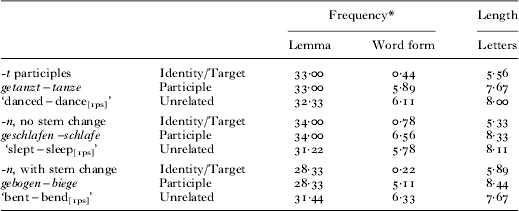
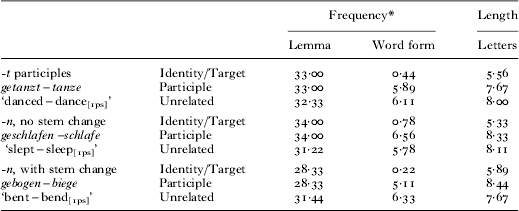
The materials were matched as closely as possible with respect to a number of criteria, namely lemma and word-form frequency, word length, lexical neighborhood, and age of acquisition, as well as (formal and semantic) prime–target overlap. Consider first frequency and length matching (see Table 1).
Mean frequency and length of experimental prime words
note: * Frequencies are per million words in the CELEX corpus (Baayen, Piepenbrock & Gulikers, Reference Baayen, Piepenbrock and Gulikers1995).
The prime words used in the unrelated condition were matched pairwise with the corresponding primes in the participle condition with regard to lemma frequency, word form frequency, and number of letters, based on data from the CELEX corpus (Baayen, Piepenbrock & Gulikers, Reference Baayen, Piepenbrock and Gulikers1995). Paired t-tests revealed no differences between any of the participle and the unrelated primes for any of the three matched variables (all ts < 1). To allow for comparisons between the three types of participle primes, they were also matched for mean lemma frequency, mean word form frequency, and mean number of letters (see Table 1). One-way ANOVAs revealed no significant differences between the three participle types for any of the three matched variables (all Fs < 1). The target words for the three critical prime types were also matched for lemma frequency, word form frequency, and number of letters (see ‘Identity/Target’ in Table 1). Additionally, the target words were matched with respect to mean neighborhood size (-t: 11·8; -n with stem change: 11·0; -n without stem change: 12·3); one-way ANOVAs revealed no significant differences between the targets of the three participle types for any of the matched variables (all Fs < 1).
As we tested children, the experimental items also need to be matched for age of acquisition. For German child language, however, there are no sufficiently large corpora of children's productions that would provide a reliable basis for calculating the ages of acquisition of the experimental items used. On the other hand, several studies have found that estimated age of acquisition is highly correlated with objectively assessed age of acquisition for English nouns (e.g. Carroll & White, Reference Carroll and White1973; Morrison, Chappell & Ellis, Reference Morrison, Chappell and Ellis1997) and German nouns (Schröder, Gemballa, Ruppin & Wartenburger, Reference Schröder, Gemballa, Ruppin and Wartenburger2012). We have therefore performed a pretest with thirty-four adult native speakers of German (age 18–72 years) in which all critical primes and targets were visually presented as a randomized word list and participants were asked to estimate the age of acquisition for these words on a 10-point scale (1 = year 1, 2 = year 2, 3 = year 3, 4 = year 4 … 10 = year 10). Estimated mean ages of acquisition did not significantly differ between participle types (means, -t: 3·92, SD: 0·967, -n without stem change: 3·65, SD: 1·17, -n with stem change: 3·54, SD: 1·18; F < 1). These results suggest that experimental items were properly matched with respect to (estimated) age of acquisition.
Another set of criteria by which our materials were matched was formal as well as semantic prime–target overlap. Formal overlap in our stimuli was assessed using the Match Calculator tool (http://www.pc.rhul.ac.uk/staff/c.davis/Utilities/MatchCalc/; Davis & Bowers, Reference Davis and Bowers2006).Footnote 1 Mean overlap ratios for morphologically related and morphologically unrelated primes and targets were calculated for the three experimental conditions. For morphologically related prime–target pairs, the mean overlap ratios were ·23 in the -t participle condition, ·11 in the -n/without stem change condition, and ·16 in the -n/with stem change condition. For the morphologically unrelated prime–target pairs, the corresponding mean overlap ratios were ·26, ·29, and ·24, respectively; one-way ANOVAs did not reveal any significant differences between conditions with respect to formal overlap, either for the morphologically related or the morphologically unrelated prime–target pairs (both Fs < 1).
To assess semantic overlap, a group of thirty-four adult native speakers of German were visually presented with all three types of prime–target pairs from our cross-modal priming experiment (identity, morphological, unrelated) in a randomized order and were asked to estimate the semantic overlap between the two forms on a 5-point scale (1 = semantically identical, 5 = no semantic overlap). All morphological prime–target pairs (e.g. geschlafen – schlafe ‘slept – sleep’) for the three participle types were rated as ‘1’, i.e., ‘semantically identical’, whereas the unrelated control prime–target pairs were rated as having ‘no semantic overlap’ (means: -t: 4·95; -n/without stem change: 4·98; -n/with stem change: 4·95).
Another property of our prime words that needed to be assessed was how common they are as attributive adjectives and/or nominalizations in German usage. Note that -t and -n forms do not only occur as participles but that they are also fed into the formation of attributive adjectives (e.g. das gedruckte Buch ‘the printed book’) or into nominalizations (das Gedruckte ‘the printed (matter)’). If such forms were common for particular items, this could lead to competition for the recognition of the participle forms of these items. However, a search in the CELEX database revealed that such forms were extremely rare amongst the critical items of our experiment. There was only one item amongst the critical -n participles without stem changes and one amongst those with stem changes that had a word form frequency for an attributive adjective or nominalized form that was different from 0, namely the nominalizations Gefangen(er), Gefangen(e), Gefangen(en) ‘prisoner’, and the attributive adjective gebogen(en) ‘bent’. Second, a one-way ANOVA was performed to ensure that the three prime types (-t forms, -n forms with stem changes, -n forms without stem changes) did not significantly differ with respect to their mean frequencies of attributive adjective and/or nominalized forms (F < 1). Third, we note that attributive adjective and nominalized forms are not completely homophonous with participles, as the former always require an additional ending, at least a schwa (e.g. das Gedruckte ‘printed (matter)’, gebackene Kartoffeln ‘baked potatoes’), whereas this is not allowed for participles (e.g. gebacken). For these reasons, it is unlikely that our participants misperceived our prime words as nominalizations or attributive adjectives. Furthermore, the same -t and -n forms that are used as (past) participles also occur in so-called ‘predicative adjective’ contexts (Das Brot ist gebacken ‘The bread is baked’, Die Sauce ist gerührt ‘The sauce is stirred’). It is true that the two constructions, the predicative adjective and the auxiliary + participle one, have different syntactic and semantic properties, but the different construction types in which -t and -n forms appear are unlikely to affect their internal structure as isolated words, which we are testing in the present experiment. Nevertheless, the experimental items should be controlled for whether or not they are commonly used as homophonous adjective forms. Since the CELEX lexical database does not provide this information, we relied on four standard German dictionaries (Grimm & Grimm, Reference Grimm and Grimm1991; Wahrig, Reference Wahrig1997; Drasdowski, Reference Drasdowski1993; Paul, Reference Paul1992) to determine whether the critical items used in the present experiment were listed as adjectives in any of them. There were four items within each of the three participle types that (in addition to a participle) had an adjective entry in at least one of these four dictionaries: -t participles (gedruckt ‘printed’, gesteckt ‘stuck’, gesprengt ‘blasted’, gerührt ‘stirred’), -n/without stem change (gesalzen ‘salted’, gewachsen ‘grown’, gewaschen ‘washed’, gefangen ‘caught’), -n/with stem change (gebogen ‘bent’, gestohlen ‘stolen’, gesunken ‘sunk’, gerissen ‘ripped’). Hence, item sets for the three participle types were parallel in this respect.
The critical prime–target pairs were distributed over three counterbalanced experimental lists that were matched as closely as possible in terms of mean frequencies. Each list contained all twenty-seven critical target words, but only one prime–target pair for each target (Identity, Morphological, or Unrelated). To prevent participants from developing any response strategies for the experimental items, a set of eighty-one unrelated filler prime–target pairs was included, which reduced the amount of related prime–target pairs in each experimental list to less than 17%. The set of filler items consisted of different verb forms as primes and targets (e.g. bare stem forms, participles, 1st sg. present tense forms, and infinitives). To eliminate undesired priming or inhibition effects across items, the 108 prime–target pairs in each list were pseudo-randomized. To ensure that no semantic association of any kind existed between consecutive items, not more than two items of the same prime–target pair type occurred in sequence, and a given prime or target word had a different onset from the subsequent word. For each of the three lists, a reverse-order list was created, which was identical to the original list except for the fact that the order of items was reversed. An additional set of eight additional filler prime–target pairs (consisting of participle forms, infinitives, bare stem forms, and 1st sg. present tense forms) was used as practice items.
Procedure
For the cross-modal priming experiment, auditory prime words were spoken by the same female German native speaker and recorded in one session using Audacity (http://audacity.sourceforge.net). All visual target words were presented in size 36 font in white letters against a black background. The experiment was programmed using the DMDX experiment software (Forster & Forster, Reference Forster and Forster2003) and carried out on a laptop computer with a 17″ screen. Primes were presented through loudspeakers and targets as written words in the middle of the computer screen. Prior to the experiment, participants were asked if they could clearly understand the spoken words. If necessary, the loudspeakers' volume was adjusted following the participants' requirements.
Participants were instructed to listen carefully to the spoken words and to read out aloud single words appearing on the computer screen as quickly and accurately as possible. Each trial followed the same sequence. A fixation cross was presented for 800 ms in the middle of the screen followed by an auditory attention tone presented for 200 ms. Directly thereafter, the auditory prime word was presented, immediately followed by the visual target word, which stayed on screen until the participant had read it aloud. The next trial was initiated by the experimenter. The participants' spoken responses were recorded using a digital audio recorder, which were then processed with the PRAAT sound file editor to obtain response latencies. To encourage participants to listen carefully to the primes, they were told that ten of the prime words throughout the experiment were followed by a request to repeat the prime word after they had produced the target word. All of these were filler trials randomly distributed over each experimental version. To make the task more appealing to children, the experiment was introduced along with a board game on which the child participants could mark their progress after each block of twelve trials. Each experimental version was divided into nine blocks of twelve prime–target pairs each; after each block participants could have a break or terminate the experiment if they wished. Finally, to ensure that the child participants were familiar with the vocabulary items used in the main experiment, they were asked to perform a visual word/non-word decision task on all target words from the main experiment plus corresponding nonce words that differed in not more than one phoneme from the target words. Accuracy on this task was 100%, demonstrating that the children were familiar with the target words tested.
Participants were tested in a quiet room. Each experimental session began with the digit-span test. This was followed by detailed oral instructions to the main experiment. The main experiment started with the practice session, consisting of eight filler prime–target pairs, after which participants had the opportunity to ask questions about the procedure. After the main experiment, the child participants were tested on the vocabulary items used in the main experiment. Each experimental session took approximately 25 minutes for the children and 20 minutes for the adult participants.
Data analysis and scoring
We measured participants' response latencies from the offset of the prime word to the onset of their spoken response using an automatic pause detection script in PRAAT. This script detects pause boundaries (<45 Hz) on the audio files, which were subsequently double-checked by two transcribers.
Only trials for which correct responses were given were considered for analysis. Trials containing unexpected responses were not further analyzed. These included productions of another inflected form of the targeted verb, e.g. stop instead of the target word form stoppe, or the targeted inflected form of a different lexeme, e.g. stecke ‘stick[1ps]’ instead of the target strecke ‘stretch[1ps]’. There were 0·6% incorrect responses in the adult and 3·3% in the child data. We excluded mispronunciations of the target words due to hesitations or syllable repetitions; this affected another 0·1% of all trials in the adult and 0·6% of all trials in the child group. We excluded response latencies which were larger than 2·5 standard deviations of the group mean, which affected 1·5% of all trials from the adult group and 1·3% from the child group. Prior to any statistical analyses, the raw response latencies were log-transformed and converted to z-scores for each participant. Whilst mean response latencies are shown, all statistical analyses were performed on these z-score averages. This was done because across participle types and prime types, children's overall response latencies were 1·3 times longer than those of the adult group, which when left untransformed could have led to overestimating effects for the slower participant group; see the ‘overadditivity effect’ reported by Faust, Balota, Spieler, and Ferraro (Reference Faust, Balota, Spieler and Ferraro1999). Under such circumstances, Faust et al. (Reference Faust, Balota, Spieler and Ferraro1999) recommend performing statistical analyses on z-score averages.
To analyze the data statistically, we first conducted 3 × 3 × 3 mixed analyses of variance (ANOVA) with the variables ‘Condition’ (-t participle, -n participle without stem changes, -n participles with stem changes), ‘Prime Type’ (Identity, Morphological, Unrelated), and ‘Group’ (children/age group I, children/age group II, adults). We also included presentation list as a factor to account for possible error variance based on list (Pollatsek & Well, Reference Pollatsek and Well1995), but did not analyze this factor. Two analyses were conducted, one by participants (F 1), one by items (F 2). In the F 1 analysis, Prime Type and Condition were treated as within-subjects factors, and Group as a between-subjects factor. In the analysis by items (F 2), Group and Prime Type were treated as within-items factors and Condition as a between-items factor. Second, main effects and interactions with the critical variables were further examined in post-hoc comparisons using two-tailed paired t-tests. Third, two sets of mixed 2 × 2 ANOVAs were performed for each participant group with the two-level variable ‘Prime Type’ (Unrelated and Morphological) and the two-level variable ‘Participle Type’ (Set 1: ‘-t participle versus -n participle without stem changes’, set 2: ’-n participle without stem changes versus -n participles with stem changes’). The two-level factor ‘Participle Type’ was included to examine the role of the two participle endings (set 1) and the role of stem changes (set 2) independently of each other. For the variable ‘Prime Type’, these analyses only included two levels (Unrelated and Morphological), to determine whether any morphological priming effect obtained in the overall analysis can be replicated without including the Identity condition; see Smolka et al. (Reference Smolka, Zwitserlood and Rösler2007, p. 328) for discussion.
RESULTS
Mean target response latencies (as well as standard deviations) in the three prime conditions for -t participles as well as for -n participles with and without stem changes are displayed in Table 2, separately for the three participant groups.
Mean response latencies (and standard deviations) in milliseconds for two age groups of children and the adult group

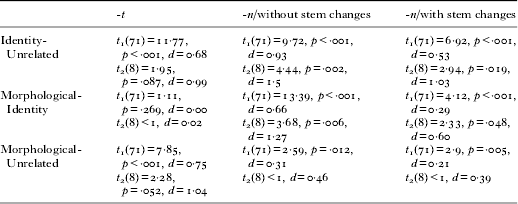
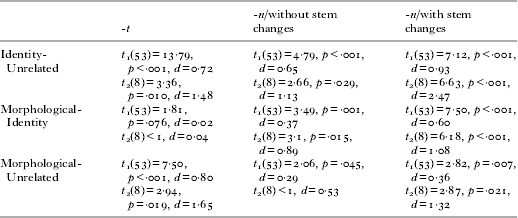
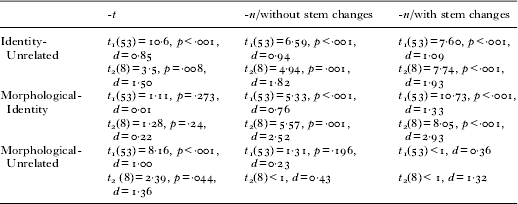
The overall 3 × 3 × 3 ANOVAs showed significant main effects of Prime Type (F 1(2,342) = 467·14, p < ·001, ηp 2 = ·73, F 2(2,36) = 29·65, p < ·001, ηp 2 = ·62) and of Group (F 1(2,171) = 4·71, p = ·010, ηp 2 = ·052, F 2(2,36) < 1, ηp 2 = ·003) and Condition (F 1(2,171) = 16·56, p < ·001, ηp 2 = ·088, F 2(2,18) < 1, ηp 2 = ·075), the latter two in the participant analysis only. In addition, there were significant interactions of Prime Type and Group (F 1(4,342) = 5·65, p < ·001, ηp 2 = ·062, F 2(4,72) = 3·27, p = ·023, ηp 2 = ·15), as well as of Condition and Prime Type (F 1(4,342) = 20·83, p < ·001, ηp 2 = ·11, F 2(4,36) = 1·46, p = ·25, ηp 2 = ·14) and of Condition and Group (F 1(4,171) = 2·98, p = ·021, ηp 2 = ·034, F 2(4,36) = 1·08, p = ·38, ηp 2 = ·11), the latter two of which were reliable in the participant analysis only. Most importantly, we found a three-way interaction of Condition, Prime Type, and Group in both the participant and the item analyses (F 1(8,342) = 4·31, p < ·001, ηp 2 = ·048, F 2(8,72) = 2·59, p = ·022, ηp 2 = ·22). These results suggest between-group differences for the priming effects in the three conditions, which were examined in post-hoc comparisons using paired t-tests; see Tables 3a to 3c.Footnote 2
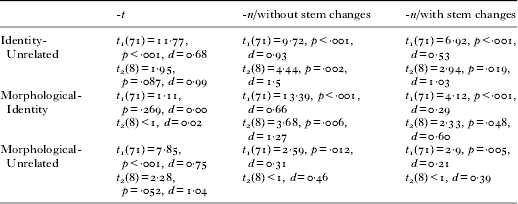
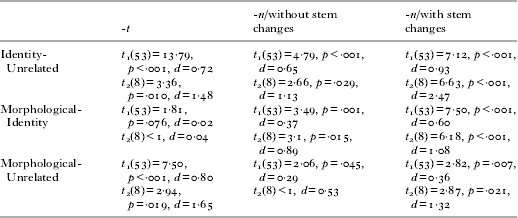
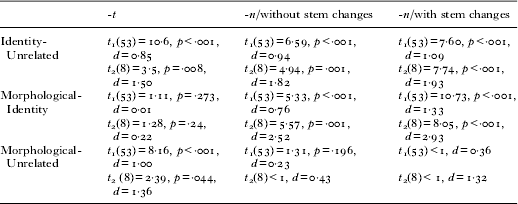
Table 3a shows that in the adult control group, -t participles produced a full priming effect (in the by-participants analysis only), i.e., significantly shorter target response latencies after participle primes than after unrelated prime words, and no difference between identity and participle primes. In contrast to that, -n participles, both those with and those without stem changes, yielded a partial priming effect, i.e., significantly shorter response latencies after participles than for unrelated prime words, but longer ones after participle than after identity prime words (with the former differences significant in the by-participants analyses only). Table 3b shows that the older children (= age group II) produced the same priming patterns as the adult group, a full priming effect for -t participles and partial priming effects for both -n participles with and without stem changes. Different priming patterns were found, however, for the younger children; see Table 3c. While children of age group I showed an adult-like full priming effect for -t participles, -n participles did not yield any priming effect, neither those with or those without stem changes. These results indicate developmental changes in the priming patterns for -n participles.
Planned comparisons of the mean response latencies for the adult group
Planned comparisons of the mean response latencies for children in age group II
Planned comparisons of the mean response latencies for children in age group I
Consider next the results of the ANOVAs that examined the role of the two participle endings for priming separately from the role of stem changes. Recall that the Identity condition was not included in these analyses. Comparing the two participle types without stem changes, i.e., -t versus -n forms without stem changes, revealed main effects of Participle Type for the adult group (F 1(1,69) = 58·56, p < ·001, ηp 2 = ·46, F 2(1,12) = 2·32, p = ·15, ηp 2 = ·16) and for children of age group II (F 1(1,51) = 25·65, p < ·001, ηp 2 = ·34, F 2(1,12) = 2·82, p = ·12, ηp 2 = ·19), significant for participants only. There was also a main effect of Prime Type for the three participant groups (adults: F 1(1,69) = 136·87, p < ·001, ηp 2 = ·67, F 2(1,12) = 6·86, p = ·022, ηp 2 = ·36; children – age group II: F 1(1,51) = 210·31, p < ·001, ηp 2 = ·81, F 2(1,12) = 7·36, p = ·019, ηp 2 = ·38; children – age group I: F 1(1,51) = 46·37, p < ·001, ηp 2 = ·48, F 2(1,12) = 5·43, p = ·038, ηp 2 = ·31) as well as interactions of Participle Type and Prime Type that were significant in the participant analyses of the three groups (adults: F 1(1,69) = 12·31, p = ·001, ηp 2 = ·15, F 2(1,12) < 1, ηp 2 = ·073; children – age group II: F 1(1,51) = 10·90, p = ·002, ηp 2 = ·18, F 2(1,12) = 1·60, p = ·229, ηp 2 = ·12; children – age group I: F 1(1,51) = 15·60, p < ·001, ηp 2 = ·23, F 2(1,12) = 2·28, p = ·16, ηp 2 = ·169). These interactions are due to larger magnitudes of priming, i.e., response latency differences between the Unrelated and the Morphological condition, for -t than for -n participles in all three participant groups (adults: 67 ms vs. 18 ms; children – age group II: 106 ms vs. 35 ms; children – age group I: 138 ms vs. 38 ms); see Table 2. These comparisons confirm that -t participles produce more priming than -n participles in all participant groups.
The comparison of -n participles both with and without stem changes yielded main effects of Participle Type for the adult group (F 1(1,69) = 58·56, p < ·001, ηp 2 = ·46, F 2(1,12) = 2·32, p = ·15, ηp 2 = ·16) and for children of age group I (F 1(1,51) = 11·45, p = ·001, ηp 2 = ·18, F 2(1,12) = 3·11, p = ·103, ηp 2 = ·21), significant in the participant analysis only, due to longer overall response latencies for -n participles with stem changes than for those without. There were also main effects of Prime Type, for the adult group in the participants analysis (F 1(1,69) = 51·85, p < ·001, ηp 2 = ·43, F 2(1,24) = 2·26, p = ·16, ηp 2 = ·16) and for children of age group II (F 1(1,51) = 15·52, p < ·001, ηp 2 = ·23, F 2(1,24) = 5·74, p = ·034, ηp 2 = ·32), due to shorter response latencies for the Morphological than the Unrelated condition in these participant groups. By contrast, there was no reliable interaction of Participle Type and Prime Type in any participant group (all F 1 < 2, all F 2 < 1). These comparisons confirm that -n participles with and without stem changes produce parallel patterns of results within each of the three participant groups, a priming effect in the adult group and in children of age group II, and no priming in children of age group I.
Finally, developmental changes were found with respect to overall response latencies. A one-way ANOVA on the mean overall response latencies across participle and prime types (see Table 2) revealed a significant between-group difference (F(2) = 50·24, p < ·001), due to children of age group I responding more slowly than children in age group II, who were responding more slowly than adults (717 ms vs. 656 ms vs. 537 ms).
DISCUSSION
The main finding from the current study is that seven- to ten-year-old children showed similar priming effects as adults. Participles with -t yielded full stem-priming effects for adults as well as for children of both age groups, indicating that a -t participle form of a given verb facilitates reading aloud the corresponding 1st sg. form as much as this verb form itself. By contrast, -n participles did not facilitate performance on the target word as much as an identical prime word. Instead -n participles produced less priming than -t participles. This was the case for both -n participles with stem and without stem changes, and for both children and adults. We also found developmental changes for -n participles, with the older (but not the younger) subgroup of children producing an adult-like partial priming effect. In addition, the younger children were found to respond more slowly than the older ones, specifically for participles with stem changes.
The results from the adult group replicate the findings of Sonnenstuhl et al. (Reference Sonnenstuhl, Eisenbeiss and Clahsen1999) from cross-modal and of Neubauer and Clahsen (Reference Neubauer and Clahsen2009) from masked priming experiments in that -t participles were found to yield full priming and -n participles without stem changes partial priming effects. Furthermore, our finding of partial priming for -n participles with stem changes is consistent with Smolka et al.'s (Reference Smolka, Zwitserlood and Rösler2007) priming results for this type of participle. Note, however, that because Smolka et al. (Reference Smolka, Zwitserlood and Rösler2007) did not include an identity condition it is impossible to decide whether the priming patterns they reported represent full or partial priming effects. Taken together, the results from masked and cross-modal priming experiments help to better understand morphological processing at different stages of word recognition. If one assumes that masked priming is sensitive to early form-level access and cross-modal priming to later lemma-level retrieval (Marslen-Wilson, Reference Marslen-Wilson and Gaskel2007), our findings suggest that -t and -n participles are processed differently, both at early and at later stages of word recognition. At the early form-level access stage of visual word recognition, the partial priming effect for -n participles obtained in masked visual priming might be attributed to the formal and/or semantic overlap between primes and targets. This does not, however, explain the full (masked) priming effect obtained by Neubauer and Clahsen (Reference Neubauer and Clahsen2009) for -t participles that were closely matched to -n participles with respect to formal and semantic overlap. Instead, Neubauer and Clahsen (Reference Neubauer and Clahsen2009) attributed the full priming effect for -t participles to their combinatorial structure, which allow these forms to be decomposed into stem plus affix during early visual word recognition. A full priming effect in a cross-modal priming experiment is supposed to result from repeated activation of the same lemma representation in prime and target, and a partial priming effect from the activation of distinct, but related, representations. The set of findings indicating (cross-modal) priming differences for -t and -n participles can be interpreted along these lines. Due to full morphological decomposition, a -t participle prime activates the same lemma as its corresponding target, whereas -n participles activate their own lexical entries, which are only indirectly related to the lexical entries of the target words.
Results from morphological priming experiments are sometimes difficult to interpret because any reported priming effect may not be morphological in nature but instead due to non-morphological factors such as a high degree of orthographic overlap and/or semantic relatedness between primes and targets. As pointed out above, this possibility also applies to a number of previous priming studies with children. For the current study, however, these non-morphological factors can be ruled out as potential sources of priming. If shared surface forms were responsible for priming, -n participles with and without stem changes should have produced different priming patterns corresponding to their different degree of orthographic and phonological overlap between prime and target. This was not the case for either participant group. Instead, the two types of -n participles yielded parallel results, partial priming effects for adults and children of age group II and no priming for children of age group I. If, on the other hand, shared semantics was the determining factor, we should have found the same amount of facilitation for -t and -n participles, due to the fact that semantic overlap between prime and target is the same for -t and -n participles. This prediction was also disconfirmed, again for both adults and children. Our finding that only -t participles produced full priming is hard to explain in non-morphological terms and cannot be attributed to semantic and/or orthographic/phonological overlap (Gonnerman et al., Reference Gonnerman, Seidenberg and Andersen2007; Seidenberg & Gonnerman, Reference Seidenberg and Gonnerman2000), either for adults or for children.
Another source for the observed priming differences between -t and -n forms could be their morphosyntactic functions. The -n affix has multiple functions in the German verb inflection system. In addition to 1st and 3rd plural and participle forms, -n also serves as the infinitive affix. The -t affix is less widespread, occurring as a participle form as well as for the 3rd singular and 2nd plural. While we acknowledge that -n is the more common affix in German, it is not clear why this should lead to a priming disadvantage for -n relative to -t participle forms. Previous studies examining effects of an affix's morphosyntactic functions, e.g. Baayen, Wurm, and Aycock (Reference Baayen, Wurm and Aycock2007), Plag and Baayen (Reference Plag and Baayen2009), reported an advantage (rather than a disadvantage) for suffixes occurring in a larger number of word types relative to less common suffixes, namely reduced lexical decision and naming latencies. Other studies did not find any such difference (e.g. Burani & Thornton, Reference Burani, Thornton, Baayen and Schreuder2003). In a recent review, Amenta and Crepaldi (Reference Amenta and Crepaldi2012, p. 8) concluded: ‘All in all, there does not seem to be clear evidence to hold that [affix] productivity, however defined, influences word identification times.’ If this is correct, the observed priming differences between -t and -n participle forms are unlikely to be due to their different morphosyntactic functions.
To explain our findings from a morphological perspective, consider the proposal (e.g. Wunderlich & Fabri, Reference Wunderlich and Fabri1995) that -t and -n participles have different morpholexical representations, morphologically structured forms derived by affixation for -t participles and lexical (sub)entries for -n participles. That -t and -n participle primes produced different priming patterns – despite similar surface form and semantic overlap with their targets – can be explained in these terms. The full stem-repetition priming effect for -t participles indicates that these forms are morphologically decomposed into stems and affixes during processing, e.g. ge-kauf-t ‘bought’. In this way, the base stem kauf is isolated and directly activates the base stem of the target word kauf-e ‘buy[1ps]’. By contrast, -n participles yielded partial priming effects, which we attribute to related lexical entries for the prime and the target word. A prime word such as geschlafen ‘slept’, for example, due to being stored as a subentry of the corresponding verb's base entry, indirectly activates the unmarked stem schlaf, which produces a reduced or partial priming effect for the recognition of the corresponding stem of the target word schlafe ‘sleep[1ps]’. Our results from cross-modal priming show that this account extends to -n participles with stem changes such as getrunken ‘drunk’, which produced the same partial priming effect as -n participles without stem changes. The finding of parallel priming patterns for both types of -n participle is in line with the proposed linguistic analysis of the system (Wunderlich & Fabri, Reference Wunderlich and Fabri1995), which posits different representations for -t vs. -n participles irrespective of whether they contain stem changes.
Our results for participles in German-speaking children of age group II are consistent with findings from previous priming studies with primary-school children in other languages (English, French, Hebrew, Portuguese) that have reported the same priming effects for morphologically related words as for adults. For the younger children of age group I, we also found adult-like priming effects, but only for -t, and not for -n participles.
Although the cross-modal priming patterns obtained in the current study were largely similar for children and adults, our results revealed developmental changes. The most interesting developmental difference was the contrast in children of age group I between adult-like priming for -t participles and no priming for -n participles. While children of both age groups had the same full priming effects for -t participles as adults, a reliable priming effect for -n participles was only found for the older subgroup of children. We attribute the developmental changes for -n (but not for -t) participles to their distinct lexical representations. While -n participles constitute (sub)entries stored in lexical memory, -t participles are thought to be combinatorial word forms generated from stems and affixes that do not require any kind of lexical storage. Memory storage and retrieval are dependent on experience and are likely to become more stable and more reliable when children get older. This applies to the subentries for -n participles, which need time to be properly integrated into complex lexical entries. A related developmental difference concerns response latencies after -n participle primes with stem changes, e.g. gesunken ‘sunk’, which in children of age group I were significantly longer than those for -n participle primes without stem changes (778 vs. 729 ms, t 1(53) = 3·49, p = ·001, t 2(16) = 2·30, p = ·035). By contrast, adults and children in age group II performed similarly for these two types of -n participles (adults: 549 vs. 546 ms; age group II: 665 vs. 666 ms, all ts < 1). This difference is unlikely to be due to properties of the target words as these were closely matched across conditions. Instead, it seems that the stem changes in -n participles such as gesunken slows down lexical retrieval in the younger children. A third developmental difference was that children's response latencies were overall slower than those of adults, and within the child group, the subgroup of younger children had significantly longer overall response latencies than the subgroup of older children (‘age group II’).
Adult-like contrasts between -t and -n participles paired with developmental changes in lexical retrieval have also been reported in previous studies of online production of German participles in five- to twelve-year-old children and control groups of adults (Clahsen, Hadler & Weyerts, Reference Clahsen, Hadler and Weyerts2004; Fleischhauer & Clahsen, Reference Fleischhauer, Clahsen, Chung and Kimball2012). Production latencies for the two participle types showed the same pattern for children and adults. High-frequency -n participles were produced faster than low-frequency ones, but high-frequency -t participles did not show any such advantage. Yet, children were found to over-regularize the -t participle suffix to verbs that require -n and to produce stem errors for elicited participle forms, almost all of which were cases in which the unmarked stem form was incorrectly maintained, e.g. *gefinden instead of gefunden ‘found’ (Clahsen et al., Reference Clahsen, Hadler and Weyerts2004, p. 696). In addition, children had significantly longer overall production latencies than adults, and the five- to seven-year-olds significantly longer ones than the eleven- to twelve-year-old children. These findings have been taken to indicate that primary-school children make use of the same representations and mechanisms for producing participles as adults, but that lexical retrieval becomes more efficient as children get older. The current findings from cross-modal priming suggest that this interpretation extends to word recognition.
CONCLUSION
This study examined processes involved in the recognition of inflected words in two groups of German-speaking primary-school children (group I, mean age: 8;4, group II: mean age: 9;9) and a control group of adults using the cross-modal priming technique. Morphological priming patterns for regular (-t) forms were found to be parallel for children and adults, indicating that children in the age range tested make use of the same mechanisms for processing regularly inflected word forms as adults. Developmental differences were found for irregular (-n) forms, in that the older age group of children, but not the younger one, showed adult-like (partial) priming for these word forms. In addition, the younger subgroup of children had longer response latencies than the older one and the adult group, specifically for participles with stem changes. We attribute these developmental differences to lexical retrieval becoming more efficient as children get older. To account for the reported priming effects, non-morphological factors such as surface form overlap between primes and targets as well as semantic relatedness were found to be insufficient, either for children or for adults. Instead we explained the priming patterns in morphological terms, by assuming different morpholexical representations for -t and -n forms, stem+affix representations for -t participles and lexical (sub)entries for -n forms (Wunderlich & Fabri, Reference Wunderlich and Fabri1995).
APPENDIX