With rapidly growing prison populations throughout the world, vast numbers of children are experiencing parental imprisonment. Provisional estimates suggest that 125,000 children under the age of 18 experience parental imprisonment each year in England and Wales (Murray, Reference Murray2007). One and a half million children under the age of 18 had an incarcerated parent in the United States in 1999 (Mumola, Reference Mumola2000). Small-scale studies suggest that children can react to parental imprisonment with internalizing problems such as sleep disturbance, bedwetting, concentration problems, clinging behavior, sadness, low mood, and withdrawal (see, e.g., Boswell & Wedge, Reference Boswell and Wedge2002; Kampfner, Reference Kampfner, Gabel and Johnston1995; Sack & Seidler, Reference Sack and Seidler1978; Skinner & Swartz, Reference Skinner and Swartz1989). However, as several commentators have noted (Gabel, Reference Gabel1992; Hagan & Dinovitzer, Reference Hagan, Dinovitzer, Tonry and Petersilia1999; Murray, Reference Murray, Liebling and Maruna2005; Parke & Clarke-Stewart, Reference Parke and Clarke-Stewart2002), studies of prisoners' children usually do not use adequate sampling, standardized measures, suitable controls, or long-term follow-up.
It has been suggested that 30% of prisoners' children experience mental health problems during childhood and adolescence, compared to about 10% of the general population (Philbrick, Reference Philbrick1996). We found only one study that compared the rate of internalizing problems among prisoners' children with those experienced by a control group selected from a general population. Forty years ago, Friedman and Esselstyn (Reference Friedman and Esselstyn1965) compared 90 boys of imprisoned fathers with 154 controls, apparently selected from school registers. Nearly half (45%) of prisoners' children had below average “self-concept,” as rated by teachers, compared with 29 and 14% among two control groups. However, other internalizing outcomes were not measured, maternal imprisonment was taken into account, official records were not used to verify the status of the control group, and statistical tests were not used in the analyses. In short, virtually nothing is known from high quality studies about the risk of internalizing problems for prisoners' children in the short or long term.
In this paper, we investigate whether separation because of parental imprisonment predicts boys' internalizing problems through the life course using reliable measures of parental imprisonment, well-standardized outcome measures, and several different control groups. “Internalizing problems” refer to “a core disturbance in intropunitive emotions and moods (e.g., sorrow, guilt, fear, and worry)” (Zahn-Waxler, Klimes-Dougan, & Slattery, Reference Zahn-Waxler, Klimes-Dougan and Slattery2000, p. 443). We use the term “imprisonment” to refer to any form of custodial confinement, including local and training prisons (in the United Kingdom), and jail and prison (in the United States). In the following, we outline three theoretical perspectives that might explain why children's internalizing problems develop after parental imprisonment.
The Trauma Perspective
According to attachment theory originally formulated by Bowlby (Reference Bowlby1969, Reference Bowlby1973, Reference Bowlby1980), separation from a parent during childhood can negatively affect children's sense of security, and cause internalizing problems in the short and long term. In a much cited passage, Bowlby argued that continuous care by an attachment figure was as important to children's development as proper diet and nutrition (Kobak, Reference Kobak, Cassidy and Shaver1999). According to this perspective, parental imprisonment might cause internalizing problems for children because parent–child separation disrupts children's attachment relations.
However, two lines of research suggest that children's difficulties following separation from a parent are not simply caused by separation per se. First, prospective longitudinal studies of children who experience parental separation and divorce demonstrate that many of their problems were actually present before the divorce (Emery, Reference Emery1999; Rutter, Giller, & Hagell, Reference Rutter, Giller and Hagell1998). In the context of parental divorce, stressors other than parent–child separation (including interparental conflict, strained relationships between children and custodial parents, and a decline in the standard of living) appear to have more impact on children's adjustment than separation itself (Amato, Reference Amato1993; Emery, Reference Emery1999; Rodgers & Pryor, Reference Rodgers and Pryor1998). Second, as attachment theory developed, Bowlby and Ainsworth emphasized that children's reactions to separation are significantly modified by the nature of the separation, and the quality of the attachment relationship before the separation (Kobak, Reference Kobak, Cassidy and Shaver1999). They suggested that the adverse affects of parent–child separation can be mitigated by planning and negotiating separations, by continuing communication, and by maintaining children's confidence in the accessibility and responsiveness of their parent (by children having secure “working models” of their parent). Therefore, different types of parent–child separation might have very different consequences for children (Juby & Farrington, Reference Juby and Farrington2001; Rodgers & Pryor, Reference Rodgers and Pryor1998; Rutter et al., Reference Rutter, Giller and Hagell1998).
Parental imprisonment is often unexpected and unexplained (Shaw, Reference Shaw1987, Reference Shaw and Shaw1992), and sometimes frighteningly violent. Children's highly limited access to their imprisoned parent is often strained by long-distance travel, unpleasant search procedures, and restrictive visiting environments, sometimes prohibiting physical contact (Brown, Dibb, Shenton, & Elson, Reference Brown, Dibb, Shenton and Elson2002; McDermott & King, Reference McDermott, King and Shaw1992; Richards et al., Reference Richards, McWilliams, Allcock, Enterkin, Owens and Woodrow1994). Therefore, although separation per se may not always cause difficulties for children, the traumatic nature of separation caused by parental imprisonment may be particularly harmful.
Limited evidence to date suggests that children often show attachment-related problems following parental imprisonment. In a study of 2- to 7-year-old children with imprisoned mothers, Poehlmann (Reference Poehlmann2005) found that 83% of the children cried, showed sadness, or repeatedly called for their mothers during the first 2 weeks of separation, and 63% of them had insecure–negative attachment representations of their mothers. Children were less likely to have such insecure–negative representations when they were older and when they did not react to the initial separation with anger. In a questionnaire study with imprisoned fathers, Lanier (Reference Lanier1993) also found that fathers reported decreased feelings of closeness with their children following imprisonment.
However, control groups were not included in the above two studies, and there is little evidence on whether parental imprisonment has similar or worse consequences for children compared with other forms of parent–child separation. Only one previous study compared internalizing problems of prisoners' children with those of children separated from parents for other reasons. Moerk (Reference Moerk1973) found similar levels of poor self-concept among 24 boys whose fathers had been imprisoned (for at least 1 month since the boys' births) and 24 boys separated from their father because of parental divorce. However, the study was cross-sectional, and no information was reported about how parental imprisonment (or divorce) was measured.
In summary, according to the trauma perspective, parental imprisonment might cause internalizing problems for children because it disrupts children's attachment relationships. Separation caused by parental imprisonment may be more harmful for children than other forms of parent–child separation, because the nature of the separation during parental imprisonment is more traumatic. In the present study, we compare internalizing outcomes of prisoners' children and children separated from parents for other reasons.
The Life-Course Perspective
The life-course perspective emphasizes that other adversities often follow a life event such as parental imprisonment, and that these adversities might mediate the relationship between parental imprisonment and children's internalizing problems. (We discuss factors preceding parental imprisonment in “The Selection Perspective” section.)
Parental imprisonment can precipitate a loss of family income, emotional stress among children's caregivers, disrupted prisoner–caregiver relationships, and house and neighborhood moves. One of the most comprehensive studies of prisoners' families was conducted by Morris (Reference Morris1965), who interviewed 825 imprisoned men in England and 469 of their wives. Among the most common problems reported, 63% of wives said they experienced deterioration in their financial situation, 81% reported some deterioration in their work, 46% reported deterioration in their present attitude to marriage and future plans, 63% reported deterioration in social activity, and 57% reported deterioration in relationships with friends and neighbors.Footnote 1 The experience of imprisonment might also reduce imprisoned parents' capacity to care for their children when they are released. These multiple stresses might, in turn, cause internalizing problems for prisoners' children (see Garber, Reference Garber, Sameroff, Lewis and Miller2000, and Vasey & Ollendick, Reference Vasey, Ollendick, Sameroff, Lewis and Miller2000, on the effects of social stresses on depression and anxiety, respectively).
Parental imprisonment might also cause children's internalizing problems because of the stigma attached to it. According to several small-scale studies (Boswell & Wedge, Reference Boswell and Wedge2002; Sack, Reference Sack1977; Sack & Seidler, Reference Sack and Seidler1978; Sack, Seidler, & Thomas, Reference Sack, Seidler and Thomas1976), children can experience stigma, bullying, and teasing because of their parent's imprisonment. These events might cause internalizing problems in the short and long term (see the review by Hinshaw & Cicchetti, Reference Hinshaw and Cicchetti2000, on the developmental effects of stigma in relation to mental illness).
Parental imprisonment might also have indirect effects on children's internalizing problems because of its effects on children's antisocial behaviors. Recently, we found that parental imprisonment during childhood predicted boys' antisocial outcomes through the life course (Murray & Farrington, Reference Murray and Farrington2005). Comparing boys separated because of parental imprisonment (ages 0–10) with boys who did not experience separation and whose parents were not imprisoned, odds ratios (ORs) for predicting antisocial personality at different ages were 8.3 at age 14 (confidence interval [CI] = 3.3, 20.5), 12.2 at age 18 (CI = 4.4, 33.4), and 10.6 at age 32 (CI = 3.9, 28.9). We also found that parental imprisonment was a risk factor for criminality among males and females in Sweden (Murray, Janson, & Farrington, Reference Murray, Janson and Farrington2007). However, the effects of parental imprisonment were not as strong in Sweden as they were in England.
The meta-analysis by Angold, Costello, and Erkanli (Reference Angold, Costello and Erkanli1999) shows that there are strong associations between antisocial behaviors and internalizing problems. Possibly, “conduct disorder may set in motion a series of events including police contact, parental disapproval, and peer rejection that increase the likelihood that those who have conduct disorders will develop affective disorders” (Fergusson, Lynskey, & Horwood, Reference Fergusson, Lynskey and Horwood1996, p. 452). If this were true, children's antisocial behaviors might mediate the effects of parental imprisonment on children's internalizing problems. In the present study, we examine whether antisocial behaviors in adolescence mediate the relationship between parental imprisonment during childhood and internalizing problems in adulthood, and whether parental imprisonment predicts the co-occurrence of internalizing and antisocial problems for boys.
In summary, according to the life-course perspective, parental imprisonment might precipitate social and economic stresses, which might cause antisocial behavior. These stresses and antisocial behavior may, in turn, cause an increase in children's internalizing problems through the life course.
The Selection Perspective
A critical question is whether parental imprisonment causes children's internalizing problems, as outlined above, or whether preexisting disadvantages that are associated with parental imprisonment cause children's problems. Prisoners, and therefore their families, tend to come from extremely deprived backgrounds, even before imprisonment takes place. It is possible that parental imprisonment is not a cause but is associated with children's internalizing problems purely because it is associated with preexisting adversities in children's lives, which themselves cause internalizing problems.
Prisoners are more likely than the general population to be unemployed, to have low social class, multiple mental health problems, many criminal convictions, marital difficulties, and their own experiences of abuse and neglect (Dodd & Hunter, Reference Dodd and Hunter1992; Lynch, Smith, Graziadei, & Pittayathikhun, Reference Lynch, Smith, Graziadei and Pittayathikhun1994; Singleton, Meltzer, Gatward, Coid, & Deasy, Reference Singleton, Meltzer, Gatward, Coid and Deasy1998). Recently, Murray and Farrington (Reference Murray and Farrington2005) confirmed that prisoners' children tend to experience more childhood adversities than their peers. At age 10, boys separated because of parental imprisonment had, on average, 5.4 individual and family risk factors (such as low IQ, poor marital relations, and low family income), compared with 2.3 risk factors among boys without a history of parental imprisonment or parent–child separation (see also Phillips, Erkanli, Keeler, Costello, & Angold, Reference Phillips, Erkanli, Keeler, Costello and Angold2006). Hence, it is important to assess whether parental imprisonment predicts adverse outcomes for children after controlling for these background risks. In the present study, we examine whether parental imprisonment predicts boys' internalizing problems after controlling for other individual and family adversities in childhood.
Stanton (Reference Stanton1980) compared 22 children with jailed mothers and 18 children with mothers on probation to try to disentangle the effects of parental imprisonment from background adversities. Jailed mothers' children were more likely to be rated by teachers and counselors as having “low self-esteem” (59%) than probation mothers' children (22%). However, the difference was not statistically significant, and jail and probation mothers differed in terms of previous criminal convictions, and employment and education histories, which might have been confounding factors. We located no other studies that examined whether parental imprisonment predicts children's internalizing problems independently of background adversities.
It is also possible that prisoners' children are at genetic risk for internalizing problems before parental imprisonment takes place, as is suggested by Crowe's (Reference Crowe1974) adoption study. In the present study, we compare boys separated because of parental imprisonment during childhood (ages 0–10) with boys whose parents were only imprisoned before their sons' births. This comparison helps to disentangle the effects of preexisting genetic and environmental adversities (which are high among children whose parents were imprisoned before their child's birth; Princeton University, 2002) from the effects of separation because of parental imprisonment.
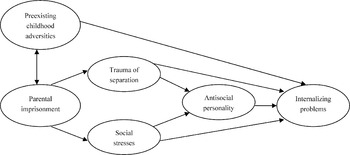
In summary, very little is known about internalizing problems among prisoners' children. Parental imprisonment might cause children's internalizing problems because of the trauma of separation, or because of other stressful experiences following the imprisonment. Alternatively, parental imprisonment might predict children's internalizing problems only because it reflects preexisting disadvantage. Figure 1 shows a conceptual model of these possible links between parental imprisonment and children's internalizing problems.
Parental imprisonment and boys' internalizing problems (conceptual model).

The Present Study
We used data collected on males in the Cambridge Study in Delinquent Development (CSDD) and their parents to examine the effects of parental imprisonment on boys' internalizing problems. We tested six hypotheses about the effects of parental imprisonment on boys' internalizing problems through the life course.
1. The first hypothesis was that parental imprisonment in childhood (ages 0–10) predicts boys' internalizing outcomes through the life course.
2. Drawing on the trauma perspective, we tested the second hypothesis that separation because of parental imprisonment in childhood predicts more internalizing problems than parent–child separation for other reasons.
3. Drawing on one idea from the life-course perspective, we tested the third hypothesis that boys' antisocial personalities mediate the relationship between parental imprisonment in childhood and later-life internalizing problems.
Drawing on the selection perspective, we tested the following three hypotheses:
4. Parental imprisonment before boys' births predicts similar levels of internalizing problems as separation because of parental imprisonment during childhood (ages 0–10).
5. Other childhood adversities associated with parental imprisonment also predict boys' internalizing problems.
6. The association between parental imprisonment and boys' internalizing problems disappears after controlling for these other childhood adversities.
Method
Participants and procedures
The CSDD is a prospective longitudinal survey of 411 males, followed up from age 8 to 48 (Farrington, Reference Farrington, Thornberry and Krohn2003; Farrington et al., Reference Farrington, Coid, Harnett, Jolliffe, Soteriou and Turner2006). At the time they were first contacted in 1961 to 1962, these males were all living in a working-class innercity area of South London. The sample was chosen by taking all the boys who were then ages 8–9 and on the registers of six state primary schools within a 1-mile radius of a research office. Hence, the most common year of birth of these males was 1953. In nearly all cases (94%) their family breadwinner at that time (usually the father) had a working-class occupation (skilled, semiskilled, or unskilled manual worker). Most of the males were White (97%) and of British origin. The study was originally directed by Donald J. West. Since 1982 it has been directed by David P. Farrington, who has worked on it since 1969. It has been funded mainly by the Home Office and also by the Department of Health. It is unusual for detailed information on parents' criminal records to be collected in studies of child development, and the CSDD represents a rare opportunity to study the effects of parental imprisonment on children's internalizing problems.
In this article, we compare five mutually exclusive groups of boys according to whether their parents were imprisoned, and according to whether they were separated from a parent for other reasons. The experimental group consists of 23 boys who experienced parental imprisonment in their first 10 years of life. The first control group consists of 227 boys who did not experience any separation from a parent (of 1 month or more) in their first 10 years, and whose parents were not imprisoned at any time before the boys' 18th birthdays. The second control group consists of 77 boys whose parents were not imprisoned, but who experienced separation from either parent in their first 10 years because of hospitalization (of parent or child) or parental death. The third control group consists of 61 boys whose parents were not imprisoned, but who experienced separation from either parent in their first 10 years for other reasons than hospitalization, death, or imprisonment (usually because of parental disharmony). The fourth control group consists of 17 boys whose parents were imprisoned before the boys' births, but not again between then and the boys' 18th birthdays.Footnote 2
Measurement
Measures, data reduction methods, and major findings on earlier phases of the study have been reported in four books (West, Reference West1969, Reference West1982; West & Farrington, Reference West and Farrington1973; West & Farrington, Reference West and Farrington1977) and in many publications, including two summary articles (Farrington, Reference Farrington1995, Reference Farrington, Thornberry and Krohn2003).
Parental imprisonment and parent–child separations
Cases of parental imprisonment were identified from searches of the central Criminal Record Office in London for findings of guilt of the boys' biological parents. Parents had to be convicted for a relatively serious offense to have a criminal record: offenses of common assault, traffic infractions, and drunkenness are not included in these records. Social worker files were used to identify further cases of parental imprisonment for minor offenses or on remand. Parents had to have been imprisoned for at least 1 month to appear in social worker files. Four cases, where parents had only been held in custody for 1 day (in lieu of a fine), were coded as “no parent imprisoned.”
According to these criteria, during the boys' first 10 years of life, 20 boys' fathers were imprisoned, two boys' mothers were imprisoned, and one boy's mother and father were imprisoned (the experimental group). The average time that these boys' parents served in prison during the boys' first 10 years of life was 9.6 months (SD = 14.2). None of these boys was permanently separated from his parent before the imprisonment. Among the 17 boys whose parents were imprisoned only before the boys' births, 15 boys had fathers who had been imprisoned, and 2 boys had mothers who had been imprisoned. The average time that these boys' parents had served in prison was 7.8 months (SD = 6.6).
Parent–child separations for reasons other than parental imprisonment were measured in repeated interviews with the boys' parents, conducted by psychiatric social workers. Boys defined as separated from their parents because of hospitalization or death, or for other reasons, had to be separated for at least 1 month from their operative parent up to age 10 (see West & Farrington, Reference West and Farrington1973). The percentages of boys who were separated from their operative father up to age 10 were 74% among boys separated because of hospitalization or death and 93% among boys separated for other reasons. The percentages of boys who were separated from their operative mother up to age 10 were 75% among boys separated because of hospitalization or death and 61% among boys separated for other reasons.
Boys' outcomes
Neuroticism in adolescence
Neuroticism is primarily a personality construct, which represents vulnerability to anxiety, phobic fears, obsessional reactions, and dysthymia (Eysenck & Rachman, Reference Eysenck and Rachman1965). However, it also reflects symptoms of these internalizing problems (see Farmer et al., Reference Farmer, Redman, Harris, Mahmood, Sadler, Pickering and McGuffin2002).
Boys' neuroticism was measured at age 14 using the New Junior Maudsley Inventory (NJMI; for psychometric details, see Furneaux & Gibson, Reference Furneaux and Gibson1966). The NJMI is a 64-item questionnaire, with 22 items pertaining to neuroticism. Respondents are asked to indicate if they feel the “same” or “different” to a person who states, for example, “I find it hard to forget my troubles.” Data on neuroticism were collected for 406 boys (99%) at age 14 using the NJMI. The reliability (α or Kruder–Richardson 20, which are equivalent for dichotomous data) of the NJMI neuroticism scale was .53 based on 403 respondents with no missing data.
Study males' neuroticism was measured at age 16 using the Eysenck Personality Inventory (EPI; Eysenck, Reference Eysenck1964). The EPI is a 62-item questionnaire, with 24 items pertaining to neuroticism. Respondents are asked to answer “yes” or “no” to questions such as, “Does your mood often go up and down?” Data on neuroticism were collected for 398 boys (97%) at age 16. The reliability (α) of the EPI neuroticism scale was .79, based on 389 respondents with complete data.
After descriptive analyses of neuroticism scores at each age (see Table 1), an average score of neuroticism during adolescence was used for the main analyses of internalizing outcomes. The average score was calculated as the mean score of neuroticism at ages 14 and 16, after scores had been transformed into percentiles.
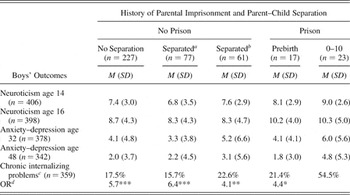
Parental imprisonment and sons' internalizing problems

aParent–son separation within first 10 years of son's life because of hospitalization or death.
bParent–son separation within first 10 years of son's life for reasons other than hospitalization, death, or imprisonment.
cProblems present two or three times through the life course (problems present at both ages 14 and 16 are only counted once). Percentages show the proportion of each prison/separation group who had chronic problems.
dOdds ratios comparing prison (0–10) with controls on chronic internalizing problems.
* p < 0.5.
** p < .01.
*** p < .001.
Anxiety and depression in adulthood
Anxiety and depression are the main dimensions of internalizing disorders, and are highly correlated (Goldberg & Goodyer, Reference Goldberg and Goodyer2005, p. 9).
Study males' anxiety and depression (combined) were measured at age 32 and at age 48 using the 30-item General Health Questionnaire (GHQ; Goldberg & Williams, Reference Goldberg and Williams1988). The GHQ measures potential psychiatric cases of anxiety and depression, with reference to symptoms over the last few weeks. Respondents are asked to indicate on a four-point scale whether they have recently “lost much sleep over worry,” for example. A total anxiety–depression score was produced by summing the total number of difficulties reported by each individual. Of study males still alive at age 32 (n = 403), 94% (n = 378) completed the GHQ, and of those still alive at age 48 (n = 394), 87% (n = 342) completed the GHQ. The reliability (α) of the GHQ at age 32 was .92, based on 371 cases with complete data. The reliability (α) of the GHQ at age 48 was also .92, based on 339 cases with complete data.
After descriptive analyses of anxiety–depression scores at each age (see Table 1), an average score of anxiety–depression during adulthood was used for the main analyses of internalizing problems. The average score was calculated as the mean score of the GHQ at ages 32 and 48, after scores had been transformed into percentiles. A log transformation was performed on the total score of internalizing problems during adulthood to reduce skewness for parametric tests.
Antisocial personality in adolescence and adulthood
Antisocial personality scales, reflecting features of conduct disorder, antisocial personality disorder, and psychopathy, were derived from interviews with the boys themselves, parents, teachers, and official records. For details of these measures, including intercorrelations, see Farrington (Reference Farrington1991).
The combined scale of antisocial personality at age 14 comprised 12 items: convicted, self-reported delinquency, steals outside home, regular smoking, had sex, bullies, lies frequently, lacks concentration/restless, daring, frequently disobedient, hostile to police, truant (α = .75). At age 18 the antisocial personality scale (referring to the previous 3 years) comprised 14 items: convicted, self-reported delinquency, self-reported violence, involvement with an antisocial group, taken drugs, heavy smoking, heavy drinking, drunk driving, irresponsible sex, heavy gambling, an unstable job record, an antiestablishment attitude, tattooed, impulsive (α = .74). At age 32 the antisocial personality scale (referring to the previous 5 years) comprised 12 items: convicted, self-reported delinquency, involved in fights, taken drugs, heavy drinking, poor relationship with parents, poor relationship with wife, divorced or child elsewhere, unemployed frequently, antiestablishment, tattooed, impulsive (α = .71). At age 48 the antisocial personality scale (referring to the previous 5 years) comprised 11 items: convicted, self-reported delinquency, involved in fights, taken drugs, heavy drinking, poor relation with female partner, ever divorced or separated, unemployed for over 10 months, antiestablishment, impulsive, tattooed (α = .51).
Continuous scores of internalizing and antisocial outcomes were used for most analyses in this study. However, dichotomized scores were used for two purposes: to identify individuals who had high internalizing scores more than once in their lives, and to identify individuals who had both high internalizing and high antisocial personality scores. To identify individuals who scored highly on different scales, it was necessary to set a cut point above which participants were defined as having high levels of internalizing or antisocial problems. Previously, antisocial personality scales were dichotomized into the worst quarter versus the remainder in the CSDD. In the present study, we also dichotomized internalizing scales into the worst quarter versus the remainder, because there was a disproportionate number of prisoners' children in the worst quarter on these scales. For example, of children separated because of parental imprisonment, 48% were in the upper quartile of neuroticism scores at age 14, but 26% were in the third quartile. Splitting the scale into five categories did not improve discrimination: 30% of prisoners' children were in the worst quintile of neuroticism scores at age 14, but 30% were also in the fourth quintile. As well as equating sensitivity, dichotomous variables simplify the presentation of results, and do not necessarily cause a decrease in measured strength of associations (Farrington & Loeber, Reference Farrington and Loeber2000).
Childhood adversities
Individual, parenting, and family risk factors were measured when boys were ages 8–11. Because childhood adversities were measured after most occurrences of parental imprisonment these data do not enable us to distinguish whether childhood adversities had selection or mediating effects on the relationship between parental imprisonment and children's internalizing problems.
Scores of childhood adversities were dichotomized into the worst quarter versus the remainder to equate sensitivity with dichotomous variables of parental imprisonment. Because most family risk factors were measured in two, three, or four categories, dichotomization did not result in a great loss of information. Dichotomization seemed preferable to assuming that a variable with three or four categories constituted an interval scale.
Junior school attainment was measured by arithmetic, English, and verbal reasoning tests, and nonverbal IQ was measured using Raven's Progressive Matrices Test. The boys' parents provided details about such things as their family income, the social class of the family breadwinner, and their degree of supervision of the boy. Harsh attitudes of mothers and fathers refer to combined measures of cruel, passive or neglecting attitudes, and harsh or erratic discipline. Anxiety/depression of fathers and mothers refer to combined measures of the parents' nervousness and psychiatric treatment (and a neuroticism questionnaire in the case of mothers). Further details of these and other childhood risk factors in the CSDD can be found in West and Farrington (Reference West and Farrington1973).
To test whether parental imprisonment is an independent predictor of internalizing problems, it is important to disentangle the effects of parental antisocial behavior and criminality from the effects of parental imprisonment. In the present study, we counted criminal convictions of mothers and fathers up to when boys were age 10 to create a continuous variable called “parental convictions.” Most (74%) imprisoned parents had multiple (two or more) convictions, compared with a small minority (8%) of nonprisoner parents. To account for different levels of parental criminality prior to imprisonment, we controlled for “parental convictions” on an interval scale in regression analyses.
Analyses
First, we examined whether separation because of parental imprisonment predicted boys' internalizing outcomes, chronic internalizing outcomes, and co-occurrence of internalizing and antisocial outcomes. Second, we examined whether the association between parental imprisonment during childhood and internalizing outcomes in adulthood was mediated by antisocial behavior in adolescence. Third, we investigated which other childhood adversities predicted boys' internalizing problems. Fourth, we tested whether separation because of parental imprisonment was an independent predictor of boys' internalizing problems, controlling for other childhood adversities and parental criminality, using ordinary least squares (OLS) regression.
It is possible that, for some children, parental imprisonment reduces stress and improves their mental health, but we predicted, on average, that children would be negatively affected by parental imprisonment. Because our hypotheses were unidirectional, we used one-tailed tests of statistical significance.
Results
Parental imprisonment as a risk factor for boys' internalizing problems
Separation because of parental imprisonment predicted boys' internalizing problems through the life course (Table 1). For example, boys who were separated because of parental imprisonment in their first 10 years of life had a higher mean level of anxiety–depression at age 48 (M = 4.8, SD = 5.3) than all four comparison groups (Ms = 2.0, 2.2, 3.1, and 1.8).
We tested whether boys who were separated because of parental imprisonment (0–10) had significantly higher levels of internalizing problems in adolescence (using the combined scale of neuroticism at ages 14 and 16) and higher levels of internalizing problems in adulthood (using the combined scale of anxiety–depression at ages 32 and 48) compared with the four comparison groups.
1. Boys separated because of parental imprisonment (0–10) had higher levels of internalizing problems in adolescence (t = 2.69, df = 248, p < .01) and internalizing problems in adulthood (t = 3.59, df = 29.9, p < .001, equal variances not assumed) than boys who did not experience any form of separation.
2. Boys separated because of parental imprisonment (0–10) had higher levels of internalizing problems in adolescence (t = 3.32, df = 45.1, p < .001, equal variances not assumed) and in adulthood (t = 4.16, df = 45.3, p < .001, equal variances not assumed) than boys who were separated because of hospitalization or death.
3. Boys separated because of parental imprisonment (0–10) had higher levels of internalizing problems in adolescence (t = 2.31, df = 82, p < .05) and in adulthood (t = 1.95, df = 77, p < .05) than boys who had been separated for other reasons (usually parental disharmony).
4. Compared with boys whose parents were only imprisoned before their births, boys separated because of parental imprisonment (0–10) did not have significantly higher levels of internalizing problems in adolescence (t = .48, df = 38, p = .32), although they did have significantly higher levels of internalizing problems in adulthood (t = 2.03, df = 21.8, p < .05, equal variances not assumed).
These findings show that parental imprisonment was a risk factor for boys' internalizing problems through the life course.
Parental imprisonment and chronic internalizing problems
For the whole sample of boys, internalizing scales at all four ages were significantly intercorrelated (14 vs. 16, r = .35, p < .01; 14 vs. 32, r = .19, p < .01; 14 vs. 48, r = .16, p < .01; 16 vs. 32, r = .19, p < .01; 16 vs. 48, r = .11, p < .05; 32 vs. 48, r = .21, p < .01). Next, we investigated whether separation because of parental imprisonment predicted chronic internalizing problems for boys. Chronicity was defined by having an internalizing problem that was present two or three times during the life course: during adolescence (age 14 or 16), at age 32, or at age 48 (problems present at both ages 14 and 16 were only counted once). At each age, “internalizing problems” were defined as being in the worst quarter on internalizing scores.
Overall, 20% of boys (out of 359) suffered chronic internalizing problems through the life course. Boys separated because of parental imprisonment had higher rates of chronic internalizing problems than all four control groups (Table 1). Of boys separated because of parental imprisonment, 55% experienced chronic internalizing problems, compared with: 18% of boys who did not experience separation (OR = 5.7, CI = 2.6, 12.2), 16% of boys separated because of hospitalization or death (OR = 6.4, CI = 2.7, 15.6), 23% of boys separated for other reasons (OR = 4.1, CI = 1.7, 9.9), and 21% of boys whose parents were only imprisoned before their births (OR = 4.4, CI = 1.2, 15.8).
Parental imprisonment and the co-occurrence of internalizing and antisocial problems
For the whole sample of boys, scales of internalizing and antisocial problems were positively, but only weakly, related (age 14, r = .13, p < .01; age 16–18, r = .08, p = .05; age 32, r = .27, p < .001; age 48, r = .21, p < .001). We tested whether separation because of parental imprisonment predicted the co-occurrence of internalizing and antisocial problems compared with the four control conditions. At each age, co-occurrence was defined by being in the worst quarter on internalizing scores and in the worst quarter on antisocial personality scores. The proportions of all boys (n = 392) who had both internalizing and antisocial problems at ages 14, 16–18, 32, and 48 were 7, 7, 10, and 5%, respectively.
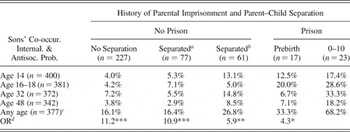
Table 2 shows that separation because of parental imprisonment was a strong predictor of the co-occurrence of internalizing and antisocial problems through the life course. Of boys separated because of parental imprisonment (0–10), 68% had co-occurring internalizing and antisocial problems at some point in their lives (between ages 14 and 48), compared with 16% of boys who did not experience separation. Comparing boys separated because of parental imprisonment (0–10) with the four control groups, all four ORs for co-occurring internalizing and antisocial problems (at any age) were large (>4) and significant. The ORs were 11.2 (CI = 5.0, 25.1) in comparison with boys who did not experience any form of separation, 10.9 (CI = 4.4, 27.1) in comparisons with boys separated because of hospitalization or death, 5.9 (CI = 2.4, 14.4) in comparison with boys separated for other reasons, and 4.3 (CI = 1.3, 13.8) in comparison with boys whose parents were only imprisoned before their births.
Parental imprisonment and the co-occurrence of internalizing and antisocial problems in sons

Note: Percentages show the proportion of each prison/separation group who had co-occurring problems.
aParent–son separation within first 10 years of son's life because of hospitalization or death.
bParent–son separation within first 10 years of son's life for reasons other than hospitalization, death, or imprisonment.
cCases with two or more missing values were excluded from this group.
dOdds ratios comparing prison (0–10) with controls on co-occurring problems at any age.
Chi-square tests comparing prison (0–10) and controls: *p < .05. **p < .01. *** p < .001.
Given that parental imprisonment predicted antisocial personality during adolescence (see Murray & Farrington, Reference Murray and Farrington2005) and internalizing problems in adulthood (see above), sons' antisocial personality might have mediated the relationship between parental imprisonment during childhood and internalizing problems in adulthood. We conducted a formal test of this mediation model using the technique proposed by Baron and Kenny (Reference Baron and Kenny1986). We used continuous scales of antisocial personality in adolescence (age 14) and internalizing problems in adulthood (combined scale, ages 32 and 48), and a dichotomous measure of parental imprisonment during childhood (coded “1” if boys were separated because of parental imprisonment during their first 10 years, and “0” if boys' parents were never imprisoned).
First, we regressed internalizing problems on parental imprisonment. In this model (R 2 = .023, F = 9.64, p < .01), parental imprisonment significantly predicted internalizing problems (β = .16, t = 3.11, p < .01). Second, we regressed antisocial personality on parental imprisonment. In this model (R 2 = .085, F = 35.84, p < .001), parental imprisonment significantly predicted antisocial personality (β = .29, t = 5.99, p < .001). Third, we regressed internalizing problems on antisocial personality. In this model (R 2 = .009, F = 3.36, p < .05), antisocial personality significantly predicted internalizing problems (β = .09, t = 1.83, p < .05). Fourth, we regressed internalizing problems on both parental imprisonment and antisocial personality. In this model (R 2 = .028, F = 5.25, p < .01), antisocial personality did not significantly predict internalizing problems (β = .05, t = 0.93, p = .18), and the effect of parental imprisonment remained significant, with a similar effect size (β = .15, t = 2.70, p < .01). Therefore, antisocial personality did not mediate the relationship between parental imprisonment and sons' internalizing problems.
Other childhood adversities and boys' internalizing problems
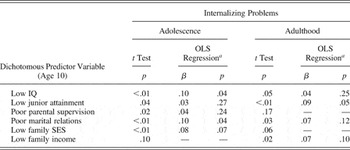
Because parental imprisonment is associated with so many other childhood adversities (Murray & Farrington, Reference Murray and Farrington2005; Phillips et al., Reference Phillips, Erkanli, Keeler, Costello and Angold2006), it is important to establish if parental imprisonment predicts children's outcomes independently of associated risks. Using the whole sample of boys, we investigated which childhood adversities (other than parental imprisonment) were risk factors for boys' internalizing outcomes. Ten childhood adversities in the CSDD were previously identified as important predictors of boys' antisocial behavior: low nonverbal IQ, low junior school attainment, poor parental supervision of the boy, harsh attitudes of mothers and fathers, anxiety/depression of mothers and fathers, poor marital relations, low social class, and low family income. According to t tests, six of these childhood adversities significantly predicted boys' internalizing problems: low IQ, low junior attainment, poor supervision of the boy, poor marital relations, low social class, and low family income (Table 3). The other four childhood adversities were not significantly related to boys' internalizing problems.
Childhood adversities as predictors of boys' internalizing problems

Notes: SES, socioeconomic status.
aOnly variables that were significant in t tests were entered into ordinary least squares (OLS) regression models.
We tested which factors independently predicted boys' internalizing outcomes by entering childhood adversities that were significant in t tests into OLS regression models. Internalizing problems in adolescence were independently predicted by low IQ (β = .20, t = 1.72, p < .05), poor marital relations (β = .10, t = 1.78, p < .05), and low social class (β = .08, t = 1.48, p < .10).Footnote 3 Internalizing problems in adulthood were independently predicted by low junior attainment (β = .09, t = 1.63, p = .05) and low family income (β = .07, t = 1.26, p = .10).
In addition, boys' internalizing problems were significantly, but only weakly, correlated with the number of times their parents were convicted up to when boys were age 10 (r = .14, p < .01 for internalizing problems in adolescence; r = .13, p < .01 for internalizing problems in adulthood).
Parental imprisonment as an independent risk factor
We investigated whether separation because of parental imprisonment predicted boys' internalizing problems independently of parental convictions and other childhood risk factors. We compared boys who were separated because of parental imprisonment with the four control groups in turn, controlling for parental convictions, and controlling for the childhood risk factors identified above, using OLS regression.
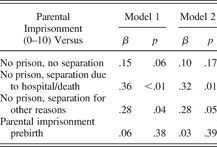
Separation because of parental imprisonment (0–10) had small to moderate effects on boys' internalizing problems in adolescence, even after controlling for parental convictions (Model 1, Table 4). Effect sizes for parental imprisonment were statistically significant in comparison with separation because of hospitalization or death (β = .36, p < .01), and in comparison with separation for other reasons (β = .28, p < .05). Therefore, separation because of parental imprisonment did not predict sons' internalizing problems purely because prisoners were highly criminal; imprisonment had an independent effect. After controlling for low IQ, poor marital relations, and low social class (as well as parental convictions), separation because of parental imprisonment (0–10) still significantly predicted internalizing problems in adolescence compared with separation because of hospitalization or death (β = .32, p < .05) and separation for other reasons (β = .28, p < .05; Model 2, Table 4). In fact, effect sizes for separation because of parental imprisonment (0–10) remained very similar in all four comparisons before and after controlling for low IQ, poor marital relations, and low social class (Models 1 and 2, Table 4). These results suggest that the association between parental imprisonment and internalizing problems in adolescence was not explained by prisoners' children having criminal parents, lower IQs, their parents having worse marital relations, or having low social class.
Parental imprisonment as an independent predictor of sons' internalizing problems in adolescence

Note: Variables in Model 1: parental imprisonment, parental convictions; variables in Model 2: parental imprisonment, parental convictions; boys' low IQ, poor marital relations, low social class.
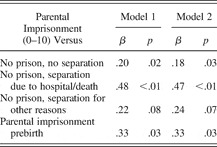
Table 5 shows the effects of separation because of parental imprisonment on internalizing problems in adulthood after controlling for parental criminality and other childhood adversities, using OLS regression. Compared to all four control groups, separation because of parental imprisonment (0–10) predicted more internalizing problems in adulthood, even after controlling for parental convictions (Model 1, Table 5). Effect sizes were small to moderate in these four comparisons (β = .20, p < .05; β = .48, p < .01; β = .22, p = .08; β = .33, p < .05). Therefore, imprisonment had an independent effect. Compared to all four control groups, separation because of parental imprisonment (0–10) also predicted more internalizing problems in adulthood, even after controlling for low junior school attainment and low family income (Model 2, Table 5). Effect sizes remained small to moderate in all four comparisons (β = .18. p < .05; β = .47, p < .01; β = .24, p = .07; β = .33, p < .05). Hence, the association between separation because of parental imprisonment and sons' internalizing problems in adulthood was not entirely explained by prisoners' children having criminal parents, low junior attainment, or low-income families. Again, parental imprisonment had an independent effect.
Parental imprisonment as an independent predictor of sons' internalizing problems in adulthood

Note: Variables in Model 1: parental imprisonment, parental convictions; variables in Model 2: parental imprisonment, parental convictions; boys' low junior school attainment, low family income.
Discussion
This study investigated the effects of parental imprisonment on boys' internalizing problems through the life course, using prospective longitudinal data from the CSDD. Parental imprisonment in the boys' first 10 years of life predicted internalizing problems in adolescence and adulthood compared with four control conditions. Hence, parental imprisonment was a risk factor for sons' internalizing problems. Separation because of parental imprisonment also predicted boys' internalizing problems after controlling for other childhood risk factors measured in the study. Hence, parental imprisonment was an independent risk factor for boys' internalizing problems.
According to the trauma perspective, parental imprisonment might cause children's internalizing problems because it disrupts children's attachment relationships. Parental imprisonment predicted worse internalizing outcomes than other forms of parent–child separation in this study, even after controlling for other risk factors. The results indicate that the particularly traumatic separation of parental imprisonment might cause internalizing problems for children.
According to the life-course perspective, parental imprisonment impacts on children because of other stressful experiences that often follow it, such as economic loss; school, house, and neighborhood moves; strained parenting by children's remaining caregivers; stigma; and adverse consequences of children's own antisocial behaviors. We were unable to investigate many of these possible mechanisms. However, we were able to test whether children's antisocial behaviors mediated the effects of parental imprisonment on their later internalizing outcomes.
Prisoners' children were more likely than their peers to show both internalizing and antisocial problems throughout their lives. This is an important finding because there have been few attempts to identify which family factors precede co-occurrence of internalizing and antisocial disorders (Marmorstein & Iacono, Reference Marmorstein and Iacono2004). However, antisocial behavior in adolescence did not mediate the relationship between parental imprisonment and sons' internalizing problems in this study. It is possible that children's antisocial behavior might have increased their internalizing problems earlier in childhood (see Gilliom & Shaw, Reference Gilliom and Shaw2004), but we were unable to test this hypothesis.
According to the selection perspective, parental imprisonment predicts internalizing problems because prisoners' children are already disproportionally disadvantaged, not because parental imprisonment causes problems for children. Previously we found that prisoners' sons experienced high levels of individual and family adversities compared to their peers (Murray & Farrington, Reference Murray and Farrington2005). In the present study, several of these childhood adversities also predicted children's internalizing outcomes, consistent with the selection perspective. However, in several tests, separation because of parental imprisonment predicted children's internalizing problems even after statistically controlling for other childhood adversities. This was inconsistent with the selection perspective. In addition, parental imprisonment during childhood predicted more internalizing problems than parental imprisonment before boys' births. This also suggests that the experience of parental imprisonment might be harmful for children, over and above the effects of background disadvantage.
Conclusion
In conclusion, parental imprisonment appeared to have an independent effect on children's internalizing problems through the life course. However, further tests are required to discover if children's problems following parental imprisonment are influenced more by the traumatic experiences of parental imprisonment itself, or by other life adversities that often follow parental imprisonment.
Other interpretations of these results should be considered. First, with small numbers of prisoners' children (n = 40) statistical conclusions are less reliable. Second, we were unable to test whether prisoners' children had worse internalizing problems than their peers before imprisonment took place. Although we controlled for childhood adversities associated with parental imprisonment, it is still possible that boys separated because of parental imprisonment had elevated internalizing problems before their parents were imprisoned, or that unmeasured environmental differences accounted for their outcomes. Therefore, causal conclusions must be extremely tentative. Third, twin and adoption studies are needed to investigate to what extent the effects of separation caused by parental imprisonment might be genetic. Fourth, because of small numbers, we were unable to test potential protective factors among boys who experienced parental imprisonment. Fifth and finally, imprisonment was measured in England among parents of White males between 1953 and 1964. Since then, prison populations have grown dramatically. The proportion of prisoners in England and Wales with long-term sentences has increased; the proportion of women in prison has grown (Morgan, Reference Morgan, Maguire, Morgan and Reiner1997) and, over the last decade, the Black and ethic minority prison population increased by 124% (Home Office, 2004). In the United States, imprisonment rates grew by more than 200% between 1980 and 1996, with a dramatic increase in the rate of imprisonment of drug offenders, ethnic minorities, and women (Blumstein & Beck, Reference Blumstein, Beck, Tonry and Petersilia1999). Replication studies are required to establish whether results from the present study apply to today's prison populations in the United Kingdom and in other jurisdictions.
Nevertheless, this is the first prospective longitudinal study of the effects of parental imprisonment on children's internalizing problems. Major strengths of this study are: the long period of follow-up, the low rates of attrition, and the use of well-validated measures, appropriate comparison groups, and controls for several possible confounds.
Prisoners' children are likely to be disproportionately represented in clinical populations (Phillips, Burns, Wagner, Kramer, & Robbins, Reference Phillips, Burns, Wagner, Kramer and Robbins2002). The clinical implications of this study are that, as well as prisoners' children facing elevated risk for antisocial problems (Murray & Farrington, Reference Murray and Farrington2005), they are also at increased risk for internalizing problems throughout their lives. In fact, prisoners' children are more likely to have co-occurring antisocial and internalizing problems than their peers. Unfortunately, the comorbidity of problems such as conduct disorder and depression indicates serious social maladjustment for children (Goodwin & Hamilton, Reference Goodwin and Hamilton2003; Marmorstein & Iacono, Reference Marmorstein and Iacono2003). In addition, internalizing problems among prisoners' children seem particularly chronic. Early intervention is needed to prevent severe and long-lasting social and emotional difficulties among prisoners' children (see Murray & Farrington, Reference Murray and Farrington2006, on evidence-based programs for prisoners' children).
In agreement with Bronfenbrenner's (Reference Bronfenbrenner1979) thesis that macrosocial policies influence child development, the results suggest that the policy of imprisoning criminals has adverse effects on their children's mental health. There are many alternatives to imprisonment following conviction (such as community sentences, use of electronic tagging, fines, and restorative justice agreements). The effects of imprisonment on communities, families, and children are rarely taken into account when calculating the costs and benefits of imprisonment. Therefore, imprisonment continues to be used without appropriate, rational appraisal of its overall utility. It is imperative that policy makers are informed of the long-lasting effects of imprisonment on children (and other relatives), so that the benefits of alternative sentences are recognized, and better support services can be provided to families of prisoners if needed. It is possible that the harmful effects of parental imprisonment on children could be mitigated by family-friendly visiting practices in prisons, economic and social support provided to prisoners' families, and less stigmatizing judicial policies and public opinion concerning offenders, such as in Sweden (Murray et al., 2007).
Developmental psychopathology has steadily increased our knowledge of the course and sequelae of high-risk conditions (Cicchetti, Reference Cicchetti, Rolf, Masten, Cicchetti, Nuechterlein and Weintraub1990). To further advance understanding of the risks associated with parental imprisonment, there is a need for replication studies, ideally controlling for children's adjustment prior to parental imprisonment, and additional investigation of the factors intervening between parental imprisonment and children's maladjustment. In particular, there is a need for large-scale studies with frequent measurement of children's outcomes that examine the more subtle dimensions of parental imprisonment: the meanings that children attribute to the event, the experiences of stigma and social isolation that might follow parental imprisonment, and family dynamics before, during, and after parental imprisonment. In addition, to help identify potentially effective interventions, there is a need to investigate factors, such as social support, that might buffer the effects of parental imprisonment on children. There is also a need to know whether there are different effects of parental imprisonment on girls, children of different ages, children of different ethnicities, and children experiencing maternal, compared with paternal, imprisonment.
To date, the effects of parental imprisonment on children have been almost entirely neglected in academic research, public policy, and media coverage. In an era of mass imprisonment there is a great need for a major investigation into how parental imprisonment affects children's lives.