

Introduction
What can we say about the fiscal responses of countries to the COVID-19 pandemic? Why did these anti-crisis measures differ so much? The growing literature based on recent data generally confirms that the consequences of the pandemic on public health and the economy were profound (Moehring et al. Reference Moehring, Weiland, Reifenscheid, Naumann, Wenz, Rettig, Krieger, Fikiel, Cornesse and Blom2021; Pak et al. Reference Pak, Adegboye, Adekunle, Rahman, McBryde and Eisen2020; Piltch-Loeb et al. Reference Piltch-Loeb, Merdjanoff and Meltzer2021; Smith Jervelund and Eikemo Reference Smith Jervelund and Eikemo2021). To counteract economic downturn, most of the advanced economies introduced unprecedented fiscal packages (Alberola et al. Reference Alberola, Arslan, Cheng and Moessner2020; Makin and Layton Reference Makin and Layton2021). However, we still know very little about the institutional and political determinants of these fiscal anti-crisis measures taken during the COVID-19 pandemic. Some existing research has studied political drivers of the COVID-19 policy evaluations among the citizens (Altiparmakis et al. Reference Altiparmakis, Bojar, Brouard, Foucault, Kriesi and Nadeau2021) and some others found the relevance of the government’s ideology for the character of the fiscal response to antecedent crisis episodes (Coulombe Reference Coulombe2026; Giesenow et al. Reference Giesenow, de Wit and de Haan2020). However, to the best of our knowledge, no existing study has addressed this problem concerning the COVID-19 pandemic. Anti-crisis fiscal measures might be an effective tool to counter the economic downturn (Ganong et al. Reference Ganong, Greig, Noel, Sullivan and Vavra2024), therefore, gaining a better understanding of what drove their size is of primary importance.
At the same time, past research generally suggests changing patterns in how government ideology shapes economic policymaking (Bandau and Ahrens Reference Bandau and Ahrens2020; Potrafke Reference Potrafke2017). Traditionally, left-wing parties supported active, Keynesian measures, with the right mostly addressing fiscal stability instead. In recent decades, these ideological positions have become much weaker predictors of policies actually implemented. The following study adds to this literature by studying the persistence of the ideology-policy relationships in the time of the COVID-19 crisis. Since available data reveals only a faint link between the size of implemented fiscal programs and the severity of the pandemic, such as numbers of confirmed cases or the average lockdown stringency, we hypothesize that other determinants, political in nature, must have been in play. While elaborating on the relationship between the political (left-right) ideology and the fiscal response to the COVID-19, we also expect the latter to have been largely determined by economic constraints, such as GDP, public debt or inflation. Besides, existing literature frequently highlights the distinctiveness of the Nordic model in shaping a specific socio-economic context. It combines a comprehensive welfare state with high investments in human capital within a market environment, both grounded in strong social trust (Andersen et al. Reference Andersen, Holmström, Honkapohja, Korkman, Tson and Vartiainen2007). As a result, the model has attracted considerable attention with regard to potential differences in how past crises have been managed (Calmfors Reference Calmfors2014; Greve et al. Reference Greve, Blomquist, Hvinden and Van Gerven2021). Following this literature, we include the Nordic model as one of our socio-economic controls. Finally, the paper considers further political controls, such as approaching elections (incentivizing politicians to increase public spending) or the leadership style linked to gender, as possibly correlated with policy choices.
The main research question, formulated and addressed in this paper is thus the following:
(Q1). Did the political ideology (left-right) of a government matter for the scope of pandemic fiscal packages?
As an auxiliary research question, to fully account for all potential drivers, we also ask:
(Q2). How was this relationship shaped by economic constraints such as an economy’s size, public debt or inflation? Could different patterns be observed for varying socio-economic models, e.g., in the case of Nordic countries?
As expressed by Q1, the paper’s main goal is to investigate the importance of the government’s left-wing or right-wing ideology towards public spending in the perspective of the size of COVID-19 pandemic anti-crisis fiscal measures. In the study, we limit our attention to the year 2020 only, as in this period the absence of vaccines has led decision-makers to a clear trade-off: public health or the economy. In the later phases of the pandemic, more sophisticated policy mixes were available, and therefore identifying one general pattern could be much hampered. Focusing on the beginning of the pandemic allows us to track the relationships between the designed fiscal responses and their political determinants. In this way, we might investigate factors that drove fiscal responses to the crisis of an almost unprecedented scale.
Taking advantage of the available data, our empirical study consists of a sample of 94 countries. Our main results strongly suggest that right-wing governments tended to introduce significantly bigger fiscal packages than in countries ruled by more center- or left-leaning parties. Moreover, the findings are robust to alternative measures of party ideology and additional model specifications. In consequence, the claim of the weakening, or even reversing, political divides between the left and right gains additional support in our paper. Although the implemented fiscal programs turned out sensitive in their size to economic constraints such as wealth or relative debt, these factors did not seem to have interfered with the fundamental relationship between the right-wing ideology and increased spending. In other words, even though governments differed in their fiscal response depending on their position in political spectrum, they seemed to behave similarly given the levels of public debt or inflation. Intriguingly, our results confirm the distinctiveness of the Nordic model: despite lower average spending, Nordic countries were the only ones observed to link rising numbers of confirmed cases with an increased fiscal response. One possible explanation is the role of trust in these societies. Governments addressing the economic consequences of the pandemic may have aligned their spending more closely with available evidence in order to preserve this trust. Finally, we also find that other political controls (leaders’ gender, electoral years) were of no statistical significance in predicting the size of programs. In particular, the insignificance of upcoming elections might suggest that rent-seeking behaviors need not be as ubiquitous among decision-makers as political economy would usually assume.
The value added by this paper to the literature, based on a quantitative analysis used for exploring recent data, is multifold. We shed a new light on the decisions of policymakers as a response to COVID-19 and relate it to the weakening traditional party divides. Apart from contributing to the literature on the coronavirus pandemic, the paper thus adds to various subfields of political economy, including the partisan theory and the political business cycle models, or gender economics. By exploring the patterns of policymaking during the pandemic, our empirical results provide informative insights and bring attention to some of the problems discussed within these disciplines.
The remainder of the paper is structured as follows. Section Theory and Literature Review provides a literature review on the potential drivers of fiscal response to the pandemic and develops a theoretical framework performing both a predictive and explanatory function in regard to our empirical findings. Then, the subsequent Section Empirical analysis contains the description of the data used in the research and applied empirical methodology. Main results of the study are presented and discussed in Section Results and discussion. Last, but not least, concluding remarks close the paper.
Theory and literature review
Before examining the political and economic drivers of fiscal policy during crises, it is useful to begin with considering the efficacy of different fiscal strategies. In downturns, policymakers face a classic trade-off: prioritizing inflation control and fiscal sustainability, or pursuing Keynesian stimulus to support output and employment. This choice is far from straightforward. Research shows that counter-cyclical fiscal policies, especially those boosting aggregate demand, can significantly reduce unemployment and shorten recessions (Baldacci et al. Reference Emanuele, Gupta and Mulas-Grandos2009; Furman Reference Furman, Bernanke, Geithner and Paulson2020). Packages emphasizing public investment or transfers to low-income groups tend to yield higher multipliers (Wilson Reference Wilson2020), though they also raise concerns about inflation, debt sustainability, and long-run crowding-out (Bianchi et al. Reference Bianchi, Ottonello and Presno2023).
The COVID-19 pandemic intensified this dilemma. Prior to vaccines distribution, lockdowns and voluntary behavioral changes (social distancing) were among the most effective tools for slowing the virus transmission, but their economic costs were steep. Decision-makers had to balance reducing virus-related mortality with preventing deeper economic losses (Acemoglu et al. Reference Acemoglu, Chernozhukov, Werning and Whinston2021; Eichenbaum et al., 2020). To mitigate the latter and stimulate the economies, substantial fiscal packages were provided.
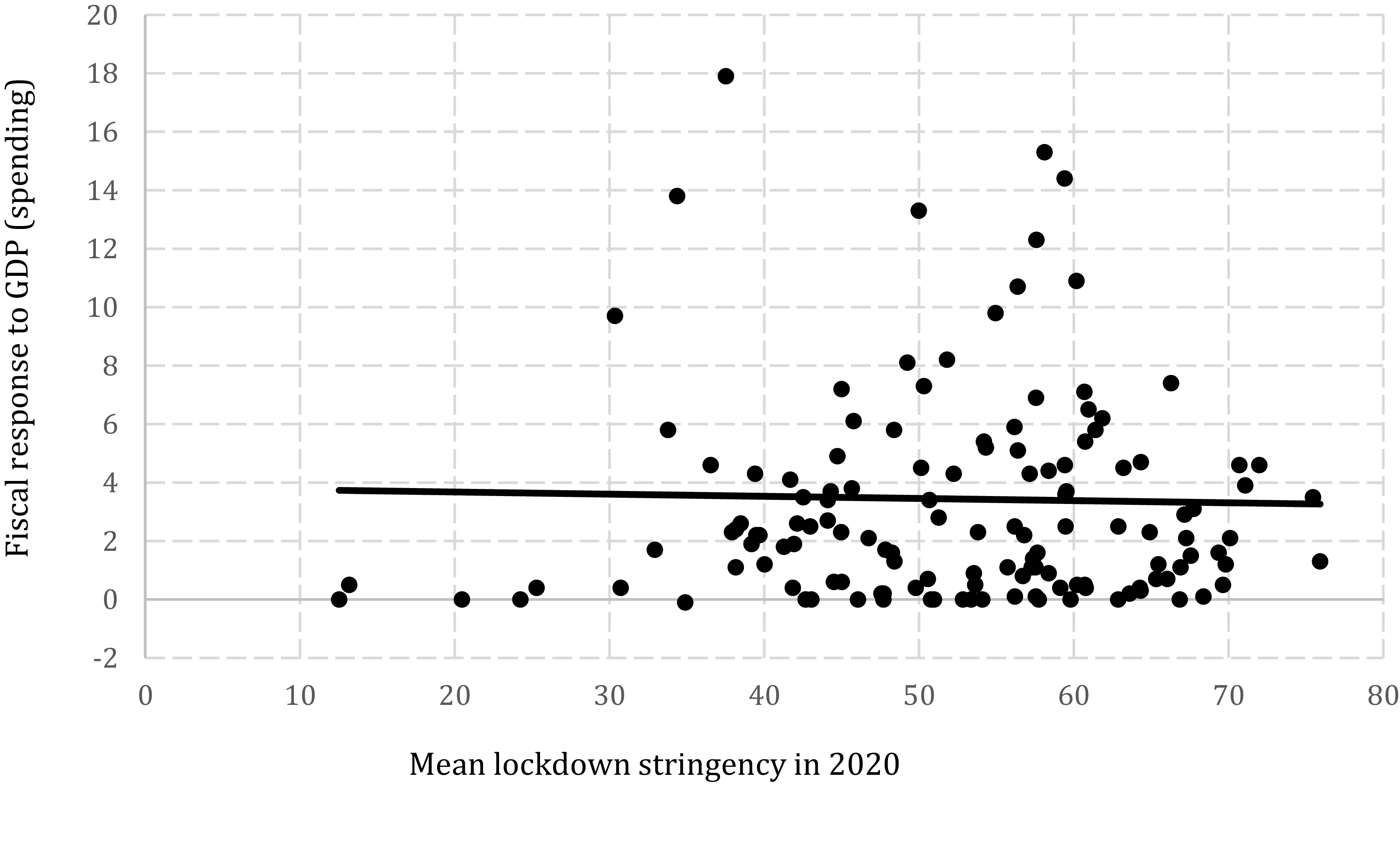
Surprisingly, their size varied widely across countries, with little correlation to the severity of restrictions as Figure 1 presents. Yet the challenges were largely shared: providing liquidity to shuttered businesses (Makin and Layton Reference Makin and Layton2021), protecting low-skilled workers disproportionately exposed to job loss and infection risk (Romer Reference Romer2021), and navigating the unique difficulty of stimulating demand while many sectors remained closed. The effects of fiscal support also varied across income groups and pandemic phases (Chetty et al. Reference Chetty, Friedman and Stepner2024).
Mean lockdown stringency in 2020 to fiscal response (as per cent of GDP).

Therefore, the sources of this variation in fiscal response must be searched elsewhere, outside the scope of lockdown severity. Understanding them might require integrating insights from political economy, macroeconomics, and public finance. This section outlines key theoretical and empirical findings on how ideology, institutions, and economic constraints shape crisis-time fiscal policy, especially during the COVID-19. Since the independent drivers of the pandemic such as the virus infections fail to fully account for the variation in fiscal response (as shown later), we hypothesize that it is the political ideology of a ruling party that can explain the size of public spending. As the following subsection argues, the nature of such relationship is far from obvious. Even though traditionally right-wing parties were expected to support the austerity politics, with left adhering to fiscal expansionism, the last decades have weakened this trend. However, one might also reasonably believe that a country’s fiscal capacities should not be ignored – we therefore expect factors like GDP or debt to serve as important controls, constraining decision-makers choices, regardless of their political affiliation. Finally, we also introduce further political controls, relating to the political cycles theory and gender economics. These strands of literature aim to complement the partisan theory in its description of ideological divides between parties across spectrum. It should be also noted that one must be cautious when interpreting our theory causally. Even though it formulates some predictions concerning what different parties do, the available data allows for only a very limited causal inference.
Political economy of crisis response: partisan theory and ideological divides
At the heart of political economy explanations lies the theory that partisan ideology significantly influences fiscal decisions. Rooted in the classic partisan model (Alesina Reference Alesina1987; Hibbs Reference Hibbs and Douglas1977), the expectation is that left-wing parties prioritize employment and income equality, making them more likely to pursue expansionary fiscal policy during downturns. In contrast, right-wing parties, emphasizing fiscal discipline and inflation control, are more prone to adopt austerity or pro-cyclical policies. Within this theory, one of the reasons for this policy diversity can be fundamental interests and preferences of constituencies each party represents (Alesina Reference Alesina1987). Traditional left voters – blue collar workers – are more exposed to growths of unemployment which has stronger effects on their income, as dependent mostly on salaries. For middle- and upper-class electorates with more secure jobs and at least part of their capital stored in financial assets, disutility of high inflation prevails. Their right-wing political representation is thus expected to prioritize pro-cyclical policies, even at the expense of growing unemployment (Hibbs Reference Hibbs and Douglas1992). Importantly, for the COVID-19 case, significant differences in the pandemic perception and risk-taking attitudes have been observed for individuals across political spectrum (Jones and McDermott Reference Jones and McDermott2022; Kyung et al., Reference Kyung, Thomas and Krishna2022). Considering the partisan model, these differences are expected to be reflected also in policies implemented by ruling parties.
At the same time, there seems to be no very strong agreement about the theory’s empirical validation. While Lowery (Reference Lowery1985) and Poterba (Reference Poterba1994) find no significant differences between Democratic and Republican administrations in their budget adjustments to fiscal shocks, De Haan and Sturm (Reference De Haan and Sturm1994) or Reed (Reference Reed2006) provide historical evidence supporting the partisan divide. The latter finds that Democrat-controlled state legislatures in the U.S. can be associated with higher tax burdens. Similarly, Toubeau and Vampa (Reference Toubeau and Vampa2021) find persisting partisan differences on a regional level in Spain and Italy, linking them to high priority assigned by the left to welfare protection. As a result, public finance retrenchment is weaker when left-wing parties are represented in the local government. On the other hand, some other recent scholarship tends to find trends that evolve over time. In a literature review study, Bandau and Ahrens (Reference Bandau and Ahrens2020) note that persistence of partisan differences highly varies with the choice of dependent variable, but also observe the partisanship effect declining in time. Haddow (Reference Haddow2020) reports that Canadian provinces governed by left-wing parties implemented more counter-cyclical policies, though this pattern faded post-2004, perhaps due to declining unemployment or ideological convergence. Indeed, a meta-analysis of OECD countries (Potrafke Reference Potrafke2017) suggests a long-term weakening of partisan effects on fiscal policy, especially after the 1990s.
Such ideological blurring is also discussed by Zakaria (Reference Zakaria2016), who argues that economic positions of parties have become less predictable. The case of the Trump administration’s large fiscal stimulus in 2020 can perfectly exemplify this: despite its right-wing orientation, the U.S. enacted one of the most expansive responses globally.
Thus, while the partisan theory provides a useful starting point implying spending patterns along the traditional ideological divisions, it must be refined to account for other possible confounders. As theories of political business cycle suggest, party divides may be complicated by forthcoming elections (Kalecki Reference Kalecki1943; Nordhaus Reference Nordhaus1975; see Drazen Reference Drazen2000 for a discussion). Namely, politicians facing imminent elections might have incentives to prioritize short-term gains over long-term stability, often leading to increased spending. An empirical implication this theory yields for the COVID-19 crisis is to expect more counter-cyclic measures if an election was about to take place in a country during the pandemic. Alternatively, the forthcoming election might also induce a policymaker to constrain his or her potential successor’s choice set, amplifying the partisan effect.
Historically, Poterba (Reference Poterba1994) indeed finds that U.S. states were less likely to enact spending cuts or tax hikes during election years. Similarly, Chaudhuri and Dasgupta (Reference Chaudhuri and Dasgupta2006) report that Indian states adjusted their fiscal behavior based on electoral timing. Also, during the COVID-19 pandemic, South Korea reportedly ramped up fiscal relief in advance of legislative elections (Duchâtel et al. Reference Duchâtel, Godement and Zhu2020). Nevertheless, some other studies find more mixed effects (Lowery, 1984; Alesina et al., Reference Alesina, Cohen and Roubini1992; Haddow Reference Haddow2020), which highlights the need to interpret such electoral incentives within a broader political context.
Besides, gender economics offers insights on the links between leaders’ gender and crisis management. Noteworthy, women are more likely to prioritize equality-oriented, redistributive policies (Clots-Figueras Reference Clots-Figueras2012; Wängnerud Reference Wängnerud2009) and to support left-wing parties (Edlund et al. Reference Edlund, Haider and Pande2005). These differences in voters’ preferences might translate to different policies implemented by male and female leaders (Chattopadhyay and Duflo Reference Chattopadhyay and Duflo2004). However, extra caution is needed while interpreting gender-ascribed variation in policymaking causally: both access to political positions to women and policies they enact might originate from a society’s liberal values (Piscopo Reference Piscopo2020).
Indeed, the evidence in support of either channel is mixed. Different risk perceptions between men and women during the pandemic (Galasso et al. Reference Galasso, Pons, Profeta, Becher, Brouard and Foucault2020) were paralleled by earlier lockdown imposition by female leaders (Garikipati and Kambhampati Reference Garikipati and Kambhampati2021). However, other evidence emphasizes the role of structural determinants such as efficient healthcare rather than of leader-specific traits (Abras et al. Reference Abras, Fava and Kuwahara2021; Mavisakalyan Reference Mavisakalyan2014; Piscopo Reference Piscopo2020). Nevertheless, fiscal policy analysis can benefit from considering gender. Without favoring either mechanism that links gender to pandemic relief, one can still ask whether female leaders tended to increase spending.
Economic constraints and the politics of capacity
Beyond political ideology, a country’s fiscal capacity and macroeconomic context shape its room for maneuver. GDP per capita, debt levels, and credit ratings are among the most frequently cited constraints in the literature (Alberola et al. Reference Alberola, Arslan, Cheng and Moessner2020; Makin and Layton Reference Makin and Layton2021; Raudla and Kattel Reference Raudla and Kattel2011).
Some studies highlight a positive correlation between the size of fiscal response size during the COVID-19 pandemic and the GDP, particularly in emerging markets (Alberola et al. Reference Alberola, Arslan, Cheng and Moessner2020; Makin and Layton Reference Makin and Layton2021). Among advanced economies, however, higher GDP level was sometimes associated with a more modest fiscal response, possibly due to the presence of automatic stabilizers and more extensive welfare systems. The relationship provides a strong reason to consider not only continuous measures of wealth but also distinguish between discrete income groups. Conversely, Balajee et al. (Reference Balajee, Tomar and Udupa2020) find no significant relationship, suggesting this factor may be more context-dependent.
Debt levels may also play a role. Armingeon (Reference Armingeon2012) argues that high public debt constrains fiscal space, although Romer (Reference Romer2021) contends that this constraint has often been overstated, especially during the dominance of Washington-consensus thinking. As a part of the broader economic narrative, anti-debt ideas effectively shaped the mental models of policymakers (Romer Reference Romer2021; see Shiller Reference Shiller2017), a dynamic illustrated by the cases discussed in Raudla and Kattel (Reference Raudla and Kattel2011).
Taken together, these insights imply that economic variables need not be merely control factors but can also interact with political ideology. As in the model of Alesina and Tabellini (Reference Alesina and Tabellini1990), debt accumulation may rise when opposing parties alternate in power, while tighter economic constraints should narrow ideological differences. For instance, a left-wing government in a low-debt country may enact a larger stimulus than a similarly oriented government operating under stricter fiscal limits.
A noteworthy case that illustrates the interaction between political and economic factors is that of the Nordic countries (Sweden, Norway, Denmark, Iceland, and sometimes EstoniaFootnote 1 ). These states combine generous welfare services and strong institutional capacity with a highly market-oriented economic framework (Andersen Reference Andersen2008). Notably, they consistently rank high in economic freedom indices, despite their expansive welfare systems. Because of this configuration, the Nordic model transgresses conventional ideological or economic divisions: a substantial social safety net coexists with fiscal discipline, both supported by broad political consensus and high public trust in institutions (Rothstein and Stolle Reference Rothstein and Stolle2008). These features shape the fiscal choice in ways that differ both from the welfare regimes traditionally supported by political left and from the strictly market-oriented systems. In particular, the combination of solid automatic stabilizers, strong social safety nets, and a political culture that favors predictable, rules-based policymaking may reduce the perceived need for large discretionary fiscal packages during crises. Moreover, one of the most unorthodox approaches to tackle the pandemic that attracted wide public attention and aroused lots of controversies was the one taken by Sweden. In a highly individualistic manner, Sweden prioritized minimizing virus spread in its early phases by building up herd immunity even at a cost of a higher death toll in the short term (CBC News 2022; Henley Reference Henley2020).
The COVID-19 literature similarly treats Nordic countries as a coherent institutional cluster, emphasizing how their trust-based governance and existing welfare architecture influenced pandemic responses (de la Porte et al. Reference de la Porte, Jensen and Kvist2023; Gordon et al. Reference Gordon, Grafton and Steinshamn2021). In particular, given the central role of trust in the Nordic social contract, one may expect fiscal responses to be closely aligned with the severity of the pandemic. Namely, detaching government spending from publicly observed data could pose risk to the belief that the former acts within the social contract between it and the citizens. At the same time, analyzing these countries as a separate group can clarify how a specific combination of high institutional capacity, backed by a pro-market orientation, and a strong safety net might result in a relatively weaker discretionary fiscal response, even when economic fundamentals would leave some space for more decisive actions.
Empirical analysis
Data and empirical design
The final sample used in this research, retrieved from data sources described in Table A1 in the Appendix, includes 94 countries (listed in List 1 in the Appendix).Footnote 2 All variable values are expressed either for 2019 or 2020, depending on their characteristics (see below). The dependent variable is the cumulative size of the fiscal response to the COVID-19 crisis in 2020. Hence, the dataset is a cross-section of countries. Concededly, the International Monetary Fund (2021a) also shared partial data for selected months, this was, however, incompatible with most independent variables.
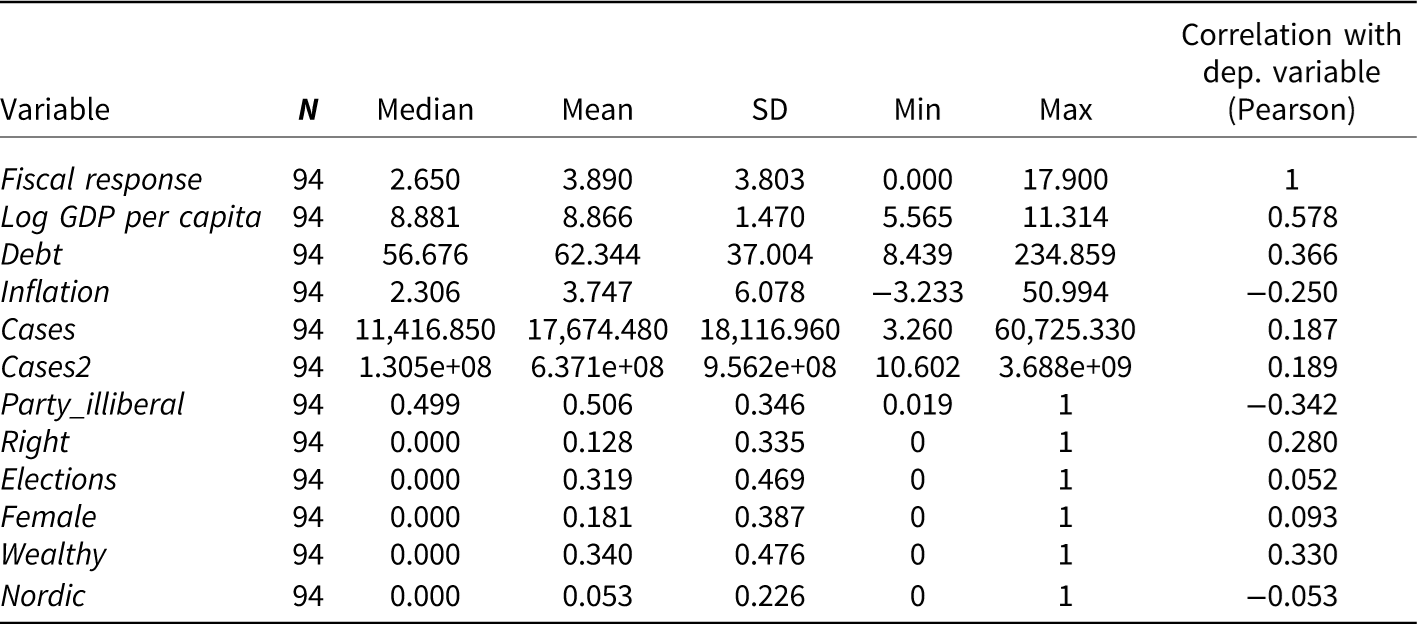
Based on the literature review and data availability, we selected the following set of independent variables: cases, right (binary), gdp_pc_log, debt, inflation, elections (binary), and female (binary). Additionally, we included two further binary controls. The first (wealthy) indicating wealthy countries (defined as a logarithm of GDP per capita exceeding 9.5, which translates to upper 32% of our sample), and the second (nordic) identifying Nordic countries in the sample (specifically Sweden, Norway, Denmark, Iceland, and Estonia). Descriptive statistics of all variables are presented in Table 1.
Descriptive statistics of the variables used in estimations

Table 1. Long description
A table with 12 rows and 9 columns presenting descriptive statistics of variables used in estimations. The columns are labeled as Variable, N, Median, Mean, SD, Min, Max, and Correlation with dep. variable (Pearson). The rows list different variables along with their respective statistics. Row 1: Fiscal_response, 94, 2.650, 3.890, 3.803, 0.000, 17.900, 1. Row 2: Log_GDP_per_capita, 94, 8.881, 8.866, 1.470, 5.565, 11.314, 0.578. Row 3: Debt, 94, 56.676, 62.344, 37.004, 8.439, 234.859, 0.366. Row 4: Inflation, 94, 2.306, 3.747, 6.078, -3.233, 50.994, -0.250. Row 5: Cases, 94, 11,416.850, 17,674.480, 18,116.960, 3.260, 60,725.330, 0.187. Row 6: Cases2, 94, 1.305e+08, 6.371e+08, 9.562e+08, 1.0602e+08, 3.688e+09, 0.189. Row 7: Party_illiberal, 94, 0.499, 0.506, 0.346, 0.019, 1, -0.342. Row 8: Right, 94, 0.000, 0.128, 0.335, 0, 1, 0.280. Row 9: Elections, 94, 0.000, 0.319, 0.469, 0, 1, 0.052. Row 10: Female, 94, 0.000, 0.181, 0.387, 0, 1, 0.093. Row 11: Wealthy, 94, 0.000, 0.340, 0.476, 0, 1, 0.330. Row 12: Nordic, 94, 0.000, 0.053, 0.226, 0, 1, -0.053.
Source: own elaboration.
The dependent variable, denoted as fiscal_resp, represents the size of public fiscal stimuli enacted to fight the pandemic, expressed as a percentage of GDP in each country in 2020. This data was extracted from the International Monetary Fund (2021a), with all values for each observation current as of the end of 2020 (cumulating since the pandemic’s onset). It is worth noting that the fiscal measures analyzed here include only the above-the-line measures in sectors other than health. These programs specifically concern additional budgetary spending and forgone revenue, excluding equity injections, loans, and asset purchases (below-the-line measures) or public guarantees (contingent liabilities) (International Monetary Fund 2021a). Excluding additional health expenditures in 2020 prevents a two-sided causation between the dependent variable and one of the independent variables (specifically, the number of confirmed COVID-19 cases). If included, the size of the fiscal program could influence the number of cases, which in turn might impact the program itself throughout the year. Therefore, no additional healthcare spending is included. Values for the dependent variable range from 0 to 17.9 percent of GDP, with a mean of 3.890 percent.
In light of a weak relationship between lockdown stringency and the extent of fiscal response, presented in Figure 1, other pandemic severity measures should be considered. However, none of them seems perfect too. Virus mortality statistics highly depended on the reporting system implemented in each country, while the number of confirmed cases could provide no more than a partial account of the pandemic’s toll, as conditional on the access to tests. In theory, a more robust measure of the overall consequences for public health was the excess mortality (Ritchie et al. Reference Ritchie, Ortiz-Ospina, Hasell, Giattino and Roser2021b). However, it is questionable whether this abstract statistic did in fact inform policymaking across the globe. In contrast, the number of cases provided more immediate, visible, and widely reported data, even if less precise. Consequently, we decide to refer to the numbers of confirmed cases as the most practical choice – despite its limitations. The variable cases (total confirmed COVID-19 cases in 2020) is retrieved from (Mathieu et al. Reference Mathieu, Ritchie, Rodés-Guirao, Appel, Gavrilov, Giattino, Hasell, Macdonald, Dattani, Beltekian, Ortiz-Ospina and Roser2021a). Due to the nature of the dependent variable (size of fiscal relief), we consider the cumulated yearly numbers of observed infections, instead of their daily, weekly, or monthly reports. Consequently, the model included the total number of cases per million citizens at the end of the year 2020, later taken in logarithm for the sake of computations.
The main independent variable, right, relevant for our research question Q1 (that addresses partisan differences in policymaking) was decoded from the V-Party dataset (Lührmann et al. Reference Lührmann, Düpont, Higashijima, Kavasoglu, Marquardt, Bernhard, Döring, Hicken, Laebens, Lindberg, Medzihorsky, Neundorf, Reuter, Ruth-Lovell, Weghorst, Wiesehomeier, Wright, Alizada, Bederke, Gastaldi, Grahn, Hindle, Ilchenko, von Römer, Pemstein and Seim2020b). It defined whether a government (formed after the most recent elections) was controlled by a right-wing party in terms of economic policy, taking a binary value: 1 – yes, 0 – no. While assigning the value, the most recent information, available as of the end of 2019, was used. For its specific calculation, please also see Table A1 in the Appendix. In that time, twelve countries were governed by economic right, and these were: Brazil, Colombia, Cyprus, Guatemala, Honduras, India, Japan, Norway, Singapore, Turkey, the United Kingdom, and the United States. Importantly, they account for half of the countries with the biggest fiscal relief packages and include four out of eight whose with programs exceed 10 percent of GDP, that is, Japan, Singapore, the United Kingdom, and the United States. For the set of economic controls, related to the auxiliary research question Q2, we firstly included information on the relative size of an economy, public debt and inflation. The independent variable gdp_pc_log represents the logarithm of GDP per capita in 2019, retrieved from the World Bank (2021) and based on GDP per capita in current US dollars. To avoid potential simultaneity, the GDP per capita indicator was lagged to 2019. This variable revealed a strong correlation with the dependent variable (0.578), suggesting its importance in explaining the fiscal response.
To account for the sustainability of public finance and available space to exercise fiscal capacity, we also used the level of public debt as percentage of total GDP (debt) and yearly inflation (inflation), both as of 2019. In our sample, Japan was the most indebted country (234.859 percent of GDP) while Estonia was the least (8.439 percent). In the case of inflation, its mean value in the sample is 3.747 percent, with a standard deviation of 6.078. Both above-mentioned variables come from World Bank (2021).
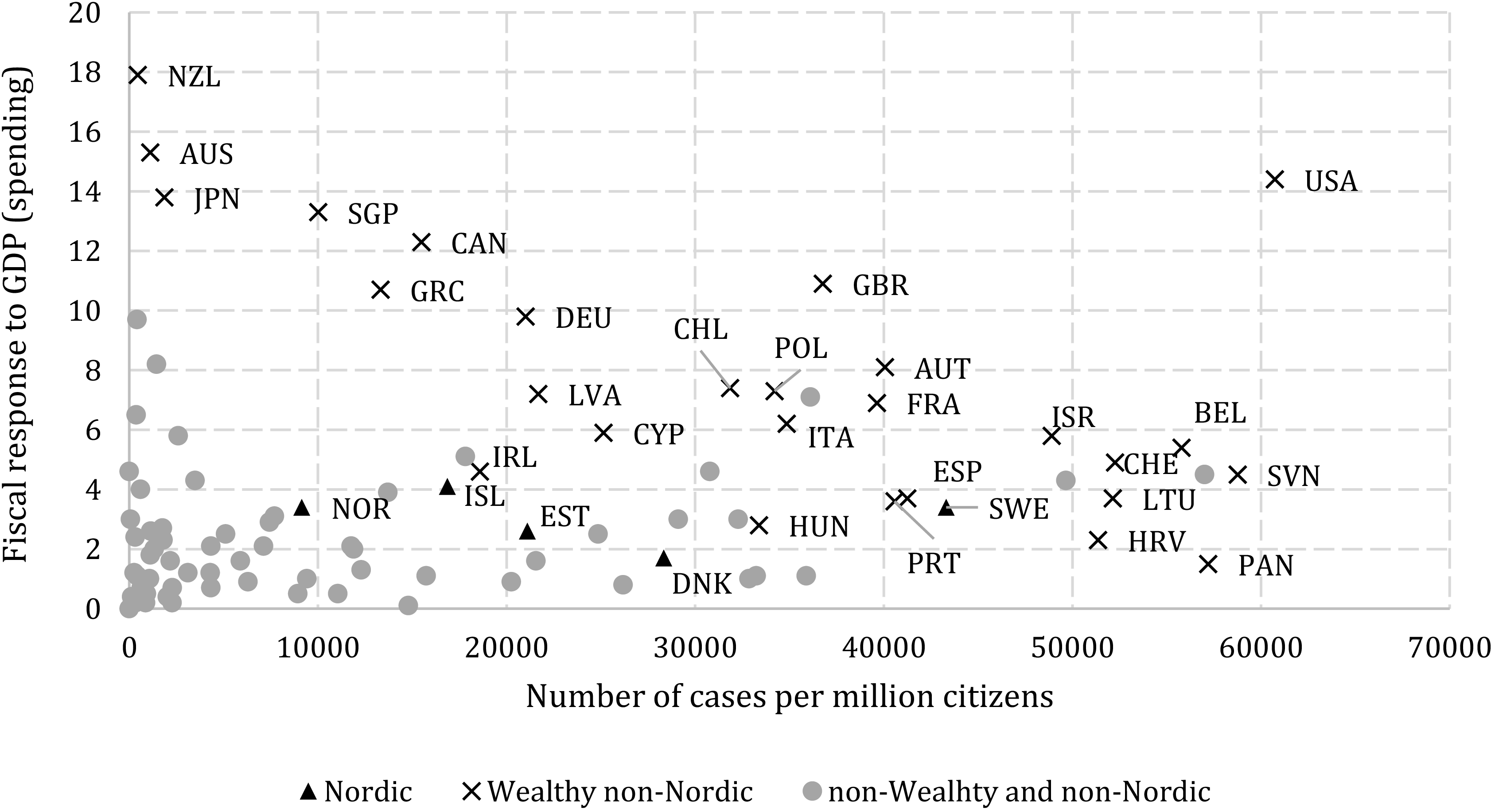
Further economic controls suggested by the theory from Section Theory and Literature Review were the binary wealth level (wealthy) and the Nordic countries indicator (nordic). To corroborate the need of their inclusion before the model estimation, we compared fiscal response relative to the severity of the pandemic between different groups of countries. The following Figure 2 presents the fiscal response to GDP (y axis) against the number of COVID-19 cases (x axis). As illustrated, a distinct relationship between the two variables in cases of the Nordic and other wealthy countries stands out from the rest of the sample. Consequently, the literature (e.g., de la Porte et al. Reference de la Porte, Jensen and Kvist2023 and Gordon et al. Reference Gordon, Grafton and Steinshamn2021) emphasizing the special character of these groups finds further support in available data.
Fiscal response and number of COVID-19 cases.
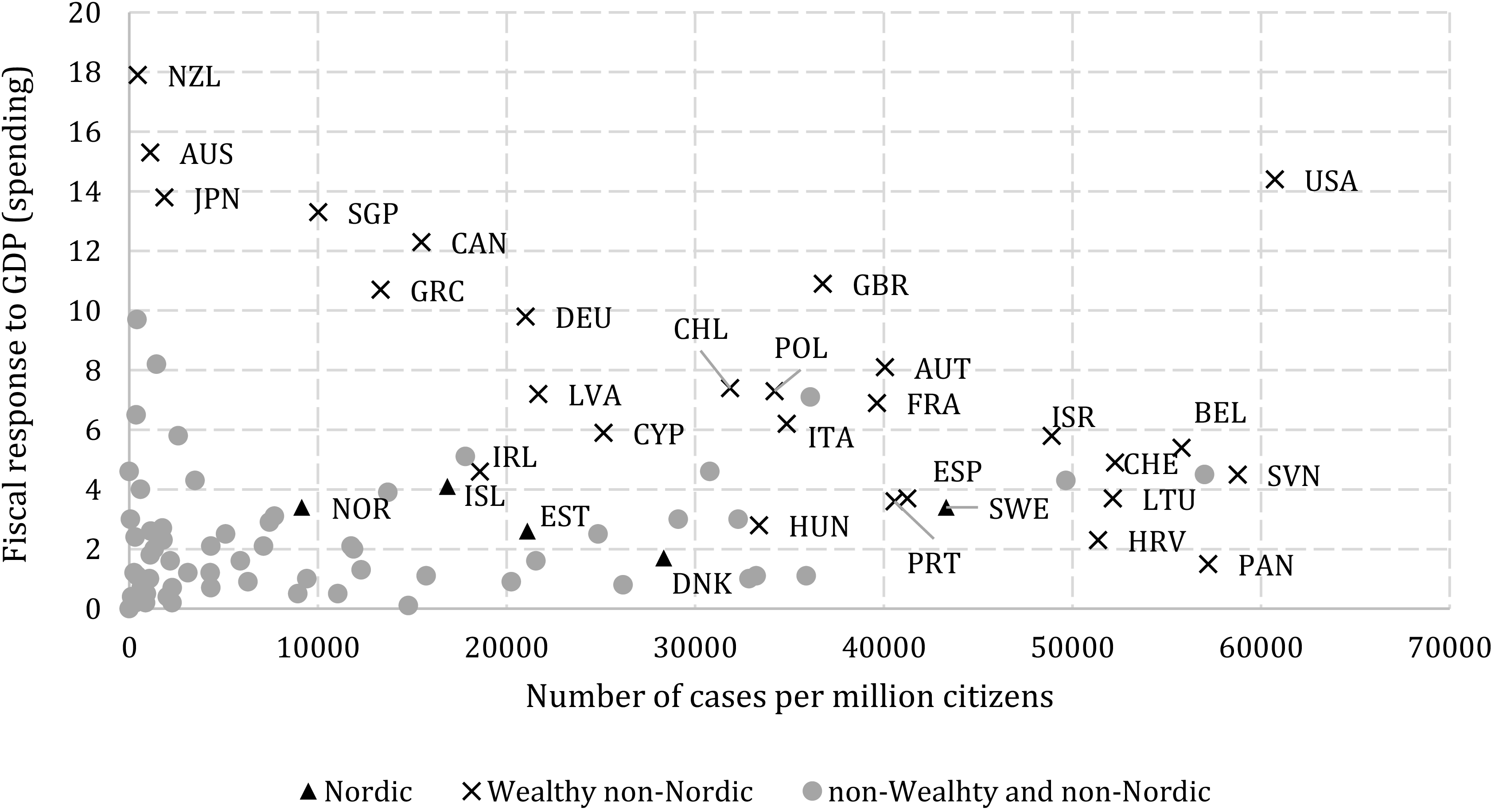
Figure 2. Long description
A scatter plot represents the relationship between the number of COVID-19 cases per million citizens and the fiscal response to GDP spending. The horizontal axis represents the number of cases per million citizens, ranging from 0 to 70000. The vertical axis represents the fiscal response to GDP spending, ranging from 0 to 20. The data points are categorized into three groups: Nordic countries, wealthy non-Nordic countries, and non-wealthy and non-Nordic countries. Nordic countries are marked with triangles, wealthy non-Nordic countries with crosses, and non-wealthy and non-Nordic countries with circles. Notable clusters and outliers include New Zealand, Australia, Japan, and the USA, which have distinct fiscal responses relative to their number of cases. The plot shows a variety of fiscal responses across different countries, with some countries having high fiscal responses despite fewer cases and others with lower fiscal responses despite higher cases.
To complement the picture, we include two additional political controls.Footnote 3 The binary variable elections quantified whether a country faced parliamentary or presidential elections in 2020 after the pandemic began (1 – yes, 0 – no). Retrieved from the V-Dem dataset (Coppedge et al. Reference Coppedge, Gerring, Knutsen, Lindberg, Teorell, Alizada, Altman, Bernhard, Cornell, Fish, Gastaldi, Gjerløw, Glynn, Hicken, Hindle, Ilchenko, Krusell, Luhrmann, Maerz, Marquardt, McMann, Mechkova, Medzihorsky, Paxton, Pemstein, Pernes, von Römer, Seim, Sigman, Skaaning, Staton, Sundström, Tzelgov, Wang, Wig, Wilson and Ziblatt2021), it was based on two original binary variables: v2xel_elecpres and v2xel_elecparl, which informed, respectively, if presidential or parliamentary elections were held in 2020. For the specific calculation of the variable elections, please also consult Table A1 in the Appendix. Altogether, 30 countries from the sample held elections in that period. These were: Azerbaijan, Bolivia, Burkina Faso, Burundi, Croatia, Dominican Republic, Georgia, Ghana, Iceland, Ireland, Israel, Jamaica, Lithuania, Malawi, Moldova, Mongolia, Myanmar, New Zealand, Niger, Peru, Poland, Romania, Serbia, Seychelles, Singapore, Sri Lanka, Tanzania, Trinidad and Tobago, the United States, and Vanuatu.
The last political control, female, was also extracted from the V-Dem dataset. As the previous one, it was derived from two original dummy indicators. If power was exercised by a female head of government or a female head of state, female assumed 1, and 0 otherwise. To avoid unobserved interactions with elections, values of female were taken for the turn of 2019 and 2020. At that time, a woman was the head of state or government in seventeen countries: Bangladesh, Barbados, Belgium, Bolivia, Denmark, Estonia, Ethiopia, Georgia, Germany, Iceland, Myanmar, Nepal, New Zealand, Norway, Serbia, Singapore, and Trinidad and Tobago. Finally, it is worth emphasizing that no worrying correlation between the regressors was found. Although some of them are indeed rather strongly interconnected (Pearson correlation above 0.30 – see Table A2 in Appendix), there is insufficient reason to exclude these variables based on these relationships.
To explore the relationship between these independent variables and the size of the fiscal response to the COVID-19 crisis, we decided to exploit a regression model of the form
 $\eqalign{fisc\_res{p_i}\; = & \;{\beta _0} + {\beta _1}*gdp\_lo{g_i} + \;{\beta _2}*debt{_i} + \;{\beta _3}*inflation{_i} + \;{\beta _4}*cases{_i} \\ & + \;{\beta _5}*cases2{_i} + \;{\beta _6}*right{_i} + {\beta _7}*elections{_i}\; + \;{\beta _8}*femal{e_i} + \;{\varepsilon _i}}$
The method selection resulted directly from the cross-sectional dataset. Models’ validity examination was performed using the Ramsey-RESET test and the studentized Breusch-Pagan test for heteroskedasticity. Furthermore, we explored the possibility of simultaneity between the fiscal response to the COVID-19 crisis and the number of cases. Moreover, we considered another specification with the number of cases not transformed but squared. The results of these two additional approaches are presented in the Appendix (Table A3 and Table A4 respectively).
Results and discussion
Political ideology
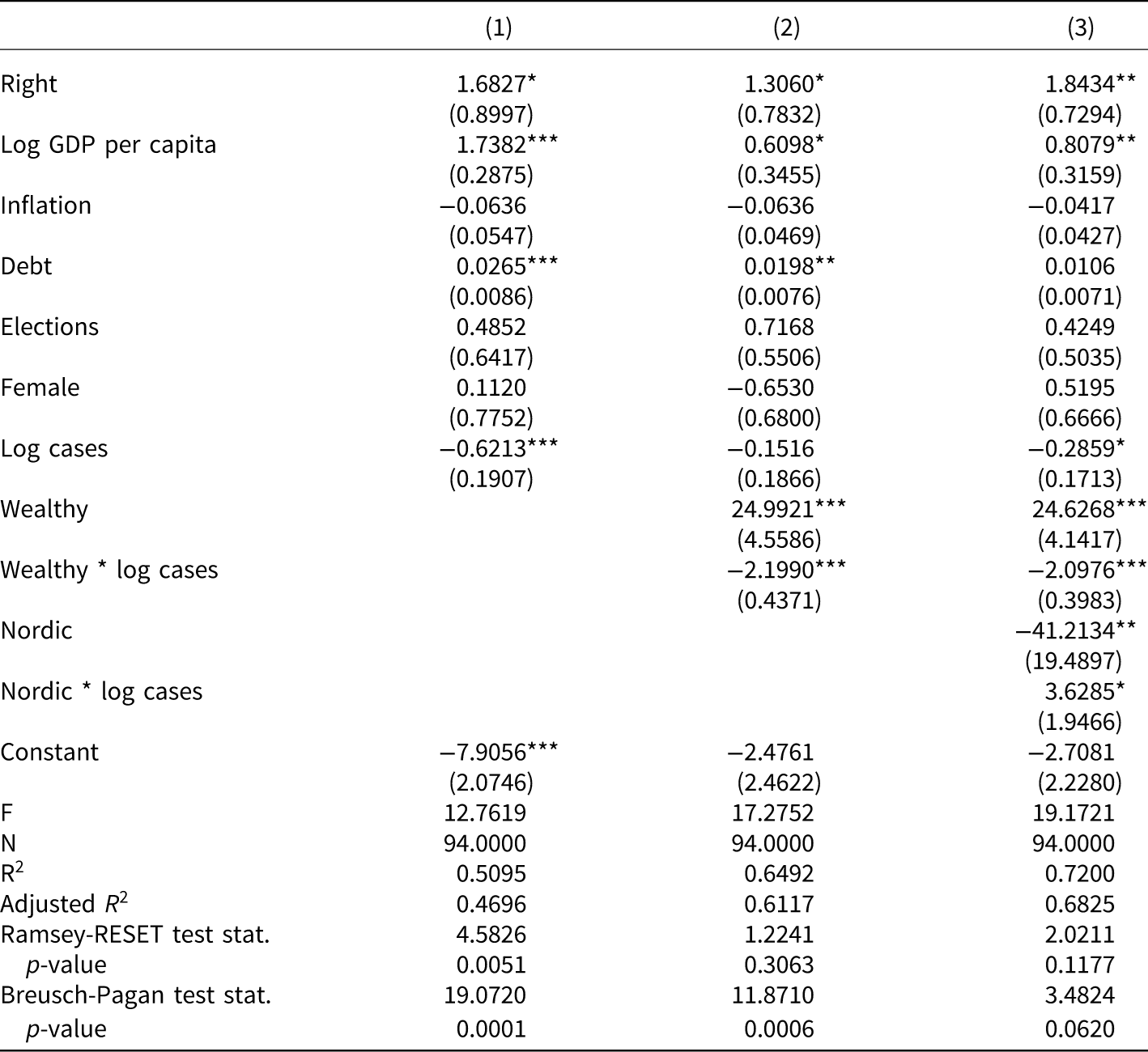
Table 2 summarizes the combined results of different specifications of our baseline model. Its fullest version, presented in Column (3) explained over 70 percent of the variability of the fiscal response. In this regard, we managed to surpass similar models designed by Balajee et al. (Reference Balajee, Tomar and Udupa2020), which reported R2 statistics lower than 25 percent.
The baseline models results
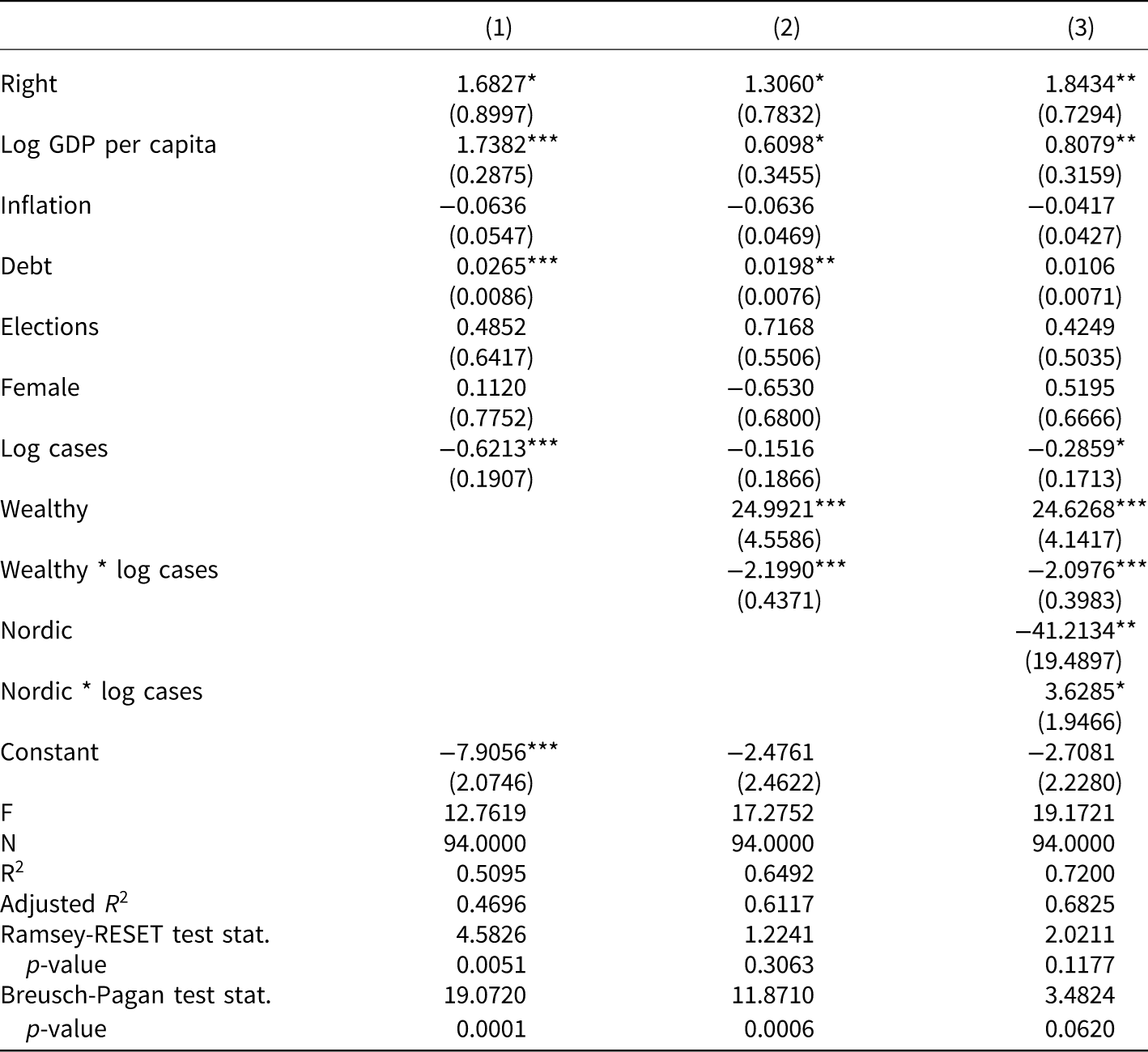
Table 2. Long description
The table presents the results of different specifications of a baseline model, with three columns labeled (1), (2), and (3). Each column lists various variables and their corresponding coefficients, standard errors, and significance levels. The variables include Right, Log GDP per capita, Inflation, Debt, Elections, Female, Log cases, Wealthy, Wealthy * log cases, Nordic, and Nordic * log cases. The table also includes statistical measures such as Constant, F, N, R2, Adjusted R2, Ramsey-RESET test stat., p-value, Breusch-Pagan test stat., and p-value. Column (3) explains over 70 percent of the variability of the fiscal response, surpassing similar models designed by Balajee et al. (2020), which reported R2 statistics lower than 25 percent. Row-wise data: Row 1: Right, 1.6827*, 1.3060*, 1.8434**; Row 2: Log GDP per capita, 1.7382***, 0.6098*, 0.8079**; Row 3: Inflation, -0.0636, -0.0636, -0.0417; Row 4: Debt, 0.0265***, 0.0198**, 0.0106; Row 5: Elections, 0.4852, 0.7168, 0.4249; Row 6: Female, 0.1120, -0.6530, 0.5195; Row 7: Log cases, -0.6213***, -0.1516, -0.2859*; Row 8: Wealthy, 24.9921***, 24.6268***; Row 9: Wealthy * log cases, -2.1990***, -2.0976***; Row 10: Nordic, 3.6285*, -41.2134**; Row 11: Constant, -7.9056***, -2.4761, -2.7081; Row 12: F, 12.7619, 17.2752, 19.1721; Row 13: N, 94.0000; Row 14: R2, 0.5095, 0.6492, 0.7200; Row 15: Adjusted R2, 0.4696, 0.6117, 0.6825; Row 16: Ramsey-RESET test stat., 4.5826, 1.2241, 2.0211; Row 17: p-value, 0.0051, 0.3063, 0.1177; Row 18: Breusch-Pagan test stat., 19.0720, 11.8710, 3.4824; Row 19: p-value, 0.0001, 0.0006, 0.0620.
*p < 0.10, **p < 0.05, ***p < 0.010; Standard errors in parentheses.
To begin with, it should be noted that the implications yielded by the early evidence illustrated in Figure 1 (and reconfirmed in Table A7 in the Appendix), presenting the negligible relationship between the average lockdown stringency and the size of enacted programs, remain largely valid when the former is replaced with the number of infections. The parameter estimate of the (log) number of cases is negative or statistically insignificant in all specifications, which could suggest that most of the countries failed to calibrate their fiscal tools to the scale of the public health challenge (or that reporting was flawed). Notably, the same pattern (negative correlation) holds for the interaction with the wealthy countries indicator, but reverses to a positive sign when Nordic states are considered instead. Further discussion for this cluster of countries is provided below. Table A3 in the Appendix considers an extended framework in which the number of cases is endogenized to account for a potential simultaneity between it and the fiscal response. Similarly, Table A5 replaces confirmed cases with deaths to COVID-19, with similar findings.
Our main political variable, right, yields a statistically significant parameter estimate with a positive sign in the fullest specification of the model, suggesting increased spending under right-wing parties. To corroborate this finding, we performed also the Score Matching technique, which yields consistent results (Table A8).
The answer given to (Q1) can be thus positive: yes, the political ideology did matter for the scope of the pandemic fiscal relief. However, the result may counter some general expectations towards the partisan divides. In line with the part of the literature indicating weakening (or reversing) differences between left- and right-wing parties (Bandau and Ahrens (Reference Bandau and Ahrens2020); Haddow (Reference Haddow2020); Potrafke (Reference Potrafke2017)), economic right was associated with a larger fiscal response during the early phase of the COVID-19 pandemic – contrary to those studies that find these political divides persistent (Toubeau and Vampa Reference Toubeau and Vampa2021). The disagreement how to conduct fiscal policy in crisis traces back to the debate between Hayek and Keynes, where the former feared a disturbance of spontaneous (market) order through a way too drastic public intervention, and the latter advocated for “moderate planning” (Shearmur Reference Shearmur1997). While right-wing parties generally used to embrace Hayekian minimalism, the left-wing ones were more prone to Keynes’ policy, as also predicted by the partisan model (Alesina Reference Alesina1987; Hibbs Reference Hibbs and Douglas1977). In the case of the COVID-19 crisis, the situation turned out to differ quite much: right-wing governments enacted significantly larger fiscal packages than the center- or left-leaning ones. Interestingly, the finding goes beyond the results of Haddow (Reference Haddow2020) and Potrafke (Reference Potrafke2017), who observe the difference between the political left and right fading in recent years. In a similar tone, it has been argued that these political categories are no longer as explanatory as they used to be in the past. As Sandel (Reference Sandel2020, pp. 62–66) notes, left-wing governments in the US, UK, and Germany tended to employ rhetoric and conduct policies very similar to those supported by their right-wing predecessors already at the turn of the 1990s and 2000s. But then why did the right-wing politicians decide for such deep fiscal measures in 2020?
We see two possible explanations for this relationship. First, it should be remembered that since the 2008–2009 crisis, governments across the world have usually decided to abandon restrictive, pro-cyclical fiscal policy in favor of a more active, Keynesian response. For some reason, it might have been the case that among right-wing parties this shift of attitude was more intense. One could argue that active fiscal policy coincided more prominently with the revival of national ressentiments and the (rhetorical) retreat from globalization (Zakaria Reference Zakaria2016). One of additional specifications, presented in the Appendix, considers illiberalism of a ruling party, but without statistically significant results. Another reason might be the role of less quantifiable determinants, such as the character of leadership. Piątkowski (Reference Piątkowski2018, pp. 260–263) makes a convincing point that this sometimes-neglected factor plays a role hard to overestimate in determining future development paths. As already said, states governed by right-wing parties were overrepresented among the states with the strongest fiscal responses. While only eight countries provided packages exceeding 10 percent of their GDP (with the sample mean at 3.890 percent), at least two of them were governed by leaders intentionally investing in the image of a strong, economy-oriented politician: Great Britain and the United States. Their leaders’ choices might have indirectly impacted the final findings. Nevertheless, none of these two descriptions explains the whole picture. It might also be the case that the right-wing parties, traditionally perceived as more responsible in terms of economic policy, were able to employ more active policies without losing credibility. In other words, considered more economy-oriented, they might have found it easier to convince the public to unprecedented spendings. Nevertheless, fiscal responses (during this or future crises) depending on decision-makers’ economic views still require further research and discussion.
Economic constraints and controls
As for the economic constrains, associated with the research question (Q2), most of them is also found to significantly correlate with the fiscal response. As GDP per capita grows, a larger fiscal response can be also expected, consistently with the literature, pointing out substantial discrepancies in COVID-19 fiscal relief between countries relative to their wealth (Alberola et al. Reference Alberola, Arslan, Cheng and Moessner2020; Makin and Layton Reference Makin and Layton2021). The result’s importance should not be underestimated. At first glance, no differences between advanced and emerging markets should be expected, as the dependent variable is measured relative to GDP. Consequently, this finding can yield important practical implications. It might be the case that less developed economies were simply not able of fully addressing the crisis. A well-designed international assistance could thus help them implement optimal policies.
More surprising results are obtained for public debt and inflation. For the debt burden, a negative correlation with the fiscal response could be expected, as the literature usually finds it (Alberola et al., Reference Alberola, Arslan, Cheng and Moessner2020; Armingeon Reference Armingeon2012; Balajee et al. Reference Balajee, Tomar and Udupa2020). However, our model yields no association of debt with fiscal response. Hypothetically, the direct mechanism, constraining available fiscal space, might have been countered by an opposite effect. Namely, more indebted countries could face lower marginal utility from securing a long-term stability and prudence of public finance. For those already dealing with massive debt, the additional burden might have seemed not as detrimental. Similarly, past inflation has also not been found a significant explanation of the pandemic spending. We further tested these results in additional specifications, as presented in Tables A3-A7, A9-A10 and in the online appendix, with similar findings.
However, the results from Table 2 clearly support the hypothesized segmentation of the countries by distinguishing wealthy and Nordic countries from the rest of the sample. Both parameter estimates are statistically significant, as well as their interactions terms with the number of cases. Moreover, with special emphasis placed on diagnostic tests, the model shown in Columns (3) appears superior to models of Columns (1) and (2). To ground these findings in more solid empirical fundaments, additional models ignored the distinction of the Nordic and wealthy countries, but the results (presented in Table A4 in the Appendix) turned out inferior to those from Table 2 in terms of fit and model diagnostics. Having said this, distinguishing subpopulations of Nordic and wealthy countries provides a valid model of fiscal response.
Contrary to parts of the cited literature, wealthy countries did not seem to enact smaller programs, a hypothesis consistent with the presence of solid automatic stabilizers and redistribution mechanisms. They were rather characterized by a larger scale of the fiscal response and also a more profound negative relationship to the numbers of confirmed deaths than indicated by the baseline estimates. However, the Nordic countries stand out in both terms. Noteworthy, they were associated with a weaker response, but also tended to increase it with growing numbers of infections, a dynamic unobserved for the rest of the sample. Both findings can confirm the specificity of the Nordic economic and social model, often characterized as much different in its approach to tackle the pandemic (Gordon et al. (Reference Gordon, Grafton and Steinshamn2021) and de la Porte et al. (Reference de la Porte, Jensen and Kvist2023). As hypothesized earlier, one could possibly attribute the positive association of confirmed cases with higher spending to the high role of trust in Nordic societies.
The remaining political variables, the electoral cycle and female leaders, turned out statistically insignificant for the explanation of the fiscal response. In other words, contrary to some expectations and parts of the available literature, neither the political cycle theory nor gender economics are successful extensions of the ideological divides models while explaining the fiscal decisions took in the beginning of the COVID-19 pandemic. Nevertheless, these results are not fully negative. Noteworthy, the previously discussed literature on the influence of female decision-makers primarily inspects their choices concerning public health (Abras et al. Reference Abras, Fava and Kuwahara2021; Garikipati and Kambhampati Reference Garikipati and Kambhampati2021). As also stated, the uniqueness of the COVID-19 crisis consisted in the fact that political leaders must have faced both the health and economic aspects of the pandemic, the latter frequently resulting from the former as side effects. Although the literature gives some reason to claim that female decision-makers acted differently when public health was at stake, our model shows that no such relationship could be found in terms of the economic facet of the pandemic. Similarly, decision-makers seem to not have relied on the fact of upcoming elections while designing their policies. It can suggest that politicians are not always such pure rent-seekers as the public choice theory or common sense would have it.
Finally, to test the stability of these relationships, we applied a battery of extensions to test possible interactions with the economic and political controls, in order to see if their presence changes the predictions of our baseline model. The results are reported in the online appendix. However, in most of the cases the model remains stable and interactions – insignificant.
Conclusions
The economic and social implications of the COVID-19 pandemic constitute a complex issue. Understanding the determinants of governments’ fiscal responses is therefore both an important and challenging research problem. This paper aimed to examine the role of the government’s economic policy orientation in shaping the size of fiscal support measures implemented during the pandemic. Using a cross-sectional sample of 94 countries and focusing on fiscal responses in 2020, we used a set of econometric tools to identify key political and economic drivers of policy choices.
The main finding of this study is that political ideology played a significant role in explaining variation in fiscal responses. Contrary to traditional expectations, right-wing governments were associated with larger fiscal packages. This finding requires further examination and discussion, and might be the next argument for the frequently made claim that the categories framing our perception of politics have become obsolete, here in terms of economic policies. Other political determinants such as forthcoming elections, or the gender of a leader are of secondary importance. As for non-political factors, the most important predictor appears the wealth of a country. Consequently, alarming findings about growing discrepancies – not only between individuals but also countries – as a result of the pandemic, can once again be confirmed (Romei Reference Romei2020). Richer countries tended to spend more to counter the economic downturn following the pandemic, often even contrary to what the number of infections would suggest. This highlights persistent global inequalities in crisis management capacity. In contrast, variables such as inflation and public debt do not appear to have significantly constrained fiscal decisions during the initial phase of the pandemic. An important exception to general patterns is observed for Nordic countries. While their overall fiscal responses were smaller, they were the only group for which spending was positively associated with the number of COVID-19 cases. This result may reflect the role of institutional trust and a stronger alignment between policy decisions and observable public health conditions.
The article brings a novelty to the current literature in institutional economics and political science by dealing with an important question about the determinants of fiscal response to the pandemic. The study not only broadens our knowledge about various mechanisms that evolved during COVID-19 but also about the behavior of politicians. Apart from the contribution to the literature, this research has a practical meaning for the executives and policymakers in the perspective of future shocks.
Several directions for future research remain open. In particular, an interplay between the fiscal responses and varying efficacy of vaccine distributions in the later phase of the pandemic could be studied. Additionally, more characteristics of political leaders may be considered in the context of government effectiveness in fighting the implications of the pandemic. Last, but not least, it would be well-worth to say more about the consequences of the fiscal packages introduced in 2020.
Supplementary material
The supplementary material for this article can be found at https://doi.org/10.1017/S0143814X26101238
Data availability statement
Replication materials are available in the Journal of Public Policy Dataverse at https://doi.org/10.7910/DVN/JJTBAU.
Acknowledgements
We would like to express gratitude to two anonymous referees of JPP for insightful comments to this manuscript. All mistakes are our own.
Competing interests
The authors declare none.
AI declaration
This article and its content were independently developed by the authors. AI-based tools were used solely for proofreading.


 Open access

