INTRODUCTION
The foraging behaviours of pollinators have long been thought to influence the mating systems of the plants that they pollinate, particularly those that rely solely on animals for successful cross-pollination (Darwin Reference DARWIN1888). Recent studies suggest that pollinator foraging behaviours can determine plant mating patterns (Barrett & Eckert Reference BARRETT, ECKERT and Kawano1990, Harder & Barrett Reference HARDER, BARRETT, Lloyd and Barrett1996, Karron et al. Reference KARRON, HOLMQUIST, FLANAGAN and MITCHELL2009, Snow et al. Reference SNOW, SPIRA, SIMPSON, KLIPS, Lloyd and Barrett1996, Whelan et al. Reference WHELAN, AYRE and BEYNON2009), which can influence the evolution and maintenance of plant breeding systems (Alonso et al. Reference ALONSO, MUTIKAINEN and HERRARA2007, Barrett Reference BARRETT2003, Borkent & Harder Reference BORKENT and HARDER2007, Scribailo & Barrett Reference SCRIBAILO and BARRETT1994). Androdioecy is a rare breeding system with two breeding types, plants with male flowers and plants with hermaphroditic flowers (Darwin Reference DARWIN1888). There is some evidence that pollinator foraging behaviours have an effect on the maintenance of androdioecy in animal-pollinated plants (Ishida & Hiura Reference ISHIDA and HIURA2002, Landry & Rathcke Reference LANDRY and RATHCKE2007), but more data are needed to make generalizations about pollinator effects.
According to Evolutionarily Stable Strategy (ESS) models for androdioecy, male plants must incur at least twice the fitness of the male component of hermaphroditic plants to be maintained in populations (Charlesworth Reference CHARLESWORTH1984, Lloyd Reference LLOYD1975). Lloyd (Reference LLOYD1975) constructed a model for androdioecy with parameters that can be estimated through field studies. However, Lloyd's model (1975) does not include parameters describing the influence of pollinator foraging behaviours, so the model best describes wind-pollinated plants like Datisca glomerata (Liston et al. Reference LISTON, RIESEBERG and ELIAS1990) and Mecurialis annua (Pannell Reference PANNELL1997). Lloyd's model (1975) is insufficient to explain observed male frequencies in populations of insect-pollinated Fraxinus lanuginosa Koidz. (Ishida & Hiura Reference ISHIDA and HIURA2002) and Laguncularia racemosa (L.) Gaertn. f. (Landry & Rathcke Reference LANDRY and RATHCKE2007). Further, mathematical simulations have demonstrated that pollinator foraging behaviours can affect the plant mating system and the relative abundance of male pollen available for pollination events, both which have effects on the maintenance of androdioecy (Landry Reference LANDRY2005, Sato Reference SATO2002).
To determine whether differences in pollinator foraging behaviours could help explain the frequency of male plants in L. racemosa populations in Florida, we compared the two factors that influence floral visitation rate: the frequency of animal visitors, and the number of flowers visited during their foraging bouts. In self-compatible plants, these two factors have opposite effects on the mating system. An increase in the number of animal visitors increases the number of pollination vectors carrying pollen from another plant, which can increase the frequency of outcrossing (Ashman et al. Reference ASHMAN, KNIGHT, STEETS, AMARASEKARE, BURD, CAMPBELL, DUDASH, JOHNSTON, MAZER, MITCHELL, MORGAN and WILSON2004). However, the frequency of geitonogamous self-pollination increases as the number of flowers visited during the animal's within-plant foraging bout increases (Karron et al. Reference KARRON, HOLMQUIST, FLANAGAN and MITCHELL2009, Snow et al. Reference SNOW, SPIRA, SIMPSON, KLIPS, Lloyd and Barrett1996).
If pollinator behaviour is important to the maintenance of androdioecy in L. racemosa, then we expect to find foraging behaviours that maximize outcrossing in androdioecious populations (Lloyd Reference LLOYD1975). This occurs when two conditions are met: (1) insects visit few flowers during foraging bouts, which increases movement between plants and reduces geitonogamous self-pollination in hermaphroditic plants; and (2) the frequency of insect visitation is high, so a large fraction of the flowers produced receive insect visitors and autogamous self-pollination is reduced in hermaphroditic plants. Further, we expect to find greater rates of insect visitation to male plants relative to hermaphroditic plants, which increases male reproductive success because more insects will carry pollen from male plants.
STUDY SPECIES
Laguncularia racemosa (L.) Gaertn. f. (Combretaceae) is an insect-pollinated shrub or tree found in mangrove forests throughout the Neotropics and north-western Africa (Tomlinson Reference TOMLINSON1994). The species has a variable breeding system (Landry et al. Reference LANDRY, RATHCKE and KASS2009); some populations are androdioecious, while other populations lack male plants, i.e. they are hermaphrodite-only populations. The frequency of male plants in androdioecious populations varies in Florida, from 1–67% (Landry et al. Reference LANDRY, RATHCKE and KASS2009). Further, L. racemosa has a mixed mating system; hermaphroditic flowers can be outcrossed if visited by an animal pollinator, but they are also self-fertile and in the absence of floral visitors, they can self-pollinate (Landry Reference LANDRY2005, Landry & Rathcke Reference LANDRY and RATHCKE2007). The strength of inbreeding depression varies greatly among populations of L. racemosa. Landry & Rathcke (2007) found inbreeding coefficients ranging from 0.27 to 0.86 in two androdioecious populations, and an inbreeding coefficient of (–0.04) in one hermaphrodite-only population. Flowers are most commonly visited by bees, wasps and flies, and occasionally by butterflies and beetles (Landry Reference LANDRY2005, Landry et al. Reference LANDRY, RATHCKE, KASS, ELLIOTT, BOOTHE, Buckner and McGrath2005, Rathcke et al. Reference RATHCKE, KASS, ELLIOTT, Clark-Simpson and Smith2001). Male and hermaphroditic flowers produce equal quantities of pollen and nectar, but male plants produce four times as many flowers per inflorescence (Landry & Rathcke Reference LANDRY and RATHCKE2007) and five times as many inflorescences per plant (Landry unpubl. data). Pollen carryover has not been estimated for L. racemosa, and is likely to be different for insect visitors with different anatomical features.
METHODS
Insect observations
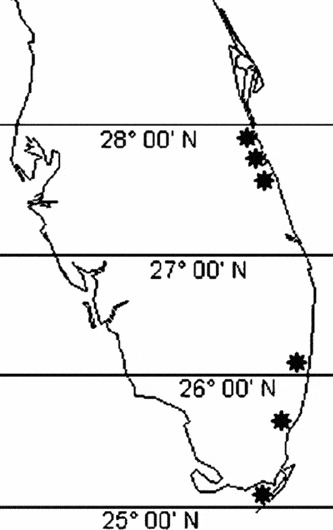
We observed insect visitors to flowers in three hermaphrodite-only populations and three androdioecious populations of L. racemosa on the eastern coast of Florida, USA (Figure 1; listed in geographic order from north to south, with abbreviations and years during which the data were collected in parentheses): Sebastian Inlet State Recreation Area, Brevard County (SEB, 2001–2003); Environmental Learning Center, Wabasso Island, Indian River County (WAB, 2000–2001, 2003); Florida Atlantic University-Harbor Branch Oceanographic Institute, Ft. Pierce, St. Lucie County (HBR, 2001); West Lake County Park, Hollywood, Broward County (HOL, 2000–2003); Matheson County Park, Coral Gables, Miami-Dade County (MAT, 2000–2003); and Pennekamp State Park, Key Largo, Monroe County (PEN, 2002–2003). Landry et al. (Reference LANDRY, RATHCKE and KASS2009) reported gender census data for these populations; the three northernmost populations are hermaphrodite-only, and will be indicated throughout this paper with the suffix ‘-H’ (SEB-H, WAB-H and HBR-H), while the three southernmost populations are androdioecious, and will be indicated with the suffix ‘-A’ (HOL-A, 42% male; MAT-A, 38% male; PEN-A, 23% male).
Locations of Laguncularia racemosa populations in central and south Florida. The three southernmost populations are androdioecious (from north to south: West Lake County Park, Hollywood, Broward County; Matheson County Park, Coral Gables, Miami-Dade County; and Pennekamp State Park, Key Largo, Monroe County), while the northernmost populations are hermaphrodite-only (from north to south: Sebastian Inlet State Recreation Area, Brevard County; Environmental Learning Center, Wabasso Island, Indian River County; and Florida Atlantic University-Harbor Branch Oceanographic Institute, Ft. Pierce, St. Lucie County).

Insect visitors were observed during the peak of the flowering season in Florida (June–July). In each population, insect visitors were observed during 10-min intervals between 9h00 and 17h00, when insects are typically active. Observations were made in each population on 3–7 non-consecutive days over a 8–37-d work period, depending on the year. In each year, observations were made at 15–40 plants in each population; each plant was at least 5 m from all other plants included in the study. We moved randomly between plants throughout the day, which reduced the possibility of observing the same insects making multiple visits to the plants. A watch zone was established for each tree every day, and the number of open flowers in the watch zone was estimated so direct comparisons could be made between plants with different floral densities. In most cases, multiple inflorescences were included in the watch zone.
In androdioecious populations, an equal amount of time was spent observing insects at hermaphroditic and male plants. However, the number of 10-min intervals varied from 30–108 in different populations because the number of insects observed in each population was equalized, not the number of timed intervals. In each population we observed 144–224 insect visitors and counted the number of flowers they probed during their foraging bouts. Only insects that made contact with anthers and/or stigmas when probing flowers were included in the dataset. Insect visitors were identified by Mark O'Brien, Assistant Curator of Insects at the University of Michigan Museum of Zoology (UMMZ); insect voucher specimens are stored in the UMMZ Insect Division. The pollinator assemblages and the relative abundances of species in each L. racemosa population were compared to determine whether there were differences in the pollinator communities found in androdioecious and hermaphrodite-only populations.
Insect visitation rates
Insect visitation rates were estimated for each 10-min interval, and average insect visitation rates were calculated for each breeding type within each population. For androdioecious populations, a two-way ANOVA was performed using Systat 12 to test for differences in insect visitation rates between population and breeding type (male plants versus hermaphroditic plants). A one-way ANOVA was used to test for differences between insect visitation rates to hermaphroditic plants in androdioecious populations versus hermaphrodite-only populations.
Distributions of foraging bouts
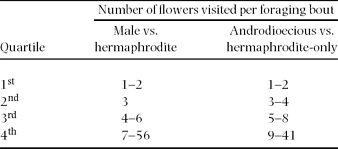
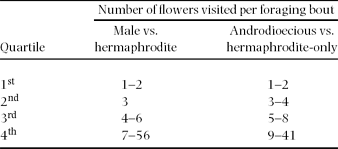
A within-plant foraging bout was defined as the number of flowers probed by an insect before leaving the plant. We compared the distributions of foraging bouts for insects visiting hermaphroditic and male plants in androdioecious populations, and the distributions of foraging bouts for insects visiting hermaphroditic plants in androdioecious and hermaphrodite-only populations. For each comparison, the foraging-bout distributions were divided into four quartiles in order to isolate the shortest and longest foraging bouts, which are included in the first and fourth quartiles, respectively (Table 1). The foraging bouts in these two quartiles have a disproportionate effect on the plant's mating system because nearly all flowers visited during foraging bouts in the first quartile (1–2 flowers visited) will be outcrossed, and nearly all flowers visited during foraging bouts in the fourth quartile (7–56 flowers visited) will be self-pollinated. Regardless of the pollen carryover values for each insect species, all insects making foraging bouts in these two quartiles will have similar effects on the mating system, so it is reasonable to isolate them for the purpose of comparison. To find the number of flowers visited during the 25th, 50th and 75th percentile foraging bouts, the combined foraging bout data were rank-ordered. The first quartile included all foraging bouts less than or equal to the 25th percentile foraging bout, the second quartile included all foraging bouts greater than the 25th percentile foraging bout but less than or equal to the 50th percentile foraging bout, etc. If the distributions of foraging bouts are even, then in each population, one quarter of the foraging bouts are expected in each quartile.
Number of flowers visited during within-plant foraging bouts that were used to compare foraging behaviour to males and hermaphrodites within androdioecious populations, and to hermaphrodites in androdioecious and hermaphrodite-only populations of Laguncularia racemosa.
Two-way ANOVAs were used to test for differences between foraging-bout distribution and breeding type in androdioecious populations, and for differences between foraging-bout distribution and population type in androdioecious and hermaphrodite-only populations. One-way ANOVAs were used to compare the number of foraging bouts in each quartile made to male versus hermaphroditic plants in androdioecious populations, and to hermaphroditic plants in androdioecious versus hermaphrodite-only populations. Apis mellifera Linn. was a very common floral visitor found in all populations, so an a posteriori two-way ANOVA was used for each population type to test for differences between foraging-bout distributions made by A. mellifera versus all other insect visitors.
RESULTS
Males versus hermaphrodites in androdioecious populations
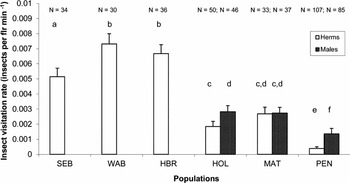
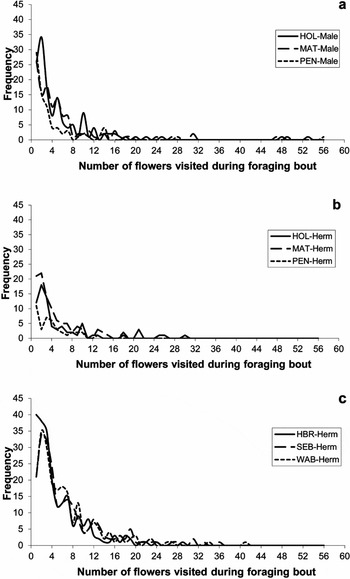
Within androdioecious populations, insect visitation rates to male flowers were significantly higher than to hermaphroditic flowers (Figure 2; two-way ANOVA, F-ratio = 5.71, df = 1, P = 0.017). Further, there was a significant deviation in the foraging-bout distributions of insects visiting male and hermaphroditic plants relative to the expected even distribution (Figure 3a-b; two-way ANOVA, F-ratio = 23.3, df = 3, P < 0.001), and a significant interaction between the foraging-bout distributions and gender (two-way ANOVA, F-ratio = 4.11, df = 3, P = 0.024). There were fewer fourth-quartile foraging bouts made to hermaphroditic plants than to male plants (one-way ANOVA, F-ratio = 5.24, df = 1, P = 0.084), but the difference was not statistically significant.
Mean insect visitation rates to hermaphroditic (Herms) and male plants in hermaphrodite-only (SEB, WAB, HBR) and androdioecious (HOL, MAT, PEN) populations of Laguncularia racemosa, with SE bars. N = number of 10-min watch intervals. Categories with different letters differ significantly from one another (P ≤ 0.05). Overall, the frequency of visitation to male plants differs significantly from hermaphroditic plants in androdioecious populations (HOL, MAT and PEN; P = 0.017), and the frequency of visitation to plants in hermaphrodite-only populations differs significantly from hermaphroditic plants in androdioecious populations (open bars, all populations; P ≤ 0.001).

Distributions of insect foraging bouts to Laguncularia racemosa flowers in three androdioecious (HOL, MAT, PEN) and three hermaphrodite-only (HBR, SEB, WAB) populations. There are significant differences in the distributions of foraging bouts made to male versus hermaphroditic plants in androdioecious populations (P = 0.024), and in the distributions of foraging bouts to hermaphroditic plants in androdioecious versus hermaphrodite-only populations (P = 0.002). Foraging-bout distributions to: male plants (male) in androdioecious populations (a); hermaphroditic plants (herm) in androdioecious populations (b); and hermaphroditic plants (herm) in hermaphrodite-only populations (c).

Androdioecious versus hermaphrodite-only populations
The average insect visitation rate to hermaphroditic plants was significantly higher in hermaphrodite-only populations than in androdioecious populations (Figure 2; one-way ANOVA, F-ratio = 244, df = 1, P < 0.001). There was a significant difference in the foraging-bout distributions of insects visiting hermaphroditic plants in androdioecious versus hermaphrodite-only populations (Figure 3b-c; two-way ANOVA, F-ratio = 16.6, df = 3, P < 0.001). There was a significant interaction between foraging-bout distributions and population type (two-way ANOVA, F-ratio = 7.44, df = 3, P = 0.002), with distributions in androdioecious populations deviating significantly from expected, while distributions in hermaphrodite-only populations did not. There were more first-quartile foraging bouts to hermaphroditic plants in androdioecious populations than in hermaphrodite-only populations (one-way ANOVA; F-ratio = 7.29, df = 1, P = 0.054), and more fourth-quartile foraging bouts to plants in hermaphrodite-only populations than to hermaphroditic plants in androdioecious populations (one-way ANOVA; F-ratio = 6.12, df = 1, P = 0.069), but the differences were not statistically significant.
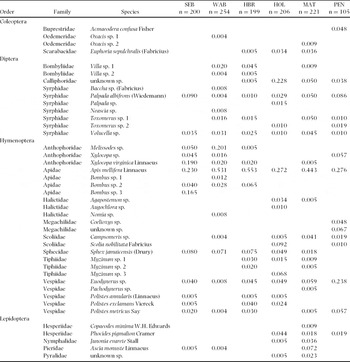
We observed at least 42 insect species visiting L. racemosa flowers, with 14–22 species observed in each L. racemosa population (Appendix 1). Most visitors were hymenopterans (bees and wasps), but dipterans, lepidopterans and coleopterans were also observed. Pollinator assemblages differed between androdioecious and hermaphrodite-only populations. While some insect species were only found in one type of population, most were observed visiting flowers in both population types, although not in every population, and not at the same relative frequency in each population. Only four insect species were observed in all six populations: Apis mellifera Linn., Palpada albifrons Wiedemann, one Volucella species and one Euodynerus species. Overall, A. mellifera was the most common floral visitor and was the dominant visitor in two hermaphrodite-only populations (HBR-H and WAB-H), where they represented half of all floral visitors. An a posteriori test was used to compare foraging-bout distributions of A. mellifera with the foraging-bout distributions of all other insect visitors. In androdioecious populations, A. mellifera made significantly fewer first-quartile foraging bouts and more fourth-quartile foraging bouts than all other insect visitors (data not shown; two-way ANOVA, F-ratio = 5.30, df = 3, P = 0.010); however, there were no significant differences between the foraging-bout distributions of A. mellifera and all other insect visitors in hermaphrodite-only populations.
DISCUSSION
Males versus hermaphrodites in androdioecious populations
Male plants produce significantly more flowers than do hermaphroditic plants (Landry & Rathcke Reference LANDRY and RATHCKE2007), and the larger floral displays produced by male plants are likely responsible for the observed increase in insect visitation rates to male plants relative to hermaphroditic plants (Borkent & Harder Reference BORKENT and HARDER2007, Willson Reference WILLSON1983). The only pollen that can contribute to male reproductive success in L. racemosa is the pollen carried by insect pollinators, so male plants could incur a fitness advantage due to increased visitation by insects.
In addition, hermaphroditic plants received fewer fourth-quartile foraging bouts than males, so the probability of geitonogamous self-pollination was reduced. Karron et al. (Reference KARRON, HOLMQUIST, FLANAGAN and MITCHELL2009) found that the frequency of selfing increased as the number of flowers visited on a plant increased. Self-pollination could reduce the fitness of hermaphroditic plants in populations with strong inbreeding depression (Snow et al. Reference SNOW, SPIRA, SIMPSON, KLIPS, Lloyd and Barrett1996). Inbreeding depression varies in L. racemosa populations; inbreeding depression expressed at the fruit set stage was moderate in the HOL-A population and strong in the MAT-A population (Landry & Rathcke Reference LANDRY and RATHCKE2007). Further, if insects visit fewer flowers on a plant, then it follows that the insects are able to move more frequently between plants. More frequent movement between plants increases the probability of outcrossing and theoretically provides a male fitness advantage (Lloyd Reference LLOYD1975). Insects may visit few flowers during within-plant foraging bouts for a number of reasons, including predator avoidance strategies (Brechbuhl et al. Reference BRECHBUHL, KROPF and BACHER2010), or interactions with other floral visitors encountered on the plant (Ghazoul et al. Reference GHAZOUL, LISTON and BOYLE1998, House Reference HOUSE1989). Interactions observed between insect floral visitors on the same L. racemosa plant usually result in one or both of the visitors leaving the plant, thus ending the foraging bouts (Landry unpubl. data).
Androdioecious versus hermaphrodite-only populations
The increased rate of insect visitation to L. racemosa in hermaphrodite-only populations relative to androdioecious populations was unexpected, and the reasons for the relative increase are not clear. These populations are found in the prime citrus-growing region of east-central Florida, so the large numbers of A. mellifera hives that are routinely relied upon to pollinate citrus trees probably contributed to the abundance of A. mellifera observed in these populations. The number of flowers produced by hermaphroditic plants in the two population types does not differ (Landry & Rathcke Reference LANDRY and RATHCKE2007), so the increased rate of visitation cannot be attributed to greater floral attractiveness. Urban development is more intensive in the areas surrounding the androdioecious populations, which could reduce the abundances of insect populations and may contribute to the paucity of insect pollinators in these L. racemosa populations, but this has not been tested.
Further, there was a greater likelihood of geitonogamous self-pollination in hermaphrodite-only populations versus androdioecious populations because more insects visited many flowers during their foraging bouts. We have demonstrated that the WAB-H population did not exhibit inbreeding depression at the fruit set stage, in contrast with HOL-A and MAT-A populations (Landry & Rathcke Reference LANDRY and RATHCKE2007). The lack of inbreeding depression may indicate that selfing has been common in these populations in the past (Husband & Schemske Reference HUSBAND and SCHEMSKE1996). It is unlikely that male plants could be maintained if they were to invade hermaphrodite-only populations, given the potentially high frequency of selfing and very weak inbreeding depression.
The differences in the distributions of foraging bouts between population types can be attributed to the behaviours of a few species that are abundant in hermaphrodite-only populations but less common in androdioecious populations. Insect visitors in androdioecious populations of L. racemosa were primarily small bees, wasps and flies that tended to visit few flowers during their foraging bouts. In contrast, insect visitors in hermaphrodite-only populations were primarily large bees and wasps that tended to visit many flowers during their foraging bouts. The most common insect species was A. mellifera, which was common in all six populations but was more abundant in hermaphrodite-only populations. The foraging-bout distributions of A. mellifera did not vary between populations. In hermaphrodite-only populations, the foraging-bout distributions of A. mellifera were similar to those of all other insect visitors combined. Therefore, while a large fraction of floral visitors in hermaphrodite-only populations were A. mellifera, their foraging behaviours had the same effect on the mating system of L. racemosa as the behaviours of the other insect visitors. In contrast, foraging-bout distributions of A. mellifera were different from those of all other insect visitors in androdioecious populations. For example, 43% of all visitors to L. racemosa in the MAT-A population were A. mellifera, but they were responsible for 67% of all fourth-quartile foraging bouts and only 35% of all first-quartile foraging bouts. Therefore, in androdioecious populations of L. racemosa, A. mellifera foraging behaviour theoretically results in greater self-pollination, while the foraging behaviours of other insects results in greater outcrossing.
The difference in the foraging behaviour of A. mellifera versus all other insect visitors in androdioecious populations is important to consider because the relative abundances of insects are not constant over time. The pollinator community at HOL-A changed dramatically following Hurricane Wilma (2005). Formerly common species that tended to visit few flowers during their foraging bouts were lost from the pollinator community and were still absent after 3 y, while the A. mellifera population increased three-fold when compared with the population size before the hurricane (Landry Reference LANDRY, Cole and Baxter2011). If the foraging behaviour of A. mellifera increases the frequency of self-pollination, then the increase in A. mellifera visitors could reduce male fitness (Charlesworth Reference CHARLESWORTH1984, Lloyd Reference LLOYD1975) and over time, could lead to a reduction in the frequency of male plants in the HOL-A population.
ACKNOWLEDGEMENTS
The authors thank the following for financial and in-kind support of this work: Montgomery Botanical Center, Coral Gables, Florida; Fairchild Tropical Gardens, Coral Gables, Florida; and Department of Ecology and Evolutionary Biology, University of Michigan, Ann Arbor, Michigan. This work was performed with permission from: Miami-Dade County Parks, Florida (Matheson County Park); Department of Environmental Resource Management, Miami-Dade County, Florida; Florida Department of Environmental Protection, Division of Recreation and Parks, Districts 3 (Permit # 06-03-02-2, Sebastian Inlet State Park) and 5 (Permit # 5-02-41, Pennekamp State Park); Broward County Parks, Florida (Anne Kolb Nature Center – West Lake Park, Hollywood); Harbor Branch Oceanographic Institute, Ft. Pierce, Florida; and Environmental Learning Center, Vero Beach, Florida. Special thanks to: Nancy B. Elliott for discussions concerning insect behaviours; Mark O'Brien for insect identifications; James Duquenel, former Staff Biologist at Pennekamp State Park, for discussions concerning A. mellifera; Mark Kaufmann, Paula Russo, Lee B. Kass and Susan Danforth for assistance in the field; David Au for assistance with figures; and the editor and several anonymous reviewers for comments that improved this manuscript. This study represents a portion of a dissertation submitted in partial fulfillment of the requirements for a PhD degree at the University of Michigan, Ann Arbor.
List of insect species observed visiting flowers in three hermaphrodite-only populations (SEB, WAB, HBR) and three androdioecious populations (HOL, MAT, PEN) of Laguncularia racemosa, and the proportion of the total number of visitors each insect species represented. Population codes: SEB, Sebastian Inlet; WAB, Wabasso Island; HBR, Harbor Branch; HOL, Hollywood; MAT, Matheson; and PEN, Pennekamp. Only insects identified to the familial level are included. n = number of insect visitors.