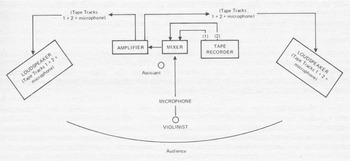
According to the ‘Directions for Performance’ included in the score of Steve Reich's Violin Phase (composed in 1967 and published in 1979), the first thing an audience member is likely to see on stage is a reel-to-reel tape recorder.Footnote 1 The diagram Reich provides also calls for a microphone, loudspeakers, amplifier, mixing board, and assistant, whose place on stage is carefully specified (Figure 1).
Steve Reich, Violin Phase, Directions for Performance. Violin Phase by Steve Reich © Copyright 1979 by Hendon Music, Inc., a Boosey & Hawkes company. Reprinted by permission. Steve Reich, Violin Phase für Violine und Tonband oder für 4 Violinen. © Copyright 1979 by Universal Edition (London) Ltd., London/UE 16185 except for the territory of the USA. www.universaledition.com

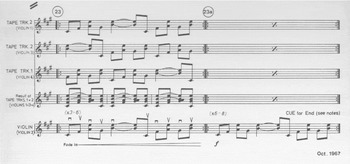
After the violinist makes an entrance, the performance begins with the technician pressing play on the tape recorder. The first sound that both an audience member and the performer hears – after the audible click or thunk of the tape machine's controls, and possibly some tape hiss – is the pre-recorded tape loop of the twelve-beat pattern that provides the basic musical material of the piece (given in the bottom staff of Example 1).
Concluding bars of the score of Steve Reich, Violin Phase. Violin Phase by Steve Reich © Copyright 1979 by Hendon Music, Inc., a Boosey & Hawkes company. Reprinted by permission. Steve Reich, Violin Phase für Violine und Tonband oder für 4 Violinen. © Copyright 1979 by Universal Edition (London) Ltd., London/UE 16185 except for the territory of the USA. www.universaledition.com

Following two to four repetitions of the recorded loop, the live violinist gradually starts to play along, fading in from inaudibility and merging with the tape. Reich specifies that the violin should be amplified and mixed so that it matches ‘the timbre as well as the volume of the tape’. The course of the 14–16 minute-long piece is choreographed by the interaction of the violinist – who executes the phase shifting process, gradually moving first four and then eight beats ahead – and the technician, who at the appropriate points in the score fades in two other pre-recorded tracks of the out-of-phase loops. Depending on the placement of the tape machine, the speed of playback, and the size of the reels, it is likely that an audience member could observe the overall duration of the work being measured out by the slowly unreeling tape. The piece ends with a cue from the violinist to the technician to press the stop button on the tape recorder.
Given the specificity of the score, along with the very detailed instructions for how the 3-track tape loop and performance tape are to be created (as I discuss below), it is noteworthy, at least judging from the large number of performances available on YouTube, that the ‘Directions for Performance’ are now usually ignored. Instead of using a tape recorder, violinists (and the many other instrumentalists who have taken on the work) perform on their own with looping pedals or laptops with music software. In most performances that use the pre-recorded tracks, the technician is placed out of sight of the camera, presumably up in a tech booth or somewhere back in the hall.
Violin Phase thus offers a striking example of the strangely occluded history of the role of magnetic recording tape in the history of twentieth- and twenty-first-century music. On the one hand, its composition and early performance history are a well-established part of the story of tape and tape machines in Reich's early development and the formation of musical minimalism more generally. But, on the other hand, the present-day performance practice of Violin Phase using looping hardware or software demonstrates how the decades-long ubiquity of tape has been replaced by a kind of invisibility, though which the particularities and materiality of the medium have been subsumed into more generalized notions of ‘fixed media’.Footnote 2 While this is surely not always the case, there can be an implication that it does not matter how a piece like Violin Phase is prepared or performed.
There are, of course, practical reasons why performers typically no longer use tape to perform Violin Phase. Reich indicates in the score that ‘Presently 4 track synchronous recorders are commonly available’ – striking evidence for the stability of the technology between when the piece was written in 1967 and its publication in 1979 – but nearly forty years later that obviously is no longer the case. And yet this raises the question to what degree the piece is transformed for the performer and listener when the musical and technical challenges of recording and splicing the three-channel tape loop can be replaced by simple cutting and pasting in a programme like Abelton Live.
In what follows I will explore how a focus on tape can illuminate Violin Phase as well as Reich's involvement with tape and other music technologies throughout his career. Reich himself has commented on the ‘cross fertilization from electronics to musical instruments’ in his music, and this has been an important theme in the scholarship on Reich.Footnote 3 But I will argue that just as the work asks the violinist to engage with the materiality of the violin in the way the basic loop uses the open strings A and E, the specific materialities of tape and tape machines are not incidental to the piece, but are central to its composition, performance, and reception.
To explore the importance of tape for Reich and Violin Phase, it is helpful to understand the piece as a technological network that involves the violin, the violinist, the technician and all the gear, and as indicated in Figure 1, the audience as well. In a broader context we can think of this network in terms of what Benjamin Piekut, drawing on Bruno Latour, has described as ‘historical ecologies’ defined as ‘a web of relations, an amalgamation of organic and inorganic, or biological and technological, elements that are interconnecting and mutually affecting’.Footnote 4 As part of these historical ecologies in Reich's creative development, the tape recorder was more than just a compositional expedient, but became heavily laden with complex and shifting meanings.Footnote 5
We can see how much weight Reich put on the technological origins of his music in his description of his phasing tape loop pieces including It's Gonna Rain (1965) and Come Out (1966) as ‘on the one hand, realizations of an idea that was indigenous to machines, and on the other hand, the gateway to some instrumental music that I would never have come to by listening to any other Western, or for that matter non-Western, music’.Footnote 6 As is clear in Reich's works from later decades using digital audio and video samples including Different Trains (1988), City Life (1995), and Three Tales (2001), the whole sphere of human interactions with machines, technology, and science has offered both compositional resources and deeply affective subject matter. Yet while his later works have increasingly emphasized the dystopian potential of these interactions, as a young composer he seems to have found an exploration of the borders between people and technologies intensely stimulating and liberating. As he noted in a sketchbook entry from 12 August 1969, ‘the phase pieces for instruments turn machine fantasies into human events’.Footnote 7
Machine fantasies
Reich's career has been deeply bound up with music technologies, with the relationship defined by an unusual openness to new tools as they have appeared, as well as regular cycles of frustration with, and even disavowal of, specific devices and technology in general. We can see both facets in the titles of his two major essays on the topic, ‘My Life with Technology’, from 1996, and ‘An Introduction: My (Ambiguous) Life with Technology’, published in 2008.Footnote 8 The years leading up to and following Violin Phase marked a high water point, including Reich's work teaching electronic music at the new School of Social Research from 1969 to 1971, and his intensive involvement in 1968 to 1969 with the design and implementation of the Phase Shifting Pulse Gate. With elements of a sequencer and a twelve-channel mixer, the device could be used to manipulate very precisely any sonic input in live performance.Footnote 9 And yet in his 1972 essay, ‘An End to Electronics – Pulse Music, The Phase Shifting Pulse Gate, and Four Organs, 1968–1970’, Reich describes being dissatisfied with the musical results of the Phase Shifting Pulse Gate, and characterizes electronic music in general ‘as a kind of interlude filled with new ideas for the ongoing history of instrumental and vocal music’.Footnote 10
Beyond his involvement with technology in the context of what might be typically considered ‘electronic music’, we can see Reich's unusual sensitivity to and awareness of the impact of a wide range of sound technologies on all aspects of music making. Or to put it another way, as with the stage directions for Violin Phase, he was interested in making the complete technological networks he encountered visible, audible, and available to be acted upon. Reich begins ‘My Life with Technology’ by noting that he is a member of the first generation of composers to grow up more with radio and recordings (first 78s then LPs) than with live music.Footnote 11 While acknowledging what he had gained by the exposure to many kinds of music through recordings, Reich also emphasizes what recordings meant for an emerging awareness of sound: ‘What I was hearing was not only sound coming from instruments, but electronically-controlled sound also coming from loudspeakers – sound whose volume could be carefully adjusted, whose high and low frequencies could be independently boosted or attenuated.’Footnote 12 Particularly striking are Reich's comments about the role of the microphone – which as he notes ‘has become so omnipresent in our lives that we hardly notice it’.Footnote 13 He writes, for example, of how microphones allowed the bass clarinets to cut through the large ensemble in Music for 18 Musicians, or in Tehillim to make it possible to write for ‘light non-vibrato’ women's voices.Footnote 14 The score of Violin Phase specifies a very close interaction between the violinist and the microphone on stage, with the indication, ‘The microphone should be placed on a boom stand so that the microphone rests about 2–4 inches away from the “f-hole” of the violin.’
Of all the technologies Reich discusses, there is no doubt that it was the tape recorder that had the biggest impact on his development. As he writes in ‘My Life with Technology’, at first he approached the device in a conventional way:
Sometime around 1959 1 bought my first tape recorder. It was a Wollensak mono machine, a garden variety model for home use in those days. I used it to record myself or others playing my pieces. I also occasionally recorded jam sessions during which I played trap drums. I was not yet aware how important tape recording would become in my musical life during the next few years.Footnote 15
Reich first started working more directly with the tape recorder as a compositional tool two years later through his involvement with Terry Riley at the San Francisco Tape Music Center, notably during the period that Riley was experimenting with tape loops and tape delay systems and putting together the 1964 premiere of In C.Footnote 16 Another influence on his approach to tape was the opportunity to work with Luciano Berio at Mills, where Reich studied in 1962–3. He describes Berio's tape works using speech as ‘the first electronic music I had heard of real interest’:
It occurred to me that speech was the answer to the question of how to make emotionally involving electronic music. Previous to this I had found oscillator-generated electronic music to be of no interest. It struck me that the tape recorder was best used to record real sound, particularly speech, just as a movie camera records real moving images. To present this real material in a recognizable way, as opposed to altering and disguising it, as in the Musique Concrete of the time, seemed to me to be the key to keeping the emotional thrust of the original speech or real sound intact.Footnote 17
Reich's desire to compose with the recorded voice practically mandated the use of a tape recorder. While it would have been technically possible, as in the early compositions of Pierre Schaeffer, to use phonograph records, only tape made it possible to manipulate the sounds with any precision.
Reich cites as his first tape piece the sound track he created in 1963 for the film The Plastic Haircut, which consists of a collage of excerpts of commentators’ voices and crowd sounds from an LP of The Greatest Moments in Sports.Footnote 18 He continued to work occasionally with filmmakers and editing film and sound tracks for film for the next decade, anticipating the central role of video in his later collaborations with his wife Beryl Korot starting with The Cave (1993).Footnote 19 For his next piece, Livelihood (1964), made while working as a cab driver in San Francisco, he assembled snippets from recordings of voices and car and street sounds collected with a portable tape recorder (a device that he shared with Phil Lesh, who the next year would become one of the founding members of the Grateful Dead.)Footnote 20 He describes the piece, which he subsequently withdrew, as ‘a crash course in tape editing, opening a door into new ways of making music’.Footnote 21
While it is easy to regard the reel-to-reel tape recorder today as technologically antiquated and even quaint, for Reich – consistent with his self-conscious and deliberate approach to sound technologies in general – the tape recorder seems to have represented both a powerful machine and an open-ended collection of potentialities. Indeed, the tape machine is an unusually heterogeneous contrivance that offers a considerable range of expected and unexpected affordances, with its spinning reels of tape, capstan and pinch rollers, levers that raise and lower the tape on to the record and playback heads, an assortment of buttons and controls, VU meters to monitor levels, and various inputs and outputs.
Along with standard modes of operation, such as those that would have been described in a user's manual, Reich figured out other ways of interacting with sounds through the device. For example with It's Gonna Rain, he anticipated DJ cross-fader techniques by rapidly turning the preamplifier switch on and off to bring out different parts of the loops. Also, like a DJ working with vinyl, he manipulated the speed of the tape by placing his thumb on the supply reel.Footnote 22 A crucial factor in using the tape recorder as a compositional tool was to have more than one; Potter reports that by late 1964, when he was working on It's Gonna Rain, Reich had two Wollensack machines and a borrowed Ampex; these were soon joined by a Sony 770 and a portable Uher recorder.Footnote 23
Of course, as we have seen, tape recorders can only be used as part of a network of other devices including microphones, amplifiers, speakers, and, with special significance for Reich, headphones. What was arguably his most significant discovery – phase shifting with two identical loops on two machines – depended on the specific network of technologies in use at a specific historical moment. As noted above, while Reich was working with Wollensack mono machines, he had stereo headphones, which at this point were still often manufactured with two separate cables and plugs (unlike the single stereo cable and jack used today, in either the ¼ or ⅛ inch variety). As he was experimenting with lining up loops from It's Gonna Rain in different metric relationships inspired by the rhythms of West African Music, he writes that he was able to have ‘one jack of my stereo headphones plugged into machine A, the other into machine B’. Instead of the expected polyrhythm, ‘the two machines happened to be lined up in unison and one of them gradually started to get ahead of the other’. He writes vividly of his intensely embodied response to the psychoacoustic effects of the phase shifting process as experienced through the technological network:
The sensation I had in my head was that the sound moved over to my left ear, down to my left shoulder, down my left arm, down my leg, out across the floor to the left, and finally began to reverberate and shake and become the sound I was looking for – It's gonna/It's gonna rain/rain – and then it started going the other way and came back together in the center of my head.Footnote 24
With its characteristic integration of remarkable resilience as well as fragility, the materiality of magnetic recording tape also shaped how Reich and others worked with sounds in interaction with the tape machine, headphones, razors, splicing blocks, splicing tape, and the whole craft of editing techniques. Different formats and brands of tape had their own sonic and physical characteristics that could impact sound quality, durability, and the kinds of editing that were practical.
The physical characteristics of the tape and tape machine also had an impact on the creation of tape loops. The distance between the playback head and the capstan determines the minimum length of a loop. While tape loops, in theory, have no maximum length, the longer they get, the more challenging it becomes to create a stable pathway for the loop and the more vulnerable it becomes to tangles and breaks. It is noteworthy that Reich's tape loop pieces all use quite short loops; assuming a tape machine running at 7½ inches per second, loops with a single statement of the material for Melodica, Come Out, and It's Gonna Rain would be between 2 and 3 inches in diameter. The directions for Violin Phase specify a loop of three to five repetitions, which would result in a circle between 16 and 28 inches across. In connection with the argument I make below about the continuing impact of tape after Reich started composing for instruments, it is striking that pieces such as Music for Mallet Instruments for Voices and Organ continue to use short repeating figures comparable in length to the musical material in works created with actual tape loops.
With special relevance to Violin Phase, Reich did not think of the tape machine as limited to the studio but made it part of the performance. In his next work after Violin Phase, My Name is_____ (1967), Reich puts engineer/musicians on stage in the act of splicing and manipulating tape: ‘The idea was, instead of playing tapes in a dark hall, we'd twist dials in a lighted hall.’Footnote 25 The verbal score calls for ‘1 OR MORE PERFORMERS, 3 OR MORE TAPE RECORDERS, AND AUDIENCE’. Using portable machines, the sounds are collected prior to the concert by recording members of the audience saying their first names: ‘My name is_____’.
Three or more identical tape loops are made from each ‘my name is_____’. This dubbing and editing process may be performed in view of the audience, and it may be done silently if the performer(s) wear earphones. Thus some other audible performance may happen simultaneously while this process is going.
. . .
Each set of three or more identical loops is then played on three or more tape recorders for about two minutes or more. Because of slight differences in motor speed, tape tension and loop length (even in ‘identical’ loops) the loops proceed to move slowly in and out of phase with each other.
The piece thus represents a particularly vivid example of a composition that makes the technological network, compositional techniques, and the creative process integral to the work; and here again he also makes explicit that the network includes the audience. In his writings, Reich commented on the impact on audience members of hearing their own voices as part of the music in the concert: ‘Psychologically, the result was interesting because usually people said their names in a very offhand way, because it was a funny thing to do when you walked into the hall . . . And also hearing your name in that way tends to get to people.’Footnote 26
With Violin Phase, Reich goes another step in requiring that the violinist and technician work together in the studio to create the tape loop and performance tape and then puts them both on stage with all the same gear to perform the piece.
The second tape recorder
Violin Phase grew out of Reich's realization of the human capacity for, as he wrote, ‘imitating machines’: while in his writings the word ‘machines’ sometimes evokes the broader category of any mechanical devices with repetitive motion, the tape machine is often the specific referent.Footnote 27 Reich describes overcoming his initial fears that humans would be incapable of the gradual phase shifting process by discovering in 1966 that he could play along with a tape loop ‘exactly as I were a second tape recorder’.Footnote 28 He attributes his experimentation with live phasing to a growing dissatisfaction with tape music after a two-and-a-half year ‘binge’; looking back in 1970, he characterized feeling at the time like a ‘mad scientist trapped in a lab’.Footnote 29 His last piece for tape alone was Melodica, which Reich reports composing and realizing in a single day on 22 May 1966 using the phasing process with two and four layers of a four-note loop.Footnote 30
We can see how central the experience of working with tape was to Reich's thinking in the way he formulated both the problem and the solution to his creative impasse. As he wrote in ‘My Life with Technology’, ‘unfortunately it seemed impossible to me at the time for two human beings to perform that gradual phase-shifting process, since the process was discovered with and seemed indigenous to, tape recorders’.Footnote 31 Yet he also claims that he ‘used tape to get away from tape’, by making a tape loop of himself playing the piano and then attempting the phasing process live:
I found, to my surprise, that while I lacked the perfection of the machine, I could give a fair approximation of it while enjoying a new and extremely satisfying way of playing that was both completely worked out beforehand, and yet free of actually reading notation, allowing me to become totally absorbed in listening while playing.Footnote 32
The most direct offshoot of this experiment was the piece Piano Phase (1967), which he performed with Arthur Murphy doing the phasing technique live using three phrases, with each section getting progressively shorter and moving through different tonal areas. But though it was later withdrawn, the most direct predecessor to Violin Phase is Reed Phase, composed in late 1966, for any reed instrument and a two-channel tape. Like the violin piece, the instructions – published along with the score in the third issue of Source: Music of the Avant Garde – specify that the musician must make their own tape loop with the out-of-phase patterns that will become the basis of the performance tape.Footnote 33 Reed Phase is also interesting in terms of a reconfiguration of the borders of the human and the machine in the way it requires the player – who was saxophonist Jon Gibson in the premiere – to adapt themselves to the relentless repetition of the tape loop by doing the circular breathing necessary to play continuously for five minutes or more.Footnote 34 Violin Phase similarly forces the violinist to adapt to the strict tempo and pitch of the mechanical repetition of the loop.
In ‘Music as a Gradual Process’ (1968), Reich makes clear his interest in transforming the composer, performer, and listener through the focus and concentration required in creating and perceiving musical processes. He significantly associates musical processes with the meditative practices of yoga, natural phenomena such as the motion of a pendulum, as well as with the operation of electromechanical devices. As we will return to below, this relates to his tendency to downplay the distinction between live and mechanized performance: ‘As to whether a musical process is realized through live human performance or through some electromechanical means is not finally the main issue.’ Rather, the goal is ‘a particular liberating and impersonal kind of ritual. Focusing in on the musical process makes possible that shift of attention away from he and she and you and me outwards towards it’.Footnote 35
From all this, we can see that the very specific instructions given in the score for creating the performance tape for Violin Phase and for staging the performance should not be lightly set aside. Indeed, the ‘Directions for Performance’ allow, and indeed require, the performer to re-enact for themselves stages of the composer's creative process and lived experience of the specific technological systems. This starts with the violinist, working with an engineer, recording themselves on the first track of a multitrack machine playing the basic twelve-beat phrase ‘over and over again for about one to five minutes’. After the tape is rewound, Reich then specifies that the violinist put on headphones and, playing along with themselves, record track two for several minutes with the basic pattern four beats ahead. As we have seen above, the use of headphones is more than just a practical solution to avoiding bleed-through from the first track in the recording, but also recapitulates Reich's formative experience in the discovery of the phase shifting process. When the second track is complete, the tape is then rewound again to the beginning so that violinist can record track three with the phrase eight beats ahead.
After recording the three tracks, the violinist and engineer are instructed to listen together ‘for a series of about three to seven repeats where the playing on each of the three tracks is the best possible’. Only at this point is a loop made from a section of the 3-track tape that is recorded in turn on to another recorder for about twenty minutes to make the stereo performance tape. It is significant that Reich specifies that the three out-of-phase looping layers should be created live in the studio, rather than what might have seemed the more expedient process of generating the whole thing from dubs of a single loop. In the directions he points to the challenge of playing the repeating pattern consistently, calling for ‘considerable preparation of tuning, rhythm and nuance’ prior to making the recording. Included among the compositional materials for the work at the Paul Sacher Stiftung in Basel are studio sessions of the first performers who attempted the work, Burton Kaplan and Paul Zukofksy, that illustrate just how challenging it was for violinists to play like a tape loop. The recordings sound as though they are attempting to perform the repeating phrase mechanically, with the utmost precision and rhythmic regularity.
Thus while it would be easy today with software to record the loop once, correct any rhythm or pitch problems, and then cut and paste it to create the two other out-of-phase versions, the performer would miss out on both the difficulty and the satisfaction of imitating machines. It is also likely that they would have less of an opportunity to engage directly with the musical material, with its harmonic and metric ambiguities that underlie the richness of the results of the phasing process.Footnote 36
We might also note here that, in the composition and first performances of the piece, the ‘engineer’ was likely the composer himself or someone who had worked closely with him. In many scores that use pre-recorded tapes, Reich gives detailed directions for the engineer to be an integral part of the performance, as for example in the score of Different Trains, where he writes, ‘The technician should definitely not be in a booth and should not rely on speakers or headphones in a booth since this is totally useless in terms of hearing exactly what the audience is hearing.’Footnote 37 This close engagement between composer, engineer, and performer is also not incidental, but is crucial to the piece and to Reich's subsequent development. The central innovation of Violin Phase, in comparison to the other phase shifting pieces for tape or instruments is the role of the violinist in pointing out the resulting patterns produced by the layering of the basic loop:
As one listens to the repetition of the several violins, one may hear first the lower tones forming one or several patterns, then the higher notes are noticed forming another, then the notes in the middle may attach themselves to the lower tones to form still another. All these patterns are really there; they are created by the interlocking of two, three, four violins all playing the same repeating pattern out of phase with each other.Footnote 38
The creative process of working in the studio with musicians on creating the loops and finding the resultant patterns resulted in Reich breaking open the score, by including melodies discovered by Paul Zukofsky and Shem Guibbory, and leaving blank staves for performers to notate their own patterns. With this piece, Reich began to approach composing through an intensive rehearsal process in which he played alongside the performers and benefited from their insights.Footnote 39
Tape after tape
Violin Phase represents both a culmination in Reich's work with tape and an important stage in his turn away from tape and electronics towards instrumental and vocal music that lasted for fifteen years. In his ‘Some Optimistic Predictions (1970) about the Future of Music’, he writes: ‘Electronic music as such will gradually die and be absorbed in to the ongoing music of people singing and playing instruments.’Footnote 40 At the time, the emphasis seemed to be on the first part of the sentence and his embrace of instrumental music for the next decade, including major works such as Drumming (1970–1) and Music for 18 Musicians (1974–6) to Tehillim (1981). But in the context of this study, the second part of the sentence seems more prophetic in pointing to the ways that all forms of music making could be permeated and remade by technology.
Indeed, Violin Phase literally embodies how tape can continue to exert an influence even when it is no longer present. The source materials show that Reich originally intended to have two separate pieces with different scores: Violin Phase for one violinist and pre-recorded tape, and an all-acoustic version to be entitled Four Violins. But in the process of writing out the score for the later version, he decided to integrate the two pieces into one (see Example 1). The implication that there would not be a fundamental difference if the three looping tracks were to be performed by live violinists or tape is underscored in the ‘Directions for Performance’. He instructs those performing with four violins to skip over the section about tape and amplification equipment, claiming:
All the rest of the notes dealing with performance, alternate resultant patterns, repeats, duration and rehearsal will hopefully be found useful if the performer will mentally substitute ‘violin’ for ‘tape’.
He also indicates that in live performance the four violinists can trade off between the parts, thus at times taking over the role of the tape loop, at other times acting as the ‘live’ musician.
Reich describes his initial motivation for returning to tape in the early 1980s as part of a renewed interest in working with the recorded speaking voice. During a visit to IRCAM he pursued an idea that he had first conceived in 1967 with Slow Motion Sound, which imagined the gradual and extreme temporal stretching of a tape loop of a speaking voice without changing its pitch. While he was disappointed with the results of the experiment, he returned to the project of combining live instruments and tape in a series of ‘counterpoint’ works, which include Vermont Counterpoint (1982), New York Counterpoint (1985), Electric Counterpoint (1987), and Cello Counterpoint (2003). He writes:
all deal with the problem of writing a piece for a soloist by multiplying that soloist into an ensemble of identical instruments, very much as Violin Phase had done for solo violin and tape back in 1967. The differences in the recent pieces can be easily heard. Melodic patterns are longer, harmony changes more rapidly and different tempos are used to set off one movement from another.Footnote 41
While beyond the scope of this article, it is worth pointing out that Reich, of necessity, continued to rely on magnetic recording tape in the composition and performance of his work into the new century, including both analogue machines and multitrack digital audio tape formats such as DA-88 used for the Triple Quartet (1998) and still offered on the Boosey & Hawkes website for performances of the work.
Reich's later works with instruments and pre-recorded tracks continue to exemplify his striking conviction that there is no essential distinction between performances that include live or taped musicians. With the counterpoint pieces, as well as a series of pieces for ensembles and tape, including Different Trains (1988), Triple Quartet (1998), Double Sextet (2007), 2x5 (2008), and WTC 9/11 (2010), he specifies that performances may use pre-recorded parts or be performed with multiple live musicians or ensembles.
The legacy of his intensive work with tape loops not surprisingly continued to play a role in his compositional development. Indeed, the sketch materials for Different Trains, his first work using sampling technology, show the challenges he faced in thinking outside the paradigm of tape and its affordances. Tape loops on tape recorders were obviously very useful for ostinato techniques and layering, but they did not lend themselves to starting and stopping at precise points, or rewinding or fast-forwarding to replay specific excerpts. Thus he writes in ‘My Life with Technology’ that the Casio sampler provided, ‘a great deal more musical control than if I were using tape loops and edits, since the sounds and voices can actually be played on the keyboard’.Footnote 42 But his notes made during the composition over several days in February1988 make clear that to leave loops behind took a considerable leap of imagination. The biggest realization was that it was now possible for the samples to start and stop, or in other words, that a sample did not need to be a loop:
Don't (Generally) use loops. Rather play repeats
or partial repeats with sampler.
. . .
Speech sample comes in ONCE or so then out, pause, again.Footnote 43
Reich concludes the 1996 essay ‘My Life with Technology’, with a discussion of the sampling keyboards that he had used in City Life the previous year. The summary paragraph is noteworthy in charting both his own compositional development and a more general account of electronic music as a story about tape and its overcoming.
To conclude, it is clear to me that technology has been a formative influence on my music since I was a child and it was particularly influential in my real compositional beginnings with tape loops in 1965. The gulf that at one time separated live music from electronic music on tape has gradually been closing over the years, primarily through the use of electric keyboard instruments to be either electric instruments, triggering devices, or both. With the introduction of sampling machines it would seem that many of the needs for tape playback during a musical performance can now be taken over by musicians playing sampling keyboards.Footnote 44
And yet, as we have seen, given Reich's long periods away from tape and his embrace of new technologies such as sampling keyboards, it is thus striking that he has nevertheless always returned to an important role in his music for recorded sound on tape or other formats of pre-recorded audio and video.
Writing twelve years later, Reich concludes his ‘An Introduction: or My (Ambiguous) Life with Technology’ with an appropriately ambiguous note that can also bring us back to the question of how one might perform Violin Phase today:
I know there are folks making music with their Power Book only, and I really understand how that came to be. I can imagine young composer-DJs bringing these strands together in unforeseen ways. But I don't see live music showing the slightest sign of fatigue.Footnote 45
In pointing out possible shortcomings with performances of Violin Phase using laptops, it is important to emphasize here that I am not arguing for some sort of authentic performance practice that would require a violinist and engineer to work with a 4-track tape machine (though it is likely with the resurgence of tape that the necessary gear is probably again readily available).Footnote 46 Reich himself signalled considerable openness towards how the work can be performed by authorizing a version for electric guitar, called Electric Guitar Phase (2000).
But I hope to have shown that performers should think through carefully how they might prepare and perform the work with available devices that would allow them to experience for themselves the sonic and technical revelations that were so central to Reich's compositional and aesthetic development. In place of the materiality of the magnetic tape, razors, and spinning loops and reels, musicians could choose to forego available software shortcuts and do things the hard way. Along the same lines, a performance practice that would allow the audience to experience something comparable to watching a reel of tape slowly unwind, even if this just means turning the laptop screen to face the audience, could reactivate a crucial aspect of the work. And musicians might consider inviting the technician back on stage for the performance and perhaps working with them to prepare the ‘tape’ along the lines Reich specifies in the score.Footnote 47 Through these and many other means no doubt on the horizon, the performer, technician, and audience can be made more aware of the technological and cultural networks and ecologies that made it possible for a work such as Violin Phase to be created and to continue to speak to us today.