1. The Coin
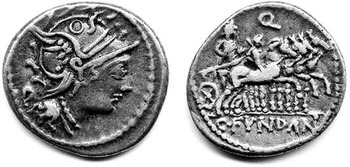
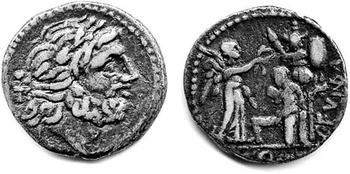
It was a regular practice among the Romans for the children of a victorious general to accompany their father during his triumph, either in the chariot itself (if they were small) or riding on one of the horses pulling the chariot.Footnote 3 The iconographic evidence for children accompanying their fathers in the republican period comes from just two coins. A denarius issued by C. Fundanius in 101 shows on the reverse (Fig. 1) a triumphator in a quadriga with a rider on one of the trace horses. The reverse of a quinarius (Fig. 2) issued by the same moneyer depicts Victory crowning a trophy, a carnyx (a type of Gallic war trumpet) and a kneeling captive. The bronze coin suggests a victory over Celtic peoples, most likely a reference to Marius’ recent victories over the Cimbri and Teutones in 102 and 101. Since both coins were issued by the same moneyer, it is plausible to conclude that the triumphator on the silver coin may ‘be regarded as Marius himself, [and] the rider on the near horse as Marius’ son, now aged about 8,’ as Crawford suggests.Footnote 4
Denarius of C. Fundanius (101) (RRC 326/1 – author’s personal collection)

Quinarius of C. Fundanius (101) (RRC 326/2 – ACANS Gale Collection)

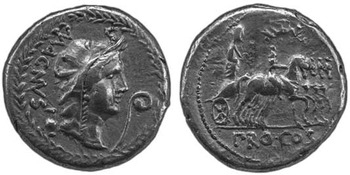
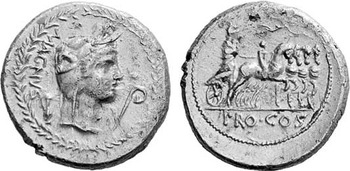
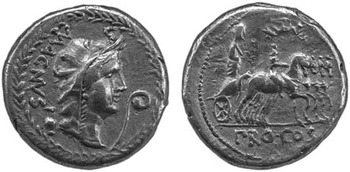
The second coin showing a son accompanying his father in a triumph is an aureus issued by Pompeius (RRC 402/1a and b), relating to a triumph of his (Figs 3, 4 and 5 on next page)Footnote 5 , and it is this coin which is the subject of this article. It has on the obverse a female figure with an elephant-head skull-cap and the augural jug and lituus, and on the reverse there is a triumphator in a quadriga with a boy or young man on one of the trace horses (just like the earlier coin of Fundanius).Footnote 6 The legends, MAGNVS on the obverse and PRO COS on the reverse, show clearly the reference is to a triumph of Pompeius.
Aureus of Cn. Pompeius Magnus (61?) (RRC 402/1a – British Museum: AN00266477)

Aureus of Cn. Pompeius Magnus (61?) (Bologna Museum: 26445D and 26445R)

Aureus of Cn. Pompeius Magnus (61?) (privately owned example – Triton Sale III, 1999, Lot 817, Numismatica Ars Classica, Auction 63 [17 May 2012], Lot 220) (Eventually sold for CHF95,000=approx. AUD$117,400)

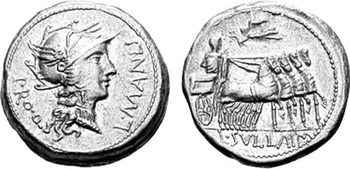
The issuing of gold coins in the republican period was rare. There were recent examples in those issued by Sulla, the promoter of Pompeius’ early career and once his step-father-in-law. One of those coins is of interest here: it was issued both as an aureus and as a denarius, in conjunction with L. Manlius Torquatus (RRC 367/2; Calicó, nos. 16-19) (Fig. 6 on p. 111). The aureus and the denarius have on their reverse a triumph, just like the one on Pompeius’ coin. Given Pompeius’ close connection to Sulla, is Sulla’s aureus a precedent and parallel, perhaps, for Pompeius’ gold coin? With both the Sullan and Pompeian coins, a number of numismatists suggest that they were minted in the East; that is, before their return and celebration of their triumphs. The senate, which made decisions about the award of triumphs, might take a dim view, however, of a promagistrate advertising a hoped-for triumph before he laid down his imperium, and that might suggest that Sulla’s and Pompeius’ coins were issued after their return from the East.Footnote 7
Aureus of L. Manlius Torquatus and L. Cornelius Sulla (81) (RRC 367/2 – British Museum: AN00622344)

2. The Personification
The dating of the Pompeian coin (and therefore the triumph it is referring to) is debated. Since the reverse has the title PRO COS, the only possibilities are 71 and 61 when he held that office. The figure with the elephant-head skull-cap is taken by some to show a personified Africa. If that identification is correct, it would point to Pompeius’ triumph for his victory in Africa in 81 after his appointment by Sulla to a command there to get rid of remnants of Marius’ forces. But that was an appointment only as pro praetor, that is, not pro cos, so the coin could not have been issued at the time of this first triumph,Footnote 8 which Pompeius had pressured Sulla into granting.Footnote 9
However, those who pursue this interpretation, that the personification on the obverse of the coin is of Africa and that the coin therefore refers to Pompeius’ African triumph, have to resort to a strained argument to explain why this coin was issued at least ten years later, in connection with his triumph in 71, say, which he celebrated on his return from Spain, where he had indeed been proconsul. For example, Crawford says:
. . . the reference to Africa is somewhat surprising, but it is intelligible if one remembers that the swift and decisive victory in Africa [in 81] was a more striking achievement than the victory in Spain, long delayed and only achieved after the murder of Sertorius by Perperna; it is also perhaps relevant that the victory in Africa was less recent and less charged with bitterness than the victory in Spain.Footnote 10
A perusal of the index of types in Crawford’s Roman Republican Coinage reveals quite a number of female personifications, but there are also 13 examples of unidentified female heads. He lists two examples of a head of Africa personified, one of which is this aureus of Pompeius.Footnote 11 Crawford’s argument then is circular: he wants to identify the female head on the gold coin as Africa personified in order to bolster his view that it celebrates Pompeius’ African triumph. But the head could just as well be a personification of some other country, without resorting to the complex or circular argument which Crawford uses, and could well join the 13 examples of unidentified female heads. Or perhaps it could be a personification of Asia, which would make equally good sense, as we shall see.
Among other numismatists, there is a (tentative) consensus about the coin’s date. Grueber believes it is to be dated to c. 61 and identifies the rider on the reverse as Pompeius’ elder son, but takes the personification on the obverse as Africa and a reference to Pompeius’ command there in 81.Footnote 12 Sydenham, while admitting that its date and place of mintage are problematical, follows Grueber in assigning it a date of 61 (?) and mintage in the East (?) and accepting that the personification represents Africa.Footnote 13 Mattingly similarly assigns the coin to Pompeius’ triumph in 61 on his return from the East, believing also that the personification represents Africa because of the elephant-head skull-cap; but he questions why such a personification representing Pompeius’ victories in Africa in 81 was used on a coin issued for a later triumph.Footnote 14
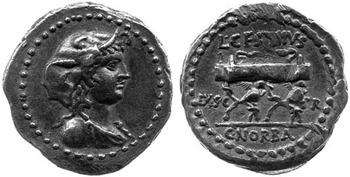
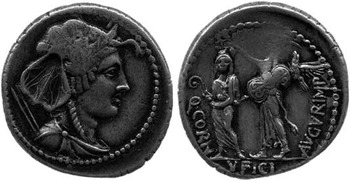
There has even been a question raised whether the head on the coin is female. The dies for the obverse of the three examples of which I have been able to obtain images are all different, but it is obvious that they are meant to depict the same personification. All three have something hanging from the ear – or where the ear would be in the case of the Bologna and privately owned examples. There is something unique on the figure on the obverse of the British Museum example: there seems to be a round ear-ring, with what looks like a lock of curled hair hanging from it.Footnote 15 . It does not seem to be a drop ear-ring – it is too curled and long for that: cf. the drop ear-ring on the head of Roma on the coin of Torquatus and Sulla (Fig. 6 above, p. 111) or of Venus on a coin of Faustus Sulla (Fig. 17 below, p. 131) which are fairly typical of such items. A lock of hair? Possibly. A perusal of such figures in Crawford’s RRC index does not help. A clue may come from later coins: a series of aurei issued in 44 by L. Cestius and C. Norbanus (RRC 491/1b; Calicó, nos. 3-5) (Fig. 7), and a denarius and aureus, both with the same obverse and reverse (Fig. 8, next page) issued by Q. Cornuficius.Footnote 16 The obverse on the coins of Cestius and Norbanus and of Cornificius has a (female) figure wearing an elephant-head skull-cap. Note the length of the item attached to the figure’s ear – it is even longer than the item on the BM example of Pompeius’ gold coin.
Aureus of L. Cestius and C. Norbanus (43) (RRC 491/1b – British Museum: AN00624257)

Denarius of Q. Cornuficius (42) (RRC 509/4 – British Museum: AN00630786)

There is no ear-ring of any sort on the Bologna Museum coin and the privately owned example, as the ear is covered. Instead there is what looks like a long string or ribbon hanging down from the elephant cap, as there is on the BM example also, but less clearly. Perhaps part of a string or ribbon tying the cap on? The figure on the Bologna example appears more masculine, especially from the solid-looking folds on the neck; the BM example has less prominent folds. Andrew Stewart, however, advises that these folds are referred to as ‘Venus rings’ and suggest the figure is female.Footnote 17
All of this analysis leads to the conclusion that the figure is indeed female. It is likely then to be a personification, but of which country? It would suit the argument of this article if the head was a personification of Asia – appropriate to Pompeius’ triumphal campaigns there, celebrated on his aureus.
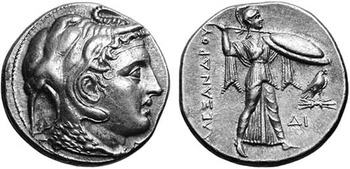
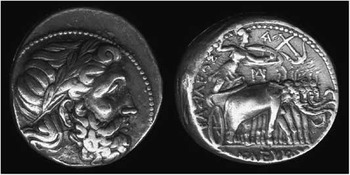
Other views of the symbolism of the head on the coin have been put forward. Jessie Maritz makes a case for believing that the image with an elephant-head skull-cap is not, in fact, a personification of Africa.Footnote 18 As precedents she looks in particular at the coins of Ptolemy I and Agathocles of Syracuse (Figs 9 and 11, below, p. 123), and concludes that the parallels between those two coin-types show that the figure wearing the elephant-head skull-cap is a portrait head, not a personification (p. 45). Her analysis of the elephant-head skull-cap on coinage over the following two centuries concludes that it is one of the attributes symbolising Hellenistic kingship and that wearing it was ‘the face of power – military power, political power, divine power, expansionist power . . . [and it] is still the face of power when it is used for the first time on Roman coins’, citing the aureus of Pompeius (pp. 48-9).Footnote 19 This is not to say that the image on the obverse of our coin is a depiction of Pompeius or even Alexander; her view is that it is the face of power. Though considering principally imagery of Alexander and his Successors, Andrew Stewart has a similar view, suggesting that Ptolemy’s early coinage was introduced ‘to supplant Alexander’s own Herakles/Zeus tetradrachms . . . [leading to an interpretation that] as the lion scalp is to Herakles, so is the elephant scalp to Alexander’, and that the elephant-head skull-cap is ‘a symbol of unassailable universal hegemony’.Footnote 20
Silver tetradrachm of Ptolemy I c. 313-312 (Svoronos 033)

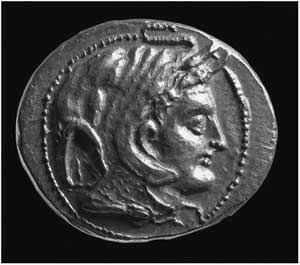
Gold coin of Seleukos I Nikator (Syria) (British Museum: 1879 0401 3)

This view that the elephant represents power and universal hegemony might have implications for the discussion later of Pompeius’ interest in elephants,Footnote 21 and his statement of success advertised in the placards and items carried in his triumph in 61 (see below pp. 121 and 129-130). But two questions need to be asked first. One, was the iconography on Pompeius’ coin borrowed from Hellenistic examples, and two, would Romans have used on their coinage such an abstract symbol? In response to the first question, see the discussion in section 5 below (pp. 119-122). To the second question one would have to answer that the obverse of Roman republican coins prefers a solidly recognisable image, a divinity, say, or the personification of a country, thus ruling out Maritz’s and Stewart’s views. It might make sense of some of the Eastern association in the iconography of Pompeius’ coin (as I shall argue) that the head is that of a personified Asia.
3. The Augural Symbols
On the obverse of the coin are shown the augur’s lituus and capis. Not only do they show the very Roman-ness of the coin, but if we could determine the date when Pompeius became augur, they might help in dating the coin. There is the danger, however, of producing a circular argument here. Those who date the aureus to 71 (that is, at the time of the second triumph) conclude that Pompeius was an augur by then; those in turn who opt for 61 (the date of the third triumph) suggest that the symbols show he was an augur by then.Footnote 22 We know of no other coins minted by Pompeius, hence no other examples of any date with the augural symbols on them to provide a possible date for the office.
There is no literary evidence either. The first occasion on which we hear of Pompeius using his augural authority is when he assisted Caesar, the pontifex maximus, in supervising the transitio ad plebem of P. Clodius in 60.Footnote 23 Could it be significant that that event took place close in time to Pompeius’third triumph in 61, the issue date of the coin which this article argues for? But that is drawing a long bow, and the conclusion has to be that nothing can be inferred from the augural symbols on the aureus for its date.
4. Youths on Horses in Triumphs
There are two lines of approach which can be pursued to argue that the coin should be associated with Pompeius’ third triumph and dated to 61. The first line has to do with identifying, and determining the age of, the youth riding on one of the chariot’s horses, shown on the reverse of the coin. To take up the comment made by Cicero, quoted at the start of this article, that the sons of triumphing generals in their early youth usually rode on the horses of their fathers’ chariots (Cic. Mur. 11) and from the example shown on the coin of Marius’ triumph, it should follow that the youth depicted on Pompeius’ aureus was one of his sons. One view is that all three of Pompeius’ children, the two sons and a daughter, were born in the period 79-76, following his marriage to Mucia Tertia, arranged by Sulla and his then wife Metella.Footnote 24 The birth year of the older son Gnaeus is usually taken to be around 79;Footnote 25 the accepted view about Sextus now is that a ‘birthdate closer to 66 makes far more sense’.Footnote 26 The births need to coincide, of course, with periods of time when Pompeius was in Rome, since there is no evidence that his wife accompanied him on any of his campaigns. He left for the long campaign in Spain as the colleague of Metellus Pius in 77 and did not return to Rome until 71. He remained there until he left for the command against the pirates in 67, after which he went straight on to the campaign against Mithridates, not returning to Rome from the East until late 62, when he sent a note of divorce to Mucia as soon as he landed in Brundisium.
Confusing the matter of deciding when the two sons were born is a comment by Florus (1.41.9): in providing a list of the commanders put in charge of various seas for the campaign against the pirates Florus says that the iuvenes Pompei (‘sons of Pompeius’) were placed in charge of one area.Footnote 27 That will just not work, since at best they could have been no older than their early teens, if they were both born in the period 79-77, and Sextus certainly would not have been old enough if he were born c. 66. They might have been old enough to have been taken by their father to gain military experience during the pirate campaign in 67, but they were certainly not old enough to exercise command.Footnote 28 In all likelihood Florus just got it wrong.
If the year of Gnaeus’ birth is correctly placed at c. 79, it would make him eight or nine years old in 71, at the time of his father’s second triumph; that seems somewhat young to be controlling one of four, presumably large, horses pulling the triumphal chariot during a procession in front of a large, noisy and excited crowd. On the other hand, eight years of age may not be too young for such a role, if Crawford’s assessment about Marius’ son depicted on the coin of Fundanius is accepted.Footnote 29 There are several pieces of evidence from which the age of Marius the younger can be calculated: Appian (BC 1.87) and the author of the De Viris Illustribus (68.1) say that he was 27 when he held the consulship in 82 with Cn. Papirius Carbo, the Marian leader and three-time consul,Footnote 30 while Velleius Paterculus (2.26.1) says that he was consul at the age of 26. On the other hand, the epitomator of Livy (Per. 86) says that he was made consul ‘through violence’ (per vim) before he was 20, which would make him surely too young to hold a consulship, even if there were political considerations in those disturbed times.Footnote 31 The evidence of Appian and Velleius would put the year of the younger Marius’ birth at around 110 or 109, making him eight or nine at the time of his father’s triumph in 101, while the age claimed by the Livian epitomator would make him far too young to be even riding a horse, let alone during a triumph.
But can we trust any of these sources when it comes to indicating ages? The epitomator of Livy seems to be way out, and the other two sources, for a start, disagree with each other by a year – not a significant discrepancy, but in terms of controlling a horse during a triumph, one year could make a difference. Another example of a wide variation in stating an age: Plutarch (Pomp. 46.1) says that ‘supporters who wished to compare Pompeius to Alexander in all points and force the parallel claimed that he was less than 34 years of age, when in truth he was nearly 40 [when he celebrated his third triumph].’ In fact, Plutarch has got it wrong, since Pompeius was about to turn 45, the victory parade being timed to mark his birthday.Footnote 32 In view of such inaccuracies, the ages given for the younger Marius when he was elected consul become suspect. The young man may actually have been born earlier: the marriage of Marius to Julia took place about 114,Footnote 33 so the birth of the son may have occurred earlier than the year 110 usually ascribed to it. He may therefore have been older when he controlled one of the horses pulling his father’s triumphal chariot in 101. All of this, then, does not impact on the argument put forward here, that the son of Pompeius might have been too young to be riding a horse in a triumph in 71, but strengthens the argument that it is more likely that he was the son riding one of the horses in Pompeius’ third triumph in 61, and that the aureus depicting that triumph was issued for that occasion.
Some comparisons drawn from the literary evidence give further support to the suggestion that youths riding the horses of a triumphal chariot would be older than eight. In describing Aemilius Paullus’ triumph in 167, Livy makes the remark that his two younger sons, whom Paullus had kept to carry on the family name, should have accompanied their father on this occasion, but sadly they did not, because the younger died just five days before the triumph, and the other, obviously sick on the days of the triumph, died a few days later. Livy says the younger boy was aged about 12 and the older boy was 14. The older sons, however, who had been adopted into other families, did take part in Paullus’ triumph, following immediately behind their father’s chariot among other dignitaries (walking presumably: there is no indication that they were riding horses).Footnote 34 In Octavius’ triumph in August 29 for the victory at Actium his step-son Tiberius, then aged 13 (born November 42), rode the left trace-horse of the triumphal chariot, and his nephew Marcellus, then of similar age (born 42), rode the right-hand one (Suet. Tib. 6.4). In his triumph in AD 17, Germanicus was accompanied by a number of his children, all placed in the chariot (Tac. Ann. 2.41): the eldest were Nero Iulius Caesar (born AD 6, so about 11) and Drusus Iulius Caesar (born c. AD 7, so about 10).Footnote 35 As the literary evidence says that both these triumphs were conducted ‘in the republican tradition’, it looks as though a son had to be at least about twelve before being entrusted with the task of riding one of the triumphal chariot’s horses. On the other hand, Pompeius’ older son (if born about 79) would be around 18 years old in 61, the date of Pompeius’ third triumph – a clearly suitable age to be controlling a horse leading a chariot in a very public and noisy parade.
5. Pompeius and Alexander
The second line of approach is to examine the images on the coin which, it will be argued, associate Pompeius with the iconography of Alexander the Great. If it can be shown that the images do have associations with Alexander, then it would follow that the coin celebrated Pompeius’ conquests in the East – extensive territorial gains just like those of an Alexander, and so it should be associated with his triumph for those conquests, that is, in 61. If that were the case, then it would also contribute to the on-going debate about the extent to which Pompeius wished to imitate or be compared to Alexander – or surpass his achievements.
What is the evidence for the view that Pompeius may have wished to imitate or emulate Alexander? For a start, Pompeius acquired the cognomen Magnus (‘The Great’), conferred by Sulla when he greeted Pompeius on his return from Africa in 81,Footnote 36 which can be suggestive, perhaps, of imitating the title of Alexander. He did not, however, start using the additional name until later, during his proconsulship in Spain held from 77 (Plut. Pomp. 13.5). Devon Martin, in putting a case for not accepting the view that Pompeius tried to imitate Alexander, devotes a large part of her article to discussing the name Magnus and its cognates used by other Roman figures, leading to her conclusion that the name Magnus would not immediately bring Alexander to the Roman mind.Footnote 37 But such a conclusion is contradicted by comparisons drawn by Pompeius’ contemporaries: for example, the very point made by Cicero in the pro Archia is to link Pompeius to Alexander via the name Magnus:Footnote 38
quam multos scriptores rerum suarum Magnus ille Alexander secum habuisse dicitur . . . quid? Noster hic Magnus, qui cum virtute fortunam adaequavit, nonne Theophanem Mytilenaeum, scriptorem rerum suarum, in contione militum civitate donavit . . .
Cic. Arch. 24
What a large number of historians of his deeds is the famous Alexander the Great said to have taken with him . . . and did not our own Magnus, whose success has been commensurate with his great qualities, confer citizenship on Theophanes of Mytilene, the historian of his exploits, at a meeting of his soldiers . . .
There is some other evidence that Pompeius cultivated the image of being a latter-day Alexander. Sallust, for example, makes this observation:
sed Pompeius a prima adulescentia sermone fautorum similem fore se credens Alexandro regi facta consultaque eius quidem aemulus erat.
Sall. Hist. 3.88M
From his earliest youth Pompeius, believing from the talk of his supporters that he would equal Alexander the king, emulated even his deeds and his plans.
Plutarch has this to say:
ἦν δέ τις καὶ ἀναστολὴ τῆς κόμης ἀτρέμα καὶ τῶν περὶ τὰ ὄμματα ῥυθμῶν ὑγρότης τοῦ προσώπου, ποιοῦσα μᾶλλον λεγομένην ἢ φαινομένην ὁμοιότητα πρὸς τάς Ἀλεξάνδρου τοῦ βασιλέως εἰκόνας. ᾗ καὶ τοὔνομα πολλῶν ἐν ἀρχῇ συνεπιφερόντων οὐκ ἔφευγεν ὁ Πομπήιος, ὥστε καὶ χλευάζοντας αὐτὸν ἐνίους ἤδη καλεῖν Ἀλέξανδρον.
Plut. Pomp. 2.1-2
There was a slight lifting of his hair and a melting look in the proportions of his face around the eyes which produced a resemblance, more talked about rather than apparent, to the portrait statues of king Alexander. And so, since many applied the name to him in his early years, Pompeius did not avoid it, so that in time some called him Alexander in mockery.
The famous marble head of Pompeius in the Ny Carlsberg Glyptotek reveals this copying of Alexander’s hair-style – the anastolê, even if not as exaggerated (atrema).Footnote 39 If one compares it with any number of statues of Alexander, or with any of the multitude of coins of Alexander’s successors, one can see the imitative hairstyle. Appian says (Mith. 117) that there were claims that the cloak worn by Pompeius in his third triumph actually belonged to Alexander, though he doubts the truth of it.Footnote 40 The images of Pompeius on coins issued by his sons, admittedly after his death, are consonant with facial characteristics and hair style of the marble head mentioned above.
An examination of Alexander iconography might help in an analysis of the imagery on the aureus of Pompeius. The Macedonian successors to Alexander in the break-up of his empire imitated the great leader, and used his iconography on their own coins. Early coins issued by Ptolemy I in both gold and silver (for example, a silver tetradrachm – Fig. 9 above, p. 114) have a portrait of Alexander on the obverse wearing – an elephant-head skull-cap (the same as the image on the obverse of Pompeius’ coin); the head also has the horns of Ammon (tucked under the cap) and the aegis, with the title ALEXANDROY on the obverse. Seleukos I Nikator similarly has a figure wearing an elephant-head skull-cap (Fig. 10), but the image is of himself,Footnote 41 showing that these rulers later put images of themselves on their coins, replacing the portrait of Alexander (for Ptolemy’s portrait of himself, cf. Fig. 12 on p. 124).
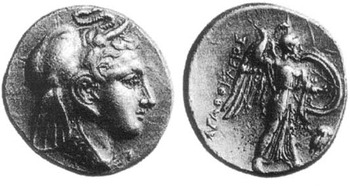
Hellenistic iconography of this sort had moved further west: there is a coin of Agathokles, tyrant of Syracuse, dating from about 310-309 (Fig. 11).Footnote 42 Soon after seizing power Agathokles was attacked by the Carthaginians who besieged his city; in a surprise counter-attack in August 310 he landed in Africa, defeated a Carthaginian army and besieged Carthage. Eventually the Carthaginians withdrew from Syracuse, but Agathokles’ campaign too petered out by 307. There is general agreement that Agathokles’ coins imitate Ptolemy’s tetradrachms – the Syracusan had allied himself at one stage in the African campaign with Ptolemy’s governor of Kyrene and became Ptolemy’s son-in-law by marriage to his step-daughter Theoxena. Andrew Stewart argues that the head on the obverse of the coin is of Alexander, like those of Ptolemy, and that the elephant-head skull-cap is not of an African elephant as one might expect, but of the eastern elephant, as the size and shape of the ears indicate, like those on the head of Alexander in the Ptolemaic coins, suggesting that Agathokles continued using the Hellenistic iconography.Footnote 43
Stater of Agathokles of Syracuse 310-304 (CNG, auction catalogue, 8/11/1998, lot 511)

6. What Sort of Elephants?
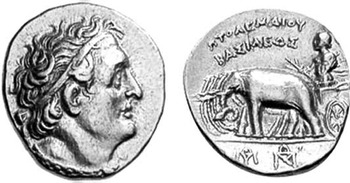
That raises a further question: what sort of elephants are depicted on these various coins? Pompeius often liked displaying one-upmanship and indulging in tradition-breaking practices – witness his extortion of a triumph from Sulla when he had not held command in the usual way, or his move straight into a consulship at too early an age and without holding the necessary previous offices in the cursus honorum. And he seems to have had an interest in elephants. In his triumph in 81, Pompeius tried to substitute elephants, from his recent connection with Africa, no doubt,Footnote 44 for the usual white stallions to pull his triumphal chariot, only to be forced to abandon this extravagant display because the animals would not fit through the Porta Carmentalis – much to his embarrassment, and the amusement of the onlookers, if one believes the ancient sources.Footnote 45 Given his supposed likeness to Alexander from an early age, Pompeius might even have got his tradition-breaking idea of using elephants instead of horses to pull the chariot in this triumph from an eastern example. Consider these two instances: a gold tetradrachm of Ptolemy I (Fig. 12) and a silver coin of Seleukos I (Fig. 13). But perhaps Pompeius would not have wanted to draw too much attention to that embarrassing incident – or it may be that he had a deliberate purpose.Footnote 46 Given the perception in some sources that Pompeius consciously likened himself to Alexander, some modern commentators see in this use of an elephant-drawn quadriga a connection with Dionysos/Liber, a deity closely associated with Alexander (see discussion with references below, pp. 131-2).
Gold tetradrachm of Ptolemy I c. 300-298 (Svoronos 126)

Silver coin of Seleukos I (British Museum: 1845 1217 258)

Pompeius’ interest in elephants may also be seen in the elephant-head skull cap depicted on the obverse of his aureus, and the display of elephants in the extravagant games held to mark the opening of his stone theatre, the first permanent theatre in Rome (another ‘first’ – and piece of one-upmanship?), portico and temple to Venus Victrix.Footnote 47 The beast shows in the games lasted five days, we are told; the piteous trumpetings of the elephants as they were slaughtered so roused the audience that they burst into tears and the display backfired on Pompeius – again?Footnote 48
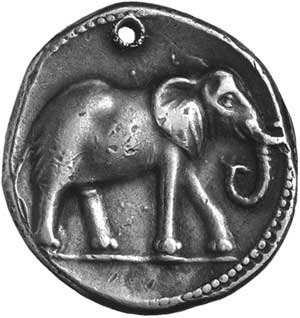
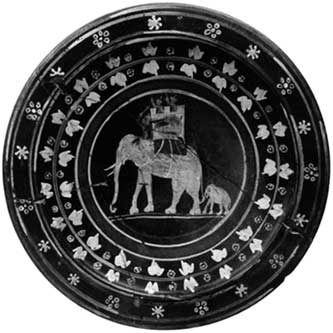
Perhaps if we could determine what sort of elephant is depicted in the elephant-head skull-cap on the coin, it might give us a clue to the type of reference intended by the iconography, especially if it could be shown to be eastern. The answer comes down to looking at the size of the elephants’ ears. Scullard provides a convenient summary of the state of knowledge of the three types of elephants available in the ancient Mediterranean world.Footnote 49 In addition to the two types well-known to us in the modern world: the African ‘bush’ elephant, with long tusks and very large ears, and the ‘Eastern’ or ‘Indian’ with ears closer to the head and of smaller stature. It would have been the latter, apparently easier to train, which would have been used extensively by Alexander, especially after he had reached the borders of India where they were more readily available, and by his successors, in both warfare and parades. There is also a difference in head shape, with the Indian elephant having a head with twin domes and a slightly indented forehead, while the African elephant carries its head lower; they have different body shapes too, with the African elephant having a concave back and the Indian a rounded back. This can be seen in Figs 14 and 15 below: the Carthaginian coin shows an African ‘forest’ elephant, while the so-called ‘Capena’ Plate, usually associated with Pyrrhus, depicts the sort of Indian elephants he would have brought with him when he invaded Italy in 280.
Barcid silver coin (Carthaginian) (courtesy of Professor Stephen Mulligan via Assoc. Prof. Dexter Hoyos)

Painted dish from Capena (3rd cent.) (now in the Villa Giulia)

In the ancient world there was apparently a third type, usually referred to as the African ‘forest’ elephant; it existed extensively in North Africa, and so would have been available to the Ptolemaic rulers in addition to Indian elephants, and was most likely the sort of elephant used by the Carthaginians. It was reduced to virtual extinction by the Romans, through hunting and transport in huge numbers to Rome for use in games and spectacles. This African ‘forest’ elephant had smaller ears than the ‘bush’ elephant and was smaller than the Indian elephant.Footnote 50
The ears on the skull-caps on the coins of Ptolemy I, Seleukos I and Agathocles, as far as one can tell, seem to be of the Indian elephant. We might have expected that Agathokles, and even Ptolemy, would have depicted the African ‘forest’ elephant, as readily available in their area. Perhaps they were following a traditional type of elephant design. Unfortunately, the ears on the image on Pompeius’ coin are hard to distinguish, but there is an outlined shape which seems to depict a small ear, that is, of an eastern elephant, fitting with the view put forward here that Pompeius was using Alexander or ‘eastern’ iconography. Compare the outlined small ear on the coin of Ptolemy I (Fig. 9 above, p. 114), with the outlined shape on Pompeius’ aureus (Figs 3 and 4 above, p. 110). It is unlikely, however, that an argument can be based too heavily on any sort of accuracy in the coin images. An examination of a wide variety of coins leads to the conclusion that one cannot draw any consistent inferences about what images influenced what and when. Hellenistic iconography may, or may not, have influenced African images, and Roman coins might have copied African images and/or Hellenistic images – so it is all very mixed up. And then there is the question whether the coin die-cutters were trying to draw a ‘real’ image based on having seen a particular specimen, or were they simply cutting what they imagined a particular animal looked like from hearsay descriptions, or were they copying the design from an existing coin? Did they appreciate the difference between an eastern and an African elephant? Perhaps not. So an examination of the types of elephant turns out not to be secure or conclusive.
That is not to say, however, that the iconography of the Pompeian aureus does not have Alexander connotations. There are other indicators, principally the use of the elephant-head skull-cap itself, to provide an Alexander link. So we are back with the question: to what extent did Pompeius imitate – or try to surpass – Alexander?
7. Pompeius: Imitating – or Claiming to Surpass – Alexander?
There is no need to consider at length here the much-debated and long-standing question whether great Roman leaders – like Scipio Africanus, or Pompeius, or Caesar – consciously desired to imitate Alexander and his achievements. While others may have likened great Roman generals to Alexander – none more so than Pompeius – did they really want to be so compared themselves? Alexander could be an embarrassing and dangerous model for a Roman to imitate, as Gruen points out. Apart from being a great conqueror, Alexander was also a megalomaniac, a temperamental and violent drunkard capable of killing friends – and moreover an absolute ruler and a king. Would Roman generals want to be associated with those aspects of Alexander? Green and Gruen represent the opposing views in the case of Pompeius. Green hangs his article on three terms, which are useful hooks for structuring the debate – imitatio (by which he means that the individual himself consciously imitated Alexander), comparatio (which he takes to mean that it was others who made the comparison, not necessarily in a positive way) and aemulatio (by which he means that the general involved tried to copy the achievements of Alexander, or even to surpass them). Green accepts the picture of Pompeius mentioned in some of the sources and holds the view that he deliberately imitated Alexander. He writes:
[Pompeius’] personal vanity, his passion for the outward trappings of glory, his political obtuseness and indecisiveness, his fatal urge to please those in titular authority – all combined to make him, even in his moment of glory, a subtly ridiculous figure. . . Pompey, with his devotion to Alexander and his respect for the constitutional forms of the Republic, was, in the last resort, a follower rather than a leader, and that this, essentially, was what imitatio implied in those who practised it.Footnote 51
Gruen, on the other hand, questions this view of Pompeius.Footnote 52 He points out that much of the ancient evidence about Pompeius’ so-called imitation of Alexander involves mockery of him for it. For example, when his chief rival, M. Crassus, was told Pompeius the Great was approaching, he quipped ‘as great as what?’ (Plut. Crass. 7.1). The name Magnus came under attack also in the theatre, when the ‘first triumvirate’ was unpopular: an actor delivered the line ‘through our misery are you great’, and he received thunderous and derisive applause (Cic. Att. 2.19.3). Gruen goes on to argue that, although the young Pompeius may have had his head turned by those who noticed a resemblance to Alexander, the similarity may have proved to be an embarrassment rather than a gain. Political enemies and rivals ridiculed his pretensions, and others found the association provided occasion for mockery. Moreover, he claims, the evidence gives little hint that Pompeius himself attempted to promote the connection – what Green would classify as comparatio.
Gruen’s general conclusion is that, if anything, Roman commanders tried to emulate the achievements of Alexander and, if possible, to outdo them – what Green would classify as aemulatio. And with regard to Pompeius Gruen argues that he was being thoroughly Roman. It is true that there are some conventional elements in Pompeius’ aureus, such as the augural symbols on the obverse and the depiction of a triumph on the reverse – and it has a figure on the obverse, and not a portrait of himself.Footnote 53 It was not yet the practice to have the head of a living person on a Roman coin; that did not occur until Julius Caesar was granted the privilege by the senate just before his premature death (Dio 44.4.4). There are numerous coins with Pompeius’ image on them, very much like the Copenhagen head, but it is important to note they were not issued until after his death, as part of the propaganda battle in the war carried on by his sons.Footnote 54 From an analysis of a number of examples from Roman history Gruen draws his conclusion that Roman commanders wished, not to imitate or be compared to Alexander, but to outdo his military achievements – and especially is this true of Pompeius. But the very act of claiming to surpass the achievements of Alexander is in itself a back-handed (if self-laudatory) form of comparison, and in Pompeius’ case it demonstrates that the aemulatio was initiated by the commander himself (whatever sorts of comparisons might have been made by others).
Moreover, as Welch and Mitchell have suggested, comparatio and aemulatio are not mutually exclusive: they think that a way can be found ‘to readjust the paradigm, taking account of Green’s and Gruen’s contributions, but still exposing the extent to which the Romans responded . . . to the reputation of Alexander the Great.’Footnote 55 In stressing the Roman aspects of Pompeius’ style, Gruen and Martin both overlook the Alexander iconography which can be observed in the coin’s images, as has been argued above, and its implications for the comparison or emulation he was trying to advertise.Footnote 56
There is merit in Gruen’s view that what Roman commanders wanted to do was to surpass the achievements of Alexander rather than imitate him. Concrete examples can be mentioned: Q. Caecilius Metellus Macedonicus – the additional name says a lot – celebrated a triumph for his victory over the Achaeans at Chaeronea; he brought back a famous set of bronze horsemen, sculpted by Lysippus and set up by Alexander at Dion in Macedonia to commemorate those of his ‘Companions’ who had fallen at the battle of the Granicus River in 334, and had them re-erected in the Forum.Footnote 57 Now a Roman general had taken away one of Alexander’s most notable monuments – that is what Roman commanders were emphasising: Roman superiority and outdoing Alexander. Or another example (admittedly a little later): Caesar is said to have removed the image of Alexander from an equestrian statue carved by Lysippos and substituted his own image, thereby eclipsing Alexander and taking his place as a supreme military conqueror.Footnote 58
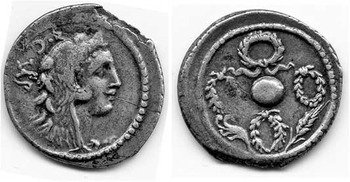
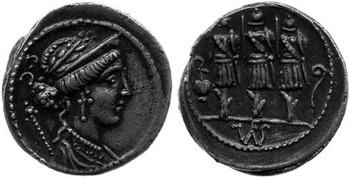
In Pompeius’ case there are several indicators of an attempt to emphasise that he had surpassed the achievement of Alexander. In his third triumph placards were carried which listed the many eastern lands he had captured, the thirty-nine cities he had founded (some with his own name attached to them – just like the many Alexandrias?), and the immense revenues he added to the treasury (Plut. Pomp. 45). Gruen says (n. 1 185) that there is no comparison with Alexander expressed in Pompeius’ statements about his victories (Plin. HN 7.97-98; Plut. Pomp. 45.1-3; App. Mith. 114-115; Diod. Sic. 40.4), but does this mean it would not have occurred to the Romans at the time that Pompeius’ achievements at least could be compared to those of Alexander, if not equalling or surpassing them? Martin argues that the East is not ‘Alexander-land’, and so conquests there would not immediately call to mind surpassing Alexander; Diana Spencer disagrees, claiming that ‘The East is the realm of the Alexander imitator.’Footnote 59 Pompeius also wore a signet-ring engraved with three trophies signifying his three triumphs over three continents (Dio 42.18.3 – other references in RRC 1.450) – just like an Alexander. Some bronze coins of 56 issued on the authority of the senate by Faustus Sulla, at this time Pompeius’ prospective son-in-law,Footnote 60 are revealing. On the obverse of one is a head of Hercules in a lion-skin helmet (how very Alexander-like), and on the reverse of this coin are three small wreaths, recalling Pompeius’ three triumphs, and another wreath representing the coronea aurea awarded to him in 63 (Vell. Pat. 2.40.4; cf. Cic. Att. 1.18.6), all surrounding a globe; there is also an ear of corn (referring to Pompeius’ corn commission) and an aplustre (ship’s prow, referring to his pirate command in 67 probably) (Fig. 16). The globe would have been reminiscent of the huge oikoumene carried in Pompeius’ triumph (Dio 37.21.2), representing his conquest of the world. Another coin issued by Faustus Sulla has on the reverse three trophies between an augural jug and lituus, the trophies again representing his father-in-law’s victories over three continents and recalling his signet ring, while the obverse carries a head of Venus (Fig. 17).Footnote 61 The name of Faustus is made insignificant or is non-existent on the coins, thereby drawing more attention to Pompeius, and all suggesting that he had conquered the world – just like an Alexander.
SC denarius of Faustus Sulla (56 or 54) (RRC 426/4a – British Museum AN00623716)

SC denarius of Faustus Sulla (56 or 54) (RRC 426/3 – British Museum AN00623715)

Some modern writers see in the imagery on Pompeius’ coin and in other of his activities a deliberate connection with deities and heroes worshipped by, or associated with, Alexander,Footnote 62 principally Dionysos and Herakles/Hercules, which supports the view that the Roman wished to compare himself to the Macedonian. Consider this passage of Pliny:
verum ad decus imperii Romani, non solum ad viri pertinent, victoriarum Pompei Magni titulos omnes triumphosque hoc in loco nuncupari, aequato non modo Alexandri Magni rerum fulgore, sed etiam Hercules prope ac Liberi patris.
Plin. NH 7.26
It concerns the glory of the Roman empire, and not that of one man, to mention at this point all the titles and triumphs of Pompey the Great, which equal the brilliance of the deeds not only of Alexander the Great, but even almost those of Hercules and Father Liber.
The coin of Faustus Sulla just mentioned, with its allusions to Pompeius’ triple conquest, has on the obverse Hercules in a lion-skin helmet – so typical of the image of Alexander on his coins. Of course, devotion to Hercules was nothing new among Roman military commanders: for example, Sulla devoted one-tenth of his wealth to Hercules (Plut. Sull. 35.1), and Crassus held a lavish dinner for the citizens of Rome in honour of Hercules (Plut. Crass. 2.3, 12.3). Pompeius himself had a temple built to Hercules.Footnote 63
A connection with Dionysos is more circumstantial. The elephant-head skull-cap, and (perhaps) the use of an elephant-drawn quadriga in his first triumph might suggest links with Dionysos.Footnote 64 Note the coins of Ptolemy I and Seleukos I (Figs 12 and 13 above) with the scene on the reverse depicting Dionysos’ return from his conquest of India in an elephant-drawn quadriga; the portrait of Ptolemy himself on the obverse shows him wearing the mitra, a symbol of Dionysos.Footnote 65 Martin claims that Pompeius would not have made any reference to Dionysos in his triumph over Mithridates since the latter, among other epithets attested by ancient sources as used by him, adopted the title Neos Dionysos.Footnote 66 Against Martin’s view of Mithridates vis-à-vis Dionysos, one could point out that the Pontic king set himself up also as the new Alexander, not only extending his conquests, but also protecting the people of the East against the aggressor Rome. Would Pompeius therefore not have wished to imply that he had defeated this new Alexander, which would have added to his claim of having surpassed the Macedonian conqueror?
Stewart argues that Ptolemy deliberately replaced the lion-skin helmet commonly depicted on Alexander’s own coinage with the portrait of Alexander in an elephant-head skull-cap (Fig. 9 above) on his coinage specifically in order to acquire the image of Alexander for himself.Footnote 67 From Ptolemy it passed to Agathokles, while others of the Successors used it too, and from there it could easily have been the basis for the iconography used by Pompeius.
An action of Pompeius’ on his return from the East provides another parallel. For Alexander, Athena was the patroness of his crusade against the Persians, obvious in his gold coinage and in his gifts to the Parthenon in Athens. For his part, Pompeius dedicated the spoils of his Eastern conquests to Minerva (= Athena) (Plin. HN 7.97) in a shrine (delubrum) which he had vowed to the goddess. In refuting the claim made by some that Pompeius honoured deities similar to those favoured by or associated with Alexander, Martin asks how then does one explain that Pompeius dedicated the spoils to Minerva, but she misses the parallel with Athena/Minerva.Footnote 68 She adds that Pompeius had an association with Venus also, a deity not connected with Alexander. But that connection is emphasised later, with the temple-theatre complex constructed and opened in 55, dedicated – appropriately – to Venus Victrix (above, n. 47). As with Hercules, an association with Venus is common in Roman commanders;Footnote 69 so Pompeius was not alone. It does not contradict the connections with Alexander to which Pompeius was alluding with the iconography on his aureus or with the placards carried in his third triumph. Just as Alexander included other gods and heroes in addition to Dionysos and Herakles, so Pompeius showed devotion to a range of Roman deities.
8. Conclusion
The aureus clearly belongs to Pompeius; the iconography suggests a link with imagery of Alexander and with the triumphant return from the East of Dionysos/Alexander (seen on coins of the Successors and imitators of Alexander); the figure on the obverse is not a personification of Africa but most likely of Asia; the age of the son riding on one of the trace-horses; the possible parallel with the gold coin issued by Sulla – all this suggests that the coin should be associated with Pompeius’ triumph in 61 after his return from great conquests in the East, and not 71, as some have argued.
It makes sense that the sort of iconography on the coin emphasises a connection with Alexander. Thus the imagery on the coin depicting Pompeius’ triumph in 61 after his defeat of Mithridates (the New Dionysos/Alexander) and his extensive ‘world’ conquests now including the East clearly suggests not only that this occasion is the date for the issue of the coin,Footnote 70 but also that it was deliberate propaganda to show Pompeius on his return from the East, not only as ‘Great’ as Alexander, but as even surpassing his achievements.