Introduction
When, in 1948, the US attempted to exclude the USSR from participating in any future international regime for the Antarctic (Gan in press), the latter set in train a consistent and single-minded policy that would ensure that it had an influential voice in any such development. In 1950, the USSR had notified the US and the other countries with Antarctic interests of its intention to participate in any negotiations on any international regime (Soviet Memorandum Reference Bush1950). Soviet policy to achieve this was, in the main, implemented as a reaction to various initiatives of international scientific organisations involved in planning the International Geophysical Year (IGY). This paper will mention the major initiatives and show how Soviet support and expansion of these proposals, combined with an active encouragement of national Antarctic research, contributed to strengthening the USSR's position in Antarctic matters, much to the consternation of the western nations with interests in the South Polar region. Australia in particular was concerned by the Soviet presence on the Australian Antarctic Territory (AAT) (Gan Reference Gan2009) and was extremely interested in whether the USSR intended to stay for the long term. Although the Australians hoped otherwise, the evidence shows that this was indeed the case. From the day the Soviets set foot on the Antarctic continent, they had no intention of leaving.
After the USSR officially opened its first scientific observatory, named Mirny, after the second vessel of Bellingshausen's great voyage of 1819 to 1821, on the Antarctic continent on 13 February 1956 as the beginning of its contribution to the IGY in the Antarctic, a question arose that was to vex the Australian government (as well as the governments of other IGY participants) for the duration of that 18 month long ‘year’ that was to end on 31 December 1958. This was most vividly posed in a newspaper article by David Burke entitled ‘Red flag near South Pole’. The question was: ‘[w]ill the Russians abandon Mirny to the penguins after 1959 . . . or will they stay?’(Burke Reference Burke1956). The potential approaches for resolving the conflicting Antarctic territorial claims of the claimant countries (such as Australia, which had a claim on that sector of Antarctica where the Soviets were planning to establish their bases) and non-claimants, such as the USA and the USSR, hinged in part on the answer to this question. If the Soviets stayed, their views on the future of the Antarctic would need to be considered. And the weight of these views would be considerable, given the size of their contribution to the international scientific endeavour, the location of their bases and their status as a world power.
Soviets and the IGY
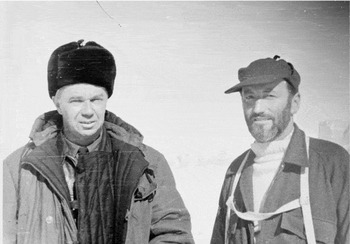
The proposal for Soviet scientists to cooperate with the worldwide scientific community in investigating the Earth, its atmosphere and the north and south polar regions during the International Geophysical Year of 1957–1958 involved the USSR in research activities in both the Arctic and Antarctic. Its previous Arctic experience was significant, while experience in the south polar region was limited to whaling and research carried out on the Slava whaling fleet which commenced operations in the southern ocean in the austral summer of 1946. The IGY proposal became the catalyst for expanding and intensifying Soviet interest in the Antarctic and provided the USSR with the perfect opportunity to secure a major presence on the icy continent with their large scale scientific programme. Scientists from other countries conducting Antarctic research recognised the Soviet programme as being ‘most comprehensive’ as reported by the head of the Australian National Antarctic Research Expedition, Philip Law (Law Reference Law1956: 9) (Fig. 1). He noted that ‘[t]here seems little doubt that the Russian Antarctic Expedition will make a major contribution to the scientific programme of the IGY’ (Law Reference Law1956: 7). Law's assessment was confirmed by the Australian Antarctic explorer Sir Douglas Mawson who wrote that ‘[t]he contribution of Russia will be very significant’ (quoted in Suzyumov Reference Suzyumov1968: 57). Dr Brian Roberts of the Scott Polar Research Institute, Cambridge, and part time civil servant in the British Foreign Office, believed that ‘[t]heir work is likely to lead to rapid and major increases in knowledge of the Antarctic’ (quoted in Bouchier Reference Bourchier1956). Even the Americans were worried that the US was ‘very apt not only to be second to USSR, but a very poor second’ in both polar regions (Albert Crary to Hugh Odishaw quoted in Belanger Reference Belanger2006: 39) and later conceded that ‘[t]he overland transport of supplies to build their [Antarctic] inland bases ranks as one of the most substantial achievements of the IGY’ (Klotz Reference Klotz1990: 29).
P. Law (right) and M. Somov (left) at Mirny on 30 or 31 Jan.1956. Photographer unknown. From Australian Antarctic Division Multi-media collection.

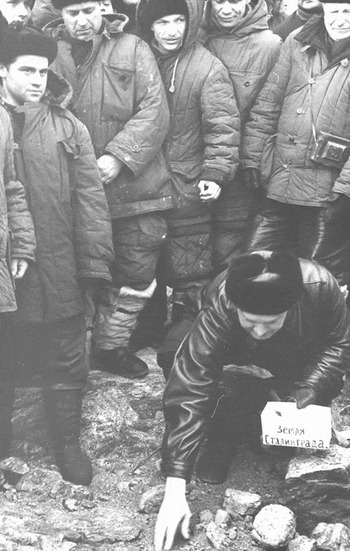
An indication of Soviet resolve to gain a foothold in the Antarctic was the solemnity of the symbolism when opening their first station. A box containing earth brought from Stalingrad was laid at the foundation of the flagpole where the Soviet flag was first hoisted above the icy continent (Fig. 2). The battle of Stalingrad (1942–1943) was still fresh in the minds of the expedition members, most of whom had fought in World War II which lasted from 1941 to 1945 as far as the Soviet Union was concerned, as the decisive battle of the war on the eastern front. Now, the ‘Red expedition’ to the Antarctic was securing the beachhead in readiness for its ‘assault on the sixth continent’ (Gusev Reference Gusev1959; Solyanik Reference Solyanik1957). Leonid Dolgushin, a Russian glaciologist, present at the flag raising, saw the inclusion of Stalingrad earth in the flagstaff base as a ‘symbol that the Soviet Union has come to Antarctica in earnest and for a very long time’ (Dolgushin Reference Dolgushin2006: 44).
The officer in charge of the first Soviet coastal base Mirny H. Greku places a box containing earth from Stalingrad at the foundation of the flagpole (photograph from the personal collection of L. Dolgushin).

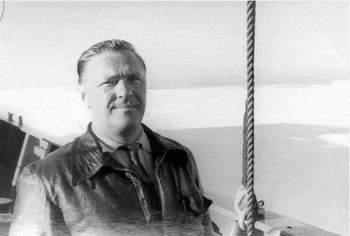
This resolve was the driving force for the Soviet campaign to attain its objectives: to conquer the harshest climatic conditions and most unforgiving terrain in attempts to reach, and to conduct scientific investigations at, two of the most remote unexplored parts of the Antarctic continent, the south geomagnetic pole and the pole of inaccessibility. There could be no thought of failure; any setbacks were causes for great concern that led to a larger allocation of resources and a redoubling of effort. When the tractor sledge traverses which set out to establish the inner continental stations were faced with great difficulties in reaching the proposed sites, the deputy chief of the Glavsevmorput [Northern Sea Directorate] Evgeniy Tolstikov was determined that ‘we cannot allow that our IGY programme not be fulfilled’ (Tolstikov Reference Tolstikov1980: 19) (Fig. 3). He proposed to assume leadership of the third composite Soviet Antarctic expedition (1957–1959) with the objective of selecting the personnel who would undergo very rigorous health screening and to develop equipment more suited to Antarctic conditions.
E. Tolstikov (photograph from the personal collection of L. Savatyugin).

Soviet policy certainly placed no obstacles in his way; on the contrary, the government was ready to provide all necessary resources for the success of its Antarctic endeavours, which was now a matter of national prestige. This was quite obvious to Roberts who was sent on an exchange visit to Moscow and Leningrad [St Petersburg] with his colleague Dr Terence Armstrong, who was fluent in Russian, in the first week of June 1956. Roberts ‘gained an impression of technical competence and scientific ability of a high order . . . and virtually no financial restrictions. Most of the equipment and instruments are excellent. On these aspects we have a much more significant “competitor” in the Antarctic than we expected’ (quoted in Bouchier Reference Bourchier1956). One of the questions that was of more than passing interest to the Foreign Office was: how long did this ‘significant competitor’ intend to stay and ‘compete’ in the Antarctic? The answer to the question was of just as much interest to the Australians, who were hoping ‘that the USSR will share discoveries under the IGY and then “quietly withdraw”’ (The Times (London) 6 February 1957; quoted in Hanessian Reference Hanessian1958: 153).
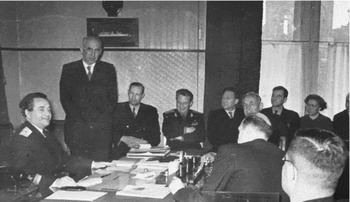
Roberts was given a hint of Soviet intentions in his conversation with the chief of the Glavsevmorput and deputy minister of the merchant fleet Vasily Burhanov, who was also responsible for Antarctic matters. Burhanov mentioned to Roberts that ‘present Soviet plans for the Antarctic only extended to the end of the IGY, but they would like to extend all the IGY stations for an indefinite period after the IGY’ (quoted in Bouchier Reference Bourchier1956) (Fig. 4). Although there were, as yet, no concrete Soviet plans for post IGY Antarctic activities, the desire for a permanent presence in the South Polar region had in no way diminished. All that was required for the desire to become more tangible was the appropriate circumstances, which were not long in arriving on the scene.
Head of Glavsevmorput V. Burhanov (far left) at a meeting of the Council for Antarctic Research (photograph from the Archives of Cino and Photo Documents, Krasnogorsk, Russia).

Proposal to continue Antarctic research after the IGY
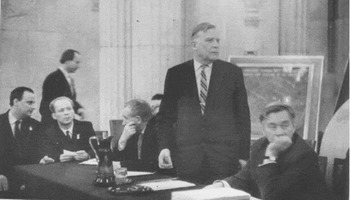
In December 1956, the US national committee for the IGY made a proposal to the Comité Spécial de l'Année Géophysique Internationale (CSAGI) to continue the IGY Antarctic programme for another year and this was approved at the fourth CSAGI conference held in Paris on 13–15 June 1957. The head of the Soviet delegation at the conference, Professor Vladimir Belousov stated that the Soviet IGY committee ‘recognized the interest of the extension for one year of the geophysical observations in the Antarctic’ and expressed considerable interest in the formation of a special committee by ICSU to look into post IGY Antarctic programmes on an international scale (Hanessian Reference Hanessian1958: 157) (Fig. 5). The question was referred to the International Council of Scientific Unions (ICSU) executive board which decided to form an ad hoc group that was to meet in Stockholm in September to consider the desirability of continuing scientific investigations of all kinds in the Antarctic which were inspired by, but not an extension of, the IGY (SCAR 1959a: 360; Hanessian Reference Hanessian1958: 149). The Soviet representative to the ad hoc group was the former head of the first composite Soviet Antarctic expedition (1955–1957) Mikhail Somov, who, after returning to Leningrad from the Paris meeting, was appointed to the new position of deputy director in charge of Antarctic research at the USSR Arctic Research Institute (ARI) in July 1957. The establishment of a new position dedicated to Antarctic research indicates that the proposal to continue scientific investigations was being taken seriously by the Soviet side. It was in this new role that Somov attended the meeting in Stockholm on 9–11 September 1957.
President of the Geophysical and Geodesy Union, V. Belousov (standing centre) at a press conference detailing the achievements of the IGY (photograph from the Archives of Cino and Photo Documents, Krasnogorsk, Russia).

Delegates to the meeting were divided in their views regarding the desirability of extension of Antarctic research coordination in the post IGY period. Those ‘in favor included the US, Chile, Argentina, and USSR, whereas the UK, France and Norway were opposed; likewise, letters from countries not sending representatives indicated that New Zealand is on the fence, South Africa favorable, Australia opposed, Belgium opposed’ (quoted in Wilson Reference Wilson1957). The Australian opposition to the proposal was driven by the fear that a favourable response would give the Soviets an ‘official’ excuse to ‘squat’ on the AAT and ‘that Australia's chances of getting the Russians to leave at the end of the IGY’ would be negligible (Sun (Sydney) 14 November 1957; Sunday Times (Perth, Western Australia) 17 November 1957). The Australian government hoped that ‘the governments of other ICSU countries, whose scientists favour an official extension of research, will refuse to make the necessary funds available for political reasons’ (Sunday Times (Perth, Western Australia) 17 November 1957).
After the conclusion of the meeting, there was some conflict in interpreting Somov's statements regarding Soviet intentions in Antarctica after the IGY between the US representative Dr Harry Wexler (chief scientist of the US IGY Antarctic program) and the British representative, Sir David Brunt (secretary of the physical section of the Royal Society of London). The former reported that Somov ‘indicated on a map where the Soviet Antarctic stations were and where they wanted to go, said they expected to continue their studies in the Antarctic, and expressed the opinion that while Russia did not wish to influence other countries to go ahead if they didn't wish to do so, they felt in such case new nations should be invited in to carry on the studies’ (quoted by Hall Reference Hall1994: 113). Brunt however, had the impression that Somov was not keen to continue research in the Antarctic if only the US and USSR were to continue their programmes with no other countries participating. The Americans felt that the elderly Brunt was somewhat disoriented and did not understand the gist of what was actually being said (Hall Reference Hall1994: 113–114), although F.W.G. Baker, a British official, who had worked with Brunt ‘more or less until he died . . . never knew him disoriented but rather an astute negotiator’ (F.W.G. Baker, personal communication, July 2008). In any case, it seems highly unlikely that the newly appointed deputy director in charge of Antarctic research would have been opposed to continuing Soviet investigations in the Antarctic. According to the Australians, it was only natural that the Soviets would ‘jump on the bandwagon’ (Sunday Times (Perth, Western Australia) 17 November 1957) of the American proposal and consequently ‘have the perfect excuse for staying on’ (Sun (Sydney) 14 November 1957).
In fact, Somov managed to electrify the meeting ‘by announcing [the] USSR intention to continue all six of their stations in Antarctica: Mirny (37 scientific personnel); Oasis (7) (including radiosonds observations); Pionerskaya (6); Komsomolskaya (4); Vostok (10); and Sovetskaya (6) built during the IGY’ (Wilson Reference Wilson1957). He explained that it would be ‘uneconomical to go to the enormous expense and effort to establish inland stations and then keep them going for only one year’ (Wilson Reference Wilson1957). John Hanessian, the executive officer of the US IGY committee responsible for the American scientific programme in the Antarctic, quotes the ICSU-SCAR report that the USSR stated its intention to continue operations of all its stations, with further over snow seismic traverses and additional oceanographic cruises in Antarctic waters (Hanessian Reference Hanessian1958: 157). Although opinion was divided, the group finally recommended that the ICSU establish a committee to undertake the task of coordination of further international scientific activity in the Antarctic. The ICSU bureau at its meeting on 18–19 September 1957 decided to establish a Special Committee on Antarctic Research (SCAR), to be composed of delegates of the twelve nations actively engaged in Antarctic research and asked them to nominate a representative each to the committee (SCAR 1959a: 360; Hanessian Reference Hanessian1958: 149).
Somov himself was also acutely aware of the political ramifications of the Stockholm conference for an international agreement on Antarctica. He felt the full weight of his own responsibility when he attended the first meeting of SCAR held at The Hague on 3–5 February 1958. Somov considered this to be a ‘crucial meeting’ which would have long term international repercussions when it formulated its research objectives (Somov Reference Somov1958: 4) and prepared plans for the scientific exploration of Antarctica in the years following the IGY (SCAR 1959a: 361). As the sole Soviet delegate, Somov presented wide ranging Soviet ideas for future work in the Antarctic, which were received with much interest (Hanessian Reference Hanessian1958: 151). He also suggested establishing seven additional coastal and five inland stations on the Antarctic continent, a proposal later adopted by one of the conference's working groups (Hanessian Reference Hanessian1958: 157–158). Following the meeting, he wrote in his report that the Soviet side had not realised the importance of the occasion and had sent him as the one and only delegate, which significantly reduced the effectiveness of the Soviet delegation. He was also frustrated by the fact that the interpreting support provided by the local embassy was inadequate and ‘reduced [his input] to a minimum, detracting from the prestige and authority of the Soviet Union in resolving questions relating to Antarctic research which have not only scientific, but huge political implications’ (Somov Reference Somov1958: 4). His report produced the desired result and all future Soviet delegations to the SCAR consisted of at least two scientists, one of whom had knowledge of the appropriate language.
Soviet reactions to the proposal
Following the SCAR meeting at The Hague, the academic council of the ARI convened on 24 May 1958 to discuss the preliminary results of the second continental Soviet Antarctic expedition, the hydrographic and cartographic work of the third marine Antarctic expedition and plans for the fourth Soviet Antarctic expedition. Particular mention was made of the widening international scientific research in the Antarctic agreed to at The Hague conference and the widening role of Soviet science in the region. The council considered it necessary to investigate the little known geography of the areas adjacent to the Bellingshausen and Amundsen Seas and suggested building a small permanent coastal observatory in that vicinity. This was all the more important since these areas were ‘first discovered by the Russians’. The council noted that there was ‘insufficient geological and glaciological research undertaken by the Soviet scientists’ and proposed a transcontinental seismoglaciological traverse from Mirny – Pionerskaya – Vostok – South Pole and then on to the new station on the Bellingshausen Sea, as well as a general geological investigation of Dronning Maud Land and the Bellingshausen Sea coast (Gordienko and Burdikina Reference Gordienko and Burdikina1958a: 2). There seemed to be great emphasis placed on research in the shelf, shoal and ice covered waters of the Bellingshausen Sea, to which the marine expedition was to pay special attention (Gordienko and Burdikina Reference Gordienko and Burdikina1958a: 5). Once again, the plans were on a grand scale and it seems likely that the attempt to establish a base on the coast adjoining the Bellingshausen Sea and the investigations of the sea itself had more than scientific value: occupation of the Antarctic continent in an area ‘first discovered by the Russians’ (Gordienko and Burdikina Reference Gordienko and Burdikina1958a: 2) and hitherto unclaimed would have a distinct advantage for any potential future Soviet claim.
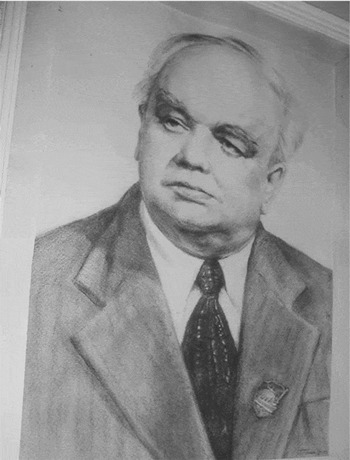
Political factors were also a consideration in the question of processing the accumulated data of the Soviet expeditions. The academic council recommended that the ARI and the expedition expedite the publication of preliminary reports of the expedition members (Gordienko and Burdikina Reference Gordienko and Burdikina1958a: 6). The acting director of the ARI Pavel Gordienko (1913–1982) (Fig. 6) and the secretary of the institute's Communist Party organisation L. Balakshin wrote to the deputy minister of the merchant fleet Aleksandr Afanasiev that the situation regarding data processing was critical and required a government decision. Afanasiev granted his approval for the director of the ARI, Vyacheslav Frolov, to edit and publish a journal entitled the Information Bulletin of the Soviet Antarctic Expedition (Afanasiev Reference Afanasiev1958a), the first issue of which was in August of that year. The last bulletin was published in 1999, although the editorial board has not been disbanded to this day. Gordienko and Balakshin further argued that the draft resolution of the USSR Council of Minister on the Antarctic that included the creation of an Antarctic Institute independent of the Arctic Institute was ‘untimely and economically unwarranted’ with the Leningrad city executive committee being ‘categorically against’ locating an institute in Leningrad. ‘[O]nly specific political considerations could contribute to a positive decision regarding such an Institute’ (Gordienko and Balakshin Reference Gordienko and Balakshin1958b). Instead, it suggested creating a large division capable of supporting all the goals of the Soviet Antarctic expedition, being either a branch or department of the ARI dedicated exclusively to Antarctic research and headed by the leaders of the complex Antarctic expedition. The academic council of the ARI met on 12 June 1958 and resolved that because the Antarctic had become an essential component of the research interests of the ARI, its name would be changed to the Arctic and Antarctic Research Institute (AARI) (Frolov Reference Frolov1958). This resolution formally to incorporate Antarctic research into permanent mainstream Soviet academia was ratified by a decree of the council of ministers on 25 June 1958 (AARI 1958) and demonstrated that Antarctic research would continue on a long term basis.
P. Gordienko. Portrait by S. Gesin (hanging at AARI).

A further major opportunity for the USSR to provide input for future Antarctic plans presented itself at the fifth general assembly of CSAGI held in Moscow 30 July – 9 August and at the second SCAR meeting (4–11 August) which was held in conjunction with the CSAGI assembly at the same venue. One of the four principal matters to be taken up by the assembly was the question of future international cooperation in geophysics at end of the IGY. The Soviet delegation, supported by the Peoples' Republic of China, Poland and the German Democratic Republic proposed that the IGY be extended for another year to complete IGY tasks that were not completed by the end of 1958, especially in the study of Antarctica, as well as extending cooperation to allow time to organise a permanent arrangement for such cooperation (Sullivan Reference Sullivan1961: 408–409). The Soviet proposal was optimistically positive in its assessment of the IGY, stressing that ‘[t]he IGY became a symbol of wide international co-operation based on mutual benefit. New forms of co-operation are being built on the foundation of World Data Centres, World Days Centres, etc’. The USSR was eager to continue the momentum of international collaboration and called on the countries involved ‘to expand the success of international scientific co-operation’ and to continue the IGY activities for one year until 31 December 1959 (CSAGI 1958). This proposal was referred to the advisory council for the IGY which recommended that the IGY should be succeeded by a programme of International Geophysical Co-operation 1959 in which all nations willing and able to continue their research would participate. The ICSU meeting in Washington in October 1958 endorsed this proposal (Chapman Reference Chapman1959: 108–109).
It is interesting that H. Newell from the US naval research laboratory in Washington DC, who was substituting for Lloyd Berkner in the coordinating role of CSAGI reporter for rockets and satellites at the Moscow assembly, reported that ‘[f]rom their position on this question . . . it appeared that the Soviet scientists need the IGY name and organization to help them maintain their position at home and their outside contacts and the freedom of intercourse that has been achieved so far. Apparently this need is a very urgent and demanding one in the opinion of the Soviet geophysicists and solar physicists’ (quoted in Sullivan Reference Sullivan1961: 409; Newell Reference Newell1959: 80). Newell's views are borne out by the fact that Somov and Burhanov were keen to expand ties with other countries by inviting their scientists to participate in the Soviet programme. They had, by this time, experienced the beneficial effects of having the American exchange meteorologists Gordon Cartwright on the second Soviet Antarctic expedition (Cartwright Reference Cartwright1958; Cartwright and Rubin Reference Cartwright and Rubin1961) and Morton Rubin on the third expedition (Rubin Reference Rubin2004) wintering at Mirny during the IGY. In Moscow at the SCAR meeting, the Soviets invited the Danish delegate to send a scientist on the next Soviet Antarctic expedition after the IGY (Herlofson Reference Herlofson1958). At their urging, Afanasiev prepared a draft resolution to include both a Polish and a Danish scientist in the forthcoming expedition, which he sent for approval to the central committee of the Communist Party of the Soviet Union. However, the central committee was not quite as enthusiastic as were Afanasiev, Somov and Burhanov to encourage fraternisation with western scientists and suggested that they find ways to ‘tactfully deny permission’ to the Danish scientist, but it was happy to approve the eastern bloc representative from Poland (Afanasiev Reference Afanasiev1958b). For the Australians, who continued to be wary of Soviet plans in the Antarctic, ‘the introduction of additional bloc scientists into Antarctic research is noteworthy, in view of persistent Soviet desires to broaden accession to the A[ntarctic] T[reaty] to be negotiated in October 1959’ (Miller Reference Miller1959).
The wariness of the Australian government was not allayed by the decision to continue international geophysical co-operation in 1959. It was placed in a situation in which the USSR was ‘presented with an “official” excuse to remain’ in the AAT (Sunday Times (Perth, Western Australia) 17 November 1957). The Australian government had previously ‘welcomed’ the Soviet scientists onto the territory it claimed on the Antarctic continent for the period of the IGY, even though the Soviets refused to acknowledge any claims (Gan Reference Gan2009). It had hoped that the Soviet scientists would leave at the conclusion of the IGY, but now felt the need to attempt once again to gain recognition of its claim by ‘conveying to the Government of the USSR their approval for the continuance of scientific research by Soviet scientists in the AAT’ (Brady Reference Brady1959). In agreeing to these activities, the Australian Government wished to make it clear that it reserved in its entirety the position in relation to the AAT (Brady Reference Brady1959). This Australian approval was certainly not in answer to any Soviet request for permission, since the USSR was insistent that it recognised no claims. The Soviet lawyer Movchan (Movchan 1959: 350) relates Khruschev's reply to the Australian Melbourne Herald correspondent as reported in the 23 June 1958 newspaper who asked the Soviet leader to comment on the alarm about Australian sovereignty caused by the Soviet request ‘to prolong the Russian scientists’ stay in the Antarctic. Khruschev told the journalist that his question ‘seems to be based on a misunderstanding. We have not made any such request to anyone’: the USSR had never requested Australian permission to conduct research in the Antarctic. He explained that the continuing Soviet presence on the icy continent was decided ‘at the meeting of the special committee on Antarctic investigations under the International Council of Scientific Unions, held at The Hague in February this year . . .’ (Department of External Affairs 1958) not on the permission of a claimant whose claims were not recognised by either the USSR or the USA. Moreover, he reiterated the Soviet position that ‘according to international practice, all interested countries should take part in discussing the question of jurisdiction over any area of international importance. The Soviet Government considers that this international practice should be followed in deciding the question of jurisdiction over the Antarctic’ (Department of External Affairs 1958).
Meanwhile, at the SCAR meeting in Moscow (4–11 August 1958) the USSR reported that it was in the process of forming a new national Antarctic committee, since Australia, Belgium, France, Japan, New Zealand, South Africa had already formed their own. The USA had a polar committee that would act as a national Antarctic committee for the purposes of SCAR. The USSR intended to continue operations at existing bases, close Pionerskaya, reduce work at Oasis (which was actually decommissioned on 17 November 1958 before being transferred to the Polish Academy of Science on 23 January 1959 and renamed Dobrovolski in honour of the Polish geophysicist and Antarctic explorer (Machowski 1977: 132 – 133)) and to move Sovetskaya to the pole of inaccessibility in October or November 1958. A traverse from Vostok to the South Pole and back to Sovetskaya was also planned, as well as establishing small bases south of the Bellingshausen Sea and Dronning Maud Land which would assist the transcontinental traverse planned for the future (SCAR 1959a: 363–364). The Soviet intention to set up a small base on the Bellingshausen coast raised questions as to whether motivations of a political nature lay behind this. The Australians in particular were unsure of Soviet intentions: they recognised that they ‘may indicate a Soviet desire to establish some connection between present Soviet scientific work in the Antarctic and the explorations of Bellingshausen early in the 19th century, with a view to an eventual Soviet claim to territory in the sector’ (Department of External Affairs 1959). Overall, however, the Australians now acknowledged that it was important ‘to ensure the continuation of international scientific programmes in Antarctica which had proved so effective during the IGY and to foster the admirable spirit of international friendship and co-operation which had grown up. The establishment of SCAR placed Antarctic research on a firm long-term footing for the first time in Polar history’ (Gunson Reference Gunson, Greenwood and Harper1963: 396).
Among other investigations proposed by the USSR at the SCAR meeting was a comprehensive, coordinated mapping programme with various nations co-operating to produce a map of Antarctica on a scale of 1:3,000,000 (SCAR 1959a: 365) with the aid of aero photography. Australia revealed its insecurity with regard to the Soviet proposal by attempting to stall this initiative, which would allow the Soviets to utilise their superior logistic capabilities to map the AAT on which they had built their bases. The AAT had not yet been extensively mapped by the Australians and their claim to the territory may have been significantly weakened if the Soviets were the ones responsible for producing a map of the territory. K. Bullen, the Australian delegate, declared that he was unable to discuss the matter without his government's approval. The majority of the other delegates, however, agreed to the proposal (Burhanov Reference Burhanov1958) and Australia had no alternative but to accept the formation of a cartography working group under the chairmanship of Georges Laclavère. Australia not only resigned itself to the Soviet proposal, but was host to the third SCAR meeting in Canberra on 2–6 March 1959, at which the Soviet delegate Somov and his adviser Boris Dzerdzeyevsky gave impetus to the proposal by asking that preparation of the 1:3,000,000 map of Antarctica be begun without delay (SCAR 1959b: 593; Somov Reference Somov1959: 32). Ironically, the Australian director of national mapping, Bruce Lambert, was appointed to the new post of permanent secretary of the working group on cartography (Gunson Reference Gunson, Greenwood and Harper1963: 397).
Conclusion
The eagerness with which the USSR embraced US initiatives in international scientific collaboration and introduced its own was a consistent policy thread followed by the USSR as a consequence of its determination to settle the political question of an international regime for the Antarctic. The goodwill engendered by such international collaboration had provided the USSR with a mechanism for continuing to engage in high quality research in the Antarctic, and the means by which to extend and maintain a significant presence in the region. This meant that it had become impossible to exclude the USSR from any scientific, and ultimately from any political, discussions about the future of the Antarctic as the US had attempted to do with its proposal for the internationalization of Antarctica in 1948 (Gan in press). As regards the scientific discussions, enthusiastic Soviet support for the short term CSAGI and the long term SCAR had given the USSR a substantial voice in formulating research programmes in the Antarctic. Although the SCAR was merely a scientific body that wielded no executive power, it became the instrument which could ‘ensure the continuation of the co-ordination of international scientific programmes in Antarctica which had proved so effective during the IGY . . .’ (Gunson Reference Gunson, Greenwood and Harper1963: 396).
The creation of such an instrument had repercussions which extended much wider than the world's scientific community. Gunson contends that ‘the fact that world scientists consider the Antarctic such an important field for scientific research has had a powerful influence on political thinking’ (Gunson Reference Gunson, Greenwood and Harper1963: 396). Thus, the ICSU decision to create the SCAR was pivotal in accelerating and focussing the political processes that would lead to an international agreement on the Antarctic. Hall correctly considers that the Soviet announcement in Stockholm regarding the USSR's continuing presence in the Antarctic was ‘a crucial turning point on the path toward a conference on Antarctica and, ultimately, an Antarctic agreement’ (Hall Reference Hall1994: 154). His view is confirmed by Soviet international law expert Vladimir Golitsyn, who writes more generally that the international cooperation achieved during the IGY had laid the groundwork for both the creation of the SCAR and indeed of a future agreement on the Antarctic (Golitsyn Reference Golitsyn1983: 37).
And of course the answer to the rhetorical question of whether the Soviets would ‘abandon Mirny to the penguins after 1959 . . . or will they stay?’ was becoming more and more obvious. The stake that the Soviets had placed on science to achieve their Antarctic political interests was paying dividends, and they believed that they should continue to play their winning card. While relaxing in Sydney after the conclusion of the third SCAR meeting in Canberra, the Soviet delegate Dzerdzeyevsky was able to finally show his hand to the journalist who had originally posed the question: ‘[a]s long as there is need for scientific investigation, the Soviet expedition will be in Antarctica . . .’ (Burke Reference Burke1959).
Acknowledgments
I would like to thank the anonymous referees of this paper for their helpful suggestions and comments. I am grateful to my supervisor from the School of Government of the University of Tasmania, Robert Hall for allowing me to use documents from his collection and to Graeme Watt from the library of the Australian Antarctic Division (AAD), Kingston, Tasmania for his constant and cheerful willingness to assist in finding my way around the AAD collection. My sincere gratitude to Leonid Dolgushin and his wife Veronika Filatova from Moscow for sharing experiences, films and photographs of the first SAE and welcoming me to their home.