1. INTRODUCTION
Nowadays, a wide range of technologies have been developed for controlling the temperature in the cutting zone. Among other methods of cooling and lubricating, such as flood cooling, minimum quantity lubrication, cryogenic cooling, and so on, high-pressure cooling is becoming more popular every day. High-pressure jet assisted (HPJA) turning presents an innovative method of lubricating and/or cooling the cutting zone during machining. The high-speed fluid allows a better penetration of the fluid into the chip–tool and workpiece–tool interfaces, thus providing a better cooling effect and a decrease in tool wear together with an extension of the operational area for a given tool–material pair (Kramar & Kopac, Reference Kramar and Kopac2009). Additional advantages are reduction of the tool–chip contact length/area and effective chip breaking (Ezugwu & Bonney, Reference Ezugwu and Bonney2004; Kramar & Kopac, Reference Kramar and Kopac2009). Different approaches were taken to model the HPJA process. Mohd Hadzley et al. (Reference Mohd Hadzley, Izamshah, Siti Sarah and Nurul Fatin2013) performed a study on a finite element model of HPJA turning of titanium alloy, and Courbon et al. (Reference Courbon, Sajn, Kramar, Recha, Kosel and Kopac2011) used the same methodology for Inconel 718 machining. Empirical modeling of HPJA machining of Inconel 718 using Taguchi DOE analyses has been carried out by several authors (Courbon et al., Reference Courbon, Kramar, Krajnik, Pusavec, Rech and Kopac2009; Sekulic et al., Reference Sekulic, Kopac, Gostimirovic and Kramar2013; Yünlü et al., Reference Yünlü, Çolak and Kurbanoğlu2014), but no literature can be found on modeling of HPJA with artificial intelligence.
The surface quality is one of the most significant characteristics of modern production that could influence the performance of mechanical parts and the production costs. Surface quality is defined by the combination of surface finish, surface texture, and surface roughness, where the major indication of surface quality on machined parts is surface roughness (R a). Surface roughness is important for improving the tribological properties, corrosion resistance, and fatigue behavior (Trdan & Grum, Reference Trdan and Grum2014). Furthermore, a reasonably good surface finish is necessary to meet growing customer requirements for quality and aesthetic appeal of the product. Surface roughness is influenced by different machining parameters, such as spindle speed, feed, depth of cut, workpiece material characteristics, machine tool vibration, tool material, and lubrication pressure.
The surface roughness prediction strategy has been developed using mathematical modeling based on physics of process, multiple regression, artificial neural networks, and fuzzy logic. Among these, due to complexity and nonlinearity of the machining processes, soft computing techniques are being preferred for prediction of the performance parameters of machining as well as for the optimization of the process (Chandrasekaran et al., Reference Chandrasekaran, Muralidhar, Krishna and Dixit2010; Chandrasekaran & Devarasiddappa, Reference Chandrasekaran and Devarasiddappa2014).
Apart from artificial neural networks, the fuzzy logic approach has been widely used in modeling and optimization of turning processes in general and surface roughness in particular. A fuzzy-based methodology has been proposed by Fei and Jawahir (Reference Fei and Jawahir1992) for predicting the achievable levels of surface roughness in finish turning operations. In this work, a set of rules was generated from human expert knowledge, and a new methodology for predicting surface roughness values for a given set of cutting conditions, work materials, tool insert types, and tool geometries is proposed. Rajasekaran et al. (Reference Rajasekaran, Palanikumar and Vinayagam2011) used the fuzzy modeling approach to predict the surface roughness values and to examine the influence of machining parameters combination to obtain a good surface finish in turning of the CFRP composite by a cubic boron nitride cutting tool. In this study, the input variables considered are cutting speed, feed rate, and depth of cut, and the output variable is surface roughness. The results indicate that the fuzzy logic modeling technique can be effectively used for the prediction of surface roughness.
A number of authors have used the combination of fuzzy logic with other soft computing methods as an effective strategy for the prediction of surface roughness. Jiao et al. (Reference Jiao, Lei, Pei and Lee2004) used a fuzzy adaptive network for the prediction surface roughness in turning operations. The developed network is capable of providing both the learning ability of a neural network and a linguistic representation of a complex, not well-understood, and vague phenomenon. Abburi and Dixit (Reference Abburi and Dixit2006) developed a knowledge-based system using a neural network and fuzzy set theory to predict surface roughness in turning. The neural network is trained with knowledge acquired from the shop floor, and as a result, the trained network provides a huge data set, which is fed to a fuzzy set based rule generation module. The developed rule base is used for predicting surface roughness for given process variables as well as for the prediction of process variables for a given surface roughness. Roy (Reference Roy2007) designed an adaptive network-based fuzzy inference system to establish the relationship between cutting parameters and surface roughness in turning, and consequently to predict surface roughness using input cutting parameters, namely, cutting speed, feed, and depth of cut. Nandi and Pratihar (Reference Nandi and Pratihar2004) developed an expert system based on the fuzzy basis function network to predict surface finish in ultraprecision turning. An approach for automatic design of rule base and the weight factors for different rules is developed using a genetic algorithm (GA). Roy (Reference Roy2006) developed an expert system using two soft computing tools, namely, fuzzy logic and a GA, for prediction of surface roughness in ultraprecision diamond turning of a metal matrix composite. The predicted surface finish values obtained from an expert system were compared with the experimental data, and results indicates that the proposed system can be effectively used for the prediction of surface finish in diamond turning. Nandi (Reference Nandi2006) designed the Takagi–Sugeno–Kang type fuzzy logic controller using a combined linear regression and a GA for surface roughness prediction in ultraprecision turning. The results of the proposed approaches are compared with the empirical expression, which is not accurate, as well as real experimental data to predict surface roughness in ultraprecision turning. A gravitational search algorithm was recently applied for modeling of a turning process with multiple responses (cutting force, surface roughness, and tool life) by Hrelja et al. (Reference Hrelja, Klancnik, Balic and Brezocnik2014a). They also used the particle swarm optimization (PSO) approach for modeling a turning process (Hreja et al., Reference Hrelja, Klancnik, Irgolic, Paulic, Jurkovic, Balic and Brezocnik2014b).
A review of the literature shows that not much work is reported on artificial intelligence modeling surface roughness in HPJA turning. This can be ascribed to the large number of interrelated parameters (cutting speed, feed, pressure of the jet, diameter of the nozzle, etc.) that influence the surface roughness and make it extremely difficult to develop a proper model. With all of the viewpoints above, the objective of this study is to examine the influence of five HPJA parameters [diameter of the nozzle (D n), pressure of the jet (p), cutting speed (v c), feed (f), and distance between the impact point of the jet and the cutting edge (d)] on surface roughness and to develop a fuzzy expert system for predicting surface roughness in HPJA turning. Furthermore, in order to improve the performance of a developed fuzzy expert system, optimal fuzzy system is constructed using a GA and PSO.
2. EXPERIMENTAL DETAILS
The experimental work was carried out at the Laboratory for Machining, Faculty of Mechanical Engineering, in Ljubljana. The experiments were conducted in a longitudinal turning process on a conventional lathe, fitted with a Hammelmann high-pressure plunger pump of 150 MPa pressure and 8 L/min capacity. The fluid used was Vasco 5000 cooling lubricant from Blaser Swisslube, Inc., a 5.5% emulsion without chlorine on the basis of vegetable oil mixed with water (pH 8.5–9.2). All experiments were carried out using the nickel-based alloy Inconel 718 supplied as bars (145 mm diameter × 300 mm length) with hardness between 36 and 38 HRC. A PVD TiAlN-coated carbide tool (grade P25, SNMG 12 04 08–23, Sandvik) was chosen.
An orthogonal array L27 has been used for design of experiments (DOE). The experiments were carried out for different combinations of the following HPJA turning parameters at three levels: diameter of the nozzle D n (0.25, 0.3, and 0.4 mm), pressure of the jet p (50, 90, and 130 MPa), cutting speed v c (46, 57, and 74 m/min), feed f (0.2, 0.224, and 0.25 mm/rev), and distance between the impact point of the jet and the cutting edge s (0, 1.5, and 3 mm), while depth of cut a p = 2 mm was kept constant. Cutting speed and feed are conventional machining parameters. Other, so-called hydraulic parameters, such as pressure, nozzle diameter, and jet impact point position, were chosen because they influence on performance of this hybrid machining process. The pressure gives kinetic energy to the jet, and together with nozzle diameter, defines the volume rate of the coolant, which is important for chip braking and cooling capability. The jet impact point is important to assure both breaking and cooling efficiency. The values of these parameters were selected according to the previous studies reported by Courbon et al. (Reference Courbon, Kramar, Krajnik, Pusavec, Rech and Kopac2009).
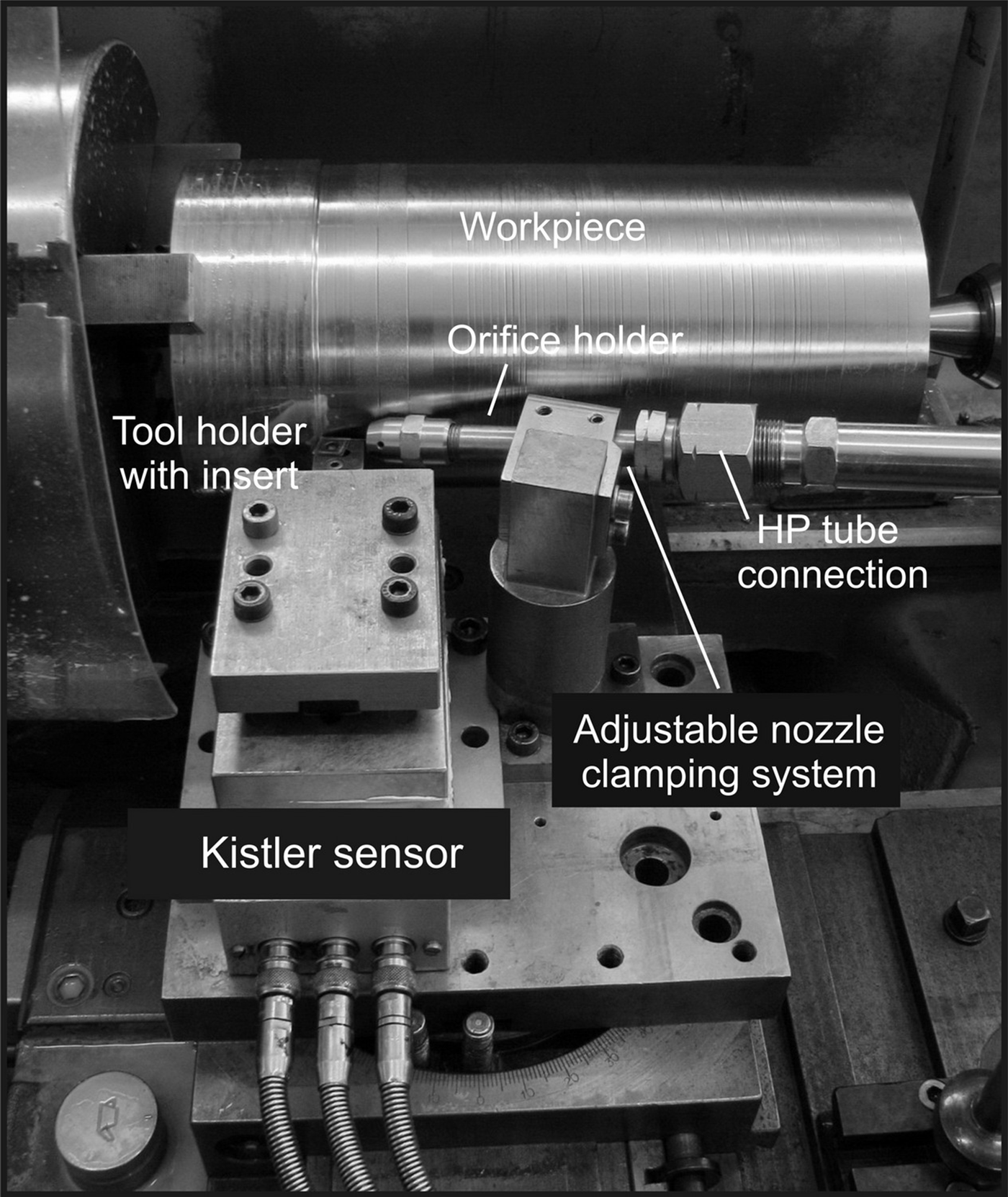
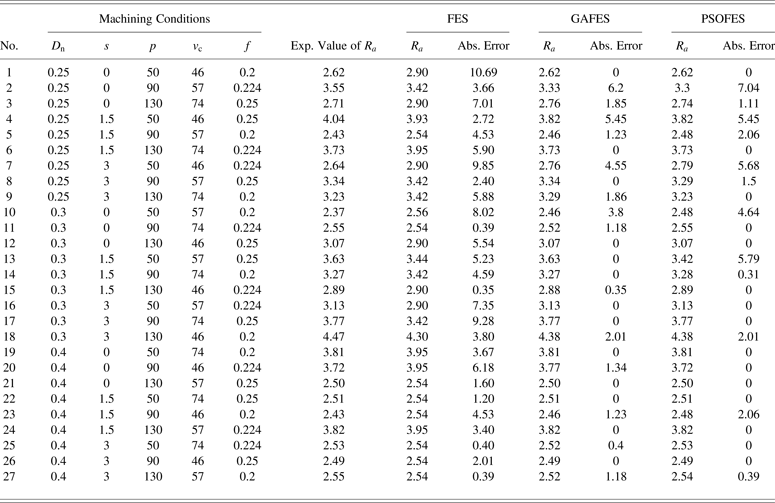
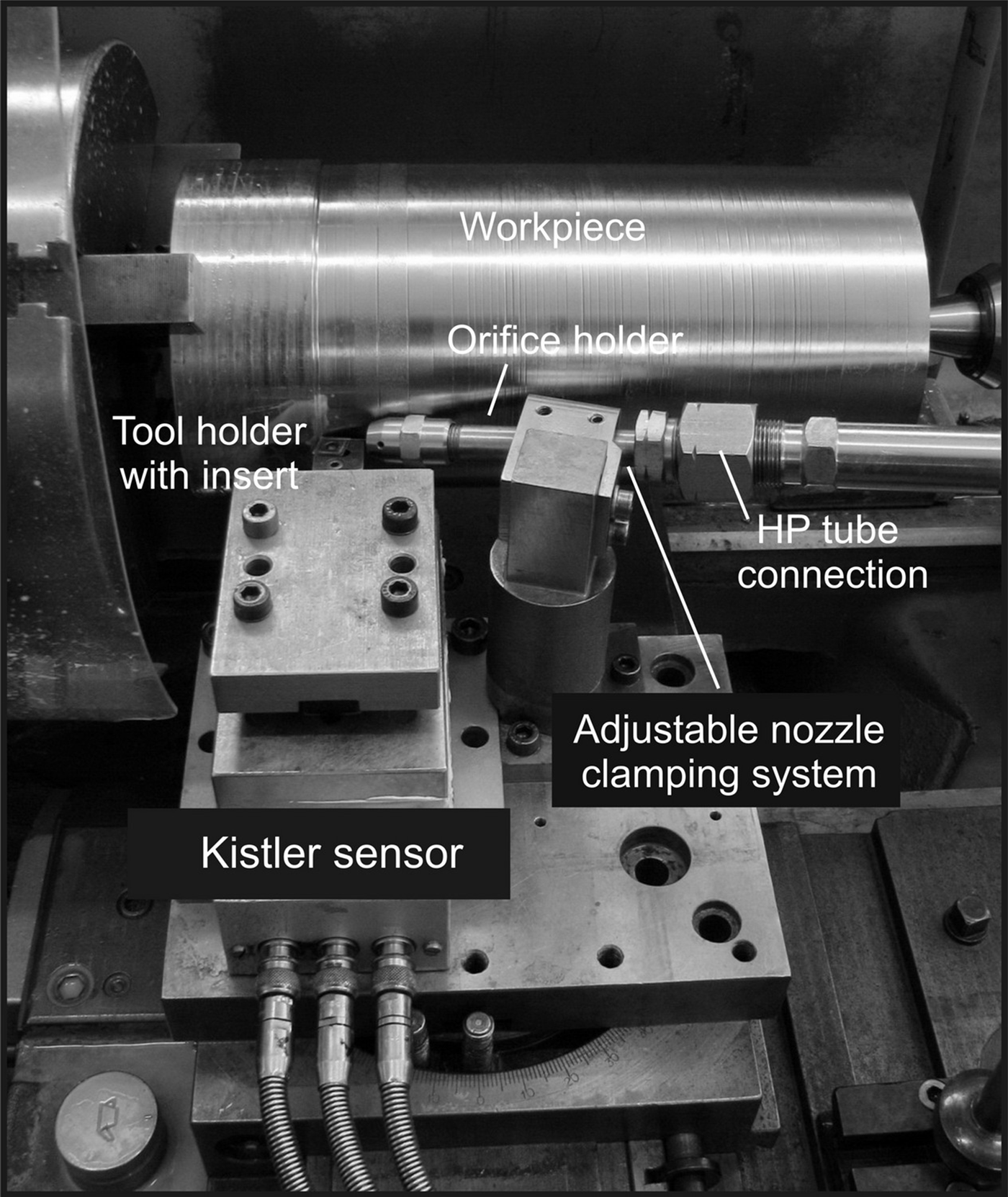
The surface roughness was measured with a stylus type instrument (Mitutoyo-Surftest SJ-301). The surface roughness response is the average reading of three consecutive measurements. The experimental setup is shown in Figure 1, and the DOE and measured results are provided in Table 1.
Experimental setup.
Machining conditions and comparison between predicted surface roughness values (Ra) and experimental results
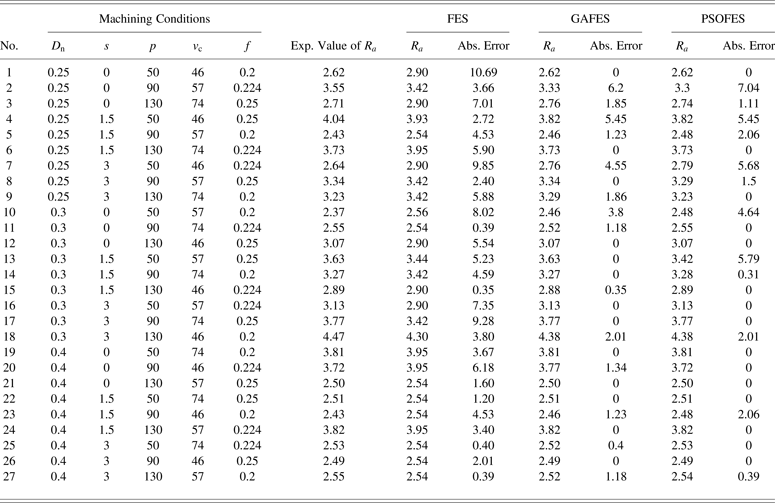
Note: D n, Nozzle diameter; s, distance between the impact point of the jet and the cutting edge; p, pressure; v c, cutting speed; f, feed; FES, fuzzy expert system; GAFES, genetic algorithm based FES; PSOFES, particle swarm optimization based FES.
3. DEVELOPMENT OF FUZZY EXPERT SYSTEMS
Fuzzy logic is one of the most successful of today's technologies for developing rule-based expert and sophisticated control systems. Fuzzy logic methodology has found particular application in industrial systems and applications that are very complex and cannot be modeled precisely even under various assumptions and approximations, because it has the advantage of the relatively simple mathematical calculations in linguistically specified terms instead of complicated equations used in the conventional methods.
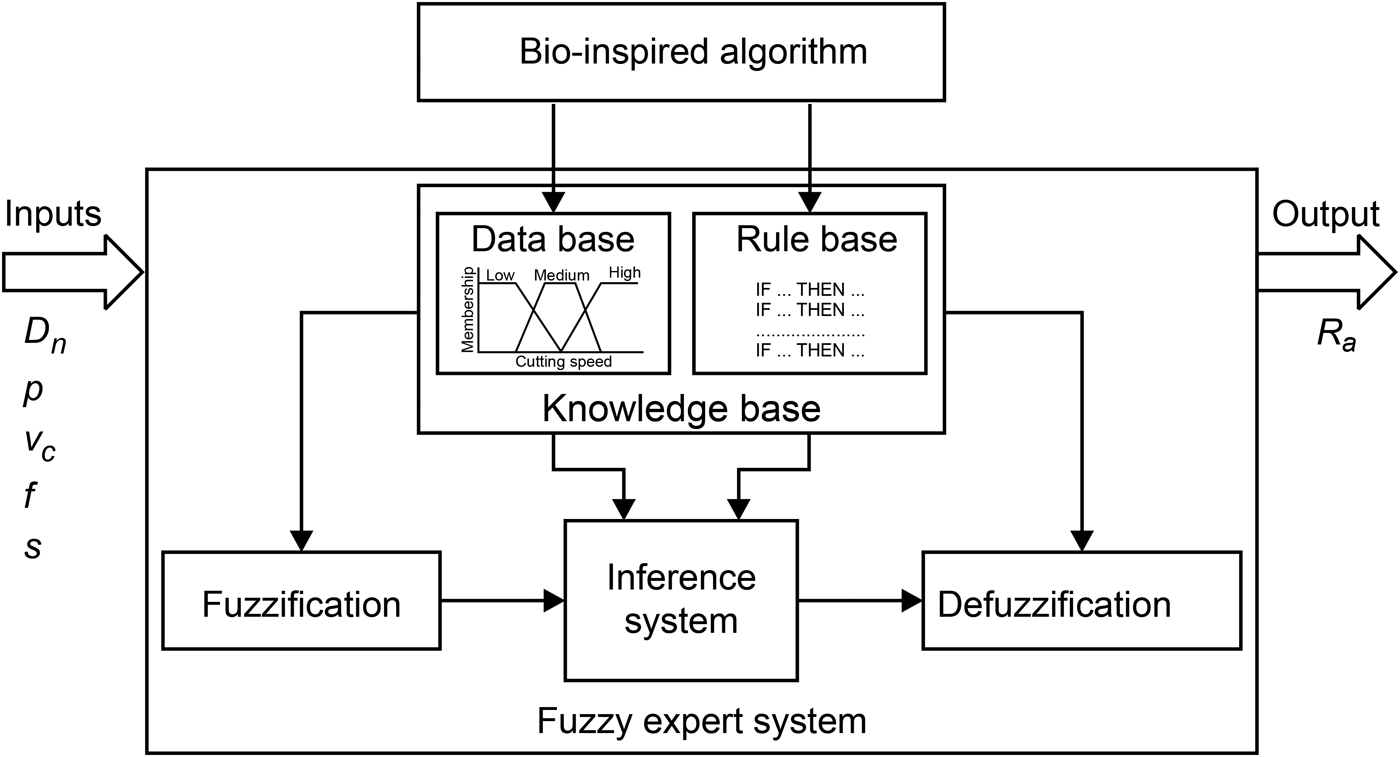
The basic structure of a fuzzy inference system can be considered to be composed of several functional blocks described as follows: a rule base containing the fuzzy if–then rules, a database that defines the membership functions (MFs) of the fuzzy sets used in the fuzzy rules, a decision-making unit that performs the inference operations on the rules, a fuzzification interface that transforms the numerical input variables into fuzzy variables with linguistic labels, and a defuzzification interface that transforms the fuzzy results of the knowledge base in combination with the results of the decision-making unit into a numerical output variables (Fig. 2). A Mamdani-type fuzzy inference system is used in this paper, due to the intuitive and interpretable nature of the rule base and because of its relatively simple structure.
A schematic diagram showing genetic algorithm/particle swarm optimization trained fuzzy expert system.

The objective of fuzzy logic is to define the relationships between input and output variables and estimate the parameters of the model; some implications are needed to be defined in the form of rules. The fuzzy rule based system uses rules defined in the form of if–then logical statements, given by, if antecedent, then consequent. The general form of the fuzzy rule base system with multiple inputs and one output is
Rule 1: If x 1 is A 1 and x 2 is B 1 and . . . and x n is V 1, then y is W 1.
Rule 2: If x 1 is A 2 and x 2 is B 2 and . . . and x n is V 2, then y is W 2.
Rule n: If x 1 is A n and x 2 is B n and . . . and x n is V n, then y is W n,
where x i (i = 1, 2, . . . , n) are input variables that describe the state of the process; y is the output variable; and A i, B i, . . . , W i are the linguistic terms used for the fuzzy subsets of the corresponding input and output variables.
Although the usual approach to design a fuzzy system is to encode expert knowledge in a direct and easy way using rules with linguistic labels, problems can appear because the performance of a system depends on the a priori knowledge of the human expert. Furthermore, wrong fuzzy rules or inadequate MFs and their boundaries make significant impacts on the final performance of the fuzzy expert system. In order to eliminate these drawbacks, there has been a sustainable amount of research done in the field of applying automatic tuning techniques to fuzzy expert systems. Because bioinspired algorithms have been shown effective in improving tuning the parameters and learning the rule base, we focus on a GA and PSO as methods for improving the performance of fuzzy expert systems (Fig. 2). Once trained, the GA and PSO-trained fuzzy expert systems will be able to predict surface finish in HPJA turning of Inconel 718 before conducting a real experiment.
3.1. Fuzzy rule based expert system
In this study, the authors were to design the rule base and database of the fuzzy expert system, based on their knowledge of the HPJA turning. The first step in the design of a fuzzy logic system is definition of fuzzy variables and selection of appropriate MFs. The input variables are diameter of the nozzle, pressure of the jet, cutting speed, feed, and distance between the impact point of the jet and the cutting edge, while the output variable is surface roughness. The situations of uncertainties in fuzzy logic are defined via giving appropriate MFs to the input and output variables. The MF associates a weighting with each of the inputs, defines functional overlap between them, and ultimately determines an output response.
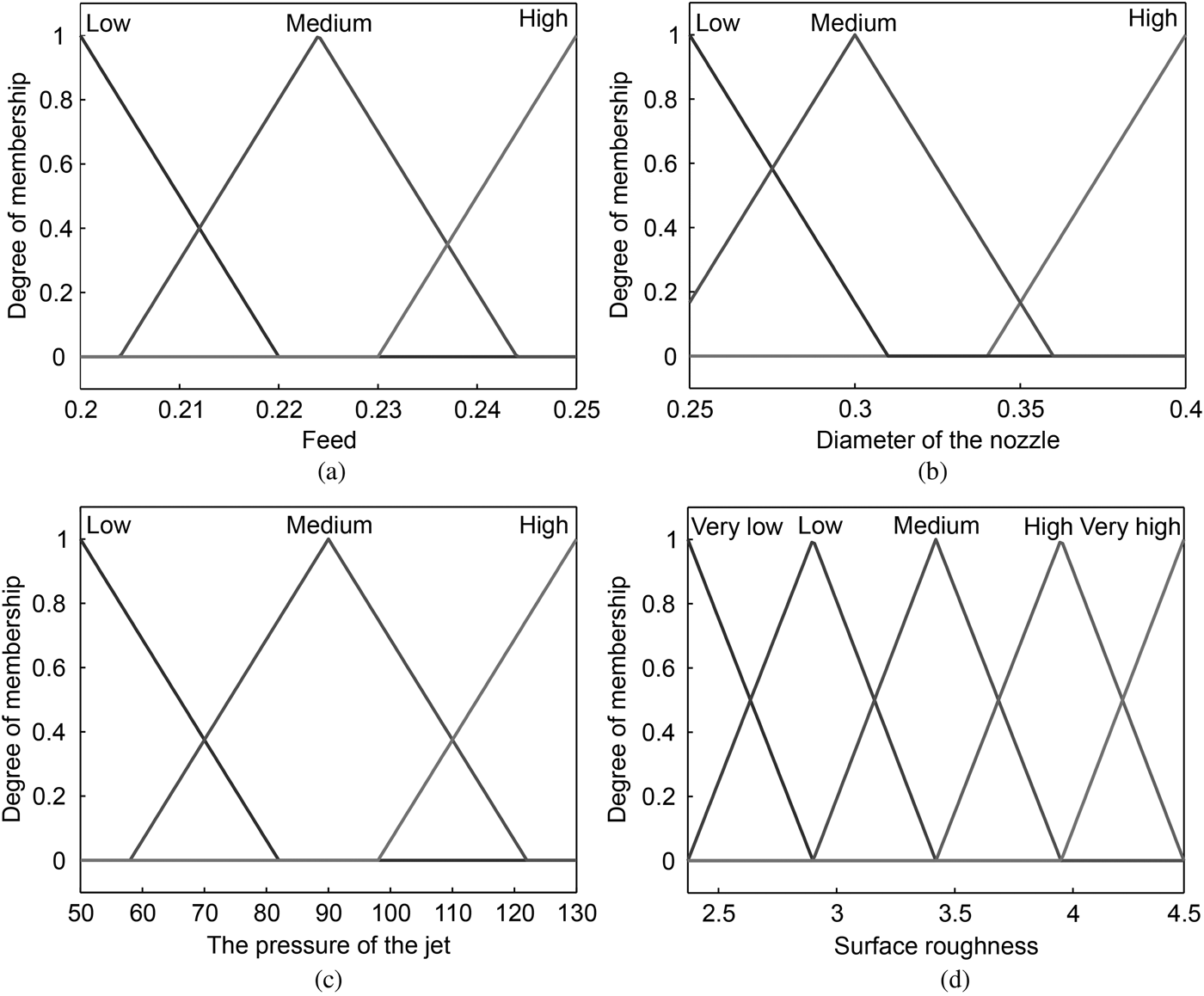
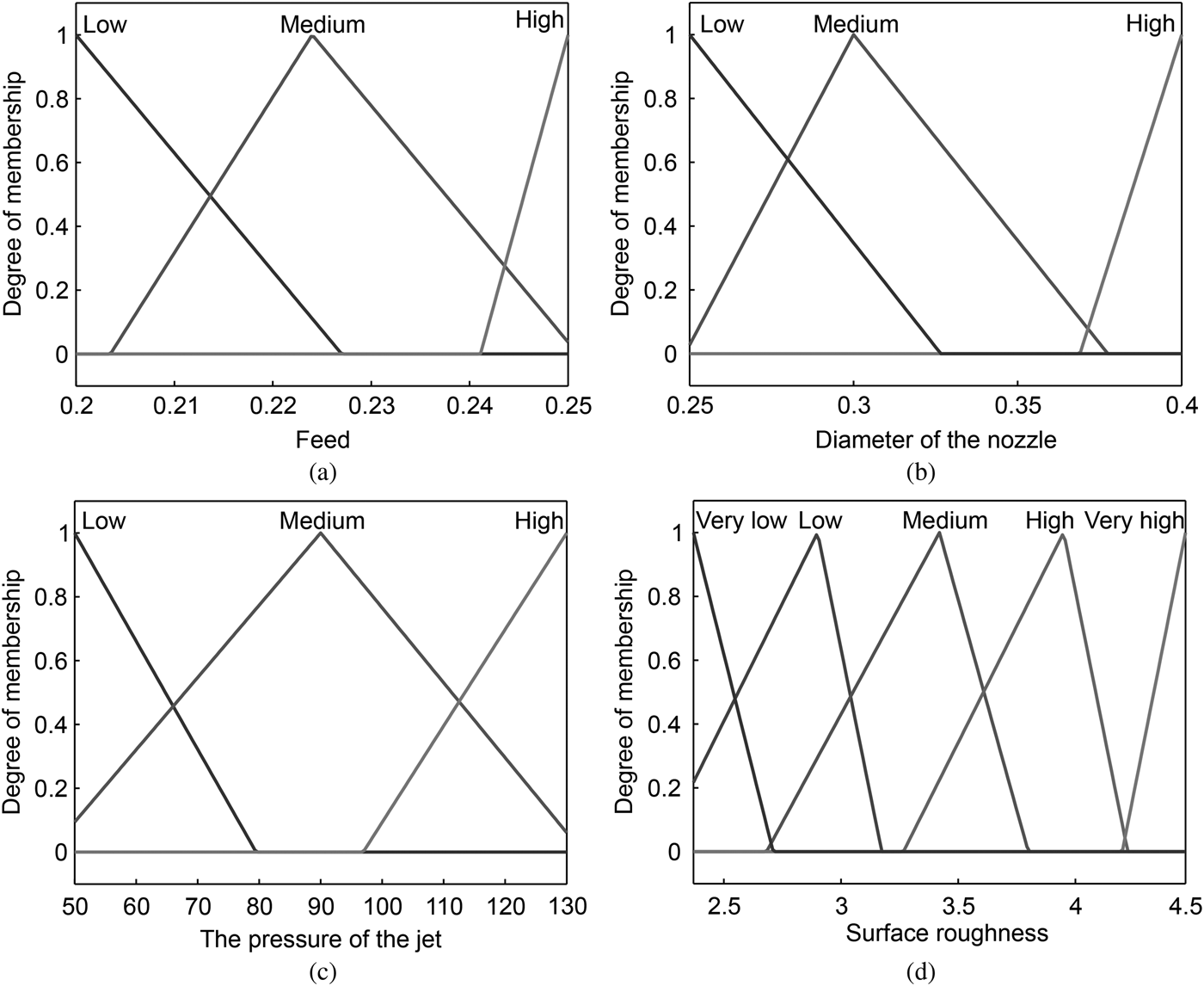
In this fuzzy expert system, diameter of the nozzle, pressure of the jet, cutting speed, feed, and distance between the impact point of the jet and the cutting edge have three MFs labeled low, medium, and high. The output parameter, that is, surface roughness, has five MFs with labels very fine, fine, medium, coarse, and very coarse. A triangular shape of a MF is employed to describe the fuzzy sets for input and output variables. The input variables have been partitioned according to the experiment parameter ranges. Some of the MFs for the fuzzy set input variables are shown in Figure 3a–c. The MF used for the output surface roughness fuzzy set is presented in Figure 3d. In the next step, fuzzy rules are formulated to establish the relationship between the input and the output in a fuzzy system. A fuzzy rule based model has been developed from the experimental data for correlating the machining parameters with surface roughness. The number of fuzzy rules is related to the number of fuzzy sets for each input variable. Because there are five inputs of the fuzzy expert system, which are all classified into three fuzzy sets, the maximum number of rules for this system is 243. When the number of fuzzy rules is large, the system takes more time to produce output because of the large number of computational steps and may require large memory space. Thus, if it possible to approximate the output of the fuzzy expert system without increasing the rules, and then the overall system architecture is simplified, and reduces computational steps and memory space requirements. From these reasons, only 27 of the 243 possible rules are selected for constructing the rule base.
Membership functions for (a) feed, (b) diameter of the nozzle, (c) the pressure of the jet, and (d) surface roughness.
Once all of the fuzzy rules are defined, it is possible to examine performance of the fuzzy system. Furthermore, the expert can perform tuning of the parameters of the fuzzy rules and adjust the shape of MFs through bioinspired algorithms in order to design an optimal fuzzy system.
3.2. GA based fuzzy expert system
GAs are a very popular tool to solve wide types of searching and optimization problems that use principles inspired by natural genetics to evolve solutions to problems. GAs are especially useful for complex optimization problems where the number of parameters is large and the analytical solutions are difficult to obtain. It simulates the evolutionary principle of survival of the fittest by combining the best solutions to a problem in many generations to gradually improve the result. The initial population of solutions is created randomly, and as the evolution goes, the best individuals are combined in each generation until an optimal solution converges. At each iteration, the population is updated (usually) through three important operators: selection, crossover, and mutation.
Reproduction is the first genetic operator applied on a population. It is a process in which copies of the strings are copied into a separate string called the “mating pool,” according to their fitness values; that is, the strings with a higher fitness value have a higher probability of contributing one or more offspring in the next generation. The reproduction operator is also called a selection operator. A reproduction operator can be implemented in algorithmic form in a number of ways, such as proportional selection, tournament selection, truncation selection, roulette wheel selection, and ranking selection.
A crossover operator is applied to the mating pool to generate new individuals. This operator is applied to the population to hopefully create better strings. The strings to be crossed and the crossing points are selected randomly, and crossover is done with a crossover probability, which is the ratio of total strings selected for mating and the population size. The crossover operator is mostly responsible for the search aspects of a GA.
Mutation is the occasional random alteration of the value of a string position. By introducing a mutation operator into the GA, diversity in the population is ensured. The role of a mutation operator is to provide and guarantee that the search algorithm is not trapped on a local optimum.
This way of seeking completely different solutions allows the algorithm to potentially fall into more promising regions. The GA has a mutation probability, which dictates the frequency at which mutation occurs.
A GA procedure ends when it reaches a certain number of generations or when no more improvement of populations can be obtained. A GA covers different levels of complexity, from parameter optimization to the automatic generation of the knowledge base of a fuzzy expert system.
The focus of this study is to employ a GA for optimization of an already existing fuzzy rule based system through a genetic tuning process. The main idea is the definition of parameterized MFs and the subsequent adaptation of parameters by the GA according to a fitness function that specifies the design criteria in a quantitative manner. Because the triangular shape of MFs is employed to describe the fuzzy sets for input and output variables, optimization of MF distributions is reduced to changes of the base widths. Furthermore, fuzzy rule weights are also optimized by a GA. After obtaining the optimal result, the parameter value will be optimized by a GA and will be used to build the whole new fuzzy MF.
As Figure 2 shows, the fuzzy system lies at the core of the hybrid structure. The fuzzy system fuzzifies the input state, performs the inference based on the fuzzy rules, and aggregates the result of the inference process into a crisp output, while a GA is used to improve the performance of the fuzzy system by the tuning process. In order to achieve the best performance of a GA, a parametric study is carried out to determine the optimal set of GA parameters.
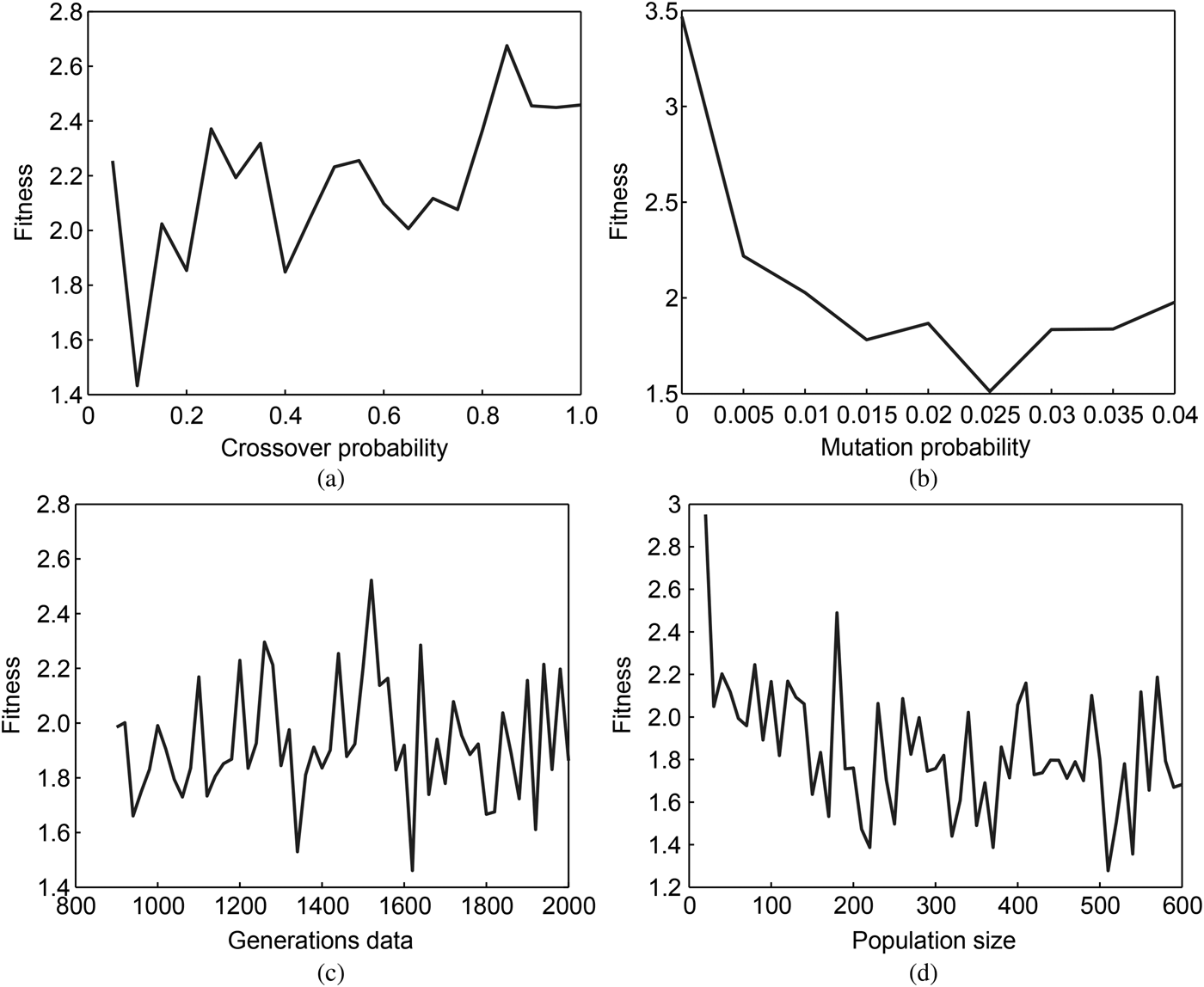
A parametric study is carried out so that the value of one parameter is varied at a time, while other parameters have fixed values. The crossover probability is changed in the range of 0.01–0.99, while the values of the other parameters (mutation probability, maximum number of generation, and population size) have been kept fixed to 0.01, 1000, and 100, respectively. The best result is observed with the uniform crossover probability of 0.1, and this value has been used for the remaining part of the parametric study. Then the mutation probability is varied from 0.005 to 0.03, keeping the crossover probability, maximum number of generations, and population size fixed to 0.1, 1000, and 100, respectively. The GA yields the minimum value of the fitness corresponding to the mutation probability of 0.025. In the next stage, the maximum number of generations has been varied in the range of 900 to 2000, while the crossover probability, mutation probability, and population size are kept fixed to 0.1, 0.025, and 100, respectively. The optimal value of the fitness is found to occur corresponding to the maximum number of generation size of 1620. Finally, the population size has been varied from 50 to 600, after keeping the other parameters (crossover probability, mutation probability, and maximum number of generations) fixed to their optimal values. The GA yields the minimum value of the fitness corresponding to the population size of 510. Thus, the optimal values of crossover probability, mutation probability, number of generations, and population size are 0.1, 0.025, 1620, and 510, respectively. The results of the parametric study are shown in Figure 4.
Results of sensitive analysis to determine the genetic algorithm parameters.
3.3. PSO based fuzzy expert system
PSO is one of the population based optimization algorithms based on natural flocking and swarming behavior of birds. There has recently been a huge interest in PSO due to its great potential as a bioinspired algorithm for resolving the nonsmooth global optimization problems. Very similar to the GA, PSO algorithms are initialized with a group of a randomly generated population and have fitness values to evaluate the population. Furthermore, both algorithms update the population and search for the optimum with random techniques. However, PSO does not have genetic operators like mutation and crossover. The standard PSO model consists of a swarm of particles, moving interactively through the problem space to find new solutions. When compared to a GA, PSO has a simpler concept and easier implementation.
The PSO algorithm is initialized with a population of random candidate solutions called particles. The position of the ith particle in the d-dimension solution space at iteration k is denoted as
 $${\bf x}_i \lpar k \rpar = \lcub {x_{i\comma 1} \lpar k \rpar \comma \; x_{i\comma 2} \lpar k \rpar \comma \; . \,. \,.\,\comma \; x_{i\comma d} \lpar k \rpar } \rcub .$$
Let
 $${\bf \hat y}_i \lpar k \rpar = \lcub {\hat y_{i\comma 1} \lpar k \rpar \comma \; \hat y_{i\comma 2} \lpar k \rpar \comma \; . \,. \,.\,\comma \; \hat y_{i\comma d} \lpar k \rpar } \rcub $$
represent the best position found by particle i up to iteration k, and let
 $${\bf \tilde y}\lpar k \rpar = \lcub {\tilde y_{i\comma 1} \lpar k \rpar \comma \; \tilde y_{i\comma 2} \lpar k \rpar \comma \; . \,. \,.\,\comma \; \tilde y_{i\comma d} \lpar k \rpar } \rcub $$
be the best position found by any of the particles in the neighborhood of xi up to iteration k. The new position of particle i in iteration k + 1, xi (k + 1), is computed by adding a velocity,
 $${\bf v}_i \lpar {k + 1} \rpar = \lcub {v_{i\comma 1} \lpar {k + 1} \rpar \comma \; v_{i\comma 2} \lpar {k + 1} \rpar \comma \; . \,. \,.\,\comma \; v_{i\comma d} \lpar {k + 1} \rpar } \rcub \comma \;$$
to the current position xi (k):
 $${\bf x}_i \lpar {k + 1} \rpar = {\bf x}_i \lpar k \rpar + {\bf v}_i \;\lpar {k + 1} \rpar.$$
The components of vi(k + 1) are computed as follows:
 $$\eqalign{ {v_{i{\rm \comma }j}}\lpar {k + 1} \rpar &= {\rm \omega} {v_{i{\rm \comma }j}}\;\lpar k \rpar + {c_1}{r_{1{\rm \comma }j}}\;\lpar {{{\hat y}_{i{\rm \comma }j}}\lpar k \rpar - {x_{i{\rm \comma }j}}\lpar k \rpar } \rpar \cr & \quad + {c_2}r_{2{\rm \comma \; }j}\lpar {{{\tilde y}_j}\lpar k \rpar - {x_{i{\rm \comma }j}}\lpar k \rpar } \rpar {\rm \comma \; }}$$
where j designates a component in the search space; ω represents the inertia weight, which decreases linearly from 1 to near 0; c 1, and c 2 are cognitive and social parameters, respectively, known as learning factors; and r 1,j and r 2,j are random numbers uniformly distributed in the range [0, 1]. The inertia weight component causes the particle to continue in the direction in which it was moving at iteration k. A large weight facilitates the global search, while a small one tends to facilitate fine-tuning of the current search area.
The cognitive term, associated with the experience of the particle, represents its previous best position and provides a velocity component in this direction, whereas the social term represents information about the best position of any particle in the neighborhood and causes movement toward this particle. These two parameters are not critical for the convergence of PSO. However, fine-tuning may result in faster convergence of algorithm and alleviation of local minima. The r 1,j and r 2,j parameters are employed to maintain the diversity of the population.
In this paper, the aim is to optimize the existing fuzzy rule based system in the PSO algorithm. The parameter values to be optimized are fuzzy rule weights and the MFs. The optimization process takes place with the values of cognitive acceleration, social acceleration, population size, and maximum number of generations.
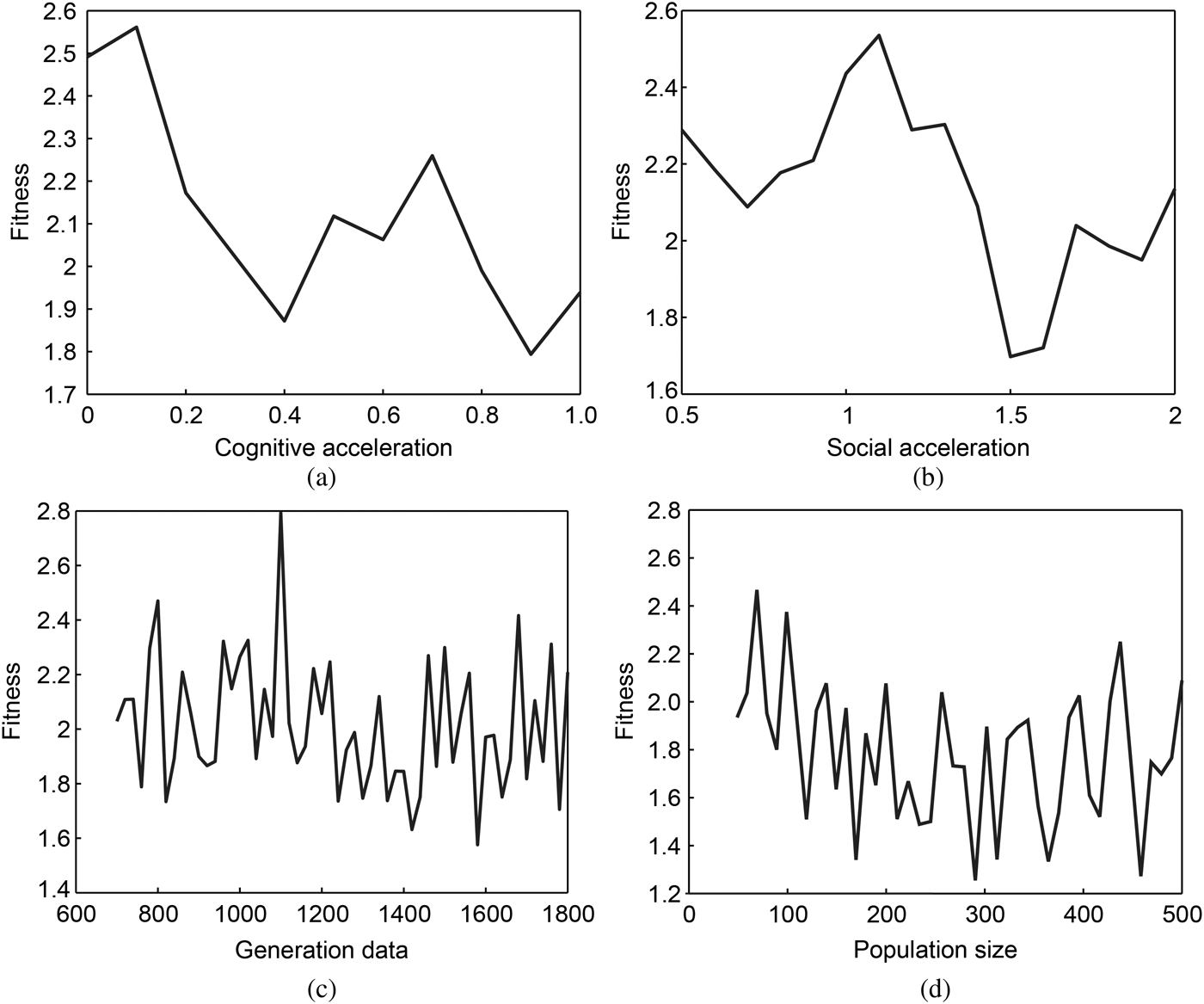
Similar to the previous one, a careful study has been carried out to determine the set of optimal parameters, where the value of one parameter is varied at a time, while other parameters have fixed values. The optimization process takes place with the values of cognitive acceleration, social acceleration, maximum number of generations, and population size. The optimal values of cognitive acceleration, social acceleration, number of generations, and population size are 0.9, 1.5, 1580, and 290, respectively. The results of the parametric study are shown in Figure 5.
Results of sensitive analysis to determine the particle swarm optimization parameters.
4. RESULTS AND DISCUSSION
In this section, all three fuzzy systems (fuzzy rule expert system, a GA based fuzzy expert system, and PSO based fuzzy expert system) are applied for prediction of surface roughness and a comparative analysis is performed.
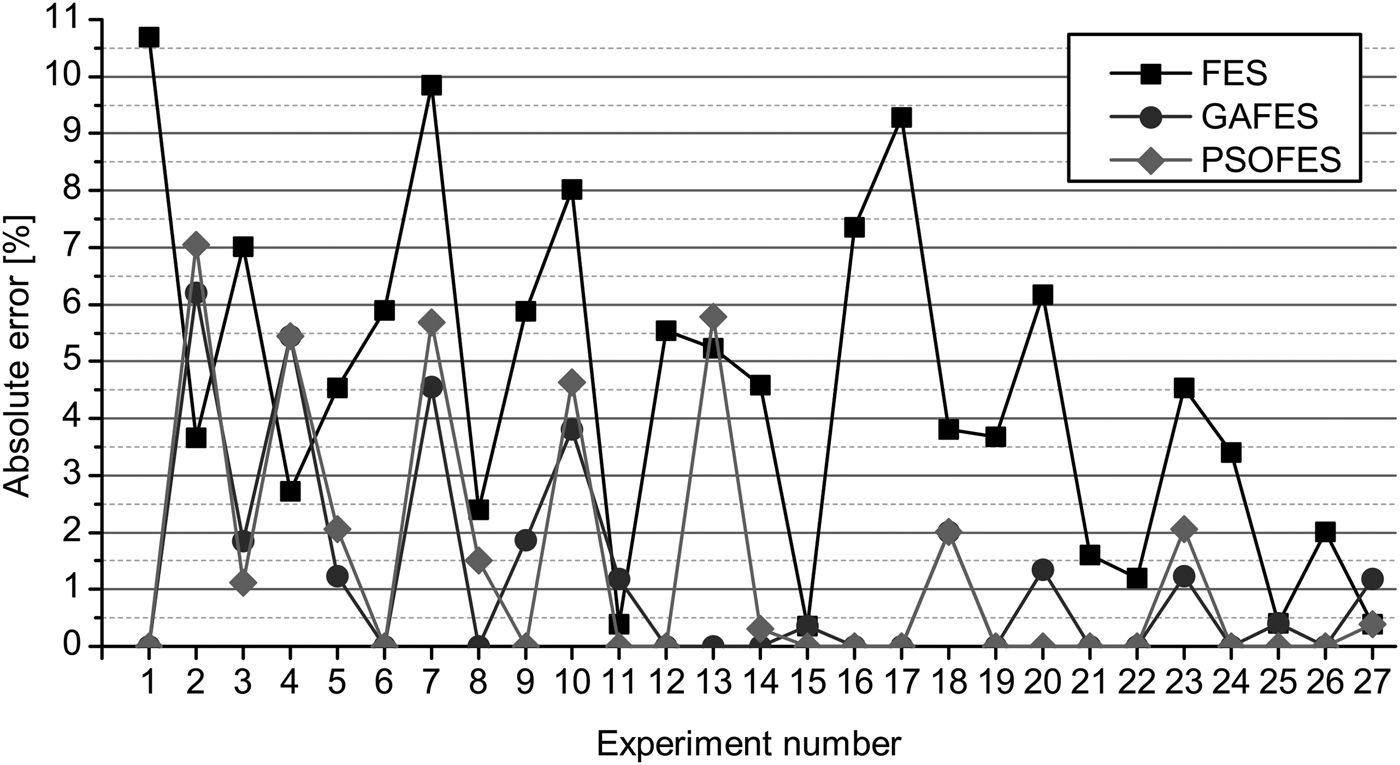
In order to evaluate the performance of developed fuzzy rule expert systems, the predicted surface roughness values were compared with the experimental values and summarized in Table 1. The average absolute percentage error of the fuzzy rule based expert system is 4.47%, while the maximum absolute percentage error is 10.69%. The low level of errors shows that the author-defined Mamdani fuzzy expert system can be successfully adopted in the prediction of surface roughness. Furthermore, in order to investigate the capability of the GA and PSO trained fuzzy expert systems for predicting surface roughness, the results of both proposed approaches are compared with some real experimental values. Figure 6 shows the optimized MF distributions of the input–output MFs that are obtained after a fine-tuning using a GA. The average absolute percentage error of the GA and PSO based fuzzy expert systems were 1.21% and 1.41%, respectively. The maximum absolute percentage error of the GA based fuzzy expert system is 6.2%, while this value for the PSO based fuzzy expert system was 7.04%. Figure 7 shows the comparison in prediction of surface roughness obtained using the fuzzy rule based expert system and the GA and PSO based fuzzy expert systems in terms of % error. In almost all the cases, prediction of surface roughness using fuzzy systems optimized with bioinspired algorithms is better than the fuzzy rule based expert system. Hence, it is evident that there is good agreement between estimated and experimental values of surface roughness for each of three models that clearly indicates that the fuzzy logic technique is a good alternative for prediction of surface roughness in HPJA turning within the range of input parameters under consideration. However, bioinspired optimization algorithms have been shown very effective in improving performance of a fuzzy expert system. The predicted values of the GA and PSO based fuzzy expert systems and measured values are fairly close, which indicates that both models can be used effectively to predict surface roughness in HPJA turning.
Genetic algorithm optimized membership function distributions for (a) feed, (b) diameter of the nozzle, (c) the pressure of the jet, and (d) surface roughness.
Error profile of predicted surface roughness values obtained using fuzzy rule based expert system, genetic algorithm, and particle swarm optimization based fuzzy expert system. GAFES, Genetic algorithm based fuzzy expert system; PSOFES, particle swarm optimization based fuzzy expert system.
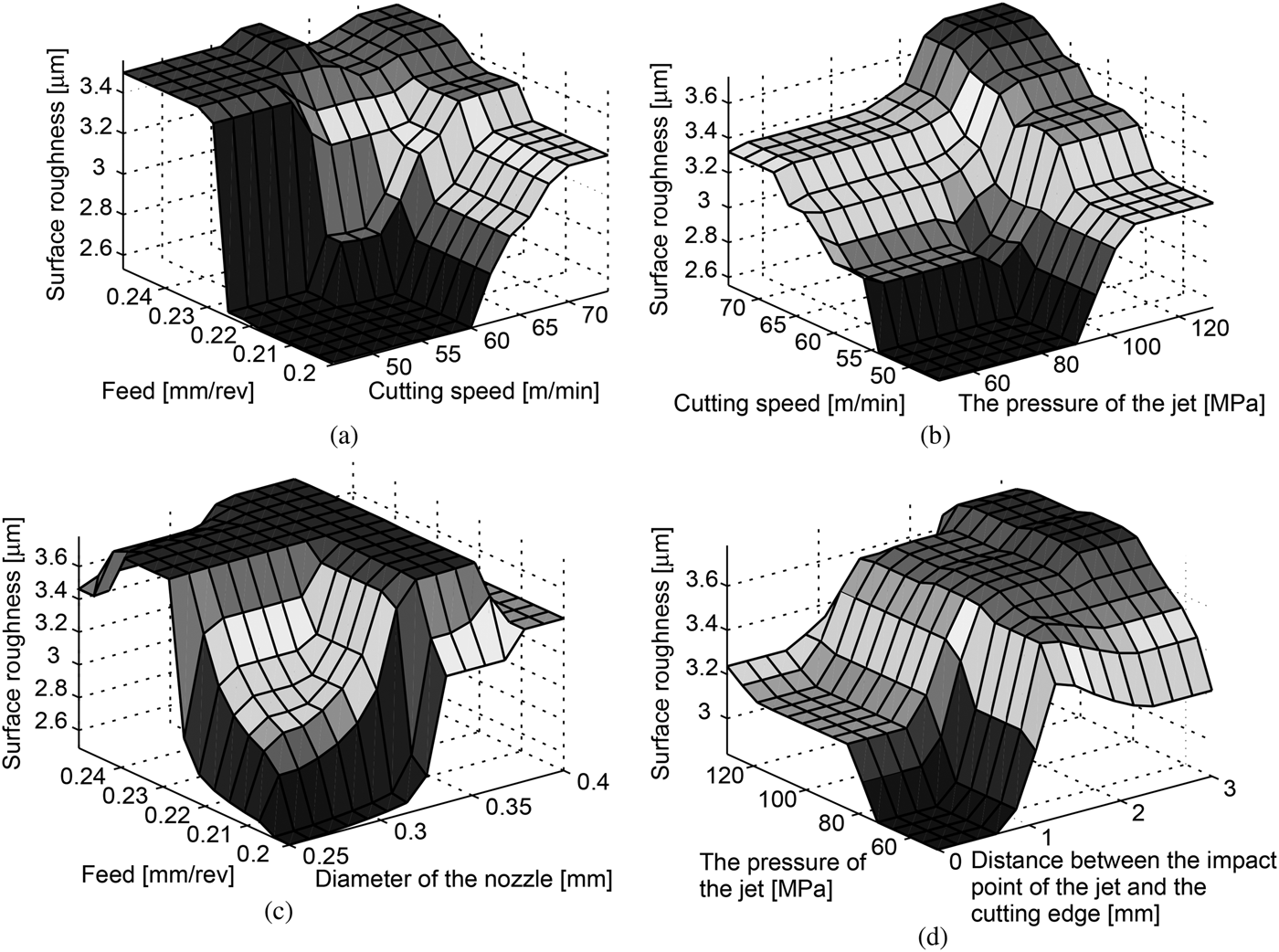
The variation of surface roughness with different combinations of machining parameters is studied using the fuzzy response surfaces. The output surface of the fuzzy inference system enables us to analyze the effects and trends of the process response parameter surface roughness with the variation of the control parameters. Figure 8 shows only a few examples of relations.
Response surfaces of genetic algorithm based fuzzy expert system for surface roughness.
Figure 8a shows the influence of both regular machining parameters, namely, feed and cutting speed, on surface roughness. As seen from that diagram, higher feeds always result in higher roughness regardless of the cutting speed applied, while cutting speed only influenced the roughness at lower feed rates. The lowest value of roughness can be achieved with the lowest feed rate and cutting speed setting. This is very important when productivity is taken under consideration. Figure 8b represents the fuzzy response surface obtained for the effect of cutting speed and the pressure of the jet on the surface roughness. It can be observed that the lowest value of surface roughness is obtained with smaller cutting speeds at low pressure. The results show that no pressures higher than p = 60 MPa are needed to achieve the best surface roughness. Anyhow, such pressure should be provided for sufficient chip breakability. Similar conclusions are valid in testing the influence of feed rate and diameter of the nozzle (Fig. 8c). From Figure 8c, it is clearly seen that both the feed and the diameter of the nozzle are significant factors on changes of the surface roughness. The size of the nozzle effects on the surface only at lower feeds. The smaller feed and diameter of the nozzle will produce lower surface roughness. It is assumed that for the depth of cut a p = 2 mm diameter of the nozzle, between 0.25 and 0.3 mm should be used to obtain the lowest surface roughness possible. Finally, the variation of surface roughness with pressure of the jet and distance between the impact point of the jet and the cutting edge is shown in Figure 8d. It can be observed that the lowest value of surface roughness is obtained with a smaller distance between the impact point of the jet and the cutting edge at low pressure. The results show that the best surface roughness at the highest productivity can be achieved with the parameter set at the following values approximately: v c = 55 m/min, f = 0.22 mm/rev, p = 60 MPa, D n = 0.25 mm, and s = 0 mm.
5. CONCLUSIONS
In this study, three fuzzy expert systems for surface roughness prediction in HPJA turning of Inconel 718 were developed and discussed. The authors designed a fuzzy rule based expert system, derived from their heuristic knowledge of the HPJA turning in the form of fuzzy control rules and MFs. The predicted results of surface roughness achieved via this fuzzy system are compared to the experimental values. The results obtained indicated that the proposed fuzzy rule based expert system can be effectively used for predicting the surface roughness in HPJA with the 95.5% accuracy. However, manually adjustment of MFs is highly dependent on expert knowledge, and it is time consuming and prone to errors. Because bioinspired optimization algorithms have been shown effective for tuning the parameters of fuzzy rules and adjusting the shape of MFs, a major objective of this paper is also optimization of the fuzzy system using two bioinspired algorithms: a GA and PSO. GA and PSO based fuzzy expert systems were evaluated for validity and applicability in prediction of surface roughness. The results of both the approaches are compared with the real experimental data. It is shown that the hybridization between fuzzy systems and bioinspired algorithms provides a more optimized and accurate result compared to an author-defined fuzzy system.
In order to achieve a comprehensive approach, the influence of various cutting process parameters on the surface roughness were studied. Several general conclusions can be drawn on the basis of the experimental and fuzzy modeling results. In semifinish HPJA turning of Inconel 718, the increase of feed increases the surface roughness, whereas the increase of cutting speed reduces the surface roughness, which is in agreement with a theory of turning. Furthermore, for better surface roughness, the recommended settings are the lowest values of the diameter of the nozzle, the pressure of the jet, and the distance between the impact point of the jet and the cutting edge. Because the effectiveness of the model depends on a number of included variables and their ranges, further improvement can be possible by introducing a larger number of variables and a wider range of cutting parameters.
Davorin Kramar is an Assistant Professor at the Faculty of Mechanical Engineering, University of Ljubljana. He received MS and PhD degrees in nonconventional manufacturing technologies from the same university. Dr. Kramar's research interests include removal mechanisms and machinability of hard to machine materials such as stainless steels, hardened steel, and Inconel.
Djordje Cica is an Assistant Professor at the Faculty of Mechanical Engineering, University of Banja Luka, BiH. He teaches and conducts research in advanced manufacturing systems. His interests include metal cutting processes, machine tools, and process monitoring, as well as artificial intelligence techniques in predicting machining performance.
Branislav Sredanovic is a Teaching Assistant, Researcher, and PhD student in production engineering at the Faculty of Mechanical Engineering, University of Banja Luka, BiH. He received his BS in machinability from the same university. His research activity focuses on the field of machinability of hard to machine materials and microtechnologies in metal cutting.
Janez Kopac is a Professor at the Faculty of Mechanical Engineering, University of Ljubljana, and Head of the Department of Machining Technology Management. He leads a research team dealing with cutting processes in the Laboratory for Cutting. Dr. Kopac investigates the removal mechanisms of materials, modern cutting tool materials and tool management, planning of machining technology, optimizing of cutting parameters, monitoring and identification of machining process, machining costs and time analyzing, neural networks, and fuzzy logic for predicting tool wear and surface roughness.