


Introduction
The experience of psychosis is associated with increased levels of depression (Birchwood, Iqbal, Chadwick and Trower, Reference Birchwood, Iqbal, Chadwick and Trower2000). Research has shown that several months after an acute episode of psychosis rates of post-psychotic depression can be up to 50% of cases (Whitehead, Moss, Cardno and Lewis, Reference Whitehead, Moss, Cardno and Lewis2002; Birchwood, Reference Birchwood2003). Depression in psychosis has been linked with higher levels of hopelessness and an increased likelihood of suicide (White, McCreery, Gumley and Mulholland, Reference White, McCreery, Gumley and Mulholland2007; Drake, Gates, Whitaker and Cotton, Reference Drake, Gates, Whitaker and Cotton1985). Meta-analysis estimates of lifetime suicide rates for individuals with schizophrenia spectrum disorder indicate that 4.9% of individuals with schizophrenia will commit suicide (Palmer, Pankratz and Bostwick, Reference Palmer, Pankratz and Bostwick2005). Individuals who develop depression following psychosis appraise this life event as representing a humiliating threat to their future status, leading to the loss of a sense of personal value in various social roles (Birchwood et al., Reference Birchwood, Trower, Brunet, Gilbert, Iqbal and Jackson2006, Reference Birchwood, Iqbal, Chadwick and Trower2000). Individuals who have experienced psychosis can struggle to come to terms with the implications that their experience of psychosis has for how they perceive themselves and how they think others perceive them. Internalized stigma and shame are key features evident in depression occurring in the context of schizophrenia (Gumley, Braehler, Laithwaite, McBeth and Gilbert, Reference Gumley, Braehler, Laithwaite, McBeth and Gilbert2010).
Ferster (Reference Ferster1973) proposed that “avoidance” has a central role in the development of depression. He suggested that depressed individuals engage in avoidance to escape from aversive internal and external stimuli. Paradoxically, however, these particular patterns of responding only serve to deny the individual access to experiences that may have helped to elevate their mood. The “response styles theory of depression” (Nolen-Hoeksema, Reference Nolen-Hoeksema1991; Just and Alloy, Reference Just and Alloy1997) proposed that individuals who “ruminate” over the potential causes and consequences of depressive symptoms are more likely to become depressed and stay depressed for a longer duration. Rumination has been defined as a coping response to negative mood involving self-focused attention, characterized by a repetitive and passive focus on one's negative emotions (Nolen-Hoeksema, Reference Nolen-Hoeksema1991, Reference Nolen-Hoeksema2000; Nolen-Hoeksema, Larson and Grayson, Reference Nolen-Hoeksema, Larson and Grayson1999). In prospective studies, rumination has been shown to both precipitate (Nolen-Hoeksema, Morrow and Fredrickson, Reference Nolen-Hoeksema, Morrow and Fredrickson1993) and perpetuate (Nolen-Hoeksema, Reference Nolen-Hoeksema2000) depression. Developing on from this, the “behavioural activation approach” to understanding and treating depression (Jacobson, Martell and Dimidjian, Reference Jacobson, Martell and Dimidjian2001; Martell, Addis and Jacobson, Reference Martell, Addis and Jacobson2001) conceptualized rumination as a problematic, avoidant behaviour that is functionally similar to more overt behavioural examples of avoidance such as withdrawal or inactivity. Watkins and Mould (2004) expanded on this proposed avoidant function of rumination by claiming that it serves to impede the activation of distressing emotional and somatic responses. Cribb, Moulds and Carter (Reference Cribb, Moulds and Carter2006) proposed that rumination has two experientially avoidant pathways:
1) A behavioural pathway: rumination is an alternative to engaging in activities that may entail discomfort to the individual.
2) A cognitive pathway: as a mainly “verbal” process, rumination acts to limit the distressing effect of more concrete image-based thought content. Ehlers and Steil (Reference Ehlers and Steil1995), for example, have proposed that by engaging in depressive rumination individuals may avoid having to process potentially more distressing anxiety-eliciting trauma memories. Cribb et al. (Reference Cribb, Moulds and Carter2006) found that in a sample of undergraduate degree students, avoidance had strong positive correlations with both depression and rumination, even when levels of anxiety were controlled for.
Like depression, anxiety is a common comorbid difficulty experienced by individuals with psychosis. Lysaker, Davis, Lightfoot, Hunter and Strasburger (Reference Lysaker, Davis, Lightfoot, Hunter and Strasburger2005) suggested that two-thirds of individuals with schizophrenia may experience anxiety levels at least one standard deviation above the population anxiety mean. Furthermore, the prevalence of co-morbid anxiety disorders, which occur within individuals diagnosed with schizophrenia, has been estimated at 30–85% (Pokos and Castle, Reference Pokos and Castle2006). Even after controlling for anxiety associated with delusions or hallucinations is excluded, the concomitancy rate of anxiety in psychosis has been estimated to be approximately 16–17% (Tibbo, Swainson, Chue and LeMelledo, Reference Tibbo, Swainson, Chue and LeMelledo2003; Huppert and Smith, Reference Huppert and Smith2005; Ziedonis et al., Reference Ziedonis, Smelson, Rosenthal, Batki, Green and Henry2005). The presence of such anxiety problems is associated with behaviours such as social withdrawal, which contribute to reports of a reduced quality of life (Braga, Mendlowicz, Marrocos and Figueira, Reference Braga, Mendlowicz, Marrocos and Figueira2005). Giorgio et al. (Reference Giorgio, Sanflippo, Kleiman, Reilly, Bender and Wagner2010) drew parallels between the avoidant function of aspects of depression (such as rumination) and the avoidant nature of anxiety processes (such as worry). Borkovec and Roemer (Reference Borkovec and Roemer1995) found that individuals with Generalized Anxiety Disorder, compared to control participants, were more likely to consider their worry to be a means of distraction from what were termed “more emotional topics”. Using Borkovec's (Reference Borkovec, Davey and Tallis1994) model for Generalized Anxiety Disorder, Giorgio et al. (Reference Giorgio, Sanflippo, Kleiman, Reilly, Bender and Wagner2010) highlighted how worry-related avoidance of emotionally arousing material provides a false sense of control over emotions and serves to prevent effective processing of negative emotions; because emotional processing is hindered, threatening meanings are maintained and the anxiety persists (Borkovec, Ray and Stöber, Reference Borkovec, Ray and Stöber1998).
Both depression and anxiety are common features experienced by individuals following an episode of psychosis. Both depression (Saarni et al., Reference Saarni, Viertiö, Perälä, Koskinen, Lönnqvist and Suvisaari2010; Meijer, Koeter, Sprangers and Schene, Reference Meijer, Koeter, Sprangers and Schene2009) and anxiety (Huppert and Smith, Reference Huppert and Smith2001; Huppert, Weiss, Lim, Pratt and Smith, Reference Huppert, Weiss, Lim, Pratt and Smith2001) have been identified as major factors contributing to poorer quality of life in individuals with psychosis. Giorgio et al. (Reference Giorgio, Sanflippo, Kleiman, Reilly, Bender and Wagner2010) have proposed that rumination and worry share an avoidant function that serves to impede the processing of deeper, more emotional topics. Acceptance and Commitment Therapy (ACT; Hayes, Strosahl and Wilson, Reference Hayes, Strosahl and Wilson1999) is a psychological therapy that promotes a non-judgmental willingness to experience aversive events whilst simultaneously moving toward valued life goals. ACT places specific emphasis on what is termed “psychological flexibility”, which has been defined as: “the ability to fully contact the present moment and the thoughts and feelings it contains without needless defense and, depending upon what the situation affords, persisting or changing in behavior in the pursuit of goals and values” (Hayes, Luoma, Bond, Masuda and Lillis, Reference Hayes, Luoma, Bond, Masuda and Lillis2006; p. 7). Psychological flexibility is assessed using the Acceptance and Action Questionnaire (AAQ-II; Bond et al., Reference Bond, Hayes, Baer, Carpenter, Orcutt and Waltz2011). Two key processes that have been highlighted as impacting negatively on psychological flexibility are: “cognitive fusion” and “experiential avoidance”. Cognitive fusion is an excessive attachment to the literal content of human thoughts. Experiential avoidance occurs “when a person is unwilling to remain in contact with particular private experiences (e.g. bodily sensations, emotions, thoughts, memories, images, behavioral predispositions) and takes steps to alter the form or frequency of these experiences” (Hayes et al., Reference Hayes, Strosahl, Wilson, Bissett, Pistorello and Toarmino2004, p. 554). It is suggested that processes such as cognitive fusion and experiential avoidance contribute to psychological inflexibility, which impedes people's ability to take behavioral steps that are consistent with their core values (Hayes and Smith, Reference Hayes and Smith2005). We propose that anxiety and depression occurring in the context of psychosis can be understood as manifestations of this psychological inflexibility. This psychological inflexibility can in some senses be considered functional because it potentially avoids the processing of distressing emotional material (i.e. particularly traumatic memories from the past) and minimizes the likelihood of engaging in behaviours that may threaten the psychological and/or physical integrity of the individual.
In addition to other therapeutic strategies, ACT utilizes mindfulness exercises to address experiential avoidance. Mindfulness techniques aim to “teach people how to pay open-hearted attention to objects in the exterior and interior world as they unfold, moment by moment. Attention is paid not only to the objects themselves but to our reactions to them, particularly reactions of wanting positive states to last, negative states to end, and neutral states to be less boring” (Williams, Reference Williams2010, p. 2). Bishop et al. (Reference Bishop, Lau, Shapiro, Carlson, Anderson and Carmody2004) distinguished between two components of mindfulness: one that involves self-regulation of attention, the other that involves an orientation toward the present moment characterized by curiosity, openness, and acceptance. Research has indicated that improving individuals’ capacity to be mindful can improve well-being. For example, Williams et al. (Reference Williams, Alatiq, Crane, Barnhofer, Fennell and Duggan2008) and Barnhofer et al. (Reference Barnhofer, Crane, Hargus, Amarasinghe, Winder and Williams2009) have found that mindfulness training can significantly reduce the risk of a further episode of depression in individuals who have been chronically depressed. A recent meta-analysis by Hofmann, Sawyer, Witt and Oh (Reference Hoffmann, Sawyer, Witt and Oh2010), that excluded studies relating to ACT, found that in patients with anxiety and mood disorders mindfulness-based therapy was associated with large effect sizes for improving anxiety and mood symptoms. The meta-analysis concluded that these effect sizes “were robust, unrelated to publication year or number of treatment sessions, and were maintained over follow-up” (Hoffman, Sawyer, Witt and Oh, Reference Hoffmann, Sawyer, Witt and Oh2010, p. 169).
Reflecting on the role that mindfulness plays in ACT, Wilson, Bordieri, Maureen, Lucas and Slater (Reference Wilson, Bordieri, Maureen, Lucas, Slater, Herbert and Forman2011, p.247) recently stated that “mindfulness, as it is understood in ACT, consists of four core ACT processes: (a) contact with the present moment, (b) acceptance, (c) defusion and (d) self-as-context”. The psychological flexibility that ACT aims to facilitate can therefore be distinguished from mindfulness on the basis of the two remaining core ACT processes: (e) values exploration, and (f) committed action. Research has demonstrated significant associations between measures of psychological flexibility and mindfulness (Baer, Smith and Allen, Reference Baer, Smith and Allen2004; Baer, Smith, Hopkins, Krietemeyer and Toney, Reference Baer, Smith, Hopkins, Krietemeyer and Toney2006; Hayes et al., Reference Hayes, Strosahl, Wilson, Bissett, Pistorello and Toarmino2004). Recently, Skinner, Robertson, Allison, Dunlop and Bucks (Reference Skinner, Roberton, Allison, Dunlop and Bucks2010) used regression analyses to indicate that psychological flexibility actually mediated the relationship between mindfulness and depression in spinal cord injured patients.
There is a growing interest in the efficacy of mindfulness and ACT for individuals diagnosed with psychosis. Chadwick, Barnbrook and Newman-Taylor (Reference Chadwick, Barnbrook and Newman-Taylor2007) demonstrated that the mindfulness skills of individuals who were hearing hallucinatory voices had a significant negative correlation with negative affect and distress associated with the hallucinatory voices. Research has also shown that mindfulness-based interventions are acceptable to individuals with psychosis (Chadwick, Hughes, Russell, Russell and Dagnan, Reference Chadwick, Hughes, Russell, Russell and Dagnan2009). To date, research relating to ACT for psychosis has focused mainly on distress associated with the symptoms of the psychosis. Randomized controlled trials found that individuals receiving ACT demonstrated significantly lower belief in positive symptoms and reduced rates of re-hospitalization at follow-up compared to a treatment as usual group (TAU) (Bach and Hayes, Reference Bach and Hayes2002; Gaudiano and Herbert, Reference Gaudiano and Herbert2006). Indicating other potential benefits of ACT for psychosis, Gaudiano and Herbert (Reference Gaudiano and Herbert2006) also found a marginally significant impact of ACT, relative to enhanced TAU, on mood as assessed by the Brief Psychiatric Rating Scale affect subscore. However, a specific measure of anxiety or depression was not employed in their study. Shawyer et al. (Reference Shawyer, Ratcliff, Mackinnon, Farhall, Hayes and Copolov2007), in a cross-sectional study, reported that greater psychological flexibility in relation to the experience of hallucinatory voices (as assessed by the Voices Acceptance and Action Questionnaire) was associated with lower depression.
We propose that depression and anxiety occurring in the context of psychosis are closely associated with psychological inflexibility. The current study sought to determine how depression and anxiety occurring in the context of psychosis were associated with both mindfulness and psychological flexibility. Building on Wilson et al.'s (Reference Wilson, Bordieri, Maureen, Lucas, Slater, Herbert and Forman2011) claims that mindfulness represents only a proportion of the processes that contribute to psychological flexibility, we hypothesized that psychological flexibility, relative to mindfulness, would contribute to a significantly greater amount of variance in both depression and anxiety scores of individuals who had experienced psychosis.
Methodology
Design
This study had a cross-sectional correlational design.
Participants
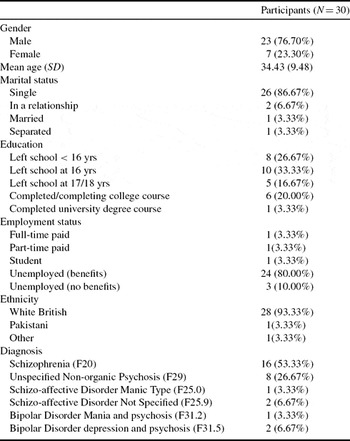
A total of 30 participants were consented into the study. Demographic information relating to the participants is provided in Table 1. Participants were consecutively recruited and assessed from mental health services across Greater Glasgow and Clyde NHS, including community mental health teams, early intervention services for psychosis, a medium-secure forensic service, and psychiatric rehabilitation services. Participants all met ICD-10 (WHO, 1992) criteria for a psychotic disorder determined by a diagnosis of a psychotic disorder (i.e. schizophrenia, schizoaffective disorder, schizophreniform disorder, delusional disorder, brief psychotic disorder, psychotic disorder NOS), bipolar disorder (with psychotic features), or depressive disorder with psychotic symptoms. Diagnoses were determined by case-file review. Participants were excluded if there was (1) a diagnosis of learning disability; (2) an inability to participate in psychotherapy/research due to acute medical condition or acute psychosis (as defined by a score ≥ 5 on an item of the Positive Syndrome subscale of the PANSS); (3) they were receiving a systematic psychological therapy at the point of recruitment/randomization.
Demographic characteristics of participants

General outcome measures
The Hospital Anxiety and Depression Scale (HADS; Zigmond and Snaith, Reference Zigmond and Snaith1983) is a widely used self-report instrument designed as a brief assessment tool of the distinct dimensions of anxiety and depression in non-psychiatric populations. Bjelland, Dahl, Haug and Neckelmann (Reference Bjelland, Dahl, Haug and Neckelmann2002) noted that the psychometric properties of the HADS are such that it can be used with confidence clinically.
The Positive Scale of Positive and Negative Syndrome Scale (PANSS; Kay, Fiszbein and Opler, Reference Kay, Fiszbein and Opler1987) is a 30-item observer-rated scale used to assess the presence and severity of positive (e.g. delusions, hallucinations) and negative (e.g. blunted affect, emotional with-drawl) symptoms. Derived scores include “positive”, “negative” and “global psychopathology” scale scores. Psychometric studies have reported good inter-rater reliability and satisfactory internal consistency, construct validity and concurrent validity in relation to other measures of psychopathology (Kay, Opler and Lindenmayer, Reference Kay, Opler and Lindenmayer1988, Reference Kay, Opler and Lindenmayer1989). Two research assistants completed the PANSS. One of the raters (LR) had used the PANSS extensively prior to the commencement of the trial and was considered expert. The second rater (JMcT) was trained on the PANSS training videos and then shadowed LR as she conducted 6 of the PANSS assessments at baseline. JMcT independently rated participants’ responses on these 6 PANSS assessments and the ratings were then compared. According to PANSS accuracy criteria (Kay et al., Reference Kay, Opler, Spitzer, Williams, Fiszbein and Gorelick1991; Lambert, Reference Lambert1996), a PANSS rater is considered accurate if their responses are: 1) At least 80% of the 30 items (i.e. at least 24 of 30 items) are rated within a range of the expert standard±1; 2) PANSS total scores are not differing from the expert standard by more than ±20%. Concordance of at least 80% is considered “satisfactory” and proportions of 90% and above are deemed “highly reliable” (Kay et al., Reference Kay, Opler, Spitzer, Williams, Fiszbein and Gorelick1991; Norman, Malla, Cortese and Diaz, Reference Norman, Malla, Cortese and Diaz1996). Both raters achieved highly reliable ratings on PANSS assessments.
ACT-related measures
The Acceptance and Action Questionnaire – II (AAQ-II; Bond et al., Reference Bond, Hayes, Baer, Carpenter, Orcutt and Waltz2011) is a 10-item self-report measure that was developed specifically for assessing ACT outcomes. Individuals respond to each item on a 7-point Likert scale ranging from “never true” to “always true”. Sample items include: “My painful memories prevent me from having a fulfilling life” and “I worry about not being able to control my worries and feelings”. The total score provides an indication of psychological flexibility. The AAQ is reported to be both reliable and valid in previous research (Bond and Bunce, Reference Bond and Bunce2003).
The Kentucky Inventory of Mindfulness Skills (KIMS; Baer et al., Reference Baer, Smith and Allen2004) is a self-report inventory for the assessment of mindfulness skills. It assesses four mindfulness skills: observing or attending to internal and external stimuli (observing); describing and labelling phenomena non-judgmentally (describing); acting with awareness in which undivided attention is focused on one thing at a time (acting with awareness); and accepting or allowing present moments or events to occur without judging them (accepting without judging). Analyses have shown that the KIMS has good internal consistency and test-retest reliability (Baer et al., Reference Baer, Smith, Hopkins, Krietemeyer and Toney2006).
Procedure
The research procedures were approved by the West of Scotland NHS Research Ethics Committee No. 3 (ref: 09/S0701/74), and approval was granted from Research and Design at NHS Greater Glasgow and Clyde NHS (ref: PN09CP213). The sample used for the current study was part of a sample of individuals who were recruited to a randomized controlled trial of ACT for emotional dysfunction following psychosis (White et al., Reference White, Gumley, McTaggart, Rattrie, McConville and Cleare2011). The research team met with seven psychiatric services from across Greater Glasgow and Clyde NHS to present the research. Clinical vignettes were used to highlight how difficulties associated with adaptation following psychosis might present. Referrals were invited to the study. A member of the research team then met with the individual to assess their appropriateness for the study. Individuals’ ability to participate in research was further assessed by their ability to appropriately respond to questions about the study. Informed consent was then sought and demographic information collected. Immediately after obtaining consent, participants completed assessment measures with a research assistant.
Analyses
All statistical analyses were performed using SPSS-14 analysis package. Spearman ρ correlation analyses were conducted to investigate the associations that the Anxiety and Depression subscales of the HADS had with ACT-related measures and the Positive and Negative Syndrome subscales of the PANSS. Linear Regression analyses were conducted to determine which of the variables predicted variance in the Depression and Anxiety subscales of the HADS. Babyak (Reference Babyak2004) has highlighted that regression analyses employing small sample sizes can lead to over-fitting of the model and an increased likelihood of type I errors. In light of the small sample size in the current study only two independent variables were entered into the regression analyses: AAQ-II scores and the KIMS Total Score. Hierarchical regression analyses were used in which the two “predictor” variables were entered in separate blocks. The ACT model proposes that mindfulness is one of a group of processes that overlap to form psychological flexibility (Wilson et al., Reference Wilson, Bordieri, Maureen, Lucas, Slater, Herbert and Forman2011). So, to control for the effect of mindfulness and determine whether psychological flexibility made a proportionately larger contribution to variance in depression and anxiety scores, the KIMS Total score was entered in the first block of the regression analysis and the AAQ-II in the second block. The Durban-Watson statistics indicated that the residuals were independent, and tests indicated that there was no perfect multi-collinearity. There was good homoscedasticity.
Results
Participants had a median score of 8.00 (IQR: 4.75 – 11.25) on the Depression subscale of the HADS; 10.50 (IQR: 7.00 – 15.00) on the anxiety subscale of the HADS; 12.00 (IQR: 10.50 – 15.50) on the Positive Syndrome subscale of the PANSS; and 14.00 (IQR: 11.00 – 17.50) on the Negative Syndrome Subscale of the PANSS.
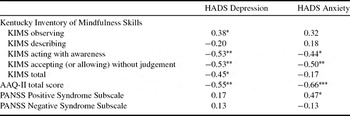
Table 2 provides details of the correlations between the ACT-related measures and general outcome measures. The level of depression as assessed by the Depression Subscale of the Hospital Anxiety and Depression Scale (HADS) had a significant positive correlation with the Observing subscale of the Kentucky Inventory of Mindfulness Skills (KIMS) (p < .05). There were also significant negative correlations between the HADS Depression subscale and the Acting with awareness (p < .01) subscale of the KIMS, the Accepting without judgement subscale of the KIMS (p < .01), the KIMS Total score (p < .05), and the Acceptance and Action Questionnaire (AAQ-II) (p < .05).
Spearman ρ correlations that the HADS had with ACT-specific measures and the PANSS

***Significant at the p < .001 level (2-tailed); **Significant at the p < .01 level (2-tailed); *Significant at the p < .05 level (2-tailed) KIMS = Kentucky Inventory of Mindfulness Skills; AAQ-II = Acceptance and Action Questionnaire; PANSS = Positive and Negative Syndrome Scale; HADS = Hospital Anxiety and Depression Scale
The level of anxiety as assessed by the Anxiety Subscale of the Hospital Anxiety and Depression Scale (HADS) had significant negative correlations with the Acting with awareness subscale of the KIMS (p < .05), the Accepting without judgement subscale of the KIMS (p < .01), and the AAQ-II (p < .001). There was also a trend approaching significance regarding the association between the Anxiety subscale of the HADS and the Observing subscale of the KIMS (p = .08). There was no significant correlation between the HADS Anxiety subscale and the KIMS total score.
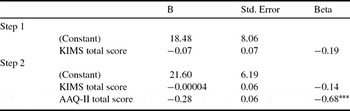
The top panel in Table 3 contains the results of the first step of the regression: testing the model in which the KIMS total score predicted depression scores on the HADS. The regression reached statistical significance (F(1, 28) = 6.05, p < .05). The regression weight for the KIMS total score was significant (t = –2.46, p < .05). The model accounted for 18% of the variance in depression. The second panel of Table 3 presents the results testing the model that included the KIMS total score and the AAQ-II as predictors of depression scores on the HADS. The regression model was statistically significant (F(2, 27) = 10.81, p < .001). Although the regression weight for the KIMS total score (t = –1.82, p > .05) was no longer significant, the regression weight for the AAQ-II (t = –3.60, P < 0.01) did achieve statistical significance. The model accounted for 46% of the variance in depression scores which was a significant increase (F-change (1,27) = 12.98, p < .01) over the model containing only the KIMS total score.
Linear regression analyses with the Depression subscale of the HADS as the dependent variable
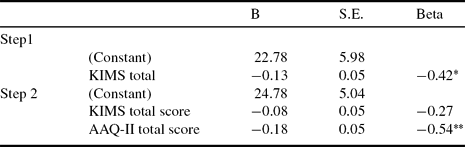
Notes: R 2 = 0.18 for step 1 (p < .05); R2 = 0.46 for step 2 (p < .001)
**Significant at the p < .01 level (2-tailed); *Significant at the p < .05 level (2-tailed) KIMS = Kentucky Inventory of Mindfulness Skills; AAQ-II = Acceptance and Action Questionnaire; HADS = Hospital Anxiety and Depression Scale
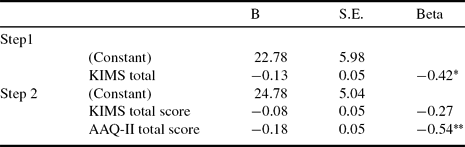
The first panel of Table 4 presents the results testing the model in which the KIMS total score predicted anxiety scores on the HADS. The regression failed to reach statistical significance (F (1,28) = 1.03, p >.05). The regression weight for the KIMS total score was not significant (t = –1.01, p > .05). The model accounted for 4% of the variance in anxiety. The second panel of Table 4 presents the results testing the model that included the KIMS total score and the AAQ-II as predictors of anxiety scores on the HADS. The regression model was statistically significant (F (2, 27) = 11.40, p < .001). Whereas the regression weight for the KIMS total score (t = –0.001, p > .05) was not significant, the regression weight for the AAQ-II (t = –4.59, p < .001) was significant. The model accounted for 46% of the variance in anxiety scores, which was a significant increase (F-change (1, 27) = 21.05, p < .001) over the model only of the KIMS total score.
Linear regression analyses with the Anxiety subscale of the HADS as the dependent variable

Notes: R2 = .04 for step 1 (p >.05), R2 = .46 for step 2 (p < .001) **Significant at the p < .01 level (2-tailed); *Significant at the p < .05 level (2-tailed) KIMS = Kentucky Inventory of Mindfulness Skills; AAQ-II = Acceptance and Action Questionnaire; HADS = Hospital Anxiety and Depression Scale
Discussion
This study sought to investigate the associations between levels of emotional dysfunction following psychosis (depression and anxiety) and Acceptance and Commitment Therapy (ACT) related measures. A number of important and novel findings were revealed. For the first time, the levels of depression experienced following psychosis were shown to be correlated with mindfulness and psychological flexibility. The negative correlation between the depression score and psychological flexibility suggests that as the levels of depression increase the level of psychological flexibility decreases. A positive correlation between depression scores and the KIMS Observing subscale suggests that the more depressed individuals were, the more they were attending to internal and external stimuli. Negative correlations between depression levels and the Acting with awareness and Accepting without judgement subscales suggest that as depression scores increase, individuals find it difficult to allocate undivided attention to one thing at a time or accept present moment experiences without judging them. These findings are in keeping with Chadwick et al.'s (Reference Chadwick, Barnbrook and Newman-Taylor2007) previous findings with individuals experiencing auditory hallucinations. They found that the individuals’ level of negative affect had significant negative correlations with their general level of mindfulness as well as their specific capacity to be mindful of their hallucinatory voices (as assessed by the Southampton Mindfulness Questionnaire and the Southampton Mindfulness of Voices Questionnaire; Chadwick et al., Reference Chadwick, Barnbrook and Newman-Taylor2007). More recently, Chadwick et al. (Reference Chadwick, Hughes, Russell, Russell and Dagnan2009) demonstrated that individuals with psychosis can tolerate interventions aimed at increasing mindfulness skills. Our recent randomized controlled trial of ACT for emotional dysfunction following psychosis (White et al., Reference White, Gumley, McTaggart, Rattrie, McConville and Cleare2011) showed that changes in mindfulness skills correlated with changes in depression scores.
Regression analyses indicated that mindfulness skills and psychological flexibility contributed to a model predicting 46% of variance in depression scores. The finding that the KIMS total score no longer made a significant contribution to the regression model when the AAQ-II total score was included raises the possibility that psychological flexibility mediates the association between mindfulness and depression. The prominent association noted in the current study between depression and psychological flexibility in individuals with psychosis is consistent with previous research that has highlighted strong associations between depression and AAQ scores in undergraduate degree students (Cribb et al., Reference Cribb, Moulds and Carter2006) and individuals with borderline personality disorder (Berking et al., Reference Berking, Neacsiu, Comtois and Linehan2009). Consistent with Skinner et al.'s (Reference Skinner, Roberton, Allison, Dunlop and Bucks2010) research with spinal cord injured patients, our results raise the possibility that psychological flexibility potentially mediates the association between mindfulness and depression in individuals who have experienced psychosis. Our recent randomized controlled trial of ACT for emotional dysfunction following psychosis (White et al., Reference White, Gumley, McTaggart, Rattrie, McConville and Cleare2011) found no significant correlation between changes in psychological flexibility and changes in depression scores. The trial was, however, a feasibility study and the numbers recruited were small. Future research should investigate further the extent to which changes in psychological flexibility potentially mediate the relationship between changes in depression and mindfulness in individuals with psychosis.
In the current study depression scores did not correlate significantly with levels of positive or negative symptoms of psychosis. However, the anxiety scores experienced by individuals with psychosis correlated significantly with positive symptom levels. This is consistent with previous research findings showing links between anxiety and positive symptom levels (Huppert et al., Reference Huppert, Weiss, Lim, Pratt and Smith2001; Emsley, Oosthuizen, Joubert, Roberts and Stein, Reference Emsley, Oosthuizen, Joubert, Roberts and Stein1999). Significant negative correlations with the Acting with awareness and Accepting without judgement subscales of the KIMS suggests that as anxiety levels increased, the mindfulness skills assessed by these subscales decreased. Unlike depression scores, anxiety scores were not significantly associated with the Observing subscale of the KIMS or the KIMS total score. A significant negative correlation between the anxiety scores and psychological flexibility (as assessed by the AAQ-II) suggests that as anxiety levels increase, the level of psychological flexibility decreases. This finding is consistent with previous research indicating that increased psychological flexibility was associated with anxiety sensitivity (Berman, Wheaton, McGrath and Abramowitz, Reference Berman, Wheaton, McGrath and Abramowitz2010) and uncued panic attacks (Tull and Gratz, Reference Tull and Gratz2008). Regression analyses indicated that levels of psychological flexibility, but not mindfulness, contributed significantly to a model predicting 46% of the variance in anxiety scores.
There is a lack of evidence supporting the use of psychological interventions for depression in context of schizophrenia. Although effective at treating positive symptoms, cognitive behavioural therapy for psychosis (CBTp) is less effective for treating emotional dysfunction associated with psychosis such as depression, hopelessness and suicide risk (Birchwood, Reference Birchwood2003; Wykes, Steel, Everitt and Tarrier, Reference Wykes, Steel, Everitt and Tarrier2008; Tarrier et al., Reference Tarrier, Haddock, Lewis, Drake and Gregg2006). Giorgio et al. (Reference Giorgio, Sanflippo, Kleiman, Reilly, Bender and Wagner2010) proposed that treatments that focus on the importance of actively experiencing emotions, whilst challenging negative meta-cognitive beliefs related to emotional experience, may be more successful in ameliorating depressive symptoms. ACT is an intervention that places specific emphasis on addressing psychological flexibility. Preliminary findings with non-psychotic populations (see Zettle and Hayes, Reference Zettle and Hayes1986; Zettle and Raines, Reference Zettle and Raines1989; Petersen, Reference Petersen2007; Bohlmeijer, Fledderus, Rokx and Pieterse, Reference Bohlmeijer, Fledderus, Rokx and Pieterse2011) support the possibility that ACT can reduce levels of depression. Medium to large effects have been found for ACT interventions for depression (e.g. Forman, Herbert, Moitra, Yeomans and Geller, Reference Forman, Herbert, Moitra, Yeomans and Geller2007; Lappalainen et al., Reference Lappalainen, Lehtonen, Skarp, Taubert, Ojanen and Hayes2007). Similarly, research has indicated that ACT is an effective treatment for anxiety in non-psychotic populations. For example, ACT has been shown to be effective for treating test anxiety (Zettle, Reference Zettle2003; Brown et al., Reference Brown, Forman, Herbert, Hoffman, Yuen and Goetter2011), Generalized Anxiety Disorder (Roemer, Orsillo and Salters-Pedneault, Reference Roemer, Orsillo and Salters-Pedneault2008), Obsessive–Compulsive Disorder (Twohig, Hayes and Masuda, Reference Twohig, Hayes and Masuda2006; Twohig et al., Reference Twohig, Hayes, Plumb, Pruitt, Collins and Hazlett-Stevens2010), trichotillomania (Walther, Ricketts, Conelea and Woods, Reference Walther, Ricketts, Conelea and Woods2010) and social anxiety disorder (Dalrymple and Herbert, Reference Dalrymple and Herbert2007). In terms of understanding potential mechanisms of change in ACT, Forman et al.'s (Reference Forman, Herbert, Moitra, Yeomans and Geller2007) research with individuals experiencing depression found that changes in both depression and anxiety scores for individuals receiving ACT were significantly correlated with changes in mindfulness skills and psychological flexibility. Forman et al.'s (Reference Forman, Herbert, Moitra, Yeomans and Geller2007) findings raise the possibility that ACT could be an effective treatment for depression and anxiety following psychosis. The results of the current study highlight that mechanisms that ACT purports to target are significantly associated with depression and anxiety. Our recent feasibility study of ACT for emotional dysfunction following psychosis (White et al., Reference White, Gumley, McTaggart, Rattrie, McConville and Cleare2011) notes a significant reduction of participants presenting with clinically significant levels of depression compared to treatment as usual. Further research of this type appears to be warranted.
The current study had several limitations. The study was cross-sectional in nature and as such we are limited in the extent to which causal assertions can be made about the associations that were found. The numbers of participants recruited were comparatively small. This has particular implications for the integrity of the regression analyses. When small sample sizes are used this can result in “overfitting”, where the regression analysis is skewed by the idiosyncrasies of the sample in question. This increases the likelihood of type 1 errors and risks artificially inflating the amount of variance accounted for (Babyak, Reference Babyak2004). With this consideration in mind we opted to restrict the number of variables being entered into the regression model to only two variables: psychological flexibility (AAQ-II) and mindfulness skills (KIMS total score). It is possible, however, that due to the small sample size our regression models may fail to generalize to other samples. For this reason, the results of the regression analyses reported in the current study should be interpreted with caution. Future research should seek to replicate the current findings in other larger samples. This research may benefit from employing mediational analyses to determine how mindfulness and psychological flexibility might interact in their associations with emotional dysfunction following psychosis. Anxiety levels were positively correlated with positive symptom levels. It is possible that positive symptom levels may have accounted for variance in anxiety scores but this was not picked up because the number of variables entered into the model was restricted to two. However, when a separate regression analysis was run with the PANSS positive symptoms score and then AAQ-II entered in a hierarchical manner, only the AAQ-II scores significantly predicted variance. This suggests that similar to mindfulness, positive symptom levels were limited in the extent to which they predicted anxiety levels in individuals who have experienced psychosis. The absence of a diagnostic interview to confirm case-file diagnoses is also a weakness. The participants that were recruited to the trial also had a range of psychiatric diagnoses. It could be argued that the pragmatic nature of recruitment actually lends ecological validity to the research. Although there may be discrepancies in the specific symptoms that individuals with different psychotic disorders experience, there is substantial overlap in the types of problems encountered by these individuals as they adjust to these particular disorders (British Psychological Society, 2000). The current study did not employ a measure of rumination or worry to assess the aspects of depression and anxiety respectively that are proposed to be experientially avoidant and closely associated with psychological flexibility. In terms of the measures that were included, different versions of the Acceptance and Action Questionnaire (AAQ) have been used in studies to measure psychological flexibility. This makes comparisons between study findings less straight forward than would be desirable. Concerns have been raised about the wide range of constructs measured by the AAQ (e.g. beliefs about emotions, avoidant behaviours, fears about the consequences of emotions, cognitive activities related to avoidance), and the possibility that the AAQ may be measuring negative affectivity as opposed to avoidance (Berking, Neacsiu, Comtois and Linehan, Reference Berking, Neacsiu, Comtois and Linehan2009; Giorgio et al., Reference Giorgio, Sanflippo, Kleiman, Reilly, Bender and Wagner2010). However, Bond et al. (Reference Bond, Hayes, Baer, Carpenter, Orcutt and Waltz2011) recently used a confirmatory factor analysis to demonstrate that psychological flexibility and depression were separate constructs. They found that a model specifying the AAQ-II and the Beck Depression Inventory-II (Beck et al., Reference Beck, Steer and Brown1996) as representing different latent variables had a significantly better fit than the one specifying both latent variables as the same construct.
Conclusions
Consistent with previous research that has been conducted with non-psychotic populations, psychological flexibility and mindfulness appear to have strong associations with two major forms of emotional dysfunction experienced by individuals with psychosis. It seems that psychological flexibility in particular accounts for a large proportion of variance in depression and anxiety scores in this population. It may be that processes such as rumination and worry have an avoidant function that potentially serve to protect the individual from other distressing emotional processing. Unfortunately, however, the psychological inflexibility associated with these processes has the potential to give rise to the signs and symptoms of depression and anxiety that can emerge following psychosis. These claims are speculative and require further exploration. Future research should longitudinally track potential changes in psychological flexibility and mindfulness in individuals diagnosed with psychosis and determine how these changes might relate to changes in levels of emotional dysfunction in psychosis.
Acknowledgements
The Mental Health and Wellbeing Research Group at the University of Glasgow acknowledges the financial support of NHS Research Scotland (NRS), through NHS Greater Glasgow and Clyde. The research project was adopted and supported by the Scottish Mental Health Research Network.



Comments
No Comments have been published for this article.