INTRODUCTION
The use of radiocarbon dating is a crucial and inherent aspect of modern archaeological research. A growing body of 14C dates is being released for a number of Eurasian Steppe regions, including southern Siberia (Alekseev et al. Reference Alekseev, Bokovenko, Boltrik, Chugunov, Cook, Dergachev, Kovalyukh, Possnert, van der Plicht, Scott, Sementsov, Skripkin, Vasiliev and Zaitseva2001; Svyatko et al. Reference Svyatko, Mallory, Murphy, Polyakov, Reimer and Schulting2009; Kiryushin and Tishkin Reference Kiryushin and Tishkin2009), Baraba forest-steppe (Molodin et al. Reference Molodin, Marchenko, Kuzmin, Grishin, Van Strydonck and Orlova2012), southern Ural Mountains (Hanks et al. Reference Hanks, Epimakhov and Renfrew2007), North Caucasus (Higham et al. Reference Higham, Warren, Belinskij, Härke and Wood2010; Hollund et al. Reference Hollund, Higham, Belinskij and Korenevskij2010), North Caspian steppes (Shishlina et al. Reference Shishlina, Zazovskaya, van der Plicht, Hedges, Sevastyanov and Chicagova2009, Reference Shishlina, Zazovskaya, van der Plicht and Sevastyanov2012, Reference Shishlina, Sevastyanov, Zazovskaya and van der Plicht2014), Dnieper Basin (Lillie Reference Lillie1998; Alekseev et al. Reference Alekseev, Bokovenko, Boltrik, Chugunov, Cook, Dergachev, Kovalyukh, Possnert, van der Plicht, Scott, Sementsov, Skripkin, Vasiliev and Zaitseva2001; Lillie et al. Reference Lillie, Budd, Potekhina and Hedges2009), and the steppes in general (Chernykh et al. Reference Chernykh, Kuzminykh and Orlovskaya2004). However, in the very heart of the Eurasian Steppe region, Kazakhstan, archaeological research using 14C dating is only in its formative stage. A number of 14C dates have been obtained for Kazakhstan sites since the 1980s; however, these mostly represented isolated attempts to investigate single burials and sites and in most cases remained unpublished. Such a sporadic approach could not address the multiple and diverse chronological issues of either particular sites or entire historical periods. Partly, the insufficiency of 14C research was compensated with sophisticated and well-elaborated comparative-typological (i.e. “archaeological”) dating, developed by a number of research groups. As a result, no systematic radiocarbon databases have been created for the archaeological cultures of Kazakhstan. This research will present the first 14C chronology for the region, specifically for the Early Iron Age sites of central Kazakhstan.
ARCHAEOLOGICAL BACKGROUND
Cultural Geography of Central Asia in the Early Iron Age
The development of the Early Iron Age archaeological cultures of Kazakhstan was determined by the geographical specifics of this land located at the border of Asia and Europe and its position as a unique gateway between the two continents. To the south, the land bordered the ancient civilizations of Iran, Chorasmia, and Bactria. Despite the long history of scientific investigations of the region, initiated by V Radlov more that century and a half ago (Sorokin Reference Sorokin1969), by the first half of the 20th century the area was regarded generally as scarcely populated, deserted land lost between European and Asian Scythia. To date, this perception has changed dramatically, as a number of impressive Saka, Savromatian, and Sarmatian archaeological complexes have been found. Step by step, the role of ancient Kazakhstan among the Early Iron Age cultures of the Eurasian steppe is being recognized.
Central Kazakhstan is one of the key regions of ethnocultural processes in the Early Iron Age Eurasian Steppe. Abundant in rich sources of copper, the area became a hearth of powerful Bronze Age cultures of the Eurasian Steppe, whose achievements formed a basis for the later cultures of the Early Iron Age. Prehistoric populations of central Kazakhstan played a bridging role in the exchange of a variety of achievements and innovations between the southern sedentary civilizations (such as Chorasmian and Bactrian) and the north, particularly with the Sayano-Altai region.
Scythian-Saka Époque and Sites in Kazakhstan
The Scythian-Saka époque of the Early Iron Age takes a special place in the history of not only Kazakhstan, but the entire Eurasian steppe. This was the period of vibrant and distinctive processes that resulted in major changes in the lifestyle of the 1st millennium BC steppe populations. The transition to mobile forms of pastoralism (i.e. to “nomadism”) involved subsequent innovations in the social organization, economy, material culture, and ideology of the people. These new features of the culture and lifestyle of the societies had a great effect on their burial structures and material assemblages, such as enormous kurgans, places of worship, rich artifacts made of bronze, iron, gold, and other precious metals and stones. In the 1960s, the term Saka cultural community was introduced (Kadyrbaev Reference Kadyrbaev1966) to define the eastern area of the steppe Scythian cultures.
During the past half-century, a number of striking archaeological discoveries have been made in the Kazakhstan steppes, which allowed a more detailed assessment of the development of Saka cultures in the Eurasian steppe. The most significant discoveries include the sites of Besshatyr, Issyk, and Zhalauly in southeast Kazakhstan (Akishev and Kushaev Reference Akishev and Kushaev1963; Akishev Reference Akishev1978; Samashev et al. Reference Samashev, Grigoryev and Zhumabekov2005), Tagisken and Uigarak in the eastern Aral Sea region (Vishnevskaya Reference Vishnevskaya1973, Reference Vishnevskaya1992), the sites of the Mayemerskaya culture, as well as impressive archaeological complexes of Berel and Shilikty in eastern Kazakhstan (Samashev Reference Samashev2011; Toleubaev Reference Toleubayev2011) and Taldy 2 in central Kazakhstan (Beisenov Reference Beisenov2013).
The new findings became a powerful factor for the intensification of Scythian-Saka research, forming the basis of the concept of “steppe civilization” of the ancient riders of the Eurasian plains (Martynov Reference Martynov2008). According to this concept, the major achievements of the steppe society were based on highly developed stock-rearing management rather than crop farming. The former fully took into account environmental factors through the regulation of pastures and water sources, as well as emphasized the role of exchange practices, to the extent of assigning values through warfare.
Tasmola Culture
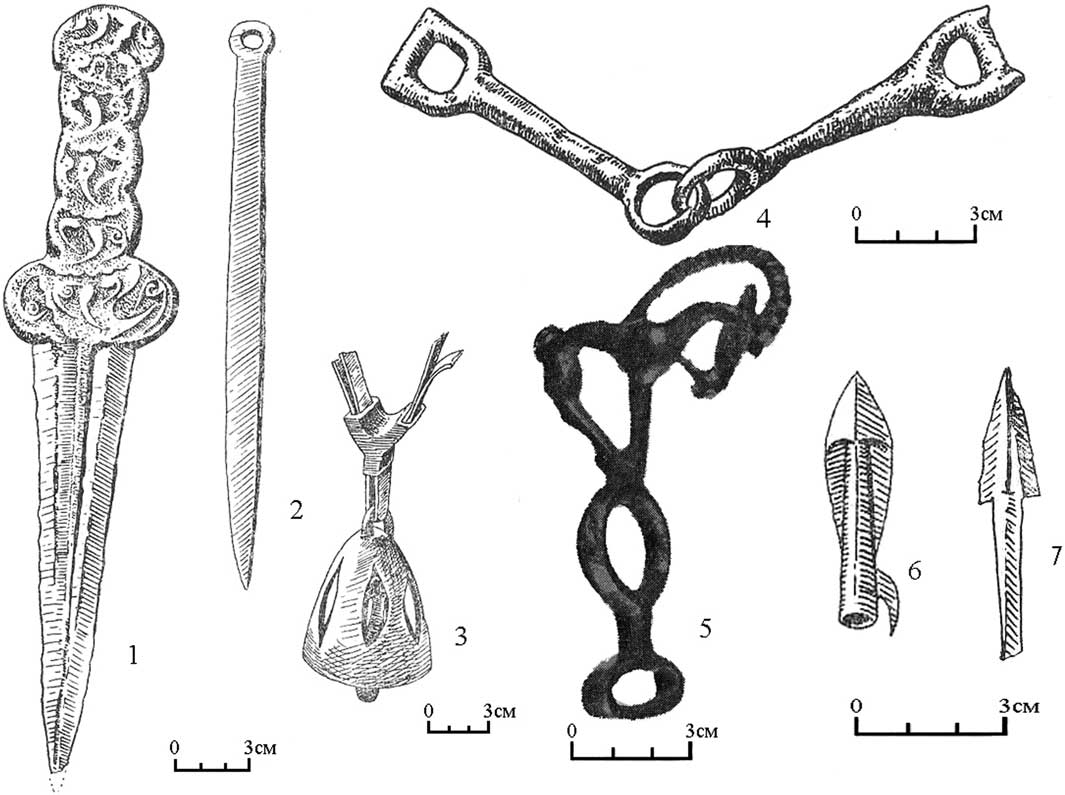
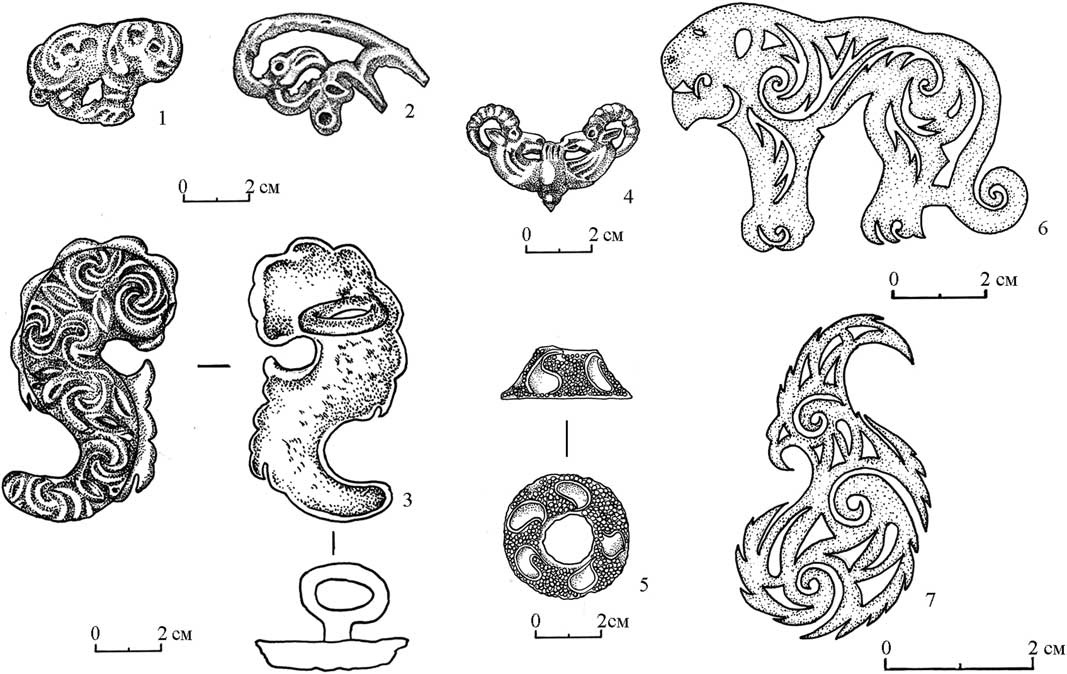
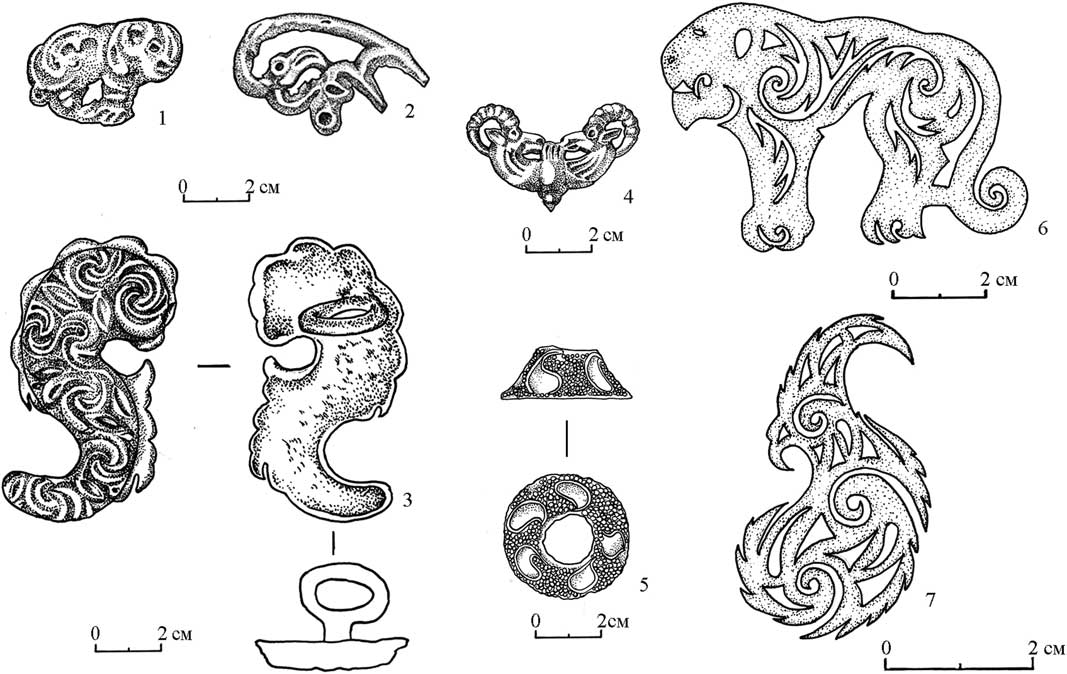
Defined in the 1960s, the Tasmola archaeological culture is characterized by strongly marked steppe nomadic appearance, kurgan burials, numerous pieces of weaponry, horse harnesses, and household items (Figures 1 and 2). Presently, this culture is regarded as a large historical-ethnographic community that included the regions of central (Beisenov Reference Beisenov2011) and northern Kazakhstan (Habdulina Reference Habdulina1994), and the southern Trans-Urals (Tairov Reference Tairov2007).
Bronze artifacts of the Tasmola culture, SW Pavlodar Oblast (excavations by M K Kadyrbaev, 1959–1962 documented in Kadyrbaev Reference Kadyrbaev1966): 1, 2, 7 – dagger, knife, and arrowhead (Nurmanbet 4, kurgan 1); 3, 4, 5 – bell, bridle bit, and figurine of a mountain goat (Tasmola 5, kurgan 2); 6 – arrowhead (Karamurun 1, kurgan 5ж).

Golden ornaments of the Saka aristocracy ceremonial costumes from the elite Tasmola kurgans, Karaganda region (excavations by A Z Beisenov, 2010–Reference Beisenov2011): 1, 3, 5 – Taldy-2, kurgan 5; 2, 4 – Taldy-2, kurgan 2; 6 – Karashoky, kurgan 1; 7 – Sherubai, kurgan 1.
Most Tasmola mounds are large, more than 15–20 m in diameter and more than 1.5–2 m high. The smallest mounds are kurgan 3 of the Taisogan graveyard (0.4 m high, 8 m in diameter) and kurgan 11 of the “37 warriors” cemetery (0.4 m high, 10 m in diameter). The largest is kurgan 2 of the Nurken-2 graveyard (6 m high, ~60 m in diameter). Limestone, abundant in the hilltops in the area, was extensively used in the construction of the kurgans, including mounds themselves, tops and around burial pits. Mounds located on the riverbanks contain clay, which obviously replaced stone, which is difficult to extract and transport. Kurgans always contain single grave, dug in the ground, and in most cases a passage (dromos) orientated to the east or southeast, ranging from 1.5 m (“37 warriors,” kurgan 11) to 15 m in length (Nurken 2, kurgan 2). The deceased are usually orientated towards the northwest or west.
The early investigations of the Tasmola sites in the 1950s and 1960s were mostly focused on kurgans located along the Shiderty River (SW Pavlodar Oblast). On the basis of particular characteristics of burials and grave goods assemblages, it was initially divided into two chronological stages, archaeologically dating to the 7th–6th and 5th–3rd century BC, respectively (Kadyrbaev Reference Kadyrbaev1966). To date, more than 200 kurgans have been investigated. The most important directions of modern research include the investigation of the elite Tasmola burial mounds and investigation of settlements (Beisenov Reference Beisenov2002, Reference Beisenov2012, Reference Beisenov2013; Habdulina Reference Habdulina2003; Beisenov and Lohman Reference Beisenov and Lohman2009; Beisenov and Mertz Reference Beisenov and Mertz2010).
Korgantas Period
In the 4th century BC, a new type of burial appeared in central Kazakhstan, different from those of the Tasmola culture. Typically, the burials represent small, round, or oval roughly built mounds from 6–7 m to 10–15 m in diameter, which is indicative of a change in funeral rites of the people. A chaotic assemblage of stones is often found on the ground above a grave. The enclosure, characteristic for the Tasmola burial mounds especially of the early phase of the culture, is missing for the Korgantas sites. Typically, the mounds contain a single burial; the deceased are orientated towards the northeast or east. No passages (dromoi) have been discovered in Korgantas burials. The aforementioned features allowed to attribute the burials to a distinctive cultural unit, the Korgantas period (Beisenov Reference Beisenov1995). These sites are characterized by a number of features similar to those of the early Hun burials, such as sacrificial head-places holding heads of domestic animals (Beisenov Reference Beisenov1995, Reference Beisenov1997).
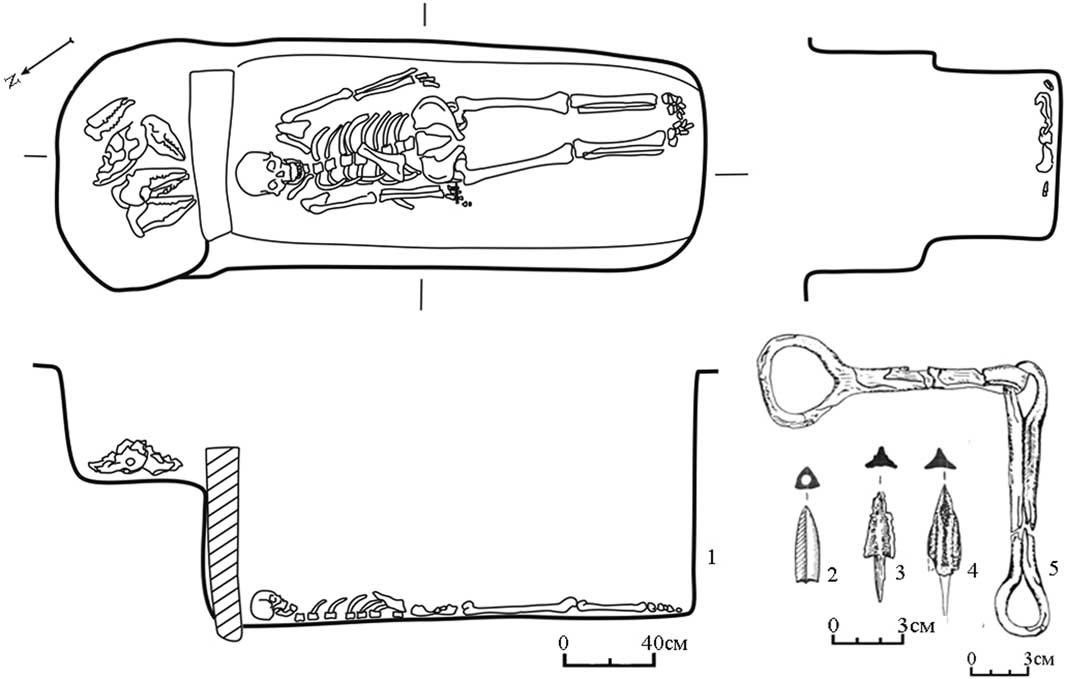
To date, a number (less than 40) Korgantas kurgans have been investigated, most of which have been plundered (in some cases, several times), apparently in ancient times; as such, many issues regarding the interpretation of the discoveries remain unaddressed. Archaeologically, this period was dated to the 3rd–1st century BC; however, some features (e.g. bone arrowheads) suggest the 4th century BC as the start date of the period (Beisenov Reference Beisenov1995, Reference Beisenov1997). Specific features of burial structures and artifacts (Figure 3) suggest that the Korgantas are related to sites in the eastern regions of Central Asia, and that the population might have migrated from Ordos region of north China (Tairov Reference Tairov2006; Shulga Reference Shulga2011).
Burials and artifacts (arrowheads and bridle bits) of the Korgantas period, Birlik cemetery, SW Pavlodar Oblast (excavations by A Z Beisenov in 1990): 1 – plan and cross-section of the kurgan 2 burial pit; 2, 3, 4 – bone and iron arrowheads and bridle bits, kurgan 19.

Aims of the Study
Since the early stages of the research into the Early Iron Age of Eastern Eurasia, the problems of chronology and periodization have appeared the most topical and included the issues of development of the cultures themselves, as well as their contacts with neighbors. At the moment, the research into the Saka cultures of Kazakhstan is strongly limited by the lack of reliable 14C data sets. In particular, it is virtually impossible to intercorrelate the chronologies of elite Saka kurgans. The routine employment of biochemical methods, including 14C dating, is one of the crucial factors of the modern research into the Early Iron Age cultures of Kazakhstan.
The main aim of this study is to present the 14C chronology of the Tasmola culture and the Korgantas period, and in particular, to address the issue of the end date of the second phase of the Tasmola culture (i.e. the end date of the culture itself). The original archaeological attribution of the second phase of the culture to the 5th–3rd century BC (Kadyrbaev Reference Kadyrbaev1966) was based on a small number of burials excavated in the 1950s and 1960s, and this has since been challenged. The recently defined Korgantas period, archaeologically dated to the 4th/3rd to 1st century BC, chronologically corresponds with the second phase of the Tasmola culture, which raises the question of the end date of the Tasmola. The new 14C dating program has a potential of refinement of the end date of the Tasmola culture, which, based on archaeological evidence, has been earlier proposed as (possibly the start of the) 5th century BC (Beisenov Reference Beisenov1995, Reference Beisenov1997). In the broader context, the new 14C dates are of great importance not only for a regional archaeology, but also for wider research in chronology as a comparative material, as well as serving as a timeframe for DNA research, which recently has largely expanded to the Bronze Age of the Eurasian Steppe (Allentoft et al. Reference Allentoft, Sikora, Sjögren, Rasmussen, Rasmussen, Stenderup, Damgaard, Schroeder, Ahlström, Vinner, Malaspinas, Margaryan, Higham, Chivall, Lynnerup, Harvig, Baron, Della Casa, Dąbrowski, Duffy, Ebel, Epimakhov, Frei, Furmanek, Gralak, Gromov, Gronkiewicz, Grupe, Hajdu, Jarysz, Khartanovich, Khokhlov, Kiss, Kolář, Kriiska, Lasak, Longhi, McGlynn, Merkevicius, Merkyte, Metspalu, Mkrtchyan, Moiseyev, Paja, Pálfi, Pokutta, Pospieszny, Price, Saag, Sablin, Shishlina, Smrčka, Soenov, Szeverényi, Tóth, Trifanova, Varul, Vicze, Yepiskoposyan, Zhitenev, Orlando, Sicheritz-Pontén, Brunak, Nielsen, Kristiansen and Willerslev2015; Haak et al. Reference Haak, Lazaridis, Patterson, Rohland, Mallick, Llamas, Brandt, Nordenfelt, Harney and Stewardson2015).
MATERIALS AND METHODS
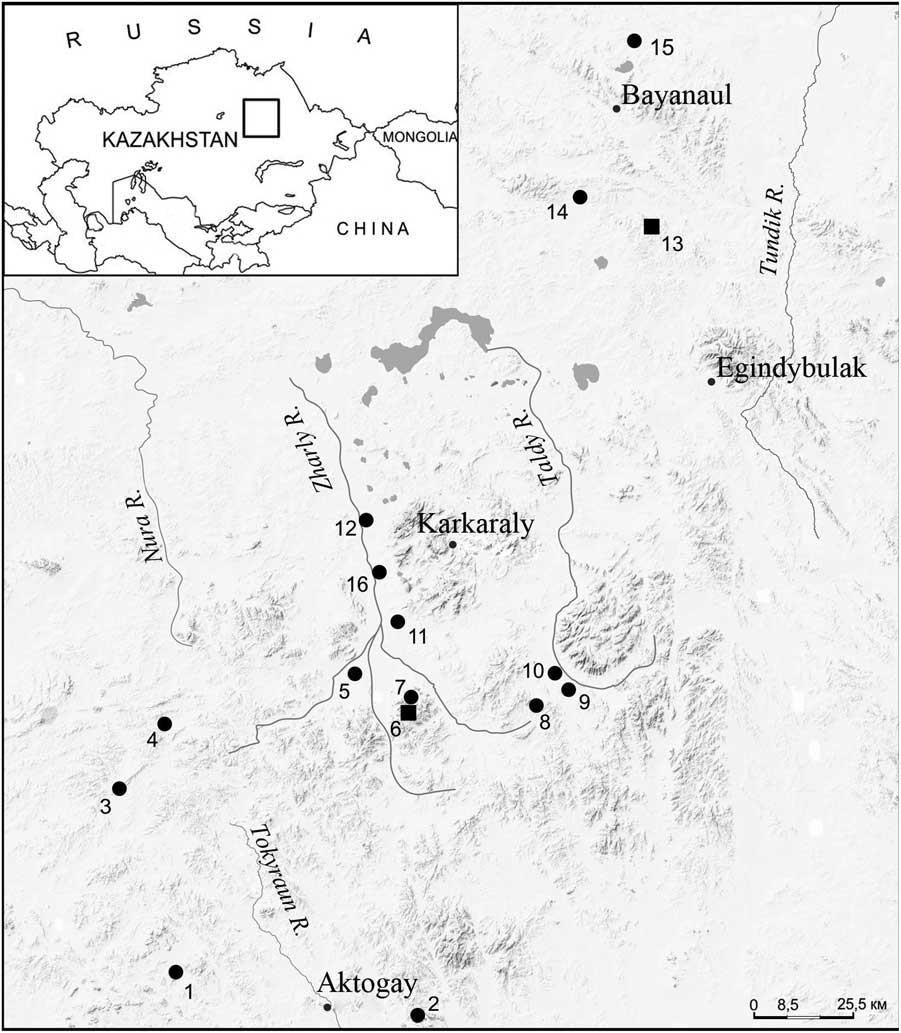
The analyzed sites (Figure 4) were excavated in 2000–2013; they are located in the Kazakh uplands between the southwestern part of Pavlodar and eastern part of the Karaganda regions, characterized by vast steppes with high rocky hills. The kurgans are grouped in small cemeteries, located on plains with small rivers or streams, which usually dry up during the summers. Particularly large kurgans are located in approximately equal distances of few tens of kilometers, which suggests that they might have been used to mark the location of related families with their lands.
Map of the newly discovered Early Iron Age sites of central Kazakhstan, mentioned in the paper. Circles indicate cemeteries and squares mark settlements. Sites 1–14 belong to the Tasmola culture, and sites 15 and 16, to the Korgantas period: 1. “37 warriors”; 2. Begazy, Kyzyl; 3. Karashoky; 4. Akbeit 1; 5. Nurken 2; 6. Sarybuirat; 7. Bakybulak; 8. Koitas; 9. Taisoigan; 10. Taldy 2; 11. Nazar 2; 12. Kosoba; 13. Tagibaybulak; 14. Kyzylshilik; 15. Birlik; 16. Bidaik. In total, 22 adult humans and 2 animals from 16 sites have been sampled.

Two laboratories have been used to analyze the samples. Two dates were obtained from Beta Analytic (Miami, Florida, USA; the details of pretreatment protocol for these samples are not available). The majority of the AMS 14C dates (n=22) were obtained from bone collagen samples prepared and analyzed in the 14CHRONO Centre for Climate, the Environment and Chronology (Queen’s University Belfast) using an NEC compact 0.5MV accelerator mass spectrometer (AMS). Sample bone surfaces were cleaned. Preparation of collagen was based on an ultrafiltration method (Brown et al. Reference Brown, Nelson, Vogel and Southon1988; Bronk Ramsey et al. Reference Bronk Ramsey, Higham, Bowles and Hedges2004) and included bone demineralization (2% HCl), gelatinization (at 58°C for 16 hr), filtration, ultrafiltration (using Vivaspin 15S ultrafilters with MWCO 30kDa; 3000–3500 rev/min for 30min), and freeze-drying. The dried collagen was stored in a desiccator. Prepared collagen samples were sealed under vacuum in quartz tubes with an excess of CuO and combusted at 850°C. The CO2 was converted to graphite on an iron catalyst using the zinc reduction method (Slota et al. Reference Slota, Jull, Linick and Toolin1987). The graphite was then pressed to produce a “target” and the 14C/12C and 13C/12C ratios were measured by AMS. The sample 14C/12C ratio was background corrected and normalized to the HOXII standard (SRM 4990C; National Institute of Standards and Technology). The 14C age and one standard deviation were calculated using the Libby half-life (5568yr) following the conventions of Stuiver and Polach (Reference Stuiver and Polach1977). The 14C ages were then corrected for isotopic fractionation using the AMS-measured δ13C, which includes natural and machine fractionation (and therefore is not included in the text), and calibrated using the CALIB 7.0 program (Stuiver et al. Reference Stuiver, Reimer and Reimer2013) and IntCal13 calibration curve (Reimer et al. Reference Reimer, Bard, Bayliss, Beck, Blackwell, Bronk Ramsey, Buck, Cheng, Edwards, Friedrich, Grootes, Guilderson, Haflidason, Hajdas, Hatté, Heaton, Hoffman, Hogg, Hughen, Kaiser, Kromer, Manning, Niu, Reimer, Richards, Scott, Southon, Staff, Turney and van der Plicht2013).
RESULTS AND DISCUSSION
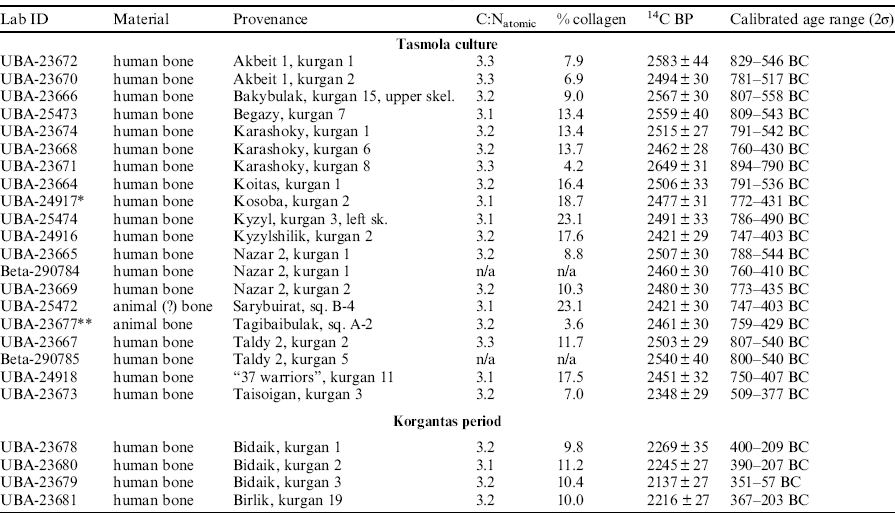
For samples analyzed in the 14CHRONO Centre, the bone collagen content varied between 3.6% and 23.1%, which indicates very good collagen preservation (van Klinken Reference van Klinken1999; Table 1). The C:Natomic ratio was within the accepted range 2.9–3.6, also characteristic of well-preserved collagen (DeNiro Reference DeNiro1985).
AMS 14C dates, C:Natomic and collagen yield of the samples from the Early Iron Age sites of central Kazakhstan. Two dates have been published previously in (*) Beisenov (Reference Beisenov2014a) and (**) Beisenov (Reference Beisenov2014b).

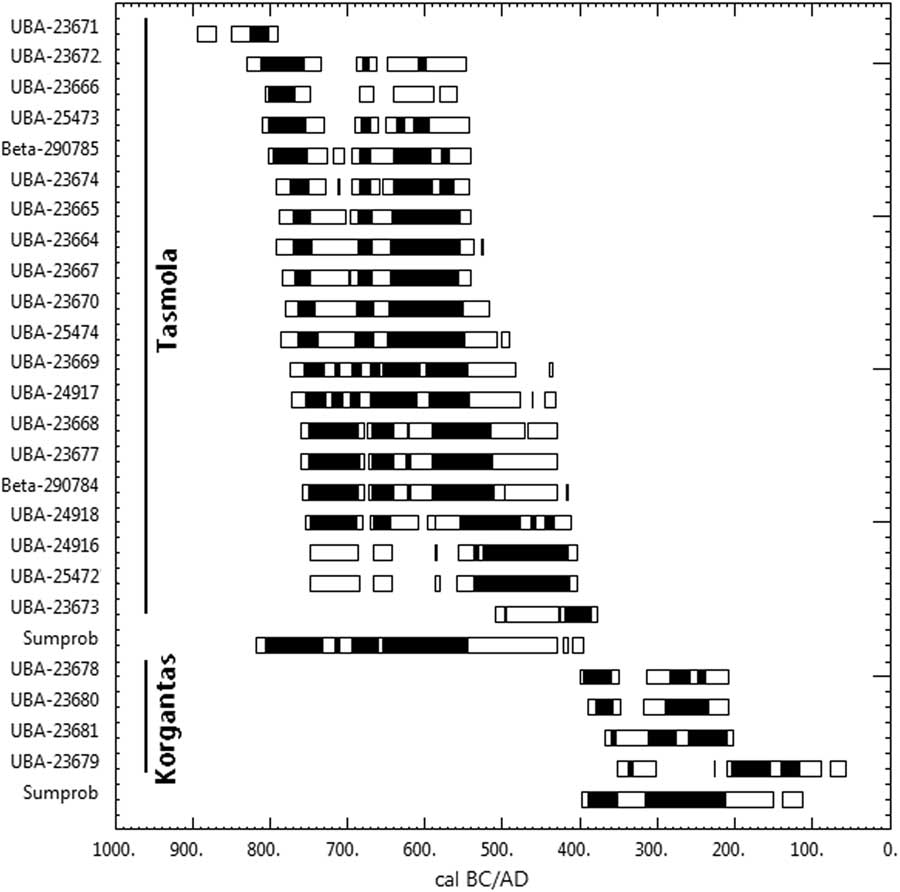
Table 1 and Figure 5 present the results of the 14C measurements for the Tasmola (n=20) and Korgantas (n=4) samples, as well as summed probabilities for the two periods. In general, the dates for both periods cluster together very well. Summed probabilities for the periods appear as 818–396 cal BC (2σ) for the Tasmola culture and 397–113 cal BC (2σ) for the Korgantas period. For the Tasmola culture, the earliest date clearly belongs to kurgan 8 of the Karashoky cemetery (UBA-23671; 894–790 cal BC), while the latest date belongs to kurgan 3 of the Taisoigan cemetery (UBA-23673; 509–377 cal BC). Archaeologically, kurgans of the Karashoky cemetery have quite an archaic appearance, considering the architecture and burial features, and are similar to the burials of the Bakybulak and Akbeit 1 cemeteries, the majority of which also have earlier 14C dates. For the same reasons (architectural simplicity and roughness, smaller size of burials), the site of Taisogan can archaeologically be attributed to the late phase (decline) of the culture. At the moment, archaeologically it is difficult to develop the internal chronology for the Korgantas sites, as most of the burials have very simple constructive features.
Calibrated age ranges and summed probabilities (1 and 2σ) of the Tasmola and Korgantas samples analyzed.

The new 14C dates of the Early Iron Age Saka sites of central Kazakhstan, presented here, make it possible to review the most topical issues in the chronology of cultural transitions for the region, primarily, the chronology (start and end dates) of the Tasmola culture. The initial chronological framework for the Tasmola culture proposed by Kadyrbaev (Reference Kadyrbaev1966), wherein the two stages of the culture were dated to the 7th–6th and 5th–3rd century BC, was largely based on the widely supported traditional stadial approach to the chronology of Scythian-Saka cultures of steppe Eurasia developed in the first half of the 20th century (see Klejn Reference Klejn2012). Following this approach, the Scythian epoch was dated to the 7th–3rd century BC, based on the archaeological dates of the latest Bronze Age sites, and also based on the reign of Modu Chanyu emperor (Xiongnu Empire) and beginning of the Hunno-Sarmatian epoch.
However, since the 1970s, the archaeological meaning of the term Scythian époque, as well as the chronology of a number of cultures, have been reconsidered for many regions of the eastern Eurasian Steppe, including Kazakhstan. This was greatly triggered by the research in the Sayan-Altai region of southern Siberia and discovery of the Early Scythian burial mound of Arzhan 1 dated to the end of the 9th–8th century BC, which is essentially earlier than the “traditional” date for the beginning of the Scythian époque (Gryaznov Reference Gryaznov1980). The subsequent sensational discovery of the Arzhan 2 kurgan dated to middle to end of the 7th century BC further challenged the traditional perception of the Early Scythian chronology, which was now considered as starting in the 8th–7th century BC (Chugunov Reference Chugunov2006; Čugunov et al. Reference Čugunov, Parzinger and Nagler2010).
Since the 1990s, the problem of the discrepancy of the Tasmola archaeological chronology with that of neighboring cultures became evident, partly being the result of the insufficient research into the sites. By 2010, a number of newly discovered (discussed in this paper) Tasmola burial mounds appeared archaeologically younger than those excavated in 1960s by M K Kadyrbaev. Their younger date is suggested by the archaic constructive features and particular artifacts; a number of kurgans contained passages (dromoi). The dimensions of newly discovered mounds was rather large, up to 30–50m in diameter, 3–5m in height, while the kurgans discovered earlier had small mounds up to 15–25m in diameter and 0.5–1.5m in height. Clearly, these earlier kurgans exceeded the traditional archaeological date of the beginning of Tasmola culture (i.e. 7th century BC).
In this context, the 14C dates obtained during the current study confirm the earlier start date of the Early Scythian period in central Kazakhstan. The earliest 14C dates for the Tasmola culture belong to the 8th century BC, which makes it approximately 1 century older compared to the traditional archaeological start date of the 7th century BC. The results also correspond with data for the beginning of the Early Scythian period in the end of the 9th–8th century BC in the Sayan-Altai region (Tishkin Reference Tishkin2007), where cultural connections with central Kazakhstan have been previously observed (Kyzlasov Reference Kyzlasov1977).
The later kurgans of the Tasmola culture change their appearance; they become smaller and do not contain golden ornaments. Archaeologically, the most representative Tasmola kurgans containing characteristic pieces of horse harnesses, weaponry, and ornaments disappear by the 5th–4th century BC, apparently without an external influence. Obtained 14C dates also suggest the end date of the culture as 5th century BC, thus confirming the archaeological observations and making the end date of the culture ~2 centuries older compared to the traditional end date (3rd century BC).
Archaeologically, it appears that a new period starts in central Kazakhstan in the 4th century BC, which is confirmed by the new 14C dates. The obtained results suggest the 4th–2nd century BC as the most probable date of the Korgantas period, which also indirectly confirms the general end of the Tasmola culture in the 5th century BC (although one can accept the possibility of later dates for particular isolated burials).
It is possible to suggest that a number of late Tasmola burials dating to the 4th century BC might be found in the future, possibly in the outskirts of the main areal of the culture. As such, the next step of our research will include the detailed study of the chronology of the second phase of the Tasmola culture.
CONCLUSIONS
The first 14C database presented herein for the Early Iron Age of central Kazakhstan is an essential step for further archaeological research in the area. The new 14C dates suggest the beginning of the 9th to end of the 4th century BC as timing of the Tasmola culture and the 4th to beginning of the 2nd century BC as the timing of the Korgantas period. Thus, the start and end dates of both periods are apparently 1 to 2 centuries older than defined originally, which corresponds with the latest archaeological data for the region, which is somewhat in contrary to the traditional perception of the chronology of Scythian period in central Kazakhstan. The new dates suggest the beginning of the Early Scythian period in the region in at least in the 8th or late 9th century BC rather than 7th century BC according to the traditional approach. Further research into the chronology of the region will include the investigation of the possible freshwater reservoir effect on the 14C dates of particular types of samples, including human bone.