

In 1911, Elaine Goodale Eastman, longtime collaborator with her husband, Indigenous writer Charles Eastman (Ohiyesa), published Yellow Star: A Story of East and West, one of several texts she wrote for young white audiences. Eastman’s main character, Stella/Yellow Star, an orphan of the 1890 Wounded Knee Massacre, arrives in the fictional New England village of Laurel as the adoptee of Lucy Waring, a white missionary widow.Footnote 1 Determined to continue valuing her original Indigenous community, Stella models both a particular brand of acquiescent assimilation and a strong resistance to its would-be totalizing power. As such, the literary character of Yellow Star demonstrates a complicated version of historian Philip Deloria’s assertion that, even in the face of such forces as the boarding school movement, Plains warfare, and being forced onto reservations, early twentieth-century “Native people engaged the same forces of modernization that were making non-Indians reevaluate their own expectations of themselves and their society.”Footnote 2 That is, although this novel’s self-positioning as literature about and for youth sometimes led its author to over-simplify her protagonist’s portrait, Yellow Star nonetheless presents a narrative counter-story resisting many of the stereotypes that were then being assigned to American Indians by white cultural arbiters. Those inaccurate views, as Deloria argues, cast Indians as “supposedly” “corralled on isolated and impoverished reservations, miss[ing] out on modernity—indeed, almost dropped out of history itself.”Footnote 3
Across multiple stages of maturation, before returning to the West to teach mothers and children of her tribe, Yellow Star/Stella articulates an alternative historical voice. She insists that her New England neighbors rethink their ideas about “cruel and treacherous savages.”Footnote 4 She offers different versions of events for which she knows that dominant, white-managed accounts are wrong. In interpreting this book’s treatment of such historical topics, the Eastmans’ family history merits analysis, since it illuminates both the author’s personal knowledge of Indigenous culture and her limitations as a purveyor of that heritage. Additionally, Goodale Eastman’s standpoint as an author facing gendered constraints as well as race-related ones presents another layer for historical analysis. Accordingly, Yellow Star provides a case study of the forces at play when literary texts engage complex histories related to Indigenous cultures.
Yellow Star draws on Elaine Goodale Eastman’s background as a white woman raised in New England, a region sometimes associated with traditional, idealized versions of American history and an identity bound up, as Joseph Conforti has noted, with “Imagined pasts” that could in some cases help “New Englanders negotiate, traditionalize, and resist change.”Footnote 5 These are culture-shaping forces Yellow Star both recognizes and discursively resists in terms reminiscent of some choices her creator had made earlier in her own life. Leaving New England at a young age, Elaine Goodale embraced an educational mission that took her, first, to teaching at Hampton Institute, whose students included both African Americans and American Indians, and subsequently to a part of the West caught up in the assimilationist campaign to control Indigenous education. Favoring pedagogy honoring Indigenous language and cultural practices, she was, at this stage of her life, progressive in her early commitment to on-reservation learning over boarding school displacement of children. Later, as the wife of a famous, influential Indigenous intellectual, she sought ways to impact the challenging cultural context that would shape the adulthood of their mixed-race children. Yellow Star thus represents, on one level, an author’s purposeful history-telling aimed at educating white people in order to promote more informed and accepting understandings of Indigenous peoples. Yet the narrative also reflects white America’s (and the writer’s) persistent ties to hierarchical race, class, and gender relations. Specifically, Goodale Eastman’s own personal limitations as a cross-cultural history-teller illustrate recurring shortcomings among white would-be allies of Indigenous communities.
To address this multilayered literary history-telling, my core argument falls into three parts. Since the novel is not widely read today, the first, most detailed section presents a close reading of Yellow Star’s interventionist rhetoric set in the period of its publication, namely its efforts to educate white youth and parents to accepting a place for Indigenous people in the United States. This interpretation assumes benefits arise from viewing historical fiction as projecting rhetorical goals beyond providing an accurate chronicle of the past. As Greg Walker suggests, “To read literature historically allows us to see how contemporary men and women deployed the ideas, concepts and symbols that mattered to them,” including how such values shaped their responses “to moral, social and political issues.”Footnote 6 The second domain of analysis expands on the biographical ties referenced within the first section’s close readings to offer an intersectional analysis of narrative themes seemingly derived from the Eastmans’ family history, including their vexed interactions as co-authors of multiple texts within the ongoing tensions of their marriage.Footnote 7 The third area of interpretation envisions future scholarship and teaching, including asking how the recovery of this long-marginalized novel demonstrates what is gained by studying children’s literature from past eras.
Family Reading of Girlhood Models in the Long Nineteenth Century
Analysis of Goodale Eastman’s text as “children’s literature” requires acknowledging the family literacy practices associated with the genre across the long nineteenth century and into the twentieth, as well as the author’s previous utilizations of the form. Though dubbing a text “children’s literature” today might conjure images of a youth’s silent individual reading, the tradition of domestic literacy narratives established by New England writers like Lydia Sigourney, Lydia Maria Child, and Catharine Maria Sedgwick—drawing on British models like Anna Barbauld and her brother John Aikin’s popular Evenings at Home—envisioned reading this genre as a social familial act guided by parents, especially white middle-class mothers. Barbauld, in particular, helped establish this practice of American family reading with her Lessons for Children primers for mother-led home education.Footnote 8 Countless portraits of family reading within “children’s literature” texts in succeeding decades would enshrine this ideology, seen in episodes such as Ellen Montgomery reading the Bible with her mother in Susan Warner’s The Wide, Wide World (1850) and Ma reading to Pa and the Ingalls girls in the Little House series. Eastman herself, having grown up in a New England literary family, was both a product of and, early on, a contributor to this tradition.
Along with her sister Dora, she published in free-standing book form and in the most influential periodical for family reading of their day, St. Nicholas: An Illustrated Magazine for Young Folks, under the visionary editorship of Mary Mapes Dodge. As early as 1877, poems by Elaine and Dora Goodale appeared in the magazine. Years later, Goodale Eastman, tapping into her well-established professional connections with Dodge, would help launch her husband’s career writing about American Indian life by facilitating publication of stories about his youth in the magazine—stories that expanded into multiple books she would edit. Writing for St. Nicholas and other venues for children’s literature during this era meant participating in a vision of the genre as bringing youth and adults together as readers. As Michelle H. Phillips has documented, St. Nicholas under Dodge’s leadership was “a magazine that mediate[d] the exchanges between adults and children” by resisting views of youth and parents as opposite ends of a binary. “Rather than conceive of the child and adult as lives and identities a world apart, St. Nicholas invite[d] its readers and contributors, regardless of age, to imagine themselves as members of hybridized community, capable of inhabiting and communicating” and learning together in a “medial” space cutting across what might otherwise be separate “sociological interiors.”Footnote 9
Related to such age-bridging family literacy practices, as Robin Cadwallader and LuElla D’Amico have observed, was a gendered conception of girlhood and writing/reading about girls that would also have been a significant influence on Goodale Eastman’s Yellow Star. Noting how texts like Louisa May Alcott’s Little Women encouraged their “contemporaneous readers” to resist pinpointing girls’ precise ages and instead maintained a sense of girlhood identity for characters even into courtship and marriage, Cadwallader and D’Amico emphasize that the literary figure of the “girl” in American culture of the late nineteenth/early twentieth century cast such characters as a “construct,” one serving as “a site of possibility” and “represent[ing] hope for new ideas and new ways of seeing the world” via an agency “inextricably intertwined with national identity.”Footnote 10 For Goodale Eastman’s Yellow Star, these interrelated traditions should foster interpretation of the narrative as written for adults as well as children of varying ages, and as portraying a main character as an aspirational model addressing national-level concerns.
Revising Schoolroom History-Telling
In setting Yellow Star in New England at the turn of the twentieth century, Elaine Goodale Eastman identified her text’s main audience: white American cultural stewards whose views of current issues were intertwined with their associated historical visions and related social power. Having grown up in the region and having relocated her family to live there, Goodale Eastman understood both the symbolic place of New England village life in U.S. history and its lingering influence on white Americans’ views of themselves and their nation. Bringing her protagonist into such a representative setting also enabled the author to send a strong cross-cultural signal. White readers in the northeast had been receiving regular positive reports of various processes of settler colonialism, but confronting an Indigenous person in their own community—even one cast in the nonthreatening form of a pre-adolescent girl—would require direct engagement with questions about cultural differences and the impact of events like the Indian Wars. For Goodale Eastman and her youthful heroine, an essential step for providing Indigenous people access to a meaningful social role involved having white Americans revise the dominant historical narrative denigrating Indigenous culture. Thus, in a series of encounters with those misinformed narratives, Yellow Star/Stella pressed for reconfigured versions of whites’ assaults on Indigenous land and people, their control of performative representations of the “Wild West,” and their efforts to manage the education of Indigenous children. In each case, Yellow Star used a revision of white-sponsored historical narratives to promote a corrective understanding of past and ongoing interactions between Indigenous people and colonizers, along with lessons for enacting ethical social practices.
The first of these cultural rewriting efforts occurs in an early chapter tellingly entitled “A Lesson in History.” Though a major goal of her novel involves resisting the stereotyping of Indigenous peoples, Goodale Eastman invokes other stereotypes in her description of the village school’s students: “the children of European peasants, the earlier and quick-witted Irish, the later Poles, with the broad, heavy faces, two or three brilliant, undersized young Jews, and the dark-brown scions of several long-established negro families, sat side by side with the severely self-respecting descendants of the earliest Puritan stock.”Footnote 11 This last group holds sway, unsurprisingly, including in later scenes depicting social relations among the students (such as a girls’ club excluding one character based on her working-class identity).Footnote 12 Yellow Star, the narrator observes, is “add[ing] one more ingredient to the racial melting-pot” of the classroom.Footnote 13 Since “nearly everybody” was “accept[ing] her with excellent grace,” the scene initially appears to affirm the ideals of the New England common school as community-building.Footnote 14 But Goodale Eastman depicts conflict arising between the teacher, Miss Morrison, and the newest student (Figure 1).
Stella/Yellow Star as envisioned by Native American artist Angel De Cora and William Henry “Lone Star” Dietz, a student of De Cora’s innovative art program at Carlisle who married her in 1908.Footnote 15 Elaine Goodale Eastman, Yellow Star: A Story of East and West, 1911.

These exchanges set up a dialogue whose setting and content would resonate with young readers—in Goodale Eastman’s time and today. Asked, “‛How did the early settlers treat the Indians?’” Mary Maloney responds: “‘They treated them fine.’”Footnote 16 The teacher’s follow-up query of “‘What did the Indians do?’” is directed to Rosey Bernstein, whose reply of “‘[t]he cruel and treacherous savages turned upon the defenseless settlers with fire and ax’” is, the narrator reports, “glibly recited” and supplemented with Rosey’s referencing “‘a series of frightful massacres.’”Footnote 17 Rounding out this sanctioned performance of racist propaganda cast as history, Goodale Eastman has “woolly-headed Pete Holley” volunteer a scathing addition: “‘They stove babies’ heads in, right in front of their mothers’ faces, and then made the mothers walk hundreds of miles barefoot in the deep snow.’”Footnote 18 Goodale Eastman knew from personal experience when she joined her future husband in efforts to find and nurse survivors of Wounded Knee that this assessment of savagery might be more accurately ascribed to whites’ assaults on Indigenous communities. Nonetheless, the scene in the novel underscores the persistent power of false reporting, as Rosey chimes in again with an invocation of brutal scalpings, giving a direct reading from her open copy of a book that was part of the official curriculum. This reading, Yellow Star is horrified to hear, contrasts “cruel” Indians with the “justice and kindness” of white leaders.Footnote 19
Goodale Eastman, whose career included years of classroom teaching (first at Hampton and later in Indigenous Dakotas communities), here crafted portrayals of students’ recitations, reconfirmed via an official textbook’s authority, to demonstrate the pervasiveness of anti-Indigenous history-telling. By folding in stereotyped markers casting the children as Irish, Jewish, and African American, meanwhile, she also demonstrated how pernicious cultural assumptions can be incorporated into the worldview of historically marginalized races against other victims of white oppression. And she illustrated the insidious interaction of formal documents like textbooks with mediating authority figures like schoolteachers, as all of these factors interacted to reinforce false versions of Indigenous people and their place in American historical memory.
Resisting these forces, Yellow Star/Stella (here dubbed “her people’s advocate”) interjects a counter-narrative framed as rhetorical questions:
Was it treating them [Native people] with justice and kindness to take their lands away from them, and give them only a few beads and knives for thousands of acres? Was it fair to give them whiskey to drink, and knives to kill people with, and then when they were drunk and angry and killed some bad white men, to punish the whole tribe by burning their villages and wives and children? … Did the “cruel, treacherous savages” take away all the white people’s guns and then shoot them down, women with little babies and boys and girls smaller than us? Did they chase them all over the prairie and kill them while they begged for mercy, and then call it a battle? Footnote 20 That’s what your soldiers did to us, and I was in it! Maybe, if we wrote the history books, there wouldn’t be so much in them about the “treacherous Indians!”Footnote 21
This initial scene of revisionist teaching establishes a rhetorical pattern in which the text first acknowledges the prevailing narratives being taught to children, then presents a counter-narrative through the voice and actions of Yellow Star/Stella. Central to this pattern’s discursive force is the character’s drawing on her identity and her personal experiences for history-telling. Her insistent “I was in it!” exerts a different brand of epistemological authority over historical narrative than those inscribed in traditional, white-controlled accounts. Goodale Eastman repeats this approach in later scenes, moving through increasingly complex topics and culminating in an episode wherein Stella/Yellow Star has become a teacher herself, facing challenges to her would-be agency.
Popular Performances versus Lived History
Yellow Star’s next interventionist engagement with histories of settler–Indigenous interactions takes up the problem of popular Wild West shows’ portrayals of white–Indigenous conflicts.Footnote 22 Attending the famous Buffalo Bill performance at a nearby town—along with several of her village friends—Stella offers up a determined rejection of false narratives such scenes proffer. When her well-meaning but naïve friend Cynthia asks if the dramatic stagecoach attack makes Stella “‘think of home,’”Footnote 23 she again draws on personal experience to refute white culture’s storytelling. Rejecting the show’s rousing (and stereotypical) presentation of “the Indians—real, painted, plumed, ferocious warriors,” Yellow Star informs the Laurel community cohort: “‘our men all dress like farmers now, and ‘most all wear their hair short. I never saw anything like this before—except once on a Fourth of July when some white people paid our Indians to dress up and give a war-dance.’”Footnote 24 She explains that her tribe’s men might have “‘dressed up at councils and dances,’” but if they were “‘going to war,’” they “‘wouldn’t want to be bothered with all those fixings if they really had to ride far, or fight, or anything like that.’”Footnote 25 Furthermore, she points out, details such as the “‘beaded things’” in the performers’ costumes were “‘not Sioux.’”Footnote 26 By declaring those costume features “‘not Sioux,’” she resists erasure of individual tribal nations and their distinct customs. Relatedly, by describing her community’s men as “‘dress[ing] like farmers now [emphasis added]’” she alludes to the complex impact of assimilation as an ongoing process including both coercion and spaces for resistance. She acknowledges that some Indigenous people joined Buffalo Bill for personal economic reasons, thereby underscoring how traditional means of livelihood had been eliminated by settler colonialism’s enforced migrations and related policies.Footnote 27 Overall, her comments position both Indigenous communities and individuals within them as making agency-asserting choices for their lives, whether in deciding on how to dress for different contexts or in choosing to join Cody’s Wild West shows, which required a particular identity performance, but which also provided access to appealing aspects of modernity such as travel and, as Deloria has noted, a chance (however constrained) to shape the cultural narrative.Footnote 28
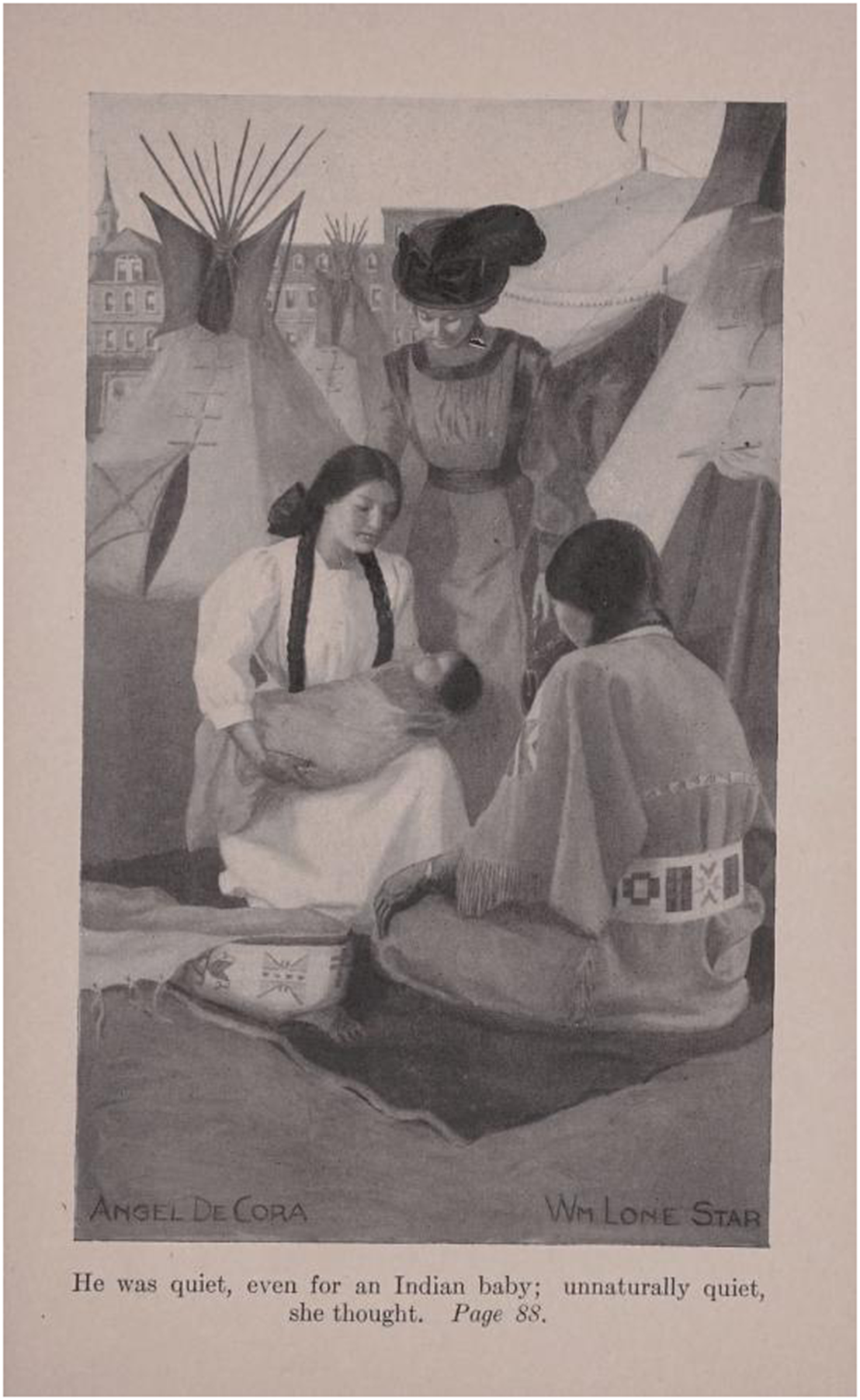
Goodale Eastman has her protagonist offer all these correctives in a patient and nonthreatening way. Nonetheless, Stella’s efforts here to reform the perceptions of Indigenous performers held by people who have become her friends also posit a related argument about whose knowledge should shape history-telling and how. As the Laurel group’s conversation about the performance continues, Goodale Eastman’s text uses Yellow Star’s assertion of her own detailed understanding of specific tribal customs to spotlight distinctions between popular entertainment presented as if historical, on the one hand, and historical knowledge based in actual lived experience of communities being depicted, on the other. Moreover, in a follow-up episode where Yellow Star recognizes members of her tribe among the performers, Goodale Eastman again takes up the question of why Indigenous people would have signed on to embody inaccurate portrayals of themselves in Wild West shows. Recognizing that two of the traveling troupe—Young Eagle and Blue Earth—come from her original tribal community, Yellow Star is distressed to see signs of severe illness in their baby. Stella’s kind efforts to secure medical care for the child soon reveal the economics often driving some American Indians to participate in white-scripted self-representations. Dependent on the salaries provided by their performances, the young couple is simultaneously caught up in the demanding schedule of the show’s touring and cut off from the support of their home community when facing such trials as their baby’s illness.Footnote 29 Although the presence of Yellow Star as a cultural broker helps secure the services of a local physician, this episode demonstrates the undermining impact policies such as the 1887 Dawes Act were having on Indigenous tribes’ communal approaches to family care.Footnote 30 Thrust into an economic system tied to capitalist self-advancement and paternal bread winning for nuclear families, individuals like the episode’s Young Eagle and Blue Earth would have had difficulty transitioning to these white-mandated expectations (Figure 2).
With her teacher Miss Morrison, Yellow Star offers comfort and guidance to a Native mother (Blue Earth) at the Wild West show attended by a group from Laurel. Elaine Goodale Eastman, Yellow Star: A Story of East and West, 1911. lllustration by Angel De Cora and William Lone Star.
Teaching in the West
The closing chapters of Yellow Star resituate the novel’s heroine from New England to “the Indian camp on Cherry Creek” in the Dakota region of her birth.Footnote 31 The plot device prompting that return to the West is a letter from Blue Earth, the young mother Stella had met at the Wild West show. Reporting that her husband Young Eagle “had left her and gone across the Big Water with the show,” Blue Earth urges Yellow Star “to come and live with her, and teach her how to teach her children” so they could eventually “‘walk the white man’s road’” with confidence.Footnote 32
Yellow Star, “after a sleepless night with the letter under her pillow,” decides to go.Footnote 33
The novel reports on several steps Stella’s supporters in Laurel took in the hope of aiding this transition, yet also highlights how their own race- and class-based privileges, as well as lingering stereotypes influencing their thinking, come into play through this process. These details, conveyed mainly in dialogue, foreshadow difficulties the novel’s heroine will face as a would-be servant-leader for her tribe. These challenges also echo constraints Goodale Eastman’s spouse Charles Eastman had encountered in his attempts to serve his people in different capacities after their marriage. (Such repeated roadblocks were one reason behind Elaine’s pushing to move the family to New England and to have both Eastmans turn increasingly to writing as a core means of family economic support and as a tool to educate the larger public about Indigenous people’s histories.)
The fathers of Stella’s friends Cynthia and Doris, while strategizing how to support her plans, demonstrate a patronizing affection for her and persistent limitations in their view of American Indians more broadly. Through their conversation, Goodale Eastman underlines differences between accepting—even welcoming—one individual from a minoritized group who seems exceptional and extending that stance through informed understanding of that person’s community and the systemic barriers it faces. By limning distinctions between the capacity each man—Mr. Parker and Mr. Brown—has for making this additional step in cross-cultural understanding, Goodale Eastman suggests how prevailing ideas about social hierarchy were related to varying degrees of historical understanding among white cultural stewards and political power figures.Footnote 34 Parker, for instance, asks his colleague: “‘are you dead sure she ought to butt in amongst a lot of half-savage Sioux—a girl who would make a place for herself in any community?’”Footnote 35 Brown’s response indicates a more liberal, if still racist, position, noting that his interactions with her have led him to question ideas he previously held about American Indians: “‘I don’t know much about the American Indian, but judging from our Stella, there must be good stuff in the breed.’”Footnote 36 Through Brown’s use of terms like “our Stella” and “the breed,” Goodale Eastman highlights the anti-Indigenous elements of this more liberal character’s views.
The author extends this point when Brown asks Parker if he has “‘any wires to pull that’ll land our little girl in the Indian Service.’”Footnote 37 Parker replies he can easily call on his friend Senator Morton. His and Brown’s shared trust in the U.S. government’s assimilationist policies and practices, along with the men’s access to power levers, provides another example of Goodale Eastman’s critique of those systemic structures and the ideologies behind them. Meeting with “‘our little girl,’” Brown (well-meaning yet patronizing) characterizes her upcoming work as “‘a field matron’” as supported by having “‘the whole United States Government back of you,’” including the pragmatic “‘right to draw on the agency for supplies—soap and buckets and rations for sick people and all that.’”Footnote 38 In this breezily assured forecast of Yellow Star’s upcoming role, Brown conveys both a trust in his own and Parker’s influence as white social leaders and assumptions about his national government that ignore the oppressive history of U.S. interactions with tribal communities.
Once Yellow Star arrives in Cherry Creek, however, Goodale Eastman presents a series of encounters with that ongoing history and its constraints on American Indians’ well-being. Affirming connections generated through conversations with Blue Earth and her children, a sewing circle of women, and plans for a cooking class point to a hopeful vision for the protagonist’s work.Footnote 39 However, Goodale Eastman also invokes the continued history of white people seeking control of Indigenous communities to present a view of cross-racial relations that is far less sanguine than those of Brown and Parker.
Perhaps most strikingly, in a letter to her friends Doris and Cynthia back in Laurel, Stella confesses to disappointments grounded in the brutal history of conflicts in the West. Through this epistle to Yellow Star’s longtime white friends, the text underscores that its white readers share their standpoint. Counter-narratives the heroine’s letter-writing constructs aim to revise historical understandings and, therefore, current perspectives on social issues linked to Indigenous-white relations. For example, she vividly describes the “‘dreadful’” time she had helping Blue Earth resist governmental efforts to carry her young son off to boarding school.Footnote 40 Yellow Star reports that a policeman came for little Chaskay just after his fifth birthday, and the only way to prevent his forced removal was through a commitment to “‘carrying him on horseback, five miles each way, morning and evening’” to the closest day school.Footnote 41 Explaining that the daily rides were “‘glorious fun while the fine weather lasted,’” Stella conversely notes how winter blizzards and springtime requirements such as fording a swelling river triggered perilous scenarios.Footnote 42 This account underscores the degree of fear and frustration Yellow Star (and Goodale Eastman) ascribed to Blue Earth at the thought of having her child taken away to boarding school; these five-mile daily rides back and forth, despite their dangers, were preferable.
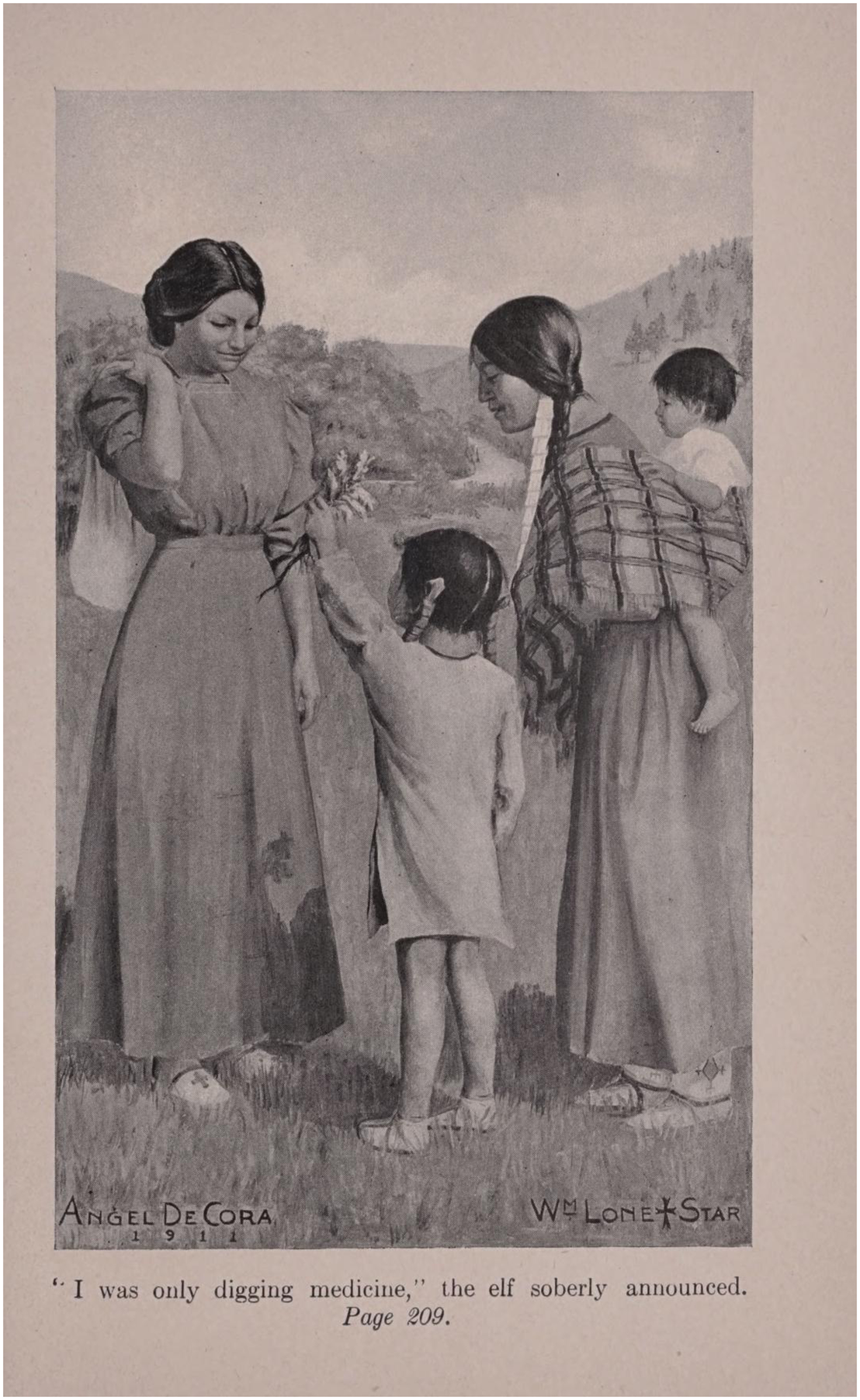
In another detail pointing to the horrific impact of boarding schools, Yellow Star describes her community as having “‘many sick people this spring—mostly with coughs and consumption.’”Footnote 43 She links the growing number of illnesses to returned students, including one “‘poor sick … young man who had been away to school’” and whose grieving grandmother sought help from Yellow Star to ease his dying days.Footnote 44 This same letter to friends in Laurel critiques government policies Eastman had observed while teaching in the Dakotas between 1885 and 1890. Countering more affirming reports circulating in the East to tout good results arising from transforming Plains Indians into full-time farmers, Yellow Star sends a biting assessment of government-hired white “‘assistant farmers’” who were supposedly teaching reservation-bound Indigenous people agricultural skills and promoting a transition from stock raising.Footnote 45 She declares they were typically, instead, providing free labor to white reservation agents. In contrast, a scene where Yellow Star joins Blue Earth and her children in “happily gather[ing] red-and-yellow Dakota plums” and natural medicinal herbs affirms Indigenous environmental knowledge and productive interactions with the natural land.Footnote 46 Taken together, through implicit rejection of the now-infamous before-and-after portraits of American Indians “schooled” into a white-envisioned brand of “civilization,” these episodes offer a counter-narrative portrayal of living and learning in a tribal setting, in tune with the natural environment and honoring communal values (Figure 3).
Yellow Star with Blue Earth’s children and their mother. Elaine Goodale Eastman, Yellow Star: A Story of East and West, 1911. lllustration by Angel De Cora and William Lone Star.
The Author’s Own Teaching History as Interpretive Context
An historicized close reading of the novel’s three main retellings of Indigenous cultural portraits illuminates its rhetorical goals. Another helpful layer of analysis emerges through a look at its autobiographical links, which spotlight both sources of Goodale Eastman’s authority as a writer depicting Yellow Star’s cultural interventions and the author’s limitations for doing this work. Based on a posthumously published biographical account highlighting her time as an on-reservation educator, Sister to the Sioux (1978), and on periodical texts published before and during the first years of her marriage to Santee Sioux Charles (Ohiyesa), Goodale Eastman can be described as holding then-progressive positions on the education of American Indian children and on the place Indigenous people deserved in U.S. culture. Numerous details in Yellow Star align with this characterization, and many of the novel’s episodes draw on her own experiences as an educator in the West.Footnote 47 As an unmarried woman teacher in Dakota communities, she had spent time between school-year sessions traveling with tribal groups, developing deep appreciation for their cultural practices. She had learned the local language well enough to serve as a seemingly trusted interpreter.Footnote 48 She advanced from providing single-schoolhouse instruction to supervising a cluster of other educators doing similar work within Indigenous communities. The curriculum she envisioned was consistent with core assumptions of assimilationist pedagogy, such as the importance of instruction in English and imposition of white American social practices. In that vein, Goodale Eastman was convinced that the best available route to individual and social agency for Indigenous peoples was, in words she would assign to her Yellow Star character Blue Earth, to “‘walk the white man’s road.’”Footnote 49 Yet, her commitment to on-reservation schooling that would adapt the original Hampton model under which she first trained as a teacher—including maintenance of Indigenous language alongside English language acquisition—distanced her for a time from the egregiously punitive approaches that Richard Henry Pratt, with his infamous creed of “kill the Indian to save the man,” had adopted at Carlisle at its opening in 1879 and then promoted for other institutions.
While her retrospective self-assessments may have been self-serving, Goodale Eastman’s portrait of her initial teaching career, revisited in The Voice at Eve (1930), is worth examining as personal history that informs details in Yellow Star. Like the central character in her 1911 novel, Goodale Eastman included “sewing, cooking, gardening” and other life skills in her teaching.Footnote 50 Encouraged, like Stella/Yellow Star, by the area’s bishop and a “local minister, himself a Sioux,” she had gone beyond the steps her young heroine could take to develop a broadened reach for her educational agenda by establishing additional day schools in “a wider field” of the region.Footnote 51 Teachers she set in place included “returned students from Hampton.”Footnote 52
Recalling these efforts, Goodale Eastman declared in her Voice at Eve memoir, “I had faith in the day-school” and “the true community center.”Footnote 53 She was aided in this initiative, she explained, by a then-new Commissioner of Indian Affairs, Thomas J. Morgan, whom she appreciated for taking “his responsibilities very seriously, with discernment regarding the educational program” she was promoting.Footnote 54 Besides “[i]gnoring the protests of such as objected to the appointment of a young unmarried woman” of twenty-seven “to a post requiring a good deal of initiative as well as much hard and unconventional travel,” Morgan also supported her approach of collaboration with local Indigenous people and her inauguration of “the first series of teachers’ institutes ever held in the Indian service.”Footnote 55
Goodale Eastman’s experiences served as one source for Yellow Star’s depiction of a protagonist with a determined commitment to collaborations with Indigenous people, as well as a willingness to push back against problematic white bureaucratic failings. Perhaps, when crafting related sentences about Stella/Yellow Star, Goodale Eastman was rather nostalgically looking back on her own prior history in the Dakotas. Thus, she would limn her protagonist as having “ideas of her own,” including pushing “the assistant farmers throughout the reservation” to adopt practices that would increase the milk supply “for young children and motherless babies,” to use improved seed brands, and to enhance ventilation designs in the community’s cabins.Footnote 56
Reading Goodale Eastman’s portrayal of Yellow Star’s efforts in such directions may underscore a wish to see herself as a genuine ally of Indigenous people, both in her recollections of her prior late nineteenth-century pedagogy and in her early twentieth-century efforts to craft a novel to educate readers. Since she depicts her Indigenous protagonist as admittedly experiencing more severe constraints on agency than she had encountered as a white teacher stationed in the West, Goodale Eastman can be credited for her awareness of such racialized differences in the experiences of white-acculturated American Indians seeking to become teachers themselves. At the same time, of course, she can be faulted for failure to address those distinctions more directly and critically—including in relation to her access to publishing about Indian education.
Vexed Authorship History
During her youth in New England, Goodale Eastman had become well-known for producing well-reviewed books of poetry.Footnote 57 But her move to the West marked a shift in her career from a focus on aesthetics to an emphasis on advocacy. Her reports on her teaching appeared regularly in publications in the East. When looking back in her Sister to the Sioux manuscript years later, she described this phase in her authorship with pride, alongside circumspect reflections. She reminisced about having begun publishing highly literary poetry while still a pre-adolescent, but asserted that her writing during this subsequent period—drafted “at odd moments, or late at night” into rushed reportorial forms rather than crafted pieces—served a different exigence: addressing the “live issue” of Indigenous peoples’ place in the nation, a topic so vital that “over twenty different newspapers and magazines” accepted her journalism in the 1880s and 1890s.Footnote 58
Fully reconciling this version of Goodale Eastman as periodical promoter of then-progressive views on American Indians with the appreciative biography of Pratt that she would publish in 1935, decades after Yellow Star, may seem impossible. A white cultural arbiter like William Lincoln Brown could praise that biography without seeing contradictions, describing Goodale Eastman as “eminently qualified” to write about Pratt, based on her work as teacher and “supervisor of Indian education under the Federal government.” He cast her portrayal as consistent with his own view of “the man himself,” whom he ranked as the Indian’s best friend.Footnote 59 Perhaps one context at least partially illuminating what would otherwise appear an inexplicable shift for Goodale Eastman emerges via connected reading of several other publications: her The Voice at Eve (1930), biographer Theodore Sargent’s introduction of a 2004 edition of Sister to the Sioux, and Gretchen Eick’s dual biography of the Eastmans, They Met at Wounded Knee (2020).
Elaine met her future spouse when both were living and working on the Pine Ridge Reservation during and after the massacre. They wed in 1891 in New York City. The event generated widespread press coverage incorporating awareness of Elaine’s status as a well-established author.Footnote 60 In the early years of the marriage, Goodale Eastman continued producing writing that advocated for Indigenous rights, and she gave enormous energy to supporting her husband’s efforts to establish a meaningful career. A graduate of Dartmouth with a medical degree from Boston University, Charles was increasingly touted as a model of assimilation. But professional success initially eluded him—first, as an agency physician at Pine Ridge and Crow Creek, and later when he sought to establish a private practice in Minnesota. The Eastmans’ first move east was to Washington, D.C., where Charles attempted lobbying to support Indigenous people but met with continued frustrations. Eventually, with encouragement and editorial support from Elaine, he found noteworthy success as a writer, publishing biographical stories initially in St. Nicholas and then in popular books such as Indian Boyhood (1902) and From the Deep Woods to Civilization (1916) (Figure 4).Footnote 61
Dr. Charles Eastman and Elaine Goodale Eastman. Edward E. Ayer Digital Collection, Newberry Library, https://collections.carli.illinois.edu/digital/collection/nby_eeayer/id/144 (accessed March 7, 2024).

However successful the two became in positioning Charles as a literary icon and Indigenous spokesman, the marriage faced pressures over gender roles and continued financial challenges associated with their family that grew to include six children.Footnote 62 By the time she was composing Yellow Star, as Goodale Eastman would later aver in The Voice at Eve, she was well along on a path toward her marriage’s bitter dissolution. The relationship between Charles and Henrietta Martindale (producing an out-of-wedlock child, Bonno Hyessa, in 1919) has sometimes been identified as a breaking point; another factor, perhaps even more significant in their decisive separation in 1921, was the death of their beloved daughter Irene Taluta.Footnote 63 However, Elaine’s frustrations over the constraints she increasingly faced as a white female author also produced stresses. One source of this tension can be traced in the Eastmans’ mix of both separate and collaborative writing projects.
Elaine confessed in The Voice at Eve that she struggled to accept the limitations linked to being a wife and mother in an era when a white middle-class woman’s social role was usually grounded in domestic maternalism and support of her spouse’s career.Footnote 64 Additionally, though her youthful publication record meant that, at the time of their marriage, she was the more famous of the two, once his books began to appear, Charles clearly held a superior authority for addressing topics linked to Indigenous America. Goodale Eastman’s Voice at Eve reflected on her struggles to navigate these waters during their marriage, as well as to represent them fairly afterward:
In an hour of comparative leisure [after their move to Massachusetts] I had urged him to write down his recollections of the wild life, which I carefully edited and placed with St. Nicholas. From this small beginning grew Indian Boyhood and eight other books of Indian lore, upon all of which I collaborated more or less. Their wide acceptance led to a demand for lectures by the author, and for fifteen years I handled nearly all correspondence and publicity incident to twenty-five or more annual appearances.Footnote 65
After having helped him achieve success, Elaine found her resentment grew accordingly.
Admitting that “the adjustment” from foregrounding her own authorship to supporting Charles’s was difficult, Goodale Eastman also conceded in Voice that she was, at times, “lonely, restless and haunted by a secret sense of frustration.”Footnote 66 Connecting these feelings to gendered constraints, she added: “Every woman who has surrendered a congenial task and financial independence will understand” that his successes were more public than her own: “He travelled widely, even to London,” she recalled, adding that he “met hosts of interesting people” while she, though immersed in “the joys of motherhood,” remained “inevitably house-bound.”Footnote 67 Her personal ambition, she said, had been “wholly subordinated to the business of helping my talented husband express himself and interpret his people.”Footnote 68
Reading Elaine’s retrospective complaints about her marriage’s impact on her writing career highlights her bitterness over how romantic life choices made in relative youth became increasingly constraining across time. Emphasizing the role gender played in providing greater professional opportunities to her husband while limiting her own agency, much of her personal history-telling here deemphasizes her husband’s race and the associated limitations that he continually encountered, even as an “assimilated” Indigenous leader. Ultimately, for Goodale Eastman, frustrations over the constraints she faced based on her gender apparently superseded her longstanding commitment to white allyship with her husband. This shift would become most evident by the 1930s, when, besides publishing her sympathetic biography of Pratt, she also wrote her 1935 Hundred Maples novel, which erased race relations entirely from portrayal of a woman author’s struggle to escape a confining marriage and achieve unfettered access to aesthetic agency. The Yellow Star narrative anticipated this eventual stance through the text’s reluctance, already in 1911, to fully embrace a marriage plot formula that had become a staple over decades of nineteenth-century women’s writing.
Interracial Romance: Lived History versus Novels’ Plots
The racial and gendered politics of Yellow Star further emerge when the novel is viewed through the lens of what literary critic Nina Baym identifies as typical plot patterns in women’s fiction, in which a young girl progresses toward a happy marriage. This interpretive strand suggests how, beyond operating as a didactic text for family reading about an idealized Indian girl, the novel participated in, yet hung back from endorsing, that familiar romance plot whose typical wedding endpoint would have had to take racial differences into account in ways Goodale Eastman, as early as 1911, was unwilling to do in her narrative. Beginning with Baym’s influential 1978 Woman’s Fiction, feminist literary scholars have repeatedly pointed to recurring plots in popular nineteenth-century novels depicting young (white) women who faced a series of adverse situations, struggled to shape a strong personal identity, and in the end embraced wedded home life with a worthy suitor. Building on (and in some cases amending) Baym’s work, generations of feminist scholars have dug deeper into the middle chapters of such narratives, calling attention to more radical impulses sometimes depicted there, despite the seemingly requisite triumph of the familiar marriage plot. In a 2014 Legacy journal roundtable on Baym’s influential “overplot” and her insistence that the tribulations depicted there were meaningful, if less audacious than masculine adventure stories, multiple scholars acknowledged that she brought to light subversive attitudes and social critique within the middle episodes in such texts. Elizabeth Stockton, for example, noted how Baym showed “these heroines almost always find that purportedly helpful social institutions, especially patriarchal structures like the market or the legal realm, are unreliable and ineffective.”Footnote 69
Though appearing in the early twentieth century, Goodale Eastman’s Yellow Star maintains traces of the recurring plot Baym identified in earlier women-authored texts, including a romance storyline devoted to Stella’s/Yellow Star’s blooming relationship with idealized New Englander Ethan Honey. Both during her time in Laurel and after moving to her post in the West, Yellow Star repeatedly encounters setbacks of the type Stockton (and Baym) referenced, but Ethan reliably arrives in the proverbial nick of time to save her from permanent harm. For instance, when she misses a train back to Laurel after assisting Blue Earth’s ill baby in the Wild West show episode, Ethan gallantly retrieves her. Similarly, in the novel’s final chapter, as a dangerous fire approaches her reservation home, he conveniently appears, in a surprise visit from the East, to ward off not only nature’s blazing threat but also a “coarse,” overly aggressive white suitor, Jack Pepper.Footnote 70
Notably, however, although a wedding would have ended the romance narrative conventionally, Goodale Eastman provides only partial satisfaction. Ethan does persuade his “‘Star’” to promise that she will return to Laurel soon—with the stated rationale being to nurse one of the aging members of the household where she had lived earlier in the novel, but with a clear indication that another magnet drawing her back is Ethan himself.Footnote 71 Yet, an additional goal for leaving what had been rewarding work among her people aligns with advice from the region’s bishop, who had been supporting her endeavors as field matron but encouraging her to return East for advanced learning she could then use for even more successful service to Indigenous people. Ethan suggests he actually would be willing to join her in that endeavor, saying “the place doesn’t matter much…. Any place holds duties to fill a lifetime” (Figure 5).Footnote 72
Frontispiece of the novel, showing New Englander Ethan Honey’s journey West to visit and reconnect with his “Star.” Elaine Goodale Eastman, Yellow Star: A Story of East and West, 1911. Illustration by Angel De Cora and William Lone Star.

Despite the novel’s laying the groundwork for an eventual marriage between Yellow Star and Ethan, Goodale Eastman nonetheless resists including an actual wedding scene. Was her reluctance grounded in personal history and a related hesitancy to predict an interracial union based on a successful partnership? Did it perhaps also reflect an understanding that even the most assimilated Indigenous youth—such as her own mixed-race children—were likely to face rejections, even outright racism, when seeking meaningful social roles in a white-dominated world? Indeed, despite the successes Goodale Eastman allowed her young protagonist to achieve in Cherry Creek, she also folded in a realistic portrayal of Yellow Star’s liminal status, standing somewhat apart from local tribe members in dress and demeanor, and even more marginalized by whites who refused to grant the loving acceptance she had found in Laurel: “She was fairly happy, upon the whole, among her own people at Cherry Creek, but with the ‘white people,’ who should have welcomed her in all sincerity as a fellow-worker, she felt lonely and ill at ease.”Footnote 73 Authority figures like the white agent and his colleagues, and “most of all their wives, were continually saying among themselves: ‘How long do you suppose she’ll keep it up? Too well-dressed and too self-possessed for an Indian girl, anyway; looks as if she thought too much of herself—needs taking down a peg.’”Footnote 74 Such descriptions provide one context for assessing otherwise incompatible attitudes Goodale Eastman herself espoused regarding questions about what Indigenous youth and adults—including her children—would be able to achieve in a white-dominated society.Footnote 75 Goodale Eastman’s frustrations with her own gendered cultural constraints may well have convinced her that coming “down a peg” was inevitable for would-be Indigenous social leaders, too. According to such logic, accepting assimilation as only a partial ticket into cultural agency was therefore essential, if painful, for America’s Indigenous peoples, particularly girls and women.
Assessing the Novel
Taking the politics of its era into account, along with the author’s own history across multiple decades, where should Yellow Star be located as both product of and would-be intervention into the cultural landscape of its time? Goodale Eastman’s memoir, Voice at Eve, situated her 1911 novel among a cluster of other texts she wrote “[i]n odd hours” and published with “young folks” as primary audience: “Little Brother o’ Dreams, (1910), Yellow Star, (1911), Indian Legends Retold, (1919), and The Luck of Oldacres, (1928).”Footnote 76 Contrasting these writings with her husband’s books, which she described as contributing to his “growing reputation,” she lumped these family-and-children’s narratives together as merely “‘pot-boilers,’” produced primarily because “our income was never at all adequate to the family needs.”Footnote 77
Such claims need not be taken at face value.Footnote 78 If not as appealing aesthetically to Goodale Eastman as her poetry, Yellow Star offers multiple worthwhile analytical entry points for historically responsive and responsible scholarship and teaching in a range of fields. It offers one window into American Indian history in the United States. Yellow Star’s personal story and history-telling spotlight government policies (such as the Dawes Act and education programs) affecting Indian Country at the turn of the twentieth century. It highlights white Americans’ diverse attitudes toward Indigenous people in that era, and Indigenous peoples’ efforts to claim agency while navigating both pressures from assimilationist culture and pathways to modernity’s promises. Taking a cue from its subtitle, Goodale Eastman’s narrative also calls for future analysis as a text grappling with regional differences, including negotiations surrounding cultural memory in local and national contexts, as well as among different community groups.
Through its central character promoting multiple counter-histories to resist dominant, white-managed accounts in her day, Yellow Star presents rich opportunities for analysis in university courses such as Native Studies, Ethnic Studies, and Cultural Rhetorics, as well as classes for (future) classroom teachers.Footnote 79 In such instructional settings, one point of inquiry could be parallels between the novel’s fictional Stella/Yellow Star and an actual survivor of Wounded Knee, Zintka/Zintkalanuni (“Lost Bird” in Lakota) whose life history has been identified as a source for the novel’s content.Footnote 80 Students might consider to what extent this novel appropriates the life history of a vulnerable figure to address the publication needs of its author, perhaps more for personal career and financial goals than didactic antiracist aims. Furthermore, Yellow Star could productively contribute to literature courses on women writers, on writing for children, and on multicultural literatures, any of which could examine the book’s own history as a text long marginalized based on its author’s identity as well as its genre associations.
Fascinating to read in the context of the Eastmans’ complex (and eventually failed) marriage and their parenting of mixed-race children, as well as their collaborative authorial experiences, Yellow Star takes on heightened resonance today through its examination of history-telling as a contested cross-cultural process. The Eastmans themselves, after all, were literally living in a cross-cultural relationship across multiple decades, and the shifts in their interpersonal and familial situation across time left traces in this text that make its engagement with larger social questions facing the nation particularly complicated to interpret. Overall, Yellow Star’s depiction of history-in-the-making as an enterprise potentially open to interventions from even a youthful and racially marginalized figure like its protagonist offers a wealth of possibilities for both scholarship and teaching exploring how various communities create and sustain (or resist) historical storytelling linked to pressing communal issues.



