INTRODUCTION
Tropical savannas are defined by the coexistence of both a woody overstorey and herbaceous grass-layer, with the precise ‘tree-grass’ balance primarily determined by mean annual rainfall, and plant-available moisture and nutrients, at larger (e.g. landscape) scales (Baruch Reference BARUCH2005, February et al. Reference FEBRUARY, HIGGINS, NEWTON and WEST2007, Sankaran et al. Reference SANKARAN, HANAN, SCHOLES, RATNAM, AUGUSTINE, CADE, GIGNOUX, HIGGINS, ROUX, LUDWIG, ARDO, BANYIKWA, BRONN, BUCINI, CAYLOR, COUGHENOUR, DIOUF, EKAYA, FERAL, FEBRUARY, FROST, HIERNAUX, HRABAR, METZGER, PRINS, RINGROSE, SEA, TEWS, WORDEN and ZAMBATIS2005, Reference SANKARAN, RATNAM and HANAN2008; Williams et al. Reference WILLIAMS, DUFF, BOWMAN and COOK1996). Tree–grass balance (and the coexistence of both strata) is the subject of rigorous scientific debate among savanna ecologists, in part because this balance can be altered through extrinsic disturbance events, namely fire and grazing (Bond et al. Reference BOND, MIDGLEY and WOODWARD2003, Higgins et al. Reference HIGGINS, BOND and TROLLOPE2000, Sankaran et al. Reference SANKARAN, RATNAM and HANAN2008, Scholes & Archer Reference SCHOLES and ARCHER1997). For example, with fire exclusion over a long (e.g. 20 y) period of time, savannas can experience a transition from woodland to closed forest, resulting in lower grass abundance (Bowman & Fensham Reference BOWMAN and FENSHAM1991, Brookman-Amissah et al. Reference BROOKMAN-AMISSAH, HALL, SWAINE and ATTAKORAH1980, San José & Farinas Reference SAN JOSÉ and FARINAS1991, Woinarski et al. Reference WOINARSKI, RISLER and KEAN2004).
Grass species composition in tropical savannas is strongly influenced by woody plants, because of the effect that shading and litter cover have on life-cycle processes such as germination, establishment and seed production (Belsky et al. Reference BELSKY, AMUNDSON, DUXBURY, RIHA, ALI and MWONGA1989, Brookman-Amissah et al. Reference BROOKMAN-AMISSAH, HALL, SWAINE and ATTAKORAH1980, Scholes & Archer Reference SCHOLES and ARCHER1997, Scott et al. Reference SCOTT, SETTERFIELD, ANDERSEN and DOUGLAS2009). As demonstrated in a variety of ecosystems, litter cover can affect seed germination by altering the seed's micro-environment, and reduce plant establishment through the imposition of a physical barrier, allelopathic effects and increased seed predator activity (Barritt & Facelli Reference BARRITT and FACELLI2001, Carson & Peterson Reference CARSON and PETERSON1990, Facelli Reference FACELLI1994, Fenner & Thompson Reference FENNER and THOMPSON2005). Reduced light from canopy shading has been demonstrated to decrease the establishment of savanna grasses, as well as their biomass, growth and reproductive allocation (Cook et al. Reference COOK, RONCE and WILLIAMS1998, Lane Reference LANE1996, Smit Reference SMIT2005). The influence of litter and shading in savanna ecosystems is therefore determined to a large extent by fire frequency, through its effect on the tree–grass balance.
In the tropical savannas of northern Australia, little is known on the influence of shading and litter cover, and their interactions with fire frequency, on grass species abundance. Particular interest surrounds annual grasses in the genus Sorghum, which survive the dry season as seeds in a transient seed bank (Andrew & Mott Reference ANDREW and MOTT1983). These species are thought to out-compete other grass-layer plants in frequently burnt areas, as well as increase fire frequency to the detriment of fire-sensitive plants (Miles Reference MILES2003). Fire experiments have demonstrated an overall reduction in their abundance with long-term fire exclusion and the subsequent woody encroachment (Hoare et al. Reference HOARE, HOOPER, CHENEY and JACOBSEN1980, Russell-Smith et al. Reference RUSSELL-SMITH, WHITEHEAD, COOK and HOARE2003, Woinarski et al. Reference WOINARSKI, RISLER and KEAN2004). Conversely, widespread ‘invariant frequent burning’ has been linked to increases in annual Sorghum abundance (Bowman et al. Reference BOWMAN, FRANKLIN, PRICE and BROOK2007, Miles Reference MILES2003, Russell-Smith et al. Reference RUSSELL-SMITH, RYAN and CHEAL2002, Reference RUSSELL-SMITH, WHITEHEAD, COOK and HOARE2003). It has been suggested that changes to annual Sorghum abundance may be part of a fuel feedback cycle, resulting in significant changes to savanna structure (Bowman et al. Reference BOWMAN, FRANKLIN, PRICE and BROOK2007).
The specific mechanisms that limit establishment and seed production in annual Sorghum include soil moisture, site productivity (Andrew Reference ANDREW1986a), intraspecific competition (Lane Reference LANE1996), granivory (Andrew Reference ANDREW1986b) and seed dispersal (Andrew & Mott Reference ANDREW and MOTT1983). Cook et al. (Reference COOK, RONCE and WILLIAMS1998) reported the negative influence of the tree canopy, litter cover and grass competition on the establishment of the annual Sorghum brachypodum. In addition, seeds sown under trees or artificial shading produced plants with significantly lower seed production and biomass, whereas artificial watering significantly increased seed production and biomass (Cook et al. Reference COOK, RONCE and WILLIAMS1998). The influence of the tree canopy on annual Sorghum establishment and seed production, however, has not been quantified with respect to fire.
This study investigates mechanistic processes involved in Sorghum establishment in a north Australian savanna, and tested the hypothesis that establishment is affected by disturbance (fire) and environmental factors relating to the overstorey. First, a seed sowing experiment was conducted in the field. This field trial aimed to examine the relative effect of fire regime, canopy cover and litter cover on the establishment, height and seed production of the regionally dominant annual grass Sorghum intrans F.Muell. ex Benth. Second, a seed sowing experiment was conducted in a shade house using S. intrans and six other grass species representative of the local flora. The shade-house experiment aimed to compare seedling emergence among treatments of no litter, sowing seeds on litter and sowing seeds underneath litter.
METHODS
Study site
Field studies were conducted in savanna woodland dominated by the overstorey trees Eucalyptus tetrodonta and Eucalyptus miniata, within experimental fire compartments at the Territory Wildlife Park, 30 km south-east of Darwin, Northern Territory, Australia (12°41′42.25″S, 130°58′50.36″E). The climate is monsoonal, with a hot wet season between October and March, and a mild dry season between April and September. Soils in the northern and central areas of the study site are gravelly clay-loams with massive laterite 10–50 cm below the surface. In the south, soils are sandy-loams and less gravelly, in association with Quaternary colluvial sediments of a permanent lagoon, and do not contain massive laterite in (at least) the upper 1 m. These edaphic characteristics result in a soil moisture gradient, where soil water content in the topsoil increases from south to north (Scott et al. Reference SCOTT, SETTERFIELD, ANDERSEN and DOUGLAS2009). Woody plants have better access to the water table in the south than in the north, and so despite the lower soil water content in the topsoil, woody plant density (particularly stems in the grass-layer and midstorey) is significantly higher in the south (Scott et al. Reference SCOTT, SETTERFIELD, ANDERSEN and DOUGLAS2009). In addition, the southern block experienced a lower fire frequency in the previous 14 y, so vegetation structure is more accurately described as a result of a soil moisture–fire frequency interaction (Scott et al. Reference SCOTT, SETTERFIELD, ANDERSEN and DOUGLAS2009). Eighteen 1-ha experimental compartments (125 m × 80 m) were distributed along the north–south edaphic/vegetation gradient for a manipulative fire experiment (beginning in June 2004), where three replicates of six fire regime treatments (comprising different seasons and frequencies of burning) were allocated according to a randomized complete block design.
Sorghum intrans field sowing experiment
A seed-sowing experiment with S. intrans was undertaken to determine the relative influence of fire regime, canopy cover and litter cover on emergence, establishment, height and seed production. Seeds were sown into 1-m2 quadrats constructed of weldmesh and fibreglass fly screen sides (to prevent seed movement; Setterfield Reference SETTERFIELD2002), in a nested factorial design. The design comprised three of the fire regimes (fixed factor; burnt, previously burnt, long unburnt), three blocks (random factor; north, centre, south; nested in fire regime), two canopy cover conditions (fixed factor; open and closed canopy), two replicate plots of the canopy cover conditions (random factor; nested in fire regime and block), and two litter sowing conditions within each plot, replicated twice (fixed factor; dense litter and bare soil).
The sowing experiment was undertaken in the third year of the fire experiment (2006). The burnt regime was burnt in the two previous early dry seasons prior to sowing and again 2 mo after sowing, the previously burnt regime was burnt in the early dry season prior to sowing only, and the long unburnt regime was unburnt for at least 6 y previously and was not burnt during the study. Mean (± SE) fire intensity ranged between 78 ± 37 kW m−1 and 144 ± 18 kW m−1 in the burnt regime (2004–2006), and was 1110 ± 569 kW m−1 in the previously burnt regime (2005; R. J. Williams, unpubl. data).
The two canopy cover conditions were either directly under trees or shrubs (closed canopy, mean = 81% cover), or within canopy gaps (open canopy, mean = 38% cover). These canopy cover values are the overall mean of each treatment at the beginning of the experiment (May 2006), estimated by taking the mean of four cardinal points of a forestry densiometer at 1.4 m height. Canopy cover was assessed on four occasions during the experiment, but it remained unchanged during the study, even after the early dry season fire in the burnt regime.
Litter sowing conditions comprised either sowing the seeds on a layer of desiccated tree leaf litter collected nearby (dense litter), or sowing on bare soil where litter was manually removed (bare soil). The dense litter treatment aimed to cover 100% of the quadrat at the time of seed sowing, to a depth of 5 cm, which was similar to unburnt vegetation and subcanopy habitats at the site. A visual estimate was made of litter cover within all quadrats on a monthly basis between May and December 2006, and again at the end of the experiment in March 2007. Litter cover at the time of germination in November 2006 was analysed with the five-way factorial ANOVA design described above, after arcsine-transformation.
Seeds used in the experiment were collected within 5 km of the site in March 2006, and were sown in early April 2006 at a density of 250 seeds per quadrat (the lower range of germinable seed densities found in the soil seed bank; Andrew & Mott Reference ANDREW and MOTT1983). Sowing occurred at the time of natural seed fall and before significant rainfall later that month, allowing seeds to bury themselves with their hygroscopic awn (Andrew & Mott Reference ANDREW and MOTT1983). A count of seedling density was made in the following December (emergence) after germination had occurred in October–November, and again 3 mo later in March (establishment) when the plants were reproductively mature in the late wet season (Andrew & Mott Reference ANDREW and MOTT1983). In March, plant height and number of seeds was measured on 10 random individuals per quadrat.
The germinability of the seeds used in the sowing experiment was determined at the time of germination (November), after laboratory storage throughout the dry season, using three replicates of 50 seeds. Seeds were placed in 9-cm plastic Petri dishes lined with filter paper, and kept moist (with tap water) in a temperature cabinet set at 30 °C with a 12-h diurnal light regime. Germination was considered to have occurred with the emergence of the radicle, and was monitored for 8 wk.
The response variables of seedling emergence, establishment, height, number of seeds per individual and an additional derived variable (number of seeds m−2), were analysed using the five-way factorial ANOVA design described above (following transformation if necessary to satisfy the normality and variance homogeneity assumptions of ANOVA). Interaction plots are shown for all interactions with fire regime, the principal factor of interest in this study.
Shade-house litter experiment
A shade-house litter experiment assessed the importance of litter cover as a driver of grass species composition. The experiment was conducted in Darwin (12°22′14.37″S, 130°51′53.53″E) with seeds of S. intrans, Pseudopogonatherum contortum (Brongn.) A.Camus, Sorghum plumosum (R.Br.) P.Beauv., Chrysopogon latifolius S.T.Blake, Eriachne triseta Nees ex Steud., Heteropogon triticeus (R.Br.) Stapf and Alloteropsis semialata (R.Br.) Hitchc. Seeds were collected within 300 km of Darwin, stored in paper bags, and used within 1 y of collection, except for C. latifolius, which was 18 mo old at the time of sowing. In the 2006 wet season, three replicates of 300 seeds for each of three litter treatments (per species) were sown into separate 35 × 25 × 10-cm plastic trays filled with 50%–50% sand-coco peat potting medium. The three litter treatments comprised sowing seeds on a 5-cm litter layer, sowing seeds underneath a 5-cm tree litter layer, and sowing seeds with no litter (bare soil/control). Litter was collected from the field site in the month prior to sowing, in a small patch consisting mostly of desiccated Eucalyptus leaves. Trays were kept moist throughout the experiment by overhead automatic mist sprinklers. The number of seedlings that had emerged after 8 wk was counted and compared between treatments with a one-way ANOVA or non-parametric Kruskal–Wallis tests, following arcsine-transformation where necessary to satisfy the ANOVA assumption of variance homogeneity. The germinability of each species at the time of sowing was assessed with three replicates of 30 seeds in the laboratory conditions.
RESULTS
Litter cover
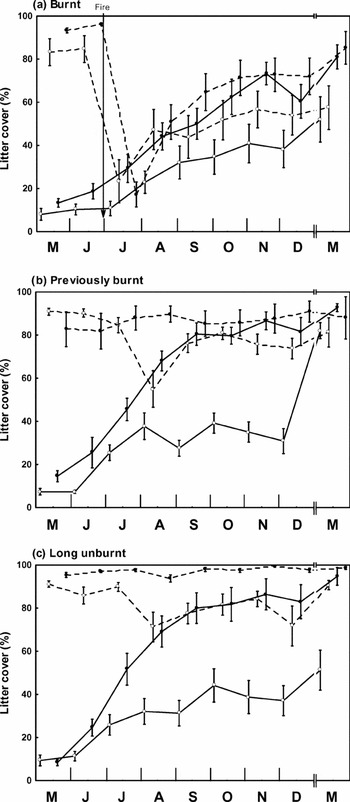
Litter cover was considerably reduced by fire, but increased progressively in the post-fire environment due to natural accumulation (Figure 1a). Likewise, litter progressively accumulated in quadrats of the bare-soil treatment where litter had been removed initially (Figure 1b, c). Despite the fluctuations in litter cover during the year, at the time of germination there was a significantly greater cover of litter (approximately 20% higher) in quadrats where litter had been initially added (F1,6 = 50.3, P < 0.001), reflecting the treatment conditions first imposed, and no effect of fire regime on litter cover (F2,6 = 2.3, P = 0.178). Litter accumulation was however greater under the tree canopy (approximately 20% higher), resulting in a significant difference in litter cover between canopy cover treatments (F1,6 = 60.8, P < 0.001). The effect of plot (F9,71 = 2.7, P = 0.01), and interactions with plot and canopy cover (F9,71 = 2.46, P = 0.017), and canopy cover and litter treatment (F1,6 = 30.2, P = 0.002), were also significant and demonstrate complex spatial variability.
Visual estimates of the per cent cover of litter for the duration of the field sowing experiment between May 2006 and March 2007, in three experimental fire regimes: Burnt (annual early) (a); Previously burnt (biennial early) (b); and Long unburnt (unburnt) (c). Values are the mean ± 1 SE. Data points are staggered to enhance the interpretation of individual error bars; data for all treatments were, however, collected on the same day in a given month. Lines are treatment combinations of open- (○) or closed-canopy (●) habitats, and litter addition (- - -) or removal (—) treatments. The arrow in (a) indicates the timing of the experimental fire in the Burnt regime, which occurred between the June and July sampling dates (28 June 2006).

Sorghum intrans field sowing experiment
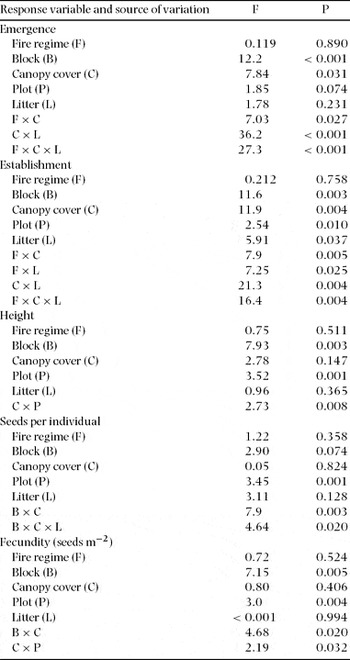
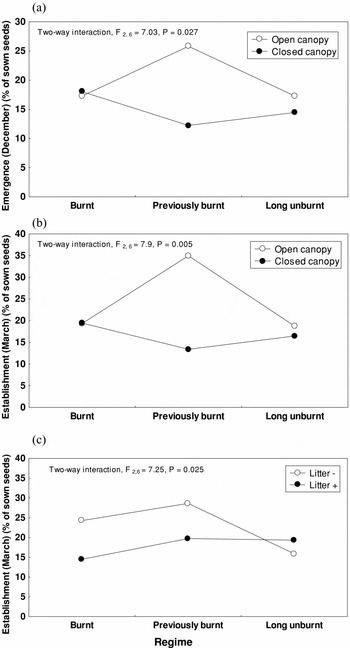
Emergence and establishment. The late-dry-season germinability of sown seeds, determined in the laboratory, was 51% ± 5% (mean ± SE). In December, 18% (range: 1–43%) of the sown seeds had emerged as seedlings and were approximately 15 cm in height. Therefore, approximately 30% of seeds therefore lost germinability or viability in the field during the dry season, were physically relocated outside of the quadrats, or had been predated by fauna (perhaps ants). Seedling emergence showed significant effects of block and canopy cover (Table 1). Emergence was considerably lower in the southern block, and lower when sown under a closed canopy. Fire regime was not a significant factor overall in determining the number of seedlings that emerged, but there was a significant interaction between fire regime and canopy cover (Table 1; Figure 2a). Seedling emergence was similar between fire regimes when sown under a closed canopy, yet higher in the previously burnt regime than the other regimes, when sown in the open canopy (Figure 2a).
Results summary (F and P values) for the five floristic variables in the five-way Sorghum intrans field sowing experiment.

Interaction plots of means for significant interactions in the Sorghum intrans field sowing experiment with fire regime: fire regime and canopy cover for emergence (a), fire regime and canopy cover for establishment (b), and fire regime and litter treatment for establishment (c).

Three months later (in the late wet season), 20% (range: 1–61%) of the sown seeds had established as mature plants. Thus, there was little overall difference (2%) between the number of seedlings counted in December and the number of mature plants counted in March. However, in the open patches of the burnt previously regime, more seedlings appeared to emerge (and establish) after the emergence count in December (Figure 2).
Establishment showed similar, significant effects of block, plot and canopy cover (Table 1). Establishment was lower in the southern block, lower when sown under a closed canopy, and lower when sown on litter. As with emergence, fire regime was not a significant factor overall, but there was a significant interaction between fire regime and canopy cover (Table 1, Figure 2b). Establishment was higher in the previously burnt regime than other regimes when sown in the open canopy (Figure 2b). In addition, there was a significant interaction between fire regime and litter treatment (Figure 2c). Establishment in the burnt and previously burnt regimes was higher when seeds were sown on bare soil (litter minus), but higher when sown on litter (litter plus) in the long unburnt regime (Figure 2c).
Height. Mean height at reproductive maturity was 131 cm (range: 17–277 cm) and varied spatially, with a significant effect of both block and plot (Table 1). Individuals in the northern and central block were almost double the height of those in the southern block. The effects of fire regime, canopy cover and litter were not significant.
Seed production. Mean seed production per individual was 16 (range: 0–163), although there were a small number of individuals without reproductive tillers at the time of harvesting, particularly in the southern block. Seed production per individual was spatially variable, with a significant effect of plot evident (Table 1). There was a mean of 816 seeds m−2 (range: 0–4343 seeds m−2), with a significant effect of both block and plot (Table 1). The mean number of seeds m−2 produced in the northern and central blocks was over double that of the southern block. As with height, the effects of fire regime, canopy cover and litter were not significant.
Shade house litter experiment
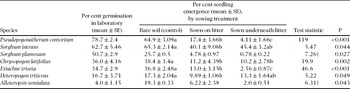
Laboratory-determined germinability of the seven grass species in the shade house experiment was variable, ranging between 4% (A. semialata) and 79% (P. contortum), and this tended to reflect the number of seedlings that emerged in the bare soil (control) trays (Table 2). All seven species were disadvantaged by litter, showing greater emergence in the bare soil treatment than either of the litter treatments. The majority of species (P. contortum, S. plumosum, C. latifolius, E. triseta and A. semialata) had lowest emergence where seeds were sown underneath litter, whereas S. intrans and H. triticeus showed lowest emergence when sown above litter.
Per cent seedling emergence (± 1 SE) after 8 wk, of seven grass species sown in each of three litter sowing treatments, for a shade-house litter experiment. Mean values of seedling emergence with different letters are significantly different between sowing treatments (P < 0.05; parametric analyses only, determined by a Tukey's HSD post hoc test). Pseudopogonatherum contortum and Sorghum intrans are annual species and the remainder are perennials.

† Analysed by Kruskal–Wallis (non-parametric) tests. All other species analysed with one-way ANOVA.
DISCUSSION
Effect of canopy cover
Our results show that woody plants exerted a strong influence on the establishment of S. intrans, which are consistent with previous studies of annual Sorghum that described a habitat preference for canopy gaps (Bowman et al. Reference BOWMAN, WILSON and HOOPER1988, Cook et al. Reference COOK, RONCE and WILLIAMS1998, Lane Reference LANE1996). Lower establishment under the canopy and in the southern block supports the more general observation that grass-layer richness and abundance is considerably lower in densely wooded savannas where competition between grasses and trees is greater (Bowman & Fensham Reference BOWMAN and FENSHAM1991, Brookman-Amissah et al. Reference BROOKMAN-AMISSAH, HALL, SWAINE and ATTAKORAH1980, San José & Farinas Reference SAN JOSÉ and FARINAS1991, Scott et al. Reference SCOTT, SETTERFIELD, ANDERSEN and DOUGLAS2009, Woinarski et al. Reference WOINARSKI, RISLER and KEAN2004).
Differences in S. intrans establishment between the canopy and canopy gaps appeared to be the result of competition with woody plants; below ground for soil moisture and nutrients, and above ground for light (Scholes & Archer Reference SCHOLES and ARCHER1997). However, specific effects are difficult to identify because of the confounding effects of other variables, particularly litter cover which accumulated faster under the canopy. Sowing seeds on litter significantly reduced seedling emergence in the shade house and establishment in the field. The annual Sorghum brachypodum also showed significantly lower establishment when sown under litter in the field (Cook et al. Reference COOK, RONCE and WILLIAMS1998). Elsewhere, litter (grass thatch) accumulation is attributed to the mortality of perennial grass tussocks (Silva et al. Reference SILVA, RAVENTOS, CASWELL and TREVISA1990), of the annual grass Andropogon brevifolius in Venezuelan savannas (Canales et al. Reference CANALES, TREVISAN, SILVA and CASWELL1994), and of Themeda triandra in temperate Australian grasslands (Morgan & Lunt Reference MORGAN and LUNT1999). Our study was not designed to identify the mechanism causing reduced emergence or establishment with litter, such as mechanical constraints (Carson & Peterson Reference CARSON and PETERSON1990, Facelli & Picket Reference FACELLI and PICKET1991), allelopathy (Barritt & Facelli Reference BARRITT and FACELLI2001), or enhanced seed predation (Facelli Reference FACELLI1994).
Our results with S. intrans contrast with those of S. brachypodum, where seed production was significantly reduced under the tree canopy (Cook et al. Reference COOK, RONCE and WILLIAMS1998). Manipulation of shading with 50% shade cloth by Cook et al. (Reference COOK, RONCE and WILLIAMS1998) indicates at least part of their canopy response could be attributed to low light, which reduces biomass and seed production. Conversely, Lane (Reference LANE1996) showed no effect of 50% shade cloth on S. brachypodum biomass and seed production. These studies and our data therefore indicate the importance of interspecific variation, light intensity and interactive site factors, in the canopy response of seed production and establishment in annual Sorghum.
The shade-house litter experiment documented the broader importance of tree litter cover (and therefore disturbances such as fire which remove litter) as a driver of grass species composition, similar to the effects of grass thatch as a driver of species composition in grasslands (Foster & Gross Reference FOSTER and GROSS1998, Lenz et al. Reference LENZ, MOYLE-CROFT and FACELLI2003). Although interactive effects are likely (e.g. with canopy shading), the reduced abundance and diversity of established grass-layer plants under the tree canopy in savannas (San Jose & Farinas Reference SAN JOSÉ and FARINAS1991, Scott et al. Reference SCOTT, SETTERFIELD, ANDERSEN and DOUGLAS2009, Woinarski et al. Reference WOINARSKI, RISLER and KEAN2004) can be directly ascribed to the negative effect of litter on seed germination (e.g. changes to the light, temperature and soil moisture regime) and seedling emergence (e.g. mechanical barrier, allelopathy or enhanced predation). Peak rates of litter fall in the dry season, after seed fall, results in seeds germinating in the early wet season underneath a layer of accumulated litter (Cook Reference COOK, Andersen, Cook and Williams2003). Differences between the numbers of seeds that emerged between species in the litter treatments, suggest that litter may play an important role in determining community composition. Annuals with low emergence underneath litter (e.g. P. contortum) may be expected to become locally extinct first in unburnt environments or those characterized by high rates of litter accumulation during the dry season. In open canopy or recently burnt environments without much litter, several species are likely to show high emergence from the seed bank (Table 2).
Effects of fire regime
Although fire regime had no overall effect, S. intrans establishment was higher in the previously burnt regime than the other two regimes in open patches. A comparison of the regimes reveals that burning had little direct (negative or positive) impacts on germinable seed density, which has been previously demonstrated for annual Sorghum in population studies (Andrew & Mott Reference ANDREW and MOTT1983). We believe that enhanced establishment in the previously burnt regime (of open-canopy habitats) is unlikely to be related to litter and canopy cover in this short-term study. Despite early dry-season fire considerably reducing litter cover, subsequent accumulation meant that there was no significant difference in cover between regimes at the time of germination in November. Canopy cover remained unchanged during the experiment, even after fire in the burnt regime.
Rather, the intermediate cover of grass-layer plants in landscapes burnt biennially (compared to those burnt annually or very infrequently) could provide seedlings with a unique set of conditions that balance positive and negative factors involved with regulating establishment. For example, higher cover and abundance of grass-layer plants in unburnt environments (e.g. long unburnt regime) is likely to reduce grass establishment given higher competition for the available soil moisture and nutrients, and light (Cook et al. Reference COOK, RONCE and WILLIAMS1998, Silva et al. Reference SILVA, RAVENTOS, CASWELL and TREVISA1990, Williams et al. Reference WILLIAMS, CONGDON, GRICE and CLARKE2005). At the other extreme, annually burnt environments experience higher surface soil temperatures and lower soil moisture (Mott et al. Reference MOTT, MCKEON and MOORE1976, Scholes & Walker Reference SCHOLES and WALKER1993, Snyman Reference SNYMAN2004). These conditions are likely to decrease seed germination, increase seedling mortality through desiccation and reduce plant growth rates (Cook Reference COOK, Andersen, Cook and Williams2003, Garnier & Dajoz Reference GARNIER and DAJOZ2001). In a northern Australian savanna, fewer seedlings of S. intrans and the perennial grass Themeda triandra survived in burnt compared to unburnt areas (Mott & Andrew Reference MOTT and ANDREW1985). Similarly, seedling emergence in two perennial grasses in a Venezuelan savanna (Andropogon semiberbis and Sporobolus cubensis) was considerably lower in a burnt plot compared to an unburnt plot (Silva et al. Reference SILVA, RAVENTOS, CASWELL and TREVISA1990).
Implications of fire frequency for species distribution and the tree–grass balance
Lower establishment under the canopy, and in the presence of litter, support observations that annual Sorghum could decrease in abundance during periods of long-term fire exclusion typified by woody encroachment and litter accumulation (Hoare et al. Reference HOARE, HOOPER, CHENEY and JACOBSEN1980, Russell-Smith et al. Reference RUSSELL-SMITH, WHITEHEAD, COOK and HOARE2003, Woinarski et al. Reference WOINARSKI, RISLER and KEAN2004). As frequent burning maintains the typical open canopy structure of savanna vegetation and consumes litter (Williams et al. Reference WILLIAMS, GILL and MOORE1998, Reference WILLIAMS, COOK, GILL and MOORE1999), such a fire regime should maintain the abundance of annual Sorghum determined by inherent site factors (Andrew Reference ANDREW1986a). If a regime of frequent, high-intensity burning were to occur over more parts of the landscape (such as has been suggested with the transition from indigenous to non-indigenous fire management in the 21st century), the notion that ‘invariant frequent burning’ has increased annual Sorghum abundance is conceivable at the landscape-scale (Bowman et al. Reference BOWMAN, FRANKLIN, PRICE and BROOK2007, Miles Reference MILES2003, Russell-Smith et al. Reference RUSSELL-SMITH, RYAN and CHEAL2002, Reference RUSSELL-SMITH, WHITEHEAD, COOK and HOARE2003). Frequent and/or high-intensity fire would appear to maintain microsites in the landscape that allow annual Sorghum to successfully establish.
Key questions remain regarding the impact of extrinsic disturbance on the tree–grass balance in these savannas. The impact of fire exclusion, leading to an increase in canopy cover and decrease in grass abundance, is well established and was corroborated by this study. The reverse, however, that frequent and/or high-intensity burning can decrease woody dominance and increase annual grass abundance (at the site-scale), assumes that annual grass-dominated fuels result in more intense fires, which kill a higher proportion of woody plants. Currently, the relationship between fire intensities in different fuel types, and their impact on savanna vegetation structure, is largely unknown. Furthermore, our knowledge of the time-frame in which changes to the tree–grass balance occur are poorly known, probably because they occur over several decades.
ACKNOWLEDGEMENTS
Funding for this project, and a PhD scholarship for K. Scott, was provided by the Bushfire Cooperative Research Centre, Melbourne, Australia. A conference paper based on this work was presented at the 4th International Wildland Fire Conference (May 2007), Seville, Spain, with assistance from the Bushfire CRC and the Holsworth Research Endowment, ANZ Charitable Trusts Australia. We thank the Territory Wildlife Park, Bushfires NT, John Henderson, Robert Eager, Keith McGuiness, Sam Crowder, Boronia Saggers, Don Franklin and Lou Elliott for various contributions.