Introduction
The prevalence of helminths in tropical and subtropical areas has reduced production potential of livestock development programmes by causing countless deaths and economic losses (Al-Quaisy et al., Reference Al-Quaisy, Al-Zubaidy, Altaf and Makkiawi1987). Helminthiasis adversely affects ruminants, e.g. haematological and biochemical disturbances (Iqbal et al., Reference Iqbal, Rasool, Hayat and Akhtar1998; Hayat et al., 1999), anorexia, weight loss (Khan et al., Reference Khan, Hayat, Ilyas, Hussain and Iqbal1988), hypoproteinaemia, loss of meat (27%) and wool (40%) (Hussain & Akram, Reference Hussain and Akram1967), impaired digestive efficiency, poor reproductive performance (Terblanches, Reference Terblanches1979) and even death of lambs (FAO, 1974; Barger, Reference Barger, Symons, Donald and Dineen1982).
In Pakistan, parasitism is one of the major menaces for livestock, causing obstacles to the development of a profitable livestock industry, as in sheep (Khan et al., Reference Khan, Hyat, Chaudhry, Iqbal and Hayat1989; Iqbal et al., Reference Iqbal, Akhtar, Khan and Riaz1993; Sajid et al., Reference Sajid, Anwar, Iqbal, Khan and Qudoos1999), goats (Iqbal et al., Reference Iqbal, Akhtar, Khan and Riaz1993), cattle and buffaloes (Hayat et al., Reference Hayat, Malik, Anwar and Iqbal1990). Geoclimatic conditions and a poor awareness of livestock farmers contribute towards a conducive environment for the development and growth of parasites.
Critical analyses (Iqbal et al., Reference Iqbal, Lateef, Khan, Muhammad and Jabbar2005; Lateef et al., Reference Lateef, Iqbal, Jabbar, Khan and Akhtar2005) have revealed that most surveys carried out on the prevalence of parasites in Pakistan were based on convenience of access in the vicinity of veterinary institutions. Therefore, there are numerous geographical regions in which the livestock population needs to be examined for the presence of gastrointestinal helminths. This paper describes the prevalence of helminths in some domesticated ruminants in Tehsil Jatoi (District Muzaffar Garh), a riverine belt, which has remained unexplored as far as the parasite fauna is concerned.
Materials and methods
Study area and sample collection
District Muzaffar Garh, sprawling over an area of 8249 km2, lies in the form of strip between the rivers Chenab and Indus, which pass along the eastern and western boundaries, respectively, of the district and form a triangle at Alipur tehsil of the district. This riverine belt is rich in livestock, due to its geographical location and availability of lush green pastures. The district is located between latitude 28°57′ to 30°46′N and longitude 70°30′ to 71°47′E. The climate alternates between extremely hot and cold throughout its area. A large area of the district consists of sand dunes and barren land. Almost all the area of Tehsil Alipur and some parts of Muzaffar Garh tehsil are flooded each year. The people of Muzaffar Garh are an agricultural community who practise subsistence crop agriculture as their main livelihood. Livestock husbandry is very important in the community, and traditionally wealth has been assessed based on the number of livestock, especially buffalo and cattle, owned by an individual (Anonymous, 2000).
One hundred livestock, comprising cattle, buffaloes, sheep and goats which had not been dewormed for at least 12 weeks, in three villages representing three union councils (Tehsil Jatoi), were sampled to determine the prevalence of gastrointestinal helminths during March and April 2005. Faecal samples were collected randomly in sterile polythene bags directly from the rectum of each animal and brought to the District Diagnostic Laboratory, Muzaffar Garh for identification of eggs/larvae of helminths or adult worms.
Parasitological procedures
Faecal samples were examined for helminth eggs/larvae using direct and sedimentation/floatation techniques (Soulsby, 1982). Coproculture was performed to obtain larval stages for genus/species identification of nematodes (MAFF, 1979). Identification of eggs and larvae was made according to the description given by MAFF (1979) and Soulsby (Reference Soulsby1982).
Statistical analyses
Data were analysed by analysis of variance and tests for two proportions using MINITAB software (MINITAB, 2000).
Results
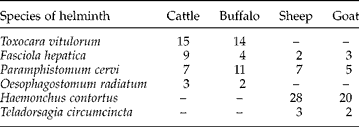
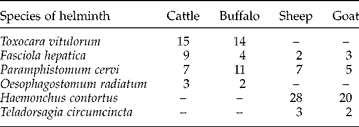
The overall prevalence of helminths was the highest (P = 0.060) in sheep (62%) followed by goats (52%), cattle (51%) and buffaloes (47%). The distribution of different classes of helminths included nematodes, followed by trematodes and cestodes in all host species. The most prevalent helminth species included: Toxocara vitulorum; Fasciola hepatica; Moniezia expansa in cattle, T. vitulorum; Paramphistomum cervi; M. expansa in buffaloes, Haemonchus contortus, P. cervi, M. expansa in sheep and H. contortus, P. cervi, M. expansa in goats (table 1). All host species showed varying degrees of mixed infections comprising differences in the number and species of helminths, i.e. cattle (10%), buffaloes (8%), sheep (11%) and goats (12%).
Overall prevalences (%) of helminths in ruminants.
Host-age prevalences
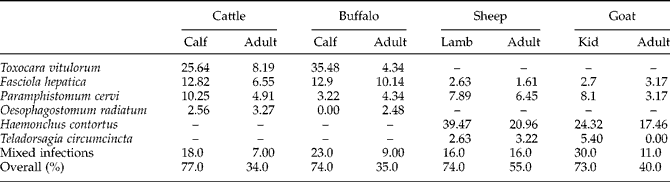
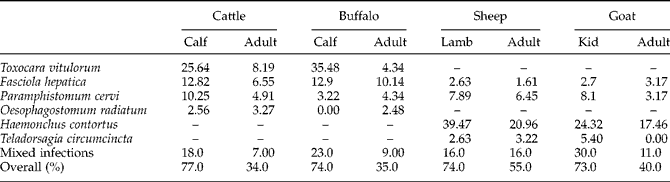
The overall prevalence of helminthiasis was higher in young animals compared with adults in all host species, i.e. cattle (P < 0.0001), buffaloes (P < 0.0001), sheep (P = 0.059) and goats (P = 0.010) (table 2). These differences were, however, only attributed to T. vitulorum in cattle and buffaloes (P = 0.017) and H. contortus and Teladorsagia circumcincta in sheep (P = 0.045) and goats (P = 0.062), respectively, as none of the other helminth species differed in prevalence between young and adult animals.
The prevalence (%) of helminths in ruminants relative to host age.
Host-sex prevalences
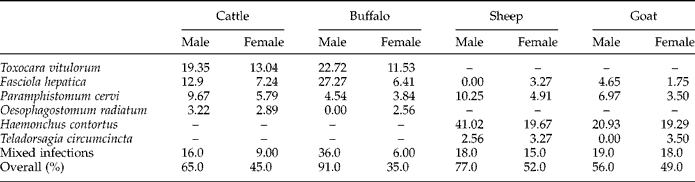
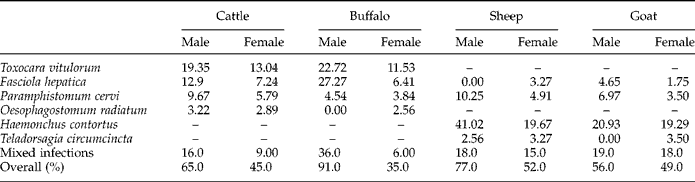
The results revealed higher (P < 0.0001) prevalences of helminths in male buffaloes (91%) compared with females (35%). Similar trends were also recorded in male (77%; P = 0.014) and female (52%) sheep (table 3). However, there were no sex-related differences in helminth prevalences in cattle and goats, except for P. cervi in cattle (P = 0.006) and H. contortus in goats (P = 0.020).
The prevalence (%) of helminths in ruminants relative to host sex.
Discussion
The present study showed that the highest prevalence of helminths was recorded in sheep followed by goats, cattle and buffaloes. The higher prevalence of helminths in sheep and goats correlates well with a higher proportion of time spent on grazing compared with cattle and buffaloes, which are grazed proportionately less and kept mainly in stalls for feeding.
The helminths recorded in the study area have also been reported previously in other areas of Pakistan (Shah et al., Reference Shah, Hussain and Siddiqui1980; Siddiqi & Ashraf, Reference Siddiqi and Ashraf1980; Mohiuddin et al., Reference Mohiuddin, Khan, Mugha and Sheikh1984; Khan et al., Reference Khan, Hyat, Chaudhry, Iqbal and Hayat1989) and elsewhere in the world (Specht, Reference Specht1982; Vercruysse, Reference Vercruysse1983; Hunter & Heath, Reference Hunter and Heath1984; Gupta et al., Reference Gupta, Yadav and Chaudhri1987; Charles, Reference Charles1989; Van Aken et al., Reference Van Aken, De Bont, Vercruysse and Dorny1990; Pandey et al., Reference Pandey, Ndao and Kumar1994; Dorny et al., Reference Dorny, Symons, Jalila, Vercruysse and Sani1995; Jacquiet et al., Reference Jacquiet, Colas, Cabaret, Dia, Cheikh and Thiam1995). However, these workers have also recorded the occurrence of other helminths and this regional variation may be attributed to different geographical distributions, host factors and climatic conditions required for the development of free-living stages of the nematodes.
In the present study, the highest prevalence of helminths was recorded in sheep. The rate of helminth infection in sheep varies from one part of the world to another. A variety of factors such as host age, sex and breeding status, grazing habits, the level of education and economic capacity of farmers, the standard of management and anthelmintic used can influence the prevalence of helminths (Asanji & Williams, Reference Asanji and Williams1987; Gulland & Fox, Reference Gulland and Fox1992; Pal & Qayyum, Reference Pal and Qayyum1992; Maqsood et al., Reference Maqsood, Iqbal and Chaudhry1996; Jorgensen et al., Reference Jorgensen, Leathwick, Charleston, Godfrey, Vlassoff and Sutherland1998; Komoin et al., Reference Komoin, Zinsstag, Pandey, Fofana and Depo1999; Valcárcel & García Romero, Reference Valcárcel and García Romero1999; Ouattara & Dorchies, Reference Ouattara and Dorchies2001).
The most prevalent nematode recovered in this study was T. vitulorum in cattle and buffaloes and H. contortus in sheep and goats. Previous studies have also shown T. vitulorum to be the most frequently occurring nematode in cattle and buffaloes (El-Moukdad, 1979; Iqbal et al., Reference Iqbal, Durrani and Tariq1984; Mourad et al., Reference Mourad, Abdullah and Allowy1985; Pal & Balakrishnan, Reference Pal and Balakrishnan1987; Anwar et al., Reference Anwar, Hayat and Amir1996) and H. contortus in sheep and goats (Bali & Singh, Reference Bali and Singh1977; Grant, Reference Grant1981; Ahmed & Ansari, Reference Ahmed and Ansari1987; Gupta et al., Reference Gupta, Yadav and Chaudhri1987). The high prevalence of H. contortus is likely to be related to a relatively short generation interval and an ability to maximize favourable environmental conditions (Grant, Reference Grant1981). A mean monthly maximum temperature of 18 °C or above and total monthly rainfall of 50 mm are conducive for the transmission of H. contortus (Gordon, Reference Gordon1953), especially propagation of H. contortus larvae.
Climatic conditions in the study area, which vary from tropical to subtropical, are conducive for the development of larval forms or the intermediate hosts of helminths with indirect life cycles. A warm and moist summer is well suited to the development and survival of free-living stages of nematodes (Grant, Reference Grant1981). Moreover, the availability of green pastures in irrigated or waterlogged areas also assist in the perpetuation of helminth life cycles. Pasture larval counts and helminth fecundity also play a role in the epidemiology of helminths. Pasture contamination is therefore likely to have a direct influence on the population dynamics of nematodes such as Trichostrongylus colubriformis (Barnes & Dobson, Reference Barnes and Dobson1990). This is also true for nematodes, such as H. contortus, which is highly prolific, laying up to 10,000 eggs/day for several months. Thus under optimum climatic conditions, gross contamination of pasture can occur in a very short time (Radostits et al., 1994).
It is evident from table 1 that T. vitulorum in cattle and buffaloes and H. contortus and T. circumcincta in sheep and goats are responsible for the overall higher prevalence in young animals compared with adults. Toxocara vitulorum is a parasite of the small intestine of ruminants, particularly in calves of 15–90 days of age, with a peak egg output occurring 31–45 days post-infection (Gupta et al., Reference Gupta, Joshi and Rai1976; Starke et al., Reference Starke, Machado, Honer and Zocoller1983; Roberts, Reference Roberts1990). It is responsible for high morbidity and mortality rates in ruminants (Das & Singh, Reference Das and Singh1955; Patnaik & Pande, Reference Patnaik and Pande1963) resulting in serious economic losses (Enyenihi, Reference Enyenihi1969). The high prevalence of T. vitulorum in young animals indicates a high degree of susceptibility, unlike the adults which acquire immunity to T. vitulorum. Rajapakse et al. (Reference Rajapakse, Lloyd and Fernando1994) reported high titres of anti-larval ES antibodies in buffalo cow colostrum and in the serum of their suckling calves. This correlated with low T. vitulorum faecal egg counts in calves, suggesting that antibodies have a protective role against activated or migrating larvae.
Likewise, H. contortus and T. circumcincta are highly immunogenic, as older ruminants develop a resistance against these parasites: two types of antigens have been recognized in H. contortus. The first type includes natural antigens that are recognized by the host during the course of infection, generating an immune response; whereas the second type of antigen is hidden. Although hidden antigens are not exposed to the host's immune system during natural infections, some of these have shown promising results in protection trials (Knox, Reference Knox2000).
It is interesting to note that the prevalence of helminths was higher in males compared with females in buffaloes and sheep, as opposed to cattle and goats. Normally, females are assumed to be more heavily infected due to stress during pregnancy and parturition. The present results may be due to the practice of stall feeding females during pregnancy, therefore lessening the degree of exposure to pasture contamination. Most researchers have observed higher rates of nematode infections/worm burdens in female hosts compared with males (Asanji & Williams, Reference Asanji and Williams1987; Pal & Qayyum, Reference Pal and Qayyum1992; Iqbal et al., Reference Iqbal, Akhtar, Khan and Riaz1993; Maqsood et al., Reference Maqsood, Iqbal and Chaudhry1996; Komoin et al., Reference Komoin, Zinsstag, Pandey, Fofana and Depo1999; Valcárcel & García Romero, Reference Valcárcel and García Romero1999). In contrast, Gulland & Fox (Reference Gulland and Fox1992) reported that the prevalence and intensity of infection (faecal egg counts) were higher in males than females, except during the lambing periods, and decreased with host age in both sexes. Therefore, there is no possible explanation for host-sex differences among different ruminants except for variation in the stages of pregnancy.
The present study was based on random sampling for about 2 months during March and April; therefore, any seasonal effect on helminth prevalences could not be ascertained. Some species, such as T. circumcincta thrive better in cool, moist conditions (Kates, Reference Kates1950; Gordon, Reference Gordon1953). The present findings are, however, typical of helminth infections reported in other subtropical areas of the world (McCulloch & Kasimbala, Reference McCulloch and Kasimbala1968; Taylor & Cawthorne, Reference Taylor and Cawthorne1972; Beveridge & Ford, Reference Beveridge and Ford1982; Pino et al., Reference Pino, Morales, Perdomo and Aldana1988; El-Sayed, Reference El-Sayed1997; Stear et al., Reference Stear, Bairden, Bishop, Gettinby, McKellar, Park, Strain and Wallace1998).
Bearing in mind the high pathogenicity of H. contortus compared with other nematode species, it is concluded that sheep farmers in the study area are at a relatively high risk of economic suffering due to the lowered productivity of their animals. This situation becomes worse as the majority of infected sheep harboured more than one nematode species, with a minimum of two and a maximum of three helminth species in each host.